



Abstract
While ecological wisdom has been widely examined in traditional environmental discourse, its representation within economic narratives in global media remains underexplored. Amid intensifying challenges of balancing growth with sustainability, this study investigates how ecological wisdom is discursively constructed and has evolved in international economic discourse, focusing on 601 English-language news reports from the China International Import Expo (CIIE) between 2018 and 2024. Employing a corpus-assisted Discourse-Historical Approach (DHA), the study identifies key ecological topics centering on low-carbon transition, green innovation, high-quality development, sustainable growth, and international cooperation, through LDA topic modeling and intercoder annotation. Intertextuality analysis, supported by correspondence analysis, reveals increasing integration of ecological values via references to state policies, keynote speeches, corporate perspectives, and global sustainability agendas. Discursive strategy analysis highlights a future-oriented, collaborative, and inclusive stance that frames ecological wisdom as interconnectedness, openness, and harmony. However, explicit references to China’s “ecological civilization” concept are largely absent, limiting the cultural depth and resonance of these narratives. The findings highlight how intertextual and interdiscursive mechanisms influence the framing of ecological wisdom in global economic media, underscoring the need for more culturally grounded storytelling strategies. The present study contributes to a deeper understanding of how sustainability values are embedded in economic discourse, offering insights into enhancing the cultural coherence of China’s ecological narratives in international communication.
Plain Language Summary
Climate change is a major global challenge. Nations must find ways to grow their economies while protecting the environment. This study explores how green ideas are communicated in international media, focusing on the China International Import Expo (CIIE), a key platform where China presents its trade and development strategies to the world. We analyzed more than 600 English-language news articles published between 2018 and 2024 on the official CIIE website. The study identified three main ecological themes: green innovation and high-quality development; trade, market, and business opportunities; and openness and international cooperation. Although news coverage often highlights China’s environmental initiatives, most narratives are drawn from government statements and policy documents. These texts, however, rarely connect directly with deeper cultural ideas such as ecological civilization, a concept that integrates traditional Chinese ecological wisdom with modern sustainability goals. This omission may limit the global resonance of China’s environmental message. The study suggests that deeper integration of cultural-philosophical perspectives could strengthen message coherence. Combining contemporary policies with traditional values might enrich global environmental dialogues.
Introduction
Ecological wisdom (EW) is a multifaceted concept that combines philosophy, ethics, and practice in addressing human-nature relations (Xiang, 2014). It was first introduced by Norwegian philosopher Arne Naess (1973, p. 99) as “ecosophy,” a coined term combining the Greek words oikos (household place) and sophia (wisdom), referring to “a philosophy of ecological harmony or equilibrium,” or more specifically “a philosophical world-view or system inspired by the conditions of life in the ecosphere” (Naess, 1989, pp. 37–38). Initially conceived as a personal philosophy of ecological harmony, ecosophy was later expanded from sophia (theoretical wisdom) to phronesis (practical wisdom), thereby encompassing both individual and collective knowledge (Liao & Chan, 2016; Xiang, 2016). Beyond any single intellectual tradition, comparable notions of ecological wisdom have long emerged across cultures, both in antiquity and in the present. These include Schweitzer’s notion of “reverence for life” (Meyer & Bergel, 2002) and Leopold’s (1966)“land ethic” in the West, Confucianism’s “unity of heaven and humanity” (Tu, 2001) and Daoist environmental thought (Nelson, 2021) in the East; the indigenous ethic of respecting all beings, and the contemporary principle of sustainable development. Such perspectives underscore the universality of ecological wisdom as both a moral orientation and a practical framework for action.
Building on its universal appeal, ecological wisdom has now attracted growing interdisciplinary attention, with applications spanning environmental and urban planning (X. Wang & Xiang, 2016), linguistics (Levesque, 2016; Teo, 2024), education (Zeng et al., 2024) and tourism studies (Olivadese & Dindo, 2025). The field of “Ecological Wisdom Inspired Science and Engineering” (EcoWISE) even regards EW as a core skill that informs sustainable technological innovation and socio-ecological practices. In ecolinguistics, it serves as a benchmark for evaluating the extent to which discourse can be considered “ecological.” While the terms “ecological wisdom” and “ecosophy” are often used interchangeably, this study adopts “ecological wisdom” to refer to culturally grounded ecological values.
As language in use, discourse reflects and constructs ideologies, and it lies at the center of narratives about the conflict between development and the environment, for it is, in essence, a form of social practice characterized by heterogeneity and intertextuality. On the one hand, discourse is both constitutive of and constituted by social reality, embodying the dialectical relationship between discursive practices and social structures (Fairclough, 2013, p. 92). It also exhibits a dual character, functioning as both practice and representation, and plays a role in maintaining or transforming social structures (Xin, 2016). On the other hand, discourse is inherently polyphonic, dialogic, and intertextual, incorporating multiple voices, genres, and perspectives (Bakhtin, 1981; Kristeva, 1986; Xin, 2016). Discourse is not homogeneous, and environmental discourse is internally interwoven with economic or development discourses (Feindt & Oels, 2005), while ecological and economic values are also converging within the discourse of sustainability (Lee & Kim, 2025). Awakened by the destructive environmental crisis, reflection on environmental governance has given rise to hybrid discourses that seek to reconcile market growth with ecological preservation (Dryzek, 1997; Hajer, 1995). This intertextual entanglement is evident in policy initiatives such as China’s ecological civilization plan (X. Wang & Zhao, 2023) and the European Green Deal (Molek-Kozakowska, 2024), where environmental sustainability is articulated within, and often subordinated to, the logics of economic competitiveness, innovation, and efficiency.
Despite ecolinguistic recognition of the intrinsic link between economy and ecology (Stibbe, 2015b, p. 24), existing studies primarily address EW in environmental discourses, overlooking its construction in economic discourse. A “taken-for-granted division” still persists between environment and development (Kojola, 2017). This oversight is significant, as economic discourse shapes ecological awareness in daily life. As Stibbe (2015a, p. 2) observes, discourses that are not explicitly “environmental” may nonetheless exert ecologically destructive effects, precisely through the omission of references to the natural world. He and Wei (2017, 2018) suggest that expanding the research scope from “human and nature” to “human and society” can ultimately promote the sound development of the ecosystem. Thus, examining how EW is constructed in economic discourse is essential for bridging the conceptual divide between environment and development.
This persistent cognitive divide between the economy and the environment frames rapid economic progress as a harm to nature and ecological preservation as an obstacle to development. Such a binary impedes the cultivation of sustainable ecological awareness. To address this, the study applies a corpus-assisted Discourse-Historical Approach (DHA) to investigate how ecological wisdom is constructed and evolves in economic media discourse, a pivotal yet underexplored context (Cheng & He, 2021). By examining English-language news coverage of the China International Import Expo (CIIE), the analysis investigates how ecological wisdom is integrated and redefined through the discursive construction of topics, intertextual references, and discursive strategies. Ultimately, this study aims to clarify how economic discourse can both challenge and reinforce boundaries between economic growth and sustainability.
Literature Review
Given this context, we critically leverage the potential of critical discourse analysis (CDA) to illuminate underlying ideologies and examine the hybridization of environmental and economic discourses. This study examines how these intersecting discourses convey and shape ecological wisdom within the context of global economic reporting.
Discursive Construction of Ideologies
Though somewhat elusive, the concept of ideology is generally understood as a set of beliefs and values that shape social practices and power relations, and is deeply embedded within discourse. CDA has developed from an early focus on political interests into a discipline with wide-ranging applications. It is recognized for examining the interplay between language, power, and ideology, with the central aim of exposing how discourse encodes and sustains social inequalities (Wodak, 2001b, p. 10).
Theoretically, CDA encourages self-interpretation and understanding of core concepts such as discourse, power, and ideology. Pioneers of CDA have provided various interpretations of these concepts. For instance, Fairclough (1989) integrates the philosophical concept of ideology into everyday discourse, presenting it as “commonsense” tied to discourse and power. Van Dijk (1995) defines ideologies as fundamental systems of social cognition that structure and organize the beliefs, attitudes, and social representations of group members. He introduces several basic assumptions for approaching ideology through CDA, emphasizing its cognitive, social, and sociocognitive dimensions, as well as its complexity, context-independence, and generality. Reisigl and Wodak (2014, p. 88) view ideology “as an (often) one-sided perspective or world view composed of related mental representations, convictions, opinions, attitudes and evaluations, which is shared by members of a specific social group.” They underscore its role in “establishing and maintaining unequal power relations.”
Empirically, a variety of ideologies have been investigated across different contexts. Early CDA studies were primarily concerned with various political actions, including the discourse of Thatcherism (Fairclough, 1989), the legitimization of immigration control in official letters (Van Leeuwen & Wodak, 1999), and the discursive constitution of politics through language (Chilton, 2004). As the field evolved, the scope of research broadened to encompass diverse topics such as the discursive construction of national images (M. Liu, 2023; Tang, 2021), implicit attitudes in environmental (M. Yang & Wang, 2023), and news and power relationship in environmental discourse in football area (Wågan, 2025).
With respect to research on ecological wisdom, although ecological and environmental issues have long attracted CDA scholarship (Alexander, 2017; Campbell, 2023; Coffey, 2016; Feindt & Oels, 2005; Gellers, 2015; Gustafsson, 2013; Livesey, 2001; Wodak, 2001a), the discursive construction of ecological wisdom within non-environmental contexts, particularly within economic discourse, remains inadequately explored. Stibbe (2015b) introduced “ecosophy” into ecolinguistics to provide a principled benchmark for evaluating the ecological orientation of language, following his earlier proposal to integrate an ecolinguistic lens into CDA (Stibbe, 2014). Thus, CDA’s engagement with environmental discourse has been broadened through an ecolinguistic perspective. The articulation of ecological wisdom, however, is often realized indirectly through non-environmental discourse. In this regard, Alexander and Stibbe (2014) and Stibbe (2015a, p. 2) note a key limitation of confining analysis to explicitly environmental texts, since a wide range of discourses, not only “environmental” ones, can exert ecologically destructive or protective effects. Moreover, extending the analytical scope from “human and nature” to “human and society” can effectively promote ecosystem well-being (He & Wei, 2017, 2018). Recent work has begun to address non-environmental discourse more explicitly (Teo, 2024), but substantial gaps remain.
Convergence of Economic and Environmental Discourses
Economic discourse has traditionally been viewed as competing with environmental discourse; however, studies have shown that environmental narratives often incorporate economic ideologies. Sustainability discourse, which simultaneously addresses both environmental and developmental values, further blurs the lines between these two domains. As economic development increasingly incorporates ecological considerations, examining the integration of ecological ideas within economic narratives becomes essential. Discourse plays a pivotal role in shaping societal perceptions of the relationship between the economy and the environment. Therefore, discourse analysis is crucial in understanding how these domains intersect. Hajer (1995) defines discourse as a set of ideas and practices that transform social and physical realities, noting that environmental issues often involve multiple discourses. Dryzek (1997) views discourse as shared ways of understanding the world, mapping the plurality of environmental perspectives. This highlights how environmental discourse intersects with other domains and the significant role of discourse analysis (Feindt & Oels, 2005).
Initially, this intersection was primarily investigated within environmental discourse, mainly focusing on environmental policies and environmental news, where it frequently reveals concealed political or economic ideologies. Coffey (2016) clarifies how the use of economic metaphors in environmental policies reinforces neoliberal ideas and narrows the scope of environmental debate. These metaphors can be categorized into three frameworks: pro-economic, anti-economic, and non-economic (Luxon, 2019). Following this seminal work, metaphors continue to be a crucial linguistic tool for interpreting this interrelationship (Peng, 2025; Torkington et al., 2020; X. Wang & Zhao, 2023; K. Yang & Sun, 2024), as well as environmental policies. In addition to metaphors and policies, Horsbøl (2020) employs the concept of topos, drawing on a combination of environmental communication, discourse analysis, and place studies, to examine attitudes toward the green transition as represented by wind turbine construction in Denmark’s local media, revealing six topoi across three dimensions, namely resident well-being concerns, environmental advancement, and democratic decision-making. Meanwhile, the genre is expanded into media discourse, which plays “a central role in the discursive struggles over the meaning of nature” (Nicoletta & Yüksek, 2023). However, most studies show that when economic or developmental interests are at stake, ecological and social concerns are often sidelined (Torkington et al., 2020).
Later, the sustainability discourse gained increasing attention, particularly after the formation of the UN’s Sustainable Development Goals (SDGs), as they represent an alternative discourse that offers a critical departure from the dominant neoliberal capitalist framework (Riedy, 2022), reflecting a globally shared concern. In China, the governance policy of “ecological civilization” has garnered significant attention. It is a synthesis of traditional values, socialist legacies, and economic objectives, offering a state-driven approach to sustainability that contrasts with Western models (Ma & Wei, 2021). As the cornerstone of China’s economic-environmental balance, the discourse on ecological civilization not only fosters the construction of a pro-ecology national image driven by “moderate green” ideology (X. Wang & Zhao, 2023), but also frames this relationship through the “Life Community” metaphor (K. Yang & Sun, 2024). In the West, economic-environmental policies also serve as the primary discursive space for addressing this issue. For instance, studies have identified the dominance of techno-economic focus in German media discourse on bioeconomy (Dieken & Venghaus, 2020), the merging of economic and environmental goals and the inner reinforcement of neoliberal logics in the “European Green Deal” (Molek-Kozakowska, 2024), and the legitimization of economic actions by covering them with cultural heritage and sustainable resources in Japan’s whaling policy (R. Liu et al., 2025). On a global scale, beyond the most widely investigated UN’s SDGs with their underlying worldview and the application situations (Montesano Montessori & Lautensach, 2025), the sustainability discourse has evolved into a multifaceted global conversation, extending beyond governmental frameworks to encompass sports events (Wågan, 2025) and academic actions (Eisenbeiss et al., 2025).
Recently, the discursive construction of environmental conservation values in economic discourse has also been explored. Megura and Gunderson (2022) employ qualitative frame analysis and CDA to examine how fossil fuel companies frame climate change in their sustainability reports, and identify four main frames enabling greenwashing of the fossil fuel industry as part of the climate solution. Lee and Kim (2025) examine the promotional discourses at Expo 2020 between developed and less-developed countries, revealing that the former focus on economic growth and technological solutions, while the latter emphasize social and cultural dimensions. Nervino et al. (2025) analyze how banks frame sustainability within financial discourse as a business opportunity, focusing on leadership, diversity, and client empowerment. They emphasize how banks position themselves as catalysts for sustainable growth while shifting the bank-client relationship toward greater client agency.
Above all, both the plurality and heterogeneity of environmental and sustainability discourse are revealed, with such discourse serving as a space or tool for cultivating values beyond ecological ones. The shift in sustainability discourse also implies that economic and environmental discourses are becoming increasingly interrelated. However, existing studies, while shedding light on how economic and environmental agendas are linguistically fused, have some limitations. Most focus on environmental or sustainability discourse, leaving economic discourse, especially in the media, underexplored. Additionally, while political, economic, and managerial orientations are emphasized, the broader philosophical and cultural dimensions of ecological wisdom, which link ecological values with economic reasoning, are often neglected. Few studies have examined non-Western contexts, and when they do, they tend to be politically driven, marginalizing counter-narratives that challenge the assumed harmony between economic growth and ecological sustainability. Moreover, existing discourse categorization (Luxon, 2019), cannot adequately capture the recent core concepts emerging from China, such as “ecological civilization” and “dual-carbon goal”. In particular, the ESG (Environmental, Social, and Governance) discourse in China has witnessed a growing emphasis on environmental protection and social responsibility (B. Yang & Park, 2024), reflecting a distinctive historical and cultural context that has fostered traditions of ecological wisdom and driven conceptualizations that differ significantly from those in the West. Furthermore, while linguistic devices such as topoi (Horsbøl, 2020) and interdiscursivity (Molek-Kozakowska, 2024) are discussed, further exploration is needed. These gaps underscore the need for a more nuanced perspective that extends beyond merely describing the fusion of “green” and “growth.” What remains insufficiently addressed is how economic discourse itself constructs, appropriates, or resists ecological wisdom, and how this process unfolds in global communicative events where multiple discourses converge.
In conclusion, while CDA has shed light on how economic and environmental agendas are linguistically intertwined, it has yet to provide a comprehensive intertextual mapping of this process across time and contexts. Against this backdrop, the present study attempts to address this issue with a corpus-assisted DHA applied to the news discourse of a worldwide economic mega-event, the CIIE. This investigation is guided by three research questions:
What ecological topics are discursively constructed in CIIE news reports (2018–2024)?
How are ecological and economic discourses intertextually linked in these topics?
What discursive strategies are employed to construct intertextual connections that embed ecological values?
Analytical Framework
This section introduces an applicable framework for a corpus-assisted DHA to examine the interrelationship between economic and environmental discourse and the construction of ecological wisdom within them. The feasibility and validity of this combination have been thoroughly discussed (Baker, 2012; Nervino et al., 2025), though further refinement and classification are necessary for continued progress.
For this corpus analysis, we utilized KH Coder (Version 3; Higuchi, 2016, 2017), a quantitative content analysis and text mining tool well-suited for corpus-assisted discourse studies (M. Liu, 2023). In KH Coder, the Stanford POS Tagger is employed for extracting lexical data from English texts, while R is used for statistical analysis, and MySQL is utilized to manage and organize the corpus. This tool integrates techniques from natural language processing, machine learning, and computational linguistics, enabling the analysis and extraction of valuable insights from textual data. Two key tools in corpus linguistics provided by KH Coder are co-occurrence and similarity examinations, which are instrumental in revealing features and patterns within the data.
For discourse analysis, DHA was selected primarily for its topical, intertextual, and historical understanding of discourse, which helps uncover ecological themes, intertextuality and discursive strategies within economic texts. The distinctive analytical tools and principles of DHA, described as “three-dimensional,” involve identifying topics, investigating discursive strategies, and examining linguistic means (types) and realizations (tokens; Wodak, 2001a, pp. 72–73). Similar to Fairclough (1992), who regards intertextuality as a tool for examining social changes, Wodak (2001a) also approaches intertextuality from a historical perspective in her DHA approach. By linking intertextual practices to historical evolution, she explores how new forms of genre hybridity generate novel intertextual phenomena (Wu & Qin, 2006)
This approach demonstrates the interdiscursive and intertextual relationships between discourses, topics, genres and texts (see Figure 1). In this framework, the relationship between “discourse A” and “discourse B” is defined as interdiscursivity. The co-occurrence of “text x” and “text yz” represents intertextuality, and the connection among “topic x1,”“topic yz1,” and “topic u1” illustrates topicality. Discourse is understood here as the different genres of thematically interrelated semiotic manifestations of “a complex bundle of simultaneous and sequential interrelated linguistic acts” (Wodak, 2001a, p. 66).

Interdiscursive and intertextual relationships between discourses, discourse topics, genres, and texts.
By combining DHA with corpus analysis, and drawing on its three-dimensional framework and explanation of intertextuality (Molek-Kozakowska, 2024; M. Yang & Shi, 2021), we developed an analytical framework (Figure 2) to address research questions concerning how ecological wisdom is constructed in economic discourse both diachronically and intertextually.

Analytical framework.
Initially, Latent Dirichlet Allocation (LDA) modeling and qualitative annotation were applied to identify ecologically relevant topics within the CIIE news reports from 2018 to 2024. LDA is a generative probabilistic model that treats each document as a mixture of topics, with each topic defined by a distribution of words, offering insights into document collections by revealing topic structures without requiring explicit language understanding (Blei & Lafferty, 2007). Based on the topic model, the coding procedure conducted by coders from both linguistics and economics is employed to minimize bias in identifying topics related to ecological and environmental progress.
Following this, intertextuality is examined by identifying and categorizing key lexical items and phrases from economic, sustainability, and environmental discourses, which are then coded to quantify their frequency, distribution, and diachronic flow in the corpus through correspondence analysis. These findings are further interpreted through representative textual instances. Intertextuality, as extended from Bakhtinian dialogism by Kristeva (1986), conceptualizes every text as simultaneously a response to prior texts and a precursor to future ones. In discourse studies, intertextuality is commonly categorized along several axes: “strong” and “weak” (Jenny, 1982, pp. 40–41), “horizontal” and “vertical” (Kristeva, 1986, pp. 36–37), “manifest” and “constitutive” (or interdiscursivity; Fairclough, 1992a, pp. 104–105), “specific” and “generic” (Xin, 2000), and “intertextual” and “interdiscursive” (Wodak, 2001a). These distinctions reflect differences in how explicit or implicit textual borrowings operate across and within genres.
Finally, discursive strategies are explored to explain how, and from what attitudes and perspectives, ecological topics and intertextuality are framed, ultimately revealing the ecological wisdom embedded within CIIE economic discourse. Discursive strategies, defined as the “systematic ways of using language” (Wodak, 2001a, p. 72), involve the “(discursive) manipulation of “reality” by social actors in order to achieve a certain goal” whether conscious or not (Carvalho, 2005). The relationship between major actors, as constructed in CIIE news, is visualized through a word association network and further analyzed through their discursive strategies.
Data Collection
News discourse assumes a pivotal role in chronicling global events, elucidating viewpoints, and conveying attitudes. The political function of media discourse has been well documented. However, its underlying ecological values are relatively underexplored (Cheng & He, 2021). This research examines how and why ecological values are integrated within Chinese economic news discourse, with the CIIE coverage serving as a prime example.
As the world’s first import-themed international expo, the China International Import Expo (CIIE) is an annual economic event that was initiated in 2018 to foster global trade and cultural exchange, and is held every November 5 to 10. It represents a significant initiative by China to actively open its market to the world, demonstrating the country’s commitment to expanding openness and supporting the multilateral trading system (Quan, 2022). In the context of rising protectionism and challenges to economic globalization, nations are encouraged to collaborate in defending free trade and promoting multilateralism. Additionally, the CIIE serves as a prominent platform for advocating sustainable development, incorporating ecological concepts such as low-carbon initiatives (Han et al., 2022).
To ensure the authenticity of the data and its direct pertinence to institutional discourse, this study sourced news texts exclusively from the official CIIE website (https://www.ciie.org). Using Python, we retrieved news articles published in November from 2018 to 2024 without applying keyword restrictions, in order to minimize the potential bias of cherry-picking during corpus compilation. Standard text preprocessing procedures, primarily including the removal of duplicated texts, boilerplate material, and stop words, were implemented to enhance data quality. A total of 601 news articles, comprising 392,147 tokens and 14,794 unique types, were retained, compiling the observed corpus for the subsequent analysis.
Findings and Discussion
In this section, we address the research questions by applying a three-dimensional analytical framework within corpus-assisted discourse studies.
LDA-Based Topic Analysis
Identifying topics is the most direct way to gain an overview of the corpus. The discourse-historical approach is noted for its emphasis on the macro-topic feature of discourse, conceptualizing it as a complex interplay of simultaneous and sequential linguistic acts that are expressed through thematically linked semiotic signs (oral or written) across social fields (Wodak, 2001a). This dimension has been explored through corpus and text mining methods, including high-frequency words, keywords, and LDA topic modeling. Accordingly, this study adopted LDA.
To run LDA topic modeling, the optimal number of topics should be determined. The ldatuning method, a package integrated into KH Coder, was chosen for this purpose as it provides a more comprehensive measurement by using four different metrics for optimal topic identification. These metrics, each with a distinct approach to assessing topic quality, include: the indicator by Cao et al. (2009), which minimizes the average cosine distance; the indicator by Griffiths and Steyvers (2004), which combines the Markov Chain Monte Carlo algorithm with Bayesian models; the indicator by Arun et al. (2010), based on symmetric Kullback-Leibler divergence; and the Latent Class Model (LCM) by Deveaud et al. (2014), which maximizes topic differences.
In the ldatuning graph (Figure 3), the horizontal axis represents the number of topics, while the vertical axis displays two sets of indicators: those to be minimized (Arun et al., 2010; Cao et al., 2009) and those to be maximized (Deveaud et al., 2014; Griffiths & Steyvers, 2004). The optimal number of topics is determined when the indicators to be minimized reach their lowest values and those to be maximized reach their peaks. To avoid overfitting and reduce computational cost, a stable metric response is preferred. This graph indicates that most metrics stabilize at around 20 topics.

Optimal number of topics in LDA.
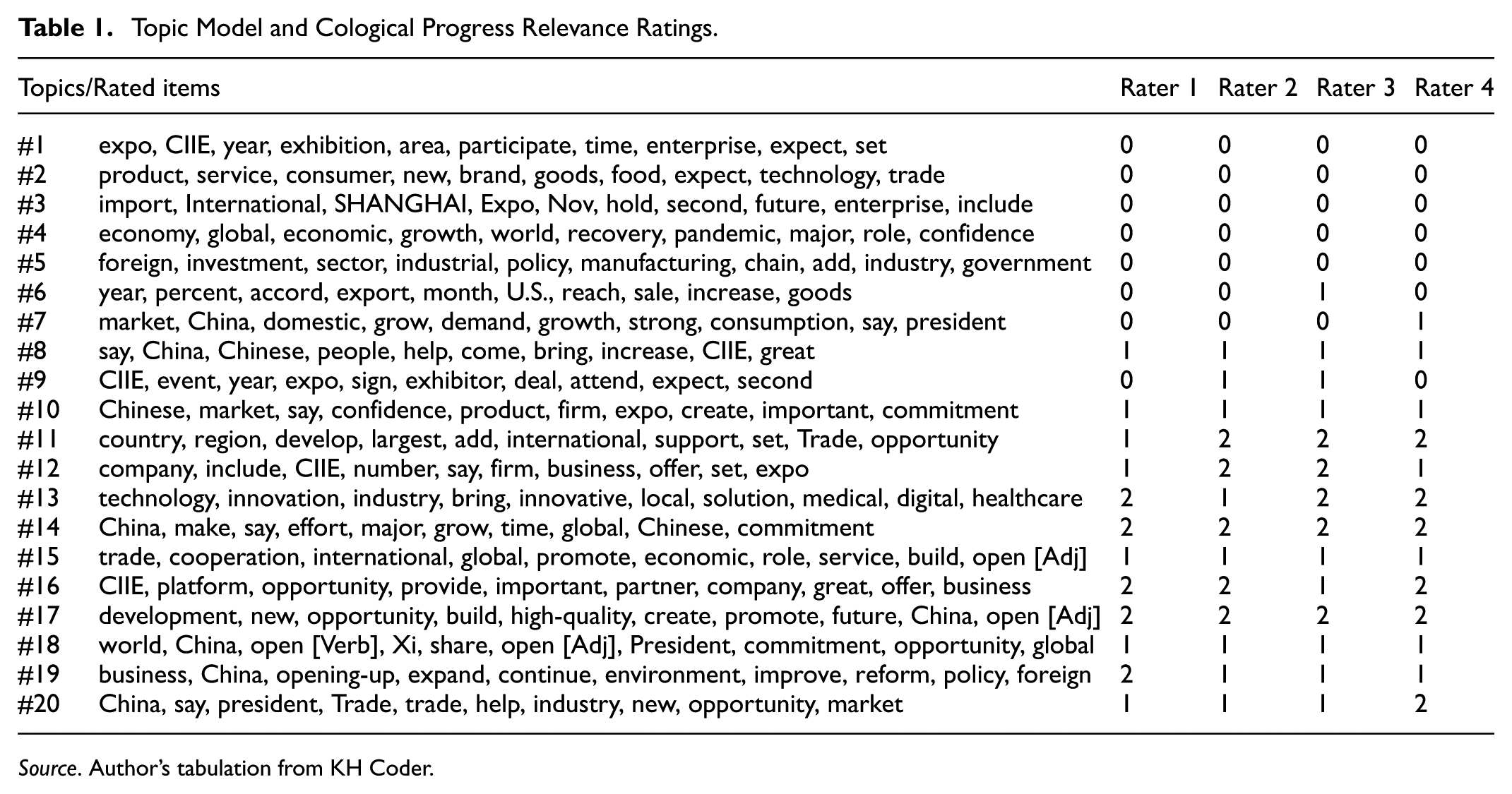
Following this process, LDA topic modeling was applied, resulting in 20 topic-word sets. The topics identified by the LDA model were further annotated by four independent coders, with two specializing in linguistics and two in economics. Their task was to assess the relevance of each topic to ecological progress based on a standardized coding scheme: a score of 2 was assigned to topics with strong relevance, 1 to those with weak relevance, and 0 to those considered irrelevant. The detailed coding results are presented in Table 1.
Topic Model and Cological Progress Relevance Ratings.
Source. Author’s tabulation from KH Coder.
To quantify the consistency of coding outcomes across coders, intercoder reliability was evaluated using the K-Alpha Calculator (Marzi et al., 2024), a user-friendly tool specifically designed for computing Krippendorff’s Alpha, one of the most robust metrics for assessing inter-rater reliability, particularly in studies involving multiple coders. The results yielded a Krippendorff’s Alpha of .811 (ordinal scale), accompanied by a 95% bootstrap confidence interval of [0.641, 0.917]. This result slightly exceeds the commonly accepted threshold of 0.80, indicating a high level of agreement among coders.
Among the 20 topics generated through LDA modeling, Topics 8, 10, 12, 15, 18, 19, and 20 were identified as weakly relevant to ecological progress (coded as 1 or 2, but not consistently as 2, by at least three coders), while Topics 11, 13, 14, 16, and 17 were classified as strongly relevant (coded as 2 by at least three coders). These can be further classified into the following three categories.
First, the category of green innovation and high-quality development (Topics 8, 13, 17), which reflects the growing emphasis on technological advancement, innovation-driven solutions, and sustainable growth models. Key concepts such as “innovation,”“high-quality,”“solution,” and “help” align closely with the sustainable development and ecological civilization framework (X. Wang & Zhao, 2023). Second, the category of trade, market, and business opportunities (Topics 10, 11, 12, 16, 20), which emphasizes the CIIE’s role as a platform for business interaction, trade promotion, and market expansion. Frequent references to “market,”“opportunity,”“company,” and “offer” illustrate how economic cooperation is framed as a mutually beneficial process that facilitates global growth. Third, the category of openness and international cooperation (Topics 14, 15, 18, 19), which captures discourse centered on China’s commitment to global engagement and collaborative governance. Terms such as “cooperation,”“commitment,”“opening-up,” and “reform” highlight how CIIE discourse positions China as a proactive global actor fostering multilateral partnerships and shared responsibility. The latter two categories are related to Goal 17 (Partnerships for the Goals) of the SDGs, which emphasizes the importance of fostering partnerships to achieve global sustainability.
Additionally, considering discourse is action in practice, topic analysis also focuses on the major actors, which in CIIE news reports mainly refer to “enterprises” or “exhibitors,”“China,” and various “global regions.”
“Enterprises” play a central role in the CIIE narrative by actively engaging in exhibition displays, deal signings, and pursuing business opportunities. This is reflected in Topics 1, 9, and 12, which collectively underscore their robust participation and expansion strategies. Similarly, exhibitors facilitate key business exchanges through product displays and transactional activities, as evidenced by exhibition-centric topics.
“China” is another pivotal actor in this discourse, championing both domestic and international initiatives. Domestically, it aims to foster market development and stimulate consumption, as outlined in Topic 7. On the international stage, China vigorously promotes trade cooperation and openness, fulfilling its global commitments and advancing policies for continuous opening-up. This proactive stance is mirrored in topics such as 14, 15, and 19.
“Countries and regions worldwide” are also revealed as active participants in CIIE discourse, collaborating to share international opportunities and drive regional development, as shown in Topic 11. Economic activities form the backbone of the discussion, with efforts to boost global economic growth and recovery, implement foreign investment and industrial policies, and enhance export performance—reflected in topics 4, 5, and 6.
Overall, the analysis of the CIIE coverage reveals the expo’s strong emphasis on inclusivity, innovation, and mutual benefit, all of which align with China’s broader commitment to fostering open trade and economic globalization. The integration of these themes into the news coverage of CIIE reflects the broader values of sustainable development and global economic integration. Further examination of the discursive strategies will illuminate how these values are articulated and promoted in the context of CIIE.
Intertextuality Analysis
This section examines the intertextuality in CIIE news across both diachronic and textual dimensions, based on coding and categorization. Drawing on previous studies (Cheng & He, 2021; Luxon, 2019; X. Wang & Zhao, 2023), the interconnections between different discourses can be observed through the co-occurrence of specific terms and phrases. For example, the co-occurrence of terms such as “high-quality development” (115 hits), “green development” (49 hits), “green economy” (21 hits), and “low-carbon development” (17 hits) illustrates the semantic integration of ecological concerns into economic discourse.
Using corpus tools, we identified high-frequency words and categorized them into three groups: economy-related, sustainability-related, and environment-related terms. These categories were then coded according to the KH Coder’s coding rules, allowing us to calculate the overall frequency and distribution of these terms within the corpus, as well as their diachronic changes. Table 2 presents the coding results for the CIIE corpus, including the codes, conditions, frequencies, and distributions. The results demonstrate that CIIE economic news exhibits a hybridized discourse, predominantly economic in nature, yet incorporating significant elements of sustainability and environmental narratives.
Condition, Frequency, and Distribution of Codes.

Diachronic Changes of CIIE Economic News
To demonstrate the diachronic changes in CIIE economic news more directly, we applied correspondence analysis, a multivariate statistical technique used to explore the relationships between categorical variables by visualizing the associations between rows and columns in a contingency table, often in the form of a two-dimensional plot. Based on the aforementioned codes for “economic discourse,”“sustainability discourse” and “environmental discourse,” the variable “year” was used to illustrate the diachronic flow of the CIIE corpus, as shown in Figure 4. The correspondence analysis plot reveals that the interrelationship between discourses across the first to seventh CIIE events can be divided into three distinct phases.

Correspondence analysis of codes.
The first phase (2018–2019) was dominated by economic discourse. This international mega-event, launched in 2018, aimed to expand open and free markets across an increasing number of countries and regions, symbolizing the globalization of both the economy and culture. In 2018, ecological civilization was incorporated into the Chinese constitution “as the ideological framework for the country’s environmental policies, laws, and education” (Hansen et al., 2018), following its integration as a major component of coordinated implementation of the five-sphere integrated plan and the four-pronged comprehensive strategy. The integration of ecological concerns into the economic process is not merely a promotion but has become a national legal mandate. However, this influence did not become fully evident until subsequent phases.
The second phase (2020–2024) witnessed the growing prominence of sustainability discourse. This shift reflects the global emphasis on sustainable development, technological innovation, and social responsibility. Several events may have contributed to this change. The COVID-19 pandemic accelerated the shift, highlighting humanity’s vulnerability and the importance of environmentally responsible economic practices. In 2021, China hosted the 15th meeting of the Conference of the Parties to the Convention on Biological Diversity (COP 15) under the theme “Ecological Civilization: Building a Shared Future for All Life on Earth.” Within this context, the increasing frequency of terms such as “sustainable development,”“common challenges” and “common prosperity” aligned CIIE reports more closely with the global sustainability agenda, signaling a clear pivot toward long-term, socially responsible development.
The third phase (2022–2024) marked the rise of environmental discourse as a central theme, reflecting a growing focus on urgent challenges, including carbon reduction, clean energy adoption, and biodiversity conservation. This change was primarily influenced by the announcement of China’s “dual carbon” goals in 2020, namely the carbon peak by 2030 and carbon neutrality by 2060. Following its introduction, environmental discourse gained significant momentum, with terms such as “carbon,”“low-carbon,”“carbon-neutral,” and “clean energy” appearing more frequently in post-2020 CIIE reports. These reports increasingly emphasize green technologies, renewable energy innovations, and international cooperation in economic development, with a significant focus on ecological conservation.
Overall, from 2018 to 2024, CIIE economic news evolved from a narrow focus on economic growth to a broader emphasis on sustainability, particularly after the constitutional incorporation of ecological civilization and the announcement of the “dual-carbon” goals. It is important to note that these phases are not strictly discrete. Discourses remained intertwined throughout, with certain aspects becoming more prominent at different times. This evolution clearly demonstrates that CIIE economic news has increasingly incorporated elements of ecological wisdom into its narrative.
Intertextuality in CIIE Economic News
This section examines intertextuality from the following aspects: lexical collocation, direct and indirect quotation, generic hybridization, and multimodal integration. Lexical collocation represents the most basic form, for instance, Example 1 uses direct modifiers such as “green” and “low-carbon” to emphasize the global consensus around ecological modernization. Example 2, featuring a corporate voice, frames “low-carbon transition” and “environmental protection” within a narrative of international cooperation and development responsibility.
Example 1 “Green” and “low-carbon” are key words of this year’s CIIE, signaling that promoting green economic recovery in the post-COVID era has become a general consensus. (November 09, 2021_CIIE pools strength for jointly building open world economy) Example 2 The CIIE has built an excellent platform for multi-level exchanges and cooperation, facilitated the reaching of a global consensus on common development, and helped encourage various parties to carry out further practices in low-carbon energy transition and upgrading, environmental protection, and other fields, said Li Shaoqi, commercial director of Kohler Power China and Asia Pacific. (November 09, 2021_CIIE pools strength for jointly building open world economy)
In addition to lexical collocates, manifest intertextuality often appears through citations from both domestic and global sources, encompassing both political and non-political voices. The 14th Five-Year Plan (42 hits) was frequently cited, as it outlines two key sustainability-related goals: the “dual circulation” strategy, which promotes domestic consumption and industrial upgrading, and the “carbon peak” and “carbon neutrality” agenda aligned with international climate targets (Example 3). Citations from the United Nations (30 hits) are also prominent. Example 4 directly quotes a UNDP member’s views on the Chinese market’s expectations regarding renewable resources. Furthermore, the voices of corporations are widespread, as shown in Example 5, highlighting the intersection of corporate growth and China’s expanding renewable energy sector.
Example 3 Accelerating green and low-carbon development and reducing carbon emissions is also a key goal, to meet UN climate change targets. China’s policy aim is to reach peak carbon emissions before 2030. (November 23, 2020_Voices | Country’s growth set to provide huge global opportunities) Example 4 “In terms of the use of renewable resources and renewable energy sources, I think China is on a scale that we haven’t seen elsewhere in the world,” he said, adding that China’s promotion of electric vehicles and restrictions on purchasing gasoline automobiles are models for the development of a green economy. (November 11, 2019_UNDP senior official hails China’s efforts) Example 5 Mazzero said the company’s sales are divided, with about one-third in Italy and two-thirds outside Italy’s borders. However, this could change dramatically in the coming years, as China’s renewable energy sector rapidly grows. (November 15, 2021_Italy’s Delta OHM eyes rapid growth in China’s renewable energy sector after participation in CIIE fair)
At the level of interdiscursivity, the CIIE discourse blends multiple genres, including economic policy documents (Example 3), advertisements (Example 6), and political speeches (Example 12). Among these, commercial advertisements contribute significantly to interdiscursive layering. In Example 6, the CIIE mascot “Jinbao” is constructed as a semiotic resource, symbolizing ecological wealth and sustainable prosperity. To further illustrate this, we present its multimodal representation (Figure 5; Christiansen et al., 2020). It features a cute giant panda wearing a blue-yellow scarf embroidered with the logo of the CIIE. According to its official introduction, “the green China on the earth embodies the idea that “clear water and green mountains are mountains of gold and silver,” meaning that the CIIE will focus on the principles of innovative, coordinated, green, open and shared development.” This design aligns with the CIIE logo’s green-themed Earth, which highlights China’s philosophy that lucid waters and lush mountains are invaluable assets.
Example 6 Let’s embark on this incredible journey, hand in hand with Jinbao, as we dive into the wonders of the CIIE and HQF! (November 04, 2024_H.E. Jinbao: You have an invitation of the opening ceremony to be collected)

Mascot and logo of CIIE.
Collectively, these intertextual and interdiscursive elements show how CIIE news discourse strategically integrates ecological discourse into economic narratives. By foregrounding low-carbon technologies, green trade, and cooperation, the reports construct a discursive space where economic growth and ecological responsibility appear mutually reinforcing.
The intertextuality analysis, examined from both diachronic and textual dimensions, reveals that the hybridization of CIIE discourse is deeply rooted in economic, sustainability, and environmental themes. In the diachronic dimension, there has been a clear shift toward greater emphasis on sustainability and environmental concerns, reflecting global trends and public discourse. This evolution underscores the growing intersection of economic growth with social and environmental priorities, marking a critical transition in how economic and ecological futures are framed in international communication.
In the textual dimension, CIIE news reports frequently cite political discourse, NGO statements, corporate voices, and advertising discourse through lexical collocation, direct and indirect quotations, and multimodal embedding. While the frequent citation of political discourse may distance the message from certain audiences, and the lack of direct reference to ecological civilization could be seen as a limitation, the discourse nonetheless places considerable emphasis on ecological concerns. The fusion of traditional ecological wisdom with modern ecological philosophy remains an underlying thread, even if its presence is largely indirect.
Discursive Strategy Analysis
The strategies of nomination, predication, argumentation, perspectivization, and intensification and mitigation are the five proposed strategies in DHA. In essence, they respectively address how research objects are referred to, the attributes they are assigned, the arguments employed, the perspective adopted, and the degree of linguistic articulation. In this section, we examine how the main agents, namely China as the holder and other countries as participants, and their related actions toward the global economy are linguistically constructed, focusing on discursive strategies and linguistic expressions, specifically their types and instances. Using text mining tools, KWIC concordance analysis, and word association, we identified that ecological values, concepts, and perspectives are framed using three types of strategies: nominations, predication, and argumentation.
The Nominations Strategy
Nomination categorizes the membership of objects implicitly, suggesting certain attitudes behind the categorization. Under this strategy, we investigated how the CIIE holder and the participants are nominalized, assisted by the KWIC concordance analysis.
The nominations of China varied, but several referential terms were much more frequent than others. In the news discourse of CIIE, China is primarily represented by an economic identity such as “huge market” (39 hits), “second largest economy” (7 hits), “largest exporter” (7 hits), and “major trader” (1 hit), followed by inclusive identity of “partner” (60 hits), “crucial part” (2 hits), “crucial member” (1 hits), and other metaphoric names like “home” (3 hits), “driving force” (2 hits), and “stabilizer” (2 hits).
It is also noticed that these nominations are mostly in-group construction, positioning China in relation to the “world” or “foreign” agents using the high-frequency collocating words “between,” regardless of the specific relationships, functions, or contributions involved. To further analyze the relationships within CIIE discourse, we coded the agents “China,”“world,” and “foreign” and generated a co-occurrence network through word association. This analysis illustrates associations between words through connecting lines, providing a clear overview of the relationships and allowing for the identification of prominent themes and patterns within the corpus.
The top 80 words with a Jaccard coefficient of 0.225 or higher were presented (see Figure 6) in the Centrality: degree model. The analysis shows that among the three coded agents, “world” (including terms “international,”“global,” and “world”) holds the most significance in CIIE news discourse.

Co-occurrence network of the codes China, world, and foreign.
In the subgraph of “international (trade),” the term “cooperationPres” has the highest centrality, linking the concepts of economy, academic research, and international trade. This provides a detailed network illustrating how the concept of cooperation has developed within the context of the CIIE.
Additionally, “China,”“world (global),” and “foreign” are directly connected with “trade,” suggesting that CIIE news discourse portrays the economies and developments of these agents as interdependent and closely related (see Example 7). “China” is nominated as “a long-time important trade partner” (see Example 8). This directly links the two in trade, highlighting the significance of their relationship. The CIIE is presented as “an important platform for African countries and enterprises,” grouping China, Africa, and the CIIE. This illustrates their interconnectedness, with the CIIE facilitating trade, thereby indicating mutually beneficial and close economic and trade interactions, as evident in CIIE news discourse.
Example 7 As a multinational company and a third-party testing and inspection service provider, we are confident in China's business environment, and we will continue to build bridge of trust between China and the world, help businesses around the globe to share the opportunities of an open Chinese market. (November 05, 2020_Voices | Multinational firm execs welcome Xi's keynote remarks at CIIE) Example 8 Mentioning that Africa is stepping up the establishment of a free trade zone, Ramaphosa said China is a long-time important trade partner and that the CIIE provides an important platform for African countries and enterprises. South Africa has actively participated in previous CIIEs, he said, wishing the third CIIE a success. (November 05, 2020_China's CIIE shares opportunities, boosts global recovery, world leaders say)
Here, “China” is connected to “the world” through a multinational company’s actions of “building a bridge of trust” and “helping global businesses share China’s open-market opportunities.”“China” is characterized by its open market, and “the world” is positioned as a beneficiary. The multinational company links them, highlighting their interdependence. This grouping in CIIE news discourse highlights China’s open-market impact on the global business community and its mutual opportunity-sharing and cooperative relationship.
Recalling the theme and slogan of CIIE, “New Era, Shared Future,” the observed relationship in news discourse is unsurprising. The objective of CIIE is to establish an international public platform characterized by inclusiveness, openness, cooperation, and mutual benefit. The very concept and portrayal of CIIE, as well as China’s image, inherently embody these values. CIIE is presented as an opportunity and platform for global cooperation, with China’s role highlighted through its contributions to the global community and collaborations with other economies. An analysis of the nomination strategies reveals the positive, open, and inclusive attitudes embedded in the discourse, reflecting China’s positioning as a key actor in global trade. These strategies underscore China’s active role in promoting international cooperation and mutual prosperity, aligning with the broader goal of fostering a shared future.
The Predication Strategy
The predication strategy underscores the qualification of the objects. As previously discussed, the CIIE is represented as an opportunity and platform for enhanced development and cooperation. However, it is essential to delve deeper into the specific types of development and cooperation that CIIE represents.
The word association of “development” (1,227 hits) and “cooperation” (770 hits) was analyzed, focusing on adjectives and verbs, which are the primary types of predication strategies, as filtered by Log Likelihood. The top 10 predications that co-occurred with “development” include adjectives such as “economic,”“high-quality,”“sustainable,”“new,”“domestic,”“global,”“green,” and “common,” as well as verbs like “share” and “promote.” For “cooperation,” the top 10 co-occurring predications include adjectives “international,”“win-win,”“economic,”“global,”“mutual,”“bilateral,” and “open,” and verbs “promote,”“deepen,” and “strengthen.”
We can see that the conceptualization of “development and cooperation” in CIIE news is not viewed as an isolated endeavor, but rather as a collaborative effort requiring the participation of all parties globally, which highlights the values of fairness and inclusivity. In particular, the development model promoted by the CIIE emphasizes high-quality, sustainable economic growth, reflecting a core ecological value—a commitment to long-term, balanced progress. The concept of cooperation aligns with Goal 17 of the SDGs. By grounding these concepts in Chinese philosophical traditions, particularly the notion of “harmony between humans and nature,” the CIIE discourse reflects both the convergence and divergence between ecological civilization and global frameworks such as the SDGs.
The Argumentation Strategy
In essence, argumentation strategy involves justifying one’s claims through the use of topos or content-related argumentative patterns. Wodak (2001a) introduced a range of topoi, including advantage or usefulness, disadvantage or uselessness, name-interpretation, danger and threat, humanitarianism, justice, responsibility, burdening or weighting, finances, reality, numbers, law and right, history, culture, and abuse. However, this list is not exhaustive, as it can be tailored to suit specific argumentative purposes as long as they effectively support the argument.
With the aid of concordance lines, we investigated the topoi employed in representing the concept of “development and cooperation.” While various topoi are used, those of advantage, history, and responsibility appear most frequently. The topos of advantages argues through the means of condition that “if an action under a specific relevant point of view will be useful, then one should perform it” (Wodak, 2001a, p. 74). In news about CIIE, the benefits of pursuing “development” and “cooperation” are underscored, as illustrated in Examples 9 and 10.
Example 9 Attending the CIIE is a good way for Houston companies to cultivate business opportunities with the world’s second largest economy, Texas State Representative Gene Wu said. (November 04, 2019_Bigger CIIE presence shows U.S. business passion for China market) Example 10 The CIIE is a powerful and well-established platform and a symbol of China’s commitment to balanced trade relations with the rest of the world, especially with developing countries and small and medium-sized enterprises, she added. (November 06, 2023_CIIE’s key global role hailed)
The topos of history emphasizes the valuable and persuasive lessons derived from historical experience, encouraging actors to perform or refrain from specific actions in situations allegedly comparable to historical examples (Wodak, 2001a). This underscores the importance of following historical trends, as demonstrated in Examples 11 and 12.
Example 11 China’s development, viewed through the lens of history, is an integral part of the lofty cause of human progress. (November 04, 2021_Xi leads China’s pursuit for higher-level opening-up) Example 12 For any country or nation to thrive, it must follow the logic of history and develop in line with the trend of the times. (November 04, 2021_Xi’s keynote speech at 4th CIIE opening ceremony)
The topos of responsibility argues that clarifying agents’ accountability for certain challenges leads to the view that they should take action to resolve them (Wodak, 2001a). The responsibility to foster a healthier economic environment and tackle shared global challenges is repeatedly emphasized, encouraging the collective sharing of responsibilities in global development, as shown in Examples 13 and 14.
Example 13 All countries should adhere to multilateralism and open regionalism, give full play to the constructive role of global and regional multilateral mechanisms, jointly safeguard rules-based multilateral trading system, and strengthen macroeconomic policy coordination, the report stated. (November 06, 2021_China releases World Openness Report at Import Expo) Example 14 The China International Import Expo (CIIE) fully illustrates how the nation shoulders its responsibilities as a leading member of the global community and demonstrates the promising blueprint of China’s two-way opening-up as well as its huge market appeal, according to a report published on Wednesday on the sidelines of the ongoing 7th CIIE. (November 07, 2024_CIIE living proof of opening-up)
Above all, the news about CIIE employs the topos of advantage, history, and responsibility to underscore the importance of multilateral cooperation for a sustainable future. This cooperation, framed as both historically validated and mutually beneficial, is positioned as the most effective approach to achieving sustainable development and global prosperity. Through these topoi, the discourse not only aligns with global sustainability goals but also reinforces China’s role in shaping international economic governance and promoting equitable, multilateral partnerships.
Ecological Wisdom Construction
Using a corpus-assisted DHA, the research traced environment-related topics, intertextual patterns, and diachronic changes to uncover how environmental concerns are framed within economic discourse. The findings reveal a consistent emphasis on innovation, sustainable development, and global cooperation, highlighting how environmental discourse is integrated into narratives of economic openness and progress. As Poole (2022, P. 15) observes, “Each selection from the language system reflects and construes the values, beliefs, and worldview of the speaker/writer, as alternate and contrasting selections, which could equally have been selected, were not chosen.” The preceding analysis demonstrates that the discourse consistently exhibits three defining traits: a strong orientation toward innovation, alignment with sustainable development, and a focus on benefit-sharing through win-win cooperation. Collectively, these traits integrate key elements of ecological wisdom, namely inclusivity, interconnectedness, openness, and harmony, especially in the articulation of cooperation and sustainability narratives.
Interconnectedness
The CIIE economic discourse exhibits a profound sense of inclusivity and interconnectedness. Rooted in Chinese tradition, the ecocentric worldview sees nature and humanity as an indivisible whole (Tucker, 2025). As encapsulated in the Confucian adage, “people are my brothers and all things are my kinds,” humanity is intrinsically linked to other beings. By balancing economic and social priorities with environmental imperatives, the CIIE narratives harmonize with global sustainability frameworks while advancing localized ecological values.
Topic and intertextuality analyses of CIIE discourse reveal the intersection of ecological networks and sustainable systems, indicating an awareness that environmental and social issues form a unified whole. Argumentation strategies, employing topoi of responsibility, further legitimize multilateral coordination for global economic-ecological equilibrium. The discourse emphasizes the interdependence between China, the world, and foreign entities, especially in trade-related contexts. These discursive patterns reflect two primary drivers: the pursuit of SDGs and China’s ecological civilization agenda.
Therefore, these findings imply that social, economic and ecological systems are inherently interconnected. In practice, this means that policy and practice must consider ecosystems, communities, and markets in a holistic manner. Such interdependence underpins ecological wisdom, where decision-makers recognize that actions in one domain have ripple effects throughout the entire ecological-social fabric.
Openness
The wisdom of openness is constructed in the CIIE economic news as both an economic necessity and an ecological virtue, with a particular emphasis on international cooperation. This aligns with the Daoist concept of “Wuwei,” which means “taking no action that is contrary to Nature” and “the ethical response of non-coercion,” promoting an “open, altruistic, and innocuous attitude” toward other living beings (Zeng et al., 2024). The analysis reveals that “China” is represented in the CIIE economic news through “in-group” self-mentioning, positioning itself within the global community and articulating ecological openness through a focus on knowledge exchange and collaborative governance.
“Openness” emerges as a central theme in the CIIE corpus, revealed by the topic analysis. The term “opening-up” frequently appears both as a reference to the national policy and as a modifier of global economic affairs. The discursive strategies uncover an inclusive identity construction. The analysis shows that terms such as openness, cooperation, innovation, and global exchange often co-occur in relevant topics, underscoring a discourse of engagement and learning. Openness, therefore, signifies embracing cross-cultural and scientific dialogue and welcoming novel solutions, rather than a closed, isolationist stance.
Harmony
Harmony is one of the most central expressions of ecological wisdom in Chinese culture. The concept of “unity of Heaven and Humanity” is considered to embody an “ecological turn” (Tu, 2001), and this concept is shared across Confucian and Daoist ecological discourses (Zhou & Huang, 2017). Meanwhile, discourse promoting cooperation is regarded as ecologically beneficial (S. Wang & Ji, 2019). Reflecting on the CIIE slogan, “New Era, Shared Future,” the CIIE news discourse consistently emphasizes the concepts of benefit-sharing and win-win cooperation.
Terms such as “balanced,”“coexistence,” and “win-win,” found in topics related to sustainability, reflect a harmonious ethos. By referencing the CIIE as an “opportunity” and “platform” for all participants, and employing the topos of advantage in its argumentation, CIIE news emphasizes collective benefits over zero-sum competition, thus constructing an ecological wisdom of harmony, which signifies balanced coexistence. In practical terms, harmony refers to the pursuit of balanced growth, where social and economic activities do not exceed the limits of nature but instead align with its cyclical rhythms and moral laws.
Conclusion
This study examines how ecological wisdom is discursively constructed and has evolved in international media coverage of the CIIE from 2018 to 2024. The analysis is three-dimensional, combining both quantitative and qualitative methods. Three categories of ecological topics, focused on development, opportunity, and cooperation, emerged through LDA topic modeling and multicoder annotation. Intertextuality, supported by correspondence analysis, reveals the flows and patterns of how economic, sustainability, and environmental discourses intersect in the CIIE corpus. The analysis shows an increasing emphasis on sustainability and environmental discourse after 2020, alongside intertextual collocations of lexis, quotations, genres, and multimodal resources. Discursive strategies, based on KWIC concordance analysis and word associations, uncover the underlying values and perspectives in the economic news. These findings resonate with Chinese philosophical traditions, emphasizing relational ethics, holistic thinking, and the moral alignment between nature and society.
Through a theoretical framework that combines corpus linguistics, text mining, and CDA, this study expands the research scope of CDA and develops methods for addressing diachronic heterogeneity and intertextuality across discourses. It helps to bridge the conceptual divide between environment protection and economic development. Accordingly, the findings, informed by the ecological wisdom identified in the analysis, suggest that a more effective integration of ecological civilization in CIIE-related discourse is needed. This can be achieved, for example, through bridging metaphors like “continuity of being” and “sheng-sheng” (production and reproduction), or by aligning traditional Chinese values with globally recognized sustainability goals. This contributes to more coherent, culturally grounded ecological narratives, thereby enhancing the legitimacy and resonance across diverse audiences.
Despite these contributions, several limitations remain in the present study. First, the analysis primarily focuses on textual data, which constrains the examination of ecological meaning-making in increasingly multimodal media environments where visual and audiovisual resources play a central role. Second, although the study addresses international reporting, it does not undertake a systematic cross-cultural comparison, leaving potential cultural variations in the discursive construction of ecological wisdom underexplored. Future research could therefore benefit from incorporating multimodal data and adopting comparative cross-cultural designs to achieve a more comprehensive understanding of how ecological values are negotiated and communicated in global economic discourse. Nonetheless, this study provides a foundation for the discursive negotiation of ecological values in global economic communication within evolving media environments.
Footnotes

Author Contributions
Peng Tian and Mei Yang contributed to the conceptualization and methodology of the study. Peng Tian curated and processed the data, performed the analysis, and drafted the manuscript. Mei Yang designed the research plan, supervised the study, and revised the manuscript. Both authors approved the final version of the article for publication and agreed to be accountable for all aspects of the work. Peng Tian and Mei Yang contributed equally to this work.
Ethical Considerations
This article does not contain any studies with human or animal participants.
Funding
The authors received no financial support for the research, authorship, and/or publication of this article.
Declaration of Conflicting Interests
The authors declared no potential conflicts of interest with respect to the research, authorship, and/or publication of this article.