




Abstract
Among the wide range of studies investigating sources of situational interest in text-based and classroom-based contexts, two strands of findings seem to have emerged: intrigue and knowledge gap. However, the effectiveness of these two types of triggers has not been extensively examined, particularly for the reading context in the field of second language reading. Therefore, this study uses a quasi-experimental method to compare the effectiveness of different types of pre-reading questions that are designed based on features drawn from intrigue and non-intrigue, with the condition of no pre-reading questions in arousing situational interest in text reading among English as a foreign language (EFL) learners. Their effects on reading task performance were also examined. A total of 89 EFL learners were divided into three groups: intrigue question group, non-intrigue question group and a no-question group. The results indicated that intrigue questions were more effective in triggering situational interest compared to non-intrigue questions in this single-session context. However, the aroused interest did not significantly influence the L2 reading task performance. Given the exploratory nature of this study and its methodological limitations, these preliminary findings suggest that intrigue features may play a role in triggering situational interest in L2 reading. Pedagogical recommendations for optimizing pre-reading and other steps of reading activities in L2 contexts are provided.
Plain Language Summary
This study explored how different types of questions, asked before reading a text, impact learners’ interest and understanding when reading in a second language. The researchers compared two types of questions: intriguing questions designed to spark curiosity with surprising or unusual details, and straightforward questions that simply focused on the main ideas of the text. They also included a group that received no questions before reading. The study involved 89 university students learning English in China. The students were divided into three groups, each receiving one of the question types or no questions at all. Their interest levels were measured at different stages: before reading, after seeing the pre-reading questions, and after completing the reading task. The results showed that intriguing questions were much better at grabbing students’ attention and making them more interested in the reading. Straightforward questions and having no questions at all didn’t have the same effect. However, the increased interest from intriguing questions didn’t last long or lead to better reading performance. The researchers suggest that while intriguing questions can help spark interest, it’s important to maintain that interest throughout the reading process. This could involve using more engaging materials or adding follow-up questions during or after reading. Teachers and educators can use this approach to make language learning more engaging and enjoyable for students.
Introduction
Interest is consistently regarded as a critical and unique factor in learning which involves affective, motivational, and cognitive components (Ainley, 2006; Krapp & Prenzel, 2011; Renninger & Hidi, 2020). It exerts a significant direct impact on learning and outcomes of cognitive performance (O’Keefe et al., 2017). It has also been found to have indirect links with learning outcomes, by playing a mediating role and being reciprocally related to self-efficacy, goal setting, and self-regulation (Fryer & Ainley, 2019; Harackiewicz et al., 2016; O’Keefe & Linnenbrink-Garcia, 2014).
Two theoretical models have been developed on the factor of learning interest. One is the Four-Phase Model of Interest (Hidi & Renninger, 2006), which conceptualizes interest as developing through progressive stages, with situational interest representing the initial phases (triggered and maintained) that may eventually develop into stable individual interest (emergent and well-developed). Situational interest is often activated spontaneously by external factors and usually short-lived, whereas individual interest is often internally activated and relatively stable (Guo & Fryer, 2025; Schraw, 1997). Research within this framework identifies intrigue-based features as primary triggers of situational interest, such as novelty, surprise, suspense, vividness, and emotional appeal embedded in texts, materials, or tasks (Ainley, 2006; Hulleman et al., 2016). According to this account, the mechanism underlying interest arousal involves affective responses to distinctive stimulus properties: learners experience heightened attention and positive affect when encountering unexpected information, narrative tension, or emotionally evocative content (Bergin 2016; Guo & Fryer, 2025; Palmer et al., 2017).
In contrast, the Knowledge Deprivation Model (Rotgans & Schmidt, 2014, 2017; Schmidt & Rotgans, 2021), as the other influential model of interest, proposes that situational interest arises primarily from epistemic mechanisms, specifically, awareness of knowledge gaps. This model suggests that presenting learners with questions or problems creates cognitive gap between current and desired knowledge states, triggering interest that motivates information-seeking behavior. On the basis of this observation, the researchers maintained that situational interest was aroused when there was a knowledge deprivation. However, situational interest might decline when the knowledge gap was closed. This raises the question of whether all types of questions, which generate a knowledge gap, can effectively trigger situational interest or whether only those with intriguing features, such as unexpectedness, novelty, suspense, or cognitive discrepancy, are effective. Limited research has addressed this issue, particularly in the context of L2 reading.
These two theoretical accounts generate distinct empirical predictions. If intrigue features constitute the primary mechanism, then questions embedding novelty, surprise, or suspense should trigger significantly greater situational interest. Conversely, if knowledge-gap awareness constitutes the primary mechanism, then any questions exposing missing knowledge may trigger comparable interest levels, regardless of intrigue features, with differences emerging only if questions vary in the magnitude or salience of knowledge gaps they reveal. However, empirical examination of these competing predictions has been limited. Notably, studies supporting the knowledge deprivation model have primarily employed questions that contain substantial intrigue features. For example, Rotgans and Schmidt’s (2014, 2017) experimental questions incorporated unexpected information (“the Japanese army was in fact outnumbered”), surprising contradictions (“the moon, which is not a light source itself, can shine so bright”), and narrative framing that extends beyond simple knowledge-gap creation. This confounding of intrigue features with knowledge-gap induction leaves unresolved whether observed interest effects derive from epistemic mechanisms, affective mechanisms, or both.
In L2 reading contexts, this theoretical ambiguity has practical consequences. Pre-reading questions are commonly used to direct readers’ attention to the reading, activate background knowledge, and encourage predictions about the text content (Phuong & Thuy, 2018; Tang & Moore, 1992). While prior studies highlight the importance of pre-reading questions in engaging learners, there is insufficient exploration of how specific question characteristics influence interest and comprehension in L2 reading. Although extensive research has explored links between situational interest and textual features or instructional elements, the role of question design remains underexamined. Our study aims to address this gap by using a quasi-experimental method to investigate how intrigue and non-intrigue pre-reading questions affect situational interest and reading comprehension among L2 learners. To be more specific, we focus on exploring whether pre-reading questions with intrigue features, or questions without considering the intriguing features, are more effective triggers of situational interest in L2 reading.
Related Works
Situational Interest and Its Sources
Situational interest, which often occurs in classroom settings, plays a crucial role in capturing the attention of individuals and fostering feelings of enjoyment and curiosity (Hidi & Renninger, 2019; Maclellan, 2008). An array of studies has explored the triggers of situational interest. Text-based studies identify thematic, stylistic, and structural elements as critical factors in arousing interest (see Table 1). For instance, topics of universal concern, novelty, suspense, humor, vividness, and clear narrative structures have been found to engage readers and elicit emotional reactions, thereby triggering situational interest (Renninger & Hidi, 2011; Schraw, 1997). Classroom-based studies reveal additional triggers, such as relevance to real life, cognitive activation, novelty, and social interactions, etc. (see Table 2).
Triggers of Situational Interest in Text-Based Reading.

Triggers of Situational Interest in Classroom-Based Studies.
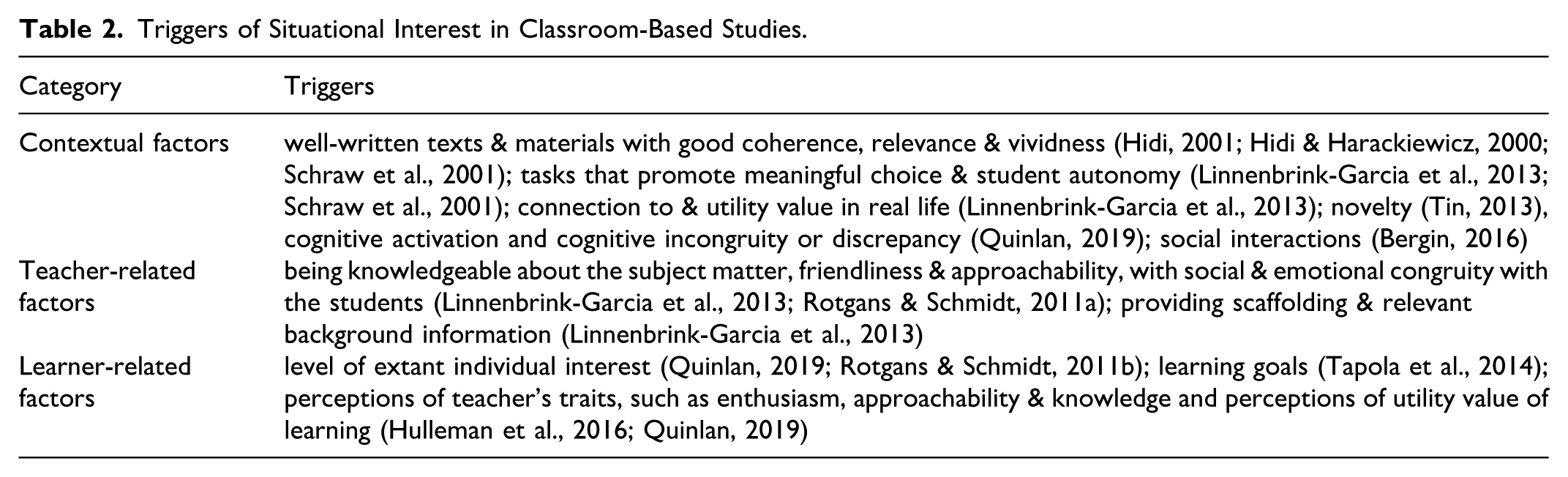
It is not hard to see from the findings on effective triggers of situational interest that elements with distinguished features contained in the texts, learning materials or learning activities substantially contribute to situational interest emergence and development (Lin et al., 2013; Palmer et al., 2017). Research found that novelty was more powerful than other triggers including autonomy and social involvement, with novelty encompassing task variety, new information exposure, surprise, and suspense (Palmer, 2009; Palmer et al., 2017). Lin et al. (2013) found that novel and aesthetic experiences in science classrooms could maintain students’ situational interest, supporting the view that affective and aesthetic responses to distinctive stimulus properties constitute a primary interest mechanism.
Recent findings, however, suggest an alternative mechanism centered on epistemic processes and knowledge-gap awareness. Studies (Rotgans & Schmidt, 2014, 2017; Schmidt & Rotgans, 2021) propose that situational interest is triggered when learners become aware of knowledge deprivation and diminishes as missing knowledge is acquired. According to this knowledge deprivation model, confronting problems or questions that reveal what learners do not know triggers interest through creating cognitive tension between current and desired knowledge states. The model further suggests that repeated arousal of situational interest, perhaps instead of the maintained situational interest, in turn, increases individual interest (Rotgans & Schmidt, 2017). Other studies provide partial support for knowledge-gap mechanisms. Harackiewicz et al. (2016) found that problem-based learning triggered and sustained interest through ongoing question generation and answer-seeking. Quinlan (2019) found that cognitive activation (requiring learners to think about questions) correlated strongly with situational interest, while cognitive incongruity (contradicting prior beliefs) showed only weak correlations.
However, upon considering the questions used as the trigger of interest in the experiments of the studies by Rotgans and Schmidt (2014, 2017), it needs to be noted that all the questions were not common questions concerning the information to be learned by the students. Instead, to some extent, they were rich in intriguing features, such as novelty, unexpectedness, and suspense (see Table 3 for the details on the learning tasks and the questions).
Summary of Learning Materials and Questions Used in the Two Studies by Rotgans and Schmidt.

Source. Adapted from Rotgans and Schmidt (2014, 2017).
Regarding the sources of situational interest, the findings by Rotgans and Schmidt (2014, 2017) and Schmidt and Rotgans (2021) seem to be quite different from the previous views which mainly concentrate on contextual and stylistic elements such as novelty, suspense, surprise, humor, etc. Therefore, a question occurs regarding the trigger of situational interest: is it the mere presence of the questions to create knowledge gap or the inclusion of intriguing elements in the questions that effectively arouses situational interest? It is of necessity to address this issue by examining the design of questions in text reading settings.
Situational Interest and L2 Reading Outcomes: Inconsistent Evidence
The relationship between situational interest and learning outcomes remains contended. While some researchers hold that situational interest directly enhances learning outcome or task performance, for example, text reading performance (List et al. 2019), knowledge acquisition or learning outcome (Bernacki & Walkington, 2018; Rotgans & Schmidt, 2018), others maintain that the effect of situational interest is not directly related to the learning outcome (Tapola et al., 2014) due to its transient and momentary nature. Researchers investigating the impact of situational interest on learning also hold that situational interest contributes to learning through its mediating role, by interacting with other factors, such as individual interest, perceived competence, and academic or cognitive engagement (Linnenbrink-Garcia et al., 2013; Palmer et al., 2017; Thomas & Kirby, 2020). Soemer et al. (2025) discovered a reciprocal relationship between situational interest and mind wandering during text reading with the two variables mutually affecting each other. A more important role of situational interest lies in its potential function as an antecedent for individual interest to emerge and develop (Guo & Fryer, 2025). Given the inconsistent findings regarding the connection between situational interest and learning performance, it deserves more research efforts to clarify this issue, particularly in the context of reading classroom.
In L2 contexts, the connection between situational interest and reading performance remains under-explored. Among the relatively limited body of studies that focused on situational interest in L2 learning, the sources and effective approaches to arouse it have been examined. Pan and Sun (2024) developed a set of pictographic glosses, designed with elements of exploration intention, instant enjoyment, novelty, attention demand, challenge and total interest, to facilitate EFL learners’ vocabulary learning in the online learning setting. The results of that study showed that the pictographic gloss was effective in triggering learners’ situational interest. While researchers have identified ways to arouse situational interest, a related construct of topic interest has been more extensively examined in L2 learning, particularly in L2 reading. In a recent study by Cancino and Fonseca (2025) focused on examining English as a foreign language (EFL) learners’ perceived topic interest in their text reading, they found that topic interest was influenced by individual interest, which was primarily determined by prior knowledge and personal relevance. The higher topic interest, in turn led to more resilience from the learners to deal with complex and difficult linguistic barriers. While topic interest has been shown to influence reading comprehension (Ercetin, 2010; Lee & Pulido, 2014), it differs from situational interest in that it incorporates elements of both individual interest and situational interest (Ainley et al., 1998). Therefore, the effects of situational interest and topic interest may be different on reading comprehension of L2 readers.
Despite some knowledge about how to arouse situational interest and evidence from related constructs, quite inconsistent findings have been found among studies that investigated the link between situational interest and L2 reading performance. Li (2023) focused on situational interest, reading comprehension and reading strategy use in academic medical text reading among intermediate-to-advanced EFL learners. The study did not find significant associations between situational interest and L2 reading comprehension, nor between situational interest and L2 reading strategies. Lack of close connections between situational interest and L2 reading comprehension is also shown by part of the results from the study by Ölmez (2016) in which situational interest was one of the several textual and learner-related variables under investigation. In a similar vein, Eidswick (2014) did not find significant influence of situational interest on L2 reading comprehension. As a contrast, Martínez (2019) found a significant effect of perceived interest on EFL learners’ reading comprehension measured by two types of tasks: a written recall and a multiple-choice task. These contradictory findings highlight the need for further research to clarify the contributions of situational interest to L2 reading performance.
Reading Comprehension and Pre-Reading Activities in L2
Successful L2 reading comprehension involves both lower-level processes, such as word recognition, phonological decoding, etc., and higher-level processes, such as inference making and comprehension monitoring (S. Graham et al., 2020). In addition, psychological and ecological factors, including interest, also play a critical role (Sparks, 2019). However, most studies have focused on cognitive components, leaving the influence of interest under-investigated in the domain of L2 reading.
Pre-reading activities, such as previewing, making predictions, pre-learning of words, semantic mapping, brainstorming, are widely recognized for their role in activating background knowledge and directing attention (Ajideh, 2003; Anaktototy & Huwae, 2020; Pellicer-Sanzchez et al., 2022; Webb, 2012). However, the effectiveness of questioning strategies in L2 contexts has yielded mixed results. While some studies report positive effects on reading comprehension (Phuong & Thuy, 2018), others find no significant impact or even negative effects when questions disrupt comprehension processes (Callender et al., 2013; Liu, 2021). It is of note that the questioning strategies examined in these two studies were while-reading questions instead of pre-reading questions.
To summarize the current literature on situational interest, pre-reading activities, and reading comprehension in the domain of L2 learning, several issues emerge as follows. First, the intrigue elements as incorporated in certain topics, themes, and textual structures are the main source of situational interest. However, as studies in recent years indicate, questions or knowledge gaps may also work as effective triggers of situational interest in classroom (Schmidt & Rotgans, 2021). Thus, the question arises as to the property of the questions that are used for arousing situational interest: What kind of question works well to achieve this purpose? Those contextualized in intriguing information and stylistic features or those common questions merely creating knowledge gap for learners? Based on this thinking, in our study, the pre-reading questions are operationalized in terms of the following two types: intrigue questions and non-intrigue questions, with the designing of the former type of questions based on the intrigue elements drawn from findings on external context as interest trigger, whereas the designing of the latter type of questions based on the knowledge gap generated by questions based on the knowledge deprivation model of learning interest. Secondly, pre-questioning, regarded as one of the effective activities in pre-reading activities in L2 reading, needs empirical studies to explicate what types of questions make it effective in arousing interest, or even enhancing learning. Thirdly, due to the divergent findings as to the influence of situational interest on reading performance particularly on L2 reading, studies need to be done to examine whether there is a direct link between situational interest and reading comprehension. These considerations inform the current study, which aims at addressing the following research questions:
How does situational interest change during the reading process among learners presented with intrigue pre-reading questions, non-intrigue pre-reading questions, and no questions?
Do intrigue pre-reading questions differ from non-intrigue pre-reading questions in their effectiveness in arousing situational interest in L2 reading?
Does situational interest influence L2 readers’ immediate reading comprehension performance?
The Study
Participants and Context
A total of 89 first-year university students majoring in English language studies at a provincial university in China participated in this study. All participants were admitted to the university based on similar English proficiency level as determined by the National College Admission Examination. They also had similar educational backgrounds, with English as a mandatory course in their primary schools and middle schools under the Chinese Ministry of Education guidelines. Before the study, all participants were fully informed about the purpose and scope of the study. They were notified that their participation was entirely voluntary and that they could withdraw at any time without any repercussions. The participants were also assured that all data collected would remain confidential and be used exclusively for research purposes. Informed consent was obtained from all participants before the study commenced.
Due to the nature of classroom-based research, participants were drawn from three intact classes and assigned to three conditions: the Intrigue Question Group (IQG, n = 30), the Non-Intrigue Question Group (NIQG, n = 30), and a control group (n = 29). Random assignment at the individual level was not feasible as it would have disrupted normal classroom instruction; instead, entire classes were assigned to experimental conditions, a common and accepted practice in educational research. To address potential selection bias, baseline equivalence was verified through pre-intervention reading proficiency testing (detailed in Procedures), which confirmed no significant differences among groups.
The participants were enrolled in a semester-long extensive reading course in the second semester of their undergraduate study. Each weekly session lasted for 1.5 hr of class time. They were taught by the same instructor and followed the same teaching procedures in their regular course time. Each session consisted of steps including presentation of reading skills, in-class reading practice and discussion, and after-class reading assignment. The same instructor taught all groups using identical methods and procedures, except for the experimental intervention. The measures taken to ensure the identical teaching among all the groups include making and adopting standardized lesson plans and materials before teaching, deliberate instructor training on avoidance of talking about any intervention content outside the assigned group, and consistent efforts to keep to the teaching plan as made before the class. In addition, the teaching of the three groups was conducted in separate class sessions, and the participants could not have access to the reading material and reading task assigned to the other groups.
Procedures
The experiment spanned one session and followed the steps outlined in Figure 1. Prior to the outset of the intervention, all participants completed a reading proficiency test consisting of six passages followed by multiple-choice questions. The Kruskal-Wallis test revealed no significant difference in reading proficiency scores among the three groups (p = .407), confirming group comparability at baseline.

Experiment procedures.
Following the pre-intervention reading test, a reading task was given to the participants in all the three groups. Specifically, the IQG and NIQG were provided with several pre-reading questions concerning the topic of the reading passage, while the control group was not provided with any pre-reading questions.
The IQG and the NIQG followed the same steps in completing the task. The only difference between these two experimental groups was the type of pre-reading questions, which were designed and worded in different ways. To be specific, the questions for the IQG were designed purposefully to be intriguing and novel for the readers so as to create interestingness and unexpectedness on the topic they are about to read, while the questions for the NIQG were straightforward questions focusing on the main ideas of the passage. The intrigue questions were designed mainly based on the question features used in the study by Rotgans and Schmidt (2014, 2017) and also informed by previous studies identifying intrigue-related elements as effective sources of situational interest. We invited two experts in educational psychology and language teaching to review and assess the intrigue questions and non-intrigue questions. The distinction in the level of intrigue between the two sets of questions was confirmed by their evaluation.
Both experimental groups completed three rounds of situational measurements: after they were shown the topic of the reading passage (T1), after they were shown the pre-reading questions (T2), and after they finished reading the passage but before answering reading comprehension questions (T3). The control group was asked to read the same passage and finish the same comprehension questions, but without any pre-reading questions before their reading. Therefore, the control group completed only two rounds of situational interest measures, respectively after the participants were shown the topic (T1) and after they read the passage (T3).
Instruments
Situational interest of the participants was measured by the situational interest scale developed by Rotgans and Schmidt (2011a). It has six items to determine the present state of the interest level placed on a 5-point Likert scale, ranging from 1 “not true at all” to 5 “very true for me” (see Supplemental Appendix 1). This instrument was reported to have good psychometric properties, with acceptable validity (with mean factor loadings of 0.78) and reliability (with a mean coefficient H of 0.90; Rotgans & Schmidt, 2011b). The items were translated into the Chinese language for the ease and clarity of understanding among the participants. In order to ensure the validity of the translation, a standard forward-backward translation method was used. The scale was first translated into Chinese, separately by two translators proficient in the two languages. Then they discussed and solved the discrepancies between their translations to agree on a single version. A third bilingual translator back-translated the Chinese translation into English. The two authors of this study checked the English translation to ensure there was not any conceptual discrepancy between the back-translated version and the original version.
The reading passage, consisting of approximately 500 words (see Supplemental Appendix 2), exhibits intermediate difficulty as evidenced by pilot study results. When administered to students with English proficiency levels comparable to the participants in the current study, the assessment yielded a mean performance score of 69.2 out of 100, confirming its appropriateness for the target population. The passage content was selected to be informative but relatively neutral in terms of inherent interest-generating features, avoiding topics with extreme novelty or personal relevance that might independently trigger situational interest. Following the passage, there are five multiple choice questions, including both literal and inferential questions, assessing the participants’ understanding of the main ideas and important details.
For the two experimental classes, after they were shown the title of the reading passage but before they started to read the passage, three pre-reading questions concerning the main topic of the passage were shown to them. The questions were designed to be different in their degree of intrigue. For the IQG, the questions were deliberately designed to contain the elements of novelty and unexpectedness, while the questions for the NIQG were straightforward questions without these intriguing features, even though they focused on the same ideas with the questions for the IQG (see the question lists in Table 4).
Pre-Reading Questions for the IQG and NIQG.

Data Analysis
The data were analyzed with SPSS 25.0 and Python. We examined normality for each group × timepoint cell using Shapiro-Wilk tests and Q–Q plots. At Time 1, all three groups deviated from normality (Shapiro–Wilk ps = .002, <.001, .007 for IQG, NIQG, Control, respectively), corroborated by Q–Q plot deviations. Given these violations and our small cell sizes (29–30 participants per group), non-parametric tests were used (Larson-Hall, 2015). The dependent variable is the situational interest level, and the independent variable is the pre-reading question type with three levels, namely intrigue questions, non-intrigue questions and no questions.
To address potential Type I error inflation from multiple comparisons, we employed a hierarchical testing strategy and applied appropriate corrections for familywise error rate. For within-group comparisons across time points, omnibus tests were conducted first: Friedman tests for the two experimental groups (IQG and NIQG) with three measurement points, and Wilcoxon test for the control group with two measurement points. Pairwise post-hoc comparisons using Wilcoxon signed-rank tests were conducted only when the omnibus test reached statistical significance. For these post-hoc comparisons within each group, we applied Bonferroni correction by dividing the alpha level 0.05) by the number of pairwise comparisons (three comparisons: T1–T2, T2–T3, T1–T3), resulting in an adjusted alpha of .017.
For between-group comparisons, Kruskal-Wallis H tests were used for T1 and T3 when all three groups were compared. For the T2 comparison between IQG and NIQG, Mann-Whitney U test was employed. This T2 comparison represents a planned, theory-driven test of our central research hypothesis regarding the differential effectiveness of intrigue versus non-intrigue questions in triggering situational interest and thus was evaluated at the conventional alpha level of .05. As for the reading task performance measured after the intervention, the Kruskal-Wallis H test was carried out to see if there was any significant difference between all three groups. According to the reliability tests on the three rounds of situational interest measures, the values of Cronbach’s Alpha were .836, .898, and .881 respectively, confirming acceptable reliability standards (Gwet, 2014).
For non-significant omnibus results, we conducted pairwise equivalence tests using the two one-sided tests (TOST) procedure on Hedges g with bootstrapped 95% bias-corrected and accelerated (BCa) confidence intervals (10,000 resamples). We set an a priori smallest effect size of interest (SESOI) to |g| = 0.30 (≈0.50 points on the 0–5 test). We also computed post hoc sensitivity (minimal detectable effect) at 80% power (two-sided α = .05) for the observed sample sizes (Lakens, 2017; Lakens et al., 2018).
Results
Changes in Situational Interest Across Time
The results of Friedman test (Table 5) indicated that there was a significant within-subjects effect of pre-reading question type on participants’ situational interest in the IQG (
Friedman Test Results.

Note. IQG = Intrigue Question Group; NIQG = Non-intrigue Question Group; BCa = bias-corrected and accelerated bootstrap, 10,000 resamples in Python.
p < .01.
Given the significant Friedman test result for the IQG, follow-up pairwise comparisons were conducted using Wilcoxon signed-rank tests with Bonferroni-corrected alpha level of .017 (.05/3). The results (see Table 6) showed that the situational interest level of the IQG significantly increased from T1 to T2 (Z = −2.950, p = .003 <.017), indicating that participants’ situational interest was significantly heightened after reading the intrigue questions. The associated effect size was r = .615 (95% BCa CI [0.140, 0.824], Npairs = 23), which represents a large effect size (Cohen, 1988). Additionally, their situational interest level significantly decreased from T2 to T3 (Z = −3.135, p = .002 <.017), meaning that after they read the passage, their situational interest significantly waned. The effect size was r = .627 (95% BCa CI [0.198, 0.817], Npairs = 25), also large. Regarding the situational interest levels between T1 and T3, the difference did not reach the significant level (Z = −0.943, p = .346 >.017). The corresponding effect size was r = .197 (95% BCa CI [0.006, 0.534], Npairs = 23), small. All significant pairwise comparisons remained significant after Bonferroni correction, confirming the robustness of these findings.
Wilcoxon Signed-Rank Test Results of Situational Interest of IQG.
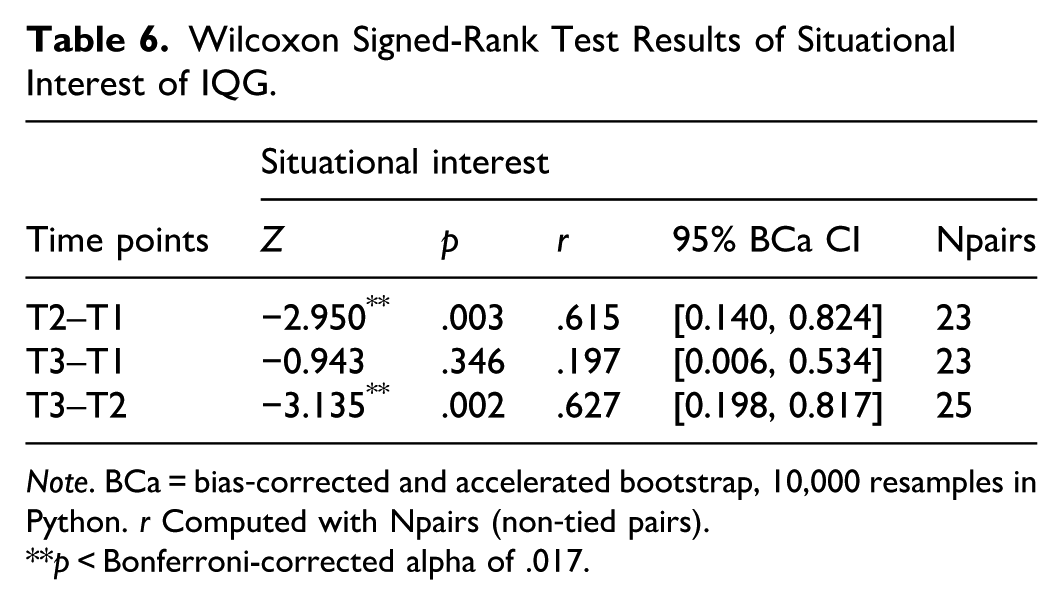
Note. BCa = bias-corrected and accelerated bootstrap, 10,000 resamples in Python. r Computed with Npairs (non-tied pairs).
p < Bonferroni-corrected alpha of .017.
For the NIQG, since the omnibus Friedman test was not significant (p = .073), pairwise comparisons were not conducted, adhering to the hierarchical testing protocol. Similarly, the NIQG also demonstrated an upside-down U-shaped trajectory of their situational interest change (Figure 2), but the differences between across the three timepoints were not statistically significant (T2–T1: Z = −1.886, p = .059 >.017; T3–T2: Z = −0.988, p = .323 >.017; T3–T1: Z = −0.114, p = .910 >.017).

Situational interest means of the three groups across the three timepoints.
For the control group, as shown by the results from the Wilcoxon signed-rank test (Table 7), there was a significant difference between T1 and T3 (Z = −2.057, p = .040 <.05), with r = .403 (95% BCa CI [0.038, 0.672], Npairs = 26), a medium effect, indicating that the interest level significantly decreased after the students finished reading the whole passage. For all the three groups, similar decrease in their situational interest was witnessed at T3 (i.e., after reading the passage), but only the decrease in the control group reached significant level at the conventional alpha of .05.
Wilcoxon Signed-Rank Test Results of Control Group.

Note. BCa = bias-corrected and accelerated bootstrap, 10,000 resamples in Python. r Computed with Npairs (non-tied pairs).
p < .05.
Situational Interest Differences Among Groups
To explore the between-subjects effect on the three groups for T1 and T3, the Kruskal-Wallis tests were employed. For T2, since only the two experimental groups were involved, Mann-Whitney test was used to compare the means of situational interest between them. According to Table 8, for the situational interest level at T1, there was no significant between-subjects effect among the three groups (H = 0.263, p = .877 >.05). Likewise, no significant difference was observed among the three groups at T3 (H = 1.537, p = .464 >.05). The corresponding effect sizes were ε2H = −.020 at T1 and ε2H = −.005 at T3 (95% BCa CIs [−0.023, −0.014] for T1 and [−0.023, 0.052] for T3), indicating essentially no between-group dispersion at these timepoints. These results indicate that groups were equivalent in situational interest both before the intervention (after seeing only the reading topic) and after completing the reading passage.
Kruskal-Wallis Test Results for T1 and T3.

Note. Effect-size ε2H values and their BCa CIs were computed via 10,000 bootstrap resamples in Python. IQG = Intrigue Question Group, NIQG = Non-Intrigue Question Group, CG = Control Group.
However, based on the Mann-Whitney U test results (Table 9), for the situational interest level at T2, there was a significant between-subjects effect on their situational interest levels between the two experimental groups (U = 307.50, p = .034 <.05) with a small effect size (r = .273). Specifically, the IQG had a significantly higher level of situational interest than the NIQG, indicating that intrigue questions might exert a larger effect on situational interest than non-intrigue questions. The corresponding rank-biserial correlation was r_rb = −.317 (95% BCa CI [-0.571, 0.001]), indicating higher situational interest in the IQG than the NIQG (IQG coded first, thus negative sign). This comparison represents a planned, a priori test of our central research hypothesis about the differential effectiveness of intrigue versus non-intrigue questions. While this p-value (p = .034) needs cautious interpretation given its proximity to the significance threshold of 0.05, it is supported by converging evidence including: (a) the robust within-group increase in IQG from T1 to T2 (p = .003, well below the Bonferroni-corrected threshold of 0.017), (b) the large within-group effect sizes with BCa CIs for IQG (r = .615 for T2–T1 and r = .627 for T3–T2), and (c) the absence of any significant interest change in NIQG. Nevertheless, we acknowledge that replication with larger samples would strengthen confidence in this between-group finding.
Mann-Whitney Test Results for T2 Comparison.

Note. Effect size estimated by rank-biserial r with 95% BCa CIs (10,000 resamples in Python). IQG = Intrigue Question Group, NIQG = Non-Intrigue Question Group.
p < .05.
Reading Task Performance
Table 10 indicates that there was no significant difference among the three groups in terms of the reading task performance measured after the completion of text reading (H = 5.598, p = .061 >.05). That is, the intervention did not seem to have direct influence upon the learners’ reading task performance. Consistent with this, the Kruskal–Wallis effect size for reading task performance was small: ε2H = .041 (95% BCa CI [0.000, 0.141]).
Kruskal-Wallis H Test Result.

Note. Effect size ε2H and its 95% BCa CI were obtained via 10,000 bootstrap resamples in Python. IQG = Intrigue Question Group, NIQG = Non-Intrigue Question Group, CG = Control Group.
Pairwise TOST with SESOI |g| = 0.30 indicated practical equivalence for IQG-CG (g = 0.02, 95% BCa CI [−0.35, 0.39], p = .004) and IQG-NIQG (g = −0.29, 95% BCa CI [−0.66, 0.08], p = .012), while NIQG-CG (g = 0.31, 95% BCa CI [−0.06, 0.68]) did not reach equivalence (p = .078), likely due to imprecision. Post hoc sensitivity showed the design had approximately 80% power to detect |g| ≈ 0.55 in pairwise comparisons; thus, moderate effects would likely be detected, whereas smaller effects could be missed. Together with the small omnibus effect (ε2H = .041, 95% BCa CI [0.000, 0.141]), these results suggest any group differences in immediate reading performance are, at most, small.
Discussion
In response to the three research questions proposed in this study, the answers are briefly revisited in each of the following subsections. Elaboration is then provided through comparisons with the results from related studies, alongside further reflections on the similarities and disparities that emerge from these comparisons. Given the exploratory nature of this single-session intervention and the limitations in our stimulus design and comprehension measures, the following interpretations should be regarded as preliminary findings requiring validation through further research.
Changes in Situational Interest
The significant increase in situational interest levels for the IQG after the intrigue questions were presented to the participants suggests that in this specific context, the intrigue questions may be effective in arousing situational interest in reading. In contrast, the lack of a significant increase in the NIQG suggests that non-intrigue questions may not effectively trigger or sustain situational interest in the same manner. This result will be discussed in further details in the next section, which focuses on comparing the effects of different types of pre-reading questions on situational interest.
However, two other significant differences in situational interest levels are noteworthy. For the control group, situational interest decreased significantly from T3 to T1, suggesting that without pre-reading interventions, learners’ interest tends to decline as they complete the reading task. Another significant change of situational interest is observed in the IQG, where interest significantly decreased from T2 to T3. This indicates that although situational interest was substantially promoted when the participants read the intrigue questions, it dropped gradually and substantially while they were reading the text. Compared with the IQG and the control groups, the situational interest level in the NIQG remained relatively stable, showing no significant increase or decrease, although it exhibited a similar pattern of change to that in the IQG group: an initial increase followed by a decrease.
This similar pattern of decreased situational interest during reading among all the three groups may align with the knowledge deprivation model, which posits that situational interest diminishes as the knowledge gap is closed and learners’ desire for the knowledge is satisfied (Rotgans & Schmidt, 2011b, 2014). However, in addition to the role of knowledge gap, other plausible explanations may also account for such a pattern. Triggered situational interest and maintained situational interest are two separate yet related early phases in interest development (Tan et al., 2024). Once triggered, situational interest needs to be repeatedly aroused or maintained; otherwise, it may decrease, regress, or even disappear (Hidi & Renninger, 2019; Tan et al., 2024). Without being sufficiently supported by effective means, the triggered situational interest quickly decreased, particularly as indicated by the change between T3 and T2 in the IQG. Given our short timeframe, we measured triggered rather than maintained situational interest, limiting conclusions about sustained effects.
A second consideration is that at each stage of reading or learning activities, situational interest needs to be triggered and retriggered. Although our intrigue questions incorporated intriguing elements, the reading text content may not have been equally compelling. Students may have perceived the text as failing to deliver expected interest or found ideas irrelevant to their concerns (Renninger et al., 2019; Tan et al., 2024; Wong et al., 2020). However, these interpretations remain speculative because our study examined only one text in one session. The decline could alternatively be attributed to passage characteristics, intervention duration, individual differences not captured in our measures, or measurement effects from repeated assessments. Longitudinal studies examining interest trajectories across multiple texts and sessions would be necessary to determine whether these patterns are generalizable or context specific.
Our findings tentatively suggest that emphasizing topic novelty alone may not maintain interest without supportive instructional design. Aroused interest may require external support through meaningful tasks, active engagement, and facilitated connections to content (Palmer, 2019; Renninger & Bishop, 2017; Renninger & Hidi, 2022). The similar decline pattern across groups could reflect insufficient connections between content and student concerns. However, alternative explanations, such as fatigue effects, specific passage characteristics, or measurement limitations, cannot be ruled out. Future research with diverse texts, extended interventions, and additional methodological controls would be needed to substantiate these tentative interpretations. These findings nevertheless suggest important considerations for instructional design, particularly regarding how triggered interest might be sustained throughout reading activities, which we address in the pedagogical implications section.
Intrigue Questions as Effective Triggers of Situational Interest
The IQG showed significantly higher situational interest than that of the NIQG after the presentation of the pre-reading questions, despite similar initial levels after topic presentation. However, this finding should not be interpreted as contradicting previous studies showing that knowledge gaps trigger situational interest (Harackiewicz et al., 2016; Rotgans & Schmidt, 2014, 2017). Both our intrigue and non-intrigue questions created knowledge gaps; the difference lies in the additional intrigue-related features (novelty, surprise, narrative elaboration) present in the IQG questions.
Our findings suggest that in this particular context, intrigue questions may trigger stronger immediate situational interest than non-intrigue questions. It is important to note, however, that our intrigue and non-intrigue questions differed not only in intrigue features but also in length, narrative elaboration, and affective tone. Therefore, we cannot definitively attribute the observed differences solely to intrigue elements. Additionally, the questions used in this study were researcher-designed and have not been systematically validated across multiple contexts. Replication with validated, systematically controlled question sets that isolate specific features would be necessary to confirm these preliminary observations and identify which specific question characteristics drive interest effects.
Recent discussions regarding the distinctions between the two constructs of interest and curiosity (e.g., Grossnickle, 2016; Shin and Kim, 2019; Shin et al., 2023; Tang et al., 2022) may also shed light on interpreting this finding. As suggested by Shin and Kim (2019), incomplete information can trigger curiosity, while well-organized information associated with positive affect and enjoyment can drive situational interest. In the present study, the non-intrigue pre-reading questions might have functioned to prompt participants to recognize their incomplete information and stimulate their curiosity, while the intrigue pre-reading questions might have functioned as well-organized information, due to the meticulous integration of novel and intrigue elements into the questions, thereby arousing situational interest. This finding could potentially lend support for validating this distinction between the two often-confounded constructs, though this interpretation remains speculative without direct measurement of curiosity alongside interest.
Regarding situational interest measured after participants completed the reading passage, no significant difference was observed, neither between the two experimental groups, nor among all three groups. This result further consolidates the finding as presented in the earlier section of this paper that the purposefully designed intrigue questions were effective triggers of situational interest, yet the reading passage and post-reading comprehension questions, which were identical for all three groups, did not elicit situational interest in a similar manner.
Situational Interest and Reading Performance
No significant differences in immediate reading performance emerged among groups, suggesting that single-session intervention of situational interest did not directly influence competence outcomes in this study. This aligns with studies finding no immediate impact of situational interest on task performance (Gericke et al., 2025; Schroeder, 2013; Shin et al., 2023; Tapola et al., 2014), supporting claims that momentary and short-lived situational interest does not have significant influence on performance within short learning timeframes (Linnenbrink-Garcia et al., 2013), However, multiple alternative explanations merit consideration.
First, a more feasible interpretation for the absence of a significant effect on reading comprehension might lie in the different roles of the two sub-phases of situational interest. According to the four-phase model of learning interest (Hidi & Renninger, 2006), situational interest comprises two sub-phases of triggered situational interest and maintained situational interest. J. Graham et al. (2008) found maintained (on-task) interest partially explained reading performance for low-interest texts. In our study, triggered situational interest at T2 in the IQG might not have transferred to maintained interest, resulting in no performance differences. However, we did not directly measure this distinction, and our brief time interval may have been insufficient for maintained interest to develop or manifest in performance.
Second, the use of different types of reading comprehension measurements might be an important reason to explain such a result. According to Martínez (2019), different types of reading comprehension tasks could be important factors that influence the relationship between interest and L2 reading comprehension. In our study, the five-item multiple choice assessment may not have adequately captured deeper comprehension processes that interest might influence. Future studies could use multiple types of assessment such as information recall, written summary, mind mapping task, etc. to probe into this issue more comprehensively.
Third, the interest-performance relationship may not be straightforward. This relationship may also be moderated by variables including reading medium (Clinton-Lisell, 2022), initial interest or individual interest (Palmer et al., 2017), learning goals (Harackiewicz & Hulleman, 2010), and difficulty levels (Soemer & Schiefele, 2019). These variables were not systematically measured in our study, potentially obscuring effects or contributing to response heterogeneity. Another possibility is that L2 comprehension depends more on linguistic knowledge than interest (Jeon & Yamashita, 2014), though our design cannot test this proposition.
Conclusion, Implications, and Limitations
This exploratory study provides preliminary evidence regarding the potential role of intrigue pre-reading questions in arousing situational interest in L2 learning. A quasi-experimental method investigated the effects of intrigue questions, non-intrigue questions and no questions on situational interest and L2 reading performance among university students in a single session. Given the exploratory nature of this investigation and its methodological limitations, conclusions and implications should be interpreted with appropriate caution.
Conclusions
Within the constraints of this single-session, exploratory study, the findings suggest that what may validate pre-questions as effective triggers for situational interest is not the questions themselves, but the intrigue properties associated with them. Furthermore, we observe that the impact of intrigue questions on situational interest in reading appeared not to last long in our specific context. The initial arousal of situational interest during the pre-reading step may need to be maintained or strengthened through other means, such as meeting the readers’ expectations of interestingness during the while-reading phase and closely connecting reading materials with readers. Compared to the intrigue topics and pre-reading questions, the intrigue contents of the reading material may prove more consequential for further maintaining or developing readers’ situational interest. Moreover, the single-session interest elevation did not translate to measurable comprehension differences. This could indicate that triggered interest requires transition to maintained interest before influencing performance.
Limitations and Recommendations for Future Studies
First, our study does not operationalize the knowledge-gap construct independently from intrigue in a way that allows clean empirical testing of theoretical accounts. Both intrigue and non-intrigue questions created knowledge gaps. Another limitation concerning the pre-reading questions is that the intrigue questions in this study differed from non-intrigue questions not only in intrigue elements (novelty, surprise) but also in length, narrative elaboration, and affective tone, making it impossible to isolate which feature(s) drove the observed effects. Future research should use controlled experimental designs that systematically manipulate individual features to disentangle these confounded variables and identify the specific components of intrigue questions that trigger situational interest.
Second, the intervention was limited to a single reading session. Therefore, the conclusion of the study should be approached with caution. Future studies should use longitudinal designs to examine the sustained effects of intrigue questions on situational interest. Another potential limitation of our study is the unequal rounds of situational interest measurement for the three groups. This design choice was necessary to isolate the effects of pre-reading questions (intrigue vs. non-intrigue questions) from the no-question condition. Future studies that investigate along this avenue of inquiry should overcome this limitation and develop more balanced designs that allow for equal measurement points without compromising the validity of the comparison.
Qualitative studies are recommended to provide richer insights into the nuanced processes underlying interest fluctuations, particularly on the inhibition, attrition or decline in situational interest among readers, by using methods such as stimulated recall or retrospective interviews.
Pedagogical Implications
While this exploratory study has limitations, the findings offer tentative insights that may inform future pedagogical exploration in L2 reading instruction. The observed effectiveness of intrigue-enhanced pre-reading questions in triggering situational interest, though momentary, suggests that incorporating novelty and unexpected elements into pre-reading activities may help capture learners’ initial attention and engagement. For L2 educators designing pre-reading tasks, this implies that questions framed with intriguing features, such as presenting surprising facts, highlighting unexpected contradictions, or embedding elements of suspense, may be more effective in arousing initial interest than straightforward factual questions, at least in the immediate term. However, given that we cannot isolate which specific question characteristics (novelty, length, narrative structure, or affective tone) drove the observed effects, educators should view these as preliminary considerations for experimentation rather than validated design principles.
The decline in situational interest observed across all groups after reading completion points to an important instructional challenge: triggered interest requires ongoing support to be sustained. This finding suggests that educators cannot rely on a single intervention point but must conceptualize reading instruction as a dynamically orchestrated sequence. During the while-reading phase, prediction verification activities, where learners explicitly check whether the text confirms or contradicts initial expectations, may help sustain the interest aroused by pre-reading questions (Harackiewicz et al., 2016). Similarly, carefully aligning text selection with intrigue question expectations appears important; texts must deliver substantive novel information rather than routine content to avoid disappointment effects. Problem-solving tasks requiring learners to apply newly encountered information could maintain cognitive engagement beyond initial arousal (Schmidt & Rotgans, 2021).
Additionally, post-reading activities offer extra opportunities for interest consolidation. Discussions or reflective tasks that help learners connect newly acquired information to personally relevant contexts may transform momentary interest into more enduring engagement (Hulleman et al., 2016; Renninger & Hidi, 2020). Collaborative activities where learners share surprising discoveries or debate controversial ideas from the text may leverage social interaction as an interest-sustaining mechanism (Bergin, 2016). However, these pedagogical recommendations must be interpreted with substantial caution. Our study examined only a single text in a single session with researcher-designed questions not validated across contexts. The suggested approaches derive from theoretical extrapolation rather than direct empirical testing. Educators should treat them as hypotheses requiring systematic classroom experimentation rather than evidence-based best practices. Future research employing longitudinal designs with validated materials and controlled comparisons of maintenance strategies would be necessary to transform these tentative suggestions into empirically grounded recommendations.
For L2 practitioners interested in exploring intrigue question design in their classrooms, Supplemental Appendix 3 provides illustrative examples demonstrating how intrigue features might be incorporated across different text types and topics. Those examples demonstrate recurring intrigue features including unexpectedness (contradicting common assumptions), cognitive discrepancy (highlighting paradoxes), suspense (creating anticipation through incomplete information), novelty (introducing unfamiliar perspectives), narrative framing (embedding questions within story-like structures), and personal relevance (connecting to learners’ lived experiences). Additionally, when designing intrigue questions, teachers should ensure alignment with text content to avoid disappointment effects, match question complexity to learners’ L2 proficiency levels, consider cultural appropriateness, balance intrigue with clarity to manage cognitive load, and systematically document which approaches engage their specific learners for ongoing refinement.
Supplemental Material
sj-docx-1-sgo-10.1177_21582440251413897 – Supplemental material for Effectiveness of Pre-Reading Questions as Sources of Situational Interest in Second Language Reading: An Exploratory Study on the Role of Intrigue Questions
Supplemental material, sj-docx-1-sgo-10.1177_21582440251413897 for Effectiveness of Pre-Reading Questions as Sources of Situational Interest in Second Language Reading: An Exploratory Study on the Role of Intrigue Questions by Juan Zhang and Michael Yi-Chao Jiang in SAGE Open
Footnotes
Acknowledgements
We are grateful for the contributions of all the participants in this study as well as the funding from the Doctoral Scholarship and the Publication Bursary provided by the University of Otago for supporting the data collection and writing of this article. We are also grateful to the anonymous reviewers for their insightful suggestions on the manuscript.

Funding
The authors disclosed receipt of the following financial support for the research, authorship, and/or publication of this article: This study is supported by grant from Higher Education Teaching Innovation Project, Guangdong University of Technology 2025 (Grant No. 124): AI-Empowered Translation Course Design of Understanding Contemporary China.
Declaration of Conflicting Interests
The authors declared no potential conflicts of interest with respect to the research, authorship, and/or publication of this article.
Data Availability Statement
The data are available from the corresponding author upon reasonable request.
Supplemental Material
Supplemental material for this article is available online.
References
Supplementary Material
Please find the following supplemental material available below.
For Open Access articles published under a Creative Commons License, all supplemental material carries the same license as the article it is associated with.
For non-Open Access articles published, all supplemental material carries a non-exclusive license, and permission requests for re-use of supplemental material or any part of supplemental material shall be sent directly to the copyright owner as specified in the copyright notice associated with the article.
