




Abstract
Against the backdrop of population aging and the prevalence of intergenerational care in China, this study examines the impact of grandchild care on middle-aged and older adults’ cognitive function. It analyzes 2018 China Health and Retirement Longitudinal Study (CHARLS) data using an empirical approach that combines causal inference methods (OLS, IV, PSM) with KHB mediation analysis. The analysis reveals a significant positive association between caregiving activities and enhanced cognitive performance, although this benefit gradually diminishes at high-intensity care levels. The caregiving group exhibits three distinctive patterns: (a) an inverted U-shaped relationship between care intensity and cognitive benefits, with moderate-intensity care providing the greatest cognitive improvement; (b) compared to non-caregivers, both newly commenced care and continuous care are associated with improved cognitive function, with newly commenced care demonstrating a more pronounced effect; and (c) the positive cognitive effects of grandchild care are consistent among individuals with both agricultural and non-agricultural household registration (hukou) status. Furthermore, receiving intergenerational financial support and participating in social activities are identified as significant mediating mechanisms. This study recommends promoting moderate-intensity care, strengthening intergenerational economic support, and encouraging social participation to enhance cognitive health in later life. Policy efforts should focus on building supportive community environments and improving grandparent caregivers’ access to social resources.
Plain Language Summary
Background: China’s population is growing older, and many grandparents are involved in caring for their grandchildren. This study looks at how providing such care affects grandparents’ cognitive abilities. Methods: Using data from the 2018 China Health and Retirement Longitudinal Study (CHARLS), this study employs linear regression, instrumental variable (IV), and propensity score matching (PSM) methods to identify causal relationships and address endogeneity issues. Furthermore, the Karlson-Holm-Breen (KHB) method is applied to test the mediating roles of intergenerational economic support, lifestyle habits, and healthcare utilization. Results: Grandchild care has a significant positive effect on the cognitive function of older adults. Further analysis reveals moderate caregiving brings the greatest cognitive benefits, while too little or too much care can reduce these benefits. Both newly commenced care and continuous care are associated with improved cognitive function, with a stronger effect observed for newly commenced care. Despite institutional disparities associated with the household registration (hukou) system, the positive cognitive effects of grandchild care are consistent among both agricultural and non-agricultural hukou holders. The KHB mediation analysis indicates that receiving intergenerational financial support and participation in social activities are significant mediators, whereas providing financial support and healthcare utilization show no significant mediating effects. Conclusions: The study recommends promoting moderate-intensity care, strengthening intergenerational economic support, and encouraging social participation to enhance cognitive health in later life.
Keywords
Introduction
Cognitive function is a core dimension of healthy aging and exerts a decisive influence on the physical and mental well-being of middle-aged and older adults (Lapane et al., 2001). Studies have shown that individuals with better cognitive function generally report higher life satisfaction and more positive attitudes toward aging (Jones et al., 2003; Siebert et al., 2020), whereas cognitive decline significantly increases the risks of depression, functional impairment, Alzheimer’s disease, and premature mortality (Allott et al., 2016; Deary et al., 2005; Mirza et al., 2017). Therefore, identifying modifiable factors that can delay cognitive deterioration has become a central focus in the fields of public health and aging research.
In China, grandparental involvement in childcare has become a widespread and distinctive social phenomenon. This behavior originates not only from the Confucian value of intergenerational responsibility but also from the practical gaps in modern family structures and social support systems. A comparative study by Ko and Hank (2014) showed that approximately 58% of Chinese grandparents participate in grandchild care, which is far higher than the proportion in South Korea (6%). In a society characterized by dual-earner households and limited public childcare resources, grandparents have naturally become the “invisible backbone” of family childcare. However, whether long-term grandchild care serves as a form of active aging through meaningful social engagement or instead imposes health-related burdens remains an unresolved question in the academic literature.
Given that both cognitive decline and caregiving responsibilities often emerge during midlife, this study focuses on individuals aged 45 and above, encompassing middle-aged (45–59 years) and older (60 years and above) adults. It systematically investigates the impact of grandchild care on grandparents’ cognitive function. Distinct from prior research that primarily centered on psychological well-being, this study emphasizes cognitive aging and further examines its underlying mechanisms and heterogeneity. Specifically, how does grandchild care influence cognitive function among middle-aged and older adults? What are the mediating pathways? Does this effect vary by care intensity, care history, or household registration (hukou) status? A thorough investigation of these questions will provide valuable empirical evidence for promoting healthy aging. Exploring these questions will deepen our understanding of the relationship between intergenerational caregiving and healthy aging and provide empirical evidence to inform relevant social policies.
Literature Review
Health Effects of Grandchild Care
In Confucian-influenced societies, grandparental involvement in childcare is widespread (Hoang et al., 2020). In China, about 58% of grandparents provide care for their grandchildren (Ko & Hank, 2014). Most existing studies have focused on the benefits of such intergenerational caregiving for children, including educational achievement, social development, and physical and emotional well-being (Bramlett & Blumberg, 2007; Cruise & O’Reilly, 2014; Hayslip & Kaminski, 2005; Mencarini et al., 2019; Pilkauskas & Dunifon, 2016). However, much less attention has been paid to its consequences for grandparents, particularly regarding their health and cognitive function.
Research on the effects of grandchild care on grandparents remains limited and yields mixed findings. Some studies highlight adverse outcomes, suggesting that providing care for more than 9 hr per week increases the risk of coronary heart disease (Lee et al., 2003) and is associated with higher depressive symptoms and poorer health (Hughes et al., 2007). In contrast, other studies emphasize potential benefits, showing that moderate caregiving can enrich grandparents’ lives (Balukonis et al., 2008), promote active lifestyles (Fujiwara & Lee, 2008), and improve self-rated health among grandmothers (Baydar & Brooks-Gunn, 1998).
In developing countries such as China, multigenerational co-residence is common, public childcare infrastructure remains underdeveloped, and strong cultural expectations of intergenerational responsibility coexist with rising socioeconomic pressures. These factors may jointly shape the health implications of grandchild care in unique ways. Drawing on nationally representative data, this study systematically examines how grandchild caregiving influences cognitive function among middle-aged and older adults within the context of a developing economy.
Cognitive Function and the “Use It or Lose It” Principle
Variations in cognitive decline across populations may arise from innate or genetic factors (Mahedy et al., 2021), as well as differences in educational attainment (Evans et al., 1993), occupational type (Stern et al., 1994), and lifestyle (Fratiglioni et al., 2004). The “use it or lose it” principle (Hultsch et al., 1999) offers a coherent framework for understanding these patterns, positing that engagement in diverse activities may mitigate age-related cognitive decline (Hanushek et al., 2025), whereas cognitive inactivity may accelerate deterioration.
Family interactions align closely with this principle. Frequent communication with family members serves as a form of cognitive exercise and plays a critical role in maintaining cognitive health in late life (Engelhardt et al., 2010; van Gelder et al., 2006). Such interactions can stimulate intellectual engagement, promote neurogenesis, and slow brain aging, thereby attenuating cognitive decline. Conversely, older adults living alone are more susceptible to depression, and depressive symptoms may increase cortisol secretion, damage hippocampal memory function, and further exacerbate cognitive impairment (Kalmijn et al., 1998).
As a specific type of family interaction, caring for grandchildren may influence grandparents’ cognitive function. Given that caregiving involves multitasking, problem-solving, and affective engagement, it may act as a cognitively enriching activity.
Cognitive Function and Social Roles: Role Enhancement Versus Role Strain
Role enhancement theory (Sieber, 1974) and role strain theory provide competing theoretical lenses through which to understand the effects of grandchild care. Role enhancement theory contends that assuming the role of a grandchild caregiver creates opportunities for social participation, generates emotional satisfaction, enhances subjective well-being, and thereby delays cognitive decline by increasing social interaction and cognitive stimulation (Hayslip et al., 2014). In contrast, role strain theory argues that excessive care demands may deplete an individual’s psychological and physiological resources, induce chronic stress (Farmer & Ferraro, 1997), and divert valuable self-care resources (Szinovacz & Davey, 2006), all of which may adversely affect cognitive function.
The tension between these perspectives suggests that the link between grandchild care and cognitive function is not strictly linear but likely shaped by key contextual factors. To unpack these mechanisms, this study employs a dual perspective integrating dose effects and dynamic trajectories. From a static view, we assess differences in weekly care intensity; from a dynamic view, we distinguish caregiving histories—never, former, recent, and persistent caregivers—to examine how these patterns yield divergent cognitive outcomes.
Cognitive Function and Hukou Disparities
China’s household registration (hukou) system constitutes a fundamental institution underlying the urban–rural dichotomy and has profoundly influenced the distribution of public health resources (Chan, 2010). Initially implemented in the 1950s (Boffy-Ramirez & Moon, 2018), the system categorizes individuals at birth as either “agricultural” or “non-agricultural” hukou holders, typically based on parental registration (Song & Smith, 2019). Owing to decentralized fiscal and administrative authority, access to social welfare and public services remains strongly tied to hukou type (Gersovitz, 2016). Urban residents generally benefit from preferential policies in healthcare, education, and pension benefits (Zhang & Treiman, 2013), whereas rural hukou holders face structural disadvantages.
The hukou system directly restricts rural residents’ access to healthcare services (Li et al., 2018), particularly in terms of availability and quality, thereby exacerbating health inequalities (Liang & Liu, 2025). Yuan et al. (2023) found that older adults with rural hukou exhibit higher rates of cognitive impairment and more rapid cognitive decline.
The Mediating Roles of Intergenerational Economic Support, Lifestyle Habits, and Healthcare Utilization
Intergenerational economic support is a core component of familial exchange, encompassing both transfers received from and given to adult children. Adult children may increase financial support to their parents out of gratitude or reciprocity (Hu et al., 2025), which can ease grandparents’ financial burden, enhance their health investment capacity, and provide a material foundation for better health (Yuanfeng & Xu, 2024). Conversely, healthier and more financially secure grandparents may offer support to strengthen family bonds and self-worth (Cheung, 2023; Huang & Fu, 2021), with such psychological satisfaction further promoting well-being (Thomas, 2010).
Grandchild care may affect cognitive health by shaping grandparents’ lifestyle habits. Taking on caregiving responsibilities can promote more structured and health-oriented behaviors, such as maintaining regular naps, quitting smoking, and engaging in social activities. Moderate afternoon naps can offset sleep deficits and have been linked to better cognitive performance (Dutheil et al., 2021). To set a positive example, grandparents may also be more motivated to reduce health-risk behaviors (Im et al., 2015). In addition, caregiving fosters social engagement (Tian et al., 2021), and rich social interaction provides cognitive stimulation, a key protective factor against cognitive decline (Poff et al., 2024).
The sense of responsibility associated with caregiving may heighten grandparents’ attention to their own health, leading to greater use of healthcare services—particularly outpatient visits and hospitalizations. Such proactive health management enables early detection and control of cognitive risk factors, including hypertension and diabetes. Prior studies have shown that healthcare utilization has significant positive effects on overall health outcomes (Gallet & Doucouliagos, 2017).
Based on this reasoning, we propose the following hypothesis:
Marginal Contributions
Building upon prior literature, this study extends existing research in three significant ways: (a) It moves beyond the traditional binary approach to caregiving involvement by innovatively integrating the dual perspectives of “dose effects” and “dynamic trajectories” to systematically examine the influence of care intensity and care history on grandparents’ cognitive function, thereby refining the understanding of this relationship. (b) By incorporating China’s unique household registration system as a key variable into the analytical framework, the study is grounded in the context of structural inequalities within the country, providing important contextualized evidence on how institutional environments shape the health effects of caregiving. (c) Through empirical testing of three mediating mechanisms—intergenerational economic support, lifestyle habits, and healthcare utilization—the study reveals the specific pathways through which grandchild care influences grandparents’ cognitive health, constructing an integrated “behavior-mechanism-outcome” explanatory framework.
Therefore, based on previous work and within China’s national context, this study aims to address the following questions: First, what is the relationship between grandchild care and grandparents’ cognitive function? Second, does the effect of grandchild care on cognitive function exhibit heterogeneity depending on care intensity, care history, and hukou type? Third, through what mediating mechanisms does grandchild care affect grandparents’ cognitive function?
The hypothesized relationships and empirical pathways outlined above are summarized in the analytical framework (Figure 1). This framework visually maps the direct effect of grandchild care on cognition, the heterogeneity of care intensity, history, and hukou type, and the proposed mediating mechanisms.
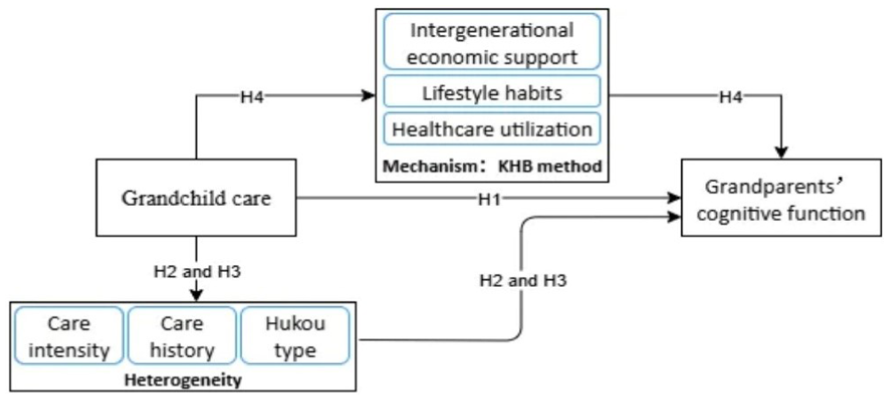
The analytical framework.
Materials and Methods
Data Source
This study utilizes data from the 2018 wave of the China Health and Retirement Longitudinal Study (CHARLS). The survey questionnaire was designed in alignment with international standards, drawing on the methodologies of the Health and Retirement Study (HRS) in the United States, the English Longitudinal Study of Ageing (ELSA), and the Survey of Health, Ageing and Retirement in Europe (SHARE). The survey covered 150 counties and 450 communities (villages) across 28 provinces (autonomous regions and municipalities) in China, using a multi-stage probability proportional to size (PPS) sampling method at both county/district and village levels. The year 2018 was selected because it contains particularly detailed cognitive health data for middle-aged and elderly respondents. The project aims to collect high-quality microdata representative of Chinese households and individuals aged 45 and above to support research on population aging. Since the initial stages of cognitive aging typically begin in midlife (45–59 years), and individuals in China often start assuming grandparental caregiving roles during this period, focusing solely on older adults would risk missing the critical early window of cognitive changes and the initial impacts of caregiving. Therefore, this study defines its sample as middle-aged and older adults aged 45 and above. After excluding observations with missing or invalid values in key variables, the final analytical sample consists of 6,809 individuals.
Variable Definitions
Dependent Variables
Cognitive function is measured using two proxy variables: memory ability and calculation ability.
Memory ability comprises both immediate and delayed recall. Respondents were read a list of 10 Chinese words and asked to recall them immediately. One point was awarded for each correctly recalled word, resulting in an immediate recall score ranging from 0 to 10. After a delay during which other questions were administered, respondents were again asked to recall the 10 words, yielding a delayed recall score (also 0–10). The overall memory score is the average of the immediate and delayed recall scores, ranging from 0 to 10, with higher values indicating better memory ability.
Calculation ability is assessed based on the number of correct answers in a serial subtraction task where respondents were asked to subtract 7 from 100 sequentially 5 times. One point was given for each correct subtraction, resulting in a score between 0 and 5. Higher scores reflect better calculation ability.
Core Independent Variable
The key explanatory variable is grandchild care, derived from the question: “In the past year, did you or your spouse spend time caring for your grandchildren or great-grandchildren?” A value of 1 indicates providing such care, 0 indicates not providing care. The term “grandparent” in this study refers to individuals aged 45 and above who report providing informal care to their grandchildren, regardless of biological relation or legal guardianship. The focus is on caregiving behavior rather than formal family structure.
Control Variables
To mitigate potential confounding effects, several demographic variables were controlled for. Gender is coded as 1 for male and 0 for female. Marital status is represented dichotomously, respondents who reported being married and cohabiting with their spouse, or married but temporarily separated due to circumstances such as work, were classified as having a spouse (coded as 1). Those who were separated, divorced, widowed, or never married were categorized as without a spouse (coded as 0). Household registration (hukou) is included as a binary variable, with agricultural hukou assigned a value of 1 and non-agricultural hukou a value of 0. Educational attainment is grouped into four categories: primary school or below, junior high school, senior high school, and college or above. The descriptive statistics for all variables are summarized in Table 1, which provides a preliminary overview of the data structure to support subsequent empirical analysis.
Descriptive Statistics of Variables.

Source. CHARLS (2018) data were used.
Note. Sample size: N = 6809.
As summarized in Table 1, the sample was relatively balanced by gender (mean = 0.516) and had an average age of 63.187 years. Most respondents were married (mean = 0.783) and primarily held agricultural hukou status (mean = 0.816), with the majority having an educational attainment of primary school or below (mean = 0.688). This demographic profile suggests that the study’s findings primarily represent a relatively younger, less-educated, and predominantly rural segment of the older population.
Empirical Strategy
We first employ an ordinary least squares (OLS) regression model to examine the impact of grandchild care on the cognitive function of middle-aged and older adults. To address potential endogeneity concerns, we further apply an instrumental variable (IV) approach and propensity score matching (PSM). Finally, we use the Karlson–Holm–Breen (KHB) method to test the mediating effects of intergenerational financial support, health behaviors, and healthcare utilization (Kohler et al., 2011). The baseline OLS model is specified as follows:

where
Results
Baseline Results
Table 2 presents the OLS regression results examining the impact of grandchild care on the cognitive function of middle-aged and older adults. The results indicate that providing grandchild care has a significant positive effect on both memory and calculation abilities. Even after controlling for demographic variables and including province fixed effects, grandchild care remains significantly and positively associated with improved memory (
Stepwise Regression Analysis Results.

Note. Standard errors are in parentheses.
, **, and *** denote significance at the 10%, 5%, and 1% levels, respectively. Applies to subsequent tables.
Grandchild care represents a form of social participation and an active lifestyle, which contributes positively to grandparents’ cognitive health. For middle-aged and older adults, involvement in stimulating activities can delay the process of cognitive decline, while a lack of cognitive stimulation may have detrimental effects on cognitive function.
As shown in Table 2, the vast majority of control variables exerted significant effects on both memory and calculation abilities among middle-aged and older adults, a finding largely consistent with the existing literature. Variables such as gender, age, marital status, household registration (hukou), and educational attainment all showed significant associations with cognitive function in this population.
Specifically, male respondents exhibited significantly higher calculation ability than their female counterparts. Overall, cognitive performance declined markedly with age. Individuals with a spouse showed significantly better cognitive outcomes than those without, likely because a spouse provides a key source of close social interaction, while the absence of a partner may contribute to emotional distress and depression that negatively affect cognition. Furthermore, respondents with non-agricultural hukou demonstrated significantly better cognitive function than those with agricultural hukou. This difference may be explained by the relatively narrower social networks and limited activity ranges of older adults in rural areas, where a lack of community facilities further constrains opportunities for social engagement and cognitive stimulation. With respect to educational attainment, using “primary school or below” as the reference group, having junior high school, senior high school, or college and above education was significantly associated with better cognitive function. The strongest effect was observed among those with a college degree or higher, followed by those with a senior high school education.
Endogeneity Issues
The regression analysis of the effect of grandchild care on the cognitive function of middle-aged and older adults may suffer from endogeneity due to reverse causality and omitted variables. First, grandparents’ cognitive ability may influence their decision to provide grandchild care: better cognitive function increases the likelihood of providing care, while poorer cognitive function reduces it. Second, the decision to care for grandchildren is influenced by grandparents’ personal willingness, which may be affected by factors such as personality and subjective perceptions—variables that are difficult to measure directly and may thus lead to omitted variable bias.
To further address these endogeneity concerns, an instrumental variables approach was employed in the analysis presented in Table 3. The variable “whether there is a grandchild under the age of 16” was selected as an instrument for grandchild care. Having a grandchild under 16 increases the likelihood of providing care, satisfying the relevance condition. At the same time, it is unlikely to directly affect grandparents’ cognitive function, thus meeting the exogeneity requirement. Therefore, “whether there is a grandchild under the age of 16” is logically valid as an instrumental variable.
Instrumental Variable Estimates.

The regression analysis conducted using the two-stage least squares (2SLS) method, as presented in Table 3, demonstrates that grandchild care remains significantly and positively correlated with grandparents’ memory (
To further strengthen the robustness of the findings, a propensity score matching (PSM) approach was employed, as presented in Table 4. Although the instrumental variable (IV) method helps mitigate reverse causality and omitted variable bias, selection bias may persist due to the non-random self-selection into caregiving behavior. Therefore, PSM was applied to construct a counterfactual framework and correct for potential selection bias. As shown in Table 4, grandchild care has a significant positive effect on both memory and calculation abilities, supporting the robustness of the findings.
Propensity Score Matching Results.

Note. Nearest neighbor matching used two matches per unit, radius matching used a caliper of 0.0005, and kernel matching used default bandwidth.
Heterogeneity
Variations in Care Intensity
Prior research has predominantly assessed the effects of grandchild care on grandparents’ cognition using a binary measure (caregiving vs. non-caregiving). This study extends that work by examining variations in care intensity among caregiving grandparents, with the results presented in Table 5. We specifically analyze how weekly care hours affect memory and calculation abilities. Care intensity was measured based on responses to the survey question: “How many hours per week do you spend caring for this child?”
Effects of Care Intensity on Cognitive Function.

As shown in Table 5, the regression results indicate that both the linear term of caregiving time (memory:
According to role enhancement theory, caring for grandchildren can have positive effects on grandparents. Engaging in multiple social roles helps individuals integrate more effectively into society and gain greater satisfaction, thereby enhancing overall well-being. On the other hand, role strain theory suggests that grandchild care may compete with grandparents’ resources for self-care, forcing them to sacrifice certain less essential personal needs. As caregiving time increases, the importance of the compromised resources grows, thereby increasing the burden on grandparents. Under the joint influence of these two mechanisms, the marginal positive effect of grandchild care on the cognitive function of middle-aged and older adults diminishes with increased caregiving time.
Variations in Care History
The aforementioned studies only analyze the impact of caring for grandchildren on grandparents’ cognitive function from a static perspective. Cross-sectional data can only reflect the situation in the selected year and fail to capture long-term effects, making the findings incomplete. Therefore, this study will further examine the effects of changes in grandchild care status and different care history on the memory and calculation abilities of middle-aged and older adults from a dynamic perspective.
By examining data from the China Health and Retirement Longitudinal Study (CHARLS) from 2013 to 2018, information on grandchild care provision each year was obtained. The types of care history were categorized into four groups: never provided care, currently ceased care, newly commenced care, and continuous care. The detailed classification of different types of care history is provided in Table 6.
Classification of Different Types of Care History.

Note. “O” indicates no grandchild care was provided, and “√” indicates grandchild care was provided.
Table 7 presents the impact of different grandchild care history on cognitive function among middle-aged and older adults. Using those who never provided grandchild care as the reference group, both those who newly commenced care and those engaged in continuous care showed statistically significant positive effects on both memory and calculation abilities. In terms of the magnitude of the effects, newly commenced care had the strongest beneficial influence on memory and calculation abilities (Memory:
Effects of Care History on Cognitive Function.

These findings reflect the dynamic interplay between role enhancement and role strain theories. As shown in Table 7, compared to grandparents who provided no care, those who newly commenced care showed significant cognitive benefits, primarily driven by fresh emotional fulfillment, enhanced social engagement, and cognitive stimulation from acquiring new skills. However, for those in continuous care, these benefits diminish as the initial novelty and motivational effects wane, and long-term burdens—consistent with role strain theory—become more prominent. This balance between cognitive gains and role strain explains the observed gradient in benefits, thereby supporting Hypothesis H2.
Variations in Hukou Type
Household registration status (hukou) reflects differences in socioeconomic status, cultural context, and family values, which may lead to varying effects of grandchild care on the cognitive function of middle-aged and older adults. Therefore, a subgroup regression analysis is necessary to explore this relationship in a more detailed and precise manner.
Table 8 shows that providing grandchild care is significantly associated with improved memory and calculation abilities among both agricultural (Memory:
Subgroup Regression Results by Hukou Type.

Mechanism
Table 9 examines the mediating roles of intergenerational economic support, lifestyle habits, and healthcare utilization in the relationship between grandchild care and grandparents’ cognitive function. Intergenerational economic support is measured using two indicators: receiving financial support and providing financial support. Receiving financial support is measured by asking, “In the past year, how much financial support did you or your spouse receive from [child’s name]?” Providing financial support is measured by the question: “In the past year, how much financial support did you or your spouse give to [child’s name]?” Both variables are log-transformed in the regression analysis using the formula: j = ln (J + 1). Lifestyle habits are represented by three binary variables: whether the individual takes naps, whether they have quit smoking, and whether they participate in social activities. Each variable is assigned a value of 1 for “yes” and 0 for “no.” Healthcare utilization is measured by two binary variables: outpatient visits and hospitalization. Outpatient visits are determined by the question: “In the past month, have you visited a medical institution for outpatient care or received home-based medical services (excluding physical examinations)?” Hospitalization is assessed using the question: “In the past year, has a doctor recommended that you be hospitalized without you actually being hospitalized?” Both variables are coded as 1 for “yes” and 0 for “no.”
KHB Mediation Analysis Results.

Table 9 employed the Karlson-Holm-Breen (KHB) method to test for mediation effects, which is suitable for analyzing both single and multiple mediators. The KHB results are shown in Table 9. To examine the significance of each of the seven mediators on memory and calculation abilities, Columns (1) to (7) included only one mediator at a time, while Column (8) incorporated all mediators that exhibited significant mediating effects. As shown, the total effect coefficients in Columns (1) to (8) are all significantly positive, indicating that grandchild care generally enhances memory and calculation abilities. Among Columns (1) to (7), receiving financial support (Memory:
Discussion
This study systematically examines the impact of grandchild care on the cognitive function of middle-aged and older adults within the Chinese context, along with its underlying mechanisms. The main findings can be summarized as follows: First, the baseline regression results indicate that providing grandchild care has a significant positive effect on both memory and calculation abilities among middle-aged and older adults. This finding remains robust after addressing endogeneity concerns through instrumental variable (IV) estimation and propensity score matching (PSM), supporting the “use it or lose it” hypothesis (H1). This suggests that caring for grandchildren, as a form of cognitive and social engagement, helps slow cognitive aging in this population, supporting the “use it or lose it” hypothesis, which posits that engaged, stimulating activities can buffer against cognitive decline in aging (Hanushek et al., 2025; Hultsch et al., 1999). This result is consistent with studies by van Gelder et al. (2006) and Engelhardt et al. (2010), further corroborating that caring for grandchildren, as a form of family interaction, helps stimulate cognitive function.
Second, this study examines heterogeneity in grandchild care effects through care intensity and history (H2). Findings reveal an inverted U-shaped relationship between care hours and cognitive function: benefits peak at moderate intensity but decline with excessive hours due to role strain. The inflection points (memory: 71.7 hr/week; calculation: 75.8 hr/week) far exceed Western thresholds (e.g., 9 hr/week; Hughes et al., 2007; Lee et al., 2003), reflecting cultural differences. In Confucian societies like China, intensive care is both common (Hoang et al., 2020; Ko & Hank, 2014) and culturally meaningful—a valued family role rather than a burden. From a dynamic perspective, both newly commenced care and continuous care are associated with improved cognitive function, with the former demonstrating a stronger effect. This pattern supports the integrated influence of role enhancement and role strain theories: newly commenced care provides heightened emotional engagement, social participation, and cognitive stimulation (Hayslip et al., 2014), whereas the benefits of continuous care may be partially offset by the accumulated strain over time (Farmer & Ferraro, 1997). These findings extend cross-sectional evidence by delineating the temporal dynamics of caregiving.
Third, despite structural disparities in resource allocation between urban and rural areas due to the household registration (hukou) system, this study finds that providing grandchild care has a positive impact on cognitive function for both agricultural and non-agricultural hukou holders. This finding fails to support Hypothesis H3 and presents a noteworthy contrast with Yuan et al. (2023), who reported a higher risk of cognitive impairment associated with rural hukou. This suggests that grandchild care, as a prevalent informal engagement within Chinese families, may provide comparable cognitive benefits across socioeconomic backgrounds. The cognitive stimulation, emotional fulfillment, and role enhancement (Hayslip et al., 2014) inherent in this caregiving behavior may, to some extent, mitigate the cognitive disadvantages associated with the structural barriers of the hukou system.
Finally, the mechanism tests show that receiving intergenerational financial support and participation in social activities are significant mediating variables (H4a, H4b). Receiving intergenerational financial support demonstrates a significant mediating effect, consistent with the findings of Hu et al. (2025), indicating that adult children may increase financial support to their parents out of gratitude or compensation, thereby providing a material foundation for grandparents’ cognitive health (Yuanfeng & Xu, 2024). However, no significant mediating effect was found for providing financial support, suggesting that cognitive benefits are driven more by the receipt of resources than by the psychological rewards of giving support (Cheung, 2023; Huang & Fu, 2021). Although providing behavior enhances well-being in other contexts (Thomas, 2010), it is less critical than receiving resources for directly promoting cognitive function in caregivers. This highlights the differential impact of receiving versus providing on cognitive health in intergenerational exchanges. Social activity participation serves as another significant mediating pathway, providing support for the “use it or lose it” hypothesis (Hultsch et al., 1999) and role enhancement theory (Sieber, 1974). Caring for grandchildren often naturally embeds more social interactions (e.g., community engagement, social activities during school pickups), which offer sustained cognitive stimulation and constitute an important protective factor against cognitive decline (Poff et al., 2024). In contrast, healthcare utilization does not play a significant mediating role, indicating that the cognitive advantages of grandchild care are not primarily achieved through increased medical consumption. Although healthcare generally has a positive impact on health outcomes (Gallet & Doucouliagos, 2017), it is not a core mechanism in this framework. This finding suggests that policy efforts should focus on building social support and economic compensation systems rather than relying solely on the existing healthcare system.
Compared to existing research, the contributions of this study lie in integrating the dual perspectives of “dose effects” and “dynamic trajectories,” incorporating the hukou system into the analytical framework, thereby providing more nuanced evidence for understanding the cognitive benefits of grandchild care and exploring the mechanisms behind its impact on grandparents’ cognitive function. The results emphasize that moderate involvement, social interaction, and economic support are key to maximizing the positive effects of grandchild care.
Conclusion
Based on data from the 2018 China Health and Retirement Longitudinal Study (CHARLS), this study systematically analyzes the impact of grandchild care on the cognitive function of middle-aged and older adults and its mechanisms. The main conclusions are as follows:
Firstly, grandchild care overall significantly improves the memory and calculation abilities of middle-aged and older adults, supporting the “use it or lose it” hypothesis and confirming the feasibility of the active aging concept within Chinese family practices. Secondly, the impact of grandchild care on cognitive function exhibits significant heterogeneity. The benefits are greatest at moderate care intensity, while excessively high intensity leads to negative effects due to role strain. Both newly commenced care and continuous care have significant positive effects on older adults’ cognitive function, with the effect being stronger for newly commenced care. Thirdly, despite the urban-rural dual structure, grandchild care enhances cognitive function for both agricultural and non-agricultural hukou holders, demonstrating its universal value across hukou types. Finally, receiving intergenerational financial support and participation in social activities are important mediating mechanisms through which grandchild care influences cognitive function, highlighting the crucial role of intra-family intergenerational reciprocity and social integration in promoting cognitive health.
In summary, this study argues that grandchild care is not only a form of sharing family responsibilities but also a potential strategy for promoting healthy aging. Policy design should focus on guiding “moderate care intensity,” strengthening intergenerational support, and encouraging social participation to maximize its cognitive benefits.
Based on the above conclusions, this study proposes the following policy implications: (a) Promote and support “moderate care” with enhanced community services. Given the inverted U-shaped relationship between care intensity and cognitive benefits, policies should guide families toward reasonable intergenerational division of labor to prevent grandparents from undertaking excessive care burdens. It is recommended to strengthen the development of age-friendly and childcare-friendly community facilities, such as establishing senior activity centers, community childcare centers, and intergenerational activity spaces. These facilities can provide grandparents with opportunities for social interaction, leisure, and temporary childcare services, alleviating the pressures of continuous caregiving while promoting their social participation and cognitive engagement. (b) Establish economic incentives and social recognition mechanisms for grandchild caregivers. Research indicates that receiving intergenerational financial support is a significant pathway to improving caregivers’ cognitive health. The government could consider implementing tax reductions, care subsidies, or pension contribution credits to provide financial compensation to grandparents who actively participate in grandchild care. This would not only mitigate the reduction in self-health investment due to caregiving commitments but also enhance their willingness to continue providing care. Meanwhile, public awareness campaigns could be conducted to increase societal recognition of the contributions made by grandchild caregivers. (c) Foster social participation and intergenerational interaction to build a “cognition-friendly” community environment. Given that social activity participation is another significant mediating mechanism, communities should actively organize cultural, educational, and recreational activities involving both grandparents and grandchildren, such as community elderly universities, parent-child reading corners, and intergenerational integration courses. These initiatives can strengthen grandparents’ social connections and cognitive stimulation, while also enhancing their sense of achievement and well-being during caregiving, thereby forming a virtuous cycle.
Limitations and Future Research
This study has several limitations, which point the way for future research: First, although instrumental variable (IV) and propensity score matching (PSM) methods were employed to mitigate endogeneity concerns, the potential influence of unobserved variables (such as personality traits and family relationship quality) cannot be entirely ruled out. These factors may simultaneously affect both caregiving decisions and cognitive outcomes, resulting in potential residual confounding. To strengthen causal claims, future studies could utilize longer-term longitudinal (panel) data to track cognitive trajectories or identify natural experimental settings, for instance, those created by policy reforms that generate exogenous variations in caregiving demands, to establish more robust causal identification. Second, the cognitive assessment was confined to memory and calculation tasks, omitting domains like executive function and language. Consequently, the findings reflect grandchild care’s association with specific cognitive abilities but may not capture its full impact on overall cognitive health. Future studies should employ more holistic assessment tools to advance this research. Third, while this study utilized data from CHARLS, the sample structure was skewed toward younger, less-educated older adults with agricultural household registration. Although nationally representative, future research should employ more diverse samples to enhance the generalizability of the findings. Fourth, in the CHARLS database, variables such as social activity participation and napping were based on self-reported data, which may be subject to biases from subjective perception, memory error, or social desirability. Future research could improve measurement validity by incorporating objective behavioral data, such as digital monitoring, time-use diaries, or sleep tracking. Fifth, the study did not delve into the differential effects of factors such as the grandchildren’s age or the type of care provided (e.g., daily care vs. educational companionship) on cognitive outcomes. These aspects warrant further detailed analysis in subsequent research. Finally, cultural specificity should be considered when interpreting the findings. Grandchild care behaviors in China are deeply rooted in Confucian values of filial piety, family responsibility, and intergenerational reciprocity, which may enhance their positive effects on cognitive function. In contrast, these mechanisms may differ in more individualistic Western contexts. Future studies should include cross-cultural comparisons to examine how cultural frameworks shape the relationship between caregiving and cognition.
Footnotes
Acknowledgements
The authors extend their sincere gratitude to the China Health and Retirement Longitudinal Study (CHARLS) team for providing access to the data that made this research possible.

Ethical Considerations
This study used secondary data from the China Health and Retirement Longitudinal Study (CHARLS). CHARLS received ethical approval from the Institutional Review Board at Peking University (Approval No. IRB00001052-11015). All participants in the original survey provided written informed consent. No new data were collected by the authors, and no animal studies were conducted.
Consent to Participate
All CHARLS participants provided written informed consent during the original data collection. No additional consent procedure was required for this secondary data analysis.
Author Contributions
Yadi Wang contributed to the study design, data analysis, interpretation of the findings, manuscript drafting, and revisions.
Funding
The author received no financial support for the research, authorship, and/or publication of this article.
Declaration of Conflicting Interests
The author declared no potential conflicts of interest with respect to the research, authorship, and/or publication of this article.