




Abstract
This study investigates the impact of career determinants on the academic performance of undergraduate accounting students in Ghana, with a specific focus on the mediating role of career preference intention. Drawing on the social cognitive career theory and the theory of planned behaviour, we propose and test a model where career preference intention mediates the relationship between various career determinants and academic performance. Data were collected from 360 undergraduate accounting students from two public universities in Ghana using a structured questionnaire. We employed Partial Least Squares Structural Equation Modelling (PLS-SEM) for the analysis. The findings reveal that career preference intention positively mediates the relationships between career determinants and academic performance. Specifically, students who were determined to pursue an accounting career demonstrated higher academic performance. Interestingly, we found that job factors directly influenced students’ academic performance. These results suggest that by encouraging students’ career preference intention, educators and universities can enhance academic outcomes. The study provides important theoretical and practical implications for accounting education, especially in developing economies.
Introduction
Accounting education is essential for developing the skilled professionals needed to manage financial systems and drive economic growth. Globally, educational policymakers recognise the importance of empowering students with the knowledge and skills necessary to meet the demands of a dynamic economy. A primary indicator of a student’s mastery of these skills is their academic performance, which serves as a foundational measure of their readiness for a professional career (Ahinful et al., 2019).
In Ghana, while there has been a consistent record of high pass rates for financial accounting at the high school level (WAEC, 2016–2020), this trend has not been mirrored in higher education or professional examinations. Reports from the Institute of Chartered Accountants Ghana (ICAG, 2016, 2018) and other studies (Ahinful et al., 2019; Issahaku, 2017) highlight a worrying decline in the academic performance of accounting students at the tertiary level, leading to student rustication and reduced enrolment. This underperformance is a significant concern, as it directly impacts the national supply of qualified professional accountants, which currently falls short of the country’s demand (ICAG, 2017).
A potential factor contributing to this academic decline is a lack of student interest and commitment, which can stem from inappropriate career choices (Igere, 2017; Saayir & Sande, 2020). Students’ career decisions are often influenced by career determinants, which include a range of factors such as personal interests, the influence of referent groups (e.g., family and peers), and job-related attributes like salary and prestige (Owusu et al., 2019). These determinants shape a student’s career preference intention, which reflects their willingness and determination to pursue a specific profession. This intention is a fundamental link between a student’s motivations and their academic effort, and it ultimately influences their academic performance (Yamen, 2019).
The existing literature on career determinants and academic performance has largely focussed on developed countries with established career guidance frameworks (Hammour, 2018; Jackling & Keneley, 2009; Muhamad et al., 2020; Ng et al., 2017). This creates a significant contextual gap, as there is a scarcity of studies examining these relationships within a less developed country context like Ghana, which presents unique educational, cultural, and socioeconomic factors that may alter these dynamics. Importantly, while existing research has explored the direct relationships between some of these variables (Agyenim-Boateng et al., 2025; Amaning et al., 2020; Nanjundaswamy et al., 2025), there is a theoretical deficit. Specifically, the cascading mechanism through which career determinants translate into academic success remains empirically untested in the extant literature. This study, therefore, introduces and empirically tests the mediating role of career preference intention, a central element of career theory, to better understand this complex process.
This study is thus designed to address these critical gaps by rigorously examining the mediating role of career preference intention in the relationship between personal, reference, and job factors, and the academic performance of undergraduate accounting students in Ghana. This research offers significant contributions to the extant literature, both theoretically and practically. Theoretically, by integrating career determinants, preference intention, and academic performance into a single, cohesive structural model, this study provides a more comprehensive understanding of the motivational framework that underpins student success. It extends social cognitive career theory by establishing the central role of mediation, demonstrating how external influences are internalised into career intent, which subsequently drives performance in a developing economy context. Furthermore, the findings will provide actionable evidence for accounting educators, university administrators, and policymakers. By identifying which specific determinants most strongly influence students’ intentions and subsequent performance, institutions can design targeted interventions, enhanced career guidance programmes, and curriculum reforms to improve student outcomes and directly address the persistent national shortage of qualified professional accountants in Ghana.
The remainder of the study is organised as follows: Section 2 reviews the related literature, Section 3 outlines the methodology, Section 4 presents the analysis and findings, Section 5 discusses the results, and Section 6 concludes the study.
Literature Review
Theoretical Foundation: Integrating SCCT and TPB
This study is anchored in a synergistic application of two foundational behavioural theories: Social Cognitive Career Theory (SCCT) and the Theory of Planned Behaviour (TPB). While both frameworks have been extensively applied in isolation to explain career-related choices, their combined application provides a more robust and comprehensive lens through which to examine the complex relationship between personal, social, and job-related factors, and their ultimate influence on students’ academic performance via career preference intention.
The Social Cognitive Career Theory (SCCT), developed by Lent et al. (1994), posits that career-related choices are a dynamic interplay among personal attributes (self-efficacy), external environmental factors, and an individual’s behaviour. The core of SCCT lies in the relationship between an individual’s self-efficacy (confidence in one’s ability to succeed) and their outcome expectations (beliefs about the consequences of performing a specific behaviour). An individual who believes they are capable of performing a task and expects positive outcomes from that task is more likely to develop an interest, set a goal, and persist in that career path (Brown & Lent, 2019; Ho et al., 2025; Lent et al., 2000). In the context of this study, a student’s confidence in their ability to master complex accounting subjects (personal factors/self-efficacy) and their belief that this will lead to a high-paying, prestigious job (job factors/outcome expectations) directly influences their academic and career goals.
The Theory of Planned Behaviour (TPB), introduced by Ajzen (1988), offers a complementary perspective by explaining the psychological drivers of human action. TPB proposes that an individual’s behavioural intention is the most immediate predictor of their actual behaviour. This intention, in turn, is shaped by three key determinants: attitude towards the behaviour, subjective norms, and perceived behavioural control (Bin & Wahid, 2025). Attitude refers to the degree to which a person holds a favourable or unfavourable evaluation of the behaviour. Subjective norms are the perceived social pressures to perform or not perform the behaviour (e.g., from family or peers). Perceived behavioural control, which closely parallels the concept of self-efficacy in SCCT, is a person’s belief in their ability to perform the behaviour (Baba et al., 2025).
The integration of these two theories is essential for a holistic understanding of the research problem. While TPB effectively captures the immediate antecedents of intention (attitude, subjective norms, perceived control), SCCT provides a deeper explanation for the formation of these antecedents. Specifically, the “personal factors” in this study, such as quantitative skills and interest, can be conceptualised as aspects of SCCT’s self-efficacy and TPB’s perceived behavioural control. Similarly, the “job factors” align with SCCT’s outcome expectations and TPB’s attitude towards the behaviour. The “referent factors” directly correspond to TPB’s subjective norms. This integrated framework allows the researchers to examine not only what influences career preference intention, but also how these influences are formed and, ultimately, how they collectively predict academic performance, as shown in the conceptual model.
Specifically, the conceptual model, depicted in Figure 1, visually represents the hypothesised relationships among the study’s variables. This model is a direct application of the integrated theoretical framework, proposing that personal, referent, and job factors influence academic performance indirectly through the mediating role of career preference intention.

Conceptual model of the study.
Hypotheses Development
Personal Factors and Academic Performance
Grounded in the Social Cognitive Career Theory and the Theory of Planned Behaviour, this hypothesis posits that personal factors such as a student’s interest, willingness to study, and quantitative skills are integral to their self-efficacy and perceived behavioural control. Individuals with a strong belief in their capabilities are more likely to set goals and persist in challenging tasks, leading to better academic outcomes. This theoretical link is consistently supported by empirical evidence. Academic excellence, often measured by the Grade Point Average (GPA) or Cumulative Grade Point Average (CGPA), is a primary objective for most academic institutions (Garkaz et al., 2011; Kumar et al., 2021). Researchers have identified several personal factors as influential, including personal interest and aptitude for accounting (Jackling & Calero, 2006; Owusu et al., 2019; Uyar et al., 2011). Studies by Guney (2009) and Issahaku (2017) found that students with good learning attitudes and habits, such as spending more time on studies, achieve higher academic performance. Furthermore, research by Kukreja and Aali (2013) demonstrated that a high level of academic interest can lead to intellectual development and better performance, a finding supported by Fallan and Opstad (2014) and Ahinful et al. (2019). Moreover, while a number of studies have looked at accounting education and career (e.g., Agyenim-Boateng et al., 2025; Cuzdriorean et al., 2025; Ho et al., 2025; Nanjundaswamy et al., 2025), limited attention has been lent to personal factors of accounting students that may determine their academic performance. The convergence of theory and evidence leads the present study to propose that these personal factors will significantly influence academic performance.
Referent Factors and Academic Performance
This hypothesis is informed by the TPB’s concept of subjective norms, which recognises the influence of significant others such as family, peers, and mentors. These referent groups can provide a fundamental support system or exert social pressure that impacts a student’s commitment. When a student perceives that their significant referents approve of their academic and career choices, they are more likely to be motivated and committed, which can positively impact their academic performance. The influence of referent factors on academic performance is well-documented (Anis & Hanafi, 2015; Cotton et al., 2025; Zakaria et al., 2012). A study in Pakistan by Khan et al. (2019) found a significant correlation between a supportive family background and improved student performance. Similarly, Arora and Singh (2017) concluded that a positive family environment significantly predicts a college student’s academic success. Additionally, the occupational and educational levels of parents have been shown to have a significant influence on accounting students’ performance, a finding confirmed by Odoh et al. (2017) and Xiang and Yu (2018). Derrick et al. (2022) linked parenting engagement to academic performance. In all this, students in accounting education are rarely considered. We, therefore, hypothesises that:
Job Factors and Academic Performance
This hypothesis is derived from SCCT’s focus on outcome expectations and TPB’s attitude towards the behaviour. The more a student perceives a career to offer positive outcomes such as high remuneration and prestige, the more favourable their attitude towards the profession will be. This positive perception is expected to strengthen their resolve and efforts, which in turn influences their academic performance (Hoti & Zenuni, 2024). Job-related factors, including the availability of employment, high financial rewards, and desired working conditions, serve as powerful motivators for students (Bekoe et al., 2018; Tan & Laswad, 2006). According to the SCCT, these outcome expectations fuel individuals’ behaviours and help them sustain effort when confronted with challenges (Agyenim-Boateng et al., 2025; Brown & Lent, 2019). Akhter and Rahaman (2020) and Olufemi et al. (2018) revealed that students’ perceptions of the job market have a significant effect on their academic performance, as they are motivated to put forth greater effort to meet employer demands. This is further validated by a study from Brook and Roberts (2021), which concluded that the perceived availability of a job market motivates accounting students to study harder and achieve a better cumulative grade point average. Based on these, the researchers theorise that:
Career Preference and Academic Performance
Drawing directly from the core tenet of the TPB, an individual’s behavioural intention is the most immediate predictor of their actual behaviour. In this context, a strong intention to pursue an accounting career is expected to translate into concrete actions, such as greater effort, focussed study habits, and a commitment to achieving high grades, which are necessary to secure a job in the field. Career preference intention, an individual’s readiness to pursue a particular career, is a key element in the TPB, as it is believed to directly precede and guide behaviour (Tang & Seng, 2016). A study by Igere (2017) found a significant relationship between career preference and academic performance. Her findings were consistent with studies by Aminu and Timothy (2014) and Hellen and Kitainge (2016), which demonstrated that students who were either forced into a programme or had no interest in it performed poorly. These studies underscore that a student’s commitment and effort are strongly tied to their personal preference for a career path. This is further supported by Owusu et al. (2019), Okwuduba et al. (2021), Slåtten et al. (2021), and Tadese et al. (2022), who found that students with a strong self-interest and preference for a given profession achieved higher grades. Thus, this study proposes that:
Mediating Role of Career Preference Intention
This final hypothesis posits a complex relationship where career preference intention acts as a mediating variable. The theoretical arguments for the preceding hypotheses suggest that personal, referent, and job factors are the initial drivers that shape a student’s career preference intention. This intention then serves as the pivotal mechanism through which those factors are translated into tangible academic performance outcomes. The mediating role of career intention is crucial for a complete understanding of the relationships. As per the TPB, intentions represent the key elements that affect a student’s behaviour (Tang & Seng, 2016). When attitudes towards a career (job factors), subjective norms (referent factors), and perceived behavioural control (personal factors) are favourable, they enhance an individual’s career preference intention, which in turn influences their behaviour and, ultimately, academic performance (Ndovela & Mutanga, 2024; Phal, 2025). This is why studies like those by Aminu and Timothy (2014) and Hellen and Kitainge (2016) found that lack of interest (or intention) directly led to poor academic outcomes. While the literature supports this link, this study makes a unique contribution by empirically testing this mediation model within the specific context of Ghanaian undergraduate accounting students, a gap given limited attention in the extant literature (Agyenim-Boateng et al., 2025; Ho et al., 2025; Nanjundaswamy et al., 2025). We fill this lacuna by hypothesising that:
Methodology
This study adopted a quantitative research approach to test the hypotheses and examine the relationships among the variables. The explanatory research design was selected as the most appropriate framework because it seeks to explain the connections and influence between factors, aligning with the study’s objective of testing the proposed conceptual model and the mediating role of career preference intention. This design, which relies on a deductive approach, is well-suited for a study that uses a survey to collect data and tests a pre-existing theoretical framework (Skinner & Dancis, 2020).
Population and Sample
The population for this study consisted of all Level 400 undergraduate accounting students (N = 438) from two universities in Ghana. These universities were purposively selected because they are known for their established accounting programmes. The decision to focus exclusively on Level 400 students was based on the fact that they have completed the majority of their coursework and thus have a comprehensive Cumulative Grade Point Average (CGPA), which serves as the key measure of academic performance. Afrogha et al. (2020) supports this approach, noting that a student’s final CGPA is rarely significantly different from their CGPA at the end of Level 300, making this cohort a reliable group for analysis. Given the manageable size of the population, a census approach was adopted, where all 438 students were targeted to participate. A total of 415 questionnaires were retrieved, resulting in a high response rate. After an initial data screening process, 360 valid responses were retained for the final analysis.
Instrument and Data Collection
Data were collected using a self-administered questionnaire, which was chosen to ensure confidentiality and anonymity, thereby encouraging more candid and reliable responses from participants. The questionnaire was structured into three main sections (see Appendix). Part A collected demographic information about the respondents. Part B was designed to measure the key variables, including personal, referent, and job-related factors, as well as career preference intention. These items were measured on a five-point Likert scale ranging from Strongly Disagree (1) to Strongly Agree (5). The scales were adapted from established instruments in the literature, particularly from Odia and Ogiedu (2013) and Awadallah and Elgharbawy (2021). Part C was dedicated to collecting self-reported data on academic performance, specifically the respondents’ Cumulative Grade Point Average (CGPA) as of the end of Level 300 and their expected CGPA after Level 400. The use of self-reported CGPA is a well-established practice in educational research (Connely et al., 1998; Hensley, 1995; Mansfield et al., 2009).
Prior to final administration, the questionnaire was pre-tested to refine its content, eliminate ambiguities, and ensure legibility. The instrument’s reliability was assessed using Cronbach’s Alpha, with all scales demonstrating excellent internal consistency, yielding scores that ranged from .89 to .95, well above the acceptable threshold of .70 (Hair et al., 2014). Ethical approval was obtained from the universities’ institutional review boards to ensure the study adhered to all necessary ethical protocols. Participants provided written informed consent, and strict measures were implemented to ensure anonymity and confidentiality throughout the data collection process. Participation was entirely voluntary, with no coercion involved, and participants retained the right to withdraw at any time. Respondents were assured that all information gathered would remain anonymous and be used solely for research purposes. In accordance with the principle of anonymity, the questionnaire did not include any questions that could reveal respondents’ identities, such as names, home addresses, or telephone numbers. The study was designed to minimise any potential risks, and the expected benefits of advancing knowledge in career preference and academic performance outweighed any risk of harm to the participants.
Data Analysis
The collected data were first coded and organised for analysis. The analysis was performed using Partial Least Squares Structural Equation Modelling (PLS-SEM) via SmartPLS 3.1.7. This technique was selected due to its suitability for a study with a relatively small sample size and for its ability to model complex relationships involving both direct and mediating effects (Hair et al., 2019). Descriptive statistics were used to summarise the characteristics of the data. PLS-SEM was then applied to perform the inferential analysis, which included testing the hypothesised direct relationships between the variables and assessing the mediating role of career preference intention.
Analysis and Findings
Demographic Profile of Respondents
The demographic analysis of the 360 valid responses provides key insights into the study’s sample. As shown in Table 1, male respondents (64.7%) had a significantly higher response rate than female respondents (35.3%). The data also indicated that the majority of respondents were in a relatively youthful age bracket, with 60.8% of the participants aged between 21 and 23 years. This demographic profile is representative of a typical undergraduate student population in accounting education programmes.
Socio-Demographic Characteristics of Respondents.

Source. Author computations (2025).
Assessment of the Measurement Model
The research instrument’s reliability and validity were assessed by evaluating the measurement model using confirmatory factor analysis (CFA) within SmartPLS. This assessment is crucial for establishing the quality of the data before testing the hypotheses. The five latent constructs (Academic Performance, Career Preference Intention, Job Factors, Personal Factors, and Referent Factors) and their 23 observed variables were evaluated.
The CFA model demonstrated a good fit with the data, as indicated by the following indices: CFI = 0.921, SRMR = 0.072, RMSEA = 0.005, and PClose = 0.087. These values all met or exceeded the recommended thresholds, confirming that the model provides a strong representation of the data (Table 2).
CFA Model Fit Indices.

Source. Author computations (2025).
Note. CFI = comparative fit index; SRMR = standardised root mean square residual; RMSEA = root mean square error of approximation; PClose = p-value for close fit.
Reliability and Validity
The individual item reliability was assessed by examining the outer loadings of each construct’s measure. As suggested by Hair (2014) and Taherdoost (2016), all observed indicators in the measurement model were found to have a convergence of above 0.60 with their respective latent constructs, as shown in Table 3. Internal consistency was measured using Composite Reliability (CR) and Cronbach’s Alpha. As shown in Table 3, all latent constructs showed CR and Cronbach’s alpha statistics above the recommended threshold of .70 (Bagozzi & Yi, 1988; Hair et al., 2014). This confirmed the internal consistency of the constructs. Convergent validity was further established as the Average Variance Extracted (AVE) for each construct exceeded the .50 threshold (Hair et al., 2014; Taherdoost, 2016).
CFA Loadings, AVE, CR, and Cronbach’s Alpha.

Note. AP = academic performance; CPI = career preference intention; JF = job factors; PF = personal factors; RF = referent factors; CR = composite reliability; CA = Cronbach’s alpha; AVE = average variance extracted.
Source. Authors’ computations (2025).
Discriminant and Divergent Validity
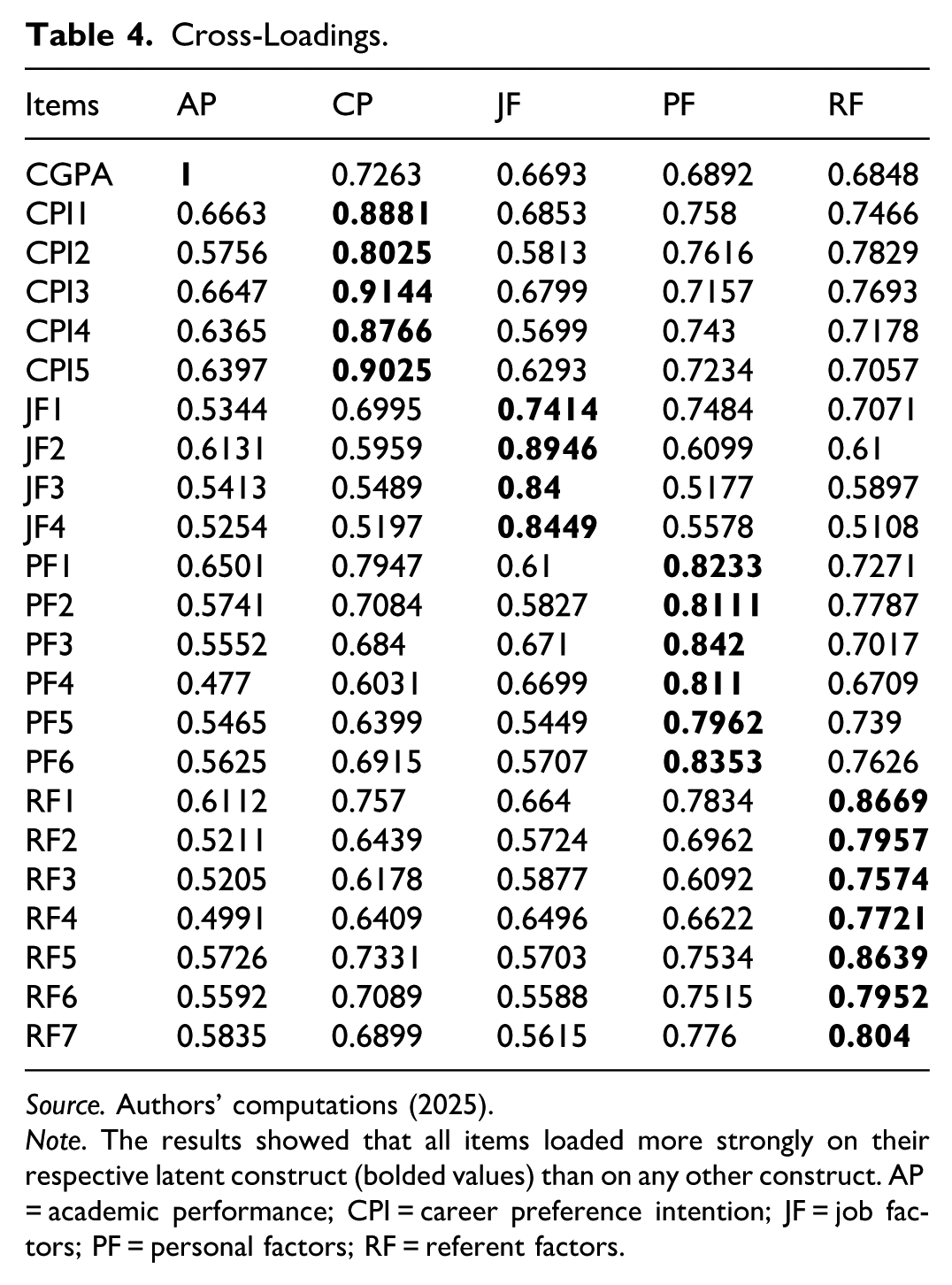
To confirm discriminant validity, we first performed a cross-loading analysis. The results showed that all items loaded more strongly on their respective latent construct than on any other construct (Table 4).
Cross-Loadings.
Source. Authors’ computations (2025).
Note. The results showed that all items loaded more strongly on their respective latent construct (bolded values) than on any other construct. AP = academic performance; CPI = career preference intention; JF = job factors; PF = personal factors; RF = referent factors.
Additionally, the researchers used the Fornell-Larcker criterion, where the square root of each construct’s AVE (the bolded diagonal values) must be greater than its correlation with all other constructs. Table 5 shows that this condition was met for all constructs, indicating that each one is unique and does not capture the same phenomenon as another.
Fornell-Larcker Criterion.

Source. Authors’ computations (2025).
Note. AP = academic performance; CPI = career preference intention; JF = job factors; PF = personal factors; RF = referent factors.
Finally, as proposed by Henseler et al. (2015), the Heterotrait-Monotrait Ratio (HTMT) was assessed. A latent construct is considered to have discriminant validity when its HTMT ratio is below the recommended threshold of 0.850. The HTMT values for each of our constructs were 0.712, 0.788, 0.617, 0.502, and 0.601, all well below the threshold (Table 6). The constructs are, therefore, deemed to have discriminant and divergent validity.
Heterotrait-Monotrait Ratio (HTMT).

Source. Authors’ computations (2025).
Note. AP = academic performance; CPI = career preference intention; JF = job factors; PF = personal factors; RF = referent factors.
Assessing the Structural Model
The structural model was evaluated to determine the relationships between the latent constructs. This assessment included tests for multicollinearity, coefficient of determination (R2), and predictive relevance (Q2), followed by a detailed analysis of the hypotheses, including both direct and mediating effects.
Collinearity Assessment
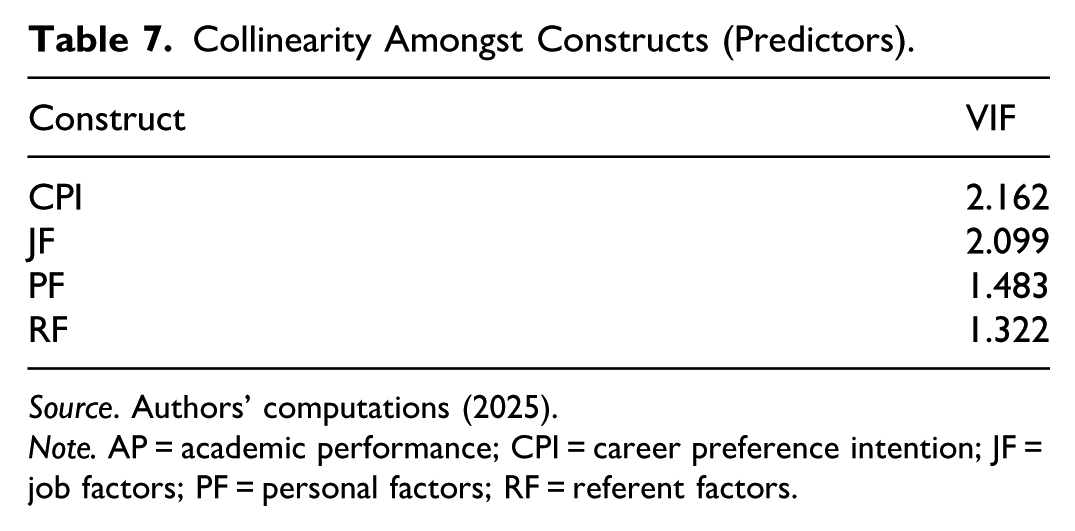
We first assessed the model for multicollinearity between the predictor variables by examining the Variance Inflation Factor (VIF). According to Kock and Lynn (2012) and Kock (2014), VIF values greater than 3.3 indicate pathological collinearity and potential common method bias. The results of our analysis showed a minimum VIF of 1.322 and a maximum of 2.162, all well below the recommended threshold. This indicates the absence of multicollinearity and common method bias in the model (Table 7).
Collinearity Amongst Constructs (Predictors).
Source. Authors’ computations (2025).
Note. AP = academic performance; CPI = career preference intention; JF = job factors; PF = personal factors; RF = referent factors.
Predictive Accuracy and Relevance
The model’s predictive accuracy was measured by the coefficient of determination (R2). Our results, summarised in Table 8, showed an R2 of 0.578 for Academic Performance, which is considered a moderate value (Hair et al., 2014). This indicates that 57.8% of the variation in Academic Performance is explained by the combined effects of job factors, personal factors, and reference factors. We also assessed the predictive relevance (Q2) of the model on the endogenous variable, with a result of 0.553, indicating a strong predictive relevance. This confirms that the exogenous variables are effective predictors of the endogenous variable. Furthermore, the effect sizes (f2) were evaluated. The results revealed that job factors have a large effect size on the endogenous variable, while personal factors and reference factors have a small effect size, following the guidelines of Hair et al. (2014) where 0.02, 0.15, and 0.35 are considered small, medium, and large effects, respectively.
Summary of the Results.

Source. Authors’ computations (2025).
Note. AP = academic performance; JF = job factors; PF = personal factors; RF = referent factors.
Hypotheses Testing
This section presents the results of the hypotheses testing, including both the direct and indirect effects of the study’s variables.
Direct Effects
The study first assessed the direct relationships between the independent variables and the dependent variable, as well as the relationships leading to the mediating variable (Career Preference Intention). Table 9 presents the results for all direct paths, showing the beta coefficients (beta), T-statistics, and p-values.
Results of Direct Effects.

Source. Authors’ computations (2025).
Note. Age and gender were controlled for. AP = academic performance; CPI = career preference intention; JF = job factors; PF = personal factors; RF = referent factors.
From Table 9, the effect of personal factors on academic performance was found to be statistically insignificant (β = .1065, t = 1.1446, p > .05). The relationship between referent factors and academic performance was also found to be insignificant (β = .0619, t = 0.5927, p > .05). On the other hand, job factors were found to have a statistically significant positive effect on academic performance (β = .2595, t = 4.6763, p < .05). Similarly, career preference intention had a significant positive effect on academic performance (β = .3959, t = 4.3422, p < .05). All three career determinant variables (Job, Personal, and Referent Factors) had a statistically significant relationship with career preference intention, confirming the first part of the mediation model, while career preference intention’s statistically significant relationship with academic performance confirmed the second part of the mediation model.
Indirect (Mediation) Effects
A mediation analysis was conducted to examine the intermediate role of Career Preference Intention, particularly for the paths that showed insignificant direct effects. According to Nitzl et al. (2017), a significant indirect effect is the only prerequisite for establishing mediation. As shown in Table 10, the results indicate that Career Preference Intention significantly mediates the relationships between all three independent variables and Academic Performance.
Results of Indirect Mediation Effects.

Source. Authors’ computations (2025).
Note. The analysis controlled for age and gender. AP = academic performance; CPI = career preference intention; JF = job factors; PF = personal factors; RF = referent factors.
Computations were done using 10,000 bootstrap resamples.
Summary of Hypothesis Outcomes
Based on the criteria for mediation outlined by Nitzl et al. (2017), the study’s results revealed both partial and full mediation. Table 11 and Figure 2 provide a comprehensive summary of the outcomes for all tested hypotheses.
Summary of Hypotheses Test Outcomes.

Source. Authors’ construct (2025).

Structural model.
Discussion
This study examined the direct and indirect influences of career determinants – personal factors, job factors, and reference factors – on the academic performance of accounting students, with a particular focus on the mediating role of career preference intention. Drawing on both the Social Cognitive Career Theory (SCCT) and the Theory of Planned Behaviour (TPB), the findings provide valuable insights into the complex relationship between a student’s career aspirations and their academic success within the unique educational context of Ghana.
Our analysis of the direct effects yielded a mix of expected and counterintuitive findings. First, personal factors (
This study thus provides a nuanced explanation for these findings. We argue that in such educational environments, the link between personal interest and academic performance is not direct but is instead fully mediated by career intention. This offers a critical micro-level perspective that complements macro-level discussions regarding evolving business paradigms (Nanjundaswamy et al., 2025), by demonstrating that intrinsic interest, on its own, is insufficient to drive academic performance in this specific context.
Similarly, the results for reference factors (
In contrast, job factors (
Furthermore, the direct relationship between career preference intention (
The core of this study’s theoretical contribution lies in the mediating role of career preference intention, which provides the missing explanatory mechanism for the influence of other factors on academic performance. The results revealed a full mediation for both personal factors (
Additionally, the analysis showed a partial mediation for job factors (
Implications
This study provides valuable insights with both significant theoretical and practical implications, stemming from our findings on the relationship between career determinants, career preference intention, and the academic performance of accounting students in Ghana.
Our research offers a nuanced perspective on the TPB, demonstrating how the link between attitudes (personal interest) and subjective norms (reference group influence) and the final behaviour (academic performance) is fully mediated by behavioural intention (career preference intention) in Ghana’s examination-focussed educational system. This finding extends the TPB by highlighting how the full mediating role of intention can be a function of the external environment. This provides a fundamental lesson for educators and curriculum designers, who must recognise that cultivating genuine interest and leveraging social support is not enough to guarantee academic success. The focus should be on building a student’s firm and internalised career intention, as this is the psychological mechanism that drives the behavioural effort required to excel.
Furthermore, our findings provide a specific application of the Social Cognitive Career Theory. We offer empirical evidence from a developing country that the link between extrinsic outcome expectations (job factors) and academic success is both direct and indirect. This partial mediation suggests that job-related motivators have a powerful dual effect: they directly drive students to perform well, and they indirectly strengthen their commitment to their chosen career path, which in turn enhances their performance. From a practical standpoint, this accentuates the importance for educators and university career services to continually emphasise the tangible benefits of a career in accounting, such as job security, high demand, and competitive salaries. By consistently reinforcing these extrinsic motivators, they can strengthen students’ resolve and ultimately improve academic outcomes.
Finally, the study’s findings on the mediating role of intention offer a clear strategic roadmap for accounting educators and policymakers. Given that both personal and reference factors are fully dependent on a student’s career intention to influence performance, a key focus should be on career guidance and mentorship programmes. These programmes should be designed not just to inform students about the profession, but to help them solidify a personal, determined career preference.
Limitations and Directions for Future Research
This study, while providing valuable insights, is not without its limitations, which in turn offer promising avenues for future research.
First, the research design is cross-sectional, meaning data were collected at a single point in time. This approach, while effective for testing our proposed model, limits our ability to establish definitive causality among the variables. Future research should employ a longitudinal design to better understand the evolution of the relationships between career determinants, career preference intention, and academic performance over time. Second, the data were collected from a specific context: undergraduate accounting students in Ghana. While this provides novel insights from a developing economy, the findings may not be generalisable to other disciplines (e.g., medicine, engineering) or to developed economies. Future studies could replicate this research in different sectors and in other geographical regions to test the universality of our findings.
Third, the data relied on self-reported survey measures, which may be susceptible to common method bias. Although statistical tests were performed to mitigate this, future research could use a multi-source approach, incorporating both archival data (e.g., official student grade records) and stakeholder interviews to provide a more robust and objective measure of the variables. Finally, as with many behavioural studies, there is the potential for omitted variable bias, since not all relevant factors influencing career intentions and performance can be fully captured in a single model. This study sought to mitigate this risk by including basic demographic controls, specifically sex and age, which are known to systematically influence academic and career-related outcomes. Nonetheless, future research should expand the set of control variables to include socioeconomic background, prior academic achievement, and institutional characteristics to further minimise bias and enhance the robustness of findings.
Conclusion
This study set out to investigate the direct and indirect influences of career determinants – personal, reference, and job factors – on the academic performance of undergraduate accounting students in Ghana, with a focus on the mediating role of career preference intention. By employing a robust analytical framework informed by the Theory of Planned Behaviour and Social Cognitive Career Theory, our findings provide a comprehensive understanding of the complex pathway from a student’s motivations to their academic outcomes.
The empirical results reveal that while personal interest and social pressures from referent groups do not directly influence academic performance, their effect is fully transmitted through a student’s career preference intention. This highlights that for students in a highly examination-focussed environment, a positive attitude or social support is insufficient; they must first internalise these factors and develop a firm, determined intention to pursue the career. In contrast, job factors, which represent powerful extrinsic motivators, influence academic performance both directly and indirectly via career preference intention, underscoring their pivotal role in shaping both a student’s resolve and their ultimate academic success.
These findings make several important contributions. Theoretically, our study extends the TPB by demonstrating that the full mediating role of intention can be a function of the external environment, providing a refined perspective on this foundational theory. It also provides a specific application of the SCCT, offering a granular, dual-pathway explanation for how extrinsic motivation and outcome expectations operate in a developing economy. From a practical standpoint, the study offers a clear strategic roadmap for accounting educators, policymakers, and university career services. The key implication is the need to shift from solely promoting interest in the profession to actively encouraging and solidifying a student’s career preference intention through focussed mentorship and career guidance programmes that continually reinforce the tangible benefits of the accounting profession.
While this study provides valuable insights, it is subject to several limitations, including its cross-sectional design and reliance on a specific context. Future research should consider longitudinal studies to better understand the evolution of these relationships, replicate this research in other disciplines and geographical regions, and use multi-source data to provide a more robust measure of the variables. In conclusion, this study provides a vital understanding of the psychological mechanisms linking career aspirations to academic success in an under-researched context, offering a clear path forward for enhancing student outcomes and addressing the shortage of qualified accountants.
Footnotes
Appendix
Author Note
The authors declare that the submitted work is our original work and that it is currently not under review by any other journal

Ethical Considerations
For ethical considerations, approval was secured from the University of Cape Coast Institutional Review Board with approval number UCCIRB/CES/2022/13.
Consent to Participate
The respondents’ written informed consent also ensured that the data collected from them would be used for academic purposes, including the publication of articles.
Consent for Publication
Respondents provided written informed consent, and strict measures were taken to maintain anonymity and confidentiality throughout the data collection process. Participation was entirely voluntary, with no coercion involved.
Author Contributions
Emmanuel Yaw Arhin was involved in the conception, literature review, design, analysis and interpretation of the data. He was also responsible for drafting the paper and revising the article critically for intellectual content and was involved in the final approval of the version to be published.
Edward Marfo-Yiadom was involved in the conception, design, and interpretation of the data. He was also involved in revising the article critically for intellectual content and the final approval of the version to be published.
Joseph Tufuor Kwarteng was involved in the literature review, design and analysis of the data; He was also involved in revising the article critically for intellectual content and the final approval of the version to be published
Emmanuel, Edward and Joseph agree to be accountable for all aspects of the work.
Funding
The authors disclosed receipt of the following financial support for the research, authorship, and/or publication of this article: This research did not receive any specific grant from funding agencies in the Public, Commercial, or not-for-profit sectors.
Declaration of Conflicting Interests
The authors declared no potential conflicts of interest with respect to the research, authorship, and/or publication of this article.
Data Availability Statement
The data gathered for the study is available upon request from the corresponding author.