



Abstract
Vocational education is crucial for cultivating skilled talent, and the integration of industry and education plays a pivotal role in this process. This study employs a combination of latent Dirichlet allocation (LDA) and word embedding (Word2vec) models to analyze 27 Chinese vocational education policies on industry-education integration issued between 2014 and 2023. The analysis identifies two distinct stages of policy evolution: an initial phase (2014–2018) characterized by national-level strategic guidance and broad frameworks, and a subsequent phase (2019–2023) marked by regional implementation, refined governance structures. Over time, policy focus has shifted in three key ways: from national to regional strategic design, from flexible to structured organizational frameworks, and from basic talent cultivation to a more comprehensive industry-education synergy. By applying semantic analysis to vocational education policy research, this study offers a structured approach for tracking policy evolution and provides a replicable framework for analyzing vocational education policies globally. The findings contribute to the discourse on industry-education integration and offer practical insights for policymakers aiming to enhance vocational education systems.
Plain Language Summary
Vocational education is crucial for cultivating skilled talent, and the integration of industry and education plays a pivotal role in this process. This study employs a combination of latent Dirichlet allocation (LDA) and word embedding (Word2vec) models to analyze 27 Chinese vocational education policies on industry-education integration issued between 2014-2023. The analysis identifies two distinct stages of policy evolution: an initial phase (2014–2018) characterized by national-level strategic guidance and broad frameworks, and a subsequent phase (2019–2023) marked by regional implementation, refined governance structures. Over time, policy focus has shifted in three key ways: from national to regional strategic design, from flexible to structured organizational frameworks, and from basic talent cultivation to a more comprehensive industry-education synergy. By applying semantic analysis to vocational education policy research, this study offers a structured approach for tracking policy evolution and provides a replicable framework for analyzing vocational education policies globally. The findings contribute to the discourse on industry-education integration and offer practical insights for policymakers aiming to enhance vocational education systems
Introduction
Vocational education is a key driver of economic growth and workforce development, equipping individuals with the skills necessary to meet the demands of modern industries (UNESDOC, 2016). As economies transition toward green and digital development (UNESDOC, 2022), vocational education systems worldwide are undergoing significant transformations to enhance their responsiveness to evolving labor market needs. A widely recognized approach to improving the effectiveness of vocational education is industry-education integration, which aims to align educational outcomes with industry requirements, ensuring that graduates possess relevant competencies (European Union, 2020).
Existing research on vocational education or industry-education integration policies has primarily adopted qualitative approaches, focusing on case studies, policy reviews, and expert opinions (Hardy & Liu, 2022; Zhang et al., 2024). While these studies provide valuable insights, they often lack a systematic, data-driven analysis of policy evolution. The quantitative study of policy texts remains limited, particularly in the context of vocational education. Some recent works have explored topic modeling and semantic analysis in education policy research (Li & Xue, 2022; Liu & Wong, 2024), but their application to industry-education integration policies—especially in China—has been scarce. Given China’s status as the world’s largest vocational education system (Ministry of Education, 2023) and its strategic commitment to cultivating a highly skilled workforce (State Council, 2019b, 2022), understanding the trajectory of its policy evolution can offer valuable insights for both scholars and policymakers.
To bridge this research gap, this study applies latent Dirichlet allocation (LDA) and word embedding (Word2vec) to analyze 27 Chinese industry-education integration policies issued between 2014 and 2023. LDA enables the identification of latent thematic structures within policy texts, while Word2vec captures semantic relationships and shifts in policy focus over time. These methods have been successfully employed in policy studies related to education and governance (Lin & Chen, 2023; Sadigov et al., 2024), but their use in examining the evolutionary dynamics of vocational education policy remains underexplored. By integrating these text-mining techniques, this study provides a structured and replicable framework for analyzing policy evolution quantitatively.
This study focuses on three key objectives:
Analyze the Content and Evolution of Policies—Identify dominant themes and their progression over time using LDA and Word2vec models.
Explore Policy Evolution Dynamics—Examine shifts in policy priorities to uncover trends and underlying drivers of industry-education integration.
Apply a Quantitative Text-Mining Approach—Demonstrate the utility of advanced semantic analysis techniques in policy research, offering a replicable framework for studying vocational education policies globally.
By achieving these goals, the study contributes to global discourse on vocational education by aligning with international strategies, such as UNESCO’s vision for Technical and Vocational Education and Training (TVET) to meet the demands of the green and digital economies, and the European Union’s vocational education frameworks, which emphasize labor market alignment and lifelong learning. Beyond academic contributions, this research offers actionable insights for policymakers aiming to develop robust and adaptive vocational education policies. Furthermore, the study’s replicable framework provides guidance for other nations seeking to enhance their industry-education integration strategies, fostering global collaboration and knowledge exchange in vocational education policy development.
The Literature Review presents a literature review on policy research in the fields of vocational education and the integration of industry and education, as well as the LDA model and Word2vec model. The Methodology section introduces the methods and approaches used in the study. Building on these methodological foundations, The Results section and the Evolution Analysis section show the topic content and topic evolution of the two stages of the policy text analysis of the integration of industry and education related to vocation education, respectively.
Literature Review
Overview of Existing Research
Research on vocational education and industry-education integration policies has been predominantly qualitative and has explored several critical dimensions, including policy evolution, policy implementation, drivers of policy change, and comparative international analyses.
Firstly, research on vocational education policy evolution has primarily concentrated on historical trajectories and shifts in policy approaches. Abersek (2004) explored the transformation of Slovenia’s vocational education system, highlighting the shift from traditional, skills-based training toward modern competency-based frameworks, reflecting broader industrial and economic changes at the global level. Similarly, Shen et al. (2021) provided an in-depth analysis of China’s vocational education policies, systematically dividing them into distinct developmental phases, each responding to evolving national economic policies and priorities. Their analysis revealed crucial insights into the logical underpinnings and implementation challenges faced by these policies.
Secondly, extensive policy reviews by Li & Huang (2021) have provided insightful reflections on the establishment of China’s industry-education integration system, emphasizing challenges related to coordination among educational institutions, enterprises, and governmental entities. Similarly, Luo & Yang (2023) examined Swiss vocational education and training (VET) governance, highlighting the effective mechanisms that have allowed Switzerland to adapt successfully to labor market automation. Both studies underscore that effective policy implementation frequently encounters complexities stemming from regionally distinct economic structures and governance frameworks.
Thirdly, researchers have extensively investigated the driving forces behind and future trajectories of vocational education policies. Zhou et al. (2023) utilized the Multi-source Flow Theory to analyze the evolution of vocational education policies, emphasizing that shifts have been primarily driven by structural changes in industries and consequent labor market demands. Yuan and Zhang (2022), through an extensive textual analysis of 104 governmental policies from 2013 to 2021, highlighted emerging trends toward policy diversification and specialization, particularly focusing on the digital and green economies, forecasting further policy expansion and region-specific adjustments. Cheng et al. (2024) provided empirical support to these claims by proposing the Triple Helix Model for industry-education-city integration, suggesting that regional governments will increasingly take on significant leadership roles due to localized economic conditions and the necessity for closer alignment between education and industry.
Lastly, the methodological approaches in existing studies largely include textual analysis (Haybi Barak & Shoshana, 2024), discourse analysis (Chen & Wang, 2019), and comparative studies (Ibsen & Thelen, 2024). While these qualitative methods have provided deep insights into policy content and context, they fail to systematically quantify semantic patterns and evolutionary trends, highlighting a clear research gap.
Limitations of Current Quantitative Research
Although quantitative methods such as content analysis and text mining have been employed in vocational education policy research, they frequently rely on basic techniques like word frequency analysis and policy-tool classification (Jiang et al., 2023; S. Xu & Wei, 2022). These approaches tend to capture superficial lexical features without addressing deeper semantic content or patterns. Furthermore, classifications such as supply-type or demand-type policies inherently rely on subjective judgments, limiting their reproducibility and interpretive robustness. This situation underscores the necessity for advanced, data-driven approaches capable of uncovering latent semantic relationships within policy texts, which remain largely underexplored in vocational education policy research.
Methodological Contributions of This Study
This research responds directly to these identified limitations by integrating latent Dirichlet allocation (LDA) with Word2vec, offering a more sophisticated quantitative method for policy text analysis. Although the LDA model has been previously applied successfully to identify latent topics in large textual datasets (Gan & Qi, 2021; Lin & Chen, 2023), its effectiveness is constrained by its “bag-of-words” approach, neglecting contextual relationships among words. The addition of Word2vec (Mikolov et al., 2013), which captures semantic relations between words through embedding techniques, significantly improves the contextual sensitivity of textual analysis.
Prior studies applying a combined approach of LDA and Word2vec have proven effective in various domains, such as patent and literature analyses (Gao et al., 2022; Xiang et al., 2023), yet this approach remains novel in the domain of vocational education policy analysis. Furthermore, previous attempts to analyze education-related policies using LDA alone (Ma & Qirui, 2023; Ruthven, 2018) or qualitative comparative analysis (Chen & Wang, 2019; Y. Wang & Gao, 2021) have not addressed the contextual semantic limitations effectively. Therefore, by combining LDA with Word2vec, this study contributes methodologically by addressing these semantic limitations and enhancing the precision and depth of vocational education policy analysis.
Research Gaps and Significance
In summary, this literature review clearly identifies several key gaps. Current qualitative studies lack the ability to generalize thematic findings systematically across larger datasets. Existing quantitative approaches have limitations in capturing deeper semantic structures within policy texts. Consequently, there remains an urgent methodological need for more advanced quantitative techniques to analyze vocational education policy documents systematically.
This study explicitly addresses this gap by applying an advanced, combined quantitative approach—LDA integrated with Word2vec—to examine China’s vocational education policy evolution systematically. This methodological advancement, coupled with empirical analysis of policy evolution, provides significant contributions to the field, filling critical gaps in vocational education policy research while providing a replicable analytical framework applicable to global contexts.
Methodology
The framework of this study consists of four components (Figure 1; Gao et al., 2022; Jin et al., 2024): (a) collection of policy texts in the field of industry-education integration related to vocational education; (b) text preprocessing; (c) determining the optimal number of topics for the LDA model during each phase, calculating the distributions of both topic-characteristic words and documentation-topics, and extracting the topics of texts during each phase; and (d) using Word2vec to map the topics of different phases into a unified vector space, thereby generating topic vector matrixes for different phases and calculating topic similarity across phases to support evolutionary analysis.

Framework for the analysis of policy evolution.
Data Collection
The policy text data referenced in this study were sourced from two authoritative platforms: “PKULaw” and the Official State Government website. These platforms provide comprehensive and reliable access to China’s policy documents. To ensure data accuracy and relevance, the following systematic screening and sorting criteria were applied:
Time Frame: The analysis focused on policy documents published between 2014 and 2023. This period was chosen because the 2014 document, Decision on Accelerating the Development of Modern Vocational Education (State Council, 2014), marked a significant milestone in China’s vocational education system, offering a framework for subsequent policies on industry-education integration.
Keyword Filtering: Policy documents were initially screened using the keywords “vocational education,”“industry-education integration,” and “school-enterprise cooperation” in the main text. This ensured that only documents explicitly addressing the study’s focus areas were included.
Content Relevance: Each document was reviewed to identify and extract paragraphs explicitly addressing industry-education integration and school-enterprise cooperation. Only texts that contained substantial and relevant content were retained for further analysis.
Independent Review Process: To enhance the reliability of the selection process, two independent researchers conducted the initial screening and document selection. Discrepancies were resolved through discussion, and consensus was reached with input from a third reviewer. This process ensured consistency and minimized selection bias.
Final Inclusion Criteria: A total of 27 national policy documents were retained after applying the above criteria. These documents were thoroughly reviewed, and segments closely related to the themes of industry-education integration and school-enterprise cooperation were extracted for detailed analysis.
The selected documents include a mix of overarching policy directives, implementation guidelines, and strategic frameworks, reflecting China’s evolving approach to vocational education and industry-education integration.
By adopting this rigorous approach, this study ensures the reliability, relevance, and depth of the policy text data analyzed, providing a robust foundation for uncovering the thematic evolution of industry-education integration policies in China
The 27 policy texts were subsequently divided into phases. The “Implementation Plan for the Reform of National Vocational Education,” (State Council, 2019a) proposed that “vocational education should transition from being modeled on general higher education to a distinctive type of education with enterprise participation” (E. Xue & Li, 2022), thus marking the beginning of a new industry-education integration phase. Furthermore, the number of industry-education integration policies remained low, peaking in 2019 (Figure 2). Therefore, this study identifies 2019 as the dividing line, and splits the policies into two phases: the first phase, which extends from 2014 to 2018 and includes 9 documents, and the second phase, which extends from 2019 to 2023 and includes 18 documents.

Number of policies enacted from 2014 to 2023.
Data Processing
To establish an effective text database, the policy text was subjected to the following processing steps. First, a lexicon consisting of retained words characteristic of the field of industry-education integration related to vocational education was created with reference to the keywords present in the academic literature, including terms such as “vocational education group” and “modern apprenticeships.” Subsequently, the policy texts were segmented and lexically tagged with the assistance of Python Jieba word segmentation toolkit. Then, a stop word lexicon was then developed, targeting words with minimal semantic research value. This lexicon was compiled by consulting established stop word lists, including the Library of Chinese Stop Words, the Harbin Institute of Technology Stop Words, the Baidu Stop Words List, and the Robot Intelligence Laboratory Stop Words Library from Sichuan University. (B. Wang et al., 2023). Furthermore, analytically low-value terms that appear frequently in the policy texts, such as “in principle” and “relevant departments,” were added to the stop words list. Finally, nouns and nominal verbs were retained, whereas verbs, adverbs, and other parts of speech were removed. Words with low semantic value were excluded from the segmented results to ensure that the lexicon contained terms that exhibited higher analytical value.
Policy Topic Mining Based on the LDA Model
The LDA model has become widely popular in text mining because of its robust generalization capabilities. Accordingly, following data processing, the LDA model was employed to extract topics from policy texts. Proposed by (Blei et al., 2002). This probabilistic generative model is effective for analyzing clusters within a corpus and identifying latent topic-related information in document collections. By obtaining the documentation-topic probability relationships, the potential topic of each document can be understood. Additionally, by obtaining the distributions of topic-characteristic words, the composition of characteristic words pertaining to each topic can be understood (Figure 3). By modeling the policy texts for both phases, the implicit topic information contained within the texts from each phase can be extracted.

LDA principles.
As a clustering algorithm, the LDA topic model requires a preset number of topics. Combining topic coherence (Mimno et al., 2011) with visual clustering (Rejeb et al., 2025) to determine the optimal LDA topic numbers is one of the commonly used approaches. Topic coherence measures the semantic similarity among words: a higher level of coherence indicates more semantically coherent topics and better identification by the model. Different coherence scores can be calculated for different numbers of topics. Usually, the coherence scores show an overall increasing trend as the number of themes continues to increase. However, including too many topics can result in overfitting. We need to combine the visual clustering and coherence scores to further determine the optimal number of topics.
Visual clustering requires the number of clusters to be set manually. The clustering effect is presented in the form of a bubble chart, in which context the size of the bubbles represents the topic weights, and the distance between the bubbles represents the correlations among the topics. For the extreme values of coherence scores, we perform visual clustering with the corresponding number of topics one by one, from which we select the number of topics with the best clustering effect.
Mining Topic Evolution via LDA and Word2vec
First, we use the preprocessed global dataset as word vectors to train the data, construct the word vector model. Then, we use the trained word2vec model to vectorize the topic words obtained from the LDA model and generate the corresponding word vector for each topic word. Assume a topic contains m keywords

The topic similarity between the two phases is subsequently calculated by reference to topic vectors based on the word vectors. A higher similarity value between the topic vectors associated with the two phases indicates a higher probability that the second phase inherits content from the first phase. For example, from phase 1 of the apprenticeship pilot to phase 2 of the comprehensive apprenticeship, although there are differences in breadth and depth, the focus of both stages remains on the apprenticeship system. Therefore, the topic similarity between the two stages is considered to be high. In this work, the cosine distance is used to calculate similarity, which computes the cosine of the angle between two vectors. The specific calculation formula used in this context is as follows:

Results
To explore how China formulates vocational education policies at different stages to cultivate high-skilled talent, we first aimed to extract relevant topics from corresponding policy texts by using the LDA model.
Determining the Number of Topics
To determine the optimal number of topics, we use a combination of topic coherence and visual clustering as mentioned in the Data Processing section. Topic coherence scores were calculated for different topic numbers (ranging from 2 to 10), and the highest local coherence score was observed when setting the number of topics to four. Additionally, visual clustering was performed using bubble charts, which showed that at four topics, the semantic separation between topics was optimal, with minimal overlap in content. These results confirmed that four topics provided the best balance between specificity and generalization, avoiding both underfitting and overfitting. Therefore, the number of topics for both phases was determined to be four (Figures 4–7).

Topic-coherence results, 2014 to 2018.

Topic-coherence results, 2019 to 2023.

Visual clustering results, 2014 to 2018.

Visual clustering results, 2019 to 2023.
Phase 1 Topics
The distribution of topic-characteristic words allows for a preliminary understanding of the topic content through the related characteristic words. The distribution of documentation-topic words reveals the probability of each policy document belonging to a particular topic, thereby identifying the most representative documents for each topic, which can be used for further understanding of the topic content.
Thus, combining the two (Figure 8 and Table 1) allows for a better explanation of the semantic content of the nine policies from 2014 to 2021. In Phase 1, the nine documents were assigned across four topics, with each document’s dominant topic shown in Table 1.
Topic 1: This topic focuses on the school management system. At this stage, the country explicitly supports the support of industries, enterprises, social organizations and other entities to participate in vocational education through the purchase of services, donations, guidance, etc. Vocational education, on the other hand, should be based on the region, aligned with the industry and serve the related enterprises. The preliminary framework understanding of industry-education integration at this stage emphasizes multi- entity participation and expanding the content of school-enterprise cooperation. An important organizational format that is often used to achieve this construction goal is the vocational education group. As early as 2002, both central and local governments viewed group-based schooling as a key strategy for revitalizing resources in the context of vocational education. The 2015 “Opinions of the Ministry of Education on Deepening the Group-based Schooling of Vocational Education” clarified that group-based schooling is an important direction for the development of modern vocational education. A vocational education group is a virtual organization that incorporates various entities, including government, industries, enterprises, and schools, aiming to promote industry-education integration through establishing a platform.
Topic 2: This topic focuses on teachers and teaching reform. At this stage, the country aims to cultivate “dual-qualification” teaching teams that possess both theoretical teaching abilities and practical job guidance skills through various methods, including “teacher training.” At the same time, teachers are encouraged to enhance their teaching research and improve their “basic courses” and “ specialized courses” so that their teaching content and processes align with the “work processes” of the job positions.
Topic 3: This topic focuses on enterprise-based new apprenticeships. The enterprise-based new apprenticeship system is implemented based on the principle of “government guidance, enterprise leadership, and school participation.” The pilot enterprises are primarily large and medium-sized state-owned enterprises, and the schools include educational training institutions such as “technical schools” and “training institutions.” Such training targets newly recruited or transferred employees, with teachers from both enterprises and schools helping employees enhance their skills through an alternating work-study format.
Topic 4: This topic focuses on modern apprenticeships. The modern apprenticeship system originally stems from German’s concept of “duales stadium.” The current phase of the modern apprenticeship system mainly involves pilot exploration. This system explores the synchronization of enrollment and recruitment, meaning that upon entering a pilot school, students also sign an “agreement” with an enterprise. The goal is for students entering such schools to be jointly trained by school teachers and enterprise mentors, following a standardized “training program.” This program aims to enhance workers’ comprehensive skills across both school and enterprise learning environments.

Phase 1 distribution of topic-characteristic words.
Phase 1 Distribution of the Documentation-Topic Results.

Phase 2 Topics
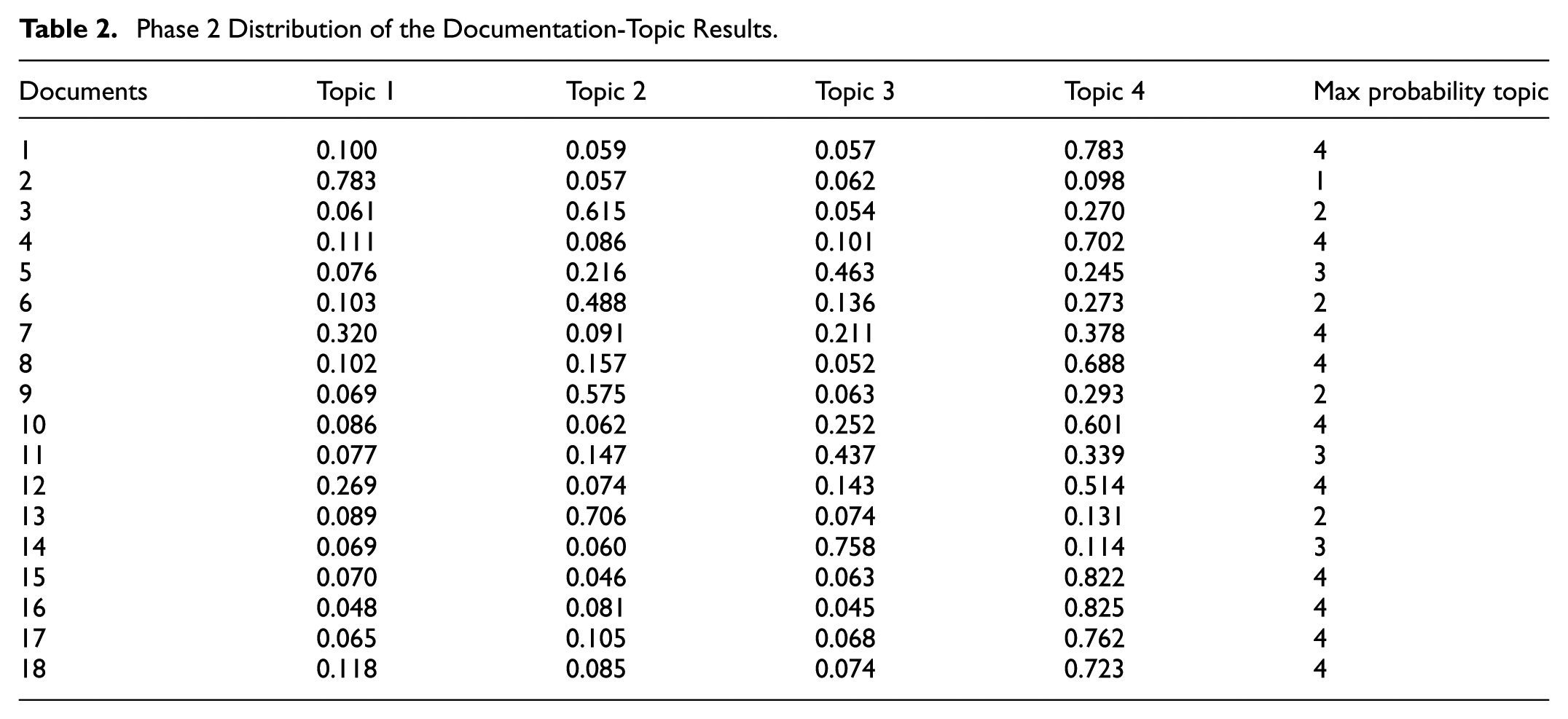
Similar to the Phase 1 Topics section, this section employs a combination of the distribution of documentation-topic (Figure 9) and topic-characteristic words (Table 2) to analyze the topic of 18 industry-education integration policy texts from 2022 to 2023. In Phase 2, the 18 documents were similarly distributed across 4 topics, and the dominant topic for each document is shown in Table 2.
Topic 1: This topic focuses on the internal system and operational mechanism. It encompasses three fundamental aspects of vocational education: (a) funding, of which the primary source for vocational education is the per-student allocation, which is supplemented by various funding avenues mentioned in topic 1 of Phase 1, (b) teachers, which means that reform related to teachers and teaching remains a significant task in Phase 2, and (c) educational direction, such that the structure of vocational education programs and talent cultivation should be “market-oriented” to promote supply-side structural reform of skilled talent.
Topic 2: This topic focuses on industry-education integration enterprises. Industry-education integrated enterprises are one of the construction tasks listed in the “Action Plan for Improving the Quality and Excellence of Vocational Education.” This initiative is led by national “development and reform” and “educational administration” departments, with the goal of transforming enterprises into significant entities for vocational education. The project is conducted using a model of cultivation followed by certification. Cultivation conditions include establishing vocational schools, undertaking pilot tasks for the modern apprenticeship and the enterprise-based new apprenticeship, undertaking vocational skill certification, and jointly building industry-education integrated training bases.
Topic 3: This topic focuses on practice skill enhancement. This topic includes two systems. The first is the “1 + X” certificate system, where “1” corresponds to an academic certificate, and “X” corresponds to multiple occupational skill level certificates. The goal is for students to master both professional theory and multiple practical skills during their time in school, with certification from relevant institutions. This certificate system is introduced in Phase 1 and widely promoted in Phase 2. The second is the apprenticeship, which includes the modern apprenticeship and the enterprise-based new apprenticeship from Phase 1, highlighting the transition from pilot projects in Phase 1 to comprehensive promotion in Phase 2. The implementation of both systems requires the establishment of a “dual-qualification” teacher team and further research into the teaching process.
Topic 4: This topic focuses on industry-education integration reform at the municipal level. This topic mainly includes industry-education integration cities, municipal industry-education integration consortia, and open regional industry-education integration practice centers. The goal of “municipal industry-education integration consortia” is to facilitate the deep participation of diverse entities in the process of operating vocational schools based on industrial parks, thereby promoting the symbiotic and coordinated development of talent cultivation in the context of vocational education as well as regional industries. The goal of “open regional industry-education integration practice centers” is to overcome the barriers that separate different education entities and facilitate the collaborative development of vocational education and training. Both construction tasks represent important contributions of “industry-education integration cities.”
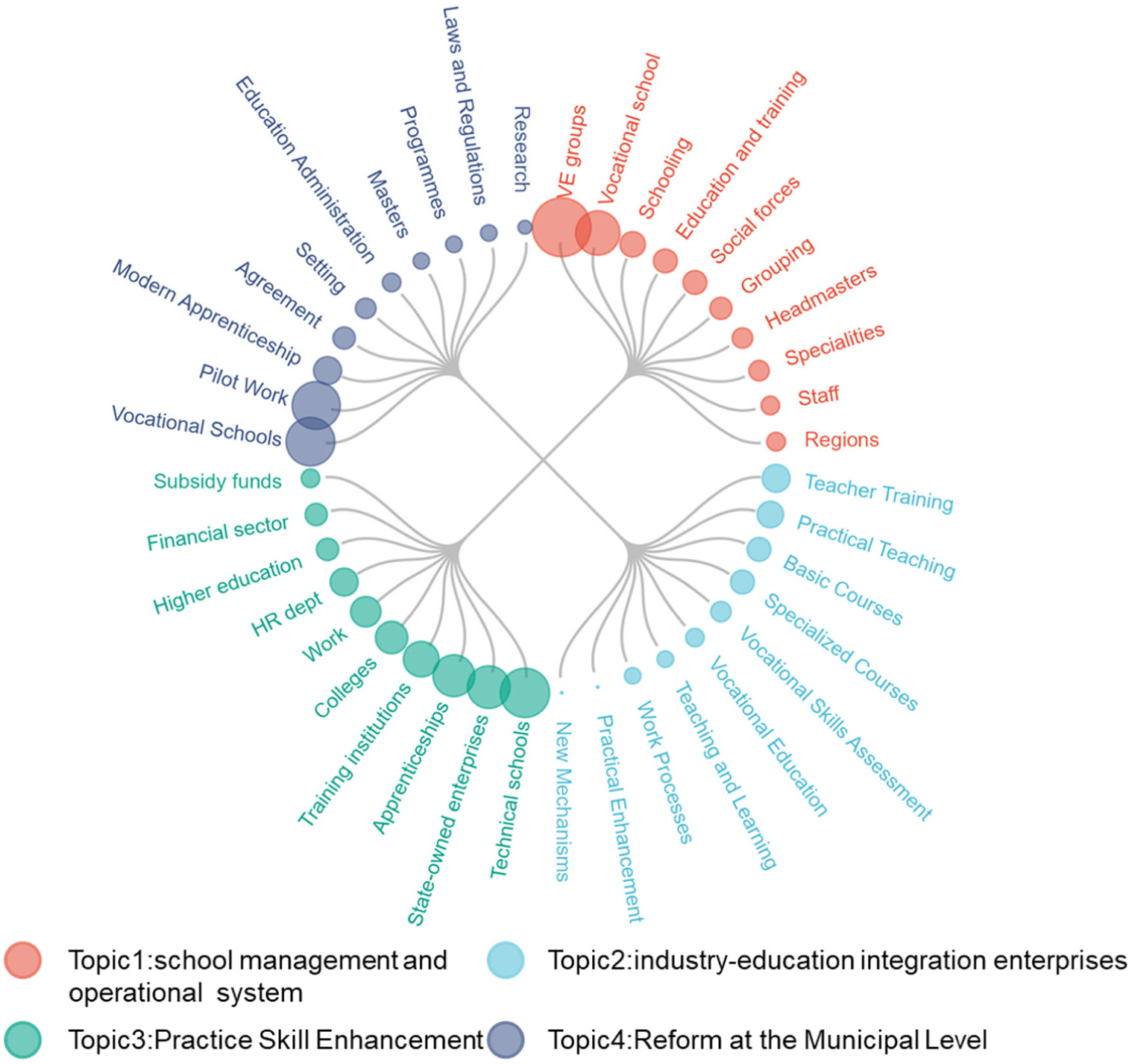
Phase 2 distribution of topic-characteristic words.
Phase 2 Distribution of the Documentation-Topic Results.
Evolution Analysis
Comprehensive Policy Evolution Analysis
The Results section has outlined two phases of analyzing topic content. To further explore how China’s vocational education policies evolve and the reasons behind this evolution, this study employs a combined approach consisting of the LDA model and Word2vec for policy text evolution analysis, as mentioned in the Mining Topic Evolution via LDA and Word2vec section.
In light of multiple experiments, this study set the word vector dimension of Word2vec to 100 and the window size to 5. The similarity threshold for topics in the two phases was set to 0.2 to exclude topic pairs that show low similarity. Figure 10 illustrates the evolution of the main topics in the field of industry-education integration related to vocational education across the two phases. In the topic evolution diagram, each node represents a topic, and the lines represent the connections among topics. The wider a given line is, the greater the similarity between the topics that it links.
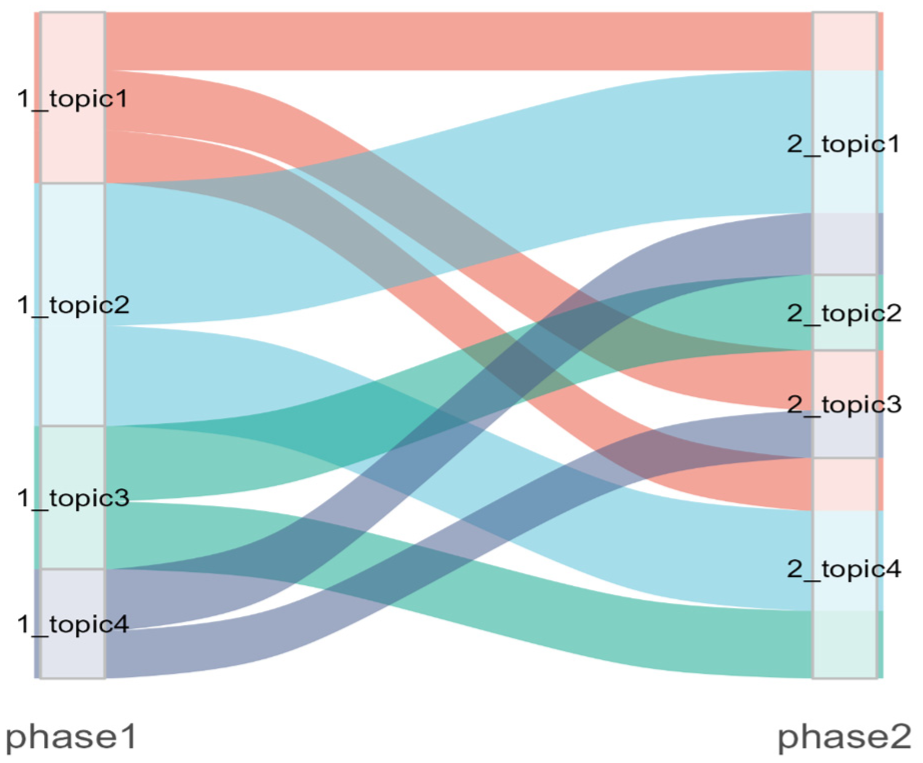
Topic evolutionary path.
Strategic Design Shifts to Regional Focus
In Phase 1, policies pertaining to industry-education integration related to vocational education were implemented via a top-down approach. At the central level, a series of pilot projects, such as modern apprenticeships, new enterprise-based apprenticeships, and the 1 + X certificate system, were introduced. These projects were supported by financial and administrative incentives, and they aimed to develop an institutional system and provide focused support for industry-education integration. This approach was crucial during the initial phase of constructing a modern vocational education system for China, as it was directly in line with the central government’s policy intentions regarding grassroots institutions and completed the foundational work.
However, during the transition from pilot projects to widespread implementation, the issue of “enthusiasm at the central level but indifference at the local level” Became increasingly relevant. Due to their lack of understanding of industry-education integration in vocational education, local governments have failed to establish a systematic policy framework alongside the central government. Moreover, due to differences in regional resources, policy implementation was characterized by significant spatial heterogeneity, and the Matthew effect on industry-education integration became more pronounced. Consequently, with regard to the transition of industry-education integration related to vocational education from a focus on rapid growth to an emphasis on high-quality development, it is historically inevitable for central and provincial governments to conduct joint explorations of a provincial-level modern system for industry-education integration related to vocational education.
Vocational education includes the “vocational domain,” the “technical domain,” the “educational domain” and the “social domain,” meaning that it must meet the needs of regional economic and social demands for skilled talent and technological innovation. Therefore, only when such education is fully linked with regional economic and cultural factors can high-quality development be achieved. On the one hand, vocational education can provide highly matched intellectual and technical support to support regional economic development. On the other hand, regional economies provide robust industrial support and high-quality material resources to support vocational education. By using industry-education integration as a bridge, vocational education incorporates regional industries into the professional development and talent training that it provides, thereby enhancing the alignment between education and regional industries. The prosperity of the regional economy directly affects the quality of the resources used to support vocational education, thereby establishing a symbiotic relationship that promotes the harmonious development of education and the economy. As local governments deepen their understanding of vocational education and industry-education integration, the establishment of connections and coordination between vocational education and regional economies become stronger. However, issues such as the fact that the quality of vocational education lags behind regional economic development as well as significant disparities in the degree of coupling between different regions persist. Thus, in Phase 2, Topic four reveals more regional attributes of industry-education integration. This topic focuses on pillar industries within regions and shifts the focus of development to the municipal and county levels, thereby emphasizing the establishment of industry-education consortia and open practice centers, which can be integrated with the development of industry-education integration cities. This approach generates bottom-up momentum, leading to the emergence of a new route for strategic design that takes advantage of localized efforts to promote broader development.
Organizational Form Becomes More Cohesive
In Phase 1, policies encouraged the establishment of connections between industry and education in loosely organized forms, such as vocational education groups, modern apprenticeships, and industry advisory committees. For example, “vocational education groups” were formed by stakeholders such as the government, enterprises, vocational schools, industry associations, and other organizations through contracts or informal memoranda. However, conflicts between individual and collective actions based on the interests of these various parties led to unstable organizational structures and high transaction costs in collaborations, resulting in insufficient integration outcomes. For example, while organizations typically want to quickly obtain the skilled talent they need at the lowest cost, talent cultivation usually takes a long time, and students may not work for the partner companies after graduation. Therefore, the development of organizational forms with embedded entities is urgently necessary.
In Phase 2, the industry-education integration enterprise project, which focused on the establishment of “learning factories” to support high-quality development, is a typical example of entity-based operational organizational forms. At this stage, enterprises become the main drivers of the industry-education integration schooling model. With regard to their production and business activities, enterprises must also cultivate practical technical skills. Due to the implementation of industry-education integration enterprises and corresponding cities, the limitations of industry participation in vocational education are gradually being addressed. This shift is partly due to policy-makers’ deeper understanding of the operations of vocational education on the basis of various industries, which has led to the emergence of an initial policy support system. Additionally, as enterprises continue to develop, their willingness to bear social responsibilities through talent training and to enhance their public credibility through multilateral dialogues increase.
The establishment of municipal industry-education consortia and industry-education integration communities, which represent two forms of industry-education integration organizations, represents an upgrade from projects at the enterprise and city levels. These organizations aim to established a shared destiny within the community with regard to industry-education integration by involving various stakeholders associated with industrial parks and cross-regional industry chains. However, unlike enterprise organizational forms, consortia and communities remain nonlegal entities. Despite the clear requirements for entity-based operations stipulated in the “Guidelines for the Construction of Industry-Education Integration Communities” and the “Indicators for the Construction of Municipal Industry-Education Consortia,” including the establishment of multiparty governing councils and rational benefit-sharing mechanisms, the transition from a virtual organization to a real organization through policies entails that motivating cross-border organizational participation remains a challenging task. This issue warrants greater attention in future policy development.
Integration Emphasizes Full Incorporation Over Talent Cultivation
In the new era and new development phase, in response to profound and complex changes in both domestic and international environments, industry inevitably requires high-quality human resources to support its transition to high-quality development. The initial goal of industry-education integration was to address the imbalance and mismatch between the supply and demand of human resources. By organically integrating “production” and “teaching,” such integration aimed to link professional education closely with job practices. Typical examples from Phase 1, such as various apprenticeship projects, addressed the issue of educational disconnection and insufficient matches based on the “enrollment is employment, entering school is entering the enterprise, and joint school-enterprise training” model. The enterprise-based new apprenticeship model, which is based on the “employment is enrollment, entering the enterprise is entering school, and joint school-enterprise training” model, improved the system for training newly hired or transferred employees. Moreover, projects with a focus on educational reform, resource development, dual-qualified teacher training, and the construction of a foundation for production-oriented training emerged to meet society’s needs in terms of talent cultivation. The construction tasks involved in this stage laid the foundation for a talent training system that could adapt to high-quality development.
As enterprises’ involvement in industry-education integration intensifies and broadens, their motivations for participating in vocational education also evolve. Due to the emergence of new technologies such as those pertaining to artificial intelligence, the demand for traditional technical skills continues to decline. Industry-education integration is needed to increase the levels of training provided to new talents and equip them innovative technical skills based on a solid foundation, thus enhancing their adaptability to new job requirements. Moreover, as industries advance, vocational schools, as key think tanks for innovation, face increasing demand from enterprises for high-level industry-academic cooperation. Simultaneously, the modern vocational education system that characterizes Phase 2 has also entered a stage of high-quality development. Industry-education integration now involves a broader range of stakeholders, including schools, enterprises, industries, and governments. For example, with respect to municipal industry-education consortia, which are based on industrial parks, in addition to relying on the joint training model to complete the task of personnel training, it is also necessary to rely on the fusion of science and education to promote technological innovation within enterprises.
Policy Borrowing Evolution Analysis
The rapid development of vocational education in China over the past decade has been shaped by drawing extensively on the experiences of developed countries such as Germany, the UK, and the US, while integrating its own developmental stages and unique characteristics. Among these influences, Germany’s dual system stands out as one of the most successful vocational education models, exerting a profound impact on China’s policy formulation. Using a policy borrowing framework, this section analyzes China’s process of borrowing, adapting, and reforming the German dual system.
Borrowing
In 2014, the same year that modern vocational education system reforms were initiated, China launched pilot projects for a modern apprenticeship system to address a severe labor shortage that had emerged in southeastern coastal cities in 2013. By 2019, the Ministry of Education announced the nationwide implementation of modern apprenticeships, identifying them as a vital mechanism for cultivating highly skilled talent.
China’s modern apprenticeship system mirrors the German dual system in several key aspects: students sign labor agreements with enterprises upon enrollment, holding dual identities as students and apprentices. Under the guidance of both enterprise mentors and school instructors, students alternate between theoretical learning at schools and practical skills training at enterprises. Furthermore, the system emphasizes the establishment of complementary standards, teaching resources, and evaluation systems to support its implementation.
Adapting
During the implementation of modern apprenticeships, challenges arose due to misalignment with China’s national conditions.
Low Participation by Enterprises. Similar to many countries, Chinese enterprises were hesitant to participate in apprenticeship programs due to concerns about the costs of training and potential talent turnover. Only a few large enterprises engaged in non-core talent development. To address this, China proposed the construction of
Lack of Industry Standards. China faced difficulties in establishing nationwide standards for jobs, teaching, and evaluation due to the absence of strong industry associations and the lack of unified operational norms among rapidly developing enterprises. To overcome this, China launched various standardization initiatives. For instance, apprenticeship programs emphasize the importance of standardization, fostering the concept of establishing occupational skill standards among enterprises and schools. Leading enterprises and schools are encouraged to take the lead in forming vocational education groups and industry alliances, taking on roles similar to German industry associations in developing these standards.
Reforming
In recent years, China has introduced a range of innovative policies in the field of industry-education integration, marking a distinct departure from international approaches. While Germany’s dual system operates on a three-tier structure of federal government, states, and enterprises, the “City-Level Industry-Education Integration Consortium” proposed by China in 2023 establishes a four-tier operational framework comprising the national, provincial, municipal, and enterprise levels. In this model, the national level is responsible for framework design and standard development, provinces oversee implementation and supervision, and enterprises undertake talent training—augmented by the addition of a municipal level.
This inclusion of municipalities reflects China’s vast geographical size and the significant variability in key industries and skill demands across cities. As the smallest administrative units with independent authority over education and financial management, municipalities possess greater flexibility in policy formulation. Moreover, unlike Germany’s dual system where enterprises are the primary entities for talent development, China’s city-level consortia propose industrial parks as central actors. These parks, in collaboration with enterprises within them and local schools, jointly conduct talent development initiatives to address the workforce needs of park-based enterprises. Serving as hubs for multiple enterprises, industrial parks not only accommodate greater talent training capacity but also help mitigate fluctuations in annual talent demands from individual businesses.
China’s process of borrowing, adapting, and reforming the German dual system illustrates the dynamic evolution of vocational education policies. Through selective adoption and innovative localization, China has developed a vocational education model that aligns with its unique socio-economic context. The integration of municipal-level flexibility and industrial park-based training represents groundbreaking reforms that not only address local demands but also enhance the resilience and scalability of the vocational education system.
Discussion and Conclusion
This study analyzed vocational education and industry-education integration policies in China, revealing three critical shifts: from national to regional strategic design, from loose to tight organizational structures, and from talent cultivation to comprehensive integration. These shifts are consistent with previous studies.
Initially, policies emphasized broad national-level guidelines, but regional discrepancies in implementation effectiveness necessitated a shift toward detailed, localized strategic frameworks (B. Li et al., 2023). Moreover, the tightening of organizational structures reflects the recognition by policymakers that loose governance structures were insufficient to effectively link educational institutions and industry (Kuang & Zhu, 2024). Therefore, tighter policy frameworks and structured governance emerged to enhance the alignment between vocational education and the dynamic needs of the labor market. Additionally, the transition from talent cultivation to comprehensive industry-education integration aligns with global educational trends responding to digitalization and sustainability demands (Shen & Ji, 2024). Policies increasingly incorporate broader stakeholder cooperation, reflecting global practices such as the German dual system, aiming at fostering a highly skilled workforce adapted to new economic realities (Y. Wang & Bin, 2024)
Key Research Contributions
The findings and approach presented in this study yield several key contributions to both the theoretical understanding and practical development of vocational education policy.
(1) Methodological Enhancement: Although Latent Dirichlet Allocation (LDA) is effective in identifying underlying thematic structures, it has inherent limitations in capturing deeper semantic context. By integrating the LDA model with Word2vec, this study enhances the depth of semantic analysis, providing a nuanced understanding of vocational education policy evolution. Specifically, the combined method addresses semantic limitations found in traditional topic modeling by capturing contextual relationships among words, enabling more accurate interpretations of policy shifts over time.
(2) Empirical Insights into Policy Evolution: Through a dual-dimensional semantic analysis, this study identified three distinct evolutionary patterns within China’s vocational education policies: from national strategic frameworks to regional implementation strategies, from flexible collaboration structures to clearly defined and formalized institutional collaborations, and from an initial focus on talent cultivation toward comprehensive industry-education integration. These findings provide empirical validation of theoretical predictions in previous literature and underscore the practical necessity of adapting policies to regional labor market demands and broader industrial developments, such as digitalization and sustainability transitions.
(3) Practical Implications and Global Applicability: The evolution trajectory revealed in this study highlights how China’s vocational education policies were shaped by international policy borrowing—such as adaptations of Germany’s dual vocational system—and further refined according to local socio-economic contexts. This offers practical insights for policymakers and education stakeholders worldwide, especially those in rapidly industrializing countries aiming to improve vocational education systems. Furthermore, the replicable methodological framework proposed—integrating LDA and Word2vec—provides a robust analytical tool that can be applied beyond China, facilitating comparative policy studies across diverse national contexts.
Research Limitations and Future Directions
(1) Semantic-Level Focus: The study primarily analyzes policy texts at the semantic level, thus not addressing underlying socio-economic causes or practical policy impacts comprehensively. Future research should integrate quantitative text mining with qualitative methods, such as case studies and interviews, to better understand policy formulation contexts and practical implications.
(2) Limited Sample Size and Timeframe: The analysis, constrained to 27 policy documents over 10 years, restricts generalization of long-term evolutionary trends. Further research with expanded datasets and longitudinal perspectives is needed to more robustly capture long-term policy trajectories and validate predictions.
(3) Bridging Policy-Practice Gap: Future studies should adopt a mixed-method approach to evaluate whether policy intentions are realized effectively in practice. Qualitative research methods—including stakeholder interviews—can elucidate practical challenges, while quantitative surveys could measure outcomes, bridging the existing gap between theoretical policy development and on-the-ground implementation.
In summary, by combining advanced semantic analysis tools with detailed vocational education policy examination, this study contributes to a deeper theoretical and practical understanding of vocational policy evolution, offering methodological insights and practical implications relevant globally.
Footnotes

Funding
The authors disclosed receipt of the following financial support for the research, authorship, and/or publication of this article: The authors are grateful for the support of the National Education Science Planning Project (EJA230468).
Declaration of Conflicting Interests
The authors declared no potential conflicts of interest with respect to the research, authorship, and/or publication of this article.
Data Availability Statement
The data used to support the findings of this study are available from the corresponding author upon request.