




Abstract
The pedagogical shift toward using AI tools as learning assistants presents significant opportunities for language learners. Despite these advancements, the educational system has failed to implement regulations addressing dependency issues and diminishing critical engagement. This study explores the impact of Critical Thinking (CT)-integrated instruction on graduate students’ English language proficiency in the AI era via an exploratory sequential mixed-methods research design. The study began with an interview, continued with a pre-test, a 20-session CT-integrated intervention, and a post-test; and ended up with a follow-up interview from 107 Iranian graduate students who reported reliance on AI for language learning. They were selected through convenient sampling and were categorized into high- and low-critical thinking groups based on their performance on Watson-Glaser Critical Thinking Appraisal (W-GCTA) test. They were randomly assigned to experimental and control groups, and received semester-long CT-integrated instruction and normal instruction respectively. Mixed-model ANOVA analyses of scores revealed significant improvements in language proficiency, particularly in evaluation and self-regulation across competencies. The results from the follow-up interview underscore the necessity of incorporating CT into the language curriculum to equip students with essential skills for effective engagement and performance in modern educational environment. Educators are thus provided with methods to reconcile the benefits of AI tools with the cultivation of autonomous, critical language learners.
Keywords
Introduction
Today’s international education landscape requires graduate students—particularly those from non-English-speaking backgrounds—to engage with complex academic tasks such as understanding texts, presenting lectures, and writing scholarly articles in English (Hajar et al., 2024). To support these tasks, modern education encourages students to use AI tools to enhance their English comprehension and production (Viktorivna et al., 2022). Although AI offers significant benefits for language learners (Ni & Cheung, 2023), its swift implementation has led to overreliance that may limit students’ ability to engage critically with academic material (Derakhshan & Ghiasvand, 2024; Hockly, 2023). This overreliance, together with a lack of balanced pedagogical approaches, underscores the urgent need to investigate teaching methods that promote learner autonomy (Rusandi et al., 2023). Without this support, key skills such as analysis, evaluation, and self-regulation that are necessary for academic success may be weakened. In light of these challenges, encouraging CT and cognitive development in students have become more important in modern educational contexts (Szmyd & Mitera, 2024; Wu & Tsai, 2024).
In spite of extensive formal language education, many students still rely on external assistance such as translation and AI tools to overcome their weaknesses (Muñoz-Basols et al., 2023). This indicates a rising academic challenge in which graduate students are becoming increasingly dependent on AI tools without the ability to interact with scholarly material independently and critically. Such growing dependence not only reduces students’ cognitive autonomy but also undermines their decision-making ability, critical evaluation, and active participation in scholarly discussions. Therefore, their academic achievement becomes increasingly influenced by automated suggestions rather than reflective thought. This reliance on external technologies highlights a gap between traditional educational practices and students’ autonomous and critical engagement with academic content (Kamalov et al., 2023).
CT serves as a key solution in this context because it provides learners with evaluative tools, enables rational thinking, and promotes self-regulation (Liu & Chen, 2024). However, traditional educational systems that emphasize lower-order cognitive skills, such as rote memorization, hinder the incorporation of CT into learning (Sinnayah et al., 2024). This emphasis on memorization restricts students’ development of higher-order cognitive skills needed for academic context in English, thus strengthening dependence on external aids like AI (Mukul & Büyüközkan, 2023). This description precisely reflects the Iranian educational system.
Worldwide expansion in higher education increases the demand for linguistic competence for students’ success in international learning environments. Studies more commonly indicate that CT-integrated teaching can contribute toward language acquisition by facilitating students to fulfill multiple expectations of modern education, for example, reading of texts, critical thinking, and expression of ideas in text and speech (Michel-Villarreal et al., 2023). These approaches prompt students to decrease dependence on external assistance such as AI and develop skills for critically evaluating AI instruments for enhanced autonomy (Ayeni et al., 2024).
CT is neither about the replacement of AI tools with traditional means but rather prepares students for the discerning and judicious use of these tools (Spector & Ma, 2019). Through the integration of CT skills in instruction, students can critically analyze the credibility and appropriateness of AI-generated work, identify potential biases or inaccuracies, and assess appropriate contexts for using AI (Chaparro-Banegas et al., 2024). CT-integrated education thereby shapes students’ interaction with AI in a manner where it serves more like an aide rather than a means of compromising critical interaction and learning autonomy (Shah & Asad, 2024). This fosters the responsible, informed, and efficient use of CT skills in language learning for addressing immediate academic issues, particularly for preparing graduate students for more subtle roles such as researchers, presenters, and active contributors to the academic world at large (Guo & Lee, 2023). This enables them to critically analyze their issues, design strategies to address the complications rather than relying on external help. Besides this, they can master the AI-driven academic world—like judging the credibility of any AI-generated work —and make informed decisions about the extent and manner of implementing AI tools with responsibility—thereby maintaining intellectual independence along with analytical rigor (Walter, 2024).
On the basis of proven advantages of CT-integrated learning, this exploratory study sets out to explore its efficacy in the specific case of Iranian graduate students operating in the AI era. It examines how CT-integrated instruction improves English proficiency by fostering students’ capacity to critically assess and engage with academic content autonomously. Our goal is to provide valuable insights for educators seeking to address the evolving demands of modern education.
In response to these aims, the following research questions are posed:
How does CT-integrated instruction influence the language proficiency of high-critical-thinking graduate students?
How does CT-integrated instruction influence the language proficiency of low-critical-thinking graduate students?
How does CT-integrated instruction shape graduate students’ engagement with AI tools in the language learning process?
Literature Review
Developing language proficiency to equip graduate students with the ability to critically analyze or generate knowledge is increasingly a primary issue for educators and policymakers in modern education 21st century (Darwin et al., 2024). It can be a wise policy to overcome the current difficulty, which is overreliance on AI tools, in modern education to provide accurate responses (Zhai et al., 2021). Consequently, graduate students are being dependent on external assistance to generate and analyze data or to validate the information provided to them (Rusmiyanto et al., 2023). Integrating CT into the English language teaching system can develop both language proficiency and autonomous learning in graduate students by fostering higher-order thinking skills.
When CT is integrated with language instruction, students’ self-sufficient learning improves and they become independent of outside help, such as AI (Rose et al., 2021). This is particularly confirmed by investigations into language learners’ performance with advanced CT skills. They significantly enhance their ability to interact with content, comprehend language usage, and critically analyze language-related issues (Thompson et al., 2022). As a result, integrating CT abilities with English language teaching can be an effective way to help language learners develop language proficiency and become more independent, so they can use any external help such as AI without feeling too dependent on it.
CT and Language Learning
Among the efficient cognitive skills, especially in language learning, are CT skills that allow language students to carry out analytical reading, logical argumentation, and evaluative writing (Cartwright & Duke, 2019). Additionally, it can prepare graduate students to move beyond rote memorization and be more autonomous in language performance (Namaziandost et al., 2023). Therefore, the integration of CT in language teaching fosters language skills and autonomy through offering cognitive skills necessary for critically evaluating and employing the content.
The integration of CT in language teaching affects language proficiency in the four skills of reading, speaking, writing, and listening (Namaziandost et al., 2023). Reading comprehension needs literal interpretation of words and analysis of implicit meanings. It also requires making inferences and the association of content with prior knowledge (Cartwright & Duke, 2019). Integration of CT abilities helps language learners to engage more deeply with texts and to conduct critical analyses of their readings (Grabe & Stoller, 2002). Moreover, CT, with its augmenting analytical and inferential properties, can assist learners in boosting comprehension and analysis of texts autonomously.
Effective English speaking requires some cognitive abilities for processing, analyzing, interpreting, synthesizing, and assessing the data. CT-integrated instruction improves oral proficiency in English by fostering reflective, systematic, and communicative learning. It also enables language learners to participate in academic discussions and debates more effectively (Malmir & Shoorcheh, 2012). Ultimately, CT cultivates confidence and originality in communication by allowing language learners to articulate their thoughts independently from external cues or technological assistance.
CT-integrated instruction can develop effective writing, which is another important domain considerably impacted by cognitive and metacognitive skills (Teng, 2021). This involves critical evaluation of sources, structuring ideas, and formulating coherent arguments—all markedly enhanced by CT (Sheikhy Behdani & Rashtchi, 2019). This new approach can help language learners develop self-reflective writing skills by identifying deficiencies in their thinking and by evaluating the clarity and quality of their written compositions. Research has showen that language learners who use CT skills are more adept writers because they find it easier to structure their ideas and critically assess their work for possible improvements (Barbot et al., 2012). Moreover, the integration of CT into language instruction may cultivate problem-solving abilities, allowing language learners to produce original written content without the need for AI or any other external help.
As for the listening comprehension skill, it has been demonstrated that CT enables language learners to critically evaluate speech and identify relevant information for valid conclusions (Barjesteh & Ghaseminia, 2023). Moreover, it enhances active listening, which entails comprehensively receiving and comprehending communications (Goh & Vandergrift, 2021). Integrating CT into listening instruction improves language learners’ discriminative listening abilities by enabling them to assess spoken information efficiently and respond suitably (Etemadfar et al., 2020). Consequently, promoting self-regulation and assessment through CT-integrated instruction may enable language learners to enhance their listening skills independently, hence diminishing the need for external support.
Recent research highlights how integrating critical thinking in language instruction can significantly influence students’ language skill development. This study approaches the language skills like reading, writing, speaking, and listening as closely connected aspects of communication instead of considering them as separate. This approach better captures the real-world complexity of using language and highlights the value of critical thinking skills in empowering learners to perform academic tasks such as writing research papers, giving lectures, interpreting texts, and participating in discussions. Therefore, the CT-integrated instruction in the study was designed to encourage balanced growth across all language skills, using critical thinking as a central assistant.
AI, CT-Integrated Instruction, and Language Learning
Nowadays, AI tools are increasingly being used in language learning, creating new ways to enhance teaching approaches (Ghiasvand & Seyri, 2025). These tools can help students to write better and have real-time feedback, as well as provide them with immediate access to useful language input, tailored practice, and quick corrections (Belda-Medina & Calvo-Ferrer, 2022). Therefore, it may be implied that these tools are valuable for students studying at their own pace.
While AI tools seem beneficial, there are concerns about overrelying on them (Derakhshan & Ghiasvand, 2024). When language learners become dependent on AI tools for completing their tasks, many key cognitive skills—like organizing their thoughts, bringing together ideas from different sources, and critically reviewing their own work—may start to be weakened (Ahmad et al., 2023). Research shows that certain emotional effects such as fearing making mistakes or trusting AI-generated texts more than humanized ones may arise in second-language learning environments (Seyri & Ghiasvand, 2025). This overreliance may harm essential thinking skills, such as making conclusions, thinking reflectively, and staying mentally focused over time—all of which are central to academic success.
To mitigate these risks, the integration of CT in language instruction in the AI era is increasingly seen as pedagogically necessary. Although no unified theoretical framework currently exists to systematically explain how CT empowers students to critically engage with AI tools, emerging empirical evidence suggests that CT fosters learners’ ability to assess the relevance, accuracy, and credibility of AI-generated content (Kasneci et al., 2023). In the context of language learning, this means that graduate students equipped with CT skills can better evaluate the suitability of automated feedback, detect errors in machine-generated translations, and make informed decisions about whether and how to use AI-generated suggestions.
In this way, CT-integrated instruction transforms the learner’s relationship with AI. Rather than passively accepting technological outputs, students develop a metacognitive stance, using AI tools strategically and selectively to support their learning goals (Shah & Asad, 2024). Ultimately, this approach not only safeguards the integrity of language learning but also nurtures autonomous and responsible technology use in academic environments.
Educational Challenges in Iran
The Iranian educational system is defined by a heavy emphasis on memorization. It is exam-focused and there is little opportunity for creativity, critical thinking, or autonomous learning. Language learners are usually taught to memorize information and repeat it on tests (Taheri et al., 2020). Since effective language learning requires active engagement and higher-order thinking abilities, the Iranian language education system impedes learners’ overall development in language performance. Language learners might therefore find it difficult to adjust to settings that require creativity and problem-solving, and they seek external help such as AI as the first choice. It offers a variety of linguistic inputs, real-time feedback, and personalized, adaptive learning paths for them. It may become a risk when language learners see AI as a means of achieving language competency rather than as a tool to encourage deeper engagement and understanding. Moreover, it increases the risk of overreliance on the technology (Taheri et al., 2020).
This study addresses the integration of CT in language instruction to develop language proficiency with the aim of enabling graduate students to critically assess content. This is meant to promote independence and self-directed learning, shifting from passive information consumption to active language and technology use. It seeks to develop a language-learning model that addresses the particular limitations of the Iranian educational environment while preparing students for the complexity of an AI-dominated education in the future.
Methodology
Research Design
This study employed an exploratory sequential mixed-methods design (Creswell, 1999) to examine the impact of CT-integrated instruction on English language proficiency among graduate students in the AI era. The research design has been chosen in an effort to fully answer the research questions posed in this research through an initial examination of participants’ experience and knowledge qualitatively, followed by a quantitative determination of the impact of the instructional intervention.
It started with a qualitative stage with two components: an initial semi-structured interview held before the intervention, followed by a follow-up companion interview at the end of the study. The rationale behind the preliminary interview was to gain an in-depth insight into participants’ needs in learning an additional language and their interaction with AI tools, providing rich contextual information to inform program design and customization with the subsequent CT-integrated instructional program.
The follow-up interview acted as the qualitative counterpart of the quantitative results, allowing for further investigation into the experience, AI use perceptions, as well as the critical reflection after the administration of the CT instruction. The triangulation of the data with various methods increases the validity of the results, giving an overall picture of the process, as well as the outcome, when it involves the use of CT-integrated procedures.
The sequential design thus aligns directly with the study’s research questions by:
Exploring learners’ initial needs and AI-related challenges qualitatively to inform tailored instruction;
Measuring changes in language proficiency quantitatively to determine the effectiveness of CT-integrated instruction; and
Investigating learners’ evolving engagement with AI qualitatively to understand how CT mediates these relationships.
Overall, this approach facilitates a robust examination of both how and to what extent CT-integrated instruction empowers graduate students.
The following Figure 1 illustrates the research design and data collection sequence:
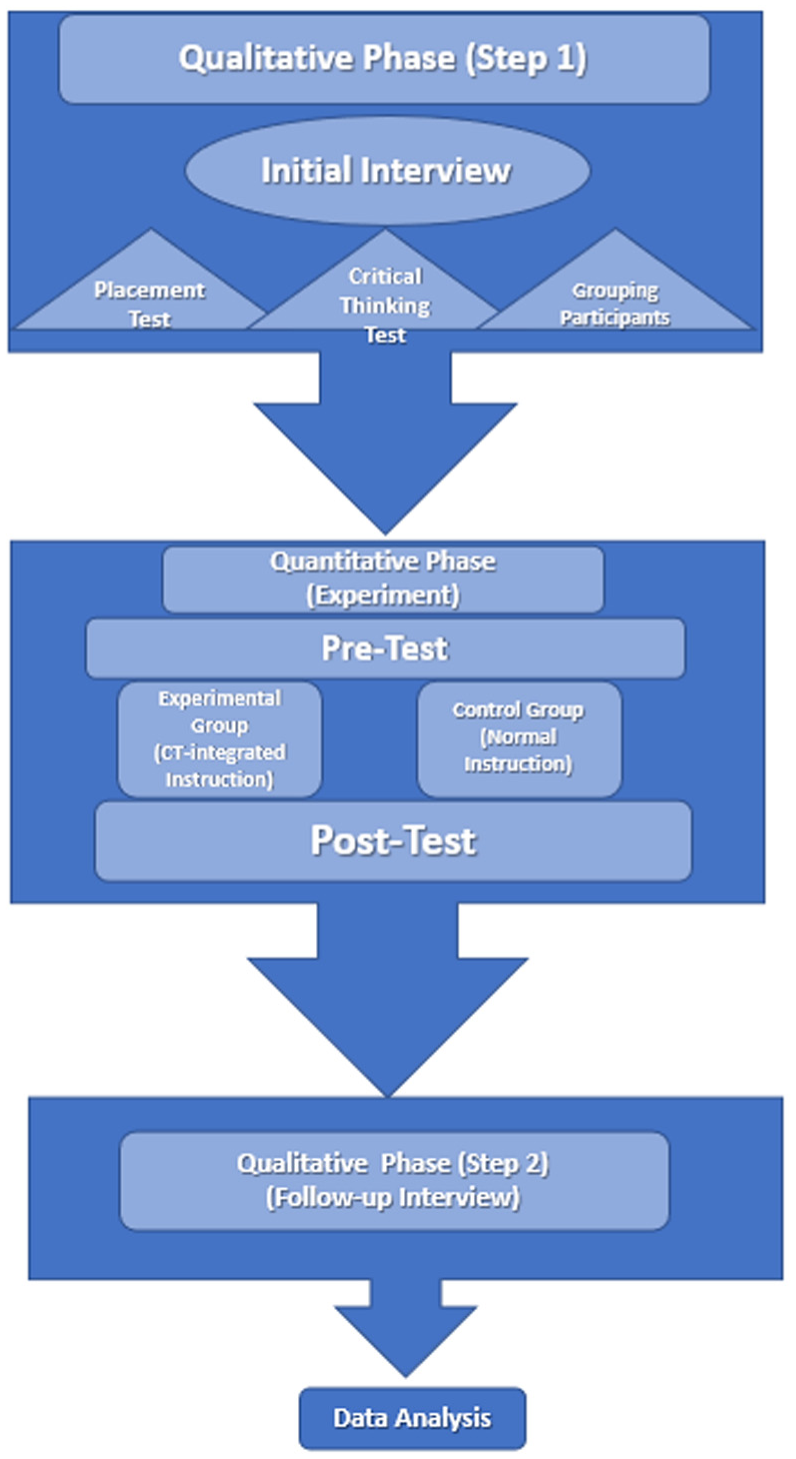
Research design.
Participants
The study comprised 107 Iranian graduate students (57 male and 50 female), aged 27 to 35, with at least 5 years of English learning experience reported reliance on AI tools owing to insufficient skills in analysis, evaluation, argumentation, and inference from English material. Notably, individuals with excellent CT skills exhibited less dependence on AI, while those with low CT skills often reported reliance on AI in their responses. Nonetheless, the researchers did not exclude individuals with excellent CT skills to elucidate the practice impact more distinctly. All participants were native Persian speakers with a minimum of 5 years of English experience. Following the ethics approval, participants subsequently executed an Ethical Consent Form to confirm their willingness to participate.
A team of six Iranian English instructors, possessing considerable teaching expertise in the English language, implemented the CT-integrated instruction. Their academic qualifications, pedagogical experience, and expertise met the requirements to achieve the study’s objectives. They participated in a professional development course focused on integrating cognitive techniques into language instruction, which enhanced their capacity to employ cognitive and CT strategies in their teaching methodologies. The objective was to establish a mutual comprehension of the study’s goals, highlighting the necessity of adhering to the systematic methodology for CT integration and familiarizing participants with the standardized educational resources created for both the experimental and control groups. Their knowledge of the Iranian environment informed their decisions, guaranteeing that the instructional content addressed the specific learning challenges encountered by Iranian students.
Instruments and Materials
The following instruments were utilized in this study for checking homogeneity, grouping the participants, instructing them as well as for collecting data (Interview and Pre-Post Test) and analyzing the data.
Oxford English Proficiency Examination
We employed the Oxford Test of English, which comprises four components—Listening, Reading, Writing, and speaking—to determine the participants’ homogeneity in English language proficiency. The Common European Framework of Reference (CEFR) specifically tailors this assessment for students at the B1 and B2 proficiency levels. This study utilized a paper-and-pencil test solely for classroom application and illustrative purposes.
Watson-Glaser Critical Thinking Assessment
Goodwin Watson and Edward Glaser created the Watson-Glaser Critical Thinking Appraisal (W-GCTA) in 1980 to assess CT abilities (Glaser, 1942). It further specifies an individual’s capacity to infer, identify assumptions, deduce, assess arguments, and analyze and reach conclusions. The examination comprises five sections, each including 16 questions. The examination provides the necessary information for answering the questions, negating the need for candidates to read or prepare in advance. The W-GCTA utilizes Item Response Theory (IRT) for scoring, followed by the use of norm-referenced grades with established pass/fail cut scores. We assessed the reliability of the W-GCTA in the Iranian context using three methods: internal consistency, temporal stability, and the correlation of scores on other forms. Split-half reliability coefficients determined the internal consistency. We administered the test again to the same group after a certain interval to evaluate temporal consistency; employing the Spearman-Brown formula, we obtained an acceptable score of 0.73. We confirmed the test’s face validity, content validity, criterion validity, and construct validity.
Mock IELTS Test
We administered two sets of the mock IELTS as pre- and post-tests, fulfilling the research requirement. These tests were piloted earlier, and their reliability had been confirmed (Salmani-Nodoushan, 2003).
CT Pamphlet
This study implemented CT-integrated instruction using a specially designed pamphlet that adhered to recognized CT components. The pamphlet was developed using the most important parts of CT, like analysis, evaluation, and inference. The methodology was supported by a review of relevant literature on CT instruction, and activities were designed to improve students’ CT skills by aligning with each part, and improvements were made with the help of expert consultation. This effectively guided the students, ensuring the regular replication of CT skills throughout the course. This approach employed a cyclical process that enhances students’ understanding and utilization of specialized knowledge and skills. The cycles of this process are structured as follows:
Presentation of Domain Knowledge and Skills: The instructor starts the cycle by presenting content relevant to domain knowledge and skills, providing the necessary information for students to engage in the learning process.
Memorization of Definitions and Procedures: Students commit to memory the definitions and methods pertinent to the offered material, ensuring foundational comprehension and the ability to retrieve relevant information.
Demonstration with Examples: The instructor exemplifies the application of information and abilities, offering students a tangible understanding of the practical implementation of theoretical principles.
Analysis of Examples: Students examine the provided examples, fostering CT and greater engagement with the content, enabling them to investigate fundamental principles and approaches.
The instructor assigns homework that requires students to independently find analogous instances, thereby reinforcing their learning by prompting them to apply their knowledge and analytical skills beyond the classroom.
Duplication of Data Collection and Analysis: Students gather pertinent data and endeavor to reproduce the analyses demonstrated in the examples. They accomplish this through practical tasks that enhance the analytical abilities acquired in the previous route.
Practical Application and Correction: Students engage in practical activities based on their learning, while the instructor provides comments and corrections. This phase allows students to apply their knowledge in practical situations and receive guidance to improve their understanding and skills.
The instructor assesses students’ assignments and provides feedback, ensuring that they receive constructive criticism essential for their continuous improvement.
Students’ knowledge was systematically built by following these cycles and the instructional procedure. This approach aimed to foster both theoretical understanding and practical application.
Initial Semi-Structured Interview
This interview concentrated on the prevalent utilization of AI tools, insufficient critical involvement, difficulties in autonomous language development, and anticipations regarding CT-integrated instruction (Appendix A). The reliability of the interview questions was confirmed by using the same set of guiding questions for all participants. Additionally, inter-coder reliability was maintained by having multiple reviewers cross-check the thematic coding. The content and construct validity of the interview questions were checked by pilot interviews. Furthermore, participant validation (member checking) was conducted by summarizing key points to participants and confirming their responses accurately reflected their experiences.
Follow-Up Interview
We conducted a second round of interviews to evaluate the impact of CT instruction on participants’ language learning practices, specifically their interaction and dependence on AI tools. This interview focused on reduced dependence on AI, critical engagement with AI outputs, improved language proficiency, and increased awareness of AI limitations (Appendix B). The reliability and validity of the questions were established in the same way as for the first interview.
Statistical Analysis Software
We analyzed the collected scores from both pre- and post-test statistically using SPSS software, version 22.
Procedure
This study started with an interview to identify the fundamental needs of English language learners. Upon confirming that CT is an important factor whoes absence directs language learners toward using and over-relying on AI, the experimental part of the study was designed. Having checked the homogeneity of participants, 107 Iranian graduate students were selected through convenient sampling and categorized into high and low critical thinking groups based on their performance on the Watson-Glaser Critical Thinking Appraisal (W-GCTA) test. They were randomly assigned to experimental and control groups; both took part in a pre-test. CT-integrated instruction was delivered to the experimental group, while normal instruction was delivered to the control group. In the 21st session, both groups took part in a post-test. The study ended with a follow-up interview.
The data collection procedure was conducted along with a Timed-Series design to keep the record at a regular interval during the semester. This was done to provide the researchers with an in-depth record of the growth of students’ English proficiency over time. Moreover, it offered an explanation of the specific impact of CT-integrated instruction at various stages of the learning process (Pearson et al., 2020).
Data Analysis
At this stage of the study, to identify the challenges that graduate students faced with, the researchers analyzed the data tools and assessed how effective CT–integrated instruction was in supporting their language development. The researchers used a mixed-method approach that brought both qualitative and quantitative data together to provide a more well-rounded view of the results. Moreover, it helped reinforce the conclusions by considering the findings from different perspectives.
Analysis of Initial Semi-Structured Interview
The first stage of the qualitative data analysis was thematic analysis of the semi-structured interviews in order to identify the specific challenges that graduate students experienced in completing academic tasks. The initial interviews also directed the design of the follow-up instructional intervention. They were conducted in Persian to allow participants to express themselves authentically and free from barriers. In addition, the interviews were scheduled flexibly to respect participants’ availability. The interviews were audio-recorded upon obtaining informed consent, and were later transcribed verbatim for analysis.
Thematic coding was guided by the core interview prompts (Appendix A). Recurring themes were identified through an iterative process of reading, coding, and refining categories, with particular attention to participants’ reported challenges, experiences with AI use, and existing or missing critical thinking strategies. These qualitative findings contextualized the need for CT-integrated instruction and shaped the design of the quantitative phase.
Statistical Analysis of Pre- and Post-Tests
Quantitative data derived from pre- and post-tests were analyzed using parametric statistical techniques, given the normal distribution of scores and Levene’s test confirming homogeneity of variances (p > .05). A repeated-measures mixed ANOVA was conducted to examine the effect of CT-integrated instruction on language proficiency over time (pre vs. post) and across groups (experimental vs. control). This approach allowed the researchers to assess both within-group and between-group differences. To address the role of learners’ critical thinking disposition, a 2 × 2 Mixed ANOVA was also performed, comparing performance among high and low critical thinkers in both experimental and control conditions. Additionally, independent-samples t-tests were used to compare mean scores between groups, while paired-samples t-tests examined pre-/post-test changes within each group. Assumptions for Mixed ANOVA were also tested to ensure validity. The Box’s M test (p < .05) confirmed equality of the variance-covariance matrix. Mauchly’s test of sphericity assessed compound symmetry, and in cases of violation (p < .05), Greenhouse-Geisser corrections were applied.
Analysis of Follow-Up Interview Data
The final qualitative data source was a second round of semi-structured interviews conducted after the instructional intervention. The follow-up interviews were conducted after the instructional intervention to capture participants’ reflections on their developinglanguage skills and the perceived transfer of those skills to academic English contexts. As with the initial interviews, the follow-up sessions were conducted in Persian, recorded with permission, and transcribed. Thematic analysis was again applied to the transcripts, this time focusing on changes in participants’ approaches to evaluating academic texts and lectures, increased autonomy in dealing with academic materials, and real life application of critical thinking strategies in academic settings.
Results
RQ1: How Does CT-Integrated Instruction Influence the Language Proficiency of High-Critical-Thinking Graduate Students?
The results of the Mixed ANOVA showed a significant interaction between time and group (F = 6.36, p = .02, η2 = 0.13). It indicated that CT-integrated instruction improved language proficiency in the experimental group compared to the control group. Moreover, the experimental group showed a significant improvement from pre-test (6.23 ± 0.40) to post-test (7.43 ± 0.42), while the control group showed a smaller improvement (pre-test = 6.22 ± 0.63, post-test = 7.02 ± 0.39). This suggests that CT-integrated instruction significantly enhances the performance of the high-critical thinkers. Subsequent independent t-tests confirmed the significance of the differences in post-test scores between the experimental and control groups (t = 3.35, p = .002). Table 1 shows the result.
Mixed ANOVA Results (HCT).

Note. Bold indicates significant effect (p < .05).
As shown in Table 1, the findings of the Mixed ANOVA revealed that the correlation between group and time was significant. (F = 6.36, p = .02, η2 = 0.13). Figure 2 shows the interaction between two groups (experimental and control) across two time points (pre- and post-test).

Interaction between two groups (experimental and control) and time (pre- and post-test; HCT).
The results indicated a greater improvement in the experimental group compared to the control group from pre- to post-test, suggesting that the intervention had a stronger effect on the experimental group. Since the interaction proved significant, all the between- and within-group variables were interpreted.
Pre-test of the Experimental and Control groups (HCT)
We used an independent t-test for this purpose. Results showed that there was no significant difference between the experimental group and the control group (t = 00, df = 42, p = 1.00)
Post-test of the Experimental and Control groups (HCT)
We used the independent t-test to analyze this. It showed significant differences between the experimental and the control group (t = 3.35, df = 42, p = .002). The experimental group, after a period of instruction, scored higher than the score of the control group (7.02 ± 0.39). Table 2 shows the results.
Independent Sample T-test Result (HCT).

Note. Bold indicates significant result (p < .05).
Pre-and Post-test in the experimental group (HCT)
This was analyzed by using an independent t-test. The results showed that there was a significant difference between pre-and post-test (t = −14.19, df = 21, p = .00). In the post-test of the experimental group, the score was higher (7.43 ± 0.42) compared to the score in the pre-test (6.23 ± 0.40).
Pre-and Post-test in the control group (HCT)
Using the independent t-test, results indicated a significant difference between pre-and post-test (t = −5.75, df = 21, p = .00). The scores of the post-test in the control group (7.02 ± 0.39) were higher than the pre-test (6.22 ± 0.63). Table 3 shows the results.
Paired Sample T-test Result (HCT).

The following bar graph compares the scores of the experimental group and the control group at two stages: pre-test and post-test. The aim is to examine the effect of the intervention on both groups over time. Figure 3 shows the results.

Overall performance of the experimental and the control groups in pre- and post-test (HCT).
As illustrated in the bar graph, the experimental group showed a notable improvement in overall performance from the pre-test to the post-test compared to the control group, suggesting the effectiveness of the intervention on the experimental participants. The second research question is answered in the following section.
RQ2: How Does CT-Integrated Instruction Influence the Language Proficiency of Low-Critical-Thinking Graduate Students?
The results of the mixed ANOVA for the low critical thinking group demonstrated a significant interaction (F = 9.23, p = .004, η2 = 0.17), indicating a substantial improvement in the experimental group in scores from pre-test (5.81 ± 0.60) to post-test (7.14 ± 0.56). The results in the control group showed a smaller increase from pre-test (5.85 ± 0.74) to post-test (6.58 ± 0.73). This result underscores the effectiveness of CT-integrated instruction. Moreover, the independent T-tests confirmed that the experimental group significantly outperformed the control group post-test (t = 2.99, p = .005). Table 4 shows the results.
Mixed ANOVA Results (LCT).

Note. Bold indicates significant effect (p < .05).
As presented in Table 4, the results of the mixed ANOVA revealed that the interaction between group and time was significant. (F = 9.23, p = .004, η2 = 0.17). Therefore, we depicted the interaction between two the groups (experimental and control) across two time points (pre and post-test). Figure 4 shows this.

Interaction between two groups (experimental and control) and time (pre- and post-test; LCT).
The results indicated a greater improvement in the experimental group compared to the control group from pre-test to post-test. Since the intervention proved to be significant, all between- and within- group variables were interpreted.
Pre-test in the experimental and the control group (LCT)
The results of an independent t-test showed that in the pre-test, there was no statistically significant difference in the scores between the experimental and the control groups (LCT; t = −0.21, df = 46, p = .83).
Post-test of the Experimental and Control groups (LCT)
The results of an independent t-test showed that there was a significant difference between the experimental and control groups (t = 2.99, df = 46, p = .005). The scores in the experimental group after a period of instruction increased (7.14 ± 0.56), which was above that in the control group (6.58 ± 0.73). Table 5 shows the results.
Independent Sample T-test (LCT).

Note. Bold indicates significant effect (p < .05).
Pre-and Post-test in the experimental group (LCT)
We employed a dependent t-test to examine the difference between pre- and post-test in the experimental group. The results showed that there was a significant difference between pre-and post-test (t = −8.13, df = 23, p = .00). The scores in the post-test (7.14 ± 0.56) were higher than scores in the pre-test (5.81 ± 0.60).
Pre-and Post-test in the control group (LCT)
We employed a dependent t-test to examine the difference between pre- and post-test in the control group. It was revealed that there is a significant difference between pre-and post-test (t = −6.48, df = 23, p = .00). The scores were higher in the post-test compared to the pre-test (6.58 ± 0.73 vs. 5.85 ± 0.74). Table 6 shows the results.
Paired Sample T-test Result (LCT).

The following bar graph compares the overall performance of the experimental and the control group in both pre-and post-test. Figure 5 shows the barograph.

Overall performance of the experimental and the control groups in pre- and post-test (LCT).
As illustrated in the bar graph, the experimental group showed a notable improvement from the pre- to the post-test compared to the control group, suggesting the effectiveness of the intervention on the experimental group.
RQ3 How Does CT-Integrated Instruction Shape Graduate Students’ Engagement with AI Tools in Language Learning Process?
To answer the third research question about the impact of CT-integrated instruction on improving graduate students’ capacity to critically evaluate and autonomously interact with AI tools, the second interview was conducted. To analyze the gathered qualitative data, a thematic analysis approach was employed. First, data were transcribed and then systematically coded using both inductive and deductive methods. We used initial open coding to identify recurring patterns and themes emerging from participants’ responses. Then the codes were organized into broader categories aligned with the research focus such as critical evaluation of AI, autonomous engagement, and language development. The thematic coding enabled us to have a deeper understanding of participants’ perspectives. Moreover, we conducted a cross-case analysis to capture consistent shifts and contrasts across individuals. The finding revealed a significant shift in the experimental group such as reduced dependency on AI tools along with an increased confidence in critical evaluation of AI outputs. Enhanced language proficiency was emphasized, particularly in writing and speaking, as they tried to apply their CT skills to synthesize and articulate complex ideas. The interviews showed a remarkable change in participants’ perception of AI tools and performance in English language. This rigorous qualitative analysis ensured that the findings were grounded in the data and meaningfully represented the impact of CT-integrated instruction on students’ use of AI tools. There are some key findings below.
Reduced Dependence on AI
Participants were highly satisfied with the CT-integrated instruction because it empowered them to rely less on AI tools when completing language tasks. They demonstrated more confidence in producing and interpreting of language independently, attributing this to the analytical and evaluative skills they had developed during the program.
Critical Engagement with AI Outputs
Participants reported a significant shift in how they interacted with AI in language learning. They showed remarkable critical analysis and interpretation, instead of copying outputs directly. They tended to use AI but to incorporate it thoughtfully into their work.
Improved Language Proficiency
Significant improvements in language proficiency, particularly in writing and in speaking were noted. Participants highlighted their ability to structure arguments, synthesize ideas, and articulate thoughts more effectively as key outcomes of the instruction.
Increased Awareness of AI Limitations
Participants showed wise awareness of AI risks in a recurring theme of the interviews. They declared the helpfulness of AI tools but admitted that the outputs are not always accurate or contextually appropriate. This mindfulness encouraged them to use AI tools as supplementary aids rather than primary solutions.
Discussion
This study set out to explore how integrating critical thinking can improve graduate students’ language skills and make them well-prepared and more autonomous in the AI era. The results of the interviews and tests showed significant progress in students’ English proficiency and self-management, making them less reliant on AI. The findings revealed that participants became more confident in clear communication and handling complex language tasks with a deeper understanding. Initial interviews showed considerable reliance on external aid such as AI resources, both in content creation and in reading texts in English. Faith in AI products was significant, but judgment about the quality, appropriateness of such products was weak. This reflected a lack of autonomy and an inability to evaluate what they receive from the external aid sources, that highlights the pedagogical need to cultivate judgment after reflection, as well as linguistic proficiency-corresponding decisions.
Results of quantitative analysis showed that the CT-integrated instruction greatly enhanced students’ linguistic proficiency at various levels of critical thinking. High and low critical thinkers in the experimental group both performed better than their control counterparts in the post-test. These gains cannot be explained merely in terms of greater familiarity with English tasks; instead, the instruction actually trained users to evaluate, reason, and communicate intentionally. This increased use of texts and tasks—where users questioned assumptions, paraphrased difficult concepts, and corrected AI-generated texts—probably resulted in more accurate, contextually apt, and syntactically sophisticated language use.
Results from the follow-up interviews also illuminated the transition in cognition caused by the intervention. The participants reported shifting from passively receiving AI products receptively to questioning, modifying, and sometimes rejecting them. Many others reported increased freedom in making decisions while working with scholarly texts or constructing answers. Such freedom in cognition means that the CT-integrated instruction had provided them with evaluation tools that transformed the way they operated with technology as well as with language. That is, they transformed from receiving AI products passively to active partners in building meanings.
The CT-integrated instruction also made participants aware of AI tool limitations. As the qualitative data unveiled, they came to appreciate that AI tools, although conducive to learning, are not flawless in their output and requires human supervision. Such increased cognizance motivated learners to practice keener revision and analysis, encouraging higher-order linguistic processing. These outcomes are consistent with past research that has indicated the advantage of cultivating skills and attitudes in CT in disparate settings (Shah & Asad, 2024; Spector & Ma, 2019). The outcome also suggests that CT-integrated instruction leads to increased success in educational, occupational, and general societal environments. It becomes clear, also in this specific investigation, that an integrated program in CT assists Iranian graduate students as well as the general relevance of cognitive variables in disparate educational settings and cultures.
Although CT might not directly lead to scores on tests, it converts learners into better reasoners, reflectors, and communicators—abilities essential for both academic and practical communication. In spite of this, conventional school structures tend to emphasize exam preparation and rote learning, leaving little opportunity for the nurturing of CT. Consequently, scholars become ill-prepared to interact insightfully with AI resources but, instead, become overdependent upon them. The current investigation disrupts this convention by revealing, with this set of participants, that focused instruction may give learners the skills they require in order to harness AI support effectively. These findings are reinforced by Worrell and Profetto-McGrath’s (2007) investigation, where, having focused upon the teaching of English, they expanded upon the importance of implementing CT strategies within this subject area, underlining that this not only improved linguistic proficiency but contributed, as well, to overall cognition. The learning paradigm involving the incorporation of CT motivates users into deeper levels of thought, reflective understanding of texts, and deliberate expression in writing— both of which are vital in coping with educational challenges in an era where technology plays an increasing role (Chaparro-Banegas et al., 2024). Rather than merely improving linguistic output (Shah & Asad, 2024), CT empowers learners to own their communication processes and reshape their learning journeys in more informed and autonomous ways.
Limitations and Suggestions for Future Research
While this research has key insights, some limitations need to be taken into account. First, the research happened under some specific cultural and learning setting—Iranian graduate students—which may limit how generalizable the outcome is in other settings. Future studies should use more heterogeneous participants with various cultural and institutional settings in an effort to strengthen the generalizability of the outcome. Second, the fairly small number of participants might weaken the statistical power of the outcome. It is recommended that large-scale studies should be undertaken with higher statistical power, allowing deeper subgroup examination. Third, while this research looked at general English proficiency, it wasn’t able to differentiate specific skills such as academic writing or listening. Future studies might examine the effects of integrated CT instruction upon specific areas in an effort to provide clearer teaching practices. Lastly, the intervention spanned a narrow timeframe, possibly obscuring longer-term effects of CT-oriented instruction upon proficiency in languages as well as interaction with AI tools. It is recommended that longitudinal studies should be undertaken in an effort to assess how such practice impacts participants over a longer term.
Conclusion and Implications
This study focused on the value of integrating critical thinking (CT) into language instruction to enhance both cognitive development and linguistic competence. While previous research has explored the nature of CT across various educational levels, findings often reveal a gap between the potential of CT and its actual impact in traditional pedagogical settings. Although it is well established that students at all levels can develop CT skills, the effectiveness of such instruction is not always consistent or reliable. Many students complete their studies with minimal or no significant improvement in these crucial skills, highlighting a pressing need for more effective and engaging approaches in higher education. The results of this study contribute to the growing body of research advocating for CT-integrated instruction. In alignment with scholars like Worrell and Profetto-McGrath (2007), the evidence suggests that integrating CT strategies within English language learning not only sharpens students’ critical capacities but also enriches their language acquisition process. More importantly, this approach transforms the classroom into a reflective, learner-centered environment where students actively engage with content, discover their voices, and take greater ownership of their learning journey. These findings advocate for the intentional and pedagogically sound integration of CT into curriculum design—particularly in contexts where both language proficiency and higher-order thinking are educational goals.
Based on these findings, educators are encouraged to incorporate CT activities that foster analysis, evaluation, and synthesis across all language skills. Doing so can help learners develop greater cognitive independence while also promoting a more thoughtful and responsible use of AI tools. Curriculum builders should methodically integrate the teaching of CT into language programs, ensuring convergence with real-world academic tasks as well as AI-augmented learning settings. Teacher training programs should also prepare instructors with effective frameworks to enable students’ critical interaction with AI-generated products as well as with academic content. Policymakers should bolster plans that advance CT incorporation into higher education curricula in order to prepare graduate students better for the technological as well as cognitive requirements of AI-informed academic as well as workplace environments.
Footnotes
Appendix A
Appendix B

Funding
The authors received no financial support for the research, authorship, and/or publication of this article.
Declaration of Conflicting Interests
The authors declared no potential conflicts of interest with respect to the research, authorship, and/or publication of this article.
Data Availability Statement
The data that support the findings of this study are available from the corresponding author upon reasonable request. Due to privacy and ethical restrictions, raw data are not publicly shared.