



Abstract
Research examining high school and undergraduate students has demonstrated the importance of identity formation for students’ confidence, retention, and aspirations in science. While we know some of the key predictors of science identity formation among these populations, relatively little work has looked at these issues among graduate students. The study presented here utilizes data from a survey of over 1,300 graduate students in the United States in five disciplines: biology, chemistry, physics, psychology, and sociology. A structural equation model is estimated to assess the demographic, experiential, and disciplinary correlates of graduate student identification with science and, separately, identification with their discipline. The analysis finds that, relative to men, women have weaker identification with science but do not differ in the strength of their identification with their discipline. Experiences, such as the quality of students’ relationship with their advisor and publishing research, are positively associated with the strength of their science and disciplinary identity. Students in psychology and sociology have weaker identification with science relative to biology students, while sociology students also have weaker identification with their discipline.
Science education, particularly at the graduate level, understandably focuses on the transmission of knowledge and skills relevant to conducting scientific research. It has become increasingly clear, though, that becoming a scientist also requires an identity-formation process, by which the individual comes to think of their self as a scientist and feel like they are part of the scientific community (Archer et al., 2010; Brickhouse & Potter, 2001; Carlone & Johnson, 2007; Hancock & Walsh, 2016; Johnson, 2020; Laudel & Bielick, 2018). The strength with which students come to identify with science has been shown to be associated with their continued pursuit of science, performance and confidence as scientists, and aspirations for science careers (Carlone et al., 2014; Chemers et al., 2011; Settles, 2004).
Much of the work examining students’ identification with science has focused on younger children (Archer et al., 2012), high school students (Aschbacher et al., 2010), or undergraduates (Robnett et al., 2015). Comparatively little research has examined variation in graduate students’ identification with science (exceptions include Gonsalves, 2014; Maton et al., 2016), although projects funded by agencies like the National Science Foundation in recent years highlight increased interest in these issues at the graduate level (e.g., Bush et al., 2018).
Some of the lack of focus on these identity issues among graduate students may be an assumption that at an advanced level these identity processes have already occurred. That is, those elementary school, high school, or undergraduate students who did not come to identify with science are unlikely to have pursued an advanced degree in science, leaving all those who have come to identify with science to become graduate students. However, given that less than half of students who begin a doctoral program in the United States will complete their degrees (Sowell et al., 2008), there may be good reason to look at variation in strength of identification among graduate students in the sciences.
In this study we utilize data from an original survey of graduate students in five disciplines representing natural and social sciences to assess the predictors of students’ strength of identification with science. Beyond its focus on graduate students, this study also expands previous research by examining students’ strength of identification with their discipline separately from their identification with science, as the two outcomes may be subject to different processes.
Identification with Science
As with many professions, becoming a scientist also involves the formation of an identity that helps the individual fit in to the social and cultural environment of professional science. The creation of this identity involves a process of social-psychological differentiation in which individuals come to see themselves as part of a group that is distinct in values, behaviors, and interests (Ashforth & Mael, 1989; Callero, 1985; Hermanowicz, 2007; Stets & Burke, 2000). This identity is often associated with a sense of pride that comes from belonging to the profession (VanZandt, 1990), and it provides a lens through which an individual “make[s] sense of their work and, to some extent, the fabric of their lives” (Friedman & Kaslow, 1986).
Research has shown this identification process to be a significant factor in explaining student outcomes in science. Archer et al.’s (2010) conversations with young schoolchildren (ages 10–11) found that many of these students found science interesting and exciting. However, some students were more likely to see themselves as potentially becoming a scientist than others.
Research has indicated that this is an important indicator of the student’s performance and persistence in science (Syed et al., 2011). A survey of undergraduates in science majors showed, for instance, that students who more strongly identify with science are far more likely to enter a graduate program in the sciences (Merolla & Serpe, 2013).
While Merolla and Serpe (2013) considered the role of science identification for pursuing a graduate degree, relatively little research has examined identification with science among graduate students. There are exceptions, though, such as Chemers et al.’s (2011) analysis of over 300 graduate students and postdoctoral fellows who were recruited through the Society for the Advancement of Chicanos and Native Americans in Science. Their study showed that factors such as research experiences and mentoring were positively associated with graduate students’ identification with science, which was, in turn, positively associated with their commitment to a career in science.
The present study builds upon this work by examining the determinants of graduate students’ identification with science using a broader sample and by examining graduate students identification with their discipline as a separate outcome.
Determinants of Identification with Science
Past research on the determinants of students’ strength of identification with science have highlighted a variety of factors falling within two broader categories, which we label here demographic and experiential factors. In addition to these factors, this study also considers disciplinary influences on students’ identification with science.
Demographics
Research has suggested that students who belong to demographic groups that are underrepresented in science often encounter obstacles to identifying strongly with science. Much of this research in this area has focused on women and certain racial or ethnic groups (Beasley & Fischer, 2012; Ceci et al., 2009; Goulden et al., 2011; Long & National Research Council (U.S.), Committee on Women in Science and Engineering, 2001; Tsui, 2007). One obstacle faced by these groups when trying to identify with science is simply their numerical underrepresentation in much of the sciences (National Science Board, 2018). This underrepresentation can result in a lack of role models (Herrmann et al., 2016), a general feeling of isolation (Johnson, 2012), and a sense that being male or white is the default for a scientist (Krawczyk, 2017). The lack of demographically-similar peers or mentors can fuel a perception that science is not a good fit for, say, female or black students (Barbercheck, 2001; Ong, 2005). Additionally, females and racial minorities are vastly underrepresented in media portrayals of scientists and are often shown in subordinate roles (research assistant, secretary to a scientist, etc.) (Loverock & Hart, 2018; Steinke & Tavarez, 2017). Indeed, students in these underrepresented groups often face stereotypes about their group’s capacity for or fit with science (Barbercheck, 2001; Losh, 2010; Ong, 2005; Settles, 2004).
Even if a student belonging to these underrepresented demographic groups does not internalize science-related stereotypes associated with the groups, they may encounter hostility and discrimination from others that harm the student’s identification with science (Steinke, 2013). Females in Gibbs and Griffin’s (2013) study cited many instances in which male peers or male superiors made them victim to sexual harassment, such as inviting female students back to their hotel room at conferences, or overt remarks about females being inferior. Similarly, racial minorities in the sciences often encounter hostility and negative treatment. Minority students often describe being mistaken for other students of the same race, especially at events such as conferences (Gibbs & Griffin, 2013).
While much of the focus has been on the dynamics that undermine gender and racial minorities’ identification with science, there is evidence that these issues extend to other often-underrepresented groups in science, such as sexual minority students (Hughes, 2018), students with families (Ecklund & Lincoln, 2016), and students of a non-traditional age (Offerman, 2011).
Experiences
It is well-established that a student’s experiences, such as forming a positive relationship with a mentor or participating in research, play a vital role in the development of scientific identity. Previous research has found that not only does the presence of a mentor promote this development (Hernandez et al., 2017; Hunter et al., 2007), but the quality of the relationship does as well (Estrada et al., 2018; Pfund et al., 2016). For instance, Thiry and Laursen (2011) examined the relationship between science identity and quality mentorship among undergraduate students participating in research. Students that received quality mentoring successfully began to develop identities as scientists and gain a sense of belonging in the scientific community. However, students that did not receive these aspects of support as a consequence of little to no interaction with their advisor, expressed frustration with the lack of growth in skills and ability and, therefore, experienced a hindered development of a scientific identity (Thiry & Laursen, 2011).
Involvement in scientific practice, particularly research experience, is also known to strengthen the development of a scientific identity (Estrada et al., 2018; Hazari et al., 2010; Hunter et al., 2007; Remich et al., 2016). Carlone et al. (2008) draws on Lave and Wenger’s (1991) work of situated learning to explain that identities are formed through participating in the practices of the field and, therefore, facilitated through engagement in classroom activities. Research experience specifically has been found to be associated with students beginning to think, work, and feel like scientists, becoming more confident in conducting research, viewing themselves as individual researchers, and becoming comfortable presenting themselves as scientists to others (Hunter et al., 2007; Remich et al., 2016). For instance, Hunter et al. (2007) studied the benefits of participating in research experiences by interviewing rising seniors who were involved in summer undergraduate research programs. Virtually all students’ reports of their experiences in the program focused on the benefits they received from participating and expressed high satisfaction with the experience overall, including the increased ability to think and work like a scientist and a greater sense of thinking of themselves a scientist.
Discipline
Outside of the traditional core of sciences that individuals are exposed to early in their education, such as biology, chemistry, and physics, many disciplines that might think of themselves as scientific are often not perceived to be sciences among the general public (National Science Board, 2014). Indeed, many of these disciplines have their own internal debates about whether they are sciences or whether they want to be sciences. Discussions about whether a discipline is really a “science” can be found for disciplines like computer science (Denning, 2005) and forensic science (Bell et al., 2018), and social science disciplines like psychology (Lilienfeld, 2012) and sociology (Turner, 2007). Graduate students in such disciplines are likely aware of these public perceptions and internal debates and could internalize a weakened identification with science, or such students view themselves as part of the discipline that do not think of it as a science.
Expectations
Based on the research examined above, we can specify several expectations concerning science graduate students’ strength of identification with science. First, we expect that graduate students in science who represent groups that are underrepresented and/or stereotyped as not being “good” scientists will have weaker identification with science relative to students who represent the numerical or cultural norms of science. Specifically, we expect that female students, Black and Hispanic students, sexual minority students, older students, and students who are married or who have children will have weaker identification with science relative to their respective comparison groups.
Second, we expect that graduate students in disciplines commonly seen as outside of the core of sciences will express weaker identification with science. Specifically, given the data used in this study, we expect that graduate students in psychology and sociology will have weaker identification with science when compared to students in biology, physics, and chemistry.
Finally, we expect students who have had more identity-supporting experiences, such as positive mentor relationships and successful research experiences, will have stronger identification with science.
Science Versus Discipline
Research on students’ identification with science has tended to focus on students in disciplines traditionally and widely recognized as “sciences.” Such research has tended to not focus on these students’ identification with particular disciplines. That is, there has seemed to be an assumption that identification with science supersedes or is equivalent to, say, identifying with biology, physics, chemistry, or some other discipline under the larger umbrella of science. This assumption may be misguided. There are many disciplines whose status as sciences is much more contested or ambiguous. Students in these areas may come to identify more strongly with their discipline than with science. Undergraduate students in psychology, for example, tend to view psychology as less scientific than their psychology instructors (Holmes, 2014).
The boundaries of science are fuzzy, though, so it not clear at what point we should be asking about identification with science and identification with discipline. Even among those disciplines that almost everyone perceives as “science,” though, students’ strength of identification with their discipline may be distinct from their strength of identification with “science.” Surveys and analyses of popular media, for example, have shown that there are clear demographic and personality stereotypes concerning individuals in science that students may be hesitant to identify with, but it is not clear that these stereotypes extend to individuals in specific disciplines (Losh, 2010; Schibeci, 1986). To put it colloquially, there could be less baggage associated with identifying with biology, for example, than there is when identifying with science more broadly.
Data and Measurement
The data for this study come from a survey designed by the lead author and was supported by a grant from that National Science Foundation. The survey was fielded the spring of 2019 on a sample of 4,000 graduate students evenly distributed in five disciplines (i.e., 800 from each): biology, chemistry, physics, psychology, and sociology. Sampling took place in two stages. In the first stage departments were randomly selected from a list of programs in each discipline. Specifically, each discipline’s top 60 programs in the US News and World Report’s rankings of graduate programs were stratified into four tiers consisting of fifteen programs each. Three programs were selected randomly from each discipline-tier. This produced 12 departments for each discipline, or 60 departments in total. Although a couple of the departments selected for the sample appeared to offer terminal master’s programs in addition to a PhD program based on their websites, the overwhelming majority of programs appeared to be PhD-focused. Indeed, on the survey 98% of the students reported that they were in a doctoral program, with the remaining 2% representing students saying they were in a terminal master’s program or some other type of program (e.g., dual-degree).
In the second stage of the sampling process a student sample frame was built by extracting information from the selected departments’ online directories of graduate students. In the end, this process produced a frame of over 6,466 students. Using this sample frame, 800 students were selected at random within each discipline to receive the survey. Note that this represents an oversample of some disciplines, as the five disciplines varied in the size of their student populations.
Respondents were invited through email to complete a web-based survey and provided a $5 Amazon.com gift code upon completing the survey. In the end, 1,307 complete responses and 72 partial responses were received, which represents an overall response rate of 35.9% (AAPOR Definition #4) (AAPOR 2019). Weights were constructed after data collection to account for the disproportionate sampling across disciplines and patterns of non-response. These weights return the estimated proportions across gender-discipline-tier strata in the survey responses to those observed in the full sample frame.
Outcome: Identification with Science
We use three items from the survey to assess students’ strength of identification with science. These items asked students their level of agreement with the following statements: (1) I have come to think of myself as a scientist; (2) In a group of scientists, I really feel that I belong; (3) Overall, being a scientist has a lot to do with how I feel about myself. Responses ranged from strongly disagree to strongly agree. These items were modeled on previous studies of student identification with science (e.g., Chemers et al., 2011; Robnett et al., 2015).
Outcome: Identification with Discipline
In addition to measuring students’ identification with science, the survey included items meant to assess students’ identification with their discipline. Specifically, two questions asked students their level of agreement with the following statements: (1) In general, being in this discipline is an important part of my self-image; (2) I have a strong sense of belonging in this discipline’s community. Responses ranged from strongly disagree to strongly agree.
Predictors: Demographics
We include a number of measures representing students’ demographic characteristics, with a particular focus on representing demographic groups who might feel numerically or culturally marginalized within academic science and therefore have weaker identification with science or their discipline. First, we include a measure representing the gender of the student. This is measured as (1) female; (2) male; (3) other gender identity. The male category serves as the reference category in the analysis. We also include a measure representing racial or ethnic identity of the student. The categories are (1) Caucasian, White, European; (2) Black, African, Caribbean; (3) East Asian (e.g., Chinese, Japanese, Korean); (4) South Asian (e.g., Indian, Pakistani, Bangladeshi); (5) Hispanic or Latino; (5) other race/ethnicity or multiple races/ethnicities. The White category serves as the reference category in the analysis. We also include indicators for the students’ sexual identity. The categories are (1) heterosexual, (2) bisexual (3) gay or lesbian, (4) other sexual identity. The heterosexual group serves as the reference group in the analysis.
We include two items representing students’ family status. The first represents their marital status with three categories of responses offered on the survey: (1) I am married; (2) I am in a committed relationship; (3) I do not have a spouse or partner. The latter category serves as the reference category. We also include an item representing the number of children the student has had. This ranges from 0 to 4, with the latter representing four or more children. Finally, we include an item representing the age of the student. This is measured continuously and ranges from 22 to 61.
Finally, we include an indicator for whether the student indicated that either of their parents has a PhD (0 = neither parent has a PhD, 1 = at least one parent has a PhD). Having one or more parents who have already obtained a doctorate may provide educational and cultural capital that allows a student to more strongly identify with science or their discipline.
Predictors: Experiences
We include three types of items to represent how students’ experiences in graduate school may influence their identification with science or discipline. The first category simply represents the number of years the student has been in their program. One might expect that identities strengthen as students move through a graduate program and reach certain milestones. Responses to this question on the survey ranged from 1 to 8, with the latter representing “This is my eight or more year.” We also include a group of items to represent students’ relationship and experiences with their advisor. These items asked students their level of agreement with the following statements: (1) My advisor encourages me to prepare for advancement in this program; (2) My advisor conveys feelings of respect for me as an individual; (3) My faculty advisor is available when I need to speak to him or her. Responses ranged from strongly disagree to strongly agree. These items were adapted from previous studies (Noe, 1988; Paglis et al., 2006). Finally, we include an item representing the number of articles the student has “published or [has] had accepted for publication in refereed journals.” This measures ranges from 0 to 10, with the latter representing 10 or more publications.
Predictors: Discipline
We include an indicator for the students’ discipline. This measure comes from the sample frame. As noted earlier, the represented disciplines are biology, physics, chemistry, psychology, and sociology. Biology serves as the comparison category in the analysis below.
Analysis Plan
The analysis presented below utilizes structural equation modeling (SEM) using Stata/SE 15.1 software (StataCorp, 2021). Structural equation modeling has several advantages for the purpose of this study, including the ability to examine multiple outcomes simultaneously and the use of multiple observed measures to represent underlying latent concepts. The analysis is limited to 1,240 cases with non-missing responses on the items used in the analysis.
There are three latent concepts included in the model representing strength of identification with science, strength of identification with discipline, and quality of advisor relationship. The factor loadings for the identification with science concept are: 0.72 (“think of myself as a scientist”), 0.63 (“being a scientist has a lot to do with how I feel about myself”), and 0.79 (“in a group of scientists, I really feel that I belong”). The factor loadings for the identification with discipline concept are: 0.63 (“being in this discipline is an important part of my self-image”) and 0.79 (“I have a strong sense of belonging in this discipline’s community”). The factor loadings for the advisor relationship concept are: 0.81 (“encourages me to prepare for advancement”), 0.79 (“conveys feelings of respect for me”), and 0.67 (“available when I need to speak to him or her”).
Figure 1 presents a conceptual model for our SEM analysis. We estimate four SEM models. The first three models include only one of our three focal groups of predictors (i.e., demographics, experiences, and discipline). The fourth and final model estimates the full SEM model. Each estimated model allows the error terms for the identification with science and identification with discipline outcomes to covary. This accounts for the fact that there may be unmeasured factors that influence the strength of both of these identities.
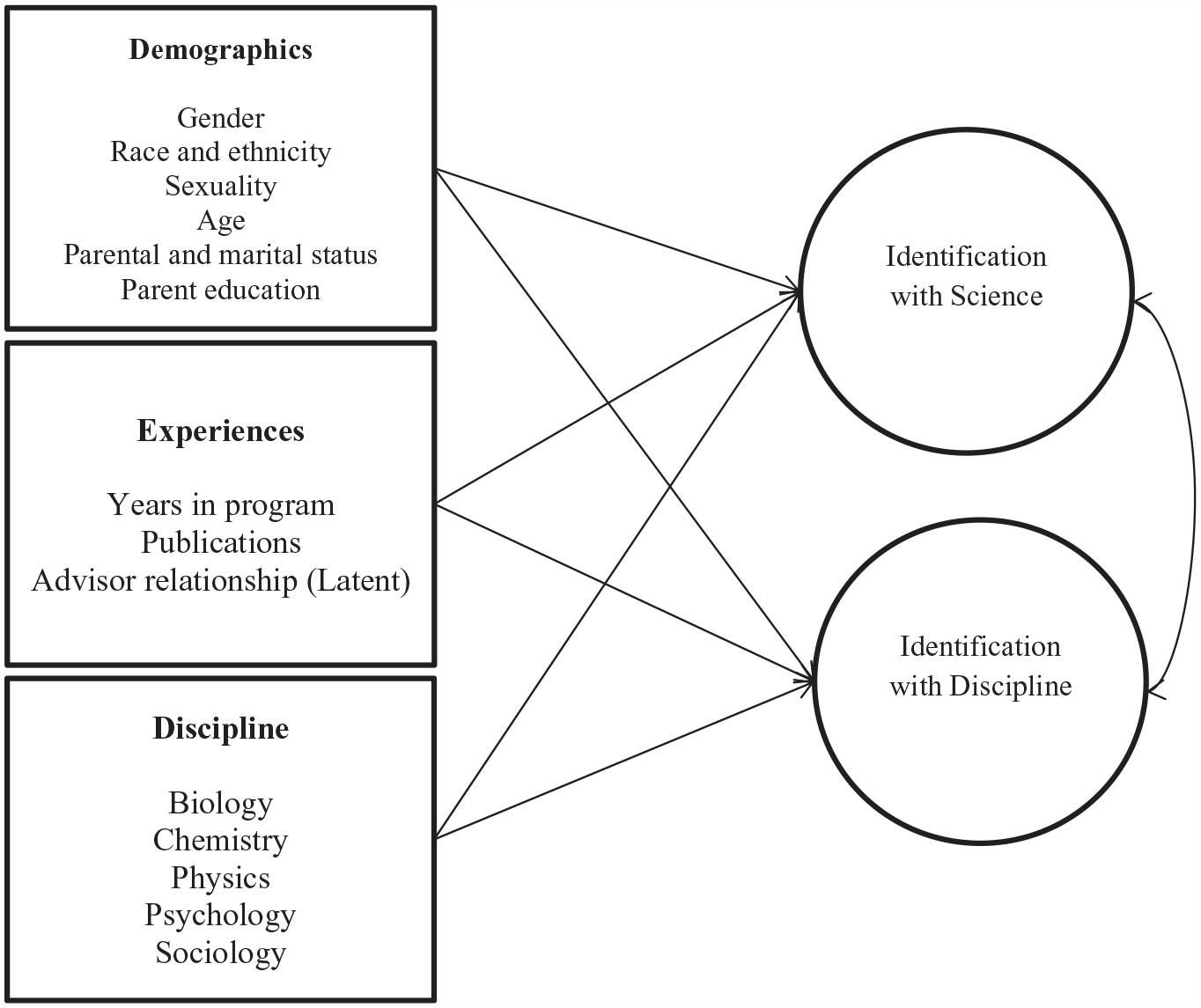
Conceptual diagram of analysis of graduate students’ identification with science and discipline.
The analysis accounts for the complex survey structure of the data through the use of Stata’s svy commands to specify the sample structure and weighting. Because the analysis utilizes complex survey data, many of the measures commonly used to assess the fit of a SEM model are not considered appropriate. However, the standardized root mean squared residual (SRMR) value for our full model does indicate an acceptable or good model fit (Hu & Bentler, 1999). If we run our full model without utilizing the weighting and complex survey command, other fit statistics also indicate a good fit (e.g., Comparative Fit Index = .92, Root Mean Squared Error of Approximation = .04).
Results
Table 1 presents unweighted and weighted means or percentages for all observed items included in the SEM model. Remember that each discipline represented 20% of those invited to complete the survey. We can see in the unweighted percentages, though, that the response rate was somewhat lower among chemistry and physics students, as these groups’ each represent less than 20% of the respondents.
Descriptive Statistics for all Observed Measures.
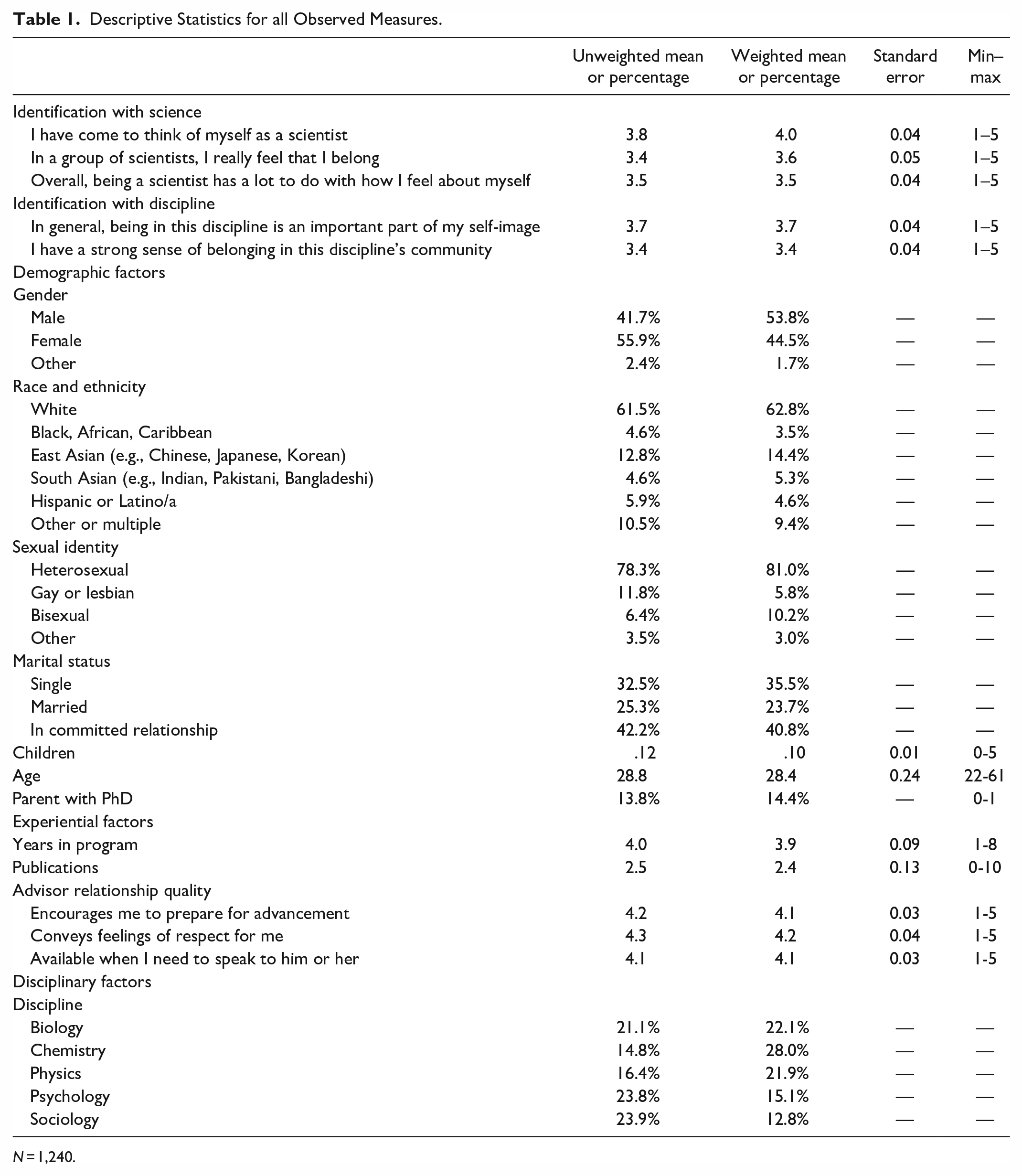
N = 1,240.
The weighted percentages account for patterns of nonresponse and the oversampling of some disciplines. In these percentages, we see that the population of psychology and sociology students is each smaller, while the population of chemistry graduate students is the largest of the five disciplines. The effect of increasing the weight of the larger disciplines has some noteworthy effects on the other variables in Table 1. For instance, the means for the three indicators of identification with science all increase slightly between the unweighted and weighted means. This suggests that these measures are somewhat higher among the larger disciplines in the analysis (i.e., chemistry, biology, physics) than in the smaller disciplines (i.e., psychology and sociology).
Table 2 presents results from our SEM models. As noted earlier, this analysis accounts for the sample structure and weighting using Stata’s complex survey commands. Before examining the full SEM results as shown in Model 4, we begin by looking at reduced models focusing on the individual groups of demographic, experiential, and disciplinary measures. Model 1, for instance, includes only the demographic predictors. The analysis shows that female graduate students report weaker identification with science relative to male students. Interestingly, though, female students do not significantly differ from male students in the strength of their identification with their discipline. In other words, while female students might not feel as strongly about their connection to “science” or “scientists,” they feel just as strongly as their male peers when it comes to their connection to, say, “biology” or “biologists.” This suggests that there may be something specific to “science” and its connotations that generate weaker identification among female students.
Standardized Results From Structural Equation Models Examining Graduate Students’ Identification With Science and With Their Discipline.

Note. N = 1,240; Model 4 standardized root mean squared residual = .02.
p<.05, **p<.01.
Turning to the race and ethnicity indicators, we find that black graduate students report weaker identification with science relative to white students. The other racial and ethnic groups, however, do not show any significant differences relative to the white group in their identification with science. As with the gender finding, we do not find a gap in strength of identification between white and black students when looking at the identification with discipline outcome.
Model 1 also finds that gay or lesbian students report weaker identification with science relative to heterosexual students, but there are not significant differences when looking at the identification with discipline outcome. We do not find any significant differences across marital statuses, number of children, or age with either identification with science or discipline. We also do not find a significant association between having a parent with a PhD and a student’s identification with science or discipline.
Model 2 includes only the disciplinary indicators. We find that, relative to biology students, psychology and sociology students both report weaker identification with science. However, when looking at the identification with discipline outcome, we find that only sociology students differ from biology students in having a weaker strength of identification with discipline.
Model 3 examines only the experiential predictors. The analysis shows that a student’s years in the program is not associated with their strength of identification with science, and it is actually significantly associated with a reduced strength of identification with discipline. This is contrary to our expectations. This could be the result of a type of honeymoon-effect among students who are early in a graduate program.
As expected, however, the analysis finds that the number of articles a graduate student has published is positively associated with both identification with science and identification with discipline. As will be discussed later, the cross-sectional nature of these data does not allow us to fully determine causal order. We suggest that, like undergraduate research experiences, publishing articles as a graduate student strengthens students’ identification with science and discipline. It is also reasonable to argue, however, that students with stronger identities will pursue publications. It is likely that both processes are at work. Also, the analysis shows a significant positive association between advisor relationship quality and graduate students’ identification with science and discipline.
There could be differences in student demographics across disciplines, or differences in experiences across student demographics. To account for the potential overlapping nature of these factors, Model 4 examines the full SEM model to assess the independent effects for each these predictors. Compared to the earlier models, some of the findings are the same while others have changed. We find, for instance, that even after controlling for discipline and experiential factors, female graduate students still report significantly weaker identification with science relative to male students. However, there is still no difference between male and female students in strength of identification with discipline. The previously significant difference between white and black students in strength of identification with science has become non-significant in Model 4, as has the previously significant difference between gay or lesbian and heterosexual students. This suggests that some of these earlier differences were due the disciplinary distribution of these groups and differences in the experiential factors across the groups. On the other hand, a significant positive association between age and strength of identification with discipline emerges in Model 4. It is possible that, net of disciplinary differences or experiential factors, older students have a clearer sense of their goals and purpose for pursuing a graduate degree and this is reflected in a stronger identification with discipline. This is speculative, however.
Looking at the disciplinary differences in Model 4, we find that not much has changed relative to Model 2. Psychology and sociology students still report significantly weaker identification with science compared to biology students, but only sociology students significantly differ on the identification with discipline outcome. This suggests that it is not simply that sociology students are less likely to think of themselves as “scientists,” but rather there is something about sociology as a discipline that is not producing the same sense of professional identity among graduate students that the other four disciplines are producing.
Finally, the experiential findings are largely the same in Model 4 as they were in Model 3. A student’s year in their program is still a significant negative predictor of their identification with their discipline. A student’s number of publications and advisor relationship quality, though, are still both positive predictors of identification with science and with discipline. All together, these demographic, disciplinary, and experiential factors account for about 20% of the variance in graduate students’ identification with science and about 25% of their identification with discipline.
Discussion
Past research has highlighted the importance of students’ identification with science for outcomes like retention and aspirations in science. In short, students who come to think of themselves as scientists, begin to feel comfortable around other scientists, start to see science as an important part of their own identity, and are more likely to stay in science.
Studies examining why some students struggle to identify with science have highlighted factors like some students’ demographic isolation within science, lack of a mentor, or lack of opportunities to engage in research. This study contributes to this literature in a couple of ways. First, most of this literature has focused on undergraduates or even younger science students. The analysis presented above extends this research to a large probability sample of graduate students in five disciplines extending from core natural science disciplines to social science disciplines. The range of disciplines included in this study led to its second contribution. Namely, research has tended to assume that identification with science is the same as identification with discipline. This may be because studies have tended to focus on those core scientific disciplines.
Of course, this is not to say that this study is without limitations. First, the data used in this study are cross-sectional in nature. This means that these data do not allow us to precisely determine the causal direction of our findings, nor can we measure changes in students’ identification over time. Moreover, the data comes from a survey of the U.S. students, which means that we must be cautious about extending our findings to other national contexts. Collecting longitudinal data and collecting data in other national settings would be a natural direction for future research.
Despite these limitations, the analysis presented in this study offers several noteworthy findings. In line with expectations from past research, our analysis finds that, net of other factors, female graduate students have weaker identification with science relative to male students. However, the analysis found no difference between female and male students in their identification with discipline. This is significant as it suggests that female graduate students do not have difficulty in thinking of themselves as, say, a chemist or feeling comfortable around other chemists. Yet, when asked about science or scientists in the abstract, there does appear to be an obstacle in such identification. From a methodological standpoint, this highlights that future studies should consider asking about identification with discipline separately from identification with science. From a theoretical standpoint, this suggests that future research might examine in more detail the differences in students’ thinking about being a part of their discipline versus being a part of science. From a policy standpoint, this suggests that educators and science programs might aim to focus on fostering or emphasizing discipline-specific identification among students more than some grand science identity, which clearly has more gender-specific associations.
Another area of interest concerns the analysis’ findings concerning research experience and advisor quality. Both of these factors were significant positive predictors of students’ identification with both science and discipline. The advisor finding is likely not surprising. However, some might assume that graduate programs in the sciences are inherently focused on research experience, and therefore specific experiences like publishing articles might not be particularly relevant to the development of a scientific or disciplinary identity. That is, course-work, research assistantships, and thesis/dissertation preparation all expose graduate students to research experiences. Yet, this study suggests that getting students specific experience with publishing articles might strengthen their science and discipline identities. Of course, it should be noted that the cross-sectional nature of these data do not allow us to be confident about causal ordering. It is possible that students who have these strong identities are more likely to pursue publishing. It is likely that both processes are at work.
The final result we highlight as significant concerns the effect of discipline on students’ identities. The analysis found that, relative to biology students, graduate students in psychology and sociology have significantly weaker identification with science. Given that both of these are outside of the perceived core of science populated by disciplines like biology, chemistry, and physics, it might be understandable that graduate students in these disciplines are more hesitant to identify strongly with “science.” On the other hand, to the extent that graduate programs in these disciplines desire their students identify with science, these findings highlight that there is still work to be done.
While psychology graduate students do not identify as strongly with science as their peers in biology, chemistry, and physics, they do not differ from those students in how strongly they identify with their discipline. Sociology graduate students, though, also have weaker identification with their discipline. This could be a function of several factors. There is much discussion within sociology concerning whether it has a “distinct disciplinary core” (Ballantine et al., 2016; Keith & Ender, 2004; Wagenaar, 2004) given its wide range of research topics and methodologies. It is possible that graduate students struggle with these same issues and have a hard time recognizing what it means to be a sociologist or what it might mean to be part of the sociological community. On the other hand, all of the disciplines considered in this study, including the natural science disciplines, contain a large range of internal variation in topics and methodologies. Yet, students in those other disciplines do not seem to struggle with identifying with their discipline. This suggests that there may be something particular to graduate education and training in sociology that is not overcoming that heterogeneity to instill a sense of disciplinary identity among students. Sociology programs may consider whether they want to address this more explicitly through the curriculum, professional development opportunities, or mentoring they provide to graduate students. In turn, future research could examine the effectiveness of such efforts.
Footnotes
Declaration of Conflicting Interests
The author(s) declared no potential conflicts of interest with respect to the research, authorship, and/or publication of this article.
Funding
The author(s) disclosed receipt of the following financial support for the research, authorship, and/or publication of this article: This research was supported by a grant from the National Science Foundation (Award #1749130, Principal Investigator Christopher P. Scheitle).
