




Abstract
This study investigates the temporal dynamics and causal relationships among risk-focused, prevention-focused, and mixed (risk and prevention) media messages during the early stage of the COVID-19 outbreak in South Korea, from December 31, 2019 to February 2020. Although media coverage plays a pivotal role in shaping public perception and encouraging preventive behavior during health crises, there is limited empirical research on how different types of messages evolve and interact over time. The news data used in this study were collected from BigKinds, a platform operated by the Korea Press Foundation, and include articles from major national daily newspapers, economic newspapers, broadcasters, specialized media, and online news outlets, as well as transcribed texts of some TV news programs. Using a corpus of Korean news articles, we categorized each article into one of the three message types and applied a series of time series analyses including cross-correlation, Granger causality tests, vector autoregression (VAR), cointegration tests, and vector error correction modeling (VECM). The results show a sequential dynamic in which risk-focused reporting significantly precedes mixed messaging, which subsequently leads to an increase in prevention-focused articles, typically with a lag of 1 to 2 weeks. Impulse response functions from the VAR model support this cascading pattern, while VECM results confirm the presence of a long-run equilibrium and short-run adjustment mechanisms among the three categories. This study offers three key contributions. First, it theorizes mixed messaging as a transitional stage between risk and prevention frames, addressing limitations in binary message models. Second, it provides an empirical framework for analyzing time-lagged media dynamics based on actual news content. Third, it reveals that prevention messaging was delayed during the early stages of the pandemic, suggesting a need for more timely and integrated communication strategies in future public health emergencies.
Plain Language Summary
This study examines how South Korean news communicated information about COVID-19 during the early stage of the outbreak, from December 31, 2019 to February 2020. The researcher analyzed three types of messages: risk-focused (highlighting danger), prevention-focused (encouraging protective actions), and mixed messages (combining both), to see how they changed over time and influenced each other. News articles were categorized into these three types, and time-based statistical methods were used to examine how one type of message might lead to another. The results showed a clear pattern: risk-focused news appeared first, followed by mixed messages, and then prevention-focused articles. This sequence usually played out over one to two weeks. The study suggests that mixed messages often act as a “bridge” between reports about danger and advice on how to stay safe. It also shows that prevention messages were delayed, which could have reduced early efforts to stop the virus from spreading. Overall, the study highlights the need for more timely and better-integrated communication strategies during health crises. Clear and early prevention messages can help people take action sooner and protect themselves.
Introduction
During public health crises such as infectious disease outbreaks, mass media play a pivotal role in shaping public risk perception and promoting preventive behaviors. In the early stages of a crisis, when uncertainty is high and accurate information is limited, media coverage significantly affects public emotions and actions (Xiao et al., 2015). This influence extends beyond simple information delivery, influencing crisis response and behavior change at the societal level. Therefore, the structure and timing of media messages are critical components of communication strategy in public health emergencies (Breakwell, 2014).
Traditional theories of risk communication assume that risk perception is a prerequisite for behavioral response. This suggests a sequential process where risk messages trigger emotional reactions, which are then followed by preventive messages that guide action (Slovic, 1987; Witte, 1992). The Extended Parallel Process Model supports this view, proposing that threat appraisal creates a psychological readiness for the acceptance of efficacy-based prevention messages.
However, excessive risk-centered coverage can lead to unintended consequences such as heightened fear, anxiety, and social stigma (Kasperson et al., 1988; Malecki et al., 2021). Although preventive messaging is often introduced to counterbalance these effects, little is known about how the two types of messages interact over time. Without empirical evidence from real-world data, the policy implications and timing of message delivery remain poorly understood.
Recent studies emphasize that the role of the media extends far beyond traditional news delivery. The rise of algorithm-driven news recommendation systems, social media platforms (e.g., Twitter/X, Instagram), and search-based information-seeking behaviors has fundamentally transformed the production, distribution, and consumption of risk and prevention information (Kim et al., 2022; Koo, 2022; Song et al., 2023). These changes accelerate the speed and sequence of message transmission and enable real-time feedback from the public, generating new communication dynamics that go beyond the explanatory power of conventional theories.
This study builds upon the social and institutional context surrounding the unfolding of the COVID-19 pandemic and the role of the media as a critical channel of crisis communication (Hong, 2024; Kim, 2020; Lee & Wong, 2021; You, 2020). In South Korea, following the first confirmed case on January 20, 2020, the government rapidly implemented large-scale diagnostic testing, digital contact tracing, transparent disclosure of case information, and quarantine measures. In addition, nationwide mask distribution, phased social distancing, and early vaccination programs effectively curbed the spread of infection without a national lockdown. This “whole-of-nation approach” operated on a foundation of strong institutional capacity and high public trust, forming a critical pillar of the country’s crisis response strategy (Hong, 2024; Kim, 2020).
These policy measures were communicated through a multifaceted media ecosystem. South Korea’s media landscape encompasses official government channels (e.g., briefings by the Korea Disease Control and Prevention Agency and the Central Disaster and Safety Countermeasures Headquarters), public broadcasters (KBS, MBC), private broadcasters (SBS, JTBC), national and economic newspapers, regional press, and specialized outlets. At the same time, digital platforms such as Naver, Daum, YouTube, Twitter/X, and Instagram played an important role in accelerating information dissemination and facilitating public engagement. The government also sought to secure the credibility of information flows and shape public discourse through fact-checking initiatives and misinformation response campaigns (Song et al., 2021; Wasti et al., 2025).
For empirical analysis, this study uses news articles collected from the BigKinds platform operated by the Korea Press Foundation. The dataset includes national and economic newspapers, broadcasters, specialized outlets, and online news, as well as transcribed TV news articles. Social media posts and personal blogs are excluded, while government announcements, health guidelines, expert interviews, editorials, columns, and general news reports are incorporated. This provides a comprehensive view of the media messaging environment during the early stage of the pandemic.
In the initial phase of the pandemic, news coverage primarily focused on risk-oriented messages, such as case counts, imported infections, and cluster outbreaks. Over time, the emphasis shifted toward prevention-oriented messages that encouraged behavioral practices such as mask-wearing, hand hygiene, and voluntary social distancing. This shift was closely associated with tangible behavioral outcomes, including higher mask usage, increased testing participation, and strong compliance with public health measures (Lwin et al., 2022). Comparative research further suggests that South Korea’s communication strategy differs from that of many Western countries in that risk messaging intensified earlier, prevention messages were integrated more rapidly, and emergent media ecosystems were actively utilized (Jin et al., 2025; Lwin et al., 2022). This contextual foundation provides the analytical basis for examining the temporal transitions and dynamic interactions among different types of media messages in this study.
In the case of emerging infectious diseases such as COVID-19, media coverage often includes a mixture of risk-focused, prevention-focused, and combined messages. Yet it remains unclear whether risk messages precede prevention messages, whether they appear simultaneously, or whether one type predicts the emergence of another. Clarifying these temporal relationships is essential for evaluating the media's dual role in issuing early warnings and guiding public behavior.
In recent years, a growing body of research has analyzed infectious disease crisis communication through emergent media channels such as Instagram, Twitter/X, and online search patterns (Kim et al., 2022; Koo, 2022; Song et al., 2023). While these studies primarily focus on the dynamics of audience response and information diffusion, traditional news media continue to function as a central channel that shapes policy agendas, formalizes information, and steers the direction of public discourse. Therefore, analyzing how the sequence, intensity, and effectiveness of messages are structured within news coverage is essential for complementing emergent media research and for advancing a more fundamental understanding of public health communication. Understanding these dynamics provides critical insight into how message transitions shape public trust, policy acceptance, and behavioral change (Jo & Chang, 2020; Kim et al., 2020; Lee, 2025).
To address this gap, this study classifies news articles published in South Korea between December 31, 2019, and February 2020 into three message categories: risk-focused, prevention-focused, and mixed (risk + prevention). It then examines the temporal interactions and causal relationships among these message types. By applying keyword-based classification, the news corpus was transformed into a time series dataset, which was analyzed using cross-correlation analysis, Granger causality tests, vector autoregression (VAR), cointegration tests, and vector error correction modeling (VECM).
This study makes three main contributions to the literature. First, it empirically identifies the sequential and interdependent evolution of message types over time in traditional news media, thereby extending classical risk communication theories and offering a complementary perspective to emergent media research. Second, it proposes a media dynamics analysis framework that captures message transition patterns based on time-lag structures using real news article data. Third, by illustrating potential mechanisms through which media-driven message transitions influence public perception and behavioral responses, the study provides practical implications for communication policy design, early warning systems, and public health strategy development.
Theoretical Framework
Risk Communication and Message Delay in Public Health Crises
In public health emergencies, the media function not only as conveyors of information but also as agents of social alarm, significantly shaping public threat perception and preventive behavior (Breakwell, 2014; Cholo et al., 2025; Kasperson, 2012). Particularly in situations of high uncertainty such as infectious disease outbreaks, the timing, framing, and sequencing of media coverage can critically influence the temporal gap between risk recognition and behavioral response. In general, early stage reporting tends to prioritize risk focused content, while prevention focused messages appear later or are embedded within mixed messages that combine threat information with behavioral recommendations.
In this context, the concepts of “risk” and “prevention” can be more precisely operationalized. Risk focused messages deliver threat oriented information such as rising case counts, superspreading events, and fatality rates that heighten public awareness and perceptions of vulnerability. Prevention focused messages, by contrast, provide efficacy oriented recommendations for protective behaviors such as mask wearing, vaccination, or handwashing (Peng et al., 2022; Witte, 1992). Mixed messages combine these two elements, simultaneously communicating threat appraisals and behavioral guidance, and often function as a bridge from initial alarm to actionable response.
This delay is not solely a function of information availability but also reflects a psychological process, wherein risk awareness must be established before prevention advice is effectively received (Heydari et al., 2021; Schmälzle et al., 2017). According to the Extended Parallel Process Model (EPPM), exposure to threat based messages can elicit fear, which leads to behavioral change only if accompanied by concrete and efficacious preventive recommendations (Witte, 1992). The model posits that the effectiveness of prevention messaging is contingent upon prior risk perception, thereby offering a theoretical foundation for the sequential relationship between risk and prevention messages.
In addition, agenda setting theory (McCombs & Shaw, 1972; Nguyen et al., 2024) highlights how media shape public priorities by emphasizing certain issues over others. During health crises, early agenda setting often focuses on alarming statistics and patterns of transmission, and only after the threat has become salient does public attention shift toward prevention.
Despite this theoretical grounding, few empirical studies have examined the actual temporal patterns of risk and prevention messaging in media coverage during the early stages of a crisis. Most prior research has relied on audience perception surveys or cross sectional content analyses rather than dynamic time series approaches, limiting our understanding of how message types evolve over time. Comparative studies further show that similar dynamics have been observed in other outbreaks including the Ebola crisis in West Africa (Oyeyemi et al., 2014), the H1N1 pandemic (Lin et al., 2014), and the Zika virus epidemic (Guidry et al., 2017), where risk amplification consistently preceded prevention messaging.
Moreover, the media landscape has changed significantly. Crisis communication now unfolds not only through traditional news outlets but also via social media platforms such as Twitter/X and Instagram, as well as search driven information flows (Kim et al., 2022; Koo, 2022; Song et al., 2023). However, this study focuses specifically on online news articles, which remain the primary channels for agenda setting and official information dissemination. Because online reporting serves as a reference point for public perception and policy communication, it offers a valuable context for analyzing the temporal structure and transitions of message types.
In the first weeks of the COVID 19 pandemic, South Korean media initially emphasized daily case counts and superspreading events but gradually shifted toward more practical guidance, such as mask wearing and social distancing (BBC News, 2020). This pattern illustrates a typical temporal delay, in which media narratives evolve from threat oriented coverage to behavior oriented communication.
This study addresses this gap by categorizing news articles into three message types risk focused, prevention focused, and mixed and analyzing their lagged relationships through time series methods. Specifically, we investigate whether risk messaging precedes the emergence of mixed messaging, and whether such mixed messaging subsequently leads to an increase in prevention coverage. By empirically modeling the temporal diffusion and transition of message types, this study seeks to measure how communication structures evolve over time and assess their implications for public behavior and crisis response strategies.
Based on this framework, we propose the following research questions:
Framing Structures and Message Type Transitions in Health Crisis Reporting
Beyond the sequencing of messages, framing also plays a critical role in shaping public understanding and behavioral responses during health crises. Framing refers to the narrative structure through which the media define problems, diagnose causes, make moral evaluations, and suggest remedies (Entman, 1993). In this context, risk-focused messages emphasize threat-related factors such as infection risk, transmission speed, and fatality rates, forming a threat-oriented frame, whereas prevention-focused messages highlight actionable measures such as mask wearing, handwashing, and vaccination, reflecting a solution-oriented frame. Positioned between these two extremes, mixed messages include both threat information and preventive guidance and can be interpreted as indicators of a transitional framing process (Jo & Chang, 2020; Kim, 2020; Koivula et al., 2024; Nguyen et al., 2024).
Framing effects are not static but evolve dynamically over time (Chong & Druckman, 2007). In the early stages of a crisis, mixed messages tend to align more closely with risk-oriented narratives but gradually shift toward prevention-oriented frames. This shift reflects more than the mere coexistence of risk and prevention content; it signals a strategic transition of media emphasis from threat perception to action guidance. Recent studies further highlight that real-time feedback loops in social media environments accelerate these framing shifts and strengthen participatory agenda-setting structures (Chan et al., 2023; Jin et al., 2025; Kim et al., 2022).
During the initial phase of the COVID-19 pandemic, briefings by health authorities and major news coverage frequently combined warnings about infection risks with concrete behavioral recommendations (Lwin et al., 2022). These cases illustrate how mixed messaging can function not merely as information transmission but as a mechanism that facilitates framing transitions, enabling the public to move from recognizing threats to engaging in preventive behaviors.
Despite these theoretical insights, existing studies have primarily relied on qualitative descriptions of framing shifts and have rarely tested the mediating role of mixed messaging in the transition from risk to prevention frames. The potential of mixed messages to act as a causal bridge between threat perception and behavioral intention remains insufficiently theorized and empirically substantiated.
To address this gap, the present study examines whether mixed messages serve as a temporal bridge between risk-focused and prevention-focused coverage, using time-series analysis to empirically capture framing transitions. Through this approach, the study seeks to move beyond static content-level analyses and uncover the temporal dynamics of framing during health crises.
Based on this approach, we propose the following research question:
Dynamic Interactions and Long-Term Structures Among Message Types in Epidemic Reporting
In epidemic reporting, media messages exhibit not only short-term fluctuations but also long-term structural interdependencies among different message types. From a time-series perspective, risk-focused, mixed, and prevention-focused messages do not exist in isolation. Rather, they evolve through continuous interactions, shaping and being shaped by time-lagged adjustments and feedback loops. An increase in one message type may trigger delayed changes in others, and over time, their relative proportions may converge toward a dynamic equilibrium, reflecting a self-corrective mechanism within the media system.
While some prior studies have observed temporal trends in news volume or qualitatively described message transitions (Ming et al., 2021), few have empirically examined the co-evolution of these message categories over time. In particular, the application of time-series methods such as co-integration analysis and vector error correction models (VECM) to epidemic-related news coverage remains extremely limited.
This study focuses on online news articles from BigKinds, a central platform for public agenda setting and policy communication in South Korea, rather than incorporating social media or user-generated content. By analyzing this domain, we capture how messages are structured and adjusted within the most authoritative and policy-relevant layer of the media environment.
Such structural analysis holds significant implications for public policy and crisis communication. If changes in one message type systematically influence others and if a long-term equilibrium relationship exists among them, this suggests the operation of an intrinsic balancing mechanism within the media system. This mechanism likely reflects not only responsible journalistic behavior but also the adaptive character of media discourse, which aims to balance public alarm with practical guidance throughout a crisis.
During the early weeks of the COVID-19 outbreak, South Korean media coverage primarily focused on daily case counts and superspreading events. Over time, however, the emphasis shifted toward prevention- and response-oriented topics such as vaccination campaigns, government containment strategies, and reopening policies (Koh et al., 2022; Lee et al., 2022). This transition illustrates the temporal reconfiguration of media messaging and the adaptive balancing mechanisms that shape the evolution of narratives during a prolonged health crisis.
To empirically examine these possibilities, the present study poses the following research questions:
Methodology
Data Collection and Pre-Processing
This study analyzes COVID-19 related online news articles published by South Korean media between December 31, 2019 and February 29, 2020. The term “news articles” in this study refers to journalistic content officially produced and distributed by traditional media organizations, including print and digital newspapers, broadcast news (converted into text form), major online news portals, and web articles from established media outlets. In addition, government announcements, policy updates, public health guidelines, and expert interviews disseminated through media channels were also included in the analysis.
The dataset was collected from BigKinds (https://www.bigkinds.or.kr), a large scale news database operated by the Korea Press Foundation. BigKinds aggregates articles from more than 50 national and regional newspapers, 15 broadcasting stations, and numerous online outlets, providing structured metadata and publication dates suitable for systematic time series analysis. The data were accessed through the platform’s publicly available academic research interface, and no additional user permissions or restricted data access were required. Moreover, since BigKinds provides news content exclusively in Korean, this study focuses solely on Korean language articles.
To minimize sampling bias, no specific media outlet or topic filters were applied, and all relevant articles published within the study period were included. However, potential biases arising from editorial decisions, indexing practices, or platform level curation cannot be fully eliminated; these issues are discussed as methodological limitations in the later sections of this article.
The keyword “corona” was used as the primary search term, and the query was applied to the full text of articles. Wildcard search (corona) was employed to capture variations such as “coronavirus,” “coronavirus disease,” and “corona19,” and additional terms such as “novel coronavirus,” “COVID-19,” “the pandemic,” and “Omicron” were included to reflect language changes over time. Through this process, a total of 74,307 articles were initially retrieved.
A multi stage filtering and cleaning procedure followed. Articles unrelated to infectious disease or public health (e.g., entertainment, sports, corporate PR, or event announcements) were excluded, and duplicate articles or those without body text were removed. The final dataset consisted of 65,731 articles.
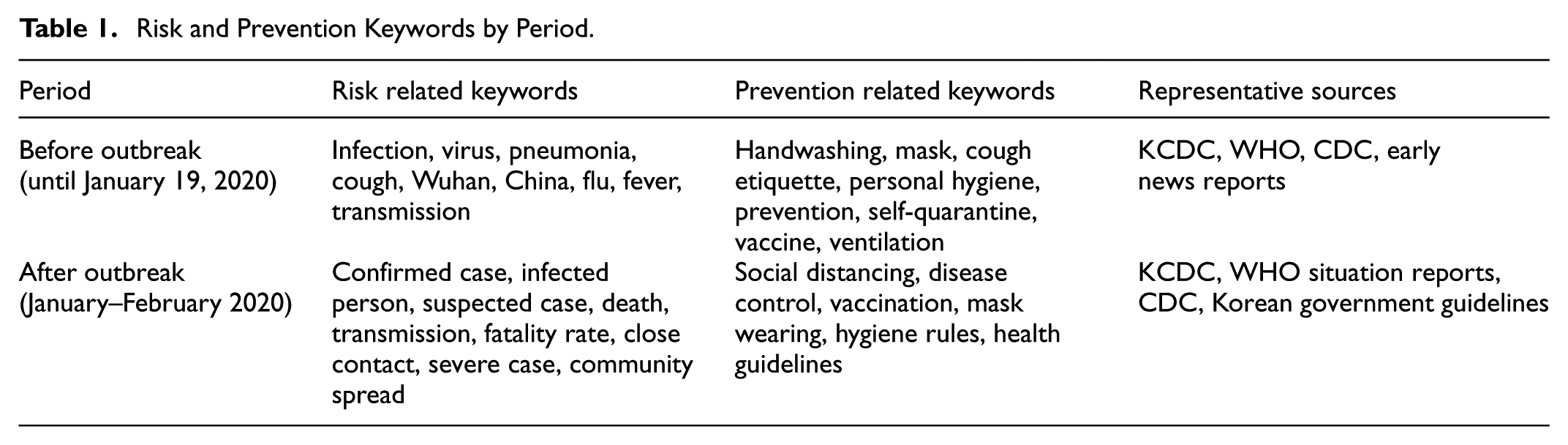
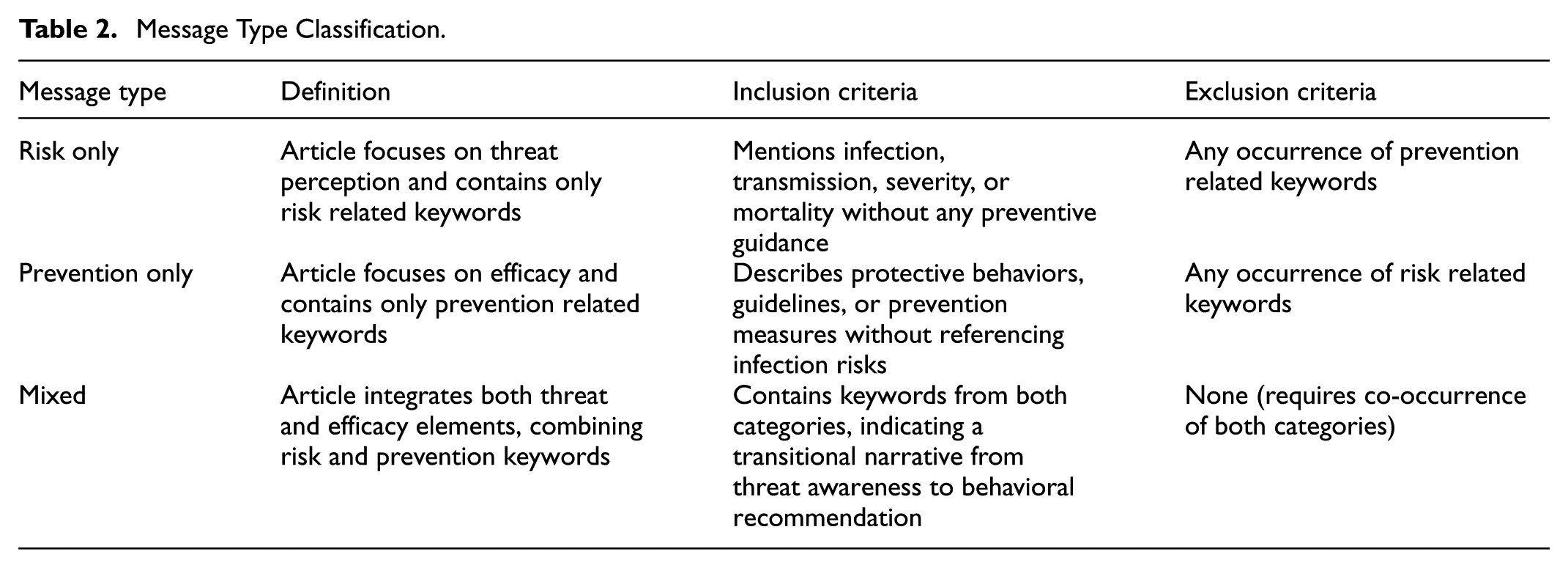
To identify infection related content, we applied an automated text matching procedure based on predefined keyword sets for risk and prevention messages. Each article was classified according to the presence of these keywords, and a manual validation check was conducted on a subset of the dataset to verify classification reliability. The conceptual distinction between “risk” and “prevention” messages follows established public health communication theory (Slovic, 1987; Witte, 1992). Risk messages include information that heightens perceived threat, such as infection counts, super spreader events, or fatality rates, whereas prevention messages provide efficacy enhancing recommendations, such as handwashing, mask use, or social distancing. Mixed messages contain keywords from both categories and represent a bridge between threat perception and behavioral response. The keyword lists were iteratively updated to reflect language shifts over time.
Table 1 summarizes the key risk and prevention keywords used in the classification and provides representative sources for each period of the early outbreak.
Risk and Prevention Keywords by Period.
Based on this classification framework, each article was assigned to one of three message categories, as defined in Table 2.
Message Type Classification.
The classified articles were then aggregated into a daily time series dataset, which served as the basis for subsequent analyses, including cross correlation, Granger causality tests, and vector autoregression (VAR). Figure 1 illustrates the cumulative daily volume of articles in each category: risk only, mixed, and prevention only, over the study period. The vertical black dashed line marks January 20, 2020, the date of South Korea’s first confirmed COVID-19 case. After this point, a sharp increase in risk focused reporting is observed, whereas mixed and prevention oriented coverage show a more gradual and delayed rise. This pattern aligns with the timeline of government policy escalation from “Attention” to “Caution” on January 20 and to “Alert” on January 27, providing contextual insight into the timing and evolution of media messaging. These results demonstrate that early media coverage during the COVID-19 outbreak was heavily concentrated on risk related content, while prevention oriented communication emerged more slowly, reflecting a structured temporal sequence in crisis reporting (Figure 2).

Cumulative number of news articles by message type over time.

Cross-correlation between risk-only and mixed messages.
Analysis Method
To examine the temporal sequence and causal relationships among the three types of media messages (risk-focused, prevention-focused, and mixed), this study applied a series of time-series analysis techniques. Daily time-series data were constructed based on the number of articles in each category. The analysis period covers 61 days, from December 31, 2019 to February 29, 2020.
Cross Correlation Analysis
To explore the temporal relationship between risk-focused and prevention-focused media coverage, a cross-correlation analysis was conducted. News articles were first classified into three types: risk-only, prevention-only, and mixed, based on the presence of predefined keywords in the article body. Using the daily number of articles in each category, three separate time series were constructed.
Each time series was standardized using z-score normalization. Cross-correlation coefficients were then calculated to assess the directional relationships along two specific paths: from risk-only to mixed messages, and from mixed to prevention-only messages.
The analysis was performed across the full range of possible time lags within the 61-day period, approximately ±60 days. The lag with the highest correlation coefficient was identified as the optimal lag, providing insight into the temporal delay between message types.
Granger Causality Test
To quantitatively assess time-lagged causal relationships, the Granger causality test was applied. Using the daily frequency time series for each message type, F-statistics and p-values were calculated for two directional paths: from risk-only to mixed messages, and from mixed to prevention-only messages, across various lag intervals.
This analysis tested whether risk-focused coverage statistically precedes mixed coverage, and whether mixed coverage in turn precedes prevention-focused coverage. Statistically significant results indicate that the leading variable in each path has explanatory power for the subsequent message type. These findings provide empirical support for a time-lagged structure in which risk-oriented messages tend to appear first, followed by other message types over time.
Vector Autoregression (VAR) Model
To quantitatively examine the short-term dynamic interactions and lagged response structures among the three message types, a Vector Autoregression (VAR) model was constructed. This model used the daily differenced time series of article counts for risk-only, mixed, and prevention-only messages, estimating both autoregressive effects within each series and cross-variable influences among them.
The optimal lag length was selected automatically based on the Akaike Information Criterion (AIC), and model adequacy was assessed through residual white noise tests. Following model estimation, impulse response function (IRF) analysis was conducted to visualize how sudden changes in risk-related coverage influence subsequent changes in prevention and mixed coverage over time.
Co-integration Test and Vector Error Correction Model (VECM)
To investigate the long-term relationship among the three types of news coverage, the Johansen co-integration test was applied. This method accounts for the possibility that each time series may be non-stationary, while testing whether a common long-term equilibrium relationship (co-integrating vector) exists among them. As the results indicated the presence of statistically significant co-integration, a Vector Error Correction Model (VECM) was subsequently constructed.
The VECM incorporates adjustment mechanisms that guide each time series toward long-run equilibrium based on short-term deviations. It allows for simultaneous modeling of both short-term shocks and long-term responses among the different message types.
In addition, impulse response function analysis based on the VECM was conducted to visualize how sudden changes in risk-related coverage affect prevention-focused and mixed messages over time.
Results
RQ1: Risk-Focused Coverage → Mixed Messages
To examine whether risk focused media coverage stimulates the emergence of mixed messages, cross correlation analysis and Granger causality testing were conducted using daily article counts. The cross correlation results revealed the highest coefficient (r = .604) at a lag of 0 days, indicating that mixed messages combining both threat related and preventive content began to emerge almost concurrently with risk focused coverage. This finding suggests that preventive elements were incorporated into media narratives even during the earliest stages of outbreak reporting, which were otherwise dominated by risk oriented content.
Granger causality testing further supported this conclusion, revealing statistically significant predictive power from risk focused coverage to mixed messaging at lags between 2 and 6 days (p < .05). Increases in risk oriented reporting were followed within several days by a measurable rise in mixed messages. These results demonstrate that risk communication did not occur in isolation but rather functioned as a precursor to the development of more complex message structures.
RQ2: Mixed Messages → Prevention-Focused Coverage
The next analysis investigated whether mixed messages serve as a catalyst for the expansion of prevention focused communication. The cross correlation analysis identified the peak coefficient (r = .379) at a lag of 21 days, indicating that prevention focused messages tended to increase approximately 3 weeks after an uptick in mixed coverage. This time lag suggests a gradual communicative shift from hybrid content to messages that exclusively emphasize preventive behaviors.
Granger causality testing reinforced this interpretation, showing significant predictive effects from mixed to prevention focused coverage at lags ranging from 8 to 14 days (p < .001). Together, these results indicate that mixed messages not only co-occur with risk focused reporting but also play a transitional role in shaping the media agenda, ultimately leading to the proliferation of prevention oriented discourse.
Figure 3 shows the cross correlation between mixed and prevention only messages, highlighting the temporal delay and the point of maximum association around 21 days.

Cross-correlation between mixed and prevention-only messages.
Figure 4 visualizes the p values of the Granger causality test for both causal paths: from risk to mixed messages (RQ1) and from mixed to prevention messages (RQ2). Significant effects were detected from lags 2 to 6 for RQ1 and from lags 8 to 14 for RQ2, relative to the .05 significance threshold. This indicates that mixed messages emerge shortly after risk coverage intensifies and later predict increases in prevention oriented coverage.

Granger causality p-values by lag.
These findings support the hypothesis that mixed messages function as a mediating layer that accumulates over time before facilitating a shift toward prevention focused communication. The sequential structure observed across both analyses provides empirical evidence for a temporal transition mechanism in health crisis reporting: risk messages precede mixed messages, which in turn lead to prevention focused messaging.
RQ3: Mixed Messages as a Mediating Pathway in Frame Transition
To further investigate whether mixed messages serve as an intermediary in the transition from risk-focused to prevention-focused communication, we conducted an Impulse Response Function (IRF) analysis based on a vector autoregression (VAR) model. This method allows for a time-dependent assessment of how an exogenous shock in one message type affects other message types over subsequent days.
The results reveal a clear sequential and asymmetric transition structure. A one-standard-deviation shock in risk-focused coverage led to a statistically significant increase in mixed messages within approximately 1 to 3 days. This pattern suggests that news narratives initially dominated by threat-based content gradually begin to incorporate preventive elements, evolving into hybrid forms of coverage. In turn, shocks in mixed messages produced a statistically significant increase in prevention-focused coverage after an additional delay of about 5 to 7 days. This finding confirms the mediating role of mixed messages, facilitating the cognitive and communicative transition from threat recognition to preventive action. These results also complement the Granger causality findings presented earlier, which showed significant effects at lags of 8 to 14 days.
In contrast, shocks in prevention-focused or mixed messages did not produce any meaningful responses in risk-focused coverage. These reverse pathways were weak and statistically insignificant, reinforcing the directional asymmetry of the message transition process.
The Ljung–Box test further confirmed that the residuals across all message types resembled white noise (p > .1), indicating that the VAR model was statistically sound and well specified.
Figure 5 illustrates these dynamic relationships among the three message types. The visual evidence clearly reflects a temporally structured progression: initial emphasis on risk stimulates mixed messaging, which subsequently catalyzes prevention discourse. This supports the theoretical model in which mixed messages act as a bridge in the frame transition from threat recognition to behavioral guidance, aligning with Extended Parallel Process Model (EPPM) assumptions. Moreover, this temporal mediation mechanism provides inferential support for the existence of a cointegrated relationship, further explored in RQ4.

Impulse response functions (IRFs).
RQ4: Short-Term Shock Responses and Long-Term Adjustment Mechanisms Among Message Types
To examine whether the three message types, namely risk focused, mixed, and prevention focused, exhibit both short term dynamic adjustments and long term equilibrium relationships, we conducted a Johansen co-integration test followed by a Vector Error Correction Model (VECM) analysis. This approach makes it possible to evaluate whether temporary deviations among message types are statistically connected through an underlying equilibrium structure and to understand how these deviations are gradually corrected over time.
Long-Term Cointegration
The Johansen co-integration test results indicated that the null hypothesis of no cointegration (r = 0) was rejected at the 95% confidence level (Trace Statistic = 45.70 > 29.80, p < .05), suggesting the existence of at least one co-integrating relationship among the three time series. In contrast, the null hypotheses for r ≤ 1 and r ≤ 2 were not rejected, indicating a single co-integrating vector. This finding implies that despite short term fluctuations, risk focused, mixed, and prevention focused messages are bound together by a long term equilibrium relationship within the media communication system (Table 3).
Johansen Co-integration Test Results.

Short-Term Shock Dynamics
To explore short term interaction and adjustment mechanisms, we estimated VECM based impulse response functions (IRFs). The results reveal a clear and directional temporal structure among the three message types.
A positive shock to risk focused coverage led to a statistically significant and persistent increase in mixed messages within 1 to 3 days, indicating that risk oriented reporting tends to prompt the incorporation of preventive components shortly thereafter. A shock to mixed messaging induced a gradual increase in prevention focused coverage over the following 5 to 7 days, supporting a cascading communication process in which mixed messages function as a bridge from threat communication to behavioral guidance. In contrast, shocks originating from prevention focused coverage did not produce significant changes in either mixed or risk focused messages. Similarly, feedback loops from mixed to risk were weak or not statistically significant, reinforcing the unidirectional flow of information.
Additionally, the Ljung–Box Q-tests on the residuals confirmed that all series exhibited white noise properties (p > .1), ensuring the adequacy of the model specification.
Figure 6 presents the impulse response functions (IRFs) derived from the Vector Error Correction Model (VECM). Each panel visualizes the lagged effects of a shock in one message type on another message type (row titles) over a 10-day period. The blue solid lines represent the estimated response values, while the black dotted lines indicate the 95% confidence intervals.

VECM impulse response functions.
These findings provide empirical support for RQ4, demonstrating that news coverage types are not only dynamically interrelated but also structurally co-evolving over time. The directional and asymmetric nature of these relationships has important implications for understanding how health risk communication unfolds during public health crises.
To synthesize the empirical findings and highlight the contributions of each research question, we present a summary table that integrates the key results from the cross-correlation analysis, Granger causality tests, impulse response functions, and vector error correction modeling (Table 4). This table offers a concise overview of the temporal and structural relationships identified among the three message types: risk-focused, mixed, and prevention-focused. The summary clarifies the sequential communication pattern in which risk coverage prompts the emergence of mixed messages, which in turn facilitates a transition toward preventive messaging. It also confirms the presence of a long-term co-integrated relationship, supporting the interpretation that these message types function as an interconnected system within the media discourse on public health crises.
Summary of Empirical Results for Research Questions 1 to 4.

Discussion
Implications and Limitations
The findings of this study indicate that prevention-focused messages tend to emerge approximately 1 to 2 weeks after risk-focused coverage. This delay suggests that preventive communication may not be adequately delivered during the early stages of a public health crisis, which could result in delayed behavioral responses from the public. Therefore, prevention messages should not be treated as secondary or supplementary. Instead, they should be recognized as core components of crisis communication and presented concurrently with risk messages from the beginning.
Furthermore, continuous exposure to risk-oriented coverage in the context of infectious disease may lead to the accumulation of negative emotions such as anxiety, fear, and helplessness among audiences (Bendau et al., 2024; Garfin et al., 2022; Liu & Liu, 2020). These emotional responses may reduce message receptivity or even lead to behavioral disengagement. Introducing prevention messages at an earlier stage may help alleviate these emotional effects while promoting actionable responses.
When situated within the broader literature on crisis communication, the findings align with previous studies conducted in the United States, the United Kingdom, and Singapore, which have consistently documented a sequential message structure from risk alerts to preventive guidance. However, the South Korean case demonstrates several distinctive features. Unlike many Western nations that experienced delays in establishing coordinated risk communication strategies, South Korean media quickly disseminated official information from the Korea Disease Control and Prevention Agency (KDCA) and integrated it with expert commentary and public health guidance. This early institutional coordination likely explains why the time lag between risk and prevention messages was relatively short (about 1–2 weeks) in South Korea compared to several weeks in other contexts. This finding suggests that the timing and composition of media messages are not spontaneous outcomes but reflect deeper structural factors such as media-government collaboration, the strength of public health infrastructure, and cultural attitudes toward collective risk.
The results also have significant practical implications in the context of contemporary challenges such as vaccine skepticism, misinformation, and the politicization of public health communication. In environments where misinformation spreads rapidly through social media, integrating prevention content into risk narratives during the initial reporting phase can help prevent misinformation from becoming entrenched. Early inclusion of credible preventive guidance can increase public trust, shape attitudes, and reduce resistance to scientific recommendations.
In addition, the observed time lag in the shift of media framing from risk to mixed and then to prevention suggests the importance of monitoring these transitions in real time. A practical policy intervention may involve the development of a framing monitoring system that detects extended periods of risk-focused messaging and recommends a timely shift toward more balanced or preventive frames. This approach could facilitate earlier involvement by relevant authorities and support more adaptive and effective crisis communication.
Theoretically, this study extends the Extended Parallel Process Model and agenda setting theory by empirically demonstrating the sequential and interdependent nature of message evolution. Rather than viewing risk, mixed, and prevention messages as static or discrete categories, the findings show that these message types constitute an interconnected diffusion process that evolves over time.
Overall, this study extends existing knowledge in crisis communication research by integrating message framing theory with time series analysis to uncover the temporal dynamics of media messages. It advances theoretical understanding by demonstrating how framing structures evolve sequentially over time, and offers a novel methodological approach for monitoring and predicting communication flows during crises. These contributions provide a more comprehensive framework for future research in public health communication, media studies, and policy design.
This study employed a keyword-based quantitative classification method to categorize news articles and conduct time series analysis. One limitation of this approach is that it does not fully capture the contextual nuances of each article, such as whether the content evokes fear or promotes action through informational guidance. These emotional and framing dimensions may have a significant influence on message reception and behavioral response, suggesting the need for future research to incorporate meaning-based and qualitative analyses alongside quantitative methods.
In addition, the analysis period was limited to the early “panic” phase of the pandemic, from December 31, 2019 to February 29, 2020. Therefore, the sequential transition pattern identified in this study reflects the dynamics of the initial phase of the crisis, and different patterns may emerge during later stages such as vaccine rollout, variant surges, or prolonged pandemic phases. Furthermore, the patterns observed in South Korea may not generalize to countries with different cultural, political, or media systems. The findings should therefore be understood as offering theoretical and policy insights specific to the early response phase of a novel crisis.
In addition, the analysis was limited to news articles, and thus did not account for cross-platform interactions involving other media channels such as social media, YouTube, television, or government briefings. Given the growing influence of social media and unofficial information sources in recent public health communication (Handayani et al., 2023; Malik et al., 2023; Terry et al., 2023), the exclusion of media interplay may constrain the theoretical generalizability of the findings.
Moreover, this study did not control for possible external factors that might have influenced media dynamics. Events such as the government’s elevation of the alert level (on January 20 and 27), superspreader incidents, or major policy announcements could have driven changes across all three message types simultaneously. These external factors must be considered when interpreting the results.
Finally, as the analysis focused solely on media content, it did not include audience-level responses such as changes in preventive behavior or shifts in public perception. While this study addresses the media side of the communication process, it does not examine the final stage involving behavioral outcomes. To comprehensively evaluate the effectiveness of media messages, future research should integrate audience response data and behavioral indicators into the analysis.
Future Research
To overcome these limitations, subsequent studies are encouraged to employ qualitative content analysis and sentiment analysis to explore emotional expressions and framing strategies embedded in news coverage. This approach would allow for deeper, meaning-based insights beyond simple categorical classification. Such analysis could help identify nuanced distinctions between risk and prevention messages, as well as emotional triggers that drive transitions between message types.
In addition, future research should consider integrative analyses across multiple communication channels. Social media posts, YouTube content, government press releases, and online community discourse often interact dynamically and are closely connected to news reporting. By collecting and analyzing these diverse sources together, researchers can gain a more comprehensive understanding of how messages spread and influence audiences in a multi-channel media environment.
Furthermore, it is important to link media content with behavioral data, such as mask purchase history, search volume related to handwashing, or vaccination rates. Examining the relationship between media coverage and actual public behavior can provide empirical evidence of media influence and uncover causal mechanisms between communication and action.
Finally, future studies could explore the use of time series-based machine learning algorithms or natural language processing models to detect and forecast shifts in media framing in real time. Developing such systems would offer practical value for pandemic response and disaster communication strategies by enabling early warnings and adaptive policy responses.
Conclusion
This study empirically demonstrated that risk-focused, mixed, and prevention-focused messages in early COVID-19 news coverage in South Korea followed a sequential progression with time delays. Risk-focused messages initially increased, followed by the emergence of mixed messages, which in turn led to a rise in prevention-focused coverage after a certain lag. This pattern reveals a structured and temporal message diffusion pathway rather than a random or ad hoc development of media content during crises.
The findings suggest that media reporting during public health emergencies follows a temporally grounded structure, and not merely reactive or uncoordinated patterns. In particular, the observed delay in the appearance of prevention-focused messages highlights a critical gap in crisis communication strategies, underscoring the need for earlier and more balanced messaging.
Accordingly, this study emphasizes the importance of adopting a parallel framing strategy that delivers both risk and prevention messages simultaneously, the development of intervention frameworks to reduce communication delays, and the implementation of real-time monitoring systems. These implications provide empirical foundations for designing more effective and timely communication strategies in future public health and disaster contexts.
Moreover, by integrating time series methods with message framing theory, this study provides a methodological foundation for analyzing communication flows in a systematic and data driven way. Such an approach allows researchers and policymakers to identify critical inflection points in message transitions, anticipate behavioral response patterns, and design more proactive communication strategies during rapidly evolving crises. For public health, this supports earlier and more effective preventive communication. For media studies, it deepens understanding of the sequential evolution of framing structures. For policy research, it provides actionable evidence for developing real-time monitoring and early warning systems. Beyond its immediate application to COVID 19, this framework can be extended to other health and risk domains, contributing to the development of an evidence based early warning and response communication system.
The study offers meaningful contributions to the fields of public health, media studies, and policy research.
Footnotes
Acknowledgements
None.

Ethical Considerations
This study did not involve human participants, animals, or personally identifiable information. Therefore, formal ethical approval was not required.
Consent to Participate
This study analyzed publicly available news articles. No informed consent was required.
Funding
The author received no financial support for the research, authorship, and/or publication of this article.
Declaration of Conflicting Interests
The author declared no potential conflicts of interest with respect to the research, authorship, and/or publication of this article.