




Abstract
This exploratory-interpretive case study explores the process by which Chinese as a foreign language (CFL) teachers construct their professional identity through self-development in the multicultural context of Australia. Aiming to fill a gap at the intersection of teacher identity and professional development, insights are drawn from six in-depth interviews with two first language (L1) CFL teachers. Using a triple theoretical framework of self-concept, dialogical self, and self-realization, thematic analysis reveals a multi-stage trajectory of identity construction: grounded in a culturally shaped self-concept, negotiated through emotional and pedagogical adaptation, and ultimately realized through intrinsically motivated, competency-aligned professional practices. The findings also reveal framework-consistent strategies that promote the development of fundamental and advanced competencies, and emphasize the roles of personal motivation and situational adaptability in identity construction. Overall, this study proposes a theoretically grounded model of self-development for CFL teachers and provides practical insights for integrating identity exploration, emotional regulation, and teaching autonomy into language teacher education.
Keywords
Background
As economic and cultural ties between China and Australia continue to strengthen, Standard Chinese (Mandarin) is increasingly recognized as an important foreign language in Australia (Weinmann et al., 2021). In Australia’s multicultural context, where English dominates public discourse, Chinese as a foreign language (CFL) teachers must navigate the challenges of cultural integration and identity construction. From an intercultural communication perspective, this process involves integrating values and expectations between Chinese and Australian culture (Martin & Nakayama, 2013). Research has pointed out that this cultural integration may trigger internal conflicts that hinder CFL teachers’ self-development and professional identity construction (Y. Han & Ji, 2021).
Drawing on classic theories of self and identity (Erikson, 1968; Verkuyten, 2013) and self-development (Callero, 2003; Shavelson et al., 1976; Tajfel, 1978), previous studies have emphasized three interrelated schemas: self-concept (Marsh et al., 2019), dialogical self (Hermans, 2008), and self-realization through meaningful work (Martela & Pessi, 2018). These schemas provide a conceptual framework for exploring the identity construction of CFL teachers in multicultural contexts such as Australia.
Despite the previous theoretical foundation, empirical research on the CFL teacher self-development trajectory has largely overlooked the interaction between competency development and self-schemas in real teaching contexts. Furthermore, while a few studies have explored CFL teacher professional identity construction (J. Han & Han, 2019; Li, 2016), the trajectory and motivational dynamics of self-development remain under-explored, particularly in multicultural contexts.
To address these gaps, this qualitative case study focuses on two CFL teachers in Australia whose first language (L1) is Chinese. Through six semi-structured interviews, this study explores how CFL teacher identity is constructed through self-development, providing insights for teacher education and broader discussions on cross-professional identities.
Literature Review
Self-Development and Identity Construction
Self-development forms the psychological foundation of identity construction, particularly in professional and multicultural settings. Classic identity theorists such as Erikson (1968) argue that identity construction is a lifelong developmental task involving internal consistency and situational negotiation. In an intercultural teaching environment, self-development becomes particularly important as teachers must reconstruct their professional identity in unfamiliar institutional, cultural, and linguistic contexts (Jaspal & Breakwell, 2014; Verkuyten, 2013).
For CFL teachers, identity construction involves not only enhancement of teaching competencies but also emotional and interpersonal transformations, seeking balance between cultural belonging and new expectations. However, while TESOL (Teaching English to Speakers of Other Languages) and general teacher education have been extensively researched, studies focusing on the identity of CFL teachers in Western multicultural contexts remain relatively scarce.
CFL Teachers’ Self-Development
Building on Leary and Tangney’s (2011) model of the self as both structured and fluid, this study adopts a triadic model to capture the complexity of CFL teachers’ identities (Yan & Huang, 2025). The adopted model’s three stages—self-concept, dialogical self, and self-realization—explain how CFL teachers initiate, negotiate, and stabilize their professional selves in multicultural teaching contexts.
Self-Concept: Foundation of Professional Self
Self-concept refers to an individual’s cognitive understanding of themselves, shaped by accumulated experiences, social roles, and internal beliefs (Oyserman, 2001; Shavelson et al., 1976). As a cognitive-emotional framework, self-concept guides actions, emotional evaluations, and future planning. For CFL teachers, the self-concept involves internalization of their teacher identity, often influenced by prior educational experiences and cultural norms (Sinclair et al., 2019; Wright et al., 2012). During the internalization of CFL teacher identity, motivation theory views self-concept as a driving force behind professional agency, particularly in multicultural contexts (Deci & Ryan, 2000).
Dialogical Self: Negotiating Change and Conflict
Dialogical self theory views identity as a dialogue between multiple “I-positions” that interact internally and with the external world (Hermans, 2008). For CFL teachers working in multicultural contexts, the concept of their dialogical self explains the tension between existing roles and emerging identities. During the dialogical process of the CFL teachers’ multiple “I-positions,” emotion management, reflective practice, and adaptation to unfamiliar classroom practices are central (Zhu et al., 2020). The dialogical self thus provides a lens for understanding professional uncertainty, identity transformation, and gradual integration into new cultural-professional norms.
Self-Realization: Identity Fulfillment and Sustainability
Self-realization—closely related to Maslow’s (1970) self-actualization—describes the process of individuals realizing their potential and aligning their work with meaning (Amendola, 2025; Martela & Pessi, 2018). In teaching, this manifests as the development of a confident, agentive, and socially connected professional identity. Research indicates that meaningful interactions with students, pedagogical creativity, and colleague support all contribute to the formation of self-realization (Kira & Balkin, 2014). For CFL teachers working in host-country contexts, self-realization entails not only professional competency but also a sense of belonging and sustained motivation for self-fulfillment in a new culture.
CFL Teacher Identity Construction and Competency Enhancement
CFL teacher identity construction does not progress in isolation from professional skills. Competency—defined in this study as the evolving ability to perform effectively in classroom, institutional, and multicultural contexts—is the dynamic foundation of identity stabilization. Key competencies include reflective competency, intercultural competency, emotional regulation, identity negotiation, agency growth, and integrated identity (C. A. Clarke et al., 2009; Dörnyei, 2009; Fairley, 2020; Henry, 2016, 2019; Kubanyiova, 2015; Pennington & Richards, 2016; Trent, 2016). These competencies enable CFL teachers to transition from reactive to proactive teaching, thereby promoting identity coherence. Furthermore, teacher competencies are deeply intertwined with teachers’ self-schemas. As competencies develop, individuals’ internalized identity positioning and narrative coherence also evolve (Beauchamp & Thomas, 2009). The communities of practice model further emphasizes that competencies and identity co-evolve through participation, mentoring, and mutual interaction (Wenger, 1998).
Research Gaps
Despite the rich literature on teacher identity, competency, and self-development, these concepts have not been integrated to study the trajectory of CFL teacher identity construction in a multicultural context. Most identity studies either focus narrowly on TESOL teachers or examine CFL teacher identity in a domestic Chinese context (Li, 2016). Few studies have systematically tracked the developmental interactions between CFL teachers’ three schemas of self and competency growth while teaching in a multicultural environment (Li, 2016; Liu et al., 2024). In addition, existing studies mostly emphasize self-reflection or external challenges and fail to capture the phased progress from self-concept through dialogical self to self-realization. Finally, few studies have combined a conceptual framework based on three schemas of self with first-hand evidence from L1 teachers with many years’ experience of teaching CFL in Australia.
Conceptual Framework
To address these gaps, this study proposes a conceptual framework that integrates three self-schemas (self-concept, dialogical self, and self-realization) with competency-based identity construction in a multicultural context (see Figure 1). This framework supports analysis of the developmental trajectory of CFL teacher identity as a dynamic, relational, and competency-embedded phenomenon.
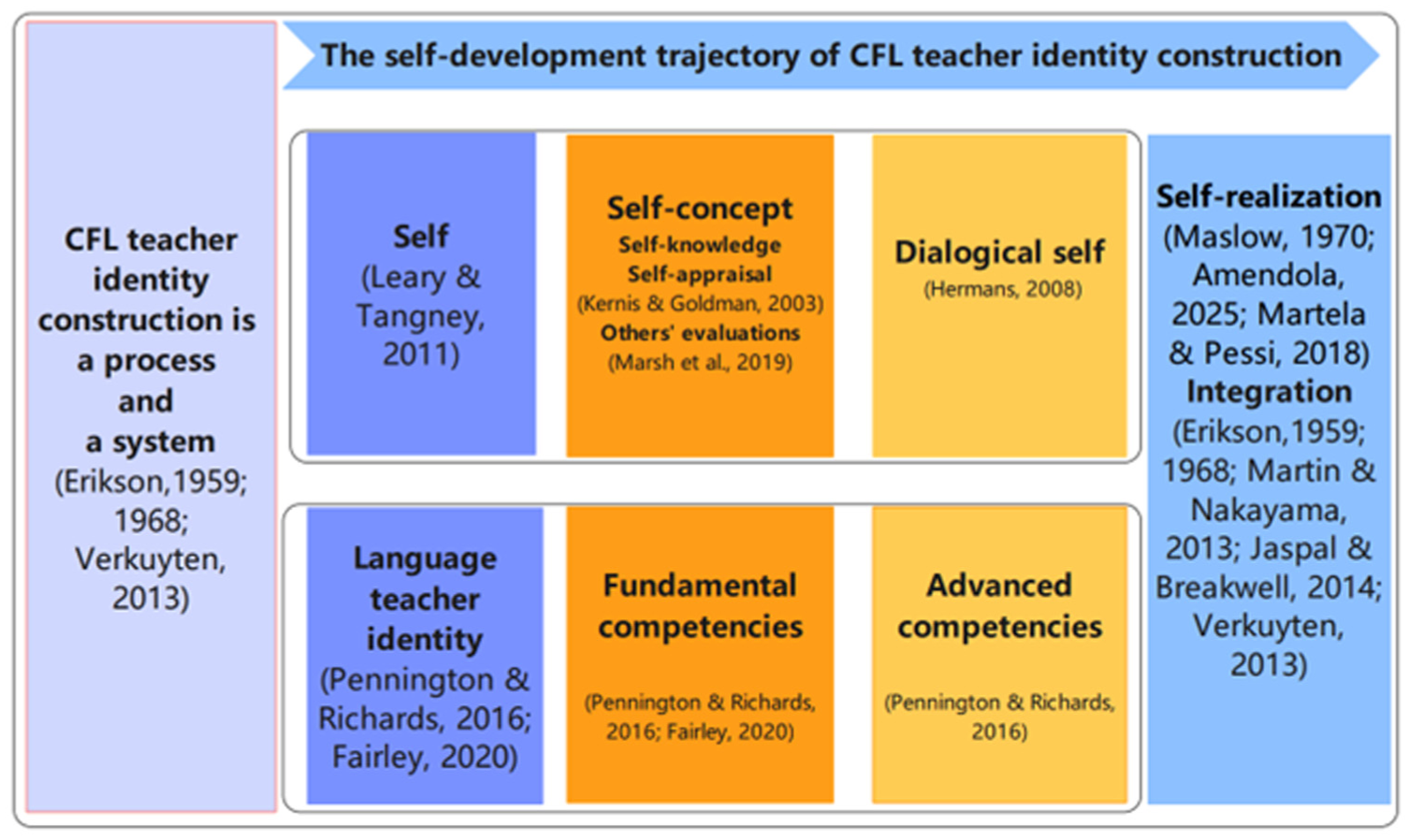
Conceptual framework.
Based on the above framework, this study explores the following questions:
How does the self-development trajectory contribute to CFL teacher identity construction within the multicultural context of Australia?
How can competency enhancement be integrated with self-development to promote CFL teacher identity construction?
How do individual differences influence the process of CFL teacher identity construction?
Methods
This research adopted an exploratory-interpretive case study design (Yin, 2014) to investigate the self-development processes in CFL teacher identity construction within Australian primary and secondary school settings. A case study methodology is particularly suited to exploring complex “how” and “why” questions in authentic contexts where the researcher does not control events. This design enabled the examination of evolving identity through longitudinal, situated narrative accounts.
Participant Selection and Context
Initially, five CFL teachers were observed in naturalistic classroom environments. From these, two participants were purposively selected (Miles & Huberman, 1994) based on three key criteria: (1) evidence of adapting pedagogical approaches to local students’ learning styles, (2) demonstration of strong teacher–student relationships, and (3) effective classroom management. Both participants were native Mandarin speakers from mainland China, teaching in well-established CFL programs in Adelaide.
Teacher A taught primary and secondary students (years 3–12) at a private girls’ school, while Teacher B taught upper primary students (years 5–6) in a public school with a strong Greek heritage. The participants’ demographics and educational backgrounds are summarized in Table 1.
Participant Information.

Data Collection
Data were collected through six semi-structured interviews (three per participant) conducted in Mandarin. Each interview lasted between 25 and 76 min, with a mean duration of ~50 min. The interview questions were designed based on Martin and Nakayama’s (2013) intercultural identity framework and reviewed by two professors (an applied linguist and a psychologist) to ensure content validity and cultural appropriateness.
All interviews were conducted in familiar and quiet school settings—in the teachers’ lounge with Teacher A and in an unused classroom with Teacher B—to ensure the interviewees’ feeling of comfort, privacy, and sense of trust in the study. With participants’ consent, interviews were audio-recorded and supplemented with field notes. All recordings were transcribed by a professional and translated into English. Transcribed texts and notes were imported into NVivo (version 1.7.2) by QSR International for systematic analysis.
Data Analysis
Thematic analysis followed V. Clarke and Braun’s (2013) six-stage method: familiarization with the material, initial coding, theme generation, theme review, theme definition, and narrative development. A mixed coding strategy was adopted, combining deductive and inductive processes (Gundarina, 2023; Proudfoot, 2023).
The first step was theory-driven top-down coding based on the reviewed literature, considering concepts related to teacher identity and self-development, such as self-concept, dialogical self, and emotional regulation. Top-down coding was then supplemented by open-ended bottom-up coding emerging naturally from participants’ narratives. Through repeated coding comparison and theme clustering, over 200 preliminary codes were generated and refined.
Inter-coder reliability was not calculated as this interpretive study aimed for conceptual coherence and theoretical saturation instead of statistical agreement. Rather than discrete quantifiable units, codes were treated as relational indicators of evolving self-perceptions and contextual meanings. Rigor was ensured through transparent documentation, iterative coding comparison, and triangulation of analytic perspectives. Initial coding was conducted by the first author, with second-round verification and theme refinement jointly undertaken with the second author. Additionally, feedback on theme clarity and relevance was obtained from the same two professors who reviewed the interview questions as external experts. This multi-step process supported internal consistency and conceptual alignment with the study’s schema-based framework.
Ethical Considerations
This study adheres to institutional ethical guidelines and the ethical principles outlined by the Committee on Publication Ethics (COPE). Ethical approval was obtained from the Human Research Ethics Committee of the first author's institution. To protect participant privacy, both were assigned pseudonyms, and all identifying information has been removed from the data, ensuring that the participating individuals and their institutions can be identified. Participants were informed of the study purpose, procedures, and their right to withdraw at any time. The research design poses minimal risk and ensures participants maintain autonomy and dignity throughout the process.
Informed Consent
Both participants and all relevant school authorities gave written informed consent prior to data collection, including consent for the publication of anonymized data.
Results
The Self-Development Trajectory of CFL Teacher Identity Construction
The coding process ultimately identified five interrelated and theoretically grounded themes that together form a conceptual framework for the self-development trajectory of CFL teachers in a multicultural context. The first three themes are self-concept, reflecting participants’ internal identity based on past experiences; dialogical self, embodying the process of negotiation between internal beliefs and external expectations; and self-realization, representing their gradually formed professional consistency and sense of purpose. The final two themes extracted from the data are fundamental competencies (e.g., classroom management, emotional resilience) and advanced competencies (e.g., intercultural mediation, teaching innovation), which highlight the evolving competencies that support identity construction. The combined five themes highlight the convergence and contrast in the two participants’ identity construction processes instead of considering each participant separately.
Self-Concept: Cultural Anchoring and Identity Assumptions
At the outset of their transnational journey, the two teachers had distinctly different self-concepts, deeply shaped by cultural narratives and educational backgrounds.
Excerpt 1: When most people see me, they think I am a cultured person. I feel that I must constantly learn and update my understanding of society and culture… I majored in English and I wanted to live in an English-speaking country. (Teacher A) I was seen as a good student… but later I found that my abilities were no longer as strong as those of local students. My values and ideas are still more Chinese, even though my way of doing things is a bit Australian. (Teacher B)
Teacher A viewed herself as a “cultured person,” rooted in China’s tradition of valuing learning and cultivation. Her decision to leave her role of English teacher in China to pursue an overseas teaching career was well-considered and forward-looking. By contrast, Teacher B experienced an identity rupture because her previous academic self-image was challenged by her new environment. Despite this rupture, she maintained a strong sense of cultural self-identity. This stage highlights the foundational role of self-concept as the internalized image of professional self, rooted in cultural and educational capital.
Dialogical Self: Coping with Challenges and Reflective Adjustments
As the two teachers became more embedded in the Australian teaching environment, they entered the identity-negotiation stage. Emotional regulation and reflective strategies were key facilitators of their adaptation.
Excerpt 2: Reflection journals help me identify mistakes and grow. Dancing, singing, watching TV series, and travelling… to appreciate myself and enjoy nature. (Teacher A) I like to go hiking in the mountains or walking along the beach. This is a nature-based way of regulating my emotions. Serving as a periphery subject teacher allowed me to see things from different angles. (Teacher B)
Teacher A refined her teaching identity through active reflection, and regulated stress through structured self-care routines. Similarly, Teacher B responded to challenges through emotional strategies.
Excerpt 3: I remain flexible in all aspects. I continue to learn pedagogical creativity, [and] constantly adjust to the local educational system and students’ learning styles. (Teacher A) If students respond well, the activity is correct; if not, I rethink the lesson. (Teacher B)
Competency building is closely linked to dialogical negotiation in a new cultural context. While Teacher A emphasized flexibility and adjustment, Teacher B described learning through student feedback and needs.
In summary, dialogical self is the identity formed through continuous interaction with social, emotional, and institutional environments, requiring internal negotiation and external adaptation.
Self-Realization: Professional Belonging and Motivational Maturity
Through sustained engagement and adaptive growth, both teachers entered the self-realization stage, characterized by professional coherence, creativity, and intrinsic motivation.
Excerpt 4: Now we learn while playing… there are so many teaching methods catering to the students’ learning style…The adaptation took around ten years and I have a positive relationship with my local colleagues now. (Teacher A) I showed them coupons from McDonald’s in China. They converted the prices from CNY to AUD. They were very interested in learning numbers by comparing between currencies! And now I can communicate with Australian colleagues because we have common topics to discuss. (Teacher B)
Teacher A demonstrates teaching innovation and ownership of her teaching identity, expressing a sense of belonging to the professional community. Teacher B also adopted innovative teaching methods, in combination with cultural engagement. Over time, her confidence has grown and she has developed deeper connections with peers.
Excerpt 5: I’ve always wanted to study abroad… I’ve been working toward that for years. (Teacher A) At first my development was for my family… now I enjoy my work and the environment. (Teacher B)
Teacher A’s trajectory reflects a proactive pursuit of sustained intrinsic motivation, while Teacher B’s growth path demonstrates a shift from extrinsic to intrinsic motivation. Despite these differences, both emphasize that self-realization is a critical stage in achieving identity stability. This stability is attained through cultivating professional competency, enhancing a sense of belonging, and stimulating intrinsic motivation—all elements fostered by the host country’s educational environment.
Self-Realization as the Result of Self-Development
Self-realization is a gradual process influenced by teachers’ continuous self-development in coping with teaching, emotional, and cultural challenges. Early in their careers, both teachers were highly dependent on external structures and expectations, reflecting a fragile and externally driven professional identity.
Excerpt 6: At first, I focused on survival—meeting expectations. But after a few years I started to feel that I could keep the students well engaged in learning. Teaching has become part of who I am. The lessons I design reflect what I care about. (Teacher A) At first, I just did what I was supposed to do. I followed instructions because I didn’t want to make mistakes. After trying several new methods and receiving positive feedback from students, I felt more confident in classroom management. Now I try new methods because I want to, not because someone else tells me to. (Teacher B)
Teacher A describes a shift from adaptive compliance to professional autonomy. Her development also integrated emotional and pedagogical growth. Similarly, Teacher B recalls her initial anxiety and how she progressed toward greater autonomy through reflective experimental and emotional adaptation. Ultimately, this self-development led her to form intrinsically motivated practices and clarify her professional self.
These narratives suggest that self-development—through reflection, adaptation, and emotional regulation—drives stable and meaningful teacher identity construction. This process is neither linear nor uniform but contextualized, cyclical, and evolving, as professional competency, personal motivation, and relational belonging gradually align. In this way, self-realization is not an endpoint but a visible manifestation of ongoing self-development—a state in which internal resources and contextual demands are meaningfully reconciled within CFL teacher identity construction.
Competency Enhancement Integrated with Self-Development
The thematic analysis indicates that CFL teacher identity construction is a multidimensional process shaped by the evolution of self-development patterns. Participants’ narratives demonstrate how different types of teaching competencies gradually emerge at different stages of self-development and how these competencies are negotiated, internalized, and expressed in specific contexts. To capture the hierarchical nature of this development process, the competency domains (including fundamental and advanced competencies) are integrated with the three self-schemas in the conceptual framework, showing in Table 2. The table links theme codes in NVivo with narrative excerpts and relevant prior research, providing a structured perspective on how teachers’ cognitive, emotional, and professional growth is rooted in internal schemas and mediated through contextual practice.
Competency Enhancement Integrated with Self-Schemas: NVivo Themes, Narrative Excerpts, and Scholarly Support.

As shown in Table 2, competency domains are not static but evolve in tandem with shifts in participants’ self-perceptions. For example, Teacher A’s critical reflection and professional confidence are rooted in an early internalized self-concept aligned with cultural capital, whereas Teacher B initially faced challenges in emotional regulation and only gradually developed classroom autonomy. For both teachers, dialogical self emerged as a critical stage of negotiating the tension between traditional teaching norms and the demands of a culturally diverse classroom.
Notably, the transition from dialogical self to self-realization signifies the internalization of professional agency and the alignment of personal values with classroom practices. These findings demonstrate that competency is not merely a skill-oriented outcome but a relational and emotional achievement embedded in identity transformation. The integration of the conceptual framework, experiential codes, and lived experiences supports a holistic model of CFL teacher identity construction that emphasizes psychological depth and educational relevance.
Individual Differences in CFL Teacher Identity Construction: A Cross-Case Analysis
Following detailed analysis of each participant’s evolving self-schemas and corresponding competencies, it is useful to compare their identity-development pathways. Teacher A’s self-concept was rooted in cultural capital and teaching objectives. She developed through stages of dialogical participation and reflection, culminating in a stable self-realized identity aligned with institutional goals and a personal mission. Her competency development followed a progressive path, with fundamental competencies (such as critical reflection and self-confidence) laying the groundwork for advanced intercultural responsiveness and teaching autonomy.
By contrast, Teacher B’s trajectory reflects adaptive identity reconstruction. Her initial self-concept was unstable because of cultural incongruity, and she initiated competency development through emotional regulation and external feedback. Her reflective practices enabled a gradual alignment between teaching methods and personal identity. The agency and voice she ultimately gained stemmed from intrinsically motivated experimental exploration, rather than prior self-confidence.
The participants’ distinct developmental trajectories confirm that CFL teacher identity construction is neither uniform nor linear. Instead, it is a contextualized, recursive, and competency-oriented process rooted in an evolving self-development framework. Teacher A shifted from a structure-oriented approach to teaching autonomy, while Teacher B transitioned from uncertainty to stability. Together, their narratives reveal how situational responsiveness, emotional strategies, and professional aspirations dynamically interact over time to shape teacher identity.
Discussion
This exploratory case study offers a contextualized perspective on CFL teacher identity construction as a multi-stage process rooted in the evolution of self-development from self-concept through dialogical self to self-realization. By focusing on two cases, this study aims to illustrate how identity construction may unfold in relation to professional growth. Integrating a competency-based perspective enhances the explanatory relevance of the proposed conceptual framework, facilitating an in-depth, situated exploration of identity construction rather than universal generalization.
The two cases suggest that competency enhancement may play a central role in identity construction, particularly when teachers navigate unfamiliar educational and cultural settings. In the self-concept stage, the participants relied on fundamental competencies such as emotional regulation, critical reflection, and situational awareness. These competencies align with the possible selves that motivates teacher agency in multicultural settings (Deci & Ryan, 2000; Dörnyei & Kubanyiova, 2014), and serve as enabling intrinsic mechanisms for adaptation and self-positioning.
The stage of dialogical self involved ongoing negotiation between personal expectations and institutional realities, often entailing emotional dissonance and shifting role expectations (Hermans, 2008; Zhu et al., 2020). The participants’ narratives point to the development of advanced competencies—such as adaptive teaching methods, intercultural sensitivity, and reflective engagement—as they engaged with institutional norms and student expectations. These findings highlight context-specific processes consistent with Fairley’s (2020) argument that emotional regulation and relational awareness support identity navigation in multicultural education. Both participants described moments of tension that catalyzed their experimentation with new teaching methods and relational strategies. When these tensions were met with reflective responses rather than avoidance, transformative insights and skills emerged.
In the self-realization stage, the participating CFL teachers demonstrated a considerable degree of professional autonomy and coherence, marked by increased alignment between internal values and teaching practices. This process echoes Martela and Pessi’s (2018) and Maslow’s (1970) views on actualization. While informed by only two cases, this stage appears to reflect a recursive interaction between intrinsic motivation and external validation practices, consistent with Wenger’s (1998) notion of identity as participation and mutual recognition within a professional community. In this stage, the participating CFL teachers exhibited integrated identities, with self-positioning that reflects both agency and belonging.
A conceptual model of CFL teacher self-development—based on the integration of the conceptual framework, experiential codes, and lived experiences—presented in Figure 2, illustrates the dynamic evolving process which explains how competency domains co-evolve with three self-schemas (self-concept, dialogical self, and self-realization), and visualizes the trajectory of CFL teachers transition from externally guided practices to an internally consistent professional identity.

Model of CFL teacher self-development.
Rather than offering a prescriptive sequence, the model is intended to provide an exploratory visualization of how identity and competencies may co-evolve in CFL teacher self-development. Fundamental competencies such as emotional regulation and reflection appear to support the early formation of self-concept, while the advanced competencies associated with dialogical negotiation promote adaptive teaching and intercultural sensitivity. The stage of self-realization is characterized by the alignment of acquired competencies with teachers’ professional voice and intrinsic motivation. As an exploratory tool, this model contributes to understanding identity construction as recursive, contextual, and competency-mediated.
Comparing the two participant narratives provides illustrative insights into how variability emerges within a shared developmental structure, supporting identity construction as both structured and fluid (Leary & Tangney, 2011). Teacher A’s path shows a culturally anchored and goal-driven progression, whereas Teacher B’s development trajectory appears more adaptive, feedback-dependent, and emergent. These differences highlight the importance of personalized professional development pathways that align with teachers’ internal schemas and external challenges. Rather than suggesting uniform patterns, this study underscores the heterogeneity of identity work across individual experiences.
In summary, the findings offer context-sensitive evidence that CFL teacher identity construction in multicultural settings may be shaped by recursive interactions between evolving self-schemas and shifting professional competencies. This study aims not to generalize but to provide a conceptual grounding for further explorations of teacher agency, reflection, and sustainable professional development.
Conclusion
This study contributes to the theorization of CFL teacher identity construction by proposing a schema-anchored, competency-based model that captures the staged and recursive nature of professional growth in multicultural contexts. Drawing from narrative data of two in-service CFL teachers, the study conceptualizes identity construction as a process encompassing self-concept, dialogical self, and self-realization, each embedded within corresponding phases of competencies enhancement. Albeit limited to two cases, this study develops a recursive model of CFL teacher identity construction by integrating the self-schema framework—comprising self-concept, dialogical self, and self-realization—with professional competencies development, and provides empirical support for the conceptual coherence of the developed model (Dörnyei, 2009; Leary & Tangney, 2011).
The findings indicate that competency development operates as both a driver and outcome of teacher identity construction. Fundamental competencies—such as emotional regulation, critical reflection, and situational sensitivity—enable CFL teachers to navigate cultural transitions and begin reconstructing their self-concept. When CFL teachers engage in dialogical interactions with institutional norms and classroom realities, their internal cognitive frameworks are challenged and reshaped, giving rise to advanced competencies such as intercultural sensitivity and adaptive strategies (Fairley, 2020; Hermans, 2008). Through continuous reflection and internalization, teachers reach self-realization by achieving higher professional autonomy and identity integration.
The proposed model (Figure 2) articulates the dynamic interplay between identity construction and competency enhancement across the three stages of self-development. The model emphasizes that effective identity construction requires not only mastery of technical skills but also cultivation of reflective, emotional, and intercultural competencies closely linked to evolving internal schemas. The contrasting trajectories of the two participating teachers highlights individual differences and underscores the necessity of developing personalized, schema-responsive professional development pathways. Meanwhile, the proposed model offers a valuable practical and framework for aligning teacher education programs with the goal of cultivating culturally responsive, autonomous, and reflective CFL teachers (Pennington & Richards, 2016). This model further contributes to deepening understanding of teacher growth in multilingual and transnational contexts.
Although this exploratory case study deeply examines CFL teacher identity construction within a specific sociocultural context, the methodological design favors conceptual illustration over statistical generalization. The sample facilitates detailed analysis of two practicing teachers’ self-developmental trajectories but does not permit population-level inference. The absence of longitudinal data further restricts insight into the sustained dynamics of identity construction over time.
The self-reported nature of the data highlights that teacher identity is constructed and narrated within context-specific institutional realities, potentially excluding perspectives gained through external observation or long-term engagement. Incorporating viewpoints from students, colleagues, or administrators could enhance the analytical scope through triangulation. Moreover, cross-contextual application and adaptation of the proposed model across multilingual and multicultural educational systems would test analytical robustness and refine conceptual precision.
In summary, this study conceptualizes CFL teacher identity construction as a self-development process shaped by the interaction of internal cognitive schemas, external demands, and evolving professional competencies. The proposed recursive model—from self-concept to self-realization—offers a structured account of how CFL teachers progressively align pedagogical agency with intercultural positioning. This model provides both an interpretive lens and a practical scaffold for supporting sustained, context-responsive identity construction in multilingual educational environments.
Footnotes
Acknowledgements
We extend our special thanks to Professor Sun Hongwei, Professor of Psychology at Shandong Second Medical University, China, for his valuable advice. We sincerely thank the editors and reviewers for their assistance with this study.

Ethical Considerations
This study involved human participants and was conducted in full compliance with ethical guidelines for academic research. Ethical approval was granted by the Human Research Ethics Committee at Shandong Second Medical University prior to data collection. As the research involved in-service Chinese as a foreign language (CFL) teachers reflecting on their professional development, no physical, medical, or emotionally sensitive procedures were involved, ethical considerations were fully addressed in line with Sage’s publishing requirements and Section 8.05 of the APA Ethical Principles.
The potential benefits of the research—to study participants and the wider field of language teacher education—clearly outweighed any minimal risks involved. The findings aim to inform teacher identity construction and support the professional growth of CFL teachers working in multicultural environments. For the participants, the opportunity to engage in structured reflection on their teaching experiences offered meaningful professional insights and empowerment.
The study is not exempt from ethical review as it involved direct interaction with human participants. Therefore, exemptions applicable to studies that do not involve human subjects are not applicable in this case.
Consent to Participate
To minimize risk, all participants were assured that their participation was voluntary and informed that they could withdraw at any time without consequence. Interviews were conducted face-to-face in private settings to ensure participant comfort and psychological safety. No institutional affiliations or identifying information are disclosed. All interview transcripts were anonymized, and pseudonyms are consistently used throughout the manuscript.
Written informed consent was obtained after fully briefing participants on the purpose of the research, its voluntary and confidential nature, and the intended use of the data for academic publication. Anonymization of all personal and institutional identifiers has been strictly maintained to ensure compliance with peer-review standards and the protection of participant privacy.
This research aligns with Sage’s Publication Ethics Policy and upholds the standards set by the Committee on Publication Ethics (COPE). We affirm that the study was conducted with full respect for academic integrity, transparency, and participant welfare. No copyrighted materials or third-party data have been included without permission. The manuscript has been prepared in accordance with Sage’s best practices on ethical publishing and has been checked for originality.
We recognize that responsible research conduct includes not only ethical data collection and participant care but also full compliance with policies around authorship, originality, and accurate scholarly reporting. Any future corrections or updates, should they become necessary, will follow Sage’s corrections and retractions policies.
Consent for Publication
All participants provided informed consent for the publication of anonymized data from this study. No identifying personal or institutional information are disclosed in the manuscript. The authors affirm that participants were fully informed about the nature of the study and its intended publication, and consented to the use of their pseudonymized responses for academic purposes.
Author Contributions
ZW collected and analyzed data, and wrote the main manuscript text. ZMZ conceptualized and supervised the research. Both authors reviewed the manuscript.
Funding
The authors disclosed receipt of the following financial support for the research, authorship, and/or publication of this article: This work was supported by
1. The International Chinese Language Education Research Key Project (2022), “A multiple case study of identity development of international Chinese language teachers in Malaysia,” funded by the Center for Language Education and Cooperation, Ministry of Education, China (grant number 22YH13B).
2. Education and Teaching Innovation and Research Key Project (2025) “Strategies and Practices for Promoting High-Quality Development of University through Educational Internationalization,” funded by Shandong Second Medical University, China [grant number 2025ZD001].
3. Educational Research Key Project (2024–2025), “Exploring Pathways for Co-construction and Sharing of Educational Resources and the Development of a Credit Bank System under the Integrated Framework of General, Vocational, and Continuing Education,” funded by the China Adult Education Association, China (grant number GXJJZD 25024S).
4. The Study Abroad Projects, funded by the Government of Shandong Province, China, 04-23/04-24.
Declaration of Conflicting Interests
The authors declared no potential conflicts of interest with respect to the research, authorship, and/or publication of this article.
Data Availability Statement
The data supporting the findings of this study are available from the first author upon reasonable request.