



Abstract
Expressing causation through complex grammatical constructions is a significant challenge for EFL learners, as these constructions often involve nuanced semantic and pragmatic considerations beyond simple grammatical rules. Periphrastic causatives represent a syntactic and semantic category that enables learners to articulate causal relationships concisely. Previous research has documented EFL learners’ underuse, overuse, and misuse of periphrastic causatives compared to native speakers, highlighting cross-linguistic influences and exposure effects. However, most studies focus on single native language (L1) backgrounds or specific proficiency levels, leaving gaps in understanding developmental trajectories across diverse L1s and a continuum of proficiency. Thus, this study investigates the development of periphrastic causative constructions with MAKE, HAVE, and LET in writings of Chinese, Swedish, and Spanish EFL learners across proficiency levels from A2 to C2 through a usage-based approach. Employing corpus analysis of token and type frequencies, the findings reveal the predominance of causative MAKE but distinct L1-influenced patterns. For HAVE and LET, nuanced interactions between L1, proficiency, and development emerged. High token frequencies facilitated chunk entrenchment, while increasing type frequencies promoted abstraction and productivity, reflecting a progression from formulaic to generalized usage. These findings align with usage-based principles, contributing insights into language development processes. Pedagogically, the results inform instructional design tailored to learners’ needs and paths across diverse L1s and proficiency levels.
Introduction
The acquisition of complex grammatical constructions poses a significant challenge for English as a Foreign Language (EFL) learners, particularly when navigating intricate linguistic patterns that involve expressing causation. Periphrastic causatives are defined narrowly as causative predicates taking infinitival complements (e.g., MAKE/HAVE/LET + NP + Vinf, BE MADE + Vto-inf; Hollmann, 2007). Given our learner-production focus, we additionally analyze two extended resultative patterns—MAKE/HAVE + NP + ADJ (lexical adjective) and MAKE + NP + Vpp (resultative participle)—because they encode caused resultant states and are robust in native and learner corpora (Altenberg & Granger, 2001; Gilquin, 2012, 2016).
Periphrastic causative constructions, characterized by the use of causative verbs (e.g., make, have, let) combined with a non-finite complement, which can be either an infinitive verb (e.g., make them study, let me explain) or a past participle (e.g., have it done), represent a syntactic and semantic category within the English language. These constructions enable learners to articulate causal relationships concisely and accurately, contributing significantly to the development of their linguistic competence and ability to engage in sophisticated discourse (Gilquin, 2010; Hu et al., 2015).
However, previous research has consistently demonstrated that EFL learners often exhibit patterns of underuse, overuse, and misuse when employing periphrastic causatives, compared to native English speakers (Cai, 2000; Liu & Shaw, 2001; Zhang & Liu, 2005). These deviations from target-like usage highlight the intricate challenge EFL learners face in acquiring such complex constructions, which extend beyond simple grammatical rules and involve nuanced semantic and pragmatic considerations. EFL learners, especially at lower proficiency levels, frequently make errors in their use of causative constructions, often due to a lack of mastery over the syntactic rules of causative verbs.
Various factors have been proposed to account for these difficulties, including cross-linguistic influences from learners’ native languages (L1), developmental stages, and exposure to specific causative patterns in the input (Ellis & Ferreira-Junior, 2009; Gilquin, 2016). Notably, recent studies have demonstrated that EFL learners adapt to English structures through priming and proficiency-level differences, providing that L1 transfer and frequency of exposure play key roles in shaping causative verbs usage. For example, Hwang (2022) explores the adaptation of Korean learners to causative structures, showing that structural priming can facilitate the uptake of unfamiliar constructions (e.g., Jen had her computer fixed). Likewise, Jeong and Kim (2023) highlight that Korean learners’ acquisition of causatives varies significantly across proficiency levels, indicating that developmental stages influence the selection and use of causative verbs.
Corpus-based studies have shed light on the distinct usage patterns and potential sources of difficulty encountered by EFL learners from different L1 backgrounds (Altenberg & Granger, 2001; Gilquin, 2016; Zhang & Liu, 2005). Wijaya and Winstin (2023) further reinforce the importance of L1 influence and frequency in the acquisition of causatives, showing how learners’ awareness and production of causatives often diverge, particularly when L1 structures provide little support.
However, most existing research has primarily focused on learners from a single L1 background or provided snapshots of learner language at one proficiency level, leaving gaps in our understanding of how periphrastic causatives develop across a broader linguistic spectrum and a developmental continuum. Moreover, the role of output frequency, which represents learners’ active production of linguistic patterns, has been relatively underexplored in the context of periphrastic causative acquisition.
To address these limitations, the current study investigates the developmental progression of periphrastic causatives (MAKE, HAVE, and LET) among EFL learners from Chinese, Spanish, and Swedish backgrounds. By examining causative use across proficiency levels, the study aims to uncover cross-linguistic patterns, track developmental stages, and analyze the role of output frequency in entrenching these constructions in learner writing.
Periphrastic Causatives in EFL Learners
Periphrastic causatives are a distinctive syntactic and semantic construction in the English language, characterized using causative verbs to express causation or the initiation of an action (Shibatani & Pardeshi, 2002). Periphrastic causatives employ causative verbs such as MAKE, HAVE, and LET in combination with non-finite complements to convey that one entity causes another to perform an action. The typical structure of periphrastic causatives involves a subject (causer), a causative verb, a noun phrase (causee), and an infinitive verb representing the action (Wolff & Song, 2003). For example, in “She made him eat the vegetables,”“made” acts as the causative verb, indicating that the subject compels the causee to perform the action described by the infinitive verb “eat.” Following Hollmann (2007, p. 193), we label such cases core periphrastic causatives, for example, causative predicates that select infinitival complements in which the causee functions as the semantic subject of the lower verb (e.g., MAKE/HAVE/LET + NP + Vinf; BE MADE + Vto-inf).
In addition, because EFL learners very frequently encode causation via resultative secondary predication, we analyze two robust extended patterns alongside the core type: MAKE/HAVE + NP + ADJ (where ADJ is a lexical adjective, not a participial form) and MAKE/HAVE + NP + Vpp (a resultative small clause with a past participle predicate). These extended resultatives are well attested in native and learner corpora and form a productive part of EFL learners’ causative repertoires (Altenberg & Granger, 2001; Gilquin, 2012, 2016). In line with standard descriptions, active MAKE selects a bare-infinitival complement in its core use, whereas the pattern MAKE + NP + Vpp is treated here not as “make + verb complement,” but as a causative + small-clause configuration that assigns a caused state (e.g., made herself understood/known; made their voices heard; Altenberg & Granger, 2001; Carter & McCarthy, 2006; Gilquin, 2012). Throughout, we use periphrastic causatives as an umbrella term for both Core and Extended (resultative) subtypes. To maintain construct validity and comparability with prior work, we limit extended resultatives to small-clause predicates realized as ADJ, Vpp, or Vprp. Adverbial/particle predications (e.g., have him back) are excluded due to inconsistent analysis in the causative literature and low/ambiguous incidence in our corpora.
Periphrastic causative constructions hold importance for EFL learners. These constructions enable EFL learners to express complex causal relationships concisely and accurately, thus enhancing their ability to convey causative ideas and actions. EFL learners encounter these constructions as they navigate the complexities of English grammar, and mastering them is fundamental to achieving grammatical proficiency (Duan & Shi, 2021; Hu et al., 2015). Additionally, the acquisition of periphrastic causatives contributes significantly to the development of linguistic competence, allowing learners to engage in more sophisticated forms of discourse and expanding their overall language proficiency (Gilquin, 2010). However, acquiring periphrastic causatives presents a multifaceted challenge for EFL learners, as evidenced by extensive research in this area.
Studies have shown that EFL learners often struggle with the appropriate use of periphrastic causatives, exhibiting patterns of both underuse and overuse compared to native speakers. Cai (2000) observed significant deviations in causative usage among EFL learners, with both underuse and overuse evident. Liu and Shaw (2001) found that Chinese learners tend to overuse “make” in causative constructions, possibly due to L1 influences. Wang (2024) further highlights that advanced Chinese EFL learners struggle with causative alternation in unaccusative structures, often overusing transitive forms and accepting constructions, such as Make-NP-VP, which native speakers would reject.
Similarly, French-speaking learners overuse causative constructions in contexts where native speakers might prefer simpler forms, a phenomenon attributed to negative L1 transfer (Gilquin, 2016). Spanish EFL learners also exhibit both underuse and overuse, especially with “make” and “have,” influenced by Spanish causative structures (Gilquin, 2012, 2016). Moreover, research indicates that EFL learners struggle with causative verbs beyond “make,”“have,” and “let.” Verbs like “get” and “force” present additional challenges, partly due to their lower frequency in EFL materials, which may lead learners to overuse more familiar causatives (Gilquin, 2016). This supports Hwang (2022), who found that learners can adapt to unfamiliar causative structures via priming and repeated exposure.
These studies underscore the significant role of L1 influence and frequency effects in shaping EFL learners’ acquisition of causative verbs, revealing that EFL learners from different L1 backgrounds follow unique developmental trajectories shaped by their native language structures and exposure to specific constructions.
Frequency Effects on Language Development From Usage-Based Perspectives
Usage-based theories, which have gained increasing attention over the past two decades, argue that language development is a product of accumulated linguistic experience (Ellis et al., 2016; Langacker, 1987). Central to this perspective is the emphasis on a bottom-up learning process, where learners start with specific linguistic items and gradually progress to more complex structures through repeated encounters (Roehr-Brackin, 2015).
Within the framework of usage-based theories, frequency plays a pivotal role in understanding how language development unfolds. These theories posit that language learning is intricately linked to the frequency of exposure to linguistic patterns, encompassing both input frequency (what learners receive) and output frequency (what learners produce). Input frequency, denoting the frequency of exposure to linguistic patterns, has received significant attention in research (Candarli, 2021; Diessel, 2007; Diessel & Hilpert, 2016). It shapes language development by enhancing comprehension and usage through repeated exposure. While, output frequency, representing what learners actively produce, is equally important in understanding language development has been relatively underexplored. The act of generating linguistic output reinforces mental representations of linguistic structures, contributing to their entrenchment and accessibility during language use (Gass & Mackey, 2007; Kim et al., 2020). Output frequency effects are particularly significant in assessing how learners internalize and employ linguistic patterns in their expressive language skills. When learners actively produce certain language features or constructions frequently, these elements become ingrained in their linguistic repertoire.
As Hwang (2022) demonstrates, repeated exposure to L2 causative structures through priming can significantly increase the likelihood of producing target-like constructions, providing further evidence that output frequency plays a key role in the entrenchment of these structures. Jeong and Kim (2023) also support this perspective by showing that higher proficiency learners, who have been exposed to causative constructions more frequently, display more accurate and varied use of these constructions, reinforcing the role of exposure and frequency in advancing learners’ proficiency.
Frequency is divided into two distinct yet interconnected aspects: token frequency and type frequency (Ellis, 2012; Madlener, 2015). Token frequency refers to the frequency of individual words in a given text or context, whereas type frequency counts the number of distinct lexical items. Token frequency has a significant effect on entrenchment, which refers to the process by which repeated exposure to linguistic patterns solidifies them in the learner’s cognitive system (Ellis, 2012). It is often seen as the starting point of the language learning process. As learners encounter and use specific linguistic patterns more frequently, these patterns become entrenched in their mental representations.
As Hwang (2022) suggests, the entrenchment of causative structures through repeated exposure enables learners to produce them more naturally, shifting away from non-native-like structures. Jeong and Kim (2023) further demonstrate that higher proficiency learners exhibit more flexibility in their causative usage, which can be attributed to their more frequent encounters with a variety of causative constructions across proficiency levels.
Token frequency can lead to the formation of “chunks”—formulaic strings of unanalyzed linguistic items (e.g., “make me feel” or “make life become better”). These chunks represent holistic language processing without an in-depth analysis of internal structures. Advanced proficiency level learners, as observed in Hou et al.’s (2018) study, may exhibit only subtle development in their use of chunks. For learners, the initial stages of language development often involve working with these “chunkatory” structures, as opposed to engaging in structural analysis (Arnon & Cohen Priva, 2013; Serrano et al., 2015). In contrast, type frequency primarily contributes to productivity, which refers to the ability of learners to generate new linguistic items and adapt existing patterns to novel contexts. High type frequency, characterized by the presence of distinct lexical items that fit within a specific linguistic structure, enhances learners’ capacity to notice the slots and frames within these patterns (Ellis, 2012). The more lexical items that can fit into a given structure, the more versatile and adaptable the pattern becomes.
As learners progress in their language development journey, the increasing type frequency drives them toward more advanced stages, such as the “island” and “slot and frame patterns” stages (Madlener, 2015). During the “island” phase, learners’ transit from item-based learning to systematic learning. With a growing type frequency of distinct lexical items in the slots of a pattern, learners begin to analyze the internal structures of these patterns. They gradually generalize formulaic patterns (e.g., “it makes me feel…,”“it makes me think…,” etc.), signifying the emergence of systematic learning processes. Hwang (2022) also illustrates, repeated exposure to causative constructions in different contexts facilitates learners’ ability to adapt these structures to new contexts. This progression aligns with the principles of schema formation and generalization in language development (Bybee, 2013).
In this study, the focus on frequency effects is justified by the need to trace developmental patterns in the use of periphrastic causatives among EFL learners. By analyzing frequency data from learner corpora, we aim to illustrate how different frequency types influence the acquisition and use of these constructions across various proficiency levels. This approach enables us to draw meaningful insights into the role of frequency in shaping learners’ linguistic competence and supports the broader framework of usage-based theories in understanding language acquisition.
Corpus Based Studies on Periphrastic Causatives
A corpus is a collection of digital written or spoken texts that are compiled and organized for the purpose of linguistic analysis. A learner corpus is a specific type of corpus that consists of language data produced by learners of a language, used primarily to study the patterns, errors, and development in language acquisition. Corpus-based studies have made significant contributions to our understanding of periphrastic causatives in EFL settings. Altenberg and Granger (2001) were pioneers in this field, examining the grammatical and lexical patterning of the verb MAKE, a central causative verb, in both native and non-native writing. Their study revealed that Swedish and French EFL learners frequently use causative MAKE, but those EFL learners encounter difficulties of correctly uses, even at advanced proficiency levels. This study focused primarily on the frequency and errors associated with “MAKE” among learners from specific L1 backgrounds.
Similarly, Zhang and Liu (2005) also conducted a corpus-based study and found that Chinese EFL learners also overuse causative MAKE constructions, particularly the NP1 MAKE NP2 VP/ADJ pattern. Building on these insights, Gilquin (2006) analyzed over 3,000 constructions of periphrastic causatives and found that the most frequent pattern involved an inanimate causer and an animate causee, particularly expressing a non-volitional effect. This complements Altenberg and Granger’s (2001) study by providing a detailed examination of the patterns of “MAKE” usage among learners and highlights the necessity for more detailed analysis of periphrastic causatives. Ellis and Ferreira-Junior (2009) demonstrated that learners’ exposure to specific causative constructions in their input significantly influenced their acquisition patterns, challenging the notion of a fixed universal sequence in language acquisition and underscoring the role of frequency and exposure.
In summary, the corpus-based studies on periphrastic causatives reflect the complexities of EFL learners’ acquisition and usage of these constructions. Previous studies suggest that while some problems are common across L1 backgrounds, others are unique to specific language groups. The current study expands upon these findings by examining the development of periphrastic causatives in EFL writings across a broader L1 backgrounds, from Chinese, Swedish, and Spanish EFL learners, and across a developmental continuum from CEFR levels A2 to C2.
Limitations of Previous Studies and Rationale for This Study
Although prior studies have offered valuable insights, several limitations persist that constrain our understanding of periphrastic causative development in EFL learners. First, studies that focus on learners from a single L1 background (Cai, 2000; Liu & Shaw, 2001; Zhang & Liu, 2005) provide controlled insights into L1-specific effects but limit our understanding of cross-linguistic influences and reduce the generalizability of findings. A broader, comparative analysis is needed to investigate whether EFL learners from different L1 backgrounds exhibit similar or divergent developmental orders for periphrastic causatives.
Second, most research captures only a snapshot of learner language at one proficiency level, leaving the developmental progression of periphrastic causative acquisition largely unexplored (Altenberg & Granger, 2001). Tracking learners across proficiency levels could reveal how these constructions evolve and solidify as learners’ language skills increase.
Finally, while previous studies emphasize the role of input frequency in causative acquisition (Gilquin, 2012, 2016), the effects of output frequency—how often learners produce these constructions—remain underexamined. Exploring output frequency is essential to understanding how learners entrench linguistic patterns and utilize these constructions productively in writing.
To address these limitations, this study investigates the development of periphrastic causatives among EFL learners from three distinct L1 backgrounds: Chinese, Spanish, and Swedish. Using a corpus-based analysis across proficiency levels, the study examines both token and type frequency effects on causative construction use. This approach enables us to track learners’ developmental progress and analyze cross-linguistic patterns. The study is guided by the following research questions:
Do EFL learners with different L1 backgrounds show similar or different developmental order regarding periphrastic causative MAKE, HAVE, and LET constructions?
What are the differences in the use of these periphrastic causatives between lower and higher proficiency EFL learners?
How does output frequency influence the development order of these periphrastic causative constructions in EFL writing?
Methods and Data Collection
Corpora Used in This Study
This study utilized three learner corpora representing general writings by EFL learners at varying proficiency levels: the Chinese Learner English Corpus (CLEC), the Written Corpus of Learner English (WRICLE) from Spanish learners, and the Uppsala Student English Corpus (USE) from Swedish learners. The CLEC contains English writings by Chinese high school students at an approximately A2 level and university English majors at the B1 level per CEFR mappings.
The CLEC, constructed by Gui and Yang (2003), contains 1,207,879 words of English writings by Chinese EFL learners, primarily collected from daily writing assignments, mainly argumentative essays, by high school students (A2 level) and university English majors (B1 level) as mapped by CEFR standards (CEFR, Council of Europe, 2001; CSE, National Education Examinations Authority, 2018). This focus on argumentative essays provides a rich context for causative verb usage, as this genre often involves articulating cause-and-effect relationships.
The USE, compiled by Axelsson (2000), includes 300,000 words of essays written by Swedish university students at B2 and C1 proficiency levels. This corpus encompasses a variety of text types, such as argumentative essays and literature analyses, which provide contexts where periphrastic causatives are frequently employed. The advanced proficiency levels represented in the USE corpus allow for the exploration of how learners with higher language skills utilize causative constructions in sophisticated written discourse.
The WRICLE, developed by O’Donnell et al. (2009), comprises 750,000 words of academic English writings from Spanish EFL learners. The writings range from spanning A2 to C2 CEFR levels according to the Oxford Placement Test (UCLES 2001) taken by each of the learners. The inclusion of various academic essays makes this corpus valuable for examining causative constructions. Academic writing often necessitates the use of complex syntactic structures, including periphrastic causatives, which are used to articulate arguments and explain processes, making this corpus particularly suitable for the study.
To facilitate meaningful comparisons across these diverse corpora, the frequency of periphrastic causative constructions was normalized per million words. Normalizing to a million words provides a consistent metric that reflects the relative frequency of linguistic features within each corpus, allowing us to assess the use of periphrastic causatives across different learner groups and proficiency levels.
Data Collection Framework
This study employs a syntactic classification framework to identify periphrastic causative constructions in learner corpora. The classification targets core periphrastic causatives—MAKE/HAVE/LET + NP + Vinf and BE MADE + Vto-inf—and, motivated by learner usage, two extended resultative patterns: MAKE/HAVE + NP + ADJ and MAKE + NP + Vpp. The core versus extended distinction follows Hollmann’s (2007) narrow definition for periphrastic causatives (infinitival complements) while recognizing corpus-attested resultatives that encode causation and are frequent in learner production (Altenberg & Granger, 2001; Gilquin, 2012, 2016). In our data, MAKE + NP + Vpp predominantly hosts the participles heard/known/understood/felt, which corpus studies identify as distinctive collexemes of the construction (Gilquin, 2012, 2016).
For MAKE/HAVE + NP + ADJ we restrict ADJ to lexical adjectives (e.g., available, possible, ready, strong, happy), which admit be/become paraphrases and degree modification. Participles functioning as adjectives are excluded from the ADJ category. The revised example HAVE + NP + ADJ is The teacher had the students’ presentation ready (Extended, ADJ). These resultatives are well-documented in native and learner corpora (Altenberg & Granger, 2001; Gilquin, 2012, 2016).
To operationalize this framework in data extraction, we configured AntConc 3.2.4 to retrieve occurrences of these predefined patterns from the corpora, with search parameters tailored to each syntactic structure defined in Table 1.
Syntactic Structures (Core vs. Extended) for Causative MAKE, HAVE, and LET.

Notes on scope and notation: Core periphrastic causatives follow Hollmann’s (2007) infinitival-complement definition (MAKE/HAVE/LET + NP + Vinf; BE MADE + Vto-inf). Extended resultatives include MAKE/HAVE + NP + ADJ (ADJ = lexical adjective), MAKE/HAVE + NP + Vpp, and NP + HAVE + NP + Vprp (resultative participle); these encode caused resultant states and are frequent in learner output (Altenberg & Granger, 2001; Gilquin, 2012, 2016). In line with reference grammars, active make takes a bare-infinitive complement in its core use; MAKE + NP + Vpp is therefore analyzed as a resultative small clause, not as a core “make + verb complement” (Carter & McCarthy, 2006). Core items are labeled “Core”; resultatives labeled “Extended.” Traditional grammars restrict active make to the bare-infinitive complement (Carter & McCarthy, 2006); our “Extended”MAKE + NP + Vpp entries are analyzed as small-clause resultatives rather than core make + Vinf complements. Vinf = bare infinitive; Vto-inf = to-infinitive; Vpp = past-participle form (resultative participle); Vprp = present participle (-ing); ADJ = lexical adjective.
Data Collection Software
To extract causative constructions from these corpora, we employed AntConc 3.2.4 (Anthony, 2011), in combination with regular expressions, a method for identifying syntactic patterns across large datasets. Using PatternBuilder (Liang, 2009), we formulated regular expressions that allowed us to capture formulaic sequences associated with causative constructions—such as MAKE/HAVE/LET + NP + Vinf—with precision. The application of regular expressions in AntConc 3.2.4 allowed us to systematically locate specific causative patterns in the corpora. By setting precise formulaic strings, we ensured that AntConc 3.2.4 could accurately match constructions, thereby capturing syntactic structures associated with each causative verb (e.g., MAKE, HAVE, LET) in the target patterns.
To ensure the precision and accuracy of the extracted patterns, all the results were manually checked by the authors. The manual checking process involved reviewing each extracted instance to confirm whether it functioned as a causative construction within its context. Disagreements in classification were discussed among the authors until a consensus was reached, ensuring a consistent and reliable coding process.
Results and Analysis
Causative Uses of MAKE, HAVE, and LET in EFL Writings
Causative MAKE emerges as the predominant verb among EFL learners, as illustrated in Figure 1. This finding aligns with previous studies emphasizing MAKE’s centrality in causative usages (Altenberg & Granger, 2001; Gilquin & Viberg, 2009). Conversely, causative HAVE and LET are less frequently used compared to MAKE, indicating that learners may not strongly associate them with causative meanings. Unless stated otherwise, aggregated “causative uses” in the figures/tables include Core (infinitival) and Extended (resultative) subtypes; where relevant, we point out subtype-specific trends.

The normed frequency (per million words) of causative uses of MAKE, HAVE, and LET.
Statistical analyses further illuminate the relationship between causative verb usage and proficiency level. Chi-square tests indicate significant associations between the causative uses of MAKE, HAVE, and LET and the EFL learners’ proficiency levels. Specifically, for Chinese learners (χ2 = 39.358, df = 2, p < .01), Swedish learners (χ2 = 24.407, df = 2, p < .01), and Spanish learners (χ2 = 531.259, df = 8, p < .01), the differences in the usage of these causative verbs across proficiency levels are statistically significant. As learners advance from foundational A2 to the sophisticated C2 levels, they rely on the prototypical causative MAKE to express causation.
Figure 2 presents a comprehensive overview of how EFL learners with varying L1 backgrounds and at different stages of using specific causative constructions in their writings.

The distribution of causative patterns across L1 groups and proficiency levels.
As shown in Figure 2, certain causative constructions are used with varying frequency as EFL learners progress in their English proficiency. Notably, the MAKE + NP + ADJ, LET + NP + Vinf and MAKE + NP + Vinf constructions are predominant across all learner groups, signifying their importance in the acquisition of English causatives. This trend is consistently observed in all three corpora, underlining the centrality of these constructions in learners’ development. Further examination reveals a shift in the frequency of certain constructions as EFL learners move from lower to higher proficiency levels. For example, the construction MAKE + NP + ADJ shows a marked increase in frequency from A2 to B1 in the CLEC corpus but then declines as proficiency grows, indicating a developmental progression in learners’ constructional knowledge. The detailed analysis of each causative construction was elaborated in subsequent sections of the study.
Causative MAKE Patterns in EFL Learners’ Writings
The analysis focused on token and type frequency of causative MAKE patterns among EFL learners across proficiency levels.
Table 2 provides insights into the usage patterns of causative MAKE constructions by Chinese EFL learners at two proficiency levels, A2 and B1. The normed token frequency of causative MAKE patterns moderately increased from 885 to 984 between the A2 and B1 levels among Chinese learners. However, this change did not reach statistical significance (χ2 = 8.233, df = 4, p > .05). At the A2 level, the MAKE + NP + ADJ construction exhibits the highest token frequency of 100 and a normalized frequency of 481, corresponding to 53% of the type frequency. This indicates its prominence in early stages of language acquisition. Progressing to B1, there is an increase in token frequency to 114 with a normed frequency of 531, with the same the type frequency percentage (53%). This suggests that as learners’ proficiency develops, they continue to favor this construction.
Token and Type Frequency of Causative MAKE Patterns in Chinese EFL Learners’ Writings.

Note. Normed frequency refers to the occurrence of each causative construction per million words in the learner corpora.
The MAKE + NP + Vinf construction follows in frequency, with a raw count of 66 and normalized frequency of 317 at A2, accounting for 36% of the type frequency. At B1, the token frequency increases to 83 with a normalized frequency of 387, with type frequency accounting for 40%. This points to the increased use of verbs in MAKE + NP + Vinf construction with learners’ proficiency developed. MAKE + NP + Vpp has a lower token frequency at A2 with 17 and a normalized frequency of 82, making up 10% of the type frequency, which decreases further at B1 level to 13 tokens and 61 normalized frequency, representing 6% of the type frequency. This pattern is marginal increase in token frequency yet decrease in type frequency suggests that while it is learned and used, it remains a less favored option compared to other causative constructions. The MADE + NP + Vto-inf construction is scarcely represented at both A2 and B1, with a single token and normalized frequency of 5 at each level, comprising only 1% of the type frequency. This usage implies that MADE + NP + Vto-inf is not a focus within the learners’ causative repertoire at these stages.
Table 3 outlines the token and type frequencies of causative MAKE patterns in the writings of Swedish EFL learners at B2 and C1 proficiency levels. The MAKE + NP + ADJ pattern, with a raw token frequency of 137 at the B2 level, decreases to 43 at C1, while its normed frequencies are 749 and 688 respectively (χ2 = 29.954, df = 5, p < .01). Aligned with the drop in raw frequency, this type frequency of patterns decreased from 61% at B2 to 55% at C1. This suggests a slight reduction in its dominance as learners advance.
Token and Type Frequency of Causative MAKE Patterns in Swedish Learners’ English Writings.

The MAKE + NP + Vinf pattern shows a raw token frequency of 84 at B2, which reduces to 33 at C1, with normed frequencies of 459 and 528 respectively. The type frequency slightly increases from 35% to 43%. This indicates that the learners increase the use of MAKE + NP + Vinf patterns with English proficiency developed. In contrast, the MAKE + NP + Vpp pattern exhibits a lower token frequency, with 18 at B2 and 6 at C1, and normed frequencies of 98 and 96 respectively. The minimal type frequency percentages at both levels (4% at B2 and 2% at C1) reflect its marginal role. The absence of the MADE + NP + Vto-inf construction at both B2 and C1 suggests that this pattern is either not introduced or not adopted by learners in these proficiency stages.
The analysis of causative MAKE patterns among Spanish EFL learners presents a compelling developmental narrative when analyzing token and type frequencies separately before synthesizing them into a comprehensive overview.
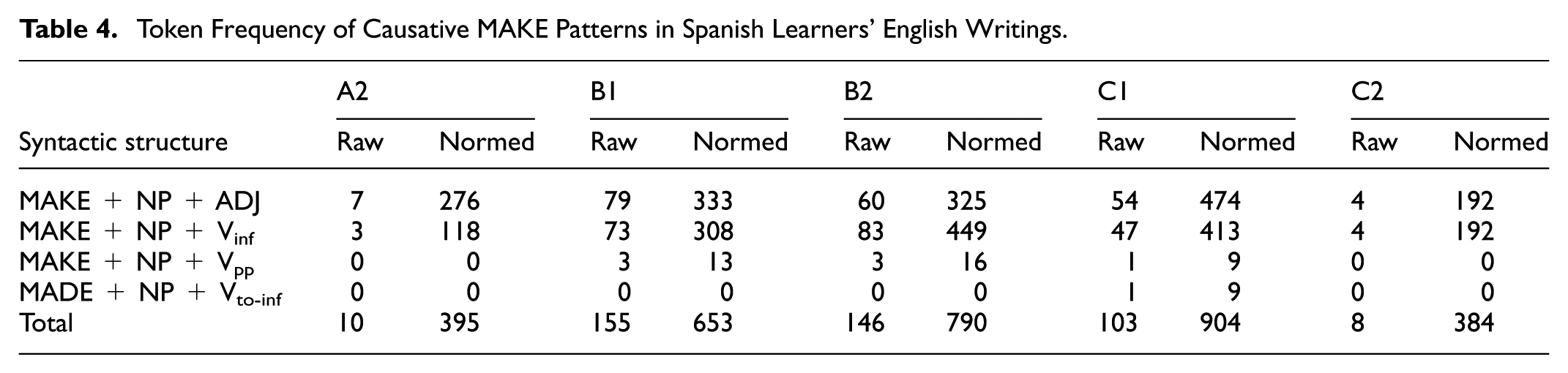
Tables 4 and 5 present the token and type frequencies of causative MAKE patterns in Spanish learners’ English writings. Table 4 shows an incremental use of causative MAKE constructions, with MAKE + NP + Vinf and MAKE + NP + ADJ dominating across the proficiency levels (χ2 = 167.290, df = 8, p < .01). The token frequency of MAKE + NP + ADJ is predominant at the A2 level with a raw count of 7 and a normalized frequency of 276. As proficiency increases to B1, this pattern’s usage ascends to a raw count of 79 and a normalized frequency of 333, which then peaks at the C1 level with a raw count of 54 and a normalized frequency of 474 before declining at C2 levels to raw counts of 4 and normed frequencies of 192. This trajectory suggests an initial preference for adjective causatives, which decreases as learners attain higher proficiency, potentially indicating a shift toward more complex causative structures. For MAKE + NP + Vinf, the token frequency is lower at the A2 level with a raw count of 3 and a normalized frequency of 118, which increases at B1 to a raw count of 73 and a normalized frequency of 308, arrive at the peak of at B2 with the normed token frequency of 449. This pattern points to a similar developmental arc where usage expands in the intermediate stages and then reduces, suggesting increased language proficiency may be associated with a diversification of grammatical structures.
Token Frequency of Causative MAKE Patterns in Spanish Learners’ English Writings.
Type Frequency of Causative MAKE Patterns in Spanish Learners’ English Writings.

Table 5 shows the type frequency for MAKE patterns, echoing the trends observed in token frequencies. MAKE + NP + ADJ remains the most varied from A2 and C1 levels but decreases in variety by C2, while MAKE + NP + Vinf experiences an increase in type frequency at C2 despite the decrease in token frequency, indicating that learners use this construction with a wider variety of verbs as they progress. The low presence of MAKE + NP + Vpp and MADE + NP + Vto-inf across both tables suggests these patterns are not central to the causative construction repertoire of Spanish learners at these proficiency levels.
Causative HAVE Constructions in EFL Learners’ Writings
The current study does not analyze the raw token frequency and type frequency of causative HAVE, instead, the normalized token frequency is focused. It is because causative HAVE demonstrates limited usage across learner backgrounds. The low type frequency of causative HAVE among EFL learners does not adequately reflect this construction’s productivity. Additionally, raw token frequency might not provide meaningful insights into the learners’ proficiency with causative HAVE, as it could be skewed by the overall low usage. Hence, normalized token frequency is a more appropriate measure, aligning with the study’s usage-based theoretical foundation and providing a clearer picture of the learners’ actual use and competence with this construction. Table 6 displays the normalized token frequency of causative HAVE patterns across proficiency levels from A2 to C2 within the Chinese, Swedish, and Spanish EFL learners.
Normed Token Frequency of Causative HAVE Patterns.

A significant observation from the Table 6 is the marked prevalence of the causative construction HAVE + NP + Vpp among EFL learners from all three L1 backgrounds, with an exceptional frequency noted among Spanish EFL learners at the C2 level, with the normed token frequency being 96. This suggests that although the frequency of HAVE + NP + Vpp pattern dominant all the uses of causative HAVE, EFL learners’ native language might influence the uses of it. Furthermore, disparities in the frequency of causative HAVE patterns between the learner groups are evident. The pattern HAVE + NP + ADJ is frequently used by Spanish EFL learners at A2 level (79), contrasting starkly with its much lower frequency among Chinese EFL learners of A2 level (19) and this pattern completely disappears at the B2 and C1 level of Swedish EFL learners. Causative HAVE patterns such as HAVE + NP + Vprp show low frequency across all proficiency levels and learner groups.
Exploring the use of causative HAVE constructions among EFL learners from different L1 backgrounds and proficiency levels reveals a blend of shared tendencies and distinct variations. The pattern HAVE + NP + Vpp emerges as a common thread, widely used across all learner groups, indicating its fundamental role in learners’ acquisition of English causatives. However, the exceptional use of this construction by Spanish EFL learners at the C2 level highlights how higher proficiency can lead to a more pronounced adoption of certain structures, reflecting the interplay between learners’ linguistic background and proficiency level. In contrast, the usage of HAVE + NP + ADJ varies significantly. Spanish A2 learners frequently employ this pattern, unlike their Chinese and Swedish counterparts, suggesting that native language influences the choice of specific causative constructions. Additionally, the developmental trajectory of these patterns exhibits interesting trends. Chinese learners show an increase in the use of HAVE + NP + Vto-inf from A2 to B1, indicating an integration of more complex structures with proficiency. However, this pattern plateaus in Swedish and Spanish learners at higher levels, possibly signaling a shift toward other constructions. Moreover, the uniformly low frequency of complex patterns like HAVE + NP + Vprp and HAVE + NP + Vto-inf across all backgrounds and proficiency levels suggests that these constructions are either integrated later in the learning process or less preferred due to their complexity.
Causative LET Constructions in EFL Learners’ Writings
Upon closer examination of Table 7, which details the normed token frequency and type frequency of causative LET patterns, the usage trends across learner corpora from China, Sweden, and Spain EFL learners can be identified.
Normed Token Frequency and Type Frequency of Causative LET Patterns.

The normed token frequency for Chinese EFL learners displays a moderate decrease in the use of LET + Vinf from the A2 level (452) to the B1 level (312), suggesting a decline in reliance on this construction as proficiency improves. Swedish EFL learners present a similar pattern. At the B2 level, the normed token frequency stands at 388, which then experiences a slight decrease to 304 at the C1 level. This suggests that as Swedish learners progress from upper-intermediate to advanced stages of proficiency, their utilization of LET + Vinf constructions diminishes. Spanish EFL learners show an incremental use of LET + Vinf from the A2 level (118) through B1 (135) and B2 (135), followed by a substantial increase at the C1 level (202) and a decrease at the C2 level (48). This pattern reflects a peak in the use of LET + Vinf at the intermediate C1 level, with a significant reduction as learners reach higher proficiency levels.
Remarkably, Chinese EFL learners, particularly at A2 and B1 levels, demonstrated higher frequencies of causative LET patterns compared to Swedish and Spanish learners. Noteworthy chunks like “NP lets me tell” or “NP let me see” emerged at lower proficiency levels, transitioning to newer chunks like “NP let me know” or “NP let me introduce” as proficiency developed, resembling the progression observed in causative MAKE patterns. These shifts in chunk usage and the emergence of new constructions align with the concept of developmental progression, akin to an island phenomenon. The decreased frequency of certain chunks and the introduction of new ones align with ordered development theories in second language acquisition. Additionally, the identification of structured frames, such as [LET me/us/it—VERB], reflects learners’ attempts to fill and comprehend the frame within causative LET constructions. The increased type frequency of verbs within this frame suggests a shift from item-based learning toward a more systematic understanding of causative LET patterns (Ellis et al., 2016). Turning to type frequencies, there is an apparent progression in the variety of LET + Vinf. constructions used by Spanish learners as they advance, with type frequencies of 3 at A2 rising to 26 at B1, peaking at 21 at B2, then decreasing 17 at C1 and dropping to 1 at C2. This indicates a broadening in the diversity of verbs employed in LET constructions at the intermediate level, which narrows at the highest level of proficiency.
Discussions
The present study employed a usage-based approach to investigate the development of periphrastic causative constructions in the writings of EFL learners from Chinese, Swedish, and Spanish backgrounds. The discussion focused on three research questions, which are addressed in the following sections
RQ1: Do EFL Learners with different L1 background show similar or different developmental order regarding periphrastic causative MAKE, HAVE, and LET constructions?
Concerning the first research question, the findings reveal both shared patterns and distinct variations across the three learner groups. A common thread observed is the predominance of the causative MAKE construction across all proficiency levels and L1 backgrounds. This aligns with previous research (Altenberg & Granger, 2001; Gilquin & Viberg, 2009) that highlights MAKE as the prototypical causative verb in English. However, the specific patterns of MAKE usage exhibit divergences tied to learners’ L1 backgrounds. For instance, Chinese learners demonstrate a strong preference for the MAKE + NP + ADJ construction in the early stages, with a gradual shift toward MAKE + NP + Vinf as proficiency increases. In contrast, Swedish learners exhibit a more balanced use of MAKE + NP + ADJ and MAKE + NP + Vinf across proficiency levels. Spanish learners, on the other hand, display a distinct developmental trajectory, with MAKE + NP + ADJ being favored initially, followed by a peak in MAKE + NP + Vinf usage at intermediate levels before diversifying their causative repertoire at higher proficiencies. These variations underscore the influence of learners’ L1 on the acquisition of periphrastic causatives, aligning with previous findings that highlight L1 transfer effects in the development of complex constructions (Liu & Shaw, 2001; Zhang & Liu, 2005). The disparities observed suggest that while MAKE is a shared starting point, learners’ native language structures and pragmatic considerations shape their developmental trajectories.
Regarding causative HAVE and LET constructions, the findings reveal a more nuanced picture. The HAVE + NP + Vpp pattern emerges as a common construction across learner groups, albeit with varying frequencies. As summarized in Table 6, Spanish learners at the C2 level exhibit an exceptional reliance on this pattern, suggesting a potential influence of L1 background and proficiency level on its use. As for causative LET, Chinese learners demonstrate a high frequency of LET + Vinf at lower proficiency levels, which decreases as they advance. This trend is mirrored in Swedish learners, while Spanish learners show an initial increase followed by a substantial decrease at the C2 level. These developmental trajectories were shown in Table 7, where the normed token frequency and type frequency of LET constructions clearly vary by group and level. These divergent patterns highlight the intricate interplay between L1 background, proficiency level, and the development of specific causative constructions.
RQ2: What are the differences in the use of these periphrastic causatives between lower and higher proficiency EFL learners?
The progressive nature of language acquisition, as revealed through the analysis of causative constructions across proficiency levels, underscores a fundamental principle of usage-based learning: language development is a dynamic, usage-driven process that evolves from concrete, formulaic expressions to abstract and flexible usage (Bybee, 2013). This study’s observation of the early dominance and subsequent diversification of MAKE + NP + ADJ and MAKE + NP + Vinf constructions exemplify this principle, illustrating a clear trajectory in learners’ ability to abstract and generalize from specific linguistic instances to more complex patterns.
The transition from reliance on formulaic expressions, such as MAKE + NP + ADJ, to a broader application of causative constructions reflects learners’ expanding linguistic competence. This shift aligns with Bybee’s (2013) assertion that the abstraction and generalization processes are central to language learning, requiring both rich linguistic input and opportunities for meaningful output. Previous studies corroborate this observation, indicating that as learners advance in proficiency, their language use becomes more varied and sophisticated (Ellis & Ferreira-Junior, 2009; Gilquin, 2010). The decrease in reliance on MAKE + NP + ADJ with increased proficiency, as noted in our findings, highlights a significant aspect of language development: learners’ capacity to adapt and employ more diverse linguistic structures as they navigate more complex communicative contexts.
The unique trend observed in this study, where learners exhibit a decreasing reliance on MAKE + NP + ADJ as their proficiency advances, offers a perspective on the dynamic nature of language development. This finding challenges the prevailing assumption that certain causative constructions maintain their dominance across all levels of language proficiency. Instead, it suggests a sophisticated evolution toward diverse causative constructions, a phenomenon that underscores the significance of varied linguistic input in supporting learners’ ability to generalize and apply linguistic structures in new contexts (Bybee, 2013; Tomasello, 2003). Such insights are echoed in Altenberg and Granger’s (2001) analysis of learner corpora, which also documented shifts in the usage patterns of causative constructions as learners progress.
RQ3: How does frequency of output experience shape the developmental path of periphrastic causative constructions in EFL writing?
The third research question explores how output frequency—encompassing both token and type frequencies—shapes the acquisition of causative constructions in EFL learners’ writings. This question is particularly pertinent in understanding the dynamic interplay between linguistic output and cognitive processing in the context of language learning.
The findings reveal that constructions with higher output token frequencies, such as MAKE + NP + ADJ and LET + Vinf, are more prominent at lower proficiency levels. This aligns with the usage-based notion that frequent production of linguistic patterns reinforces their entrenchment and accessibility (Ellis, 2012; Gass & Mackey, 2007). As learners actively produce these constructions, they become more deeply ingrained in their linguistic repertoire. The observed discrepancies in Island patterns between learners of varying proficiency levels exemplify the critical role of token frequency in facilitating developmental progress toward more complex slot-and-frame patterns. For instance, the progression from simplistic constructions like “…sports make you losing weight…” to more complex forms such as “…different villages will make a team to take part in this race…” underscores the importance of repeated output in driving learners’ linguistic development.
However, it is important to emphasize that an increase in frequency does not automatically imply accuracy or grammatical appropriateness (Cai, 2000; Liu & Shaw, 2001; Zhang & Liu, 2005). This issue is particularly salient at lower proficiency levels, especially for A2 learners who tend to misuse causative constructions. The sentence “sports make you losing weight” is an example of a frequent error observed among A2 learners. This construction involves an incorrect form (the gerund “losing” instead of the infinitive “lose”), illustrating common struggles at the early proficiency stages. Such errors, while frequent, are indicative of the developmental challenges learners face in mastering causative syntax.
Additionally, the second example, “different villages will make a team to take part in this race,” has been reassessed. Initially, it seemed like a causative construction, but further analysis reveals that “make” here is better interpreted as “form,” with the following clause functioning as an adverbial clause of purpose. This sentence does not reflect a causative structure as intended but rather a lexical usage of “make” in its meaning of “form.” This example shows the misuse of causative “make” at higher proficiency level, reflecting learners’ challenges in accurately applying causative verbs in appropriate context. This also reinforces the importance of not over-interpreting frequency trends as evidence of development in accuracy.
The study’s observations on the type frequency of causative MAKE constructions, particularly the noted increase in the use of MAKE + NP + Vinf and MAKE + NP + ADJ, reveal the vital role of type frequency in guiding learners through the process of abstraction and generalization. This phenomenon supports usage-based theories’ emphasis on the cognitive processing involved in transitioning from concrete instances of language use to the abstraction of linguistic schemas (Dąbrowska, 2000; Tomasello, 2003). The increased output frequency of distinct lexical items within a construction enhances learners’ ability to generalize and adapt the pattern to novel contexts, fostering productivity (Ellis, 2012). The intricate merging of shared and non-shared elements within these constructions, leading to the abstraction of a NP1 MAKE NP2 VP/ADJ schema, exemplifies the sophisticated cognitive processes underpinning the development of linguistic competence.
The observed trends echo the principles of frequency effects proposed within the usage-based theories (Ellis et al., 2016; Madlener, 2015). Initial language development is driven by high token frequencies, leading to the entrenchment of formulaic chunks. As learners progress, the increasing type frequency facilitates the emergence of systematic patterns, enabling them to transition from item-based learning to more productive and generalized usage. However, the constrained developmental trajectories and limited usage of HAVE and LET, contributing novel insights into the acquisition of periphrastic causatives. These findings suggest that HAVE and LET constructions may not naturally follow the same developmental path as MAKE. Thus, the pathways of acquisition for HAVE and LET, alongside MAKE, underscore the diverse impacts of output frequency on different causative constructions, challenging simplistic models of language development and advocating for a more multifaceted approach to language learning.
Conclusion
This study investigated the development of periphrastic causative constructions in the writings of EFL learners from Chinese, Swedish, and Spanish backgrounds. The findings revealed both shared patterns and distinct variations across the three learner groups in their acquisition and use of causative MAKE, HAVE, and LET constructions.
A key observation was the predominance of the causative MAKE construction across all proficiency levels and L1 backgrounds, aligning with its status as the prototypical causative verb in English. However, the specific patterns of MAKE usage exhibited differences tied to learners’ L1 backgrounds, underscoring the influence of native language structures and pragmatic considerations on the developmental trajectories. Regarding causative HAVE and LET constructions, the findings painted another picture, with variations in frequency and patterns of use across learner groups and proficiency levels, highlighting the complex interplay between L1 background, proficiency, and the development of specific causative constructions.
The implications of these findings are twofold. Theoretically, this study contributes to our understanding of language development by providing empirical evidence. Practically, the findings can inform pedagogical strategies tailored to EFL learners’ developmental needs. For example, providing learners with exposure to authentic language input can facilitate the internalization of diverse causative patterns, while encouraging the application of learned constructions across varied contexts can promote cognitive mechanisms that enable learners to adapt structures flexibly. These insights have the potential to inform instructional materials and teaching strategies that support learners’ gradual progression from fixed expressions to creative language use.
Despite these contributions, the study has certain limitations. First, it relies on written corpus data, providing only a snapshot of learners’ language use at specific proficiency levels without capturing developmental progress over time. Additionally, the Chinese learner data from the CLEC corpus consists mainly of argumentative essays, which may not fully reflect the range of causative verb use across different genres. This genre focus might limit the generalizability of findings, as causative usage could vary in other types of writing, such as narrative or descriptive texts. Future research could address these limitations by incorporating diverse text types and exploring causative acquisition through longitudinal designs to gain a fuller picture of developmental patterns.
Footnotes
Acknowledgements
The paper acknowledges the corpora used in current study: Chinese Learner English Corpus (CLEC), compiled by Gui Shichun; Uppsala Student English corpus (USE), compiled by Margareta Westergren Axelsson and Ylva Berglund, the Department of English, Uppsala University, 1999 to 2001; Written Corpus of Learner English corpus (WriCLE), complied by Amaya Mendikoetxea and her team, the Department of English at the Universidad Autonoma de Madrid. The paper also acknowledges that ChatGPT 3.5 was used for proofreading.

Ethical Considerations
There are no human participants in this article.
Consent to Participate
Informed consent was obtained from all corpora constructor involved in this study.
Funding
The authors disclosed receipt of the following financial support for the research, authorship, and/or publication of this article: This research project is supported by Shanghai Municipal Philosophy and Social Sciences Planning Project (Project No. 2024EYY011); Key Laboratory of Language Science and Multilingual Artificial Intelligence, Shanghai International Studies University (Project No. KLSMAI-2023-OP-0005); Key Laboratory of Language Cognitive Science of Ministry of Education (Beijing Language and Culture University), the Fundamental Research Funds for the Central Universities (Project No. 24KFKT0203), Humanities and Social Science Project of the Ministry of Education (Project No. 24YJCZH443) and 2025 Teaching Reform Project for Undergraduate Education, University of Shanghai for Science and Technology (Project No. JGXM202534).
Declaration of Conflicting Interests
The authors declared no potential conflicts of interest with respect to the research, authorship, and/or publication of this article.
Data Availability Statement
The data supporting the findings of this study are available upon reasonable request.