



Abstract
This research investigates the employment challenges faced by individuals with disabilities in Spain, with a specific focus on gender-based disparities. Despite a higher poverty rate among women with disabilities, they receive disproportionately less government assistance compared to their male counterparts. The study draws on data from the 2020 Disability, Personal Autonomy, and Dependency Situations Survey, employing classification and regression trees (CART) to analyze key demographic characteristics associated with employment status, active job seeking, and labor inactivity among this population. The CART model identifies specific terminal nodes that capture profiles of individuals who are employed, with fewer nodes highlighting those actively seeking work. These nodes reveal distinct demographic patterns and employment outcomes, offering insights into the factors that contribute to labor market inclusion or exclusion for people with disabilities. Importantly, gender-specific nodes provide nuanced profiles, indicating that women and men with disabilities face different barriers and opportunities in the labor market. This highlights the need for gender-sensitive approaches to policy and support mechanisms. In addition to gender, factors such as age, health status, and the nature of the disability play significant roles in shaping employment outcomes. The research emphasizes the importance of tailored interventions that address the diverse needs of subgroups within the disability community. By identifying distinct patterns in employment activity and job-seeking behavior, the findings call for targeted policies aimed at improving labor market access and support for individuals with disabilities, particularly for women who face compounded disadvantages.
Plain Language Summary
This research looks at the job challenges faced by people with disabilities in Spain, especially focusing on the differences between men and women. Women with disabilities are more likely to live in poverty, yet they receive less government support than men. The study uses data from the 2020 Disability, Personal Autonomy, and Dependency Situations Survey and applies a method called classification and regression trees (CART) to explore patterns related to employment, job searching, and inactivity in the labor market. The CART analysis reveals clear profiles of people who are employed, with fewer profiles for those looking for work. These patterns help explain what factors lead to either inclusion or exclusion from the labor market for individuals with disabilities. The results also show that men and women face different obstacles and opportunities when trying to find or keep a job, highlighting the need for gender-specific policies and support systems. Beyond gender, age, health status, and the type of disability also play a big role in shaping job outcomes. The research underlines the importance of creating customized policies that meet the needs of different groups within the disabled population. By identifying specific patterns in employment and job-seeking behavior, the study calls for targeted policies that improve access to jobs and provide better support, especially for women who face greater challenges.
Keywords
Introduction
Several authors (e.g., Crudden et al., 2005; Shier et al., 2009) have highlighted the various difficulties and inadequacies concerning the labor market inclusion of people with disability. The labor difficulties are clearly seen by observing the employment rate of this group of people, which is still much lower in most European and world countries when compared with social demographics (United Nations Development Programme, 2018). According to data from the European Parliament, the employment rate for people with disability in the EU is 50.6%, while the employment rate for people without disability is 74.8% (European Commission, 2021). In Spain, the employment rate for individuals with disabilities is notably lower than that of other European Union countries, standing at 26.9% compared to 51.1% for those without disabilities, as reported by the Spanish Public Employment Service (SEPE, 2023). Additionally, the unemployment rates are higher, reaching 22.5% in the same year, compared to 12.9% for individuals without disabilities.
To fully comprehend the persistence of these inequities, a broader theoretical lens is required. In this sense, such a lens must interrogate both the structure of the labor market and the social construction of disability. From a labor sociology perspective, these employment rates are not an anomaly but a feature of capitalist labor markets that prioritize certain forms of productive capacity. Drawing on Bourdieu’s (1986) theory of capital, persons with disabilities are often systematically denied access to the economic, cultural, and social capital necessary for market participation, while facing institutional barriers that actively prevent its acquisition. Within this system, the neoliberal concept of “employability” individualizes responsibility for success, thereby obscuring the structural and institutional barriers that produce and sustain exclusion (Barnes & Mercer, 2005; Foster & Fosh, 2010).
This critique is central to the social model of disability, a foundational framework in disability studies that distinguishes between impairment (biological conditions) and disability (socially constructed barriers) (Oliver, 1990). This model shifts the analytical focus from individual limitations to the discriminatory societal structures that create and maintain exclusion. The chronically low employment rates among people with disabilities are a clear manifestation of what Barnes (1991) termed institutional discrimination—systematic practices embedded within organizational policies, physical environments, and workplace cultures that disadvantage disabled people. A rights-based framework for professional inclusion (Roulstone & Barnes, 2005), moves beyond charity-based models to demand equal participation in economic life, encompassing career advancement, workplace equality, and the transformation of organizational cultures.
A critical analysis of the data reveals that these disadvantages are not uniformly experienced. In Spain, 59% of people with disabilities are women, who face a higher poverty rate (22.5%) than their male counterparts (19.8%) (European Anti-Poverty Network, 2023). Despite this disparity, only 16.3% of women received government aid, while 22.8% of men did, according to the European Anti-Poverty Network (2023). This suggests that, despite a higher poverty rate among women with disabilities, it does not translate into a proportionately higher amount of government assistance compared to their male counterparts.
These gendered disparities exemplify the compounding effects of multiple marginalization (Vernon, 1999). Intersectionality theory (Crenshaw, 1989) provides the essential tool for understanding how systems of oppression interact, demonstrating that the confluence of disability and gender creates unique, intensified forms of exclusion that cannot be understood by examining each axis of identity in isolation (McCall, 2005). Women with disabilities experience what Morris (1993) conceptualized as “double discrimination,” facing barriers related to both gender and disability. Furthermore, as gender studies scholarship highlights, traditional employment structures are built around the normative ideal of a male worker with stable health and minimal care responsibilities (Acker, 1990). This creates particular challenges for women with disabilities, who may simultaneously face societal expectations to provide care while also experiencing stigma as care recipients.
The adoption of the UN Convention on the Rights of Persons with Disabilities (2006), ratified by Spain in 2008, marked a paradigm shift from a medical to a rights-based approach. Article 31 of the convention, titled “Data Collection and Statistics,” mandates that State Parties are obligated to collect pertinent information, including statistical and research data. This requirement is designed to empower them in formulating and implementing policies that effectively bring the provisions of the Convention into practical effect.
This international framework aligns with critical disability studies scholarship that emphasizes the need for structural transformation rather than individual adaptation (Goodley, 2017). The emphasis on data collection reflects recognition that evidence-based policy requires detailed understanding of the mechanisms through which exclusion operates.
In this context, the 2020 Disability, Personal Autonomy, and Dependency Situations Survey (EDAD), conducted by the Spanish National Institute of Statistics (INE, 2022), along with preceding macro-surveys (the 1986 Survey on Disabilities, Impairments, and Handicaps—EDDM (INE), (1987), the 1999 Survey on Disabilities, Impairments, and Health Status—EDDS (INE), (1999), and 2008 Disability, Personal Autonomy, and Dependency Situations Survey—EDAD) (INE), (2008)), presented objective data that facilitated a comprehensive understanding of the realities faced by individuals with disabilities in Spain. This information addressed the growing demand for insights into disability, dependency, and the aging trends within the resident population, originating from both public administrations and various users, including social action organizations in the Third Sector.
In these surveys, and following the WHO’s ICF (2002), the concept of disability has been identified as significant limitations in the performance of daily life activities that have lasted or are expected to last for more than 1 year and have their origin in an impairment.
Despite this wealth of data and theoretical advancement, a significant gap remains. Previous studies have often relied on parametric statistical approaches that may miss the complex, non-linear interaction effects between variables such as gender, age, type of disability, and education, interactions that intersectionality theory identifies as crucial. While valuable research has explored differences by disability type (Schur et al., 2017) or gender (Houtenville & Kalargyrou, 2012), few research has employed data mining techniques to identify distinct demographic profiles that capture the true heterogeneity within the disabled population, and none of them in Spain. The use of large-scale, nationally representative survey data to identify employment profiles remains relatively uncommon in disability research, despite its potential to inform evidence-based policy making.
Building on this comprehensive theoretical and methodological foundation, the main objective of the research is to identify and understand the demographic profiles and characteristics associated with employment, active job seeking, and labor inactivity within the disabled population in Spain. By integrating perspectives from labor sociology, disability studies, and gender studies, and by employing analytical techniques suited to capturing intersectional complexity, this research seeks to provide a nuanced, evidence-based contribution to the goal of meaningful professional inclusion.
Method
Database
The database used in the present research is EDAD2020 (INE, 2022; Available at https://www.ine.es/ftp/microdatos/disca/EDAD2020/datos_2020.zip). The data were obtained with a two-stage sampling design with stratification. The units of the first stage were the census sections. The census sections are grouped into strata according to the size of the municipality to which they belong. Census sections within each stratum were selected with a probability proportional to their size within the stratum. For each autonomous community, independent sampling was carried out. The number of census sections to include was determined by the size of the population of each Autonomous Community. According to this methodology, each respondent’s weighted weight was calculated to estimate the population data.
The survey methodology incorporated an initial household questionnaire designed to identify individuals aged 6 or older with disabilities and gather more detailed information through an individual questionnaire. For obtaining the sample, a compromise between uniform and proportional allocation has been used. Ratio estimators, along with calibration techniques, have been employed to estimate the main characteristics investigated in the survey. The final estimator has been developed considering the following aspects: the probability of selection based on the sample design, correction for non-response, and calibration (by age groups and gender).
For the present investigation, individuals who met the condition of being in working age (16–64 years old) were selected (actual n = 4,580; estimated n = 1,653,004). The sample comprised 51.6% women. Of the participants, 80.1% were able to independently complete the questionnaire, while in the remaining cases, responses were provided by parents (41.9%) or partners (24.3%).
Variables
Dependent Variable
Employment status (working, actively seeking employment, not working, and not seeking employment).
Independent Variables
Sociodemographic variables: Respondent (the person with disability or other related person), gender, age, and level of education.
Health and disability: Need for assistance, health status, age of onset of the disability, morbidity (different from the origin of limitations).
Legal aspects: Percentage of disability legal certification, legal level of dependency.
Economic aspects: Periodic monetary benefits received (contributory disability pension, non-contributory disability pension, benefit for the care of a child with a disability, dependency benefit, other periodic benefit).
Grouped limitations: Visual, auditory, communicative, learning, mobility, self-care, domestic life, interpersonal. If the person presents one or more significant grouped limitations or difficulties, it is marked as 1 (yes); otherwise, it is marked as 0 (no) for each group. If the person scores 1 in more than one group, it is also recorded as “more than one group.” The onset age for “more than one group” corresponds to the earliest onset age among those presented.
Origin of limitations: It is based on the first deficiency that the respondent attributes to their limitation or problem. Grouped deficiencies have been intellectual disability (includes developmental disability, different levels of intellectual disability, or borderline intelligence), mental illness and other mental disorders, visual impairment (total blindness or poor vision), hearing impairment (prelocutive or postlocutive deafness, poor hearing, and balance disorders), language deficiency (muteness or difficulty in speech that is unclear or incomprehensible), musculoskeletal deficiency (affecting the head, spine, upper and/or lower extremities), nervous system deficiency (paralysis of an upper or lower limb, paraplegia, tetraplegia, coordination disorders of movement and/or muscle tone), visceral deficiencies (deficiencies in the respiratory, cardiovascular, digestive, genitourinary, endocrine-metabolic, hematopoietic, and/or immunological systems), and other deficiencies (skin, multiple deficiencies, or those not classified elsewhere).
Data Analysis
Classification and Regression Trees (CART) through SPSS 25 were used to discern the variables that, when considered concurrently, more effectively predicted participants’ employment status (working, actively seeking employment, not working, and not seeking employment). This approach was employed with an exploratory intent, aiming to identify potential patterns and relationships among variables.
The model’s predictive performance and robustness were rigorously assessed using a 50% random sample holdout for validation; the resulting overall accuracy, category-specific misclassification rates, and the confusion matrix for the validation sample will be reported to ensure the reliability and generalizability of the findings. The algorithm handled missing data through a dual approach: for nominal predictors, missingness was treated as a separate, informative category, while for scale variables, surrogate splitters were employed to assign cases with missing values. All categorical predictors were defined as nominal, allowing the model to determine the most significant grouping of their levels to form splits.
To mitigate concerns regarding overfitting, the model was pruned using the 1-SE rule, and we explicitly constrained tree growth by setting limits on the maximum tree depth (five levels) and minimum number of cases per node (50 for child nodes and 5000 for parent nodes) (Hastie et al., 2009; Kuhn & Johnson, 2013). These parameters ensured a more interpretable and generalizable model, aligned with the exploratory nature of the study.
CART, a binary recursive partitioning method, allows researchers to identify segments within a diverse population that exhibit the closest relationship to a dependent variable (in this case, employment status) by considering various shared characteristics. In heterogeneous populations such as people with disabilities, the underlying causal structures may differ qualitatively across groups. Estimating separate CART trees therefore allows different predictors to emerge as primary determinants for each gender, revealing potentially distinct decision structures that might be masked in an integrated model. For this reason, we generated the trees using the complete sample and subsequently divided the sample into groups based on gender (men and women).
Additionally, CART demonstrates greater resilience to the impacts of multicollinearity, outliers, and missing data, making it valuable for detecting higher-order interactions among predictors before determining the variables to be included in the model (Merkle & Shaffer, 2011).
To simplify the description of the obtained results and focus on the most characteristic profiles, we have concentrated on terminal nodes that a) encompassed the highest number of subjects in the criterion category and b) represented the highest percentage within the node (Neufeld et al., 2022).
Results
Descriptive Statistics
Employment Status
At the time of responding to the survey, 22.6% of the participants were employed. The majority were in a situation of labor inactivity (neither working nor actively seeking employment) (66.7%), while 9.7% were actively looking for a job.
Sociodemographic Variables
The average age of the participants was 50.16 years (SD = 12.07), indicating a diverse age range among the study participants. The majority (64.1%) had completed compulsory secondary education or lower, with the most common educational level being compulsory secondary education (29.9%). Participants with university studies constituted 9.9% of the sample. Additionally, 16.6% were either illiterate or had not completed primary education (Table 1).
Level of Education.

Health and Disability
The majority of participants reported their health status was deemed adequate (37.2%), with 37.6% perceiving their health as good or very good, and 24.8% rating it as poor or very poor. A total of 62.7% did not require assistance to perform activities of daily living, although 27.3% experienced morbidity (beyond their disability), and 53.2% had multiple morbidities. The mean age of onset of disability was 31.55 years (SD = 19.76), indicating a considerable variability in the age at which participants first experienced disability.
Legal Aspects
A predominant share of participants (58.2%) possessed a legally acknowledged disability percentage surpassing 33%. A substantial segment (27.6%) exhibited a disability percentage exceeding 65%. Additionally, it’s noteworthy that a considerable number of participants (36.5%) did not have their disability officially recognized by law. In line with this information, only 18.4% had an officially recognized degree of dependency (Grade I: 6%; Grade II: 5.9%; Grade III: 6.4%).
Economic Aspects
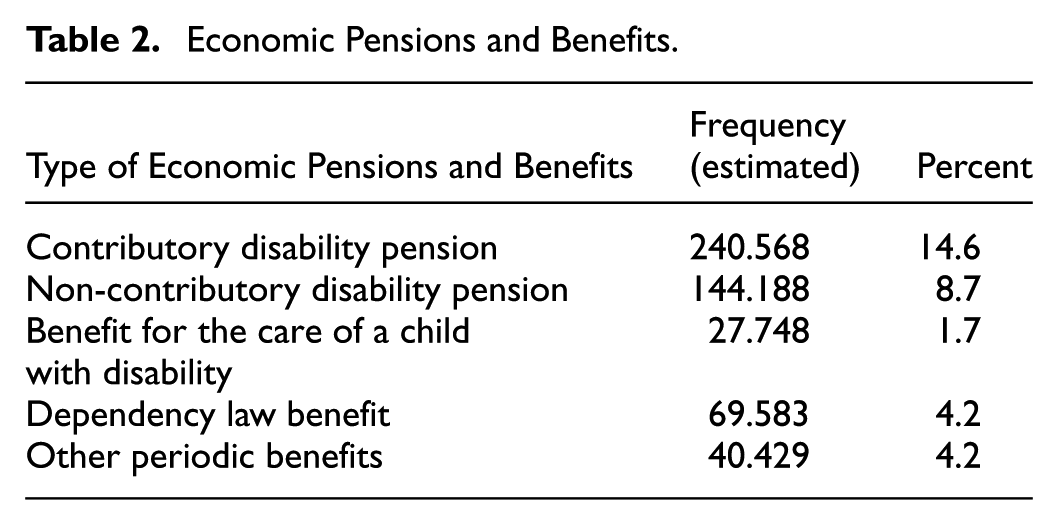
As seen in Table 2, the majority of participants do not receive disability-related pensions (66.6%). Among those who do, the most common type is the contributory disability pension.
Economic Pensions and Benefits.
Limitations and Origin of Limitations
The limitations with the highest prevalence are mobility limitations (50.1%). Following closely are domestic limitations (37.0%), visual limitations (23.3%), self-care limitations (21.5%), and auditory limitations (20%) (Table 3). A 45.5% of the sample exhibited more than one limitation, highlighting the multifaceted nature of the challenges faced by participants.
Limitations.

Concerning the attributed origin of limitations (Table 4), visual and auditory limitations are primarily attributed to visual and auditory disabilities, respectively. Secondly, communicative and learning limitations are associated with intellectual disabilities. Thirdly, limitations in mobility, self-care, and domestic tasks are predominantly linked to musculoskeletal impairments. Finally, interpersonal limitations are correlated with mental disorders, a pattern also seen in the second position for learning limitations.
Main Origin of Limitations.
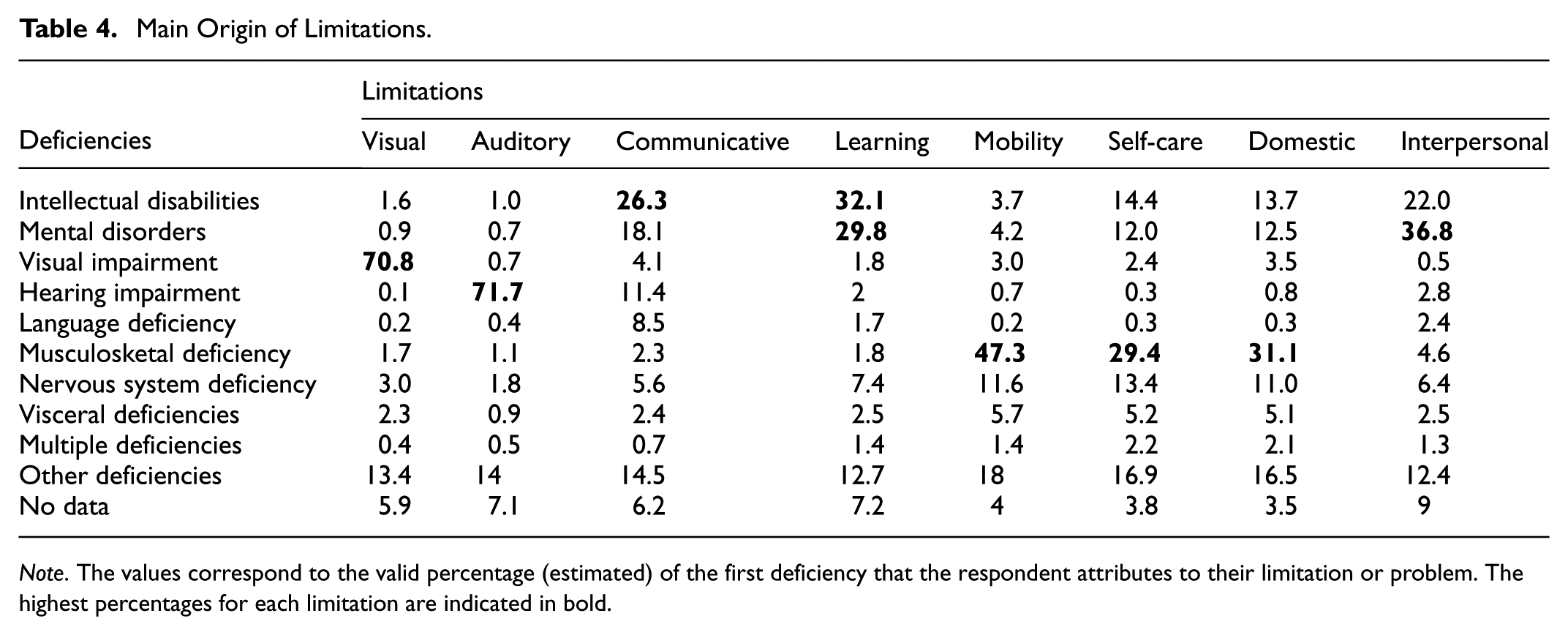
Note. The values correspond to the valid percentage (estimated) of the first deficiency that the respondent attributes to their limitation or problem. The highest percentages for each limitation are indicated in bold.
Global Results
The first variable that is introduced in this model is the certified percentage of disability. The following branches include contributive and not contributive pension, health status, age, need for assistance, and level of education (Figure 1).

Classificatory tree of employment status (Complete sample).
Only one terminal node has a majority of employed individuals (node 17). This node is composed of 73,723 people, representing 60.1% of the node and 39.92% of the category. These individuals lack a disability certificate or have recognition below 65%, report good or very good health status, or do not provide an answer. They fall within the age range of 21.5 to 57.5 years and do not require assistance. There is no terminal node with a majority of individuals actively seeking employment.
Finally, two nodes represent people who are not working nor actively seeking employment, node 3 and node 5. Node 5 encompasses 236,439 individuals who are neither working nor actively seeking employment, constituting 65.3% of the node and 45.54% of the non-working category. These individuals lack a disability certificate or have recognition below 65%, and they report a health status ranging from regular to poor or very poor. On the other hand, Node 3 is comprised of 78,032 individuals, representing 94.2% of the node and 15.03% of the category of those not working or seeking employment. They have a disability level exceeding 65% and receive a contributory disability pension.
The CART model demonstrated a robust and generalizable predictive performance. The overall accuracy of the model, as indicated by the risk estimate, was 71.5% for the training sample and a nearly identical 71.4% for the test sample, with minimal standard error (0.001). This high degree of consistency between the samples confirms that the model is not overfit and generalizes well to unseen data. However, the classification results reveal a critical pattern in the model’s predictive behavior. The model excelled at identifying individuals who were “Not working and not actively seeking employment,” correctly classifying 93.4% of this group in the training sample (93.3% in the test sample). Conversely, it performed poorly in distinguishing the “Actively seeking employment” category, failing to correctly identify a single case and misclassifying all of them into the other two groups. Furthermore, the model correctly classified only 41.0% of individuals who were actually “Working.”
Results by Gender
Female
The first variable that is introduced in this model is receiving other monetary social benefits. The following branches include having more than one group of disability, age, health status, percentage of disability, and level of education (Figure 2).

Classificatory tree of employment status (Female).
Node 12 comprises 19,155 working women, accounting for 68.7% of the node and 19.99% of all working women. These women do not receive monetary social benefits, have a single type of disability, are under 57.5 years old, report good or very good health (or do not provide an answer), and have mid-level or higher professional education, or university studies. Once again, no terminal node is specified for those women who do not work but are actively seeking employment.
Finally, node 3 includes 143,038 women who are not working or actively seeking employment, constituting 79.4% of the node and 53.18% of women in this category. These women do not receive monetary social benefits and have more than one type of limitations. On the other hand, node 14 comprises 27,435 women who are not working or actively seeking employment, making up 90.1% of the node and 10.2% of this category. These women do not receive monetary social benefits, have a single type of disability, are over 57.5 years old, have a recognized disability level exceeding 25%, are illiterate, or have any level of education except for higher professional studies.
The Classification and Regression Tree (CART) model demonstrated a consistent and generalizable performance, achieving an identical overall accuracy of 69.8% for both the training and test samples, with a minimal standard error of 0.001. This high level of consistency confirms the model’s robustness and indicates no overfitting. The model exhibited exceptional predictive power for a single category: it correctly identified 98.3% of individuals who were “Not working and not actively seeking employment.” However, this high overall accuracy masks critical weaknesses in distinguishing between active labor market states. The model completely failed to identify any individuals in the “Actively seeking employment” category, resulting in a 0.0% accuracy rate for this group. Furthermore, it correctly classified only 20.5% of individuals who were actually “Working.” The global percentages show that the model’s predictions were heavily skewed, with 93.0% of all cases being predicted as inactive.
Male
The first variable that is introduced in this model is needing assistance. The following branches include percentage of disability, health status, visual disability, and age (Figure 3).
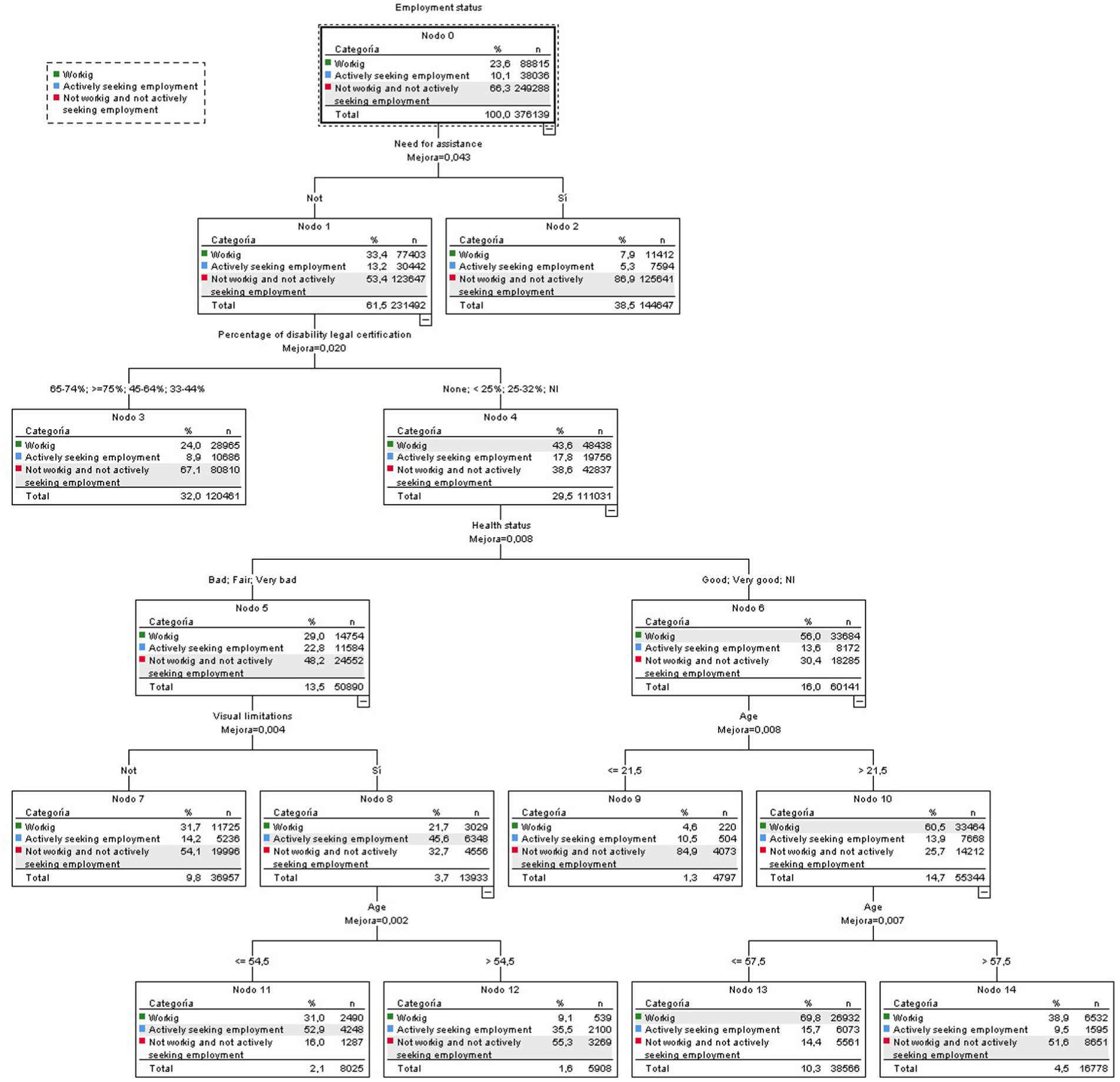
Classificatory tree of employment status (Male).
Node 13 consists of 26,932 working men, representing 69.8% of the node and 30.32% of the category. It includes men who do not require an assistant, with a disability level below 32%, in good or very good health, and aged between 21.5 and 57.5.
Node 11 encompasses 4,248 men actively seeking employment, making up 52.9% of the node and 11.17% of the category. These men do not need assistance, have a disability level below 32%, report regular, poor, or very poor health, have visual impairments, and are under 54.5 years old.
Finally, node 2 comprises 126,641 not working or actively seeking employment men, accounting for 86.9% of the node and 50.8% of men. These are men who require assistance.
The overall accuracy of the model was identical for both training and test samples at 72.7%, with a minimal standard error of 0.001, indicating excellent generalizability and no evidence of overfitting. The model showed particularly high predictive power for identifying individuals in the “Not working and not actively seeking employment” category, achieving 97.3% classification accuracy for both samples. However, the model faced challenges in distinguishing the other two employment categories. It correctly identified only 30.4% of actually “Working” individuals in the test sample, while its performance was poorest for the “Actively seeking employment” category, with merely 10.9% accuracy.
Discussion
The comprehensive analysis of the results reveals notable patterns and disparities among different groups, shedding light on various aspects of the labor market dynamics for individuals with disabilities. Through the lens of intersectionality theory (Crenshaw, 1989) these findings illustrate how disability and gender interact to create distinct patterns of labor market exclusion that cannot be understood through additive models alone.
Differences between those currently employed and those not seeking employment are evident in the general sample, with both groups sharing disability levels below 65% or lacking a disability certificate. The key distinguishing factor lies in the perception of health, where those employed report good or very good health, while those not working or seeking employment describe their health as poor, bad, or very bad. This trend is consistent across genders.
This health-employment relationship reflects what Oliver (1990) conceptualized as the operation of the “medical model of disability” in labor market practices, where employment opportunities are primarily determined by perceived functional capacity rather than addressing structural barriers to inclusion. Consistent with this perspective, previous research has highlighted that employed working-age adults with disabilities tend to report better overall and mental health compared to their unemployed peers, especially in part-time employment settings (Hall et al., 2013; Reichard et al., 2019). Previous research has highlighted that employed working-age adults with disabilities tend to report better overall and mental health compared to their unemployed peers, especially in part-time employment settings (Hall et al., 2013; Reichard et al., 2019).
Monetary benefits play a role, with individuals not working or seeking employment and having a disability percentage above 65% receiving compensatory pensions. This pattern highlights the phenomenon of institutional dependency (Meekosha & Shuttleworth, 2009) whereby social protection systems, while offering essential support, may inadvertently create disincentives for participation in the labor market. Poor health is identified as a significant risk factor for exiting paid employment through disability pension, unemployment, or early retirement (Van Rijn et al., 2013). This finding aligns with Mitchell et al. (2006), who demonstrated a more rapid decline in employment rates for people with disabilities, particularly by the 60s age decade.
The absence of disability-related pensions for employed women, in contrast to those not working or seeking employment, is linked fundamentally to age, with employed women being younger than 57.5 years. This age–gender interaction observed in our findings reflects the double discrimination (Morris, 1993) whereby women with disabilities experience compounded labor market exclusion arising from the intersection of ageism, sexism, and ableism. This aligns with Mitchell et al.’s (2006) evidence of a decline in employment rates occurring earlier in the lifespan for individuals with disabilities.
Transitioning from disability benefits to employment is associated with improved mental and physical health (Curnock et al., 2016), suggesting a positive impact of employment on the health of those previously receiving disability benefits. Our results further indicate that women not working or seeking employment report poorer perceived health, while those employed exhibit good or very good health.
These gendered health–employment patterns reflect broader dynamics within the care economy, where women with disabilities occupy dual roles, as care recipients due to their disability and as potential care providers due to societal gender expectations, thereby encountering complex barriers to formal employment (Russell & Malhotra, 2002).
Another relevant variable in our results is the educational level. The relationship between education and employment for people with disabilities is complex and multifaceted, with factors such as health, wealth, occupation, and employment playing roles in this correlation (Bliksvær, 2018; Poterba et al., 2017). In our findings, educational level emerged as significant only for women, particularly among those employed, with a higher prevalence noted among individuals with professional or university education. However, for men, educational level did not prove to be a defining factor in determining employment status.
Finally, nodes representing individuals actively seeking employment are not prevalent, indicating a potential need for further exploration or targeted interventions in understanding and supporting this specific demographic.
In our findings, a distinct profile emerges only for men actively seeking employment. This group is characterized by being autonomous (not requiring support), having disability levels below the legal minimum, reporting perceived health at regular, poor, or very poor levels, visual limitations, and being under the age of 54.5.
Harrabi et al. (2014), based on World Health Survey data from 70 countries, found that the chances of finding employment decreased as the severity of visual impairment increased among individuals actively seeking. The absence of other health or physical conditions and shorter unemployment durations are significant predictors of job-seeking behavior among persons with visual impairments (Leonard, 2002). These findings suggest a favorable outlook for labor market integration for this specific profile. Importantly, the reported low levels of perceived health can be linked to the current lack of employment, emphasizing the intricate relationship between health and employment status (Hall et al., 2013; Reichard et al., 2019).
Overall, these results emphasize the importance of tailoring policies and support mechanisms based on the diverse needs and circumstances of various subgroups within the population. An intersectional perspective reveals that universal disability policies alone are insufficient because effective interventions must consider how multiple systems of exclusion intersect to create unique barriers for distinct groups. By identifying and understanding the nuanced profiles within each category can guide targeted interventions to enhance employment opportunities, support those actively seeking employment, and provide specialized assistance to specific groups based on gender, age, health, and disability status.
Finally, our findings underscore the need for targeted, intersectional policies in the Spanish welfare system that account for the diverse experiences of individuals with disabilities across gender, age, and functional capacity. Flexible benefit schemes, gender-sensitive employment support and early career retention programs can collectively reduce institutional dependency, mitigate intersecting barriers, and enhance labor market inclusion. Facilitating employment through these measures may also contribute to improved physical and mental health, highlighting the interdependence of work, well-being, and social inclusion across different subgroups.
Limitations and Future Research
While the previous research provides valuable insights into the employment dynamics of individuals with disabilities in Spain, it is important to acknowledge certain limitations that may impact the interpretation and generalizability of the findings.
Firstly, the research relies on data from the 2020 Disability, Personal Autonomy, and Dependency Situations Survey (EDAD). Surveys are subject to respondent biases, recall errors, and may not fully capture the dynamic nature of employment situations. Additionally, its definition of disability, based on ICF, while providing operational clarity for survey research, remains contested within disability studies. Critics argue that ICF maintains elements of the medical model by focusing on individual functional limitations rather than social barriers (Thomas et al., 2007). However, the longitudinal nature of Spanish disability surveys provides valuable opportunities to examine how employment patterns evolve over time and across different social groups, contributing to our understanding of the dynamic processes of inclusion and exclusion.
Secondly, the research adopts a cross-sectional design, capturing a snapshot of the situation at a specific point in time. This limits the ability to establish causal relationships or observe changes over time, potentially overlooking temporal trends in employment dynamics. Moreover, the study depends on self-reported data, introducing the possibility of social desirability bias or inaccuracies in responses, especially when dealing with sensitive topics like health, disability, and employment status.
Thirdly, the findings may not be directly applicable to different cultural contexts or disability support systems outside of Spain. Generalizing the results to other countries or regions should be done cautiously, considering variations in social, economic, and policy landscapes.
Fourthly, while our CART analyses provide valuable descriptive insights into employment patterns among individuals with disabilities, we acknowledge an important methodological limitation. The primary predictive strength of the model lies in identifying the factors associated with labor market inactivity, while the variables used are insufficient to reliably differentiate between those who are employed and those who are actively seeking work. Finally, in addition to the gender-stratified CART analyses presented here, future research could benefit from systematically testing interaction effects within integrated frameworks. Such approaches would allow for a direct comparison between the explanatory value of additive–multiplicative interactions and the nonparametric, subgroup-oriented structure uncovered by CART. Moreover, the application of alternative machine learning methods, including random forests, would provide a benchmark for assessing predictive performance and robustness. These comparative analyses would help clarify the relative advantages of CART for exploratory profiling while situating its contributions within a broader methodological landscape (Austin et al., 2022).
Considering these limitations, future research could adopt mixed-methods approaches, include a broader array of variables, and explore the longitudinal aspects of employment among individuals with disabilities for a more comprehensive understanding.
Footnotes

Ethical Considerations
This study is based exclusively on secondary data obtained from previously published sources. All data used were publicly available and collected in accordance with the ethical standards of the original studies.
Consent to Participate
No new data collection involving human participants was conducted. As such, ethical approval was not required for this research.
Consent for Publication
The authors have ensured that all sources are properly cited and that the use of data complies with the terms and conditions of the original publications.
Author Contributions
Romeo, M: Conceptualization, Writing—Original Draft, Writing—Review & Editing. Yepes-Baldó, M.: Conceptualization, Writing—Original Draft, Writing—Review & Editing. Pascual, J.: Resources, Data curation, Formal analysis, Writing—Review & Editing.
Funding
The authors received no financial support for the research, authorship, and/or publication of this article.
Declaration of Conflicting Interests
The authors declared no potential conflicts of interest with respect to the research, authorship, and/or publication of this article.