



Abstract
This study, based on structural equation modeling (SEM), investigates the effects of sleep quality, dietary habits, and physical activity on college students’ physical fitness, with a particular focus on the mediating role of emotional states. Using survey data from 794 college students, empirical analysis reveals that sleep quality significantly and positively predicts both emotional states and physical fitness, and also exerts an indirect effect on physical fitness through emotional states. Physical activity has a direct positive effect on physical fitness but shows no significant influence on emotional states. The paths from dietary habits to emotional states and physical fitness are not statistically significant. Emotional states partially mediate the relationship between sleep quality and physical fitness. These findings enrich the theoretical understanding of health behavior among college students and provide empirical support for targeted health interventions in higher education settings.
Plain Language Summary
This study aimed to understand how college students’ lifestyle habits, such as sleep, diet, and physical activity, affect their physical health. We specifically looked at the role emotions play in this process. By surveying 794 college students and using an advanced statistical method called Structural Equation Modeling (SEM), we found several key results: Sleep is very important: Good sleep quality significantly and positively impacts both students’ emotional states and physical fitness, directly and indirectly. Sleeping well not only leads to more stable emotions but also indirectly boosts physical health. Exercise has direct benefits: Physical activity directly improves physical fitness. However, we did not find a significant direct influence of physical activity on emotional states. This might suggest that the physical benefits of exercise are more immediate, while its emotional impact may require a longer intervention or specific types of activities to take effect. Diet’s influence was not significant: In this study, dietary habits did not show significant effects on either emotional states or physical fitness. This could be due to the diversity of dietary structures, limited nutritional awareness, or self-report bias among students. Emotions are a key mediator: Emotional states played a significant mediating role between sleep quality and physical fitness. Positive emotions can encourage health-promoting behaviors, thereby influencing physical health outcomes. These findings help us better understand how college students can improve their physical condition through healthy lifestyle habits. We recommend that universities prioritize sleep health education, integrate emotional regulation strategies into health curricula, and offer diverse physical activity options to help students maintain overall physical and mental well-being.
Introduction
The college years represent a critical stage in an individual’s physical and mental development as well as the formation of lifestyle habits. Physical fitness at this stage not only affects students’ current academic performance and quality of life, but also shapes their long-term health trajectories (Masanović et al., 2020). However, recent studies have revealed a noticeable decline in college students’ lifestyle behaviors—such as sleep quality, dietary habits, and physical activity—which have become major risk factors for both physical and psychological health (Ahmed & Khatun, 2024; Wang & Liu, 2023).
A substantial body of literature has examined the impact of sleep, diet, or physical activity on health outcomes individually. However, few studies have addressed how these three behavioral domains jointly contribute to physical fitness in an integrated manner (Chang & Park, 2023; Zhao et al., 2021). Notably, emotional states—particularly positive and negative affect—have recently been recognized as important mediating variables linking lifestyle behaviors with health. Prior evidence suggests that healthy lifestyle behaviors can enhance positive affect and reduce negative affect, thereby influencing overall health status (Devkota et al., 2024; Riberio & Fernandes, 2021).
Structural equation modeling (SEM) offers an effective methodological tool to conceptualize and test the behavioral–emotional–health pathway, allowing for the simultaneous estimation of direct and indirect effects among multiple variables while accounting for measurement error (Kang & Lee, 2024). Despite the growing application of SEM in the fields of public health and education, integrated models that examine the interplay between sleep, diet, physical activity, emotional states, and physical fitness among college students remain limited. Further research is needed to develop and test such models, both theoretically and empirically (Guo et al., 2022; Smith et al., 2024).
To address these gaps, the present study focuses on the following research questions:
This study surveyed 794 Chinese college students, collecting data on their lifestyle behaviors (sleep, diet, and exercise), emotional states (using the PANAS scale), and self-reported physical fitness. SEM was employed to identify potential mechanisms through which lifestyle behaviors influence physical fitness via emotional pathways, with the goal of enriching theoretical frameworks and providing empirical evidence for health promotion among college students. Unlike prior studies that typically focused on a single health behavior (e.g., sleep or exercise), the present research integrates three lifestyle domains—sleep, diet, and physical activity—into a single structural model, with emotional states as a mediator. Moreover, by focusing on Chinese college students, this study offers culturally contextualized insights that have been largely absent in the literature.
The remainder of this paper is organized as follows. Section “Literature review and hypotheses development” reviews relevant literature on sleep, diet, exercise, emotional states, and physical fitness. Section “Research methodology” presents the research methodology, including sample, measurement scales, data processing, and modeling procedures. Section “Results and analysis” reports the empirical results, including descriptive statistics, reliability and validity tests, confirmatory factor analysis (CFA), structural path analysis, model fit indices, and mediation effects. Section “Discussion and implications” provides a detailed discussion of the findings in relation to the proposed hypotheses, compares them with prior studies, and offers policy and practical implications for student health interventions. Finally, Section “Conclusion and recommendations” concludes the study by summarizing the main contributions, acknowledging its limitations, and proposing directions for future research.
Literature Review and Hypotheses Development
Theoretical Foundations: Health Belief Model and Ecological Model
This study draws on the Health Belief Model (HBM) and the Ecological Model to construct a theoretical framework for understanding how college students’ lifestyle behaviors influence physical fitness. According to the HBM, the adoption of health-related behaviors is influenced by individuals’ perceptions of disease threat, perceived benefits, and barriers to action (Becker, 1974). For example, college students who recognize that regular exercise and a balanced diet can enhance physical health are more likely to engage in such behaviors.
The Ecological Model further expands the understanding of health behavior by emphasizing the interaction of multiple levels of influence, including individual, social, and environmental factors (McLeroy et al., 1988). Among college students, lifestyle behaviors such as sleep, diet, and physical activity often interact with psychological states (e.g., emotional states) and the broader campus environment, jointly shaping health outcomes.
The Effects of Sleep, Diet, and Physical Activity on Physical Fitness
A growing body of empirical research has demonstrated that lifestyle behaviors are closely associated with physical fitness among college students.
Sleep quality plays a critical role in cognitive functioning, immune regulation, and emotional stability. Many college students experience irregular sleep schedules and insufficient sleep, which often lead to fatigue and declining health indicators (Smith et al., 2024).
In terms of dietary behavior, a balanced and regular diet helps maintain proper metabolism and physiological homeostasis. In contrast, unhealthy habits such as high-fat and high-sugar intake or irregular eating patterns increase the risk of chronic fatigue and physical deterioration (Ahmed & Khatun, 2024).
Physical activity not only enhances muscular strength and endurance, but also contributes significantly to psychological regulation. Exercise stimulates the secretion of dopamine and endorphins, promoting feelings of pleasure and energy, which in turn are reflected in improved physical fitness levels (Zhao et al., 2021).
The Mediating Role of Emotional States
In recent years, emotional states have attracted growing attention as a key mediating mechanism between health behaviors and health outcomes.
Positive affect has been found to enhance individuals’ motivation for health, promoting sustained behaviors such as regular exercise and healthy eating (Wang & Liu, 2023). In contrast, negative affect—such as anxiety and depression—is often associated with poor health behaviors, including sleep disturbances and binge eating (Devkota et al., 2024).
Emotional states are not only outcomes of health behaviors, but may also serve as critical bridges linking behavior and physical health. For example, sleep deprivation or dietary imbalance may cause emotional instability, which in turn can negatively affect individuals’ perception of their physical health.
Applications of Structural Equation Modeling in Health Education Research
Structural equation modeling (SEM) has been widely applied in public health and health education research due to its ability to simultaneously analyze multiple latent variables and path relationships (Kang & Lee, 2024). Compared with traditional regression techniques, SEM is more effective in identifying both direct and indirect pathways while controlling for measurement error, making it an ideal tool for modeling the complex relationships among lifestyle behaviors, emotional states, and physical fitness.
Previous studies have used SEM to explore the mechanisms through which sleep and diet influence mental health (Guo et al., 2022). However, few studies have integrated sleep, diet, and physical activity into a unified model that also includes emotional states as mediators to explain physical health outcomes. Therefore, the present study employs SEM to construct and validate the proposed hypotheses, aiming to clarify the mechanisms through which college students’ lifestyle behaviors impact their physical fitness.
Research Hypotheses
Based on the above theoretical and empirical foundations, the following hypotheses are proposed:
Previous studies have shown that good sleep helps individuals restore psychological energy, enhances emotional stability, and improves overall well-being (Kushlev et al., 2020; Fredrickson, 2001). In addition, sleep quality is closely associated with physical capacity and immune functioning (Masanović et al., 2020). Therefore, it is hypothesized that sleep quality not only directly affects physical fitness but also has an indirect effect through emotional states.
Nutritional intake has a direct impact on physiological function and emotional regulation. Healthy dietary habits help stabilize blood glucose levels and reduce the likelihood of negative emotional experiences (Tremblay et al., 2016). Furthermore, a balanced dietary structure is closely linked to adolescents’ BMI and health behaviors (Yang et al., 2021). Thus, it is hypothesized that healthy dietary habits improve emotional states and, in turn, enhance physical fitness.
Exercise promotes blood circulation and regulates the nervous system, contributing significantly to cardiovascular endurance and muscular strength (Lee et al., 2021). Moreover, moderate physical activity has been found to alleviate anxiety and depression, facilitating the development of positive affect (Lev Arey, 2022). Therefore, it is hypothesized that physical activity directly improves physical fitness and may also exert an indirect effect through emotional states.
Emotional states are not only indicators of psychological well-being but may also influence physical health via hormonal and immune pathways (Kushlev et al., 2020; Fredrickson, 2001). Positive affect encourages engagement in health-promoting behaviors, while negative affect may lead to fatigue and decreased motivation, thereby indirectly impairing health outcomes. Accordingly, this study hypothesizes that emotional states mediate the effects of sleep quality, diet habits, and physical activity on physical fitness.
Research Methodology
Research Design and Data Collection
This study adopted a quantitative research design, employing structural equation modeling (SEM) as the primary analytical method to examine the direct and indirect pathways through which college students’ lifestyle behaviors—namely sleep quality, dietary habits, and physical activity—affect physical fitness. Emotional states were included as a mediating variable.
Data were collected via a questionnaire survey conducted in March 2025 at three comprehensive universities in Shanxi Province, China. A total of 794 valid responses were obtained. The sample included participants with diverse backgrounds in terms of gender, academic year, and major, thus ensuring a high degree of representativeness.
Ethics Statement: This study involved human participants and adhered to the ethical principles of the Declaration of Helsinki. The research protocol, including survey design and data collection procedures, was reviewed and approved by the Academic Affairs Office of the participating universities in Shanxi Province, China. To minimize risks, the study adopted anonymous and voluntary participation, did not collect sensitive personal information, and allowed participants to withdraw at any time. The potential benefits of this research, including contributing to the understanding of college students’ health behaviors and informing higher education health promotion strategies, outweighed the minimal risks involved. Informed consent was obtained electronically from all participants prior to data collection, and data were collected and analyzed anonymously to ensure confidentiality.
Questionnaire Construction and Measurement Variables
The questionnaire consisted of 6 latent variables and a total of 28 measurement items. All items were measured using a 5-point Likert scale (1 = strongly disagree to 5 = strongly agree), where higher scores indicate greater intensity or agreement. Stratification was based on academic year (freshman to senior) and field of study (humanities, science, engineering, education). Paper-based questionnaires were distributed mainly to freshmen and sophomores, while electronic questionnaires were delivered to juniors and seniors through the academic affairs system.
All instruments used in this study were based on validated scales and were adapted to the Chinese college student context. For example, sleep quality items were derived from the Chinese version of the Pittsburgh Sleep Quality Index (PSQI), dietary items were developed in accordance with the Chinese Dietary Guidelines, physical activity was measured using the Chinese-adapted International Physical Activity Questionnaire (IPAQ), and emotional states were assessed with the validated Chinese version of the PANAS.
Sleep Quality
Based on a revised version of the Pittsburgh Sleep Quality Index (PSQI), three items were used to assess sleep quality, such as “I can fall asleep within 30 minutes” and “I get sufficient sleep time every day.” The Cronbach’s alpha for this scale was .82 (Hair et al., 2014; Kline, 2016).
Diet Habits
Following the Dietary Guidelines for Chinese Residents and relevant literature, five items were developed, including statements like “I eat breakfast regularly” and “I consume sufficient vegetables and fruits every day.” The reliability coefficient (α) was .87.
Physical Activity
Adapted from the International Physical Activity Questionnaire (IPAQ), four items were used, such as “I engage in moderate-intensity physical activity at least three times a week.” The Cronbach’s alpha was .85.
Emotional States (Affect)
Emotional states were measured using the Chinese version of the Positive and Negative Affect Schedule (PANAS), including:
Positive Affect: Four items (e.g., “I feel happy,”“I feel energetic”), with α = .91
Negative Affect: Five items (e.g., “I feel anxious,”“I feel depressed”), with α = .89
Physical Fitness
A revised version of the National Physical Fitness Standards for Chinese Students was used to construct a self-assessment scale with six items, such as “I can easily complete an 800-meter run” and “I have good physical condition.” The Cronbach’s alpha was .90.
Sampling and Data Collection Procedures
A stratified random sampling method was employed in this study. Paper-based and electronic questionnaires were distributed randomly across different academic years and disciplines. Prior to participation, informed consent was obtained through the university’s academic affairs system, and participants were informed that all data would be used anonymously for research purposes only.
After excluding responses with excessively short completion times or extremely consistent answer patterns, a total of 794 valid responses were retained for analysis.
Among the respondents, 47.6% were male and 52.4% were female. Students from all four academic years were represented, with the highest proportion being sophomores (35.2%). Participants were evenly distributed across major fields of study, including humanities, science, engineering, and education.
Data Processing and Analysis Procedures
All data analyses were conducted using R (version 4.3.3). The analytical procedures consisted of the following steps:
(1) Data Cleaning and Missing Value Treatment: Invalid responses were excluded, and extreme values were identified based on standardized Z-scores.
(2) Descriptive Statistics: Mean, standard deviation, skewness, and kurtosis were calculated for each observed variable.
(3) Reliability and Convergent Validity Testing: Cronbach’s alpha coefficients were computed to assess internal consistency, and average variance extracted (AVE) and composite reliability (CR) were used to assess convergent validity.
(4) Confirmatory Factor Analysis (CFA): CFA was conducted to examine the structural validity of the measurement model.
(5) Structural Model Estimation and Path Analysis: SEM was applied to evaluate the direct and indirect effects among the latent variables in the proposed model.
(6) Mediation Effect Testing: The significance of mediating effects was tested using the bootstrap method with 5,000 resamples.
Structural Equation Model Specification
Based on the proposed research hypotheses, a structural equation model (SEM) was constructed with the following path relationships:
(1) Sleep quality, diet habits, and physical activity → emotional states
(2) Sleep quality, diet habits, and physical activity → physical fitness
(3) Emotional states → physical fitness
(4) Emotional states as a mediating variable
Maximum Likelihood (ML) estimation was used to estimate model parameters. Model fit was evaluated using a range of goodness-of-fit indices, including the Comparative Fit Index (CFI), Tucker–Lewis Index (TLI), Root Mean Square Error of Approximation (RMSEA), and Standardized Root Mean Square Residual (SRMR) (Figure 1).

SEM model path diagram.
Results and Analysis
Descriptive Statistics and Reliability Analysis
All measurement items were assessed using a five-point Likert scale. The item means ranged from 2.95 to 4.37, with standard deviations between 0.67 and 1.15, indicating no serious issues with skewness or kurtosis. Cronbach’s alpha coefficients for all latent variables exceeded .80, demonstrating good internal consistency in accordance with psychometric standards. Detailed statistics are presented in Table 1.
Descriptive Statistics Results.

Confirmatory Factor Analysis (CFA)
Confirmatory factor analysis (CFA) was conducted using the lavaan package in R. The initial measurement model included six latent variables and 28 observed indicators. The CFA results (see Table 2) indicated the following:
Confirmatory Factor Analysis (CFA) Results.

(1) All factor loadings were statistically significant (p < .001), with standardized coefficients ranging from 0.69 to 0.96.
(2) The average variance extracted (AVE) values for all latent variables exceeded 0.50, and the composite reliability (CR) values were all above 0.80.
(3) The overall model demonstrated a good fit to the data, satisfying the requirements for construct validity.
Model Fit Index
The fit index of the structural equation model is shown in the following Table 3:
Model Fit Indicators and Path Analysis Results.

(1) CFI = 0.957, TLI = 0.952, RMSEA = 0.062, SRMR = 0.041, χ2/df = 4.07;
(2) All the above indicators are within the acceptable or good range, indicating that the theoretical model has a high degree of fit with the data.
Structural Path Analysis Results
The results of the path analysis (see Table 4) revealed the following key findings:
Path Coefficient Results.
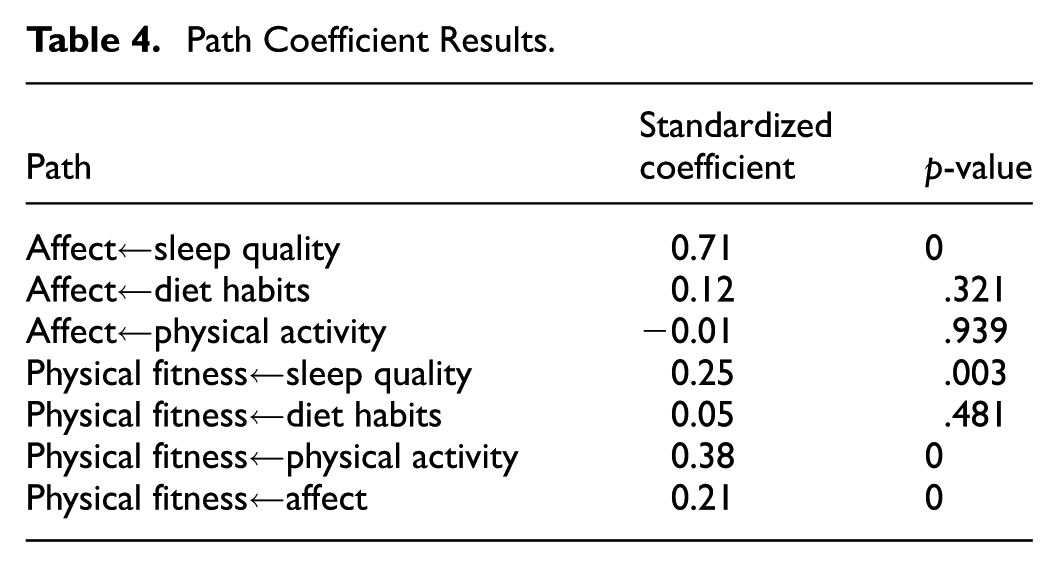
(1) Sleep quality significantly and positively predicted both emotional states (β = .71, p < .001) and physical fitness (β = .25, p = .003).
(2) Diet habits did not significantly affect emotional states (β = .12, p = .321) or physical fitness (β = .05, p = .481).
(3) The paths from physical activity to emotional states and physical fitness were not statistically significant; however, the direct effect of physical activity on physical fitness was significant (β = .38, p < .001).
(4) Emotional states had a significant positive effect on physical fitness (β = .21, p < .001).
Mediation Effect Testing
The significance of indirect effects was tested using the bootstrap method with 5,000 resamples. The results are summarized as follows (Figure 2 and Table 5):
(1) Sleep quality exerted a significant indirect effect on physical fitness through emotional states (β = .149, p < .001).
(2) Diet habits showed a marginally significant mediating effect (β = .025, p = .018).
(3) The mediating effect of physical activity via emotional states was not significant (β = –0.002, p = .731).

SEM model path coefficient diagram.
Results of Mediation Effect Analysis.

Discussion and Implications
Discussion of Major Findings
This study employed structural equation modeling (SEM) to examine the direct and indirect effects of sleep quality, dietary habits, and physical activity on college students’ physical fitness, with emotional states as a mediating variable. The results partially supported the proposed hypotheses, highlighting several key findings. First, sleep quality played a prominent role, as it significantly and positively influenced both emotional states and physical fitness, directly and indirectly, which is consistent with prior research indicating that good sleep enhances psychological stability and physiological restoration, thereby promoting overall health (Köllerová et al., 2021). In contrast, dietary habits showed limited influence on emotional states and physical fitness (Liu et al., 2023; Saeed & Shahbaz, 2023), possibly due to the diversity of dietary structures, limited nutritional awareness, or self-report bias, and contrary to previous evidence suggesting stronger associations (Lassale et al., 2019). Physical activity demonstrated a significant direct effect on physical fitness but not on emotional states, suggesting that exercise may deliver immediate physiological benefits while its emotional effects may require longer interventions or more targeted activity types. Finally, emotional states emerged as a key mediating variable, significantly linking sleep quality to physical fitness, thereby supporting the emotional pathway mechanism connecting health behaviors with outcomes, consistent with the broaden-and-build theory of positive emotions in positive psychology (Faulkner et al., 2021; Fredrickson, 2001; Riberio & Fernandes, 2021).
Theoretical Contributions
Theoretically, this study extends the applicability of the Health Behavior Theory and the Ecological Model to the domain of college students’ physical fitness. By constructing a structural model encompassing lifestyle behaviors, emotional states, and health outcomes, it provides a comprehensive empirical framework for the “behavior-emotion-health” mechanism.
Moreover, the use of structural equation modeling (SEM) allowed for a more nuanced depiction of the relationships among latent variables, addressing the limitations of traditional correlation-based analyses that are unable to account for the complexity of indirect and mediated effects.
Practical Implications
Our results show that emotional states mediate the effect of sleep quality on physical fitness. This finding suggests that university health interventions should not only target sleep hygiene but also incorporate emotional regulation strategies such as mindfulness training or counseling services. Similarly, the strong direct impact of physical activity on physical fitness underlines the importance of maintaining robust physical education programs.
(1) Improving sleep through institutional intervention: University health education programs should strengthen sleep-related interventions, such as organizing “Sleep Health Awareness Days” or delaying class start times, in order to improve students’ sleep quality.
(2) Integrating emotional regulation into health education: Emotional management strategies should be incorporated into physical education and health curricula to foster positive emotional states and enhance their mediating role in health promotion.
(3) Expanding the scope of exercise interventions: Physical activity programs should adopt multidimensional assessment approaches, focusing not only on physical fitness improvements but also on psychological feedback and the integration of healthy lifestyle training.
Limitations and Future Research Directions
This study has several limitations:
(1) Cross-sectional self-report data were used, which may be subject to common method bias.
(2) The model included only a limited set of lifestyle variables and did not account for external influencing factors such as social support or academic stress.
(3) The sample was geographically confined to universities in eastern China, which may limit the generalizability of the findings.
Although the self-reported physical fitness scale demonstrated strong reliability, it may not fully reflect participants’ actual physical performance. Future research could integrate objective indicators such as standardized fitness tests or wearable devices to enhance measurement accuracy.
Because the present study is based on cross-sectional data, the findings should be interpreted as associations rather than causal effects. Longitudinal or experimental designs would provide more robust evidence regarding the directionality of the observed relationships.
Conclusion and Recommendations
Research Conclusions
Using structural equation modeling (SEM), this study systematically examined the pathways through which three key lifestyle behaviors—sleep quality, diet habits, and physical activity—affect the physical fitness of college students, with emotional states considered as mediating variables. Based on exploratory factor analysis (EFA), confirmatory factor analysis (CFA), and path analysis of the questionnaire data, the following main conclusions were drawn:
(1) Sleep quality emerged as a strong predictor of physical fitness. It not only had a direct positive effect on fitness levels but also exerted indirect effects by enhancing positive emotions and alleviating negative emotions.
(2) Diet habits did not exhibit significant effects on physical fitness in this study, suggesting that their impact may be limited by factors such as students’ nutritional awareness, dietary structure, or the consistency of dietary interventions.
(3) Physical activity had a significant direct effect on physical fitness but did not significantly influence emotional states, indicating that its health benefits may not be entirely dependent on psychological mechanisms.
(4) Emotional states played a partial mediating role between lifestyle behaviors and physical health outcomes, particularly establishing a significant indirect pathway between sleep quality and physical fitness.
In summary, this study proposed and validated a relatively comprehensive behavioral mechanism model for college students’ physical health and offers both theoretical grounding and empirical evidence to inform future health intervention strategies.
Policy Recommendations
Based on the research findings, the following practical recommendations are proposed to inform university health management, curriculum reform, and public health interventions:
(1) Prioritize sleep health education: Universities should implement systematic sleep-related interventions, such as organizing “Healthy Sleep for College Students” lectures, introducing quiet hours in dormitories, and encouraging regular sleep schedules, to raise students’ awareness of the importance of sleep.
(2) Enhance emotional regulation skills: Emotional regulation strategies should be integrated into health education curricula and psychological counseling services. Students should be encouraged to adopt practices such as mindfulness, meditation, and emotional journaling to strengthen psychological resilience and improve overall well-being.
(3) Optimize physical education programs: Diverse physical activity options should be offered to accommodate varying personality types and interests, including team sports, individual fitness programs, and emotion-focused exercise formats. These approaches can increase students’ motivation to participate in and adhere to physical activity.
(4) Strengthen targeted nutrition education: Nutritional guidance should be reinforced through mechanisms such as healthy cafeteria assessment systems and digital nutrition tracking tools. These strategies can help students develop healthier eating habits and improve the consistency and effectiveness of dietary interventions.
(5) Foster cross-departmental collaboration for health support: Universities should promote coordinated efforts among academic affairs, logistics, mental health services, and sports departments to create a supportive health-promoting environment that contributes to the holistic development of students.
Footnotes
Acknowledgements
The authors sincerely thank the participating universities, faculty, and students for their cooperation and support in data collection. We are also grateful to colleagues who provided feedback on the study design and analysis.

Ethical Considerations
This study was conducted in accordance with the ethical principles of the Declaration of Helsinki. The research protocol, including the survey design and data collection procedures, was reviewed and approved by the Academic Affairs Office of the participating universities in Shanxi Province, China. To minimize risks, the study ensured anonymous and voluntary participation, did not collect sensitive personal information, and allowed participants to withdraw at any time. The potential benefits of this research were determined to outweigh the minimal risks involved. All data were analyzed anonymously to ensure confidentiality.
Consent to Participate
Informed consent was obtained electronically from all participants prior to data collection. Participants were informed through the university s academic affairs system that their data would be used anonymously and solely for research purposes before they agreed to participate.
Author Contributions
Ning Wang: Conceptualization, Data Collection, Formal Analysis, Writing—Original Draft. Tao Li: Methodology, Supervision, Writing—Review & Editing, Correspondence. Both authors have read and approved the final version of the manuscript.
Funding
This work was supported by the Philosophy and Social Sciences Research Project of Shanxi Provincial Universities under the project `Comprehensive Impact of Health Behaviors and Emotional States on University Students' Physical Health—An Empirical Investigation Based on Colleges in Shanxi Province' (Project No.: 2025W071).
Declaration of Conflicting Interests
The authors declared no potential conflicts of interest with respect to the research, authorship, and/or publication of this article.
Data Availability Statement
The datasets generated and/or analyzed during the current study are available from the corresponding author upon reasonable request.
Biases,Mitigation,and Ethics
Potential biases were mitigated through the use of stratified random sampling to ensure representativeness across academic years and majors. The self-report nature of the data may introduce response bias; however, this was minimized by ensuring anonymity, voluntary participation, and by excluding invalid responses (e.g., incomplete or patterned answers). Ethical safeguards, including informed consent and confidentiality assurances, were strictly observed throughout the study.