




Abstract
The present study investigated the correlation between improper use of the mobile phone (IUMP) and anxiety in the aftermath of the coronavirus disease 2019 pandemic. It examined the mediation and moderation effects of mindfulness on this correlation. IUMP, anxiety, and mindfulness were measured in 575 university students. The results indicated that in the aftermath of the pandemic, IUMP emerged as a significant predictor of anxiety among university students. Furthermore, mindfulness moderated and mediated the correlation between IUMP and anxiety. Students demonstrating greater mindfulness capacity exhibited proportionally diminished anxiety levels. Our evidence offers critical guidance for developing targeted interventions to mitigate university students’ psychological challenges.
Keywords
Introduction
The coronavirus disease 2019 pandemic triggered the worldwide containment strategies such as mandatory school closures and social distancing mandates. (Wang et al., 2022), which not only altered individuals’ lifestyles (Abbott, 2021) but also compromised their psychological health (Xiang et al., 2020). A growing proportion of individuals faced psychological disorders such as anxiety (Kang et al., 2020; Vindegaard & Benros, 2020). Anxiety, characterized by nervousness, unease, worry, and fear, is a complex emotional state (Zung, 1971). Former studies indicated significantly elevated anxiety scores after the pandemic (Wang et al., 2022), especially for college students who tended to be more anxious aftermath of the pandemic (Liu et al., 2023); while their anxiety had negative influences on their academic achievements and social communications (Fu et al., 2021; Guan et al., 2021). Therefore, factors influencing post-COVID-19 anxiety among college students must be investigated, and effective measures must be implemented to prevent and treat anxiety in this population.
After the pandemic, university students have become increasingly reliant on smartphones for social interaction and academic activities (Iyengar et al., 2020). Increased smartphone use has led to frequent problems (Popescu et al., 2022). The term IUMP refers to excessive smartphone use or addictive behaviors that disrupt users’ daily life, studies, and interpersonal relationships, negatively affecting their mental and social functioning (Elhai et al., 2017; Mei et al., 2023). IUMP and psychological disorders have demonstrated escalation following pandemic onset (Caponnetto et al., 2021). IUMP adversely affects individuals’ comprehensive health (Yang et al., 2020). A collective analysis established IUMP as a significant predictor of anxiety (Li et al., 2020). Recently, Nahidi et al. (2024) indicated that the anxiety appraisal among university students who were severely addicted to mobile phones ranked higher than others. Gong and Liu (2023) identified a robust positive associatio
Mindfulness refers to focusing on an individual’s present experiences with an attitude of openness and acceptance, with an emphasis on awareness of the now and nonjudgmental self-acceptance (Kabat-Zinn, 1994; Keng et al., 2011). Mindfulness is a personal trait that can alleviate external stress (Calvete et al., 2017). On the basis of the mindfulness stress buffering account, mindfulness, a kind of psychological resource, could relieve anxiety and other negative emotions and promote mental health by reducing individuals' appraisal and reactions to pressure resources (Creswell & Lindsay, 2014). IUMP is always accompanied by the psychological experience of desire and losing control, which could be considered as individuals' pressure resources and negative emotions (Yang et al., 2019). Therefore, mindfulness could moderated the negative influenc of IUMP on individuals' mental health outcomes. Moreover, research showed that mindfulness could effectively raise individuals' emotional adjustment ability, helping them face pressure and reduce anxiety and other negative emotions (Zeidan et al., 2010). Mindfulness weakened the negative influences of IUMP on anxiety and other psychological disorders by strengthening individuals’ perception and moderation of negative emotions, playing a buffer role in mentality. So, mindfulness could reduce the connections between IUMP and anxiety as a mediating variable.
Evidence suggests that mindfulness can reduce IUMP and prevent psychological disorders. Regan et al. (2020) discovere
The pandemic has stimulated scholarly attention (Kwon, 2023), particularly in exploring the function of mindfulness in improving mental health. Research demonstrates mindfulness reduces temporal anxiety by enhancing present-moment attention, thereby promoting mental health (Keng et al., 2011). While extant literature has established mindfulness as a moderating factor in the IUMP-anxiety association among college populations, the potential mediating pathways through which mindfulness operates remain empirically underexplored. Empirical investigations during the pandemic period have systematically documented both the high prevalence of IUMP and its positive correlation with anxiety in Chinese collegiate populations. (Santander-Hernández et al., 2022; Yang et al., 2019; Zhang et al., 2022). Thus, the mechanisms through which IUMP affects students’ mental health must be elucidated. Arpaci (2021) identified a negative correlation between IUMP and mindfulness, suggesting that smartphone addiction can hinder the cognitive processes associated with mindfulness (Stevenson et al., 2017). Zhang et al. (2021) identified IUMP to be a negative predictor of mindfulness. Empirical evidence demonstrates that higher levels of mindfulness significantly predict lower anxiety among university students (Malik & Perveen, 2023). Most studies on the correlation between IUMP and anxiety have treated mindfulness as a mediator. For instance, Zhang et al. (2021) confirmed the mediatin
Hallauer et al. (2022) explored the correlation between anxiety (independent variable) and IUMP (dependent variable), finding that mindfulness mediated this association. According to social cognition theory, there is an interaction between individuals' behaviour and emotions (Bandura, 1986). Our study explores whether mindfulness mediated between these two factors taking IUMP as a predictive factor and anxiety as the outcome. On the basis of these findings, we hypothesized that IUMP would indirectly influence anxiety in university students through mindfulness.
Hallauer et al. (2022) studied the mediating function of mindfulness in anxiety-IUMP association; Liu et al. (2017) explored the moderation of mindfulness between IUMP and sleep quality; previous research has already verified that IUMP was significant relative to college students’ anxiety (Gong & Liu, 2023); however, there were not any researches discussing simultaneously the boundary conditions and potential influencing mechanism of mindfulness in these influencing relations. Thus, focusing on post-COVID-19 university populations, our research explores how IUMP relates to anxiety, with particular attention to how mindfulness may mediate or moderate this association. The research model is showed in Figure 1. We proposed three hypotheses in this context. In our analytical models testing the hypothesized relationships, biological sex was controlled.

Research model diagram.
Methods
Study Cohort and Procedure
This cross-sectional study included university students from Hainan Province, China. University students are frequent smartphone users. They spend considerable time on social media and online learning apps every day; such practices are closely associated with Psychological disorders (Chen et al., 2022; Yang et al., 2020). Moreover, university students tend to experience elevated levels of stress, which makes them susceptible to anxiety (Eisenberg et al., 2009). Empirical evidence has been supported that mindfulness contributes to improved self-regulation and alleviates anxiety (Keng et al., 2011; Zenner et al., 2014). Systematic examination of smartphone effects on university students' mental health contributes to evidence-based intervention planning for critical transition periods (Hurst et al., 2013).
The convenience sampling method was employed to recruit participants during a specified period between December 20 and 23, 2022. The online platform Questionnaire Star was used to conduct a survey. The entire process lasted 4 days, during which time eligible students were enrolled and instructed on how to complete the study questionnaires.
To adjust for potential information variance, we explained the research objectives and questionnaires to the participants before data collection. Participants received full disclosure regarding anonymous data collection procedures and their unconditional right to quit the study anytime. After giving informed consent, participants proceeded to complete the study questionnaires. The institutional ethics committee granted ethical approval for this research. 603 students completed the questionnaires. After excluding 28 invalid responses, 575 valid responses were retained. Female students accounted for 72.87% (n = 419) of the total sample.
Instruments
Improper Use of the Mobile Phone
IUMP was measured using the IUMP scale, which was developed by Leung (2008). The instrument contains 17 items organized into four distinct dimensions: inability to control craving, feeling anxious and lost, withdrawal/escape, and productivity loss. Participants rated each statement using a standard 5-point Likert response format, obtaining a possible total score fro
Mindfulness
The Chinese adaptation of the Mindfulness Scale (Liu et al., 2019) was employed to assess mindfulness in this study. This tool contains 10 items across 2 dimensions: awareness and nonjudgment/acceptance. Responses were recorded on a 5-point Likert response format, obtaining a possible total score from 0 to 40, where elevated scores reflected greater severity of mindfulness. A sample question is, “I tell myself that I shouldn’t feel the way I’m feeling.” This scale was proved to hav
Anxiety
Anxiety was assessed using Zung’s (1971) 20-item anxiety scale, employing a 4-point Likert response format. Possible total scores were from 20 to 80, where elevated scores reflected greater severity of anxiety. An example question is, “I feel more nervous and anxious than usual.” Following its initial Chinese adaptation by Wang and Chi (1984), it has been extensively utilized in China. Its strong psychometric properties have been consistently documented in subsequent validation studies (Duan et al., 2022; Wang & Zhao, 2020). The scale reflected ideal internal consistency (Cronbach’s alpha = .844).
Statistical Analysis
Exploratory factor analysis was initially conducted to examine potential common method variance (CMV) in the formal study sample; a nonrotating principal factor analysis was performed with all variables. The Kaiser–Meyer–Olkin (KMO) value exceeded .800, and the Bartlett test of sphericity reached significance (p < .001). The first factor needs to explain less than <50% (Harris et al., 2009).
Second, variable reliability was examined via Cronbach's alpha analysis conducted in SPSS; the Cronbach alpha threshold exceeded 0.7 (Nunnally, 1978). Confirmatory factor analysis (CFA) was conducted using SPSS AMOS. Model fit was assesse
Third, descriptive statistics (e.g., mean and standard deviation [SD] values) were calculated for all variables. Interdimensional correlations were assessed using the Pearson correlation analysis. The results indicated that the correlation index was smaller than .800 and reached significance (Benesty et al., 2009).
Fourth, the potential moderation of mindfulness in the IUMP-anxiety association was examined, employing Model 1 within the SPSS framework. A corresponding 95% confidence interval (CI) value was calculated through bootstrap sampling (with 5,000 bootstrapped samples).
Fifth, mediation analysis was also conducted with SPSS Model 4 to investigate whether mindfulness mediated the effect of IUMP on anxiety. A corresponding 95% CI value was calculated through bootstrap sampling (with 5,000 bootstrapped samples; Hayes, 2013).
Finally, to confirm significant interactions, we performed a simple slope analysis according to the moderation factor of −1 SD, Mean, +1 SD towards low level (−1 SD) and high level (+1 SD) and drew the moderating sketch figure.
Results
Analysis of the Instruments
Due to the limitations associated with self-reported data, the collected data was analyzed by Harman's single-factor test. The Varimax principal component analysis yielded a KMO value of .921. The Bartlett's test of sphericity yielded statistically significant results (p < .001). The first element accounted for only 26.21% of the overall variance, not exceeding the 50% critical value (Harris et al., 2009). Thus, the risk of CMV was nonsignificant in our study, indicating that a single factor did not predominantly influence the data and that the results were reliable.
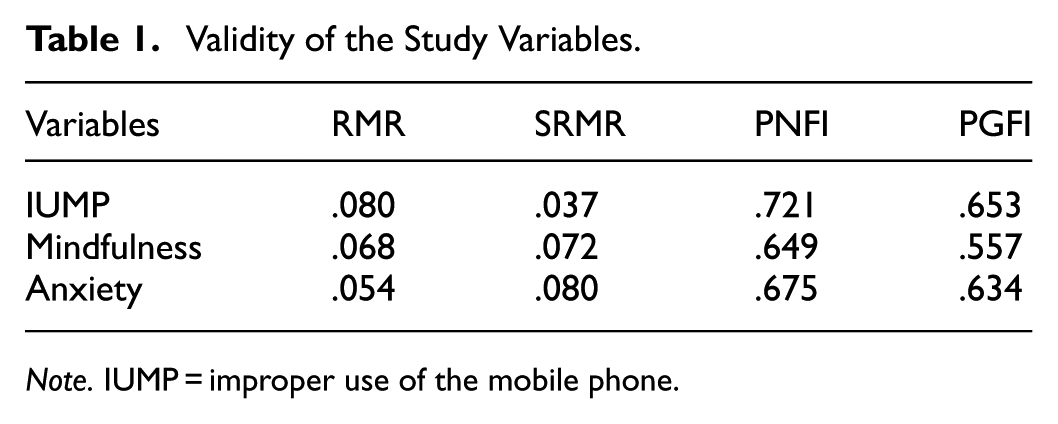
Next, a reliability analysis (Cronbach’s alpha) and CFA were performed with all variables. As indicated in Table 1, the reliability index for all variables exceeded .70, indicating relatively high levels of reliability (Nunnally, 1978). Therefore, the scales used in our study exhibited high levels of consistency in measuring the variables. In summary, the participants provided similar answers to the same questions, which demonstrates the reliability of the scales. The CFA results indicated acceptable goodness-of-fit indices for all variables (Hair et al., 1998), suggesting that the models effectively explained the data structures and represented the expected correlations between the variables.
Validity of the Study Variables.
Note. IUMP = improper use of the mobile phone.
Descriptive and Correlation Analyses
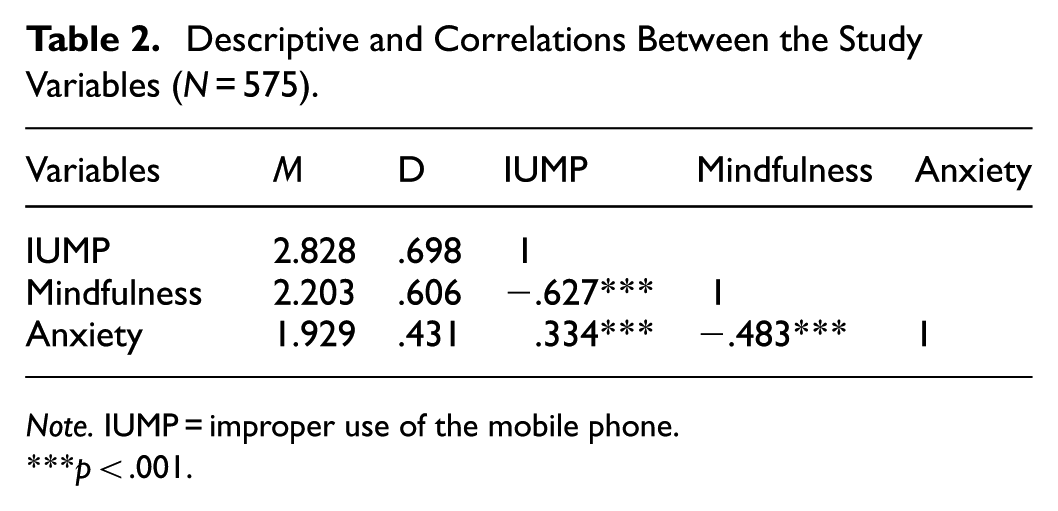
Basic descriptive measures and their correlations obtained from the current analyses are shown in Table 2. The participants’ mean scores for IUMP (score: 2.828), mindfulness (score: 2.203), and anxiety (score: 1.929) were all lower than the midpoints of the corresponding scales. These findings suggest that on average, the participants exhibited relatively low levels of IUMP, mindfulness, and anxiety.
Descriptive and Correlations Between the Study Variables (N = 575).
Note. IUMP = improper use of the mobile phone.
p < .001.
Before conducting linear regression and moderation analyses, we performed correlation analyses. The Pearson correlation analysis (Table 2) revealed three significant associations between the study variables: (a) a negative relationship between IUMP and mindfulness (r = −.627, p < .001), (b) a positive association between IUMP and anxiety (r = .334, p < .001), and (c) a negative association between mindfulness and anxiety (r = −.483, p < .001). Overall, the findings demonstrate that increased IUMP correlates with reduced mindfulness and elevated anxiety, while greater mindfulness corresponds to lower anxiety levels. Therefore, individuals who could better maintain their awareness of the now often experienced less anxiety.
Hierarchical Regression Analyses
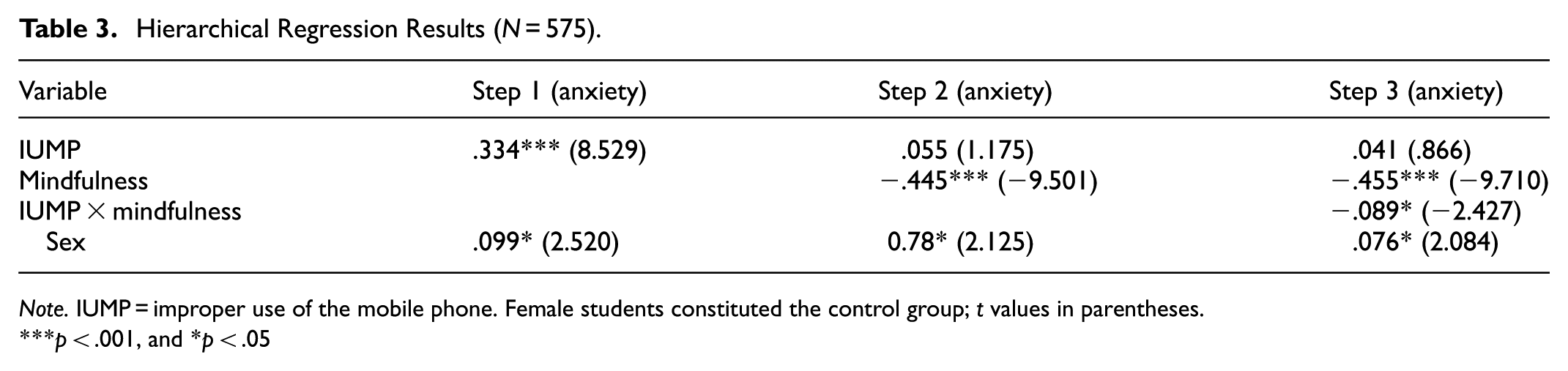
Table 3 shows the outcomes of the hierarchical regression analysis. Step 1 revealed that IUMP exerted a statistically significant positive influenc
Hierarchical Regression Results (N = 575).
Note. IUMP = improper use of the mobile phone. Female students constituted the control group; t values in parentheses.
p < .001, and *p < .05
Moderating Effect Analyses
The moderation influence of mindfulness in the IUMP-anxiety associatio
Moderating Effect Results (N = 575).

Note. IUMP = improper use of the mobile phone. Female students constituted the control group.
p < .001, and *p < 0.05
Figure 2 illustrates the significant moderation influence of mindfulness in the IUMP-anxiety relationship. The analysis revealed that elevated mindfulness levels attenuated the positive association between IUMP and anxiety, while increased IUMP corresponded with diminished mindfulness and heightened anxiety. These findings provide empirical support for Hypothesis 2.
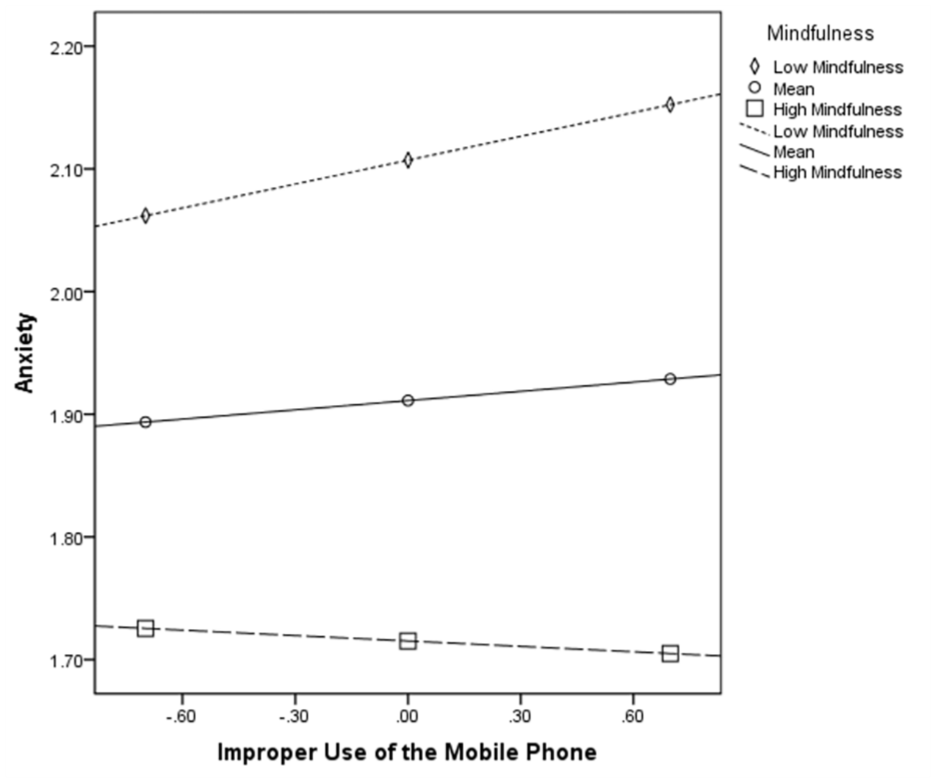
Moderation graph of the moderation for the bufer effect of mindfulness.
To identify the correlation between IUMP and mindfulness, we divided mindfulness into three levels (−1 SD, mean, and +1 SD) and conducted a simple slope test. The analysis revealed differential effects of IUMP on anxiety based on mindfulness levels. Among students with lower mindfulness, IUMP showed a significant positive influence on anxiety (B .0649, t 2.062, 95% CI: .003 to .127]). Conversely, for students with higher mindfulness, this effect became nonsignificant (B −.015, t −.418, 95% CI: −.084 to .054]). These results suggest that mindfulness protect against IUMP-related anxiety, whereas those with elevated mindfulness were better equipped to manage IUMP and thus anxiety.
Mediating Effect Analyses
The mediatio
Mediating Effect Results (N = 575).

Note. IUMP = improper use of the mobile phone. Female students constituted the control group.
p < .001, and *p < .05.

Mediation Models.
Discussion and Conclusions
We elucidated the moderation as well as the mediation influence of mindfulness on the IUMP-anxiety correlation among Chinese university students under the post-pandemic context. Our findings indicate that IUMP significantly predicted anxiety. Mindfulness moderated the correlation between IUMP and anxiety. Specifically, university students exhibiting elevated mindfulness were better equipped to reduce the effect of IUMP on anxiety. Furthermore, mindfulness fully mediated the correlation between IUMP and anxiety in these students. Our findings provide empirical foundations for developing anxiety-reduction interventions tailored to post-pandemic university settings.
IUMP emerged as a significant predictor of anxiety in the study cohort; this finding is consistent with those of Gong and Liu (2023), who reported that IUMP exacerbated anxiety. Smartphone usage substantially increased during the pandemic, increasing individuals’ reliance on these devices for information, social interactions, and entertainment. However, this reliance had negative implications, particularly for mental health. As postulated by Bandura's social cognitive theory, one’s actions influence their emotional state and vice versa (Bandura, 1986): actions can both influence and result from emotions. Thus, smartphone use can be both a cause and a consequence of increased anxiety. When university students face academic pressure and social anxiety, they are likely to seek temporary emotional relief through smartphone use. However, excessive smartphone use worsens anxiety and loneliness (Keles et al., 2020). IUMP is closely associated with emotions and psychological well-being (Yang et al., 2019). Especially during the pandemic, individuals have increasingly relied on smartphone usage as a coping metho
In our study, mindfulness moderated the correlation between IUMP and anxiety, aligned with Yang et al. (2019), who also demonstrated that mindfulness mitigated the effect of IUMP on anxiety. As illustrated in Figure 2, university students exhibiting greater mindfulness demonstrated enhanced capacity to mitigate the anxiety-inducing effects of IUMP. Therefore, mindfulness helps individuals cope with stress and anxiety resulting from IUMP. Our findings corroborate the stress-buffering model of mindfulness, illustrating its role in reducing both technological stressors (e.g., IUMP) and stress-related psychological distress (e.g., anxiety). By enhancing individuals’ self-awareness and emotional regulation abilities, mindfulness helps them adopt efficient coping strategies dealing with negative emotions and stressors (Keng et al., 2011). Mindfulness exerts therapeutic effects on anxiety and other psychological disorders (Brown & Ryan, 2003; Yeun & Kim, 2022). Mindfulness training improves emotional regulation and reduces smartphone dependence, thereby alleviating anxiety. University students with increased mindfulness exhibit substantially less IUMP (Tubbs et al., 2019; Chen & Huang, 2022). Mindfulness training can also foster mental resilience, helping students maintain a healthy mental state when facing academic pressure and life stress. Our study offers empirical evidence in support of the notion that mindfulness can mitigate the influence of IUMP on anxiety among college students.
Mindfulness fully mediated the correlation between IUMP and anxiety in our cohort. Thus, in the post-COVID-19 era, IUMP influenced anxiety indirectly through mindfulness. IUMP negatively predicted mindfulness, while mindfulness itself showed a negative correlation with anxiety among university students. These outcomes align with prior empirical evidence documenting the inverse relationships between IUMP and mindfulness (Zhang et al., 2021), and that increasing mindfulness helps alleviate anxiety (Malik & Perveen, 2023). Setbacks in life, potentially due to smartphone overuse, may reduce mindfulness, which in turn amplifies anxiety. Mindfulness alleviates anxiety by helping individuals focus on the present and reduce excessive concerns about the distant future (Keng et al., 2011; Kircaburun et al., 2019). Practicing mindfulness can enhance emotional resilience, which allows individuals to effectively cope with IUMP (Creswell, 2017). Therefore, beyond its mental health benefits, mindfulness also protect against the adverse impact of IUMP. By practicing mindfulness, university students can better manage their emotions and behaviors, thereby reducing anxiety due to IUMP. The present study suggests that mindfulness not only moderates but also mediates the correlation between IUMP and anxiety. Our findings offer new insights that can aid in the prevention of psychological distress in university students, underscoring the need for incorporating mindfulness training into psychological counseling and health education. Such training may enable students to effectively address the challenges posed by modern technology.
While this study provides valuable insights, certain methodological limitations warrant acknowledgment. First, this study utilized a cross-sectional methodology, which prevented it from investigating the causal relationship between IUMP and anxiety. Future studies should adopt longitudinal designs to obtain compelling evidence enabling the investigation of causal relationships. Second, IUMP was self-reported by the participants, which might have introduced a cognitive bias. Future studies should collect data from teachers or parents to gain objective insights. Third, the sample had a higher proportion of females (72.87%), which may potentially influence the generalizability of results across genders. Future research might include a more balanced gender distribution to improve the generalizability of our results. Finally, while this study examined IUMP's impact on anxiety and mindfulness's buffering effects, potential confounding variables like academic stress and personal difficulties were not accounted for in the analysis (Gulliver et al., 2010; Pontes et al., 2024). Future studies could explore these factors.
Moreover, our findings offer valuable insights that can assist with alleviating anxiety among university students after the pandemic. University teachers should pay attention to IUMP behaviors among students and promote extracurricular activities and sports to reduce students’ smartphone dependence and anxiety. Furthermore, the crucial role of mindfulness in alleviating anxiety should not be overlooked. The widespread prevalence of student anxiety exceeds the capacity of university counseling services to address all cases individually. Thus, mindfulness-based stress reduction courses should be integrated into university curricula to alleviate anxiety in students (Cary et al., 2023).
Footnotes

Ethical Considerations
This study used self-rated and anonymous questionnaires, the respondents voluntarily participated in filling the questionnaires. The respondents are adults and have the full right to stop the survey at any time. So, it is not required to apply for the ethics statement for the research conducting on animal and human objects.
Author Contributions
Conceptualization: L.C.; Methodology: L.C. and S.G.; Writing-original draft preparation: L.C.; Writing review and editing: L.C., S.G. and Y.P.
Funding
The authors received no financial support for the research, authorship, and/or publication of this article.
Declaration of Conflicting Interests
The authors declared no potential conflicts of interest with respect to the research, authorship, and/or publication of this article.
Data Availability Statement
The data that supports the findings of this study are available from the corresponding author, upon reasonable request.