




Abstract
To effectively respond to unforeseen organizational changes, soft skills should be transferable, well-balanced, and consistently sustainable. For example, after the outbreak of the COVID-19 pandemic, which forced remote work in academic sectors, soft skills became more important. Therefore, evaluating the psychosocial development of work teams is important to identify the factors involved in the adaptive process. Our study focuses firstly on the comparison of group cohesion and teamwork adaptation skills among Peruvian STEM academics, before and after institutional licensing and the outbreak of the COVID-19 pandemic. We also sought to identify critical factors that need to be strengthened or improved to facilitate adaptation to unforeseen circumstances. Our study has a repeated cross-sectional design in two moments (2018, n = 30 academics; and 2023, 25 academics). The participants’ age was between 40 and 60 years, with 18.5 ± 4.2 years of academic experience. The change or stability of group cohesion was evaluated using sociograms, according to Moreno’s Sociometric Method. The perception of the skills needed for teamwork adaptation was assessed using a 22-item scale with adequate validity and reliability. In the group of Peruvian STEM academics, we identified (a) a substantial change in group cohesion and a significant change in the status of the leader’s choice over 6 years, (b) a high level of group stability that contributes to both autonomy in decision-making and improved communication of goals, (c) high satisfaction in management of interpersonal conflicts, and (d) a significant change in group identification over 6 years. It is noteworthy that the group of Peruvian STEM academics succeeded in avoiding nepotism and careerism attitudes. We conclude that, despite serious unexpected organizational changes, the group of STEM academics was able to maintain the levels of stability of group cohesion and to teamwork adaptation skills that they had achieved in the previous 6 years. The identification and communication of goals, and the proper management of interpersonal conflicts, played a significant role in this achievement. This study shows that the development of stable and efficient work teams would benefit from improving (a) group cohesion, (b) cooperation and coordination skills, and (c) integrity.
Keywords
Introduction
Within the set of essential soft skills for professional and work success, group cohesion and teamwork adaptation are fundamental, particularly for academics in the field of Science, Technology, Engineering, and Mathematics (STEM; Bawa et al., 2024; Fernández-Arias et al., 2023). Therefore, in an academic environment where the organizational culture is more or less stable and the teamwork is multidisciplinary, specialized STEM skills and soft skills must be balanced (Adeinat & Abdulfatah, 2019; Cheruvalath, 2024; de Campos et al., 2020).
Maintaining a functional work environment requires complex job-related competencies (e.g., self-control, trust, group identification, synergistic individual effort, communication, and interpersonal conflict management), group cohesion, and medium- and long-term teamwork adaptation (Mohd et al., 2023; Rico et al., 2020; Yoshizumi et al., 2020). Acquiring these competencies often requires cognitive and attitudinal changes in team members. It is also necessary to overcome the natural resistance to change, generated by interpersonal conflicts or dysfunctional leadership (Baillien et al., 2017; Duchek, 2020). The adaptability and flexibility of members of diverse work groups (e.g., educators) are constantly changing, are subjected to external factors, and are impacted by unforeseen circumstances (Evans & Dion, 2012; Georganta et al., 2023; LePine et al., 2008; Randall et al., 2011).
In the organizational literature, the terms team adaptation and teamwork adaptation are often used interchangeably, yet they denote distinct concepts. Team adaptation refers to a group’s overall ability to adjust its structure, functions, or operations in response to internal or external demands. This includes strategic changes, role reassignments, and leadership transitions. In contrast, teamwork adaptation focuses specifically on the interactive processes—both task-related and interpersonal—that enable team members to coordinate, collaborate effectively, and sustain group performance under changing conditions. In STEM academic environments—where collective work is intensive, interdisciplinary, and often subject to institutional pressures—teamwork adaptation is particularly relevant. It more accurately reflects a team’s capacity to maintain functional and effective collaboration despite disruptions or emerging challenges.
Work teams with adaptation experience, such as STEM academic groups, recognize the similarities of different situations, and use their previous experience to implement successful adaptation strategies. Previous studies have illustrated the importance of team experience in conditions that require efficient transfer of knowledge for problem-solving (Burke et al., 2006; Huckman et al., 2009; Rico et al., 2020). Within this theoretical framework, prior team adaptation experience favors maintaining or improving the team’s soft skills. Therefore, teams with previous adaptation experience, such as STEM teams, should address the form and conditions of an adaptation process more favorably than work teams without previous adaptation experiences as a group (Duchek, 2020; Georganta et al., 2023; Kossen & Van der Berg, 2022; Llamas et al., 2019; Mohd et al., 2023; Regina & Allen, 2023).
To date, there is extensive knowledge on organizational teams, including teamwork adaptation (Adeinat & Abdulfatah, 2019; Cheruvalath, 2024; de Campos et al., 2020; Fernández-Arias et al., 2023). However, according to our extensive review of the literature (through database mining and analysis of the bibliographic results using the “VOSviewer” software), we found in a review of the literature on engineering academics from India, South Africa, and Eastern Europe (de Campos et al., 2020), as well as in another study (Cheruvalath, 2024), that transversal competences—specifically soft skills related to teamwork—enhanced critical thinking, problem-solving abilities, and consequently, employability. Additionally, in a study focused on Latin American academics (Fernández-Arias et al., 2023), these teamwork-related skills were reported to be more prevalent among women. In addition, a study of STEM researchers in Malaysian universities (Mohd et al., 2023) found that teamwork competence regulates performance, helps them adapt to research and professional practice, and enables them to achieve good results because they understood that complex environments require team coordination (Rico et al., 2020). Furthermore, meta-analyses by LePine et al. (2008) and Evans and Dion (2012) based on 16 studies from European and Asian countries concluded (a) that teamwork processes have positive relationships with the performance and satisfaction of its members, (b) in cohesive groups of scientists, performance is 18% higher than in non-cohesive groups. Finally, an experimental study from Germany (Georganta et al., 2023) and a North American study (Randall et al., 2011) verified that experience in psychological collectivism under routine (e.g., scheduled teaching, administrative duties) and non-routine conditions (e.g., sudden institutional changes or crisis-driven adjustments) provides better conditions for teamwork adaptation and work performance.
As a part of their professional work, STEM academics often need to adjust to new experiences or to adapt their working conditions to a changing environment. They therefore represent an interesting model to evaluate the factors involved in maintaining group cohesion and the soft skills required to adapt to unforeseen job conditions. According to what has been described in the literature, we assume that prior experience in group adaptation, marked at baseline, would contribute to cohesion within a group of STEM academics, even in the presence of stressful and unexpected events, such as the institutional quality evaluation process and the COVID-19 pandemic.
There are three steps driving group development through change. The first, unfreezing, consists of the unexpected arrival of a change that destabilizes the group forcing it to leave its comfort zone (Lewin & Dorwin, 1951). During this step, a communication strategy that guides the group toward shared objectives facilitates change. The second, movement, consists of important actions and measures taken after the change occurred. During this step, the adaptation to change benefits from a communication strategy that promotes collective conversations of an emotional nature (Burke et al., 2006; Kelley, 1991; Nagda et al., 2006; Wheeler, 2008). The third step, refreezing, consists of moving toward a new temporary equilibrium. During this stage, a suitable communication strategy is aimed at the leader’s speech, highlighting what has been learned or left behind, while emphasizing the improvements that the change brought to the organization (Snyder, 2009).
As shown in the previous paragraph, throughout the entire team adaptation process, communication is the transversal axis through which constructive transformation is achieved, despite the chaotic nature of human communication, which is often emotional and unpredictable (Kelley, 1991; Snyder, 2009). Communication is thus an intangible and valuable asset for organizations (Burke et al., 2006; Kelley, 1991; Nagda et al., 2006; Snyder, 2009; Wheeler, 2008) that also benefits from cohesion within a work team. In turn, team cohesion is achieved when team members recognize that they depend on each other because they share limited resources, make decisions, and assume responsibilities as a group. Lewin and Dorwin (1951) argued that the interdependence of the members of a team is what holds the group together as a natural dynamic unit. They also argued that there are less interdependent circumstances in which the leader plays a decisive role (Duchek, 2020; Kelley, 1991; Llamas et al., 2019; Nagda et al., 2006; Wheeler, 2008; White, 1992).
The organizational change management model proposed by Lewin and Dorwin (1951) and used for decades for the analysis of groups and organizational leaders (Wheeler, 2008), is based on two opposing forces: one driving force that exerts positive pressure for change, and one restrictive force that halts change. To achieve significant changes in an organization, it is often necessary to modify the attitudes and behaviors of work team members (Burnes, 2004). It is thus important to identify the skills and other factors that facilitate adaptation to change in a work team.
In the present study, our main objective was to compare the levels of group cohesion and STEM teamwork adaptation skills before and after the institutional licensing process mandated by Peru’s National Superintendency of Higher Education (SUNEDU)—a quality assurance procedure required for all universities in the country—as well as after the outbreak of the COVID-19 pandemic. We also sought to identify critical factors that need to be strengthened or improved to facilitate adaptation to unforeseen circumstances.
More specifically, we explored how the following factors were perceived as important for the change or stability of group cohesion and teamwork adaptation, over 6 years: (a) the degree of cohesion of the STEM team and the selection status of the leader, and (b) the adaptive skills of self-control, organization and confidence, group identification and individual effort, communication, and interpersonal conflict management.
The hypotheses that encompass the set of skills of both group cohesion and teamwork adaptive skills were as follows:
Methods
Data Context
The data correspond to a team of STEM academics from a public university in the Peruvian Amazon that stood out in group cohesion levels among eight other groups of non-STEM academics. This group was evaluated transversely at two moments (2018 and 2023). This institution was subject to a quality assurance review as part of the institutional licensing process in 2020. STEM academics are members of a long-term team who, together with leaders of five research subgroups, develop scientific research and do teaching. The leaders of these subgroups are formal, self-managed, and appointed by their members.
Team members are predominantly male (92%), aged between 40 and 60 years. They have worked together for more than 15 years (18.5 ± 4.2), so they are aware of how their teammates work and are aware of when new members need support and coordination. The members of the STEM team depend on each other because they share limited resources, make decisions, and take responsibility together. However, as in any other group, team conflicts emerge and can even be exacerbated in environments with unmet motivational demands, budget cuts, low salaries, and irregular working hours (Berkowitz et al., 2022), which can negatively influence institutional commitment (Vévoda et al., 2018).
Sample
A specific sample size was not calculated because the study focused on the universe of STEM group members. The total number of participants in the first stage of the study was n = 30 academics, with a voluntary acceptance rate of 91% (total n = 33 participants). In the second stage of our study, the members from the 2018 evaluation also participated, but the sample was reduced to 25 academics (5 dropped out); the acceptance rate was 93% (total n = 28). From the first to the second stage of the study, 16.7% of the participants were mobilized for various reasons. Our sample sizes are in keeping with other comparative studies that included from 3 to 21 members per analysis group (Forsyth, 2021; Georganta et al., 2023; Hoogstraten & Vorst, 1978; Maynard et al., 2015; Melnick & Chemers, 1974; Mink et al. 2020; Randall et al., 2011). Thus, the sample size of the present study is within the acceptable range for subgroup analysis (Dalmaijer et al., 2022).
Study Design and Procedures
The Moreno’s Sociometric Method (Yoshizumi et al., 2020) was applied. It requires ad hoc group dynamics for data collection through sociometric surveys (O1) and psychometric surveys (O2) and at two times. In our case, T1 = 2018, prior to the institutional licensing process; and T2 = 2023, following both the outbreak of COVID-19 and the completion of the institutional licensing process (Figure 1).
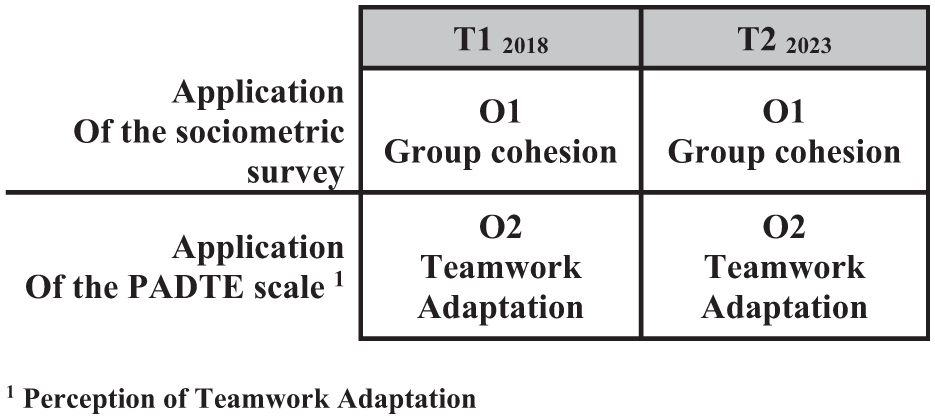
Design of study.
The members of the STEM group who agreed to participate in the group dynamics responded to two anonymous sociometric surveys and two guided anonymous psychometric surveys (Figure 1). The first group dynamics and the first sociometric survey, as well as the first guided individual psychometric survey, were applied in December 2018 for 3 weeks (T1). The second group dynamics, the second sociometric survey, and the second psychometric survey were applied in July 2023 for 2 weeks (T2; Figure 1).
The study design was cross-sectional and repeated over 6 years (2018 and 2023) to assess both the stability and change in group cohesion and the skills needed to adapt to changes in work conditions in the STEM team. The initial evaluation scheme was scheduled for the medium term (up to 5 years), however, the COVID-19 pandemic forced the second evaluation time to be postponed an additional year. The two-stage cross-sectional design has limitations in controlling independent variables and the random assignment of the analysis units. However, it has the advantage of having ecological validity, because it allows representing and generalizing the results in correspondence with the evaluation and estimation of the situations and limitations of everyday life (Burgess et al., 2006); in this case, dealing with the permanence and interactions of the members of the STEM team.
Measurements
On Stability and Change of Group Cohesion
To assess group cohesion, the Moreno’s Sociometric analysis method adapted by Yoshizumi et al. (2020) was applied, adding two anonymous sociometric questionnaires composed of a single item with the following instructions: …Of your colleagues, with whom do you prefer to work, consult, ask for support, and share motivations or difficulties? You can write up to three of your colleagues, with the number one indicating the colleague of your greatest preference, followed by numbers two and three.
After adding the data to a sociometric matrix, sociograms were automatically designed and a graphic analysis was performed based on the interaction network technique using Gephi v.10.1.9 (the freely available software), (Bastian et al., 2009).
On Stability and Change in Teamwork Adaptation Skills
To assess teamwork adaptation skills and expand the information on the skills underlying group cohesion, the Teamwork Adaptation and Development Perception Scale (PADTE) was applied through an individual voluntary guided survey.
Validity and Reliability Properties of the PADTE Scale
This scale was designed based on the theoretical construct of adaptive competencies and teamwork development (Rico et al., 2020). The PADTE scale consists of 4 factors and 22 items: 15 Likert-type items with four grades (1 = Never, 4 = Always); and five semantic differential items with four categories (1 = first category, 4 = fourth category). The validity and reliability results of the PADTE scale are as follows:
(a) Content validity according to the evaluation by 10 experts is adequate (W = 0.765; p < .016), exceeding the minimum values (p ≤ .05) suggested by Marozzi (2014).
(b) In terms of content validity, according to internal structure, through exploratory factor analysis, we found that the final solution of eigenvalues greater than 1.00 is four factors, explaining up to 46% of the variance (acceptable according to Coulacoglou and Saklofske (2018) and Lloret et al. (2014)). Through confirmatory factor analysis, we determined that two goodness-of-fit measures are adequate: parsimony adjustment, X2/df = 356(224) = 1.589 (maximum permitted standard: 3.00); standardized root mean residual index, SRMR = 0.077 (maximum 0.08). Three fit measures are acceptable: comparative fit indices (CFI = 0.867), Tucker-Lewis (TLI = 0.859), when the minimum is ≥0.90; and the fit index root mean square error of approximation (RMSEA = 0.065, close to ≤0.06). In summary, the PADTE scale is consistent with the theoretical framework described. It is thus suitable for assessing collaborative skills and for expanding information on skills underlying group cohesion.
(c) Convergent validity is significant between the PADTE scale and the subscales of intrinsic job satisfaction (ρ = .417; df = 52) and extrinsic job satisfaction (ρ = .491; df = 52). This means that as the levels of perception of teamwork improve, the perception of job satisfaction increases and viceversa.
(d) According to McDonald’s omega coefficient, the reliability according to the internal consistency of the scale is adequate (ω = .902). The reliability in the four factors of the scale (ω = .700 to ω = .847) is acceptable, with ω ≥ .70 as the acceptable value (Da Silva et al., 2015; Supplemental Material [Additional File 1]).
Data Analysis
From the sociometric matrix and the sociogram interpreted as the “group information network,” the degree of group cohesion was determined at two evaluation points (2023 vs. 2018). The numbers of bidirectional and unidirectional interrelations were automatically calculated, and then the following sociometric indicators (SIs) were calculated: (a) the group cohesion coefficient (GCC) and (b) the research group leader status quotient (LSQ). Then, the percentage variation (PV) index of the SIs at 6 years was calculated: IST2 with respect to IST1 [PV = (IST2/IST1) − 1) × 100]. The interrelation of information in the STEM group is the result of a set of tasks of different intensity and duration that occur between members (analogous to “nodes”), as a process of adaptation to teamwork that is modified by changes in the context of the group, either by the incorporation or departure of members (Christian et al., 2017).
To determine the stability or change in teamwork adaptation skills, skills were organized into four factors. The absolute and relative frequencies of 19 indicators were computed in four categories of occurrences, at two evaluation times (2018 and 2023): A = Never; B = Sometimes; C = Almost always; D = Always. Then, the Chi-square tests (X2) based on 2 × 4 frequency contingency tables were applied. For contingency tables containing zero in any cell, or tables with a small sample size, Fisher’s exact test was used. The first global indicator of the context of the STEM group (perception of the work environment) was analyzed in a similar way. To assess the stability or change of the second global context indicator (perception of negative attitudes) the Phi coefficient (φ) was calculated based on 2 × 2 frequency contingency tables. This indicator had two categories of occurrence (present or absent) and at two assessment times (2018 and 2023). In all cases, a p-value less than .05 was considered to indicate statistical significance.
Ethical and Safety Considerations
For data collection, the ethical principles of the Declaration of Helsinki and the WHO Guide for Research Ethics Committees were used. Therefore, the researchers obtained informed consent from the participants, writing in Spanish, and provided a verbal explanation beforehand. This gave the participants the opportunity to ask questions about consent and confidentiality in the research. Given that the research significantly improves institutional academic cohesion and productivity, the minimal risks assumed by the participants are justified. The research project was approved by the Research Ethics Committee of the National Agrarian University of la Selva (Peru) through Report No. 001-2024-CI-UNAS.
The datasets generated and analyzed during the current study are available in the [Figshare] repository [https://doi.org/10.6084/m9.figshare.25735542.v1]; see Supplemental Material [Additional File 2].
Results
Change and Stability of Group Cohesion
Table 1 shows that the cohesion of the STEM team evaluated by the GCC coefficient (“Group Cohesion Coefficient”) has changed substantially improving in the last 6 years (2018–2023), with VP = 64.3% (Table 1; Figure 2). This change denotes higher confidence among members in performing their tasks, doing consultations, asking for support if necessary, or discussing their successes and difficulties within the STEM group. Another positive factor involved in the improvement of group cohesion is the decrease of subgroups up to 20% of the total. The members of the STEM academic are interdependent because they are not part of isolated subgroups. Instead, they are linked to members of two or more subgroups (Figure 2).
Variation According to Sociometric Indicators.

Source. Authors’ analysis based on data [https://doi.org/10.6084/m9.figshare.25735542.v1]; see Supplemental Material [Additional File 2].

Sociogram of the interrelation networks between nodes (A = 2018; B = 2023).
There was also a positive change in the election status of the leaders of the STEM group evaluated by the Leader Status Quotient. The election status of the leader with the highest number of preferences increased with VP = 19% relative to the measurement made in 2018 (Table 1). On the other hand, there was a high degree of preference for the leader elected in 6 years ago, as most team members maintained their preference for the same leader (A24) to consult, request support, or share difficulties (Figure 2).
Another notable indicator of positive change is academic A17 who became the leader of several linked subgroups (Figure 2). Nonetheless, there were two academics that lost five to three elections (A19 and A1; Figure 2).
Change and Stability of Teamwork Adaptive Skills
Synergy and Self-Control
For 68.8% of the members of the STEM group, the perception of the sustained individual contribution of skills for the synergistic change of the group remained stable (p = .477) from 2018 to 2023 (Table 2). This factor is essential because it involves particular experiences and skills that drive members’ adaptation to teamwork (Johnson et al., 2009; LePine, 2003), and is of high value because it occurred without pressure or restriction (p = .268; Table 2). This perception of the individual contribution of skills for synergistic change is consistent with the answers to item 15F of the PADTE scale, where individual effort was perceived consistently, thus encouraging the rest of the members to meet their goals (p = .213; Table 4). Likewise, the perception of autonomy for decision-making in the execution of activities inherent to the STEM team remained stable from 2018 to 2023 (p = .999) in = 77% of the team members (Table 2). The group’s full understanding of goals was not stable from 2018 to 2023 (p = .048), with PV = −12.9% (2018, = 81.2%; 2023, = 70.8%). Low perception of this variable was only present in 29.2% of the members in 2023 and did not affect the correct understanding of goals in the majority of the members (70.8%; Table 2).
Synergy and Self-Control.

Source. Authors’ analysis based on data [https://doi.org/10.6084/m9.figshare.25735542.v1]; see Supplemental Material [Additional File 2].
Note. A = Never; B = Sometimes; C = Almost always; D = Always.
Calculated based on four answer options.
Chi-square test (X2).
Organization and Trust
Cooperative and coordination or mutual support skills remained stable from 2018 to 2023 among members of the STEM team (p = .691) in 66.7% of the participants (Table 3). However, the frequency of common use of materials decreased from 70.8% to 41.6%, but this difference is not statistically significant (p = .106; Table 3). Likewise, the perception of the members’ abilities to easily adapt to teamwork remained stable (p = .999). On the other hand, half of the members easily adapted to the demands of the team and its leaders. Destructive competitions occurred in only 7% of participants.
Organization and Trust.

Source. Authors’ analysis based on data [https://doi.org/10.6084/m9.figshare.25735542.v1]; see Supplemental Material [Additional File 2].
Note. A = Never; B = Sometimes; C = Usually; D = Always.
Calculated based on four answer options.
Group Identification and Individual Effort
The perception of group identification and individual effort of most members of the team remained stable from 2018 to 2023 (
Group Identification and Effort.

Source. Authors’ analysis based on data [https://doi.org/10.6084/m9.figshare.25735542.v1]; see Supplemental Material [Additional File 2].
Note. A = Never; B = Sometimes; C = Usually; D = Always.
Calculated based on four answer options.
Trust between members of the team also remained stable in 75% of participants (p = .309). However the perception of genuine interest among the members of the team decreased in 50% of the members (Table 3), but the difference was not statistically significant (p = .079).
The perception of genuine interest among the members of the team decreased in 50% of the members (Table 3), but the difference was not statistically significant (p = .079).
Communication and Interpersonal Conflicts Management
The perception of an authentic and open communication style (competency i) was present in the majority of the members of the STEM team (
Communication and Interpersonal Conflicts Management.

Source. Authors’ analysis based on data [https://doi.org/10.6084/m9.figshare.25735542.v1]; see Supplemental Material [Additional File 2].
Note. A = Never; B = Sometimes; C = Usually; D = Always.
Calculated based on four answer options.
In addition, in the overall perception of the STEM group context, we found stability in the perception of an adequate work environment, support, and respect for differences (p = .889) in 78% of the team. The adequate work environment was reflected by open and authentic communication of mutual trust, which allows interpersonal conflicts to be handled in depth. Regarding the perception of negative attitudes, we found that a strength of the group was the absence of nepotism. The frequency of regionalist attitudes was reduced from 41.7% to 16.7% from 2018 to 2023, and careerism from 12.5% to 8.3%. An unfavorable aspect of the group, perceived by 54.2% of the members, is that they still perceive procrastination attitudes.
Discussion
In this work, we evaluated the levels of group cohesion and perception of soft skills for adaptation to STEM teamwork. We sought to identify those skills that may be critical for future psychosocial team development programs. The main results were: (a) a substantial change in group cohesion and a significant change in the status of the leader’s choice; (b) stability of the group that contributes to autonomy in decision-making, and significant improvement in the communication of goals; (c) high satisfaction with the management of interpersonal conflicts; and (d) a significant change in group identification over time. In addition, a strength of the group was to avoid nepotism and careerism. These results reveal the solidity of the group, given its previous experience of teamwork adaptation under routine conditions. These results highlight the importance of experience and the need to develop work teams through socio-emotional awareness of prioritized soft skills articulated within and outside the organization (Burke et al., 2006; Cheruvalath, 2024; Georganta et al., 2023; Huckman et al., 2009; Maynard et al., 2015; Rico et al., 2020).
The positive changes observed (promote autonomy in decision making and adequate management of interpersonal conflicts) highlight the decisive role of the leader in giving strength to the team and generating trust, as the members of the team STEM found in him guidance, understanding, and support. This result is consistent with several reports that indicate that, through communication, the leader guarantees the process of change in the team according to its three stages, freezing, movement, and refreezing (Baillien et al., 2017; Burke et al., 2006; Duchek, 2020; Kelley, 1991; Lewin & Dorwin, 1951; Nagda et al. 2006; Wheeler, 2008). It should also be noted that effective communication is essential to foster group identification and create an environment of trust and collaboration (Kossen & Van der Berg, 2022).
However, it is pertinent to note that the levels of group cohesion achieved by the STEM group do not fully support the initial hypothesis that there would be better adaptation to non-routine variations in the work conditions, because in other contexts, members of non-STEM groups had already reached higher levels of development of the relevant skill set (Christian et al., 2017; Huckman et al., 2009; Rico et al., 2020). Nevertheless, compared to the STEM team studied, coordination and integrity among members of team continued at low levels.
Regarding the specific dynamics of skills for teamwork adaptation, we found that stability in synergy and self-control are consistent with the reports of Johnson et al. (2009) and LePine (2003). These two dimensions involve particular experiences and skills that drive members’ adaptation to teamwork (Regina & Allen, 2023). These results increase their value because the changes observed from 2018 to 2023 occurred without pressure or restrictions, and because the members of the STEM team were aware of the team’s goals. This awareness generated an inverse positive effect, causing the attitudes of rivalry or antagonism in interpersonal relationships to decrease. It should be noted that when work teams adapt their behavioral strategies, positive changes in motivation, well-being, and performance of the work team can be predicted (Regina & Allen, 2023).
The stability observed in the soft skills grouped as “group identification and individual effort” is in keeping with the proposals of Kossen and Van der Berg (2022), because in the STEM team, these dimensions were essential to maintaining members’ identification with their team. In the technology sector, group identification is related to group commitment and satisfaction, even when social isolation may be increased by unexpected external events, such as the outbreak of COVID-19 (Kossen & Van der Berg, 2022). Improved group identification not only strengthens the sense of community and cohesion, but can also increase job satisfaction, employee commitment, and motivation (Konradt et al., 2016).
The observed stability of skills related to communication and interpersonal conflict management is in keeping with the satisfaction observed within the group and is consistent with the stability of responses on the perception of an adequate work environment in the context of the team. Taken together, these results show solid theoretical support because interpersonal communication is the basic element for adapting to teamwork and promoting value-based leadership; which in turn has a global impact on improving group identification, culture, and organizational environment (Kossen & Van der Berg, 2022). A work team without interpersonal conflicts increases its psychological capital based on its adaptability to change (Baillien et al., 2017).
Limitations
The limitation of the study was the lack of additional measurement at two times: (a) immediately after the first routine-disrupting event was completed (quality assessment for the institutional licensing process), and (b) immediately after the outbreak of the COVID-19 pandemic. These limitations do not affect the results, but would have allowed for a better analysis of how external conditions affected the STEM team. The second limitation is the lack of comparison between the STEM team and academics from different sciences, which would allow us to determine the differences in the dynamics of group cohesion and the skills necessary for to teamwork adaptation. A third limitation was the loss of participants and the incorporation of new ones for various reasons, which is natural given the nature of the study in terms of the time and peculiarities of the academic team.
Implications, Contributions, Suggestions, and Future research
In agreement with the response framework of the team adaptation process of Maynard et al. (2015) and Rico et al. (2020), our data show that the determination for change, the stability of group cohesion and the perception of teamwork adaptation skills, open possibilities for academics and officials motivated by “Team building” to (a) intensify the development of critical skills during psychosocial interventions; (b) select team members with adequate adaptive skills and cognitive capacities through experiential and psychometric methods; and (c) develop training programs to improve the interactions between teams and team leaders, through transactive memory, role identification (Randall et al., 2011), and experiential behaviors (Christian et al., 2017; Randall et al., 2011).
Our work has important theoretical implications because it broadens the understanding of STEM teamwork in the medium term, which will support studies based on socio-emotional indicators that are currently underrepresented in research (Rico et al., 2020).
The results of our study are relevant to team success in changing and unpredictable work environments. The main strength of our study in Peru lies in the use of the experiential method to assess group cohesion in the medium term. Two previous studies in other contexts examined cohesion at more than one stage using indirect methods (Maynard et al., 2015; Georganta et al., 2023). To our knowledge, this is the first study in Peru that combines two assessment methods in a cross-sectional design, repeated over 6 years. Another strength of the study is the identification of critical soft skills that should be considered in psychosocial intervention programs, both in team building and the development of work teams.
Based on our results, we suggest using effective and transparent communication as a basis to promote the participation of members of a work team and thus ensure that everyone feels heard and valued. The goal is to create an environment of trust and collaboration that strengthens ties within the team. We suggest creating a shared sense of purpose, through psychosocial achievement motivation programs, so that group members understand the group’s goals, values, and mission, and identify with them (Christian et al., 2017; Kossen & Van der Berg, 2022; Randall et al., 2011).
Our results on the change and stability of group cohesion and the perception of the skills that are necessary for adaptation to STEM teamwork, sustained over the medium term, are a basis for (a) developing longitudinal studies aimed at identifying soft skills in teams with development needs; (b) generating theoretical models for estimating team adaptation; (c) designing experimental research to evaluate the efficiency of new technologies in psychosocial interventions for team development, particularly in the health sector (taking into account the studies by Christian et al. (2017), Randall et al. (2011)); and (d) evaluating the psychometric properties of instruments measuring adaptation and development processes of work teams in Latin American contexts.
Conclusions
The main results were: (a) a substantial change in group cohesion and significant change in election status for the leader; (b) stability of the group that contributes to autonomy in decision-making, and significant improvement in the communication of goals; (c) high satisfaction with the management of interpersonal conflicts; and (d) a significant change in group identification over time. A strength of the team was to keep away attitudes of nepotism and careerism.
The dynamics of the STEM team in the medium term consisted of maintaining the levels of group cohesion and teamwork adaptation skills that had been achieved 6 years before the study; mainly through group identification and communication aimed at understanding goals and managing interpersonal conflicts.
Enhancing the skills of cooperation, coordination, and integrity among members of a team is a priority to develop strong teams and improve group cohesion.
Supplemental Material
sj-csv-2-sgo-10.1177_21582440251385755 – Supplemental material for Change or Stability in Cohesion and Teamwork Adaptation Skills of Peruvian STEM Academics Over 6 Years
Supplemental material, sj-csv-2-sgo-10.1177_21582440251385755 for Change or Stability in Cohesion and Teamwork Adaptation Skills of Peruvian STEM Academics Over 6 Years by Luis Fidel Abregú-Tueros, Juan Carlos Curi Gamarra and Mercedes Sarapura Sarapura in SAGE Open
Supplemental Material
sj-docx-1-sgo-10.1177_21582440251385755 – Supplemental material for Change or Stability in Cohesion and Teamwork Adaptation Skills of Peruvian STEM Academics Over 6 Years
Supplemental material, sj-docx-1-sgo-10.1177_21582440251385755 for Change or Stability in Cohesion and Teamwork Adaptation Skills of Peruvian STEM Academics Over 6 Years by Luis Fidel Abregú-Tueros, Juan Carlos Curi Gamarra and Mercedes Sarapura Sarapura in SAGE Open
Footnotes

Ethical Considerations
The research project was approved by the Research Ethics Committee of the National Agrarian University of la Selva (Peru) through Report No. 001-2024-CI-UNAS.
Informed Consent
For data collection, the ethical principles of the Declaration of Helsinki and the WHO Guide for Research Ethics Committees were used. Therefore, the researchers obtained informed consent from the participants, writing in Spanish, and provided a verbal explanation beforehand. This gave the participants the opportunity to ask questions about consent and confidentiality in the research. Given that the research significantly improves institutional academic cohesion and productivity, the minimal risks assumed by the participants are justified.
Funding
The authors disclosed receipt of the following financial support for the research, authorship, and/or publication of this article: LFA-T has received partial funding for the field operation from the Institute of Psychological Research (University of San Martín de Porres, Peru).
Declaration of Conflicting Interests
The authors declared no potential conflicts of interest with respect to the research, authorship, and/or publication of this article.
Data Availability Statement
Supplemental Material
Supplemental material for this article is available online.
References
Supplementary Material
Please find the following supplemental material available below.
For Open Access articles published under a Creative Commons License, all supplemental material carries the same license as the article it is associated with.
For non-Open Access articles published, all supplemental material carries a non-exclusive license, and permission requests for re-use of supplemental material or any part of supplemental material shall be sent directly to the copyright owner as specified in the copyright notice associated with the article.
