



Abstract
In this study, we examined mental simulation and gestural embodiment of the definite article (the) by analyzing gestures produced by presenters talking about a variety of subjects. We used a Chi-square test to find out what type of gesture occurred more frequently with the definite article. The results showed that the number of pointing gestures that occurred with definite articles used before already-mentioned nouns was significantly higher than the number of pointing gestures that occurred with other types of the definite article. Based on these results, it is suggested that when speakers use a word to refer to an already-mentioned entity, that entity is one part of the simulated situation even before it is mentioned again. Therefore, when speakers use a word to refer to it again, they refer to something that exists in the context of the mentally simulated situation. In the same way that speakers may use a pointing gesture to refer to an entity in the physical context of the conversation, they may use a pointing gesture to refer to something in the context of the mentally simulated situation. This pointing gesture can be regarded as the gestural embodiment of the grammatical function of the definite article.
Introduction
Theories of embodiment and the processes involved in embodying semantic contents of words and sentences during language production and comprehension have been the subject of a large body of interdisciplinary research in recent decades (e.g., Baur et al., 2022; Borghi et al., 2017, 2019; Caligiore & Fischer, 2013; Dong & Lee, 2017; Dove & Elpidorou, 2016; Gianelli et al., 2013; Gibbs, 2006; Khatin-Zadeh, Hu, Eskandari, et al., 2023; Khatin-Zadeh, 2024; Robin & De Bont, 2022; Villani et al., 2021; Xu et al., 2023; Yamada et al., 2025). These theories have changed the ways that researchers study various phenomena in our world (e.g., Bietti, 2013; Duby & Barker, 2017; Marmolejo-Ramos et al., 2018). Many of these studies have provided behavioral and neuroimaging evidence that supports the main idea of embodiment theories, although there are some disagreements and conflicting evidence. According to the main idea of the embodied cognition, when people talk/think about or imagine an object/concept, the same sensorimotor activities and processes experienced during actual perception of the object/concept are reactivated and re-experienced (e.g., Barsalou, 2010; Feldman & Narayanan, 2004; Pulvermüller, 2013). Crucially, the sensorimotor processes and activities occurred during real perception of the object can be later reactivated and re-experienced when people talk/think about or imagine it even in the absence of the object (e.g., Bartolomeo, 2022; Boccia et al., 2017, 2019; Farah, 1989; Hamamé et al., 2012; Hauk et al., 2004; Pulvermüller, 2005; Rizzolatti & Arbib, 1998). Reactivating and re-experiencing sensorimotor processes means that the same sensorimotor networks that were activated during real perception of the object are re-activated when people talk/think about it or imagine it. An object with various perceptual characteristics can be perceived through the activation of a complex network of neurons in various cortical areas. These perceptual features (visual, audio, haptic, olfactory, and gustatory) constitute semantic content of a word that refers to that object. According to the theories of linguistic embodiment, when this word is used, the same networks and cell assemblies are activated (Pulvermüller, 1999). For example, when the word desk is used, visual and haptic experiences associated with perceiving a desk, and sensory networks involved in visual and haptic perception of a desk are activated (e.g., Arbib, 2012).
The process of embodying a concept or an action can be simulated in co-speech gestures when people talk about the concept or the action. According to Hostetter and Alibali (2008, 2018), co-speech gestures are physical realizations of actions that are mentally simulated. They argue that when mental simulation of an action (simulation in the pre-motor areas) passes a certain level, it is realized in a real co-speech gesture (simulation in the primary motor areas). Gestures have a variety of types. Some gestures reflect semantic features of their referents or have a contextual relationship with what they refer to, while others do not have any sematic and contextual relationship with the accompanying speech. According to a well-known typology proposed by McNeill (1992), gestures can be categorized into four types: pointing, iconic, metaphoric, and beat gestures. Pointing gestures refer to the locations. Iconic gestures show the shape of objects by traces of body movements (e.g., a pushing movement used with the sentence ‘push the door’). A metaphoric gesture has a metaphoric relationship with the meaning of the accompanying speech (e.g., a grasping gesture used with the sentence ‘I grasped the idea’). Beat gestures do not have any meaningful relationship with the accompanying speech. Iconic and metaphoric gestures are called representational gestures. In a later work, McNeill (2008) notes that this typology is not absolutely dichotomous, as a given gesture can have the features of more than one type of gestures. For example, a gesture can have the features of pointing and iconic gestures.
In this study, our aim was to investigate the gestural embodiment of the definite article (the). This word does not have much semantic content. It has a grammatical function. Our goal was to examine how the definite article is mentally simulated and how this simulation is realized in gestures. The majority of past research has focused on the embodiment of meanings of words. A much smaller number of studies have investigated the embodiment of grammatical words and the realization of this embodiment in co-speech gestures. The base idea behind our study was that meaning of a word is not the only aspect that is embodied and realized in gesture. Grammatical function of a word may also be embodied and realized in gesture, even if the word does not have any clear meaning. Before describing the method of our study, in the following section, we have a look at some studies that have investigated the embodiment of meanings and grammatical aspects of some words.
Studies on Mental and Gestural Embodiment
Mental and gestural embodiment of meanings of some concepts have been examined in a number of past studies. In one of the pioneering studies that was conducted by Glenberg and Kaschak (2002), the participants were asked to make sensibility judgments on a number of sentences that referred to the transfer of concrete objects or abstract entities by making hand movements toward or away from their bodies. The results showed that when the direction of the required response was opposite to the direction of the transfer of the concrete object or abstract entity, the participants were faced with difficulty to make a sensibility judgment. These results suggest that when people process sentences that refer to directed transfer of objects and abstract entities, the actions involved in such transfers are mentally simulated. This means that literal and even metaphoric actions are mentally simulated, and these simulations may appear in co-speech gestures that occur with literal and metaphoric sentences. This has been confirmed by the findings of many studies investigating the same question from a variety of perspectives and with various methods (e.g., Diefenbach et al., 2013; Fischer & Zwaan, 2008; Glenberg et al., 2008; Greco, 2021; Kaschak & Borreggine, 2008; Taylor et al., 2008; Van Dam & Desai, 2017; Winter et al., 2022).
A recent study (Khatin-Zadeh, Hu, Marmolejo-Ramos, et al., 2023) examined how presenting the gestural representation of a metaphor schema to comprehenders affects their understanding of that metaphor. Three different groups of participants made sensibility judgments on a set of metaphors in congruent gesture-prime, incongruent gesture-prime, and no-prime conditions. A comparison between judgments in these three conditions showed that in congruent gesture-prime conditions, metaphors were judged to be more sensible and sensibility judgments were faster. Based on these results, researchers of this study concluded that during processing a metaphor, metaphor schema which is an important part of semantic content of a metaphor is mentally simulated, and this mental simulation may be realized in metaphoric gestures that co-occur with the metaphor. These results were confirmed by the results of another study (Khatin-Zadeh, 2023) that examined the process of understanding metaphors in congruent gesture-prime, opposite gesture-prime, and no-prime conditions. A recent story-telling study examined the gestural embodiment of intensifiers as a specific category of grammatical words (Khatin-Zadeh, Farsani, Hu, et al., 2023). Results of this study showed that adding an intensifier to a literal sentence increases the probability of using an iconic or beat gesture with the word that occurs after intensifier, and adding an intensifier to a metaphoric sentence increases the probability of using a metaphoric or beat gesture with the word that occurs after intensifier. Intensifiers have clear grammatical functions, but they have significant amounts of semantic content. In other words, these words are not purely grammatical. Therefore, gestural embodiment of these words can be considered as a combination of embodiments of their meanings and their grammatical functions in the sentence. The interesting point about the findings of this study is that when some words that belong to a certain grammatical category are added to a sentence, the process of embodying the action that is described by that sentence can be strengthened.
In this study, we examined the embodiment and gestural simulation of the definite article (the). We analyzed a set of videos downloaded from YouTube to find out what types of gestures had been used with definite articles in various contexts. We used McNeill’s (1992, 2008) typology of gestures (representational, pointing, and beat) and a categorization of definite articles into five types as a framework for our analysis. We categorized definite articles into: 1) definite articles used before known nouns, 2) definite articles used before already-mentioned nouns, 3) definite articles used before superlative adjectives, 4) definite articles used before the names of systems and services, 5) definite articles used before a noun or an adjective that refers to all members of a group. We intended to find out what type of gesture occurred more frequently with each type of the definite article. The aim was to find out how grammatical function of the definite article (the) is embodied and realized in co-speech gestures. We took theories of embodied language processing as a framework for our study and assumed that semantic contents and grammatical functions of words are embodied and may be realized in co-speech gestures. Based on these theories, we hypothesized that some types of gestures occur more frequently with certain types of the definite article. Therefore, we assumed that a gesture that co-occurs with it is a reflection of embodiment of its grammatical function. The definite article has a primarily grammatical function and does not have a significant semantic content. However, in the case of referring to a known noun or an already-mentioned noun, it has also a pragmatic function. It has a pragmatic function as it refers an information that is shared by the speaker and the hearer. Since pointing gestures also have a pragmatic function, one can expect a relationship between the definite article and pointing gestures. In the following section, we explain the methodology of our study in detail.
Method
Materials
We used a set of keywords to search for suitable videos on YouTube. These keywords were about a variety of topics such as family, traditions, education, psychology, modernization, sport, and history. The reason for using keywords was to organize our search and find videos that were about a variety of subjects. Initially, we found 98 videos. Then, we examined these videos to select more suitable ones for the purpose of our study. Among these videos, we selected 53 videos that were sufficiently long and easier to analyze. These videos included oral presentations by adult native English speakers. In some videos, the speaker talked to live audience. In some others, there was not a live audience in front of the speaker. Totally, these videos had a length of around 7 hr. In the process of selecting the videos, we did our best to select those ones in which gestures produced by the presenters could be clearly seen and analyzed by an observer. All presentations of the videos were transcribed. In these transcriptions, all definite articles were marked, and the type of each definite article was determined. As mentioned, each definite article was included in one of these categories: 1) definite articles used before known nouns, 2) definite articles used before already-mentioned nouns, 3) definite articles used before superlative adjectives, 4) definite articles used before the names of systems and services, 5) definite articles used before a noun or an adjective that referred to all members of a group. These transcriptions were used for coding gestures that co-occurred with definite articles in the presentations. Our aim was to examine types of gestures that co-occurred with each category of definite articles.
Procedure
All videos that had been selected for final analysis were carefully transcribed. All definite articles in the transcriptions were marked. Each marked definite article was included in one of the five categories of definite articles. The transcriptions and videos were examined to code the gestures that co-occurred with definite articles. The aim of this analysis was to determine the type of hand gestures (representational, beat, and pointing gestures) that had co-occurred with each definite article in the transcriptions. Two independent coders who were not involved in the study coded the gestures that had co-occurred with definite articles. The aim was to prevent the effect of any kind of bias in coding the data. The two coders independently watched the videos and made judgments on the types of gestures that had co-occurred with definite articles. Only gestures that had occurred exactly at the time of using a definite article were counted and coded. To make sure that the process of coding was accurate, the coders watched the videos several times. Inter-coder reliability was also obtained to make sure that the data gathered from the two coders had an acceptable rate of reliability. In some cases, the two coders had made different judgments on the type of gestures that had occurred with definite articles. In these cases, the final judgments were made by one of the researchers of the study.
Data Analysis
The inter-coder reliability between the judgments of the two coders on the types of gestures produced in the videos was calculated. The aim was to make sure that the process of coding the gestures had an acceptable rate of reliability. The number of produced definite articles that fell into each one of five categories was obtained. Then, for each category of definite articles, the number of co-occurring representational, pointing, and beat gestures were obtained. In this way, a 3 × 5 table was created. Types of gestures were put in the first column and types of definite articles were put in the first row of this table. Each cell of this table showed the number of one type of gesture (representational, pointing, and beat) that had occurred with a certain category of definite articles. We used a Chi-square test (3 × 5 contingency table analysis) to examine the co-occurrence of each type of gesture with each category of definite articles. For each type of gesture in each row of the table, the proportion of gestures that had occurred with each category of definite articles was obtained. Our aim was to find out what type of gesture had co-occurred more frequently with each category of definite articles.
Results
The judgments of the two coders on the type of gesture co-occurred with each definite article were compared. In 86% of cases, the judgments of the two coders were similar. This was an acceptable rate of inter-coder reliability. In 14% of cases that the two coders had made different judgments, the final judgments were made by one of the researchers of the study.
In Table 1, the number of each type of gesture that had co-occurred with each type of definite article has been given. For each category of definite articles, the proportion of co-occurred gesture (by row) has been given.
The Number of Each Type of Gestures that Co-occurred with Each Category of Definite Articles.
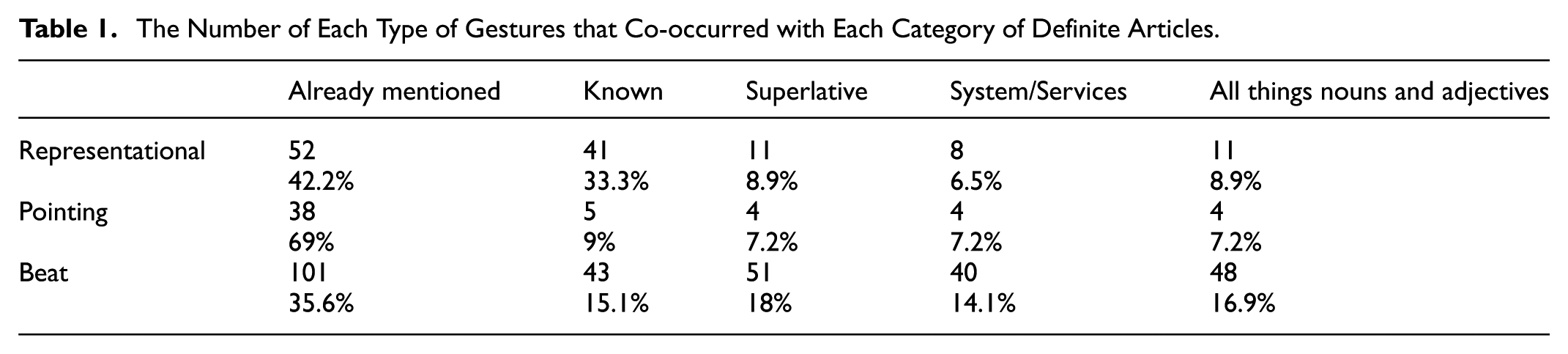
As mentioned, we used a Chi-square test (3 × 5 contingency table analysis) to examine the co-occurrence of each category of definite articles and each type of gestures. Results of this test showed that the relation between these variables was significant, χ2 (4, N = 583) = 48.7316, p < .00001. These values along with the proportions given in Table 1 show that: 1) the number of pointing gestures that occurred with definite articles used before already-mentioned nouns was significantly higher than the number of pointing gestures that occurred with other types of definite article; 2) the number of beat gestures that occurred with definite articles used before already-mentioned nouns was significantly higher than the number of beat gestures that occurred with other types of definite article. Figure 1 presents a mosaic plot of relationship between types of definite articles and types of gestures that occurred with them.

Mosaic plot of relationship between types of definite articles and types of gestures that occurred with them.
Also, among the gestures that occurred with definite articles, 17 gestures had the features of both pointing and beat gestures.
Discussion
As mentioned, results of this study showed that the number of pointing gestures that occurred with definite articles used before already-mentioned nouns was significantly higher than the number of pointing gestures that occurred with other types of the definite article. Also, the number of beat gestures that occurred with definite articles used before already-mentioned nouns was significantly higher than the number of beat gestures that occurred with other types of the definite article. Importantly, a significant number of gestures that occurred with definite articles before already mentioned nouns had the features of both pointing and beat gestures. Here, we explain the higher number of pointing and beat gestures with definite articles used before already-mentioned nouns by describing a mechanism through which pointing gestures help the speaker keep a mental image of the simulated situation. During talking about a situation, a mentally simulated situation is formed in the mind of the speakers (e.g., Feyereisen & Havard, 1999; Hostetter & Alibali, 2008, 2018; Kita et al., 2017; Wesp et al., 2001). When speakers use a word to refer to something/someone that has already been mentioned, that thing or person is one part of the simulated situation even before the second mentioning of it. In other words, it is one element of the mentally simulated context that has been formed and is talked about. Therefore, when speakers use a word to refer to it again, they refer to something that exists in the context of the mentally simulated situation. In the same way that speakers may use a pointing gesture to refer to a location, an object, or a person in the physical context of the conversation, they may use a pointing gesture to refer to something in the context of the mentally simulated situation. In other words, since the mentally simulated situation is an embodied context, it can be said that there is no difference between physical context of a conversation and the context of the mentally simulated situation. In other words, speakers imagine that they are in the context of the mentally simulated situation and use pointing gestures to refer to objects, locations, and people in that context. Even if the speakers are not in the physical context that is talked about, they mentally simulate and embody it in their minds. Therefore, speakers may use a pointing gesture to refer to something in the mentally simulated situation, although that thing does not exist in the physical context of the conversation.
The important point about the definite article is that it does not carry any semantic content. It has a solely grammatical function. Results of our study suggested that this grammatical function can have an embodied realization in pointing and possibly beat gestures. But, since the definite article does not have any meaning or any semantic relationship with the meaning of the noun that appears after it, the gesture that occurs with the definite article (and the subsequent noun) is not a representational gesture. Interestingly, in some cases of our study, when nouns were mentioned for the first time, they were accompanied by representational gestures. These representational gestures had a direct relationship with the meanings of the nouns. Since in the first mentioning of a noun, it was not accompanied by a definite article, the gesture that occurred with it just reflected the meaning of the noun. But, when the noun was mentioned again, it was preceded by a definite article, and the gesture that occurred with it and its preceding definite article had a direct relationship with the grammatical function of the definite article. This suggests that the process of mentally simulating a situation and the use of co-speech gestures is dependent not only on the meanings of words used to describe that situation but also on the grammatical functions of words that do not have any clear semantic content. In our study, the meanings of nouns were realized in representational gestures, while the grammatical function of definite articles was realized in pointing gestures.
Therefore, it is suggested that grammatical words (such as the definite article) that do not have any meaning can be embodied and realized in co-speech gestures. Depending on the grammatical function of a category of words, that category can be embodied in a certain way or affect the embodiment of other words in the sentence. In our study, a definite article that occurred before an already-mentioned noun was realized in a pointing gesture. This pointing gesture can replace a representational gesture that has a direct relationship with the semantic content of the noun that occurs after the definite article. As mentioned, in some cases, the first mentioning of a noun (without a definite article) was accompanied by a representational gesture, while the second mentioning (with a definite article) was accompanied by a gesture which had the features of pointing gestures (for example, an extended index finger).
An important point about grammatical words is that a certain group of these words can have the same grammatical function. In other words, although these words are different in appearance, they have the same function across a wide range of sentences. Therefore, all words belonging to one category of grammatical words can be embodied and realized in gestures in the same way. For example, all conjunctive words (e.g., and, or) have the same grammatical function; they connect words or phrases that serve the same grammatical purpose in a sentence. These words do not have much semantic content, but all of them do the same grammatical job in any sentence. This grammatical role can be embodied in the same way for all words that belong to this category of grammatical words. Therefore, it can be suggested that the embodiment of a grammatical function is different from semantic embodiment in an important respect. While all words that belong to a certain grammatical category can be embodied in the same way, the meaning of each word is embodied in a unique way. This means that all words that belong to a certain grammatical category and have the same grammatical function can be accompanied by a certain gesture. This gesture can be regarded as the embodied realization of that grammatical category or embodied realization of all words belonging to that category. The definite article is a single word. However, it can be used in a variety of situations to refer to something that has already been mentioned. Although these situations can vary in many respects, the definite article is realized as a pointing gesture (e.g., an extended index finger) in all these situations.
A question that may be raised here is that how the gestural embodiment of the definite article can help the speaker present a clear picture of the situation that is talked about. A representational gesture offers a picture of semantic features of the object it refers to. In this way, it can provide visual information about the situation. This is particularly helpful when the load of visual information to be expressed is too high or the visual information is difficult to encode in words of speech. Importantly, as Wesp et al. (2001) argue, a representational gesture can help the speaker maintain a mental imagery of the simulated situation that is being talked about, as it offers a visual description of the objects that are involved in that situation. This can be the case not only with representational gestures, but also pointing gestures that co-occur with a definite article and its subsequent word. A pointing gesture that occurs with a definite article and its subsequent word can help the speaker keep a stable mental imagery of the objects that are involved in the simulated situation. When a speaker talks about a situation, a mental image is formed in his mind. This mental image may be fixed (a static mental image) or running (a dynamic mental image). If this mental image is running, it would be more difficult to maintain it as a running image undergoes some changes during talking. In any case, a pointing gesture can function as an anchor to keep the elements of the simulated situation in the right place and create a stable and coherent mental image of the situation. Here, a pointing gesture has a regulatory function. It can help speakers regulate their mental processes by forming an integrated or coherently-structured image of the situation.
Conclusion
Most of the discussions about the role of pointing gestures have been focused on those cases that speakers talk about objects, locations, and people in the physical context of the conversation. Speakers use pointing gestures to refer to objects, locations, and people that are in the place of the conversation. These pointing gestures are helpful as they can enhance the process of expressing information and communicating between interlocutors. Such gestures help people focus their attention on what is talked about. But, the results of our study suggested that pointing gestures can refer to objects, locations, and people even in the absence of objects, locations, and people in the physical context of the conversation. Speakers use such gestures as if the referred objects, locations, and people are present in the physical context of the conversation. These gestures can have a regulatory function in thought processes. The data of our study suggested that the gestural embodiment of the definite article can be one specific type of such gestures. In other words, not only representational gestures that illustrate the semantic content of words but also pointing gestures that reflect grammatical function of words may have a regulatory function in thought processes. This means that a variety of gestures can support speakers in the process of expressing information and managing their thought processes. They also help listeners receive visual information about meanings of words, contextual features of the situation, and also grammatical functions of words that are used to describe the situation. Presenting a picture of how semantic and grammatical information are integrated in a gestural format is a question that can be investigated in future research. Finally, it should be noted that in our study we specifically investigated gestural embodiment of the definite article in English. In other languages, definite articles may appear in a variety of linguistic forms and structures. This could affect the ways that these articles are embodied and manifested in co-speech gestures. Furthermore, culture-specific features may affect gestures that co-occur with definite articles in various languages. These are some other questions that can be the subject of future investigations.
Supplemental Material
sj-xlsx-1-sgo-10.1177_21582440251385321 – Supplemental material for Embodiment and Gestural Simulation of the Definite Article
Supplemental material, sj-xlsx-1-sgo-10.1177_21582440251385321 for Embodiment and Gestural Simulation of the Definite Article by Omid Khatin-Zadeh, Zahra Eskandari, Danyal Farsani and Hassan Banaruee in SAGE Open
Footnotes
Acknowledgements
We appreciate NTNU for covering the APC.

Funding
The authors received no financial support for the research, authorship, and/or publication of this article.
Declaration of Conflicting Interests
The authors declared no potential conflicts of interest with respect to the research, authorship, and/or publication of this article.
Data Availability Statement
The data that support the findings of this study are attached as supplementary materials.
References
Supplementary Material
Please find the following supplemental material available below.
For Open Access articles published under a Creative Commons License, all supplemental material carries the same license as the article it is associated with.
For non-Open Access articles published, all supplemental material carries a non-exclusive license, and permission requests for re-use of supplemental material or any part of supplemental material shall be sent directly to the copyright owner as specified in the copyright notice associated with the article.
