




Abstract
The global surge in health awareness and the widespread adoption of fitness applications (apps) on smartphones have reshaped how individuals approach health and leisure activities. This study employs a modified model of the Theory of Reasoned Action (TRA) by introducing three variables—credibility, reciprocity, and entertainment value—to examine the impact of fitness apps on users’ sharing attitudes, community identification, and sharing intentions. A two-part analytical process, involving a measurement model and structural equation modeling analysis, was used to assess the instrument and test the hypotheses, based on 408 valid questionnaires from fitness participants with over 1 year of experience. The findings showed that the three variables significantly influenced sharing attitudes and community identification, while sharing attitudes and subjective norms positively affected sharing intentions. These results provide a strategic reference for sports app developers in managing social networking features.
Introduction
The rise of global health awareness and the widespread use of smartphones with fitness applications (apps) are now integral to daily life. Consumers rely on social media and mobile apps to obtain information, share their opinions, and make purchasing decisions (Cheung & To, 2017; Won et al., 2023). In sports, apps play a key role by providing detailed tracking of users’ exercise data and enabling the sharing of this information on social networking sites (SNS) at any time, thereby promoting interaction and community engagement. Sports apps not only simplify exercise management but also enhance users’ sense of engagement and achievement through real-time sharing features. For example, among the billions of daily posts shared on platforms like Facebook, a considerable proportion is related to exercise (Kashian & Liu, 2019; Stragier et al., 2015).
Previous research (e.g., Ahmed et al., 2019; Gretzel et al., 2015) focused on knowledge sharing on SNS within diverse communities and organizations. However, other studies have suggested that, in addition to knowledge sharing, the quality and credibility of the information (e.g., Khan et al., 2024; Osatuyi, 2013), reciprocity (e.g., Pai & Tsai, 2016; Wasko & Faraj, 2000), and entertainment value (e.g., Kim & Han, 2009; Uhrich, 2021) of what is being shared influence sharing behavior and attitudes. Despite the increasing popularity of sports apps, there remains a lack of systematic research on users’ motivations and the factors influencing their sharing of exercise information on SNS.
Accordingly, this study aims to fill this gap by exploring users’ intentions to share information via sports apps, proposing nine hypotheses related to credibility, reciprocity, and entertainment value. It adopts a modified version of the Theory of Reasoned Action (TRA) to better explain sharing intentions in online environments, particularly within fitness app communities. The original TRA posits that an individual's attitude toward a behavior, subjective norms, and perceived behavioral control shape their behavioral intentions and actual behaviors (Ajzen, 1991). However, the traditional model does not fully capture the complex dynamics of digital interactions. In this study, credibility, reciprocity, and entertainment value are introduced as key variables that influence sharing intention through the mediating roles of sharing attitude, community identification, and subjective norms.
The findings aim to offer practical insights for sports app developers in designing features that enhance user interaction and engagement. The study is organized as follows: First, we review the relevant literature on SNS, sports apps, and the underlying theoretical framework, and introduce nine hypotheses alongside the proposed mediating variables. Next, we outline the research methodology, followed by a presentation and analysis of the results. Finally, we conclude with a discussion of key findings, study limitations, and practical and managerial implications.
Literature Review
Social Networking Sites
SNS have evolved from simple communication tools to dynamic ecosystems that influence identity expression, social validation, and community participation. They are interactive platforms that enable users to share information (e.g., videos, photos) and communicate in real time through features like messaging and comments (Osatuyi, 2013). These platforms facilitate user-generated content, interpersonal feedback, and networked visibility—factors critical for understanding online sharing behavior. In health and fitness contexts, SNS amplifies the reach of personal achievements and fosters motivation through peer recognition and support (Balatsoukas et al., 2015). Unlike social media platforms like weblogs that primarily broadcast information, SNS support collaborative creation and relationship-building (Horst & Miller, 2017; Smock et al., 2011). Users can create profiles, share content, and engage with others to exchange or provide information (Kol & Lissitsa, 2024). SNS have expanded their role to various activities, including sports, where organizations and athletes use them for effective communication (Dalen & Seippel, 2021). The act of sharing on SNS is often driven not only by self-expression but also by the desire for social reinforcement and belonging, making these platforms ideal for studying information-sharing intentions.
Sports Apps
Smartphones and watches enable users to download various applications from virtual app stores. Health-promoting apps often combine information and tracking functions with social networking features, enhancing user engagement and supporting behavior change (West et al., 2012). Sports apps, for instance, track physical activity and offer features such as exercise tracking, training plans, and health advice to improve fitness (Bo, 2024). They use GPS to record jogging routes and calculate metrics such as speed, distance, time, and calories burned (Janssen et al., 2017).
Sports apps are not only fitness trackers but increasingly function as digital communities that foster motivation, accountability, and social interaction. According to Huang et al. (2022), these apps play a dual role—supporting behavior regulation through performance feedback and facilitating social comparison among peers. The gamification elements (e.g., badges, leaderboards) and social connectivity features (e.g., friend feeds, comments) enhance user engagement by tapping into intrinsic and extrinsic motivators. Moreover, sports apps now enable users to build online identities centered on fitness achievements, thereby reinforcing consistent usage and sharing behaviors (Feng, 2024). This social dimension is central to understanding sharing intention. By integrating social networking, users can share their running data on SNS to encourage consistent exercise.
Theory of Reasoned Action
The TRA was developed in the field of social psychology to explain the process of human behavior decision-making (Fishbein & Ajzen, 1975). It posits that an individual’s decision to perform a specific behavior is influenced by their attitude and subjective norms. In the TRA, behavioral intention refers to an individual’s degree of willingness to engage in a specific behavior and incorporates the positive or negative feelings they hold toward performing it. The more positive an individual’s attitude toward a particular behavior, the stronger their intention to perform it. Subjective norms refer to perceived social pressures from others regarding the behavior and may influence the individual’s decision.
The TRA has been widely applied in past studies to explain how behavioral intentions are formed (e.g., Bamberg et al., 2003; Kim et al., 2013). However, the rapid development of social media and digital platforms has revealed limitations in the TRA’s ability to explain users’ intentions to share information on SNS. Specifically, the TRA only considers the influence of attitude and subjective norms on behavioral intentions, neglecting other important factors in the modern digital environment, such as the credibility of information, reciprocity, and entertainment value.
First, the TRA overlooks the role of information credibility (McKnight & Kacmar, 2007), which is regarded as a key factor in determining behavioral intention in today’s social media environments. Second, reciprocity plays a critical role in online communities (Wasko & Faraj, 2000), yet it is not considered in the TRA. Lastly, entertainment value—an important driver of user engagement and sharing behavior (Koh et al., 2003)—is also absent from the TRA’s framework. These omissions limit the theory’s ability to fully explain individuals’ sharing intentions on SNS.
The integration of credibility, reciprocity, and entertainment value into the TRA is supported by contemporary research examining user engagement and behavioral intention in digital contexts. Credibility has been shown to significantly impact trust and information sharing in online communities (Ham et al., 2014). Reciprocity, rooted in social exchange theory, is a key motivator for participation in knowledge-sharing platforms (Zhang et al., 2021). Similarly, entertainment value has been identified as a driver of online engagement, especially in SNS-based contexts where hedonic motivations often complement utilitarian ones (Hu et al., 2022). Despite its extensive use in behavioral research, the TRA has been criticized for insufficiently capturing the multidimensional nature of digital engagement. Scholars argue that traditional constructs like attitude and subjective norms are no longer sufficient to explain behavior in socially interactive, media-rich environments. Therefore, modifying the TRA to include these constructs aligns with evolving digital behavior models and strengthens its explanatory power in the context of sports app usage and social sharing.
In light of these limitations, this study proposes the Modified Theory of Reasoned Action (MTRA) to more accurately explain sports app users’ intentions to share information on SNS. Specifically, this study incorporates credibility, reciprocity, and entertainment value into the modified model as key variables influencing both attitude and subjective norms. Furthermore, the MTRA assumes that these new variables not only directly influence sharing attitudes but also enhance community identification, which consequently strengthens subjective norms and ultimately affects sharing intention.
Relationship Between Credibility, Sharing Attitude, and Sharing Intention
Information credibility refers to the extent to which users are willing to believe that a certain piece of information is reliable and trustworthy (McKnight & Kacmar, 2007). In the context of using sports apps, the credibility of information significantly influences users’ willingness to share their exercise information on SNS. When users perceive the information in sports apps as credible, they are more likely to believe it will be accepted and trusted by other community members.
McKnight et al. (2002) noted that others’ experiences can enhance the recipient’s perception of the source’s goodwill and integrity, thus increasing their willingness to rely on the information. The higher the level of trust between community members, the more willing individuals are to share resources with others (Nahapiet & Ghoshal, 1998). Similarly, in a community formed around sports apps, high trust between members suggests that individuals are more likely to share their exercise results, achievements, and information with other members on social platforms.
A study by Khan et al. (2024) pointed out that content credibility significantly influences the information adoption behavior of social media users. In the context of sports apps, this means that when users believe the information they are sharing on SNS is credible, they are more likely to share it and expect feedback and interaction from other members. Therefore, enhancing the credibility of exercise information not only increases users’ willingness to share but also promotes community interaction and engagement.
Zhang et al. (2023) indicated that trust in the source of information and trust between recipients have a positive impact on attitudes toward information sharing. In one such study, Cheung and To (2017) found that the propensity to trust in-app advertisements significantly influenced mobile users’ trust and led to positive attitudes. Similarly, a positive attitude toward information sharing is posited to influence users’ intention to share information. Based on this premise, this study proposes the following hypothesis:
Relationship Between Credibility, Community Identification, Subjective Norms, and Sharing Intention
Given the inherent uncertainty of SNS, community members must establish mutual trust to form a solid community and enhance their sense of identification with it (Wang & Emurian, 2005). Kim et al. (2013) noted that community identification in virtual communities is built on trust that facilitates interpersonal relationships. When the information shared by app users is perceived as accurate, other users are more likely to develop a sense of reliance, which consequently enhances their community identification (Osatuyi, 2013).
Chen (2020) found that community identification and subjective norms significantly affect the willingness to share information. Specifically, when users perceive support and expectations from the community, they are more likely to engage in information-sharing behaviors. This suggests that a supportive community atmosphere and expectations regarding sharing behaviors can increase users’ motivation to share information. In the context of sports apps, if users experience identification with and expectations from the exercise community, sharing their exercise information on SNS is anticipated. Therefore, enhancing the sense of community identification and subjective norms within sports apps may increase users’ willingness to share exercise information. Accordingly, this study proposes the following hypothesis:
Relationship Between Reciprocity, Sharing Attitude, and Sharing Intention
Reciprocity refers to the expectation that individuals will give and receive equally during exchanges, maintaining future interactions (Kollock & Smith, 1999; Pai & Tsai, 2016; Wasko & Faraj, 2000). It represents the perception of fairness in knowledge exchange behaviors (Chiu et al., 2006) and is evident even in online communities, where sharing resources, shared values, and reciprocal behaviors are crucial components (Lechner & Hummel, 2002).
Bock et al. (2005) found that anticipated reciprocity positively affects sharing attitudes. In their TRA-informed research involving 154 managers from 27 Korean organizations, the authors found that subjective norms were influenced by self-worth and organizational climate. Similarly, in their health-related research using the TRA, Wu and Kuang (2021) reported that reciprocity positively influences attitudes toward sharing behavior, leading to a higher willingness to share information.
In the context of sports apps, users who receive corresponding returns from sharing exercise information—based on this expectation of reciprocity—may be more willing to share such information on SNS, resulting in positive sharing behaviors. Thus, creating an effective atmosphere of reciprocity within sports apps may increase users’ willingness to share information. Hence, this study proposes the following hypothesis:
Relationship Between Reciprocity, Community Identification, Subjective Norms, and Sharing Intention
In the process of information exchange, positive relationships established through reciprocity can influence sharing attitudes. When individual interests align with group interests, it fosters a sense of identification that motivates individuals to contribute knowledge for the benefit of the group (Kang et al., 2017; Kankanhalli et al., 2005). Koranteng et al. (2023) found a positive relationship between reciprocity and community identification. Reciprocity not only promotes community identification but also indirectly enhances sharing intention by influencing subjective norms. When users experience reciprocal behaviors within a community, they are more likely to perceive strong social expectations from the group, which further motivates them to share information (Wu & Kuang, 2021).
Specifically, the presence of reciprocity enhances the formation of community identification, meaning that when users experience reciprocal behavior on SNS, they are more likely to develop a sense of community identification. Based on this premise, the study proposes the following hypothesis:
Relationship Between Entertainment Value, Sharing Attitude, and Sharing Intention
Entertainment value refers to the pleasure individuals derive from interacting with content on social networks and with other members (Koh et al., 2003). It is considered a measure of how well users’ needs are met, including emotional release and anxiety reduction (Lee & Ma, 2012). When users of sports apps experience entertainment on social platforms, their mood improves, which enhances their willingness to engage with the community.
Obrenovic et al. (2020) found that when employees feel enjoyment and satisfaction while sharing knowledge, their willingness to share knowledge increases. This suggests that in a pleasant environment, people are more motivated to actively participate in sharing behaviors. Pang (2021) reported that hedonic value significantly affects users’ emotional responses, which consequently influence their electronic word-of-mouth sharing behaviors. This indicates that when sports app users feel enjoyment and satisfaction while sharing exercise information, they are more likely to actively engage in sharing activities. Accordingly, the study proposes the following hypothesis:
Relationship Between Entertainment Value, Community Identification, Subjective Norms, and Sharing Intention
In terms of online information sharing, entertainment value has been identified as a factor influencing user attitudes (Kim & Han, 2009). Zhong and Park (2024) found that the SNS sports community’s perception of sports value partially affected their perception of fun, which in turn influenced sports activities. Moon and Kim (2001) observed that entertainment value is a subjective factor, and when users share their exercise results and receive feedback, they experience greater enjoyment and happiness. Cheung and Lee (2009) found that experiencing entertainment within a community significantly enhances members’ sense of identification with the community. This suggests that entertainment is not only a subjective experience but also contributes to community cohesion and activity.
When individuals use sports apps to share information on social platforms, the process can provide entertainment; thus, stronger motivation to share can enhance their sharing attitude. Users of sports applications interacting on social platforms often share common interests and goals, forming emotional connections with actively engaged members. This fosters a sense of belonging, which enhances users’ community identification. A strong sense of community identification not only increases users’ acceptance of behavioral expectations from community members but also strengthens their willingness to share information (Yadav et al., 2023). Furthermore, when community activities bring entertainment value to users, they are more likely to accept behavioral expectations from other community members, leading to an increased willingness to share (Yang et al., 2012). Based on this, the study proposes the following hypothesis:
Relationship Between Community Identification and Subjective Norms
Virtual communities are composed of members who share similar interests and goals, making community identification a crucial foundation for their formation and maintenance (McKenna & Bargh, 1998). Identification is a process that reflects the degree to which individuals perceive themselves as belonging to a particular group or community and influences how they express and present themselves to others (Pan et al., 2014). Zhao et al. (2012) found that familiarity with members from structural and cognitive dimensions, along with trusting relationships, created a sense of belonging within a virtual community. Their research highlighted the importance of emotional attachment, which they posited was crucial for community formation. Hence, community identification reflects individuals’ awareness of their community role and strengthens their connections with other members.
Tang et al. (2022) found that individuals with high community identification were influenced by subjective norms in their behavioral intentions. In this extended TPB study, the authors demonstrated that when individuals identify with a community, they perceive themselves as part of that community and recognize the connections between members. The influence of subjective norms gradually increases as more members enroll.
Subjective norms refer to the social pressure individuals perceive when performing a behavior (Ajzen & Fishbein, 1980). The perception of subjective norms has a widespread impact on individual behavior, as individuals consider others’ opinions important and view them as sources of expectation (Ajzen, 1991). The components of subjective norms reflect important reference points in offline social communication networks, such as family or friends (Andrews & Bianchi, 2013). Dholakia et al. (2004) observed that social norms significantly affect users’ willingness to share and participate within a community. Their investigation suggests that users’ behavioral intentions are influenced by social pressure and identification. As more people reach a consensus on sharing exercise information and use platforms like Facebook to facilitate interactions, subjective norms are engendered, leading individuals to mimic the behavior.
A social norm is created when more people share their exercise results on social media through sports apps. Consequently, users may feel obligated to participate and share their exercise information. This social pressure can arise from direct social interactions or from observation, where seeing others share exercise results might inspire similar behavior. Hence, this study proposes the following hypothesis:
Relationship Between Sharing Attitude, Subjective Norms and Sharing Intention
The TRA posits attitude as a belief about the expected outcomes of a behavior, and the strength of these beliefs depends on the perceived likelihood of achieving desired results (Teo & Van Schaik, 2012). Sharing intention refers to an individual’s inclination to perform a specific behavior and is a subjective judgment of the outcome (Ajzen & Fishbein, 1980). Attitude can be understood as the intention to convert goals into actions (Schwartz, 1992). Koh et al. (2003) found that positive attitudes toward preferred activities lead to increased participation in online social interactions, thereby enhancing sharing intention. If community members share similar visions, their motivation and opportunities for knowledge or resource sharing will be enhanced (Dyer & Nobeoka, 2000). In their study on Taiwanese online communities, Chen et al. (2013) found that users’ attitudes indirectly influenced their willingness to contribute knowledge in virtual communities. Similarly, Zhang et al. (2023) found that the value of information sharing and sharing attitudes positively influence users’ willingness to share information.
The TRA posits that individuals’ attitudes and beliefs influence their behavioral intentions. Likewise, users’ attitudes toward sharing exercise information via sports apps may directly affect their sharing intention. A positive attitude toward sharing behavior is more likely to facilitate engagement in sharing activities, consistent with the findings of Teo and Van Schaik (2012) and others. Chen et al. (2013) further supported the importance of attitude in shaping behavioral intentions, showing that users’ attitudes toward the community indirectly affect their willingness to contribute knowledge. Enhancing users’ positive attitudes toward sharing and their perception of the value of sharing helps increase their willingness to share exercise information on community websites (Zhang et al., 2023). Therefore, it can be inferred that the design of sports apps should focus on enhancing users’ sharing attitudes and perceived value of sharing to promote sharing behavior on community platforms.
Bamberg et al. (2003) found that attitude has a significant and positive impact on behavioral intentions, similar to subjective norms, with mutual influence between the two. Previous studies have highlighted the significant effect of subjective norms on individuals’ behavioral intentions: higher subjective norms lead to stronger behavioral intentions, and vice versa (Taylor & Todd, 1995). Jae Hoon Choi et al. (2020) found that subjective norms are a key motivation for knowledge-sharing intentions in social media. Both attitude and subjective norms significantly and positively affect behavioral intentions (Bamberg et al., 2003; Taylor & Todd, 1995). In other words, when individuals possess a more positive attitude toward a behavior—such as sharing exercise information—their intention to perform that behavior increases. Similarly, subjective norms, or the expectations and views of others regarding the behavior, also influence individuals’ behavioral intentions. When individuals perceive support and encouragement from those around them regarding sharing behavior, they are more likely to engage in sharing.
Additionally, Jae Hoon Choi et al. (2020) indicated that in the social media environment, subjective norms are an important motivation for knowledge-sharing intentions. This suggests that community interactions and support significantly enhance users’ sharing intentions, especially in the context of sports apps, where community identification and interactivity may promote more exercise information-sharing behaviors. This study proposes the following two hypotheses:
This Study
Since the 1980s, the number of road races in Taiwan has steadily increased, reflecting the public’s enthusiasm and support for health-related activities (Hsu et al., 2020; ShaPu et al., 2021). Unlike the intense competitiveness of team sports, road running is self-competitive, more inclusive, flexible, and accessible. Therefore, the decision to engage in this sport may arise from different factors compared to team-based events. This study aims to contribute to the literature on this particular sport, given the importance of healthy living and sports marketing.
Research Method
Participants and Procedure
Participants represented users of sports apps and SNS recruited at physical sports events or via online sporting communities over 1 year. The final sample, which was gathered using a convenience sampling method, consisted of 408 respondents (242 male, 166 female). The inclusion criteria were users of sports apps, experience with SNS, and involvement with road running. Completing the forms and submitting them were taken as giving informed consent.
Research Framework
The MTRA was proposed to more accurately explain the intention of sports app users to share information on SNS. Specifically, this study incorporates credibility, reciprocity, and entertainment value into the modified model as key variables influencing attitude and subjective norms. The proposed MTRA model is shown in Figure 1.

Modified theory of reasoned action model.
Structural equation modeling (SEM) was used for data analysis, employing the statistical software LISREL 8.8 and SPSS 20.0. The analysis process consisted of two parts: (1) measurement model analysis, and (2) SEM analysis. In the measurement model analysis, the study evaluated the reliability and validity of the questionnaire. The SEM analysis primarily examined the path analysis results for the proposed hypotheses.
LISREL was used for SEM analysis instead of AMOS or SmartPLS for the following reason: model complexity and applicability. LISREL is suitable for handling complex SEMs and has robust statistical capabilities for addressing measurement errors and latent variable models. While AMOS is mainly used for confirmatory factor and path analyses, it is less optimal for complex model structures such as multilevel structural models. SmartPLS is more appropriate for exploratory research and small sample sizes, but for studies requiring strong hypothesis testing, LISREL’s maximum likelihood estimation (MLE) method is more suitable.
Questionnaire Design
The online questionnaire was developed using MySurvey (http://www.mysurvey.tw/), a platform enabling customizable survey design and real-time data collection. It was distributed across online sports communities on SNS to target active users. In addition, paper-based questionnaires were distributed to participants at road race events, parks, and sports fields to ensure diverse sampling. To encourage participation, respondents completing the questionnaire on-site were provided a sports drink as an incentive.
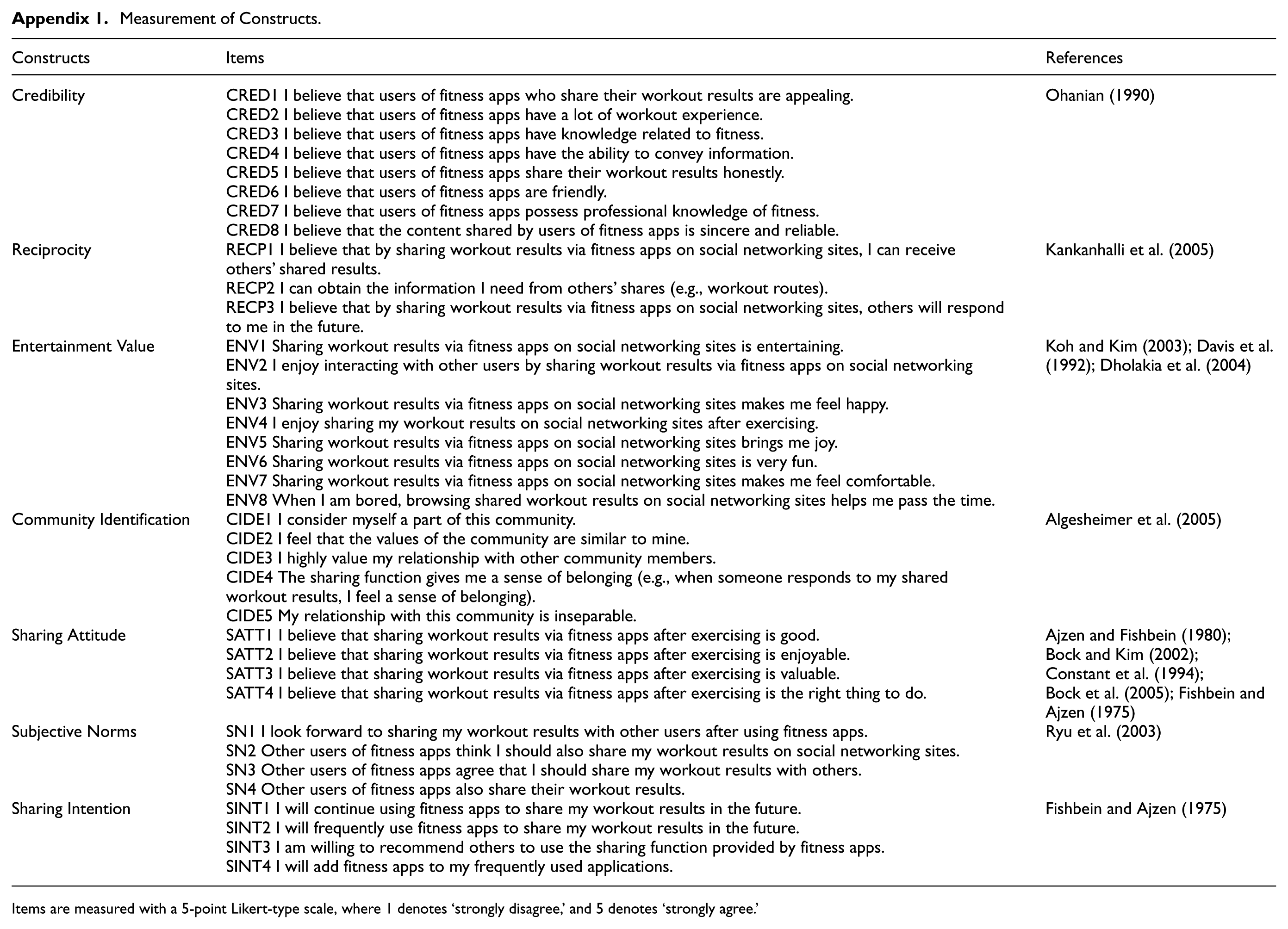
The incorporation of the MTRA into the questionnaire (see Appendix 1) consisted of incorporating the following key variables:
O Sharing Attitude: Participants’ feelings toward sharing exercise information.
O Subjective norms: The influence of peers and social expectations on sharing behavior.
O Credibility: The perceived trustworthiness of the information shared.
O Reciprocity: The expectation of mutual sharing within the community.
O Entertainment value: The enjoyment derived from sharing and engaging with content.
O Community identification: Participants’ perception of being a part of the community.
O Sharing intention: Participants’ feelings toward sharing their exercise details..
Sample and Procedures
Participants were recruited using a convenience sampling approach tailored to the study’s objective of targeting individuals with dual experience in using fitness apps and social networking platforms. A total of 423 questionnaires were collected, with 408 valid responses after excluding incomplete answers, non-users of sports apps, and those without SNS experience. Participation was voluntary, and no identifying information was collected.
At physical events, recruitment was conducted across five major urban locations to ensure geographic diversity. Events were selected to capture a range of fitness engagement levels—from casual runners at local park runs to amateur athletes participating in city-organized road races. Onsite recruitment was facilitated by trained data collectors who provided information sheets and obtained verbal consent prior to questionnaire completion. For the online component, community administrators were contacted for permission to post survey links in relevant forums. Filter questions at the start of the survey were used to confirm that participants had current or recent experience using both fitness applications and social media platforms.
While convenience sampling was used due to practical constraints, efforts were made to ensure that the sample represented a diverse group of sports app and SNS users, enhancing the relevance of the findings. Prior studies, such as Chu and Kim (2011) and Hair et al. (2014), support the use of convenience sampling in SNS research and SEM. This study builds on that foundation by using a more diverse sample to enhance generalizability and real-world applicability.
The questionnaire design followed a Literature-Based Questionnaire Design method, extracting validated items from existing literature and empirical studies to ensure a strong academic basis and enhance content validity. In addition, a pilot test was conducted on a similar population to check the clarity of the questionnaire items and instructions. More details about the pilot test are described in Section 4.2.
Operational Definitions of Research Variables and Measurement Items
The questionnaire items were based on relevant past literature and adjusted based on the research context to ensure validity. Seven dimensions were covered by adopting a 5-point Likert scale, ranging from strongly disagree (1 point) to strongly agree (5 points). The specific items for each research variable are listed in Appendix 1.
Ethical Considerations
This study involved a low-risk, anonymous questionnaire survey, all participants provided informed consent prior to completing the survey, either verbally (in person) or by ticking a consent checkbox online. No personally identifiable information was collected, and all responses were anonymized at the point of data entry. Recruitment through online communities was conducted only with the permission of group administrators, and all participants were informed about the voluntary and confidential nature of the study.
Data Analysis
Respondents’ Demographics
The respondents’ socio-demographic information is shown in Table 1. Male respondents accounted for 59.3%, while female respondents comprised 40.7%. The majority of respondents were between 31 and 40 years old, which comprised 43.6% of the sample, followed by those aged 21 to 30, who accounted for 27.9%. In terms of educational background, 46.8% of the respondents held a university degree, followed by 27% with a postgraduate degree or higher. Regarding occupation, the largest proportion of respondents worked in the service industry, representing 23%, followed by 18.9% in the manufacturing sector. As for experience using sports apps, 27.5% had used them for less than 3 months, while 19.1% had used them for 6 months to 1 year. Additionally, 29.2% of respondents used SNS for more than 6 hr per week. The most commonly used sports app was Nike+Running, with 52.5% of respondents reporting its use.
Respondents’ Demographics.

Model Diagnostics
A pilot test with 30 sports app users was conducted to ensure the questionnaire validity. Based on the results, items with lower correlation coefficients to the total score were deleted, along with items with a Cronbach’s α value below .7, as well as those with lower factor loadings in the exploratory factor analysis.
Revised Measurement Model Analysis
The measurement model analysis results for assessing the reliability and validity of the questionnaire are shown in Table 2. In terms of reliability, the composite reliability of latent variables, derived from the reliability of all observed variables, should exceed 0.7 (Bagozzi & Yi, 1988). As shown in Table 2, the composite reliability of each dimension exceeds 0.75, indicating that the seven dimensions in this study exhibit good internal consistency.
Measurement Scale and Model Fit Indices.

Note. CR = composite reliability; AVE = average variance extracted; GFI = Goodness-of-fit index; AGFI = adjusted NFI = normal fit index; NNFI = non-normal fit index; CFI = comparison fit index; RMSEA = root mean-square error of approximation; RMR = root mean-square residual; SRMR = standardized root mean-square residual.
For the validity assessment, both convergent and discriminant validity were evaluated. First, in the confirmatory factor analysis (Yang et al., 2004), after removing unsuitable items, the factor loadings of the remaining 25 items ranged from 0.66 to 0.88, all exceeding the acceptable threshold of 0.5 (Hair et al., 2010). Additionally, the t-values for all factor loadings exceeded 1.96, reaching significance at the level of p < .05, indicating that the dimensions had good convergent validity (Anderson & Gerbing, 1988). Another method for assessing convergent validity is the average variance extracted (AVE), which represents the explanatory power of each measurement variable on the latent variables and should exceed 0.5 (Bagozzi & Yi, 1988). According to the results in Table 3, the AVE of all dimensions exceeds 0.54, further supporting the good convergent validity of each dimension.
Results of Discriminant Validity.
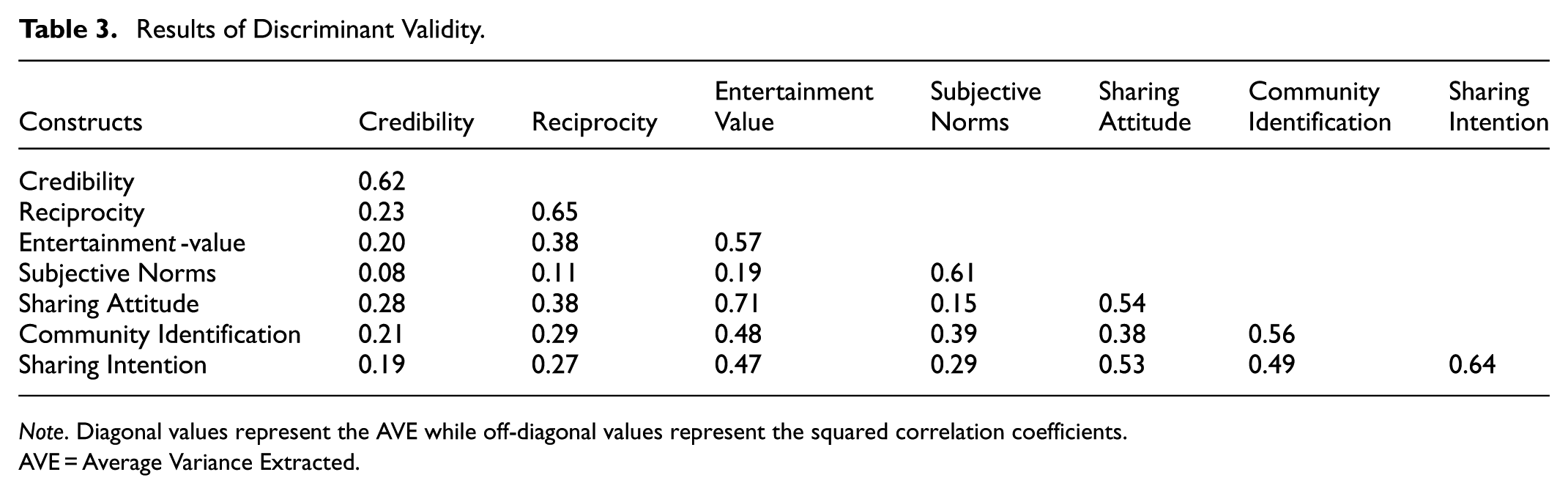
Note. Diagonal values represent the AVE while off-diagonal values represent the squared correlation coefficients.
AVE = Average Variance Extracted.
The data in Table 3 show that the square root of the AVE for each dimension (on the diagonal) is greater than the correlation coefficients to its left and below, which largely meets the standard proposed by Fornell and Larcker (1981)—that the square root of the AVE should be greater than the inter-construct correlations. Most dimensions conform to this standard, with only the discriminant validity between entertainment value and sharing attitude being slightly lower. However, the overall validity is still acceptable because all dimensions exhibit good convergent validity.
Structural Equation Model Analysis and Hypothesis Testing
Goodness-of-Fit of the Structural Equation Model
This study used a SEM analysis to test the research hypotheses. We evaluated the fit between the theoretical structure and the hypothesized model through the goodness-of-fit. Hair et al. (2010) suggested that the Chi-squared value divided by the degrees of freedom should be less than 3; the root mean square residual (RMR) should be lower than 0.05; and the normed fit index (NFI) and the non-normed fit index (NNFI) should both be greater than 0.9. Browne and Cudeck (1993) recommended that the root mean square error of approximation (RMSEA) should fall between 0.05 and 0.08; the comparative fit index (CFI) should be greater than 0.9; and the standardized root mean square residual (SRMR) should be below 0.08. According to the fit indices of this study (Table 4), the ratio of Chi-squared value to the degrees of freedom is 2.55; the goodness-of-fit index (GFI) is 0.9; the adjusted goodness-of-fit index (AGFI) is 0.86; the NFI is 0.97; the NNFI is 0.98; the CFI is 0.98; the RMSEA is 0.059; the RMR is 0.055; and the SRMR is 0.086. Although the RMR and the SRMR were slightly higher than the recommended values, all other indices met the standards suggested by relevant scholars. Therefore, the overall goodness-of-fit of the SEM in this study is acceptable.
Direct Effects, Indirect Effects, and Total Effects Between Latent Variables.

Note.*p < .05, **p < .01, ***p < .001.
Analysis of Effects
This study further examined the direct, indirect, and total effects between latent variables, with the results shown in Table 4. The theoretical framework of this study hypothesized that credibility, reciprocity, and entertainment value positively influence users’ sharing attitudes and community identification, consequently affecting subjective norms and sharing intentions. According to the data in Table 5, the most direct, indirect, and total effects between the latent variables are statistically significant. Specifically, the direct effects of credibility, reciprocity, and entertainment value on community identification were 0.158, 0.130, and 0.541, respectively, reaching significant levels (p < .01, p < .05, and p < .001). Additionally, their indirect effects on subjective norms are 0.098, 0.081 (p < .01), and 0.337 (p < .001), showing that community identification and subjective norms mediate the relationships between credibility, reciprocity, entertainment value, and sharing intentions. Similarly, the direct effects of credibility, reciprocity, and entertainment value on sharing attitudes are 0.154, 0.113, and 0.704, respectively, also reaching significant levels (p < .01, p < .05, and p < .001) and indicating that sharing attitudes mediate the relationships between these variables and sharing intentions.
Path Coefficients of the Theoretical Structural Model and Hypothesis Testing.

Note.*p < .05 (t ≥ 1.96), **p < .01 (t ≥ 2.58), ***p < .001(t ≥ 3.29).
Hypothesis Testing
The hypothesis testing for this study is explained below. First, the path coefficient for credibility affecting sharing attitude is 0.15, with a t-value of 3.08 and a significance level of p < .01. This positive relationship shows that credibility has a significant positive influence on sharing attitude, supporting H1. The path coefficient for credibility affecting community identification is 0.16, with a t-value of 2.81 and a significance level of p < .01, indicating a positive relationship and supporting H2, showing that credibility also has a significant positive influence on community identification.
The path coefficient for reciprocity affecting sharing attitude is 0.11, with a t-value of 2.02 and a significance level of p < .05. This positive relationship shows that reciprocity has a significant positive influence on sharing attitude, supporting H3. The path coefficient for reciprocity affecting community identification is 0.13, with a t-value of 2.04 and a significance level of p < .05, also showing a positive relationship and supporting H4.
The path coefficient for entertainment value affecting sharing attitude is 0.70, with a t-value of 9.08 and a significance level of p < .001, indicating a strong positive relationship and supporting H5. The path coefficient for entertainment value affecting community identification is 0.54, with a t-value of 7.34 and a significance level of p < .001, showing a positive relationship and supporting H6.
The path coefficient for community identification affecting subjective norms is 0.62, with a t-value of 10.28 and a significance level of p < .001, showing a positive relationship and supporting H7. The path coefficient for subjective norms affecting sharing intention is 0.16, with a t-value of 2.88 and a significance level of p < .01, showing a positive relationship and supporting H8. The path coefficient for sharing attitude affecting sharing intention is 0.48, with a t-value of 6.99 and a significance level of p < .001, showing a positive relationship and supporting H9.
The results of the related tests are summarized in Table 5. The standardized parameter estimates for the study are shown in Figure 2. Regarding the explanatory power of the latent dependent variables, based on the R2 values, the thresholds of 0.02, 0.13, and 0.26 can be used to judge low, medium, and high predictive capabilities of the model, respectively (Chen, 2018). Except for the R2 of subjective norms, which is .389, the R2 values for sharing attitude, community identification, and sharing intention all exceed .5, indicating that the explanatory power of this model is good.

Standardized Parameter Estimates of the Research Framework.
Examination of the Mediating Effects
This study further examined the mediating effects of “sharing attitude,”“community identification,” and “subjective norms” within the model (Table 6). Sharing attitude fully mediates the direct effect of credibility on sharing intention (Model 1). However, there are partial direct effects in the influence of reciprocity, entertainment value, and community identification on sharing intention (Models 2, 3, and 7).
Test of Mediation Effects.
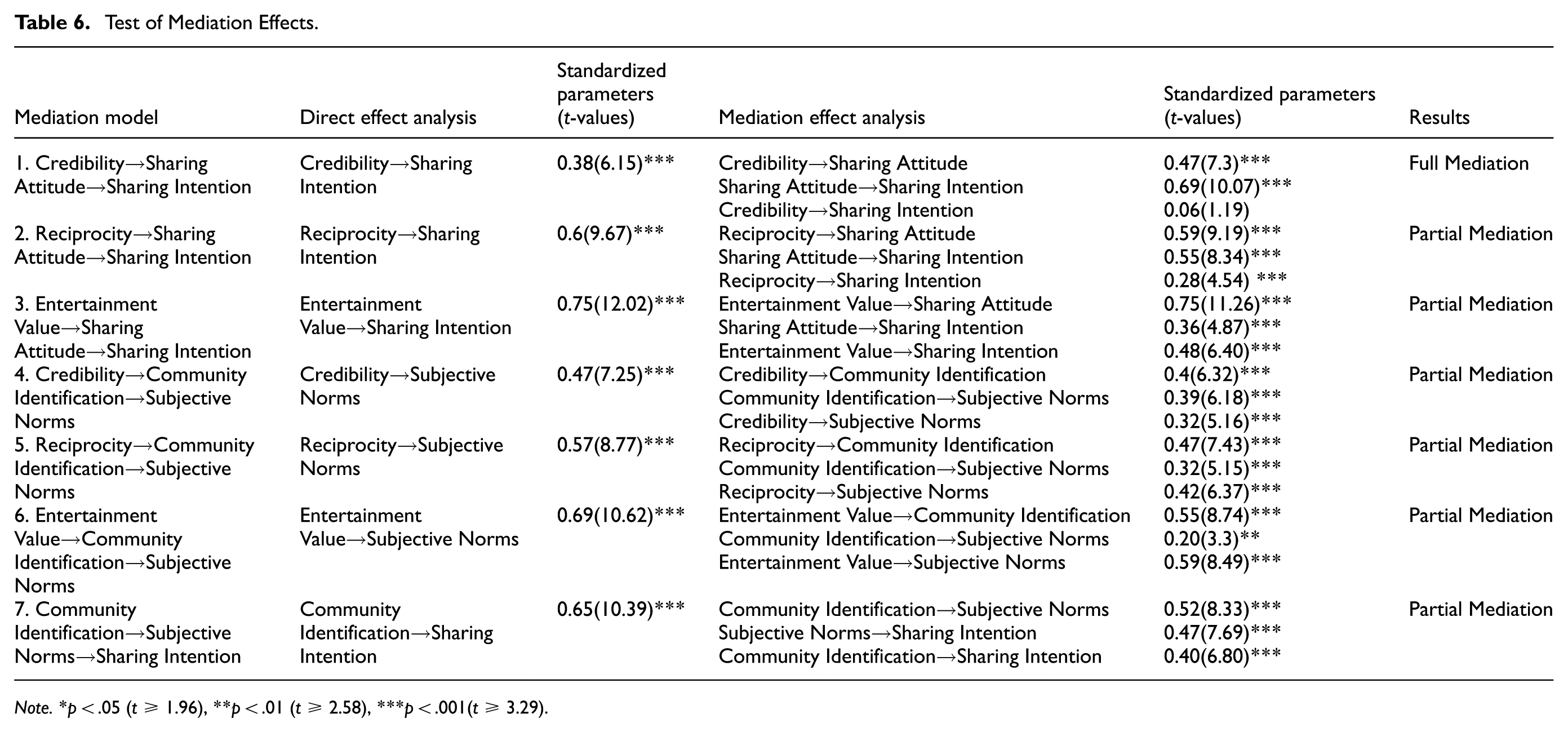
Note.*p < .05 (t ≥ 1.96), **p < .01 (t ≥ 2.58), ***p < .001(t ≥ 3.29).
Specifically, Model 1 indicates that sharing attitude fully mediates the direct effect of credibility on sharing intention. Model 2 shows that sharing attitude partially mediates the direct effect of reciprocity on sharing intention. Model 3 demonstrates that sharing attitude also partially mediates the direct effect of entertainment value on sharing intention. Model 5 indicates that community identification partially mediates the direct effect of reciprocity on subjective norms. Finally, Model 7 shows that subjective norms partially mediate the direct effect of community identification on sharing intention. Therefore, the results of these mediating effects support H8.
Discussion
This study explored the willingness of individuals to share their exercise achievements on SNS using exercise apps, with sharing attitude, community identification, and subjective norms as the mediating variables.
Credibility, Reciprocity, and Entertainment Value Positively Influence Sharing Attitude
The findings reveal that users’ perceptions of high credibility, reciprocal relationships, and entertainment value in content shared through exercise apps significantly enhance their sharing attitudes. Trust within the user community fosters a greater inclination to share personal exercise achievements, tips, and routes. This trust not only legitimizes the credibility of the shared content but also deepens engagement by creating a reliable and supportive environment. Through integrated online sharing features, users disseminate running routes, fitness milestones, and exercise records on social platforms, receiving praise and encouragement from others. These interactions generate emotional satisfaction and amplify the social and hedonic rewards of exercising, transforming solitary workouts into socially enriched experiences. Consequently, the entertainment value associated with these social interactions substantially strengthens users’ attitudes toward sharing and increases their willingness to engage in further sharing behavior.
While previous research has primarily emphasized the influence of social interaction and reciprocity on sharing behavior (Pai & Tsai, 2016; Wasko & Faraj, 2000), the current study highlights entertainment value as a critical and previously underappreciated determinant. Koh et al. (2003) acknowledged the role of entertainment in online environments but did not explore its significance in shaping sharing attitudes. This study advances that conversation by demonstrating that entertainment is not merely a by-product of social media use but a primary motivator for sharing within exercise-focused communities.
The findings are consistent with prior work emphasizing the role of trust in facilitating information sharing (Cheung & To, 2017; Nahapiet & Ghoshal, 1998). However, this study adds that in the context of exercise apps, trust also contributes to a more enjoyable user experience, thereby strengthening the emotional underpinnings of sharing motivation. This builds upon the work of McKnight and Kacmar (2007), who linked information credibility to user trust, by showing that trust can enhance not only perceived reliability but also the emotional engagement that underlies repeated sharing.
In contrast to traditional knowledge-sharing research, which often focuses on rational, utilitarian motivations such as information exchange or self-presentation, this study foregrounds the role of emotional and social gratification. Obrenovic et al. (2020) demonstrated that knowledge sharing can be driven by enjoyment; our findings reinforce this by emphasizing that, in the exercise app context, the entertainment value associated with sharing significantly boosts sharing attitudes.
Furthermore, the findings are situated within the broader social dynamics of digital fitness communities, which foster a strong sense of belonging and identity among users. Previous research has shown that community identification—fueled by shared goals like fitness tracking or challenge participation—promotes sustained engagement, mutual accountability, and content sharing (Liao et al., 2023; Zhao et al., 2012). When users perceive alignment between personal fitness goals and community objectives, they are more likely to engage in behaviors that reinforce group identity and social norms (Fiedler & Sarstedt, 2014). This creates a virtuous cycle of visibility, feedback, and social reinforcement, further encouraging users to remain active in app-based communities.
In sum, this study contributes to the literature by emphasizing the pivotal role of entertainment value—alongside trust and reciprocity—in shaping sharing attitudes within exercise apps. Unlike traditional frameworks focused on rational utility, this work highlights emotional gratification and community interaction as essential motivators for digital sharing behavior, offering a more holistic understanding of user engagement in health and fitness technologies.
Credibility, Reciprocity, and Entertainment Value Positively Influence Community Identification
The findings of this study reveal that when exercise app users perceive the content they encounter and share as credible, reciprocal, and entertaining, their sense of community identification significantly increases. This supports the premise that in digital fitness communities—especially those mediated through SNS—community identification is shaped not only by cognitive and informational factors but also by emotional and relational experiences.
Credibility plays a foundational role in fostering trust and social bonds in virtual environments, where users often interact with unknown individuals. This aligns with Koranteng et al. (2023), who emphasized that trust and credibility mitigate uncertainty in digital communities, enhancing users’ identification with the group. When users believe that shared content—such as exercise metrics, achievements, or advice—is reliable and authentic, they are more likely to develop a deeper psychological connection with the community.
Reciprocity also emerged as a critical enabler of community identification. Users who receive responses—likes, comments, or shared experiences—after posting their own exercise results experience a social exchange that reinforces mutual support. This mirrors the findings of Wasko and Faraj (2000), who identified reciprocity as a central mechanism for community trust and cohesion. Additionally, Pan et al. (2014) highlighted that participation in knowledge-sharing leads to a heightened sense of belonging, which this study confirms within fitness app-based communities. Importantly, reciprocity was observed to be dynamic and evolving through continued engagement—a nuance not extensively addressed in earlier literature but critical in understanding sustained community involvement.
Furthermore, the study sheds light on the often-understudied role of entertainment value in strengthening community identification. While past research (e.g., Koh et al., 2003) acknowledged that entertainment can enhance user engagement, its direct influence on community identification was underexplored. This study bridges that gap by demonstrating that enjoyable experiences—arising from social interactions, playful competition, or celebratory feedback—contribute meaningfully to users’ emotional connection to the community. Ko et al. (2016) similarly noted that fun, interactive elements in digital environments support ongoing participation and identity formation.
This perspective is supported by previous findings that trust (Hsu et al., 2012; Nahapiet & Ghoshal, 1998; Sahharon et al., 2023) and reciprocity (Chiu et al., 2006; Wu & Kuang, 2021) are critical in community-building. However, this study extends existing models by highlighting entertainment as an equally important emotional driver. By identifying the combined influence of credibility, reciprocity, and entertainment value on community identification, this research provides a more holistic framework for understanding engagement in fitness-related SNS communities.
In summary, the study advances existing theoretical discussions by integrating emotional and experiential dimensions—particularly entertainment—into the understanding of community identification. These insights not only reinforce the roles of trust and reciprocity found in earlier studies but also introduce a fresh perspective on how enjoyment and playful engagement shape users’ sense of belonging in digital fitness ecosystems.
Community Identification Positively Influences Subjective Norms, and Subjective Norms Positively Influence Sharing Intention
This study found that an increased sense of community identification significantly enhances users’ subjective norms, which, in turn, positively influence their sharing intentions. When individuals strongly identify with a digital community—such as those formed around exercise apps—they are more likely to internalize group expectations and adopt shared behaviors. For example, users who feel connected to others through app-based fitness groups are more inclined to participate in social sharing, particularly during events like running races, where sharing performance metrics (e.g., race results) becomes a socially expected norm. As community membership expands and members engage in similar activities, these behaviors form a collective culture that normalizes exercise-related content sharing.
These findings align with Tsai and Bagozzi (2014), who reported that users with a strong sense of community internalize group norms, which directly shape their intention to share. Similarly, Cheung and Lee (2010) emphasized that subjective norms in online communities increase perceived social pressure to contribute. Liu et al. (2024) further supported this by showing that in fitness app environments, shared goals and a sense of belonging strongly influence engagement and information-sharing behavior, reinforcing the development of collective behaviors and expectations.
While prior research has consistently emphasized reciprocity as a key driver of knowledge sharing and community identification (Wasko & Faraj, 2000), this study offers a nuanced perspective. Although reciprocity was found to play a meaningful role, entertainment value emerged as an even stronger predictor of both sharing attitudes and community identification. This extends the work of Koh et al. (2003), who acknowledged entertainment’s role in stimulating interaction but did not explore its impact on identification in depth. The present findings demonstrate that when exercise app users find enjoyment in using the platform and engaging with others, their emotional connection to the community strengthens, leading to higher levels of identification and sharing.
These insights also contribute to the theoretical advancement of the TRA. While the traditional TRA emphasizes attitude and subjective norms as central to behavioral intention (Ajzen, 1991; Fishbein & Ajzen, 1975), this study supports the value of extending the model to incorporate constructs more relevant to digital and social media contexts—specifically, credibility, reciprocity, and entertainment value. The modified TRA framework demonstrated that these variables not only shape sharing attitudes and intentions but also enhance community identification and subjective norms. This broader approach reflects the complexity of user motivation in digital fitness environments, where both rational and hedonic factors interplay to drive behavior.
Finally, the study reinforces the growing recognition that emotional experiences—particularly entertainment—are essential in fostering community participation. As Uhrich (2021) emphasized, users are motivated not only by utility or obligation but also by the enjoyment they derive from community engagement. In the context of exercise apps, the social and playful nature of interactions contributes significantly to both community identification and the willingness to share. This underscores the importance of designing app environments that not only support information exchange but also deliver enjoyable, emotionally engaging experiences that promote stronger user commitment.
Theoretical Contributions
This study extends the existing TRA theoretical framework by incorporating variables such as credibility, reciprocity, and entertainment value. First, the results show that these variables significantly affect sharing attitude and intention, with entertainment value notably enhancing users’ willingness to share. This aspect addresses a gap in the literature and enriches our understanding of behavioral intentions on SNS. Second, this study validates the mediating roles of sharing attitude and subjective norms in sharing intention. It highlights the importance of these variables in the context of exercise app sharing behavior, providing new empirical support for the behavioral sciences. Moreover, the findings contribute to a deeper understanding of the relationship between community identification and sharing intention, offering new directions and insights for future research on SNS.
The inclusion of credibility, reciprocity, and entertainment value was guided by their relevance to digital content sharing behavior. These constructs capture the psychological and social drivers of user engagement on SNS, particularly within health-related apps. Their empirical significance in this study underscores their theoretical value in extending TRA to more accurately model user intentions in online environments.
Managerial Implications
The study results can serve as practical references for managers in the field. Managers should focus on providing differentiated solutions to meet user needs, thereby gaining a competitive advantage. The managerial implications of this study are presented below.
Vertical Integration of Software and Hardware Collaboration: Enhancing Reciprocity and Entertainment Value to Improve Sharing Attitude
When users perceive that content shared through exercise apps has high reciprocity and entertainment value, their sharing attitude improves. Developers should strengthen vertical collaboration between software and hardware—for example, by providing a dynamic and engaging community platform. This would allow a large number of app users to upload and share their data through an official community space, thereby increasing their sense of achievement, generating positive feedback, and encouraging content uploads.
Developers should also organize competitions to promote user interaction and sharing, reward users who share photos on community sites, and understand the needs and behaviors of community members to provide timely and practical feedback—thus improving sharing attitudes. Additionally, regularly updating information about sports events on the community site and offering event registration reminders through the platform could be beneficial.
Apart from building community platforms, exercise app developers should consider integrating communication software such as Line or WhatsApp. These platforms have a large user base, and developers could create official accounts to provide users with the latest sports event information and utilize features like ON AIR for push notifications to keep users informed.
Furthermore, the wearable device market holds significant potential, as users increasingly prefer lightweight wearable devices. Developers should create apps that support and integrate with wearable devices, such as watches and bands, turning these apps into personal assistants that can track and monitor exercise data anytime and anywhere (Janssen et al., 2017).
Strengthening Backend Management and Offering Sports Knowledge Courses to Enhance Credibility and Improve Sharing Attitude
When users perceive high credibility in the content shared via exercise apps, their sharing attitude improves. Developers should offer well-curated, accurate digital content and integrate event information. Inviting sports experts to share insights on topics like running techniques, muscle endurance, and injury prevention, along with hosting workshops, can enhance shared information quality and credibility, encouraging sharing attitudes.
As exercise trends grow, users rely on apps to accurately track and improve performance. Developers should strengthen backend management by using GPS to precisely monitor routes, distance, speed, and altitude, and applying algorithms to calculate calorie consumption. Delivering precise data is crucial for building user trust in exercise apps.
Establishing Exclusive Member Platforms and Offering Reward Systems to Increase Reciprocity and Entertainment Value, thereby Enhancing Community Identification
Reciprocity positively affects community identification. Each community site has its own characteristics and core values (Pan et al., 2014). Exercise app users frequently share their exercise achievements or knowledge on community sites and interact with friends. If developers can regularly introduce topics and encourage users to participate in discussions, users will transition from passive receivers to active content creators. This helps increase their sense of participation and promotes information exchange, sharing, collaboration, and mutual assistance. As these topics gain popularity, they can attract users who were not previously part of the community (Pan et al., 2014). The value of platforms like Facebook lies in helping businesses grow and attract new users—not just in gaining “likes” from strangers. It is crucial to ensure that users’ friends see these shares, as sharing information not only increases the visibility of the brand but also builds its reputation.
Furthermore, the study shows that entertainment value positively affects community identification. Developers can establish exclusive reward systems for members, such as accumulating experience points or kilometers for participating in events or sharing related content on community sites. These can be converted into exercise points, which may be redeemed for various discounts offered by businesses. Exercise app users who actively participate in community activities and share content are more likely to develop a sense of community identification. For users who run daily, receiving additional rewards during exercise and sharing not only helps maintain physical health but also increases the entertainment value—further enhancing community identification and achieving dual benefits.
While this study ensured participant anonymity and adhered to ethical standards, it also highlights broader concerns around user privacy on digital fitness platforms. Sports and fitness apps often collect sensitive health, behavioral, and location data, raising ethical questions about data sharing and third-party use. App developers should implement transparent data protection policies, give users greater control over data sharing, and ensure compliance with data privacy regulations such as GDPR. Future research should further explore users’ perceptions of data security and informed digital consent.
Enhancing App Design and Social Engagement Features
Based on the identified motivational factors—credibility, reciprocity, and entertainment value—sports app developers should incorporate features that build trust (e.g., verified data badges), encourage mutual engagement (e.g., reward-based peer feedback systems), and enhance user enjoyment (e.g., gamified challenges and social leaderboards). These social mechanisms can increase user retention by fostering a sense of community and meaningful interaction among users.
Marketing Strategies Tailored to User Motivations
Marketing campaigns should align with users’ primary motivations. For example, highlighting credible performance metrics and peer testimonials can reinforce trust, while promoting user stories and interactive features can enhance perceived entertainment and reciprocity. Social media integrations and referral incentives can further amplify engagement by leveraging the social sharing of achievements and fostering reciprocal behaviors within digital communities.
Conclusion, Research Limitations, and Future Research Recommendations
This study aimed to explore individuals’ willingness to share content from exercise apps on social media platforms. Some limitations were evident despite efforts to ensure objectivity in the questionnaire design, data collection, and model framework. A key limitation of this study is the use of convenience sampling, which may limit the generalizability of the findings due to potential self-selection bias. Although efforts were made to recruit a diverse sample across locations and platforms, the absence of random sampling restricts representativeness across the broader population of fitness app users.
Second, the research design did not differentiate between the functionalities of different exercise apps, which may affect respondents’ willingness to share and their responses to the questionnaire. Future research could consider classifying different types of exercise apps to more precisely analyze their impact on sharing behavior. Additionally, because the study focused exclusively on exercise apps, the proposed framework may not be fully applicable to other app types. Further validation and adjustment are needed for applicability to other app categories.
We recommend that future researchers employ a mixed or multi-method approach, combining interviews with quantitative methods, to gain a more comprehensive understanding of the factors affecting sharing willingness. Future research could also segment users based on their frequency of app use—such as heavy, moderate, and light users—to investigate whether significant differences exist in sharing behavior under different usage contexts.
Finally, users’ ability to self-report presents a potential risk of under- or over-reporting. However, the validation of the instrument helped mitigate this risk. Overall, the results of the study provide additional insights into our understanding of sports apps and sharing intention and should be of value to sports app developers in managing social networking sites.
Footnotes
Appendix
Measurement of Constructs.
| Constructs | Items | References |
|---|---|---|
| Credibility | CRED1 I believe that users of fitness apps who share their workout results are appealing. CRED2 I believe that users of fitness apps have a lot of workout experience. CRED3 I believe that users of fitness apps have knowledge related to fitness. CRED4 I believe that users of fitness apps have the ability to convey information. CRED5 I believe that users of fitness apps share their workout results honestly. CRED6 I believe that users of fitness apps are friendly. CRED7 I believe that users of fitness apps possess professional knowledge of fitness. CRED8 I believe that the content shared by users of fitness apps is sincere and reliable. |
Ohanian (1990) |
| Reciprocity | RECP1 I believe that by sharing workout results via fitness apps on social networking sites, I can receive others’ shared results. RECP2 I can obtain the information I need from others’ shares (e.g., workout routes). RECP3 I believe that by sharing workout results via fitness apps on social networking sites, others will respond to me in the future. |
Kankanhalli et al. (2005) |
| Entertainment Value | ENV1 Sharing workout results via fitness apps on social networking sites is entertaining. ENV2 I enjoy interacting with other users by sharing workout results via fitness apps on social networking sites. ENV3 Sharing workout results via fitness apps on social networking sites makes me feel happy. ENV4 I enjoy sharing my workout results on social networking sites after exercising. ENV5 Sharing workout results via fitness apps on social networking sites brings me joy. ENV6 Sharing workout results via fitness apps on social networking sites is very fun. ENV7 Sharing workout results via fitness apps on social networking sites makes me feel comfortable. ENV8 When I am bored, browsing shared workout results on social networking sites helps me pass the time. |
Koh and Kim (2003); Davis et al. (1992); Dholakia et al. (2004) |
| Community Identification | CIDE1 I consider myself a part of this community. CIDE2 I feel that the values of the community are similar to mine. CIDE3 I highly value my relationship with other community members. CIDE4 The sharing function gives me a sense of belonging (e.g., when someone responds to my shared workout results, I feel a sense of belonging). CIDE5 My relationship with this community is inseparable. |
Algesheimer et al. (2005) |
| Sharing Attitude | SATT1 I believe that sharing workout results via fitness apps after exercising is good. SATT2 I believe that sharing workout results via fitness apps after exercising is enjoyable. SATT3 I believe that sharing workout results via fitness apps after exercising is valuable. SATT4 I believe that sharing workout results via fitness apps after exercising is the right thing to do. |
Ajzen and Fishbein (1980); Bock and Kim (2002); Constant et al. (1994); Bock et al. (2005); Fishbein and Ajzen (1975) |
| Subjective Norms | SN1 I look forward to sharing my workout results with other users after using fitness apps. SN2 Other users of fitness apps think I should also share my workout results on social networking sites. SN3 Other users of fitness apps agree that I should share my workout results with others. SN4 Other users of fitness apps also share their workout results. |
Ryu et al. (2003) |
| Sharing Intention | SINT1 I will continue using fitness apps to share my workout results in the future. SINT2 I will frequently use fitness apps to share my workout results in the future. SINT3 I am willing to recommend others to use the sharing function provided by fitness apps. SINT4 I will add fitness apps to my frequently used applications. |
Fishbein and Ajzen (1975) |
Items are measured with a 5-point Likert-type scale, where 1 denotes ‘strongly disagree,’ and 5 denotes ‘strongly agree.’
Acknowledgements
None.

Consent to Participate
Informed consent was obtained from all participants to complete the anonymous questionnaire. Before conducting the survey, we informed the participants in advance about the purpose of the questionnaire and that the survey is anonymous, ensuring that their personal information is protected.
Author Contributions
A is responsible for guiding B and C to complete the journal paper submission. B is responsible for writing Chinese papers, including introduction, literature review and development of hypotheses, research methodology, data analysis and research results, and conclusions. C is responsible for translating Chinese papers into English and modifying them into the format prescribed by the journal.
Funding
The authors received no financial support for the research, authorship, and/or publication of this article.
Declaration of Conflicting Interests
The authors declared no potential conflicts of interest with respect to the research, authorship, and/or publication of this article.
Data Availability Statement
All data generated or analyzed during this study are included in this published article.