




Abstract
This study presents the construction and validation of a formal conceptual model, or domain ontology, useful for the formal representation and analysis of conversations on heritage, memory and identity (HMI) on social network sites (SNS), of interviews with participants in such conversations, and of scholarly works engaging with such phenomena. The ontology provides for the first time a conceptual framework for HM interactions on SNS addressing the semiotic and discursive nature of such interactions in the context of cultural-historical activity theory and semiosphere theory. Part of the Connective Digital Memory in the Borderlands research project, it is developed using an evidence-based knowledge elicitation and domain modeling approach. The study presents the three components of the ontology: an event-centric core conceptual model, an inductively derived concept taxonomy, and a meta-theoretical conceptual scheme, based on a combination of conceptual analysis and lexical analysis of relevant scholarly literature. To validate the ontology, it then provides an example of how it can be used to represent an actual HMI-related SNS conversation and scholarly intervention using knowledge graphs, a quantitative analysis of the occurrence of taxonomy terms in different subfields of HMI on SNS studies, a qualitative analysis of concepts used in studies on non-professional, archeological, and institutional heritage communication on SNS, and a meta-theoretical account of studies of HMI on SNS. The ontology can be used as a framework for theorization and for the development of data models, questionnaire protocols, thematic analysis vocabularies, and analysis queries relevant to HMI on SNS research.
Introduction
Communication on social network sites (SNS) emerged recently as an important new field for practices related to heritage, memory, and identity (HMI). The meteoric rise of social media platforms such as Facebook, Instagram, Twitter, and YouTube in the 2010s made them a relevant domain of inquiry for broader research communities and fields, whose diverse epistemic orientation and theoretical arsenal becomes consequential for researchers interested in HMI practices on SNS. Research on HMI-related practices on SNS draw from diverse theorizations of material and intangible heritage in the context of heritage studies (Harrison, 2013, 2020; Kirshenblatt-Gimblett, 1995; MacDonald, 2009; Meskell, 2015; Roued-Cunliffe & Copeland, 2017; Smith, 2006; Waterton & Watson, 2015), but also from the historical field of memory studies and its recent shift toward mediated practices (Hoskins, 2018; Olick & Robbins, 1998; Roediger & Wertsch, 2008), as well from communication and media theory (Hall, 1993; Livingstone, 2005) and the focus on participation, social networking and the logic of platforms within digital media studies (Boyd, 2007; Jenkins et al., 2015; Van Dijck et al., 2018).
Several hundred publications of HMI on SNS, authored by researchers in fields as diverse as history, museum studies, communication and media studies, geography, political science, sociology, anthropology, archeology, psychology, information studies, tourism studies, and marketing, have been published in the last decade. Some scholars focus on how SNS operate on online platforms endowed with algorithmic mechanisms of datafication, commodification and selection (Van Dijck et al., 2018), and support their members with identity, presence, relationships, reputation, group membership, conversations, and content sharing functions (Kietzmann et al., 2011). Others show how HMI practices emerge in diverse contexts and institutional-community negotiations surrounding digital heritage (Cameron & Kenderdine, 2007; Drotner & Schrøder, 2013; Giaccardi, 2012; Kalay et al., 2007; Parry, 2010). More recently, Chiara Bonacchi leveraged the power of big data to demonstrate the relevance of HMI-related SNS practices in contexts such as Brexit, Donald Trump’s demonization of immigrants, and the rise of populism and nationalism in Italy (Bonacchi, 2022). At the intersection between heritage and digital social media communication, research on HMI on SNS practices addresses issues as diverse as Holocaust commemoration (Manca, 2021; Wight, 2020), the “memory wars” of Eastern and Central Europe (Rutten et al., 2013), heritage preservation (Sedlacik, 2015), community engagement with local history (Hood & Reid, 2018), archeological communication (Colley, 2014) between professionals (Richardson, 2015) and with mateur communities (Kelpsiene, 2019), institutional museum communication (Kidd, 2014), education (Charitonos et al., 2012), and marketing (Chung et al., 2014). These phenomena are distinct in their simultaneous dependence on the logic of social media platforms (Van Dijck et al., 2018), and on a process of translation across different—historical versus contemporary, scholarly and institutional versus grassroots—semiotic communities (Lotman, 1990).
This markedly transdisciplinary literature on HMI-related practices on SNS ranges from advocacy paers suggesting why SNS are useful for institutional heritage communication or community activism, to evidence-based investigations on the properties, motivations, and effects of empirically-attested SNS interactions related to HMI, including qualitative, quantitative, and mixed-methods studies. Recent systematic literature reviews account for scholarship on loosely related themes such as participation in online communities (Malinen, 2015), social media and activism (Allsop., 2016) and social media in tourism (Zarezadeh et al., 2018), or on narrower topics such as social media in museums and heritage (Vassiliadis & Belenioti, 2017), Holocaust-related social media memory and education practices (Manca, 2021), and difficult heritage on SNS (Kelpšienė et al., 2022). Yet the underlying structure of HMI on SNS, viewed both as a field of practice and a field of knowledge, is not addressed by any of these studies. To our knowledge, no published theoretical synthesis or individual study from those we examined presents a holistic conceptualization of the diverse range of manifestations, factors, motivations, causes, and effects of the particular kinds of SNS memory work which engage with heritage and involve identity construction and representation.
Processes of conceptualization and operationalization, broadly recognized as constituent parts of social research, entail the mapping of selected dimensions of objects of inquiry into structures of indicators (variabls) amenable to observation and data representation (Babbie, 2015)—in other words, the definition of the main entities and relationships that capture salient aspects of a domain of inquiry, that is, its ontology (Crotty, 1998). In this light, an ontological framework on how memory practices on social media engage with heritage and the past to shape conversations on contemporary identities and values based on an explicit conceptual model, understood as a kind of proto-theory suitable for elucidation and validation (Bates, 2005), can be useful for theory building and operationalization in the transdisciplinary field of HMI-related practices on SNS. To serve this purpose, the objective of this study is to establish, and validate, a formal conceptual model, or ontology (Guarino et al., 2009), suitable for the systematic, evidence-based representation and study of referential and discursive aspects of conversations on HMI on SNS, of interviews with participants in such conversations, and of scholarly works engaging with such phenomena.
In doing so, the study addresses the following research questions:
RQ1. What is a conceptualization of the activity structure of semiotic interactions on SNS adequate to account for their referential and discursive aspects, and how can it be expressed in the form of a core (upper and middle layer) ontology?
RQ2. What is a conceptualization of the semiotic content of HMI-related interactions on SNS adequate to account for their thematic and meta-theoretical dimensions, and how can it be expressed in the form of a concept taxonomy (constituting the lower level of the ontology)?
RQ3. How can the ontology defined in RQ1 and RQ2 be validated in the context of data constitution and systematic analysis challenges encountered in scholarly research on HMI-related semiotic practices on SNS?
Theoretical Framework
Two theoretical approaches are particularly relevant as intellectual foundations for conceptualizing HMI on SNS work, viewed as a specifically semiotic kind of mediated action. The first, cultural-historical activity theory, considers domains of social action as activity systems composed of a hierarchy of purposeful, interconnected activities, performed by individual or collective actors in the context of some division of labor; each activity is directed toward some object, that is, physical or conceptual entities which may embody the fulfillment of some actor goal, or intended to meet some actor need by means of tool mediation, involving both physical and/or cognitive mediating tools (Engeström, 1999; Leont’ev, 1978). The second, cultural semiotics, posits that cultures are communicative systems consisting of a relatively stable set of rules in tandem with an aggregate of texts that both realize these rules and have the capacity to generate them (Lotman et al., 1978), and operating within variably structured semiotic spaces, or semiospheres exhibiting processes of creolization at their boundaries (Lotman, 2005).
Both activity theory and cultural semiotics are theoretical constructs that may be represented in the form of a conceptual model. Models differ according to discipline, subject-matter, or purpose or research (Burke et al., 2011), and may range from quite informal schematizations to ontologies, defined as formal specifications of a shared conceptualization of some domain (Gruber, 1995; Guarino et al., 2009). There are, in fact, several ontologies developed to account for interactions on social media, situated, for the most part, situated in the context of either semantic web engineering social media data analytics (Mika, 2004). They are focused on providing formalisms that aid the analysis of platform connectivity structures between SNS users (Golbeck & Rothstein, 2008), sentiment analysis (Kumar & Joshi, 2017; Thakor & Sasi, 2015), influence (Razis & Anagnostopoulos, 2014), social network analysis (Pankong et al., 2012), user activities (Rosenberger et al., 2015) and product recommendations on SNS (Villanueva et al., 2016). Additionally, different ontologies draw from practical argumentation theories (e.g., Mann & Thompson, 1988; Toulmin, 1958; Walton, 2006) to account for the argumentation structure in social media conversations (for a survey, see Schneider et al., 2013). For example, SIOC (Lange et al., 2008) seeks to model argumentative discussions on SNS by incorporating the DILIGENT ontology argumentation module to model Arguments, Issues and Positions leading to some Decision by way of Challenges, Justifications and Argumentation (Tempich et al., 2005), further elaborating the influential gIBIS argumentation model (Conklin & Begeman, 1988; Shum et al., 2006). Despite specific strengths, no single ontology among these can account for the cultural-historical, meaning-laden, semiotic activity related to HMI on SNS work and scholarly investigation.
On the other hand, CIDOC CRM, also ISO standard 21127 for the integration, mediation and interchange of heterogeneous cultural heritage information (Bekiari et al., 2021) is a widely established core ontology which fits remarkably within activity theory’s interactionist orientation and relational conceptualization of activities in fundamental relationship to actors, objects, and mediating tools (Engeström, 2000). CIDOC CRM considers cultural objects from the viewpoint of events and activities, broadly defined as “meetings” between (human) actors, physical things and (often related) conceptual objects, timespans and places. In preference to alternative activity theoretical ontologies such as the CSCL collaborative learning ontology (Barros et al., 2002), CRM demonstrates a high degree of maturity, wide adoption, rigor, and extensibility. Among its formal extensions, CRMinf provides a detailed structure for representing the production of inferences and adoption of beliefs, but it is oriented toward representing the provenance of scientific knowledge in the light of scientific observation, rather than the wide range of communicative action manifested in the HMI on SMS field (Doerr et al., 2016; cf. Stead & Doerr, 2015). The earlier KP Lab Ontology aims “to support the planning, supervision, and monitoring of knowledge creation and knowledge mediation activities and their products” across heterogeneous contexts (Doerr et al., 2012), while Scholarly Ontology (Pertsas & Constantopoulos, 2017), a generalization of the NeMO digital humanities methods ontology (Hughes et al., 2015), aims to model scholarly process across disciplines. While both are closely related to CIDOC CRM, neither provides for the range and specificity of HMI on SNS. The MIDM ontology (Van Ruymbeke et al., 2018) extends CIDOC CRM to account for multiple interpretations of the same observable (archeological) reality, and introduces, usefully, an explicit distinction between “content” and “discourse,” but covers a narrower field than our domain of diverse semiotic activities related to HMI practices on SNS. In a different approach, the CHARM ontology (Gonzalez-Perez et al., 2012, p. 191), intended to provide a model for representing multiple viewpoints in heritage knowledge work, introduces the notion of valorization to makes explicit an important relationship between “primary” and “secondary” knowledge activities. While insightful, CHARM adopts a very different upper ontology layer than CIDOC CRM, and therefore it cannot benefit from its significant expressive advantages and activity-centric orientation.
Methodology
In this study, we followed an ontology engineering approach which prioritizes epistemic validity in the domain of HMI on SNS research over technical applicability for computation (Akkermans & Gordijn, 2006). To ensure that the ontology constitutes a useful and valid representation of data and knowledge in the application domain, we combined expert knowledge elicitation with formal analysis of SNS data structures, and lexical analysis. Because of its maturity, extensibility, completeness and clear documentation, we chose to adopt CIDOC CRM as the foundation for building our domain specific ontology, covering the scope of HMI on SNS semiotic practice and related scholarly activity, drawing from alternative ontologies for insights on addressing aspects of the domain that are not covered by the core CRM model.
The task of ontology building was distinguished in terms of a three-layer structure:
The upper layer, borrowed from CIDOC CRM, and providing entities and relationships that represent fundamental dimensions of physical and social reality.
The middle layer, or our core ontology, aiming to capture the conceptual structure of entities and relationships representing semiotic activity on social media, and epistemic activity in scholarly work that accounts for and is introduced to such semiotic activity.
The lower layer, accounting for more fine-grained aspects, represented as taxonomies of concepts from the perspective of heritage studies, memory studies, and social media studies.
The research workflow adopted (Table 1) represents the sequence of activities of ontology definition and validation in the study.
Ontology Building and Validation Research Workflow.

In what follows, we adopt the definitions of key concepts and terminological conventions in CIDOC CRM (Bekiari et al., 2021). CRM entity names such as E7 Activity are capitalized and prefixed by En, while CRM relationship names, such as P2 has_type, are in small letters and prefixed by Pn. Names of entities in our ontology are shown in Inner Capitalization Italics. Taxonomy terms are presented in
Ontology Definition
The following ontology aims to model semiotic activities related to SNS and their epistemic uptake in scholarly work. Its scope includes communicative activities of platform users such as posting, sharing, commenting, tagging and reacting, but also scholarly activities of researchers engaging with SNS, as well as activities linking the two domains of social media communication and scholarly work. The intellectual framework shaping the ontology draws from activity theory, and cultural semiotics.
The ontology aims to be as compatible as possible to CIDOC CRM. It does not aim, however, to be a formal extension of CIDOC CRM, but rather a specialization created for the pragmatic purposes of supporting representation, analysis, and formulation of scholarly propositions and questions in a specific domain, trading compatibility for expressiveness.
Core Ontology
Based on conceptual modeling of HMI on SNS practices, the core ontology represents entities and relationships relevant to the representation of semiotic activity on SNS and related scholarly activity (Figure 1). Ontology entities (shown capitalized in italics) are defined as equivalent classes or subclasses of CIDOC CRM entities and inherit their properties (identified by prefixes E and P). The central notion is Semiotic Activity, representing communicative or meaning-bearing activities on (or related to) SNS, and defined as a subclass of E58 Creation by adding properties for modification, type and property assignment of conceptual objects involved in SNS or related scholarly activities. A Semiotic Activity may P9 consist_of other Semiotic Activities; it can be as broad as someone’s overall communicative activity history on Facebook, and as granular as a single reaction to a Facebook post; as broad as the overall scholarly activity of a researcher, and as granular as an annotation, or identification of some property, of a single tweet. In addition, a Semiotic Activity may P134i be_continued_by additional Semiotic Activities. A Semiotic Activity may P16 use_specific_object Affordance or Tool, a subclass of E29 Design or Procedure representing some media or system affordance, corresponding to the activity-theoretical notion of mediating tool. An Affordance or Tool may P148 have_as_component some more granular Affordances or Tools, and thus may represent from the entire set of functionalities of a social media platform such as Facebook to the minimal affordance of providing a “like” button in the same platform.

Core ontology representing the main entities and relationships of semiotic and scholarly activity on SNS.
A Semiotic Activity P108 produces or P31 modifies some Expression, a subclass of E31 Document, E33 Linguistic Object, and E36 Visual Item, representing some object with a fixed, recognizable form which acts as a carrier of meaning. An Expression can have_as_component other Expressions; it can be as broad as a monograph, a Facebook message thread including comments and media, or a list of hashtag query results, and as narrow as a word in a post, an Instagram photo, or a sentence in an article. Each Expression P67 refers, P129 is_about, or P138 represents one or more instances of Meaning, a subclass of E89 Propositional Object with identifiable meaning in the form of a proposition, question, evaluation, affect, motivation, etc. An
Any Semiotic Activity is P14_carried_out_by a Person, an equivalent class to E21 Person, and may involve one or more instances of Collectivity, an equivalent class to E74 Group, through different sub-properties specializing of P11 has_participant: For example,
Finally, Concept, an equivalent class to E55 Type, accounts for characterizations of entities which do not require the definition of additional properties; each Concept may P127 have_as_broader_term some other Concept, or P150 define_typical_parts of some other Concept. Subclasses of Referent, such as Semiotic Activity, Expression, Collectivity, Meaning, Affordance or Tool, etc., may P2 have_as_type some instance from a relevant sub-hierarchy of Concept. For example, an instance of Semiotic Activity such as “retweeting” a tweet P2 has_type “disseminating,” an instance of Concept within a sub-hierarchy restricted to the characterization of Activities; on the other hand, the Expression“#idlenomore” P2 has_type “hashtag,” an instance of Concept in a sub-hierarchy identifying different formats and genres of Expression. In CIDOC CRM terms, Referent P2 has_type Concept is a shortcut (Bekiari et al., 2021, p. 21), standing in place of a more extended Activity structure. We also use shortcuts to indicate, most notably, the relationship between an Expression and its Meaning, the connection between a Person and some Collectivity, the belief some Person or Collectivity has in some Meaning, and the competence of a Collectivity in a Semiotic Code. This is to enable common operations, which correspond to established conventions in the domain of HMI on SNS research.
The ontology may be applicable to a range of semiotic activity on social media communities, to scholarly work related to such activity, and to interactions thereof. Such interactions may be seen as processes of retroduction, involved in the production of knowledge when researchers re-express the terms of some reality in theoretical terms (Bhaskar, 1979). In the broader context of semiotic activity and digital curation “in the wild” (Dallas, 2016), such processes correspond closely to the notion of translation, occurring in the boundaries between non-professional and professional semiospheres engaged in cultural HMI practices (Laužikas et al., 2018).
Concept Taxonomy
To populate the concept taxonomy, we relied on a lexical analysis of a convenience sample of 220 English language scholarly publications, including introductions to major edited volumes and textbooks, literature reviews, and synthesis studies, from four research areas: cultural heritage studies (42 items), memory—including Holocaust—studies (44 items), social media studies (93 items), and digital heritage studies (41 items). We surmised that the vocabulary of canonical works from these fields will be highly relevant to the target field of HMI on SNS studies. We used the MaxQDA software to conduct frequency analysis of words and 2 to 5 word combinations, excluding common words. We manually excluded common words, and terms occurring <5 times, added relevant terms from a broader social science vocabulary, and ended up with 953 concepts. To these, we added 196 cited author references indicating interest in the theoretical work of major authors, resulting to 1,149 terms. The high-level structure of the taxonomy (Figure 2) is organized in three facets, or domains of concepts: (a) substantive, a container for terms defining the type of core ontology entities, that is, Activity, Semiotic Activity, Collectivity, Affordance or Tool, and Expression; (b) theoretical, a container for terms defining thematic and grounded theory concepts characterizing instances of Meaning; and, (c) meta-theoretical, a container for concepts related to meta-theoretical and epistemological dimensions of Meaning.
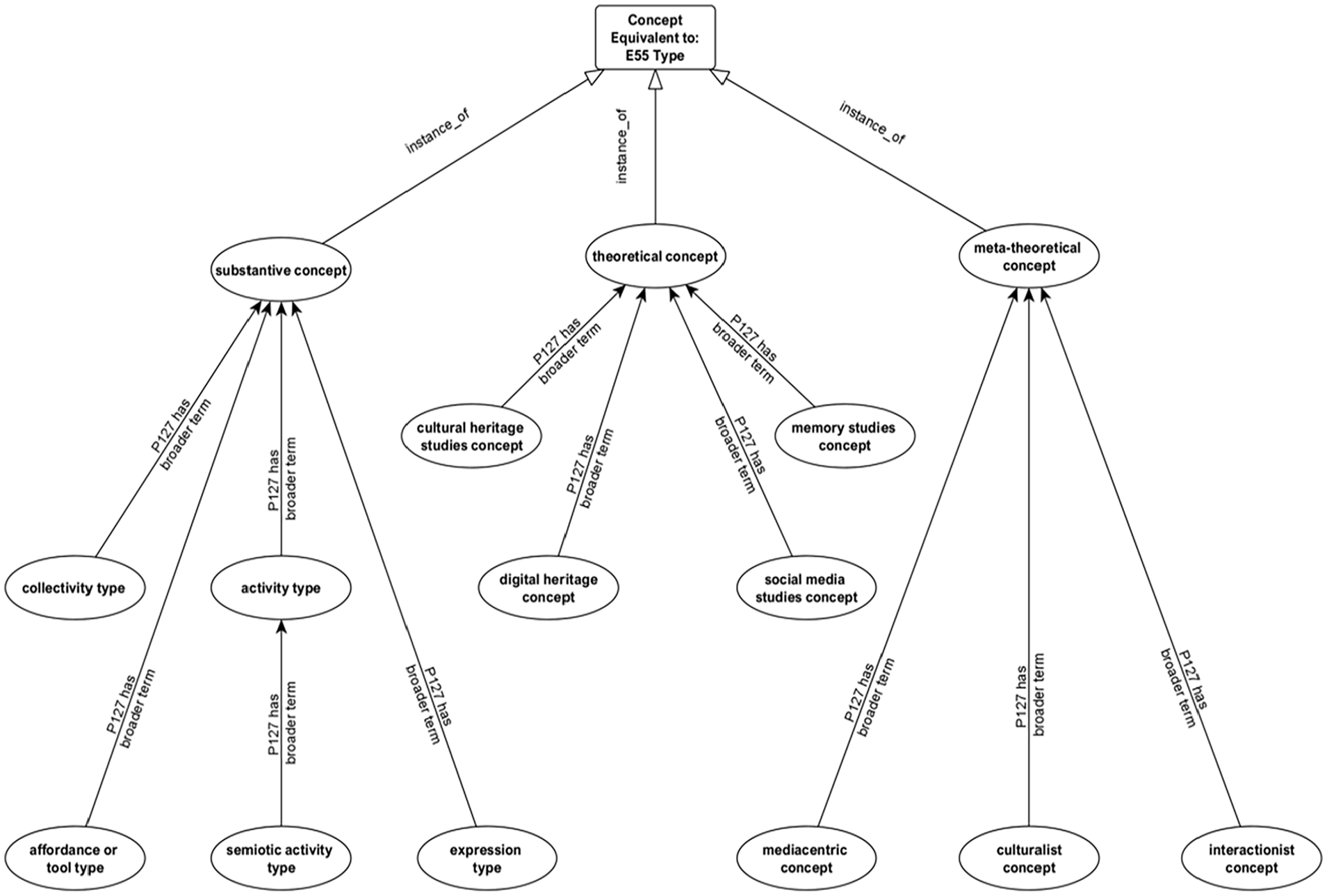
High-level structure of concept taxonomy.
This structure is well-suited to accommodate terms in our frequency analysis. Substantive taxonomy concepts as diverse as
Meta-Theoretical Dimensions
An underlying dimension within concept taxonomy terms goes beyond substantive, grounded and thematic classification, reflecting meta-theoretical orientations shared by specific thought collectives (Fleck, 1979), and providing the rationale for positing a meta-theoretical domain as part of the concept taxonomy, in addition to these substantive and theoretical domains. In this meta-theoretical domain, the SNS field of practice may be observed from three perspectives or approaches which we term mediacentric, culturalist, and interactionist.
The range of mediacentric approach is broad and heterogeneous, including strands as diverse as classic media theory (
The culturalist approach does not deny the importance of media, but avoids overemphasizing it.
Within the culturalist approach, the
The dominant notion of the
Individual and
Ontology Validation
We now turn to presenting four activities which use the ontology to address pragmatic research challenges, and thus validate it, in the target domain of HMI on SNS research.
Representing Semiotic Activity Structure
The first validation activity is intended to address the following challenge:
Challenge 1. Can the ontology be used to represent adequately instances of HMI-related semiotic and scholarly activities on SNS in practice?
Two knowledge graphs, based on the core ontology, are produced to address this question. The first instance (Figure 3) concerns a Facebook group conversation on the June 1941 Uprising in Lithuania. In this case, Peter (Person) reads (Semiotic Activity) a post (Expression) related to the 80th anniversary of the June uprising in Lithuania. The Person who carried_out the Semiotic Activity which produced this Expression represents the Uprising as an honorable action. But Peter, who belongs to the Liberal political party (Collectivity), employs a liberalist Semiotic Code) to decode the SNS message differently from the author. Peter evaluates (Semiotic Activity) the opinion of the post’s author as wrong (Meaning), and posts (Semiotic Activity) a comment (Expression) on the original post.

Knowledge graph representing a Facebook conversation on contested heritage.
The second knowledge graph (Figure 4) addresses a more complex semiotic interaction, whereby a scholar uses SNS data as evidence to understanding online communities. Simon and Peter are members of different communities (Collectivities): Peter, in particular, belongs to a community of researchers studying contested heritage and memory (Collectivity). He uses SNS conversations (Expressions) as evidence for understanding Lithuanian commemorative communities. Peter’s premise (a Meaning) is that SNS posts and comments (Expressions) exemplify different Collectivities related to diverse history- and heritage-based ideologies (Meanings) and modes of understanding the past (Semiotic Codes). Peter collects and analyzes (Semiotic activities) SNS conversations (Expressions) using established scholarly theories (Semiotic Codes, Meanings), and, on this basis, describes and provides explanations (Semiotic Activity) for research findings in the form of scholarly publications (Expression).
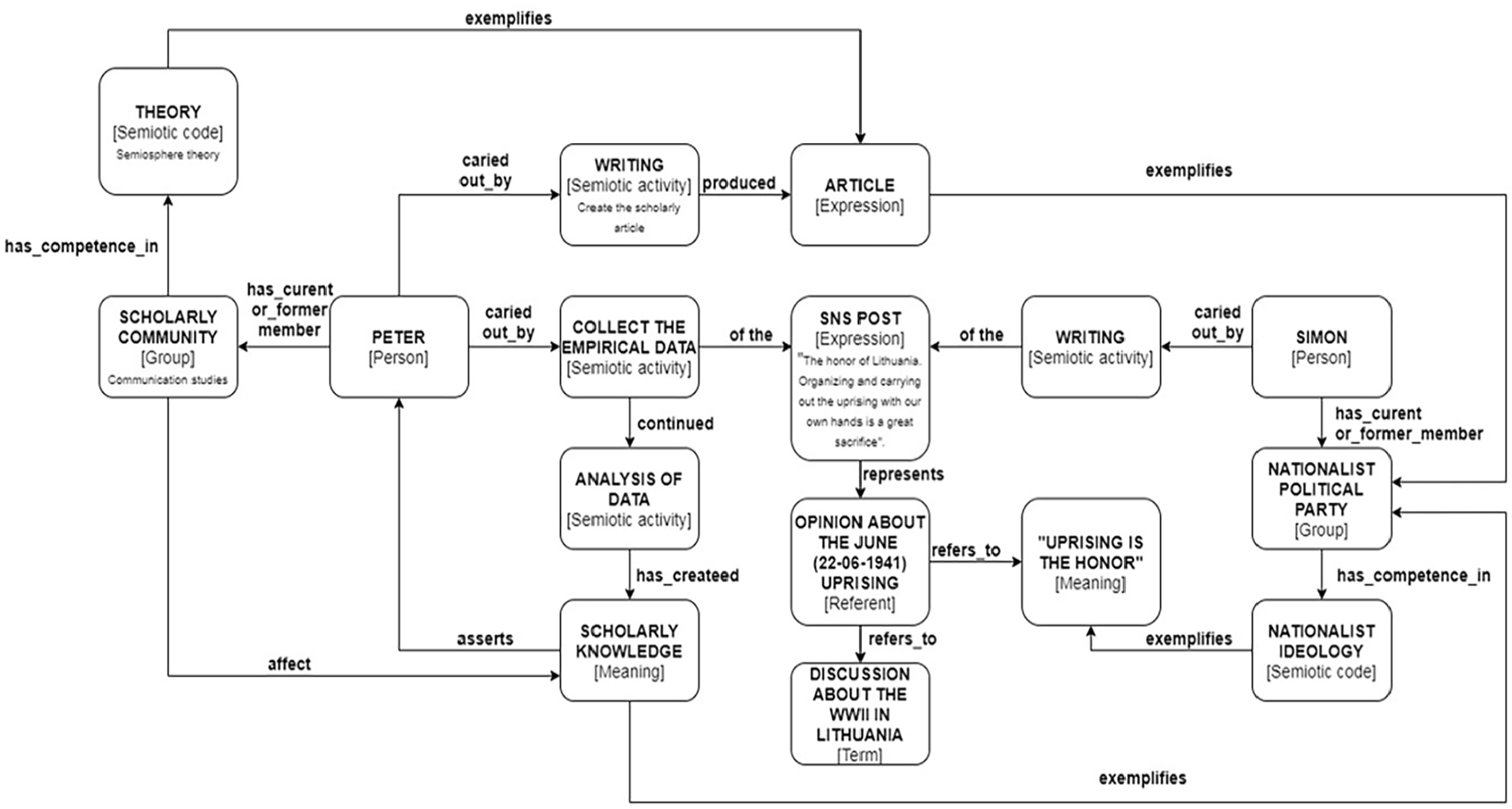
Knowledge graph representing scholarly engagement with the Facebook conversation of Figure 3.
Knowledge graphs based on our ontology may be used to model knowledge creation processes (use, reuse, interchange) across HMI studies and social media scholarship to account for HMI-related SNS practice. The process bridges professional scholarly knowledge work to non-professional HMI practices (Semiotic Activities) involving researchers and SNS users (Actors) who are members of different scholarly and grassroots communities (Collectivities). It can account also for an inverse semiotic practice of translation between scholarly and vernacular (non-professional) knowledge, showing how Meanings in HMI and SNS scholarship expressed in scholarly publications using scholarly language (Semiotic Code) may be translated to vernacular Expressions employing non-professional “languages” (Semiotic Codes), through interpretive Semiotic Activities involving the (re)use of pre-existing information and knowledge, and leading to the creation of new information and knowledge. Such processes, shared by non-professional community members participating in HMI practices, involve existing community knowledge, conceived as schemata of Meanings communicated through Expressions made intelligible through a Semiotic Code, which act as organizing frames to: (a) filter and reject scholarly knowledge unacceptable to the community; and, (b) interpret filtered scholarly knowledge to create expressions understandable among community members. These organizing structures are fundamental to the construction of identities, represented, in terms of our ontology, as ego-networks connecting a community (Collectivity) with a “language” (Semiotic Code) shared by its members (Persons), SNS actions (Semiotic Activities) it engages with, messages (Expressions) produced by such activities, and new non-professional “knowledge” (Meanings) resulting from them. This process is conditioned by knowledge-related needs, motives, goals and aspirations (Meanings) of the members of the community, also by the algorithmic capabilities of social media platforms (Affordances and Tools).
Frequency Analysis of Concepts in Scholarly Literature
The second challenge addresses the applicability of the concept taxonomy:
Challenge 2. How can we use the ontology to make sense of the most relevant concepts employed by researchers for the study of different subfields of heritage-related SNS activity?
To address this question, we performed a frequency analysis of concept taxonomy terms in six subfields of HMI practice on SNS literature: (a) Holocaust on SNS, (b) difficult heritage on SNS, (c) memory and identity on SNS, (d) non-professional grassroots communities on SNS, I archeological professional communities on SNS, and (f) museum, institutional, and tourism communication on SNS (Table 2).
Thematic Subfield, Count and Method of Selection of Publications in Corpus of Literature on Heritage, Memory and Identity Practice on SNS.

Corpus documents were imported to MaxQDA, and autocoding was performed using a term dictionary containing all concepts and author names in the taxonomy. Codings for common proper names, and ambiguous terms, were checked manually and false positives removed. We performed a frequency analysis of term occurrence and calculated the range and variance of occurrences of each term across documents. The analysis yielded 44 concepts appearing in at least 50% of all documents, deemed to be shared, and characteristic of the whole corpus (Figure 5).

Frequent concepts (total occurrences >100) with the least variance across subfields.
Terms from the concept hierarchy (Figure 2) appearing equally often across different literature subfields include
To identify how concept frequency differs across subfields (Table 1), we calculated separately the frequencies and produced wordcloud diagrams representing up to 100 most frequent concepts in publications within each subfield, excluding terms that occurred less that 10 times on average per document (Figures 6–11).

Most frequent concepts in Holocaust on SNS publications.
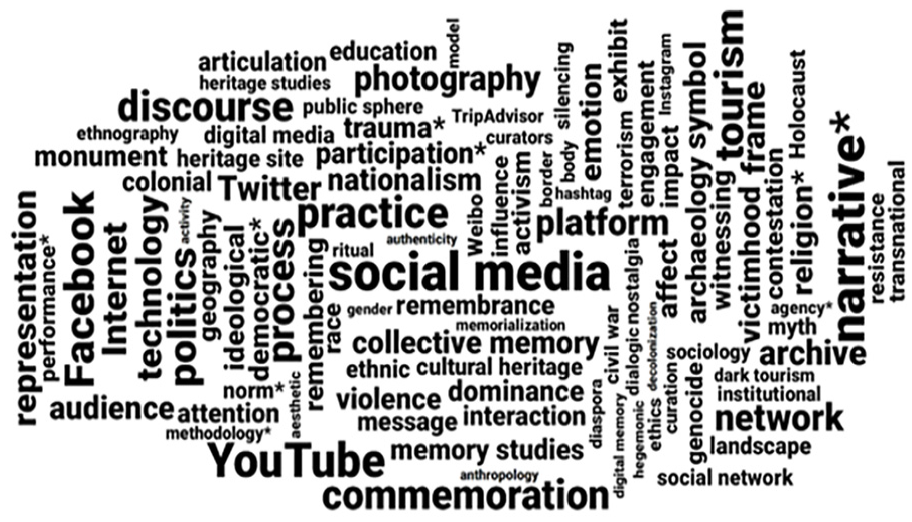
Most frequently mentioned concepts in difficult heritage on SNS publications.
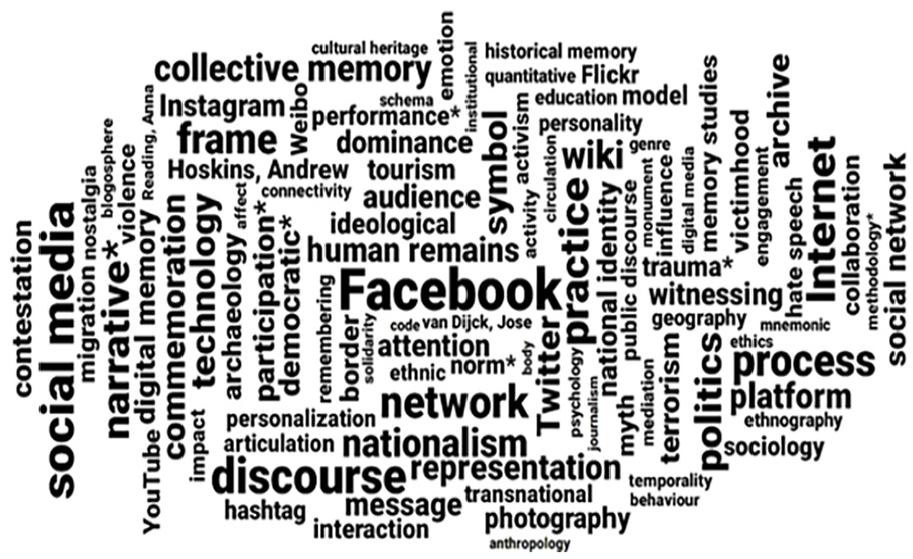
Most frequent concepts in memory and identity on SNS publications.
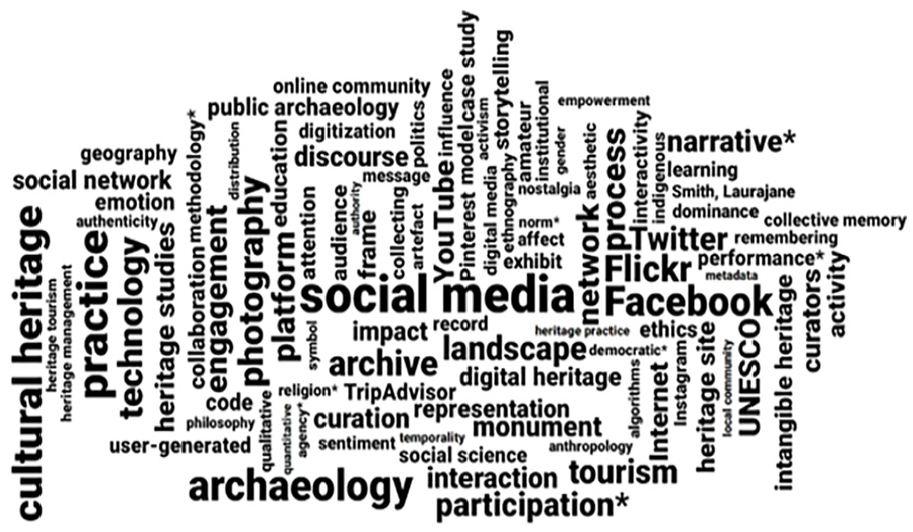
Most frequent concepts in non-professional communities on SNS publications.
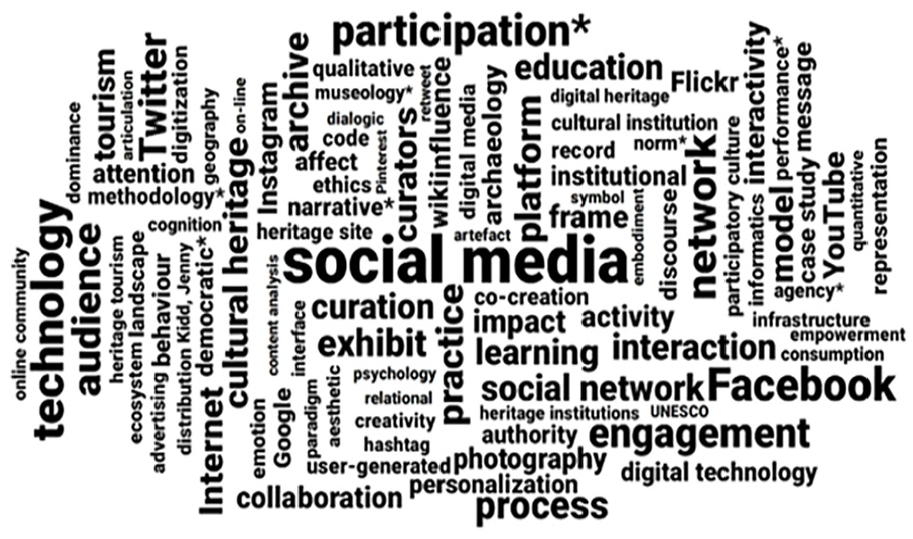
Most frequent concepts in institutional communication on SNS publications.

Most frequent concepts in archeological communities on SNS publications.
Some substantive concepts are unevenly distributed between subfields. Among affordance or tool types,
Taxonomy Concepts in Scholarly Discourse
The third challenge aims to address the following question:
Challenge 3. To what extent are taxonomy concepts represented in the scholarly discourse of studies of heritage-related communities and institutional communication on SNS?
Much of the literature on cultural heritage in SNS focuses on institutional and professional heritage communication, concerned with the creation of a successful social media strategy that could foster meaningful
Most studies focusing on SNS heritage communication concern museums, which were first to recognize the potential of social media to attract
SNS are popular platforms among archivists, because, like blogging and wiki sites, it provides an easy way for the creation of a virtual archive (Garaba, 2012; Theimer, 2010). However, some
In fields of professional practice such as
The importance of community participation and public action in cultural heritage was emphasized in the Faro convention (Zagato, 2015), whereas public engagement was thought to generate a new kind of heritage from below, defined as
The complex interconnections between professional and
Meta-Theoretical Dimensions of Difficult Heritage on SNS Scholarship
The fourth challenge to validate the ontological framework presented in this study is:
Challenge 4. Can a meta-theoretical classification of studies of difficult HMI on SNS emerge from concepts and authors they refer to?
The mediacentric, culturalist and interactionist meta-theoretical approaches can be traced in difficult HMI on SNS literature.
The mediacentric approach is of rather lesser importance, Often, media representations of heritage are characterized as
The most widespread concept is
The culturalist approach is particularly visible in the popularity of the concept of
Unsurprisingly, memory is often analyzed and defined in culturalist terms, through concepts such as memory of events, place memory, collective cultural forgetting, memory and collective identity, performative memory, and remembering. Several scholars focus on a social rather than individual perspective, drawing from concepts coined by the classics in the field,
Memory practices on SNS are perceived by culturalists as ways to deal with institutional forgetting, to sustain officially
The interactionist approach is manifested in discussions of
Interactionist and culturalist approaches are not mutually exclusive in difficult HMI on SNS scholarship. In some areas they converge, while in others they stand in dialectical tension. Convergence may be spotted in the concept of public defined, following
Conversely, psychology-based research paradigms focusing on
Discussion
In this study, we defined an ontology for semiotic and scholarly activity on SNS, addressing the needs for scholarly research in the narrower field of HMI while staying as closely as possible to the CIDOC CRM ontology (Bekiari et al., 2021). CIDOC CRM’s upper ontology is suitable for our event-centric conceptualization, which puts Semiotic Activity in the center, connected to some Person as subject of the activity and some Group as its recipient, and producing some Message and assigning it some Meaning while employing pre-existing Meanings, while employing some Affordance or Tool and observing some Semiotic Code (Figure 1). We therefore go beyond social media ontologies we consulted, by addressing semiotic aspects of user activity on SNS, and scholarly activities which address such SNS user activity.
Some additional aspects of our ontology where we diverge, extend, or specialize CIDOC CRM warrant consideration. Firstly, to ground the ontology and make it applicable in the specific field of scholarly research about HMI on SNS, we defined its lower layer as a taxonomy of Concepts, providing extensible vocabularies for categorization of Semiotic Activities, Collectivities, Affordances or Tools, Expressions, and a variety of Meanings established in the context of cultural heritage, digital heritage, social media, and memory and identity discourses (Figure 2). Secondly, we grounded the ontology and taxonomy work on a conceptualization of mediacentric, culturalist and interactionist meta-theoretical approaches governing scholarly discourse related HMI on SNS. Finally, to provide ground truth, we validated the results of the study through four examples: a representation of an actual HMI-related SNS conversation and scholarly intervention using knowledge graphs (Figures 3 and 4), a quantitative analysis of the occurrence of taxonomy terms in different subfields of HMI on SNS studies (Figures 5–11), a qualitative analysis of concepts used in studies on non-professional, archeological, and institutional heritage communication on SNS, and an meta-theoretical account of studies of HMI on SNS.
Secondly, we considered whether we should enrich the ontology so that it can account for granular argumentative interactions between participants in, especially, difficult and contested heritage contexts. As noted, there are several existing ontologies aimed to formally represent practical and formal argumentation and knowledge work. Our Meaning entity may be viewed as a superclass of Scholarly Ontology’s notion of Assertion, encompassing affective and evaluative dispositions beyond the domain-specific cases of SO’s Annotation, Research Question, Proposition and Goal entities (Pertsas & Constantopoulos, 2017, p. 178), and as a superclass of I4 Proposition Set in the CRMinf extension to CIDOC CRM, as it extends to a much wider range of instances beyond “formal binary propositions that an I2 Belief is held about” (Stead & Doerr, 2015, p. 10). Given, however, that our interest, in the context of HMI on SNS, is primarily in the relationship between Expressions and Meanings expressed by Persons and shared with Collectivities whose communicative practice as governed by specific Semiotic Codes, our ontology does not seek to represent the argumentation operations and structures, or the detailed scholarly activity processes these studies address.
Thirdly, a major aim for our ontology was to represent directly and clearly the semiotic, communicative, meaning-making aspects of activities such as posting a message, commenting on a message, or replicating it in a different communicative context (e.g., by sharing it on Facebook, which creates a copy of the original message on the sharer’s page). Being a broadly applicable reference ontology, CIDOC CRM does not provide directly for semiotic aspects of activity. We therefore defined two entities, Expression and Meaning, to represent the two complementary notions of signifier and signified in semiological theory. In this, we drew from a similar distinction between “medium” and “content” in the definition of “Representations” by the CHARM ontology (Gonzalez-Perez et al., 2012); but, unlike CHARM, we set these entity classes within an event-centric ontology structure aligned with CIDOC CRM. Therefore, in our model, the relationship connecting Expression with Meaning is a “shortcut” (Bekiari et al., 2021, p. 21) for a structure mediated by a Semiotic Activity, mediated by the Affordance or Tool at hand, and also by the Semiotic Code, that is, the meaning-making structures applied in the process of encoding – when a user posts a message on social media — as well as decoding – when other users read that message (Hall, 1993).
A fourth, thornier, challenge, was how to account for semiotic activities which had as their object other semiotic activities, such as when scholarly research seeks to interpret some aspect of HMI-related semiotic activity between SNS users. In line with Lotman’s cultural semiotics theorization (2005), we conceive the field of semiotic activity on SNS and the field of scholarly activity related to HMI as virtual semiospheres, and the way they interact (for instance, when scholars interpret SNS conversations, or when an SNS user refers to from some scholarly assertion about the past) as manifestation of creolization work in the boundaries between professional and non-professional communities (Laužikas et al., 2018). In line with this theorization, and to provide for the diversity of such operations of translation or creolization, we opted to stay closer to core CIDOC CRM by providing a formalization of the relationship between primary and secondary semiotic work through classification into Activity Types, rather than by adopting different entities as modeled in CHARM’s Valorizations (Gonzalez-Perez et al., 2012, p. 191), or the explicit representation of inferential and belief adoption processes as posited by CRMinf (Stead & Doerr, 2015) and MIDM (Van Ruymbeke et al., 2018). Therefore, our ontology represents the process of knowledge translation between non-professional and professional SNS activities as a sequence of Semiotic Activities, the first of each characterized through some SNS Activity Type (e.g., posting on Twitter) and related to a Non-Professional Collectivity Type (e.g., member of a Lithuanian partisans Facebook group), while following ones related to both an SNS Activity Type (e.g., commenting) and a Scholarly Activity Type (e.g., theorizing, conducting a research study, etc.) in the context of an Epistemic Collectivity Type (e.g., heritage studies researchers) and mediated by a relevant Semiotic Code (e.g., the semiosphere of critical heritage studies).
Finally, in building the concept taxonomy, we analyzed classifications provided by the literature of social network sites for specific aspects of SNS activity. Given our understanding of the field of HMI on SNS, however, we concluded that we need a bottom-up, evidence-based approach to identifying specific terms that can truly capture the diversity and multiple foci of scholarly research on the field. Therefore, we established an approach to start from a provisional dictionary of terms from a frequency analysis on a corpus of publications from the established fields of heritage studies, memory studies, digital heritage, and social media studies, enrich it with relevant terms from the social and human sciences, organize them using qualitative data analysis methods in specific hierarchies, and validate it empirically by analyzing term occurrence in a comprehensive “target” corpus of publications on the narrower, “intersection” field of HMI on SNS. To our knowledge, while automated and quantitative methods of ontology extraction are common, there are no prior studies that apply such a mixed methods approach, combining frequency analysis with qualitative data analysis, for the development and validation of a concept taxonomy.
The objective of the study has been to develop an ontology “for the systematic, evidence-based representation and study of referential and discursive aspects of conversations on HMI on SNS, of interviews with participants in such conversations, and of scholarly works engaging with such phenomena.” The ontology is not meant as just a theoretical exercise, but as a pragmatic construct that can be used to serve purposes of data constitution, analysis, and theory building. Therefore, to ensure fitness-for-purpose, we adopted a research design which included an explicit process of validating the ontology by applying it for the purpose of four concrete activities that might emerge in the process of actual HMI on SNS research. Firstly, with regard to data constitution, we demonstrated that the ontology is fit for the purpose of data representation in the case of a semiotic interaction between SNS users referring to the contested memory of the June 1941 uprising in Lithuania (the referential aspect), and the subsequent uptake of this interaction in scholarly interpretation, viewed as a process of translation (the discursive aspect). Secondly, with regard to analysis, we showed how the taxonomic hierarchies defined as part of the ontology can be used to provide a “distant reading” of a corpus of 274 publications investigating HMI on SNS by means of a frequency analysis of taxonomy concepts and cited authors, enabling, in addition, the extraction of useful insights on the differentiation between subfields of SNS practice related to the Holocaust, other contexts of difficult heritage, memory and identity work, non-professional communities, institutional communication, and archeological communities. Thirdly, we provided a complementary critical qualitative account demonstrating that taxonomy concepts in the ontology do inform the discourse of publications in the field of HMI on SNS scholarship. Finally, we demonstrated the usefulness of the ontology for theory building by using it to test the hypothesis that the intellectual structure of the scholarship of difficult HMI on SNS may be understood in the light of latent mediacentric, culturalist and interactionist meta-theoretical lenses. The successful application of the ontology in these four different scenarios indicates that it can be a useful instrument for the representation, analysis and theoretical investigation of social media interactions related to heritage, memory, and identity.
Conclusion
In this study, we presented an ontology suitable to support the process of data constitution, analysis and theory building on semiotic activity of HMI on SNS and related scholarly activity and validated the ontology through successful application in four examples of relevant investigations on related data and scholarly literature. To address RQ1, the study establishes a core ontology through a structure of entities and relationships suitable for expressing HMI-based interactions on SNS while accounting both for the purposeful, tool-mediated activity of participants, and for the cultural semiotic nature of communicative acts, based on an intellectual framework of activity theory and cultural semiotics, departs in several notable ways from prior work in cultural heritage ontologies. To address RQ2, it introducing a concept taxonomy relevant to requirements specific to HMI on SNS practice which accounts not only for substantive concepts representing the properties of SNS communicative activity structure and theoretical or thematic concepts characterizing the referential content of SNS communications, but also meta-theoretical concepts pertaining to the meaning of these communications. To address RQ3, the study introduces a novel process of taxonomy “ground truthing” based on lexical analysis of a corpus of reference works from the fields of cultural heritage, memory studies, social media studies, and digital heritage, and of ontology validation based on its use to support data constitution, analysis and theory-building in HMI on SNS research.
Based on its conceptual structure and formal properties, the ontology can be a useful framework for the following purposes:
1. To construct data models for the collection and representation of data from SNS platforms, and build research datasets from SNS posts, comments, and reactions.
2. To develop thematic guides and questionnaires for qualitative interviewing related to HMI on SNS.
3. To build thematic analysis vocabularies and code systems for qualitative content analysis of SNS data, interview transcripts, and literature review items.
4. To formulate queries useful to filter and summarize evidence represented in a corpus of primary and secondary data related to HMI on SNS.
5. To get insights for the identification of sensitizing concepts or the construction of a theoretical framework for studies related to HMI on SNS.
Limitations of the study are related to the conceptualization and design decisions it adopts, and to the unavoidable trade-off between expressiveness and usability. Firstly, the core ontology does not account for the representation of rhetorical, narrative, discourse, or argumentation structures within Expressions, and therefore complementary conceptual structures and tools will be necessary to formally support related analysis procedures. Secondly, the concept taxonomy is structured as a monothetic hierarchy, a structural limitation which, while easy to maintain and use, may be at odds with polythetic (“family resemblance”) or fuzzy (non-deterministic) way categories may be pragmatically constructed and understood in social and epistemic practice; it is therefore not meant as a formalism suitable for fundamental theoretical research on epistemic concepts within heritage, memory and identity in social media studies. Finally, the applicability of the ontology as a schema was tested only by testing its expressiveness in representing examples of HMI-related SNS interactions in the form of a small number of knowledge graphs; further work will be necessary to assess if an ontology-compliant database of HMI-related SNS interactions can be useful in supporting queries to account for a variety of important research questions.
In our ongoing research, we already applied the ontology to generate an applicable data model, in the form of a property graph schema, for the collection and representation of several thousand conversations related to Lithuanian cultural heritage and history from Facebook and Instagram, and for initial searches related to research questions in the project. We also used the concept taxonomy for the identification of sensitizing concepts for the study, and for the definition of the thematic guide for conducting interviews with SNS mnemonic actors, which we expect to test in practice in the forthcoming period. In addition, we used ontology entities and concept taxonomies as the guiding structure to develop a provisional code system which we intend to use for lexical analysis and qualitative coding of both SNS conversation threads and interview transcripts. In future work, we aim to report on how well the ontology serves the needs of such an evidence-based investigation of semiotic activity on SNS, a hugely consequential field for further studies of heritage, memory and identity work in the emerging global communication domain of online social networks.
Footnotes
Correction (August 2023):
The article has been updated for minor changes in the content and removal of the passage that was submitted in the form of a footnote.
Declaration of Conflicting Interests
The author(s) declared no potential conflicts of interest with respect to the research, authorship, and/or publication of this article.
Funding
The author(s) disclosed receipt of the following financial support for the research, authorship, and/or publication of this article: This article reports on research conducted as part of “Connective digital memory in borderlands: a mixed-methods study of cultural identity, heritage communication and digital curation on social networks.” The Connective project is funded by the “European Social Fund (Project No. 09.3.3-LMT-K-712-17-0027) under a grant agreement with the Research Council of Lithuania (LMTLT).”
Ethical Statement
Not applicable
