




Abstract
Within the significant global fertility rate decline, China’s negative population growth is particularly remarkable. Over 40 years, China has experienced two notable socioeconomic trends: longer birth intervals among women and improved educational levels. Investigating the relationship between these factors will enhance understanding of China’s current challenges and provide essential insights for global population governance. This study aimed to explore the effect and mechanism of women’s education level on the birth interval between first and second childbirths using a Cox regression model and data from the 2018 China Migrants Dynamic Survey. The results showed that: (1) Higher education levels significantly extended the interval before having a second child and reduced the probability of having a second child by 28.5%, while women with residential area-related above-average years of education also significantly delayed having a second child, reducing their likelihood by 20.5%. (2) The income substitution effect significantly moderated the influence of women’s education on the second childbirth interval, with higher income amplifying the impact of education, which further reduced the likelihood of women with higher education or residential areas with above-average years of schooling having a second child, thus extending the interval between births. And (3) The child penalty effect significantly moderated the influence of women’s education on the interval between childbirths. Increased work commitment and more severe penalties for childbearing enhanced the impact of women’s education on the birth interval, reducing the likelihood of having a second child for highly educated women and further prolonging the interval between births.
Keywords
Introduction
In recent decades, the total global fertility rate has declined significantly (Agbaglo et al., 2022), and the postponement of childbearing and the expansion of birth intervals have been increasingly recognized as essential dimensions affecting and explaining the decline in fertility rates (Sobotka, 2017). Since the initiation of China’s reform and opening-up period, Chinese women’s right to education has been fully guaranteed, with the average number of years of education for women increasing from 7.8 years in 1990 to 10.8 years in 2018. Meanwhile, the duration separating first and second childbirths, referred to as the second childbirth interval, has risen for Chinese women of reproductive age from 3.1 years (Ding, 2003) to 7.1 years, indicating a synchronous upward trend. Therefore, the question arises whether improved women’s education levels have led to extended birth intervals among Chinese women of childbearing age.
Existing studies show that the length of the birth interval is closely related to the fertility rate of women of childbearing age (Leridon, 2004) and that a shortened birth interval is conducive to increasing fertility rates (Björklund, 2006). However, regarding the education level and birth interval of women of childbearing age, scholars have reached differing conclusions based on varying perspectives. First, improving education levels has been reported to extend the birth interval for women of childbearing age. For example, Kim (2010) used survey data from Indonesia and found that women with higher education levels had longer birth spacing. Erfani et al. (2018) also claimed that higher education levels have a significant impact on extending birth intervals. Zhao and Li (2018) and Shi and Li (2004) reached similar conclusions, based on data from different periods in China. Second, higher educational levels have been reported to shorten the birth intervals for women of childbearing age. For example, Ge’s (2005) study on second childbirth intervals found that the higher the educational level of women, the shorter the birth interval between the first and second childbirths. Third, it has been challenging to establish a causal relationship between higher levels of education and birth interval. Zhang and Ma (1998) found no significant correlation between women’s educational levels and the birth interval, while some research reported no statistically significant positive correlation between women’s education and second childbirth (Zuanna & Impicciatore, 2010).
China has long been the world’s most populous country. From 1978 to 2012, China also implemented a planned, legalized, and institutionalized family planning policy. However, owing to factors such as the decline in the number of women of childbearing age, the sudden spread of global epidemics, and socioeconomic development, China experienced its first negative population growth rate in 2022, thereby losing its position as the world’s most populous country. China’s negative population growth rate has continued, and its birth rate has remained below 10% for several consecutive years. Existing studies have found that China’s population development faces fertility issues not only in terms of low birth rates but also that the proportion of older mothers had risen to 13.5% by 2017 (Li et al., 2019). With the progress of urbanization in China, the motivation to stay in cities has further exacerbated the birth interval issue among migrant populations through interruption effects (Liu & Flöthmann, 2013). Therefore, comprehensively utilizing China Migrants Dynamic Survey (CMDS) data concerning the migrant population from the perspective of women’s education levels and birth intervals may help reveal the underlying mechanisms affecting this fertility decline, with potential implications beyond China. First, most of the migrant population meets the “two-child” childbearing requirements of China’s family planning policy, which is a prerequisite for the study. Second, China has a large migrant population base, reaching 241 million in 2018. Different regions and customs may lead to significant differences in childbearing behaviors, providing rich material for research using large-scale random survey data. Third, benefiting from the rapid development of education in China, the average number of years of schooling for the migrant population aged 16 to 60 years in 2018 was 10.3 years, providing a realistic foundation for the research. Finally, and perhaps most importantly, despite significant changes in China’s family planning policy, China’s population experienced negative growth 10 years after relaxing its family planning policy, and what was formerly the world’s most populous country is now facing the challenge of a low fertility trap. Considering how China can optimize its fertility policy to achieve a suitable fertility level provides a critical context in which to focus on China as a case study, with implications for sustainable global population development. Given this context and considering data availability, this study aimed to use data from the 2018 CMDS to systematically examine the impact of education levels on women’s second childbirth intervals, uncover the underlying mechanisms, provide a research basis for China to optimize its family planning policies, and offer a vital reference case for global population governance.
Mechanism and Hypotheses
Related research has shown that increasing women’s education levels positively prolongs the birth interval. This improvement in education levels can contribute significantly to a country’s sustainable development, particularly in rural areas (S. Xu et al., 2022). Studies have highlighted the importance of women in ensuring food security (Aziz et al., 2022). Higher levels of women’s education have consistently been associated with lower fertility rates (Yedan, 2020). Women with lower formal education levels are more likely to have a second child than are those with higher educational levels (Ahammed et al., 2019; Fagbamigbe, 2020). Based on data from a South African study, Afolabi and Palamuleni (2022) reported that women with secondary education in a rural setting were 14% more likely to delay a second birth compared to those with primary education at most. Shifti et al. (2020) used data from the 2016 Ethiopia Demographic and Health Survey and found that having no education or only a primary education increased the possibility of short birth intervals. Based on data from India, Pörtner (2022) found that well-educated women without sons had the longest interval between births. Mustefa and Belay (2021) reported that higher levels of education were strongly associated with lower fertility and longer intervals between births. In addition, women with higher education face higher opportunity costs for having and raising a second child (Martin-Garcia, 2008), thus affecting their initial decision to have a second child and lengthening the second childbirth interval. Based on these findings, we propose the following hypothesis:
Existing research indicates that income changes and child penalties are the two major factors causing highly educated women to delay childbearing (Figure 1). Additionally, higher income and increased child penalties have been shown to amplify the effect of women’s educational level on the second childbirth interval. As a woman’s education level increases, so does the value of time (Handa, 2000). This, in turn, increases the indirect reproductive costs of raising a second child. Women still face the dual responsibilities of social work and family care, and there can be conflict between their maternal and professional roles. In other words, the conflict between work and childbearing remains an essential factor affecting the fertility intentions of women of childbearing age (Chen et al., 2022). Based on the above analysis, this study explored the impact of a woman’s educational level on the interval between their second childbirths from two perspectives: income level and child penalty.
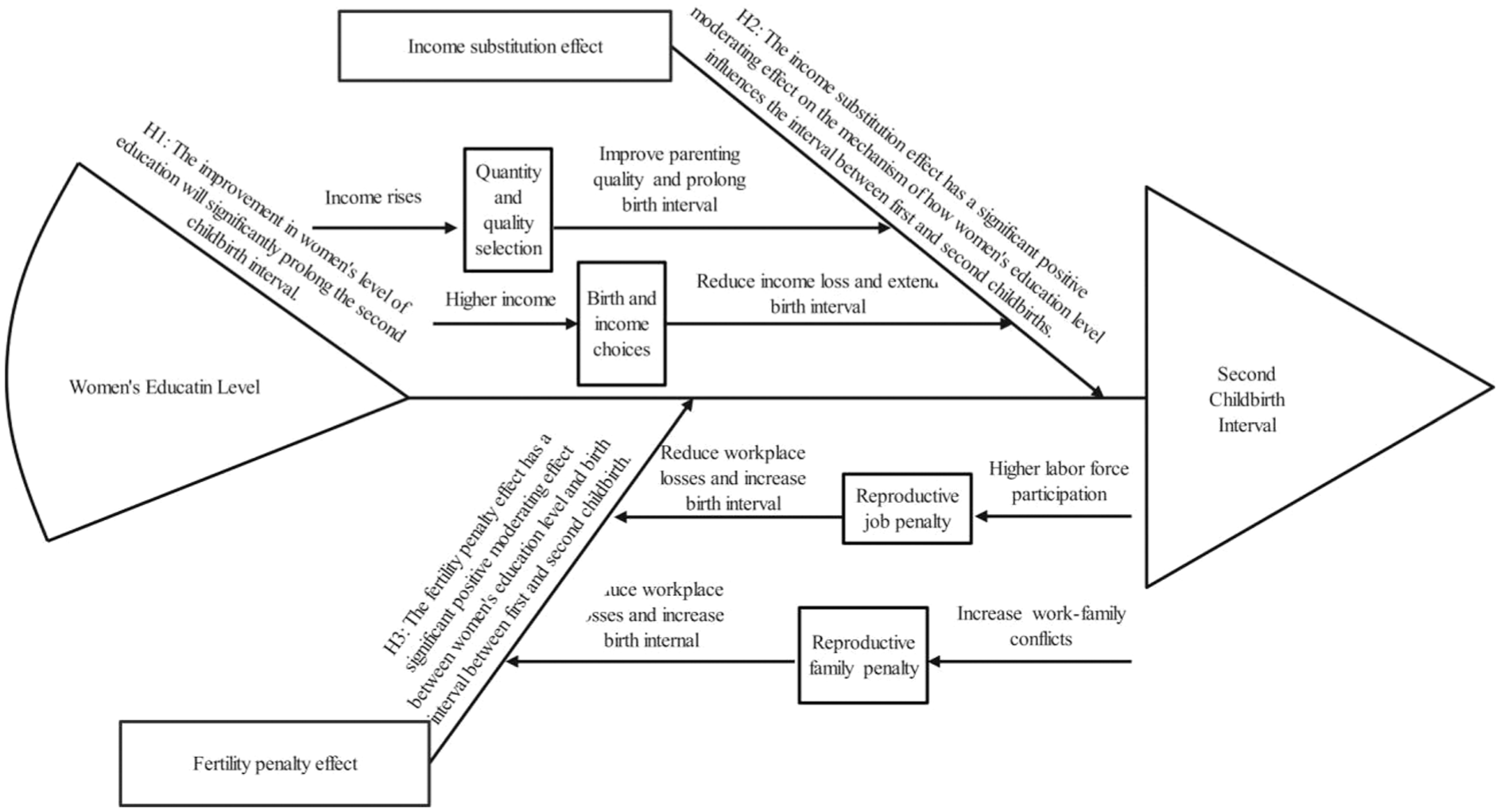
Mechanism and research hypothesis.
According to micro-demographic economic theory, a higher level of household affluence is associated with a lower rate of having children. As income levels increase, the cost of raising children also increases, leading people to prioritize improving the quality of their children’s lives by having more children. Becker and Lewis (1973) were the first to propose a substitution relationship between quantity and quality in childbearing behaviors. They argued that increased income has both substitution and income effects. In other words, when income rises, the substitution effect outweighs the income effect, causing families to focus on enhancing the quality of their children’s lives rather than on having more children. Lee (1990) also reported a negative correlation between a family’s income level, birth rate, and childbearing intentions. It has been noted that a higher income can improve a family’s ability to raise children, but also increase costs. Consequently, there may be reduced willingness to have a second child (Freedman & Thornton, 1982). Furthermore, in a study using data from India’s National Employment and Unemployment Household Survey, Duraisamy (2002) found that returns on education were higher for women than for men at the middle school, high school, and college levels. Additionally, Dhanaraj and Mahambare (2019) reported that increased educational attainment leads to higher income for women. Therefore, having a second child requires women to give up the salary they receive from their regular jobs, thereby increasing the opportunity costs for women of childbearing age. Consequently, extending the birth interval of the second child is preferred. Based on the above analyses, this study proposes the following hypothesis:
According to child penalty theory, the arrival of children creates a long-run gender gap in earnings of around 20%, driven by hours worked, participation, and wage rates (Kleven et al., 2019). The main issue identified using child penalty understanding is that a woman’s childbearing affects the time she can dedicate to work. Berniell et al. (2021) reported that becoming a mother significantly reduces female employment and working hours. Moreover, time allocation theory suggests that individuals have limited time and energy (Becker, 1965). When women participate more in the labor force, they take on increased responsibilities. Therefore, women of childbearing age may choose to have fewer children to avoid heavier family burdens (Craig & Siminski, 2010). It has also been reported that work-family conflict among women is central to China’s low fertility rate (Yingchun & Zhenzhen, 2020). As work takes up a considerable amount of time, there is less time available for family care, resulting in work-family conflict and influencing a woman’s decision not to have a second child (Rindfuss & Brauner-Otto, 2008). More educated women generally face higher social expectations and are thus more likely to experience work-family conflicts (Greenhaus & Beutell, 1985). Research shows that this conflict is common among working women because of the traditional Chinese concept of division of labor within the family, which partially weakens working women’s willingness to have a second child (T. Liu, 2018). Hsu (2021) highlighted that women’s employment rates decline sharply after their first and second births, leading to negative long-term impacts on women’s earnings. Based on this analysis, we propose the following hypothesis:
Based on a literature review, this study constructed a research framework that considered income levels and child penalties. First, a base regression was used to analyze the impact of a woman’s education level on the second childbirth interval. Then, the effect of a woman’s education level on her second childbirth interval was examined from two perspectives: the income effect and the child penalty effect (as shown in Figure 1).
Research Design
Empirical Models
Regarding the investigation of birth intervals, the existing literature employs empirical methods, including interval stratification models, split population survival models, and proportional hazards regression models (Wube Bayleyegne & Gashaw Asfaw, 2020). The interval between the first and second childbirths encompasses whether to have a second child. However, the birth interval can only be calculated after the second child has been born. Researchers can only obtain samples of non-childbearing time up to moment t, which does not truly reflect the birth interval, and cannot explain an individual’s ultimate childbearing duration. This problem is analogous to survival time in the medical field. Therefore, in similarly treating second childbirth to survival time, where the distribution of the survival time is unknown, a Cox semi-parametric proportional hazards model (Cox model) was considered appropriate in this study as it can handle censored data and does not depend on specific distribution assumptions, making the estimation results more robust (Cox, 1972).
Assuming that the hazard function

Where β1, β2,…, βm represent the partial regression coefficient of the independent variable and
Based on these considerations, the impact of women’s education level (EDU) on birth intervals was analyzed from two dimensions: women who had received higher education (edu1) and those with education years above the average level in their place of residence (edu2) as the experimental group, with

Keeping other factors constant and only considering the effect of

Let

For factor
Data Sources
The data used in this study were obtained from the 2018 CMDS, organized and implemented by the National Health and Health Commission in China. The survey covers migrant population data from 31 provinces (autonomous regions and municipalities) across the country using a stratified, multi-stage, and scale-proportional probability sampling method involving 2,737 counties (cities and districts) and 7,600 village (community) level sample points. The 2018 survey was conducted by uniformly trained interviewers who visited the respondents directly, filled out personal questionnaires, and used the execution management subsystem and telephone survey system on a comprehensive survey platform to provide logical support, telephone calls, and other methods for quality control of the reported data, effectively ensuring the scientific nature and authenticity of the survey data. In this study, we selected female samples aged 15 to 49 years who had given birth to at least one child, and then removed samples with twin births, second childbirth intervals of less than 7 months, and missing variables such as birth year, resulting in a total of 31,066 samples. In the robustness test, “long-term survivors,” that is, those who will never have a second child, were further screened according to whether the ideal number of children was greater than 1, and 16,073 samples were obtained after removing these samples.
Variable Selection
Description of Dependent Variable Selection
The dependent variable in this study was the second childbirth interval, which denotes the time elapsed between the birth of a woman’s first child and the birth of her second child. In terms of the survival analysis, the first child was considered the starting event, while the birth of the second child was considered the ending event. The duration between the two births was defined as the survival time. To obtain the year and month of birth of both the first and second child, the individual questionnaire used to collect mobile population data included questions Q314BY1 (birth year of the first child), Q314BM1 (birth month of the first child), Q314BY2 (birth year of the second child), and Q314BM2 (birth month of the second child). The birth interval between the first and second child was then deduced based on these responses, with the unit accuracy limited to months. For cases where the survey participants had only one child at the time of the survey, the interval between the birth of the second child was defined as the interval between the birth of the first child and the survey time point.
Description of Independent Variable Selection
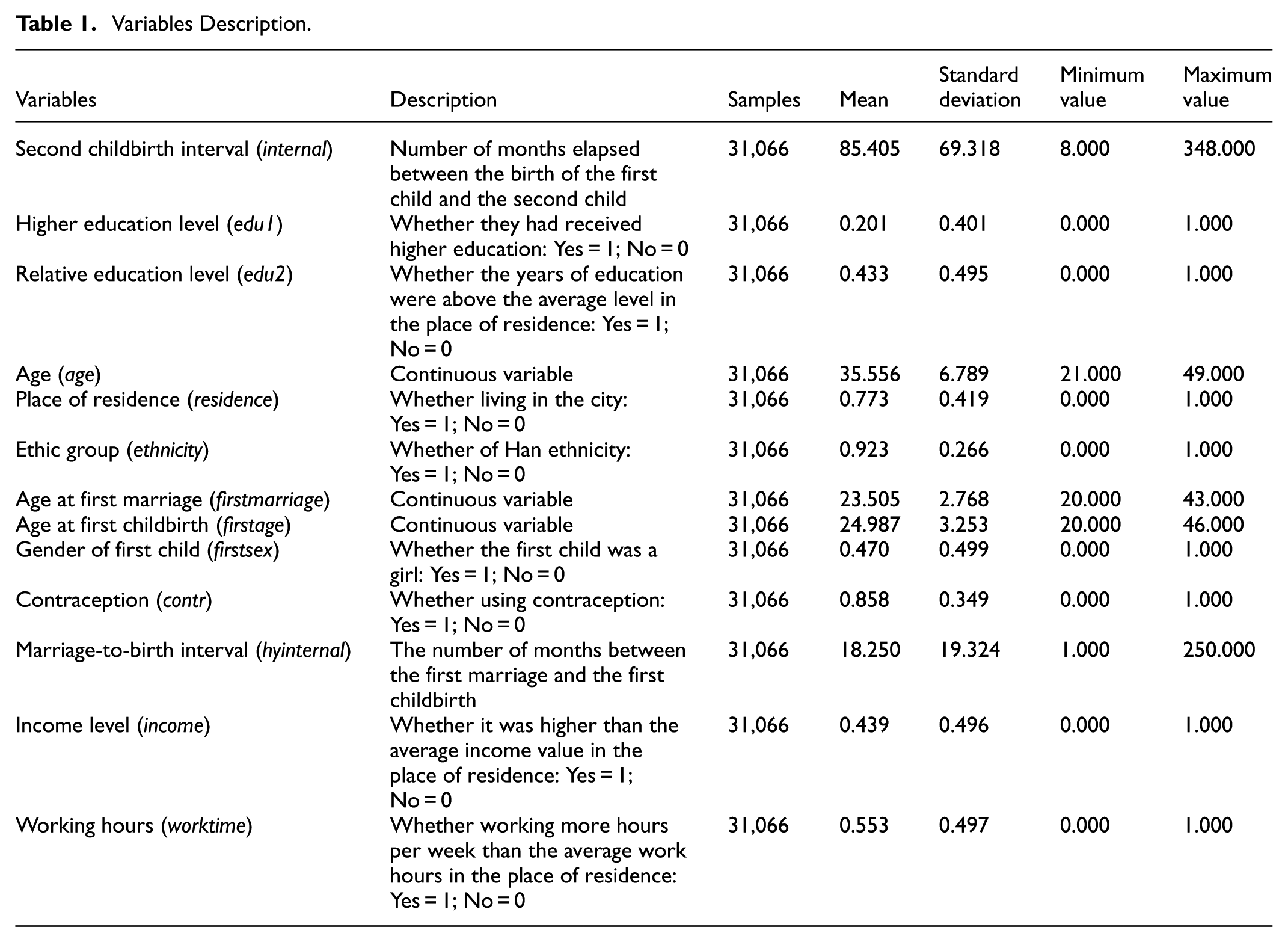
The independent variable was the women’s education level, determined based on answers to the question Q101E (education level, EDU) in the personal questionnaire to ascertain the general education level of the sample women. The use of two indicators to characterize education level – whether they had received higher education (higher education level, edu1) and whether the years of education were above the average level in the place of residence (relative education level, edu2) – facilitated a comprehensive and nuanced approach to analyzing the impact of education on birth intervals (shown in Table 1). This dual measurement captured higher and relative education levels, allowing for a more accurate representation of regional educational disparities. By combining these indicators, this study was able to compare the effects of different aspects of educational attainment on birth intervals, potentially uncovering complex relationships that a single measure may miss. This multidimensional analysis enhanced the accuracy and reliability of the research, providing richer insights for policymakers and enabling the formulation of more targeted education and population policies. Ultimately, this approach facilitated a thorough and precise exploration of the influence of education on birth intervals, leading to valuable conclusions and policy recommendations. According to the requirements of the Cox regression model, the sample data in relation to edu1 and edu2 were classified in terms of 1 for yes and 0 for no for both indicators.
Variables Description.
Description of Control Variables
The following factors that may affect the interval between first and second childbirths were selected as control variables, including age (age), place of residence (residence), ethnic group (ethnicity), age at first marriage (firstmarriage), age at first childbearing (firstage), gender of the first child (firstsex), whether using contraception (contr), marriage-to-birth interval (hyinternal), income level (income), and time occupied by work (worktime). The definitions of these variables and statistical descriptions of the data are presented in Table 1.
Table 1 presents the descriptive statistics of the variables from the 2018 CMDS, which covered 31,066 samples. The second childbirth interval (the dependent variable) averaged 85.405 months (approximately 7 years and 1 month), with a standard deviation of 69.318 months, ranging from 8 to 348 months (29 years), which could be tied to the parents’ age difference of nearly 30 years. For the independent variables, 20.1% of women had higher education, and 43.3% had above-average education in their residential areas. Among the control variables, the average age was 35.56 years, 77.3% lived in a city, and 92.3% were Han Chinese. The mean age at first marriage was 23.5 years, and at first childbirth was 24.99 years. The first child was a girl in 47% of cases, and 85.8% of the families used contraception. The average interval from marriage to the first birth was 18.25 months. A total of 43.9% of women had an above-average income, and 55.3% worked more hours than the local average.
Empirical Results Analysis
Effect of Women’s Education Level on the Second Childbirth Interval
The Kaplan-Meier method and the Stata statistical analysis tool were used to obtain survival curves for the interval between first and second childbirths for the women with different education levels, as shown in the figures (A) and (B) of Figure 2. In Figure (A), the survival curve for women who had received higher education consistently remained above the curve compared with those who had not, indicating that women with higher education had a lower possibility of having a second child than those without higher education. In Figure (B), the survival curve for women whose years of schooling were above the average level in their place of residence also consistently remained above the curve compared with those whose years of education were below the average level in their place of residence. In conclusion, the higher the women’s educational level, the longer the interval between their first and second childbirths. Moreover, the survival curves in Figures (A) and (B) did not intersect, indicating that the data aligned with the proportional hazards assumption, allowing further analysis using the Cox regression model.
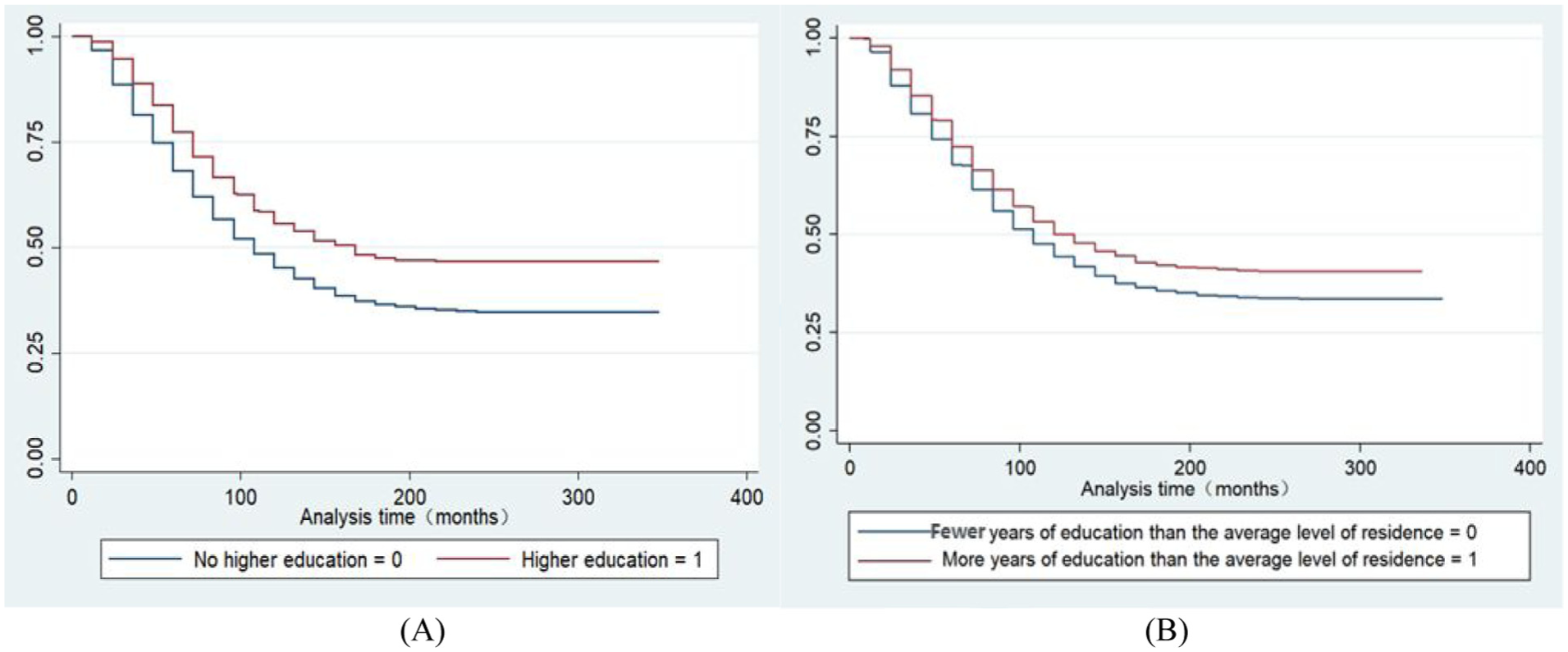
Kaplan-Meier survival curves for the second childbirth interval.
Higher Education Levels and the Second Childbirth Interval
The effect of educational level on the interval between first and second childbirths was assessed based on whether the women had received higher education, with estimation results shown in Table 2. In Model (1), only age, urban-rural status, and ethnicity were introduced as control variables, whereas Model (2) reports the estimated results after controlling for fertility information variables based on Model (1). The estimated results in Table 2 show that, in Model (1), the regression coefficient for women receiving higher education on the interval between the first and second childbirth was 0.639, significant at the 1% level, indicating that women’s education levels had a significant impact on the interval between first and second childbirths. In other words, women who had received higher education had significantly prolonged second-child birth intervals. After further controlling for the fertility information variables, the regression coefficient of the independent variable in Model (2) was 0.715, which passed the significance test at the 1% level. This coefficient, as the HR, indicated that the possibility of women having a second child when receiving higher education was 71.5% of the original possibility. Through applying the calculation 1 to 0.715 = 0.285, it could be determined that the possibility had reduced by 28.5%. This finding indicated that the women’s education levels had a positive impact on the birth interval of their second child; that is, receiving higher education was a protective factor in the survival analysis, which showed a reduced possibility of 28.5% in terms of having a second child. Thus, the interval between the first and second child was prolonged, which is consistent with the conclusions of most studies (Gu, 2021; He & Lin, 2021).
The Impact of Higher Education Levels on the Second Childbirth Interval.

Note. Robust standard errors are indicated in the parentheses.
denotes the significance at the 0.01 level.
Relative Education Levels and the Second Childbirth Interval
We next explored the impact of women’s education levels on the birth interval between first and second childbirths based on whether their years of education were above the average level in the place of residence, with estimation results summarized in Table 3. The findings for Models (3) and (4) indicated that, as the control variables were gradually introduced, the regression coefficients of the independent variable remained consistently less than one and were significant at the 1% level. The regression coefficient of the independent variable in Model (4) was 0.795. The HR value indicated that, when controlling for other factors, the possibility of women with years of education above the average level in their residential area having a second child was 79.5% of that for the women with years of schooling below the residential average. Through applying the calculation 1 to 0.795 = 0.205, it could be determined that the former group’s possibility of having a second child was 20.5% lower than that of the latter group. This finding reflected the effect of years of education relative to the average level of education in the residential area on the possibility of having a second child, meaning that having years of education above the residential average served as a protective factor in the survival analysis, reducing the likelihood of the women having a second child; that is, the women with years of education above the average level in their place of residence significantly prolonged the interval between their first and second childbirths. This can be explained in terms of additional education increasing current and expected human capital, with higher human capital changing fertility decisions (Black et al., 2008); thus leading to an expansion in the interval between first and second childbirths. Therefore, Hypothesis 1 was supported.
The Impact of Relative Education Levels on the Second Childbirth Interval.

Note. Robust standard errors are indicated in the parentheses.
denotes the significance at the 0.01 level.
Interaction Effects Based on Income Level and Child Penalty
Examination of the Moderating Mechanism of the Income Substitution Effect
According to Becker’s (1965) labor supply theory, education enhances human capital and increases long-term income. Therefore, stepping out of the labor market to raise children results in higher opportunity costs and an income substitution effect on having children. Women with higher education may prioritize improving the quality of their children’s upbringing over having more children. In this case, a more significant portion of their income is allocated to their children’s upbringing and care, which can decrease their willingness to have a second child and result in longer intervals between first and second childbirths. Wang and Luo (2021) also claim that the increase in labor income brought about by an improvement in education level has an income-substitution effect on childbearing intention.
To support Hypothesis 2, empirical analyses were conducted from two dimensions: whether the women had received higher education and whether the years of education were above the average level in the place of residence. Models (5) and (7) in Table 4 show the estimated results without an interaction term. In Model (6), an interaction term between income level and whether the women had received higher education was introduced. The estimated results showed that the regression coefficient of the interaction was 0.759, indicating that a higher income level led to the highly educated women having a lower possibility of experiencing a second childbirth event than women without higher education, thereby prolonging the second childbirth interval. The interaction between income level and whether the years of education were above the average level in the place of residence was examined in Model (8) in Table 4. The estimation results showed that the regression coefficient of the interaction term was 0.883 and passed the significance test at the 1% level, indicating a positive relationship between income level and the effect of women’s educational level relative to the residential average on the second childbirth interval. In other words, the women whose years of education were above the average level in their residential area had a relatively lower possibility of having a second child than those whose years of education were below the average level in their residential area. This factor further prolonged the second childbirth interval, suggesting that the income substitution effect strengthened the impact of the women’s educational level on the interval between first and second childbirths, with a significant positive moderating effect. Thus, Hypothesis 2 was supported.
Moderating Effect Model Estimation Results (Income Substitution Effect).

Note. Robust standard errors are indicated in the parentheses.
denotes the significance at the 0.01 level.
Examination of the Moderating Mechanism of the Child Penalty Effect
According to Bailey (2006), a high percentage of women in the labor force is associated with low fertility. A study conducted by Kim and Luke (2020) on low fertility in Korea found that work–family conflict among women played a pivotal role in the decline of fertility. Data from Latin American countries and Greece, as reported by Glauber (2007) and Daouli et al. (2009), indicate that women with more children tend to have lower levels of labor force participation and shorter working hours. After having their first child, women face the challenges of balancing work and child rearing, resulting in greater caution in their decision to have a second child (Brewster & Rindfuss, 2000). Generally speaking, the higher a woman’s education level, the higher the social role expectations she bears and the more likely she is to experience work–family conflict. Thus, to circumvent this child penalty effect, most women actively extend their second childbirth intervals.
To evaluate Hypothesis 3, empirical studies were conducted from the two dimensions of whether the women had received higher education and whether the years of schooling were above the average level in the place of residence. Models (9) and (11) in Table 5 show the results without interaction terms. Model (10) used an interaction term between work time and whether the women had received higher education. The results summarized in Table 5 show that the regression coefficient of the interaction was 0.745 and was significant at the 1% level. This finding indicated that the women with higher education had a lower chance of having a second child than those without such education. In other words, as a woman’s labor force participation rate increased, her time spent at work also increased, leading to less time being devoted to her family and children. This finding highlighted a significant child penalty effect, which increased the second childbirth interval. Model (12) in Table 5 shows the regression coefficient of an interaction term between work time and whether the years of education were above the average level in the place of residence, which was 0.895 and statistically significant at the 1% level. This finding indicated that, compared to the women whose years of education were below the average level in their place of residence, the women with above-average years of education had a lower possibility of having a second child, thus prolonging the interval between first and second childbirths. Therefore, the childbirth penalty effect strengthened the impact of the women’s educational levels on the interval between first and second childbirths, demonstrating a significant positive moderating effect. Therefore, Hypothesis 3 was supported.
Estimation of the Moderating Effect Model (Child Penalty Effect).

Note. Robust standard errors are indicated in the parentheses.
denotes the significance at the 0.01 level.
Robustness Tests
It is essential to recognize that, while the proportional hazard regression model is the prevalent method for examining factors influencing birth interval, the assumption that all women will eventually have a second child does not align with reality. The presence of long-term survivors (those who never have a second child) can introduce estimation bias (Cho et al., 2001). Consequently, the Cox model was employed for estimation in the primary regression analysis, and further screening for long-term survivors was conducted based on whether the ideal number of children was greater than 1; samples excluding long-term survivors were used for robustness tests.
To eliminate the potential interference of long-term survivors, we determined whether a woman would have a second child based on her childbearing intentions during the sample selection process, and excluded samples of women who only had one child and had zero subsequent childbearing intentions. This screened sample was used for the robustness tests, resulting in 16,073 observations. We conducted robustness tests from the perspective of whether the women had received higher education, with the results shown in Table 6. The regression coefficient of the independent variable in Model (13) was 0.802, indicating that, compared to the women who had not received higher education, receiving higher education reduced the possibility of the women having a second child by 19.8%, resulting in a longer interval between first and second childbirths. The regression results of Models (14) and (15) show that the regression coefficients of the interaction terms (income level and whether the women had received higher education; child penalty and whether the women had received higher education, respectively) were less than one and significant at the 1% level, indicating that an increase in income levels and an increase in fertility penalties strengthened the positive impact of women’s education level on the birth interval between first and second childbirths, further supporting the research hypotheses.
Estimation Results Excluding Long-Term Survivors for the Women Who Had Received Higher Education.
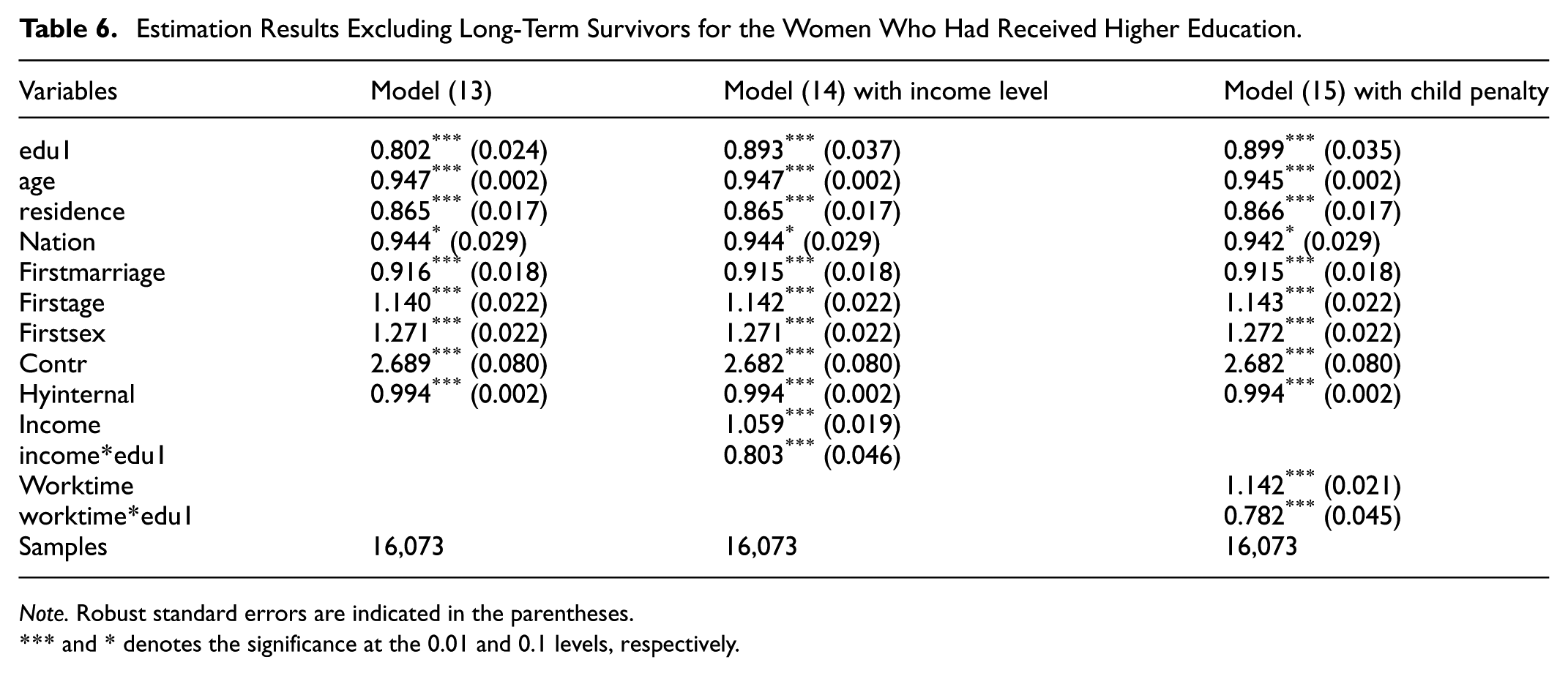
Note. Robust standard errors are indicated in the parentheses.
and * denotes the significance at the 0.01 and 0.1 levels, respectively.
A further robustness test was carried out based on the perspective of whether the years of education were above the average level in the place of residence, with the results shown in Table 7. The regression coefficient of the independent variable in Model (13) was 0.866, indicating that the women whose years of education were above the average level in their place of residence had a 13.4% lower possibility of having a second child than the women whose years of schooling were below the average level, resulting in a relatively longer interval between first and second childbirths. Finally, the regression results from Models (17) and (18) show that the coefficients for the interaction terms (income level and whether the years of education were above the average level in the place of residence; child penalty and whether the years of schooling were above the average level in the place of residence, respectively) were all less than one and significant at the 1% level. Their results aligned with the previous results, indicating that the findings retained their reliability even after removing the long-term survivors from the analysis.
Estimate Results Excluding Long-Term Survivors for the Women Whose Years of Education Were Above the Average Level in the Place of Residence.

Note. Robust standard errors are indicated in the parentheses.
and * denotes the significance at the 0.01 and 0.1 levels, respectively.
Discussion
The negative population growth rate problem in China is noteworthy in the context of the significant decline in the total global fertility rate (Lin et al., 2024), and understanding of the key factors involved is required. The first point to be made concerning this issue is that the birth interval among women of childbearing age in China is an essential indicator of social and economic progress. Protecting women’s rights to education is crucial in promoting social and economic progress. This study found that, for the women of childbearing age who had received higher education or who had a higher relative education level, the interval between first and second childbirths was significant in China. Since 2009, the total number of female students in China’s regular higher education institutions has exceeded that of male students. It can be foreseen that the proportion of women of childbearing age receiving higher education and the number of years of such education will further increase, reducing the possibility of having a second child and extending the interval between first and second childbirths. This is not only an issue that needs to be considered in China’s family planning policy, but also an issue that other developing countries must actively pay attention to when formulating family planning policies. For example, India and developing countries in Africa should actively consider the impact of educational level on birth spacing for women of childbearing age when formulating such policies.
Second, in contrast to the previous literature, this study systematically explored the influence of women’s education levels on the birth interval between first and second childbirths from the perspective of the migrant population. In this context, where women could give birth without policy restrictions, facilitated research in this area. Specifically, although China implemented a planned, legalized, and institutionalized family planning policy for 35 years, the birth of a second child among the migrant population was not prohibited by this family planning policy, which was a precondition for undertaking this study. However, as a country transitions from an agricultural to an industrial base, urbanization is inevitable. With China’s rapid urbanization, one out of every six individuals has become part of the migrant population. This phenomenon allowed for obtaining extensive sample data for this study, enhancing its practical significance and providing a valuable reference for optimizing China’s family planning policies. As an increasing number of developing countries move toward industrialization, large-scale population mobility is inevitable. The internal processes and patterns concerning how women’s education levels in China’s migrant population affect the interval between first and second childbirths are also likely to occur in the urbanization processes of other developing countries, which is a consideration worthy of attention for developing countries when formulating relevant policies.
Finally, this study identified and examined the mechanism by which women’s education levels affect the interval between first and second childbirths from two perspectives: the income substitution effect and the child penalty effect. Scholars have long focused on the role of the income substitution effect on fertility. Despite significant differences in culture and politics, all countries are committed to improving the income levels of their citizens, and most governments strive to increase residents’ incomes by ensuring the right to education. However, improving education has increased women’s income, which in turn affects their birth intervals, with implications for family planning and population growth rates. The effect of this mechanism was further confirmed in this study involving data drawn from China’s migrant populations. This finding not only provides new policy insights for China to optimize its family planning policy but also provides an essential reference for developing countries in the process of population-related governance. Furthermore, while the child penalty effect has been frequently considered in population studies (Q. Xu, 2023), this study highlights that an increase in education levels among women in the migrant population makes the childbirth penalty effect even more worthy of attention. This finding provides new evidence for legislation to protect the career development of migrant women of childbearing age, which is not only of great significance for China but also for some developing countries in terms of legislation for women’s protection.
Conclusions and Implications
Using CMDS (2018) data, this study explored and analyzed the influence of women’s education levels on the interval between first and second childbirths from two dimensions: women who had received higher education and women whose years of schooling were above the average level in the place of residence, from a micro-perspective. It also empirically evaluated the moderating effects of income levels and child penalties on this relationship. The main findings of this study are as follows.
The women’s educational levels significantly affected the interval between first and second childbirths. Specifically, receiving higher education reduced the possibility of women having a second child by 28.5%, thus extending the interval between first and second childbirths. For the women whose years of education were higher than the average level in their place of residence, the possibility of having a second child was reduced by 20.5%, thus also extending the interval between first and second childbirths. The income level was found to be a significant positive moderator between a woman’s level of education and the interval between first and second childbirths. The results indicated that a higher income level reduced the chance of having a second child for women with both higher levels of education and whose levels of education were relatively higher in terms of their place of residence, with a longer birth interval between first and second childbirths. Further, the child penalty acted as a positive moderator between the women’s education levels and the second childbirth interval. In other words, as the time spent at work increased, work-family conflicts became apparent, further exacerbating the child penalty that women would be likely to experience in the employment field. This penalty effect implies that women with higher education levels are less likely to have a second child than are women with lower education levels.
In conclusion, the findings of this study on the relationship between women’s education levels and the second childbirth interval have important implications for China’s future demographic trends. The 14th Five-Year Plan (2021), Five-Year Plan (2022), Five-Year Plan (2023), Five-Year Plan (2024), Five-Year Plan (2025) includes broad educational development goals such as increasing the average years of education for the working-age population and raising higher education enrollment rates. While not specifically targeting women’s education, these objectives are likely to improve educational opportunities. This general increase in education levels may contribute to further delays in second childbirth decisions. Moreover, as China continues its economic reforms and development, overall income levels are expected to rise. This economic growth, combined with the persistent challenges of balancing career and family (often referred to as child penalties), may further amplify the effect of women’s education levels on extending the second childbirth interval. These factors underscore the complex interplay among education, economic development, and childbearing decisions in shaping China’s demographic future.
Based on this, this study proposes the following policy recommendations. It is necessary to relax family planning controls further, pay attention to the spatial and temporal differences in the implementation of fertility policies, and carry out targeted family policy pilot programs for regions with different education levels to ensure the positive impact of childbearing-related policies. Furthermore, it is necessary to optimize the income distribution system, improve the income distribution pattern, and construct an income penalty mechanism for unmarried and childless individuals of appropriate age. Specifically, the government should implement mechanisms to incentivize childbirth for women of childbearing age, such as reducing personal income tax for working mothers and promoting flexible working systems, thereby creating a favorable childbearing atmosphere and promoting a moderate level of childbearing.
Footnotes

Funding
The authors disclosed receipt of the following financial support for the research, authorship, and/or publication of this article: National Natural Science Foundation of China (72264014), Research on the Mechanism and Policy Optimization of Education Expansion’s Intergenerational Transmission on Fertility Intentions. Jiangxi Province Education Science “14th Five-Year Plan” Project (23YB016), Research on the Influence Mechanism and Countermeasures of Education Level on Women’s Fertility Intentions. Jiangxi Province Department of Education Science and Technology Research Project (GJJ2200346), Research on the Impact of Education Expansion on Women’s Fertility Intentions from a Whole Life Cycle Perspective. Henan Province Young Backbone Teachers Training Program for Undergraduate Universities in Henan Province (2025GGJS062).
Declaration of Conflicting Interests
The authors declared no potential conflicts of interest with respect to the research, authorship, and/or publication of this article.
Data Availability Statement
The data are available from the corresponding author on reasonable request.