




Abstract
Using a between-subjects experimental design with 660, this study investigated the impact of exposure and non-exposure to fact-checking on people’s rectifying behaviors in response to COVID-19 fake news. We found that participants who read COVID-19 fake news accompanied by true fact-checking information believed that the news stories had a greater impact on others than on themselves. This phenomenon is commonly known as the third-person effect (TPE). When exposed to COVID-19 fake news with fact-checking information (vs. fake news with no fact-checking information), youths perceived a less negative influence on themselves and consequently showed weaker intentions to correct fake news on social media. Conversely, they perceived that the fake news had a greater negative influence on others, leading to stronger support for regulating fake news. This study contributes to the existing literature on the third-person effect and fact-checking of fake news in non-Western social media environments.
Introduction
The COVID-19 pandemic has caused the deaths of up to 7 million people worldwide since its emergence in December 2019 (WHO, 2024). Along with the panic caused by the virus itself, the spread of fake news about COVID also causes panic, creating an infodemic (Gupta et al., 2022; van der Linden et al., 2020). Fake news, is a general term used to describe inaccurate information—which encompasses misinformation, false or misleading information, fabricated content, and imposter content with low levels of accuracy—that stems from attempts to manipulate, confuse, or deceive using information of questionable origin (Egelhofer & Lecheler, 2019; Gomes-Gonçalves et al., 2022; Greene & Murphy, 2021; Lazer et al., 2018). In practice, fake news, often in the form of deepfakes, can mislead the public, as when it was intentionally spread through social media to achieve a conspiratorial purpose during the COVID-19 pandemic (Gomes-Gonçalves, 2022; Rocha et al., 2023). Compared with real news, fake news is easier to spread and share on social media, thus greatly hindering government efforts to educate people about health issues and encourage compliance with public health policies (Carrion-Alvarez & Tijerina-Salina, 2020; Moscadelli et al., 2020).
In the Chinese context, particularly during the COVID-19 pandemic, the government often labeled false information on social media as “fake news” and subjected it to fact-checking (Chen, Zhang et al., 2021; Pang et al., 2022). Due to the spread of COVID-19 fake news, many people believed that the pandemic was a hoax and consequently did not comply with public health directives, such as wearing masks, maintaining social distance, and getting vaccinated, increasing the spread of the virus (Tasnim et al., 2020; J. Zhang et al., 2021). It is evident that this “infodemic” compromised the effectiveness of the government’s public health measures and posed a serious risk to public safety (Hartley & Vu, 2020; Ünal & Çiçeklioğlu, 2022). Therefore, fact-checking health-related information could play a crucial role in helping people access accurate information and protect themselves against COVID-19 or other critical threats to public health (Burel et al., 2020; Schuetz et al., 2021).
Although fake news is a global phenomenon, research on fact-checking has been concentrated primarily in Western countries, especially the United States (Nieminen & Rapeli, 2019; Walter et al., 2020). During the COVID-19 pandemic, some studies explored the effects of fact-checking COVID-19 fake news on American social media users (Cotter et al., 2022; Schuetz et al., 2021; J. Zhang et al., 2021) and the factors influencing the effects of fact-checking (Xue et al., 2022). Although there have been studies on the impact of Chinese citizens’ exposure to fake news with reference to the third-person effect (TPE; people’s belief that fake news affects others more than themselves), those studies have not involved exposure to fact-checking (L. Chen & Fu, 2022; S. Tang et al., 2021).
During the COVID-19 pandemic in China, research on fact-checking primarily concentrated on the government’s efforts to combat COVID-19 fake news (Rodrigues & Xu, 2020); the role, purpose, and function of the government in fact-checking (Chen, Chen et al., 2021; Chen, Zhang et al., 2021; Fang, 2022); and the impact of people’s health concerns on their fact-checking behavior on social media (Jiang, 2022). However, there have been fewer studies on how fact-checking influences people’s attitudes and behaviors toward fake news in non-Western contexts. Each country or region’s political landscape and cultural values affect fact-checking organizations’ strategies (Çömlekçi, 2022). In non-Western countries, the effectiveness of fact-checking and its impact on people’s perceptions and behaviors may differ from those in Western countries (Chung & Kim, 2021; Humprecht, 2020; Malhotra, 2020). Therefore, this study presented in this paper explores how exposure to fact-checking affects young people’s self-reported likelihood of taking corrective actions against fake news and support of censorship with respect to their perception of the impacts of fake news on themselves and others. We asked 660 students in China to read fake COVID-19 news, both accompanied and unaccompanied by fact-checking.
This study makes several theoretical contributions to the literature. First, the study enriches the fact-checking literature in non-Western contexts. This research diverges from previous fact-checking research that primarily focused on Western contexts or the role of the Chinese government. Instead, it examines the impact of fact-checking on public attitudes and behaviors during the COVID-19 pandemic in non-Western contexts. Additionally, this study enriches our understanding of TPE theory. The existing literature primarily focuses on exploring the TPE in the context of fake news, examining its influence on public attitudes and behaviors (L. Chen & Fu, 2022; Corbu et al., 2020; F. Yang & Horning, 2020; J. Yang & Tian, 2021). This study explores how fact-checking influences public behavior through the TPE. Moreover, the study extends beyond examining the traditional cognitive gap of the TPE by incorporating the ‘impacts on both oneself and others to investigate the mechanisms through which fact-checking affects various public behaviors.
Literature Review
Fake News and Fact-Checking on Chinese Social Media
In China, social media serves as the primary source of both government-approved news and fake news (S. Tang et al., 2021; Y. Zhang & Guo, 2021). Particularly during the COVID-19 pandemic, fake news has circulated widely on social media, leading to significant disruption in the social order (X. Wang et al., 2022). Consequently, the Chinese government has implemented a range of measures to combat fake news. In November 2022, the Cyberspace Administration of China (CAC) spearheaded joint efforts with major social media platforms like WeChat, Weibo, and Tiktok to combat false information and online rumors related to COVID-19. This special action effectively shut down over 5,400 rumor accounts across social media platforms (CAC, 2022). The Chinese government assumes a leading role in the fight against fake news about COVID-19 by mandating the rapid deletion of fake news through the use of blacklist keywords, manual deletion, and background monitoring on platforms (Rodrigues & Xu, 2020; L. Tang & Zou, 2021).
The role of the Chinese government in combating fake news is closely connected to censorship. Government censorship may impact public attitudes and behaviors toward fake news and fact-checking. Cheng et al. (2021) conducted a study in Japan, South Korea, and Thailand (N = 5,218) and discovered that an increase in people’s perception of social harm caused by fake news will lead to greater support for regulating it. However, the fact-checking websites available to individual readers has decreased people’s support for controlling fake news in Japan and South Korea. This might be due to the fact that in countries with free speech principles like Japan and South Korea, the public is aware that government regulation of fake news might infringe on their freedom of speech, resulting in reduced support for regulation. They may instead prefer to use fact-checking websites to detect fake news, replacing the government’s role. In a semi-democratic country like Thailand, the use of fact-checking websites did not decrease public support for regulating fake news as much as it did for Japanese and Korean respondents (Cheng et al., 2021).
However, some researchers have reached different conclusions about authoritarian China. S. Tang et al. (2021) conducted a survey in 2018 using a national sample of 1,111 Chinese adults. They found that although the Chinese public recognized the negative impact of fake news on social media, they still did not support government censorship as a solution. This could be due to the fact that despite concerns about fake news, the Chinese public values freedom of the press and is cautious about government intervention in news media (Jang & Kim, 2018). There have been limited studies analyzing the effect of providing fact-checking of news stories on public attitudes and behaviors in the context of Chinese censorship. Therefore, this study aims to investigate how providing fact-checking influences the attitudes and behavior of Chinese youths toward fake news and fact-checking on social media.
Fact-Checking and the Third-Person Effect
Davison (1983) proposed the third-person effect (TPE) theory, which developed into a major theory in the media field, to explain how people perceive the impact of media information. This theory states that people tend to think that information spread in the media has a greater negative impact on others than on themselves. A large number of scholars have studied the TPE in relation to pornography (Chia et al., 2004; Gunther, 1995; Lo & Wei, 2002; Zhou & Zhang, 2023), television violence (Hoffner et al., 1999; Salwen & Dupagne, 2001), online advertising (Lim, 2017), information risk perception (Jung et al., 2020), and so on. The majority of these studies support Davison’s theory (Chia et al., 2004; Lim, 2017; Lo & Wei, 2002; Zhou & Zhang, 2023).
Due to the prevalence of fake news during the 2016 US presidential election, the Brexit campaign in Europe, and the COVID-19 pandemic, scholars are increasingly interested in the relationship between fake news on social media and the third-person effect (L. Chen & Fu, 2022; Corbu et al., 2020; Jang & Kim, 2018; S. Tang et al., 2021). These studies have all found a third-person perception gap (TPPG): people perceive that others are more negatively affected by fake news than themselves. In these studies, participants were asked how they perceived the negative influence of fake news on themselves and others (L. Chen & Fu, 2022), but they were not provided with examples of fake news with and without external fact-checking; therefore, it is impossible for participants to know if they have been exposed to fake news unless they are told so (Silverman & Singer-Vine, 2016).
Fact-checking is the systematic and effective assessment of information by public officials and institutions to determine whether it is true (Walter et al., 2020). If research surveys or interviews provide a fact-checking component with news stories presented to participants, they will know whether they are being exposed to fake news. The question arises, if people know they are reading fake news, does that affect their perception of how the news affects them? Chung and Kim (2021) conducted an experimental study in which 261 participants were presented with one of two versions of a fake news story about the Fukushima nuclear power plant—one version providing no fact-checking information and the second providing fact-checking that debunked the fake story. The authors found that the TPE was subdued when people were unaware that they were reading fake news. In contrast, when they were provided with fact-checking, participants believed that fake news had a greater negative influence on others than on themselves.
The TPE is calculated by subtracting the perceived negative influence on the self from the perceived negative influence on others (L. Chen & Fu, 2022; Chung & Kim, 2021; Jang & Kim, 2018). However, Lo and Wei (2002) argued that the magnitude of the perceived gap between the impact of negative information on the self and the impact on others could not distinguish the following situations: the respondents perceived low effects on themselves and others simultaneously, or they perceived high effects on themselves and others. Therefore, besides the TPPG, the TPE should also include individuals’ perceptions of themselves and others (Salwen, 1998). Thus, our hypotheses are:
H1a: Youths who read fake news accompanied by debunking fact-checking will perceive a lower negative influence of fake news on themselves than those who read fake news with no fact-checking.
H1b: Youths who read fake news accompanied by debunking fact-checking will perceive a greater negative influence of fake news on others than those who read fake news with no fact-checking.
H1c: Youths who read fake news accompanied by debunking fact-checking will perceive a greater negative influence of fake news on others than on themselves compared to youths who view fake news without fact-checking.
Fact-Checking and Rectifying Behaviors
The purpose of fact-checking is to reduce the spread of fake news and promote the establishment of a fact-based news ecosystem and a culture of truth (Lazer et al., 2018; Vraga & Bode, 2017, 2018). When people know the truth, they may take actions to correct fake information, and support censorship of fake news. Such actions are called rectifying behaviors (Sun et al., 2008). According to Sun et al. (2008), rectifying behaviors include corrective behaviors and restrictive behaviors. An example of corrective behavior is actively preventing the spread of fake news and asserting that it is fake on social media. An example of restrictive behavior is supporting censorship of fake news policies to counteract the expected harmful effects of negative information (Barnidge & Rojas, 2014; Chung & Kim, 2021; Lim, 2017; Sun et al., 2008).
Many researchers find that people struggle to accept facts and take action when corrected information contradicts their pre-existing beliefs and attitudes, a challenge influenced by cognitive, social, and affective factors, making it difficult to change their preferences (Ecker et al., 2022; Kuklinski et al., 2000). Nyhan et al. (2014) agrees that correcting misinformation and providing accurate information can be counterproductive and even prevent people from adopting positive behaviors. Furthermore, Tandoc et al. (2020) found that people who know the facts would offer corrections, but only when fake news on social media is very relevant to themselves and people close to them. Vraga and Bode (2018) confirm this conclusion, arguing that people who believe fake news are more willing to express themselves forcefully on the internet, while those who know the facts are often silent and do not attempt to correct fake news.
However, some studies have shown that after being presented with fact-checking, people perceive more persuasive information, which motivates them to take rectifying action (Barnidge & Rojas, 2014; Pennycook et al., 2020; Walter et al., 2020; Wintterlin et al., 2021). When people find that the information on a social media platform is false, they can correct it to reduce misunderstanding (Arif et al., 2017). For example, they can participate in rectifying fake news about health issues on social media after they are provided with fact-checking (Bode & Vraga, 2021a; Wintterlin et al., 2021). Thus fact-checking can make people less convinced of fake news stories and encourage them to stick to the truth (Porter et al., 2018). Experimental research by Chung and Kim (2021) also shows that if people see fake news that is highly liked and shared on social media, they are motivated to share it. But when they are provided with fact-checking and know it is fake news, they are more likely to take rectifying action. Thus, this study proposes the following research hypotheses:
H2: Youths who read fake news accompanied by debunking fact-checking believe they are more likely to adopt corrective behaviors than those who read fake news with no fact-checking.
H3: Youths who read fake news accompanied by debunking fact-checking believe they are more likely to support news restriction policies than those who read fake news with no fact-checking.
TPE and Rectifying Behaviors
The TPE is of interest to by communication scholars because it influences how people respond to news stories in terms of their attitudes and actions (Lo et al., 2002). Many researchers have identified a positive correlation between TPE and paternalistic behaviors, including the willingness to protect vulnerable individuals (Lee et al., 2023). For instance, in their 2018 online survey of 510 Americans, Koo et al. (2021) found that the TPE encourages people to correct self-propagated or other-propagated misinformation. Recently, L. Chen and Fu (2022) conducted a questionnaire survey of 1,063 people in China and found that the TPE positively affects people’s attitudes toward misinformation and perceived behavioral control, which will prompt them to take corrective action, such as reporting misinformation to platforms or the government. Talwar et al. (2020) analyzed the reasons why people take corrective actions to protect others from harmful fake news, aiming to make other social media users aware of the misinformation and to gain their trust. In addition, the TPE will encourage people to support restrictive policies to prevent the potential harm of misinformation (McLeod et al., 1997; Zhao & Cai, 2008).
Measurement of the TPE in the above studies was achieved via the TPPG—the gap between people’s perception of the effect of misinformation on themselves versus the effect on others. However, Salwen and Driscoll (1997) argued that the TPPG is not an appropriate variable to predict people’s support for press restrictions on trial coverage. It may be that people are more tolerant of trial coverage because they think it is a necessary topic in a democracy. Shah et al. (1999) found that people’s perception of the negative effects of harmful advertising (e.g., casinos and lotteries) both on themselves and others makes them take more rectifying actions against harmful information. And many researchers hold that compared with TPPG, “influence on oneself” and “influence on others” are reliable variables for predicting people’s rectifying behaviors (Gunther & Storey, 2003; L. Guo & Johnson, 2020; Lo & Wei, 2002; Zhou & Zhang, 2023).
Researchers generally confirm that fake news causes people to perceive a greater TPE and that the TPE further influences rectifying behaviors, such as preventing them from sharing fake news on social media (Koo et al., 2021) and expressing support for media literacy education (Jang & Kim, 2018) and government regulation (Lim, 2017). Mena (2020) found that when people know that the information they are exposed to is fake news, the flagging of false news may discourage people from sharing it on social media because of the decreased credibility of the news. Recently, Chung and Kim (2021) recruited 261 participants on a crowd-sourcing platform and randomly assigned them to groups that were exposed to fake news with and without fact-checking. They found that exposure to fact-checking increased the TPE, and the TPPG further reduced people’s willingness to share fake news on social media. This may be because after exposure to fact-checking, they are worried that sharing could lead to the spread of fake news, causing more people to be affected, or they do not want to publicly admit the impact of the news on themselves.
The above studies did not examine how fact-checking affects people’s likelihood of engaging in rectifying behaviors through the TPE. If the above hypotheses are true, and the three dimensions of the TPE (perceived negative impact of fake news on oneself, impact on others, and the TPPG) also has an impact on public behavior, then whether exposure to fact-checking would affect people’s rectifying behaviors through the TPE is still unclear. Thus, this study proposes the following research questions:
Q1: Does exposure to fact-checking influence the likelihood of youths engaging in corrective behaviors such as debunking fake news through the TPE (influence on oneself, influence on others, and TPPG), and if yes, how does this occur?
Q2: Does exposure to fact-checking influence the likelihood of youths supporting restrictions on fake news, such as supporting anti-fake news policies through the TPE (influence on self, influence on others, and TPPG), and if yes, how does this occur?
Methodology
Participants
To avoid the impact of accessibility to internet on the use of social media and to cover different regions of China, this study selected Guangzhou University Town in the eastern region, Wuhan University Town in the central region, and Chongqing University Town in the western region for experiments. From April 1, 2022, to June 30, 2022, questionnaires were sent to university students in these three university towns through Sojump, one of the most popular professional survey companies in China, with about 2.6 million registered participants. Participants were self-selected into the Sojump database and received ¥20 for participating in the online survey. Participants had to read the consent form and agree to continue before entering the survey. They were randomly assigned to one of two conditions: reading a fake news story about COVID-19 either with or without fact-checking information.
University students were chosen for three reasons. First, the students tend to share common characteristics, such as age and education level. Particpants’ similarities can help to minimize the interference of other complex factors. Second, university students represent a group of young people who are the main users of social media; it is increasingly common for youths to encounter fake news on social media (S. Tang et al., 2021). As of December 2021, the proportion of Chinese netizens using mobile phones to access the Internet reached 99.7%, and the number of online news users reached 771 million, accounting for 74.7% of the total netizens, many of whom are young users (CNNIC, 2022). During COVID-19, youths are exposed to fake news mainly from mainstream social platforms such as WeChat (Similar to Facebook) and Weibo (Similar to Twitter, which was renamed to X in 2023; Rodrigues & Xu, 2020). Young people spend more time on social media compared to other groups, such as elderly people, increasing their exposure to fake news (Ray, 2021). Third, university students represent the future elite of Chinese society, and their attitudes and behaviors toward fake news may have vital implications for social development in China (H. Wang & Shi, 2018). According to China’s seventh census in 2020, there are more than 218 million university-educated people in China (Xinhua net, 2021). More than half of young people in the 20 to 24 age group are currently attending university (QQ, 2022). Therefore, this study primarily focuses on university students as the research subjects.
The experimental method is often used for causal inferences because it ensures the credibility of causal relationships through random assignment and enhances internal validity (Jackson & Cox, 2013). This approach addresses the intriguing yet problematic nature of exposure to fake news: typically, people do not realize they are being exposed to fake news until it is pointed out to them (Prior, 2021). This study focuses on understanding how fact-checking affects people’s attitudes and behaviors toward fake news. Moreover, people often label real news, which contradicts their political views, as fake news (Egelhofer & Lecheler, 2019), and survey-based methods cannot distinguish between participants’ exposure to actual fake news and exposure to news they simply refuse to believe. To address these issues, this study adopted an experimental design. The fact-checking in the experiment ensured that participants were aware that the news stories they were reading were false. Furthermore, learning that news is indeed false through fact-checking might increase the likelihood of participants adopting corrective and restrictive behaviors. We aimed to test this possibility.
As of June 30, 2022, there were 660 students in the experiment. The sample included 369 (55.9%) females and 291 (44.1%) males. The majority (91.5%) of the participants were between 18 and 24 years old. Among the participants, 352 (53.3%) were in their first or second year of university, 257 (38.9%) were in their third or senior year, and 51 (8.3%) were graduate students.
Design and Procedure
We first showed two fake news stories about COVID-19 on social media to the random control group. The first story’s title is “COVID-19 on the surface of fruits and vegetables may infect people.” This fake news was listed among the top 10 health rumors on social media in 2020 by the Internet Refuting Rumors Platform (led by a governmental agency called the Cyberspace Administration of China) and by some mainstream media outlets. This fake news story is significant as it pertains to daily life and COVID-19 prevention—topics that closely relate to ordinary pepple and are easily comprehensible for them. The story was published on Weibo, which is similar to Twitter. The first fake news story (Figure 1) read: During the COVID-19 pandemic, Weibo members posted a large number of messages such as "COVID-19 on the surface of fruits and vegetables may infect people." COVID-19 can survive for up to five days in a suitable environment. If someone who has COVID-19 touches fruits and vegetables in the supermarket, the virus will be transmitted to the digestive tract by touching or eating the food.

The first news story.
The second piece of fake news claimed that people who were infected with the Omicron variant of COVID-19 would also be infected with HIV. This story appeared among the “hot searches” on Weibo in 2021, and triggered substantial online discussion. It pertains to the evolving knowledge surrounding the COVID-19 virus, making it a pertinent example of fake news during the pandemic. Figure 2 shows the CCTV (China Central Television) news channel’s logo in the upper left of the news story. This fake news originated from news published by a commercial media, Phoenix Net in Hong Kong, on its official Weibo page under the headline “Where does Omicron come from? South African scientists are worried: AIDS patients may create multiple mutant strains” (published on December 8, 2021, at 07:14 a.m.). It caused a heated discussion among netizens on Weibo, where it became a “hot topic.” This story read: Some new stories speculate that when people are infected with Omicron, they will also get HIV. South Africa is the country with the most serious AIDS crisis in the world. Nineteen percent of young adults there are infected with HIV, and nearly one-third of them did not receive antiviral treatment. Previous clinical trials of the COVID-19 vaccine in South Africa have shown low protection because it is related to HIV infection. Low immunity can also cause COVID-19 to multiply faster, which promotes mutation.

The second news story.
For the randomly selected control group, we first conducted a pretest on the respondents, including asking whether they had seen the two news stories and whether they believed them. Then we post-tested a news story unrelated to COVID-19—a clip about Chinese diving champion Quan Hongchan winning a gold medal at the Tokyo summer Olympics in 2021, and respondents answered the same questions again after they read the story.
We gave the randomly selected experimental group the same two fake news stories and first conducted a pretest, including the questions about whether they had seen the two fake news stories and whether they believed them. For a posttest, we informed participants that the two stories were fake news. We gave them excerpts from fact-checking articles about the stories published by official Chinese mainstream media—the People’s Daily and Global People Magazine—and we included links to the full articles that they could click on to learn more (see the Appendix 1 for the text of the excerpts). All participants were exposed to the true stories even if they didn’t click on the links and read the full articles. After the fact-check, they answered the same questions again (Figure 3).

Participants’ flow in the online experiment.
Main Measures
Third-Person Effect (TPE)
The TPE measure consisted of the perceived negative influence of fake news on self, the perceived negative influence on others, and the gap between the two (Appendix 2).
Perceived Negative Influence on Self and Others
Based on several previous studies in which researchers gaged presumed media influence on self or others separately, we used a 5-point Likert scale ranging from 1 = strongly disagree to 5 = strongly agree (L. Chen & Fu, 2022; Gunther, 1995) to measure this. The three items were: “The news stories I read would have a negative influence on my (others’) emotions,” “The news stories I read would have a negative influence on my (others’) feelings about COVID-19,” and “The news stories I read would have a negative influence on my (others’) opinions on COVID-19.” The sum of the scores for the three items is the assigned value for the perceived negative influence of the news on self (M = 8.90, SD = 3.26, Cronbach’s α = .89) and on others (M = 10.7, SD = 2.60, Cronbach’s α = .86), as a variable assessed by the respondents. The sum of the scores for the three items is the assigned value for the perceived negative influence of the news on self (others). A higher score indicates a greater perceived negative influence on self and others.
Third-Person Perceived Gap
The third-person perceived gap (TPPG) was derived by subtracting the perceived negative influence of the news on self from the perceived negative influence on others in accordance with previous studies (L. Chen & Fu, 2022; Jang & Kim, 2018). A higher score indicates a greater gap (M = 1.82, SD = 3.08).
Corrective Behaviors
Participants’ behavioral likelihood of taking corrective action in response to fake news was measured by three items using a 5-point Likert scale ranging from 1 = very unlikely to 5 = very likely (Lim, 2017; Tandoc et al., 2020): (1) post a comment on the social media saying it’s wrong; (2) post a link to a fact-checking news report that addresses the fake news spreading on social media; (3) submit a complaint about this fake news to the government or customer service of social media platform. The sum of the scores indicates the likelihood of the respondents’ corrective behaviors. A higher score indicates a higher likelihood of performing corrective behaviors (M = 7.81, SD = 3.38, Cronbach’s α = .81).
Restrictive Behaviors
Participants were asked, on a 5-point Likert scale (1 = strongly disagree and 5 = strongly agree; Jang & Kim, 2018), to indicate how likely they would be to support (1) legislation to prohibit fake news, (2) punishment of Internet companies, such as Tencent and Alibaba, that publish fake news, and (3) government regulation of fake news. The sum of the scores indicates the respondents’ attitudes toward regulation, with a higher score indicating a more positive attitude toward regulation (M = 12.9, SD = 2.54, Cronbach’s α = .90).
Control Variables
Since all respondents were university students with relatively similar educational levels, education was excluded as a control variable. Two demographic control variables were included in our models: gender and age. In addition, following S. Tang et al.’s (2021) research on corrective behaviors, we controlled for potential effects from past exposure to the two fake news stories because it could affect people’s corrective behaviors against fake news on social media (S. Tang et al., 2021).
Results
To test hypotheses 1a, b, and c, we used a T-test to explore the TPE of exposure to fake-checking (Table 1). As can be seen in Table 1, compared with youths who read fake news with no fact-checking (M = 9.36, SD = 3.11), youths who were exposed to fact-checking (M = 8.51, SD = 3.34) generally believed that fake news would have a less negative influence on themselves (t = 3.38, p < .001). Thus, H1a was supported. Compared with youths who read fake news with no fact-checking (M = 10.08, SD = 2.63), youths who read fake news with fact-checking (M = 11.28, SD = 2.43) generally believed that fake news would have a greater negative influence on others (t = −6.11, p < .001). Thus, H1b was supported. And compared with youths who read fake news with no fact-checking (M = 0.71, SD = 2.51), youths who read fake news with fact-checking (M = 2.77, SD = 3.20) generally believed that fake news would have a greater negative influence on others than on themselves (t = −9.09, p < .001). Thus, H1c was supported.
T Test for the Influence of Reading Fake News with and Without Fact-checking on Self and Others and the Gap Between Them (N = 660).

Note. TPE = third-person effect; TPPG = third-person perceived gap.
p < .001.
To test H2, we used an ordinary least squares (OLS) regression model to explore the influence of exposure to fact-checking while controlling for respondents’ past exposure to fake news, gender, and age (Table 2). Table 2 shows that youths who were exposed to fact-checking were less willing to prevent fake news from being shared than those who were not. Thus, H2 was not supported.
Ordinary Least Squares (OLS) Regression Analyses of Behaviors Following Exposure to Fact-checking (N = 660).
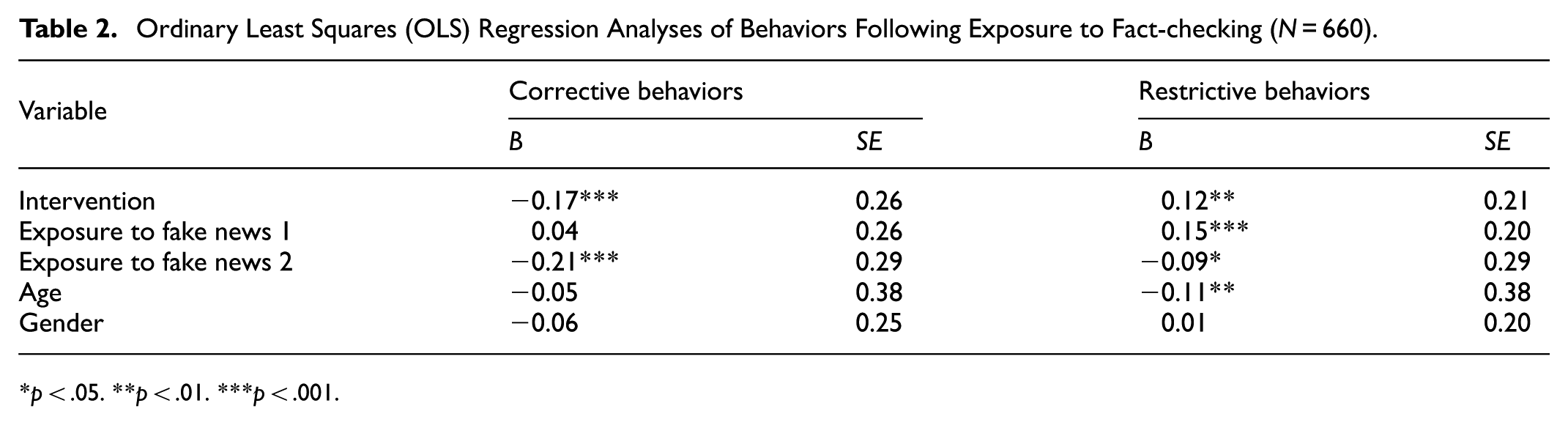
p < .05. **p < .01. ***p < .001.
H3 hypothesized that youths who were exposed fact-checking would be more likely to adopt restrictive behaviors to support fake news restriction policies than those who read fake news with no fact-checking. According to the OLS regression (Table 2), H3 was supported.
To answer RQ1, we ran a simple mediation test using fact-checking status as an independent variable (0 = news without fact-checking, 1 = news with debunking fact-checking), using influence on self or on others or the TPPG as a mediator, and corrective behaviors as a dependent variable (Hayes, 2013). Table 3 shows that exposure to fact-checking information decreased corrective behaviors via influence on self (indirect effect = −0.064; bootSE = 0.016; 95% bias-corrected 5,000 bootstrap CI, [−0.082, −0.013]). Exposure to fact-checking information decreased corrective behaviors via the TPPG (indirect effect = −0.089; bootSE = 0.014; 95% bias-corrected 5,000 bootstrap CI, [−0.128, −0.056]). That is, compared to youths who were not provided with fact-checking, those who were exposed to fact-checking perceived a smaller negative influence of fake news on themselves, and they were less likely to take corrective actions against it. The more participants who were exposed to fact-checking believed that fake news had a greater negative influence on others than on themselves, the less likely they were take corrective action against it.
Mediating Effect Test (N = 660, Bootstrap Sample Size 5,000).

Note. A = fact-checking; B = perceived influence on self; C = perceived influence on others; D = third-person perceived gap; E = corrective behaviors; F = restrictive behaviors.
To answer RQ2, we ran a simple mediation test using fact-checking status as an independent variable (0 = news without fact-checking, 1 = news with debunking fact-checking ), influence on self or others or the TPPG as a mediator, and restrictive behaviors as a dependent variable (Hayes, 2013). Table 3 shows that exposure to fact-checking information increased participants’ likelihood of restrictive behaviors via their perception of the influence of fake news on others (indirect effect = 0.049; bootSE = 0.016; 95% bias-corrected 5,000 bootstrap CI, [0.107, 0.472]). Compared to participants who were not exposed to fact-checking, those who were exposed to fact-checking perceived a greater negative influence of fake news on others and had a lower likelihood of restrictive behaviors.
The final model of the above research results is shown in Figure 4.

Final model.
Discussion
Does exposure to fact-checking of fake news influence people’s likelihood of engaging in corrective and restrictive behaviors through the third-person effect? To answer this question, this study compared the effects of exposure and nonexposure to fact-checking of fake COVID-19 news on young people’s cognition and self-reported likely behaviors through an experimental design involving 660 students in China. The study found that on the cognitive level, exposure to fact-checking affects the third-person effect of fake news on social media; on the behavioral level, it affects people’s self-reported likelihood of taking corrective action and support of restrictive policies in response to fake news. This study makes several contributions to understanding social media fact-checking mechanisms in theory and preventing the spread of fake news in practice.
This study offers insight into the impact of exposure to fact-checking on the third-person effect in the context of Chinese social media. It found that compared to youths who were not exposed to fact-checking, youths who were able to view fact-checking felt that fake news on social media had a more negative influence on others than on themselves. This may be because without the availability of fact-checking, it is difficult for people to identify fake news on social media and they may unwittingly consume, believe, and share fake news as real news stories (Chung & Kim, 2021; Prior, 2021). Compared with people who don’t know the truth, youths who have been exposed to fact-checking know that they are reading fake news and believe that they have more knowledge than others. This verifies previous scholars’ claim that the TPE is more commonly observed among more knowledgeable people (Davison, 1983; Price et al., 1998). At the same time, after exposure to fact-checking, youths also exhibit optimism bias, which makes them believe that fake news has a more negative influence on others than on themselves and increases the TPE (Boyle et al., 2008; G. M. Chen & Ng, 2017; Gunther, 1995; Paul et al., 2000; Perloff, 2002).
This study also found that youths who were exposed to fake news with fact-checking information (vs. fake news with no fact-checking information) made participants perceive a less negative influence on themselves, which in turn led to weaker intentions to debunk fake news on social media. The reasons for the above findings may be the following. First, after being exposed to fact-checking, individuals who are already informed about the truth tend to believe that fake news has less impact on them. As a result, their willingness to engage in communication decreases. This means they are less likely to gather and share information with friends and family through social media or participate in correcting fake news (McKeever et al., 2016). And those who do not know the truth may doubt the information and perceive themselves as very good at identifying fake news; therefore, they are more likely to actively try to prevent the spread of fake news (Lyons et al., 2021). This further confirms previous research indicating that the more informed individuals often constitute the silent majority, while those who are misled tend to be more vocal online (Bode & Vraga, 2021b). Second, youths who have been exposed to fact-checking believe that they have been less negatively affected by a fake news story and may think that the negative impact of fake news on others is not relevant to themselves, so they are less concerned about fake news and are less willing to correct it (Chung & Kim, 2021; Tandoc et al., 2020; J. Yang & Tian, 2021). Based on self-interest, rational people compare the personal costs and benefits of their actions (Green & Gerken, 1989; Jensen & Hurley, 2005). If taking corrective action entails personal costs, this might reduce people’s willingness to take action. Third, it is also possible that administrators of social media platforms can be more effective in debunking rumors than individual users, leading young people to conclude that they do not need to take any action to publish the truth (Jung et al., 2020). Thus the results of this study suggest that exposure to fact-checking has a negative impact on personal corrective action on social media.
Furthermore, when participants were exposed to fake news with fact-checking information (vs. fake news with no fact-checking information), they perceived that the fake news had a greater negative influence on others, which in turn led to stronger support for regulating fake news on social media. This may be because individuals who engage in fact-checking are aware of the truth and, out of concern for others, support regulatory policies to prevent harm, often based on paternalistic motives (Lee et al., 2023; McLeod et al., 2001). This provides further evidence that within the framework of Chinese collectivist culture, youths are primarily concerned with the negative impact of fake news on others (Chung & Wihbey, 2024; Hofstede et al., 2010). Consequently, they endorse government regulation as a means to limit these negative consequences. When people believe that social-level regulation would be more effective, they want to address perceived threats with society-level restrictive strategies (S. Guo & Feng, 2012; Lim, 2017; Rosenthal et al., 2018; Shah et al., 1999). Moreover, this may be also because young people who receive fact-checking information are more concerned about the societal harm caused by fake news rather than the harm resulting from news censorship. This aligns with previous research finding that the lesser-evil principle is not applicable to countries where freedom of speech is restricted; that is, in societies where speech is censored, people may not realize that government policies aimed at regulating fake news could also restrict their ability to express themselves (Cheng et al., 2021).
There are two main possible reasons why fact-checking influences the public’s corrective and restrictive behaviors through TPE in different ways. One reason relates to China’s media censorship environment. The Chinese government regulates fake news, including the fact-checking of content on social media platforms and controlling the dissemination of certain information about the COVID-19 pandemic on these platforms (Rodrigues & Xu, 2020; Ruan et al., 2020). The more people receive fact-checked information, the less trust they tend to have in the government, leading to their fear of taking any corrective actions that could be scrutinized by authorities (Li & Chan, 2017; Robinson & Tannenberg, 2019). As a result, they are more inclined to support the government’s regulation of fake news rather than engage in their own corrective actions (Cao, 2009; S. Guo & Feng, 2012; King et al., 2017; Li & Chan, 2017). The other possible reason is that Chinese youths, especially university students, after receiving political education for years, have developed a greater level of trust in the government (Huang et al., 2021). Also, during the COVID-19 pandemic, by cracking down on fake news, the government has successfully cultivated a positive image of itself in the minds of the public, leading to increased trust (Bolsover, 2017; Qin et al., 2017; Rodrigues & Xu, 2020; Zhou & Lu, 2023). Therefore, Chinese young people rely on the government rather than taking corrective measures themselves, and hope that the government will enact laws and policies to restrict fake news.
Theoretical and Practical Implications
Theoretically, a large number of research has already explored the impact of fake news and fact-checking on TPE in Western contexts (L. Chen & Fu, 2022; Chung & Kim, 2021; J. Yang & Tian, 2021) as well as the effects of fact-checking (Freiling et al., 2023; Wood & Porter, 2019). This study explores the impact mechanism of fact-checking in a non-Western context, thereby enriching prior research by examining both a precursor and an outcome of the third-person effect. This study also extends TPE theory. By focusing on non-Western contexts and the impact of the COVID-19 pandemic, it offers a new theoretical explanation of how fact-checking influences the public’s various responses to fake news through the TPE. Specifically, it elucidates the differing pathways through which fact-checking affects the public’s corrective and restrictive behaviors via the TPE.
This study also has important practical implications for governments, social media platforms, or other professionals to explore citizen participation in fake news regulation. When the government implements policies regulating fake news, it can emphasize the social harmfulness of fake news on social media in order to increase public support for relevant policies. And as social media platforms and officials refute fake news, they can highlight the individual harm caused by fake news, which may prompt people to actively debunk fake news on social media.
Limitations
This study has the following limitations. First, the population involved in this study is university students, which is not representative of the broader youth population, nor of society in general. Future researchers should consider other educational backgrounds and other age groups. Second, this study mainly explored the role of the third-person effect on youths’ exposure to fact-checking and their likelihood of rectifying behaviors. However, it ignored other possible influencing factors, such as people’s negative emotions toward fake news, self-efficacy in debunking rumors, and actual rectification behaviors. Future studies could add these variables as mediators. Third, this study focused on fake news related to the COVID-19 pandemic, so the conclusions may only apply to health news. Finally, this study was conducted in China, which is characterized by social media censorship and collectivism culture Future researchers might conduct comparative studies in other contexts such as political fake news and Western cultures. Fourth, the research was conducted while the COVID-19 pandemic was ongoing, which may have influenced the spread of other types of fake news during the study period. Future research should consider conducting comprehensive sampling studies on all fake news circulated during the pandemic to enhance the representativeness of the sample and the robustness of the findings.
Footnotes
Appendix 1. Fact-Checking Texts
During the COVID-19 pandemic, Feng Luzhao, a researcher at the Chinese Center for Disease Control and Prevention, stated that the likelihood of the COVID-19 virus contaminating vegetables, meat, and fruits through droplets or direct contact is very low. The virus can be killed in 30 minutes at a temperature of 56°C, whereas normal cooking temperatures can reach 100°C or higher. By washing and cooking food thoroughly, as well as washing hands before eating and after using the restroom, we can prevent the virus from spreading through the digestive system.
A reporter interviewed Wu Guizhen, the chief expert at the Institute of Viral Disease Prevention and Control of the Chinese Center for Disease Control and Prevention. Wu stated, ‘It is completely baseless to worry about simultaneous infections of Omicron and HIV; the two are not related. Currently, just over 20% of South Africa’s population has been fully vaccinated against COVID-19. Given that South Africa has a high rate of HIV infection, generally low immunity, low levels of COVID-19 vaccination, and limited protection, these factors collectively contribute to the easier replication of the COVID-19 virus and the emergence and spread of mutant strains. Being infected with Omicron is not linked to an HIV infection.’

Funding
The authors disclosed receipt of the following financial support for the research, authorship, and/or publication of this article: Major Project of the National Social Science Fund of China: Research on all-media production and dissemination mechanisms and evaluation systems (Project No. 24ZDA071).
Declaration of Conflicting Interests
The authors declared no potential conflicts of interest with respect to the research, authorship, and/or publication of this article.
Data Availability Statement
Data sharing not applicable to this article as no datasets were generated or analyzed during the current study.