



Abstract
Our study employs computational methods to explore gender and regional differences in Chinese audiences’ preferences for American films and TV dramas, using a rich dataset of Douban movie reviews. We applied advanced topic modeling techniques to analyze review content based on gender and region. Our findings reveal distinct preferences: female audiences favor themes of pets, family, and love, using emotional vocabulary, while male audiences prefer fantasy, adventure, and gaming, often incorporating Internet-specific language and profanities. Additionally, our analysis shows that audiences from economically developed regions have an affinity for Christmas and French romance themes, whereas those from less developed areas focus more on social issues like school bullying and racial discrimination. Leveraging Social Identity Theory and Cultural Capital Theory, we interpret these preferences as reflections of social roles, gender identity, cultural backgrounds, economic development, and media environments. This integrated approach offers deeper insights into the socio-cultural dynamics within different gender and regional groups in Chinese society. Our study underscores the impact of imbalances in economic and cultural capital on the widening social and cultural divide, proposes policy recommendations to promote cultural equity, and advocates for the localization of theories and the advancement of cultural fairness within the framework of globalization.
Keywords
Background
In the context of media convergence and the existence of digital texts, a symbiotic “viewer-reviewer” relationship emerges. International films are embedded in a transmedia communicative scenario, where varied viewing modalities and user-generated review content have broadened the communicative scope and derivative dimensions of international film and television works. Contrary to the relatively isolated textual existence of traditional films, contemporary international films exhibit a fluid, interconnected state within derivative environments such as online social platforms, short video platforms, and online community forums.
The networked reviews derived from films and related contents construct a media ecology of integrated symbiosis. Online community forums, led by Douban, Zhihu, and Xiaohongshu, have become vital channels for the dissemination of international film scenarios. The decentralized discourse fields empower the cultural proactivity of the viewing audience, serving as platforms where public discourse congregates, and offering crucial pathways to perceive societal states and value orientations through international films as a medium.
Online community reviews are processes of group interaction and cultural practice linked by interests and emotions. Such grassroots movie reviews, as well as the movie rating systems built upon extensive user data and algorithm optimization (such as those found on Douban, MTime, and Maoyan), are invaluable for the healthy development of China’s film industry and the advancement of reforms in related industrial systems. Online review platforms empower audiences, enhancing cultural proactivity toward international films and unlocking potentials for audience-generated meanings in texts. Raymond Williams, from a cultural materialism perspective, proposed the concept of “structures of feeling,” reflecting the meanings and values experienced by people in everyday life, revisited and understood in certain states of life practice. Audiences in different social contexts, due to varying cultural backgrounds and reception environments, will derive different meanings from a text (Williams, 2015). Semiotician Peirce elucidated the variations formed in textual symbols during the communication process due to the recipients and communicative environments (Peirce, 1974). The cross-cultural communication of international films in China represents a process of foreign culture localizing in a new cultural context, providing a window to understand the values, emotions, and attitudes absorbed by domestic audiences from international films.
Online review platforms are not just passive derivatives of primary texts; under the context of media convergence, the cultural effects aggregated by online community reviews, short videos, social platforms, and specialized movie websites are progressively enhancing the value of the original texts. Media convergence is not a mere amalgamation and combination of various media forms but a process of media reconstruction, where traditional and new media integrate in content, channels, terminals, and organizations, creating new value. Thus, analyzing international film reviews serves as an entry point to glimpse the cultural symptoms and public cultural emotions of the era. This study employs topic modeling to analyze the short review data on Douban from domestic audiences on American movies, aiming to explore the various focus points, value orientations, and attitudes of domestic audiences toward international movies.
Our study is focused on the following aspects:
To explore the focus points, value orientations, and attitudes of Chinese audiences toward international films by analyzing short review data on Douban for American movies.
To investigate the differences in content focus and evaluation patterns between male and female audiences through gender-based analysis, revealing the impact of gender perspectives on the reception of international films.
To examine the acceptance and focus characteristics of international films among audiences in different regions based on geographical divisions, reflecting the influence of geographical location, cultural background, and economic development levels on viewing behaviors.
To provide empirical support and theoretical insights for the optimization of market strategies in the film industry, the expansion of international communication pathways, and the deepening of audience research in the field of communication studies through thematic modeling and content analysis of review platform data.
Through these objectives, we aimed to reveal how international films, as a medium of cultural exchange, interact with audiences’ emotional structures and cultural practices in the context of globalization and localization.
Relative Works
Film and television serve as vital conduits for cultural communication, conveying the ideas, values, and esthetics of distinct cultures to audiences through images, music, and narratives (Schramm & Porter, 1982). These works not only showcase the cultural landscapes within specific social contexts but also reflect the lifestyles, traditions, and values of diverse regions and countries (Ren & Yao, 2023). Moreover, they facilitate cultural exchange and dialog by enabling the dissemination of cultures across borders (Kindem, 2000). Through cross-cultural interactions, viewers gain insights into the lifestyles and values of other cultures, fostering cultural understanding and identity (X. Luo, 2017). Additionally, film and television shape and influence culture by not only reflecting but also guiding audience values and behaviors (Hudson et al., 2011).
However, audience engagement with international films is shaped by various factors, among which geographical location and gender stand out as particularly influential dimensions. Geographical location and gender significantly shape audience behaviors and preferences for international films. Location-based social media data reveals strong links between geographic check-ins, social connections, and cultural engagement, offering valuable insights into socio-geographic patterns and the spatial distribution of cultural ecosystem services (D. Ma et al., 2017; H. Zhang et al., 2022). Geographic disparities in digital movements like #MeToo further highlight the importance of cross-cultural analyses in understanding audience participation (Quan-Haase et al., 2021). Advances in point-of-interest data and federated learning also illustrate how technology and geography intersect to influence audience preferences while preserving privacy (Huang et al., 2022; Psyllidis et al., 2022). These findings underscore the critical role of spatial and cultural contexts in shaping media consumption, but they often overlook how local socio-economic disparities mediate these dynamics, leaving a gap in understanding the nuanced relationships between culture, geography, and globalized media content.
Similarly, gender further impacts engagement, with distinct thematic preferences and emotional reactions observed between male and female audiences (Charlesworth et al., 2021; Sun & Xu, 2024). While gender stereotypes persist across media, gradual shifts toward balanced portrayals are emerging, driven by audience demand and the role of female filmmakers (Yang et al., 2020). Factors such as temperament, age, and same-gender alignment in influencer endorsements also significantly influence film preferences and media engagement (Infortuna et al., 2021; Hudders & De Jans, 2022). These insights reveal a growing awareness of gender dynamics in media consumption, yet they often fail to address the intersectionality of gender with other identity markers, such as race or socio-economic status, which could provide a more comprehensive understanding of audience diversity.
Building on this foundation, Social Identity Theory (SIT) offers a robust framework for exploring how individuals’ group affiliations shape their identity, psychology, and behaviors. SIT emphasizes the internalization of group identities and their influence on emotions, thoughts, and behaviors, focusing on the bonds within groups and the interactions between them (Ellemers & Haslam, 2012; Trepte, 2013). It also examines how shared values propagate within groups, shaping social structures and behavior patterns (Jacobson & Mustafa, 2019; Rosenmann et al., 2016). By linking group membership to self-concept, SIT highlights how cultural frameworks imbue unique psychological significance across different social and cultural groups (Leung & Morris, 2015; Mastro, 2003).
In gender studies, SIT has been instrumental in explaining how societal expectations, cultural traditions, and media representations shape and reinforce gender roles (Bussey, 2011; Fagot et al., 2012). Gender identities are socially constructed through the internalization of norms and are maintained through social interactions, aligning individual behaviors with group expectations (Deaux & Martin, 2003; Simon & Nath, 2004). Men’s and women’s roles carry distinct cultural meanings, which influence self-concept and social behavior (Echebarria Echabe & Gonzalez Castro, 1999; Terry et al., 1999). SIT thus provides valuable insights into how gender differences emerge and persist, offering a lens to analyze the intersection of group identity and individual behavior (Deaux & Martin, 2003; Jacobson & Mustafa, 2019).
The advent of the Internet era has further reshaped how audiences engage with films. Streaming media services like Netflix, Hulu, and Tencent Video have emerged, offering a plethora of content and breaking geographical barriers (Budzinski et al., 2021). Traditional TV stations have also transitioned to online platforms, resulting in a globalized viewing model (Burroughs, 2019). Streaming media, characterized by its immediacy and interactivity, revolutionizes the media landscape by providing on-demand access to rich media content across devices (Krikke, 2004). Social media further amplifies the distribution of films and TV dramas, allowing viewers to share their experiences and opinions (Ciacu & Tănase, 2012). User-generated content on platforms like Douban and Weibo plays a crucial role in shaping public opinion and decision-making processes (Bhuvaneshwari et al., 2022). While these platforms democratize content creation and distribution, they also perpetuate digital divides and biases, as algorithms often prioritize popular or profitable content over diverse or niche narratives.
Building on the growing volume of user-generated content, scholars have leveraged machine learning and deep learning techniques to analyze audience feedback with greater efficiency. Sentiment analysis of movie reviews aids in understanding viewers’ opinions and predicting box office performance (Basari et al., 2013; Yu et al., 2012). Moreover, movie recommendation systems leverage user-generated content to enhance viewer experience (Amolochitis et al., 2014). However, the exponential growth of customer feedback poses challenges in analyzing vast amounts of data efficiently (Bhuvaneshwari et al., 2022). Scholars have utilized machine learning and deep learning techniques to automate sentiment and topic analysis and extract meaningful insights from user-generated content (Irie et al., 2009; Koh et al., 2010; Lin & He, 2009; Mishne & Glance, 2006). Studies have also explored the influence of cultural factors on online rating behaviors and financial performance prediction of movies (Koh et al., 2010; Mishne & Glance, 2006). Additionally, thematic analysis of movie reviews sheds light on evolving trends in movie themes over time (Meng et al., 2012). Natural language processing techniques have been employed to construct movie theme models and analyze the thematic structure of movies (Bougiatiotis & Giannakopoulos, 2016). While these studies provide valuable tools for understanding audience preferences, they often focus on aggregate trends, neglecting the qualitative richness of individual audience voices and the socio-cultural factors that drive them. Furthermore, sentiment analysis and thematic modeling provide actionable insights into audience preferences, enabling the film industry to optimize marketing strategies and enhance viewer engagement (Dashtipour et al., 2021; Qiao, 2021). These computational methods, while promising, require careful ethical considerations, particularly in preserving audience privacy and ensuring fair representation across different demographic and cultural groups.
Methods
Data Source
Our study relies on the Douban platform as the primary data source, given its widespread influence in China, especially in the fields of cultural consumption and movie discussions. Douban is one of the most well-known movie and TV show review platforms in China, with a large and active user base, particularly in discussions about U.S. films and TV dramas. Although other platforms, such as Maoyan, also provide movie reviews and ticketing services, Douban has a significantly larger volume of reviews on U.S. films, making it the preferred platform for this study. Douban’s user base spans a wide range of genders, ages, and regions, and its reviews are often more detailed and in-depth, making them suitable for text analysis and sentiment mining (Chou & Lin, 2023).
To ensure the representativeness of the data, we selected over 110 U.S. films and TV dramas from Douban, covering genres such as drama, family, romance, comedy, sci-fi, action, thriller, adventure, animation, fantasy, crime, suspense, and horror. In each genre, at least five films and TV dramas were selected, with each having a Douban rating of no less than 8.0. Short reviews were collected from these selected U.S. films and TV dramas on the Douban Movie website. The information extracted from the short reviews includes the content of the reviews, the time of the reviews, the number of approvals, the user’s UID, the user’s gender, and the user’s region (specific to the city), among other details.
During the data screening process, we excluded reviews that did not contain gender or region information and filtered out spam and meaningless reviews. As a result, we obtained a total of 2,051,698 valid reviews of U.S. films and TV dramas. These reviews, sourced from Douban, provide a solid representation of Chinese audiences’ preferences and reception of U.S. films and TV shows. The primary reason for choosing Douban over other platforms, such as Maoyan, is its significantly larger volume of reviews related to U.S. films, which provides a more comprehensive and in-depth dataset.
There are certain biases in the reliability of gender and regional information reported by Douban users. Firstly, the gender information exhibits notable biases. Although Douban users can choose to provide their gender information, not all users do so, and some may not provide accurate information. Consequently, the gender distribution in the dataset may deviate from the actual population. According to the collected data, female users typically constitute a larger proportion, which may influence the results of gender analysis, particularly when discussing gender preferences. For regional information, the data is based on the IP location of the reviewers, which is relatively reliable. However, most reviewers come from first- and second-tier cities in China, whose cultural consumption characteristics may differ significantly from those in third-tier and smaller cities. As Douban’s user base is primarily concentrated in economically developed regions, this may lead to biases in the regional distribution of the sample, potentially affecting the representativeness of the results, especially when discussing regional cultural differences.
To mitigate these biases, we implemented data cleaning and filtering measures, removing reviews lacking gender or regional information, and retaining only valid reviews with complete gender and regional data, ensuring the integrity and representativeness of the analysis dataset.
While Douban provides rich data resources, we acknowledge that relying on a single platform may have some limitations. The user base on Douban is mainly concentrated in urban areas in China, particularly in first- and second-tier cities, with a higher proportion of younger users. This may lead to a bias toward the viewing preferences of these specific demographic groups. Future studies could enhance the robustness of the findings by incorporating data from multiple platforms, which would allow for cross-platform comparison and further validate the results. To contextualize the sample’s external validity, we draw on a growing body of empirical work that profiles Douban’s audience and documents its known biases. Douban has over 60 million registered users and 150 million unregistered frequent visitors. Industry white papers likewise portray the platform as a hub for university-educated, white-collar users in economically advanced regions (Intelligence, 2022; Team, 2017). Academic research corroborates these patterns: Yecies et al. identify Douban as an urban-elite “cultural barometer” whose ratings shape national viewing agendas (Yecies et al., 2016). Synthesizing these sources, we acknowledge that Douban over-represents young, educated, coastal users and contains non-trivial gender self-report bias, yet remains the richest and most widely validated corpus for large-scale, fine-grained analysis of Chinese audience responses to U.S. film and television.
Research Methodology
Topic modeling is a computer-assisted method for analyzing large amounts of unstructured text in an inductive manner. Emerging in the field of computational linguistics, it is now commonly used in a variety of other disciplines, including journalism, media and communication studies (Jacobi et al., 2018). The method is particularly well suited to analyzing large amounts of review data (Y. Chen et al., 2023).
Bertopic is a Bert-based topic modeling algorithm whose main purpose is to help users achieve text clustering and topic modeling faster and easier (Grootendorst, 2022). The comprehensive study results demonstrate that BertTopic outperforms other algorithms in topic modeling (Egger & Yu, 2022). We try to extend Bertopic for unsupervised learning to automatically discover topics in text without pre-specifying the number or name of topics. This algorithm can handle not only single documents, but also collections of multiple documents, such as news articles, social media posts, and scientific literature. At the heart of Bertopic is the Bert embedding, which utilizes a pre-trained Bert model to generate high-dimensional vector representations for each document. These vector representations can be used for clustering and topic modeling. Bertopic also uses a flow learning algorithm called UMAP to transform high-dimensional vectors into points in 2D or 3D space. This allows visualization of clustering results and topic modeling results.
The algorithmic process consists of three stages: firstly, a BERT model is used to extract the document embedding, in this paper, the multilingual paraphrase-multilingual-MiniLM-L12-v2 model is used (Huertas-García et al., 2021). Then, the embedding is downscaled by using
UMAP (McInnes et al., 2018), and the downscaled embedding is clustered by using HDBSCAN, to generate document clusters with similar semantics. Finally, topics are streamlined and extracted by using C-TF-IDF, and MMR is used to improve the coherence and diversity of topic words, and finally, a topic list according to the frequency ranking is obtained. document clusters with similar semantics (McInnes et al., 2017); Finally, C-TF-IDF is utilized for topic streamlining and extraction, and MMR is used to enhance the coherence and diversity of topic words (Carbonell & Goldstein, 1998), and finally the topic clustering results are obtained in terms of frequency ranking. In short, BERTopic can model topics on a large amount of text and then perform clustering to obtain more concise topics that are easy to interpret while retaining important words in the topic descriptions. These words are those with high information entropy in the document, ranked according to C-TF-IDF scores.
Egger et al. (Egger & Yu, 2022) conducted a comprehensive comparison of Bertopic with these traditional methods, highlighting that Bertopic consistently outperforms LDA, NMF, and Top2Vec. The key advantage of Bertopic is its ability to provide clear divisions between topics, which is particularly valuable when there are many closely related themes in the dataset. While LDA and NMF can sometimes group similar topics together, leading to ambiguous results, Bertopic’s clustering mechanism ensures that topics are more distinct and interpretable, making it a more effective choice for text analysis tasks where clarity and detail are essential.
After Conducting a BerTopic Theme Analysis of American Film and Television
productions by Douban users, we conducted a reliability test through a series of steps to ensure the reliability of the results. First, we tested the setting of the number of topics k, which was gradually reduced from 30, and finally found the optimal number of topics in the range of 4 to 30 (Eisele et al., 2023). We used a clustering and merging method to combine topics to eliminate the least frequent ones, and finally determined that the best results were achieved with k = 8.
In order to verify the internal reliability of the themes, we hired two experienced coders to manually test the theme results at k = 8. In this process, we randomly selected 10,000 comment data and asked the coders to categorize the themes for each comment and calculate the kappa coefficient to assess their consistency. The results showed that both coders achieved a kappa coefficient of 0.8 or more, demonstrating a high level of coding consistency and internal reliability.
In a manual test, our analysis reveals that 94.7% of the comments were correctly categorized, further confirming the accuracy and reliability of the thematic results. In light of this, we determined that the number of themes, k = 8, should be used for subsequent cluster analyses to ensure that the results of the study have credible internal consistency and validity based on thematic modeling.
This study proceeds to classify the raw review data into male and female according to the gender of the publisher, and conducts BerTopic thematic analysis on the raw text data of short reviews of American movies on Douban. Thus, it explores the differences in attention to American movie and television content among different gender groups. After removing the comments posted by users with hidden genders as well as users with unknown genders, there are 815,940 male sample data and 1,205,409 female sample data remaining.
Removing the comments posted by users with unknown geographic locations, this study further divides the raw data into geographic regions according to the 34 provincial administrative divisions in China and overseas Chinese (the current IP priority is greater than the location priority set by the user profile), and conducts BerTopic thematic analysis on the raw text data of short reviews of American movies on Douban, so as to explore the content of attention and acceptance of foreign film and television productions in different geographic locations, at different levels of economic development, and in different ethnic cultures. The text data for each province is not less than 50,000 and no more than 300,000.
Findings
General Overview
Theme clustering results of short reviews of American movie and TV drama works in Douban Figure 1 shows. The graph reveals the presence of several prominent themes within the short reviews on Douban for American film and television productions. In the figures and tables below, “C” indicates that the original text is in Simplified Chinese, “E” indicates that the original text is in English, and “TC” indicates Traditional Chinese.
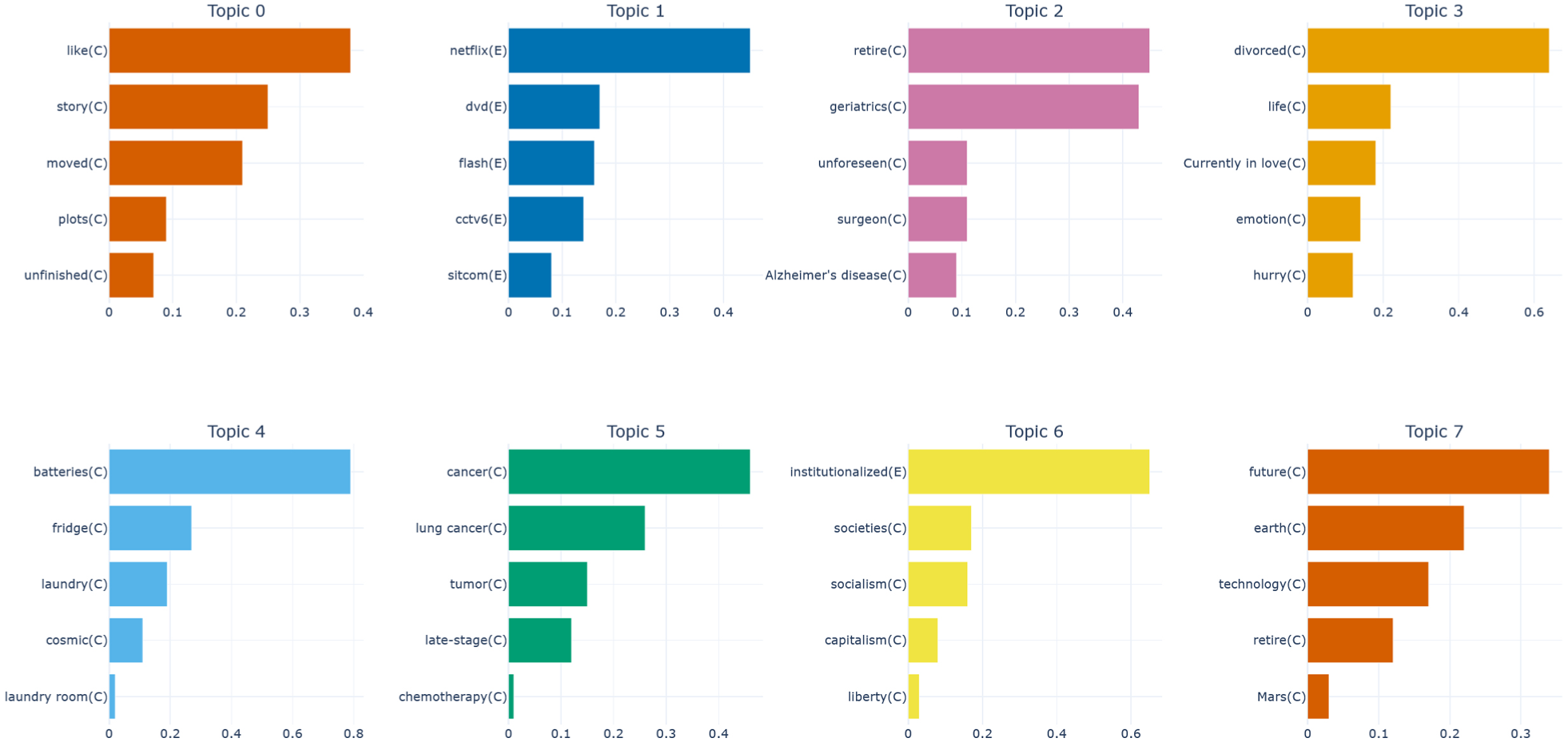
Results of the clustering analysis of the themes of short reviews of American film and television works in Douban.
Gender-Specific Studies
Bar charts in Figures 2 and 3 depict the thematic analysis of short reviews for American films and TV dramas, distinguishing between female and male perspectives. The notation “C” within parentheses following the theme term signifies that the original text is in Chinese, while “E” denotes that the original text is in English.

Thematic cluster analysis results of short reviews of American film and television works by female users on Douban platform.
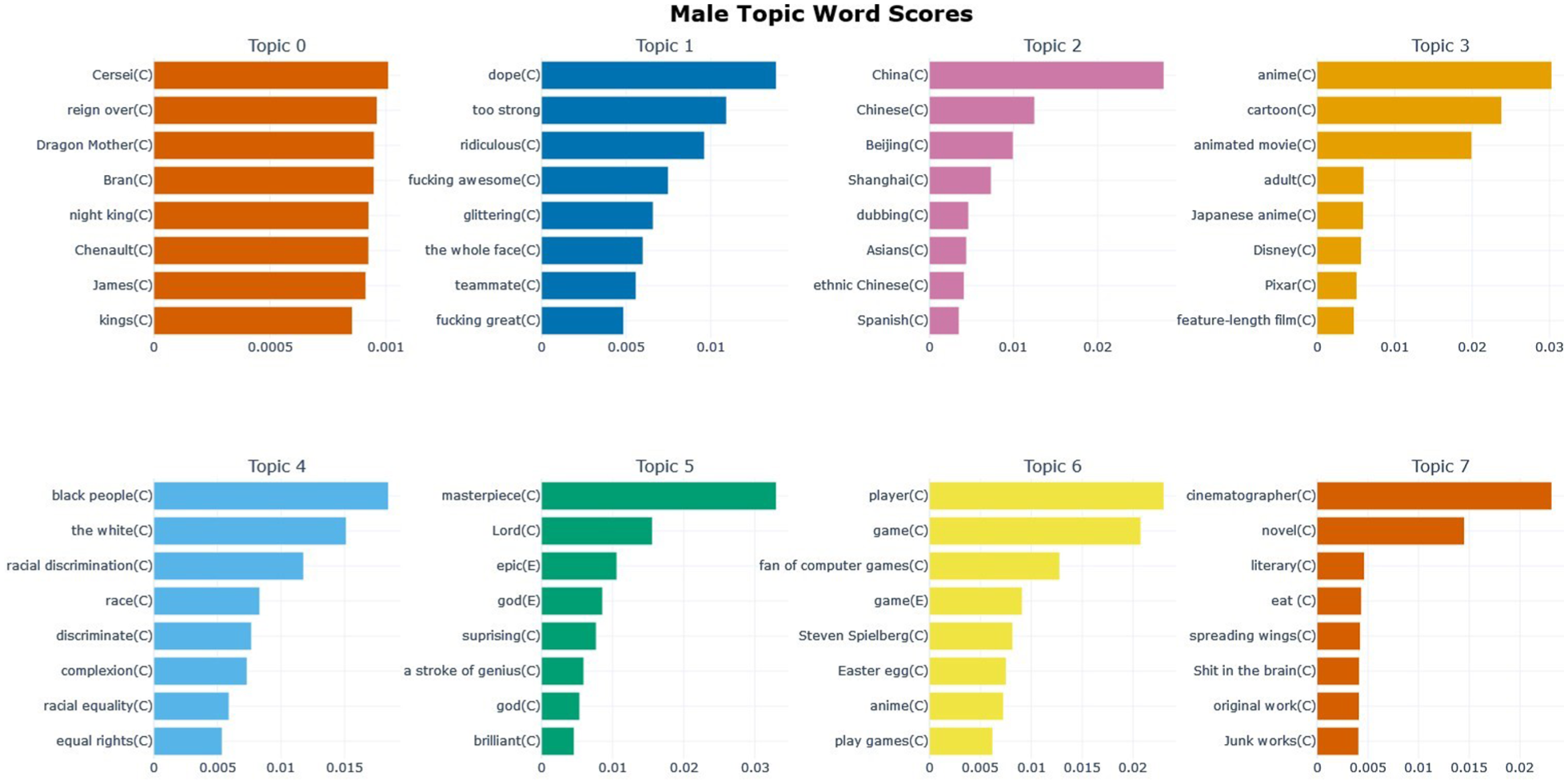
Thematic cluster analysis results of short reviews of American film and television works by male users on Douban platform.
Research has shown that there are significant differences in the topics of interest to male and female viewers.
Female viewers pay more attention to themes related to family and love. This suggests that they are more sensitive to emotions, relationships and emotional expression. Words related to emotions such as tears and crying appeared in their comments, which may mean that they pay more attention to emotional resonance and touching elements in their evaluation of movie plots and character development.
In contrast, male viewers were more interested in genre themes such as fantasy, adventure and gaming. This may reflect their preference for action, excitement and fantasy elements. The presence of networked words and expletives in the comment vocabulary of male viewers may be related to their greater tendency to use Internet language and expressions.
Another interesting finding is that both male and female viewers mentioned political issues such as racial discrimination and human rights equality. This shows that regardless of gender, audiences are also very concerned about the content of movies that reflect social issues and social justice. It can be seen that movies, as a cultural medium, can trigger viewers’ thoughts and discussions on social issues, and movies also have obvious agenda-setting abilities.
Geographical Studies
Geographic distribution is an important aspect in the study of cross-cultural communication of film and television works. Table 1 illustrates the frequency of non-Chinese language usage in comments about the United States across different regions.
Frequency of Non-Simplified Chinese Languages in Douban Comments on American films and TV Shows Varies Across Different Regions.

Among the result of a thematic analysis of the content of Douban reviews of American film and television works, geographically divided according to China’s 34 provincial administrative divisions, excluding the audience’s rating of the specific content of the film and television works (keywords: “episode,”“season,”“star”), and the positive evaluation of the movie by the majority of the audience (keywords: “like,”“movie,”“good-looking”), quantifiers (keywords: “a season,”“a movie,”“an episode”) and themes common to more than half of the provinces. The results of the study show:
Concerns pertaining to issues associated with Christmas (keywords: “Christmas,”“merry Christmas,”“Warmth” etc.) are found in Shanghai, Beijing, Sichuan, Jiangsu, Liaoning, and other provinces.
Concerns pertaining to issues associated with romance (keywords: “French,”“Frence,”“French movies,”“romance,”“warmth,”“humor,” etc.) are Macau, Yunnan, Sichuan, Tianjin, Shandong, Guangdong, Guangxi, Zhejiang, China, Fujian, Chongqing, Hunan, Liaoning and other provinces as well as overseas users.
Concerns pertaining to issues associated with pet (keywords: “cat,”“kitty,”“cats,”“likes,” etc.) include Beijing, Shanghai, Taiwan, Guangdong, Jiangsu and other provinces.
Concerns pertaining to issues associated with nuclear radiation (keywords: “nuclear radiation,”“nuclear power plant,”“terrible,”“disaster,”“Fukushima,”“Chernobyl,” etc.) are Shanghai, Hubei, Zhejiang, Guangdong, Fujian and other provinces as well as overseas users.
Concerns pertaining to issues associated with racial discrimination (keywords: “blacks,”“whites,”“discrimination,”“class,”“ color,”“race,”“politics,” etc.) in the provinces of Taiwan, Macao, Inner Mongolia, Shanxi, Henan, Hainan, Gansu, and Guizhou.
Concerns pertaining to issues associated with education (keywords: “education,”“school,”“middle school,”“elementary school,”“high school,”“bullying,”“violence”) related topics are Yunnan, Hebei, Henan, Anhui, Hainan, Guangxi, Guizhou and other remote areas or underdeveloped areas of quality education.
In addition, Table 1 provides a comprehensive overview of language preferences in user comments on American films across different regions on Douban. English usage is highest in Hong Kong (China) at 32.97%, followed by Overseas (30.64%) and Shanghai (26.48%). In contrast, Traditional Chinese language usage is led by Taiwan (24.74%), followed by Hong Kong (China; 9.61%), and Macau (China; 3.36%). This analysis sheds light on regional variations in language choices, offering valuable insights into user preferences and cultural communication patterns on the Douban platform.
It is noteworthy that coastal provinces and economically developed cities exhibit significantly higher frequencies of English language usage compared to inland and economically less affluent regions.
Discussion
Media Presentation and Interpretation From a Gender Studies Perspective
Gender Identity and Media Culture
Extending SIT to media culture, we can explore how media shapes and disseminates gender roles and identities, influencing audiences’ gender perceptions and behaviors (Trepte, 2013). Media consumption involves selective interpretation based on societal norms and individual psychology, leading to different readings of media texts. Through the lens of SIT, we can better understand how media impacts gender identity formation and audience preferences, especially in film and television (Kumar et al., 2022).
Female viewers are often more drawn to themes of family and love, influenced by societal role expectations and gender identity. In Chinese society, women are expected to care for the family and nurture relationships, making them more likely to empathize with content related to family and love (Oliver et al., 2000).
Male audiences, on the other hand, are more focused on fantasy and adventure, which align with societal expectations of bravery and exploration. These genres allow men to fulfill these roles through exciting and imaginative narratives. The socio-cultural construction of gender consciousness disciplines dominant values and esthetics, shaping how the viewer interprets and engages with media content.
Gender consciousness is not innate but is shaped and disciplined by socio-cultural influences. Media plays a critical role in this process, continually reinforcing gender norms through family, school, religious groups, and other channels. For example, boys are encouraged to be brave and responsible, while girls are taught to be gentle and manage domestic affairs. This upbringing forms the initial framework for gender consciousness.
Gender consciousness is not inherent but is molded by socio-cultural factors, and media plays a critical role in reinforcing gender norms through various channels such as family, school, and religious groups. Boys are encouraged to be brave and responsible, while girls are taught to be gentle and focus on domestic affairs. This upbringing forms the foundation of gender consciousness, which, when intervening in film and television, shapes content through the enforcement of gender “disciplines.” (Foucault, 2023) In Hollywood films, for example, male protagonists are often portrayed as brave and intelligent, becoming the narrative and visual focal points, while female characters tend to occupy secondary roles, typically as supportive figures or objects of male desire. This gendered representation reflects how gender consciousness influences media production (Woods, 2024).
The impact of gendered media content on audience interpretation is profound.
Viewers bring their pre-existing gender concepts and social experiences to their engagement with media, acting as “decoders.” Those with traditional gender beliefs may naturally accept and reinforce these stereotypes, while those with modern views on gender equality may critique gender inequality in the content and resist narratives that contradict their values.
Gender Culture and Stereotypes
As a relatively stable ideological representation mechanism, gender culture and stereotypes have a profound impact on society and individuals. They shape people’s perceptions and expectations of gender, influence individual behaviors, attitudes, and values, and crystallize into “norms” of social consciousness and representational practices with a differential structure. Different socio-cultural contexts give us a window into gender culture, and through the gendered interpretation of American films and movies by Chinese viewers, we can examine the cultural differences of gender culture in the process of cross-cultural communication.
Australian sociologist Cornell suggests that “masculinity,” as a plural form and fluid cultural concept that varies across cultures, classes, and races, externalizes gender studies from a biological essentialist, psychological positivist-style research paradigm to a dynamic presence on the cultural field (Connell, 2020). The concept of gender has been widely used in the field of cultural studies. Gender consciousness influenced by socio-cultural contexts constructs a model of power relations between masculinity and femininity, creating a more stable gender order. This involves the production relations that distribute the way work is done, the cultural rights relations of cultural capital, and the emotional relations that connect networks of interpersonal interactions. Gender culture and stereotypes shape specific roles and patterns of behavior for men and women in society. Traditionally, men are expected to exhibit competitive, calm, and strong traits in the professional sphere, representing the dominant power of men in the complex mechanisms of the institutional division of labor, whereas women are expected to exhibit caring, tender, and considerate traits in the domestic and emotional spheres, and are viewed as suitable for the domestic sphere or for unskilled types of occupations with low levels of authority. These role restrictions and social expectations influence individual career choices, lifestyles, and family roles, limiting people’s free development. In a patriarchal society and culture, the issue of power relations in the struggle for cultural capital involves the struggle for control over the interpretation of meaning, which is also reflected in the discursive construction and interpretation of meaning in film and television works.
Scott views gender, along with race and class, as an ideological system of repression, and argues that the category of gender plays an important role in structuring social frameworks that tame the subject and provide legitimacy to poorly structured societies (Scott, 2007). This is reflected in the mechanisms of cultural representation as gender culture and stereotypes have an impact on the self-identity of the individual. For individuals who do not conform to traditional gender expectations, they may face identity distress and challenges to their self-worth. For example, men may be perceived as “not manly enough” because of their interest in emotional expression, and women may be perceived as “too strong” because of their interest in leadership.
Gender culture and stereotypes contribute to prejudice and discrimination against different genders. When individuals do not conform to the traits prescribed in the gender culture, they may face negative evaluations and discrimination from society. This not only affects an individual’s self-esteem and mental health, but also hinders social inclusion and diversity (Burgess & Borgida, 1999).
Gender culture and stereotypes also influence discrimination in education and in the workplace. In the field of education, there may be differences in the expectations and evaluations of male and female students, affecting their academic development. In the workplace, women may face gender discrimination and barriers to career advancement and be considered unsuitable for certain senior positions or professions (Tabassum & Nayak, 2021).
Conversely, it is necessary to interrogate the ways in which these genre preferences reflect the evolving dynamics of gender roles in contemporary China. While traditional gender stereotypes remain visible in media consumption, the self-identifications of younger cohorts are being progressively reshaped by rapid social change and rising awareness of gender equality Recent studies have documented a growing diversity of female representations in Chinese media, with many characters portrayed as independent, resilient, and brave (Wang & Li, 2023). Such portrayals suggest that women’s identifications and interests have expanded beyond the historically dominant sphere of domestic romance to encompass career development, self-realization, and even fantasy and adventure narratives. By the same token, male audiences are becoming incrementally more receptive to content centered on emotion and family, and the roles modern men occupy in both public and private domains are markedly more varied than in previous generations (L. Li & Wu, 2025). These developments indicate that the boundaries of gendered identities are increasingly fluid: younger individuals are less constrained by inherited gender scripts—women attend to both affective and professional aspirations, whereas men pursue achievement and adventure while attaching greater value to family life.
Because social identity is inherently dynamic, China’s gender culture is undergoing continual renegotiation and rebalancing. Whether the gendered viewing patterns identified in this study simply reproduce entrenched stereotypes or, to some extent, point to an ongoing reconfiguration of gender role perceptions requires sustained longitudinal investigation (Y. Zhang & Liu, 2022). In this regard, Social Identity Theory offers a critical lens, reminding scholars to attend to the identity motivations that underlie group behavior: such preferences may simultaneously reaffirm traditional gender identities and subtly contest the prevailing gender order.
Gendered differences in the topics that audiences pay attention to in film reviews embody the aggregate mind-set of individuals when they engage in film consumption as a leisure activity. Contemporary Chinese film and television works present increasingly diverse gender images: alongside male and female figures that accord with traditional Confucian ethics, new masculine and feminine images suited to a modernized society have also emerged. Audience commentary thus reflects the public’s understanding of gender images within entertainment consumption, an understanding that differs from gender attitudes expressed in political life and economic consumption.
Since the establishment of the People’s Republic of China in 1949, the government has consistently advocated universal equality between men and women in politics, the economy, culture and society. In recent years, influenced by feminist currents, gender relations in China have settled into a subtle balance grounded in implicit antagonism.
Under the combined influence of these two forces, men and women have shown no marked changes in social life and even display a tendency toward homogenization.
However, within the sphere of film and television consumption—once the public sets aside serious political issues and weighty economic concerns—men pay greater attention to fantasy, adventure, and gaming topics, whereas women are more inclined to discuss pets, family, and love, revealing a clear divergence—an intriguingly distinctive phenomenon.
Most Douban users are young adults from major cities who have grown up in an environment of gender-equality discourse and material affluence; unburdened by oppressive gender norms, they possess a stronger sense of gendered free will. Posting film reviews on Douban occurs in a relaxed, quasi-anonymous setting, so these opinions can be regarded as authentic reflections of audience psychology.
Although men and women occupy differentiated and sometimes competitive positions in occupations (Rosenfield & Mouzon, 2013) and social roles (Offer & Schneider, 2011)—differences that might be expected to surface in film commentary—empirical studies do not support such a link. Role theory maintains that individuals holding a particular status are expected, or expect others, to enact certain behaviors; by this logic, China’s gender-equality environment should lead men and women to converge thematically (Hindin, 2007). The gender-similarity hypothesis likewise (Hyde, 2014) posits that the sexes are alike on most psychological traits, with heterogeneity arising mainly from situational factors within each group. Yet this hypothesis plainly fails to explain the distinct themes expressed by men and women in film reviews.
Our empirical findings demonstrate that, in contemporary China’s film-consumption field—and, by extension, the broader realm of leisure consumption—neither sex engages in the self-disciplining practices predicted by social-identity theory. The observed differences in topical attention arise from men’s and women’s genuine expression in an unrestrained context, indicating that people revert to their natural attributes and cultural traditions when participating in light-hearted entertainment. Men focus more on themes of combat and exploration, whereas women focus more on themes of family relationships; this pattern is neither resistance to social gender norms nor negotiation with modern industrialization, but rather an acceptance of traditional gender roles and a conscious identification with cultural heritage. In other words, Chinese audiences exhibit a pronounced trend toward cultural reversion within the sphere of cultural consumption.
Media Presentation and Interpretation
The media is a key channel through which we receive information, observe the world, and understand society. As a vehicle for cultural communication, the media presents and interprets gender-related themes, which viewers understand and engage with based on their gender identity and socialization experiences. The media’s presentation and interpretation have significant implications for both society and individuals.
Media representation influences societal and individual cognition by shaping ideologies, reinforcing stereotypes, guiding public discourse, and impacting cultural and social identities (Fowler, 2013). According to agenda-setting theory, media have a powerful agenda-setting function by choosing which topics to cover, thus directing public attention. For instance, during elections, media coverage of candidates’ policies and personal images guides voters’ attention to specific issues, influencing their voting decisions. Media representations often perpetuate stereotypes about gender, race, or social groups, reinforcing societal biases (Fowler, 2013). Social cognitive theory suggests that repeated stereotypes in the media strengthen existing cognitive schemas, leading audiences to unconsciously accept biased views. For example, the portrayal of women as weak and dependent on men in films can lead to stereotypical views of women.
Roland Barthes argued, “There are countless ways to narrate the world,” emphasizing that different perspectives result in varied worldviews. The framework created by a text shapes how we perceive it, excluding other aspects. In “The Gaze in the Expanded View,” Brisson explained that “cognitive codes” embedded in the visual discourse system influence how we interpret media, and this interpretation is shaped by social discourse. Mieke Bal introduced the concept of “framing,” where both visual and linguistic symbols generate meaning intertwined with ideology. Media framing organizes information through specific perspectives, guiding public interpretation of issues.
Furthermore, media portrayals of cultural and social groups shape individual and collective identities, impacting self-perception and public recognition (Slater, 2007).
Symbolic interaction theory suggests that self-identity forms through interactions with others, interpreting symbols, including those presented by the media. For example, idealized portrayals of successful urban white-collar workers may influence young people to compare themselves with these images and adjust their self-identity.
Media literacy plays a crucial role in enabling individuals to critically assess and interpret media content, preventing misinformation and manipulation. It highlights the media’s significant impact on shaping cognition, identity, and social norms. Developing media literacy—skills like information discernment and multi-perspective analysis—helps individuals break free from one-sided media narratives, restoring the truth and avoiding cognitive pitfalls inadvertently created by the media.
Media Presentation From the Perspective of Geographical Studies
Regional and Cultural Influences on Film Interpretation
We also uncovers notable regional variations in content preferences, which can be further explicated through Bourdieu’s theory of cultural capital. Cultural capital theory posits that systematic differences in taste and cultural consumption arise from disparities in individuals’ cultural resources and educational backgrounds (Bourdieu, 2018). Audiences in economically developed regions tend to possess higher levels of education and a broader cultural horizon; they are exposed earlier and more extensively to international information, global cultural products, and pluralistic value systems. Consequently, they have accumulated substantial “global” cultural capital and show greater interest in—and comprehension of—cross-cultural or globalized themes. By contrast, audiences in less-developed regions, historically constrained by uneven resource allocation and relatively limited information channels, hold forms of cultural capital that remain more localized and rooted in everyday experience. They gravitate toward social issues closely tied to their life worlds—rural–urban inequality, social justice, livelihood concerns, and the like. Thus, content preferences are largely bounded by the cultural resources and cognitive frameworks available to audiences: those endowed with abundant capital can appreciate unfamiliar cultural elements or narratives with grand international settings, whereas those with limited capital tend to select works that reflect their immediate social realities. As Bourdieu argues, the cultivation of esthetic taste is shaped primarily by one’s social environment and educational trajectory rather than by simple accumulation over time. Hence, the preferences of audiences in China’s prosperous coastal regions for globalized themes are not accidental; they are underpinned by the socioeconomic status and cultural formation of these groups. Likewise, the focus of audiences in the less-developed central and western regions on local social issues mirrors the realities fashioned by their cultural capital and social experience (Zhou et al., 2010).
These regional patterns are further rooted in deeper historical, political, and technological structures. Historically, coastal economic–cultural centers benefited from geographical advantages and open-door policies, positioning them at the vanguard of Sino-foreign exchange and allowing them to accrue strong global cultural influences since the late 19th century. In contrast, inland regions have long remained oriented toward agriculture and local social concerns, experiencing limited external cultural impact—a historical imbalance that underlies today’s divergence in regional cultural tastes.
Politically, since 1949 and particularly after the Reform and Opening-up era, uneven state investment in regional development has afforded the coastal provinces greater economic, technological, and educational resources, whereas public cultural and educational spending in central and western provinces has lagged behind (Liang, 2024). This policy trajectory has perpetuated a development gap, creating unequal opportunities for cultural resource acquisition and, over time, a structural division in cultural consumption. Technologically, the “digital divide” exacerbates differential access to global information and cultural production: cities and affluent regions adopted the internet and new media technologies earlier, enabling rapid diffusion of international content into daily life, whereas less-developed—especially rural—areas still contend with slower infrastructure roll-out and lower media literacy (Guo & Li, 2024). Digital technology itself has become an important form of cultural capital that can be converted into socioeconomic advantage. Communities situated at the margins of the digital environment, lacking discursive power and visibility, are frequently overlooked by the mainstream cultural market and possess limited channels for accessing globalized content; they therefore turn their attention to locally salient issues as a means of articulating concerns and engaging with reality.
These structural factors collectively produce the marked differences in content attention between affluent and less-developed regions: the former’s attention to global cultural products stems from historically endowed cultural-capital advantages, whereas the latter’s focus on local social issues reflects experiential realities conditioned by structural disadvantage. It is important to note that such cleavages are not static. The internet has enabled American TV series to circulate simultaneously in both economically developed and less-developed regions, allowing audiences to communicate across time and space.
Compared with the traditional mass-media era more than 20 years ago, this means the information gap has narrowed significantly and genuine media equality is now within reach. As state policies aimed at promoting regional equilibrium intensify and as digital technologies continue to diffuse into less-developed areas, the cultural consumption gap will gradually narrow. For the time being, however, inequalities in cultural capital remain a fundamental determinant of regional differences in audience interests and value orientations, and the historical and structural underpinnings of these inequalities warrant sustained scholarly attention and critical scrutiny.
Cultural Identity, Language Preferences, and Media Dependency
Social Identity Theory (SIT) provides a robust framework for understanding how group affiliations shape media consumption and interpretation. SIT emphasizes the internalization of group identities and explores how cultural frameworks imbue interpretative significance across different social groups. For affluent regions, media consumption often aligns with narratives that reinforce cosmopolitan and symbolic identities. These audiences interpret cultural symbols with greater sophistication, leveraging their cultural capital to decode the deeper meanings embedded in foreign films.
Audiences in less affluent regions, by contrast, approach foreign narratives through the lens of their socio-political realities. This reflects the cultural communication space where media technologies, textual content, and regional environments interact to create diverse interpretations (Jenkins, 2011). David Morley’s concept of “cultural clusters” highlights how geographical, cultural, and economic differences lead to multiple interpretations of media texts. For these audiences, films serve as a medium to critique and navigate the “otherness” of foreign cultures, fostering an understanding of cultural diversity through localized perspectives (Morley, 2003, 2005).
Language preferences further illustrate regional disparities in media consumption. Economically developed coastal regions exhibit a stronger reliance on international media and a greater preference for English communication, influenced by globalization and modernity. Media Dependency theories explain these trends, highlighting how dominant cultures shape media content and language choices. Historical and cultural factors, such as the influence of Taiwan, Hong Kong, and Macau, further underscore the unique linguistic legacies of certain regions.
Selective Exposure Theory offers additional insights into why affluent regions gravitate toward international media. These audiences are more integrated into global networks, shaping their media preferences and language choices. Conversely, underdeveloped regions prioritize content that aligns with their immediate socio-political concerns, reflecting localized priorities in media consumption.
Agenda Setting and Selective Exposure on Douban
Conversely, on contemporary digital platforms such as Douban, patterns of content circulation and audience consumption are shaped simultaneously by agenda-setting and selective-exposure mechanisms, which together reinforce cultural hierarchies, gendered role divisions, and stratified taste cultures. Agenda-setting theory posits that mass media influence public perceptions of issue salience by foregrounding certain topics (Y. Luo, 2014); as Cohen famously remarked, “the press may not be successful in telling people what to think, but it is stunningly successful in telling its readers what to think about.” (Cohen, 2015) In the digital era, the same logic applies to cultural consumption: the items emphasized in platform recommendations and leaderboards (e.g., Douban’s “Top-Rated Films/Books”) signal to users which cultural products are worthy of attention. Such algorithmic and editorial cues steer attention toward works deemed “high quality,” thereby naturalizing a cultural hierarchy in which art-house or niche productions are valorized while mainstream popular culture is comparatively marginalized. Over time, users internalize this platform-defined “cultural agenda,” equating high scores and strong word-of-mouth with superior cultural status—an online extension of Bourdieu’s cultural-capital stratification (Bourdieu, 2002; Feng, 2019).
Selective-exposure theory explains how users then self-reinforce existing tastes and identities. Audiences gravitate toward content consonant with their prior attitudes, avoiding dissonant material and thereby reducing cognitive strain. On Douban this manifests in the voluntary formation of interest groups and algorithmically curated feeds: many female users join explicitly gender-marked subforums (e.g., “Women in Academia,”“Female Gamers”) to seek solidarity, prompting the recommender system to supply ever more gender-relevant topics; male users likewise cluster around communities that mirror their interests and self-conceptions (Rabb et al., 2023).
Consequently, each cohort dwells inside a semi-sealed content environment that continually affirms its own preferences—literary youth repeatedly consume and endorse art-house films and independent music, young women concentrate on female-centered discussions and idol culture, while other audience blocs pursue their respective niches.
The interplay of agenda setting and selective exposure generates echo-chamber and filter-bubble effects. The agenda function supplies a common evaluative frame—Douban ratings and charts serve as authoritative yardsticks guiding consumption and debate.
Users, persuaded by this hierarchy, treat highly rated works as must-see texts, further elevating their status and eclipsing under-promoted alternatives. Meanwhile, selective exposure keeps users anchored within algorithmically reinforced circles, limiting contact with divergent content and viewpoints; this deepens opinion polarization and taste segregation. Empirical studies of Chinese digital media confirm that algorithmic curation and user self-selection jointly intensify echo-chamber dynamics, narrowing cross-group dialog even when divergent material is theoretically accessible (Gao et al., 2023).
Thus, Douban operates both as an arena where cultural taste is classified and as a site for identity expression and negotiation. By demonstrating how platform-level agenda setting steers perceived cultural value and how selective exposure locks users into affinity groups, the present analysis shows that Douban tacitly reproduces broader social differences in cultural capital and gender roles—substantiating recent network-agenda-setting findings in the Chinese context (Shen & Han, 2023).
Conclusion
Digital reception of foreign films in China unfolds within a multilayered social field in which regional development, economic resources, and gender hierarchies jointly configure access to—and interpretation of—global screen narratives. Large-scale Internet surveys show that the urban–rural gap in connectivity persists: by December 2024 urban users accounted for 71.8% of Chinese netizens, whereas rural users remained below 30% (China Internet Network Information Center, 2025). Province-level panel data further demonstrate a strong positive correlation between broadband penetration and per-capita income, confirming that infrastructure tracks economic advantage (X. Zhang, 2021). Recent analyses of Chinese General Social Survey (CGSS) spanning 2005–2021 likewise reveal that regional digital divides have narrowed only slowly and remain closely tied to spatial patterns of GDP growth (Zhao & Kuang, 2025). Within this uneven terrain, coastal audiences—better endowed with cultural capital and high-speed networks—are more likely to valorize symbolic and esthetic dimensions of Hollywood, South Korean, or Indian cinema (Yaqoub et al., 2024), whereas viewers in less-developed hinterlands gravitate toward socio-political storylines that echo everyday struggles and collective identities (K. Ma, 2024).
Platform evidence reinforces these cleavages. Douban, the country’s dominant review site, disproportionately attracts highly educated users from first-tier cities; their ratings exert measurable influence on nationwide box-office demand and signal cultural distinction practices aligned with Bourdieu’s notion of “legitimate taste” (Gao & Kuipers, 2024). At the same time, streaming traffic analyses reveal that economically weaker provinces are increasingly bypassing cinemas in favor of low-cost mobile viewing, a shift accelerated by the 2024 box-office contraction and broader consumer-confidence shortfall (Chan Ho-him & Ding, 2025). These patterns corroborate sociological accounts that link cultural participation to both material resources and embodied competence: Chinese elites consolidate status through engagement with “highbrow” global media, whereas under-resourced groups mobilize film texts for more pragmatic or affective ends (G. C. Li, 2021).
Gender further mediates this stratification. Confucian-derived norms continue to prescribe differentiated subject positions for men and women in popular culture, shaping genre choices, character identification, and even commenting styles on social media (Z. Chen, 2017; L. Li & Wu, 2025). The persistence of such norms suggests that algorithmic recommendation systems may reproduce rather than dismantle entrenched stereotypes, thereby limiting the emancipatory potential of digital media in the Chinese context.
These findings pose clear practical challenges. For content producers, stratified audience segments call for differentiated strategies in distribution, subtitle localization, and narrative framing: tailoring promotional campaigns to the linguistic, cultural, and infrastructural conditions of inland viewers could broaden market reach without deepening symbolic hierarchies. Policymakers, meanwhile, must pair ongoing 5G roll-outs with targeted investments in public cultural spaces and media-literacy programs to mitigate the “second-level” digital divide—that is, disparities in the ability to transform connectivity into meaningful participation (Cai & Liu, 2022). Finally, cultural-equity grants earmarked for cinema circuits and community screening initiatives in underdeveloped regions would help counterbalance market logics that currently privilege coastal consumption hubs.
Future research should advance three agendas. First, cross-platform comparative studies—linking usage traces from Douban, Bilibili, Xiaohongshu, and emerging short-video apps—are needed to test the robustness of regional and gender dynamics across distinct participatory cultures. Second, longitudinal panel designs that track individual media repertoires alongside infrastructural upgrades will clarify causal pathways between connectivity, cultural capital accumulation, and taste formation over time. Third, integrating intersectional lenses that consider ethnicity, class, and age alongside region and gender will sharpen theory and remedy Western-centric blind spots in Social Identity, Media Dependency, and Cultural-Capital frameworks as applied to China. In sum, recognizing the co-constitution of material infrastructures, symbolic resources, and social identities is essential for fostering a more inclusive and culturally plural Chinese media ecology.
Footnotes

Funding
The authors received no financial support for the research, authorship, and/or publication of this article.
Declaration of Conflicting Interests
The authors declared no potential conflicts of interest with respect to the research, authorship, and/or publication of this article.
Data Availability Statement
Data sharing not applicable to this article as no datasets were generated or analyzed during the current study.