




Abstract
Support for democracy is essential for democracy consolidation and to prevent backsliding into autocracy. This paper employs survey data from Guyana to study explanations of support for democracy. It utilizes seven measures, four of which target decidedly diffuse support with two measuring support for non-democratic principles. It finds that although principled support for democracy based on democracy affirming measures is high and tolerance for non-democratic actions by the incumbent is generally low, large percentages of the citizens (more than 40%) believe that a military takeover in difficult times is justified in some cases. Regime performance, political attitudes, ideological orientation, culture, socioeconomic status and demographic variables all contribute to explaining both specific and diffuse support for democratic and non-democratic principles and they combine to explain between 13.5% and 58.8% of the variance of the democracy/ non-democracy support measures. Furthermore, principled support is shaped by less diffuse support and is impacted by instrumental regime performance. However, inclusion of support for non-democratic principles is crucial to detection of the effects of several variables on principled support or democracy. In addition, cognitive dissonance appears to underlie some of the antecedent relationships with support for democracy and non-democratic principles.
Plain Language Summary
This paper utilizes survey data from Guyana to study explanations of support for democracy and non-democracy. It finds that although support for democracy as a system of government is high and tolerance for non-democratic actions by the incumbent is generally low, the belief that military takeover in difficult times is justified is prevalent in the population. Several categories of variables are useful in explaining the support for democracy. This includes the performance of the regime, political attitudes, ideological orientations, culture, socioeconomic status and demographic variables. Together these categories of variables explain between 13.5 and 58.8% of the variance in support for democracy or non-democracy measures. However, using only measures based on items that explicitly use the word ‘democracy’ would result in several significant relationships with these variables going undetected. There is also some evidence of people holding contradictory views on democracy support and support for non-democratic principles. In addition, among other significant findings, support for democratic principles depends to some extent on how well the government performs.
Introduction
Support for democracy is crucial for attaining and maintaining democratic consolidation and for guarding against backsliding into autocracy in transitioning societies (Claassen, 2020a, 2020b; Foa & Mounk, 2017). The global rise in apathy therefore poses a significant threat to democracy (Foa & Mounk, 2016) exacerbated by the rise of populism (Abts & Rummens, 2007; Grigera, 2017; Kwon, 2021; Mudde & Kaltwasser, 2013) and the persistent assault by populist and authoritarian leaders and political parties (see Claassen, 2020a). In Latin America, the prevalence of authoritarian attitudes and the large proportions of the populations disagreeing that democracy is the best political system create fertile grounds for breaches of democratic norms and for non-democratic governance in general (Córdova & Seligson, 2010; Foa & Mounk, 2016; Stevens et al., 2006). This concern is equally pertinent in Western societies where significant proportions of the youth perceive democracy as a (very) bad mode of governance prompting assertions – though subject to contestation (see Claassen, 2020b; Wuttke et al., 2020) – that democratic deconsolidation is underway (Foa & Mounk, 2016, 2017). The state of support for democracy accentuates the need for understanding its drivers.
However, both the conditioning role of the national context and the measurements employed are important issues in the study of democracy support. Factors such as the nature of democracy, prevailing economic conditions and institutional arrangements can either attenuate or amplify the antecedent effects on support for democracy (Anderson & Guillory, 1997; Chapman et al., 2023; Katz & Levin, 2018; Magalhães, 2016). Both national and cross-national studies are relevant in unravelling the phenomenon. On the issue of measurement, it is necessary to address whether specific or diffuse democracy support is captured to disentangle a focus on support for regime performance (Claassen, 2020a) from support for democratic principles. Researchers have also indicated that popular measures of support for democracy that use the word ‘democracy’ are subject to social desirability bias leading to inflated support (Inglehart, 2003). Therefore, measures that avoid this and especially those that address support for non-democratic principles are desirable.
This paper focuses on explaining support for democracy. In doing so, it employs measures of specific and diffuse support including some hybrid measures (both specific and diffuse support). Among the measures of diffuse support for democracy are two that draw on items that explicitly mention the word ‘democracy’ and two that avoid this by tapping into support for non-democratic principles. By comparing the results for diffuse support across the two sets of measures, this paper contributes to the discussion on how they impact the results. The effects of several categories of independent variables are assessed: structural characteristics, socioeconomic status, ideological orientations, cultural factors, political attitudes and regime performance alongside the impact of less diffuse support on strictly diffuse support for democracy and non-democratic principles. The data utilized are from Guyana which identifies as part of the Anglophone Caribbean, and which is seldom included in studies on democracy support in Latin America. This paper therefore additionally contributes to addressing the paucity of evidence for Guyana on this topic.
The Guyana Context
Guyana is a non-Western English-speaking country in South America. It operates under a Westminster, winner-takes-all form of electoral democracy but has a history of rigged elections (Khemraj, 2013). There was a return to democratic elections in 1992 which ushered in 23 continuous years of governance by the same political party. There was then a change of government in 2015 followed by another change in 2020 after a single 5-year term. The 2020 transition was eventful. It appears that the losing party attempted to hold on to power leading to local and international pressure for the elections commission to declare the correct election results (Chabrol, 2020). This episode was a jarring reminder of the enduring precarious state of democracy in the country. In fact, although Guyana is an electoral democracy, the 2024 report of the V-Dem Institute indicates that it has regressed democratically and this is evident in relation to several democracy measures (see Nord et al., 2024).
Apart from the 2020 debacle, elections in Guyana are marked by ethnic tension between its two largest groups – Indo Guyanese and Afro Guyanese (Edwards, 2017). Each of the two main political parties is known to target one of these ethnic groups as its main constituent (Griffith, 1997; Singh, 1994). Depending on which party wins the national elections, one of the ethnic groups is thus perceived to be in alignment with the government (Edwards, 2017; Khemraj, 2013). We refer to the ethnic group perceived to be aligned with the national government as the politically relevant group.
Guyanese institutions are considered to be weak (The World Bank, 2023), and the executive’s influence is prominent in their functioning. The country has also faced difficult economic circumstances and experienced expanding inequality (see Constantine, 2017). Nevertheless, it achieved upper middle-income status in 2015 and, due to a new petroleum sector, high income status in 2022 (see Hamadeh et al., 2023).
Theories of Support for Democracy
Researchers have proposed various perspectives on how support for democracy emerges and develops. Three such perspectives are the socialization theory, the performance theory and the lifelong learning theory. Although these perspectives have different nuances, they essentially regard democracy support as both learned and self-sustaining since democracy creates its own demand (Bratton & Mattes, 2001; Claassen, 2020b; Mattes & Bratton, 2007). Experience with democracy is therefore a foundational driver and democracy support becomes ubiquitous over generations. The performance and lifelong learning theories include an instrumental component focused on the benefits such as economic development and efficient and clean governance in addition to the common intrinsic component focused on issues such as providing political freedoms (Bratton & Mattes, 2001; Claassen, 2020b; Mattes & Bratton, 2007). The instrumental component conceptually accommodates fluctuations in democracy support, but its predictions fail to align with empirical evidence (Foa & Mounk, 2016). For example, there was an uptick rather than a decline in democracy support in Latin America in the presence of poor economic performance in the early 2000s (see Graham & Sukhtankar, 2004). In contrast the recently proposed thermostatic theory seems to explain the fluctuations in democracy support around the world. It asserts that changes in democracy generate ‘sharp and opposite reactions from the public’ so that increases in democracy, for example in minority rights and protections, are accompanied by reductions in democracy support. Concomitantly, a waning level of democracy will trigger stronger support (Claassen, 2020b, p. 48). This perspective contradicts the common belief that democracy support is learned and self-sustaining.
In addition to overarching theoretical perspectives, researchers have employed several categories of variables to explain support for democracy at the individual level. We focus on regime performance, political attitudes, ideological orientations, cultural factors, socioeconomic status and demographic variables.
Regime performance concerns the delivery of outputs relative to demands and general perceptions about the quality and performance of government. It involves economic performance and policy performance. If democracy provides benefits to citizens or if citizens approve of the perceived job performance of the incumbent, support for democracy is expected to increase (Córdova & Seligson, 2010; Magalhães, 2014). Regime performance is therefore linked to the instrumental aspect of democracy support. Much of the literature suggest that such performance would influence specific support while leaving diffuse support intact (see, Claassen & Magalhães, 2021; Mattes & Bratton, 2007). However, this is not generalizable outside of consolidated democracies wherein support for regime principles and satisfaction with democracy can depend on regime performance (Anderson & Guillory, 1997; Mishler & Rose, 2001).
Both socio-tropic and egocentric economic performance of the incumbent tend to increase democracy support (Córdova & Seligson, 2010; Katz & Levin, 2018) although research results are not unanimous especially for diffuse support (e.g., Claassen & Magalhães, 2021). Nevertheless, subjective economic performance functions better as a predictor than objective measures (Mishler & Rose, 2001). In contrast, crime lowers both specific support and support for regime principles (Carreras, 2013; Claassen & Magalhães, 2021). Furthermore, fear of victimization by crime makes it more likely that people will condone if not outright demand authoritarian approaches which precipitates backsliding on commitment to democratic principles (Pérez, 2003).
Clean government is an element of regime performance, and in this regard, elevated corruption perception might hinder support for democracy and regime institutions (Anderson & Tverdova, 2003; Erlingsson et al., 2016), notwithstanding counterexamples in relation to diffuse support (e.g., Canache & Allison, 2005; Claassen & Magalhães, 2021). A stronger perception of corruption could indicate frustration with government excesses or of opposition to the incumbent leading to declines in specific support, satisfaction with democracy (Claassen & Magalhães, 2021), and support for the political system (Canache & Allison, 2005; Mishler & Rose, 2001). When salient, corruption or perceived corruption seems likely to undermine support for regime principles, as seen in Iceland after the 2008 financial crisis (Erlingsson et al., 2016) and as reported for diffuse support for regime institutions in Latin America (Carreras, 2013).
Regarding political attitudes, we focus on political interest, political cynicism, anti-immigrant attitude, and feelings of resentment. Though many studies indicate positive associations between political interest and satisfaction with democracy and support for regime principles (Erlingsson et al., 2016; Kokkonen & Linde, 2023), its effects might depend on the context (Anderson & Guillory, 1997). Political cynicism involves the belief that politics and those involved are irredeemably immoral and driven by self-interest, which would reflect on the execution of government (Krouwel & Abts, 2007). Its targets are politicians, political institutions and the political system, and one of its manifestations is withdrawal from politics which directly impacts on participatory democracy (Rijkhoff, 2018). Given its targets, political cynicism is likely to affect specific support for democracy, system support, and satisfaction with democracy.
Anti-immigrant attitude is important in the Western literature on populism which involves system challenge and rejection of some democratic norms including mediated representation (see Akkerman et al., 2014; Hunger & Paxton, 2021; Mudde & Kaltwasser, 2013). This attitude has recently been introduced as a potential explanation of democracy support and it apparently reduces both satisfaction with democracy and the perceived importance of living in a democratically governed state (Kokkonen & Linde, 2023). Populists in Latin America tend to focus more on inclusion and redistribution than their European counterparts, and hence their demarcation of the perceived majority might draw less on national origins (see Mudde & Kaltwasser, 2013). An additional issue for research could be whether anti-immigrant attitudes also lower democracy support in Latin America as in Western Europe.
There is a paucity of studies addressing the potential impacts of feelings of resentment on support for democracy. Feelings of resentment capture reactions to the perception that one’s ingroup is unjustly at a disadvantage compared to some reference group (Abts & Baute, 2022). It involves four subconstructs: group relative deprivation, status insecurity, powerlessness and ontological insecurity, the first two of which are included in our analysis. Feelings of resentment engenders loss of hope and anti-establishment sentiments including anger directed at the political establishment (Hoggett et al., 2013). Group relative deprivation is the perception that institutionalized inferiority is being unjustly foisted onto one’s ingroup leading to anger towards the government and its systems for the perceived injustice (Maxwell, 2009; Sanders et al., 2014). Status insecurity is the fear of losing social status, economic position and living standard which results in uncertainty and lack of optimism about the future (Gidron & Hall, 2017). With feelings of resentment generally directed at the government, it is expected that the subconstructs are negatively associated with the perceived performance of government and hence with specific support for democracy. Nevertheless, feelings of resentment are inherently an enduring state which suggests that its impacts could spill over to diffuse support.
Ideological orientations function as heuristics that are sometimes invoked to converge quickly on interpretations and conclusions in some situations (Barros et al., 2020; Huckfeldt et al., 1999) and are expected to affect democracy support. Referring to left-right self-placement, researchers indicate that ‘ideology defines different conceptions to democracy’ (Jurado & Navarrete, 2021, p. 11). More specifically, some indicate that satisfaction with democracy is higher among those farther to the right (Magalhães, 2016), and that principled support for democracy is stronger among citizens farther to the left of the political spectrum (Torcal & Magalhães, 2022). Other ideological orientations such as individualism, egalitarianism (see Cox, 2022; Lovett, 2021) and authoritarianism might also affect support for democracy as they provide lenses through which people perceive relevant phenomena. For instance, Kokkonen and Linde (2023) indicate that, in different data sets, authoritarianism varies in its associations with the importance of living in a democracy, how democratic the country is perceived to be and principled support for democracy.
Researchers have also explored the effects of cultural factors based on the indications of cultural theories that social and political values explain support for democracy (Mishler & Rose, 2001). The influence of culture is linked to socialization through which norms and values are transmitted. At the macro level, national variations in norms and values are thought to underly country differences in political attitudes (Inglehart, 1988; Mattes & Bratton, 2007). At the micro level, differences in regime preferences and evaluations are influenced by individual norms and values (Mattes & Bratton, 2007). However, cultural variables such as interpersonal trust, risk tolerance, individual responsibility and participation in voluntary organizations have mostly no effect on diffuse support for democracy (Mattes & Bratton, 2007; Mishler & Rose, 2001).
Socioeconomic and demographic variables which capture elements of social structure yield mixed results. Some find no effect of socioeconomic status on democracy support (Mattes & Bratton, 2007; Mishler and Rose, 2001) while others indicate that higher socioeconomic status improves satisfaction with democracy and reduces endorsement of non-democratic regimes (Anderson & Tverdova, 2003; Pérez, 2003). When age and education have significant effects on support for democracy, they are often positive (e.g., Grassi et al., 2023; Erlingsson et al., 2016). But a high level of education is not necessary to inspire support for democratic principles. Primary education appears to be enough, while the overall effect of education on democracy support is positive (Ahmadov & Holstege, 2023). Ultimately the effects of demographic variables might vary depending on the context, but it remains relevant to control their potential effects when studying support for democracy (Anderson & Guillory, 1997; Erlingsson et al., 2016).
Specific and Diffuse Support for Democracy
Specific support for democracy involves an assessment of how well it works which directs attention to evaluations of performance against expectations or demands and perceptions about those in authority (Easton, 1975). Given its focus on government effectiveness or what democracy delivers, specific support is instrumental (Lipset, 1959; Mattes & Bratton, 2007). In contrast, diffuse support targets the underlying principles of democracy or democracy as the form of government (Easton, 1975) and hence it focuses on regime legitimacy which is achieved when citizens believe that the existing political institutions are the right ones for society (Lipset, 1959). Although the robustness of diffuse support is often contrasted with fluctuations in specific support, Easton recognises that discontent about performance over long periods could undermine diffuse support (Easton, 1975). In other words, specific support for democracy can impact on diffuse support for democracy. Still, since the effect of specific on diffuse support is attenuated by democratic consolidation, an impact of specific support is expected to apply more to new and transitioning democracies (Evans & Whitefield, 1995; Katz & Levin, 2018).
Support for democracy is generally measured in surveys wherein one of the most popular items focuses on satisfaction with the way democracy works. Institutional trust or confidence in government which captures support for the political system is another popular measure. Both of these measures have been shown to capture both specific and diffuse support for democracy (Canache et al., 2001; Katz & Levin, 2018; Mattes & Bratton, 2007). They are therefore regarded as hybrid measures. In contrast, decidedly diffuse support is often measured by items requiring choices between democratic and non-democratic alternatives (e.g., Claassen, 2020b), by ratings for the belief that democracy is better than any other form of government (e.g., Córdova & Seligson, 2010; Magalhães, 2014) and by items capturing endorsements of elements of democratic (or non-democratic) principles. Several of these types of measures are included in our analysis of democracy support in Guyana.
Data and Methods
The data were obtained from the Values and Poverty Study in Guyana which is a cross-sectional, nationally representative face-to-face survey conducted in two phases under the supervision of the University of Guyana and the University of Ghent. The first phase of data collection was done between May and June of 2012 in the coastal regions and the second phase was done between October and November 2013 in the interior regions. Together, the two phases cover the geographic area of the country and obtained data from 1,557 respondents: 1,048 in the coastal regions and 509 in the interior regions.
In the first phase of the study, a two-step sampling procedure which selected local government units (municipalities and neighbourhood democratic councils) with probability proportional to size was employed. This resulted in selection of 51 local government units and 87 clusters (cluster size = 12) within them. In the interior regions, communities were substituted for local government units and 17 communities were selected pragmatically to address issues of inaccessibility and sparse populations. Oversampling of the interior regions and gender nonresponse were addressed by calculation and inclusion of weights in the data.
Informed consent for the study was provided verbally by the respondents after they were furnished with an information page. Participation in the survey involved no specific risks to them and the random selection of respondents also ensured that inclusion in the sample was random. Specific respondents cannot be identified in the data.
Measurements
Dependent Variables
Three categories of latent variables measuring specific, hybrid (specific and diffuse) and diffuse support for democracy are included in this study (see Table 1). The strictly specific support measure is job approval of parliamentarians regardless of political affiliation. Parliamentarians are at the centre of democratic decision-making and therefore play a crucial role in how democracy works in the country. Two measures of hybrid (specific and diffuse) support employed are satisfaction with democracy and system support (institutional trust). Satisfaction with democracy is measured by two items: the popular satisfaction with the way democracy works and the extent to which the country is perceived to be democratic (see Mattes & Bratton, 2007). Mattes and Bratton frame this measure, based on the two indicators, as supply of democracy where not only should citizens believe that that system is democratic or mostly democratic, but they must also be satisfied with how it works. System support (Institutional trust) is a popular measure accepted as capturing support for the political system (see Canache & Allison, 2005; Mishler & Rose, 2001). In the Guyanese context, institutional trust is a second-order factor drawing on national and local trust respectively (Thomas et al., 2015). We focus only on trust in national institutions. Four measures of strictly diffuse support for democracy are included in the analysis and they split into two constructs that utilize items that explicitly mention ‘democracy’–choice of democracy and democracy is best– and two based on items that target non-democratic principles –support for non-democratic government and support for military takeover (in difficult times). We refer to the first set of diffuse measures as democracy affirming or simply as democracy support measures and to the latter set as support for non-democratic principles. The democracy affirming measures are believed to be subject to social desirability bias given the explicit mention of democracy (Inglehart, 2003).
Dependent Variables.

Percent Clearly Agree – The percentage of respondents who selected either 4 or 5 on 5-point rating scales or 3 or 4 on 4-point rating scales.
AD Scale: 1 – completely disagree, 2 – disagree, 3 – neither agree nor disagree, 4 – agree, 5 – completely agree.
Explanatory Variables
The categories of explanatory variables are regime performance, political attitudes, ideological orientations, cultural factors, socioeconomic status and demographic variables (see Table A1 in appendix). The performance variables are corruption perception, feelings of unsafety, personal financial situation, satisfaction with personal financial situation, and socio-tropic economic performance. In this group, corruption perception which focuses on the public service is the only latent variable. The political attitude variables are political interest, political cynicism, anti-immigrant attitude and feelings of resentment which includes group relative deprivation and status insecurity. These variables are all measured as latent constructs. Ideological orientations include egalitarianism (focused on income inequality), individualism, left-right placement and beliefs about inequality. Beliefs about inequality has four categories representing different societal structures (see Table A1 in appendix). The cultural variables are interpersonal distrust and disapproval of the welfare state, both of which are estimated as latent variables. Socioeconomic status is measured by assets (proxy for household income), unemployment and education. The demographic variables are chronological age, sex (male), ethnicity and location of residence. Location of residence has three categories – urban, rural, hinterland – and the classifications are based on the size, density and diversity of the regions in Guyana guided by the work of Thomas et al. (2014). The urban communities are in regions 3 and 4 of the country while the rural communites are in regions 2, 5, 6, and 10 and the hinterland communities are in regions 1, 7, 8 and 9 (interior regions).
Data Analysis
The data are analysed using confirmatory factor analysis (measurement models) and structural equation modelling. In each model, the rating scale items are treated as ordered categorial and the weighted least squares means and variance estimator (WLSMV) is utilized. Model evaluation is based on a combination of the root mean squared error of approximation (RMSEA), comparative fit index (CFI) and the Tucker and Lewis Index (TLI). However, the chi-square statistics and the weighted root mean square residual (WRMR) are also reported. In total, three measurement models, and two structural models are estimated.
The first measurement model incudes the democracy support factors that focus on specific, hybrid and diffuse support for democracy with indicators that explicitly mention ‘democracy’. In this model, three correlated residuals for indicators of system support/institutional trust are freed: between Q43_7 and Q43_8, between Q43_2 and Q47_7 (see Thomas et al., 2015) and between the first (justice system) and second (military) indicators (modification index = 61.598). This results in the final model that fits well (see Table 2). The second measurement model includes only the factors measuring support for non-democratic principles and it requires constraining the variance of the military takeover factor (to 1) to avoid a non-positive definite matrix. The resulting measurement model fits the data well overall (Table 2). In the subsequently estimated structural model, the constrained factor variance is freed as the restriction is on longer necessary. The third and final measurement model includes the latent constructs employed as independent variables. This model also fits well overall (Table 2). The results for this third measurement model are provided in Tables A2 and A3 in the appendix.
Fit Of The Estimated Models.
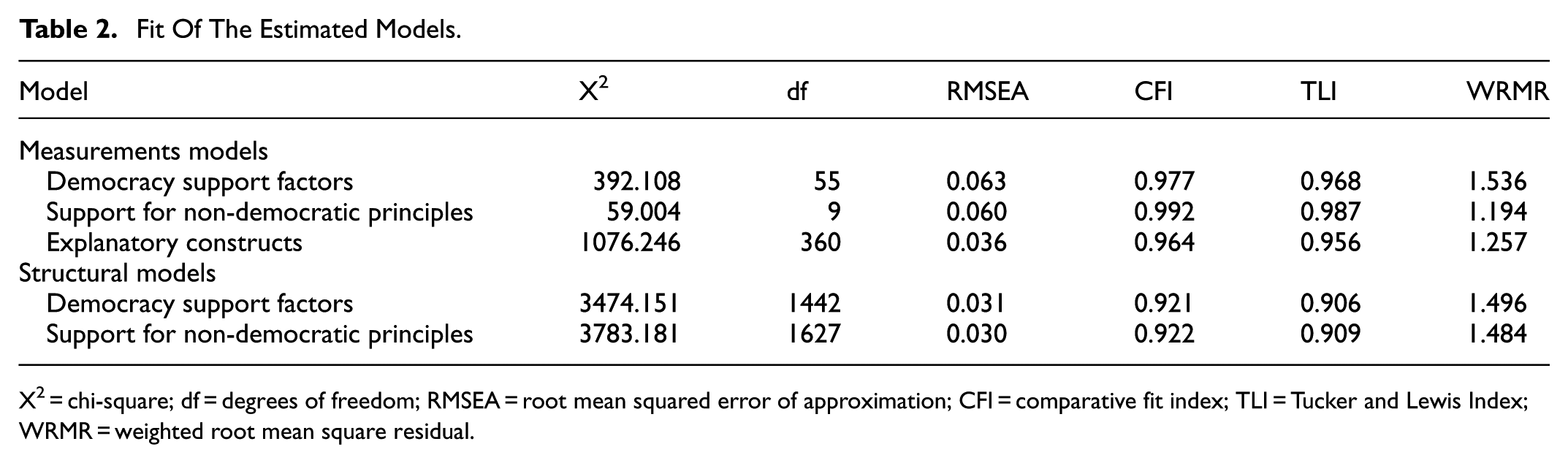
X2 = chi-square; df = degrees of freedom; RMSEA = root mean squared error of approximation; CFI = comparative fit index; TLI = Tucker and Lewis Index; WRMR = weighted root mean square residual.
The average variances extracted exceeds 0.50 for each of the democracy affirming and the non-democratic principles factors (Table 3). Each factor therefore has adequate convergent validity. The factors in the respective models are also distinct enough from each other to warrant separate estimation (not merging them) since the correlation between any pair (off-diagonal elements in Table 4) is lower than the square roots of the average variance extracted (diagonal elements in Table 4) for each of them.
Standardized Factor Loadings on Democracy Support Constructs.

Discriminant Validity Among Democracy Support Factors.

Note. The off-diagonal elements are correlations and the diagonal elements (bold font) are the square roots of the average variance extracted.
In the two structural models estimated, each predictor has a direct effect on each democracy support measure. In addition, interpersonal distrust and each demographic, socioeconomic, ideology and feelings of resentment variable has direct effects on political cynicism, corruption perception and anti-immigrant attitude. Furthermore, corruption perception has a direct effect on political cynicism and the specific and hybrid support factors have direct effects on the more diffuse support factors (see Canache & Allison, 2005; Melgar et al., 2010; Pattyn et al., 2011). The structural models fit the data well with respect to the RMSEA (less than 0.06) and the TLI (greater than 0.90) even though the CFI values are a bit low (less than 0.95) (Table 2).
In presenting the results, we emphasise the total (net) effects of the explanatory variables. For diffuse democracy support, we regard results for the democracy affirming measures as tentative pending corroboration by the results for the measures of non-democratic principles.
Results
Level of Support for Democracy
At the time of data collection, approximately 37.97% of Guyanese believed that Guyana was either somewhat democratic or very democratic yet, approximately 60.04% were either rather satisfied or very satisfied with the way democracy worked (see Q59 and Q58 in Table 1). It was therefore not entirely necessary to believe that the system was clearly democratic for some to be satisfied with the way democracy worked. Concurrently 21.1% of the people believed that parliamentarians were performing well or very well which, consistent with the average score of 2.751 means that there was low approval of the performance of parliamentarians who were at the centre of democratic decision-making in the country. The level of support for the political institutions was also generally low (Table 1). The average levels were at least at the scale midpoint for three of the seven national institutions and whereas more than half of the respondents either ‘trust’ or ‘trust very much’ in the military, less than half of them provided these responses for each of the other institutions.
A clear majority of individuals (65.71%) indicated that democracy is preferrable to any other form of government and a large majority (87.74%) believed that electoral democracy is always the best and is best in spite of its shortcomings (75.93%). At the same time, large percentages of the individuals indicated that support for military takeover is justified when there is corruption (40.82%) or a lot of crime (53.98%). This therefore appears as evidence of a ‘fair-weather’ commitment to democratic principles specifically in relation to military intervention. At the time of data collection, a large section of the population was likely to suspend commitment to democracy in favour of a military takeover in difficult times. The support for military takeover in Guyana seems consistent with the general high levels of support for authoritarian alternatives in Latin America (see Córdova & Seligson, 2010; Foa & Mounk, 2016; Stevens et al., 2006). Guyanese, in 2013, appeared to make special allowance for military intervention since the same accommodation was not extended to non-democratic actions by the president. They did not support as strongly the president ignoring, circumventing or suppressing democratic institutions or the democratic right of freedom to oppose (see Table 1). But since military intervention cannot be expected to result in preservation of the democratic norms, the affinity for it seems like a product of cognitive dissonance. This at least is an interpretation based on the democratic support theory that synthesizes socialization and performance. From a measurement perspective, the simultaneous endorsement of democracy as the best system and support for military takeover might reflect social desirability in responding to items that explicitly use the word ‘democracy’. People might pay lip service to supporting democracy but may not fully assimilate its values (Inglehart, 2003).
Explanations of Support for Democracy
The results for the total (net) effects of the explanatory variables are provided in Figure 1, Figures 2 and 3. The numeric results which include direct, total indirect and total (net) effects are provided in Table A4, Table A5 and Table A6 in the appendix.
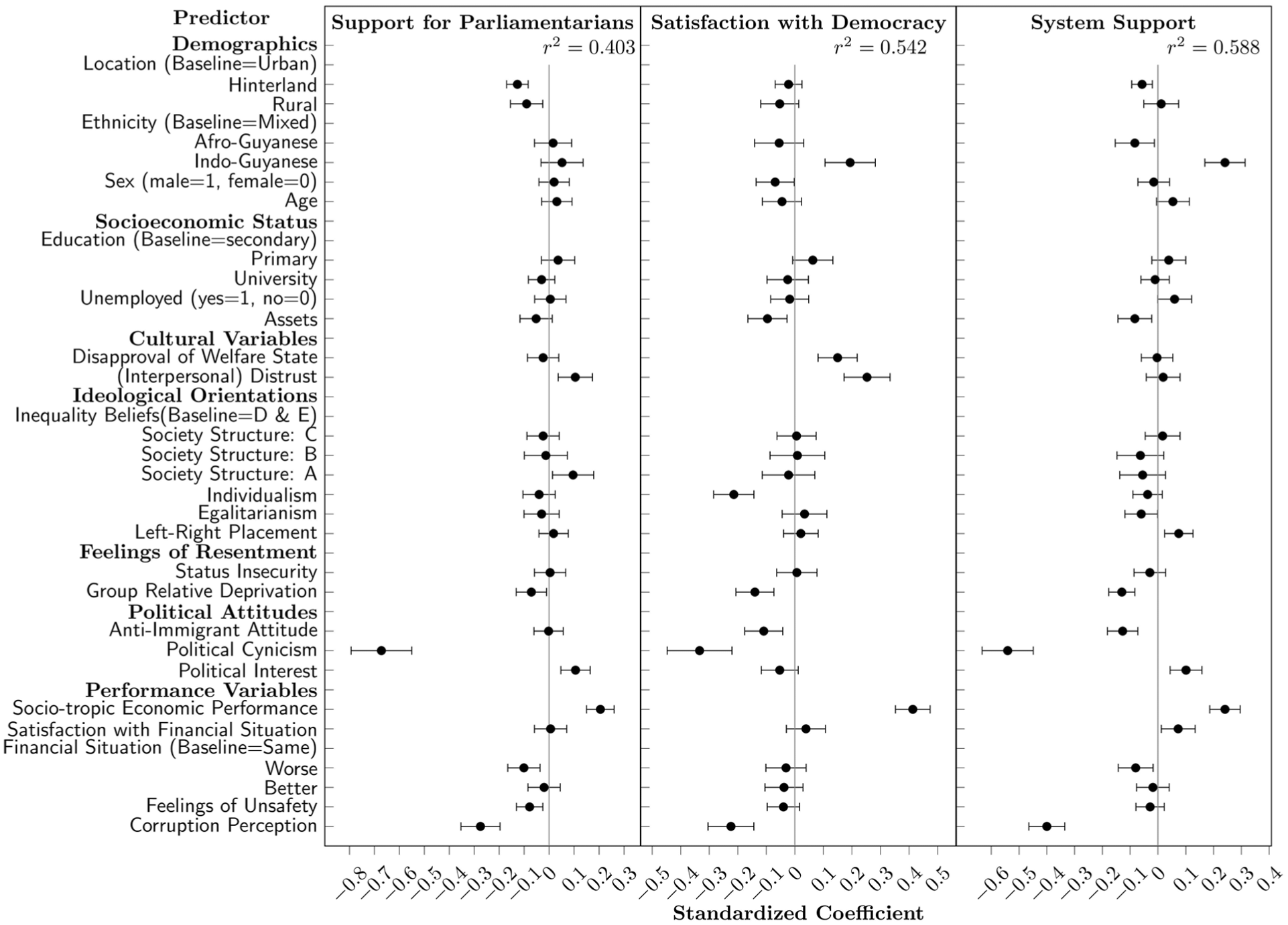
Total Effects On Specific And Hybrid Support Constructs.
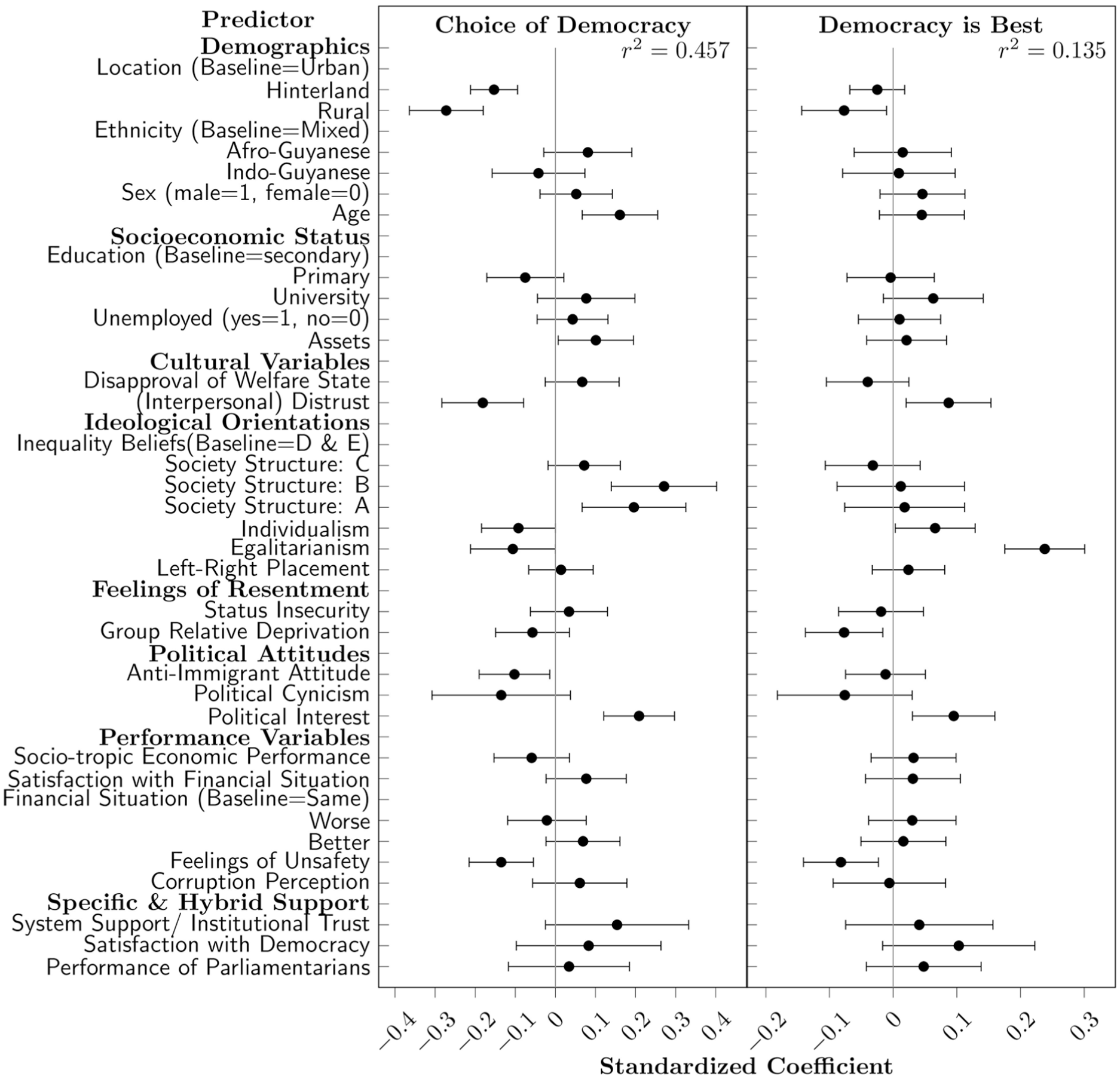
Total Effects On Diffuse Support For Democracy.

Total Effects On Diffuse Support For Non-Democratic.
The structural models explain approximately 40.3%, 54.2%, 58.8%, 45.7%, 13.5%, 40.7% and 32.4% of the variances of approval of support for parliamentarians, satisfaction with democracy, system support, choice of democracy among alternatives, ratings for democracy as the best system, support for non-democratic governance and support for military takeover in difficult times respectively. The explained variances for the specific and especially the hybrid support measures are generally larger, but they are also relatively large for most of the measures of diffuse support. The combination of explanatory variables is therefore not limited to explaining instrumental or specific support for democracy. They also perform fairly well in relation to the diffuse support for democracy.
Specific and Hybrid Support for Democracy
The specific and hybrid democracy support measures have no significant effects on the diffuse democracy affirming factors (see Figure 2). However, they affect both diffuse non-democracy support factors. Specifically, support for both non-democratic government and military takeover in difficult times intensifies with increased satisfaction with democracy and greater system support amplifies support for military takeover in difficult times. Less diffuse support for democracy therefore helps to shape more principled support for democracy (Claassen & Magalhães, 2021) but this would have gone undetected if only democracy affirming measures were utilized. Apart from this, the significant effects are in the opposite of the expected direction. We return to this issue in the conclusion.
Regime Performance
Corruption perception undermines approval of parliamentarians, satisfaction with democracy, system support, and support for non-democratic government. Elements of these results resonate with findings in other contexts. However, although corruption has important consequences for society, it appears that adverse consequences for principled support for democracy are not among them (e.g., Anderson & Tverdova, 2003; Claassen & Magalhães, 2021; Erlingsson et al., 2016). Instead, stronger corruption perception seems to lead to lower tolerance for authoritarian actions by the president. A president who might forego democratic norms is not regarded as a solution for corruption. The decline in satisfaction with democracy and system support due to higher corruption perception therefore likely represents less favourable assessments of the incumbent’s performance instead of rejection of democratic principles.
Feelings of unsafety in response to crime in the neighbourhood have no effect on satisfaction with democracy or system support. However, those who feel less safe from crime indicate lower approval of parliamentarians, are less likely to choose democracy as the best system, believe less strongly that democracy is the best system and lean more towards accommodating non-democratic actions by the president. Feelings of unsafety therefore weakens commitment to democratic principles (see Carreras, 2013; Claassen & Magalhães, 2021) and result in citizens being more likely to regard authoritarian measures as justified (Pérez, 2003).
Egocentric economic assessment influences the perceived job performance of parliamentarians and system support and leaves satisfaction with democracy and support for democratic principles intact except for diffuse support for military takeover in difficult times. Those who perceive their personal economic situation as worse than before indicate lower approval of the job performance of parliamentarians, weaker support for the political system and stronger support of military takeover in difficult times. Therefore, personal financial situation must either improve or remain unchanged to prevent erosion of support for parliamentarians and the political system (cf. Córdova & Seligson, 2010) and strikingly to stave off support for military takeover. In addition, satisfaction with the current financial situation of the household is associated with improved system support but it has no effect on diffuse support of democracy or non-democracy.
Subjective socio-tropic economic performance is positively related to approval of parliamentarians, satisfaction with democracy, system support and support for non-democratic government. When the economy is perceived as performing well, there is improvement in the specific and hybrid support measures (Claassen & Magalhães, 2021; Magalhães, 2016). Furthermore, in perceived good economic times there might be greater willingness to relax democratic principles or to overlook breaches of democratic norms by the political leadership which implies a trade of commitment to democratic principles for perceived economic gains. The combined effects of egocentric and socio-tropic economic performance confirm that there are instrumental components of both specific support and diffuse support for non-democracy (Mishler & Rose, 2001).
Political Attitudes
Political interest is associated with elevated approval of parliamentarians, system support, selecting democracy as best among other alternatives (choice of democracy), ratings for democracy as the best system (democracy is best), and with reduced support for non-democratic government and military takeover in difficult times. Interest in politics is therefore positively related to both the specific and the diffuse measures (Erlingsson et al, 2016; Kokkonen & Linde, 2023) and consequently, a lack of interest in politics appears to be detrimental to principled support for democracy. Concurrently, political cynicism erodes approval of parliamentarians, satisfaction with democracy and system support and intensifies support for military takeover in difficult times. Although this is largely consistent with the targets of political cynicism being politicians, politics and the political system, the concern that rising political cynicism around the world erodes support for regime principles (see Pattyn et al., 2011) is relevant in Guyana. Political cynics seem to have lost faith entirely in the political system.
Stronger anti-immigrant attitude is associated with lower satisfaction with democracy, system support and principled choice of democracy as the best system and with increased support for non-democratic government. This is consistent with the impact of anti-immigrant attitude on how democratic the country is perceived to be (part of satisfaction with democracy) as indicated by Kokkonen and Linde (2023). However, we go beyond this to confirm that anti-immigrant attitude diminishes principled support for democracy inclusive of approving more undemocratic actions by the president. Whether this can be generalised to Latin America should be addressed in future research.
Group relative deprivation has negative total effects on approval of parliamentarians, system support and ratings of democracy as the best system. Its impact on approval of parliamentarians is consistent with responsibility ascribed to the establishment (Hoggett et al., 2013). Group relative deprivation likely captures reactions to the ethno-political cleavage in Guyanese society (see Edwards, 2017; Khemraj, 2013) leading to negative effects on both support of parliamentarians and the political system. Although its impact on support for regime principles points to a heavy toll on society that might have resulted from the circumstances continuing without respite over a long period, this is not reflected in its relationship with any of the non-democracy support factors. Therefore, we refrain from concluding clearly that it affects principled support for democracy. Additionally, status security surprisingly has no significant net effect on any of the constructs.
Ideological Orientations
Left-right placement has limited explanatory capability given that it has a positive total effect on system support but is unrelated to any other measure. The absence of effects on satisfaction with and principled support for democracy is inconsistent with indications about both Europeans (Magalhães, 2016) and citizens of liberal democracies around the world (Torcal & Magalhães, 2022) which suggests that left-right placement functions differently in Guyana. In contrast, egalitarianism appears to concurrently strengthen endorsements of democracy as the best system, undermine support for non-democratic government, and amplify support for military takeover in difficult times. Those who strive for equality appear to suffer from cognitive dissonance given their concurrent support for military takeover and endorsement of democracy as the best system. It might be that they believe that the political system is incapable of fixing itself and view the strong non-democratic approach of a military takeover as a temporary solution to effect recalibration of the democratic system.
Individualism reduces satisfaction with democracy, improves endorsement of democracy as the best system, intensifies support for non-democratic government and lowers support for a military takeover in difficult times. The utilitarian nature of individualism might explain these conflicting results for principled support for democracy and support for non-democratic government if the authoritarian actions on the part of the president are perceived as necessary to achieve desired ends. Nonetheless, the conflicting results point to cognitive dissonance. In relation to the non-democratic principles, individualism and egalitarianism seem to move support in different directions. Whereas the egalitarians support a military solution, the individualists gravitate towards an undemocratic executive.
Inequality beliefs are significantly related to specific and diffuse support for democracy and non-democracy but not to the hybrid measures of support. Compared to those who believe that the Guyanese society has a large middle class (D) or larger numbers of people at the top (E – inverted pyramid), those who believe that there are few persons at the top, very few in the middle and the masses at the bottom (A) indicate stronger approval of the performance of parliamentarians, are more likely to choose democracy as the best system and indicate less support for non-democratic government. Additionally, those who believe that society’s structure resembles a pyramid (B) are more likely to choose democracy as the best system of government and show less support military takeover in difficult times. People tend to regard the inequality structures as indicative of ‘uneven distribution of opportunities and life chances, an elite with too much power and injustice, polarization and entrenchment of disadvantage’ (Irwin, 2018, p. 216). Therefore, it appears that those who regard society as being the most unequal regard democratic progress as necessary.
Cultural Factors
Interpersonal distrust is associated with elevated approval of parliamentarians, satisfaction with democracy, improved principled support for democracy as the best system, lower likelihood of the principled choice of democracy and stronger support for military takeover in difficult times. The effects in opposite directions for support for democracy as the best system and the choice of democracy among other alternatives are surprising even though the low correlation between the two diffuse support measures (correlation = .183) suggest that different results for them are possible. Nevertheless, effects of interpersonal distrust on the diffuse measures of support are unexpected (see Mattes & Bratton, 2007; Mishler & Rose, 2001). Stronger disapproval of the welfare state intensifies both support for non-democratic government and satisfaction with democracy. These significant effects are in conflict with the finding of Mishler and Rose (2001) for satisfaction with democracy but are similar to their finding in relation to system support. Although the results point to the relevance of cultural variables in the discussion of democracy support (cf. Mishler & Rose, 2001) the directions of the significant effects are difficult to explain substantively.
Socioeconomic Status
The variable assets has negative effects on satisfaction with democracy and system support and a positive effect on the principled choice of democracy but no effect on support for non-democratic principles or approval of parliamentarians. This is in conflict with indications that socioeconomic status improves satisfaction with democracy (Anderson & Tverdova, 2003) and reduces support for a non-democratic regime (Pérez, 2003) and is also different from other indications of an absence of significant relationships altogether (e.g., Mattes & Bratton, 2007; Mishler & Rose, 2001). It seems instead that higher household income (proxied by assets) leads to somewhat greater valuing of democracy and at the same time, greater demand for democracy conveyed by the lower satisfaction and system support. However, the greater valuing of democracy is not corroborated by the results for support for non-democratic principles and we therefore regard it as tentative. Unemployment status affects only system support and it does so positively. It is not immediately clear why support for the political system is stronger among the unemployed. However, research has generally encountered mixed results for socioeconomic variables (e.g., Anderson & Tverdova, 2003; Mattes & Bratton, 2007).
Education has limited relevance to explaining democracy support with the only significant net impact being that primary education compared to secondary education intensifies support for non-democratic government. The absence of an effect of education on the hybrid support and the diffuse support constructs (except support for non-democratic government) is inconsistent with indications of Córdova and Seligson (2010) for Latin American countries and Kokkonen and Linde (2023) for Western Europe but is somewhat similar to indications of Katz and Levin (2018) who focus on South America between 1996 and 2015. High levels of formal education are not generally necessary for people to value democracy (see Ahmadov & Holstege, 2023). Instead of necessarily creating democrats, the role of education is preventing backsliding into non-democracy by safeguarding against support for non-democratic government and authoritarian actions by the president (see Pérez, 2003). This appears to be achieved at the secondary education level in Guyana.
Demographic Variables
Age is unrelated to approval of parliamentarians, satisfaction with democracy, system support and ratings of support for democracy as the best system. However, older individuals are more likely to choose democracy as the best system and less supportive of non-democratic government and military takeover. This is indicative of weaker principled support for democracy and stronger support for non-democratic principles among younger individuals. Although youth is not a monolithic, homogeneous group with respect to how they engage in democracy (Grassi et al., 2023) they appear, on average, to be more susceptible to backsliding into non-democracy which justifies concerns about the future of democracy support (Córdova & Seligson, 2010; Stevens et al., 2006; Foa & Mounk, 201). Sex also appears consequential for democracy. While it lacks effects on most of the measures, males express greater satisfaction with democracy and greater support for military takeover in difficult times.
The results for ethnicity indicate that system support and support for non-democratic government are stronger among Indo Guyanese weaker among Afro-Guyanese compared to mixed and other ethnicities. A positive effect of the Indo-Guyanese ethnicity on satisfaction with democracy is also observed but the counterpart effect of Afro-Guyanese is not significant. These effects signal partisanship in the functioning of ethnicity wherein identification with the incumbent improves democracy support among Indo-Guyanese (the politically relevant group) while alignment with the opposition reduces it among Afro-Guyanese (see Carreras, 2013; Clarke et al., 1993; Mattes & Bratton, 2007). Ethnicity is salient in Guyanese politics (see Edwards, 2017; Khemraj, 2013) and the Indo-Afro ethnic-political cleavage appears to have introduced an element of the home team versus the opposition perspective into satisfaction with democracy, system support and support for non-democratic government. That political alignment with the incumbent (Indo-Guyanese) imbues higher tolerance for authoritarian actions by the president is similar to reduced authoritarianism with increased ideological distance from the president among Latin American elites (see Stevens et al, 2006). Non-democratic governance seems to be alright when executed by the home team but not by the other side of the political aisle. This casts support for non-democratic government as an instrument for asserting political dominance consistent with winners in more majoritarian democracies having greater access to power and being more able to impose their will on minorities (see Anderson & Guillory, 1997). Additionally, the nature of partisan support for non-democratic government might signal ideological (partisan) extremism wherein undemocratic behaviours are tolerated in exchange for implementing desired policies (Graham & Svolik, 2020; Gidengil et al., 2022).
Location of residence has several significant effects on the democracy support factors. Compared to urban residents, hinterland residents indicate lower approval of parliamentarians, weaker system support and stronger support for non-democratic government. Moreover, hinterlanders are less likely to choose democracy as the best system among alternatives. Rural residents compare to hinterland residents in their relation to urbanites except in relation to system support, ratings of democracy as best and support for support for military takeover. The levels of system support are similar between urban and rural residents, but rural residents provide lower ratings on average than urbanites for democracy is best. Rural residents are also more in favour of military takeover in difficult times than urban residents. Urbanity appears to strengthen commitment to democratic principles overall, but this effect is not linear since in some instances, hinterland residents (least urban) are closer in their views to urban residents than rural residents (medium urbanity). Urbanity also strengthens system support and inspires more lenient assessments of parliamentarians. Globally, we find similarity with the urban effect on satisfaction with democracy and support for regime principles in Iceland (see Erlingsson et al., 2016). Nonetheless, the result is at variance with the absence of an effect in Sub-Saharan Africa (Mattes & Bratton, 2007) and with an absence of an effect on principled support for democracy in Latin America (see Córdova & Seligson, 2010).
Conclusion
This paper investigates support for democracy in Guyana by utilizing seven measures that tap into specific and diffuse support for democracy and non-democracy with some measuring both specific and diffuse support (hybrid). It finds that approval of parliamentarians (specific), satisfaction with democracy (hybrid) and system support (hybrid) are generally low but that large majorities of people both prefer democracy to other systems of government (diffuse) and rate it highly on average as the best system (diffuse). At the same time, there is low tolerance for non-democratic government (diffuse), but clear support for military takeover in difficult times (diffuse). Overall, these results suggest that either the democracy affirming diffuse support measurements are inflated due to social desirability or that there is a ‘fair-weather’ commitment to democratic principles steeped in cognitive dissonance.
Specific, hybrid and diffuse support for democracy (and non-democracy) are each explained by each category of predictors employed – regime performance, political attitudes, ideological orientations, cultural variables, socioeconomic status and demographic variables – except for an absence of effects of socioeconomic status on specific support and on diffuse support for non-democracy. The predictors combine to jointly account for approximately 40.3%, 54.2%, 58.8%, 45.7%, 13.5%, 40.7% and 32.4% of the variances of approval of parliamentarians, satisfaction with democracy, system support, choice of democracy, ratings of democracy as the best system, support for non-democratic government and support for military takeover in difficult times respectively. It should be noted that the specific and hybrid measures of democracy support are also included as predictors of the more diffuse measures.
Given that social desirability might affect the democracy affirming measures (Inglehart, 2003), we emphasize the results for support for non-democratic principles more and regard as tentative results for principled democracy support that emerge from only the democracy affirming measures. Especially striking is the finding that if the two measures of support for non-democratic principles were not included, we would have missed entirely significant effects of the less diffuse support measures (support for parliamentarians, satisfaction with democracy and system support) on strictly diffuse measures. Furthermore, we would also have incorrectly concluded that corruption perception, egocentric economic performance, subjective socio-tropic economic performance, political cynicism, education, sex and ethnicity have no effects on diffuse support for democracy. Conversely, if only the constructs targeting support for non-democratic principles constructs were considered, we would have reported no effects of socio-economic status and group relative deprivation on principled support for democracy. To be clear, we regard the latter two effects as tentative. A similar conclusion would be reached if only the hybrid measures of satisfaction with democracy and system support were employed. Additionally, many of the detected effects would be substantively in the opposite direction of that indicated for non-democratic principles factors. Ultimately, our results support the conclusion that using either democracy affirming measures or the hybrid measures alone as is often done in research, has severe consequences for research results on explanations of citizen support of democratic principles.
Regime performance indicated by egocentric and socio-tropic economic evaluations explains approval of parliamentarians, satisfaction with democracy and system support (Anderson & Guillory, 1997; Katz & Levin, 2018) whereas policy performance related to controlling crime (feelings of unsafety) and delivering clean government (corruption perceptions) is related to specific, hybrid and diffuse support for democracy and non-democracy (cf. Magalhães, 2014; Carreras, 2013). Diffuse democracy support is therefore not insulated from instrumental regime performance. This aligns with the perspective that a different mechanism is relevant outside of consolidated democracies (Mishler & Rose, 2001).
However, it is apparent that in perceived good economic times, citizens will lean more towards accommodating breaches of democratic norms by the incumbent. This perhaps explains the unexpected positive impact of the hybrid support measures on diffuse support for non-democratic principles encountered in the results. In perceived good economic times, both satisfaction with democracy (due to socio-tropic economic performance) and system support (due to socio-tropic and egocentric economic performance) improve, but citizens also tend to relax demands for democratic governance. In contrast, the effect of stronger corruption perception is that citizens move towards abandoning support for non-democratic government. Democracy is therefore seen as a way of promoting clean government. The high level of perceived corruption in Guyana in 2013 (See Transparency International, 2024) when the data collection was completed was perhaps a foreshadowing of the change in government in Guyana in 2015 after 23 years in power.
Several political attitudes are related to principled support for democracy. In addition to support for democratic principles being stronger among those with greater interest in politics, those who are more cynical about politics are more strongly in support of military takeover in difficult times. Political cynicism therefore has consequences for democracy beyond issues of participation that are often discussed in the literature. Furthermore, support for non-democratic government is stronger among those with stronger anti-immigrant attitude. The effect of anti-immigrant attitude on democracy support is a relatively new issue in the literature (Kokkonen & Linde, 2023) and therefore, the results provided help to expand on what is known about its phenomenon.
Among the ideological orientations assessed, only left-right placement lacks effects on support for democratic principles. The results for individualism and egalitarianism suggest that cognitive dissonance is a key element in support for democratic or non-democratic principles. Both those who are more individualistic and those who are more egalitarian regard democracy as the best system. However, whereas the more individualistic gravitate towards non-democratic executive and away from supporting military takeover, the more egalitarian individuals do the opposite. Ultimately, neither of these perspectives is consistent with believing that democracy as the best system.
Contrary to indications in the literature (e.g., Mattes & Bratton, 2007; Mishler & Rose, 2001), cultural variables are relevant in the study of support for democracy. However, the directions of the relationships encountered for cultural variables defy expectations. The effect of cultural variables should also be studied further.
In the Guyanese context, ethnicity functions as partisanship in its relationship with support for democracy. Increased support for non-democratic government among the politically relevant group reflects the concession expected of ideological extremist (Graham & Svolik, 2020; Gidengil et al., 2022) and those interested in asserting and maintaining political dominance (Anderson & Guillory, 1997). Ideological extremism is itself important in the study of democracy support (Torcal & Magalhães, 2022) and it could potentially have intervened in other effects. The relationships of partisanship and ideological extremism with democracy support should be studied further in the Guyanese context.
Although Córdova and Seligson (2010) find no effect of urbanity on principled support for democracy as the best form of government in Latin America and the Caribbean, the location of residence emerges as important in explaining support for democracy including principled support in Guyana. Urbanity generally strengthens allegiance to principled support for democracy but not necessarily progressively. We find that rural residents are stronger in supporting military takeover than urban residents whereas their even less urban counterparts – hinterland residents – are similar to urban residents on this matter. The urbanity effect might be linked to better access to information in urban areas, but it might also evidence less partisan extremism in the more ethnically diverse urban population. Interestingly, we find that younger individuals are both less likely to choose democracy as the best political system and more strongly in support of non-democratic government. Progress towards democratic consolidation, wherein democracy has no rival, might therefore be more challenging in the future.
Many of the relationship detected in this study are different from those indicated by other studies. Some of the differences might be due to the methodological choices about measurement and modelling. However, some differences in the results appear to indicate context specificities in the relationships (Chapman et al., 2023; Magalhães, 2016). The need to study democracy support in local contexts therefore also remains relevant.
Limitations
The data used in this study are ten years old and therefore the levels of support for democracy or non-democracy might not reflect the current levels. We nonetheless expect that the relationships among the variables remain relevant.
Supplemental Material
sj-docx-1-sgo-10.1177_21582440251376813 – Supplemental material for Explaining Support for Democracy in Guyana
Supplemental material, sj-docx-1-sgo-10.1177_21582440251376813 for Explaining Support for Democracy in Guyana by Troy D. Thomas, Koen Abts and Koen Stroeken in SAGE Open
Footnotes

Ethical Considerations
The programme in which the data were collected was reviewed for its ethical dimension by the VLIRUOS selection committee (Grant No. ZEIN2008PR357). Respondents were given an information sheet, and they gave verbal consent before starting the interview.
Funding
The authors received no financial support for the research, authorship, and/or publication of this article.
Declaration of Conflicting Interests
The authors declared no potential conflicts of interest with respect to the research, authorship, and/or publication of this article.
Data Availability Statement
Research data are available upon request.
Supplemental Material
Supplemental material for this article is available online.
References
Supplementary Material
Please find the following supplemental material available below.
For Open Access articles published under a Creative Commons License, all supplemental material carries the same license as the article it is associated with.
For non-Open Access articles published, all supplemental material carries a non-exclusive license, and permission requests for re-use of supplemental material or any part of supplemental material shall be sent directly to the copyright owner as specified in the copyright notice associated with the article.
