



Abstract
The COVID-19 pandemic has had a serious and widespread impact on people’s psychosocial adaptation. This is especially true for adolescents, who face various uncertainties. To explore the impact of worry on sleep quality during the COVID-19 pandemic, the mediating effect of intrusive thoughts, and the moderating effect of mindfulness, a 1-year longitudinal study was conducted on 649 Chinese adolescents from two junior high schools in Puyang city. The Penn State Worry Questionnaire (PSWQ), the White Bear Suppression Inventory (WBSI), the Mindful Attention Awareness Scale (MAAS), and the Pittsburgh Sleep Quality Index (PSQI) were adopted as research instruments. The results revealed the following: (1) Worry at T1 had a positive effect on Chinese adolescents’ sleep quality at T2; (2) Intrusive thoughts at T2 mediated the relationship between worry at T1 and Chinese adolescents’ sleep quality at T2; (3) Both the direct and indirect effects between worry at T1 and Chinese adolescents’ sleep quality at T2 were moderated by mindfulness at T2. The results may contribute to a better understanding of the effects of worry and Chinese adolescents’ sleep quality during the COVID-19 pandemic.
Introduction
In 2020, the COVID-19 pandemic broke out and spread rapidly across the world (B. Yang et al., 2023). As a public health emergency, the high infectivity and variability of the COVID-19 virus have seriously affected people’s lifestyles as well as their physical and mental health (Vall-Roqué et al., 2021). In a national survey, 35% of respondents self-reported experiencing varying degrees of psychological stress, anxiety, depression, and sleep disturbances (Qiu et al., 2020). Adolescents have been deeply affected by the pandemic, with disruptions to their lives and education—such as school closures—leading to interruptions in their normal learning routines and social interactions (Shu et al., 2021). Studies have shown that adolescents were more vulnerable to sleep disturbances during the COVID-19 pandemic, including requiring a longer time to fall asleep and waking up later (Wang et al., 2022; Zhai et al., 2021). Sleep quality consists of multiple components, including sleep duration, sleep onset latency, sleep efficiency, daytime dysfunction, and subjective sleep quality (Q. Q. Liu et al., 2018). Good sleep quality is essential for maintaining physical and mental health, whereas poor sleep quality can lead to significant cognitive, emotional, and behavioral dysfunction (Van Veen et al., 2021). For example, studies have indicated that poor sleep quality can easily contribute to problem behaviors such as internet addiction, anxiety, aggression, and depression (Chester & Dzierzewski, 2020; El Refay et al., 2021; Kim et al., 2017). Therefore, it is crucial to examine the influencing factors and mechanisms underlying sleep quality to provide empirical and theoretical support for the prevention and intervention of sleep problems among Chinese adolescents during the COVID-19 pandemic.
Worry and Sleep Quality
Worry involves negative, repetitive, and uncontrollable thinking and imaginative activities that arise when individuals are faced with uncertain future situations (Clancy et al., 2020; de la Torre-Luque et al., 2020). According to the Acceptance-Based Model of Worry (ABMS), worry arises from the conflict between perceived external threats and internal experiences: when individuals perceive external threats, they attempt to match these threats with their internal coping resources (Treanor et al., 2011). When internal experiences are insufficient to address the external threats, worry is likely to arise. Conversely, when internal experiences are sufficient to cope with external threats, individuals are less prone to worry (Roemer & Orsillo, 2007). Research has indicated that during the COVID-19 pandemic, individuals’ tendencies to worry not only increased negative psychological states and behaviors—such as anxiety disorders, loneliness, and psychological stress (Wilson et al., 2021)—but also reduced psychological resilience, life satisfaction, and sleep quality (Lacomba-Trejo et al., 2022; Wright et al., 2021). For example, Jamieson et al. (2021) found that social isolation, peer isolation, family stress, and other negative life events during the pandemic induced worry, which in turn negatively affected sleep quality. Although previous studies have demonstrated that worry can lead to various sleep problems in different populations, no empirical research has examined the relationship between worry and sleep quality among Chinese adolescents during the COVID-19 pandemic. Adolescents often face numerous uncertainties related to their studies and daily lives, making them a high-risk group for worry and sleep disturbances (Yan et al., 2014). During the COVID-19 pandemic, adolescents encountered negative experiences such as social isolation and entrance examinations, which likely triggered worry and adversely affected their mental health (S. J. Zhou et al., 2020). Therefore, it is necessary to explore the relationship between worry and sleep quality among Chinese adolescents during the COVID-19 pandemic.
The Mediating Role of Intrusive Thoughts
Intrusive thoughts refer to involuntary, often negative, and recurrent thoughts or beliefs (Julien et al., 2007). Numerous studies have shown that intrusive thoughts are a significant predictor of psychosocial maladaptation. They not only lead to various negative psychological and behavioral problems, such as anxiety sensitivity and eating disorders (Olatunji et al., 2018; Thaiposri & Reece, 2022; Tsai & Lu, 2019), but also contribute to declines in positive psychological functions, including self-control and working memory (Heapy et al., 2022; Rebetez et al., 2018). According to the self-system belief model, negative factors (e.g., worry) influence individuals’ self-perceptions or beliefs (e.g., thinking styles), thereby affecting their psychosocial adaptation (Sandler, 2001). Therefore, this study proposes that worry may affect Chinese adolescents’ sleep quality by inducing intrusive thoughts.
On the one hand, intrusive thoughts reduce individuals’ sleep quality. According to the predisposing-precipitating-perpetuating (3P) model of insomnia, sleep problems are influenced by three factors: predisposing factors (e.g., cognitive style), precipitating factors (e.g., emotional states), and perpetuating factors (e.g., negative cognition or rumination) that maintain the sleep problems over time (Shen, 2020; Spielman et al., 1988). Empirical research has also demonstrated that intrusive thoughts significantly and negatively predict sleep quality and are associated with insomnia symptoms (Dupont et al., 2014). On the other hand, worry can exacerbate intrusive thoughts. Based on the cognitive avoidance model of worry, individuals who experience chronic worry are more likely to adopt cognitive avoidance strategies—attempting to suppress negative psychological experiences—rather than actively addressing external threats or future uncertainties (Dickson et al., 2012). This passive coping style leads to increased intrusive thoughts (Stapinski et al., 2010).
The Moderating Effect of Mindfulness
While worry may affect Chinese adolescents’ sleep quality through intrusive thoughts, it is unlikely that all adolescents who experience worry will exhibit the same degree of increased intrusive thoughts or deteriorated sleep quality. According to the differential susceptibility hypothesis, individuals’ traits and their external environments interact to influence psychological and behavioral adaptation (Belsky & Pluess, 2009; B. Yang et al., 2021). Therefore, it is essential to explore variables that may moderate the direct and/or indirect pathways from worry to sleep quality.
Mindfulness refers to an individual’s conscious, nonjudgmental, open, and accepting awareness of the present moment—a positive psychological trait (Brown & Ryan, 2003). According to the Reperceiving Model of Mindfulness, adopting a conscious and nonjudgmental attitude while paying attention to the present allows individuals to deeply observe and experience their current situations and accept both internal and external experiences with greater openness (Shapiro et al., 2006). In other words, mindfulness enables individuals to develop adaptive detachment from negative experiences, objectify their thoughts, and respond with greater acceptance, thereby alleviating the impact of negative factors (Davis et al., 2016). A growing body of research has shown that mindfulness not only fosters positive psychological and behavioral outcomes—such as enhanced self-esteem and positive emotions (Bajaj et al., 2016)—but also reduces symptoms of depression, stress, and eating disorders (Arch et al., 2016; Lei et al., 2018; Z. K. Zhou et al., 2017). Furthermore, mindfulness has been shown to buffer the negative effects of stressors on psychosocial adaptation. For example, it mitigates the adverse relationship between phone addiction and sleep quality (Q. Liu et al., 2017) and reduces the detrimental effects of intrusive thoughts on negative emotional experiences (Emerson et al., 2018). These findings suggest that mindfulness, as a positive psychological trait, may serve as a protective factor against the harmful effects of negative experiences on psychosocial adaptation.
The Present Study
In this study, based on the Acceptance-Based Model of Worry, the 3P Model of Insomnia, the Cognitive Avoidance Model, and the Perception Model of Mindfulness, we used two-wave longitudinal data (with a 12-month interval between data collections) to construct a moderated mediation model exploring the relationships between worry and sleep quality in Chinese adolescents via intrusive thoughts, with mindfulness as a moderator in the mediation process during the COVID-19 pandemic. We chose a sample of Chinese adolescents because sleep quality has become a serious concern among this population during the pandemic (Wang et al., 2022). A moderated mediation model allows for the simultaneous examination of both mechanisms, providing more comprehensive insights than simple mediation or moderation models alone (Cummings et al., 2000).
Moreover, due to cultural diversity, some factors influencing sleep quality—such as sleep latency and daytime dysfunction—may vary across cultural backgrounds (Q. Liu et al., 2017). Therefore, findings regarding risk and protective factors in Western adolescents may not be directly applicable to Chinese youth during the COVID-19 pandemic. Given the limited number of studies focusing on sleep quality among Chinese adolescents during this period, the present study aims to: (a) determine whether worry significantly predicts sleep quality; (b) examine whether intrusive thoughts mediate the relationship between worry and sleep quality; and (c) investigate whether mindfulness moderates the direct and/or indirect effects of worry on sleep quality among Chinese adolescents during the COVID-19 pandemic. Clarifying the internal mechanisms involving worry, intrusive thoughts, mindfulness, and sleep quality may contribute to improved prevention and intervention strategies for sleep problems in this population during the pandemic (Figure 1).

The moderated mediation model.
Based on both theoretical and empirical evidence, this study hypothesized that:
(1) Worry significantly and negatively predicts sleep quality among Chinese adolescents (Hypothesis 1).
(2) The relationship between worry and sleep quality in Chinese adolescents is mediated by intrusive thoughts (Hypothesis 2).
(3) Mindfulness moderates the direct and/or indirect effects of worry on sleep quality among Chinese adolescents (Hypothesis 3).
Methodology
Participants
In our study, Chinese adolescents were recruited from two junior high schools in Puyang city, with commitments to complete a follow-up investigation 1 year later. All participants were informed about the purpose of the study, their participation was voluntary, and informed consent was obtained from all participants before data collection.
Participants completed the Penn State Worry Questionnaire (PSWQ), the White Bear Suppression Inventory (WBSI), the Mindful Attention Awareness Scale (MAAS), the Chinese version of the Pittsburgh Sleep Quality Index (PSQI), and a demographic questionnaire after class. Initially, 737 adolescents participated in the first wave of data collection (T1, October 2021). Due to the COVID-19 pandemic, 62 adolescents took sick leave and were unable to complete the testing. Consequently, 675 adolescents participated in both waves of data collection. Among the returned questionnaires, 26 were excluded due to regular answering patterns or missing more than one-fifth of the items on the questionnaire (T2, October 2022). The attrition rate was 11.94%. Finally, 649 adolescents were included in the analyses (44.22% female; 55.78% male; M = 13.82, SD = 1.56). Additionally, there were no significant differences in sex [χ2(1) = 0.73, p > .05] or age [t = 1.25, p > .05] between adolescents who dropped out and those who completed both surveys. Statistical analyses also revealed no significant differences in worry (t = 0.91, p > .05), intrusive thoughts (t = 1.31, p > .05), mindfulness (t = −0.77, p > .05), or sleep quality (t = 0.52, p > .05) between these two groups. These results suggest that attrition did not introduce systematic bias.
Measures
Worry
Worry was measured by the PSWQ, which was developed by Meyer et al. (1990) and has been demonstrated to be suitable for Chinese adolescents (Shen, 2020). Students rated each item on a 5-point scale ranging from 1 to 5. A 5-point Likert scale was used to rate the scores, with higher scores representing a high level of worry. In our study, Cronbach’s alpha was excellent (.93).
Intrusive Thoughts
Intrusive thoughts were measured by the WBSI, which was developed by Wegner and Zanakos (1994) and translated to Chinese by L. H. Zhou et al. (2012). The students rated each item on a 5-point scale ranging from 1 (Strongly disagree) to 5 (Strongly agree). A 5-point Likert scale was used to rate the scores, with higher scores representing a high level of intrusive thoughts. This scale has been demonstrated to be suitable for Chinese adolescents (Wei et al., 2020). In this study, Cronbach’s alpha was excellent (.95).
Mindfulness
Mindfulness was measured by the Mindful Attention Awareness Scale (MAAS), which was developed by Brown and Ryan (2003) and translated into Chinese by Chen et al. (2012). Students rated each item on a 6-point scale ranging from 1 (almost always) to 6 (almost never), with higher scores representing a high level of mindfulness. This scale has been demonstrated to be suitable for Chinese adolescents (Lei et al., 2018). In our study, Cronbach’s alpha was excellent (.91).
Sleep Quality
Sleep quality was measured by the Chinese version of the PSQI, which is the most widely used scale for measuring sleep quality among Chinese adolescents (Wang et al., 2022). The scale consists of 19 items assessing the following seven dimensions: sleep latency, habitual sleep efficiency, sleep medication use, subjective sleep quality, sleep duration, daytime dysfunction, and sleep disturbance. In our study, Cronbach’s alpha was excellent (.89).
Statistical Analysis
Descriptive statistics and Pearson correlation analyses were conducted using SPSS 22.0. The mediating effect of intrusive thoughts was tested using PROCESS macro version 3.5 Model 4, and the moderating role of mindfulness was examined using PROCESS macro version 3.5 Model 59. Before conducting the main analyses, the assumptions of normality, multicollinearity, and residual errors were examined.
Results
Common Method Bias Test
To reduce the effect of common method bias, procedural controls were implemented, including the inclusion of reverse-scored items and randomization of questionnaire order (Podsakoff & Organ, 1986). Additionally, common method bias was assessed using both Harman’s single-factor test and confirmatory factor analysis (CFA). An unrotated principal component factor analysis of all items from the four questionnaires extracted 13 factors. The first factor accounted for 20.71% of the variance, which is below the 40% threshold, indicating no serious common method bias. Furthermore, CFA was conducted by loading all items onto a single common factor, which confirmed the absence of significant common method bias. The fit indices of the model were bad χ2/df = 7.94, TLI = 0.36, CFI = 0.41, RMSEA = 0.16, which illustrates that the current study had no serious common method bias.
Normality, Multicollinearity, and Residual Errors
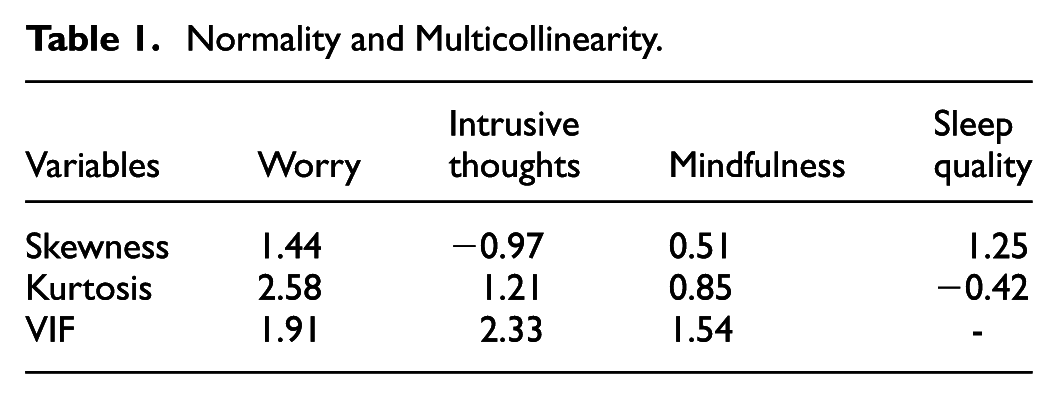
The skewness, kurtosis, and Pearson correlations for worry, intrusive thoughts, mindfulness, and sleep quality are reported in Table 1. As shown in Table 1, Skewness values ranged from −.97 to 1.44, and kurtosis values ranged from .42 to 2.58, indicating that the distributions of the main study variables were approximately normal (|Skewness| < 2; |Kurtosis| < 7) (Hancock et al., 2018). And, as suggested by Akinwande et al. (2015), multicollinearity can be assessed using the variance inflation factor (VIF). In this study, the VIF values ranged from 1.54 to 2.33, suggesting that multicollinearity was not a concern among the independent variables, as all values were well below the recommended threshold.
Normality and Multicollinearity.
Finally, to verify the assumption of homogeneity of variance, Levene’s test was conducted on the primary variables as well as demographic covariates. The results showed that the significance values (p) for all variables exceeded .05: p_gender = .374, p_age = .669, p_worry = .511, p_intrusive thoughts = .819, p_mindfulness = .624, and p_sleep quality = 0.952, indicating that the assumption of homogeneity of variance was met (Tabachnick et al., 2007).
Preliminary Analyses
The means, SD for worry, intrusive thoughts, mindfulness, and sleep quality are reported in Table 2. As shown in Table 2, worry (T1) was positively associated with intrusive thoughts (T2) and sleep quality (T2) (r = .29, p < .01 and r = .45, p < .01, respectively) and negatively associated with Chinese adolescents’ mindfulness (T2) (r = −.25, p < .01). In addition, intrusive thoughts (T2) were positively associated with Chinese adolescents’ sleep quality (T2) (r = .31, p < .01) and negatively associated with their mindfulness (T2) (r = −.13, p < .01). Finally, mindfulness (T2) was negatively associated with Chinese adolescents’ sleep quality (T2) (r = −.36, p < .01).
Means, Standard Deviations, and Correlations of the Main Study Variables.

Note. T1 = Time 1; T2 = Time 2.
p < .05, **p < .01, ***p < .001.
Analysis of the Mediating Role of Intrusive Thoughts
To examine the mediation model, we designated worry at Time 1 as the independent variable, intrusive thoughts at Time 2 as the mediator, and sleep quality at Time 2 as the dependent variable. We tested the mediation effect using PROCESS macro version 3.5 (Model 4). Covariates such as gender and age were controlled in all analyses.
As shown in Table 3, after controlling for covariates, worry at T1 was positively associated with intrusive thoughts at T2 (β = .47, p < .001), which in turn positively affected sleep quality at T2 (β = .16, p < .001). Meanwhile, the residual direct effect was significant (β = .34, p < .001), which demonstrates that intrusive thoughts at T2 mediate the relationship between worry and Chinese adolescents’ sleep quality at T2 (indirect effect = 0.08, bootstrap 95% [0.16, 0.27]). The mediating effect accounted for 18.11% of the total effect of worry at T1 on Chinese adolescents’ sleep quality at T2.
Testing the Mediation Effects of Intrusive Thoughts.

Note. Gender: 0 = boys, 1 = girls; T1 = Time 1; T2 = Time 2.
p < .05, **p < .01, ***p < .001.
Analysis of Moderated Mediation
To examine the moderated mediation model, worry at Time 1 was specified as the independent variable, intrusive thoughts at Time 2 as the mediator, and sleep quality at Time 2 as the dependent variable. Mindfulness at Time 2 was incorporated as a moderator in the model. The moderated mediation effect was tested using the PROCESS macro version 3.5 (Model 59). Covariates such as gender and age were controlled in all analyses.
As presented in Table 4, Model 1 showed worry (T1) to be significantly and positively related to intrusive thoughts (T2) (β = .26, p < .001). Moreover, worry (T1) × mindfulness (T2) was negatively related to intrusive thoughts (T2) (β = −.28, p < .01). The simple slopes analysis revealed that for Chinese adolescents with higher levels of mindfulness (T2) (M + 1SD), worry (T1) was not associated with intrusive thoughts (T2) (Bsimple = −0.02, p > .05). However, for Chinese adolescents with lower levels of mindfulness (T2) (M−1SD), the effect of worry (T1) on intrusive thoughts (T2) was much stronger (Bsimple = 0.54, p < .001; see Figure 2). Hence, the negative relationship between mindfulness and intrusive thoughts was much weaker for Chinese adolescents with lower levels of worry.
Testing for the Moderating Role of Mindfulness.

Note. Gender: 0 = boys, 1 = girls; T1 = Time 1; T2 = Time 2.
p < .05, **p < .01, ***p < .001.

Conditional effect of Chinese adolescents’ intrusive thoughts (T2) as a function of worry (T1) and mindfulness (T2).
Model 2 illustrated that worry (T1) was significantly and positively related to sleep quality (T2) (β = .31, p < .001). In addition, worry (T1) × mindfulness (T2) was related to sleep quality (T2) (β = −.20, p < .001). The simple slopes analysis revealed that for Chinese adolescents with lower levels of mindfulness (T2) (M −1 SD), a higher degree of worry (T1) was associated with a higher degree of sleep quality (T2) (Bsimple = 0.51, p < .001; see Figure 3). However, for Chinese adolescents with higher levels of mindfulness (T2) (M + 1SD), the effect of worry (T1) on sleep quality (T2) was much weaker (Bsimple = 0.11, p < .001). Hence, worry was a much stronger predictor of sleep quality for Chinese adolescents with lower levels of mindfulness. Finally, intrusive thoughts (T2) were significantly and positively related to sleep quality (T2) (β = .19, p < .001), and mindfulness (T2) moderated this indirect relationship (β = −.07, p < .01). The simple slopes analysis illustrated that for Chinese adolescents with lower levels of mindfulness (T2) (M−1SD), a higher degree of intrusive thoughts (T2) was associated with higher degree of sleep quality (T2) (Bsimple = 0.26, p < .001; see Figure 4). However, for Chinese adolescents with higher levels of mindfulness (T2) (M + 1SD), the effect of intrusive thoughts (T2) on sleep quality (T2) was weaker (Bsimple = 0.11, p < .001). Hence, intrusive thoughts were a much stronger predictor of sleep quality for Chinese adolescents with lower levels of mindfulness.

Conditional effect of Chinese adolescents’ sleep quality (T2) as a function of worry (T1) and mindfulness (T2).
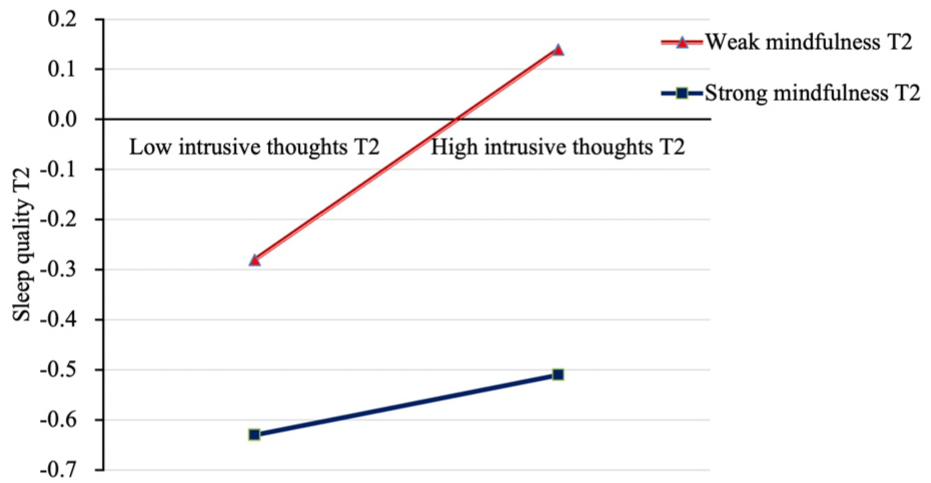
Conditional effect of Chinese adolescents’ sleep quality (T2) as a function of intrusive thoughts (T2) and mindfulness (T2).
Discussion
This two-wave longitudinal study examined the relationship between worry and sleep quality among Chinese adolescents, focusing on the mediating role of intrusive thoughts and the moderating role of mindfulness. The findings contribute to a better understanding of the mechanisms by which worry influences sleep quality through intrusive thoughts, as well as the conditions under which this effect is weakened or strengthened by mindfulness. These results have important theoretical and practical implications for improving adolescents’ mental health and sleep quality.
The Relationship Between Worry and Sleep Quality
This study found that worry significantly and positively predicts sleep quality among Chinese adolescents, supporting Hypothesis 1 and verifying the Acceptance-Based Model of Worry (ABMS). According to the ABMS, individuals are more likely to experience cognitive, emotional, and physical discomfort when their internal experiences fail to adequately address external situational threats (Treanor et al., 2011). Individuals with high levels of worry tend to perceive more threats when interpreting information in uncertain situations and are prone to catastrophizing possible outcomes (Shen, 2020). In the context of the COVID-19 pandemic, although prevention and control measures such as suspension of classes, online teaching, and home isolation have ensured adolescents’ safety, subsequent academic maladaptation, social disruption, and restrictions on freedom may increase the risk of psychological distress (Scott et al., 2021), which in turn leads to worries about studies, further education, and social interactions (Li, 2020). In a state of worried arousal, individuals tend to focus on and monitor sleep-related threats, resulting in physiological arousal that interferes with sleep and impairs daytime functioning (Jones et al., 2005; Semler & Harvey, 2004). Therefore, during the COVID-19 control period, Chinese adolescents’ worries about their lives, studies, and other stressful events led them to perceive the uncertain pandemic situation as a threat, thereby increasing their tendency to worry and negatively affecting their sleep quality.
The Mediating Role of Intrusive Thoughts
This study found that intrusive thoughts partially mediate the relationship between worry and sleep quality among Chinese adolescents, which means that worry reduces sleep quality by inducing intrusive thoughts. On the one hand, worry significantly and positively predicts intrusive thoughts in Chinese adolescents. This finding aligns with previous research indicating that worry triggers negative thinking patterns (Lewis et al., 2019). According to the cognitive avoidance model of worry, worry—viewed as a “negative coping strategy”—leads to cognitive biases toward threatening information in uncertain situations, increasing the likelihood of perceiving events as threatening cues (Buhr & Dugas, 2002). Intrusive thoughts have been identified as a key maintenance factor of worry, amplifying cognitive activity in affected individuals (Ainsworth et al., 2017). Moreover, individuals with negative self-related cognitive biases tend to develop mental models of a negative self (Zhuang, 2017). The COVID-19 pandemic has heightened uncertainty in adolescents’ lives and learning processes, transforming events once perceived as controllable into externally uncertain and negative ones. Adolescents with high worry tendencies are more likely to adopt negative cognitive strategies in response to the pandemic, interpreting COVID-19-related information as more threatening and catastrophizing possible outcomes, which further exacerbates negative self-perceptions and induces intrusive thoughts. On the other hand, intrusive thoughts significantly and negatively predict sleep quality in Chinese adolescents, consistent with previous findings that intrusive thoughts contribute to negative psychological and behavioral outcomes (Heapy et al., 2022; Tsai & Lu, 2019). The 3P model of insomnia explains why intrusive thoughts mediate the relationship between worry and sleep quality: worry, as a susceptible coping style, heightens attention to external stimuli that disrupt sleep and triggers intrusive thinking. As a form of negative, automatic cognitive activity, intrusive thoughts contribute to cognitive arousal before bedtime, impeding the initiation and maintenance of restful sleep (Guastella & Moulds, 2007). Thus, Chinese adolescents with high levels of intrusive thoughts repeatedly and negatively focus on worries related to the COVID-19 pandemic, becoming absorbed in their distress without actively addressing or resolving it, which reinforces adverse effects and ultimately impairs their sleep quality.
The Moderating Role of Mindfulness
The current study indicated that the direct and/or indirect effects of worry on sleep quality are moderated by mindfulness, supporting Hypothesis 3. Previous research has shown that mindfulness traits not only positively influence individuals’ psychosocial adaptation but also serve a protective role against the negative impacts of adverse factors (Emerson et al., 2018; Q. Liu et al., 2017). Specifically, adolescents experiencing high-risk states characterized by worry and intrusive thoughts may benefit from mindfulness through the process of “reperceiving” (Shapiro et al., 2006), which helps them experience positive emotions and reduce negative reactions to adverse stimuli, thereby enhancing psychosocial adaptation (Q. Liu et al., 2017). Individuals with low mindfulness levels often lack effective emotion regulation skills (X. J. Yang et al., 2021) and may feel helpless when facing risks, exacerbating the negative influence of such factors (Arch et al., 2016). Consequently, during the COVID-19 pandemic, Chinese adolescents with higher mindfulness tendencies are better able to tolerate and process the negative emotions associated with worry, preventing these emotions from intensifying intrusive thoughts and impairing sleep quality. These findings align with the Reperceiving Model of Mindfulness, which posits that reperceiving enables individuals to adopt a more accepting attitude toward internal and external experiences, fostering more positive perceptions of pandemic-related information and thus mitigating the influence of negative factors on psychosocial functioning. Additionally, positive thinking cultivated through mindfulness can enhance adolescents’ hope, strengthen psychological resilience, and improve positive self-concepts (Meiklejohn et al., 2012), which are critical internal psychological resources (Afzal et al., 2014). Such resources further buffer the adverse effects of the pandemic, thereby promoting better sleep quality.
Limitations and Future Directions
There are several limitations in the present study. First, all data were obtained via self-reports from Chinese adolescents, which may be subject to social desirability bias and other subjective errors (Fisher & Katz, 2000). Future research should consider employing experimental manipulations or intervention training to further investigate the effects of worry on sleep quality and the underlying mechanisms. Second, this study collected data solely from students attending two junior high schools. Whether the findings can be generalized to high school students, college students, or other populations remains to be explored. Therefore, future studies should include a broader age range of participants to validate the robustness of these results. Finally, the Mindful Attention Awareness Scale for Children and Adolescents used in this study is a unidimensional measure that does not capture the relationships between specific facets of mindfulness and other variables. Future research should employ multidimensional instruments, such as the Five-Facet Mindfulness Questionnaire, to examine the moderating effects of distinct mindfulness dimensions more comprehensively. Moreover, previous studies have highlighted that mindfulness interventions enhance present-moment awareness and self-awareness, including nonreactive and nonjudgmental observation of thoughts, which can help individuals reduce negative perceptions, cognitions, and emotions (Escudero-Pérez et al., 2016). Therefore, future research could explore whether mindfulness-based interventions can alleviate the adverse impact of worry on adolescents’ sleep quality.
Implications for Practice
Our study offers valuable insights into alleviating the effects of worry and improving sleep quality among Chinese adolescents during the COVID-19 pandemic. First, particular attention should be given to adolescents experiencing high levels of worry. During the COVID-19 pandemic, Chinese adolescents face various challenges, including changes in learning styles, preparation for entrance examinations, and maintaining interpersonal relationships (Duan et al., 2020). These challenges increase their susceptibility to worry, which in turn contributes to sleep problems caused by physical, psychological, lifestyle, and social stressors (Zhao et al., 2022). In other words, as long as significant stressors persist, adolescents’ sleep quality is unlikely to improve fundamentally. Therefore, interventions should be grounded in the students’ actual circumstances, with schools and parents collaborating to help students better understand and manage their academic and life challenges during the pandemic, thereby promoting improved sleep quality. Worry provides a novel framework for understanding and intervening in adolescent sleep problems. Since worry is closely linked to individuals’ cognitive schemas, cognitive interventions can be employed to modify maladaptive worry patterns (Querstret & Cropley, 2013), thereby reducing anxiety and enhancing sleep quality during the COVID-19 pandemic. Second, worry increases intrusive thoughts in Chinese adolescents, which exacerbates negative emotions and promotes maladaptive cognitive activities at bedtime, further impairing sleep quality. Cognitive training techniques, such as helping individuals shift attention from internal ruminations to external stimuli, can facilitate disengagement from intrusive thoughts (Moritz et al., 2011; Watson & Purdon, 2008). Regular cognitive training and group counseling may equip adolescents with effective coping strategies to reduce intrusive thoughts. Finally, mindfulness can buffer the negative impact of worry and intrusive thoughts on sleep quality. Research indicates that mindfulness interventions, such as meditation-based stress reduction and positive cognitive therapy, as well as daily mindfulness practice, can significantly enhance individuals’ mindfulness levels (Khoury et al., 2015). Therefore, schools could offer targeted stress reduction programs or group counseling to help students cultivate mindfulness through structured learning and practice, thereby alleviating the adverse effects of worry and intrusive thoughts on sleep quality.
Conclusion
In summary, this study employed two-wave longitudinal data to examine a moderated mediation model underlying the relationship between worry and sleep quality among Chinese adolescents during the COVID-19 pandemic. Our findings indicate that worry is significantly positively associated with sleep quality, with intrusive thoughts partially mediating this relationship. Furthermore, mindfulness moderates the direct and/or indirect effects of worry on sleep quality. These results contribute to a deeper understanding of the mechanisms influencing Chinese adolescents’ sleep quality and offer valuable insights for prevention and intervention efforts during the COVID-19 pandemic.
Footnotes
Acknowledgements
We would like to thank Dr. Banglin Yang for all his kindness and help in the project application and data collection.

Ethical Considerations
All procedures performed in the present study were approved by the Human Research Protection at Fujian Normal University (PSY240069) and followed the ethical standards of the 1964 Helsinki Declaration and its later amendments or comparable ethical standards.
Consent to Participate
Written informed consent was obtained from all the participants before the publication of the present study.
Author Contributions
Meijuan Zheng: Contributed to study design, data collection, and manuscript editing. Yanfeng Xu: Led conceptualization, supervised research activities, and drafted the original manuscript. Banglin Yang: Conducted literature review and assisted in methodology development. Chong Guo: Conducted data analysis and contributed to manuscript editing.
Funding
The authors disclosed receipt of the following financial support for the research, authorship, and/or publication of this article: This work was supported by the Special Commissioned Project on High-Quality Development of Basic Education under the Fujian Provincial Education Science Planning Program (Project No. FJJKWT24-002), with support from the Dewang Institute for Basic Education Research.
Declaration of Conflicting Interests
The authors declared no potential conflicts of interest with respect to the research, authorship, and/or publication of this article.
Data Availability Statement
The datasets generated during and/or analyzed during the current study are available from the corresponding author on reasonable request.