




Abstract
Combining the upper echelons theory and imprinting theory, we use data of Chinese listed companies from 2013 to 2022, to explore the relationship between executives’ IT background, managerial myopia, and digital transformation, together with the moderating effect of digital peer effect. We found that executives’ IT background significantly promotes corporate digital transformation, which is robust after serials of robustness tests. Executives’ IT education and practical background can significantly promote digital transformation. Mechanism analysis found that executives’ IT background, especially the IT education background, can promote digital transformation by alleviating managerial myopia, while the IT practical background cannot significantly alleviate the managerial myopia. The digital peer effect, digital industry and province peer effect can significantly promote the positive effect of executives’ IT background on digital transformation. Further analyses indicate that the improvement of executives’ IT background is more significant in the non-state-owned firms, non-manufacturing, and the fiercely competitive industry. This article divides the executives’ IT background into education background and practical background, which enriching the relevant research on the role of managers in digital transformation.
Keywords
Introduction
Digital technology can be fully embedded in the management processes of innovation, production, manufacturing, and service sales, achieving the digitalization of enterprise’s capital chain, talent chain, innovation chain, and supply chain (Baiyere et al., 2020; Feliciano-Cestero et al., 2023; Ghosh et al., 2022; Kaplan & Haenlein, 2019). The 2021 China Enterprise Digital Transformation Index Report released by Accenture shows that enterprises with significant digital transformation achievements in China has risen from 8% in 2018 to 16% in 2021. However, 79% of small and medium-sized enterprises’ digital transformation are still at the exploratory stage (China Electronics Standardization Institute, 2021), and the biggest challenge lies in strategic gaps and understanding biases (L. Liu et al., 2023). For example, the direction of digital transformation is not clear, and lacks guidance on digital deployment (Davison et al., 2023). Most enterprises still face the dilemma of unwilling, afraid, and unable to transform (Xu et al., 2023). Therefore, exploring the prerequisite factors of digital transformation is meaningful for helping enterprises better achieve digital transformation.
Previous research on digital transformation mainly focuses more on the economic consequences, such as firm performance (X. Guo et al., 2023; Peng & Tao, 2022), productivity (Cheng et al., 2023; Espinoza et al., 2020), innovation (Nambisan et al., 2019; Sui & Yao, 2023; Yoo et al., 2012), and supply chains (Akbari & Hopkins, 2022; He et al., 2023), with little research to link the antecedents and consequences of digital transformation, such as how managers’ background affects digital transformation and its economic consequences. The competition in the digital era requires leaders to maintain keen insight, analysis of digital technology and emerging business models, and to be able to adjust company strategies promptly (Cheng et al., 2023; Hansen et al., 2011). Therefore, the characteristics of executives are inevitably closely related to enterprises’ digital transformation and economic consequences.
Recent research on manager characteristics mainly refers to the academic background (Ju et al., 2023; Yan et al., 2023), financial background (Gu, 2023; B.Liu et al., 2020), overseas background (Cao et al., 2022), and military background (Hao et al., 2023; Z. Zhang et al., 2022), with little focus on the information technology (IT) background (Enns et al., 2018). Meanwhile, the characteristics of managers mainly focus on the impact on innovation and capital market performance (Agha & Pramathevan, 2023; Cao et al., 2022; Cui et al., 2022), with little research on digital transformation (Yan et al., 2023). According to the upper echelons theory, executives are the decision-makers and the key factor in determining the direction of enterprise development (Hambrick & Mason, 1984). Whether and how to promote digital transformation is a strategic decision made by management, and executives’ IT background will inevitably be reflected in the implementation process of digital transformation. However, little research has focused on the relationship between executives’ IT background and digital transformation.
X. Guo et al. (2023) have found that excessive or insufficient digital transformation has a negative impact on firm performance, and managerial myopia exacerbates this negative effect. Executives with IT background often have a certain level of digital awareness and ability (L. Liu et al., 2023), which can alleviate managerial myopia, improve the situation where companies are unwilling, afraid, or unable to transform (Xu et al., 2023). Meanwhile, enterprises in the same industry or region can refer to successful experiences, which may generate digital peer effects. Therefore, the main research questions are: (1) Does executives’ IT background have an impact on the digital transformation of enterprises? (2) Can executives’ IT background promote digital transformation by alleviating their myopia? (3) Does the digital peer effect have a moderating effect on the relationship between executives’ IT background and digital transformation?
Combining the upper echelons theory and imprinting theory, this study uses data of Chinese A-share listed companies from 2013 to 2022, to explore the relationship between executives’ IT background, managerial myopia, and digital transformation, together with the moderating effect of digital peer effect. The study found that executives’ IT background promotes digital transformation by alleviating managerial myopia, and digital peer effect promote the positive effect of executives’ IT background.
The remainder of this article is organized as follows. Section ‘Literature Review and Hypotheses Development’ reviews the theoretical literature and develops the hypotheses. Section ‘Method’ shows the empirical methods. Section ‘Results’ provides the results of executives’ IT background, managerial myopia, and digital transformation. Section ‘Further Analysis’ discusses the economic consequences and heterogeneity. Section ‘Discussion’ analyses the contributions. Section ‘Conclusion and Implications’ conclusions and makes some implications.
Literature Review and Hypotheses Development
Executives’ IT Background and Digital Transformation
The upper echelons theory explains the impact of a company’s top management team on strategic decision-making (Hambrick & Mason, 1984), which focuses more on changes in organizational performance but ignores the driving forces behind performance changes. The imprinting theory is a supplement to the upper echelons theory, explaining the possible mechanisms by which individuals influence organizations (Marquis & Tilcsik, 2013). The imprinting theory suggests that cognitive and behavioral patterns formed by individuals during sensitive periods such as education or early career stages will continue to have an impact for a long period thereafter (Z. Zhang et al., 2022). The integration of the upper echelons theory and imprinting theory can explain the impact of certain significant experiences of executives with primary decision-making power on corporate decision-making, which mainly includes the education and practical experience of managers.
Executives, as the core figures leading the development of enterprises, play a crucial role in the formulation and execution of enterprise strategic decisions (Tabrizi et al., 2019). Digital transformation refers to the deep integration of digital technology and business processes, leading to innovation in business models and organizational change (Fitzgerald et al., 2014; Reis & Melao, 2023). This complex and long-term process requires professional talents to provide sufficient knowledge and technical experience support.
Based on the imprinting theory, individuals who are exposed to a specific short-term sensitive period are influenced by the core characteristics of their environment to form internal traits which persist even after significant changes in the subsequent environmental context. This process is called imprinting. The IT background of executives is divided into education and practical background, corresponding to the cognitive and ability imprints (Z. Zhang et al., 2022). Hanelt et al. (2021) summarized that digital transformation is mainly achieved through two mechanisms of integration and innovation. The integration mechanism emphasizes the integration of digital technology and business, and achieve rapid restructuring of business modules based on digital technology, such as the ‘online ordering, store pickup’ model through cloud native systems. The innovation mechanism includes the strategic and operational levels, such as uses AI to capture real-time changes in market demand to assist decision-making, and dynamically adjusts store locations through user behavior data analysis.
The impact of executives’ IT background on digital transformation can be divided into two aspects. First, from the strategic perspective, the cognitive imprint generated by the IT education background of executives promotes digital transformation. Senior managers need to achieve coordination and unity between business and digital transformation (Matt et al., 2015). At the strategic level, enterprises are required to develop digital business strategies that transcend organizational boundaries in terms of business and technology based on data insights (Bharadwaj et al., 2013). The IT education background shapes the cognitive framework of executives towards digitalization, prompting them to prioritize the deployment of technologies such as AI and big data in their strategies. The systematic learning in the education stage forms a ‘technology oriented’ thinking mode, promoting executives to lean towards digital investment in resource allocation.
Second, from the operational perspective, the empirical imprint generated by the IT practical background of executives promotes digital transformation. At the operational level, firms are required to enhance the development of digital capabilities, including information collection, big data analysis, and digital platform capabilities (Karimi & Walter, 2015; Verhoef et al., 2021). The experience imprint generated by the IT practical background of executives can leverage the above abilities to provide professional solutions in risk assessment, team building, and implementation paths (Davison et al., 2023). The practical background provides implicit knowledge of technology implementation such as system integration experience, forming a competitive advantage that is difficult to replicate. Practical experience also enhances executives’ ability to coordinate cross departmental conflicts during transformation, accelerating technology application and process reengineering.
The educational background provides a theoretical framework, while the practical background provides execution experience, and the combination forms a ‘strategy-execution’ closed loop. Dual background executives can both proactively plan technology roadmaps and quickly adjust implementation strategies through trial and error, which can be considered as a digital leadership resource to drive digital transformation. Then, the following hypotheses are proposed.
Mediating Effect of Managerial Myopia
Managerial myopia refers to the short-sighted behavior taken by managers out of their interests, which is adverse to the ongoing development of enterprises (Holmstrom, 1999; Narayanan, 1985; Stein, 1988). In the early stage of digital transformation, there is a large investment, long cycle, and high risk. Due to insufficient digital awareness, managers may focus on short-term benefits and delay digital transformation (Xu et al., 2023).
The resource-based theory holds that a company’s competitive advantage stems from scarce, valuable, and difficult to imitate resources. The IT background of executives constitutes a unique digital leadership resource for organizations, and their technical knowledge and practical experience can be transformed into strategic assets such as digital patents and data governance capabilities, reducing the cost of trial and error in transformation. The dynamic capabilities theory holds that enterprises need to adapt to environmental changes by perceiving, integrating, and restructuring resources. IT background executives are better at identifying technology trends (perception), coordinating IT teams with business departments (integration), and optimizing transformation paths through agile iteration (restructuring).
Executives with an IT background have certain digital awareness and ability (Davison et al., 2023), which can alleviate managerial myopia and improve the situation where companies are unwilling, hesitant, or unable to transform and adopt a moderate approach to digital transformation. In the rapidly developing era, executives with IT education or practical backgrounds can quickly and accurately capture digital development opportunities and trends (Hansen et al., 2011), transform their accumulated professional knowledge and experience into decision support, and improve the digital strategy in enterprises.
Digital transformation is a long-term investment to achieve further integration of digital technology and business operations, as well as a global transformation of business models and value creation processes (Fitzgerald et al., 2014; Reis & Melao, 2023). Executives with IT background possess the dual characteristics of technical background and management function and have a deep understanding of digital technology and business. This enables them to plan digital transformation strategies reasonably and make long-term strategic planning, thereby alleviating managers’ short-sighted behavior. Then, the following hypothesis is proposed.
The impact of executives’ IT background on digital transformation by alleviating managerial myopia is mainly manifested in two aspects. First, Executives’ IT education cultivates managers’ structured thinking through systematic courses such as algorithm design and data architecture, forming cognitive imprints that enable them to proactively evaluate the long-term value of technological trends. Executives with a background in computer science tend to view data platforms as strategic assets rather than short-term cost, reducing their excessive sensitivity to short-term risks (Enns et al., 2018). In the inception of digital transformation, enterprises often need to invest a large amount of fixed assets and innovative resources, with high technological risks and long return cycles (X. Guo et al., 2023). When evaluating the effectiveness of transformation strategies, executives with IT backgrounds can objectively view the pressure brought by short-term performance, focus on the overall effect of transformation, and alleviate managerial myopia due to insufficient digital awareness, which helps to implement digital transformation strategies.
Second, the empirical imprint of executives’ IT practical background empowers managers with the ability to make scientific decisions using data analysis tools such as Python and Tableau, evaluate the long-term benefits of digital transformation through predictive models, and reduce reliance on short-term financial indicators (Xu et al., 2023). Executives with IT backgrounds can leverage their technological advantages, fully carry out digital innovation activities, develop and utilize the data resources (Haislip et al., 2021; Lim et al., 2012). They can combine cutting-edge technologies with the actual situation of the enterprise, reducing the risk of project failure and achieving successful transformation from innovation activities to technological achievements (Engelbrecht et al., 2017). This will provide strong support for business process change, alleviate the reluctance and inability of managers due to insufficient digital capabilities, and promote enterprise digital transformation from a technical perspective. The following hypothesis is proposed. The specific logic diagram is shown in Figure 1.

Effect of executives’ IT background on digital transformation.
Moderating of Digital Peer Effect
Prior research has found that the peer effect on R&D investments (Chang et al., 2023; J. Li et al., 2023), green innovation (Tan et al., 2022; Wang et al., 2022), corporate finance (Grennan, 2019), and social responsibility (Sibo Liu, 2016). When formulating innovation investment plans, companies may imitate peers in the same industry or region due to a lack of experience (J. Li et al., 2023). The decision-making of digital transformation is not only influenced by its resource capabilities but also by external factors such as environment, stakeholders, and market competition (Grennan, 2019). The same industry or region group is an important channel for external connections and resource acquisition of enterprises (Y. Hu et al., 2020). The digital peer effect refers to the widespread social interactions among interconnected cohorts in a dynamic and complex digital ecosystem, including competition, cooperation, imitation, etc., which subtly affect the decision-making and behavior of enterprise digital transformation.
Digital transformation requires enterprises to actively seek external resources to achieve their strategic goals and improve their digital transformation performance (Jonathan et al., 2023). Enterprises in the same industry or region can have significant external industry or regional spillover effects on other enterprises through infrastructure sharing, technology spillover, and other means (Chen et al., 2023; Y. Hu et al., 2020). Based on the concept of competition and symbiosis, industry and regional groups with similar business operations or environments may serve as decision-making references for the digital strategy (Min, 2019), thereby driving the digital transformation.
The digital peer effect’s moderating effect is divided into two aspects. First, based on the competition theory, companies within the same industry face similar business needs, technological environments, and market environments (Y. Hu et al., 2020; Seo, 2021). In order to maintain their competitive advantage, companies will closely monitor the dynamics of their competitors and respond to their behavior. The huge competitive advantage brought by digital transformation gives enterprises a stronger motivation to imitate and learn, in order to consolidate their existing market position and stimulate future development potential. Executives with IT backgrounds are more able to learn behavior through competition, accurately absorb the experiences of successful enterprises in the same industry, and imitate those proven beneficial practices to reduce the technical costs and risks, shortening the process of digital transformation.
Second, based on the symbiosis theory, enterprises in the same region often face similar resource environments, policy environments, and location advantages, and there is often a symbiotic relationship between regional members (Y. Hu et al., 2020; Ouimet & Tate, 2020). When the digital transformation in the same region improves, society’s expectations for the digital development of local enterprises also increase. In this context, enterprises are more inclined to enter the digital field in order to gain support and recognition from more stakeholders, thus generating a regional peer effect of digital transformation (Chen et al., 2023). Executives with IT backgrounds can keenly perceive the dividends brought by cross industry integration of data resources and are more inclined to enter the digital field to obtain more policy support and stakeholder recognition, accelerating the digital transformation. The following hypotheses are proposed.
The specific theoretical framework diagram is shown in Figure 2.

Theoretical framework.
Method
Data and Sample
China has become the second-largest country in digital economy scale (Wen et al., 2022), and there are diverse samples of enterprise digital transformation, which can provide reference for developing countries in digital transformation. Since the large-scale of enterprises’ digital transformation is after 2012 in China, this study used the data of Chinese A-share listed companies from 2013 to 2022. The annual reports were obtained from the Cninfo Web set (https://www.cninfo.com.cn/). The financial and accounting data of enterprises came from the CSMAR (China Stock Market & Accounting Research) and Wind Database.
We excluded ST and *ST companies; companies that belonged to the financial and high technology industries and those that had a serious lack of accounting data. Finally, 18,646 observations were obtained, and all the continuous type variables were winsorized at the 1% and 99% levels.
Measures
Dependent Variable
Digital transformation includes various aspects such as digital strategy, data elements, and digital technology applications. Digital strategy and transformation are usually reflected in corporate annual reports. Although some key words in the annual report may not represent substantial changes made by the company, but can serve as a measure of the company’s digital transformation strategy, data elements, and digital technology applications, which cannot be obtained from the financial data. Therefore, it is feasible to describe digital transformation from the frequency of digital related words in annual reports. Meanwhile, the proportion of digital intangible assets is used to measure digital transformation in the robustness tests. The keywords were based on the research of X. Guo et al. (2023), not only include digital technologies such as the Internet, artificial intelligence, big data, block-chain, and cloud computing, but also digital technology applications such as digital marketing channels and digital business models, which can also capture the nuances in digital strategies. Referring to the prior research (L. Guo & Xu, 2021; X. Guo et al., 2023), we used the textual analysis method to measure digital transformation (Digital), to count the digital-related keywords frequency ratio in corporate annual reports through Python. The expression is shown in Equation 1, where

Independent Variable
Referring to the research of Enns et al. (2018), when an executive has education or practical experience related to enterprise information management or information technology, we consider them to have an IT background. According to the Catalogue of Undergraduate Majors in Ordinary Higher Education Institutions released by the Chinese Ministry of Education in 2012, IT education background refers to the graduation major of electronic information (0807), computer science (0809), e-commerce (1208), information and computing science (070102), information management and information systems (120102), and information resource management (120503). Professional experience background refers to work experience in information technology, information management, information systems, information construction, ERP construction, software development, internet/network development, computer, electronic engineering, system engineering, system construction, e-commerce, e-government, Internet of Things, cloud computing, and other fields. When an executive has the above work or educational experience and is considered to have an IT background.
Considering the lag effect of IT background on digital transformation, we lag the IT background by one period. The expression is shown in Equations 2 to 4, where


Mediator Variable
Managerial myopia (Myopia) was constructed by the textual analysis method. Language can reflect human cognition, preferences, and personality, and researchers can capture human traits by analyzing the types and frequency of words used in language (Pennebaker et al., 2003). For example, the more emphasis a person places on words such as ‘former’ and ‘once’, the more they pay attention to the past (N. Hu et al., 2021). We used 43 myopia-related words constructed by N. Hu et al.’s (2021), which developing a word set for managerial myopia. Firstly, referring to Brochet et al.’s (2015), F. Li’s (2010), and the characteristics of MD&A Chinese corpus, identify the seed vocabulary related to short-term perspective, and use Word2Vec machine learning technology to obtain an expanded vocabulary in the financial context. Then, further screen the word set to determine the managerial myopia word set. The key words including directly reflect short-term perspective such as ‘within days’, ‘months’, ‘within years’, ‘as soon as possible’, ‘immediately’, and words that indirectly reflect short-term perspective such as ‘opportunity’, ‘moment’, ‘pressure’, and ‘test’. The expression is shown in Equation 5, where

Moderator Variable
Referring to Grennan’s (2019) method, digital peer effect (Dig_peer) was constructed by the average level of digital transformation among enterprises in the same region and industry. Digital industry peer effect (Dig_indpeer) was constructed by the average level of digital transformation among enterprises in the same industry, and digital province peer effect (Dig_provpeer) was constructed by the average level of digital transformation among enterprises in the same province.
Control Variables
Reference the relevance studies (Y. Hu et al., 2023; W. Zhang et al., 2023); we controlled for the following variables. Firm age (Age): the years that the company has existed; Firm size (lnSize): natural logarithm of the total employee numbers; Financial leverage (Lev): total asset-liability ratio; Firm performance (ROA): return on total assets; Firm Growth (Growth): operating revenue growth rate; Top1 shareholder (Top1): proportion of the largest shareholder; Duality (Dual): 1 if the chairman and CEO are the same person, otherwise, it is 0; Independent director proportion (Bod_indep): independent director numbers divided by the director numbers.
Models
To test the effect of executives’ IT background on digital transformation, we constructed model (6) as follows:

Where
To analyze the mechanism of executives’ IT background on digital transformation, we referred to Baron and Kenny (1986) and Zhao et al. (2010) and constructed models (7) and (8) as follows:

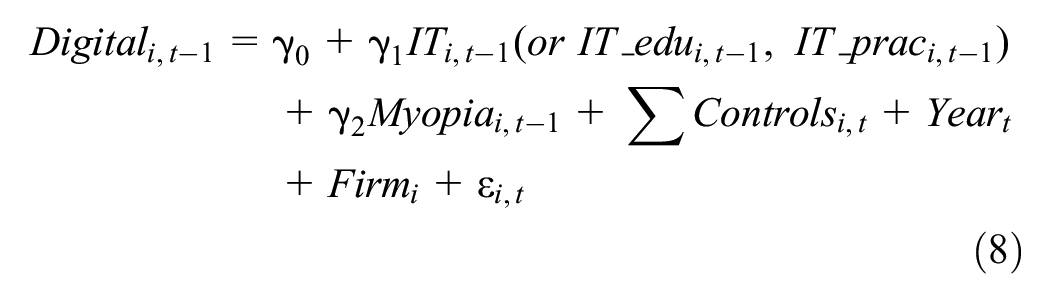
Where
To investigate the moderating role of the digital peer effect, the interaction between executives’ IT background and the digital peer effect was included, and specified the models (9) and (10) as follows:


Where
Results
Descriptive Statistics
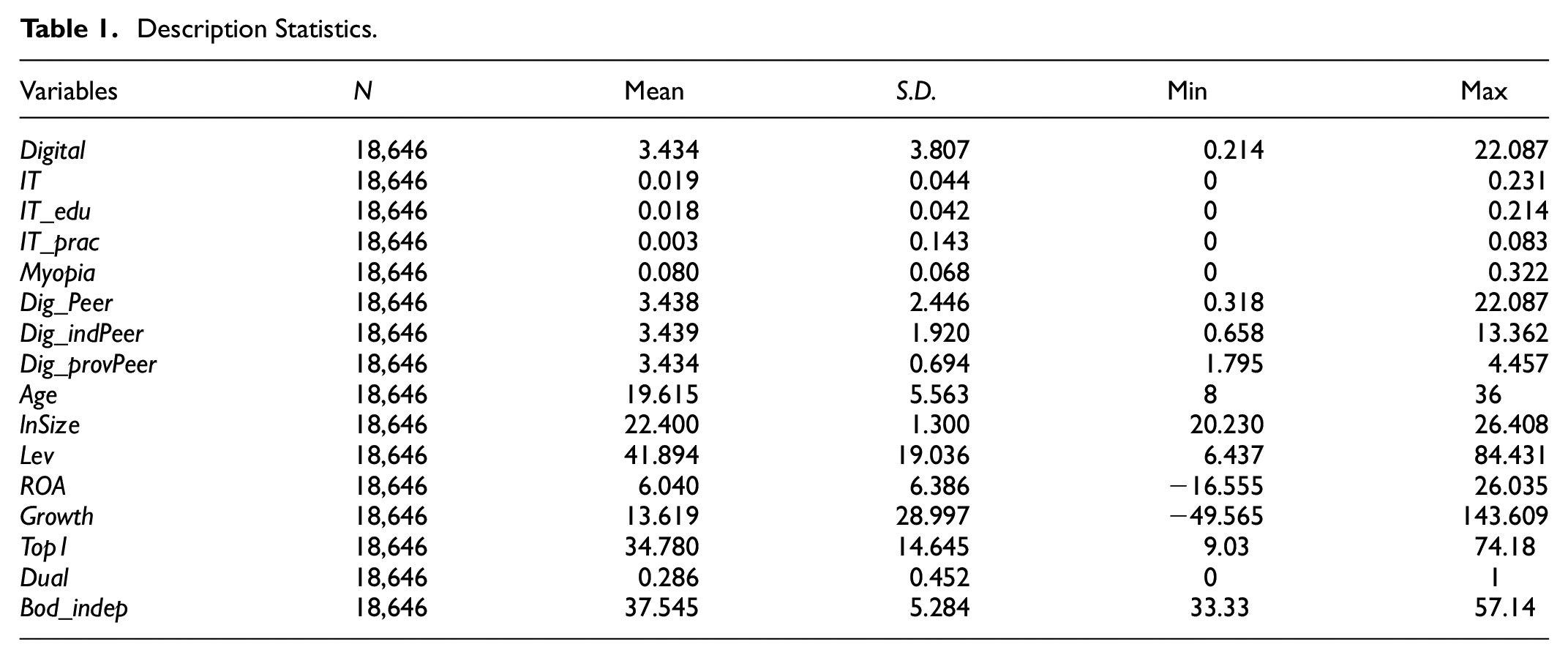
The descriptive statistics were presented in Table 1. The average of Digital is 3.434, the standard deviation is 3.807, and the min and max are 0.214 and 22.087, respectively, illustrating that there are differences in the digital transformation among enterprises. The average of IT is 0.019, and the min and max are 0 and 0.231, respectively, indicating that there are differences in the executives’ IT background, some enterprises have no IT background executives.
Description Statistics.
Baseline Regression
The max value of VIF is 1.72 < 10, indicating that the variables have no serious multicollinearity. The main findings for Equation 6 are shown in Table 2. Column (1) contains only the independent variable, the coefficient of IT is significantly positive (
Results of Baseline Regression.

Note. Standard errors in parentheses.
p < .10. **p < .05. ***p < .01.
Column (4) in Table 2 tests the influence of executives’ IT education background on digital transformation, the coefficient of IT_edu is significantly positive (
Robustness Test
Endogeneity Test
The instrumental variable method was used to solve reverse causality problems, fixed effects was used to solve omitted variable problems, and propensity score matching (PSM) was used to solve sample selection problems. To test for the endogeneity, two-stage least squares (2SLS), system GMM, and PSM were employed, and the results are presented in Table 3.
Results of the Endogeneity Test.

Note. Standard errors in parentheses.
p < .10. **p < .05. ***p < .01.
We used the average value of executives’ IT background classified by province and two-digit industry as the instrumental variable (IV) of executives’ IT background. The executives’ IT background of a single corporate is positively related to other corporate in the same region and industry. While, the executives’ IT background of a single corporate is improbably to affect the executives’ IT background at the regional-industry level, so the IV complies with the correlation and exogenous. Kleibergen-Paap rk LM rejected the null hypothesis of unrecognized IV variables at the 1% level. In the weak instrumental variable test, the F-statistic is greater than the critical value of 16.38, indicating that IV is not a weak instrumental variable. The Anderson Rubin Wald test rejected the null hypothesis at the 1% level, indicating a high correlation between IV and endogenous variables.
Column (1) in Table 3 illustrate that the coefficient of IV is 0.963 (p < .01), suggesting that IV is significantly positive with the endogenous variables. Take the fitting value obtained in the first stage as the proxy of executives’ IT background in the second stage; the results are presented in column (2). The coefficient of executives’ IT background is still significantly positive.
The system GMM results are presented in column (3) of Table 3. We used the first-order lagged of digital transformation as the instrumental variables. The system GMM results find that the coefficient of IV is significantly positive, indicating that the baseline regression is robust.
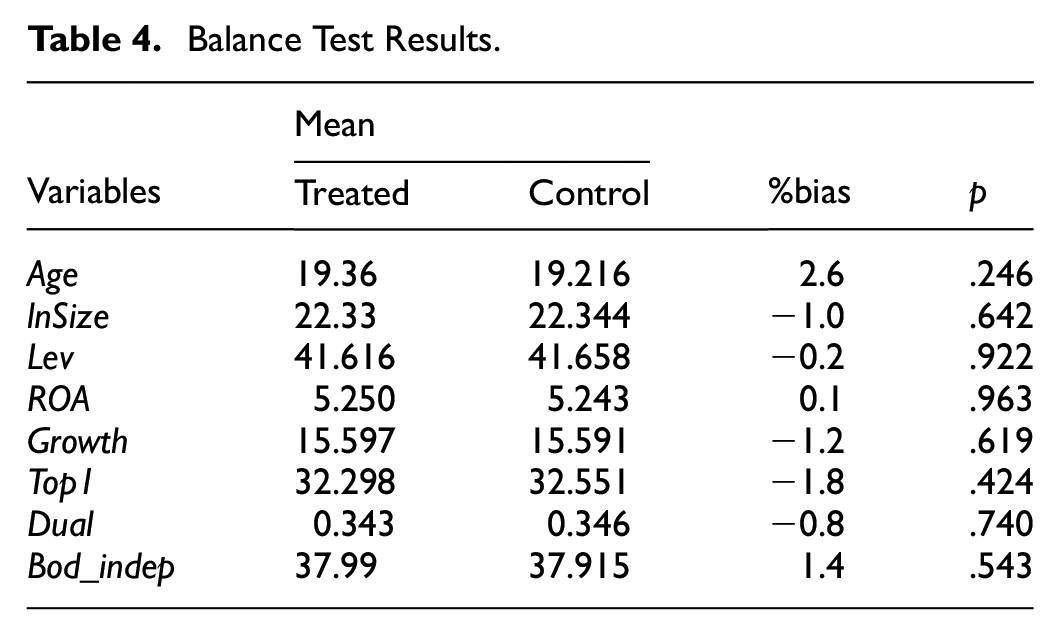
To address the endogeneity issue in sample selection, this paper employs PSM method. Use a 1:1 nearest neighbor matching method for matching, and then perform regression on the matched samples. Table 4 shows the results of the balance test. It can be found that the deviation between variables in the matched treated group and the control group is less than 5%, and the difference is not significant, indicating that the balance test has been passed. Table 3 column (4) shows the regression results of PSM samples, with 7,198 matched observations. The coefficient of IT is 4.245 (p < .01), indicating that after controlling for sample selection bias, IT background still has a significant positive impact on enterprise digital transformation.
Balance Test Results.
Other Robustness Tests
Alter-Explained Variable
The number of digital-related keywords (Dig_num) and the proportion of digital-related intangible assets in total intangible assets was used as the proxy variable for digital transformation.
Alter-Explanatory Variable
The number of executives with IT background (IT_num) and whether it has executives with IT background (IT_dummy) was used to measure executives’ IT background.
Excluding the Year of 2020 to 2022
Given that the impact of COVID-19 may accelerate the enterprises’ digital transformation (Hanelt et al., 2021), the year 2020 to 2022 were excluded to estimate the regression.
Adopting Tobit Model
Since the value of digital transformation is all above zero, we adopt the Tobit model to further examine the regression.
Controlling Industry and Province
The results may be influenced by the industry and province factors that will change with time. Following Armand and Mendi’s (2018) and Garicanoy and Steinwender’s (2016) method, the interaction between the year and industry dummy, year and province dummy were contained in the regressions.
The robustness results are presented in Table 5, the positive and significance of the coefficient of executives’ IT background are not changed in all the robustness tests. Therefore, the results of executives’ IT background can significantly improve the digital transformation is robust.
Results of Robustness Test.

Note. Standard errors in parentheses.
p < .10. **p < .05. ***p < .01.
Mediating Mechanism Analysis
The results of the mediating mechanism analysis based on Equations 7 and 8 are presented in Table 6. The coefficient of IT in column (1) is significantly negative (
Results of Mechanism Analysis.

Note. Standard errors in parentheses.
p < .10. **p < .05. ***p < .01.
The coefficient of IT_edu in column (3) is significantly negative (
The coefficient of IT_prac in column (5) is negative but not significant, and the coefficient of Myopia in column (6) is significantly negative (
To sum up, executives’ IT background, especially the IT education background, improves digital transformation by alleviating managerial myopia.
Moderating of Digital Peer Effect
The regression results of the moderating effect of digital peer effect based on Equations 9 and 10 are presented in Table 7. The coefficient of Dig_peer in column (1) is significantly positive (
Results of Moderating Effect of Digital Peer Effect.

Note. Standard errors in parentheses.
p < .10. **p < .05. ***p < .01.
We next interact executives’ IT background with the digital peer effect to examine the moderating effect of the digital peer effect. The coefficient of the interaction in column (2) is significantly positive (
Further Analysis
Economic Consequence Analysis
To analyze the economic consequence of digital transformation based on executives’ IT background, we delayed digital transformation by one phase to construct the model (11), and divided the sample into two groups: executives with IT background and executives without IT background, and the results are displayed in Table 8.

Results of Economic Consequence.

Note. Standard errors in parentheses.
p < .10. **p < .05. ***p < .01.
The coefficient of L.Digital in column (1) is significantly negative (
Heterogeneity Analysis
To analyze the heterogeneity of ownership, industry heterogeneity, and industry competitiveness, we constructed the following model:

Where Firm ownership (SOE) was coded as 1 for state-owned firms and 0 for non-state-owned firms. Industry heterogeneity (Industry) was coded as 1 for manufacturing firms and 0 for non-manufacturing firms. Industry competitiveness (HHI) was measured as the Herfindahl index.
The heterogeneity results are shown in Table 9. The interaction coefficient of IT and SOE in column (1) is significantly negative (
Results of Heterogeneity Test.

Note. Standard errors in parentheses.
p < .10. **p < .05. ***p < .01.
The interaction coefficient of IT and Industry in column (2) is negative (
The interaction coefficient of IT and HHI in column (3) is significantly positive (
Discussion
From the previous results, it can be concluded that IT education background is more likely to alleviate managerial myopia compared to practical background. First, IT education cultivates managers’ structured thinking through systematic courses, enabling them to proactively evaluate the long-term value of technological trends. The practical background may focus more on specific tool operations such as the use of ERP systems, lacking a comprehensive understanding of the technology ecosystem, resulting in decision-making limited to short-term needs. Second, Executives with a background in IT education are more likely to promote a technology driven culture within the organization. For example, improving the digital literacy of all employees through internal training can reduce the stagnation of transformation caused by employee resistance. Practical background managers may overly rely on personal experience, making it difficult to establish a systematic knowledge sharing mechanism. Third, executives with IT education background typically possess stronger self-learning abilities and can quickly adapt to technological changes such as AI and block-chain, while managers with IT practical backgrounds may rely on past experience and lead to path dependence.
This study has three theoretical contributions. First, previous research have studied on the economic consequences of digital transformation (Cheng et al., 2023; L. Guo & Xu, 2021; He et al., 2023), little research on the pre-factors that drive digital transformation. Based on the integration of the upper echelon theory and imprinting theory, we explore the impact of executives’ IT background on digital transformation and categorize the IT background. Prior research mainly focuses on the overseas, financial, academic, and military background (Cao et al., 2022; Gu, 2023; Ju et al., 2023; Z. Zhang et al., 2022), this study has inspired attention to executives’ IT background, which supplement the research on the antecedents of digital transformation, and enrich the integration of upper echelon theory and imprinting theory in explaining the personal characteristics and strategic decisions of top management teams.
Second, previous studies have found that excessive or insufficient digital transformation has a significant negative impact on corporate performance, and managerial myopia exacerbates this negative impact (X. Guo et al., 2023), lack of in-depth research on the impact of managerial background on managerial myopia. Based on the integration of the resource-base theory and dynamic capability theory, we find that executives’ IT background can effectively alleviate managerial myopia, and IT education background is more likely to alleviate managerial myopia behavior compared to practical experience background. Compared to companies without IT background executives, the negative impact of digital transformation on corporate performance is smaller and insignificant for companies with IT background executives, which also suggesting that digital transformation requires executives with IT backgrounds. The results can theoretically link the antecedents and consequences of digital transformation, enriching and supplementing relevant research on digital transformation and managerial myopia.
Third, unlike previous studies that mostly focused on the internal influencing factors of enterprise digital transformation, this research from the external digital environment of enterprises, investigates the impact of the digital industry and province peer effects on enterprise digital transformation, the moderating effect of peer effects on executives’ IT background and digital transformation, enriching the external impact mechanism of enterprise digital transformation.
Conclusion and Implications
Main Findings
Digital transformation is not only a technological change, but also a complex process of strategic, organizational, and cultural transformation. In this process, the background of the manager directly determines whether the enterprise can effectively identify opportunities, allocate resources, and drive change. The study found that executives’ IT background significantly promotes digital transformation, which is robust after serials of robustness tests. Executives’ IT education and practical background can significantly promote digital transformation, respectively.
Mechanism analysis found that executives’ IT background, especially the IT education background, can promote digital transformation by alleviating managerial myopia, while the IT practical background cannot significantly alleviate the managerial myopia. Meanwhile, the digital peer effect, digital industry peer effect, and digital province peer effect can significantly promote the positive impact of executives’ IT background on digital transformation.
Economic consequences analysis found that compared to companies without IT background executives, the negative impact of digital transformation on corporate performance is smaller and not significant for companies with IT background executives. Further analyses indicate that the improvement of executives’ IT background in digital transformation is more significant in the non-state-owned firms, non-manufacturing, and the fiercely competitive industry.
Managerial Implications
The findings have some implications for enterprises. First, it is necessary to emphasize the important role of executives’ IT background in digital transformation and allocate management personnel reasonably. The recognition and understanding of digital transformation by the executive team are related to the success or failure of enterprise digital transformation. Enterprises should appropriately allocate executives with IT backgrounds among their management to promote implementing digital transformation strategies from top to bottom.
Second, it strengthens executives’ correct understanding of digital transformation and avoids managerial myopia. A knowledgeable and innovative digital talent team is crucial for the digital transformation of enterprises, and executives with IT backgrounds can effectively alleviate managerial myopia. Enterprises should strengthen digital training for executives without IT backgrounds so that they can learn and understand digital-related knowledge as much as possible, integrate digital technology and business, and form correct digital transformation cognition to guide the digital transformation practice.
Third, managers should fully utilize the digital peer effect and seize the development opportunities of digital transformation. Enterprises should closely monitor the digital development trends of enterprises in the same industry and region, learn from the successful digital transformation experiences of excellent enterprises, establish data connections with upstream and downstream enterprises and their stakeholders in the digital business ecosystem, and explore mutually beneficial digital business models with partners.
Limitations and Future Research
Although this study examines the antecedents of digital transformation from a managerial perspective, there are still some limitations. First, the sample selection is in China, which is more suitable for developing economies and has limited applicability. In the future, the sample from World Bank Open Data can be expanded to other countries around the world to improve the universality of the conclusions.
Second, some large company executive teams have established CIOs, CDOs, and other management positions, this article only studies the impact of executives’ IT background on digital transformation. In the future, case studies can be used to investigate how CIOs or CDOs play a role in enterprise digital transformation through their own information technology background, as well as how to avoid managerial myopia.
Third, this article studies how executives’ IT background promotes digital transformation by reducing managerial myopia, without an in-depth analysis of how executives’ IT background affects managerial myopia behavior. In the future, a questionnaire survey is needed to specifically analyze the mechanism between executives’ IT background and managerial myopia in the exploration and maturity stages of digital transformation.
Footnotes
Acknowledgements
We appreciate anonymous reviewers for his/her effort to review our manuscript, and his/her positive feedback.

Author Contributions
Mengmeng Li: Conceptualization, Data collection, Methodology, Empirical analysis, Writing-original draft, Writing-review & editing; Xiaochuan Guo: Conceptualization, Writing-review; Fengzheng Wang: Conceptualization, Writing-review; Yanlin Wang: Conceptualization, Writing-review.
Funding
The authors disclosed receipt of the following financial support for the research, authorship, and/or publication of this article: The authors gratefully acknowledge the financial support provided by Hainan Provincial Natural Science Foundation of China (No.725QN304), Hainan Province Philosophy and Social Sciences Planning Project (No.HNSK(YB)24-22), National Natural Science Foundation of China (No.72164030), Inner Mongolia Natural Science Foundation (No.2024QN07018), and Basic Scientific Research Business Project of Directly Affiliated Universities in Inner Mongolia (20700-54220346).
Declaration of Conflicting Interests
The authors declared no potential conflicts of interest with respect to the research, authorship, and/or publication of this article.
Data Availability Statement
All relevant data are within the paper.