




Abstract
This work presents psychometric analyses of the Will-to-Live Scale (WTLS) among Portuguese adolescents. Two studies were carried out to establish the psychometric characteristics of the WTLS. Findings of both studies pointed out that the WTLS has satisfactory reliability and validity. Principal component analysis and confirmatory factor analysis of the WTLS evidenced a unidimensional structure. Different types of reliability estimates of the WTLS were also good. Findings also supported the convergent validity of the WTLS through significant positive correlations, between will-to-live and life satisfaction, satisfaction with family life, positive affect, self-esteem, and emotional intelligence, and negative associations with negative affect, depression, anxiety, and stress. Findings of this research indicate that the WTLS is a valid and reliable tool among Portuguese adolescents.
Introduction
Positive psychology has begun detecting variables that improve the psychological outcomes better than normal. Among those variables targeted, the will to live has emerged as a relevant factor that is positively related to persons’ well-being (Carmel, 2011). This research presents the psychometric analyses of the Will-to-Live Scale (WTLS) among Portuguese adolescents. Research with linguistically and culturally diverse samples will consolidate the robustness of this measure.
Will-to-Live
The will-to-live (WTL) is “the psychological expression of the striving for life, including both rational and instinctual underpinnings” (Carmel et al., 2007, p. 518). Cognitively, the WTL is the result of a thinking procedure, which can only be outlined by the individual who experiments it depending on the value and meaningfulness of his life. For example, higher WTL was linked to greater mental and physical health (Carmel, 2017; Shrira et al., 2019). Instinctively, the WTL expresses a natural physiological reaction to mortal threats, which enables continuation of life (Carmel, 2011). For example, higher primacy to obtain life-sustaining cares was found to correlate with a stronger will-to-live (Carmel & Mutran, 1997).
Previous investigation has indicated that the WTL is a relevant indicator of well-being by showing that it is significantly and positively associated with a set of well-being indicators, including life satisfaction, happiness, and self-esteem, and negatively associated with depression, anxiety, psychosomatic symptoms, and loneliness (Carmel, 2001, 2011, 2017; Carmel et al., 2013). However, the correlations between these indicators of well-being and the WTL are not very great, which indicates that WTL congregates “additional unique aspects of subjective well-being not depicted by other SWB indicators. The existential dimension of commitment to life is one of these unique aspects embedded in the WTL.” (Carmel, 2017, p. 289).
The WTL, as a specific indicator of subjective well-being, has also emerged as a predictor of longevity. Longitudinal studies indicate that WTL significantly predicts length of life in older adults (Carmel et al., 2007; Karppinen et al., 2012). Despite controlling other known predictors including age, gender, comorbidity, depressive feelings, and self-assessed health, WTL continues to significantly predict survival (Carmel et al., 2007; Karppinen et al., 2012). WTL also mediates relations between the self-perceptions of aging and length of life, namely, the higher positive self-perceptions of aging, the stronger the WTL, increasing the probability of survival (Levy et al., 2002).
Previous research has shown gender differences in WTL. Carmel (2001) based on gender differences in the literature about indicators of well-being, and health and illness behaviors, hypothesized that elderly females would present a weaker WTL than males. The author, as expected, found that females reported a significantly weaker WTL than males. This gender difference has also been established in another research (Carmel et al., 2007, 2018).
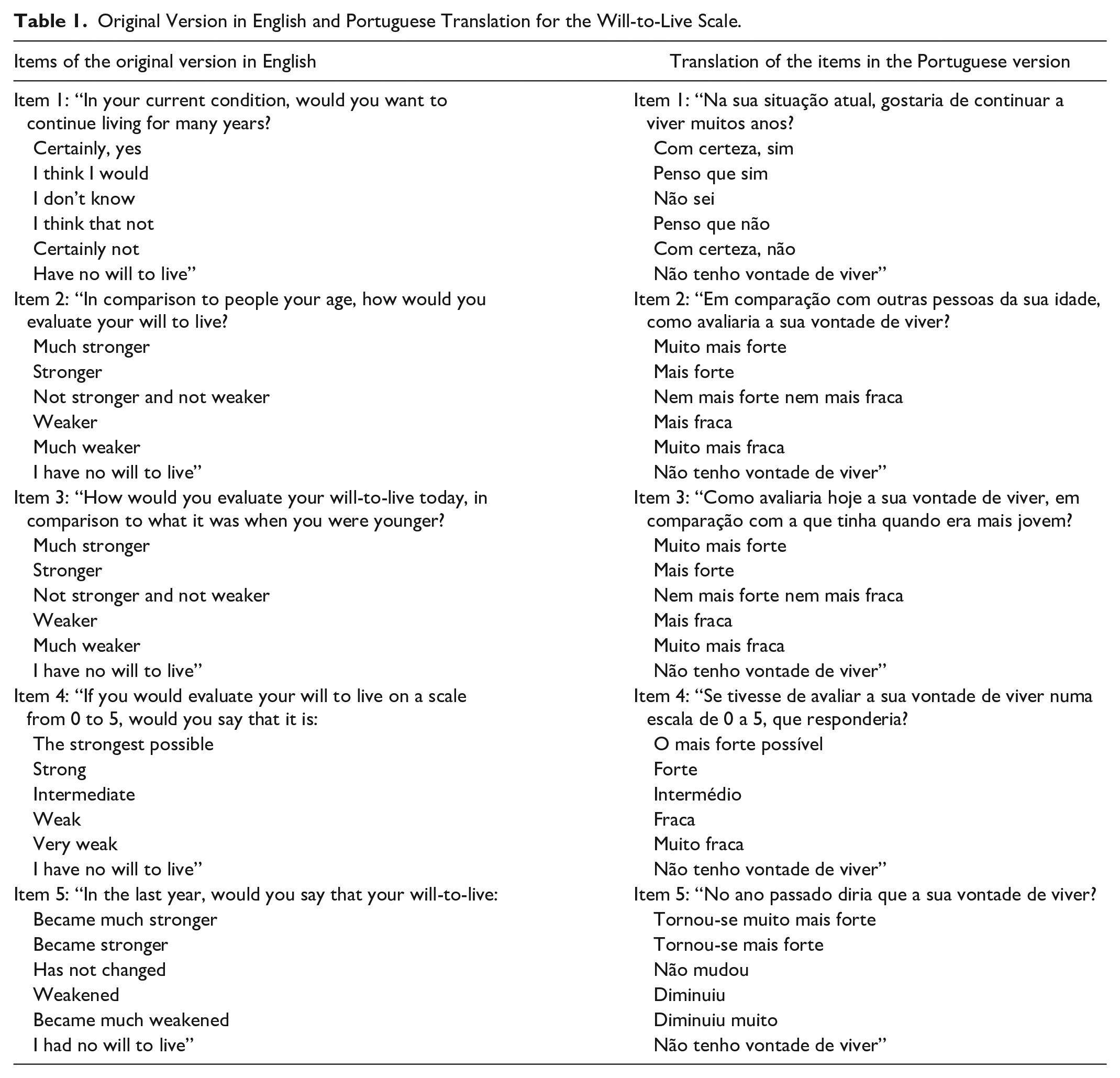
Recently, Carmel (2017) developed the Will-to-Live Scale with five straightforward items to assess the strength of the WTL (see Table 1). The original psychometric study, conducted with 868 people ranging in age from 79 to 99 living in Israel, showed that the WTLS has satisfactory psychometric characteristics. Specifically, the confirmatory factor analysis (CFA) showed that the five items fit a unidimensional structure. Goodness-of-fit statistics were adequate (time 1: CFI = .99; SRMR = .01; RMSEA = .02 [90% CI: 0.00–0.04]; time 2: CFI = .99; SRMR = .01; RMSEA = .04 [90% CI: 0.01–0.07]; time 3: CFI = .99; SRMR = .01; RMSEA = .06 [90% CI: 0.03–0.08]). Cronbach alpha appeared adequate at each time of data collection (α = .83, α = .86, and α = .90, respectively). Convergent validity was demonstrated through significant associations between WTL and several indicators of wellbeing. The WTLS has been utilized to assess WTL among elderly people residing in Israel (Carmel, 2017; Carmel et al., 2018; Shrira et al., 2019).
Original Version in English and Portuguese Translation for the Will-to-Live Scale.
The Present Research
Indeed, almost all the research on will to live has been conducted among elderly people in Israel. The present research intends to study the will to live among Portuguese adolescents. Most people want to live (Carmel et al., 2007), and adolescents are not an exception to this psychological expression of the striving for life. Adolescents also manage the meaning of life and death (Lyke, 2013). However, adolescents may present different views on these aspects from elderly people for several reasons. For example, in general elderly people are more involved in religion than adolescents (Ferreira & Neto, 2008), and the desire to prolong life in severe health circumstances was related to religiosity (Carmel & Mutran, 1997).
Decline in well-being as in the case of depression is related to suicidal thoughts and behavior. Among youths, suicide represents the second reason of death worldwide (e.g., Hawton et al., 2012; Shain, 2016). In the Portuguese cultural context suicide is also the second reason of death for youths with ages ranging from 15 to 24 years, after road traffic accidents (Sampaio, 2006). In a study, 17.9% of Portuguese adolescents reported self-harm behaviors (Neves & Santos, 2016).
The high rates of suicide behaviors among adolescents call our attention to the importance of identifying risk factors that might have implications for interventions. Various risk factors for suicidal behaviors in adolescents have been reported. A prevalent risk factor is bullying victimization which can lead to a decline in mental health followed by suicide ideation and suicide attempts (e.g., Barzilay et al., 2017). The WTL is a relevant indices of well-being, and a significant negative predictor of depression among elderly people (Carmel, 2017; Carmel et al., 2018). As such, decline in the WTL among adolescents may be considered a predictor for depression, suicidal ideation, and behaviors, and therefore an important factor to be assessed for prevention purposes.
In sum, the goals of the present research were three-fold:
(1) The first goal was to test the factor structure of the WTLS in an adolescent population. To test this, diverse analyses were performed, such as items analyses, principal component analysis (PCA), and CFA. It was expected that the scores of the WTLS would present a single latent factor, in consonance with the original scale (Carmel, 2017).
(2) The second goal was to examine the reliability of the WTLS. To achieve this, reliability of the WTLS was evaluated through Cronbach alpha, composite reliability (CR), and corrected item-total correlations.
(3) The third goal was to evaluate the validity of the WTLS. To explore this, we examined the convergent validity of the WTLS through the associations between the WTL scores and scores on other well-established constructs of well-being including subjective well-being (SWB), mental health, and emotional intelligence. These constructs were selected as they are conceptually linked to WTL (Carmel, 2017). Additionally, as past investigation showed that elderly women express significantly weaker WTL than elderly men (Carmel, 2001; Carmel et al., 2007, 2018), we also analyzed the relationship between gender and WTL in an adolescent population.
Study 1
For the purpose of achieving the objectives mentioned, two studies were carried out. The first one was intended to analyze the internal structure of the WTLS as well as its internal consistency. Our expectation was that WTLS scores would present a unidimensional structure and adequate internal consistency in consonance with previous reports (Carmel, 2017), and that girls would report weaker will to live than boys.
Method
Participants
Convenience sampling method was used in this study to recruit respondents. The sample consisted of 189 Portuguese adolescents (113 girls and 76 boys) with ages ranging between 14 and 18 (M = 16.16; SD = 1.98). Participants attended 10th to 12th grades.
Measures
The Will-to-Live Scale (WTLS)
We utilized the WTLS (Carmel, 2017) which includes five statements. The answers are assessed on a 6-point Likert scale (see Table 1). The WTLS measures the will-to-live of an individual in the present (e.g., “In your current condition, would you want to continue living for many years?”); the compared WTL with other individuals (e.g., “In comparison to people your age, how would you evaluate your will to live?”); and will-to-live modifications across time (e.g., “How would you evaluate your will-to-live today in comparison to what it was when you were younger?”). Greater values indicate stronger will-to-live. Previous investigations demonstrated the reliability and construct validity of the WTLS (Carmel, 2011, 2017; Shrira et al., 2019).
Socio-demographic data
A personal information form was utilized to collect data on age, gender, grade in school, and nationality of participants.
Procedure
The WTL scale was translated into Portuguese following the guidelines advocated by the literature on multicultural methodology (Brislin, 2000). First, two bilingual persons translated the WTLS into Portuguese. Subsequently, two other bilingual persons back-translated it into English. Minor discrepancies were solved by translators’ accordance. Finally, the WTLS was pilot-tested with 10 adolescents.
Public schools were contacted to get authorization for the study and it obtained approbation. Consent form asking permission to parents to participate in the study was acquired from all participants. Adolescents took part in a voluntary way.
A trained research assistant, a schoolteacher, or both were present to respond to issues. Participants filled out the survey in the school setting. Full anonymity was ensured.
Statistical analysis
The factor structure of the WTLS was scrutinized utilizing principal component analysis (PCA). Subsequently Cronbach alpha was utilized to assess reliability of the WTLS. The one sample t-test was calculated to compare WTLS score with neutral midpoint. One-way analysis of variance (ANOVA) was utilized to evidence a potential gender effect. IBM SPSS statistics version 25 was utilized for data analyses. Significance levels were set at 0.05.
Results
In order to examine the sample’s suitability for PCA, Kaiser–Meyer–Olkin’s (KMO) measure of sample adequacy was calculated, and Bartlett’s sphericity test was carried out (Tabachnick & Fidell, 2007). Bartlett’s sphericity test revealed significance, χ2 (10) = 304.29, p < .001. The KMO value was 0.83, higher than the recommended 0.60 (Field, 2017). Moreover, the respondent-to-item ratio was greater than 10:1 (Gaskin & Happell, 2014). These results denote favorability and support for performing a principal component analysis utilizing the five statements.
The interitem correlation matrix was subjected to a PCA. Results of PCA indicated that WTLS items consists of a single factor structure (eigenvalue = 2.91; 95% CI: 2.32–3.49) explaining 58.1% of the total variance. Table 2 presents the WTLS items and their factor loadings.
Descriptive Statistics of WTLS Items, Intercorrelations Among the Items, Principal Component Analysis Factor Loading, and Item-Reminder Correlations.

Note. All correlations between items are significant at least at p < .001. N = 189. WTLS = Will-to-Live Scale; M = mean; SD = standard deviation.
Descriptive statistics and reliability of WTLS
In order to assess the reliability of the WTLS, Cronbach’s α (Cronbach, 1951) and item-total correlations for each item were conducted. The Cronbach’s α for the WTLS was high (.82). The α of the remaining scale (when the item was removed) was .74 or above. The corrected item total correlations displayed scores ranging from .52 to .71 (Table 2). The average interitem r (homogeneity) for the WTLS was adequate at .47. Hence, the findings supported the reliability of WTLS.
The average score of the WTLS was 3.87 (SD = 0.69). This result suggests that the will-to-live was slightly great, and significantly above the neutral midpoint of 3.00 (t [188] = 17.35, p < .001). According to our expectation, males (M = 4.04, SD = 0.69) and females (M = 3.75, SD = 0.66), (F [1, 188] = 8.49, p < .01, η2 = .04) did differ significantly on the WTLS scores. Specifically, males’ average scores of the WTLS were significantly higher than females’ scores. Age was not related to will-to-live (r = −.08, p > .05).
Study 2
The goal of this study was to test the single model shown in the previous research presented by means of confirmatory factor techniques, as well as to investigate the relationships between will to live and SWB (life satisfaction, family life satisfaction, positive affect, negative affect), mental health syndromes (depression, anxiety, and stress), emotional intelligence, and self-esteem.
Method
Participants
The sample comprised 257 (111 boys and 146 girls) high school students in the north of Portugal. The average age of these students was 16.37 years (SD = 1.12; age range = 14–20 years). All respondents were Portuguese, and 83 (32.3%) attended the 10th grade, 66 (25.7%) attended the 11th grade, and 108 (42%) attended the 12th grade. This sample was equivalent in age, gender, and grade in school to the sample used in the first study.
Measures
The measures included in the first study, and the six measures already validated to the Portuguese cultural context.
Satisfaction With Life Scale (SWLS)
The SWLS comprises five statements (Diener et al., 1985; Neto, 1993). The answers are evaluated on a 7-point Likert scale from 1 (“Strongly disagree”) to 7 (“Strongly agree”), with higher scores expressing higher life satisfaction. Cronbach’s coefficient alpha calculated in this study was .84.
Satisfaction With Family Life Scale (SWFLS)
The SWFLS comprises five items (da Costa & Neto, 2019; Zabriskie & McCormick, 2003). The answers are evaluated on a 7-point Likert scale from 1 (“Strongly disagree”) to 7 (“Strongly agree”), with greater scores expressing greater family life satisfaction. Cronbach’s coefficient alpha calculated in this study was .93.
The Positive and Negative Affect Schedule (PANAS)
The PANAS includes 20 items, 10 assessing positive affect (PA), and 10 assessing negative affect (NA) (Simões, 1993; Watson et al., 1988). Respondents indicated how often they generally experience each emotion utilizing a 5-point scale (1 = “Not at all,” 5 = “Extremely”), with greater scores expressing greater PA and NA. Cronbach’s alpha calculated in the current study was .83 and .79, respectively.
The Depression Anxiety and Stress Scale-21 (DASS-21)
The Depression Anxiety and Stress Scale-21 (Lovibond & Lovibond, 1995; Pais-Ribeiro et al., 2004; Szabó, 2010) is a 21-item measure of negative affect. Each subscale includes seven items (depression, anxiety, and stress). The responses are evaluated on a 4-point Likert scale from 0 (“Did not apply to me at all”) to 3 (“Applied to me very much or most of the time”), with higher scores expressing higher depression, anxiety, and stress. Cronbach’s alpha calculated in the current study was .84, .80, and .86, respectively.
The Wong and Law Emotional Intelligence Scale (WLEIS)
The WLEIS (Carvalho et al., 2016; Rodrigues et al., 2011; Wong & Law, 2002) includes 16 statements. The range of answers is assessed on a 7-point Likert scale from 1 (“Totally disagree”) to 7 (“Totally agree”). This scale provides a global score for self-reported emotional intelligence, with higher scores indicating greater emotional intelligence. Cronbach’s coefficient alpha calculated in this study was .91 for the overall scale.
Self-esteem
Self-esteem was assessed with a single-item scale (Neto & Fonseca, 2018; Robins et al., 2001). The answers are evaluated on a 7-point scale (1 = “Strongly disagree,” 7 = “Strongly agree”), with greater scores denoting greater self-esteem.
Procedure
The procedure was similar to that used in Study 1.
Statistical analyses
Several analyses were performed including descriptive statistics, confirmatory factor analysis (CFA), reliability, one sample t-test, one-way ANOVA, and Pearson product-moment correlations. CFA was conducted to evaluate the adequacy of the unidimensional structure of the WTLS. With regard to CFA the following indices were utilized: chi square value divided by degrees of freedom (χ2/df), the goodness of fit index (GFI), comparative fit index (CFI), standardized root mean square residual (SRMR) and root mean square error of approximation (RMSEA). A χ2/df ratio less than five indicates an acceptable fit (Kline, 2005). The cut-off criteria that were used are those in Hu and Bentler (1999): a CFI and GFI of at least .90 and a SRMR and a RMSEA of less than .08 together would indicate a good fit. Reliability of the WTLS was assessed by composite reliability (CR) and Cronbach alpha (α). The one sample t-test was performed to compare the WTLS score with the neutral midpoint. One way ANOVA was utilized to measure the potential effect of gender. To test for concurrent validity, Pearson product-moment correlations between the WTLS and several constructs, considered indicators of well-being, were carried out. IBM SPSS statistics version 25 was used for data analyses. Significance levels were set at .05.
Results
A CFA was conducted on the raw data (correlation matrix, maximum likelihood estimation). The model tested was the single factor model made evident in Study 1. No correlation between error terms was allowed. This resulted in χ2 = 7.43, df = 5, χ2/df = 1.49, CFI = 0.99, GFI = 0.99, RMSEA = 0.04 [90% CI: 0.00–0.10], and SRMR = .03, suggesting a good model fit (Hu & Bentler, 1999). All standardized factor loadings were significant and exceeded 0.50 (p < .001) (see Figure 1). Therefore, these findings demonstrate that the data fit the single factor structure, which supports the construct validity of the WLS.

Confirmatory latent factor model for the Portuguese version of WTLS.
In order to analyze the reliability of the WTLS, tests for CR and Cronbach’s alpha were performed. CR value for WTLS was .81 and Cronbach’s alpha was .84, indicating good internal reliability. The corrected item-total correlation for each WTLS item was considerable. The average interitems r (.51; homogeneity) for WTLS items were also satisfactory.
Descriptive statistics of the measures utilized are presented in Table 2. The mean score of the WTLS was 3.83 (SD = 0.76). Therefore, results of this sample suggest that the adolescents reported a slightly high will-to-live, and significantly above the neutral midpoint of 3.00 (t [256] = 17.46, p < .001). As in study 1, we found significant gender differences (F [1, 251] = 13.75, p < .001, η2 = .05). Boys scored higher (M = 4.03, SD = 0.65) than girls (M = 3.68, SD = 0.80). However, the effect of gender was relatively low. Age was not related to will-to-live (r = −.09, p > .05).
Validity of the WTLS was evaluated using correlations with other indicators related to well-being. Convergent validity of the instrument was substantiated by the significant and positive correlations identified between the will-to-live scores and the scores measuring life satisfaction, family life satisfaction, positive affect, emotional intelligence, self-esteem, and by significant negative correlations between the will-to-live scores and negative affect, depression, anxiety, and stress (see Table 3).
Descriptive Statistics and Correlations Between Will-to-Live and Measures Related to Well-Being.
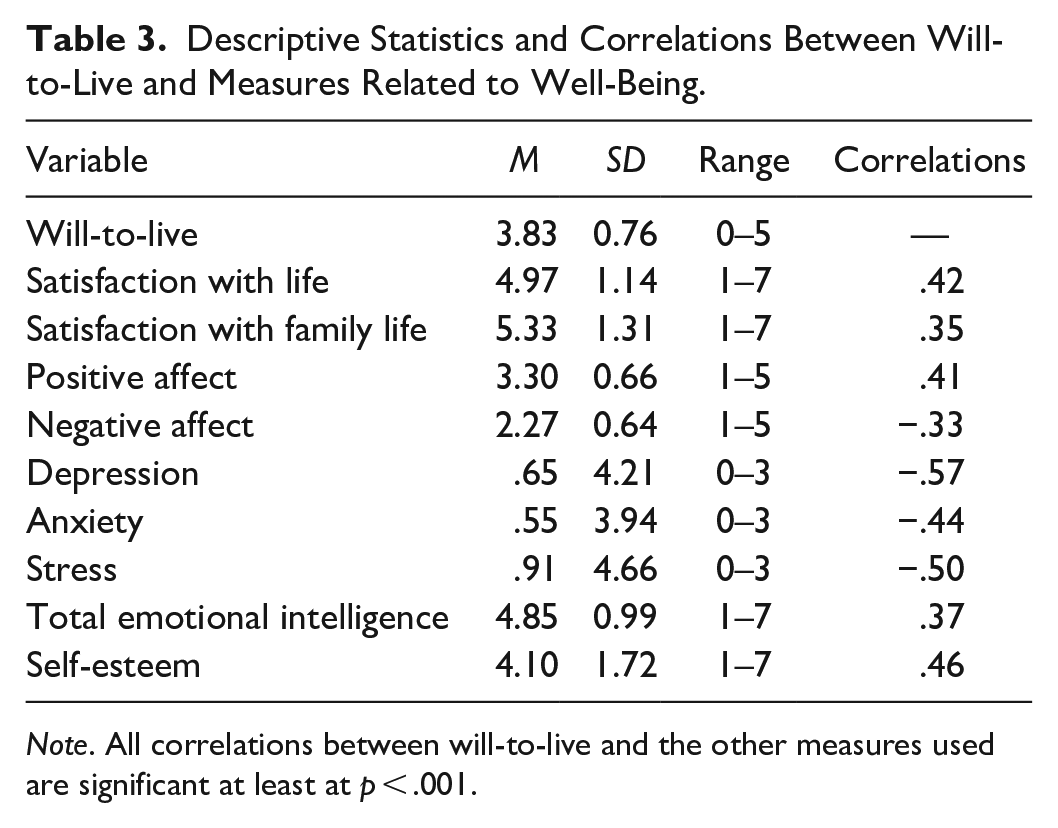
Note. All correlations between will-to-live and the other measures used are significant at least at p < .001.
In line with Carmel (2017), we evaluated the additive value of the five-item scale over the formerly single-item WTL (Item no. 4, see Table 1) in the prediction of satisfaction with life, using a hierarchical regression analysis. In the first block, the single item was entered. In the second block, the other four items of the WTLS were inserted. The variance inflation factor values were all below 10 and the tolerance statistics above 0.20, indicating no collinearity within the data. The results showed a statistically significant increase in R2, suggesting that the five-item model significantly enhanced the prediction of satisfaction with life, F (5, 250) = 11.40, p < .001 (see Table 4).
The Results of the Hierarchical Regression Analyses (β) on the Predictors of Satisfaction With Life.

p < .01. ***p < .001.
General Discussion
The present work supports the use of the WTLS among adolescents. The reported results of the Portuguese version of the WTLS supported its construct validity, internal consistency, and convergent validity. Indices of both reliability and validity were consonant with adequate standards of measurement (Carmel, 2017; Field, 2017; Kline, 2000).
The principal component analysis (Study 1) and the CFA (Study 2) supported the presence of a single WTL latent factor. This factor structure consistently replicated among adolescents the factor structure found among old people (Carmel, 2017). The internal consistency of WTL scale, indicated by composite reliability and alpha coefficient values, was high, suggesting that the WTLS is reliable among adolescents. In both studies, the average scores on the WTLS were significantly above the neutral score, which suggests a norm of general will-to-live for young people included in this study.
Moreover, the findings provide support to the convergent validity by significant correlations with constructs related to well-being (SWB, mental health syndromes, emotional intelligence, and self-esteem). SWB is not a single unitary construct (Diener et al., 2018). We have examined the relationships between WTL scores and two cognitive evaluations of SWB (life satisfaction and family life satisfaction), and two affective evaluations of SWB (positive affect and negative affect). Moderate correlations were found between WTL scores and four indicators of SWB, suggesting that higher SWB was associated with higher will-to-live.
Regarding mental health, we have considered three syndromes: depression, anxiety, and stress. Will-to-live scores correlated strongly with depression and stress and moderately with anxiety. Therefore, will-to-live appears to be related to better mental health. These are results of two relatively small cross-sectional studies, which do not enable us to assess causality between WTL and the indices of mental health. However, in a previous longitudinal research on older adults, findings showed that the WTL predicts depression rather than the other way around (Carmel et al., 2018). A replication of this study on adolescents seems to be important due to the practical implications for this age group.
Previous investigation provides support to the association of emotional intelligence with positive life outcomes (e.g., Furnham & Petrides, 2003; Sánchez-álvarez et al., 2016). People with greater emotional abilities present greater capacity to perceive, use, understand, and manage emotions, which facilitates higher SWB (Mayer & Salovey, 1997). In the current research, WTL scores correlated positively with global emotional intelligence. Therefore, higher will-to-live appears to be associated with higher emotional intelligence.
In addition, self-esteem correlated moderately with will-to-live. Higher self-esteem was related to greater will-to-live. In sum, the identified pattern of correlation points to a positive relationship between will-to-live and well-being, providing support to the convergent validity of the WTLS among adolescents.
In agreement with Carmel’s (2017) findings among elderly people, the findings of regression analysis to predict life satisfaction demonstrated also among adolescents that the predictive power of the WTLS was significantly higher than that of a single item.
A plethora of investigations have evidenced that females score lower than males on psychosocial indices of well-being (Carmel, 2019). In the current research, girls displayed significantly lower scores than boys on the WTLS. This gender difference is in accordance with past results among older people (Carmel, 2001, 2017). Present findings are consonant with the view that adolescence is harder for girls than for boys in life satisfaction (Esnaola et al., 2019).
The current work is not without limitations. First, our convenience samples included only adolescents. The extent to which the samples represented Portuguese adolescents is not exactly known. Next studies should involve a more diverse age range. Namely, as the original scale was developed among elderly people, it will be relevant to compare the WTL among adolescents and elderly people. Second, the sample size used is modest. However, despite this, the reliability coefficients suggest that sample size did not systematically affect the findings. Third, in spite of the fact that the WTLS has favorable psychometric properties, as it is a self-report tool, it might be subjected to social desirability. Fourth, the design of this research was cross-sectional; next research should use longitudinal designs in order to support predictive validity.
Despite these limitations, current findings contribute to generalizing the use of the WTLS from older to adolescent populations living in different countries. Early evaluation of decline in mental health is important for prevention purposes among both the old and the young. Being a psychometrically sound tool that requires a minimum of time and cost, the WTLS is recommended for evaluation of well-being in both populations.
Footnotes
Acknowledgements
The authors would like to thank the editor and three anonymous reviewers for their constructive comments, which enabled us to describe the research more clearly.
Declaration of Conflicting Interests
The author(s) declared no potential conflicts of interest with respect to the research, authorship, and/or publication of this article.
Funding
The author(s) disclosed receipt of the following financial support for the research, authorship, and/or publication of this article: This research was partially supported by the Center for Psychology at the University of Porto, Portuguese Science Foundation (FCT UIDB/00050/2020)
