




Abstract
The acquisition of oral communication skills is essential for lifelong learning and development. Despite their importance, specific approaches oriented to its acquisition and mastery in second languages (L2) are not widely established. Indeed, the prevalence of a monologic classroom discourse still hinders the opportunities to enhance language production. This article analyses the development of L2 oracy skills among secondary school students who have participated in Dialogic Literary Gatherings, a dialogue-based educational action, in Basque. The interactions of five students were observed and analyzed using the Cambridge Oracy Assessment Toolkit. The study also included an interview with the teacher, and a focus group with the participant students. The results show that L2 oracy skills of the students evolve when they participate in these dialogic encounters, especially in the cognitive and socio-emotional areas. Implications for the teaching of L2 spoken language are discussed.
Keywords
Introduction
A good command of spoken language is a fundamental educational goal to ensure that students can function and succeed in schooling and in the workplace (Mercer et al., 2019; OECD, 2005). Indeed, it is becoming increasingly important to develop oral communicative skills through education to train citizens able to lead active and participatory roles in society. Accordingly, research has shown that dialogically organized classrooms may foster the development of students’ oral language skills creating affordances to address that challenge (Van der Veen et al., 2017).
However, while efforts have been made to introduce productive dialogue in the classroom in the past four decades (Howe & Abedin, 2013), a type of monologic teaching that perpetuates the traditional pattern of interaction still prevails (Mehan & Cazden, 2015). This has limited students’ development of oral skills by creating a closed discourse where teacher talk predominates (Soto-Hinman, 2011; Walqui, & Van Lier, 2010). Whereas it seems essential to transforms classrooms into dialogic spaces for students to develop oral skills as essential for their education, research has revealed that English as Second Language and Foreign Second Language classrooms are not very interactive, since 70% of their practices are teacher-centered or devoted to individual students (Zuniga & Simard, 2016). So that, dialogic contexts are more necessary than ever to change this unidirectional pattern by transforming monologic classrooms to foster students’ participation in the creation of their own knowledge (García-Carrión et al., 2020).
Indeed, the benefits of including students in dialogic discussions has been explored in different disciplines. Among those, dialogic discussions helped students to be critical against teacher’s contributions based on his/her authority when teaching History in secondary classrooms (Freedman, 2020). These findings are consistent with those from several studies that have analyzed dialogic teaching and learning in science and mathematics, in primary and secondary education (Ruthven et al., 2017), or in English as a Foreign Language (Zubiri-Esnaola et al., 2020). Particularly, dialogic interactions are of outmost importance in Second Language Acquisition (SLA) for promoting oral exchanges (Walqui, 2019) that contribute to improve fluency and accuracy (McDonough & Sato, 2019). However, it is still not common to offer students interaction opportunities during L2 learning, which limits the development of their oral skills. Without ensuring the development of oracy skills in L2, many students can remain excluded in an increasingly diverse linguistic society, even more in bilingual contexts (Manterola et al., 2013).
This paper tackles this challenge by studying the development of oracy skills in a bilingual secondary classroom in the Basque Country, where the language of instruction is Basque (L2), being Spanish the L1 for most of the students. This is a particularly pertinent context for this study due to the importance of developing oral skills in Basque, for being this a minority language and the language of the school. Specifically, the educational system of the region offers the minority language Basque, as the language of instruction (L2) for most of the schools in the system, being currently the most demanded model, with a 66% of the students in the region studying in Basque (Eustat, 2021). It is the only surviving Pre-Indo-European language in Western Europe. Linguistically, Basque has been an isolated language (unrelated to any other existing languages).
According to the last sociolinguistic survey conducted in 2016 (Basque Government, 2019), the Basque language is spoken by 28.4% (751,500) of the people in the Basque territories, located mostly in Northern Spain and a small area in Southern France. However, despite its limited social use, it is essential that students reinforce their knowledge and skills in Basque to prevent their educational exclusion and school failure. For that reason, students need to find opportunities for dialogic interactions in Basque to develop oral communicative competence. Consequently, our study introduces a dialogue-based educational intervention, named Dialogic Literary Gatherings, to explore its impact in students’ oracy skills in Basque.
The main purpose of the study is to analyse the extent to which Dialogic Literary Gatherings (DLGs) contribute to the development of oracy skills in Basque. It involves students engaging in dialogue based on the reading of the greatest literary works. A theoretical framework is presented below about the importance of oracy skills in educational contexts, and the potential of dialogic practices such as DLGs, for their promotion and the success of students throughout their academic, professional, and social lives. Therefore, this work can shed light on a topic that is currently considered to be highly controversial in some bilingual o multilingual educational systems, such as in the Basque Country. This can be beneficial for preparing citizens who communicate effectively and collaborate proficiently in all aspects of their lives.
Theoretical Framework
The development of oracy skills is closely linked to language acquisition. Recent neuroscience studies have confirmed that children’s early exposure to language through interaction affects later language and cognitive skills (Romeo et al., 2018). According to Kuhl and Damasio (2012), this is due to the fact that “listening to language” stimulates early brain development. This aligns with Vygotsky’s (1962, 1978) theory of cognitive development and its contributions about the influence of language in the development of higher psychological processes. In fact, decades of empirical research have demonstrated the value and potential of sociocultural theory for education (Mercer & Howe, 2012). Specifically, language is a fundamental cultural and psychological tool that shapes inter-mental and intra-mental processes. Therefore, encouraging effective use of talk in the classroom is essential to promote collective and individual thinking and learning (Mercer, 2013; Mercer & Howe, 2012). Consequently, creating opportunities for the students to develop oral communication skills that foster these processes in the classroom is essential (Heron, 2019).
Oracy Skills
Wilkinson (1965) introduced the term “oracy” to refer to oral skills that include “speaking” and “listening” skills. In this way, “oracy” is differentiated from the “literacy” concept, which refers to written expression and reading comprehension. Baker (2001), among other authors, described language competence in terms of the four “language abilities’ (listening, speaking, reading, and writing). He classified them into two groups: oracy, which includes “listening” as a receptive skill, and “speaking” as a productive skill; and “literacy abilities,” which include reading and writing skills. Mercer et al. (2017) have furthered existing knowledge about the assessment and teaching of oracy skills. Based on the understanding that “oracy skills” are children’s abilities to use spoken language, they have identified four generic skills that must be mastered in the acquisition of oracy skills (see Table 1). So that, the Oracy Skills Framework pays attention not only to linguistic and cognitive skills, but also to the analysis of physical and socio-emotional skills, which are essential for effective communication (Mercer et al., 2017).
Oracy Skills Framework.
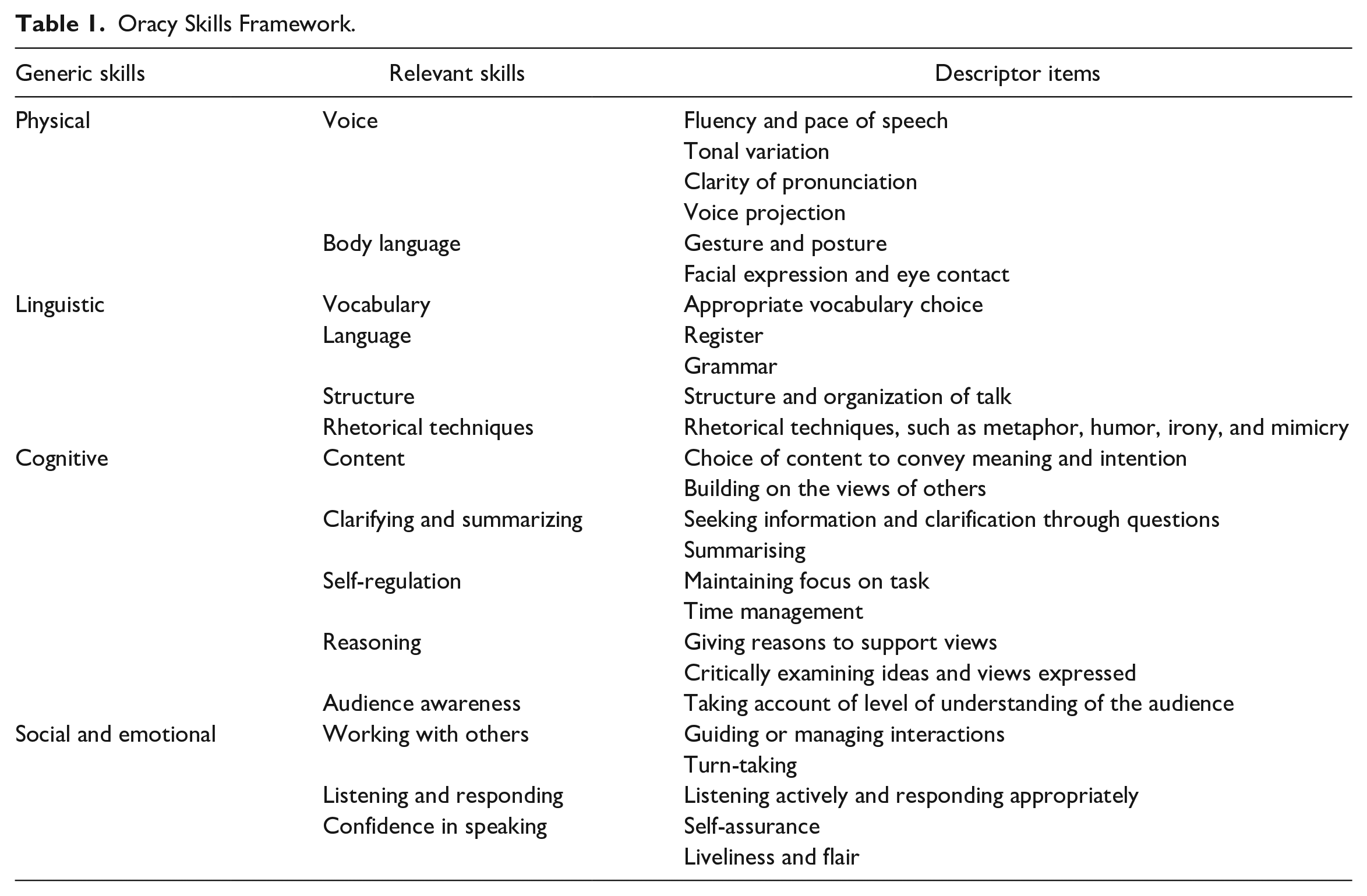
Taking this framework as a reference, Dippold et al. (2019) and Heron (2019) introduced dialogic practices to develop oracy skills in higher education. Dialogic practices in the classroom have been found to be effective in promoting interaction between peers (Maine & Hofmann, 2016), with the teacher (Howe et al., 2019; Lyle, 2008) and with other adults in the classroom (Aubert et al., 2017; Valero et al., 2017). Since the benefits of interaction and dialogue for learning depend on their quality, it has been shown that different types of productive talk such as “Exploratory Talk” (Barnes, 2008; Mercer, 2000), or “Accountable Talk” (Michaels et al., 2008; Resnick et al., 2018), foster the development of the cognitive and linguistic dimensions of oracy skills.
Dialogic contexts are especially important for the development of L2 oracy skills. Even if students master basic literacy skills, the acquisition of higher order skills requires a command of oracy skills through the use of reflection and shared reasoning processes (Boyd et al., 2019, Kotler et al., 2001; Spencer et al., 2020). However, despite the importance of dialogic contexts, according to the data from The Talking Partners program, bilingual students use L2 only for basic requests and do not have opportunities to reflect, to reason together. So that, the program provided extra sessions with adult talking partners that made a real difference to the students’ spoken skills in L2 (Kotler et al., 2001).
Hence, learning environments that stimulate dialogue and interaction in L2 might foster the development of oracy skills. In particular, Dialogic Literary Gatherings, a dialogic practice explored in depth in this study, promote dialogic interaction between students up to 80% of class time (Hargreaves & García-Carrión, 2016).
Dialogic Literary Gatherings
Dialogic Literary Gatherings (DLGs) are an educational activity based on dialogic learning (Flecha, 2000). It consists of reading and discussing the greatest literary works of humankind. This is usually carried out in a whole-class setting where the teacher facilitates equal participation among the students. Students are required to read the agreed text prior to the DLG session and identify some ideas to share with the class while providing their arguments based on their reading.
Research has shown a positive impact of DLGs across diverse contexts and groups. It has been found to be effective in the acquisition of linguistic competence, specifically, in reading comprehension, and interpretation of classic works (López de Aguileta et al., 2020; Soler, 2015), in vocabulary (Llopis et al., 2016; Santiago-Garabieta et al., 2021), and in the acquisition of school-relevant language and literacy skills (Lopez de Aguileta, 2019). However, its potential impact on the development of L2 oracy skills has not been deeply studied so far.
Methodology
This is an exploratory case study (Yin, 2018) that examines oracy skills development on five secondary students in terms of four generic skills such as physical, linguistic, cognitive, and socio-emotional (Mercer et al., 2017). This study is based on the observation of the development of oracy skills as a competence that needs to be explicitly developed in a meaningful way, in which school plays a key role (Heron, 2019; Mercer et al., 2019). This paper draws on qualitative and quantitative data to examine the evolution of oracy skills after implementing DLGs.
The study was carried out in an urban school located in a medium socio-economic area in the Basque Country, Northern Spain, where two official languages, Basque and Spanish, coexist. The school’s language of instruction is Basque, whereas Spanish is the L1 of the most of students. This displays the social situation of a minority language when it faces a diglossic situation (Zubiri, 2014).
Participants
The Basque teacher and 10th grade class (23 students, aged 15–16 from medium-high socioeconomic status) participated voluntarily in the DLG sessions that were implemented weekly. For the purpose of this study, five students (three boys and two girls) were selected according to the following criteria: (a) not having previously participated in a DLG; (b) participating in all DLG sessions; having Spanish as their L1, and Basque as their L2; (c) voluntarily agreeing to participate in the study, including an interview and focus group after being informed about it, and (d) having the informed consent of their parents or guardians for that.
Once the participants were selected, information regarding their linguistic preferences and use was gather. For that purpose, students were asked to answer open questions in an online questionnaire about, on the one hand, their attitude toward the languages they learn and use in the classroom and in their daily life and, on the other hand, the perception of their competence in those languages. This information is provided in the profile of the participants described below:
- Student 1: 15 years old boy. He does not like Basque language. For him, Basque is the most difficult subject, and more difficult than other languages, such as English. He uses Spanish in his daily life and in the school and he only uses Basque to communicate with some teachers.
- Student 2: 15 years old girl. She likes languages and for her Spanish and English are not very difficult subjects; indeed, she spends a lot of time listening to music in English. She is also learning French. However, she feels Basque is a difficult language.
- Student 3: 15 years old boy. He has a positive attitude toward Basque language. He thinks that even Basque, as Spanish or English, is not a very difficult language to learn; so he is willing to use Basque in his everyday life. He also speaks French.
- Student 4: 15 years old girl. Her favorite language is English and she has a positive attitude toward Basque. Although she thinks that Basque is a difficult language to learn, she enjoys listening to music in Basque and her favorite band plays Basque music.
- Student 5: 15 years old boy. He likes Basque and Spanish, but his favorite language is Basque. In his free time, he uses the most Spanish. However, he prefers writing and listening to music in English. He also speaks French.
Regarding the teacher, he has been working for more than 20 years as a “Basque Language and Literature” teacher in secondary education. Although his mother tongue is Spanish, he has a degree in Basque Philology and he has a full professional competence in Basque. He is very interested in fostering students’ language skills and literature knowledge through creativity. He has a strong training and interest in “Bertsolaritza,” a Basque cultural tradition that consists of creating and singing spontaneously lyrics following specific rhythms.
Procedure
Nine sessions of Dialogic Literary Gatherings were conducted once a week from October to December of 2019 as part of the subject “Basque Language and Literature.” Each session lasted approximately 50 minutes and it was facilitated by the teacher. Previously to the session, students read an agreed piece of Oliver Twist by Charles Dickens, translated into the Basque language and aged adapted. The dialogue was student-led and initiated from their ideas about the text.
Two of the researchers were involved in the school through all the academic year. Based on a communicative approach of the research (Gomez et al., 2011), the implementation was co-designed and co-created with the participants. Prior to the implementation, a training session with the teachers was conducted by the researchers. Then, one of the researchers modeled some sessions for the teachers to implement them with confidence. Once the results were obtained, both researchers discussed them with the teaching staff.
Ethics
Once the Research Ethics Committee of the University of Deusto approved the study, the research aims, and the implications and potential benefits for participants and the school community were explained to the school leadership team, the students, and the families. All participants signed and returned their informed consents to the researcher who collect the data weekly (first author). None of the participants withdrew from the study.
Data Collection
A systematic observation of the selected sample in the Dialogic Literary Gatherings was carried out by three independent observers using the “The Cambridge Oracy Assessment Toolkit.”
For the scoring of the quality of the oral interventions during the DLGs, the “The Cambridge Oracy Assessment Toolkit” was used (Mercer et al., 2017). Table 1 shows the relevant skills that make up each of the four generic skills and their corresponding descriptors.
Following the framework devised by the authors, each indicator was rated on a scale from 1 to 7 (Mercer et al., 2017; see Table 2).
Rating Scheme.
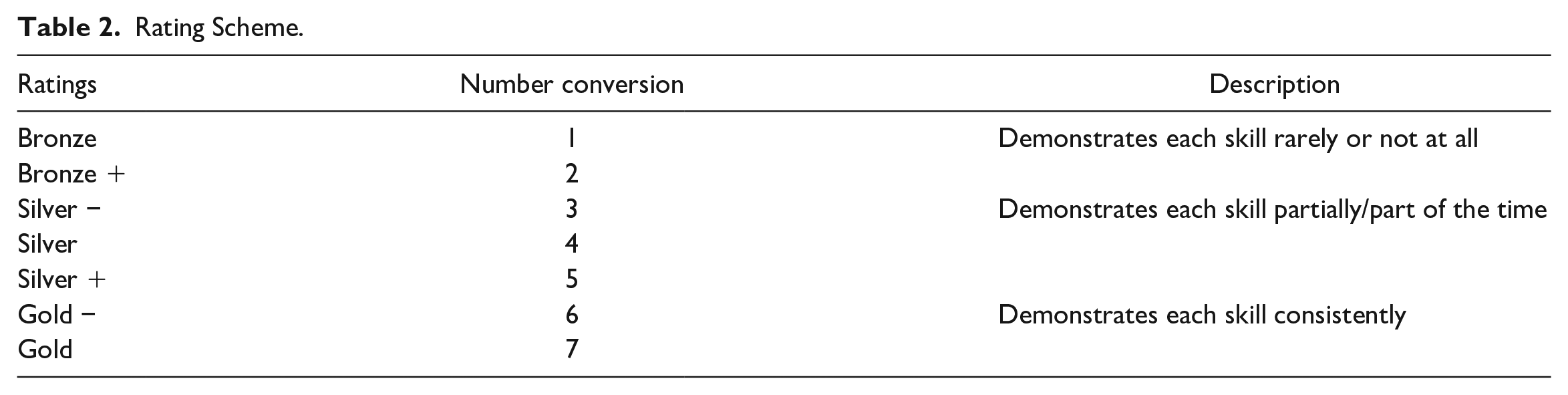
Three researchers individually rated the participant students’ oral interventions for each descriptor item (total of 25) that defined the relevant skills, as presented in Table 1
Regarding this instrument, the original study (Mercer et al., 2017) shows an inter-rater reliability calculated in three initial and three end-of-year different tasks. Thus, despite the exception of one task, which has an unreliable calculation and other two’s IRR that could not be calculated due to missing data, all the IRR scores were adequate (from .64 to .90). In the case of the present study, once the final individual rate was compiled, the inter-rater reliability was calculated. Agreement was assessed using Fleiss’s kappa (Gisev et al., 2013), which indicated high inter-rater reliability (Ҡ = .959; p = .000).
At the end of the intervention an interview was conducted with the teacher, and a focus group with the five participant students, both audio recorded. One of the researchers, who had participated in all the sessions, conducted the interviews and the focus group.
The objective of the interview and focus group was to find out participants’ and teacher’s views and perceptions of DLGs as a tool to support and, eventually improve students’ oracy skills in Basque. All data were transcribed verbatim for further analysis.
Data Analysis
As mentioned previously, the analysis has been carried out using both qualitative and qualitative data. Subsequently, the two information sources are integrated throughout the results section.
Quantitative analysis
Descriptive and inferential analysis has been conducted for students’ outcomes in their oracy assessment. All of these analyses were performed using the SPSS statistical software version 23. Given the sample size (n = 5) Shapiro-Wilk test was conducted in order to address normality of the variables. All the variables follow a normal distribution, except for five of them. Nevertheless, due to the sample size (n = 5), non-parametric analyses were conducted to know if the differences between initial and final scores per each descriptor item, relevant and generic skills were significant. Then, non-parametric Wilcoxon (Glantz, 1981) was conducted to know if these variations overtime were statistically significant. Although Wilcoxon signed-rank test has been conducted with differences of mean ranges, Tables 4 to Table 7 include the descriptive statistics Mean and Standard Deviation to facilitate understanding.
Qualitative analysis
The teacher interview and the students’ focus group were transcribed verbatim and analyzed deductively. For that purpose, the 25 five descriptor items established in the “The Cambridge Oracy Assessment Toolkit” (see Table 1) were used and applied as coding categories to analyze students’ dialogues during the DLGs. This process was made by three of the researchers independently. Subsequently, a meeting was held in order to discuss potential agreements and disagreements that arose in the codification process to reach consensus. Data was coded using Nvivo software. This data has allowed us to illustrate, with some excerpts, the relevant skills rated in our observations and are integrated in the results section.
Results
The results are presented in two main sections. First, students’ individual development of their relevant skills is reported. Second, group changes in the descriptor items for each relevant skill are described. The quantitative results are discussed against qualitative data derived from the interview, the focus group, and the students’ dialogues in the DLGs.
Students’ Individual Development of Relevant Skills
Students’ participation rate increased for all of them between the first and the last session, especially for student 3, as reported in Figure 1. Their participation was always voluntary and not teacher-requested, so that, in the last session they were more willing to contribute to the discussion than in the first one.

Students’ participation in initial and final session.
Considering all students contributions, Table 3 reports students’ progress in their oracy skills at the individual level per relevant skill. The individual score difference reported per each student shows an improvement in their oracy skills.
Students’ Individual Differences in Oracy Skills Between Initial and Final Session.

Note. S1 = Student 1; S2 = Student 2; S3 = Student 3; S4 = Student 4; S5 = Student 5.
Overall, all the students made a positive progress across the relevant skills. Student 3 achieves outstanding in 7 out of 14 relevant skills, especially in 4 relevant skills within the cognitive and in 2 within the socio-emotional generic skill. The most outstanding improvement is obtained by student 1 in “Clarifying and summarizing.” In this very same relevant skill student 4 performs higher along with the “Vocabulary” one. Student 5 stands out for his improvement in “Listening and responding.” Finally, student 2 does not present any major improvement across the relevant skills.
Group Development of Oracy Skills Across Descriptor Items
As a result of a fine-grained analysis of the students’ oracy skills, that included pre-post rating for each of the 25 descriptor items, the group mean difference was performed using a non-parametric analysis. Results show a positive development across all the descriptor items within the relevant and generic skills, as presented below. Although all the generic skills improved significantly (see Table 4–Table 7), changes have been moderated in the physical and linguistic skills, whereas a higher improvement was reached in the cognitive skill (see Table 6).
Physical Skills’ Development.

Note. MD = Mean difference; SD = standard deviation.
p < .05.
Linguistic Skills’ Development.

Note. MD = Mean difference; SD = standard deviation.
p < .05.
Cognitive Skills’ Development.

Note. MD = Mean difference; SD = standard deviation.
p < .05.
Social and Emotional Skills’ Development.

Note. MD = Mean difference; SD = standard deviation.
p < .05.
Physical
The group showed a significant improvement in two descriptor items within the Physical generic skill. Particularly, students improved their “Fluency and Pace of Speech” (MD = −2.88, SD = 1.51) and their “Gesture and Posture” (MD = −1.72, SD = 1.49). Table 4 summarizes their progress as a group.
As far as Physical skills is concerned, students reported feeling more relaxed when speaking Basque in the DLGs compared to an ordinary classroom where the teacher talks and the students listen. Student 1, who performed higher than the rest in the physical generic skill (see Table 3), explained this idea:
You feel more relaxed when you speak the language in the DLGs, because after all in class you do the exercises that the teacher tells you to do, you listen to the explanation, but you don’t speak so much. (Student 1 - Focus group)
In the same vein, the teacher highlighted students’ fluency as a remarkable improvement in the students’ oracy skills, and he also observed a change in their body language. At the beginning students addresses their comments mainly toward the teacher, whereas they move toward the group when sharing their ideas:
Above all, I would say the greatest improvement was fluency. I think this is the most remarkable aspect (. . .) At first, when they spoke, they spoke to me, it seemed that they only spoke to me. But then they got over this and today it is clear that they speak to the group. (Teacher - interview)
Linguistic
Students improved notably in structuring and organizing their talk (MD = −2.06, SD = 1.24), in their grammar (MD = −2.48, SD = 1.09) and, specially, in using an appropriate vocabulary (MD = −3.12, SD = .80) as reported in Table 5.
These improvements in students’ linguistic skills are consistent with the teacher statements. According to his opinion students developed a metalinguistic awareness when making an appropriate use of the grammar, as well as the ability for correcting mistakes when listening others and expressing themselves:
On a grammatical level, they gradually corrected some mistakes. [. . .] In the gatherings they realised that they had to use conditional verbs when expressing more profound ideas. That was how they realised how useful and valuable they are. (Teacher - interview)
Regarding the use of rhetorical techniques students started the DLGs sessions making simple comparisons, whereas by the end they expanded their repertoire and used metaphors, idioms or proverbs, and words with double meaning and irony:
I remember in the last DLG I thought about the proverb we had learned that ‘the home fire must be put out with home ash’ [a Basque proverb meaning that problems have to be solved by those directly involved]. I remembered it when I read it and shared it with the class, I think it is true. (Student 3-DLG)
Cognitive
As far as cognitive skill is concerned, most of the descriptor items improved significantly (see Table 6). The highest improvements were obtained when students seek information and asked for clarification through questions (MD = −4.42, SD = 1.43) and when they critically examined ideas and views (MD = −3.96, SD = 0.56).
The cognitive skills enacted during the DLG are pointed out by student 2 who describes the process she and the group went through, from having to choose their ideas from the reading (“Choice of content to convey meaning and intention”) to become more skilled in making connections between their contributions (“Building on the views of others”):
At first, I carefully prepared what I was going to say. Everything very measured. And as we progressed, well, you were more at ease, so you did things better. [. . .] I mean, we created relationships between some things and others. And that was at the end, when we had become old hands at the DLGs. (Student 2 - Focus group)
Both the students and the teacher emphasize how DLG participants’ interventions went from being descriptive to being argued contributions, expressing well-grounded agreement or disagreement:
Many times we say what I think is right, but we do not back it up in any way. And here you gave your opinion, someone challenged it and you tried to convince that person that your opinion was valuable. (Student 2 - Focus group)
By using dialogues, they made progress in constructing shared knowledge:
They really knew how to interpret and look for meanings that we would not have even remotely thought of (. . .) They listen to each other, and there are people who contribute high-quality, interesting ideas. (Teacher - interview)
This statement is consistent with the progress made in showing more frequent questions being asked to classmates. The following dialogue extract illustrates how Student 3 re-built the discussion:
S3: What is the alternative there? S5: Telling the truth. S3: Yes, but people fear they will be punished or something similar if they tell the truth. Therefore, he [Oliver Twist] does not want that punishment and involves the others (Student 3 -DLG)
Social and emotional
The group improved significantly in most of the descriptor items (see Table 7), particularly in “Guiding or managing interactions” (MD = −4.12, SD = 1.20) and in “Listening actively and responding appropriately” (MD = −3.14, SD = 0.86).
Students provided supportive interactions aiming at guiding or managing dialogue when sharing their ideas within the group. This peer support facilitated the flow of dialogic interaction within the group as expressed by two of the students and the teacher:
S1: When someone was not able to express a particular idea, or did not remember it at that time, if you had understood it, you can help them, lend them a hand. (Student 1 - Focus group) S3: Yes, sometimes a word that they didn’t remember and it helped them unblock. (Student 3 - Focus group) It happens a lot when they are expressing themselves in front of the others. . . if they don’t know how to say a word they ask for help from their classmates. And there is always someone who knows the word, knows how to say it. (Teacher - interview)
There is also a solid evidence on how DLGs promoted the development of active listening and appropriate responding abilities. This is what the teacher said regarding it:
They developed listening skills, learning how to listen to their classmates, respecting the opinions of others, respecting turn-taking. (Teacher - interview)
Consequently, students felt listened in the DLGs which encourage them to participate knowing that all the group will be responsive, as expressed by student 4:
I feel heard. [. . .] If you say what you think in the gathering, you know that practically the whole class will listen to you. So, I like it in that sense, because I feel that people are listening to me. (Student 4 - Focus group)
In this context where students found peer support and felt listened, they also gained confidence in speaking and increased self-assurance as student 3 also refers:
As the gatherings progressed, we relaxed and became more confident. We saw that nothing was wrong, everyone respected us, they listened to you . . . And then, as you gave your opinion more freely and with more confidence and more certainty, you say things more calmly and you speak better. (Student 3 - Focus group)
In the same vein, students experienced an increase in the liveliness of the speech reporting fun things and laughing during DLG sessions:
Yes, I think we have used a lot of imagination. But I think fun things have come up. (Student 3 - Focus group) I remember laughing, at first, we didn’t laugh, and then we did (Student 2 - Focus group)
Finally, it must be noted there is no significant difference in taking turns between first and last session. This might be explained by the fact that the teacher agreed with the students the ground rules for dialogue to foster equitable participation since the beginning.
Discussion
Previous educational research has confirmed the academic and social benefits of the Dialogic Literary Gatherings in highly diverse contexts so far (Soler, 2019). However, no studies have been identified to date that focused on the development of Basque L2 oracy skills in secondary education. In the Basque educational system, although the students are exposed to the Basque language in most of their subjects, the opportunities for them to actively engage in dialogue to improve their oral proficiency are limited. Conversely, in DLGs the students increased their participation using Basque to interact with others, express their opinions and exchange points of view with others, arguing, and building ideas together. Along this lines, the study conducted by Howe et al. (2019) found that when students participated extensively in the dialogue, elaboration, and querying of previous contributions was found to be positively associated with curriculum mastery. Consistently, in second language research participation in and use of L2 was found to be relevant for improving performance (Loewen & Sato, 2018; Long, 2015; Mackey & Gass, 2015).
Students’ oracy skills development, as reported in our results, is particularly important taking into account the peculiarities of the Basque language. It is a pre-Indo-European language with no known linguistic kinship (Lasagabaster, 2001), so expanding grammatical and lexicographic knowledge can be difficult for students who do not have Basque speakers around. In addition, taking into account that Basque is a minority language (Leonet et al., 2017; Urrutia, 2020), the opportunities for exposure outside of schools are limited. It is precisely the dialogic spaces in L2 classes that increase students’ exposure to L2, although their use is not widespread in schools (Kotler et al., 2001). Particularly, our data revealed an increase of collaborative and helpful interactions among the participants overtime. This is consistent with previous research that has observed the impact of collaborative interactions for the acquisition of other L2 such as English (Zubiri-Esnaola et al., 2020).
Overall, the results reveal an improvement in participant students’ skills and confidence in using spoken language in front of their class. This has implications for improving learning and social development since as research has shown that when schools give attention to oracy will help the students not only to use the language effectively but also may influence their cognitive and social development (Mercer et al., 2019).
Although this exploratory case study shows a positive development of oracy skills in Basque through DLGs, it has several limitations. First, it has been conducted with a single group without a control group. Further experimental research would enable to explore a causal relationship. Second, given the small size of the sample non-parametric analysis were conducted. Future studies with larger and diverse samples in terms of linguistic profiles, achievement, socio-economic status, and so on, would shed light on the effect of DLGs on student learning and development of L2 oracy skills.
Despite the limitations, this study has shown that using Dialogic Literary Gatherings in Basque fosters the oracy skills development, which are essential for educational success and the social inclusion of all students, especially considering that in the Basque educational system the language of instruction is the L2 for most of the students.
Footnotes
Authors’ Note
Rocío García-Carrión is now affiliated to Ikerbasque, Basque Foundation for Science, Bilbao, Spain.
Declaration of Conflicting Interests
The author(s) declared no potential conflicts of interest with respect to the research, authorship, and/or publication of this article.
Funding
The author(s) disclosed receipt of the following financial support for the research, authorship, and/or publication of this article: This work was supported by the Spanish National Programme for Research Aimed at the Challenges of Society. Ministry of Science [Ref: EDU2017-88666-R].
