




Abstract
Portions of the public remain confused as to the cause, effect and responsible agent of climate change. Researchers have noted that ‘misinformation’ appears responsible for this confusion, but there continues to be a scarcity of research exploring this issue and what constitutes that ‘misinformation’. This research aims to explore information about climate change coverage in news from the top carbon-emitting countries: China, the United States, India, Russia, and Japan. A random sampling of 3,716 news articles from these five countries, were examined to determine if there was a cause of climate change that is connected to any of the top five sectors that actually create greenhouse gasses; if effects of climate change were stated; and if any responsible agents of climate change were mentioned. This study also explores if content varied when discussing climate change within the ‘home’ country or within any of the other countries sampled. Most coverage in this sample did not mention a cause of climate change, the effects of climate change or the responsibility for climate change. This ‘noninformation’ in coverage was also inherently nationalistic in approach, whereby causes and responsibilities for climate change, when found, were based in ‘other’ countries and the effects of climate change were at home. The focus in scholarly research has largely been on the misinformation and disinformation divide, but this study argues that this focus does not address news content that simply did not inform readers of fundamental climate change information.
Plain language summary
In 2020, the countries in the world with the largest amount of carbon emissions were China, the United States, India, Russia, and Japan. The top five sectors that create the greenhouse gasses, which increase the rate of climate change, were electricity and heat, transport, manufacturing and construction, buildings, and industry. All five of these sectors were the most prevalent emitting sectors across these five countries. This research examined 3,716 news articles from these five countries over five years to determine if there was a cause of climate change that is connected to any of these five sectors; if effects of climate change were stated; and if any responsible agents of climate change were mentioned. This study also examined if content varied when discussing climate change within one country about that country or about any other country in this sample. Most coverage did not mention a cause of climate change, the effects of climate change or the responsibility for climate change. This ‘noninformation’ in coverage was also inherently nationalistic in approach, whereby causes and responsibilities for climate change, when found, were based in ‘other’ countries and the effects of climate change were at home. This study is important as approximately half of the population on Earth cannot enact change if they do not have fundamental information. The focus in scholarly research has largely been on the misinformation and disinformation divide, but that misses a very large component of news content that simply does not inform readers.
Introduction
The presence of climate change in the shared lexicon of public and scientific knowledge, came as early as 1896, when Swedish scientist, Svante Arrhenius, first predicted that changes in atmospheric carbon dioxide levels could alter surface temperature. A variety of scientific conclusions in the following decades continued until Gilbert Plass coined the Carbon Dioxide Theory of Climate Change in 1956. There has been building, near irrefutable, scientific knowledge and discoveries in this area for over 100 years. Anthropogenic activity has caused a range of increasing impacts on the environment since at least the 1960s (National Aeronautics and Space Administration, 2023). Yet, despite this lengthy timeline of cumulative research, the public has remained divided on this key issue of whether humans are causing global warming (Cook, 2022) and media coverage of climate change has continued its variance in coverage and perspective (Vu et al., 2023). The result is that portions of the public remain confused as to the cause, effect and responsible agent of climate change. Misinformation initially appears responsible for this confusion, but there continues to be a scarcity of substantial research exploring this issue and what constitutes that ‘misinformation’. This research aims to explore information about climate change in news coverage from the top carbon-emitting countries: China, the United States, India, Russia, and Japan.
It is important to note that this study is not aimed at any attempt to determine if news media has spread misinformation versus disinformation in these countries. Indeed, the intent of inaccurate messaging from media across nation states is impossible to determine within the methodological bounds of this research. While there has been copious research on the widespread use of the terms misinformation and disinformation, both of these terms can, and have, been politicised. This research argues that misinformation can happen simply through omission, or simply noninformation, something that is not discussed at length in research literature. This study examines the information that individuals receive about the cause, effect, and responsible agent of climate change in these five countries to determine the level of noninformation in media content about climate change. This study also examines if there are any informational disparities when discussing climate change within the ‘home’ country or within any of the other countries sampled. The findings from this research are important as individuals and societies cannot enact change if they do not have knowledge as to where climate change originates from, what its effects may be, and who is responsible.
Noninformation as Misinformation
As stated earlier, the aim of this research is not to discern if media content is categorised as mis- or dis-information. It is out of the scope of this research to determine that categorisation and is almost impossible to ascertain the difference between the two in real terms. The principal aim of this research is to expand our understandings of misinformation to include a lack of information provided, termed noninformation.
Misinformation in relation to the news has been prevalent since journalism was invented (Ehrenberg, 2012). The Internet age, however, has drastically increased the ease and rate of diffusion that misinformation can spread (Frish & Greenbaum, 2017). In terms of climate change, sources of potential misinformation are based in climate alarmism (Treen et al., 2020) and fear (Regniez & Custead, 2011). Previous research has also found that misinformation in relation to climate change often occurs through sceptical discourse (Boussalis & Coan, 2017) or delegitimization (Farrell et al., 2019) espoused by political leaders (Silva, 2022).
While much research has focussed on the persistence of misinformation, or incorrect information, in coverage, this research argues that noninformation should be considered as an important component of misinformation. After all, when there is no information provided, despite information existing, this is incorrect information. An omission of information, or noninformation, in the media can have real consequences. For example, indigenous groups have been largely omitted in media coverage, which has been seen to contribute to discrimination, oppression, and disparities facing Native Peoples (Fryberg et al., 2024). The potential reasons for this omission, whether that be official gatekeeping of information (e.g., Fedirko, 2020), outright bias (Rodrigo-Ginés et al., 2024) or institutional structures (e.g., Dreher & Waller, 2022), are beyond the scope of this research. However, the prevalence of noninformation in media has been blamed for everything from increased levels of fear and anxiety (Stafford, 2014), to specific policy responses to genocide (Hall, 2024), to the symbolic annihilation of underrepresented groups (Luisi, 2022) and to an apathetic public opinion towards mass atrocities (Mayroz, 2024).
It is important to note that noninformation may not be nefarious in intent and may not impact resultant behaviour change. For example, a study on electric vehicles found that despite an absence of media coverage, sales of electric vehicles continue to rise (Kenix & Bolanos, 2024). However, patterns of noninformation are essential to document and explore if scholars are to better understand representation and power (Schröter & Taylor, 2017). Scholarship must have a better understanding of what information is readily available to the public if academia can make any recommendations for media policy, education, or advocacy strategies.
The Facts of Climate Change
Carbon dioxide (CO2) is an odourless greenhouse gas that is highly important to life on Earth and has a significant impact on the temperature of Earth. When too much CO2 is emitted into the atmosphere, it traps the sun’s heat and raises temperatures. As a greenhouse gas, an excessive concentration of CO2 can disrupt the natural regulation of temperature in the atmosphere and this leads to global warming, otherwise known as climate change. The terms ‘greenhouse gas’, ‘global warming’, and ‘climate change’ have been used interchangeably in popular discourse. Climate change is the long-term shift in weather caused by global warming, which is caused by an increase in greenhouse gasses in the atmosphere.
The World Meteorological Organisation predicted that the annual average near-surface global temperature will be higher than 1.5 ° preindustrial levels for at least 1 year in the next 5 years from 2023 to 27 (World Meteorological Organisation, 2023). Earth’s rate of warming since 1982 is more than three times as fast as the previous 132 years (since records began in 1850; Lindsey & Dahlman, 2024). The consequences of 2-degree Celsius warming versus 1.5°C include a rise in sea levels by 0.1 metre, which would impact at least 10 million people living in coastal countries and several 100 million people exposed to climate-related risks (World Meteorological Organisation, 2023). The 10 warmest years since 1850 have all been in the past 10 years (Lindsey & Dahlman, 2024).
As of 2020, the countries in the world with the largest amount of carbon emissions are China (11,680 Gigatons; GT), the United States (4,535 GT), India (2,411 GT), Russia (1,674 GT), and Japan (1,061 GT; World Population Review, 2023). These countries, combined, comprise approximately half of the world’s population. Two years later, in 2022, these five countries remained the largest emitters. The total amount of carbon emitted in 2022 was approximately 35 billion metric tons and these five countries emitted approximately 59.1% of all carbon emitted for that year (Statista, 2023).
Historically, there were debates of the very existence of anthropogenic global warming as a cause of climate change (Boykoff & Boykoff, 2004), although this debate is abating somewhat. In 2005, the Global Monitoring Division of the National Oceanic and Atmospheric Administration stated that human activity was the cause of climate change (National Oceanic and Atmospheric Administration, 2005). NASA states plainly that after a review of thousands of scientific studies published in peer-reviewed journals, 97% of climate scientists agree that climate warming is from human activities change (National Aeronautics and Space Administration, 2024).
The top five sectors that actually create the greenhouse gasses which increase the rate of climate change, are electricity and heat, transport, manufacturing and construction, buildings, and industry (World Population Review, 2023). All five are the most prevalent emitting sectors present across the top seven emitting sectors for all the countries sampled (Table 1). Research from around the world has found that when Americans, for example, do not understand the factual causes of a problem, many simply disengage (Lewandowsky et al., 2013), whereas Australians respond by reducing their prosocial intentions (van der Linden, 2015). As this research suggests, it appears that the global public rely on heuristics to substitute for scientific knowledge (Cook et al., 2018). All of these outcomes are disastrous for societal change in regard to climate change.
Greenhouse Gas Emissions by Sector and Country.

The following hypothesis attempts to ascertain how if climate change is connected to actual carbon-emitting sectors that cause climate change in media coverage:
H1: Newspapers in the top 5 carbon-emitting countries will mention the top five carbon-emitting sectors that cause climate change (electricity and heat, transport, manufacturing and construction, buildings, and industry) in coverage about climate change more than not mentioning these sectors.
Framing of Climate Change
Gitlin (1980) long ago defined frames as ‘persistent patterns of cognition, interpretation, and presentation, of selection, emphasis, and exclusion, by which symbol-handlers routinely organise discourse’ (p. 7). A frame determines what is ‘relevant’ (Hertog & McLeod, 1995, p. 4) and ‘suggests what the issue is’ (Tankard et al., 1991). Frames are ‘organising principles that are socially shared and persistent over time, that work symbolically to meaningfully structure the social world’ (Reese et al., 2001, p. 11). Framing is frequently viewed as an essential tool for simplifying complex issues, especially within the limitations posed by the respective media, such as news holes and airtime constraints (Gans, 2004). As has been noted previously (e.g., Iyengar & Kinder, 1987), the inherent act of framing an issue, means that some aspects of that issue are highlighted and others are ignored. While selection is inevitable and, in many circumstances, useful, it can ignore a substantial amount of information and lead to a partial understanding or factual distortion. By emphasising certain attributes of a subject, or framing that subject, the media influence how the public views an issue (McCombs, 1994). This public perception helps to create the ‘reality-definition function of the media’ (Takeshita, 1997) that then creates policy.
Recent research into the discrepancy between scientific support of climate change in India, Germany, the United Kingdom, and the United States and the variable media coverage of its very presence has argued that political systems and the norms of journalism in these countries combined towards an inability to accurately or sufficiently report scientific findings regarding global warming, greenhouse gases, and climate change (Guenther et al., 2022; Ruiu, 2021). Conclusions, such as these, have profound impacts on behaviour change and societal understanding of climate change, as for most people, journalistic media are the most relevant sources of information about climate change (e.g., Guenther et al., 2022) and the public’s knowledge of climate change largely comes from news media (Schäfer & Painter, 2021). Despite the highly regarded Intergovernmental Panel on Climate Change’s (IPCC) repeated and consistent assertions that global warming is an extremely serious problem that must be addressed immediately, a study in Norway, for example, found there still appears confusion amongst the public as to the cause, effect and responsible agent of climate change (Moe et al., 2023). When the scientific consensus on human-caused climate change was communicated to research participants in America, it significantly boosted public belief in expert agreement (van der Linden et al., 2017). It appears that re-confirming the scientifically accuracy of information about climate change is vitally important. However, an overview of the diffusion of climate change misinformation (Treen et al., 2020), has highlighted the scarcity of substantial research in this area.
The broader context of journalism as an institution must be considered as a potential contributing factor to resultant news frames. There has been a ‘techtonic transformation’ (Scheufele, 2013, p. 14042) in the global media ecosystem that fundamentally affects climate journalism (Schäfer & Painter, 2021). This ‘techtonic transformation’ has complicated earlier work (Galtung & Ruge, 1965; Harcup & O'Neill, 2001) that examined the ‘newsworthiness’ of what stories are selected and how that news is framed. As a result of this transformation, contemporary journalists must create content that is ‘sellable’ in an industry decimated by economic disruption (Bauer et al., 2013). News is in competition with social media (Kleis Nielsen & Ganter, 2017) that may often ‘directly contradict scientific consensus or cut against the interests of organised science’ (Bubela et al., 2009, p. 515), which puts pressure on how resulting content is framed. While this study acknowledges the potential influences of broader socioeconomic and cultural factors on the news, research must continue to explore the actual content of news frames because of the continued, robust agenda-setting role of news media in shaping public perceptions (e.g., Langer & Gruber, 2020; Santia et al., 2022). This study explores a longitudinal range of 5 years in five distinct countries to ascertain if news content was framed in adherence to Entman’s seminal and fundamental definition of news framing that mandates every issue must present a ‘problem definition, causal interpretation, moral evaluation and/or treatment recommendation’(1993, p. 53). The following hypotheses attempt to ascertain how the causes, effects and responsible agents for climate change are framed in media coverage:
H2: Newspapers in the top 5 carbon-emitting countries will state an anthropogenic cause of climate change more than not stating an anthropogenic cause of climate change.
H3: Newspapers in the top 5 carbon-emitting countries will mention effects of climate change more than not mentioning any effects of climate change.
H4: Newspapers in the top 5 carbon-emitting countries will mention a responsible agent for climate change more not mentioning any responsible agent for climate change.
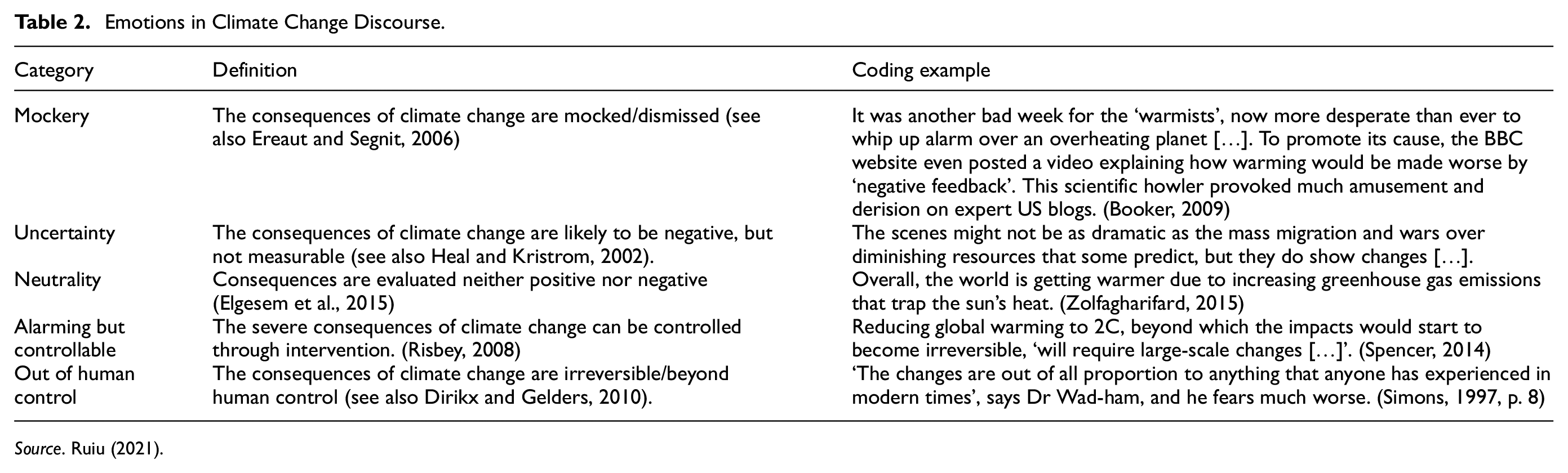
Media appear to rely on emotion more and more in conveying the news (Kenix & Gibbins, 2024). The range of emotion demonstrated in news content, particularly in relation to climate change coverage, is vast (Table 2). Understanding if emotionality in content exists across different countries is central to understanding how this subject is being framed. Previous research based in the United States, which examined emotions in climate change coverage (Sinclair et al., 2024) found that when climate change headlines are framed emotively, participants’ intentions to read and share news, real charitable donations and memory for news content are all influenced. Emotions play an important role in explaining why news framing has effects on the opinions of Dutch citizens (Lecheler et al., 2015) yet is under-researched in a global context (Ruiu, 2021). Emotive lexical choices were coded for all of the content in this study across all five countries. The following hypothesis attempts to ascertain how climate change was emotively framed in news articles:
H5: Newspapers in the top 5 carbon-emitting countries will emotively frame the cause, effect, and responsibility for climate change more than they will not emotively frame the cause, effect, and responsibility for climate change.
Emotions in Climate Change Discourse.
Source. Ruiu (2021).
Nationalism
Framing is linked broadly, yet directly, to both power and ideology (Gitlin, 1980; Tuchman, 1978). The importance of media frames are in their ability to create a specific narrative about and issue (R. Entman, 2004). It is important to note that in acknowledging the systemic power embedded in media framing, any lack of media representation can also be considered as a lack of power (Ferree et al., 2002). This power exists at a local as well as a global sociopolitical level. It is therefore, important to understand the level of noninformation that exists around the globe, particularly for issues that are inherently inter-connected. Contrary to geopolitical differences in news reporting, some research states that there is ‘universal stock of professional beliefs’ (Donsbach & Klett, 1993, p. 79) that works to create similarities in media framing as a whole. Research based in the United States has found that journalistic values include public service, objectivity, immediacy and ethics that then shapes journalistic practice (Brennen, 2000), which includes relevance, truth, public loyalty, engagement (Kovach & Rosenstiel, 2007) and professional autonomy (Singer, 2007). These findings have been extrapolated to Argentinian journalists who have been found to observe these shared norms and imitate the values that they perceive in other journalists in their newswriting (Boczkowski & Mitchelstein, 2010). Shared beliefs and values help explain uniformity in media framing across large geographical areas over long periods of time (Karlsson et al., 2023) whereby news coverage extends beyond local viewpoints and follows a global template (Ehmer & Kothari, 2018).
Other research has found that news coverage in various different countries frame issues differently due to local cultural and political concerns and ‘domesticate’ international news to make content more relevant to their audience (Hafez, 2009). In times of severe crises, a country’s government often can receive outright support from their local mainstream press. This phenomena has been labelled as a ‘rallying around the flag effect’ (Mueller, 1970), which has been demonstrated in many different contexts (Barnett & Roselle, 2008; Johansson et al., 2021) and many different countries (Fonn & Hyde-Clarke, 2023; Nielsen & Lindvall, 2021). If climate change is indeed a crisis, and reports from the Intergovernmental Panel on Climate Change urgently and comprehensively state this is the case (Intergovernmental Panel on Climate Change, 2023), then there is a possibility that media frame the local governmental role in addressing climate change perhaps more positively than science suggests. Further, media frames of the government may shift if effects are seen to be within the home country, suggesting a heightened level of nationalism within coverage. Previous research has found that a country’s direct exposure to climate change and its mitigation efforts, influence media coverage within that country to a certain extent (Barkemeyer et al., 2017). Countries with commitments under the Kyoto Protocol and those with high carbon dependency have exhibited heightened media attention (Schmidt et al., 2013).
This research acknowledges that there may certainly be differences between specific news outlets that inform final reported news content. Just a few reasons for these potential differences may be individual media ownership (Theine et al., 2025), the locality of an issue (Douai et al., 2022; Rochyadi-Reetz et al., 2019), the political orientation of a news outlet (Kenix & Jarvandi, 2019), the newsroom culture (Jiang et al., 2021) or the market orientation of a media company (Beam, 2003) However, it is important to note that this research is examining a large sample of content to help ascertain if there are differences between nations, despite individual newspaper differences in news reporting. National differences in coverage raises concerns about potential impacts on local public opinion, government accountability, and international cooperation in addressing climate change. There is research finding similarity in climate change coverage across nations (e.g., Shehata & Hopmann, 2012), but the majority of research found points to marked differences in coverage across countries. For example, media organisations in China have frequently relied on official sources that align with political agendas (Han et al., 2017), which varies between party-sponsored and market-oriented media, emphasising the nuanced roles of the Chinese Communist Party and market forces in shaping news frames. In Canada, research has found that media attention on climate change experiences issue attention cycles, with peaks corresponding to political events rather than ecological factors (Stoddart et al., 2016). Obviously, there are multifaceted influences on climate change discourse within and across nations based on market demands, state-media dynamics (Xie, 2015), political affiliations, and global news values that can all coalese to shape journalistic practices (Han et al., 2017). An overreliance on government sources within any nation state, can contribute to the politicisation of climate change and potentially limit the diversity of perspectives presented in local media.
In examining this issue across five nation states, this research aims to uncover if there are differences in the information provided about climate change in a nation’s media coverage of climate change within their own country and a nation’s media coverage of climate change about other countries. This would suggest an ‘us versus them’ construction of climate change within these five countries in what is undoubtedly a global issue. Conversely, if research discovered that content remained unchanging regardless of the country of media outlet, it would suggest that influences on journalism norms are so deeply entrenched that coverage is monolithic across the five countries sampled.
The following three research questions attempt to ascertain the differences in coverage within home countries and other countries:
RQ1: Is there a difference in how newspapers in the top 5 carbon-emitting countries address the causes of climate change within their home country and the four other countries sampled?
RQ2: Is there a difference in how newspapers in the top 5 carbon-emitting countries address the effects of climate change within their home country and the four other countries sampled?
RQ3: Is there a difference in how newspapers in the top 5 carbon-emitting countries address the responsible agent of climate change within their home country and the four other countries sampled?
Journalism Within the five Countries Sampled
China, the United States, India, Russia and Japan have strikingly divergent sociopolitical and cultural differences. While India, the United States and Japan are amongst the five largest democracies in the world (Statista, 2025d), China and Russia exist under authoritarian regimes with very few media freedoms (Freedom House, 2025a). Although these differences allow for a rich comparative analysis, it is essential to note that the media markets for the five countries sampled are markedly different.
India has approximately 15,000 registered newspapers (Krishnan, 2024) as well as the second largest digital population in the world – second only to China (Statista, 2025b). Despite the national claim to democracy noted earlier, Reporters Without Borders has found that India’s press freedom is ‘in crisis’ (2025b). Since the 1990s, there has been a hyper-expansive growth in the Indian media market alongside pervasive hyper-commercialism (Chadha, 2024) led by powerful media conglomerates that are personally and professionally connected to Prime Minister Narenda Modi. Those relationships have given Modi extraordinary power to control the media narrative and silence critics (Reporters Without Borders, 2025b). The result has been substantially less press freedom since Modi’s tenure began (Ding & Slater, 2021).
China and Russia both have experienced relatively recent tightened media freedoms in an already authoritarian political environment. Russia has seen a severe restriction on press freedom since their invasion of Ukraine in February 2022 (Reporters Without Borders, 2025c) whereas investigative, critical journalism in China has been further ‘tamed’ since 2012 due to strengthening political control, a financial crisis and the advent of digital technologies (Tong, 2019). Internet freedom within Russia has been drastically reduced (Centre for Strategic & International Studies, 2022) as the government has exponentially expanded categorisations of ‘foreign agents’ and ‘undesirable organisations’ (Freedom House, 2025b). China is ranked with the lowest indicator of press freedom among 180 countries sampled (Statista, 2025c) whereas Russia is ranked similarly low at 162nd of 180 countries, having continually decreased in rankings over the past 3 years. It is no longer possible to access many international news organisations, such as the BBC or Euronews in Russia or China and almost all independent media have been banned or blocked in both countries.
Japan and the United States both enjoy relative press freedoms, particularly in this sample. Both countries have among the top 13 highest internet freedom index scores (Statista, 2025a) and both are considered liberal democracies with a free press. Reporters Without Borders ranked the United States 55th for press freedom in 2024 and Japan achieved a similarly ranked 70th (2025a), whereas the other three countries sampled were at the bottom of the rankings (India: 159, Russia: 162, China: 172). There are certainly concerns of press freedoms in both America and Japan. Notably, Japanese journalists are forced to negotiate a larger cultural pressure of establishment norms that ‘promote a climate of self-censorship and impede courageous, critical journalism’ (Buchmeier, 2024, p. 495) and the press in America has been accused by the President of the United States as being an ‘enemy of the people’ (Kalb, 2018). Although these two countries enjoy relative press freedoms, broader socio-political and cultural influences, such as these, can also have a chilling impact on resulting news coverage.
Methodology
Articles, as the unit of analysis, were found through the news and journalism database, Factiva, by searching for all news articles that mentioned the country in question and one of the five countries as well as ‘climate change’ or ‘global warming’ in the headline or lead paragraph. For example, searches took the form of ‘China’ and ‘climate change’ or ‘global warming’ in the headline or lead paragraph in newspapers from China, the United States, India, Russia and Japan. In each Factiva search, all sources within a source country were initially included for this study and no sources from outside of the country were sampled. This purposely inclusive search process resulted in a large number of 28,083 articles that met the search term criteria in Factiva over the 5-year period across all five countries. Any editorial content, re-published news, obituaries, duplicate articles, market data, sports, calendars, etc. were excluded from the sample.
The total 28,083 found articles were pasted into text-files, which were then concatenated into single files. A Python script was run to differentiate the flow of text into individual articles. Using Python was instrumental in arriving at a dataset that was free of random errors. For example, Factiva’s editorial exclusion mechanism was found to be not fit for purpose; many editorials, especially from the South China Morning Post, were uncategorised and consequently slipped into the dataset. These were removed in the operation of the Python script.
Although newspaper content is inherently non-parametric, meaning that the distribution of the data does not need to follow a normal distribution, the population of 28,083 articles was divided into strata based on the country of publication. The final sample for analysis was generated by using NItems/NSample and chronologically extracted (Boykoff & Boykoff, 2004) for each country. ‘NItems’ is the total items found within each search, and ‘NSample’ to the number of articles needed to provide a sample that is representative with 95% confidence level and 5% margin error. From the total sample of found articles for each country, every nth article was then selected for review (n/S = nth). This process resulted in a simple random sampling of 3,716 articles for examination from a wide range of news outlets (Appendix 1).
The analysis of the texts was guided by a coding sheet, which was created following previous research in terms of likely frames that would presumably allow for the finding of patterns. Coders were instructed that this content analysis was to examine media coverage in the five most carbon-emitting countries to ascertain if newspapers in those countries addressed the cause, effect and responsibility of climate change in their own country and about any other of the five countries sampled (China, the United States, India, Russia and Japan). The process of ascertaining repeating frames from each source was guided by the five hypotheses and three research questions to then develop selection criteria for variables and values.
Coders deliberated and continually refined the values of each variable after closer readings of the text to answer the hypotheses and research questions. The Cohen’s Kappa inter-observer reliability coefficient was utilised, after negotiation and discussion, to indicate the coding scheme’s reliability between two coders – one coding 10% of randomly selected content and the second coder coding the entirety. Values of kappa greater than .75 indicate excellent agreement beyond chance alone and suggest a strong standard measure of reliability (Riffe et al., 1998).
The Cohen’s Kappa inter-coder reliability coefficient was utilised to provide an indication of coding scheme’s reliability. Intercoder reliability, as measured through Cohen’s Kappa, ranged from .872 to .941 for all of the coded variables in 10% of the content. The overall intercoder Cohen’s Kappa was .908, suggesting a highly robust coding scheme (Krippendorff, 2004). Scott’s Pi was computed at .883, representing the inter-coder agreement after chance was removed, suggesting a reliable coding scheme.
Chi-square correlations (χ2), degrees of freedom (df), simple percentages, and frequencies were used to answer stated hypotheses to determine presence of measured values and relationships between particular variables. Bivariate logistic regression tests and adjusted residual scores (ASR) were used to answer the three research questions. These questions attempted to discover if there were any direction in the relationships between particular variables that explored climate change coverage within one country about that country or any other country in this sample. Strong influences of a particular case of one variable on a particular case of another variable were found if adjusted residuals were ±2.0 points. In addition, bivariate logistic regression was used to further determine the direction of any relationship found. The odds ratio of predictor variables was calculated using the formula eβ, to determine the odds of one variable having an impact on another.
Results
Hypothesis 1: Carbon-Emitting Sectors That Cause Climate Change
The majority of content was from the United States (1,115 articles) and India, (1,137) with Japan having the least articles for examination (Figure 1). The five carbon-emitting causes of climate change most prevalent across all the countries sample (electricity, transport, manufacturing, buildings, and industry) were not found in an average of 88.24% of content. The cause of climate change was largely not connected with electricity (70.7% of content), transport (88.9%), manufacturing (97.1%), buildings (96%) and industry (88.5%) in media coverage throughout the 3,716 articles examined across five countries (Figure 2). Differences between countries were not significant, due in large part to the near exclusivity of results. Thus Hypothesis 1, which stated that newspapers in the top 5 carbon-emitting countries will mention the top five carbon-emitting sectors that cause climate change (electricity and heat, transport, manufacturing and construction, buildings, and industry) in coverage about climate change more than not, was not supported. Newspapers in the top 5 carbon-emitting countries largely did not mention the top five carbon-emitting sectors that cause climate change.

Article country in final sample (2018–2022).

Mention of top 5 carbon-emitting sectors of climate change as causes of climate change in articles from China, The United States, India, Russia, and Japan (2018–2022).
Hypothesis 2: Anthropogenic Cause of Climate Change
A near majority of 49.3% of content mentioned an anthropogenic cause of climate change. The remaining content either did not address any cause for climate change or stated ‘balance’ on potential causes for climate change. However, Hypothesis 2 stated that newspapers in the top 5 carbon-emitting countries will state an anthropogenic cause of climate change more than not. Thus, Hypothesis 2 was (narrowly) not supported. There was little variance when content was examined by country (Figure 3).

Causes of climate change in articles from China, The United States, India, Russia, and Japan (2018–2022).
Hypothesis 3: Effects of Climate Change
A majority of 57.4% of all content did not present any effects of climate change. Therefore, Hypothesis 3, which stated that newspapers in the top 5 carbon-emitting countries will mention effects of climate change more than not, was not supported. Newspapers in the top 5 carbon-emitting countries largely did not mention any effects of climate change. When content was examined by country, Japan was the most likely country to state there were no effects of climate change (Figure 4), but the variances between countries was not significant.

Effects of climate change in articles from China, The United States, India, Russia, and Japan (2018–2022).
Hypothesis 4: Responsibility for Climate Change
Approximately 65% of content overall framed a responsible agent for climate change. Therefore, Hypothesis 4, which stated that newspapers in the top 5 carbon-emitting countries will mention a responsible agent for climate change more than not, was supported. Newspapers in the top 5 carbon-emitting countries largely did mention a responsible agent for climate change. There was almost no evidence of the larger global community bearing responsibility for climate change. Rather, the country where the article was published and the other countries in the big five were found to be responsible for climate change in an average of 42% of content sampled (Figure 5).

Responsibility for climate change in articles from China, The United States, India, Russia, and Japan (2018–2022).
Hypothesis 5: Emotion in Climate Change Coverage
Hypothesis 5 stated that newspapers in the top 5 carbon-emitting countries will emotively frame the cause, effect, and responsibility for climate change more than not. This was not supported in large part because the cause, effect, and responsibility for climate change were not represented in a majority of content. However, when they were highlighted in content, ‘alarming but controllable’ was the frame most often used for each of the causes (35%), effects (28.5%), and responsible agents (40.7%) for climate change. A very small minority of content relied on the highly emotive ‘mockery’ or ‘out of human control’ frame.
Research Questions
The relationship between country of article and the country of focus for the article was significant (χ2(16, N = 3,716) = 1682.10, Cramer’s V = 0.336, p = .001). Nearly half of all content (1,542 articles) focussed on a specific country addressing climate change within their own country (Figure 6). The only exception was that China also focussed on the United States slightly more than would be expected by chance alone (ASR = 1.9). However, no country met a meaningful threshold (±2.0 points) of addressing climate change and another country. The remaining 2,172 articles were spread across the other 16 coding areas (e.g., articles from China with ‘The United States’, ‘India’, ‘Russia’, or ‘Japan’ mentioned, etc.). For all five countries, China and the United States were the most common ‘other’ countries of focus.

Articles on climate change from top 5 carbon-emitting sectors of climate change and country of focus.
Research Question 1: Causes of Climate Change at ‘Home’ and Abroad
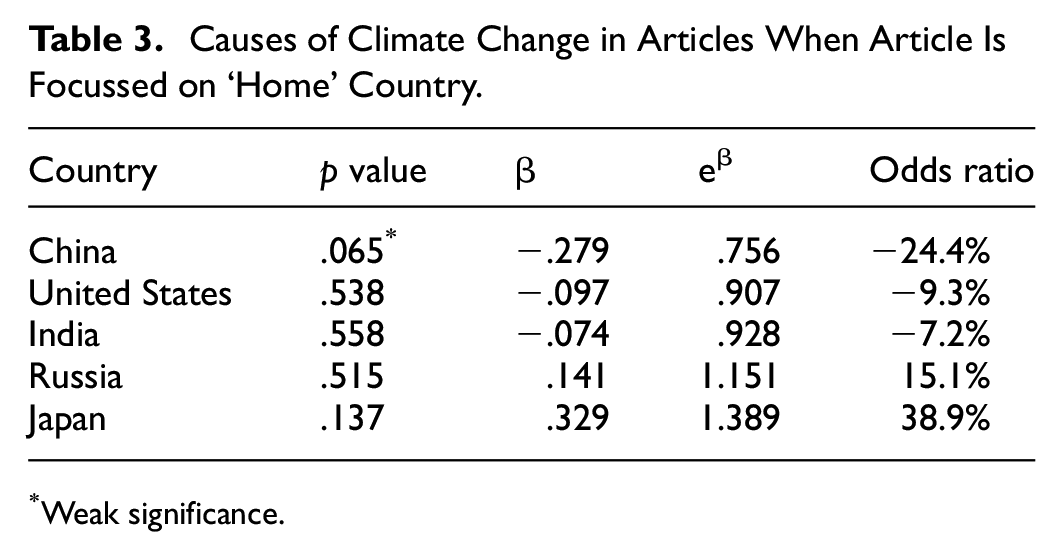
The relationship between Chinese articles focussed on China and the collapsed causes of climate change (article does or does not address causes) was only weakly significant (χ2(1, N = 703) = 3.396, Cramer’s V = 0.070, p = .065). In addition, bivariate logistic regression was used to analyse the relationship between these two variables. The p-value of .065 indicates that there is 90% chance that the true estimate of β is within the 90% CI confidence interval (Table 3). The odds ratio of the causes of climate change as a predictor variable, calculated using the formula eβ, revealed that β = −.279, resulting in a logit of 1.24. Thus, the odds of Chinese newspaper articles representing the causes of climate change were approximately 24.4% lower when an article concentrated on China (eβ = e−.279 = 0.756, which corresponds to a decrease by a factor of approximately 24.4%) than when an article concentrated on other countries.
Causes of Climate Change in Articles When Article Is Focussed on ‘Home’ Country.
Weak significance.
The relationship between articles from the United States that were focussed on the United States and the collapsed causes of climate change (article does or does not address causes) was not significant (χ2(5, N = 1,115) = 4.080, Cramer’s V = 0.060, p = .538]. The odds of United States newspaper articles representing the causes of climate change were approximately 9.3% lower when an article concentrated on the United States (eβ = e−.097 = 0.907, which corresponds to a decrease by a factor of approximately 9.3%) than when an article concentrated on other countries. Similarly, the relationship between Indian articles focussed on India and the collapsed causes of climate change (article does or does not address causes) was not significant (χ2(1, N = 1,137) =0.343, Cramer’s V = 0.017, p = .558). The odds of Indian newspaper articles representing the causes of climate change were approximately 7.2% lower when an article concentrated on India (eβ = e−.074 = 0.928, which corresponds to a decrease by a factor of 7.2%) than when an article concentrated on other countries.
The relationship between Russian articles focussed on Russia and the collapsed causes of climate change (article does or does not address causes) was not significant (χ2(1, N = 412) = 0.426, Cramer’s V = 0.032, p = .514). However, the odds of Russian newspaper articles representing the causes of climate change were approximately 15.1% higher when an article concentrated on Russia (eβ = e.141 = 1.151, which corresponds to a 15.1% increase) than when an article concentrated on other countries. Similarly, the relationship between Japanese articles focussed on Japan and the collapsed causes of climate change (article does or does not address causes) was not significant (χ2(1, N = 349) = 2.212, Cramer’s V = 0.080, p = .137). The odds of Japanese newspaper articles representing the causes of climate change were approximately 38.9% higher when an article concentrated on Japan (eβ = e.329 = 1.389, which corresponds to an increase by a factor of approximately 38.9%) than when an article concentrated on other countries.
Thus, the first research question, which asked if there was a difference in how newspapers in the top 5 carbon-emitting countries addressed the causes of climate change within their home country and for the four other countries sampled, was not supported. There was no statistical difference between how these countries represented causes of climate change within their home country and when articles focussed on other countries (Table 3). Three out of the five countries’ newspaper articles represented the cause of climate change lower when an article concentrated on the home country than when an article concentrated on other countries – meaning, in media of three of the five countries, if an article was focussed on their own country, the article was less likely to represent the cause of climate change than if the article was focussed on another country.
Research Question 2: Effects of Climate Change at ‘Home’ and Abroad
The relationship between Chinese articles focussed on China and the collapsed effects of climate change (article does or does not address effects) was not significant (χ2(1, N = 703) =0.012, Cramer’s V = 0.004, p = .912). The odds of articles from China representing the effects of climate change were approximately 1.9% higher when an article concentrated on China (eβ = e.019 = 1.019, which corresponds to an increase by a factor of approximately 1.9%) than when an article concentrated on other countries. This was replicated in all of the five countries sampled. Articles from the United States that mentioned the United States were more likely (ASR = 4.6) to also focus on climate change effects than articles from the United States that mentioned other countries (−4.6). The relationship between articles from the United States that focussed on the United States and the collapsed effects of climate change (article does or does not address effects) was significant (χ2(1, N = 1,115) =21.116, Cramer’s V = 0.138, p = .001). The odds of articles from the United States representing the effects of climate change were approximately 86.0% higher when an article concentrated on India (eβ = e.621 = 1.860, which corresponds to an increase by a factor of approximately 86.0%) than when an article concentrated on other countries.
Similarly, articles from India that mentioned India were more likely (ASR = 3.2) to also focus on climate change effects than articles from India that mentioned other countries (−3.2). The relationship between Indian articles focussed on India and the collapsed effects of climate change (article does or does not address effects) was significant (χ2(1, N = 1,137) = 9.952, Cramer’s V = 0.094, p = .002). The odds of Indian newspaper articles representing the effects of climate change were approximately 49.1% higher when an article concentrated on India (eβ = e.400 = 1.491, which corresponds to an increase by a factor of approximately 49.1%) than when an article concentrated on other countries. Articles from Russia that mentioned Russia were also more likely (ASR = 3.2) to also focus on climate change effects than articles from Russia that mentioned other countries (−3.2). The relationship between Russian articles focussed on Russia and the collapsed effects of climate change (article does or does not address effects) was significant (χ2(1, N = 412) =10.429, Cramer’s V = 0.159, p = .001). The odds of Russian newspaper articles representing the effects of climate change were approximately 126.6% higher when an article concentrated on Russia (eβ = e.818 = 2.266, which corresponds to an increase by a factor of approximately 126.6%) than when an article concentrated on other countries.
There were 349 articles from Japan for which the adjusted residuals did not meet the meaningful threshold of ±2. The relationship between Japanese articles that focussed on Japan and the collapsed effects of climate change (article does or does not address effects) was not significant (χ2(1, N = 349) =1.121, Cramer’s V = 0.057, p = .290). The odds of Japanese newspaper articles representing the effects of climate change were approximately 31.7% higher when an article concentrated on Japan (eβ = e.275 = 1.317, which corresponds to an increase by a factor of approximately 31.7%) than when an article concentrated on other countries.
Thus, the second research question, which asked if there was a difference in how newspapers in the top 5 carbon-emitting countries addressed the effects of climate change within their home country and for the four other countries sampled, was largely supported. The United States, India, and Russia were statistically more likely to address the effects of climate change within their home country then when articles focussed on other countries (Table 4). China and Japan were more neutral in their coverage of climate change effects. However, all five countries’ newspaper articles represented the effects of climate change higher when an article concentrated on the home country than when an article concentrated on other countries – meaning, in the media of all five countries, if an article was focussed on their own country, the article was more likely to represent the effects for climate change than if the article was focussed on other countries.
Effects of Climate Change in Articles When Article Is Focussed on ‘Home’ Country.

Significant.
Research Question 3: Responsibility for Climate Change at ‘Home’ and Abroad
Articles from China that mentioned China were less likely (ASR = −4.0) to also focus on climate change responsibility than articles from China that mentioned other countries (4.0). The relationship between articles from China that focussed on China and the collapsed responsibility for climate change (article does or does not address responsibility) was significant (χ2(1, N = 703) =16.256, Cramer’s V = 0.152, p = .001). The odds of articles from China representing the responsibility for climate change was approximately 45.9% lower when an article concentrated on China (eβ = e−.614 = 0.541, which corresponds to an increase by a factor of approximately 45.9%) than when an article concentrated on other countries.
There were 1,115 articles from the United States for which, the adjusted residuals did not meet the meaningful threshold of ±2. The relationship between articles from the United States that focussed on the United States and the collapsed responsibility for climate change (article does or does not address responsibility) was not significant (χ2(1, N = 1,115) = 0.018, Cramer’s V = 0.004, p = .894). The odds of articles from the United States representing the effects of climate change were approximately 1.8% lower when an article concentrated on the United States (eβ = e−.018 = 0.982, which corresponds to a decrease by a factor of approximately 1.8%) than when an article concentrated on other countries. Similarly, there were 1,137 articles from India for which, the adjusted residuals did not meet the meaningful threshold of ±2. The relationship between Indian articles focussed on India and the collapsed responsibility for climate change (article does or does not address responsibility) was not significant (χ2(1, N = 1,137) =0.719, Cramer’s V = 0.025, p = .397). The odds of Indian newspaper articles representing the responsibility for climate change were approximately 10.7% lower when an article concentrated on India (eβ = e−.113 = 0.893, which corresponds to an decrease by a factor of approximately 10.7%) than when an article concentrated on other countries. In addition, there were 412 articles from Russia for which, the adjusted residuals did not meet the meaningful threshold of ±2. The relationship between Russian articles focussed on Russia and the collapsed responsibility for climate change (article does or does not address responsibility) was not significant (χ2(1, N = 412) =0.894, Cramer’s V = 0.047, p = .344). The odds of Russian newspaper articles representing the effects of climate change were approximately 19.7% lower when an article concentrated on Russia (eβ = e−.219 = 0.803, which corresponds to a decrease by a factor of approximately 19.7%) than when an article concentrated on other countries.
Articles from Japan that mentioned Japan were more likely (ASR = 2.0) to also focus on climate change responsibility than articles from Japan that mentioned other countries (−2.0). The relationship between articles from Japan that focussed on Japan and the collapsed responsibility for climate change (article does or does not address responsibility) was significant (χ2(1, N = 349) =4.043, Cramer’s V = 0.108, p = .044). The odds of Japanese newspaper articles representing the responsibility for climate change were approximately 59.5% higher when an article concentrated on Japan (eβ = e.275 = 1.595, which corresponds to an increase by a factor of approximately 59.5%) than when an article concentrated on other countries.
Thus, the third research question, which asked if there was a difference in how newspapers in the top 5 carbon-emitting countries addressed the responsibility for climate change within their home country and for the four other countries sampled, was marginally not supported. Japan and China were the only countries that were statistically more likely to address the responsibility for climate change within their home country differently than articles that also focussed on other countries (Table 5). Four countries (China, the United States, India, Russia) represented the responsibility for climate change lower when an article concentrated on the home country than when an article concentrated on other countries – meaning, in those four countries, if an article was focussed on other countries, it was more likely to represent the responsibility for climate change, than if the article was focussed on the home country.
Responsibility for Climate Change in Articles When Article Is Focussed on ‘Home’ Country.

Significant.
Discussion
The study found that there was widespread noninformation about the cause, effect, and responsibility for climate change across the articles sampled in all of the countries examined over 5 years. Accurate information is essential to counter the impact of misinformation (Williams & Bond, 2020) and to stem the tide of general apathy that can pervade societal discourse. Indeed, democracy depends upon the media for accurate information that can then informs its citizenry.
Four of the five hypotheses tested in this research were not supported. A majority of content in this sample - across all five countries – simply did not mention the top five carbon-emitting causes of climate change (electricity and heat, transport, manufacturing and construction, buildings, and industry); did not state an anthropogenic cause of climate change; did not present the effects of climate change; and was not particularly emotive in coverage of climate change causes, effects or responsible agents. These hypotheses were built upon the expectations of news content from academic literature. There appears to be a gap between those expectations in scholarly literature and the reality of noninformation in the news from these five countries. This discrepancy needs further examination. The divergent findings in this research may be due to the ‘techtonic transformation’ (Scheufele, 2013, p. 14042) in journalism itself or these findings could suggest comprehensive differences in the reporting from individual news outlets and not necessarily differences in news from nation states (although there was some significant differences between nations). Another potential reason for these findings could be a journalistic shift away from Entman’s seminal definition of framing for a social issue, particularly for an issue that has been in the public lexicon for a prolonged period of time, such as climate change. While outside the scope of this study, much more research needs to explore the specific reasons why there has been a systemic lack of reporting the causes, effects, and responsibility for the framing of climate change across these countries.
There was a level of nationalistic ‘otherism’ in articles about climate change that privileged the home country and framed other countries as the cause for climate change and the ones responsible for ‘fixing’ the problem of climate change. If causes of climate change are primarily represented only in other countries, then the home country becomes implicitly absolved of any direct responsibility. The failure to highlight domestic contributions to climate change perpetuates a skewed understanding of this global problem that hinders the public’s ability to address the root causes of the issue. There is a ‘rally around the flag’ effect in this research that appears to have superseded the journalism norms of these individual countries. There were nationalistic differences in coverage that privileged the home country.
This level of ‘otherism’ shifted when effects of climate change were addressed. In all five countries, if an article was focussed on another country, it was less likely to represent the effects of climate change. Thus, coverage was again nationalistic in its approach of detailing the harm climate change can cause. The effects of climate change became much more pronounced within national coverage within these nation states and less obvious in coverage of climate change in any of the other four countries sampled. Thus, causes of climate change were based somewhere else, the effects of climate change were at home, and those responsible were outside of the country.
An examination of the sociopolitical or cultural factors within each country would provide a deeper analysis of the reasons for this nationalism. While there was not scope in this paper to explore those dimensions, further research should tease out nationalistic tendencies. For example, Japan was far more likely to note no effects of climate change nor any responsible agent. It would be extremely beneficial to interview news reporters within that country to better understand why this was the case.
The noninformation found in this study, alongside the in-country/out-country findings, appears to be an impediment to any collective efforts to address the global crisis effectively. Moreover, media silence on a country’s contribution to climate change may undermine the principles of democratic governance. Informed decision-making is a cornerstone of democracy, and when key information is omitted, citizens are deprived of the knowledge necessary to make meaningful choices, whether at the ballot box or in advocating for policy changes. Noninformation could hinder informed discussions on the necessary measures for mitigating climate change and lead to a misguided public discourse that fails to address the root causes of environmental degradation.
While there was clear noninformation found in the sample, that also means that some other content filled that informational void. That other information could result in a reinforcement of dominant frames, while simultaneously marginalising alternative perspectives. Further research that interviews consumers of media can better ascertain what is actually being absorbed from global news content, because the causes, effects, and responsibility for climate change in the study were constructed inaccurately.
A deliberate silence within media content could potentially stem from various factors, such as political motivations, economic considerations, or the desire to maintain a certain image on the global stage. This research does not attempt to ascertain whether the noninformation was deliberate or accidental. Regardless, this research recommends self-reflection within national media coverage. Understanding the communicative nature of media silence (Schröter, 2013) provides a necessary lens through which to analyse the intentional or unintentional gaps in climate change narratives. These gaps may not only obscure vital information but also contribute to a distorted perception of responsibility and accountability. Therefore, exploring the interplay between political participation, media silence, and the representation of environmental issues is essential for a comprehensive understanding of the complexities surrounding climate change discourse.
It is recommended that policymakers, media educators and professionals must examine the journalistic norms, processes, and values that can lead to noninformation in media coverage. Embedded in this recommendation are a whole host of possible professional changes. Policy makers could promote checking initiatives and enhance public awareness campaigns. They could collaborate with experts to establish clear guidelines for accurate climate change communication. Journalism educators need to encourage critical discussions that incorporate media literacy. Finally, media professionals need to refocus their implementation of strict fact-changing protocols that avoid sensationalism or emotional content and highlight scientific consensus in their coverage. Media professionals need to examine the context of climate change and ask what is not being addressed. They must work to fill that gap with accurate, fact-based information. While all of these recommendations cost money, the spread of noninformation in regard to climate change could be significantly reduced. Decreasing noninformation is pivotal for fostering a more informed public, empowering individuals to advocate for change, and ultimately, for steering societies towards meaningful climate action.
Limitations
The findings of this research resoundingly suggest that newspaper media across all five countries presented ‘noninformation’ as to the cause, effect, and responsible agents for climate change. However, the lack of support for the four research hypotheses in this research could also be due to potential study limitations. A possible limitation may be that the population examined was simply not large enough for reliable results and therefore prohibited support for several of the hypotheses. A larger population that examined a greater number of countries or different newspapers from the countries examined here may produce more robust results and reduce this potential measurement error. More time to conduct this research could also obviously increase the likelihood of a deeper analysis. Future research should help to expand upon these findings.
As is the case with any study examining frames that are categorical by nature, there is nothing ‘normal’ about the data collected – meaning the coded media frames did not fall on a normally distributed curve and are not assumed to be representative of a larger population of frames. The frames found were representative only of the newspaper sampled, and not of any other newspapers that exist. A limitation to this research is that the findings are not generalisable to any other country or newspaper within the countries sampled. External factors, such as environmental crises during the time of the sample, could have also confounded the results. While every attempt was made to bolster the reliability of the study through intercoder measures, subjective interpretation is always a danger when quantitatively categorising qualitative content. In addition, while the hypotheses were constructed based upon academic literature, there is always a possibility that previous research was based on incorrect assumptions.
A further and obvious limitation of this study is that Factiva only archives articles that are in English. Therefore, this study did not conclusively sample all content within each country – only the English language content that Factiva archives. Future research should cast a broader net, with adept translators if necessary, to examine articles within the host language. Presently, this research embeds an inherent English-speaking bias that did not include possible critical narratives in non-English media and results may have been skewed. Unfortunately, it was simply not possible to work with multiple languages in this single research project, however, it is hoped that future research can find a way to mitigate this issue. Conducting a multilingual level of analysis may uncover distinctions of coverage within home countries that this research was unable to obtain.
Footnotes
Appendix
Newspapers Sampled from China, The United States, India, Russia, and Japan (2018-2022).

| Chinese newspapers | # of Articles | Indian newspapers | # of Articles |
|---|---|---|---|
| China Weekly News | 169 | Hindustan Times | 137 |
| South China Morning Post | 162 | Down to Earth | 100 |
| China Daily-Hong Kong Edition | 82 | The Times of India | 72 |
| People’s Daily Online | 41 | Indo-Asian News Service | 53 |
| Xinhua News Agency | 40 | The Economic Times of India | 51 |
| China Daily | 33 | The Telegraph of India | 40 |
| Xinhua English Multimedia Newswire | 27 | Press Trust of India | 38 |
| EJ Insight | 26 | Mint | 35 |
| Global Times | 20 | Asian News International | 34 |
| PR Newswire Asia | 11 | The Pioneer of India | 27 |
| China.org.cn | 11 | UNI (United News of India) | 23 |
| Chinese (20) Publications < 10 | 81 | India Education Diary | 22 |
|
|
|
The Statesman | 19 |
| The Hindu | 19 | ||
|
|
Business Standard | 18 | |
| The New York Times | 225 | India Today Online | 18 |
| The Washington Post | 144 | Financial Express | 17 |
| CNN | 127 | Scroll.in | 15 |
| The Wall Street Journal | 56 | The Times of India - Delhi Edition | 14 |
| The Boston Globe | 56 | The Asian Age | 13 |
| Pittsburgh Post-Gazette | 27 | Financial Express Online | 11 |
| Daily Herald | 23 | Indian Government News | 11 |
| St. Louis Post-Dispatch | 20 | Business Line Online | 11 |
| Agriculture Week | 13 | Assam Tribune | 10 |
| Energy Weekly News | 12 | Indian (107) Publications < 10 | 329 |
| USA Today Online | 11 |
|
|
| American (157) Publications < 10 | 401 | ||
|
|
|
|
|
| Kyodo News | 142 | ||
|
|
Jiji Press English News Service | 64 | |
| Sputnik News Service | 169 | The Japan News | 45 |
| The Moscow Times | 92 | AJW (Asia & Japan Watch) | 23 |
| Esmerk Russian News | 67 | The Mainichi | 19 |
| Russian Government News | 35 | The Japan Times | 18 |
| Russian (6) Publications < 10 | 49 | Japan Metal Daily | 12 |
|
|
|
Nikkei Business Trends | 11 |
| Japanese (6) Publications < 10 | 15 | ||
|
|
|

Ethical Considerations
Ethical approval was not required.
Funding
The author disclosed receipt of the following financial support for the research, authorship, and/or publication of this article: This work was supported by the University of Canterbury (Faculty of Arts Contestable Research Fund).
Declaration of Conflicting Interests
The author declared no potential conflicts of interest with respect to the research, authorship, and/or publication of this article.
Data Availability Statement
Data is available from the corresponding author upon reasonable request.