




Abstract
This study examines the conflict that arises from the presence of dualistic institutions in Batam, a province that underwent decentralization in 2000. The conflict between the Batam government and the Batam Agency (BP Batam) resulted in jurisdictional overlap, which disrupted industrial sectors, led to economic decline, and impacted community well-being. The report outlines three main challenges and suggests remedies based on empirical research and a Delphi survey. The presence of institutional duality has a notable influence on both performance and the economic well-being of the community. Ex-officio plans are typically of a temporary nature, motivated by economic considerations and the welfare of society. The study integrates the viewpoints of researchers, professionals, practitioners, entrepreneurs, academics, and other specialists to provide solutions. It emphasizes the problem of inadequate governance management, resulting in the existence of redundant legislation and procedures. The study highlights the significance of flexibility and adaptability in partnerships. The Delphi process was employed to assemble influential persons and reach a consensus on particular topics. The study seeks to harmonize disparate institutions in order to attain societal well-being in terms of economic prosperity and political stability.
Plain language summary
The study explores the conflict between Batam’s government and agency, resulting from dualistic institutions, causing economic decline and disrupting industrial sectors. It highlights the impact of inadequate governance management and the need for partnership flexibility. The Delphi process reached a consensus on specific topics, aiming to harmonize institutions for societal well-being, economic prosperity, and political stability.
Introduction
Decentralization is intricately linked to the practice of allocating authority and regulation to local governments. Turner and Hulme (1997) categorize decentralization into two distinct clusters: territorial and functional. These clusters have independent foundations and carry diverse implications. Hofman and Kaiser (2006) discussed functional decentralization, which involves the transfer of government functions from the central authority to the regional level. On the other hand, geographical decentralization refers to the transfer of power from the central authority to the regions (Holzhacker et al., 2016). The complexity of the differences lies in the specific tasks and functions that need to be accomplished through decentralization. This process involves using political power, in the form of territory, to effectively manage and develop regions based on the prevailing socio-economic approach.
Following the 1998 reform, the Indonesian political economy adopted decentralization as a means of implementing democracy (Aspinall & Fealy, 2003). This step involved replacing the regime with a democratically elected government based on a constitutional framework. The objective was to address local socio-economic needs in response to the government’s inability to effectively control the financial market (Le Galès, 2021). Subsequently, the process of decentralization was simplified by distributing authority more broadly, which led to the emergence of two types of decentralization reform: symmetrical and asymmetrical.
The decentralization model, which seeks to promote public services and regional competitiveness, often encounters problems arising from variations in conditions, locations, interactions, and human resource skills (Firman, 2009; Fitrani et al., 2005). These problems create opportunities for the development of deficiencies in functionality and imbalanced governance (Ostrom, 1990, 2010). For instance, the central government is not focusing on regions that are requesting the establishment of special autonomy regions like Aceh, Yogyakarta, and Papua (Lele, 2023; Talitha et al., 2020). This procedure is done to ensure better engagement with the center, as well as improve coordination and decision-making efficiency.
Decentralization, as discussed by Guess (2005) and Herath (2009) does not ensure simultaneous progress, as evidenced by the cases of Sri Lanka, Pakistan, and the Philippines. These countries did not observe a positive relationship between decentralization and economic development. Thus, the persistence of this discrepancy requires additional investigation (Mietzner, 2012). For example, is there an error in how the concept, operations, and governance are executed? And how intricate are the conflicts of interest, and how organized is corruption inside the political cycle of the country?
In line with Indonesia, Aspinall and Fealy (2003) contend that the symmetric decentralization implemented during the “new order era” did not yield positive results for the regions and society. Thus, the establishment of asymmetric decentralization was implemented and is governed by the Regional Autonomy Law No. 32 of 2004. Kurniadi (2012a, 2012b) groups the areas of asymmetric decentralization by looking at different economic factors, conflicts, separatist movements in Aceh and Papua, economic growth in Batam, cultural elements in Yogyakarta, and the protection of national assets in Jakarta.
In contrast, Rohitarachoon and Hossain (2012) analyze the decentralization practices in Thailand and discuss how the success or failure of decentralization may be attributed to a single practice. They argue that this practice can be a foundation for planning, monitoring, and implementing policies. Decentralization is advised to attain a comprehensive, adaptable, and flexible democracy that caters to public requirements (Smoke, 2015). It is essential to reconsider the various needs of the public and regions, but it is crucial to apply them promptly and prudently. Hence, it is necessary to carefully design the decentralization framework, giving precedence to societal, economic, and cultural heterogeneity rather than solely focusing on the public’s preferences.
Following the implementation of regional autonomy in Batam, a conflict emerged regarding the legal substance between the government and the Batam authority. This conflict pertains to the Batam regulation scheme within the context of the industrial area, which subsequently evolved into a free trade zone and free port within the framework of regional autonomy regulations. The Batam Authority Agency (BP Batam) was established under Presidential Decree Number 41 of 1973, granting it the authority to manage Batam. This authority is further reinforced by Law No. 36/2000, amended by Presidential Decree No. 44/2007 and Government Regulation No. 46/2007, as well as Government Regulation No. 5/2011, which pertains to the Batam free trade zone and free port (FTZ).
On the other hand, the Batam City Government’s authority is reinforced by its implementation of Law No. 22/1999 and Law No. 53/1999, which establish the Batam City government system, as well as Law No. 32/2004, which addresses regional autonomy in Indonesia. Consequently, the management policies in Batam lack harmony. Their reliance on a dualistic framework of policy and power has adversely affected Batam’s industrial and economic sectors.
The case of Batam illustrates that the dualism of conflict and the presence of actors with ex-officio status has significant implications for the economic, political, and development sectors. The characteristics of a free trade area, border zone, and industrial hub contribute to the complexities of political dynamics, economic cycles, and regional governance through the interplay of power and mutual control.
Between 1991 and 1998, before the decentralization era, Batam experienced significant development in the industrial-trade sector, achieving an average economic growth rate of 17% annually, peaking at 31.28%, with an export value of 4.8 billion (OPDIP, 2011). Conversely, following the implementation of decentralization in Batam, the economic growth rate fluctuated between 6.47% and 8% from 2000 to 2016, with a notable decline to 2.01% in 2017. This rate represents a significant decrease compared to economic performance before decentralization in Batam.
The development and investment factors from 1990 to 1999 exhibited a significant increase of 184%. In 1990, the investment capital amounted to US$573 million, increasing to US$1.626 billion by 1999. This investment successfully prompted private sector involvement, increasing from US$2.199 billion in 1990 to US$5.215 billion in 1999 (ISEI, 2012).
The onset of decentralization and regional autonomy in 1999, along with the establishment of the Batam city government in 2000, resulted in a notable decrease in the growth rate of private investment in Batam, which fell to US$14.41 billion, representing only 10% of the levels observed before decentralization. This indicates a reduction of 90% or lower in comparison to the 1990 to 1999 period, which recorded 184% (ISEI, 2012).
The decline is attributed to ambiguous authority between BP Batam and the government, leading to issues concerning regional stability (Achmad et al., 2024). This frequently complicates the process for investors in obtaining permits for their industries. The responsibility for maintaining infrastructure is further complicated by institutional dualism. The condition of basic infrastructure, including roads and electricity, affects investment and exports from Batam (CSIS, 2003, 2015).
Hence, this paper exclusively examines the phenomenon of asymmetric decentralization in Batam, which has garnered significant attention. The objective is to offer assessment and development remedies for the failure of decentralization using the political economy approach. At first, there was substantial economic growth during the centralization period, but it decreased after decentralization was introduced. Despite the intention to promote sustainable economic growth, the actual outcome was completely at odds with the principles and aims of asymmetric decentralization. Furthermore, the dualism between the Batam Government and the Batam Authority (BP Batam) highlights political and power difficulties. The economic development of Batam, Indonesia, was ultimately impacted by overlapping and concurrent effects.
Method
Research Design
Field research was conducted in Batam, Indonesia, emphasizing the necessity of addressing and resolving the dualism of conflict between the Batam government and the Batam Management Agency (BP Batam). This study highlights the presence of significant conflicts of interest and local political factors that influence investment, development, and the local economy. The change in economic centrality policy to a decentralized system has also impacted community welfare.
Historically, numerous industries have thrived in the Batam region, establishing it as a burgeoning and progressive economic hub. This region is fundamentally connected to its industrial sector, which acts as a driving force for the local economy—functioning independently under the auspices of the Indonesian Ministry of Economy and Investment.
Subsequently, decentralization provisions were enacted across Indonesia, including in Batam. The decline gradually became apparent due to the decentralized system, which introduced new elements that adversely affected the situation. This included the division of authority and political influence, creating distinct areas for economic activities in Batam.
Consequently, numerous industrial sectors encounter heightened taxation, expenditures on incentives for both local and national regions, and pressure from interest groups stemming from political dualism. This process ultimately results in the gradual imposition of economic challenges and their consequences on the industrial sector, leading to employee layoffs and reduced productivity.
Hence, we undertook a comprehensive study incorporating insights from economists, development experts, academics, and representatives from local and national governments, as well as BP Batam. This study seeks to combine and consider the economic development ideas suggested by Aspinall and Fealy (2003), Le Galès (2021), and the centrality and decentralism framework created by Turner and Hulme (1997), Hofman and Kaiser (2006), and Holzhacker et al. (2016). Our objective is to mitigate the dualism of conflict and envision a future for Batam City that is equitable for the community.
Research Sample and Determination
This study employs the Delphi-an expert-based approach designed to achieve consensus on a specific issue through interviews, surveys, and questionnaires administered to a panel of experts. This study aims to analyze and propose solutions for the failure of decentralization in Batam, focusing on development economics and political dynamics. Landeta (2006) argues that the Delphi method is relevant in social sciences for examining issues through descriptive and statistical methods, yielding findings that may inform future solutions. This research is pertinent for addressing decentralization failure by examining its causes from the perspectives of economic and political studies.
Interviews were conducted with 74 selected respondents representing seven interest group elements: the government, BP Batam, chambers of commerce and industry of Batam, industrial management representatives, the Batam Regional People’s Representative Council (DPRD), businesspersons, and society (see Table 1).
Selected Stakeholders and Respondents.

We secured direct verbal authorization and ensured voluntary participation from the respondents before conducting the interview section. We have detailed the research method to protect the confidentiality of identities, data, and reports, and we exclusively use it to conduct the research. Additionally, the explanation outlines the advantages of each response provided to the author. This directly supports the execution of the study and enables a thorough analysis of the dualism conflict in Batam, Indonesia.
Following the interview, a Delphi method investigation was carried out with a preselected panel of 15 experts who met specific criteria. These individuals possessed specialized knowledge of the research problem, had access to relevant information, demonstrated expertise in their field, could contribute objectively and rationally, and were fully committed to participating in the research. This study builds upon prior research conducted by Landeta (2006), Laurie and Mortimer (2019), and von der Gracht (2012).
The panelists were queried regarding prospective legislation that could be enacted to facilitate the recuperation, as well as initiatives to expedite local economic advancement. Wakefield and Watson (2014) recommended conducting multiple rounds of interviews and surveys in the given circumstances. The first round aims to investigate the range of different responses, while the second round is designed to gather opinions and suggestions from panelists in a more objective manner. Ultimately, the policies implemented in Batam are subject to thorough discussion, debate, and close monitoring to reach an optimal consensus.
Experts were prompted to offer their thoughts on the questions listed in Table 2 and provide comments to determine the statements that most accurately represented the study challenge. A numerical scale ranging from 1 to 5 was utilized to assess the level of agreement, with 1 representing “strongly disagree” and 5 representing “strongly agree.” The average value obtained from the responses to the questions was then calculated and used to determine the ranking. Finally, experts were asked whether they believed it was important to offer more analysis of the results obtained for each statement (Landeta, 2006; Tersine & Riggs, 1976).
Question Sent Out to Expertise.

Research Technique and Analysis
The final section involved the integration of interview results, questionnaires, and expert panel assessments to gather descriptive and questionnaire-based data. Following data collection, the analysis employed triangulation and descriptive and statistical techniques to validate a series of research findings through reexamining interview data and field observations.
Descriptive analysis was employed to examine the distribution of expert responses in each round. Subsequently, the percentage of agreement was evaluated, and descriptive statistical measures, including mean, median, and standard deviation, were analyzed to assess the tendency of the responses.
The data was integrated to examine the dualism of conflict, ex-officio roles, decentralization failures, and their effects on conflicts of interest and the development economy in Batam. Integrating the Delphi method and quantitative analysis seeks to identify and analyze the primary factors contributing to economic decline following the implementation of decentralization policies in Batam, Indonesia while proposing potential solutions to address this issue. Integrating both methods facilitates a comprehensive and evidence-driven understanding of the phenomenon’s complexity.
Finding
Each dimension of the question is accompanied by a subsequent statement that is shown in the table component (3–7), continuing the sequence of the preceding table questions (Table 2). In general, similarity is assessed by measuring statistical magnitude and the extent to which the results deviate from the average value. This refers to the capacity to process reflective measurements using causal-formative calculations. The accessible tables are accompanied by a concise analysis for each question, highlighting the assertions that received the highest agreement or disagreement, as well as comments from experts that aid in comprehending the research findings.
Question 1: In the aftermath of decentralization, what measures are implemented to facilitate economic and political recovery?
The results indicate a degree of consensus in proposing recommendations for potential measures to facilitate economic recovery following the shift from centralization to decentralization. From an empirical standpoint, decentralization in Batam offers novel opportunities and advantages for each group to exert control over their respective circumstances. Consequently, when there is a lack of control from the center, it leads to a significant amount of friction and conflicts, which in turn affects the whole community atmosphere. The initial step that must be undertaken is to gather and consolidate the influence of interest groups that have become fragmented as a result of decentralization.
During wave 1, there is a proposition by certain experts to split regional governance into two sectors: administrative governance and community development, overseen by the Batam Government, and regional economic governance, which falls under the jurisdiction of BP Batam. Every sector must assume a leadership position in fostering collaboration between departments and actively seek cooperation with external institutions to simultaneously develop both sectors. This collective effort will result in mutual recovery and complementarity.
This section focuses on facilitating each planned institution and ensuring that the roles and responsibilities are specified from the beginning. It is crucial to include both institutions in the meeting and workshop agenda, facilitating direct interaction to foster understanding and minimize conflicts between their respective authorities. These dynamic fosters the recognition and reward of individual roles inside institutions, leading to a collaborative effort aimed only at promoting economic well-being in the community.
While this suggestion may appear acceptable, several experts dismiss it as an unattainable model due to unrealistic factors. The reason is that when each institution is capable of operating autonomously and fully understanding its components, it becomes challenging to integrate them into a cohesive whole. Historically, Batam was established and developed for specific economic purposes, while decentralization was compelled to be implemented in Batam with a unified governing mandate in a distinct territory, resulting in a duality of interests. Consequently, the existence of two separate institutions will continue to create conflicts and tensions. Many industries and companies have lodged complaints due to the legal duality and intricate administrative complexity caused by this institutional dualism.
In contrast, these institutions harbor hidden agendas to manipulate the interests of other entities. The formation of the Batam government due to decentralization will impose further pressure on BP Batam. This could result in the incremental acquisition of all assets and regional macroeconomic prospects by the city government, which is supported by a legal framework and legislation endorsed by the government and the decentralization system.
The existence of decentralization and administration in BP Batam presents obstacles and challenges in asset maintenance and the exploration of new economic opportunities in the region. They substantiate this by referencing the specific economic conditions of the Batam region, which operates under a centralized system administered by the ministry and is hence impervious to local governmental influence.
In the second wave, experts are acknowledging the need for central leadership and regulation of several enterprises or industries. They suggest establishing a suitable framework and fostering collaboration and integration under the guidance of a competent government. This outcome offers a solution to integrate the regional governance structure between the Batam Government and BP Batam under a single leadership, despite the emergence of new opportunities from the suggested “ex-officio” arrangement. The potential outcome could involve reestablishing accountability within a singular and non-overlapping role, so reducing confusion and ambiguity between the two institutions and ultimately benefiting the economy of the Batam community.
In the third wave, implementing ex-officio may offer a viable approach for establishing a fresh system of administration in the Batam, with the aim of promoting economic and political recovery. Some participants corroborated this by asserting that the government sector should select leaders with the requisite aptitude, capacity, and expertise in economic administration for the Batam authority system, hence necessitating the creation of a new scheme. This proposal has the potential to serve as a resolution and foster mutual agreement and dedication from both parties concerned.
The utilization of the ex-officio system is limited to certain regions in Indonesia for various reasons. One such reason is Papua, which has implemented a special autonomy system as a response to conflict and warfare. Additionally, the region faces challenges such as centralized economic regulation, a corrupt government system, and multiple types of conflicts within its administration (Kurniadi, 2012b; Lele, 2023). In addition to Yogyakarta’s historical significance, the provincial government system is completely controlled by the Yogyakarta Kingdom (Asrinaldi, 2014; Firman, 2009).
However, a participant raised concerns that the inclusion of ex-officio members could potentially create a new opportunity for the mafia to exert control over the government and economic institutions on an individual basis. By acquiring novel competencies and using distinct methodologies, one might mitigate economic and political disputes that jeopardize the well-being of society (wave 3).
Ultimately, a suggestion that has arisen as a potential alternative at present is the implementation of the ex-officio concept, however with regular oversight and monitoring by each institution, and a requirement to adhere to the recommendations put out in the second phase. This predicated on the notion that a sense of trust may be fostered by the implementation of a multitude of recommendations from both institutions. These recommendations may be compelled to be executed as a component of the economic and political revitalization, which would have positive effects on society (Table 3).
Question 2: What is the power-sharing system and its modifications?
Question 1 and Statements.
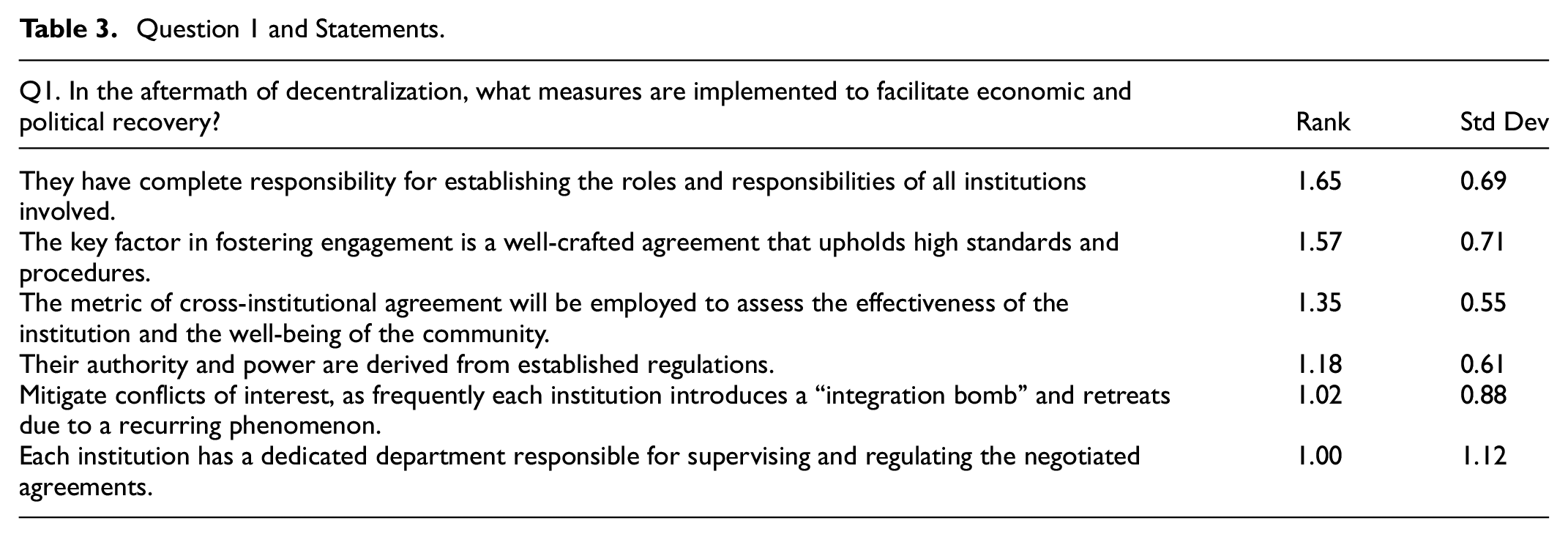
The results indicate a clear consensus regarding the answer to the initial question in order to achieve favorable outcomes in the shift from centrality to decentralization. Ensuring the reduction of conflicts of interest is an obligatory prerequisite for achieving steady economic growth, and political friction can be effectively resolved. Ex-officio is a strategic approach to address economic decline and conflicts of interest. Based on observations and current events, the second question is explained in Table 4 with lower average specifications compared to the previous results. Additionally, it has a higher standard deviation due to a wide range of perspectives and more intense discussions about the power-sharing system and its changing dynamics (Table 4).
Question 2 and Statements.

During the first wave, the expert conversations yielded a wide range of comments, including the concept of “dualism of power,” which refers to the strategic approach or ex-officio position of a leader holding authority in multiple organizations. It is probable that this only applies temporarily due to the interdependence of the decentralized government system, democratic system, and electoral system, which are integral to Indonesia as a whole. This implies that further regulations stipulate the need for a transfer of authority to occur every 5 years within a single term (maximum of two terms). Moreover, this rigidity is compelled to function conceptually, generating novel processes that may appear dynamic, while highlighting our inability to generate more rational outcomes.
Contrary viewpoints from professionals offer alternative perspectives and provide the following explanation: The results demonstrate that selecting ex-officio is one of the options that can yield greater and more prominent advantages compared to other choices. The desired outcomes will become evident when the practice and implementation align with the agreed-upon terms and predetermined schedule. In other words, if they have performed well, this pattern could potentially lead to a more equitable distribution of economic and political benefits at the local level. Alternatively, if the failure is due to the emergence of less creative and new ideas, which in turn impacts its implementation, it becomes a collective responsibility to revert to the prior state.
During the second wave, certain specialists determined that the situation becomes highly intricate when the special economic zone and the government system of decentralization operate independently, without any monitoring or control from each institution. Consequently, if each institution operates independently, friction will persist and deteriorate the quality of the economy, democracy, and local politics.
Alternatively, the concept of consolidating several discussions and other elements is proposed as a justifiable conclusion. This would involve appointing an ex-officio representative with a written agreement and establishing a dedicated department to supervise its execution, all under the authority of the central government. This implies that each decision made by a leader is carefully coordinated and mutually agreed upon in order to provide accountable outcomes. Furthermore, the allocation of power is effectively enforced, with BP Batam possessing exclusive authority over the economy, free commerce, assets, and future ventures for both national and regional purposes, as per its regulations. In addition, the local government must establish a consensus regarding the reporting of activities, administrative affairs, and responsibilities in order to effectively implement decentralization.
Similarly, the Batam Government through decentralization solely assists in carrying out administrative tasks, overseeing and regulating functions, and providing other forms of support, without actively participating in the operations of the special economic zones, which are under the jurisdiction of the central government. There is a consensus that flexibility is necessary and that a “one-size-fits-all” approach may be enforced, but it yields the desired outcome.
As stated by one of the respondents (wave 3), finding a solution to the polemic of dualism of power is a shared obligation. This is due to reasons of national interest, interests for Batam, and the welfare of its people. “This phenomenon is very important because Batam is a strategic area for international trade and has a significant impact on the national economy; its existence on the Malacca Strait peninsula (the border area of Malaysia and Singapore) is an advantage for free trade which results in economic strengthening.”
Therefore, it must be regulated by certain institutions under the supervision of the ministry, such as BP Batam, and without intervention from the local government. On the other hand, if this is under control and there is intervention from the local government; it will cause friction with BP Batam which results in overlapping regulations and interests; and bad phenomena that will not be resolved due to conflicts of interest as is happening now.
The expert’s advice to voice this reason is very appropriate and has succeeded in gaining support to achieve a formula with a special format in the division of power and authority. The first is the need for joint recognition of the existence of the local government as part of the decentralization system; with its main tasks and functions for community administration and regional development; without touching the area, economic system, and industry that has been controlled by BP Batam under the umbrella of the central government or ministry. Likewise, the recognition of the local government toward the authority institution, namely BP Batam, which is responsible for controlling the macro, micro, and other asset economic systems, free trade, and other things that have been formed since the implementation of BP Batam in October 1971.
This result is more elegant and wiser because it is formed on the awareness of the conflict of interest that has occurred since the Batam administrative area was formed in 1983. The overall recognition and contribution of each institution are still carried out according to applicable regulations and lead to the economic welfare of the community and the surrounding environment. In the end, this statement was re-submitted to consider the previous answer and re-emphasize the need to identify and clarify the functions, duties, and obligations of each institution after knowing their parts that have been agreed upon together. Any form of suspicion and concern that may arise in the future needs to be negotiated and re-discussed as a form of joint responsibility for Batam governance.
Question 3: In the event of success or failure, what is the orientation of long-term integration? Additionally, provide a prediction for the relationship of community welfare to be a priority.
According to multiple analysts, the implementation of ex-officio is important due to its high likelihood of success and its potential to resolve the dualism between the Batam government and BP Batam. It is seen to combine the two institutions under a single leadership.
Contrary to the previous question, this topic elicited a wide range of perspectives and viewpoints, which are documented in the question list presented in Table 5. The primary issue of institutional dualism is the desire to exert control over Batam, resulting in issues for the economic, industrial, and derivative sectors.
Question 3 and Statements.

The panelists recommended that each institution abstain from attempting to exert control over one another; rather, they should foster creativity and innovation to address the decrease in the local economy, which is adversely affecting national economic stagnation. As previously said by an expert, a great idea is only considered great if it has the ability to access many channels, namely by allowing each institution to jointly choose and elect a leader for the governance of both institutions.
While it may be challenging to acknowledge, if one leader initiates and both institutions implement it, it is essential to clearly establish the accountable actions and assess the influence of various factors on measurable outcomes, while recognizing the contributions of both institutions. However, it is crucial to establish clear guidelines for operations and responsibilities in order to prevent any bias and conflicts of interest in the future. Once again, this issue is connected to the need for clearly defined tasks and responsibilities in order to restore the economic sector. This involves integrating interests and politics, as stated in the preceding question.
Some experts propose the implementation of a special autonomy policy that includes the establishment of two chambers. These chambers would be designated for regions that meet the criteria for asymmetric decentralization and aim to reduce conflicts of interest related to public security. Additionally, the creation of a special economic zone (SEZ) is suggested as a policy to maintain Batam as a strategic economic area, with the goal of improving the welfare of the community under the supervision of BP Batam. In the context of special autonomy, the Batam government has established a special economic zone that is exclusively managed by BP Batam and is subject to the authority of the central government. The Batam government does not have the power to intervene in this matter.
In, the second wave. The establishment of special autonomy by the Batam Government, which encompasses a Special Economic Zone managed by BP Batam, offers superior incentive benefits compared to alternative solutions. For example, there is special autonomy and KEK, which are autonomous institutions with their own jurisdiction. The primary objective is to enhance the legal standing of BP Batam following the adoption of regional autonomy as a result of decentralization. Since its inception and the issuance of Presidential Decree No. 41 of 1973, Batam has effectively implemented special economic practices. This decree designated Batam as an industrial area and established it as a “bonded island,” meaning it became an autonomous region managed by the BP Batam.
BP Batam’s identity was overshadowed by the conflict arising from the decentralization of products, specifically the desire of the Batam government to have full control over the Batam region in 2005. Subsequently, BP Batam’s legal position was reevaluated to align with the establishment of the free trade zone (FTZ) which has been in effect since 2009 and is valid for 70 years. Additionally, past economic policies have contributed to enhancing the competitiveness of both the Batam and national economies. The presence of asymmetric decentralization entities, such as the Batam Government, serves as a “warning” to BP Batam to promptly and effectively implement measures that would positively impact the local and national economy.
Alternatively, a proposition was made to establish a distinct province called the Special Province of Batam. The objective of this plan is to streamline governance and create a unified framework for the integration of BP Batam and the Batam Government. Nevertheless, several experts promptly dismissed this plan due to its significant deviation from the provisions outlined in the regional status. The suggestion of elevating its status to a province with specific goals would likely result in additional conflicts and provoke envy from other regions.
During the third wave, the researchers collated the feedback that gained good attention and incorporated it into a special series that helped determine the long-term orientation of Batam. There are three proposals that are organized systematically based on the order of benefits and summarizing the previous two questions. Firstly, the special autonomy region is established as a result of asymmetric decentralization overseen by the Batam Government. Secondly, within this special autonomy, there is a special institution called BP Batam, which is equivalent to the Batam Government. Its sole responsibility is to manage all economic areas, ports, airports, international trade, free trade, and other assets. Lastly, both institutions are led by a single leader who has been agreed upon by each institution or ex-officio.
Moreover, the experts have identified three reasons as the optimal approach to address the conflicting interests between BP Batam and the Batam government in controlling Batam. Firstly, each institution will be granted explicit and documented power and authority through an agreement. Secondly, this will ensure that there is no overlap or collision between the two institutions, providing legal certainty for both. Lastly, this approach aims to maintain and strengthen these institutions in order to promote the economic well-being of the local and national economy.
Regarding the third question, about the orientation of long-term integration and predictive capability in prioritizing community welfare. This can be achieved by implementing the three expert agreement ideas described in the preceding paragraph. The final question is highly contentious, as it is intricately linked to the democratic and electoral system, as previously elucidated. The ex-officio agreement is limited to a maximum duration of either 5 years or two periods, equivalent to 10 years. The enhancement of the agreement with a prolonged duration entails the duty and strategic assistance provided to each partner, enabling them to cultivate larger influence and attain recognition from the policy-making entities.
Another participant proposed that “this decision is subject to strict time constraints and can be reconsidered for discussion at the national level once the election has concluded.” Moreover, it is worth noting that the decision includes the concrete disbandment of BP Batam and the complete implementation of the principle of asymmetric decentralization as a means of ensuring justice for all regions in Indonesia. This might be considered quite radical, as the management of Batam Island is primarily aimed upon boosting the national economy, with a specific focus on BP Batam. Nevertheless, in order to ensure fairness and establish a transparent governmental structure, it is imperative that power and authority be centralized and exclusively vested in the regional government system.
This assertion is supported by the idea of asymmetric decentralization, which allows for the inclusion of regional expertise in government. It involves granting exclusive authority to specific regions through a single institution. Mookherjee (2006) states that decentralization is accomplished by the establishment of administrative and economic zones that are both integrated and directly governed by the government system. Moreover, according to Libman (2010), achieving asymmetric decentralization involves taking into account factors such as conflict, historical and cultural attributes, border regions, the nation’s capital, and economic advancement. Hence, this method can be seen as a feasible choice for Batam, both in the short-term and the long-term, in order to enhance the connection between the central and local authorities within a unified governance structure (Dodgson et al., 2011).
The specialists primarily focus on addressing issues during the prodromal phase, which precedes the emergency phase and has the potential to exacerbate economic conditions and public welfare. Disregarding these forecasts, the two preceding inquiries and the methodical organization of the three fundamental areas of consensus among experts have managed to temporarily regulate the conflicts of interest, political influences, and economic factors in Batam.
This topic highlights some forthcoming issues related to establishing a well-defined governance framework, specifically in the context of regional governance and political economy methods, as depicted in Table 5. Firstly, both BP Batam and the Batam government must exhibit greater restraint, as well as a heightened level of dynamism and flexibility, in addressing the pressing demands of the population.
However, it is important to maintain courage and explore novel innovations to enhance the appeal and attractiveness of institutions. Furthermore, the theory of political economics places significant emphasis on the ownership of the means of production or the establishment of unambiguous governance to determine the sole ruler in a certain territory. This task must be executed despite the presence of difficulty, thereby necessitating one of the two institutions to yield or maybe combine into a single entity. This demonstrates that the process of consolidating power to determine the ruler in Batam is highly intricate, taking into account historical, experiential, and governance factors.
As a results it leads to a detrimental duality in the industrial sector and negatively affects the local population. It is acknowledged that integration needs to be initiated at the highest levels of the two opposing institutions and that strong support from top leadership is crucial in maintaining an integrative mindset even when there are changes in the organization’s structure and personnel. This mindset must be evident in a culture that prioritizes the well-being of the community.
Both parties must make greater efforts to overcome the dualism and economic decline, while some scholars view this as a positive aspect of Indonesian democracy. The accomplished integration may serve as a short-term solution. However, it is crucial to carefully execute the subsequent phase of determining the ruler to facilitate Batam’s economic development, which can potentially be revitalized through the decentralization of products.
Correlated with it, research by Le Roux and Schoeman (2016), Paramitha and Wanti (2016), and Reksodipoetro (2019) indicates that dualism in Batam arises from conflicts between government regulations and BP Batam, a lack of consensus regarding the relationship between the government and BP Batam, and competing interests in managing finances, resources, land, and permits in Batam. For instance, the licensing authority division employs an identical licensing scheme, yet two distinct entities administer it. The existing confusion and regulatory practices hinder investors’ ability to advance their industries.
Discussion
This study provides a distinct perspective to practitioners, specialists, officials, and leaders in the global government’s economic sector. It highlights the lack of value in maintaining dualism in an area that has a competitive resource foundation. The presence of conflicting institutions will exert a substantial influence on economic decline and public welfare, owing to the intense competitiveness and self-centeredness exhibited in their efforts to overpower one another. These difficulties have reached their maximum capacity and require unambiguous solutions that consider both the immediate and long-term future.
The government’s operating system is experiencing ongoing growth in decentralization, which is being accompanied by extensive discussions among specialists. For instance, the devolution of power and authority from the central government to the regions enables them to formulate and execute efficient policies, while still being overseen and guided by the central government (Mietzner, 2012). The ongoing enhancements in capacity and capability are being implemented through administrative reorganization and anti-corruption measures, necessitating frequent evaluation and refinement (Fathani et al., 2024; Yusuf, 2020). Hence, decentralization is regarded as a crucial approach to alleviate disputes that arise in different locations (Diprose et al., 2019).
The differentiation between symmetric and asymmetric decentralization is based on the degree of compatibility and resemblance of relationships among governments, economies, political systems, both with the central government and between nations, as well as between the central and regional governments (Rondinelli, 1981, 1983). Chien (2010) states that China’s adoption of asymmetric decentralization is a response to the pressures of globalization, considering the interplay between different areas and the central government (Zhao et al., 2022). In addition, China employs an asymmetric decentralization policy to stimulate economic growth by treating different regions differently based on their respective strengths (Wu, 2011).
The implementation of asymmetric decentralization may not be feasible in Batam, Indonesia due to the control exerted by BP Batam. Historically, the method and other factors have posed challenges in terms of dissolution or acquisition by the local government. BP Batam will eventually be dissolved because to the pressures of globalization and modern governance systems. Nevertheless, the primary objective at present is to address the progressively prolonged dispute that has significantly affected economic activity, industry, and the well-being of the Batam society.
To lessen the conflict and promote economic recovery, interim solutions have been provided, with a focus on economic factors and public well-being. Ex-officio is a potential choice among other contested proposals, potentially necessary to facilitate cross-agency collaboration under unified leadership. Decentralization necessitates the presence of the Batam Government, with a designated area inside it to acknowledge the exclusive management of the Batam economic sector by BP Batam.
There exists a definitive and documented agreement, acknowledged by both organizations, which mandates joint execution and compliance. Unsurprisingly, there are challenges in bringing together individuals and leaders from two distinct institutions with differing agendas and cultures and requiring them to collaborate as a cohesive team to accomplish mutually agreed-upon objectives.
The primary reason for the rejection of decentralization practices in Batam is the discrepancy in standards and the lack of a benchmark to compare the innovations that are being implemented. This is supported by the findings of Kurniadi (2012a). This implies that all regions are compelled to adopt decentralization practices, whether symmetrically or asymmetrically, without considering historical and economic factors, pre-existing priority assets, and disregarding previously established values before the implementation of decentralization.
However, it is important to acknowledge that the concept of decentralization does not result in equal benefits due to its tendency to elicit varied emotions and conflicting interests. Additionally, it might lead to negative outcomes stemming from the colonial activities of the central authority. It is worth noting that decentralization has been historically sanctioned under the country’s constitution. Contrarily, the introduction of special autonomy in Aceh has failed to produce desired outcomes due to conflict and a heavily skewed central authority, despite efforts to enact reforms to establish a democratic system (Talitha et al., 2020).
Lele (2023) discovered that despite being designated as a priority location, decentralization did not yield any results. The primary cause of the failure was the region’s incapacity to overhaul its system of administration, authority, and power, resulting in a strain on its resources and finances. However, conflicts of interest and tensions between institutions are indeed present in Papua, both before to and following the adoption of special autonomy. Furthermore, it is established that there is no genuine correlation between the financial capability of different regions and the economic advancement of districts and towns in Papua Province. Consequently, several areas categorized as having asymmetric decentralization are merely symbolic and remain underdeveloped.
Given the decentralization policies and the economic competitiveness of locations like Batam, it is challenging to reconcile the conflicting duality of institutions. Thus, the strategic approach derived from study findings consists of three systematically organized aspects, prioritizing the magnitude of good outcomes and the principle of collective well-being for both the political economy and public welfare. The main components of this plan are: (i) creating a special autonomous region through asymmetric decentralization, overseen by the Batam government; (ii) BP Batam, which will have the same authority as the Batam government but with a specific focus on managing economic zones, ports, airports, international trade, free trade, and other assets; (iii) both institutions will be led by a single leader who has been mutually agreed upon or appointed ex-officio. This implies that there is a recognized autonomous region that falls under the jurisdiction of the Batam administration. Within this region, BP Batam manages a designated special economic zone.
The empirical findings from Batam highlight the necessity of addressing institutional fragmentation and overlapping authorities in regions with dual governance structures. The ongoing conflicts between the government and BP Batam, particularly regarding land use, licensing, and infrastructure coordination, can severely hinder effective policy implementation and public service provision. Institutional integration necessitates regulatory harmonization alongside the cultivation of mutual trust and adaptive collaboration among stakeholders. This indicates a transition to polycentric governance, which incorporates various centers of authority while maintaining common objectives and accountability (Ostrom, 1990, 2010). This lesson recommends that policymakers in Batam and other special economic zones establish formal inter-agency frameworks and joint decision-making mechanisms to support sustainable urban and economic development.
This study has limitations; it is mainly based on key stakeholders’ views and reported experiences, which may introduce interpretive biases and fail to highlight informal or latent power dynamics inside institutional arrangements. Also, the scope is contextually limited to Batam, a city with distinct administrative and economic characteristics, which may limit the applicability of findings to other places with more traditional government systems. Finally, while the study emphasizes the institutional dualism conceptually and practically, additional research utilizing longitudinal methodologies or institutional ethnography could provide insight into how integration evolves and through other mechanisms.
Conclusion
In the conclusion of a case, it is crucial to obtain the findings of the analysis using a flawless methodology to formulate policy recommendations that serve the collective welfare. Nevertheless, it is important to remember that this outcome is specific and cannot be applied universally, thus necessitating a reassessment when applied to other domains with distinct attributes. However, given the broad and potentially regulatable nature of the policy management pattern, it is possible to examine recommendations for other areas in Indonesia.
The problem in Batam originated from the implementation of decentralization in 2000, which led to a conflict of interest and institutional dualism between the Batam government and the BP Batam. This dichotomy led to the emergence of overlapping jurisdictions that disturbed the manufacturing operations of industrial sectors, resulting in a decline in the economy and investment and adversely affecting the community’s well-being.
The importance of this problem is underscored by the recognition that institutional dualism is known to have a strong and detrimental impact on performance, leading to extensive and enduring effects on the community’s economic health. Using ex-officio schemes to manage conflicts is usually temporary and depends on economic factors and community well-being, which requires the parties involved to work together to create a positive outcome in the ongoing dispute.
It is important to recognize that each collaboration yields distinct dynamics. Consequently, adaptability is essential, given that there have been accords on numerous proposals that present greater advantages than drawbacks.
The study reveals a strategic framework for Batam focusing on asymmetric decentralization politics and economic competitiveness. The framework consists of three components: establishing a distinct autonomous region under Batam government supervision; BP Batam also has equivalent authority but focuses on economic zones, ports, airports, international trade, free trade, and assets and both entities are directed by a singular leader. This plane creates a distinct autonomous region within the Batam administration’s jurisdiction, overseeing a special economic zone. Hence, we emphasize the importance of communal well-being for political economy and public welfare.
Footnotes
Acknowledgements
The authors would like to thank the reviewers and journal editors for their highly constructive comments and suggestions. We would also like to convey our highest appreciation to all of expertise panelists, respondents, interviewee who provided their insight and expertise. In addition, the authors are thankful to some institutions such as the Ministry of Education, Culture, Research and Technology of the Republic of Indonesia, and Research and Innovation Center, and the Batam State Polytechnic.

Funding
The author received no financial support for the research, authorship, and/or publication of this article.
Declaration of Conflicting Interests
The author declared no potential conflicts of interest with respect to the research, authorship, and/or publication of this article.
Data Availability Statement
The data presented in this study are available on request from the corresponding author. The data are not publicly available due to some include informants’ names and identities.