




Abstract
The portrayal of motion events across languages has been extensively explored, typically focusing on human locomotion. This study, however, diverges from the norm by examining the representation of motion events associated with avian species. The research scrutinizes how motion events involving avian species are represented in English and Chinese, focusing on manner of motion. English utilizes a wider variety of specific manner verbs, often borrowing from adjacent categories, while Chinese relies more on basic manner verbs and manner adverbials. An additional exploration utilizing a parallel corpus highlights a prevalent reliance in Chinese on the basic manner verb 飞 fēi “fly.” Notably, disparity in manner salience in describing flight events emerge early in linguistic development, even in children’s lyrics. The factors contributing to the gap of manner salience include openness of manner category, the accessibility of manner expressions and the analyticity of languages.
Plain Language Summary
Birds fly in diverse ways, but how do we describe their flight in different languages? This study investigates how English and Chinese, two languages with distinct ways of describing motion, portray bird flight events. We analyzed the verbs used in English and Chinese texts to describe birds flying and found that English uses a wider variety of specific verbs to describe different flight patterns and behaviors, while Chinese relies more on basic verbs like “fly” and additional adverbials to describe the details. This difference reflects the ways in which English and Chinese speakers think about and experience motion in the world. This article also explored how translators handle these differences when translating English texts about bird flight into Chinese. It found that translators often use simpler verbs or combine them with additional words to convey the meaning of the original English text. This highlights the challenges of translating between languages with different ways of describing motion. Overall, this study contributes to our understanding of how language shapes our perception and description of the world around us. By comparing how English and Chinese describe bird flight, we gain insights into the ways in which language influences our cognition and communication.
Introduction
Talmy (1985, 1991, 2000) introduced a bipartite typological division between verb-framed languages (V-languages) and satellite-framed languages (S-languages). In V-languages, the path of motion typically resides within the main verb, while manner is conveyed through subordinate elements such as adverbials, coverbs, and gerunds. Conversely, S-languages exhibit a preference for lexicalizing manner in the main verb slot, with path information expressed through satellites like particles, prepositions, or prefixes. These lexicalization patterns influence narrative styles, shaping preferences in how motion events are described (Cardini, 2008; Hendriks et al., 2022; Slobin, 2006; Tusun, 2023; among others), despite the presence of alternative options (Beavers et al., 2010; Michelotti et al., 2025; Talmy, 2000).
For instance, in French, a V-language, the resultative motion “The fish swam through the waterfall” can be expressed through two patterns, as the following examples (1) to (2) show:
(1) Le poisson a nagé à travers la chute d’eau. “The fish swam through the waterfall.” (2) Le poisson a traversé la chute d’eau. “The fish crossed the waterfall.” (French—Filipović, 2007, p. 311).
Native French speakers tend to prefer option (2), which exclusively encodes the path, perceiving the alternative expression (1) with manner details as less natural (Filipović, 2007, p. 312).
The inclination in S-languages to encode manner in the main verb slot fosters a rich lexicon of manner verbs, allowing for precise distinctions. In contrast, V-languages allocate the main verb slot for path information, necessitating alternative means for expressing manner, resulting in a general omission of detailed manner descriptions (Beavers et al., 2010; Molés-Cases, 2020b; Özçalışkan & Slobin, 2003; among others).
Slobin and colleagues not only typologically contrast manner salience but also rank languages based on the specificity of manner expressions, diversity of manner verbs, and availability of slots for manner expression in discourse (De Knop & Gallez, 2013; Molés-Cases, 2020a; Slobin, 2004, 2006; Slobin et al., 2014; among others). While existing research primarily focuses on human motion, limited attention has been given to how languages represent spatial displacement in non-human entities, particularly birds or insects with distinct modes of flight. Vulchanova and Martinez (2013, pp. 144–168) emphasized the significance of the Figure of motion (mover) in describing motion events, introducing “Species” (human vs. non-human) as a crucial parameter for categorizing nuances in biological motion.
This study aims to bridge this gap by comparing how flight is linguistically encoded in English and Chinese, with “Chinese” in this article refers to the Contemporary Mandarin Chinese. While research on bird and insect flight has traditionally focused on areas such as ornithology, entomology, ecology, and climatology, linguistic analyses of these unique motion patterns have been limited. By examining verb selection in portraying avian motion, we aim to uncover typological distinctions and provide an in-depth exploration of language strategies in representing this intricate phenomenon.
The Previous Researches on Manner Salience across Languages
Manner salience, as defined by Slobin (2006), pertains to the level of attention that languages allocate to the expression of manner in event descriptions. This construct is typically assessed through the richness, diversity, and specificity of manner-related lexicon within a given linguistic system. Previous research, largely centered on human locomotion, has illuminated the cross-linguistic variability in manner salience, particularly distinguishing between S-languages such as Russian, German, and English, and V-languages like French, Spanish, and Turkish. S-languages have consistently demonstrated a greater emphasis on manner details in motion event descriptions compared to V-languages (Cardini, 2008; Fanego, 2012; Hsiao, 2009; Jiang & Li, 2018; Özçalışkan & Slobin, 2003; Slobin, 1996, 2004; Tusun, 2023; Zhu, 2019; among others).
Slobin et al. (2014) extends previous controlled studies by eliciting descriptions of various manners of walking and running from speakers of satellite-framed (English, Polish) and verb-framed languages (French, Spanish, Basque). The analysis resulted in semantic clusters for walking, running, non-canonical gaits, and quadrupedal movement, revealing greater lexical diversity in satellite-framed languages.
Speakers of S-languages exhibit a notable propensity for utilizing manner verbs extensively and with a wide lexical range, whereas speakers of V-languages tend to favor alternative methods of conveying manner. Factors influencing manner prominence include language-specific morphosyntactic features and the presence of motion-related lexical categories (Fanego, 2012; Özçalışkan & Slobin, 2003; Slobin, 2006; among others). In S-languages, the preference for incorporating manner within the primary verb position fosters the habitual lexicalization of manner, resulting in a rich inventory of manner verbs and enabling nuanced distinctions. Conversely, V-languages typically reserve the main verb slot for encoding path information, necessitating alternative strategies for expressing manner, such as subordinate manner verb constructions and adverbial phrases, thereby often leading to less emphasized manner details (Beavers et al., 2010; Molés-Cases, 2020a, 2020b; Özçalışkan & Slobin, 2003; among others). Furthermore, the acquisition of novel manner verbs also reflects typological preferences, as demonstrated by Tütüncü et al. (2024).
Slobin and colleagues have not only typologically contrasted manner prominence but also arranged languages along a continuum of manner salience based on the specificity of manner expressions, the size and diversity of the lexical inventory of manner verbs, and the availability of designated slots for manner expression in discourse (De Knop & Gallez, 2013; Molés-Cases, 2020a; Slobin, 2004, 2006; among others).
In comparing English and Chinese, significant variations are observed in terms of the cline of manner salience. English, classified as an S-language, emphasizes path encoding through satellites such as particles or prepositional phrases, while also allowing manner to be expressed within the main verb. The typological classification of Chinese remains debated, primarily due to its serial verb constructions (SVCs), where consensus on the syntactic hierarchy of the two verbs in an SVC is lacking. Chinese is categorized under the S-language classification in Talmy’s (2000) dichotomy and as an E-language in Slobin’s trichotomy (2004, 2006).
Research indicates that English speakers prioritize the manner of motion more than Chinese speakers, both in terms of the variety and specificity of manner verbs. Conversely, Chinese places less emphasis on manner compared to English, often relying on analytical strategies and compound verbs. Translation studies further illustrate that crucial manner details are frequently omitted in English-to-Chinese translations, while Chinese-to-English translations tend to integrate manner descriptions using alternative expressions to convey nuances of motion (Jiang & Li, 2018).
In conclusion, notable disparities in manner salience in motion events exist between English and Chinese. English showcases a richer, more diverse, and granular inventory of manner expressions, whereas Chinese demonstrates a relatively lower emphasis on manner encoding compared to a prototypical S-language like English.
However, all aforementioned studies have focused on human-centered displacement events. There exists a significant research gap concerning the motion of animals, particularly birds and flying insects, which exhibit distinct flight patterns and behaviors. Incorporating avian flight expressions of manner salience into the typological examination of displacement events holds the potential to expand the research scope and provide novel perspectives on typological differences.
Further exploration of motion events, especially those involving animals such as birds and flying insects with distinctive flight patterns, has the potential to deepen our comprehension of typological differences in manner salience.
Research Questions and Methodology
Research Questions
The unique dynamics of avian flight warrant a focused inquiry into how manner of motion is linguistically encoded across languages when describing the movement of birds. An illustration involving the portrayal of a flying owl from J. R. Tolkien’s “The Hobbit” and its translations indicates, akin to human locomotion, bird flight offers a valuable avenue for exploring typological variations in manner salience within motion events, as exemplified in instances (3) to (5).
(3) In V-languages: a. Spanish: Sale un buho. (Exits an owl.) b. French: D’un trou de l’arbre sort un hibou. (From a hole of the tree exits an owl.) (4) In S-languages: a. German: . . .eine Eule plötzlich raus-flattert. (. . .suddenly out-flaps an owl.) b. Russian: Там выскочила сова. (There jumped out an owl.)
These examples underscore how V-languages prioritize the transitional motion of an entity, while S-languages accentuate the manner of motion. The following presents the encoding patterns in English and Chinese:
(5) a. English: An owl popped out. b. Chinese: 飞出了一只猫头鹰. (Fēi chū le yī zhī māotóuyīng. “Fly-exit an owl.”)
Both English and Chinese possess readily available syntactic structures to encode the manner of motion. In S-languages like German and Russian, the manner of motion is integrated within the main verb, with the path delineated through a distinct satellite morpheme. In contrast, V-languages such as Spanish and French merge the path with the main verb and express the manner using a satellite morpheme. These structural disparities are evident in the descriptions of the same motion event across different languages.
The aforementioned cases clearly illustrate the diverse encoding of motion events in terms of manner salience when depicting bird flight. However, to conduct a comprehensive analysis of the encoding of bird flight manner in both languages, a more extensive dataset is imperative. This analysis should address the following three pivotal questions:
Q1: Does English exhibit a higher degree of manner salience than Chinese when describing bird flight, similar to its salience in human gait descriptions?
Q2: How do English and Chinese differ in their representation of avian motion, and what cognitive mechanisms underlie these differences?
Q3: What linguistic and cognitive factors contribute to the observed discrepancies in the encoding of bird flight manner?
By focusing on birds as the subject of study, this research aims to shed light on the intricate interplay between language, cognition, and the unique motion patterns exhibited by these fascinating creatures.
Data Selection
Our inquiry is meticulously focused on the domain of bird motion events, a realm of spatial displacement behavior that, despite its ubiquity and profound significance, has hitherto been subjected to less specialized scrutiny compared to human motion agents. The intricate dynamics and diverse expressions inherent in avian flight present an opportune landscape for delving into typological distinctions in the articulation of motion, thereby substantially augmenting our comprehension of spatial displacement expressions across linguistic spectra.
To rigorously investigate the nuanced differences in the manner of motion when depicting bird flight events, a tripartite methodology can be identified, each component designed to address specific aspects of data collection and analysis:
(i) Inventory Survey of Flight-Related Verbs: a dictionary-based lexical survey aimed at comparing the number of manner of motion verbs hile the enumeration of manner verbs is a conventional metric for assessing manner salience (Cardini, 2008; Li, 2010; Slobin, 2006), our preliminary analyses reveal that flight-related verbs often exhibit domain borrowing (e.g., “pop” “dive”), complicating the precise delineation of their inventory in the absence of contextual cues. Consequently, this method is deemed suboptimal for our investigative purposes.
(ii) Construction of a Custom Corpus: The scholarly precedents established by Chen and Guo (2009), and Shi (2014) meticulously examined verb distribution across 6 novels encompassing 180 motion episodes. These corpus are intended to systematically investigate the distribution of manner verbs across languages.
(iii) Utilization of Parallel Translation Texts: Drawing upon the methodological frameworks employed by Slobin (2006), Shi (2020), Chi and Jiang (2016), and Jiang and Li (2018), Cappelle (2012), we advocate for the incorporation of parallel translation texts to facilitate comparative analyses of manner salience across languages. The parallel corpus ensures a high degree of consistency, offering data that portrays identical scenes—a critical factor for enabling precise comparative assessments.
For our study, we primarily leverage parallel translation texts, manually extracting manner verbs and conducting statistical analyses of the types and tokens of flight-related verbs. The parallel corpus of translated texts was chosen to ensure a high level of consistency, offering data that depicts identical scenes. This uniformity is crucial for facilitating comparative analyses. Prior researchers have illustrated the value of translations in exploring the lexicalization of motion events. As noted by Slobin (2005, p. 18), “the translation task provides insight into the full range of a language as it adapts to the requirements of the source language.”
In our investigation, we focused on the novel “H is for Hawk” by Helen Macdonald, a British author and scholar at Cambridge University, and its Chinese translation, “Hǎilún de Cāngyīng” (海伦的苍鹰), executed by Liu Jian in 2017. This autobiographical narrative, originally published in 2014, delineates Macdonald’s resolve to master falconry and her subsequent endeavor to train a goshawk in the wake of her father’s untimely demise. The dual-language corpus, characterized by its extensive and nuanced descriptions of avian flight dynamics, served as an ideal basis for a comparative analysis of motion event descriptions within the English and Chinese linguistic paradigms. With its Chinese translated version, this book allows for an examination of how bird flight descriptions are interpreted within a distinct linguistic framework.
To mitigate the constraints of a single novel’s translation style and the translator’s language proficiency, we selected an additional novella in both English and Chinese. The English choice is “Jonathan Livingston Seagull” by Richard Bach, which chronicles the journey of a nonconformist seagull obsessed with the art of flying, distinct from other seagulls who fly merely for food. The novel contains 9,262 words. For the Chinese novella, we selected “Méilǐ Shānyīng” (梅里山鹰) by Shen Shixi, a celebrated contemporary Chinese animal novelist. It depicts various life scenes of a family of mountain eagles, including soaring, hunting, and daily activities, spanning 32,271 Chinese characters.
Both novellas provide rich, detailed flight scenes, offering a robust foundation for comparing flight verbs in English and Chinese discourse. Despite the disparity in word count, the translation ratio from English to Chinese typically ranges from 1:1.5 to 1:2.5. Assuming an average ratio of 1:2, a 10,000-word English novel would roughly translate to 20,000 Chinese characters.
It’s noteworthy that while the word count ratio between the 2 novellas is 1:3, their motion event densities differ. The English novella emphasizes the act of “Flight,” while the Chinese novella focuses more on the eagles’ survival and growth. Nonetheless, the two animal-themed novellas are broadly comparable in thematic content and narrative style.
By integrating the analysis of these two novellas with statistical examination of manner verbs, we can objectively assess the manner salience in flight-related expressions in English and Chinese. This dual-method approach facilitates a nuanced understanding of motion encoding across these linguistic systems, thereby enhancing insights into spatial cognition and linguistic typology.
Data Processing
In our data processing phase, we manually extracted all relevant displacement episodes related to bird flight from the chosen corpus. Our focus was on examining the diversity and granularity of flight-related manner verbs, also known as FLY verbs, used to describe the motion events of avian species. The data processing was guided by specific criteria to ensure a systematic approach to analyzing the manner verbs used in describing bird flight events. The following criteria were followed to extract and analyze the data:
(i) Manner verbs that convey only manner information and hybrid verbs that encompass both path and manner information are classified as manner verbs. This aligns with Cardini’s (2008) standard of focusing on verbs that clearly express a change of location in space and involve translational movement along a path.
(ii) We included autonomous motion events while excluding causative motion events involving causative verbs. Phrases like “fly the hawk” were omitted from our analysis to focus solely on autonomous motion. This criterion aligns with Cardini’s (2008) standard of intransitivity, ensuring that only verbs describing motion events without external causation are considered as manner verbs.
(iii) Both monosyllabic words (e.g., 飞fēi “fly,” 冲chōng “rush”) and disyllabic words (e.g., 盘旋pánxuán “hover,” 翱翔 áoxiáng “soar”) are included as manner verbs. The decision to consider both monosyllabic and disyllabic words as manner verbs in the analysis of Chinese motion descriptions aligns with the evolving nature of the Chinese language, where dynamic phrases are often lexicalized as single verbs, maintaining their integrity. Treating polysyllabic phrases as single verbs ensures consistency with English analysis. This approach is also supported by existing research on Chinese motion event expressions, demonstrating its acceptance in the academic community.
(iv) English temporary loose packages (e.g., “point-roll” “barrel-roll” “snap-roll”) are consolidated under the single manner verb “roll.” For instance, in our primary corpus, Jonathan Livingston Seagull—where pilot-author Richard Bach integrates aerobatic terms to diversify flight verbs—we unified ad-hoc combinations into the standardized verb “roll.” This methodology minimizes author-specific biases while ensuring categorical consistency.
To ensure the reliability and objectivity of our analysis, a blind check process involving a second professional English translator was conducted to independently review and identify flight-related manner verbs. Any discrepancies were discussed and resolved through consensus to enhance the accuracy of our annotations.
We acknowledge the subjectivity inherent in interpreting motion events. However, we are confident in the robustness of our findings, which are supported by consistent trends observed in manner salience between English and Chinese across a substantial dataset, including both translated and original texts. These findings align with existing research on typological differences.
Results
We analyzed the distribution patterns of manner verbs in “H is for Hawk” and its Chinese translation “Hǎilún de Cāngyīng,” counting the types and frequencies of manner verbs (Tables 1–3). Similarly, we conducted a statistical analysis on an English novella “Jonathan Livingston Seagull” and a Chinese novella “Méilǐ Shānyīng,” detailing the types and frequencies of manner verbs in each text (Tables 4–6).
Types and Tokens of FLY Verbs in H is for Hawk.

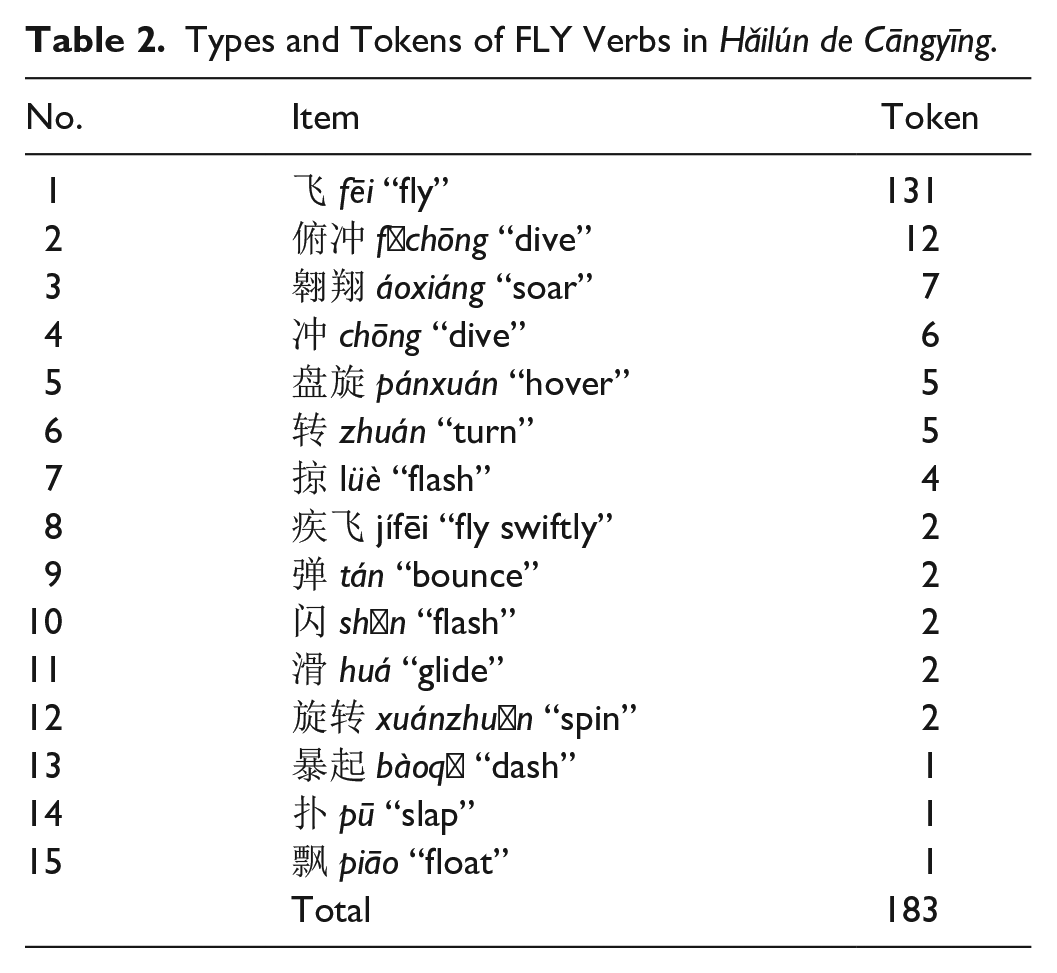
Types and Tokens of FLY Verbs in Haˇilún de Cāngyīng.
FLY Verbs in H is for Hawk and Its Chinese Translation.

Types and Tokens of FLY Verbs in Jonathan Livingston Seagull.

In addition to the aforementioned “pull away,” this novella also features expressions such as “pull into,” “pull up,” “pull upward” and “pull out” describing autonomous avian flying event.
Types and Tokens of FLY Verbs in Méilĭ Shānyīng.

Note. In the, the term “飞行” (fēi xíng) is used as a verb meaning “to fly,” which is essentially synonymous with “飞” (fēi). As a biased compound word, given the near equivalence in semantics, it is categorized under the “飞” (fēi) class for statistical purposes.
FLY verbs in Jonathan Livingston Seagull and Méilıˇ Shānyīng.

Results from Translation works
FLY Verbs in H is for Hawk
From Table 1, the following observations can be made:
(i) The English language demonstrates a rich diversity of flight-related manner verb types, totaling 33 types, and a high frequency of occurrence with 213 tokens. The basic manner verb “fly” is predominant, accounting for about 54.9% (117 out of 213 tokens). Additionally, composite manner verbs combining motion with speed, mode, or course are utilized, such as “rocket” “burst” and “race” (motion + speed), “stoop” “dive” and “glide” (motion + mode), and “circle” “spin” and “twist” (motion + course).This showcases the intricate and varied ways in which English describes bird flight through manner verbs.
(ii) Some English manner verbs, like “dive” and “drift”, do not inherently imply flight, and their interpretation in relation to “flight” relies on context. These verbs are borrowed from water sports and include onomatopoeic words such as “splutter” and “clatter.” This contextual dependency highlights the flexibility and adaptability of manner verbs in English to convey a range of motion-related actions beyond traditional flight scenarios.
(iii) Specific English manner verbs can serve as causative verbs in the presence of a direct object. However, when paired with a satellite component indicating the path, they transform into self-motion verbs. For instance, verbs like “pull (away)” and “tear (off)” exemplify this transformation, illustrating the nuanced ways in which manner verbs in English can convey causation and self-initiated motion within the context of bird flight descriptions.
FLY Verbs in Haˇilún de Cāngyīng (Traslation of H is for Hawk)
Table 2 shows the types and token of FLY verbs in in Chinese translation of H is for Hawk (Hǎilún de Cāngyīng).
Based on the empirical analysis presented in Table 2, a synthesis of the findings reveals the following insights:
(i) The Chinese translation exhibits a reduced diversity of flight-related manner verbs in comparison to English, with a ratio of 15 to 33 and a lower overall frequency of occurrence, 183 to 213, indicating the conciseness in the Chinese rendition of flight actions, characterized by a more restricted selection of manner verbs.
(ii) Notably, the primary manner verb 飞 fēi “fly” overwhelmingly dominates the spectrum of manner verbs in the Chinese translation, accounting for a substantial proportion of instances at approximately 71.6% (131 out of 183). This prevalence underscores the significance placed on basic manner verbs within the Chinese translation when depicting flight maneuvers.
(iii) While the Chinese translation does incorporate manner verbs that integrate motion with speed, mode, or trajectory—such as 扑 pū “pounce,” 俯冲 fǔchōng “descend rapidly,” and 盘旋 pánxuán “hover”—their usage is notably sparse. This preference for succinct expression in flight descriptions in Chinese is further underscored by the relatively infrequent employment of these more intricate manner verbs.
Comparison of FLY Verbs in English and Chinese from Translation Texts
Based on the observations and analysis of the data, a comparative study was conducted on the utilization of motion verbs in English and Chinese, yielding the following key findings:
The disparity in the variety of flight-related manner verbs between English and Chinese is striking, with English showcasing a significantly broader range of verb types compared to Chinese. Correspondingly, the frequency of occurrence is notably higher in English (213 tokens) than in Chinese (183 tokens).
Both languages heavily rely on basic manner verbs such as “fly” in English and 飞fēi “fly” in Chinese, which constitute a substantial portion of the total occurrences of manner verbs in their respective linguistic contexts. While English demonstrates a richer array of composite manner verbs that integrate motion with diverse elements, whereas Chinese also incorporates some manner verbs integrating these elements, albeit in relatively fewer numbers. In addition to the aforementioned points, it is worth noting that certain manner verbs in English lack an inherent semantic connection to flight and are context-dependent. Conversely, Chinese translations frequently elucidate the flight component explicitly.
In summary, discernible disparities exist in the salience of manner in motion events between English and Chinese. English showcases a higher prevalence of second-tired manner verbs in discourse, while Chinese leans towards a greater proportion of basic manner verbs in describing avian motion.
Results from English and Chinese Novellas
To compensate for the potential limitations and inadequacies inherent in translated works, we also selected one novel each in English and Chinese for comparison. The statistical results are shown from Tables 4–6.
When comparing the verb types between “Jonathan Livingston Seagull” and “Méilǐ Shānyīng” it is evident that both texts employ a considerable array of FLY verbs. However, “Jonathan Livingston Seagull” surpasses “Méilǐ Shānyīng” in the variety of FLY verbs, with 45 types compared to 18 in “Méilǐ Shānyīng.” This discrepancy suggests a more extensive lexicon for describing flight in the English novella.
The presence of verbs like “巡飞” (xúnfēi), “疾飞” (jífēi), and “飘飞” (piāofēi) in “Méilǐ Shānyīng” indicates a process of lexicalization, where manner-of-motion expressions have evolved from phrasal constructions to fixed verb forms. If these verbs are considered as adverbial modifications of “飞” (fēi), the proportion of “飞” (fēi) related verbs in “Méilǐ Shānyīng” rises significantly, accounting for 85 out of 146 tokens, or 58.2% of the total. This highlights the prevalence of “飞” (fēi) in the text, despite the higher diversity of FLY verbs in “Jonathan Livingston Seagull.”
The lower proportion of “飞” (fēi) in “Méilǐ Shānyīng” compared to “Hǎilún de Cāngyīng” can be attributed to the higher frequency of verbs like “俯冲” (fǔchōng “dive”). This variation in verb usage is influenced by the distinct narrative contexts and thematic focuses of each work. The analysis reveals that the textual context plays a crucial role in shaping the expression of motion verbs in literary works.
FLY Verbs in English and Chinese Novellas
By consolidating the data from the aforementioned four literary works, we arrive at Table 7, which provides a comparative overview of FLY verbs in English and Chinese novels:
FLY Verbs in English and Chinese.

The most notable discrepancies between English and Chinese in describing avian motion emerge in the utilization of high manner verbs, a topic that will be further explored in sections “Prevalence of Basic Manner Verbs in Flight Events Description” to “Reduction of Diversity in Manner Verbs in English-Chinese Translation.”
Upon examination, it is evident that “Jonathan Livingston Seagull” demonstrates a more diverse array of FLY verb types compared to “H is For Hawk.” This discrepancy can be largely attributed to the author’s deliberate emphasis on the protagonist’s extraordinary aviary prowess in “Jonathan Livingston Seagull” which is manifest through a richer deployment of high manner verbs. In contrast, “H is For Hawk” exhibits a propensity for the more frequent utilization of basic manner verbs, reflecting a different narrative approach to the depiction of flight.
Regarding the two Chinese novels, the original novella by the Chinese author employs a slightly higher number of manner verb types compared to the translated work, with a ratio of 18:15. However, it is noteworthy that the overall number of FLY verbs in Mandarin is relatively limited. The usage of basic manner verbs is relatively high, although “Méilǐ Shānyīng” demonstrates a less pronounced proportion of basic manner verbs compared to the translated work, albeit with a slightly richer variety.
Some may argue that translated works limit the expression of Chinese FLY verbs. However, comparing “Méilǐ Shānyīng” and “Jonathan Livingston Seagull” shows a more nuanced view. Truely that Chinese texts use fewer FLY verb types than English ones, partly due to the latter’s thematic focus on detailed flight descriptions. Yet, “Méilǐ Shānyīng” also offers rich, vivid avian flight scenes, especially when young eagles soar.
Discussion
Based on the aforementioned data, both commonalities and disparities emerge in the expressions of bird flight between English and Chinese. This section makes an analysis of the coding patterns and variances in depicting the motion of “flight” in both languages. Furthermore, we will delve into the strategies employed by translators to navigate and bridge these disparities during the translation process.
Coding Patterns of Avian Motion in English and Chinese
The structure of motion events reflects inherent tendencies within a language, often allowing for the coexistence of multiple structures. Drawing from the extracted bird flight scenarios, we can categorize six syntactic patterns for motion expressions both available in English and Chinese as follows:
Basic manner verb + satellite path: fly back to/飞向 fēixiàng “fly toward”
High manner verb + satellite path: raced/扑向 pūxiàng “pounce on”
Basic manner verb + manner adverbial: fly powerfully/疾速飞 jísù fēi “fly swiftly”
Path verb only: ascend/离开 líkāi “leave”
Path verb + manner adverbial: slowly descend/飞掠而过 fēi lüè ér guò “pass flashing”
General motion verb + path satellite: come away/消失 xiāoshī “disappear into”
The six patterns outlined above are utilized to describe avian motion in both English and Chinese, indicating a similarity in the structural representation of bird displacement between the two languages, showcasing a shared conceptualization of avian motion across linguistic boundaries. However, there are several notable differences in the encoding patterns of “flight” motion between English and Chinese.
Both English and Chinese texts utilize all six patterns mentioned, but their distribution differs. English mainly uses the first two structures, while the last four are less common. In contrast, Chinese text frequently employs the first three structures and less often uses the last three. The key distinction lies in the use of manner adverbials. In English, adverbs primarily modify manner verbs (e.g., slowly, quickly), expressing rate, attitude, effort, and gerunds (e.g., fly spluttering). Chinese, on the other hand, employs a wider range of semi-tight packaging structures to modify main verbs, including adverbial gerunds, serial verb structures, and complement structures. Loose packaging structures like temporary rhetorical expressions are also used (Allen, 2007; Shi, 2021). For example:
Adverbial gerund: 跑着追逐 pǎo zhe zhuīzhú “chase by running”
Serial verb structure: 俯冲而下 fǔchōng ér xià “dive and descent”
Complement structure: 飞得又低又疾 fēi de yòu dī yòu jí “fly low and fast”
Temporary rhetorical expression: 像飞出去的火箭一样,迅速消失得无影无踪 xiàng fēi chūqù de huǒjiàn yíyàng, xùnsù xiāoshī de wúyǐng wúzōng “fly away, quickly disappear without a trace like a rocket”
Moreover, English tends to use fewer V-structures when describing avian motion compared to Chinese. This difference can be attributed to English being a typical S-language, where V-structures are less common. However, research indicates that V-structures play a significant role in describing motion events in Chinese. For instance, a study by Chen and Guo (2009) identified 15 path verbs commonly used in describing motion in Chinese novels. These path verbs, accounting for 22.89% of V-structures in modern Mandarin, include上shàng “ascend,” 下xià “descend,” 起qǐ “rise,” 出chū “exit,” 回huí “return,” 离lí “leave or depart from” and among others. Despite this, when these path verbs are used to describe bird motion, they predominantly function as main verbs in only 11 cases in H is for Hawk, suggesting a prevalence of S-structure in both English and Chinese descriptions of avian motion.
Prevalence of Basic Manner Verbs in Flight Events Description
It is well-established that basic manner verbs (such as walk, run, crawl, climb, and fly) are favored over general motion verbs (e.g., go, come, move) or more specific manner verbs (e.g., gallop, scurry, jog, pace, saunter) in S-languages (Vulchanova & Martinez, 2013). This preference stems from the fact that basic manner verbs provide comprehensive depiction of motion compared to general manner verbs. They not only encode translational motion but also encompass additional details (such as medium, velocity, cycle, posture, species, figure orientation, etc.) that are crucial within the domain of motion. Furthermore, basic manner verbs are preferred over more specific or concrete verbs because they incorporate the most commonly encountered configurations within experientially established locomotion categories.
Our analysis of the examined texts revealed a prevalence of basic manner verbs in both languages, representing 54.9% (117 out of 213 tokens) in “H is For Hawk” and a higher preference of 71.6% (131 out of 183) in Chinese translation text. And 41.4% (77 out of 186) in “Jonathan Livingston Seagull,” and 51.4% (75 out of 146) in “Méilǐ Shānyīng.” These results are consistent with prior research on human locomotion and highlight the importance of basic manner verbs in linguistic expressions. It is evident that basic manner verbs are prominent in both English and Chinese, with Chinese showing a greater reliance on them compared to English.
To further explore the differences in manner descriptions, we conducted a comparative analysis using English and Chinese novels, examining the findings in relation to manner salience. This comparison involved studying 180 episodes from 6 contemporary novels in English and Chinese respectively. The results indicated that basic manner verbs accounted for 26.7% (35 out of 131) in English and 56.3% (117 out of 208) in Chinese, shown as in Chart 1. This additional study reinforces the prevalence of basic manner verbs in Chinese and English texts, shedding light on the nuanced differences in manner depiction between the two languages.

Percentage of basic manner verbs in English and Chinese.
The above bar chart illustrates the percentage of basic manner verbs in various texts. It is evident that the frequency of basic manner verbs in Chinese texts is generally higher than in English texts. In depicting flight events, Chinese demonstrates a stronger preference for basic manner verbs compared to English. This trend is consistent across all texts analyzed. These findings align with previous research on human locomotion, emphasizing the significance of basic manner verbs in linguistic expressions, especially in the Chinese language.
Reduction of Granularity of Manner Verbs in English-Chinese Translation
Drawing from the previous discussion, it is evident that English relies more on high-manner verbs in the context of flight motion. Frequently, the specificity of manner verbs is reduced through the utilization of various strategies when translating into Chinese. For example:
(i) Replaced by basic manner verbs
High manner verbs in English might be rendered into Chinese by omitting the intricate nuances and utilizing basic manner verb 飞fēi “fly” to indicate the subject’s movement. For instance:
(6) She glides down to the far hedge and swings up into a small ash. 她 向 下 滑行, 直到 对面 的 篱墙,然后 飞 到 一棵 小 白蜡树 上. Tā xiàng xià huáxíng, zhídào duìmiàn de líqiáng, ránhòu fēi dào yī kē xiǎo báilàshù shàng. 3.sg downward glide, until arrive opposite poss fence, then fly arrive one cl small ash loc She glided downwards, straight to the fence on the opposite side, and then flew onto a small white wax tree. (7) A submarine rippled through the tops of the pines as one swept in and away. 它们从松树树顶飞出飞入, 像潜水艇形成的涟漪那样. Tāmen cóng sōngshù shùdǐng fēi chū fēi rù, xiàng qiánshuǐtǐng xíngchéng de liányī nà yàng. 3.pl from pine tree top fly exit fly enter, like submarine form rel ripple that way They flew in and out from the top of the pine tree, just like ripples formed by a submarine.
In the original English sentences, example (6) emphasizes the hawk’s soaring and poised wings before hunting by using the high manner verb “swings.” Similarly, example (7) portrays the agility of the hawk’s flight through the use of “swept.” These two high manner verbs infuse the text with vivid imagery. However, in the translation, these two details are omitted, and only the basic manner verb飞fēi “fly” is used to represent the subject’s displacement. This translation approach, which replaces higher manner verbs with lower manner verbs, can be considered a partial translation that diminishes the expressiveness of manner but aligns with the discourse characteristics of Chinese. By employing this strategy, Chinese translators aim to convey the overall sense of flight while sacrificing some of the nuanced manner details found in the original English text.
(ii) Replaced by “manner adverbials + basic manner verbs” structure
Modern Chinese is characterized by its analyticity, allowing for flexible combinations of manner adverbs and basic manner verbs, which has been discussed above. When translating high manner verbs from English into Chinese, these patterns are commonly employed to compensate for the target language’s inadequacy of high manner verbs, using lexical or syntactic means.
(8) Mabel bursts toward me, dragging the creance behind her. 美贝尔 振 翅 向 我 飞 来, 长 绳子 拖 在 身后. Měibèi'ěr zhèn chì xiàng wǒ fēi lái, cháng shéngzi tuō zài shēnhòu. Mabel flap wings towards 1.sg fly come long rope drag on behind. Mabel flaps her wings and flies toward me, dragging the long rope behind her.
In this translation, the high manner verb “bursts” is rendered using a combination of the manner gerund 振翅zhèn chì “flapping” and the basic manner verb 飞fēi “fly.” This strategy effectively compensates for the absence of manner details in the main verb in the target language. The following are more examples of the same kind.
(9) A cock pheasant in bronze and bottle green, . . . clatters up from the dry grass. 一 只 色彩斑斓 的 雄 性 野 雉, . . . 从 干草 丛 中 扑棱 而 起. Yī zhī sècǎi-bānlán de xióng xìng yě zhì, cóng gāncǎo cóng zhōng pūlèng ér qǐ. one cl multicolored mod male pheasant, from haystack loc flutter and rise. A colorful male pheasant, with vibrant feathers, flutters up from the haystack.
In example (9), the manner of motion is expressed in the onomatopoeic word “clatter” in English, and the serial verb construction in Chinese.
(10) Mabel will rocket away from me and disappear forever. 梅贝尔 将 像 火箭 一样 迅速 飞 离 我, 永远 消失 不见. Méi bèi ěr jiāng xiàng huǒjiàn yīyàng xùnsù fēi lí wǒ, yǒngyuǎn xiāoshī bújiàn. Mabel will like rocket same quickly fly away 1SG, forever disappear no see. Mabel will swiftly fly away from me like a rocket and disappear forever.
In example (10), English original sentence utilizes “rocket” as a verb which indicates the swiftness of the protagonist, while Chinese use the rhetorical expression as an additional information to bridge information in the main verbs. Meanwhile, this strategy hereby increases the density of basici manner verb “飞fēi” in the Chinese text.
(iii) Omission of manner information
Specific details of manner might be omitted and instead substitute with path verbs or neutral verbs. An illustrative example of this can be observed in the translation of the following English sentence.
(11) And in that tiny black gap which the brain disguises, they’d dived. 就 在 那 一 瞬间,它们 便 消失 在 林 中 了. jiù zài nà yī shùnjiān, tāmen biàn xiāoshī zài lín zhōng le. Exact in that one moment, 3.pl then disappear prep forest loc perf. Just in that moment, they disappeared in the forest.
In this translation, the manner verb “dive” is omitted and directly rendered as 消失xiāoshī “disappear.” This type of omission strategy is relatively infrequent in the analyzed text.
By omitting the manner verb and replacing it with a neutral verb “disappear,” the translation focuses more on the outcome or result of the action rather than the specific manner in which it was performed. This approach may be used to convey a sense of brevity or to align with the target language’s preference for expressing motion in an alternative way.
Reduction of Diversity in Manner Verbs in English-Chinese Translation
In the realm of English-Chinese translation, a noticeable decline in the variety of conveying modes of motion can be observed, particularly when it involves the detailed depiction of “flight” events. English possesses a vibrant and expressive nature, while Chinese often falls short in capturing the nuances of flying movements. Take for instance, the translation of birds “flying rapidly forward,” where Chinese translations frequently resort to the term 冲chōng “rush,” which encompasses multiple English terms such as “barrel,” “soar,” “stoop,” “dive,” and “skydive.” Let us examine the following examples:
(12) A crow barrelled down on the male. 一 只 乌鸦 冲 向 雄 鸟. yī zhī wūyā chōng xiàng xióng niǎo. One CL crow rush towards male bird. A crow rushes towards the male bird. (13) They’d soar up again. 双 鸟 又 比 翼 上 冲. shuāng niǎo yòu bǐ yì shàng chōng. Pair bird again together wing up rush. The pair of birds soar upwards side by side. (14) The female sparrowhawk stoops at her 这 是 一 只 雌 雀鹰, 她 向 美贝尔 俯冲. zhè shì yī zhī cí quèyīng, tā xiàng měibèiěr fǔchōng. This be one CL female sparrowhawk, 3.sg towards Mable downward rush. This is a female sparrowhawk. She stoops toward Mable. (15) It was a short, brutal dive from an oak into a mess of wet hedge. 随着 一 个 迅疾 而 残酷 的 俯冲, suízhe yī gè xùnjí ér cánkù de fǔchōng, Follow one cl swift and brutal mod downward-rush, 苍鹰 从 一 棵 树 上 冲 进 一 排 潮湿 的 篱笆 墙 里. cāngyīng cóng yī kē shù shàng chōng jìn yī pái cháoshī de líbā qiáng lǐ. Eagle from One cl tree loc rush enter one cl damp mod hedge wall loc. With a swift and brutal dive, the eagle rushes from a tree into a row of damp hedge walls. (16) Their breath-taking stoops from a thousand feet. 它们 从 几 百 米 的 高空 俯冲直 下. Tāmen cóng jǐ bǎi mǐ de gāokōng fǔchōng zhí xià. 3.pl from several 100 m mod high-sky downward-rush straight down. They dive straight down from several 100 m in the sky. (17) There was none of the skydiving I’d read about in the books. 它们 没有 做 我 在 书 中 读到 的 俯冲 动作. Tāmen méiyǒu zuò wǒ zài shū zhōng dúdào de fǔchōng dòngzuò. 3.PL neg do 1.SG on book loc read-arrive rel downward-rush action. They didn’t perform the diving actions I read about in the book.
In conclusion, the richness and precision in expressing manner of motion related to flight in Chinese are generally inferior to English. This often results in a reduction of diversity and intricacy when conveying such modes during the translation process from English to Chinese.
Increase of Manner Salience in Chinese-English Translation
In light of the significant differences in the salience of manner verbs between English and Chinese, as well as the reduction of diversity and specificity of manner verbs in E-C translations, the prevalence of the basic manner verb 飞fēi “fly” in Chinese becomes apparent. While飞fēi “fly” may often be translated simply as “fly,” skilled translators frequently opt for verbs that capture nuanced manner details. An illustrative example can be found in the translated works of the esteemed translator Zhang Peiji (张培基).
(18) 它 在 院 里 跳, 有时 飞 一 下, 不过 是 由 地上. Tā zài yuàn lǐ tiào, yǒu shí fēi yī xià, bùguò shì yóu dìshang. 3.sg prep yard loc jump, sometimes fly one cl, however be from ground. 飞到 花盆 沿 上, 或由 花盆 上 飞 下 来. fēi dào huāpén yán shàng, huò yóu huāpén shàng fēi xià lai. Fly arrive flowerpot edge loc, or from flowerpot loc fly down come. It hopped, fluttered, darting up to the edge of flowerpots and back to the ground again.
In this excerpt from Lao She’s (老舍) classic prose 小麻雀Xiǎo máquè “Little Sparrow,” the original text employs three instances of the basic manner verb 飞fēi “fly” to vividly describe the joyful hopping of the little sparrow in the courtyard, creating a rhythmic effect. However, the translation opts for three high-manner verbs, precisely depicting the sparrow’s flight actions and bringing its nimbleness to life. The verbs “hopped” and “darting up” portray the lively and agile nature of the sparrow, while “flutter” conveys its tension and agitation when landing. The translator skillfully captures the difference in discourse style between English and Chinese, resulting in a translation that better aligns with the linguistic characteristics of the target language. In conclusion, in CE translation practice, besides translating 飞fēi “fly” with the basic manner verb “fly,” translators often employ more precise high-manner verbs, thereby enhancing the manner salience and increasing the diversity of displacement descriptions.
To comprehensively examine the correspondence of the Chinese ter 飞fēi “fly” in English, we can analyze not only instances where 飞fēi “fly” is translated from, but also instances where other English terms are translated into 飞fēi “fly” in Chinese. For this purpose, we referred to the Yiyan English-Chinese Parallel Corpus (http://corpus.bfsu.edu.cn/info/1082/1693.htm), a large-scale corpus created based on the Brown Corpus model. The corpus is divided into two main sections: the News section (A–C) and the Fiction section (K–R), containing diverse genres, including news reports, editorials, novels, detective stories, science fiction, and romance.
We identified a total of 49 cases where 飞fēi “fly” is used to describe the flight of birds and flying insects as well. Out of these 49 cases, 22 instances directly correspond to the English word “fly.” In the remaining 27 cases, 飞fēi “fly” is translated from different kinds of verbs.
There are six instances where 飞fēi “fly” is translated into “go (back and forth, off, around)” “come (back)” “leave” or “get (around),” which indicates a loss of manner information. Such neutralization of manner information also align with the generalization of the highly frequent Chinese basic manner verb 走zǒu “walk,” which primarily denotes the movement of animals and humans rather than specifically “moving on foot.”
There are instances in which 飞fēi “fly” is used to correspond to high manner verbs. There are four cases involving high manner verbs “flock” “swarm” “soar” and “circle” degraded into 飞fēi “fly” with less specificity. Moreover, there are five instances where 飞fēi “fly” is translated from other expressions, such as “jump into the air,” “carry off,” and “pull itself toward.” This observation highlights the diverse ways English describes avian motion, supporting our earlier findings in section “Coding Patterns of Avian Motion in English and Chinese.” Additionally, there are cases where non-motion verbal phrases like “be filled with” or “full of” are rendered as 飞满 fēi mǎn “fly full.”
Chinese tends to segment a whole trajectory into more sub-events, leading to the use of multiple verbs in motion events. We identify six cases where the basic verb 飞fēi “fly” is combined with satellite particles to translate English particles. For example:
(19) So, we circle around the Coliseum, past the Church of Santa Maria in Cosmedin, and the Temple of Hercules toward the river. 于是 我们 环绕 大 竞技场 一周, 飞过 希腊 圣母堂. Yúshì wǒmen huánrào dà jìngjìchǎng yī zhōu, fēi guò Xīlà Shèngmǔtáng. Then 1.pl circle big arena one circle, fly-pass Greek Santa mother temple. 和 海格力斯神殿, 向 台伯 河 飞去. Hé Hǎigélìsī Shéndiàn, xiàng Táibó Hé fēi qù. and Hercules Temple towards Tiber river fly-go.
“In this way, we circled the Coliseum once, flew over the Greek Church of Santa Maria and the Temple of Hercules, and flew toward the Tiber River.”
(20) (Pigeons) straight up through the courtyard into a little window into the attic. . . 鸽子 穿 过 庭院, 飞 进 窗户, 飞 上 阁楼. . . Gēzi chuān guò tíngyuàn, fēi jìn chuānghù, fēi shàng gélóu. . . Pigeons pass-across yard fly-enter window fly up attic. The pigeon passed through the courtyard, flew into the window, and flew up to the attic.
The results from the corpus align with our expectations, indicating that the Chinese basic manner verb 飞fēi “fly” is not only frequently used to translate its English counterpart “fly,” but also for other high manner verbs, neutral verbs, and even expressions without manner verbs. This generalization of the basic manner verb 飞fēi “fly” partly contributes to a reduced manner salience in describing avian motion.
Manner Salience in Flight Event Descriptions in Children’s Lyrics
Slobin (2006) observed that caretakers in S-languages employ a more diverse range of manner verbs compared to those in V-languages. Research in child language acquisition further supports this notion by highlighting the higher manner salience in S-framed English compared to Chinese (Li, 2023). Through translation works and parallel corpus analysis, we also discern the heightened manner salience of English in depicting flight motion over Chinese. Does this discrepancy in manner salience when depicting flight events already manifest in early language input?
In our exploration of avian motion portrayal, we shift our focus to a children’s lyrics featuring three butterflies. The children’s lyrics under analysis is an enchanting piece found in a children’s picture book. Although the author remains unknown, the book is described as “A special, sparkly fairy book—perfect for little girls.” The lyrics itself paints a charming scene of three butterflies preparing for a fairy party. In just 19 lines and less than 100 words, the lyrics beautifully captures the dynamic movements of the butterflies, ranging from gentle fluttering and diving to twirling and soaring high in the bright blue sky. Here goes the lyrics:
Three little butterflies are ready, They’re off to a fairy party. It’s time to be on their way! They Three little butterflies They And With bright, red poppies below. They There’s still a long way to go! The butterflies stop for a rest. Don’t be late, little ones, The fairies await their guests!
Within this lyrics, we encounter an impressive array of high manner verbs, totaling 14, effectively illustrating the butterflies’ flying actions. These verbs depict the butterflies as they flutter, dip, dive, glide, twist, tumble, spin, twirl, float, and drift. Each verb brings to life a different aspect of their movements, seamlessly transitioning from gentle flights to swift rushes, soaring to the sky, and gliding above treetops. The lyrics also includes delicate actions like lightly touching the water’s surface, dancing among clouds, and twirling over fields adorned with vibrant red poppies. These dynamic scenes are vividly portrayed through the descriptive language employed in the song, immersing readers in a world of motion and wonder.
To further explore the challenges associated with translating high-manner verbs, this lyrics was presented to a cohort of 25 Chinese university students pursuing their master’s degree in English translation. Their feedback highlighted the struggles they encountered in aligning these words with actual motion scenarios and identifying appropriate, readily lexicalized Chinese equivalents for translation. These translational obstacles highlight the intricacy of conveying the dynamic motion descriptions in the lyrics and the difficulties in capturing equivalent expressions in Chinese. Consequently, it becomes evident that the discrepancy in manner salience when depicting flight events has already surfaced in early language exposure.
Factors Contributing to the Gap of Manner Salience in Flight Events
The disparities in the salience of manner, particularly in the context of describing flight motion across languages, can be attributed to three key factors: the openness of the manner category, the accessibility of manner verbs and analyticity of languages, conceptual transfer across domains.
In the context of depicting avian motion, both English and Chinese draw upon verbs from diverse categories. In satellite-framed English, high-manner verbs showcase significant diversity and openness, aligning with Talmy’s (2009) observation that S-languages often feature an open class of manner verbs. This contrasts with the more constrained verb classes typically found in V-languages. From this perspective, Chinese displays fewer characteristics of a S-language compared to English, resulting in a diminished emphasis on manner, thereby reducing the salience of manner in descriptions of motion. In our data, S-framed English borrows many words from neighboring domains such as aquatic motion (e.g., float, dive), non-motion (e.g., blow, burst) more easily and frequently, thus makes the manner verbs more versatile and diversified.
The accessibility of manner expressions plays a crucial role in shaping the representation of manner in different languages. English, as a S-language, typically encodes path information in satellites, leaving the main verb slot for manner encoding. This structure facilitates a clear and straightforward expression of manner. Similarly, Chinese, with its satellite-framed tendencies, often encodes manner information in the main verb slot, akin to English, which can reduce cognitive processing. However, differences arise in the size and diversity of the manner lexicon between the two languages. English boasts a richer array of manner verbs, enabling nuanced manner descriptions with reduced cognitive load. Conversely, Chinese speakers may rely on analytic constructions such as “adverbial + basic manner verb” to compensate for gaps in the manner lexicon, potentially increasing cognitive load. Modern Chinese exhibits a high degree of analyticity, with a growing inclination towards incorporating manner adverbials to enhance manner descriptions.
Another significant factor to consider is conceptual transfer. Human cognition involves conceptualizing the world through the lens of self-awareness and subsequently applying these concepts to interpret other domains—a phenomenon often described as “anthropocentric.” Given English’s heightened attention paid to manner of motion on conceptualizing human motion compared to Chinese, this discrepancy extends to the conceptualization of non-human motion, such as avain or insect motion, thereby amplifying the disparity.
In addition to the aforementioned linguistic factors, personal factors may also play a significant role. For example, Richard Bach, the author of “Jonathan Livingston Seagull” previously served as a pilot and incorporated a variety of aerobatic terms into his descriptions of seagull flight, thereby enhancing the diversity of the FLY verb. As above-mentioned, we have made specific treatment aiming to reduce the complexity and potential bias introduced by individual authorial experiences.
Conclusion and Implication
The study highlights significant differences in how bird flight is described in English and Chinese. English uses a wider range of FLY verbs and specific manner verbs for detailed descriptions, while Chinese relies more on basic manner verbs and various strategies. These differences are influenced by linguistic factors like the openness of manner categories and the accessibility of manner expressions, as well as cognitive factors such as conceptual transfer. This research enhances our understanding of typological distinctions and language strategies in depicting motion events.
This study expands the scope of typological research on manner salience beyond its traditional focus on human locomotion. By examining bird flight, it provides a valuable exploration of manner salience in non-human motion events, contributing to a more comprehensive understanding of typological differences in the encoding of motion events across languages. The findings can be compared with existing research on human locomotion, providing insights into typological variations across different motion event domains.
The study has practical implications for translation practices, particularly in English-Chinese translation, by helping translators make informed decisions when translating motion event descriptions. The research also has implications for language teaching and learning, as it helps learners understand and appreciate the nuances of manner salience in different languages, thereby enhancing their ability to express motion events accurately and effectively in both their native and target languages.
Finally, the study raises awareness of the differences in manner salience across languages, promoting a deeper understanding and appreciation of linguistic diversity, which can foster cultural sensitivity and facilitate effective communication across different linguistic communities.
While the current study may offers valuable insights into the typological differences in representing bird flight events in English and Chinese, it is important to acknowledge some limitations: The study’s reliance on a limited corpus size and genre, primarily consisting three original novellas and one translated novel may not fully capture the diverse range of bird flight descriptions in both languages.
Future research could extend the analysis of manner salience to a broader range of genres, such as scientific and ornithological texts, as well as wildlife documentaries, to evaluate how flight is described in technical versus narrative discourse. This would help determine whether the observed cross-linguistic differences persist in specialized registers beyond literary and autobiographical contexts.
Footnotes
Acknowledgement
Chinese in this article refers to the Contemporary Mandarin Chinese. The author wishes to express her gratitude to Professor Shi Wenlei of Zhejiang University for his valuable guidance in the writing of this paper, and to graduate student Liu Yufan for her assistance in data processing.

Funding
The author(s) disclosed receipt of the following financial support for the research, authorship, and/or publication of this article: This research is supported by National Social Science Fund Project“A Study of the Diachronic Evolution of Chinese Analytical Lexical Features”(21BYY032), and Hangzhou Collaborative Innovative Institute of Language Services.
Declaration of Conflicting Interests
The author declared no potential conflicts of interest with respect to the research, authorship, and/or publication of this article.
Data Availability Statement
Data sharing not applicable to this article as all data generated or analyzed are included in this article.