



Abstract
Leisure and work are two important aspects of human well-being. However, most studies on individuals’ psychological well-being have examined these aspects independently, based on either job characteristics or a leisure perspective. In this study, we used a unified theoretical framework of the physical activity-mediated demand–control model to explore the impacts of job characteristics and leisure activities on people’s psychological well-being. Over 4 weeks, 662 Chinese employees completed two waves of time-lagged surveys with items measuring job autonomy, leisure activities, life satisfaction, and emotional exhaustion. The results showed that job autonomy increases employees’ life satisfaction while decreasing emotional exhaustion. Moreover, leisure activities mediate the relationships between job autonomy, emotional exhaustion, and life satisfaction. This paper adopted the comprehensive framework to integrate job characteristics and leisure activity research areas and revealed a work-to-leisure positive spillover effect.
Keywords
Leisure and work are two important aspects that affect people’s well-being (Wang et al., 2022). Engaging in leisure activities enables employees to recover from work stress (Seibel et al., 2022); previous studies have found that leisure activities increase people’s psychological well-being (PW) and health (Chen et al., 2022). PW was significantly predicted by job characteristics based on the job demands-control model (Karasek, 1979) and the job demands-resources model (Demerouti et al., 2001). Job demands negatively influence PW, whereas job control and resources have a favorable impact (Roczniewska et al., 2022). Although leisure activities and job characteristics have been identified as antecedents of PW, they have been examined in independent study traditions. Few studies have explored them systematically and as related antecedents (Häusser & Mojzisch, 2017).
Häusser and Mojzisch (2017) proposed a novel physical activity-mediated demand–control (pamDC) model. The pamDC model pointed out that work-to-leisure spillover in the area of leisure-time physical activity (LTPA) plays an important role in the relationship between job characteristics (including job demands and job control) and PW (Häusser & Mojzisch, 2017). However, limited empirical evidence supports the proposition that LTPA partially mediates the effects of job demands and job control on well-being (Grossi et al., 2021; Hadi et al., 2022). Grossi et al. (2021) did not detect significant mediation effects of LTPA among job control, job demands, and well-being. Hadi et al. (2022) found that LTPA mediated the association between day-level job demands and well-being at night after work. However, they did not find an association between day-level job control and LTPA after work and the mediating effect of LTPA between job control and well-being. Considering the importance of employees’ well-being in increasing productivity outcomes and reducing retention outcomes (Sears et al., 2013), organizations must create a pleasant work environment in which employees can be productive while also enjoying leisure time and experiencing well-being (Roczniewska et al., 2022). Therefore, more empirical studies are needed to test and enrich the pamDC model, especially focusing on specific job characteristics (e.g., job control). This will help resolve the contradictions in the existing findings and help managers design job characteristics that contribute to employees’ leisure and well-being.
This study aimed to test and refine the pamDC model. Using a questionnaire survey approach, this research evaluated the function of leisure activities as a mediator between job autonomy and PW (see Figure 1). Not all studies find such favorable results regarding the impacts of job control on LTPA and well-being (Hadi et al., 2022). One explanation might be that job control and well-being are complex constructs with many dimensions (Hadi et al., 2022). Thus, it may be worthwhile to investigate the relationship between specific job control and specific well-being. Job autonomy represents a subset of job control (Spector, 1997), and is “the degree to which employees are provided with the freedom and discretion to determine how to conduct their job” (Park & Searcy, 2012, p. 305). It helps mitigate job demands’ adverse effects (Dong et al., 2023). Warr (1994) proposed two sources of employee PW: (1) general life, such as life satisfaction, and (2) work-related emotional states, such as emotional exhaustion. Therefore, this study reveals job autonomy’s positive effect on life satisfaction and adverse effect on emotional exhaustion.
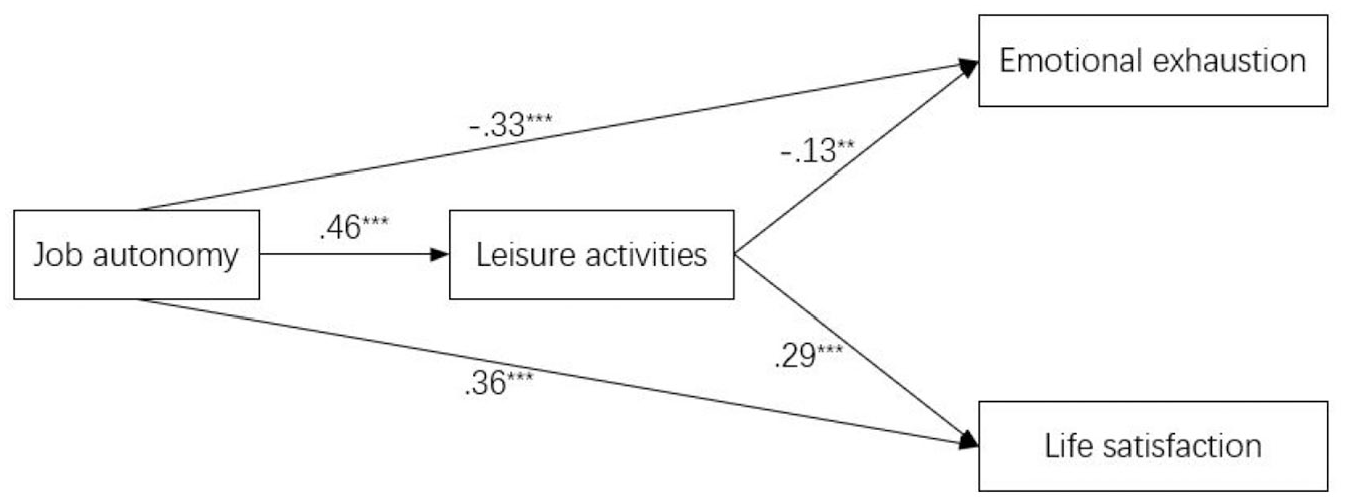
Results of the path analyses.
People may engage in various activities in their leisure time (e.g., sports, visiting friends), which contribute to well-being (X. Hu et al., 2021; Seibel et al., 2022). Although passive forms of leisure (e.g., sleeping) may not take much effort, they are advocated to facilitate recovery by offering a break from work (X. Hu et al., 2021). Moreover, some leisure activities (e.g., exercising, socializing, reading) are more active, require more effort, and significantly affect well-being (X. Hu et al., 2021). Employees with high job autonomy, such as flexible working times, can have more energy and opportunities to engage in passive and active leisure activities. It is insufficient to merely consider the mediating role of LTPA between job characteristics and well-being in the pamDC model. Thus, we expand physical activity to encompass more leisure activities and examine its mediating role between job autonomy and PW, indicating life satisfaction and emotional exhaustion.
This study makes three theoretical contributions. First, it integrates work and leisure into a single framework and reveals a work-to-leisure positive spillover effect. Despite extensive research on work and leisure over the past several decades, few studies have integrated these two areas. One consequence of this gap is that we did not know whether work is necessarily contradictory with leisure or whether it could promote leisure. Based on the pamDC model, this study emphasizes the favorable impact of job autonomy on leisure activities. Second, this study addresses a black box of the effects of job autonomy on PW. Although recent studies have focused on how job autonomy influences PW (Gardner, 2020), this literature has not fully considered the role of leisure activities. This study offers a more comprehensive understanding of the crucial role that leisure activities play in balancing work and well-being. Third, we extend the pamDC model, which only considers the role of physical activity in the relationship between job characteristics and PW. Working adults pursue numerous leisure activities, including reading, playing sports, and listening to music. The pamDC model is inadequate because it only considers LTPA, yet a high degree of job autonomy can stimulate perceptions of self-determination (Ryan & Deci, 2000) and promote participation in more types of leisure behavior. We extend the scope of leisure activities beyond physical activity and examine their meditating roles between job autonomy and PW.
Theory and Hypotheses
Job Autonomy and PW
PW is the extent to which a person functions optimally (E. Diener, 2000). Considering that well-being is a multi-dimensional umbrella concept (Warr, 1994), we focus on the impacts of job autonomy on general PW and job-related well-being. Life satisfaction can be viewed as a subset of general PW (E. Diener, 2000). It refers to a cognitive appraisal of a person’s life quality over an extended period (E. Diener, 2000). Burnout is a psychological syndrome caused by work. It is characterized by diminished personal accomplishment, depersonalization, and emotional exhaustion (Maslach et al., 2001). It is an essential consideration in job-related well-being (Tesi, 2021). Emotional exhaustion is the most significant factor underlying burnout (Edmondson et al., 2019). Therefore, we use life satisfaction and emotional exhaustion as separate measures of general PW and job-related well-being.
Job autonomy refers to employees having substantial freedom, independence, and self-determination to do their jobs (Kubicek et al., 2017). It contains multiple dimensions, such as work method autonomy, decision-making autonomy, and work scheduling autonomy (Kubicek et al., 2017). These three aspects of job autonomy give people the resources they need to accomplish their goals (Dong et al., 2023).
According to the pamDC model, people with high demands and limited control will have more significant than average health and mental issues (Häusser & Mojzisch, 2017). Therefore, increasing employees’ sense of control and meeting their autonomy needs can improve their general PW (Ryan & Deci, 2000). Employees with more job autonomy can regulate their workload, switch to less demanding jobs as needed (Karasek, 1979), and experience more flexibility in completing and scheduling their work. Not only does this help to alleviate work-to-family conflict (Yucel, 2019), but it also gives employees a chance to relax after a hard day on the job (Taris et al., 2006) and reduces the detrimental impact of high job demands on PW (e.g., long working hours; Dong et al., 2023). Giving employees more autonomy in their work is thus conducive to improving their happiness and making them more satisfied with their lives. Previous studies also found that job autonomy can increase general PW (Gardner, 2020; Park & Searcy, 2012). Thus, we propose:
Emotional exhaustion is “feelings of being overextended and depleted of one’s emotional and physical resources” (Maslach et al., 2001, p. 399). It relates to poor health status (Edmondson et al., 2019) and job performance (Hadi, Bakker, & Häusser, 2021).
Emotional exhaustion is a chronic condition of the depletion of physiological and emotional resources caused by high job demands or low job control (Demerouti et al., 2001; Ma et al., 2021). Job autonomy helps employees to have more of a sense of control over how they arrange their work assignments, choose their working approach, and make decisions about their employment. Then, perceived job control assists in preventing emotional exhaustion (Parker, 2014). For example, when employees are more flexible in scheduling work hours and locations, they can decide when to take breaks to help their mental and physical resources withstand heavy job demands. Previous studies have also shown that a lack of autonomy contributes to feelings of exhaustion (Bakker et al., 2005). However, when employees have the independence and flexibility to control their workloads, their emotional exhaustion is buffered (Ahuja et al., 2007). Thus, we propose:
Leisure Activities as a Mediator
Leisure activities are those which people engage in outside of their employment, including physical exercise, socializing, and hobbies (Paggi et al., 2016). Engaging in leisure activities is essential for workers’ recovery and well-being since leisure and recovery are often linked to good feelings and positive effects (Chen et al., 2022; X. Hu et al., 2021).
Leisure activities tend to distract people from thinking about work and encourage them to focus on enjoying their current activity (Sonnentag, 2001). Thus, it helps employees to recover from work-related stress (X. Hu et al., 2021; Seibel et al., 2022) and generate positive emotions (Denovan & Macaskill, 2016) during work, which helps to prevent the occurrence of emotional exhaustion caused by work (Hadi, Bakker, & Häusser, 2021). Hence, we propose:
Daily activities can influence life satisfaction. People who engage in enjoyable or rewarding activities are more likely to experience positive emotions, which can increase life satisfaction (E. Diener, 2000). Leisure activities are associated with an enhanced sense of purpose and significance and a diversion from daily worries (Roczniewska et al., 2022). Because leisure activities can help people detach and recover from work and life stress and give people a sense of meaning, control, and belonging (Newman et al., 2014), engaging in leisure activities during their nonworking hours can improve workers’ life satisfaction and positive affects (Y. Hu et al., 2018; Paggi et al., 2016; Wei et al., 2015). Thus, we propose:
According to the pamDC model, people in jobs with high demands and limited control will have lower leisure activities because all types of leisure activities (e.g., sports, visiting friends) after a workday require self-regulation resources (Häusser & Mojzisch, 2017). Therefore, high levels of self-determination are essential for participating in leisure activities.
In workplaces with high job autonomy, employees’ sense of self-determination is triggered (Häusser & Mojzisch, 2017). Elevated degrees of self-determination correlate with increased subjective vitality and enhanced participation in active activities (Nix et al., 1999). People with a greater sense of self-determination may expand their motivation, which derives from autonomy, from one activity (e.g., work) to another (e.g., leisure activities; Häusser & Mojzisch, 2017). Employees possessing significant autonomy and control over their work may have increased opportunities to schedule leisure activities or modify their work hours to engage in such pursuits (e.g., Hervieux et al., 2022). Thus, we propose:
Effective leisure activities require higher self-determination motivation (Newman et al., 2014). Enhanced job autonomy can lead to a greater sense of self-determination and increased motivation for leisure activities. Employees with substantial job autonomy exhibit more flexibility in arranging work and leisure schedules, enhancing the likelihood of participation in leisure activities. Leisure activities are crucial because they allow people to unwind, cope with work-related stress, try new things, feel content, and grow as individuals (Chen et al., 2022; X. Hu et al., 2021; Seibel et al., 2022). Consequently, leisure activities keep employees from work stress, reduce emotional exhaustion, and improve life satisfaction. Thus, we propose:
Methods
Participants
The corresponding author’s university’s ethics committee approved this work. The data were obtained through online surveys.
Full-time working persons aged 18 to 60 were randomly selected from the Credamo sample library (https://www.credamo.com/home.html). To mitigate common method biases, online anonymous surveys were administered to working individuals in two waves, separated by 4 weeks, because it can “create a temporal separation by introducing a time lag between the measurement of the predictor and criterion variables” (Podsakoff et al., 2003, p. 887). During the initial session, the participants finalized the measurements of job autonomy, leisure activities, and demographic information. Four weeks later, the participants completed the measurements of emotional exhaustion and life satisfaction. We utilized the final five digits of participants’ mobile phone numbers to correlate their data. Each participant received two yuan upon completing the first or second online survey. To insufficient effort survey responses (Huang et al., 2015), we used one bogus item (“I have traveled around the world twenty-three times”; Dunn et al., 2018, p. 120) for the first survey and one instructed-response item (“select ‘strongly disagree’ for this item”; Ward & Meade, 2017, p. 237) for the second survey. If participants did not select “strongly disagree” on these two items, they were automatically rejected by the Credamo platform. Seven hundred sixty-six participants completed the initial survey, 687 completed the subsequent survey, and 662 respondents were consistently matched.
The participants came from various fields (e.g., finance, retail commerce, education, information technology, and service). The sample’s minimum age was 20, and the maximum was 60. The sample’s mean age was 32.10 years (SD = 5.93). There were 382 (57.70%) female participants and 280 (42.30%) male participants in the sample. The participants’ educational backgrounds ranged from less than high school to a master’s degree. Among the participants, 76 (11.48%) had a graduate degree, 557 (84.14%) had a bachelor’s degree, and 29 (4.38%) had just completed high school or below. The research materials and data can be accessed at https://osf.io/45frp/
Measures
Job Autonomy
Kirmeyer and Shirom (1986) created the unidimensional job autonomy scale. It has seven items (e.g., “I had freedom to decide what to do”) evaluated on a seven-point scale (1 = strongly disagree to 7 = strongly agree). Cronbach’s alpha was .84 in the current study.
Leisure Activities
Pressman et al. (2009) developed the single dimension of the Pittsburgh Enjoyable Activities Test (PEAT). Participants are asked how often they have been able to spend time doing 10 items (e.g., “sports”) over the past month, evaluated on a seven-point scale (1 = never to 7 = every day). Cronbach’s alpha was .87 in the current study.
Life Satisfaction
E. D. Diener et al. (1985) created the unidimensional Satisfaction with Life Scale. The scale has five items (e.g., “I am satisfied with my life”) evaluated on a seven-point scale (1 = strongly disagree to 7 = strongly agree). Cronbach’s alpha was .91 in the current study.
Emotional Exhaustion
The measurement of emotional exhaustion was drawn from Maslach’s Burnout Inventory (Maslach & Jackson, 1981). It has nine items (e.g., “I feel like I’m at the end of my rope”) evaluated on a seven-point frequency scale (1 = very mild, barely noticeable to 7 = major, very strong). Cronbach’s alpha was .96 in the current study.
Control Variables
The participant’s gender, age, income, and education were controlled because they influenced leisure activities, life satisfaction, and emotional exhaustion (Wei et al., 2015).
Analytical Strategy
The data were analyzed using the statistical software SPSS 26 and Mplus 8.3 (Muthén & Muthén, 1998–2017). We used path analysis to examine our hypotheses. Subsequently, we employed bootstrapping analyses (5,000 samples) to evaluate the significance of the mediated effects.
Results
Common Method Variance Analysis
Initially, we employed procedural techniques, such as time-lagged and anonymous survey methods, to mitigate common method variance (Podsakoff et al., 2003). Secondly, we conducted an explanatory factor analysis and determined that a single factor explains 37.61% of the variance across all items, which falls short of the established threshold of 40% (Williams et al., 1989). Third, we developed a one-factor measurement model, which resulted in a poor fit index (Podsakoff et al., 2003; see Table 1). Consequently, the study is minimally influenced by common method variance.
Results of Confirmatory Factor Analysis (N = 662).

Note. Estimation method: maximum likelihood estimation. TLI = Tucker–Lewis index; CFI = comparative fit index; SRMR = standardized root-mean-square residual; RMSEA = root-mean-square error of approximation; BIC = Bayesian information criterion; AIC = Akaike information criterion.
Job autonomy, leisure activities, emotional exhaustion, and life satisfaction.
Similar to the four-factor model, except emotional exhaustion and life satisfaction constitute one factor.
Similar to the four-factor model, except job autonomy and leisure activities constitute one factor.
Similar to the four-factor model, except job autonomy and leisure activities constitute one factor, and emotional exhaustion and life satisfaction constitute another factor.
Similar to the four-factor model, except all four variables constitute one factor.
p < .001.
Confirmatory Factor Analyses
To evaluate the discriminant validity of the four constructs, we performed a series of maximum likelihood estimations and confirmatory factor analyses. To quantify item quality, the items with factor loadings below 0.60 were deleted (Field, 2005). One item (“I had responsibility for deciding how the job got done”) in the job autonomy scale and two items (“I spend quiet time alone” and “I spend time unwinding”) in the PEAT were deleted. After deleting these items, PEAT Cronbach’s alpha was .88, while the job autonomy scale Cronbach’s alpha was .86.
The fit indices of the four-, three-, two-, and one-factor models were compared (refer to Table 1). The four-factor measurement model was the best and provided acceptable fit indices (L. T. Hu & Bentler, 1999; χ2 = 1,565.22; df = 344; χ2/df = 4.55; p < .001; Tucker–Lewis index [TLI] = .90; standardized root-mean-square residual [SRMR] = .06); comparative fit index [CFI] = .91; root-mean-square error of approximation [RMSEA] = .07. This indicates that the four constructs of job autonomy, leisure activities, emotional exhaustion, and life satisfaction have acceptable discriminatory validity.
Descriptive Statistics
Table 2 presents the descriptive statistics of the variables. Positive connections were observed between job autonomy, leisure activities, and life satisfaction, while a negative link was observed between job autonomy and emotional exhaustion.
Means, Standard Deviations, and Zero-Order Correlations (N = 662).

Note. Gender: 1 = male, 2 = female. Income: 1 = below 5,000 yuan, 2 = 5,000 to 8,000 yuan, 3 = 8,000 to 17,000 yuan, 4 = more than 17,000 yuan. Education: 1 = have a high school education or below, 2 = have a bachelor’s degree, 3 = have a graduate degree.
p < .05. **p < .01. ***p < .001.
Hypothesis Tests
The path analysis demonstrated a good fit (χ2 = 0; df = 0; p < .001; CFI = 1.00; TLI = 1.00; RMSEA = 0.00; SRMR = 0.00). Figure 1 and Table 3 display the model’s standardized parameter estimations. Job autonomy was positively associated with life satisfaction and leisure activities and negatively correlated with emotional exhaustion. Leisure activities had a negative correlation with emotional exhaustion and a positive correlation with life satisfaction.
Results of the Path Analysis (N = 662).

Note. Standardized coefficients were reported. Gender: 1 = male, 2 = female. Income: 1 = below 5,000 yuan, 2 = 5,000–8,000 yuan, 3 = 8,000–17,000 yuan, 4 = more than 17,000 yuan. Education: 1 = have a high school education or below, 2 = have a bachelor’s degree, 3 = have a graduate degree.
p < .05. **p < .01. ***p < .001.
The mediating role of leisure activities was investigated further through bootstrapping analyses. As Table 4 shows, there was a significant indirect effect of job autonomy on emotional exhaustion and life satisfaction through leisure activities.
Unstandardized Indirect and Total Indirect Effects (N = 662).

Discussion
Expanding with the pamDC model (Häusser & Mojzisch, 2017), we found that job autonomy increases employee life satisfaction while decreasing emotional exhaustion. Moreover, increased leisure activities are the internal mechanism by which job autonomy promotes PW.
Theoretical Implications
This study makes three theoretical advances.
First, this study further reveals a work-to-leisure positive spillover effect, which states that positive work experiences transfer to leisure domains (Petrou & Bakker, 2016). We identify specific job control, namely, job autonomy, and its positive spillover effect on more general leisure activities. Prior research on the advantages of job autonomy has concentrated on aspects of the workplace, including job performance (Johari et al., 2018), work engagement (van Dorssen-Boog et al., 2020), etc. Few studies have considered the impact of job autonomy on non-work areas, such as leisure activities outside the workplace. This study adopted the comprehensive framework of the pamDC model to integrate job characteristics and leisure activity research areas and reveals the positive spillover effect of job autonomy on leisure. This finding broadens the spectrum of advantages that come with job autonomy.
Second, the study shows a new internal mechanism in how job autonomy influences PW when viewed through leisure activities. The connection between job characteristics and psychological health is one of the most significant research areas in work and organization (Grossi et al., 2021). Previous studies have debated whether job autonomy enhances PW (Gardner, 2020; van Dorssen-Boog et al., 2020). There have also been debates regarding why job autonomy improves PW, with limited research uncovering underlying psychological or behavioral mechanisms that link job autonomy to well-being (Hadi et al., 2022). Existing studies have found that perceived supervisor support (Park & Jang, 2015) and self-esteem (Gardner, 2020) mediate these relationships. However, the psychological processes underlying the impacts of job autonomy on leisure activities and PW are poorly understood. This study found that job autonomy can promote employees’ leisure activities, which improves their well-being; this deepens our understanding of the job autonomy mechanism on PW.
Third, this study has supported and further extended the pamDC model. Only a few empirical studies have tested the pamDC model since it was proposed (Grossi et al., 2021; Hadi et al., 2022). Unfortunately, these studies do not fully support the model. Under the proposed framework of the pamDC model, this study examined the positive effect of specific job characteristics named job autonomy on leisure activities and PW, which was measured with job satisfaction and emotional exhaustion. We, at least in part, respond to Häusser and Mojzisch’s (2017) recommendation that future research must evaluate their suggested pamDC model more directly—that is, to assess work demands, job control, LTPA, and health markers all in one study. Moreover, we extended the scope of leisure activities beyond physical activity in the pamDC model. Adults have a wide range of possibilities for leisure activities, such as creative, sociable, stimulating, athletic, creative, artistic, and physical (Şimşek & Çevik, 2020). There are various categories of leisure activities (Şimşek & Çevik, 2020), and physical activity is just one type. Engaging in other activities, such as creative activities (e.g., developing a new skill or participating in creative arts), is also influenced by individual autonomous motivation (Morse et al., 2021). Therefore, we believe that job characteristics, particularly job autonomy, not only encourage but also overall engagement in leisure activities. The pamDC model does not adequately consider the mediating roles of different leisure activities. This study adopted the perspective of the pamDC model to more closely examine the role of leisure activities in the relationship between job autonomy and PW. Thus, our study provides a preliminary exploration for the empirical testing of the pamDC model and further enriches the pamDC model.
Practical Implications
Given the importance of leisure in our lives, leisure can be seen as a crucial area where organizations can establish wellness policies and programs (X. Hu et al., 2021). According to our research, one job characteristic that can encourage employees’ leisure activities is job autonomy, which can improve their life satisfaction and reduce their emotional exhaustion. It is significant for an organization to redesign its work and improve employees’ leisure experience and well-being.
First, managers should be aware of the importance of work design, especially the impacts of work design on employees’ PW. The negative results of unfavorable work design, especially with high demands and low control, are serious (Hadi, Mojzisch, et al., 2021). Essential managerial responsibilities include creating a pleasant work environment and improving employees’ PW. Hence, managers should focus on job characteristics and their promoting effect on PW (Dong et al., 2023). Our findings highlight the critical role that job autonomy plays in raising life satisfaction and lowering emotional exhaustion. Thus, managers need to give employees more autonomy in their work, including flexibility regarding scheduling, working methods, work progress, and context (Kubicek et al., 2017).
Second, managers should be aware of the connection between work and leisure. According to a 2018 U.S. Bureau of Labor Statistics poll, most people spend much more time working each day than indulging in leisure activities. Furthermore, employment is often seen as having a higher value than leisure (Juniu, 2009). Prior research has concentrated on the tension between work and leisure (Shi et al., 2021). This conflict arises when individuals cannot reconcile work and leisure duties due to job demands (Shi et al., 2021), resulting in employees experiencing this conflict when they cannot meet their leisure obligations because of work pressures (Shi et al., 2021). The work-leisure conflict has produced several adverse impacts, such as diminished well-being (Lin et al., 2014) and heightened job burnout and turnover intention (Mansour & Tremblay, 2016).
However, work and leisure do not have a simple either/or relationship. In this study, job autonomy can increase engagement in leisure activities. We also find that participating in leisure activities can help prevent emotional exhaustion and improve life satisfaction. Thus, work and leisure are not contradictory. Instead, a good work design can promote leisure. Organizations can help employees engage in leisure activities and improve their PW by giving them more autonomy in their work. Hadi, Mojzisch, et al. (2021) suggest that managers can create autonomy-related factors, such as increasing decision latitude. Changes in workplace features may enhance employees’ participation in leisure activities (Häusser & Mojzisch, 2017), consequently improving their well-being.
Limitations and Future Research
First, we cannot determine causality because of the research design and data-gathering methodology. Our recommendation is to manipulate job autonomy through field experiments or use the sentence unscrambling task to induce the individual’s experience of autonomy (Lu et al., 2017) in future studies.
Second, well-being is a multi-dimensional concept that intersects with various aspects of psychology, such as depression symptoms, life satisfaction, positive self-conception, and job satisfaction (Belli et al., 2023). In this study, we only selected life satisfaction and emotional exhaustion as measures of well-being. We need more than this to help us understand the full picture of the positive effects of work autonomy on well-being through leisure activities. For a deeper understanding of the relationship between work characteristics, leisure activities, and well-being, future research needs to take a broader perspective and consider other forms of well-being, such as hedonic and eudaimonic perspectives and cognitive and affective operationalizations (Martinolli et al., 2023).
Third, the mediation function of participating in leisure activities between PW and other job characteristics was not investigated. According to the pamDC model, high job demands (e.g., time) can decrease engagement in leisure activities, while job control (e.g., skill discretion) can increase engagement. Therefore, other job characteristics and their effects on leisure activities and PW can be investigated in future research.
Fourth, compared to passive leisure activities (e.g., watching TV or using the Internet for personal purposes), working adults feel a higher level of need fulfillment and positive affect when they engage in active leisure activities, including physical leisure (e.g., exercise), social leisure (e.g., spending time with others), cognitively stimulating leisure (e.g., reading), creative leisure (e.g., making artifacts), and cultural leisure activities (e.g., attending cultural events; Schmiedeberg & Schröder, 2017). Passive leisure activities are more suited to hedonic adaptation. However, active leisure activities can promote happiness over time (Jachimowicz et al., 2020), a strong predictor of life satisfaction (E. Diener, 2000). This study did not compare the mediation effects of different leisure activity types in the connection between job autonomy and PW. Considering that the retained items in PEAT were active leisure activities (e.g., “visiting others”) when analyzing the results in the current study, we hypothesize that compared with passive leisure activities, increased participation in physical leisure activities is anticipated to result from job autonomy, which will benefit employees’ PW. Future studies can compare the mediation roles of passive and active leisure activities.
Fifth, we did not consider possible boundary conditions of the mediating effects of leisure activities in the connection between job autonomy and PW. According to the pamDC model, the self-regulation resource is a crucial motivator for people engaging in effortful activities, such as LTPA, after work (Häusser & Mojzisch, 2017). Therefore, the trait of self-control may be a possible moderation in the connection between job autonomy and leisure activities.
Conclusion
According to the current study, job autonomy can increase employee life satisfaction and reduce emotional exhaustion by increasing leisure activities. This research has provided initial supporting evidence for the pamDC model and further enriched and refined it. The findings of this study underscore the significance of job autonomy as a mechanism for improving PW and recommend its prioritization in interventions aimed at promoting employees’ leisure activities. In brief, the present study’s findings highlight the value of job autonomy as a tool for enhancing PW and suggest that interventions should focus on encouraging employees’ leisure activities. From a practical perspective, managers should give employees more job autonomy to encourage them to participate in leisure activities, thus promoting their well-being.
Footnotes
Acknowledgements
I would like to express my sincere gratitude to all those who supported and guided me throughout the completion.

Ethical Considerations
The project was approved by the Department of Psychology Ethics Committee, Tsinghua University, China.
Consent to Participate
All participants in the current studies consented to participate.
Author Contributions
All authors contributed to the study’s conception and design. Rui Dong, Shiguang Ni, Lingling Song, and Yuxi Yang performed material preparation, data collection, and analysis. The first draft of the manuscript was written by Rui Dong, and all authors commented on previous versions. All authors read and approved the final manuscript.
Funding
The author(s) disclosed receipt of the following financial support for the research, authorship, and/or publication of this article: This study was funded by the National Natural Science Foundation of China (Grant No. 72201235), Shenzhen Philosophy and Social Science Foundation (Grant No. SZ2024B038), Guangdong Philosophy and social sciences planning project (Grant No. GD23SQXY01), Guangdong Digital Mental Health and Intelligent Generation Laboratory (Grant No. 2023WSYS010), and Shenzhen Education Science “14th Five-Year Plan” 2023 major policy research project (Grant No. zdzc23013).
Declaration of Conflicting Interests
The author(s) declared no potential conflicts of interest with respect to the research, authorship, and/or publication of this article.