



Abstract
Promoting student engagement has always been a challenging endeavor, and the global pandemic has added to the complexity by disrupting traditional classroom settings. Consequently, it has become vital to investigate and address the challenges that students face in environments with academic disruption. In this study, Structural Equation Modeling was applied to analyze the collected data from a cross-sectional sample of 461 participants through the proportionate stratified random sampling method during the global pandemic at a selected Malaysian public research university. The researchers investigated the relationship between trait emotional intelligence, basic psychological needs, academic motivation, and student engagement, including the potential serial mediation of basic psychological needs and academic motivation in this relationship. The results indicated that trait emotional intelligence, basic psychological needs, and academic motivation were significant positive predictors of student engagement. Trait emotional intelligence was also a positive and significant predictor of basic psychological needs but was insignificant regarding academic motivation. On the other hand, basic psychological needs was a significant positive predictor of academic motivation. Basic psychological needs and academic motivation partially mediated the relationship between trait emotional intelligence and student engagement. The findings suggest that undergraduate students with higher levels of trait emotional intelligence, basic psychological needs, and academic motivation would have better student engagement, suggesting the need for further research related to the supportive environment for students in modern classroom settings.
Plain language summary
Imagine trying to maintain your focus and interest in learning during a global pandemic. In this study, we investigated how Malaysian university students managed to stay engaged in their studies during one such time. We surveyed 461 students from a Malaysian public research university to uncover their experiences of learning during the pandemic. We wanted to know whether factors such as their awareness of their emotions, psychological needs satisfaction, and being motivated played a role in keeping them engaged. It turns out that students who understood their emotions perceived that their needs were met and those who were academically motivated tended to be more engaged in their studies. Even more interestingly, we discovered that being emotionally intelligent helped students satisfy their psychological needs, however, it did not directly boost their academic motivation. Rather, students who had their psychological needs satisfied were more academically motivated. It is as if one positive step leads to another, which creates a chain reaction of motivation and engagement, as the findings suggest that students who are emotionally aware, who have their psychological needs fulfilled, and who are motivated are more likely to be active participants in their classes. This highlights the importance of creating supportive environments for students, especially in modern classrooms.
Keywords
Introduction
The significance of student engagement has been well-documented in the literature (e.g., Martin & Bolliger, 2018; Zhoc et al., 2019), and is one of the focuses of educational research. This study is significant as it provides valuable insights into student engagement, unlike previous studies that primarily focused on classroom settings including online platforms and blended learning. Such insights are crucial to understand the challenges that students face during and after a global pandemic. The enduring positive effect of student engagement on academic outcomes has gained massive attention from academics and educators alike. Student engagement benefits students in two ways: it improves retention rates and enhances their academic success by enriching the educational experience. While most researchers agree that student engagement is a multidimensional construct, there is an ongoing challenge in determining the best way to conceptualize it over time (Dyment et al., 2020).
Growing evidence from the literature suggests that a rigorous understanding of student engagement and its antecedents is imperative to adequately conceptualize its multifaceted nature (Fan et al., 2021). The study of student engagement should not be solely determined by the individual self, as the learning environment plays a vital role in providing academic support to facilitate student engagement. To guide readers, the remainder of this paper is structured as follows. Following the problem statement and literature review in the introduction section, the paper details the research methodology, including the research design, participant selection, measures, and data analysis procedures. Subsequently, the findings of the analyses are presented, followed by a discussion of their implications. The paper also discusses the study’s limitations and concludes by highlighting the key findings, their significance, and suggestions for future research.
Problem Statement
In 2020, the shift to different learning modes caused by the COVID-19 pandemic has been found to lead to decreased motivation and engagement among students. However, the decline of student engagement in higher education has been a major concern even before the onset of the global pandemic. This decline, which has intensified since the pandemic, has prompted researchers and educators to emphasize the importance of studying and addressing student engagement in higher education settings. This underscores the urgent need to understand and address these challenges to promote active engagement among students.
Past literature has highlighted the interconnectedness between trait emotional intelligence, basic psychological needs, and academic motivation as valuable insights to understand and enhance student engagement in higher education settings. While emotional intelligence plays a significant role in guiding engagement processes, it has received relatively little attention in student engagement research due to its abstract nature. Researchers have suggested that positive emotions promote engagement whereas negative emotions can lead to disengagement. This is because students with higher emotional competence tend to perceive their environment more positively, which fosters motivation and engagement for academic tasks. Basic psychological needs are also vital predictors of student engagement, as the satisfaction of these needs has an influence on motivation and student engagement. However, while existing literature supports motivation as having a predictive role on engagement, motivation alone may not fully explain it, which highlights the need to investigate additional contributing factors.
Student Engagement and Its Predicting Variables
Student engagement is a major concern in all higher education institutions which has been highlighted in numerous studies, underscoring a shift toward passive engagement and disengagement among higher education students (e.g., Abdullah et al., 2015; Castro & George, 2021). This declining trend of student engagement in higher education has drawn the attention of many researchers and educators who call for the urgent need to continue the study of student engagement (Boekaerts, 2016; Donald et al., 2019; Zepke, 2018). The recent global pandemic has aggravated the situation in higher education by forcing the sector to shift from physical classes to online classes, and consequently intensified the challenges to maintain learners’ engagement in learning activities. In recent studies, academics have found that students suffer from decreased in motivation and student engagement as the shift in learning mode has made it more difficult for students to focus on their studies (Hendrick et al., 2023; Wester et al., 2021; Wu & Teets, 2021). This highlights the importance of studying student engagement during the pandemic (Gopinathan et al., 2022).
One of the issues with online learning is that there are no feasible ways to keep track of students’ continuous engagement behind the monitor. This concern is even more challenging for students from disciplines such as engineering, electronics, and automotives, as many of the tutorials are designed to be hands-on; as a result, the number of passive and disengaged students grew when these classes were conducted through an online platform (Ferri et al., 2020; Oraif & Elyas, 2021). This hindered students from acquiring the necessary knowledge and skills, potentially leading to negative academic outcomes and reduced well-being (Boulton et al., 2019; Shcheglova et al., 2019).
The selected variables of this study, which encompass trait emotional intelligence, basic psychological needs, and academic motivation, hold theoretical relevance to student engagement. Despite the existing literature that has suggested significant relationships among these variables, some relationships, such as how emotional intelligence relates to student engagement, have received limited attention (Zhoc et al., 2020). It is crucial to acknowledge that student engagement is intricately tied to the person-environment fit. Hence, the global pandemic, which has changed how students learn by shifting from traditional in-person classes to online formats, has introduced a new layer of complexity to student engagement in higher education. This transformation makes it important to assess and re-examine the relationships among these variables with student engagement to offer actionable insights for educators and policymakers. Furthermore, comprehending the role of these variables in student engagement holds practical significance for educational institutions as it can inform the development of targeted interventions that aim to enhance the overall educational experience for the students.
Trait Emotional Intelligence and Student Engagement
Trait emotional intelligence has been found to be related to behavioral dispositions and perceived abilities. Drawing from the literature, it is argued that the educational experiences of university students may be influenced by their level of social, academic, and cultural adaptation to their academic environment. Additionally, trait emotional intelligence appears to impact how students perceive and utilize available academic support, thereby influencing their level of engagement. As such, trait emotional intelligence is posited to play an active role in guiding the process of student engagement. Maguire et al. (2017) opined that emotional intelligence is one of the significant predictors of student engagement that often receives little attention. As emotional intelligence is an abstract construct that is rather difficult to observe and measure closely, this could be one of the reasons why trait emotional intelligence is given little attention in student engagement research.
Past literature has proposed that emotional intelligence could be used to explain students’ adaptive and maladaptive behaviors in terms of academic learning and engagement (Thomas & Allen, 2021). Findings from empirical studies further endorse this notion by elucidating that positive emotion is likely to promote engagement and achievement (Kwon et al., 2017; Zhoc et al., 2020). Conversely, negative emotions are likely to trigger disengagement and have a negative impact on students’ academic performance. Emotion, therefore, could be very persuasive when it comes to academic decisions. Lacasse (2017) argued that emotions precede cognitions, and the emotional part of feeling assembles the foundation of facilitating memory processing, imagination, cognition, and perception of the surroundings. While some studies may have explored the contribution of emotional intelligence to student engagement, there is a paucity of research that investigates the impact of emotional intelligence through multiple mediating models.
Li and Xu (2019) posited that greater trait emotional intelligence can induce positive classroom engagement. Individuals with high emotional competence are also likely to perceive and judge the external environment more positively. In the context of education, high emotional competence could promote motivation to engage in academic activities and tasks. Di Lorenzo et al. (2019) asserted that emotional intelligence is a prerequisite for developing emotional competence. The findings from literature suggest a plausible relationship between emotional intelligence and student engagement. Maguire et al. (2017) proposed emotional intelligence as “enhanced engagement” in one of their studies to explain its linkage with academic performance. Findings from previous studies also suggest that trait emotional intelligence is a positive predictor of both affective and cognitive engagement (Thomas & Allen, 2021). Therefore, this study proposes the following:
H1: There is an influence of trait emotional intelligence on student engagement among undergraduate students at a selected Malaysian public research university.
Basic Psychological Needs and Student Engagement
Empirical evidence from well-established literature suggests that basic psychological needs are significant predictors of student engagement (Benlahcene et al., 2021). The Self-Determination Theory (SDT) is one of the motivational theories that explains the interaction between basic psychological needs, motivation, and student engagement. Based on the SDT, fulfillment of autonomy, competence, and relatedness are essential for the development of motivation, engagement, and performance (Ryan & Deci, 2017). Consistent evidence from recent studies also confirms the predictive role of basic psychological needs on student engagement (Benlahcene et al., 2020; Núñez & León, 2019). The findings from the study of Koch et al. (2017) on university students further endorsed this claim by reporting that all three innate needs yield significant relationships, however, perceived autonomy was the most significant predictor of higher education student engagement. Hofverberg et al. (2022) claimed that basic psychological needs have a profound impact on student self-esteem, regulation, social, and academic engagement. These previous studies have provided empirical evidence and support on the vital role of basic psychological needs satisfaction for optimal motivation development and student engagement experience in higher education. Therefore, this study proposes the following:
H2: There is an influence of basic psychological needs on student engagement among undergraduate students at a Malaysian public research university.
Academic Motivation and Student Engagement
The link between motivation and engagement has been highlighted in past literature (e.g., Krauss et al., 2017; Ricard & Pelletier, 2016). Motivation can be understood as impulses that drive people to achieve specific goals. Motivation in an educational context concerns academic pursuits. Existing literature supports the predictive role of motivation in engagement and suggests that student engagement mediates the relationship between motivation and academic performance, as well as between emotion and achievement (e.g., Froiland & Worrell, 2016; Singh et al., 2022; Vansteenkiste et al., 2020). Other researchers have also found substantial evidence that motivation is a predictor of student engagement (e.g., Azila-Gbettor et al., 2021; Ferrer et al., 2022; Huang et al., 2019). Reschly and Christenson (2012) provided a contrary view as they posited that motivation is necessary for student engagement development, but alone is insufficient to fully justify and explain engagement. Their argument provides a valid direction for the current study in seeking valuable contributory factors from the literature to explain the relationship between academic motivation and student engagement. Therefore, this study proposes the following:
H3: There is an influence of academic motivation on student engagement among undergraduate students at a selected Malaysian public research university.
Trait Emotional Intelligence and Basic Psychological Needs
Di Domenico et al. (2013) conducted a study on university students to examine the effect of basic psychological need satisfaction on activity in the medial prefrontal cortex zone. Findings from the study suggested that need satisfaction may promote self-coherent behavior (a mixture of optimism combined with a sense of control) by strengthening the utilization of self-knowledge to resolve conflict events through an integrative process. The SDT framework posits that the ability to manage one’s own emotions is related to self-knowledge, and since need satisfaction enhances self-knowledge, the ability to manage one’s emotions could also be related to basic psychological needs (Rapheal & Varghese, 2017). Researchers have shown a deep interest in investigating the relationship between trait emotional intelligence and basic psychological needs, and numerous studies have been conducted in settings besides the education field, such as medication, work environment, sports, and coaching (Barberis et al., 2019; Watson & Kleinert, 2019). Some of these recent studies employed different groups to test the association between trait emotional intelligence and basic psychological needs (e.g., coach and trainee, teacher and student). The findings from these studies implied that the relationship between trait emotional intelligence and basic psychological needs are not just intrapersonal but also interpersonal in nature. Therefore, this study proposes the following:
H4: There is an influence of trait emotional intelligence on basic psychological needs among undergraduate students at a selected Malaysian public research university.
Trait Emotional Intelligence and Academic Motivation
Magnano et al. (2016) suggested that more studies are needed to better understand the implications of emotional intelligence on motivation. Researchers have argued that emotional intelligence promotes motivation through the optimal use of emotions as a source of motivation. They claim that emotional intelligence is a plausible precursor for motivation since high emotional intelligence could better regulate and manage negative emotions as well as enhance positive emotion to experience them for longer and lasting periods (Resnik & Dewaele, 2020). Findings from the literature also affirm the positive relationship between emotional intelligence and motivation (Chinyere & Afeez, 2022). These studies imply that changes in emotional states can alter subsequent motivations, which can promote or hamper students’ academic performance. However, some studies have found an insignificant relationship between emotional intelligence and motivation (e.g., Jose & Ambekar, 2019; Naik & Kıran, 2018). Nevertheless, the majority of researchers endorsed the notion that emotional intelligence is an important element for motivation to occur. High emotional intelligence, therefore, implies a higher capacity and ability to perceive, regulate, and manage motivation. Therefore, this study proposes the following:
H5: There is an influence of trait emotional intelligence on academic motivation among undergraduate students at a selected Malaysian public research university.
Basic Psychological Needs and Academic Motivation
The SDT speculates that the satisfaction of basic psychological needs enhances motivation in academic pursuit and educational attainment. Evidence from the literature suggests that dissatisfaction with basic psychological needs will likely decrease motivation and hinder learning development (Müller et al., 2021). Chickering and Reisser (1993) suggested that basic psychological needs satisfaction promotes motivation by fostering a healthy sense of self and a secure relationship with others. Academic motivation is also an indispensable factor for academic success, as empirical studies have proven that basic psychological needs satisfaction is positively associated with motivation across many diverse cultures and disciplines (e.g., De Francisco et al., 2020; Vergara-Morales & Del Valle, 2021; Walker et al., 2020). Studies in past literature have also offered consistent evidence that endorses the significant role of basic psychological needs satisfaction toward academic motivation in the context of SDT. The findings from these studies not only verify the predictive role of basic psychological needs; they also imply the likelihood of basic psychological needs as the mediating role. For instance, Jin and Wang’s (2019) study confirmed the mediating role of basic psychological needs on learning engagement. Similarly, Teixeira et al. (2020) identified serial mediating roles of basic psychological needs and motivation in the relationship between task involvement and intention to practice. Likewise, the result findings of Karimi and Sotoodeh (2020), which were drawn from a sample of 365 agriculture students, concluded that basic psychological needs satisfaction had a positive and indirect relationship with academic engagement through intrinsic motivation. Substantial prior studies from the literature also provided sufficient evidence and suggest the mediating effect of academic motivation. Therefore, this study proposes the following:
H6: There is an influence of basic psychological needs on academic motivation among undergraduate students at a selected Malaysian public research university.
H7: Trait emotional intelligence impacts student engagement indirectly through the sequential mediation of basic psychological needs and academic motivation among undergraduate students at a selected Malaysian public research university.
Theories
The Theory of Involvement (TOI) asserts that student engagement relates to being actively involved, and that the SDT is complementary and suggests that the state of active engagement is self-determined. Both theories emphasize the importance of engagement in the educational process. The TOI underscores the significance of student engagement in academic and extracurricular activities whereas the SDT focuses on the factors that promote and hinder motivation and engagement. Moreover, the SDT emphasizes on fostering a supportive environment to meet students’ basic psychological needs and promote motivation. Even though the TOI does not explicitly focus on basic psychological needs and the driving forces of motivation, it acknowledges the significance of autonomous choices and active participation in educational experiences. In this regard, the SDT provides a framework for understanding underlying motivations, while the TOI helps to explain how different motivational factors can manifest into engagement experiences.
The selection of variables in this study was grounded within these two theories. Trait emotional intelligence, guided by TOI, was included as an independent variable due to its influence on students’ academic perceptions and interactions. SDT informed the selection of basic psychological needs, which is considered mandatory for optimal motivation development as a first mediator. Academic motivation, also influenced by trait emotional intelligence and basic psychological needs, serves as the second mediator. This study posits that trait emotional intelligence can impact the fulfillment of basic psychological needs, thereby influencing academic motivation and ultimately contributing to a comprehensive understanding of the outcome variable, which is student engagement.
This study contributes to the field of knowledge by integrating trait emotional intelligence into SDT and investigating the complex relationship between emotional intelligence and student engagement through the serial mediating effects of basic psychological needs and academic motivation, which has been scarce in previous studies. Moreover, this study uniquely encompasses a diverse range of engagement experiences across physical, blended, and online study modes (these different modes of study were available to the students during the data collection took place). The unique engagement experiences of respondents in these different study modes provide valuable and novel insights into the complex dynamics of student engagement, which is dissimilar to many prior studies that focused only on the physical platform. By focusing on this unique context, the study seeks to shed light on the specific dynamics and contribute to the existing body of knowledge surrounding student engagement.
The Present Study
The literature has suggested that the level of student engagement in higher education has declined over the years (Castro & George, 2021). Asian students in particular have been noted to struggle with a low level of classroom engagement in higher education (Subramanian & Mahmoud, 2020). This declining trend has drawn attention from many researchers and educators, calling for the urgent need for the continued study of student engagement (e.g., Boekaerts, 2016; Donald et al., 2019; Zepke, 2018). In addition, the global pandemic has added complexity to the matter by disrupting the traditional classroom setting. Hence, research is needed to provide new insights into the challenges faced by students in online and blended learning that is distinct from prior studies that focused on physical classes. This study sought to address these gaps by investigating the relationships between trait emotional intelligence, basic psychological needs, academic motivation, and student engagement during the COVID-19 pandemic lockdown at a selected Malaysian public research university.
Despite the passage of time, the effects of the pandemic on education have continued to shape the way learning is approached today and have fundamentally altered the educational landscape, leading to the widespread adoption of remote and hybrid learning models. Even though many aspects of education have returned to in-person settings, the experiences of student engagement in relation to the proposed variables of this study and lessons from the pandemic continue to influence the learning experiences of many. Understanding how students adapted to and maintained engagement during difficult circumstances such as during times of low motivation and disruptions to academic routines can provide insights into the learning support strategies that can be applied beyond times of disruption. This is important, because while the pandemic may subside, education systems still need to be prepared for future disruptions or crises. Hence, this study offers insights for maintaining continuity of learning and fostering engagement during times of uncertainty. The findings of this study could inform educational policies and practices aimed at supporting student engagement in the post-pandemic era, such as recommendations for technology integration, as well as support systems to enhance academic motivation and involvement.
Methodology
Research Design
This study employed a quantitative approach, which is appropriate for obtaining objective data and testing hypotheses. The use of cross-sectional and correlation research designs is justified for efficiency and to examine the relationships between the proposed variables of interest.
Participants
The respondents of this study were undergraduate students from 12 faculties at a selected Malaysian public research university from year 1 to year 4 of their studies. A total of 475 undergraduate students were initially recruited through proportionate stratified random sampling during the global pandemic. However, only 461 responses were valid and usable for data analysis, as 14 responses were excluded due to extreme values or outliers. The average age of the respondents was 21.98 (SD = 1.438). The percentage of respondents recruited from the 12 faculties ranged from 1.5% to 19.5%. All participants were required to read the informed consent agreement prior to participating in this study. After obtaining permission from the Ethics Committee for Research Involving Human Subjects at Universiti Putra Malaysia (JKEUPM), an email containing a link to a Google Form was sent to selected eligible participants, allowing them to participate in the survey. The preface section of the survey informed the respondents of the study’s purpose, potential risks for participants, confidentiality measures, informed consent, and other relevant information.
Measures
Trait Emotional Intelligence
The Trait Emotional Intelligence Questionnaire (TEIQue) was created by Petrides and Furnham (2001) based on the Trait Emotional Intelligence Theory and conceptualizes emotional intelligence as a form of affective personality trait. TEIQue is a well-established, reliable, and validated instrument that has been frequently adopted to measure emotional intelligence (Andrei et al., 2016). It has been cited in more than 2000 articles (O’Connor et al., 2019) and has previously been used in the Malaysian context (e.g., Kumar, 2019; Tawang & Rashid, 2017). The original TEIQue-Long Form (TEIQue-LF) comprises 153 items and four factors to assess respondents’ trait emotional intelligence. This study adapted the TEIQue-Short Form (TEIQue-SF) that consists of 30 items with the identical four factors of the long version to reduce the burden on participants. It uses a 7-point Likert scale ranging from 1 (Completely Disagree or Strongly Disagree) to 7 (Completely Agree or Strongly Agree). It has also been found to be a valid and reliable instrument for higher education students. Deniz et al.’s (2013) study on university students determined the consistency score of the TEIQue-SF as 0.81, and the test-retest reliability of the total score was 0.86, confirming that TEIQue-SF is an appropriate scale for testing trait emotional intelligence.
Basic Needs Satisfaction
The Basic Needs Satisfaction in General Scale (BNSG-S) was adapted from the work of Ilardi et al. (1993) based on the Basic Needs Satisfaction at Work Scale (BNSW-S) that originally focused on the working environment. Gagné (2003) later utilized this scale to address basic psychological need satisfaction in the personal life (Deci & Ryan, 2000). BNSG-S is a well-known instrument that measures basic psychological needs due to its high reliability and validity across many domains such as education and sports training. In addition, this scale has been used in Malaysian studies in the higher education context (e.g., Benlahcene et al., 2021). Another determinant to adapt the BNSG-S was because the scale is based on the SDT, which therefore makes it suitable for the current study. BNSG-S comprises 21 items and respondents rate them on a scale of 1 (Not at All True) to 7 (Very True). The internal consistency of BNSG-S was found to range from 0.84 to 0.90, whereas the three sub-scales (autonomy, competence, and relatedness) reported Cronbach’s alpha values ranging from .60 to .86, .61 to .81, and .61 to .90, respectively (Meyer et al., 2007; Vansteenkiste et al., 2006).
Academic Motivation
The Academic Motivation Scale (AMS) was selected to assess undergraduate students’ academic motivation in this study. AMS was developed by Vallerand et al. (1992) on the foundation of the SDT. It is one of the most widely used motivation scales and has been translated into many languages, with extensive evidence from literature supporting its validity and reliability (Miulescu, 2019; Souza et al., 2021). This scale has also been employed in previous Malaysian studies. Accordingly, Ariff et al. (2022) reported a Cronbach’s alpha value of .87 for AMS, thus confirming that the scale is reliable to assess the academic motivation of Malaysian higher education students. AMS consists of 28 items, and respondents rate them on a scale from 1 (Does Not Correspond at All) to 7 (Corresponds Exactly). One weakness of AMS is its length, which may cause exhaustion for participants and potentially affect the accuracy of the instrument. To address this limitation, a short-form version of AMS (SAMS) with 14 items is available. All subscales of SAMS have acceptable to high reliability, ranging from 0.61 to 0.85 (Griethuijsen et al., 2014; Raes et al., 2011). SAMS has been shown to be a reliable and validated alternative to the original AMS (Kotera et al., 2023).
Student Engagement
The Higher Education Student Engagement Scale (HESES) was developed by Zhoc et al. (2019) based on the work of Krause and Coates’s (2008) the First Year Experience Questionnaire (FYEQ). Zhoc et al. condensed the original 61 items of FYEQ to 28 items to reduce the lengthy response process while maintaining the accuracy of the scale. HESES’s items are rated on a 5-point Likert-type scale from 1 (Strongly Disagree) to 5 (Strongly Agree). Content validity was established by subject-area experts, and the scale exhibited high convergent validity (Zhoc et al., 2019). The confirmatory factor analysis (CFA) results reported high internal consistency of the proposed 5-dimensional models, with Cronbach’s alpha coefficients ranging from .71 to .88, and the estimation of McDonald’s omega coefficients (Zhoc et al., 2020). Contrary to the literature that conceptualizes student engagement from the behavioral perspective, the HESES is distinct from other instruments and assesses beyond the behavioral dimension. As it was developed based on the psychological perspective, the scale is able to streamline student engagement as students’ involvement in the learning process and address various dimensions including academic, cognitive, social, and affective constructs (Zhoc et al., 2019). Taking into consideration the advancement and development in communication and information technology, the HSES includes online engagement in its measure to capture the student’s actual academic engagement more accurately in real-life practice. Hence, not only has the HESES reduced the response burden, but it is deemed to be better at capturing the actual student engagement during the pandemic period.
Validation and Reliability of the Scales Used
All four scales were validated by a panel of experts who were familiar with the subject of the study, that is, Malaysian culture and the context of higher education. A pilot test was conducted to ensure that the research instrument met the recommended reliability. The results of the reliability test suggest that all four scales scored above .70 Cronbach’s alpha value in the pilot test (TEIQue-SF = 0.911; BNSG-S = 0.815; SAMS = 0.744; HESES = 0.924). The results indicated that the instruments met the recommended standard and were considered as reliable (Pallant, 2020).
Data Analysis
All analyses were conducted using SPSS 25 and AMOS 24. AMOS is a covariance-based Structural Equation Modeling (SEM) that is recommended for analyzing large and normally distributed data with complex relationships among multiple variables (Khine et al., 2017; Wijaya & Weinhandl, 2022). A non-covariance-based SEM, such as SMART-PLS, is based on partial least squares, which is not sensitive to data normality or sample size and is more exploratory in nature. The decision to utilize AMOS in this study aligns with recommendations by Hair et al. (2010) that a covariance-based SEM, like AMOS, is appropriate for theory testing, theory confirmation, or comparison of alternative theories, all of which suited this study well. To test the proposed research hypotheses of this study, path analysis was conducted to examine the relationships between trait emotional intelligence, basic psychological needs, academic motivation, and student engagement. Path analysis is an integral part of SEM, allowing for the testing of a specified theoretical model that includes paths representing hypothesized relationships among variables. Bootstrapping mediation analysis examined the serial mediation role of basic psychological needs and academic motivation in the relationship between trait emotional intelligence and student engagement. Bootstrapping mediation analysis assesses how an independent variable influences a dependent variable through one or more mediators. It works by repeatedly sampling data to estimate indirect effects and create confidence intervals. This technique offers more accurate estimates and improves the robustness of the results.
Descriptive statistics, including frequency, percentage, means, and standard deviations of the respective latent variables, were calculated for descriptive purposes. SEM was performed to examine the associations among latent variables and test the serial mediation role of basic psychological needs and academic motivation in the relationship between trait emotional intelligence and student engagement. To check data normality, skewness and kurtosis statistics were used. The preliminary analysis showed that the skewness coefficient ranged from −1.910 to +0.887 for each item, and the kurtosis coefficient ranged from −1.118 to +2.745. These values fall within an acceptable range for normal distribution, with skewness between ±2 and kurtosis between ±7, which is a common assumption in statistical analyses (Byrne, 2010; Hair et al., 2010; Tabachnick & Fidell, 2007). Hair et al. (2010) proposed the Maximum Likelihood Estimation (MLE) as the most appropriate estimator for model fitting parameter estimation. MLE assumes that the observed variables are normally distributed if the data is continuous (Maydeu-Olivares, 2017). Since the observed variables of this study were normally distributed, MLE was the most appropriate method for model parameter estimation.
Given that the survey questionnaire had 93 items and the number of participants was 461, it was difficult to reach the recommended good model fitting; any sample size greater than 400 would likely cause poor goodness-of-fit (Hair et al., 2010). To improve the quality of indicators and model fit, the parceling technique was employed (Orcan & Yanyun, 2016; Weijters & Baumgartner, 2022). The parcel-based model, according to Little et al. (2002), is considered superior to the item-based model as it reduces spurious correlations between items and provides more stable solutions than the original item-level data. Kline (2023) and Bandalos (2002) proposed that item parceling should only be carried out when the dimensionality of the scale is clear and suggested that this technique can be a valuable statistical tool to study the underlying structure among latent variables. When the objective of the study is to examine the relationships among latent constructs, utilizing parcel-based analyses would not only be suitable but also likely uncover structural patterns with greater precision and alleviate various issues (Matsunaga, 2008).
To establish the unidimensionality assumption, items with factor loadings below 0.50 were excluded (Hair et al., 2010; Zainudin, 2012). A total of 47 items with factor loadings above 0.5 were retained, and the item parceling technique was performed in an attempt to improve and meet the recommended criteria for a good model fit. Fornell and Larcker (1981) proposed that an Average Variance Extracted (AVE) value greater than 0.5 indicates adequate convergent validity. Hair et al. (2006) suggested that all factor loadings in a construct should be greater than 0.5 as acceptable evidence of convergent validity. A Construct Reliability (CR) value equal to or greater than 0.7 indicates the establishment of CR (Gefen et al., 2000). Discriminant validity is established when the squared correlation of the AVE for a focal construct is greater than the squared correlation coefficient of other constructs in the model (Fornell & Larcker, 1981). This ensures that the focal construct is distinct from other constructs and does not overlap significantly with them. Additionally, Henseler et al. (2015) recommended heterotrait–monotrait (HTMT) ratio of correlations thresholds of .850 for strict and .900 for liberal discriminant validity.
Findings
Sample Characteristics
The distribution of participants’ age, gender, faculty, and years of study are reported. Out of the total respondents, 29.3% or 135 respondents were male undergraduate students (mean age = 22.10, SD = 1.496) whereas 70.7% or 326 respondents were female undergraduate students (mean age = 21.94, SD = 1.414). The distribution of respondents by faculties are as follows: Faculty of Agriculture (7.6%), Faculty of Food Science and Technology (4.1%), Faculty of Modern Languages and Communication (19.5%), Faculty of Educational Studies (16.1%), Faculty of Medicine and Health Sciences (5.9%), Faculty of Design and Architecture (3.9%), Faculty of Humanities, Management, and Science (1.5%), Faculty of Forestry and Environment (7.4%), Faculty of Biotechnology and Biomolecular Sciences (6.7%), Faculty of Human Ecology (7.2%), Faculty of Engineering (10.2%), and Faculty of Science (9.9%). The distribution of respondents by years of study is as follows: 33.6% in year 1, 27.5% in year 2, 24.1% in year 3, and 14.8% in year 4.
Harman’s Single Factor Test
Common method variance (CMV) occurs when variations in responses are caused by the instrument rather than the actual predispositions of the respondent, which may pose a threat to the validity of the study (Podsakoff et al., 2003). If measures are affected by CMV, the intercorrelations among them can be inflated or deflated depending on several factors, such as bias in parameter estimation of factor analysis or if the majority of the covariance in the measure is explained by a single factor. One way to test for CMV is to use Harman’s single factor test, in which all items are loaded into one common factor. As a result, all the items in the model explained 43.78% of the variance. Since the accounted variance was less than 50%, it indicated that there was no issue of common method bias in this study (Fuller et al., 2016).
Confirmatory Factor Analysis, Convergent Validity, Discriminant Validity, and Construct Reliability
This study utilized a subset-item-parcel approach by grouping items into several parcels based on the sub-constructs of each scale, guided by the respective theory. Confirmatory factor analysis results in Table 1 showed that all 16 parcel items had factor loadings ranging from 0.594 to 0.838. The AVE of all latent constructs was greater than 0.5, and the CR surpassed the minimum criterion of 0.7. As a result, the convergent validity of the current study was established and justified.
Factor Loadings, Average Variance Extracted, and Construct Reliability of Scales.

The square root value of the AVE of every focal construct was higher than the correlation coefficient with other constructs and thus provided evidence for the establishment of discriminant validity (Table 2). The HTMT ratio of correlations of all latent constructs was also below the thresholds of .85 and thus supported the establishment of discriminant validity (Table 3).
Discriminant Validity of Latent Constructs by Fornell and Larcker Method.

Note. SE = student engagement; AM = academic motivation; BPN = basic psychological needs; TEI = trait emotional intelligence.
Discriminant Validity of Latent Constructs by HTMT.
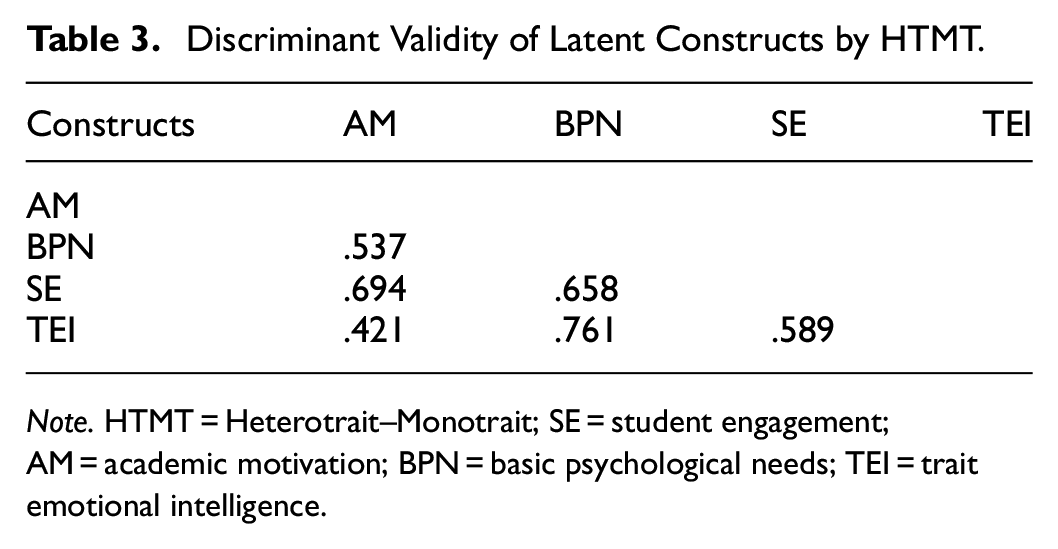
Note. HTMT = Heterotrait–Monotrait; SE = student engagement; AM = academic motivation; BPN = basic psychological needs; TEI = trait emotional intelligence.
Structural Equation Model
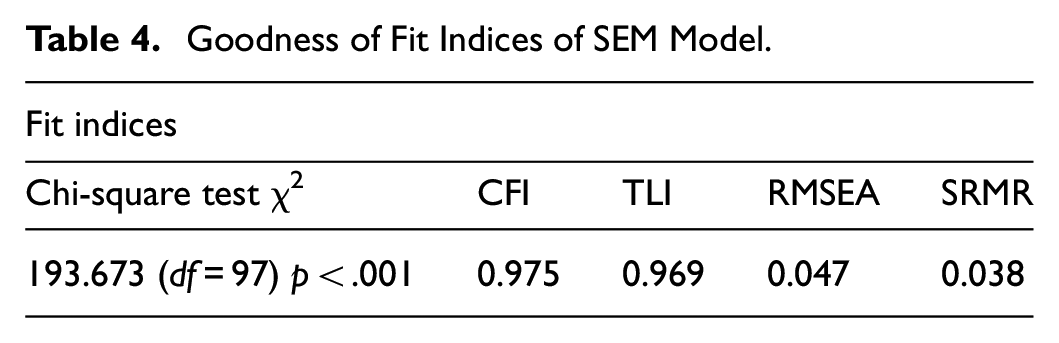
The SEM multivariate technique was conducted to examine the structure of the hypothesized research model and the direct impact of independent variables on student engagement. Additionally, the serial mediation role of basic psychological needs and academic motivation was also tested using SEM. A good model fit is typically determined using the Comparative Fit Index (CFI) and Tucker-Lewis Index (TLI) with a value of >0.9, a Root Mean Square Error of Approximation (RMSEA) of <0.08, and a Standardized Root Mean Square Residual (SRMR) of <0.08 (Hu & Bentler, 1999; Kline, 2015). These recommended thresholds serve as benchmarks for evaluating the adequacy of model fit in SEM. Figure 1 illustrates the structural model of the study with standardized regression weights, and all model fit indices indicated either acceptable model fit or excellent fit. The results revealed that the final structural model had a good model fit: χ2(97) = 193.673, p < .001, CFI = 0.975, TLI = 0.969, RMSEA = 0.047, SRMR = 0.038 (Table 4). The model explained 64.3% of the variance in student engagement (Figure 1).

Structural equation model of trait emotional intelligence (TEI), basic psychological needs (BPN), and academic motivation (AM) in relation to student engagement (SE).
Goodness of Fit Indices of SEM Model.
The findings presented in Table 5 showed that five out of six coefficient estimate paths were found to be significant (C.R ≥ ±1.96, p ≤ .05). The reported standardized path coefficient of trait emotional intelligence and student engagement (β = .223, C.R = 3.077, p = .002) indicated a significant positive impact, supporting H1. This implies that for every one unit increase in trait emotional intelligence, student engagement will also increase by 0.223 units. Ringle et al. (2018) and Cohen (2013) recommended the utilized f-squared scores for effect size: 0.02 ≥ small effects, 0.15 ≥ medium effects, and 0.35 ≥ large effects. Based on these recommendations and the calculated results, trait emotional intelligence has a small positive influence (f2 = 0.0252) on student engagement. Similarly, the estimated standardized path coefficient between basic psychological needs and student engagement (β = .219, C.R = 2.759, p = .006) suggests a significant positive influence, supporting H2. The significant result implies that for every one unit increase in basic psychological needs, student engagement will also increase by 0.219 units. However, basic psychological needs has a negligible influence (f2 = 0.0028) on student engagement. Likewise, the result of the structural model analysis signifies a significant positive influence of academic motivation on student engagement (β = .050, C.R = 8.459, p < .001), supporting H3. The result also indicates that for every one unit increase in academic motivation, student engagement will also increase by 0.050 units. Additionally, academic motivation has a large influence (f2 = 0.3585) on student engagement.
The Regression Weights of the Hypothesized Structural Model.

Note. S.E = standard error; C.R = critical ratio; SE = student engagement; AM = academic motivation; BPN = basic psychological needs; TEI = trait emotional intelligence.
The result of the structural model analysis indicated a significant influence of trait emotional intelligence on basic psychological needs (β = .754, C.R = 13.490, p < .001), supporting H4. The result suggests that for every unit increase in trait emotional intelligence, student engagement will increase by 0.754 units. However, in the examination of the influence of trait emotional intelligence on academic motivation, the estimated standardized path coefficient of trait emotional intelligence to academic motivation (β = .051, C.R = 0.601, p = .548) implies an insignificant influence of trait emotional intelligence on academic motivation, as the p-value was greater than .05. Therefore, H5 was not supported. Lastly, the findings from the structural model analyses revealed a significant positive influence of basic psychological needs on academic motivation (β = .521, C.R = 5.909, p < .001), supporting H6. The result indicated that for any one unit increase in basic psychological needs, academic motivation will also increase by 0.521 units. Furthermore, basic psychological needs had a small positive influence (f2 = 0.1079) on academic motivation.
Mediation Analysis
As evidenced by the results presented in Table 6, the study assessed the serial mediating role of basic psychological needs and academic motivation on the relationship between trait emotional intelligence and student engagement. The results revealed a significant and positive indirect effect of trait emotional intelligence on student engagement through basic psychological needs and academic motivation (β = .138, p < .001). The reported lower and upper bounds of the 95% bias-corrected bootstrap CI: [0.080, 0.224] indicated that the coefficient interval does not intersect with zero, implying a significant indirect effect, thus supporting H7. For the calculation of the indirect effect size, Ogbeibu et al. (2021) suggested halving Cohen’s recommendations for the v2 indirect effect size: 0.175 for a large effect, 0.075 for medium, and 0.01 for small. Consequently, basic psychological needs and academic motivation were found to have a small (v2 = 0.019) positive serial mediating effect in the relationship between trait emotional intelligence and student engagement. Considering the significant direct effect of trait emotional intelligence on student engagement in the presence of the serial mediators (β = .157, p = .004), it can be concluded that basic psychological needs and academic motivation partially mediate the relationship between trait emotional intelligence and student engagement.
The Indirect Effect of Trait Emotional Intelligence in Student Engagement Through the Serial Mediation of Basic Psychological Needs and Academic Motivation.

Note. Unstandardized coefficients reported. Bootstrap sample = 5,000 with replacement.
Discussion
Greater emotional intelligence competence improves student engagement (Maguire et al., 2017). Trait emotional intelligence influences the participation and quality of student engagement by developing positive attitudes and thoughts toward the surrounding environment and perceiving difficulties as challenges. The findings from this study indicated that trait emotional intelligence, basic psychological needs, and academic motivation have a direct positive influence on student engagement. Trait emotional intelligence was also found to have a direct positive influence on basic psychological needs, but not with academic motivation. More importantly, basic psychological needs and academic motivation were found to have a serial mediation effect in the relationship between trait emotional intelligence and student engagement. Thomas and Allen (2021) proposed that the academic success of students is influenced by multiple domains of engagement, and emotional intelligence is one of the personal traits that could influence student engagement directly and indirectly. A potential interpretation of the significant path found in the current study is that undergraduate students who possess a higher level of trait emotional intelligence are likely to engage more in academic activities.
Consistent with the present findings, past studies posit that the three universal basic psychological needs of autonomy, competence, and relatedness proposed by the SDT are linked to academic motivation and student engagement (Badiozaman et al., 2019; Benlahcene et al., 2020). The fulfillment of these basic psychological needs is essential for optimal motivation and student engagement development. Reeve et al. (2019) posited that the satisfaction of basic psychological needs is related to behavioral, affective, cognitive, and agentic engagement. The significant positive influence in the path coefficient of basic psychological needs on student engagement echoed the findings of a massive number of prior studies in the literature (e.g., Koch et al., 2017; Núñez & León, 2019). The fulfillment of needs satisfaction creates a desirable learning atmosphere such as volition, a sense of interest, active participation, and high quality of engagement that leads to positive academic outcomes (Ryan & Deci, 2017). The findings of this study thus endorse the notion that basic psychological needs satisfaction is a significant predictive factor of student engagement.
Motivation is distinguished from engagement where it is a more general perception that influences attitudes toward task involvement, whereas engagement is the actual involvement in tasks and activities (Afflerbach & Harrison, 2017). The result of the current study is coherent with the findings of Ferrer et al. (2022) and Huang et al. (2019), who asserted a similar positive relationship between motivation and student engagement. The direct impact of academic motivation on student engagement was articulated in SDT, which posited that academic motivation would promote student engagement (Deci & Ryan, 2000; Reeve et al., 2019) as was further confirmed by numerous previous studies in the literature. The result of the present study also complies with the assertions of many researchers where motivation is an antecedent of student engagement (e.g., Azila-Gbettor et al., 2021; Singh et al., 2022; Vansteenkiste et al., 2020).
However, the findings of the current study are incoherent with several studies (e.g., Chinyere & Afeez, 2022; Tang & He, 2023) in which emotional intelligence was found to have positive influence on academic motivation. Jose and Ambekar (2019) and Naik and Kıran (2018) yielded similar insignificant results, but failed to provide an explanation for such a relationship. Emotional intelligence could promote motivation through the optimal use of emotions as a source of motivation but not necessarily in a direct manner. Given the substantial evidence from the literature, one possible explanation for the inconsistent finding in this study is that the association between these two variables is not a direct relationship but rather an indirect one (e.g., Chang & Tsai, 2022; Hussein, 2021). Emotional intelligence is related to social competencies (Metaj-Macula, 2017); the contribution of trait emotional intelligence to academic motivation could be partly constrained by the global pandemic lockdown, which leads to not only social isolation but also changes in the social interaction of many. This could provide some arguments for the inconsistent finding when emergency remote teaching and learning replaced regular classes, which had simultaneously caused changes in the cultural context and educational experience of participants or any other factors that may influence the relationship.
Basic psychological needs satisfaction is a necessity and prevalent condition for the optimal development of academic motivation. Academic motivation is related to the satisfaction or frustration of basic psychological needs (Chevrier & Lannegrand, 2022). The significant positive influence of basic psychological needs on academic motivation in this study aligns with a substantial number of empirical studies in the literature across diverse cultures and disciplines (e.g., Goldman et al., 2017; Walker et al., 2020). The study conducted by Chue and Nie (2016) discovered that perceived psychological needs was a significant predictor of university students’ motivation. This implies that a supportive environment is fundamental for meeting basic psychological needs and facilitating the development of academic motivation. The findings of the current study endorse the propositions of Guay (2022) and Müller et al. (2021) that meeting basic psychological needs is important, as it leads to the quality of motivation, academic goals, and well-being of students, both in direct and indirect ways.
The findings of basic psychological needs and academic motivation as serial mediating variables in the relationship between trait emotional intelligence and student engagement are consistent with some previous studies. For instance, the study conducted by Shannon et al. (2018) verified the serial mediating roles of basic psychological needs and motivation in promoting student engagement behavior. Maguire et al. (2017) suggested emotional intelligence as “enhanced engagement” in one of their studies, and findings from the literature suggest that trait emotional intelligence is a positive predictor of student engagement (Thomas & Allen, 2021). The findings from the serial mediation analysis of Monteiro et al. (2018) not only supports the theoretical assumption of SDT but also highlights that the satisfaction of basic psychological needs is particularly important for behavior regulation and its positive relationship with many behavioral, cognitive, and affective engagement outcomes.
Implications to Higher Education and Post-Pandemic Classroom Learning
The present findings indicate that the impact of trait emotional intelligence on student engagement occurs via direct influence and by passing through basic psychological needs and academic motivation in a chain sequence. The results signify that greater trait emotional intelligence would facilitate the satisfaction of needs, which leads to higher academic motivation and, in turn, results in better student engagement. The results of the serial mediating analysis in this study are significant as it provides a valid new pathway for researchers and educators to study the complex phenomenon of student engagement in higher education. It underscores the importance of considering not only the direct influences but also the serial mediating effects that impact student engagement. Academics assume mediation analysis that focuses on indirect effects can enhance educational research by addressing questions that otherwise cannot be easily reached (Ballen & Salehi, 2021; Rucker et al., 2011). Therefore, this study contributes valuable insights into the ongoing discourse of the intricate interplay of factors influencing student engagement.
Undoubtedly, the pandemic may have posed challenges to the emotional intelligence, basic psychological needs, academic motivation, and engagement experience of some students. They grappled with feelings of isolation and limited opportunities for social connection and collaboration depending on individual circumstances and coping mechanisms. Additionally, the various different learning modes may have posed unique challenges to maintaining academic motivation, as students navigated new technologies, adjusted to different learning formats, and encountered obstacles to engagement. Moreover, the pandemic likely influenced the ways in which students interacted with their coursework, peers, and educational environments. Changes in mode of study may also have affected how students engage with their studies, with some students experiencing increased autonomy and flexibility in their learning experiences, while others struggled to stay motivated and connected in academic activities. The findings contribute to a better understanding of how the observed relationships in this study may have been influenced by the unique challenges and dynamics of the changes brought by the pandemic. The insights gained from the study are valuable not only for understanding the context of learning during a pandemic, but also for considering their implications beyond that, particularly in preparing the education system to support student engagement in the face of future global crises.
Limitation and Future Research
The targeted population in the current study was limited to undergraduate students at a selected Malaysian public research university. This limitation reduces the inferential power of the current study to generalize the findings to other populations. Since the current research only utilized a single-site sample, it may be subject to measurement bias. To counter this limitation, the researcher employed a stratified random sampling technique as a counter step to ensure that the recruited respondents adequately represented the population. Data was collected through 12 faculties at the selected research university. With that being said, the data collection focused only on the university, which had advantages to sustain the diversity of respondents and reduce the chances of overlapping with identical faculties in the case another research university had been involved in the data collection process.
Future studies could focus on underrepresented groups, such as students with disabilities, indigenous students, and those from low socioeconomic backgrounds to enhance the generalizability of the findings. Despite the importance of the higher education experience of these minority groups, they have been scarcely represented in the literature. Another shortcoming in the current study is the sole reliance on self-report questionnaires, which limits the ability of the researchers to verify whether respondents answered the survey honestly and the potential of fabricating invalid data. To address this issue, respondents were provided detailed instructions and necessary explanations through online platforms such as email and mobile applications like WhatsApp and Zoom to clarify any confusion and misinterpretation related to the survey instrument. Future studies should consider utilizing alternative approaches, such as physical interactions and observation, to achieve more comprehensive and insightful research outcomes in the post-pandemic era.
Conclusion
The findings of this study indicate that undergraduate students with higher levels of trait emotional intelligence, basic psychological needs, and academic motivation are more likely to exhibit greater student engagement. This suggests that improvements in any of these predictors would lead to enhancements in the outcome variable. Therefore, this study concludes that trait emotional intelligence, basic psychological needs, and academic motivation have a positive influence on student engagement. In conclusion, a higher level of trait emotional intelligence may elicit greater need satisfactions, which in turn strengthens academic motivation and leads to an improvement in student engagement. Strategies or interventions that aim to improve a single construct are unlikely to have a profound impact on student engagement; rather, a holistic implementation is recommended. In fact, student engagement relates to the person-environmental interaction, where both the individual and collective factors play a role in enhancing student engagement. Therefore, any efforts to enhance student engagement should consider including both personal and environmental factors as compulsory components in the planning and implementation of student-focused interventions. Given that basic psychological needs and academic motivation only partially mediate the relationship between trait emotional intelligence and student engagement in this study, future research can further explore additional variables related to the supportive environment to enhance the understanding of this intricate relationship.
Footnotes
Acknowledgements
The authors thank the Publication and Citation Unit of Faculty of Educational Studies Universiti Putra Malaysia for their assistance in the writing and publication process.

Ethical Considerations
This study was approved by the Ethics Committee for Research Involving Human Subjects (JKEUPM-2021-541) and was conducted at a selected Malaysian public research university, Universiti Putra Malaysia.
Funding
The author(s) received no financial support for the research, authorship, and/or publication of this article.
Declaration of Conflicting Interests
The author(s) declared no potential conflicts of interest with respect to the research, authorship, and/or publication of this article.
Data Availability Statement
The raw data supporting the conclusions of this article are available on request to the corresponding author.