




Abstract
Grounded in basic psychological need theory (BPNT), this study examined the link between mindfulness, need satisfaction/frustration, and fear of failure in university athletes. A sample of university athletes (n = 309) completed a survey form measuring the major study variables of interest. The results of regression analysis showed that mindfulness significantly and positively predicted need satisfaction, while it significantly and negatively predicted need frustration. Additionally, mindfulness significantly and negatively predicted fear of failure, while need frustration was a significant positive predictor of this outcome; however, need satisfaction did not significantly predict the outcome. Mindfulness also significantly moderated the effect of need frustration on fear of failure. These results generally align with the tenets of BPNT and suggest the buffering role of mindfulness in reducing athletes’ fear of failure.
Introduction
Athletes are situated in highly-competitive environments where winning is valued and emphasized. This emphasis involves strong social comparisons (e.g., outperforming others) and means that losing becomes a prominent source of competitive stress, which could lead athletes to experience elevated anxiety or fear of failure (Gustafsson et al., 2017; Moreno-Murcia et al., 2019). Fear of failure refers to the inclination to avoid negative outcomes linked to failure, such as experiencing shame, devaluating self-estimate, and losing social-value in evaluative circumstances (Conroy et al., 2002). Fear of failure affects both genders and is a common phenomenon in athletes, given that mistakes and failures are an integral component of sport (Sagar & Lavallee, 2010). Although fear of failure can drive athletes to stay competitive and pursue optimistic outcomes to some degree, a recent review study has linked it to various negative effects such as anxiety, burnout, and diminished sport performance (Taylor et al., 2023). This highlights the need to understand the factors that contribute to fear of failure in athletes.
A variety of studies have been conducted to investigate predictors of fear of failure in athletes. For example, self-control, empathy, and the nature of the coach-athlete relationship were found to predict fear of failure in British athletes (Sagar & Jowett, 2015). Additionally, coach-created motivational climate was identified as a predictor of fear of failure among youth handball players (Gómez-López et al., 2020). Although these studies have improved our understanding of the predictors of fear of failure, further research is needed (Taylor et al., 2023). Therefore, the present study sought to advance this area of research by examining understudied predictors of fear of failure. Specifically, grounded in basic psychological need theory (BPNT; Deci & Ryan, 2000), the connection between mindfulness, need satisfaction/ frustration, and fear of failure in university athletes was examined.
Basic Psychological Needs and Fear of Failure
BPNT maintains that individuals have three fundamental psychological needs (Deci & Ryan, 2000). The needs include the need to feel volition and independence (i.e., autonomy need), the need to experience effectiveness in finishing tasks and producing desirable outcomes (i.e., competence need), and the need to feel connections to and cared by others (i.e., relatedness need). According to BPNT (Deci & Ryan, 2000), satisfying these three needs will promote well-being and adaptive outcomes, while failing to meet them will lead to poor well-being and maladaptive outcomes. Several meta-analytic findings have supported this tenet. For example, Li et al. (2013) conducted a meta-analysis examining the relationship between need satisfaction and athlete burnout, finding that greater need satisfaction was linked to lower levels of burnout. A more recent meta-analytic finding indicated that need satisfaction was a negative predictor of sport dropout (Back et al., 2022). However, a meta-analysis on the link between need frustration and its outcomes is yet to be conducted (Ryan et al., 2022).
Only a limited number of studies have examined the relationship between need satisfaction and fear of failure in athletes. González-Hernández et al. (2023) found need satisfaction to negatively predict fear of failure in youth athletes. The finding is supported in another study with a sample of youth and adult athletes (Hu et al., 2023). Although direct evidence linking need frustration to fear of failure in competitive sport is limited, findings from the physical education context showed that need frustration had a positive association with fear of failure in school students (Bartholomew et al., 2018). Thus, the positive link between need frustration and fear of failure could also hold in athletes. For example, when athletes’ needs are unmet or frustrated, fear of failure is likely to emerge, as they may feel incapable or excessively controlled. Similarly, in environments lacking social connections, teammates are unlikely to celebrate successes or provide encouragement after mistakes, further exacerbating fear of failure.
It is noteworthy that none of the earlier research has investigated need satisfaction, need frustration, and fear of failure in a single study. Direct empirical evidence is therefore necessary to support the link between need frustration and fear of failure, particularly when considering both need satisfaction and need frustration within the same study. Indeed, need satisfaction and need frustration are not simply opposite ends of the same continuum; rather, they are independent processes (Vansteenkiste et al., 2020). For example, athletes may experience low need satisfaction when their needs are unmet (e.g., lack of encouragement), but this does not necessarily lead to need frustration. Need frustration typically involves an active threat to one's needs (e.g., provision of negative comments). Thus, a model that incorporates both need satisfaction and need frustration provides a more comprehensive framework for understanding human experience.
Mindfulness and Basic Psychological Needs
According to BPNT (Deci & Ryan, 2000), individuals’ basic psychological needs are affected by the social environments in which they are situated as well as by intrapersonal factors. In line with this tenet, recent meta-analytic findings revealed that coach autonomy support, a social environmental factor, was positively linked to need satisfaction and negatively associated with need frustration in athletes (Mossman et al., 2022). Similarly, another review showed that social environments created by significant others, such as coaches and parents, played different roles in influencing athletes’ three basic psychological needs (Chu & Zhang, 2019). Regarding intrapersonal factors, a meta-analysis found that personality traits like agreeableness, conscientiousness, and extraversion were positively linked to need satisfaction in the workplace (Van den Broeck et al., 2016). In the sport context, perfectionistic strivings were shown to positively predict need satisfaction while negatively predicting need frustration in athletes (Jowett et al., 2016). These results underscore the relevance of both environmental and intrapersonal factors in predicting the three basic psychological needs.
Mindfulness is an intrapersonal factor that is becoming increasingly popular in fields such as education, management, and sport (e.g., Kaisti et al., 2024; Noetel et al., 2019; Ratanavanich & Charoensukmongkol, 2024). Mindfulness is described as both a trait and a state ability characterized by nonjudgmental awareness of one’s present-moment experiences (Kabat-Zinn, 2023). It is characterized by an awareness of the here and now, coupled with acceptance of one’s experiences. This quality enables individuals to act in alignment with their personal values and interests, rather than being driven by external pressures. Mindfulness can enhance competence by helping individuals manage challenges that might otherwise undermine their sense of effectiveness. Additionally, mindfulness encourages individuals to be fully present in their interactions with others, fostering empathy and compassion, which in turn enhance positive relationships (Schultz et al., 2015). Taken together, mindfulness is thought to promote the satisfaction of basic psychological needs while acting as a powerful tool for reducing frustration of needs, particularly in high-stress environments. Some empirical studies have supported this notion, showing that mindfulness positively predicts need satisfaction and negatively predicts need frustration across educational, occupational, and sport contexts (Guertin et al., 2023; Li et al., 2021; Li et al., 2019; Schultz et al., 2015).
Mindfulness, Basic Psychological Needs, and Fear of Failure
To date, no studies have simultaneously examined the association between mindfulness, need satisfaction/frustration, and fear of failure within a single study. Chang et al. (2018) found that need satisfaction fully mediated the association between mindfulness and life satisfaction as well as negative affect, while also partially mediating the relationship between mindfulness and subjective vitality and positive affect in college athletes. By including both need satisfaction and need frustration in their study, Li et al. (2021) found that need frustration fully mediated the association between mindfulness and smartphone overuse in university athletes, whereas need satisfaction did not serve as a mediator in that relationship. Similarly, in the work context, need frustration was found to partially mediate the association between mindfulness and ill-being, while need satisfaction did not mediate this relationship. These findings suggest that when considering both need frustration and need satisfaction, the former appears to be a more prominent mediator in the association between mindfulness and maladaptive outcomes (e.g., fear of failure). This reasoning calls for direct empirical support.
Building on these insights, it is also important to consider the role of mindfulness beyond its mediating effects. In addition to serving as a predictor of need satisfaction/frustration, mindfulness may also be a moderator in the need-based experience. In a study involving employees, Schultz et al. (2015) found that mindfulness did not moderate the positive relationship between managerial behaviors (a social environment) and need satisfaction; however, it did buffer the negative impact of managerial behavior on need frustration. Similarly, while mindfulness did not moderate the influence of attention-deficit/hyperactivity disorder (ADHD) symptoms on need satisfaction, it reduced the impact of these symptoms on need frustration in university athletes (Li et al., 2021). Thus, mindfulness appears to play a significant moderating role in alleviating the negative effects of adverse social environments on need frustration.
While the moderation effect of mindfulness in the relationship between social environments and need-based experiences has been examined, there remains limited understanding of how mindfulness influences the connection between need-based experiences and outcomes such as fear of failure. Several studies have shown the positive effect of mindfulness-based intervention in reducing avoidance behaviors and fear of failure in university students (Carlin & Ahrens, 2014; Hjeltnes et al., 2015). This suggests that by cultivating athletes’ mindfulness, they can observe their thoughts and emotions without judgment and stay focused during competitions, which can reduce the intensity of fear of failure. The direct link between mindfulness and fear of failure, along with the documented buffering role of mindfulness in the relationship between social environments and outcomes (e.g., Li et al., 2021; Schultz et al., 2015), suggest that mindfulness could alleviate the impact of need frustration on fear of failure.
Aim and Hypotheses
This study sought to investigate the association between mindfulness, need satisfaction/frustration, and fear of failure in university athletes. Based on the literature reviewed, it was hypothesized that mindfulness would be a positive predictor of need satisfaction (H1a) and a negative predictor of need frustration (H1b; see Figure 1). Furthermore, mindfulness was expected to negatively predict fear of failure (H2a), need satisfaction would not predict fear of failure (H2b), and need frustration would positively predict fear of failure (H2c). Finally, it was hypothesized that mindfulness would diminish the predictive impact of need frustration on fear of failure (H3).
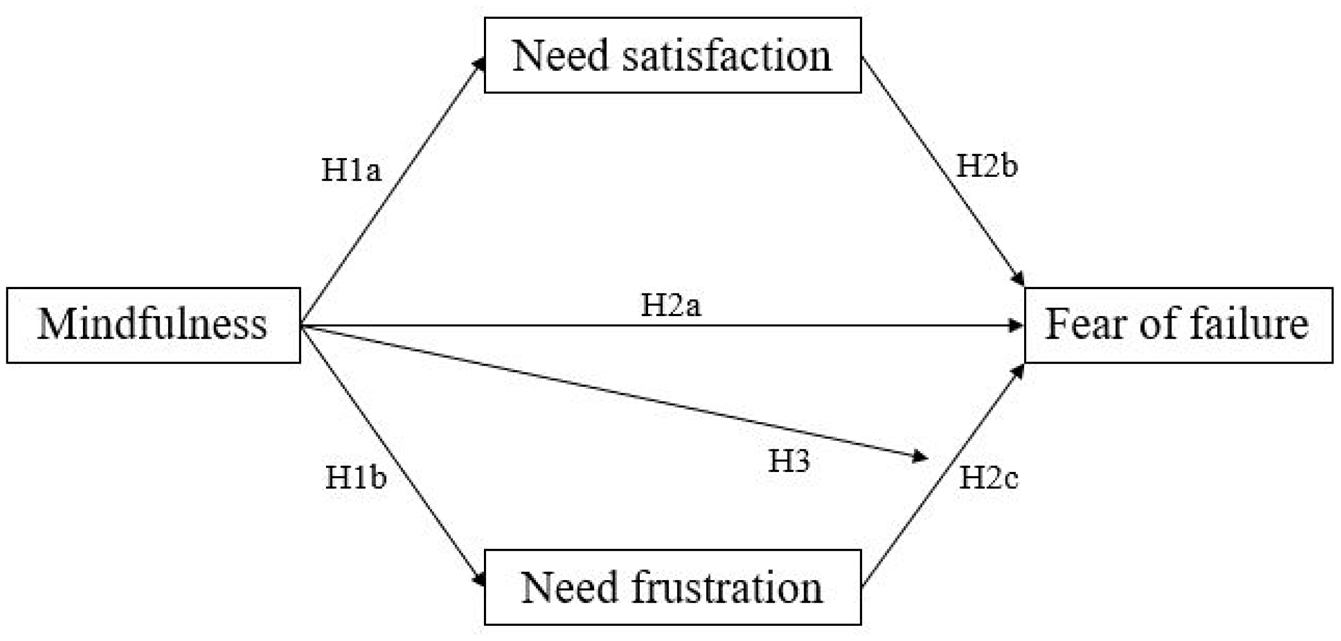
Hypothesized relationships between mindfulness, need satisfaction, need frustration, and fear of failure.
Method
The present research utilized a cross-sectional observational design. Approval from the Human Research Ethics Committee of South China Normal University was obtained (approval no. SCNU-SPT-2021-018).
Participants and Procedure
Participants were required to meet the following criteria to be eligible for the present study: (a) be an active athlete from a university team in China; (b) be aged 18 years or above; and (c) be a national grade 2 or above athlete. The Chinese sport system classifies athletes into six levels, including international master sportsman, national master sportsman, national grade 1, national grade 2, national grade 3, and no grade. National grade 2 athletes typically compete at the provincial level or higher, representing a group that is competitive but not necessarily at the elite, international level (i.e., national master sportsman or above). This level was included for the study as it is highly reflective of the overall university athlete population in terms of experience and competitiveness.
Head coaches from five public universities in China were approached to invite their athletes to take part in the present research. Two research assistants administered informed consent forms and anonymous survey forms to participants in a quiet meeting hall or room. Athletes were assured that their involvement was voluntary and were informed that there were no right or wrong answers to the questions. The survey was conducted during November and December, spanning their in-season training and competition periods. Of 353 athletes invited, 315 completed the whole survey (response rate = 89.2%) without receiving any incentives. Five cases were removed from further analysis due to incomplete surveys, leading to a final sample of 309 participants in this research. Using G*Power 3.1 (Faul et al., 2009), it was determined that a sample size of 160 would be the minimum required to achieve a practically meaningful effect (f2 = .15, α = .05, power = .95) with eight predictors. Thus, the sample size for this research is sufficient. The final sample involved 309 athletes (male = 222, female = 87) with a mean age of 20.34 years (SD = 1.63). They specialized in one of 16 sports, such as boxing, table tennis, and tennis (individual sport = 228, team sport = 81). Approximately half of them were national grade 2 athletes (national master sportsman = 45, national grade 1 = 118, national grade 2 = 146).
Measures
Participants’ age, gender, sport, and sport level were collected through demographic items. Key study variables including mindfulness, need satisfaction/ frustration, and fear of failure were assessed through standardized tools.
Mindfulness
The validated Chinese version of the Athlete Mindfulness Questionnaire was utilized to assess participants’ mindfulness (Zhang et al., 2017). The questionnaire consists of 16 items that evaluate three aspects of mindfulness in sport: present-moment attention, awareness, and acceptance. A sample item is “I can easily sustain my attention on the competition.” Participants responded on a 5-point scale (1 = “never true”, 5 = “always true”). A total mean score was calculated for further analysis, with a higher score indicating a greater level of mindfulness. The questionnaire showed good internal reliability in the present sample (α = .89).
Basic Psychological Need Satisfaction and Frustration
To assess participants’ need satisfaction/frustration in sport, the validated Chinese version of the Basic Psychological Needs Satisfaction and Frustration Scale was employed (Chen et al., 2015). This instrument includes six subscales, each with four items, measuring satisfaction and frustration related to autonomy, competence, and relatedness (e.g., “I feel my choices express who I really am”). Participants responded to the items on a 5-point scale (1 = “not at all”, 5 = “completely true”). Mean scores for both need satisfaction and need frustration were computed for subsequent analyses. The study demonstrated good internal reliability for both need satisfaction and need frustration scores (α = .85/.91).
Fear of Failure
The validated Chinese version of the Performance Failure Appraisal Inventory-Short Form was utilized to capture participants’ fear of failure in sport (Li et al., 2018). The inventory has five items, such as “When I am failing, I worry about what others think about me”). Participants answered the scale items through a 5-point scale (1 = “do not believe at all”, 5 = “believe 100% of the time”). A mean score was calculated, with higher scores indicating greater fear of failure. The inventory demonstrated good internal reliability in this research (α = .82).
Data Analysis
Descriptive statistics, including means (Ms) and standard deviations (SDs), were utilized to determine features of study variables, which included four demographic variables and four major study variables (i.e., mindfulness, need satisfaction, need frustration, and fear of failure). Zero-order correlations among the study variables were calculated. Demographic variables that had a significant association with the major study variables were adjusted for in subsequent multiple linear regression analyses. A series of multiple linear regression analyses were performed to evaluate the proposed hypotheses. Specifically, mindfulness was assessed as a predictor of need satisfaction and need frustration to test H1a and H1b. Fear of failure was regressed on mindfulness, need satisfaction, and need frustration to examine H2a, H2b, and H2c. Additionally, mindfulness, need satisfaction, need frustration, and one interaction term (mindfulness × need frustration) were used to predict fear of failure to test H3. The variance inflation factor (VIF) was used to assess multicollinearity, with a VIF value greater than 10 indicating significant multicollinearity (Kutner et al., 2005). All these analyses were carried out using IMB SPSS 26 (IBM, Armonk, NY, USA).
Results
Descriptive Results
Table 1 displays the descriptive statistics and zero-order correlations of the study variables. Mindfulness showed a positive correlation with need satisfaction (r = .39, p < .001) and a negative relationship with need frustration (r = −.23, p < .001). Both mindfulness and need satisfaction were negatively related to fear of failure (r = −.29/−.23, ps < .001), and need frustration showed a positive association with fear of failure (r = .31, p < .001). Gender was the only demographic variable found to be associated with major study variables, including need frustration (r = −.14, p = .02) and fear of failure (r = −.12, p = .04). Thus, gender was controlled for in subsequent multiple linear regression analyses.
Zero-order Correlations Among Study Variables (n = 309).

Note. Gender (0 = male, 1 = female), Sport type (0 = individual sport, 1 = team sport), Sport level (0 = national master sportsman, 1 = national grade 1, 2 = national grade 2).
p < .05 (2-tailed). **p < .01 (2-tailed).
Hypothesis Testing Results
The results of regression analysis revealed that mindfulness significantly and positively predicted need satisfaction (β = .39, 95CI [.29, .49], p < .001, R2 = 15.1%) and significantly and negatively predicted need frustration (β = −.23, 95% CI [−.34, −.12], p < .001, R2 = 5.3%), supporting H1a and H1b. In support of H2a and H2c, mindfulness was a significant and negative predictor of fear of failure (β = −.20, 95% CI [−.32, −.09], p = .001), whereas need frustration was a significant positive predictor (β = .23, 95% CI [.12, .34], p < .001). H2b was also supported as need satisfaction did not significantly predict fear of failure (β = −.09, 95% CI [−.21, .02], p = .11). These three predictors accounted for 14.8% of the total variance in fear of failure.
Table 2 summarizes the results of moderated regressions. All VIF values were below 10, indicating no significant multicollinearity issues (Kutner et al., 2005). Mindfulness was found to significantly moderate the effect of need frustration on fear of failure (β = .12, 95% CI [.01, .23], p = .03), supporting H3. A simple slope analysis (M ± 1 SD) was followed to further investigate the identified moderation effect (Aiken et al., 1991). The analysis revealed that the positive relationship between need frustration and fear of failure was less pronounced at high levels of mindfulness (B = 0.34, t = 1.28, p < .001), whereas it remained unchanged at low levels of mindfulness (B = 0.11, t = 5.12, p = .20; see Figure 2). Although not included in our hypotheses, the potential moderating effect of mindfulness on the relationship between need satisfaction and fear of failure was explored, but this effect was found to be insignificant (β = .004, 95% CI [−.09, .09], p = .94).
Summary of Multiple Linear Regression Analysis (n = 309).

Note. VIF = variance inflation factor. Significant standardised regression coefficients (p < .05, 2-tailed) are in boldface.

Moderation effect of mindfulness on the association between need frustration and fear of failure.
An additional analysis was conducted to explore the mediation effect of need frustration in the link between mindfulness and fear of failure. A mediation analysis with bootstrapping using 5000 bootstrap samples was used to generate bias-corrected CIs (Preacher & Hayes, 2008). The results revealed that the mediation effect of mindfulness on fear of failure was significant, B = −0.08, 95% CI [−0.16, −0.03], SE = 0.03 (see Figure 3). The indirect effect of need satisfaction in the association between mindfulness and fear of failure was not assessed, as need satisfaction did not significantly predict fear of failure.

Standardized regression coefficients for the direct relationship between mindfulness and fear of failure as mediated by need frustration. The indirect standardized regression coefficient is represented in parentheses. **p < .01.
Discussion
As an extension of previous research, the present study examined the association between mindfulness, need satisfaction/frustration, and fear of failure in 309 university athletes. The findings revealed that mindfulness significantly predicted need satisfaction and need frustration, and the latter, not the former served as mediator in the association between mindfulness and fear of failure. Furthermore, mindfulness was found to significantly attenuate the association between need frustration and fear of failure. Overall, these findings enhance our understanding of the associations of these major study variables and provide unique insights into the role of mindfulness in mitigating fear of failure among athletes.
In accordance with our hypotheses and BPNT (Deci & Ryan, 2000), the present research showed that mindfulness had a significant positive relationship with need satisfaction and a significant negative association with need frustration. This finding is in line with research involving athletes and non-athletes (Chang et al., 2018; Guertin et al., 2023; Li et al., 2021; Li et al., 2019). Indeed, the characteristics of mindfulness are thought to associate with need-based experiences (Schultz et al., 2015). For instance, focusing on the present moment can enable athletes to act in a way that aligns with their deeply held values, and thus facilitating autonomy needs. Similarly, adopting a non-judgmental mindset can help athletes to cope with challenges and decrease negative appraisals, which is important for their competence need satisfaction. These findings contribute to the broader literature, indicating that intrapersonal factors such as personality traits and perfectionism are significant determinants of need-based experiences (Ryan et al., 2019).
The present research also showed that need frustration positively and significantly predicted fear of failure, whereas need satisfaction did not. These findings support our hypotheses and align with a recent study by Li et al. (2021), which found need frustration to be a significant positive predictor of smartphone overuse in university athletes, while need satisfaction did not significantly predict the same outcome. These findings are also consistent with previous studies, suggesting that need frustration is a stronger predictor of maladaptive outcomes than adaptive ones (Vansteenkiste et al., 2020). In contrast, need satisfaction tends to be a more robust predictor of adaptive outcomes than maladaptive ones. For example, a meta-analysis based on the health context showed that need satisfaction had a stronger association with positive affect (r = .35 to .54) than with negative affect (r = −.28 to −.33) (Ng et al., 2012). Thus, these findings, together with ours, help clarify why need frustration showed a stronger relationship with fear of failure than need satisfaction in our research.
In support of our hypothesis, mindfulness acted as a significant moderator in the association between need frustration and fear of failure. More specifically, high mindfulness was found to weaken the positive link between need frustration and fear of failure. This finding highlights the significant contribution of the present research and suggests that the cost associated with need frustration may vary based on an individual’s mindfulness level (Ryan et al., 2019). Unlike the present study, earlier studies typically investigated the moderation role of mindfulness in the relationship between environmental/intrapersonal factors and need-based experiences (Li et al., 2021; Schultz et al., 2015), rather than in the relationship between need-based experiences and outcomes. For example, previous research involving university athletes discovered that the positive association between ADHD symptoms and need frustration was moderated by mindfulness (Li et al., 2021). Although all athletes have basic psychological needs, not all would equally suffer from need-frustrating experiences due to individual differences (e.g., mindfulness). Taken together, our findings add to the literature by suggesting that enhancing athletes’ mindfulness can be beneficial for their need-based experiences and associated outcomes, such as fear of failure.
The mediation role of need-based experiences in the relationship between environmental factors and outcomes has been supported across different contexts (Vansteenkiste et al., 2020). In our study, an additional analysis was conducted to examine the mediation effect of need frustration in the link between mindfulness and fear of failure. The analysis showed that the mediation effect of mindfulness on fear of failure was significant. This result provides the first piece of evidence regarding the utility of BPNT in explaining athletes’ fear of failure, as previous studies have primarily focused on the direct effects of mindfulness on fear of failure (e.g., Hjeltnes et al., 2015). Meanwhile, our results also indicated that the direct link between mindfulness and fear of failure was significant in the mediation model (Figure 3). This is in line with our hypothesis and previous studies, where the efficacy of mindfulness-based interventions in decreasing fear of failure and avoidance behaviors in university students (Carlin & Ahrens, 2014; Hjeltnes et al., 2015). Thus, while need frustration plays a role in the relationship between mindfulness and fear of failure, it does not fully explain the predictive effect of mindfulness on fear of failure.
Practical Implications
The findings of this study offer several practical implications for practitioners working with university athletes, such as sports psychologists and coaches. The positive association between mindfulness and need satisfaction, its negative relationship with need frustration, and its moderating role in reducing the link between need frustration and fear of failure all highlight the importance of incorporating mindfulness-based interventions into athletes' training regimens. Fostering mindfulness through practices such as focused breathing and mindful movement can help athletes fulfill their basic psychological needs. To further address athletes’ psychological needs, practitioners should create supportive environments that promote autonomy, provide opportunities for skill development to enhance competence, and encourage social connections to strengthen relatedness (Ryan et al., 2019). Furthermore, the mediation effect of need frustration in the relationship between mindfulness and fear of failure underscores the need for targeted interventions that address both mindfulness and psychological needs. By integrating these insights, practitioners can better support athletes in managing fear of failure and improving their well-being and performance.
Limitations and Future Research Directions
Although this study provides some insights into the association between mindfulness, need satisfaction/frustration, and fear of failure, it is subject to a few major limitations. First, a cross-sectional design was utilized, limiting the ability to draw causal relationships among the study variables. Future studies should employ a longitudinal or trial design to better examine the directionality and causality of these relationships. Future research could also explore other potential predictors and outcomes of need-based experiences, such as social support, coaching styles, or performance outcomes, to provide a more comprehensive understanding of these dynamics. Second, although recruiting athletes can be challenging due to their demanding schedules and accessibility, a convenient sample of athletes was recruited from five universities in China. To increase the generalizability of the present findings, a more representative sample, such as athletes from different cultural backgrounds and competitive levels, should be recruited in future investigations. Finally, the exclusive use of self-report measures in this research introduces the common method bias. To address this limitation, future research should adopt multi-method approaches, such as third-party reports, behavioral observations, or physiological measures, to provide a more objective assessment of related predictors and outcomes.
Conclusion
The results of the current study offer some preliminary insights into the connections between mindfulness, need satisfaction/frustration, and fear of failure. The study demonstrates that mindfulness significantly predicts both need satisfaction and need frustration, and it also significantly and negatively predicts fear of failure through need frustration. More importantly, mindfulness significantly attenuates the positive association between need frustration and fear of failure. These results generally support the tenets of BPNT and contribute to the relatively recent body of research on moderators within this theoretical framework. Although enhancing mindfulness and positive need-based experiences could be useful for reducing fear of failure in athletes, further research is needed.
Footnotes
Acknowledgements
We thank all the participants for their participation.
Author Note
Zhenyu Cen, Jinjin Ma, and Chunxiao Li are now at the School of Physical Education & Sports Science, South China Normal University, Guangzhou, China. The first two authors contributed equally to this research (i.e., co-first authors).

Ethical approval and informed consent
This study was approved by the Human Research Ethics Committee of South China Normal University (approval no. SCNU-SPT-2021-018) on 11 August 2021. Respondents gave oral consent before completing the anonymous survey form.
Author contributions
Conceptualization – Chunxiao Li and Zhenyu Cen; Investigation – Zhenyu Cen and Jinjin Ma; Formal analysis – Chunxiao Li; Writing – All the authors.
Funding
The author(s) received no financial support for the research, authorship, and/or publication of this article.
Declaration of Conflicting Interests
The author(s) declared no potential conflicts of interest with respect to the research, authorship, and/or publication of this article.
Data availability statement
The data are available from the corresponding author upon reasonable request.