




Abstract
People have long been attentive to the critical issues of economic development and environmental conservation, recognizing their pivotal roles in achieving high-quality economic growth. Although there is substantial literature on the impact of economic development on the environment, relatively few studies have explored the impact of environmental degradation on economic development. This study aims to identify a pathway toward achieving high-quality economic development by examining the causal relationship between air pollution and entrepreneurship. The study utilizes panel data from 1,458 counties in China, spanning the period from 2000 to 2019, and employs a fuzzy regression discontinuity design using the Qinling Mountains-Huai River line as the threshold. The findings reveal that air pollution has the potential to hinder entrepreneurship. In the heterogeneity analysis, it was found that counties located along provincial borders are particularly vulnerable to the adverse effects of air pollution. Mechanistic analysis indicates that air pollution leads to increased labor mobility, heightened financial constraints, and decreased innovative activity, all of which collectively deter entrepreneurship. These findings highlight the importance of the ecological environment in entrepreneurial activities and provide insights for policymakers to promote public entrepreneurship through air pollution mitigation.
Plain language summary
Purpose: Relatively few studies have delved into the repercussions of environmental degradation on economic development. This study aims to identify a pathway toward achieving high-quality economic development by examining the causal relationship between air pollution and entrepreneurship. Method: Analyzing data from 1,458 Chinese counties between 2000 and 2019, the study utilizes fuzzy Regression Discontinuity Design to examine the causal relationship between air pollution and entrepreneurship. Results: The study finds that air pollution disparity along the Qinling Mountains-Huai River line corresponds to an entrepreneurship gap in the same region. Air pollution has the potential to hinder entrepreneurship, particularly in counties along provincial borders. This suggests that air pollution produces a “broken window effect” on entrepreneurship in counties with provincial borders. The mechanisms behind this hindrance include increased labor mobility, heightened financial constraints, and reduced innovation activity. The results underscore the intricate connection between environmental factors and entrepreneurial activities. Implications: The study highlights the importance of addressing air pollution to foster a conducive environment for entrepreneurship. Balancing economic and ecological benefits is crucial, urging policymakers to prioritize long-term environmental sustainability over short-term gains. Additionally, collaboration among regional governments, especially those along provincial borders, is encouraged to formulate and implement effective air pollution control plans. Limitations: The study did not thoroughly examine the impact of air pollution on entrepreneurial intentions from an individual perspective. Future research could provide a more detailed depiction of this issue at the individual level.
Highlights
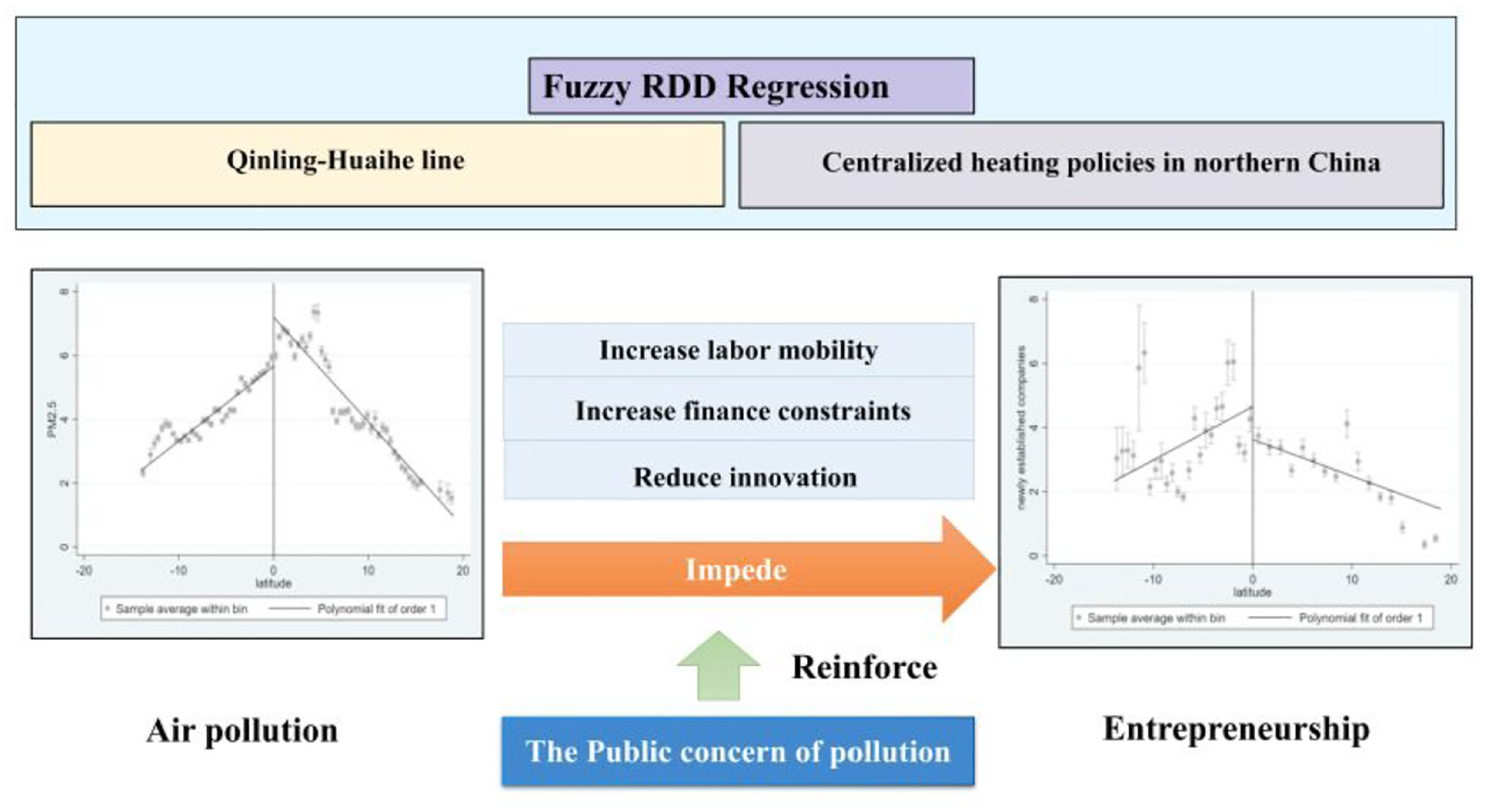
Air pollution gap bring the entrepreneurship gap in China.
The fuzzy Regression Discontinuity Design (RDD) was adapted.
To cultivate a conducive business environment, prioritizing the ecological environment is important.
Introduction
Entrepreneurship-driven employment is a crucial factor in ensuring people’s livelihoods (Y. Li, 2022) and internally driving China’s economic growth. According to the “Global Startup Ecosystem Index Report 2021” released by the global entrepreneurship research organization StartupBlink, China ranks seventh among the world’s 100 major economies. Furthermore, six Chinese cities were listed among the top 50 worldwide in terms of entrepreneurial activity. The full unleashing of entrepreneurial potential across society is pivotal in stimulating economic vitality.
As a rapidly transforming and developing nation, China has acknowledged the economic losses caused by environmental degradation. Recognizing the urgency of environmental governance and the risks of hasty development, China is increasingly focusing on environmental pollution issues, especially air pollution. China made significant commitments at the 75th United Nations General Assembly. These commitments include achieving energy-saving and emission reduction targets, capping carbon emissions by 2030, and attaining carbon neutrality by 2060.
In the context of global warming, studying the effects of air pollution has become an urgent societal issue. Scholars hold differing views on the impact of air pollution on business activities. Some believe that worsening air pollution may increase environmental awareness across society, potentially encouraging environmental protection efforts (Hansen & Liu, 2018; X. Li & Tilt, 2018; H. Zhang & Qi, 2021). However, strict environmental regulations might pose compliance challenges for entrepreneurs, potentially discouraging entrepreneurial spirit (Bawakyillenuo & Agbelie, 2021). This perspective suggests that environmental regulations could lead to unemployment (Y. Chen, 2023) and resource misallocation (X. Li et al., 2023), hindering economic growth and stifling entrepreneurship. Conversely, another group of scholars argues that air pollution may stimulate entrepreneurial activity. They contend that air pollution issues can foster inter-regional governance cooperation, create entrepreneurial opportunities, and motivate more individuals to engage in entrepreneurship. From the perspective of industrial agglomeration, highly polluting firms often choose regions with lenient environmental regulations to minimize environmental costs. Additionally, the positive impact of green and sustainable entrepreneurship on economic development cannot be underestimated (Soleimani et al., 2023; Tien et al., 2020). This study aims to explore whether air pollution inhibits the establishment of new businesses, thereby filling a gap in the research on air pollution and mass entrepreneurship. To uncover the complex relationship between environmental protection and economic growth, this study focuses on how air pollution hinders entrepreneurial activity, emphasizing the importance of environmental regulation and advocating for strong environmental protection measures.
This study makes both theoretical and empirical contributions to the existing literature by focusing on the causal relationship between air pollution and entrepreneurship. It introduces two potential innovations. First, from a theoretical perspective, while previous studies have explored the direct effects of air pollution on human health, labor mobility, investment, location choices, and corporate innovation (Y. Chen, 2023; Hansen & Liu, 2018; Soleimani et al., 2023), the impact on entrepreneurship has been largely overlooked. This study addresses this gap by investigating how air pollution affects entrepreneurship, establishing an important link between environmental protection and economic progress. It identifies a practical pathway for achieving high-quality economic development. Importantly, previous studies have mainly discussed the benefits of environmental regulations in terms of economic growth, social security, and technological advancement. In contrast, this study aims to demonstrate the positive impact of a healthy environment on entrepreneurship, thus validating the value of environmental regulations. Second, from an empirical perspective, this study utilizes county-level data in China to achieve its research objectives. Compared to city-level data, this approach provides a more detailed understanding of the relationship between air pollution and entrepreneurship. Third, this study employs a quasi-natural experiment based on China’s Northern Heating Policy and uses a fuzzy Regression Discontinuity Design (RDD) to accurately estimate the impact of air pollution on entrepreneurship, effectively addressing potential endogeneity concerns.
Literature Review
Entrepreneurship Influencing Factors
Entrepreneurship is a multifaceted phenomenon influenced by factors such as public policy, culture, entrepreneurial ecosystem, and the entrepreneurship intention. First, public policy plays a crucial role in shaping the entrepreneurial landscape. However, political entrepreneurship can foster corruption, potentially hindering entrepreneurial initiatives (Belitski et al., 2021; Park & Shin, 2022). Second, cultural influences can significantly affect entrepreneurship. For instance, hierarchical religions like Catholicism and Sunni Islam negatively impact entrepreneurship, while Judaism has a positive effect on entrepreneurial activities (Avnimelech & Zelekha, 2023). Although culture is traditionally viewed as a constraint on entrepreneurship, emerging evidence of cultural entrepreneurship indicates that culture plays a central role in entrepreneurial efforts. Third, the concept of the entrepreneurial ecosystem goes beyond a simple entrepreneurial environment, encompassing mechanisms, institutions, networks, and cultures that collectively support entrepreneurial activities (Malecki, 2018). Notably, research has found that entrepreneurial ecosystems positively influence entrepreneurship. Smart cities would harness sustainable and digital technologies to enhance their entrepreneurial ecosystems (Dana et al., 2022). Fourth, entrepreneurial intentions are critical precursors to entrepreneurial actions (Audretsch, 2023). Studies show that factors like entrepreneurial education and social networks can enhance social entrepreneurial intentions (Hassan et al., 2022). Moreover, entrepreneurial passion and self-efficacy have been identified as contributors to entrepreneurial intentions (Neneh, 2022). Social support and institutional support are found to promote individuals’ social responsibility entrepreneurial intentions (Fox et al., 2023). Additionally, high levels of resilience in personality positively influence entrepreneurial intentions (Steinbrink & Ströhle, 2023). Furthermore, entrepreneurial expectations, identity, and opportunity assessment have been identified as important factors influencing serial entrepreneurial intentions (X. Bai et al., 2022).
Existing literature primarily investigates economic factors influencing entrepreneurship, leaving a research gap regarding the impact of the natural environment on entrepreneurship. Understanding the complex relationship between natural and human systems and examining the potential effects of the natural environment on entrepreneurship is necessary. Soleimani et al. (2023) suggest that green entrepreneurship is an effective strategy for sustaining organizations and gaining a competitive advantage in a circular economy. Key factors in green entrepreneurship include total quality management, circular supply chain management, and corporate social responsibility. This study aims to explore the impact of the natural environment on entrepreneurship, seeking a more comprehensive understanding of the drivers of entrepreneurship.
Air Pollution Impact on the Economics Growth
Air pollution has become a global concern with profound impacts on economic growth, affecting human capital, industrial development, international trade, and investment. First, the adverse effects of air pollution on human health and well-being have been extensively studied. Health issues caused by air pollution lead to significant medical costs on individuals, businesses, and governments, straining economic resources (R. Bai et al., 2018). Additionally, air pollution disrupts daily life, hampers work efficiency, and stifles innovation, negatively impacting company productivity and operations (Powdthavee & Oswald, 2020). Second, air pollution poses a significant threat to ecosystems, crops, and natural resources. Industries such as agriculture, fisheries, and tourism suffer economic losses due to resource degradation and depletion (Ma et al., 2021). These impacts extend beyond the directly affected sectors, as the interconnections between industries amplify the economic consequences throughout the economy. Furthermore, non-compliance with environmental standards can result in trade barriers, including import restrictions or additional compliance costs. These barriers limit access to global markets and diminish the competitiveness of industries, and ultimately hinder economic growth (Khan et al., 2020). Third, international trade and investment play crucial roles in economic development, and the harmful effects of air pollution on trade exacerbate the negative impact on overall economic growth. Air pollution can deter foreign direct investment inflows (W. Li & Zhang, 2019). The combined effects of reduced human capital, ecosystem damage, and constraints on international trade and investment undermine economic productivity and prosperity. The multidimensional nature of air pollution’s impact on economic growth highlights the importance of implementing proactive measures and promoting sustainable practices.
Mechanisms and Hypothesis
Air pollution is a barrier to entrepreneurial decision-making. These challenges can be understood from two perspectives: resources and willingness. First, from the resource perspective, air pollution increases environmental management costs, compresses funds for innovation and management, and hinders businesses’ access to market resources, thereby reducing resource allocation efficiency (Dong & Wang, 2023). It also decreases productivity and profitability (M. E. Kahn & Li, 2020), making entrepreneurial decisions more sluggish. What’s more, when individuals face health risks and increased healthcare expenses due to air pollution, the economic resources needed for entrepreneurship are diverted, exacerbating financial constraints, and inhibiting entrepreneurial decisions. Additionally, air pollution causes regional talent migration, leading to labor and consumer resource shortages for new startups. The rising costs of employee hiring further increase the cost of entrepreneurship. Moreover, the widespread use of digital technology amplifies the negative public opinion related to air pollution, increasing labor, financing, contract, and transaction costs associated with entrepreneurship. Overall, by occupying financial resources, air pollution reduces entrepreneurial efficiency and inhibits entrepreneurial decision-making from the resource perspective. Second, from the willingness perspective, air pollution lowers individual demand levels, forcing people to focus more on basic needs and weakening their pursuit of entrepreneurship. The increased risk awareness due to air pollution makes individuals more averse to the risks and losses in the entrepreneurial field, thus inhibiting entrepreneurial decision. Lastly, air pollution easily induces pessimistic emotions, leading individuals to adopt more conservative behaviors, including hesitation toward entrepreneurship. Therefore, through the lens of willingness, air pollution also negatively impacts entrepreneurial decision-making. In conclusion, air pollution can impede entrepreneurial decisions by creating barriers related to resources and motivation. Based on this, the study proposes Hypothesis 1.
Environmental Immigration and Entrepreneurship
Air pollution significantly impacts the local labor pool, adversely narrowing the labor market. Z. Zhang et al. (2018) demonstrated a nonlinear relationship between air pollution and labor supply. As air pollution increases, labor supply initially rises, then decreases after reaching a peak, forming an inverted U-shaped relationship. F. Xu et al. (2022) found that migrants’ willingness of to stay or leave is negatively affected by local air pollution. Additionally, X. Li and Li (2022) and Guo et al. (2022) provided evidence that air pollution negatively impacts labor supply and increases the likelihood of local migration. Guo et al. (2022) also noted that air pollution generally heightens the willingness of women and middle-aged individuals to migrate. This migration results in population declines in areas with higher air pollution. Notably, young people are more likely to leave, leading to a shortage of labor supply. The local labor supply is vital for new companies, and air pollution may hinder entrepreneurship by causing labor shortages.
According to relevant literature, air pollution harm people’s health, causes environmental migration, and leads to the loss of high-talent. Evans (1989) noted that immigrants are more likely than locals to become entrepreneurs, independent of the proportion of entrepreneurial ability in the population. S. Kahn et al. (2017) further suggested that, on average, immigrants may possess higher levels of unobservable skills related to entrepreneurship. As mentioned in the literature, air pollution will be one reason for migration out of the area, leading to population loss and a shortage in the labor market. Air pollution prompts local residents, especially those sensitive to environment quality and capable of relocating, to move to better environments. These individuals are again likely to be entrepreneurs. Metcalf et al. (2016) stated that human exposure to air pollution poses specific risks to businesses. Therefore, air pollution may hinder local entrepreneurship by causing the loss of entrepreneurs. This study hypothesizes that air pollution impedes entrepreneurship through labor shortages and the outflow of entrepreneurs, thus formulating Hypothesis 2.
Air Pollution and Financial Constraints
Air pollution may increase reputational risks and operational costs, thereby intensifying financial constraints on companies. Xu et al. (2022) argue that financial constraints influence a company’s environmental decisions, including the costs associated with reducing local air pollution, and they provide evidence that air pollution negatively impacts a company’s risk-taking behavior. This reveals that air pollution will increase risks for companies, especially bringing the risk of financial constraints. Carreira and Silva (2010) provided a review of financial costs and company operations, revealing that financial supply constraints would impede the best investments and the right growth trajectories. Du and Nguyen (2022) showed that financial supply constraints hinder the growth of companies. In this way, air pollution may increase operational costs and impose financial constraints on the company, decreasing entrepreneurship.
Air pollution exacerbates financial constraints on companies through resource misallocation. Environments with higher distortions are not conducive to newly established companies. Yang and Xu (2020) demonstrated that local air pollution could accelerate wage distortions by increasing the marginal product labor distortion. Air pollution adds extra financial costs due to distortions and emission reduction expenses, reducing R&D investment, especially for companies already facing financial constraints. According to the literature, air pollution will intensify the financial constraints of a company by causing resource misallocation along with additional costs, distorting the landscape for entrepreneurship. Hence, this study hypothesizes that air pollution exacerbates financial constraints, including increased reputation risks, higher operational costs, and resource misallocation, thereby hindering entrepreneurship. Hypothesis 3 is summarized as follows.
Air Pollution and the Innovation Activity of the Company
Air pollution hampers company innovation efforts. Tan and Yan (2021) asserted that air pollution would impose the burden of more financial constraints and negatively influence human capital, demonstrating that air pollution would hinder company innovation from the perspective of environmental pressure. According to the study by Lin et al. (2020), air pollution would deter R&D investment, leading to a decrease in innovation. Cao et al. (2022) studied how air pollution significantly inhibited company productivity, including innovation efficiency. Research by Xu et al. (2022) shows that a 1% increase in air pollution leads to a 0.045% decrease in technology transfers. Zhu and Lee (2021) studied air pollution from a macro perspective using spatial regression, finding that PM2.5 concentration inhibits innovation. Wei and Liu (2022) indicated that air pollution significantly impedes regional innovation levels. Through a literature analysis of the cause-effect relationship between air pollution and companies, Xue et al. (2021) proved that air pollution impedes companies’ innovation, productivity, firm value, and sales growth. Audretsch et al. (2016) stated that Schumpeterian innovation contributes to dynamic entrepreneurship. As mentioned, air pollution may hinder entrepreneurship by reducing innovation activity. Air pollution may weaken the link between Schumpeterian innovation and dynamic entrepreneurship. Therefore, this study proposes the following Hypothesis 4.
Model and Data
Regression Discontinuity Design
This study employs a fuzzy RDD approach, leveraging a quasi-natural experiment to investigate the impact of Northern China’s centralized heating policy on air pollution and its effects on newly established companies. The centralized heating policy, initiated in the early 1950s, primarily targets Northern regions known for harsh winter climates (north of the Qinling Mountains-Huai River line, QHL). Conversely, the southern regions did not benefit from this policy due to climactic, financial and resource constraints. In the northern regions, coal serves as the primary heat source for centralized heating, leading to the release of substantial air pollutants and severe degradation of air quality. Air pollution from coal burning is avoided in the southern region. This stark contrast in winter heating policies between the North and South creates a noticeable air pollution breakpoint along the QHL. This natural discontinuity along the QHL provides favorable conditions for using the RDD method to estimate the impact of air pollution on new newly established companies. Existing literature on the Qinling Mountains-Huai River line indicates that winter heating contributes to a significant increase in air pollution levels of approximately 20% (Q. Chen et al., 2017). This empirical evidence further strengthens the suitability of the RDD approach for investigating the relationship between air pollution and entrepreneurship, allowing for a nuanced understanding of the consequences of differential heating policies on the entrepreneurial landscape. Utilizing this unique quasi-experimental setting, this study aims to elucidate the impact of air pollution caused by the centralized heating policies on the establishment, growth, and economic outcomes of new companies. Through rigorous data analysis and estimation techniques, the study seeks to provide valuable insights into the effects of air pollution on entrepreneurial activities and to inform policy decisions aimed at promoting sustainable development and environmentally conscious entrepreneurship in China’s northern regions.
Implementing RDD requires meeting two crucial conditions. First, the selection of the breakpoints must be random, ensuring no possibility of manipulation. In this study, the QHL serves as the dividing line for the centralized heating policy. This choice is justified by the fact that the average ground temperature in January is 0°C, meeting the requirement for randomness and minimizing the potential for manipulation. Second, for RDD estimates to be valid, all variables, except the core variable of interest, should change continuously at the cutoff. If other variables also display discontinuities at the breakpoint, it can introduce bias in the RDD estimates and interfere with the accuracy of regression results. To address this issue, this study examines the continuity of selected control variables at both the company and county levels. Our analysis confirms that all variables, except the core variable, exhibit continuous changes at the breakpoint. This ensures that the RDD estimation criteria are met and the assumptions necessary for reliable analysis are satisfied. By rigorously testing the randomness of the cutoff point selection and confirming the continuity of control variables, this study establishes a robust foundation for the RDD analysis. This approach allows us to accurately estimate the impact of air pollution resulting from the differential central heating policy on newly established companies. The adherence to these RDD estimation prerequisites enhances the validity and reliability of the findings, enabling us to draw meaningful conclusions regarding the relationship between air pollution and entrepreneurship in the designated regions.
For the dependent variable, new companies, this study utilizes the Akaike Information Criterion (AIC) and Bayesian Information Criterion (BIC) to determine the optimal order of the running variable. The AIC values for the first, second, and third order are 1,015.867, 3,426.865, and 1,843.094, respectively. The corresponding BIC values are 1,028.434, 3,452.991, and 1,873.012. Following the approach of Lee and Lemieux (2010), this study selects the first order as the optimal order for the running variable based on the criteria of minimizing AIC and BIC values. Thus, the fuzzy RDD estimation equation is set as follows:


The running variable

Equation 4 represents two-way fixed-effects OLS regression,
Variables
Dependent Variable
The dependent variable in this study is newly established companies in a county. Specifically, this study uses newly registered companies as the indicator for dependent variable, measured in thousand companies. The data on number of newly registered companies at the county level were obtained from the official Tianyancha website (https://www.tianyancha.com).
Core Explanatory Variable
Taking into account the availability, objectivity, and reliability of air pollution data, this study employs the county-level PM2.5 emission concentration as the core air pollution indicator. Specifically, this study takes the air pollution raster data obtained from the Center for Socioeconomic Data and Applications (CSEDA) of Columbia University with an observation accuracy of 0.01°×0.01°. Furthermore, the study extracts annual PM2.5 emission concentrations for counties in China using Arcgis software. Compared to the traditional measurement metrics of air pollution such as industrial dust, industrial waste gas, and industrial sulfur dioxide (SO2) emissions, the PM2.5 emission concentration index offer several advantages. First, it is derived from global satellite maps, where satellite remote sensing provides excellent ground imaging capability, effectively reducing the impact of weather conditions on indicator monitoring and improving data accuracy and authenticity. Since the data is not from manual records, it avoids potential issues of data manipulation and omission, making it more objective and reliable. Second, compared to traditional ground-based observation data, it has a wider coverage. Third, PM2.5, as a fine particulate matter, can remain in the atmosphere for a long time and has a significant impact on human health and air quality.
Control variables. The control variables are described as follows. Hosp represents the number of hospital and healthcare center beds, measured in thousands. Area indicates the area of each county, measured in thousand square kilometers. To use Area as a time-varying variable, this study multiplies each county’s area by the year and then divides by 100,000, resulting in Areay for regression purposes. Gdp denotes the added value of the primary industry, measured in billions of RMB. All these control variables are collected from the China Statistical Yearbook for the Regional Economy and China Statistical Yearbook (county-level). Elec represents the electricity consumption of each county, sourced from J. Chen et al. (2022), who publish worldwide gridded data of electricity consumption from 1992 to 2019. This data is utilized to effectively reflect the economic dynamics of a region.
The market environment is essential for a new company. This study employs three control variables calculated by Fan et al. (2003): Marketfactor, Gam, and Margrowing. Marketfactor reflects the development of factor markets, including financial markets, human capital markets, and technology markets. Gam consists of three sub-indices, the share of resources allocated by the market, the reduction in government intervention in business, and the reduction in government size. Margrowing is the index of the degree of product market development, consisting of two sub-indices, the degree to which prices are determined by the market (including the determination of prices of social retail goods, production materials, and agricultural products) and the reduction of local protection in the commodity market, both sub-indices.
Due to the missing values of GDP and county populations, obtaining personal GDP is challenging. However, there is a significant positive relationship between global nighttime light data and GDP, providing a theoretical basis for using lighting data (Lmean) as a representation of GDP in this study. The reliability of DMSP/OLS data has been verified by Henderson et al. (2012) and Hodler and Raschky (2014). The raw data is grid data from Harvard Dataverse, with the 2000–2013 data sourced from the Defense Meteorological Satellite Program’s Operational Linescan System (DMSP/OLS), and the 2014 to 2019 Lmean data obtained from National Polar-orbiting Partnership’s Visible Infrared Imaging Radiometer (NPP/VIIRS). The data for each county each year come from the average of the total calculated DN value divided by the number of grids.
Mechanism variable. Lpeoo is used to represent the county’s labor supply, derived from the natural logarithm of (peoo + 1), where peoo represents the county’s registered residential population in hundreds of thousands. Lfiloan signifies each county’s finance constraint, calculated from the natural logarithm of (filoan + 1), where filoan is represents the year-end balance from loans of financial institutions for each county in billions of RMB. Linna represents each county’s innovation activity, obtained from the natural logarithm of (inna + 1), where inna signifies the acceptance of domestic invention patent applications for each county in thousands (Table 1).
Variable Specification and Data Sources.

Description of Variables
As Table 2 shows, this study adopts a panel dataset, using data from the year 2000 to the year 2019, spanning 20 years in total, for 19 provinces in Eastern and Middle China, encompassing 1,458 counties, to analyze the cause-effect relationship between air pollution and new company establishment. The descriptive statistics of the key variables in this study are presented in Table 2. The mean value of Newcompany is 3.441, with a standard deviation of 5.264, there is a range of about 217 between the maximum and minimum values. The mean value of Pm25 is 5.000, with a standard deviation of 1.751. There is a range of about 11 between the maximum and minimum values. This highlights the varying levels of Newcompany and Pm25 among counties, underscoring the importance of examining the potential causal relationship between them. The descriptive statistics of the other variables generally align with previous studies (Chen et al., 2022; Yan et al., 2022; Yin & Wu, 2023; Zhou et al., 2023).
Descriptive Statistical of Key Variables.

Note. SD = standard deviation; Min = minimum; Max = maximum.
Impact of Air Pollution on Entrepreneurship
Applying a Fuzzy RDD
Fugou county and Taikang county are situated in Zhoukou city, Henan province, to the north of 34° north latitude. Due to economic reasons, there is no winter heating system in this region. In the model, it should be categorized as D = 1 when considering latitude, whereas it should be classified as D = 0 in the RDD regression. Therefore, this study applies fuzzy RDD to test the cause-effect relationship between air pollution and new company establishment.
Before conducting the fuzzy RDD analysis, it is essential to investigate whether the two core variables, air pollution and new companies, exhibit a significant change at the breakpoint of the QHL. To standardize the running variable, the latitude of each county is subtracted from the average latitude value of the QHL, which is 34° north latitude. By visually inspecting the graphs, this study aims to identify discernible breakpoints for air pollution and new companies at the QHL.
Figures 1 and 2 clearly demonstrate the discontinuity in the number of new companies and air pollution at the dividing line. Figure 1 shows that the PM2.5 emission concentration exhibits a noticeable upward jump at the dividing line, where the running variable “dis34” equals 0. This suggests that the level of air pollution in the northern counties is higher than that in the southern counties. Conversely, Figure 2 shows a distinct downward jump in the number of new companies, precisely at the cut-off line. This indicates that there are fewer new companies in the northern counties compared to the southern counties. Observing the discontinuities in Figures 1 and 2, this study confirms a clear discontinuity in both air pollution and new companies along the QHL. These findings are reinforced by the RDD estimation results, providing empirical evidence for the relationship between air pollution and new companies.

Map depicting the breakpoints of PM 2.5 indicators at the QHL.
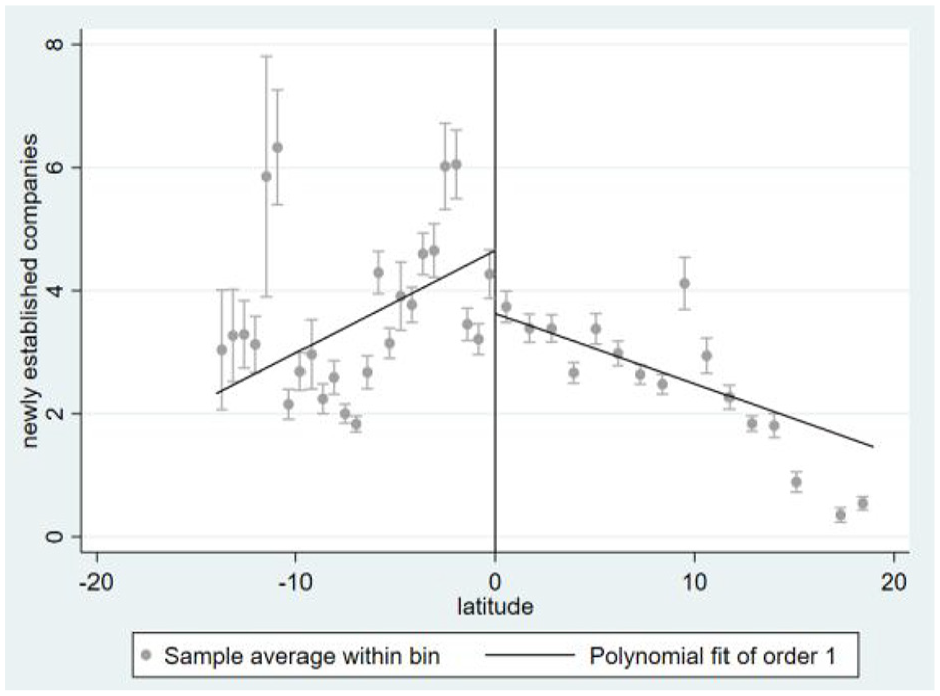
Map showing breakpoints of new companies along the QHL.
The findings presented in Table 3 provide further support for the relationship between air pollution and new companies. Specifically, in Column (1) and Column (2), the results based on Equations 2 and 3 reveal that the air pollution levels in the northern counties are significantly higher than those in the southern counties. These results align with the discontinuities observed in the breakpoint plots shown in Figures 1 and 2, reinforcing the applicability of the RDD approach in estimating the causal relationship between air pollution and new companies. Notably, the RDD coefficient in Column (2) is −0.6943, which is statistically significant at the 5% level. This suggests that an increase in PM2.5 emission concentration is linked to a reduction in the number of new companies. Moreover, Column (3) presents the results of the two-way fixed-effects OLS estimation based on Equation 4, confirming that air pollution significantly hinders the establishment of new companies. Controlling for other explanatory variables, county and year fixed effects, and clustering at the county level, each 1-unit increase in PM2.5 emission concentration leads to a 0.1685 decrease in the number of new companies. Taken together, these findings tentatively suggest that the discontinuity in new companies is caused by the discontinuity in air pollution. The empirical evidence from the RDD estimation and two-way fixed-effects OLS estimation supports the conclusion that air pollution has a negative impact on the establishment of new companies.
Impact of Air Pollution on Newly Established Companies.

Note. Figures in parentheses are standard errors in Column (1) and Column (2), figures in parentheses are county clustering standard errors in Column (3).***,**,*Indicate significance levels of 1%, 5%, and 10%, the same as above.
Discussion of the Results
Supportive evidence from previous studies further validates the effectiveness of the two-way fixed-effects OLS regression results. For instance, F. Zhang et al. (2020) found that a 1% increase in PM2.5 concentration leads to a 0.13% to 0.31% decrease in the proportion of the tertiary industry in the Beijing-Tianjin-Hebei region. Cao et al. (2022) found that a 1% increase in PM2.5 concentration hindered 0.1% of companies’ productivity in cities around the Yangtze River. Hao et al. (2018) concluded that a 1% increase in PM2.5 concentration resulted in a per capita GDP loss of less than 0.1%. These coefficients align closely with the two-way fixed-effects OLS regression coefficient (−0.1685) obtained in this study. The consistency between the two-way fixed-effects OLS regression coefficient in this study and those in the literature that also use two-way fixed-effects OLS models to estimate the relationship between air pollution and entrepreneurship highlights the reliability of the regression data and coefficients in this study.
When studying the causal relationship between air pollution and new company formation, applying RDD regression helps leverage the natural discontinuity in air pollution provided by QHL, thus mitigating endogeneity issues. In contrast to the two-way fixed-effects model, the RDD serves as a quasi-natural experiment capable of establishing a causal relationship between air pollution and newly registered companies. This significantly bolsters the study’s credibility in substantiating
Compared to G. Zhang and Liu’s (2023) study on the correlation between air pollution and entrepreneurship at the provincial level, this study’s analysis of the causal relationship at the county level offers several distinct advantages. First, counties have smaller geographical areas and boundaries than provinces, allowing for a more detailed delineation of breakpoint patterns in the relationship between air pollution and entrepreneurship. Consequently, this finer granularity provides stronger evidence for inferring a negative impact of air pollution on entrepreneurship. Second, county-level analysis enables the differentiation of counties situated north of the QHL, which lack heating policies, thus offering clearer distinctions in the study subjects. Third, examining the impact of air pollution on entrepreneurship from a county-level perspective can offer more practical policy recommendations for county governments. This, in turn, allows county governments to better balance environmental concerns and economic factors.
In conclusion, this study aligns with previous research and deepens the understanding of how air pollution affects entrepreneurship, particularly at the county level. By utilizing the fuzzy RDD method and exploring the unique context provided by the QHL, this study contributes to the literature on the causal relationship between air pollution and entrepreneurial activity. It underscores the urgency of formulating policies to address the adverse effects of air pollution on entrepreneurship, especially at the county level, and highlights the importance of balancing environmental sustainability with economic development.
Robustness Test
To ensure the validity of the RDD analysis, it is crucial to examine whether the running variable is controlled and whether its distribution is similar on both sides of the QHL. This helps prevent any endogenous grouping that might affect the fuzzy RDD results. In this study, the distribution of the running variable is assessed using a histogram, as depicted in Figure 3. By observing the variation of frequencies in different bins, it can be determined whether the running variable is under control. As depicted in Figure 3, the histogram displays a similar distribution of the running variable on both sides of the QHL. This indicates that the running variable is not subject to manipulation, meeting the requirements of RDD analysis. By demonstrating that the running variable exhibits a consistent distribution and is not influenced by endogenous grouping, this study confirms the validity of the fuzzy RDD method in estimating the causal relationship between air pollution and the establishment of new company.

Histogram showing the distribution of the running variable.
To ensure the validity of the RDD analysis, it is essential to assess the continuity of the control variables at the breakpoints. The continuity assumption states that control variables should exhibit smooth changes at the QHL. Table 4 presents the results of testing the continuity of the control variables at the QHL. Table 4 shows whether the control variables change smoothly at the cutoff point required for the RDD analysis. The results indicate that all control variables pass the continuity test, demonstrating consistent pattern of change at the breakpoint. Based on the successful assessment of the continuity of control variables, this study concludes that the RDD method is both reasonable and effective for estimating the impact of air pollution on new company formation. The results obtained using RDD provide reliable insights into the causal relationship between air pollution and new company, thereby enhancing the validity of the research findings.
Smooth Test at the Breakpoints for Control Variables.

Note. Figures in parentheses are standard errors.
To ensure the robustness of the baseline regression results and verify the absence of manipulation near the breakpoint, this study employs a “donut hole” approach. By excluding samples closest to the cutoff, the study examines whether the regression results remain significant. If the results are still significant after removing these samples, it indicates that the cutoff effect persists, ruling out the possibility of manipulation.
Figures 4 and 5 present the results of the robustness testing, which involves successively removing samples near the breakpoints of 1%, 2%, 3%, 4%, and 5%. Both figures demonstrate that for most regressions, the results remain significant after sample removal, indicating that the breakpoint effect persists and no evidence of manipulation is detected. This further strengthens the reliability and credibility of the baseline regression results. The use of the “donut hole” approach provides additional evidence to support the validity of the findings, demonstrating that the observed effects are robust and not influenced by potential manipulation near the breakpoint.
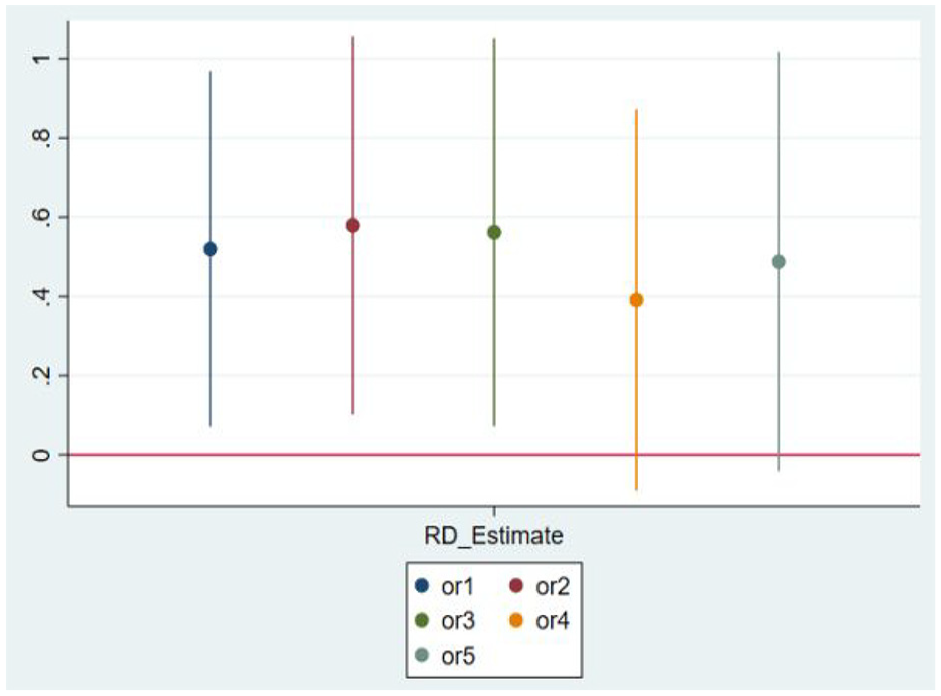
Donut test for PM 2.5 indicators.

Donut test for newly established companies.
Heterogeneity Test
The RDD estimates presented in Table 5 reveal significant differences between counties, regardless of provincial borders, highlighting intriguing findings on the impact of air pollution on new companies. The RDD estimate coefficient for air pollution is 0.5732, significant at 1%. This value exceeds the coefficient from the baseline regression (0.2857), indicating a greater positive impact of air pollution on new companies in counties along provincial borders. The RDD estimate coefficient for new companies is −0.7514, significant at 10%. This coefficient is lower than the one obtained from the baseline regression (−0.6943), suggesting a more pronounced negative correlation between air pollution and new companies in counties along provincial borders. In contrast, the two-way fixed-effects OLS regression coefficient for air pollution is −0.1651, significant at 5% level, slightly lower than the baseline regression (−0.1685). This suggests that compared to the RDD method, the OLS regression method may slightly underestimate the negative impact of air pollution on new companies. Additionally, when examining counties without provincial border, the RDD and two-way fixed-effects OLS estimates for newly established companies and air pollution (Columns (4)–(6) in Table 5) are not significant. The results in Table 5 imply that counties with provincial borders tend to have more lenient environmental regulations, leading to more severe air pollution. Therefore, air pollution has a greater impact on new companies in these counties. This finding aligns with the “Broken Window Theory,” which posits that regions with lax environmental regulation are more susceptible to the adverse effects of air pollution, thereby experiencing a “broken window effect” on entrepreneurship.
Heterogeneity Test for Provincial Border.

Note. Figures in parentheses are standard errors in Column (1), (2), (4), (5); figures in parentheses are standard errors in Column (3) and (6).
Mechanism Analysis
Labor Supply Shortage
This study hypothesizes that air pollution hinders entrepreneurship through labor supply shortage and the outflow of entrepreneurs. Regarding labor supply shortages, the RDD estimate coefficient for the variable Leoo is −0.0461, significant at the 10% level (Column (1) in Table 6). This indicates that the rise in air pollution is correlated with a decline in the labor market shortage. The two-way fixed-effects OLS regression coefficient for the same variable is −0.0046, significant at the 1% level (Column (2) in Table 6). This implies that a 1% increase in air pollution is linked to a 0.46% decrease in the labor market shortage. This supports
Mechanism Test.

Note. Figures in parentheses are standard errors in Column (1), (3) and (5), figures in parentheses are county clustering standard errors in Column (2), (4), and (6).
Finance Supply Constraints
Air pollution can increase reputation risk and operational costs, thereby intensifying financial pressure on companies. Companies in heavily polluted areas may face stricter environmental regulations, which in turn compel them to invest more in environmental protection to prevent pollution. Under environmental pressure, companies must spend more on air purification measures in polluted areas compared to cleaner regions. Under environmental pressure, companies must spend more on air purification measures in polluted areas compared to cleaner regions. From the perspective of financing constraints, the RDD estimate coefficient for financing constraint is −0.1307 significant at 5% level (Column (3) in Table 6). This indicates that as air pollution worsens, loan difficulties enhance, financing constraints increase. The two-way fixed-effects OLS regression coefficient is −0.0489, significant at 1% level (Column (4) in Table 6). This suggests that air pollution exacerbates financing constraints, which in turn hinder the acquisition of operating capital. The costs associated with air pollution include health-related expenses and environmental governance costs. Green technology is a survival strategy for companies. Hottenrott and Rexhäuser (2015) found that in Germany, green technology driven by environmental regulatory pressure hinders internal R&D, especially for financially constrained companies. Air pollution often exacerbate local financial constraints, hindering entrepreneurship, which supports
Innovation Activity Reduction
As previously mentioned, air pollution may reduce innovation activities, thereby hindering entrepreneurship. From the perspective of innovation capability, the RDD estimate coefficient for domestic invention patent applications is −0.5187, significant at 1% level (Column (5) in Table 6). This indicates that as air pollution concentrations increase, the number of invention patent applications decreases. The two-way fixed-effects OLS regression coefficient for domestic invention patent applications is −0.1499, significant at the 1% level (Column (6) in Table 6). This suggests that air pollution hampers innovation investment and activities, thereby undermining local entrepreneurial spirit. These findings support
Conclusion and Policy Implication
This study utilizes county-level data from China and employs fuzzy RDD and two-way fixed-effects OLS regression methods to examine the impact of air pollution on entrepreneurship. The following conclusions are drawn: (1) Differences in air pollution along the QHL correspond to disparities in entrepreneurship within the same region. (2) The results of the fuzzy RDD regression highlight the causal relationship between air pollution and entrepreneurship, confirming
Supporting a green economy is crucial because good air quality can promote entrepreneurial decision and enhance overall levels of mass entrepreneurship. This study has significant policy implications. (1) To elevate entrepreneurship levels, relying solely on traditional fiscal measures such as tax breaks and policy support, is insufficient. Developing a regional brand centered on high-quality ecological environments can attract external resources and improve the entrepreneurial landscape, thereby encouraging individual entrepreneurship. Given the importance of the ecological environment to capital flows, local governments should focus on creating natural resource brands characterized by excellent air quality to attract external labor and investors. This will create favorable conditions for widespread entrepreneurship and innovation, ultimately driving economic development. (2) Shifting traditional development perspectives requires balancing economic and ecological benefits. Implementing green economic development and avoiding short-term achievements at the expense of the environment is essential. Increasing the weight of the ecological environment in political evaluations and improving air quality and entrepreneurial spirit through institutional reforms are crucial. (3) Encouraging local banks to provide convenient startup loans using digital technology is a crucial strategy. This approach can improve individual financial situations, alleviate funding pressures, and facilitate entrepreneurial decisions. Research indicates that financial status and social capital are key factors in how air pollution affects entrepreneurial decisions. The government can enhance overall entrepreneurship capacity by improving personal financial conditions and fostering an entrepreneurial spirit. Additionally, establishing free and open entrepreneurship exchange centers and online platforms can provide potential entrepreneurs with information and resource, thereby strengthening local social capital and promoting widespread entrepreneurship. (4) Collaborative action between regional governments. Establishing a tighter cooperation mechanism among county-level governments along provincial borders is essential. By jointly developing and implementing regional air pollution control plans, these governments can prevent the “hands-off” approach and ensure comprehensive coverage of control measures.
Footnotes
Acknowledgements
This manuscript has not been submitted to any journal for publication, nor is under review at another journal or other publishing venue.

Author Contributions
This paper is written by the four authors named in the title page. Feng Yang: Literature, Methodology, software, Formal analysis, Investigation, Resources, Writing original draft, Writing—review and editing, Visualization. Tingwei Chen: Software, Formal analysis, Investigation, Visualization, Project administration, Supervision, Writing—review and editing, Methodology. Jiangang Gao: Writing—review and editing, Funding acquisition. Zongbin Zhang: Supervision, Writing—review and editing.
Funding
The author(s) disclosed receipt of the following financial support for the research, authorship, and/or publication of this article: This work was supported by the National Social Science Fund of China (Grant No.20BJY074).
Declaration of Conflicting Interests
The author(s) declared no potential conflicts of interest with respect to the research, authorship, and/or publication of this article.
Data Availability Statement
Data sources are outlined above in the section variables, and will be available on demand.