




Abstract
City Development Strategies (CDS) are strategic documents widely employed by cities worldwide to outline municipal governments’ visions and intentions for urban development. Given that young people constitute approximately 25% of Europe’s population and represent one of the most significant user groups of urban spaces, their perspectives are crucial in shaping these strategies. Assessing the provisions of CDS from the standpoint of young people is therefore essential. Such evaluation not only highlights how effectively these documents address the needs and expectations of this demographic but also serves as a foundation for improving future strategies to ensure they are inclusive and responsive to the priorities of young urban dwellers.
Introduction
Development strategies are standard documents in many cities around the world, promoting comprehensive and integrated planning driven by urban social and economic development priorities (Parnell & Robinson, 2006; Partidário et al., 2008; Rasoolimanesh et al., 2012). They can reflect the city government’s intentions for its future development based on current resources and the identified social, economic, cultural, spatial, environmental, etc. situation (Asian Development Bank, 2004; Rasoolimanesh et al., 2012, 2016). The form of city development strategies (CDS) varies widely, however they have a common function: to give direction to urban development and address challenges (Cities Alliance, 2011; Partidário et al., 2008; Rasoolimanesh et al., 2016). Despite their declarative nature, the goals set in CDS, if attempted, can directly impact the lives of residents and other users of cities (Parnell & Robinson, 2006; Rasoolimanesh et al., 2016).
The achievement of the goals set out in the strategy can be measured by a series of indicators, often proposed in the document itself, and an effective CDS should improve the performance of cities as measured primarily by economic, social and spatial growth in a sustainable manner (Partidário et al., 2008). What seems equally interesting is the presence of provisions that indicate some ideas that the city leaders have about the development of the city they manage. They leave a lasting footprint that testifies to the awareness of city officials of the existing problems, advantages and opportunities of the city and their response to them (Didier et al., 2012; Rasoolimanesh et al., 2014). Thus, they can be a valuable indication of the approach of cities to particular areas of development, as well as an opportunity to discover a general trend involving the direction of urban development prevailing in a specific area (e.g. region or country).
The desire to adapt CDS provisions to the social conditions prevailing at the time of their creation has recently led to special attention being paid to the ageing population and the elderly (Buffel & Phillipson, 2016; Nefs et al., 2013). Much attention is also being paid to the largest group of residents in most cities—people of working age, who primarily provide economic growth for urban centres (Cruz & Ahmed, 2018; Salvati & Carlucci, 2018; Tonucci & Rissotto, 2001). For this reason, cities are taking more and more measures to adapt public programs and their development path to these categories of urban users and to fit in with global trends and changes (Rasoolimanesh et al., 2012). Young people are also a large group of city users. People under the age of 25 are most often considered to be such (Evans, 2008; Freeman, 2020; Horton et al., 2008). According to EUROSTAT data, young people made up 25.53% of the population in European Union countries in 2022. This means that over 114 milion people in the European Union are classified as young. Simultaneously, UN projections indicate that by 2030, 60% of the global population will reside in urban areas (United Nations, Department of Economic and Social Affairs, Population Division, 2018). These figures underscore the need for young people to hold a prominent place in urban development policies. This raises the question of whether this social group is adequately represented in such document and, if so, to what extent.
Therefore, the purpose of the study is to identify provisions for young people in the development strategies of Polish district cities. The implementation of the stated goal was based on the search for answers to the following research questions:
(Q1) Do development strategies of Polish district cities include provisions related to young people, and in which parts of these strategies are they addressed?
(Q2) What topics related to young people are covered in the development strategies of Polish district cities, and how is their voice considered in the strategy-making process?
Literature Review
City Development Strategy as a Tool to Help Meet Urban Challenges
Urban development strategies are considered in the literature as a useful, widely adopted tool to enable cities to meet economic, social and environmental challenges (Keivani, 2010; Rasoolimanesh et al., 2016; Zhang, 2013). They are a reaction and response to contemporary challenges and a relatively new approach to planning in order to cope with the rapid changes occurring in the world (Didier et al., 2012; Rasoolimanesh et al., 2014). Factors such as changing population numbers and structures and socio-spatial changes significantly impact urban areas, especially in developing countries (Watson, 2009). In addition to this, cities face, for example, the phenomenon of suburbanization, inequality, poverty, pollution, globalization and economic competition, or more recently, health and security issues (Dembski at al., 2021; Florida, 2017; Giles-Corti et al., 2016; King, 2016; Lee & Rodríguez-Pose, 2021; Rodríguez et al., 2016; Sennett, 2017; Szmytkie, 2020). In addition to the above, cities are required, among other things, to develop quality spaces, sustainable transportation, or promote civil society and values that include all citizens in city life (Beall, 2000; Gerometta et al., 2005; Miller et al., 2016). One should add challenges related to local conditions to the above challenges, which are not a finite list (Rasoolimanesh et al., 2016). In Poland, for example, many cities from 2022 onward are also facing a migration crisis caused by Russia’s aggression against Ukraine, which is affecting many spheres of life for city residents and the functioning of municipal organizational units, such as schools and hospitals (Werczyńska, 2022; Wojtasz, 2022).
Cities are making efforts to deal with all of the above and many other challenges. Still, their efforts are often constrained by a lack of financial resources and other limitations imposed on local governments (Beall, 2002). Therefore, it is essential to identify the resources and conditions at hand and carefully select development goals and activities to strategically and as effectively as possible formulate, implement and evaluate development projects based on the opportunities found (Halla, 2007;Kim, 2002; Parnell & Robinson, 2006; Partidário et al, 2008; Zhang, 2013). These are parts present in a model city development strategy. The methodology for creating such documents varies and is based on several basic building blocks (Cities Alliance, 2011; Rasoolimanesh et al., 2016). The World Bank (2000) distinguishes between identifying a city’s concerns, a comprehensive analysis, and identifying financial resources to achieve goals. Cities Alliance (2002), on the other hand, points to design and assessment, vision and strategy and implementation and monitoring. These parts are created during a process that, according to ECON (ECON Analysis and Centre for Local Government, University of Technology, Sydney, 2005), can be divided into seven stages: (a) process design, (b) initial or updated assessments, (c) consultation and participation, (d) vision, goals and objectives, (e) action plans and implementation, (f) institutionalization and (g) monitoring and evaluation. Cities Alliance (2006) points to seven steps for creating and successfully implementing a CDS: (a) initiating the process; (b) establishing the initial parameters and scope of the CDS; (c) making an initial assessment; (d) formulating a vision; (e) identifying SWOT analysis; (f) setting strategic thrusts; (g) building awareness; and (h) starting the implementation. No matter what methodology is adopted to create a CDS, its success is largely determined by attention to the components (Partidário et al., 2008; Rasoolimanesh et al., 2014).
Participation of Young People in Urban Development
It is noteworthy that the CDS emphasizes a participatory approach involving local stakeholders in order to formulate as precisely as possible a development vision based on an analysis of various aspects of the city’s development (Parnell & Robinson, 2006; Zhang, 2013). CDS’s assumptions about the inclusive nature of these documents result in attention being paid firstly to the groups that co-created the document, and secondly to the degree to which the interests of these groups are incorporated into the content of the document.
One of these groups is young people under 25 (Brooks et al., 2021; Freeman, 2020; Janning & Volk, 2017). This cut-off age is associated with, according to the theory of life transitions, youth marginalization theor or social role theory, the end of education and the start of a career and a change in social status. In many cultures, this age is accepted as necessary in terms of fully engaging with society and directing one’s activities towards non-educational goals. In the social sciences, it is the age considered to be the end of the transition stage between youth and adulthood associated with the brain and the refinement of decision-making, self-control and planning skills (Eagly & Wood, 2012; Giardiello, 2024; Selder, 1989). A large proportion of these are people under 18, who in many countries around the world do not have full rights until they reach that age. Despite the increasing recognition of young people’s rights in both academic discourse and public policies, which intensified in the last decade of the 20th century (Golledge & Stimson, 1987, 1997; Lewis & Walmsley, 1997; Timmermans & Golledge, 1990), the civic engagement of members of this social category is undervalued or even undermined and blamed on a crisis of citizenship (S. Hart, 2009). This is related to the still prevailing perception among some people (including those who have direct influence on the formulation of urban policies) of young people as just forming adults, often a threat to citizenship and democracy, who need to be properly educated and their behaviour controlled (S. Hart, 2009). Often, young people’s voices are not considered until they are deemed suitable by adults for inclusion in adult society.
As R. A. Hart (1992) points out, it is not customary anywhere to allow children to occupy the same level on the ladder of participation as adults. Children’s participation in the urban planning process is marginalized (Ataol et al., 2019). This reflects where adults place children in society, as if they were less mature and experienced, and more vulnerable and dependent on others (Brzozowska-Brywczyńska, 2014). As Rehfeld (2011) notes, political maturation is developmental and continuous, and reaching a certain age does not suddenly cause the full emergence of this maturity. Situations in which young people are disregarded because of their age lead to difficulties in developing a positive sense of themselves as citizens by these individuals, their vulnerability, and also affect their self-esteem (S. Hart, 2009). Excluding young people from influencing reality can be very damaging for society as a whole (Rehfeld, 2011).
Meanwhile, children and adolescents show great competence in analysing environmental problems and formulating new ideas (Horelli, 1997). The literature indicates that children should be treated as valuable agents of change (Mansfield et al., 2021; Pulkkinen, 2017; Westley et al., 2013), and their participation in urban planning processes can benefit the entire community, empowering them and their own development into responsible citizens (Bartlett et al., 1999). For this reason, it is necessary first to include children in the strategic planning process and second, to evaluate the provisions in these documents. Derr et al. (2018) conclude that if barriers to participation are lowered and adequate support is provided, children can share their views and insights from an early age. For this, however, there is a need to stop the constant reinforcement of children’s barriers to participation put up by adults to protect their individual interests and reluctance to share their agency (Mansfield et al., 2021). However, a change in this regard will result in a better representation of children’s needs in urban policies.
In Poland, despite being an important part of society, young people are treated rather marginally in public policy. The needs of young people are rarely prioritised in political decisions. Problems such as high unemployment, low wages or limited access to housing and stable living conditions are not sufficiently reflected in government and local government action. Youth councils or consultative forums, which should be a space to actively involve young people in political life, in practice have a marginal impact on decision-making and their role is often formal and apparent. Furthermore, the lack of sufficient offer of mental health support, vocational education and social activation deepens young people’s sense of exclusion and alienation. Despite declarations of equal treatment, young people in Poland are still not treated equally to other social groups, and their voice in the process of creating public policy remains insufficiently taken into account (Kanclerz & Konarczak, 2018).
Materials, Methods and Study Areas
Studies of the presence of records in development strategies were conducted using the document analysis method. The research was conducted on secondary data and did not involve human participation. Applied method involved evaluating documents on the basis of analysing and interpreting the data contained therein in order to discover the meaning of the content and its understanding, and to develop empirical knowledge (Bowen, 2009; Corbin & Strauss, 2008; Rapley, 2007). The documents themselves are understood as “social facts” that are created, shared and used socially in an organized manner. The analytical procedure itself involves finding, selecting, evaluating (making sense of) and synthesizing the data contained in the documents. Text fragments are then organized into themes, categories and examples (Labuschagne, 2003).
This analysis included all 66 cities in Poland with district rights in 2023. This approach enabled the collection of data from a diverse range of cities differing in for example spatial and demographic structure, history and development goals. A detailed list of cities, together with statistics on population numbers and the percentage of young people, is attached as Appendix 1 (Figure 1).

Spatial distribution of cities with district rights in Poland.
First, all available strategic documents for district cities in Poland were collected (A link to a page containing a sample CDS document (for Warsaw) can be found at this link: https://um.warszawa.pl/waw/strategia/strategia-rozwoju-miasta). Then they were initially reviewed in terms of their validity—the year of drafting, as well as the adopted time horizon. After a preliminary analysis of the content of the acquired strategic documents, it was decided to analyse their 6 pars. Three of them are mandatory parts indicated in the Act on Municipal Self-Government (diagnostic part, development goals and activities), while the other three (SWOT analysis, vision and mission of the municipality) were selected due to the significant share of these parts in the vast majority of the analysed strategic documents.
The collected documents were searched for the phrases “child,”“youth,”“young,”“underage,”“18,”“student” and “minor,” along with all variations of these words in Polish (in Polish, the words often have different forms due to the feminine or masculine grammatical gender). Searches were performed manually by reviewing all collected CDS. First, extracts containing keywords were searched for. The collected extracts were then qualitatively analysed using data-driven open coding. In addition, special attention was paid to reviewing the six parts of the strategy selected for the study, looking for elements referring to children and young people in each document. It was examined whether literal children were mentioned among these parts, and the content and development of slogans present in the strategies were reviewed to identify activities for children which were not directly included. At the same time, at the stage of analysis, any phrases having the above-mentioned phrases, for example “mothers with children,” were rejected on the assumption that such entries, despite the final, mostly indirect impact on young people, in fact refer to another social group (e.g. mothers). On the other hand, due to Poland’s universal obligation to educate up to the age of 18, it was assumed that childcare and primary and secondary education records directly affect young people.
The collected material was subjected to qualitative analysis, on which a total of 13 categories of topics relating to young people present in the development strategies of Polish district cities were identified. This made it possible to compare documents from different cities both quantitatively and qualitatively. For some of the information gained during the qualitative analysis, simple mathematical and statistical calculations were carried out to help draw more correct conclusions. In this regard, the r-Pearson correlation coefficient was mainly used. It is worth noting, that the study, based on document analysis method, captures explicitly articulated mentions of youth-related issues, based on a defined set of keywords and structural elements of the strategies.
The study has several limitations that need to be taken into account when interpreting the results. Firstly, the search for relevant phrases in strategic documents was based on a predefined set of keywords (e.g. “child,”“youth,”“student,” etc.), which may have led to the omission of indirect references or alternative vocabulary that could also apply to young people. Secondly, the study focused on the strategic documents of district cities in Poland, which may not be fully representative of other regions or types of municipalities in the country. The results of the study may therefore not be fully generalisable to the policies of all cities in Poland or smaller towns. Another limitation may be the manual document search process. Although accurate, it may involve potential human error or inconsistencies in identifying and categorising relevant passages. The findings should be interpreted with an awareness of potential human bias in identifying relevant excerpts. Also figures should be viewed as indicative rather than definitive, given the manual nature of document screening and coding. It is also worth emphasising that the analysis of the level of participation was carried out on the CDS provisions, which are publicly accessible, rather than on the consultation protocols, which are the accompanying documentation for this type of document.
Results
Topics Connected With Young People Raised in CDS of Polish District Cities
The analysis of strategic documents made it possible to identify passages and mentions of young people in the development strategies of district cities. This made it possible to identify 12 main categories of topics present in the analysed documents. One supplementary category was also separated, containing issues rarely raised, from which it was impossible to create separate categories.
1) Mobility: the content of the strategy emphasizes that many young people leave in search of work or because they want to increase their earnings. Young people who do not see prospects for continued life in their current city seek happiness elsewhere. This category also applies to migration to other cities for studies and migration from smaller cities to larger ones. Also present in the development strategies are the themes of attending another school, outside of one’s place of residence and commuting to cities from neighbouring towns, which is also included in this category. Attention has also been paid to the issue of mobility within the city, that is ways of moving within the city space, especially for work purposes, but also in the context of entertainment and leisure.
2) Education and childcare: in this context, development strategies address the number of nurseries, kindergartens and schools and the number of students attending them in the context of demand for such services, the quality of education and childcare. Entries in the development strategies of Polish district cities under this category therefore cover a very wide age spectrum - from the youngest children attending nurseries to high school and college students. In addition, based on the analysis, the issues of passing elementary school and high school diploma examinations and the inclusion of foreigners in the school education system also fell into this category. The last issue is related to the increased influx of migrants, mainly from across the eastern border with Poland, which gained momentum after Russia’s aggression against Ukraine in 2022. It is worth noting that most of the analysed strategies were enacted before 2022, hence their provisions in this regard have gained particular importance after February 24, 2022.
3) Demographics: in the analysed documents one can find information about the inevitable changes in the demographic structure of district cities in Poland, which most often lead to an ageing population and an increase in the post-working age population. In individual cases, a favourable demographic structure was highlighted. Data on demographics presented in the development strategies of Polish district cities also often refer to the need to provide incentives for young people to stay or settle in the city area.
4) Labour market: the provisions of the strategy in this area relate to the professional and economic activity of young people, especially young mothers, who often struggle with problems in employment or continuity of employment. Many documents note the share of young people in the total number of the unemployed and insufficient number of jobs. Issues related to cooperation between educational units and the economic environment in order to provide young people with the highest possible professional qualifications are also raised. In addition, in the analysed documents one can find provisions for supporting entrepreneurship among young people.
5) Leisure time and personal development: the identified content refers to the operation or the need to create educational and development activities, especially in the field of culture. In addition, there are all issues related to creating and modifying recreational infrastructure (e.g. deck chairs, benches, small architecture) and sports facilities (e.g. playing fields, courts, running tracks, outdoor gyms). The number, condition and offer of catering facilities also fall into this category.
6) Housing market: includes provisions relating to the state of housing availability for young people, their preferences for where to live both on a supra-local scale (choosing a city to live in) and on a local scale (choosing a neighbourhood in the city), as well as their choice of a particular type of property (e.g. single-family or multi-family development). This category also included mentions of incentives that cities are trying to implement in this regard.
7) Physical activity: in the development strategies of district cities, there are numerous provisions relating to attendance at physical education classes in schools and the number of participants in sports and extra-curricular activities in schools. There are also provisions relating to sports activities carried out by young people on their own in their free time. CDS often, although not directly, recognize the value of informal, self-initiated physical activities undertaken by young people in their free time, such as playing football in local parks, cycling, or using public sports facilities. Many cities include provisions to support and enhance access to such opportunities by investing in infrastructure like playgrounds, sports fields and open-access fitness equipment.
8) Support: Provisions related to the health status of children and adolescents in district city development strategies emphasize a holistic approach to well-being. These include addressing critical issues such as physical health, mental health and addictions, recognizing their interconnectedness and significant impact on young people’s development and quality of life. Mental health receives increasing attention, with strategies highlighting the importance of early identification of issues such as anxiety, depression and stress. These provisions advocate for accessible psychological support services in schools and community centres, as well as training for educators and parents to recognize signs of distress and provide appropriate support.
9) Health care: Provisions related to health care in district city development strategies place significant emphasis on the well-being of children and adolescents, recognizing the unique challenges faced by this age group. Key areas of focus include addressing physical health, mental health and addictions. Strategies often highlight the importance of comprehensive health assessments to monitor the overall health status of young people and identify emerging issues early. Furthermore, these strategies prioritize the improvement of medical services by enhancing the availability of paediatric care, ensuring shorter waiting times for specialists, and expanding preventive health programs. Collectively, these provisions demonstrate a commitment to fostering a generation that is healthy, both physically and mentally, equipped to lead fulfilling lives.
10) Safety: Safety provisions in district city development strategies focus on creating environments where young people feel secure and protected from harm. These strategies address both objective measures, such as juvenile crime rates, and subjective perceptions of safety, recognizing the importance of both in shaping young people’s experiences and opportunities.
11) Civic activity: provisions focussing on young people’s identity with the place where they live, participation in social initiatives, aspirations of the younger generation and involvement in non-governmental entities. In addition, mentions of intergenerational integration and the formation of young people as social leaders with high creativity and potential are included in this category.
12) Public space: the condition of current public spaces, as well as planned new spaces, issues of revitalization and aesthetics of publicly accessible places as well as buildings. This category also includes provisions for public services.
13) Other: there were also other issues present in the analysed documents but they occurred much less frequently and sometimes singularly, which is why they were included in the last, supplementary category of other. These included issues relating to foster families, the expectations of the younger generation of the city, the use of technology among young people, and sensitivity to extreme weather events.
Distribution and Differentiation of Youth-Related Provisions in the CDS Structure
In the development strategies of Polish district cities, the presence of provisions concerning young people varies. Content analysis of the collected documents made it possible to recognize the distribution of such provisions in the structure of the strategies. Some of them contained such provisions in only one of the six analysed parts. Meanwhile, they could be found in five of the six parts. This is mainly due to the small number of provisions in the vision and mission of city development (provisions referring to young people appeared in the visions of 15 cities, and the mission of only one of them), and the moderate occurrence in the SWOT analysis (provisions of this type appeared in 33 documents). Considering only the diagnosis, goals and actions, it turns out that 26 documents (39.4%) have provisions relating to children and youth in all three of the above parts. In another 32 documents (48.5%), mentions of this social category appear in 2 of the 3 partsOnly 8 documents (12.1%) include provisions in just one part, and no document completely omits references to young people. The most common gap in provisions concerns the goals section, where 34 documents (51.5%) lack entries related to young people. The diagnostic and action sections show fewer gaps, each with only 7 documents (10.6%).
The diversity of records regarding young people was also analysed, divided into 13 identified categories. The most diverse provisions, that is those that raise various issues, are present in the proposed activities. This element contains entries from an average of four categories. It is worth noting, however, that no document contained provisions from all 13 categories in the context of young people (the highest result was 9 categories). In the diagnostic part, the average was 3.35 (highest score: 8), and in the objectives part, 1.12 (highest score: 9). In turn, in the context of SWOT analysis, this value is 1.18. In the case of vision and mission, these are much lower values—0.3 and 0.02, respectively.
In the diagnostic parts of the analysed documents, most attention was paid to the topic of education and care services (44 mentions), as well as mobility (31 mentions). In turn, the areas that were least popular in diagnoses were health care (6 mentions), civic activity (5) and safety (4). One thematic category stands out in the goals proposed by Polish district cities—education and care services (20), which appears particularly often compared to others. At the other extreme, there are provisions regarding health care (3), security (2), demography (2) and the housing market (1). In turn, the measures in terms of the most popular categories include provisions regarding support (42), education and care services (38) and the labour market (30). The least popular and outstanding in this respect were the provisions regarding demography (4). Generally, the appearance of provisions within the identified categories can most often be observed among activities (264 times; 31% of all possible entries) and in the diagnostic part (221; 25.8%). This type of entries appeared much less frequently in the SWOT analysis (78; 9.1%) and goals (71; 8.3%). Marginal participation was also recorded in visions (20; 2.3%) and missions (1; 0.1%). The calculation took into account the maximum possible number of records for each section (66 cities × 13 categories = 858) and the number of records in a specific category. This provided a picture of the diversity of records visible in the strategies by the identified categories. The analysis did not focus on the total number of records in a particular category (Figure 2).
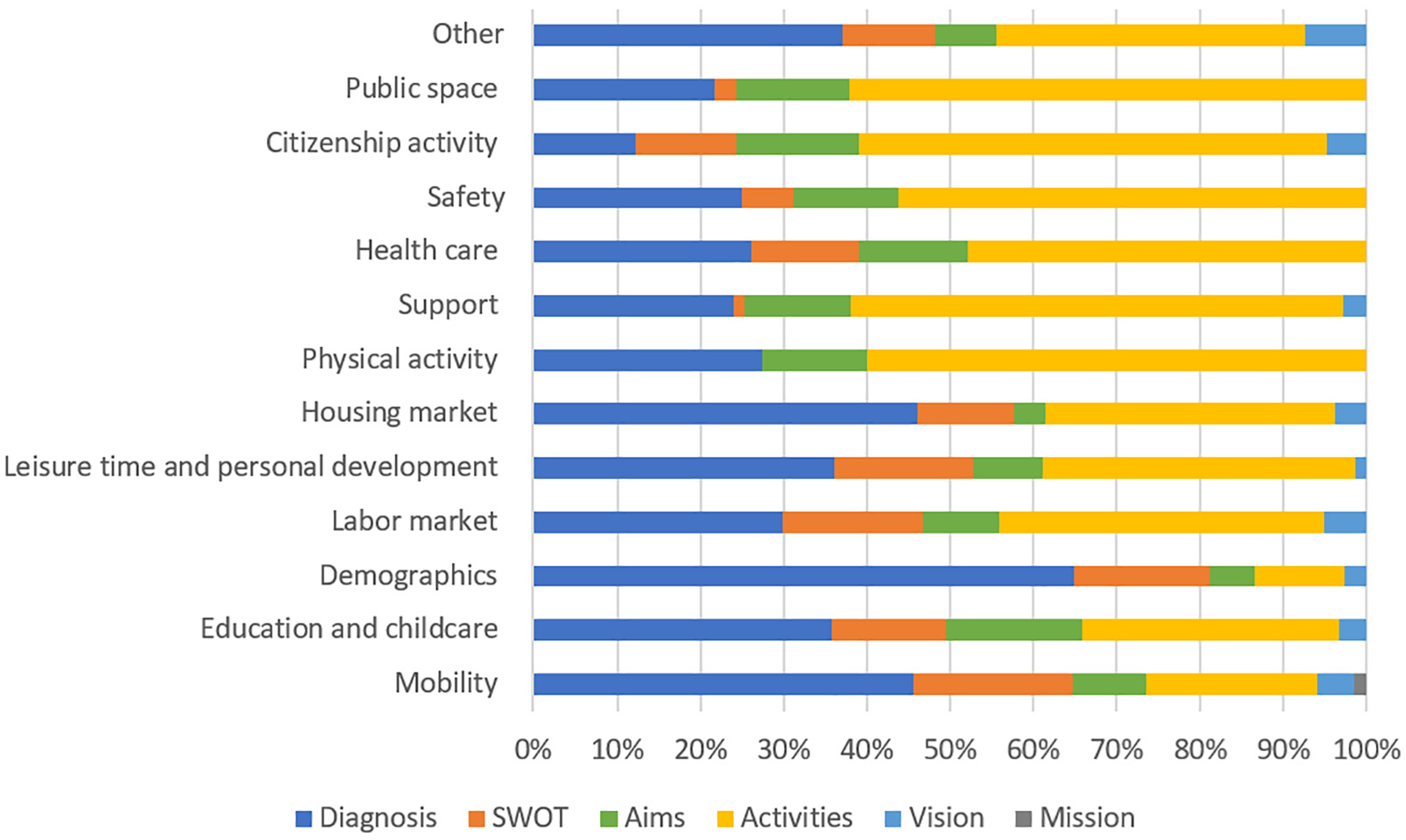
Distribution and share of identified categories in the analysed CDS parts.
Cities’ Perspective on Issues Related to Young People—What are the strengths and weaknesses?—What is an opportunity and a threat?
Of the 66 analysed documents, 52 (79%) included a SWOT analysis. Due to its structure, this CDS element was analysed separately. Thanks to this, it was possible to identify issues concerning young people, which were directly assigned by the city authorities to four categories: Strengths (S), Weaknesses (W), Opportunities (O) and Threats (T). The majority of entries in the SWOT analysis referred to weaknesses, with 37 entries. Strengths and threats followed closely, each accounting for 16 entries, while opportunities were the least frequent, appearing only 9 times. The most frequently mentioned issues in SWOT analyses are related to education and care services (17), mobility and the labour market (13 each), as well as free time and the development of interests of young people (12). The remaining categories are much less present in the provisions of SWOT analyses of Polish district cities. It is worth noting that the provisions relating to weaknesses are by far the most diverse, including separate categories (11), the remaining parts (strengths, opportunities and threats) contain 5 categories each (Figure 3).

Distribution and number of thematic categories referred to in the SWOT analysis.
The weaknesses (W) are dominated by provisions relating to the outflow of young, often qualified, educated people to other cities. Moreover, there are shortages of publicly available rest and recreation areas for children and insufficient leisure time offers for young people. The problem of unemployment and low professional activity as well as the low level of remuneration for young people is emphasized. It is also pointed out that young people have low social involvement. This is due to a lack of meaningful opportunities to participate in civic life, limited access to platforms on which young people can express their views, and a sense of lack of involvement in decision-making processes. Moreover, this part of the SWOT analysis included provisions regarding the insufficient number of extracurricular and out-of-school artistic activities for school-age children.
The outflow of young people to larger urban centres, related mainly to economic migration, was identified as by far the greatest threat (T). The reduction in the number of young people in the general population structure is also noticed in the context of economic growth. On the other hand, this part of the SWOT analysis notes the growing unemployment rate among young people and different educational preferences of young people in relation to the demand on local labour markets.
Among the strengths (S), the most prominent were issues related to the activities of educational and care facilities, especially nurseries and kindergartens. Infrastructure investments in the educational sphere are also recommended, as well as the improvement of soft skills in the development process of young people. Moreover, opportunities are seen in the large percentage of young people in the demographic structure of some cities, the operation of preventive health programs for young people and the growing number of cultural events and trainings addressed to young people.
The opportunities (O) indicated in the analysed documents mainly concerned the increasing importance of vocational education, which is a response to the needs of local labour markets and cooperation with entrepreneurs affecting the professional development opportunities of young people. On the other hand, the role of higher education and many young people going to college is also appreciated. The role of young people’s mobility and their ability to adapt to employers’ requirements is also emphasized. Moreover, opportunities are seen in the increasing participation in cultural events for children and young people and in the activities of non-governmental organizations working for children and young people.
What Actions Do Cities Propose for Young People?
The provisions in the form of proposed actions have the greatest chance of implementation and, therefore, have a direct impact on the lives of young people in district cities. At the same time, as previously mentioned, they are the most popular element of the analysed strategies in terms of occurrence. Only seven CDSs had no activities referring in their content to young people. The remaining 59 documents (88%) identified various activities relating to this social category. The most popular of them are activities in the field of support for young people (present in 42 documents) and education and care services (38). In turn, issues related to demography turned out to be the least popular. In terms of diversity of activities, the average number of thematic categories included in this element of the development strategy of Polish district cities was 4 (similar to the median). It should be emphasized that almost half of the cities (27 out of 59) included activities from at least 5 identified categories. On the other hand, a relatively small set consists of strategies with monothematic activities related to young people (5 documents) (Figure 4).
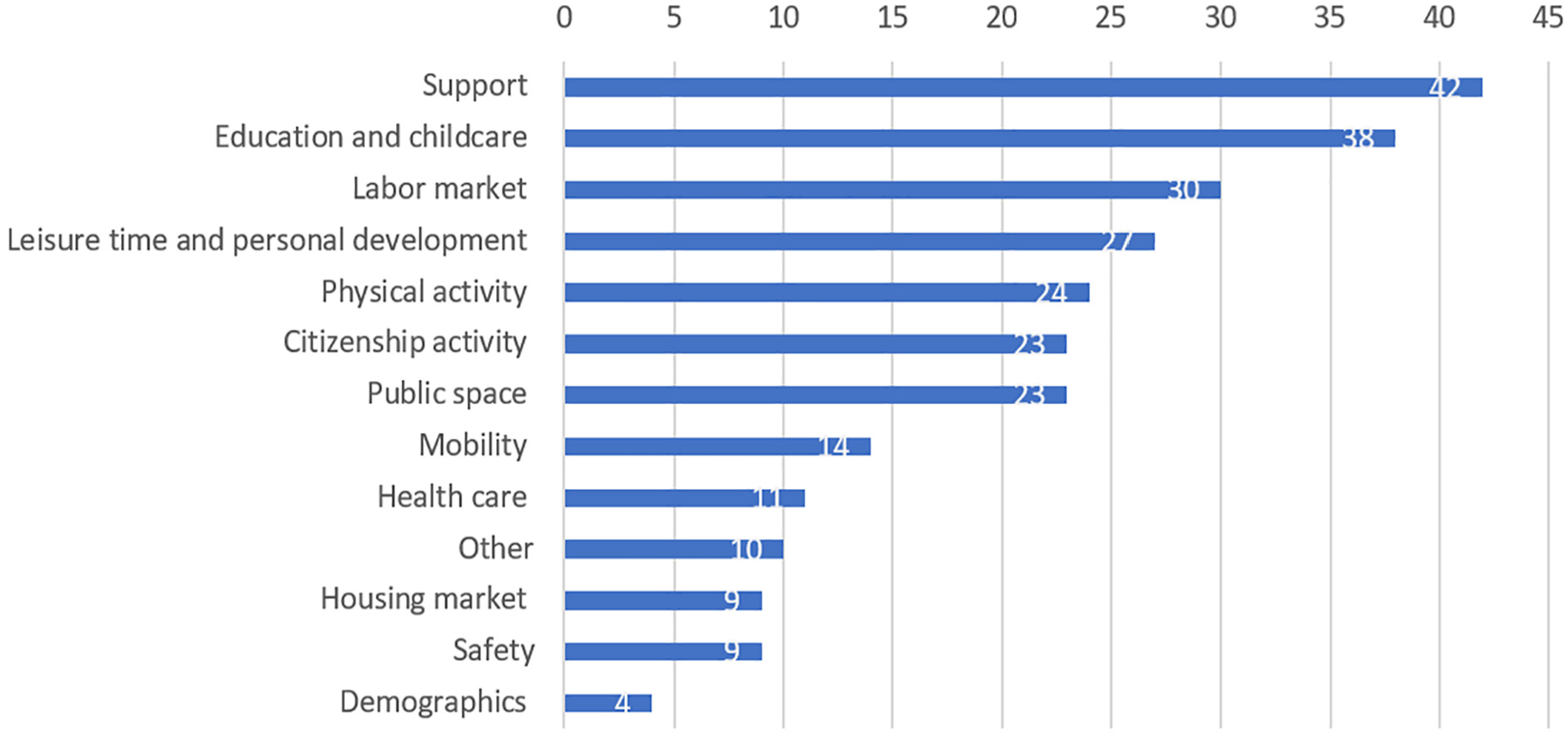
Number of documents containing activities in particular thematic categories.
The provisions in the CDS clearly indicate that support activities for young people should focus on psychological assistance. This issue is emphasized in many documents and the most exposed in them. In addition, activities aimed at preventing and eliminating social exclusion (including the inheritance of poverty), supporting digital competences (e.g. by providing programming basics), promoting a healthy lifestyle among young people (including good eating habits and counteracting overweight) and shaping pro-ecological attitudes also play an important role. In addition, activities aimed at supporting sports and artistic development are also important. Other provisions in this category include the organization of campaigns to combat stereotypes, educational and career counselling, institutional support for the observance of children’s rights, material support and help in recovering from violence.
The second most popular thematic category among the activities proposed in the CDS of district cities in Poland is education and care services. In this respect, the proposed activities are mainly related to ensuring the availability of places in nurseries and kindergartens and attractive opening hours of these facilities. Additionally, investments in teaching infrastructure are planned (e.g. modernization and construction of buildings, purchase of computer equipment and teaching materials), as well as equalization of educational opportunities. In addition, great emphasis is placed on activities related to adapting education to the needs of the labour market. Other activities proposed by district cities in CDS concern education in the field of soft skills, cultural and artistic skills and entrepreneurship, increasing the quality and standards in education and childcare, implementing educational projects developing the interests of young people and adapting schools to the needs of minorities (mainly people with disabilities and foreigners).
Actions regarding the labour market are also significant. They include primarily support for promoting entrepreneurial attitudes among young people, financial support for educating children and young people in the field of creativity and entrepreneurship, preventing and reducing youth unemployment, activities activating entrepreneurship and introducing young people to the labour market. In addition, activities are proposed to prepare for entering the labour market, strengthening career counselling, eliminating barriers to employment and preparing young people for the realities of a market economy.
In the context of young people’s free time and interests, CDS mainly proposes activities that increase the diversity of the cultural offer and involve preschool children and primary school students in city-wide events. Additionally, activities in this area include the creation of training centres, the introduction of classes that develop students’ interests and talents, creating conditions for the development of creative activity and the organization of events based on the identification of young people’s needs.
The two most popular activities regarding young people’s physical activity were also identified. They are increasing access to existing sports facilities as well as projects aimed at popularizing sports and recreation among young people and children from an early age. In addition, CDS offers many other, slightly less popular activities, such as organizing more sports activities (including school extracurricular activities), supporting the activities of local clubs and expanding their offer for children and youth, developing recreational and sports facilities in cities (both in terms of the number of facilities and their diversity, as well as quality), regular research on the physical fitness of children and adolescents, as well as the development and improvement of the sports training system for children and adolescents.
Activities aimed at civic activity indicated in the CDS include supporting the sense of local identity, providing wide opportunities for social participation and thus increasing the social activity of young people, as well as promoting and developing volunteering among young people. Other activities in this category include promoting the culture of being a citizen and civic education, supporting intergenerational integration, creating social projects attractive to young people, as well as allocating part of the civic budget to implement initiatives proposed by young people.
The declared actions regarding urban space mainly include the removal of architectural barriers that prevent their free use by as many social groups as possible, providing space for children in public places, and the construction of playgrounds and sports fields. Moreover, investments in this area concern increasing access to public services, as well as the construction and modernization of public spaces so that they can be used for spending free time by children and young people.
Mobility issues are included in the general objectives related to creating conditions conducive to attracting new residents to the city and encouraging young people to start professional life, as well as improving the transport accessibility of the city for young people coming from outside the city.
In turn, as part of health care, special emphasis was placed on increasing young people’s access to psychiatrists. In addition, access to neurologists is also important. Other activities in this area concern the provision of equipment to health care centres, the introduction of universal health monitoring and preventive support for children from birth to completion of primary school, as well as the general strengthening of health prevention and health promotion.
Creating a housing offer for young people is definitely the most frequently emphasized activity in the “housing market” category. In addition, the need to implement public and municipal construction projects is also indicated, while creating a modern and functional residential infrastructure for young people at the same time. Great emphasis was placed on the development of multi-family buildings in cities, which, according to the authors of the strategy, is the most attractive to young people.
Discussion and Conclusions
The article’s findings contribute to the scholarly discussion on young people in the context of CDS on three fronts. Firstly, the research shows the marginal participation of young people in the processes of formulating the provisions of these documents, which illustrates their limited role as policy actors. Young people are rarely involved in the creation of policies that affect their daily lives, reflecting a deficit of participation. Secondly, the analysis reveals an uneven distribution of youth-related provisions in different parts of the CDS, which may indicate a lack of comprehensive consideration of the needs of younger age groups within urban strategies. They appear most frequently in the diagnostic sections of the documents, less frequently in the objectives and actions, while they are virtually absent from the city visions and missions. Although the study is based solely on document content analysis, the lack of explicit references to youth engagement or participatory mechanisms in the CDS can be cautiously interpreted as an indication that young people are generally not included as active participants in the strategy-making process. The lack of such mentions itself becomes a meaningful indicator of limited participation and thus young people’s agency in shaping the development policies of the cities in which they live. However, the absence of such mentions does not necessarily confirm the complete lack of participation—it may also reflect the way these processes are (or are not) documented. This underscores the need to treat documents not only as reflections of policy intent, but also as limited representations of the broader processes that shape them.
Thirdly, the article identifies bridges between research and the provisions in the CDS, which, however, seem to develop independently. There is a clear need to intensify cooperation between the two areas so that the results of youth research are better applied in policy practice. To better link document content with the participatory process, it is crucial to emphasize that CDS—as strategic planning tools—are expected to reflect not only developmental goals but also the inclusiveness of their formulation. The lack of references to youth consultations, forums or advisory groups in the analysed documents indicates a gap in both representation and the procedural legitimacy of provisions related to youth. Therefore, deeper attention must be given to how participation is enacted, recorded, and made visible in strategic documents if the CDS are to fulfil their integrative and inclusive ambitions.
The identified thematic areas largely correspond to the current theoretical discussion in youth studies and children’s geographies. In the context of education, the topics of quality and equality of education for young people converge (Gambaro & Stewart, 2014; Guisbond & Neill, 2004), in particular ecological education (Freeman, 2020). As part of ecological education, the need to listen to the voice of children and young people is emphasized, which may additionally encourage them to undertake voluntary activities and social activism in this area (Cutter-Mackenzie & Rousell, 2019; Gal, 2023). The presence of provisions regarding support for young people is also important, especially in the field of psychological support (Dawson & Singh-Dhesi, 2010; Flett &/ Hewitt, 2013). In the context of free time and developing interests, the entries in the CDS can be primarily identified with research on the space and places of activity of young people, especially in the context of their free time (Burke, 2005; Day & Wager, 2010; Karsten, 2005). This interpretation directly corresponds to the empirical evidence, where support and education emerged as the two most frequently addressed categories in the analysed strategies. Their dominance in the “Actions” and “Diagnosis” sections of CDS suggests a selective but consistent pattern of thematic prioritization. These are also issues related to the level of independent mobility of young people and the methods they use to reach their destinations (Buliung et al., 2017; Mikkelsen & Christensen, 2009; Schoeppe et al., 2014;). Moreover, both CDS and scientific discussion include issues related to the place of children and young people in society, as well as their rights and participation in social life (Jeffrey, 2012; Rehfeld, 2011; Thomson & Philo, 2004). Conversely, the limited occurrence of categories such as housing, safety or civic participation, which were among the least represented in the CDS, is echoed in their peripheral treatment in the current policy discourse. Highlighting this asymmetry helps clarify the central argument of the article: while cities do engage with youth-related issues, their approach remains fragmented and selectively framed. In this context, issues related to young people’s sense of place in life (Percy-Smith, 1999) as well as everyday experiences of using the city (Ghafoor-Zadeh, 2023) require much more attention in future CDS. The thematic complementarity between CDS and the scientific discussion on the health of young people should also be emphasized, especially in the context of the COVID-19 pandemic, which has left its mark on both scientific research and the provisions of some strategies (Adıbelli & Sümen, 2020; Kusumaningrum et al., 2022; Kyriazis et al., 2021). Research on the physical activity of young people and its relationship with health and lifestyle is also popular in the scientific literature and corresponds to the identified category in the CDS of Polish district cities (Nathan et al., 2021; Tonge et al., 2020). The high thematic convergence between the provisions in the CDS and the scientific discussion in the literature is a good signal. However, this discussion should be moved to the social and political arena, which would strengthen society’s awareness of the discussed topics. The high popularity of issues such as support, mobility, civic activity, free time and development of interests also indicates the need to further develop scientific knowledge in these areas despite their presence in scientific discourse. On the other hand, thematic categories have been identified which are much less popular in scientific discussion. These include, among others, entering the labour market, unemployment and economic and educational migration of young people (Q1).
Scientific research is expected to describe the world we live in, but it should also inspire changeIn this case, the creators of the CDS are more aware of issues related to young people, as well as a more conscious presentation of these issues in the form of provisions in the CDS. This could translate into a more even distribution of provisions concerning young people. Currently, in many CDSs of Polish district cities, the issues of young people are recognized in the diagnostic part but are largely limited in SWOT analysis and goals. They appear in much greater numbers in action, again being significantly limited in vision and almost completely disappear from mission. A more even distribution of these records could also indicate a more comprehensive analysis related to the problems and expectations of young people. The issue of classifying the issues addressed and assigning them as strengths, weaknesses, opportunities and threats is also important. The disadvantages of SWOT analysis include, among others: biased use of data based on perceptions, beliefs and personal preferences (Sarsby, 2016). Therefore, it seems necessary to build awareness among young people who are responsible for creating the CDS. This may influence the perspective of city authorities on diagnosed problems and challenges in this area and potentially translate into proposals for city intervention (Q1).
Beyond thematic representation, it is also essential to reflect on how the proposed actions might translate into tangible change for young people. The actions proposed in the CDS may directly impact the quality of life of young people in cities. Both the subject matter and the nature of the objectives included in the CDS of Polish district cities are diverse. Most attention is paid to supporting young people, especially psychological assistance, preventing social exclusion and shaping a healthy lifestyle. The issues of mental and physical health of young people are being studied by researchers from all over the world (Patel et al., 2007; Sawyer et al., 2001), and the COVID-19 pandemic has additionally increased interest in this area (Kusumaningrum et al., 2022). Generally speaking, the most popular activities are also the most specific. They propose real responses with precisely defined actions aimed at solving the previously identified problem (e.g. increasing the availability of psychologists in school institutions and cpsychiatrists in psychological and pedagogical clinics). In turn, the activities that enjoy the least interest in the CDS (related to demography, security, mobility, health care and the housing market) tend to be formulated generally and imprecisely (e.g. development and implementation of a policy to increase the participation of young people in the structure of professionally and socially active residents) (Q1).
Wider and more popular inclusion of young people in consultation processes could also contribute to this. An open opportunity for young people to get involved in work on the CDS should be a conscious abandonment of hierarchy and giving children and young people the same work as adults (Hultgren & Johansson, 2019). Allowing young people to freely express their thoughts and opinions, and treating them on an equal footing with adults, can bring numerous benefits. These include the development of participatory processes, enhancement of the quality of the CDS and the fostering of citizenship from an early age (Brzozowska-Brywczyńska, 2014; Geijsel et al., 2012). Including young people in participatory processes recognizes them as valuable social actors with important competences that contribute, among others, to formulating more precise goals (Cele & van Der Burgt, 2015). This will make it possible to move from provisions based on how adults see the affairs of young people to a state in which young people themselves can design activities directly affecting their lives (Q2).
According to Arnstein (1969), citizen participation is a definition of their power that now enables excluded minorities to be included in political and economic processes. The analysis shows that the inclusion of young people in the CDS consultative process appears limited, at least in terms of what is documented, and that their role is often confined to symbolic or superficial engagement. On the ladder of participation described by Arnstein, young people in the context of CDS content development are at the Tokenism level, precisely the information or consultation levels. As identity-forming and empowered individuals, young people should be seen as partners by city authorities and thus “climb” up the ladder of participation. Giving more agency to children and young people in shaping documents such as the CDS could prove to be an invaluable enrichment of their content. This issue was pointed out as early as the early 1990s by Roger R. A. Hart (1992). The analysis conducted indicates that at the level of creating strategic documents, there has not been a dramatic change in the participation of children and young people. However, their involvement is often trivialized, and their participation is not fully utilized. Meanwhile, numerous research studies indicate that giving children and young people a voice in the participatory process helps shape their civic attitudes (Brzozowska-Brywczyńska, 2014; Geijsel et al., 2012), as well as their sense of agency, which is crucial for the development of young people’s social capital (Myszka-Strychalska, 2020) (Q2).
Footnotes
Appendix
District Cities in Poland, Together With the CDS Time Horizon, Population and Share of Young People in the Total Population.

| District city (bold regional cities) | A time horizon of the CDS | Population (2022) | Percentage of people under 25 |
|---|---|---|---|
| Biała Podlaska | 2020 (2030) | 54,768 | 24.95 |
|
|
2030 | 292,600 | 23,84 |
| Bielsko-Biała | 2030 | 166,765 | 22,73 |
|
|
2030 | 330,038 | 21,35 |
| Bytom | 2030 | 149,576 | 22,16 |
| Chełm | 2030 | 57,933 | 21,32 |
| Chorzów | 2030 | 101,914 | 23,16 |
| Częstochowa | 2030 | 208,282 | 20,65 |
| Dąbrowa Górnicza | 2030 | 114,765 | 21,15 |
| Elbląg | 2020 + (no clear time horizon) | 113,567 | 22,40 |
|
|
2030 | 486,345 | 22,87 |
| Gdynia | 2030 | 242,874 | 21,67 |
| Gliwice | 2040 | 171,023 | 21,98 |
|
|
2030 | 116,436 | 21,96 |
| Grudziądz | 2023 | 89,450 | 22,97 |
| Jastrzębie-Zdrój | 2030 | 83,139 | 23,60 |
| Jaworzno | 2020 | 87,552 | 22,63 |
| Jelenia Góra | 2025 | 75,794 | 19,43 |
| Kalisz | 2030 (2035) | 93,973 | 22,56 |
|
|
2030 | 280,190 | 20,10 |
|
|
2030 | 183,885 | 21,46 |
| Konin | 2030 | 68,112 | 20,98 |
| Koszalin | 2030 | 104,239 | 21,47 |
|
|
2030 | 803,282 | 22,22 |
| Krosno | 2022 | 44,322 | 22,59 |
| Legnica | 2030 | 93,040 | 21,91 |
| Leszno | 2026 | 60,642 | 24,10 |
|
|
2030 | 331,243 | 23,22 |
| Łomża | 2030 | 60,128 | 23,69 |
|
|
2030 | 658,444 | 20,27 |
| Mysłowice | 2030 (2020+) | 71,643 | 24,52 |
| Nowy Sącz | 2020 (noting that targets extend beyond this year) | 80,587 | 25,71 |
|
|
2030 | 168,212 | 22,75 |
|
|
2030 | 126,458 | 21,68 |
| Ostrołęka | 2020 | 48,712 | 24,15 |
| Piekary Śląskie | 2020 | 52,137 | 22,58 |
| Piotrków Trybunalski | 2030 | 67,264 | 23,29 |
| Płock | 2030 | 112,483 | 22,42 |
|
|
2030 | 541,316 | 21,78 |
| Przemyśl | 2024 | 56,802 | 21,53 |
| Radom | 2024 | 197,848 | 23,45 |
| Ruda Śląska | 2030 | 131,532 | 24,12 |
| Rybnik | 2030 | 131,744 | 24,46 |
|
|
2025 | 197,181 | 25,08 |
| Siedlce | 2025 | 75,623 | 26,07 |
| Siemianowice Śląskie | 2025 | 63,892 | 22,22 |
| Skierniewice | 2030 | 45,560 | 24,09 |
| Słupsk | 2030 | 86,365 | 21,15 |
| Sopot | 2030 | 32,276 | 18,40 |
| Sosnowiec | 2020 | 189,178 | 19,90 |
|
|
2030 | 1,861,975 | 23,25 |
| Suwałki | 2030 | 68,525 | 25,61 |
|
|
2025 | 391,566 | 21,78 |
| Świętochłowice | 2030 | 45,795 | 23,28 |
| Świnoujście | 2020 | 39,368 | 19,62 |
| Tarnobrzeg | 2030 | 44,156 | 21,63 |
| Tarnów | 2030 | 103,960 | 21,24 |
|
|
2020 (2028) | 195,690 | 22,20 |
| Tychy | 2030 | 123,105 | 23,14 |
| Wałbrzych | 2020 | 101,857 | 19,78 |
| Włocławek | 2030 | 102,102 | 21,28 |
|
|
2030 | 674,079 | 21,68 |
| Zabrze | 2030 | 155,430 | 22,40 |
| Zamość | 2030 | 58,942 | 22,34 |
|
|
2022 | 139,278 | 23,31 |
| Żory | 2030 | 61,817 | 25,89 |

Funding
The author received no financial support for the research, authorship and/or publication of this article.
Declaration of Conflicting Interests
The author declared no potential conflicts of interest with respect to the research, authorship and/or publication of this article.
Data Availability Statement
The datasets generated and/or analyzed during the current study are available from the corresponding author on reasonable request.