




Abstract
Diaspora tourism emphasizes the cultural ties between migrants and their homelands. Against the background of post-Covid and the widespread of social media, this study explores the relationship between social media engagement and diaspora tourism intentions, especially among third/fourth-generation Malaysian Chinese in the Klang valley. Based on stimulus-organism-response (SOR) theory, it constructed a framework with three variables: social media engagement, destination image, and tourist intentions. After collecting questionnaires and analyzing the data using covariance-based structural equation modeling (CB-SEM), the findings revealed that social media engagement with the cultural homeland significantly influenced diaspora tourism intentions. Generation was proved to be a moderator, and destination image was a mediator in this process. Generational differences in the diaspora were polarized in attitudes toward the preferences of media engagement and the ancestral homeland’s destination image. The results have implications for reviving transnational travel and making informed choices about media in the post-epidemic tourism.
Plain language summary
“Traveling back home” focuses on the cultural connections between migrants and their homelands. In the context of post-COVID and the widespread use of social media, this study aimed to explore the relationship between social media use and tourism intentions, especially among third and fourth-generation Malaysian Chinese in the Klang Valley. Using the SOR theory, a framework with three variables was created: social media, destination image, and tourist intentions. After collecting questionnaires and analyzing the data with data modeling, the findings showed that social media use related to the cultural homeland significantly influenced diaspora tourism intentions. Generation was found to be a factor, and destination image played a role in this process. Generational differences in the diaspora showed strong opinions about media preferences and the image of the ancestral homeland as a destination. The results have implications for reviving international travel and making informed choices about media in post-pandemic tourism.
Introduction
The 20th century witnessed significant advancements in inter-regional connections and long-distance transportation, facilitating large-scale population movements. Consequently, the global tourism industry has grown steadily, averaging a 4% annual increase since the 1950s, significantly contributed to inter-regional prosperity and globalization (WTO, 2018). Concurrently, Southeast Asia, a prominent role in the transnational tourism market, constituted nearly 10% of the global tourism sector before the Covid-19 pandemic (UNWTO, 2023). In this context, the phenomenon of migrant groups returning to their ancestral homelands or cultural home countries, termed “diaspora tourism” (T. Coles & Timothy, 2004; Edwards, 2001; Markowitz & Stefansson, 2004), has emerged as a pivotal aspect of international tourism and a burgeoning area of interest in tourism studies.
Meanwhile, social media has evolved into a powerful marketing instrument, exerting influence on individuals in diverse aspects such as personality development (Y. Kim et al., 2013), political orientation (Boulianne, 2015), and decision-making processes. Within tourism, social media harbors substantial potential, especially in terms of information dissemination and recommendations via advertising promotions, electronic word-of-mouth (e-WOM), and user-generated content (UGC; Tham et al., 2019). These digital interactions subsequently shape tourists’ behaviors toward destinations (Chu et al., 2020).
The advent of social media has strengthened bonds among diaspora communities. Previous research has suggested that the diaspora’s migration histories, acculturation level, and sense of place would determine their motivation to return (T. E , Li, McKercher and Chan (2019)). Transnational social media engagement further alters the acculturation level by enhancing transnational cultural encounters in diaspora communities and influencing diaspora perceptions of their cultural ancestries. This social constructivist perspective indicates that diaspora motivations do not stem solely from family influences or innate desires. Scholars from anthropology, geography or sociology have recognized this interdisciplinary intersection (W.-J. Huang et al., 2015; Zhu & Airey, 2021). By examining the multifaceted dynamics of diaspora tourism, researchers gain valuable insights into this relationships. However, there is no previous research that addresses transnational social media engagement to introduce a specific quantitative examination of diaspora tourism.
Among all migrant groups, Chinese migration stands out due to a large quantity of population. The colonial history and the post-World War II generated a prominent number of diasporas overseas (30–50 million), accounted for nearly one-fifth of the global diaspora community (W.-J. Huang et al., 2015; McAuliffe & Khadria, 2019). Malaysian Chinese (approximately 6.72 million) rank among the top three countries with overseas Chinese populations (Statista, 2023), whose unique ethnic and religious diversity lead to more international connections. The country welcomed 26.1 million tourist arrivals, reflecting its attractiveness as a destination (Ministry of Tourism & Culture of Malaysia, 2022). In addition, China-Malaysia relations have been strengthened since 1974 when Malaysia was the first founding member of ASEAN to establish diplomatic relations with China. Particularly, the two countries have officially exempted each other’s visas by the end of 2023, which has strongly promoted the development of the bilateral tourism industry. Given the special cultural and economic background of the Chinese community in Malaysia, it serves as an excellent site for diaspora research. Among them, Klang valley is the area with the highest total GDP, population, and a high level of internationalization and tourists’ purchasing power, which can represent the Malaysian tourism consumer market.
Considering that the wave of Chinese immigration to Malaysia roughly ceased after the 1950s, Generation Z Malaysian Chinese are typically the third or fourth generation of immigrants. Their lives and values are greatly influenced by the internet and social media. And Malaysia’s complex language environment (coexistence of Malay, Chinese, English, and Tamil) and transnational media use are also unique, closely related to the identity of youngsters (Mullany & Yoong, 2016; Wok & Mohamed, 2017). The impact of this complex state of language and media exposure on the diaspora tourism intentions of the new generation needs to be examined, which is also a contributing factor to the tourism market.
However, several challenges persist for Malaysian diaspora tourism. First, COVID-19 has brought some issues, such as a slow economic recovery after the pandemic. By the first quarter of 2023, the recovery rate was only 54% after reopening of key tourism destinations (UNWTO, 2023). Second, populism and right-wing ideologies have increasingly questioned transregional mobility, complicating identity issues (Higgins-Desbiolles et al., 2019). Intensified economic interactions with China have led to more active transnational activities between the diaspora and their cultural homeland (Ren & Liu, 2021). However, cultural ties to the ancestral homeland remain ambiguous for some youngsters. Third, COVID-19 Pandemic may exacerbate pre-existing problems of racism and social exclusion, which have already been reported in some Chinese communities (Y. Chen et al., 2021; Guo & Guo, 2021). Although the Malaysian Constitution protects the right of all ethnic groups to education in their mother language, the political suppression of Chinese education has also created some difficulties (X. Wang & Zhang, 2021).
Academically, earlier researches have explored the motivations or intentions of diaspora tourism behaviors, including sense of belonging (Iorio & Corsale, 2013), visiting friends and relatives (W.-J. Huang et al., 2017; Hung et al., 2013; Uriely, 2010), family reunion (Hung et al., 2013), roots seeking (Meethan, 2004), genealogy (Meethan, 2004; Santos & Yan, 2009), etc. However, with the proliferation of social media addiction and the rapid development of mobile internet (Cheng et al., 2021), few studies have considered the impact of social media on diaspora tourism motivation. A limited number of studies have only considered the impact of social media as part of transnational leisure (W.-J. Huang & Chen, 2020), but without a specific disaggregation of the media. For Chinese diaspora, well-developed social media platforms and media organizations from their ancestral homeland of China are also highly influential due to their social retention of the Mandarin language. A study have concluded that diaspora tourism among third-generation expatriates is decreased compared to other diaspora groups (W.-J. Huang et al., 2018). But recent research also found that younger generations of diaspora have a tendency to travel to China (Tan et al., 2023).
Based on the above background and issues, this study delves into the intricate interplay of cultural significance and economic value within diaspora tourism. Using quantitative method, it identifies an emerging growth point in the transnational tourism market, specifically within Malaysia, offering perspectives and contributing to a deeper understanding of the relationship between social media and diaspora tourism. It tries to fill the gap related to the diaspora tourism intentions of younger generations of Malaysian Chinese diaspora and its relationship with social media language preferences, creatively focusing on the role of different types of social media engagement and the differences between diaspora generations. The research objectives are to: (a) build quantitative indicators for measuring diaspora tourism intentions; (b) compare the media engagement and diaspora tourism intentions among different generations.
Literature Review
Diaspora is defined as the migration of a people from their original homeland with three key characteristics: spatial dispersion, orientation toward a homeland, and boundary maintenance (Brubaker, 2005; Butler, 2001). In recent years, there has been an increasing number of researches focusing on diaspora tourism, exploring its relationship with identity, geopolitics, anthropology, etc. Diaspora tourism always intertwines with transnationalism, identity exploration, and nostalgia, associated with heritage tourism, pilgrimage tourism, and family tourism (S. X. Chen et al., 2023). Previous research focused on phenomenological examinations of return travel within diasporic communities. For instance, Bruner (1996) delved into the travel behavior of black migrants in Ghana in Africa. Later, empirical studies have gradually gained prominence. For example, W.-J. Huang et al. (2018) explored the influencing factors toward travel intentions among intergenerational migrants using factor analysis; Tan et al. (2023) investigated gender differences in diaspora tourism among Chinese migrants in Malaysia, utilizing the theory of planned behavior and partial least squares SEM (PLS-SEM). Notably, scholars started to examine the generational differences in the perceptions of diaspora tourism (Graf, 2016; Maruyama, 2015). Despite these advancements, empirical research on behavioral models within diaspora groups remains scarce.
The introduction of social media influences in tourism research was from the beginning of the 21st century, focused on its impact on tourism firms, customers, employees, etc. (Dwivedi et al., 2007; Thevenot, 2007). Subsequent studies have focused more on (B. Zeng & Gerritsen, 2014): (a) the relationship between social media information and tourists travel planning and decision-making (Javed et al., 2020), user-generated content (Narangajavana et al., 2017); (b) social media interaction with tourism marketing, tourists’ loyalty, etc.(Hvass & Munar, 2012; Senders et al., 2013); (c) other cultural phenomena, such as the behavior of fan communities (Lindén & Lindén, 2017). More recent studies typically incorporate into certain behavioral theoretical frameworks, including the SOR framework, Ducoffe’s Model, Elaboration Likelihood Model, Theory of Planned Behavior, Technology Acceptance Model, etc. (Lin & Rasoolimanesh, 2022, 2023; C. Liu & Chong, 2023). Despite these trends, there lack studies that examined how these differences specifically affect the association between transnational social media engagement and transnational tourism.
Theoretically, this research applies the SOR model (Mehrabian & Russell, 1974) to test the relationship between social media and diaspora tourism. Because it is considered a robust model for measuring complex behaviors in tourism, marketing, retails, etc. (Vieira, 2013). Within it, “S” means external elements, such as pricing, advertising, promotions, clerking, cleanliness, social media, and websites (Eroglu et al., 2001; Gao & Bai, 2014). “O” means an exogenous variable of the organism, including cognitive, emotional, physiological, or other states. “R” refers to the actions, behaviors, or intentions of the organism. In diaspora tourism, it can include travel decisions, engagement with sites, or interactions with their ancestral homeland. Based on the theory and related literature, the potential variables are proposed as follows:
Social Media Engagement and Tourist Intention
In the process of media engagement, language plays a core role in shaping and promoting identities (N. Liu et al., 2023). For Malaysian Chinese, most of them choose to adhere to Chinese education and take pride in using Chinese as their mother language. However, there are some Malaysian Chinese who choose English as their first language. This complexity can also lead to differences in some of the information exposure patterns. Additionally, the diversity of Chinese dialects further influences the information landscape for early immigrants. Recent studies have focused on the emergence of online Chinese communities facilitated by social media platforms (Sun, 2021; Sun & Yu, 2022). Notably, the rise of social media in Mainland China has amplified its impact on transnational connections within overseas Chinese communities. Young diaspora members are engaging more with popular Chinese-language social media platforms from Mainland China, such as WeChat and Bilibili. This digital interaction fosters stronger cultural and ideological ties to their ancestral homeland, awaiting further study. Consequently, the variable of media engagement is categorized into three indexes: Malaysian Chinese-language media engagement (interactions with content in Chinese language); Ancestral Homeland Chinese-Language Media Engagement (interactions with media from China); Media Engagement in Other Languages (exposure to other languages; J. Li, Yan, & Hu (2019)). Thus, it is proposed that:
The impact on diaspora tourism decision-making from different social media engagement responds to the stimuli (S–R), which means that external factors from social media may influence the actions of the organism.
Social Media Engagement and Destination Image
Destination image is defined as a subjective interpretation of a place held in a tourist’s mind, affecting the tourist’s behavior (Agapito et al., 2013), which plays an important role in shaping tourism, in terms of information structure, destination choice, and other intentions (J.-H. Kim, 2017; Pan et al., 2021). Previous researchers have examined the destination image through affective and cognitive images (Afshardoost & Eshaghi, 2020). This multilevel division has been shown to have explanatory power regarding travel intentions (Woosnam et al., 2020). Meanwhile, there are some discussions focusing on the influence of social on destination images, such as the case of Sina Webo and Chinese tourists (S.-E. Kim et al., 2017). Destination image is also considered as a mediator between perceptions and actions. In the case of post-disaster tourism, it was proved that destination images mediated between perception of risks and tourist intention (Chew & Jahari, 2014). Thus, based on the literatures, it is proposed that:
Diasporas’ perceptions toward their ancestral homeland may have changed during the cumulative social media engagement, which means that social media engagement has an impact on organism as stimuli (S–O). Moreover, diasporas’ cognition or affection toward the image of their ancestral homeland may have influenced their decisions and attitudes toward returning to their ancestral homeland for tourism, which means that social media engagement mediated the influence on the response through organism.
Destination Image and Tourist Intention
For diaspora tourism, migrants’ emotional ties to their ancestral homeland and new-generation migrants’ perceptions of their ancestral homeland may impact their travel decisions. Meanwhile, generation is a variable discussed frequently for moderating the process of decision making in tourism (S. Huang & Van der Veen, 2019). As an important concept in migration studies, generation is usually included as a moderation role. Drawing on the correlation between destination image and tourism intention, this study argues that intention refers to a behavior based on an individual’s cognition and affection (C.-C. Chen et al., 2016), focusing on the affective and cognitive images of China as a tourist destination among Malaysian Chinese and considers a moderation of generation between diaspora tourism intention and media engagement. Thus, it is proposed that (Figure 1):

Theoretical Framework.
The influence of destination image on diaspora tourism intentions is the effect that organism produces on the response (O–R). There is a potential moderating effect of the destination image as the shaping effect of organism is related to the subject.
Methodology
This study applied quantitative methodology using structural equation modeling (SEM) analysis, a multivariate statistical analysis technique that tests measurement, functional, and predictive hypotheses approximating the reality. It can specify and estimate models of linear relationships between variables, analyze complex mediation, estimate latent variables with measurement errors, estimate latent factors for dichotomous/ordinal variables, test model invariance across groups, and model the developmental trajectory of data with repetition (Darda & Bhuiyan, 2022). SEM is suitable for multiple regression models that examine the existence of direct and indirect effects between latent variables. Algorithmically, SEM includes CB-SEM and PLS-SEM. PLS-SEM has less sample requirements and is more suitable for composite models, theory testing and validation; whereas CB-SEM requires higher sample quality and is suitable for factor-based models, theory development, and prediction (Dash & Paul, 2021; Hair et al., 2017; Rigdon et al., 2017). This study selected CB-SEM based on covariance algorithms for validating the proposed theoretical model.
The sampling method was purposive and convenience sampling, enabling the selection of suitable information conducive to achieving the research objectives. The sample population was the Chinese diaspora in Malaysia. The sample criteria were as follows: third and fourth generation of Chinese diaspora (>17 years old) with Malaysian nationality living in Klang valley (N. Liu et al., 2023; Tan et al., 2023). And a minimum sample size of 150 was required for an SEM model with seven constructs (Hair et al., 2019).
The questionnaire was developed based on latent variables and observed variables, using the seven-point Likert scale, which provides a more detailed description for each item. The questionnaire has also been improved through pilot testing. Consequently, the dependent variable measured was diaspora tourism intention (DTI). The independent variable was social media engagement, with three indicators: Malaysian Chinese-language media engagement (MCME), Ancestral homeland Chinese-language media engagement (ACME), and Media engagement in other languages (MEOL). The mediator variable was the destination image, including two indicators: affective image (DAI) and cognitive image (DCI). To verify the questionnaire validity, the principal component analysis (PCA) was applied. The detailed questionnaire design was in Table 1.
Questionnaire Questions.

The anonymous questionnaires were distributed for 1 month (November 2023) through both physical mode and online platforms. The questionnaire was voluntary and declared the concept, purpose, anonymity, confidentiality, and potential risks of the study to avoid ethical issues. The online questionnaire was shared through social media (WeChat and Xiaohongshu) to the target users. The offline distribution was mainly conducted in three areas of Klang valley (Chinese community and satellite towns): Sri Petaling, Kuala Lumpur International Airport (KLIA), and Bandar Sunsuria, by randomly inviting passersby. The questionnaire was set up with filtering questions to ensure that the respondents fit the scope of the study, including confirming their adulthood, Malaysian Chinese status, and their generation of immigrants. These filtering questions were dichotomous scales, as follows: (a) Are you a Chinese diaspora in Malaysia? (b) Have you ever been to your ancestral homeland? To avoid conceptual bias, respondents were told that for the purpose of this questionnaire, “Chinese diaspora” means a Chinese person with Malaysian nationality whose ancestors were immigrants to Malaysia. “Ancestral homeland” refers to the ancestors’ hometowns in Mainland China, Hong Kong, Macao, or Taiwan. A result, 300 questionnaires were issued, and 251 responses were collected (response rate 83.6%). Sixty-three invalid responses were filtered (deleting empty and extreme values), resulting in a sample of 188 responses (validity rate 74.9%).
Results
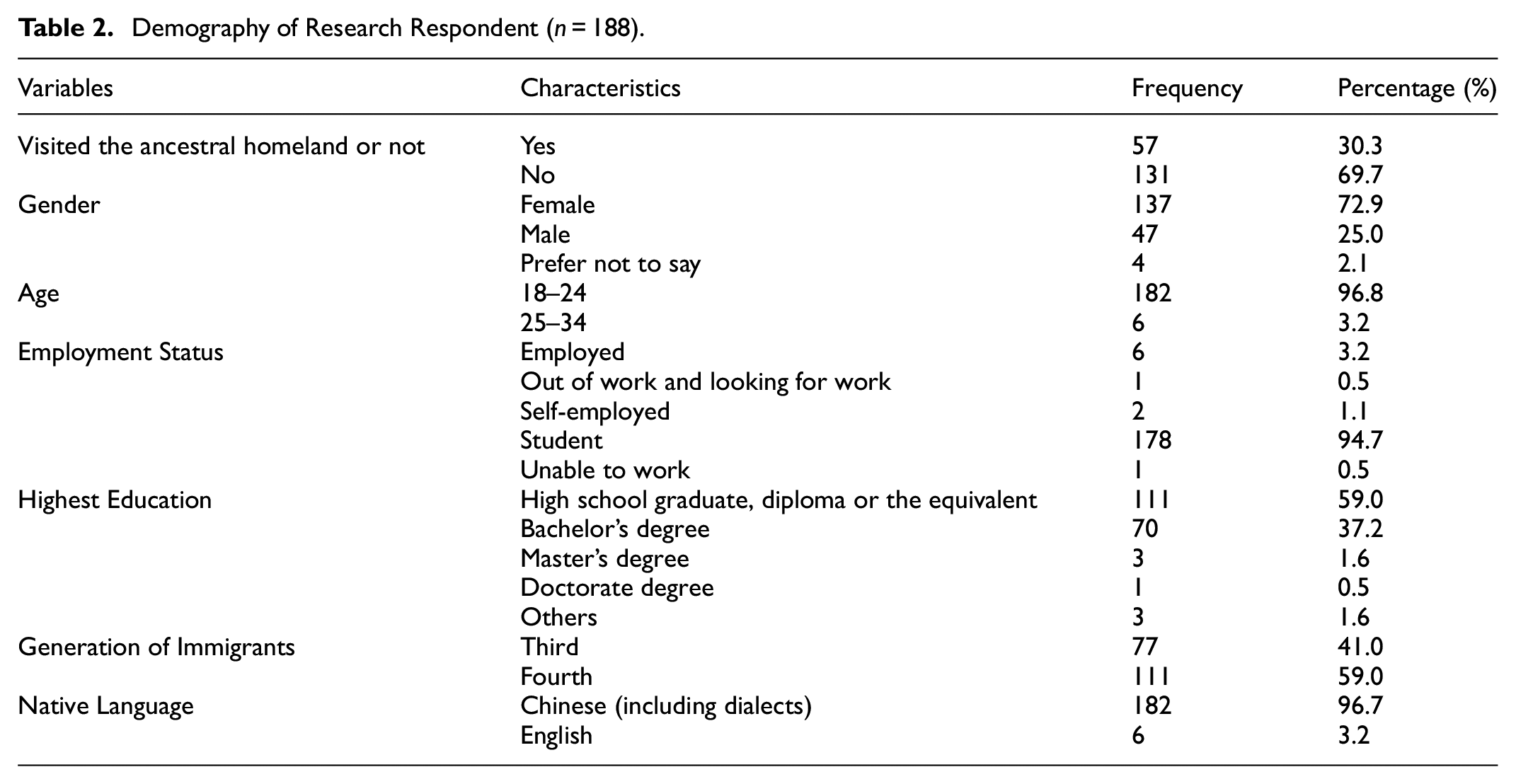
The data analysis was conducted using two software packages: Statistical Product and Service Solutions (SPSS) and its extension, AMOS. The demographic characteristics of the sample are presented in Table 2. Females constituted 72.9% of the sample in this study, while 95.7% of the respondents were between 18 and 24 years old. Most respondents were students with a certain level of educational background. Regarding the migration generation of the respondents, all of them (100%) were from the third and fourth generation, and 30.3% of the respondents had traveled to their ancestral homeland in the past.
Demography of Research Respondent (n = 188).
Common Method Bias (CMB) Test
CMB was controlled by employing anonymous completion and reverse scoring of some items during data collection. Harman’s single factor test was conducted on all scale indicators involved in hypothesis testing. The variance contribution rate of extraction sums of squared loadings was found to be 35.473%, which is less than 50%. Harman’s single factor test using the confirmatory factor analysis (CFA) was also considered. The model fit results for the single factor model tested using AMOS were: CMIN/df = 7.661, GFI = 0.524, CFI = 0.436, NFI = 0.402, TLI = 0.443, RMSEA = 0.189. Both the model fit indicators and the fitness compared to the multi-factor model were poor, indicated no significant CMB in this study (Kock et al., 2021; Korsgaard & Roberson, 1995; Williams et al., 2010).
Reliability Test
To ensure the internal consistency of the scale, SPSS 27.0 was utilized to test the reliability of 188 samples. The Cronbach’s α coefficient of the overall questionnaire scale reached .874. According to Table 3, the Corrected Item-Total Correlation (CITC) of each observed variable was greater than .5, and Cronbach’s α was greater than .7, indicating a good reliability (Taber, 2017).
Reliability Test (n = 188).

Validity Test
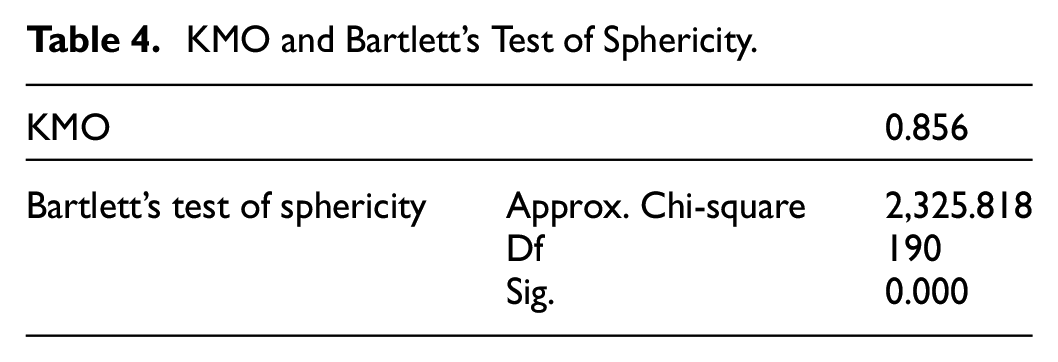
To ensure the validity of the questionnaire, KMO and Bartlett’s Test of Sphericity were conducted on the collected sample distribution. As shown in Table 4, the results indicate that the KMO values for the data are all greater than 0.6, and the significance of Bartlett’s test of sphericity is less than 0.001. These findings suggest that the data have structural validity and meet the conditions for conducting exploratory factor analysis (Shrestha, 2021).
KMO and Bartlett’s Test of Sphericity.
To confirm the dimensions of variables, PCA and the maximum variance method were applied. The rotation converged after the sixth iteration. According to Tables 5 and 6, and considering the scree plot alongside the overall meaning of the questionnaire, a total of six common factors were extracted. The eigenvalues of these factors were all greater than or close to 1, and the cumulative variance explained rate exceeded 70%. Notably, component six had an eigenvalue close to 1 and displayed distinct inflection point characteristics on the scree plot, indicating it as a valid principal component to be extracted for the variables.
The Rotated Component Matrix.

Total Variance Explained.

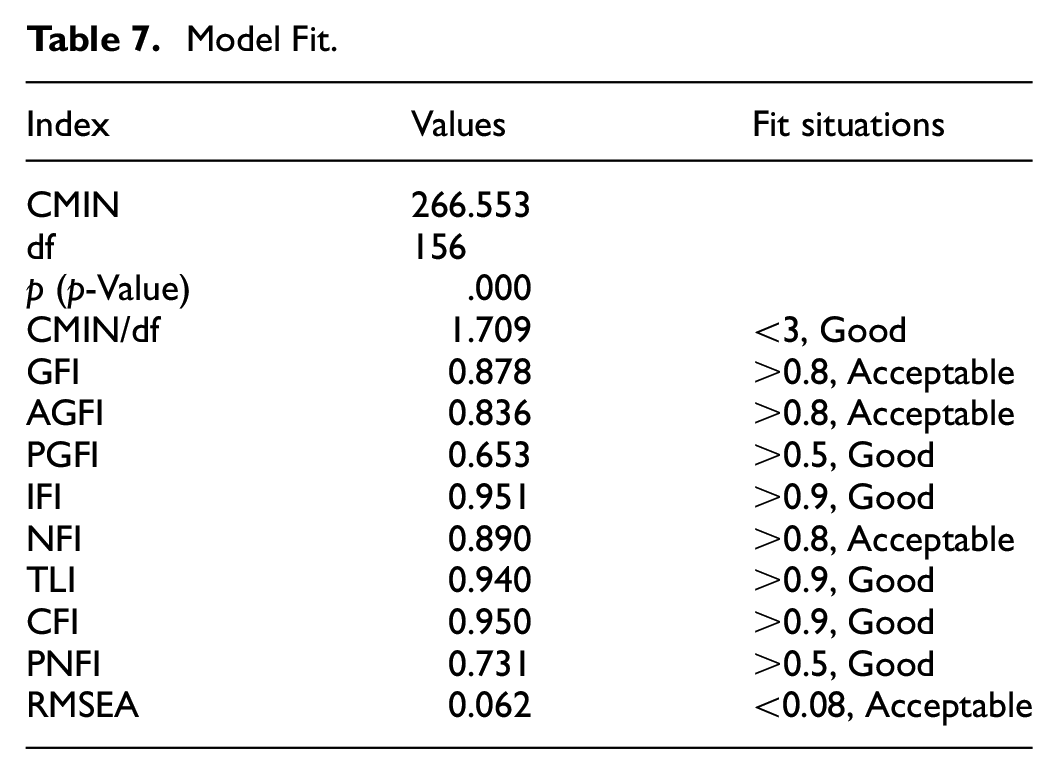
A CFA was conducted to test the structural validity, convergent validity, and discriminant validity of the prespecified models, as presented in Table 7. The results indicated that all model fitness metrics fell within the good range. Specifically, the RMSEA (root mean square error of approximation) ranged between 0.05 and 0.08 (McDonald & Ho, 2002), which is considered acceptable. Additionally, studies have suggested that thresholds of 0.8 for both GFI (goodness of fit index) and AGFI (adjusted goodness of fit index) are appropriate (Doll et al., 1994; MacCallum & Hong, 1997). Ullman (2019) noted that NFI (normed fit index) might be underestimated when the sample size is small, and the threshold can be set at 0.8.
Model Fit.
The standardized values of each unobserved variable and its observed variables were all greater than 0.6, indicating strong factor loadings. The squared multiple correlation (SMC), which represents item reliability, all exceeded .36. Additionally, the composite reliability (CR) values were greater than .6, and the average variance extracted (AVE) values were higher or close to 0.5. These findings meet the criterion for valid convergent validity (Hair et al., 2019), indicating that the model demonstrated good convergent validity for each variable (Table 8). Furthermore, the square root of the AVE value of each latent variable was greater than the correlation coefficient with the other variables, indicating good discriminant validity (Table 9). This meant that each latent variable was more related to its own indicators than to other variables in the model, supporting that the variables were distinct constructs.
Convergent Validity.

Note. ***Indicates significant at the .001 level.
Discriminant Validity.
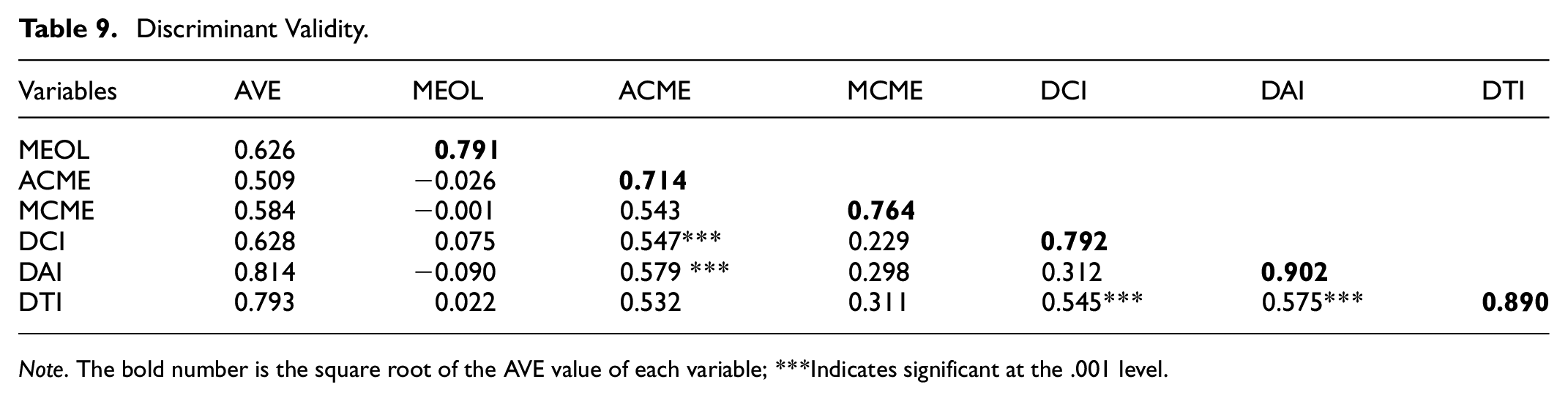
Note. The bold number is the square root of the AVE value of each variable; ***Indicates significant at the .001 level.
Hypothesis Test
The model underwent path analysis, where standardized factors of the paths were set at 0.19, 0.33, and 0.67 as thresholds for the independent variables in the paths to indicate the small, medium, and large intensity of influence on the dependent variable (Urbach & Ahlemann, 2010). According to Figure 2 and the path coefficient test in Table 10, the paths “ACME→DCI” and “ACME→ DAI” exhibited a significant relationship, with their standardized coefficients both exceeding .33, indicating a medium strength of influence. Therefore, hypotheses H2d and H2c were considered valid. Similarly, the paths “DAI→DTI” and “DCI→DTI” showed significant relationships, with standardized coefficients greater than 0.33, indicating a moderate influence. Hence, hypotheses H3a and H3b were deemed valid. However, the remaining paths in the model were found to be not significant.

Standardized Parameter Estimates for Model Test Results.
Path Analysis.

Note. ***Indicates significant at the .001 level.
Mediated Effect
A two-factor parallel multiple mediation effect test was conducted with DAI and DCI assumed as mediators (Figure 3). The bias-corrected bootstrap interval was performed with 5,000 repetitions and 95% confidence intervals to test various effects, including: indirect effect (the indirect effect of the independent variable on the dependent variable through each individual mediator); total indirect effect (the combined indirect effects of both mediators); direct effect (the direct relationship between the independent and dependent variables, not mediated by the mediators); total effect (the direct and indirect effects combined); differences between specific indirect effect (comparison between the strength of the indirect effects through each individual mediator).

Parallel Multiple Mediation Model.
The results from Table 11 indicate that both specific indirect effects, ACME→DAI→DTI and ACME→ DCI→DTI, were significant, as their confidence intervals did not contain 0. This suggests that both DAI and DCI mediated the relationship between ACME and DTI. The confidence intervals for the direct effects included 0, indicating that DAI and DCI fully mediated the relationship between ACME and DTI. In other words, there was no direct effect between ACME and DTI when considering the mediators. The confidence intervals for the total indirect effect and the total effect were both significant, as they did not include 0. This implies that the combined indirect effects of DAI and DCI, as well as the total effect of ACME on DTI (mediated and direct), were significant. Comparative analysis of the two indirect effects revealed that their confidence intervals included 0, indicating that there was no significant difference between the mediating effects of DAI and DCI (Lee, 2016).
Mediated Effect Analysis.
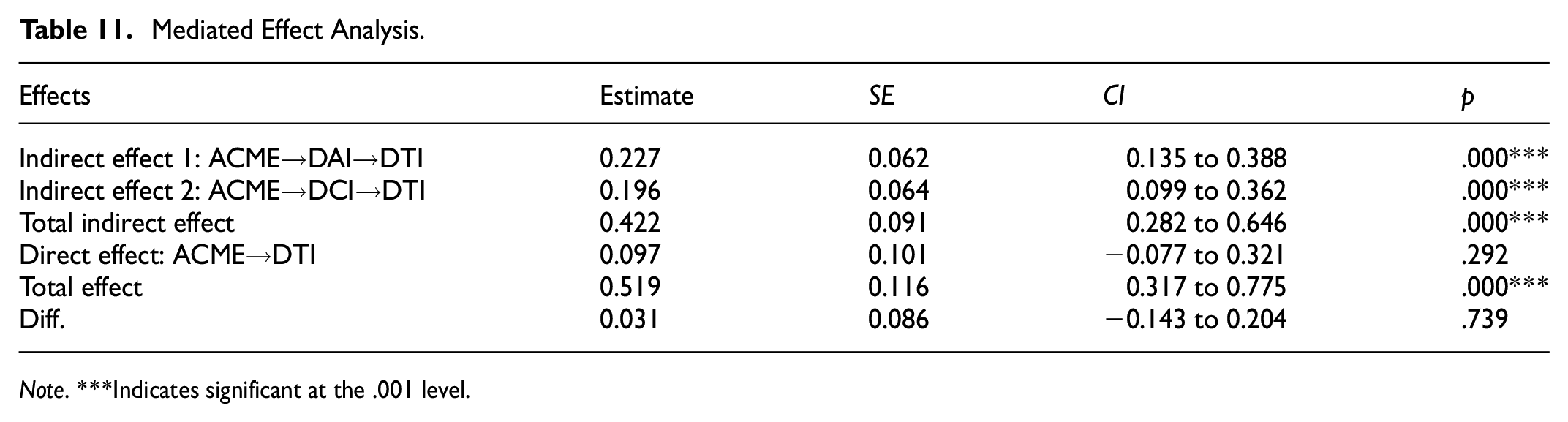
Note. ***Indicates significant at the .001 level.
Moderating Effect
The overall model was tested for moderating effects to classify the sample based on third generation and fourth generation, resulting in the path coefficients (Table 12). It is shown that compared to the third generation, the fourth generation were significant in the paths “MCME →DAI,”“MCME→DCI,” and “MEOL→DAI” and negatively correlated in the three paths. In Table 13, a significant differences between the two groups was detected: five paths “MCME→DAI,”“ACME→DAI,”“MCME→DCI,”“MEOL→DAI,” and “MEOL→DCI” had varying degrees of significance.
Grouping Path Coefficients.

Note. *Indicates significant at the .05 level. **Indicates significant at the .01 level. ***Indicates significant at the .001 level.
Group Differences.

Note. *Indicates significant at the .10 level. **Indicates significant at the .05 level. ***Indicates significant at the .01 level.
Discussion
Structural Model and Intergenerational Differences
Focusing on media engagement, MCME did not have a significant impact on other variables. However, this study found it to be highly significant in terms of generational differences. A comparison of the path coefficients for the third and fourth generation diaspora showed that MCME led to a strong negative impact on the destination image of the ancestral homeland for the 4th generation diaspora. While some previous studies have considered the role of media use in generational differences (Elias & Lemish, 2008), few studies have focused on the variability between immigrants’ media use in the host country and media use in the cultural homeland and its implications. It revealed that the younger generation of the Malaysian diaspora has developed a more negative view of their homeland than the previous generation while integrating into the transnational media environment. Considering Malaysia’s uniqueness and the protection of Chinese culture, it is possible that local Malaysian Chinese-language media may have diverged from their Chinese-language media from China regarding orientation and cultural identity.
It was found that ACME had a positive effect on both DCI and DAI with some intensity, with the Malaysian Chinese diaspora showing more favorable impressions and behavioral tendencies toward China for those who had more exposure to media from Greater China. In contrast, exposure to local Malaysian media and media in other languages had no positive correlation on DCI and DAI, and even had a negative effect among fourth-generation expatriates. This implies that exposure to different media types leads tourists to have different perceptions, which is in line with previous research exploring the correlation between transnationalism and social media use (Sun, 2021; Sun & Yu, 2022). Differences between the third and fourth generations also demonstrated a potential negative correlation between generational growth and destination impressions of China. Combining them with the differences in MCME suggested that the fourth generation diaspora may be more strongly polarized in their attitudes toward China and using media engagement in different countries as a source of influence. Unlike other studies about non-Malaysian Chinese communities, the maintenance of the traditional language in Chinese communities elsewhere is often used as an expression of identity (Shen & Jiang, 2021). In contrast, in Malaysia, this attitudinal shift was solely a result of country differences rather than media language. This may be a result of the long history of the Chinese diaspora in Malaysia and the unique social environment in which the culture and identity has been well preserved. Moreover, previous studies have argued that the use of social media for cultural homeland sources affects the sense of belonging to the host country (Madenoglu, 2022; Ponzanesi, 2020; Yu & Sun, 2019), but seldom elucidated the directional sources of this complex mechanism of occurrence. This study, instead, demonstrates that the source of the positive or negative orientation of this influence manifests itself differently across diaspora generations in Malaysia Chinese. In terms of temporal scales, researchers associated social media engagement with age differences, where youngsters have higher levels of engagement, attributed to their digital literacy and competence (Cheng et al., 2021; H.-Y. Wang et al., 2019). For diaspora, it is noted that generation relates to the time when their ancestors left their ancestral homeland. And no moderating effect regarding age was also found.
The MEOL was directly related to the portrayal of the ancestral homeland in the overall international media content. For this study, the international media was currently unable to provide a relatively significant positive contribution to diaspora tourism and Mainland China as a destination for diaspora return travelers. MEOL showed significant generational differences, and exhibited a negative influence on the image of the ancestral land destination among the fourth generation diasporas. Possible explanations for this were the mostly negative international image of China in media content outside of China (including local Malaysian Chinese-language media) due to increasing international tensions and deepening inter-regional conflicts, as well as stereotypes from overseas media. Earlier studies have also provided evidence of the impact of this negative public opinion climate on destination image (Brown, 2015; Xie et al., 2020). This unfriendly international public relations and media environment cast a shadow over the development of diaspora tourism among the new diaspora generation who were influenced by the media other than Chinese language.
This study also tested the link between diaspora tourism behavior from a perspective of media and transnationalism, explored how online communities formed by social media through the reinforcement of ethnic ties or building bridges to their ancestral lands and compatriots. The digital diaspora studies has yet to adequately explain the different motivations behind the formation of digital communities, and need to explain in detail the diversity within and between diasporas or generations (Ponzanesi, 2020). Thus, the model presented in this study provide a reference for further studies on online communities and transnational behaviors (e.g., Indians, Africans, Gypsy, etc.).
Implications and Suggestions
This study points out that diaspora tourism intention is not directly transmitted through media contact but fully mediated by the destination image. The destination image established by the diaspora receiving relevant information through the media in China is significantly more positive than that of other media. To stimulate diaspora tourism, relevant enterprises can strengthen targeted tourism advertising in the media of the ancestral homeland, especially in the media of Fujian, Guangdong provinces, etc. (main homeland of Chinese migrants). Transnational tourism promotion should focus on enhancing the improvement of image perception of the ancestral homeland and establishing emotional links based on cultural traditions. And an expansion of travel agencies’ transnational business and the construction of a diaspora-friendly tourism environment may also enhance diaspora tourism, especially how tourism business from the ancestral homeland can be accurately delivered to the media in the diaspora’s region.
Considering the international conflicts, China’s public relations strategy for its national image is of particular importance, especially in Southeast Asia where Chinese-language media is dominant. Specifically, it needs to repair negative stereotypes and destination images through systematic media marketing strategies (Avraham & Ketter, 2016). In terms of the generational differences among the diaspora, the tourism industry needs to develop an advertising strategy that reduce the negative messages, as well as a friendly environment for younger diasporas.
Study Limitations and Future Research
There are a few shortcomings in this study. The sample was concentrated in some economically developed areas. These samples may not be able to reflect the whole Chinese groups in other parts of Malaysia, especially in the rural and less developed areas. The study has also not yet incorporated the impact of family cultural background or family values of older generations on the offspring of the family. Furthermore, this study did no consider difference in ethnicity and decision-making processes in Malaysia before, during, and after COVID-19. Considering the relatively unique epidemic policy in China, the ancestral homeland of the Chinese diaspora, this may have also influenced changes in diaspora tourism decision-making among the Malaysian Chinese. Further research can build on the SOR to consider how family values, hometown complexes, and transnationalism as organismic elements can be combined with the model of diaspora travel intentions from a media perspective to refine the model from an ideological perspective and temporal dynamics. The ideologies and media attitudes formed by Chinese diaspora under the influence of long-term local culture and education abroad may vary on a country-by-country and generation-by-generation basis and affect their diaspora tourism attitudes. This trend may also be potentially relevant to the concepts of digital sovereignty and geopolitics if the perspective is extended to international relations and political governance.
Further research can also integrate the SOR with Theory of Planned Behavior and the concept of Perceived Risk to explore the multiple potential impacts of social media content on Chinese diaspora’s return to their ancestral homelands and the mechanisms through which they occur. Based on the generational differences, subsequent research could consider whether age or region could further influence the process of social media engagement. Thus, a more complete understanding of the sources and impediments of diaspora travel intentions can be achieved.
Conclusion
This study developed a theoretical model for assessing diaspora tourism intention based on the SOR model for the Chinese diaspora in Malaysia. The model introduced three indicators within media engagement based on language and country differences to explore the dimension of stimuli received by the organism and the behavioral intention of diasporas to travel as its response dimension. Using the SEM and testing for mediating and moderating effects, this study finally constructed a measurement model with indicators: Malaysian Chinese-language media engagement, ancestral homeland Chinese-language media engagement, media engagement in other languages, destination affective image, destination cognitive image, and diaspora tourism intentions, focused on studying how media engagement affects diaspora tourism intentions through the mediation of homeland image.
It highlighted the intention of differences in the preference of media engagement within the field of diaspora tourism on consumer behavioral intentions and the behavioral differences caused by different media engagement tendencies among inter-generational migrants. It provided additional evidence for the study of consumer behavioral intentions from the media engagement perspective. It showed that the Malaysian Chinese diaspora generally have a favorable image of their ancestral homeland and are willing to engage in diaspora tourism under the influence of ancestral homeland media. However, for the newer generation of diaspora, their exposure to local Malaysian media and media in other languages has been detrimental to their image of the ancestral homeland. This difference also presents a polarization based on generation and is linked to media participation. The tourism industry may need to focus on strengthening the destination image of the ancestral homeland in the international media. However, the concept of Chinese diaspora is broader and this study is limited to the Chinese in the Klang valley region. To overcome the limitations, future research will expand the sample of the study in conjunction with other overseas universities and institutions.
Footnotes

Author Contributions
Conceptualization: Zheyu Zhao and Kun Sang; Methodology: Zheyu Zhao; Validation: Kun Sang; Investigation: Zheyu Zhao; Writing—Original draft preparation: Zheyu Zhao; Writing—Review and editing: Kun Sang; Supervision: Kun Sang. All authors have read and agreed to the published version of the manuscript.
Funding
The author(s) disclosed receipt of the following financial support for the research, authorship, and/or publication of this article: This research was supported by Xiamen University Malaysia Research Fund (ID: XMUMRF-2024/C14/IART/0023).
Declaration of Conflicting Interests
The author(s) declared no potential conflicts of interest with respect to the research, authorship, and/or publication of this article.
Data Availability Statement
The dataset in this research are available upon request from the corresponding author.