




Abstract
Students at vocational schools in Denmark have, on average, a lower health status than that of comparable young people in high schools for several parameters. Against this background, several health-promoting activities have been initiated at vocational schools. However, the problem is persistent, and therefore a new approach is needed developed on the basis of an understanding of the target group. The aim was to gain understanding of students and teachers in vocational schools by creating personas. The personas were based on observational data (n = 7 classes) and semi-structured interviews among students (n = 22) and teachers (n = 7). The interviews with the students explored aspects related to health, school, well-being, and eating habits, while the teacher interviews were aimed at gaining a better understanding of their role in health promotion practice at the vocational schools. Four different student personas and three different teacher personas were created. The four student personas showed that health can be perceived in four different ways: as quality of life, absence of disease, following official recommendations and healthism. The personas describe the broad spectrum of students at vocational schools. They address the insight we gained during our analysis that health interventions should be multicomponent, targeting several aspects of health and several types of students. The three teacher personas showed that teaching health as part of a vocational education requires personal authenticity and a specific set of pedagogy and didactics. Our teacher personas address the fact that teachers are key persons in developing health promotion practices at vocational schools.
Plain language summary
Vocational school students often have poorer health compared to other young people. Health promotion efforts aim to help people improve their health, but top-down approaches led by researchers or teachers may not always be effective. This study explored health perceptions among students and teachers at four vocational schools in Denmark to better understand their needs. The students’ health behaviors and attitudes varied greatly. Some were sedentary and uninterested in health, while others were very active, focused primarily on appearance. Some students didn’t prioritize health at all, while others valued it as part of their overall well-being. The teachers faced challenges in promoting health, questioning their own ability to teach health effectively, lacking tools to engage students, or struggling to motivate students despite their enthusiasm. To capture these diverse perspectives, four student personas and three teacher personas were created based on observations and interviews. The persona-based approach offers valuable insights for creating targeted interventions that address the specific challenges and motivations of vocational school students and teachers. By tailoring health promotion efforts to the needs of each persona, more engaging and effective programs can be developed that encourage sustainable health behavior change.
Keywords
Background
The health status of students at vocational schools in Denmark has been documented to be lower than that of comparable young people at high schools for several parameters, such as physical activity, nutrition, sleep, smoking, and general well-being (Bendtsen et al., 2015; Mikkelsen et al., 2021; Ringgaard et al., 2020; Thøgersen et al., 2020; van Dongen et al., 2022; Virtanen et al., 2019). For instance, the prevalence of smoking is higher in vocational education and training students (VET-students; 32%) compared to high school students (21%; Bendtsen et al., 2015) and only 45% of the VET-students meet the recommended levels of physical activity, compared to 60% of high school students (Ringgaard et al., 2020). These disparities in health behaviors can be attributed to various factors, such as the differences in educational focus, with vocational schools prioritizing practical skills over health education (Mikkelsen et al., 2021). Moreover, VET-students often come from lower socioeconomic backgrounds (Thøgersen et al., 2020), which has been associated with higher health risk behaviors (Bonevski et al., 2014). The cumulative effect of these health disparities can have long-lasting consequences on the students’ overall well-being and their ability to succeed in their chosen careers (van Dongen et al., 2022).
The relationship between education and health is well known and shows a higher mortality rate and lower self-assessment of health in the segment with a lower educational level (Liu et al., 2024; Martinez & Lirola, 2024; Tanaka et al., 2024) just as employees with a higher education is more positive toward health promotion at the workplace (Sponselee et al., 2022). In addition, health-risk behavior is more prevalent among youth from lower socioeconomic backgrounds (Bonevski et al., 2014). Against this background, several health-promoting activities have been initiated at vocational (or pre-vocational) schools (VET-schools), not just in Denmark (Andersen et al., 2018; Christensen et al., 2019; Jensen et al., 2022; Mikkelsen et al., 2021), but also in other countries (Hankonen et al., 2016, 2017; O’Reilly et al., 2018; van Dongen et al., 2022; Verloigne et al., 2017). However, the problem is persistent, and therefore a new approach is needed, taking a more holistic view of health promotion.
Health Promotion
Health promotion is a general term that focuses on a salutogenic perspective of health instead of a perspective of avoiding illness (Dooris, 2009). The salutogenic perspective, introduced by Antonovsky (1979), emphasizes the factors that contribute to health and well-being, rather than solely focusing on the causes of disease. Antonovsky’s theory of salutogenesis suggests that individuals possess a sense of coherence, which enables them to manage stress and maintain health. According to WHO, health promotion is defined as the process of enabling people to increase control over, and to improve, their health (WHO, 2024). Health promotion includes physical activity, nutrition and mental health. In this context, mental health includes both hedonic aspects (life satisfaction and self-esteem), eudaimonic aspects (self-efficacy), and a multidimensional measure (mental well-being; Jensen et al., 2022). Most initiatives have been mono-component, focusing only on one aspect of health, such as physical activity (Grüne et al., 2020; Jensen et al., 2022), nutrition (Christensen et al., 2019; Hill et al., 2023), or the connectedness to a school (Andersen et al., 2018), even though they are interconnected. The interconnectedness of the different aspects of health has been well established in the literature. For example, a strong evidence for the beneficial effect of physical activity on mental health in children and adolescents has been demonstrated as physical activity has been shown to have a positive impact on mental health outcomes, such as reducing symptoms of depression and anxiety (Biddle et al., 2019). In VET-students, a dose-response relation has been demonstrated between physical activity and mental health (Jensen et al., 2022). This highlights the importance of considering the interplay between the different aspects of health when designing health promotion initiatives for VET-students.
While the different health promotion initiatives have shown some promise, the health disparities persist (Mikkelsen et al., 2021). One potential reason for this is that many of the initiatives have focused on a single health behavior or outcome, failing to address the complex interplay of factors that influence health (Verloigne et al., 2017). A multi-component approach with initiatives aimed at several aspects of health might result in more sustainable changes.
By addressing multiple health dimensions simultaneously health promotion initiatives are expected to be more effectively in supporting the overall well-being of VET-students. This approach aligns with the salutogenic perspective (Dooris, 2009), as it focuses on fostering the resources and capacities that enable individuals to maintain and improve their health, rather than simply preventing disease. To effectively implement a multi-component approach, health promotion initiatives should be grounded in evidence and involve the active participation of students, teachers, and other stakeholders to ensure their relevance and sustainability (van Dongen et al., 2022). By tailoring interventions to the specific needs and preferences of VET-students and addressing the complex interplay of factors that influence health, a multi-component approach has the potential to reduce health disparities and promote long-term well-being among this population.
In the commonly used top-down process, the researcher or the school professionals (school board or the teachers) have the power to decide on the interventions, such as breakfast clubs (Christensen et al., 2019; Hill et al., 2023) or training workshops (Hankonen et al., 2017; Mikkelsen et al., 2021). A top-down approach seems to be capable of increasing physical activity, though it can be criticized for not providing sustainable effects (Grüne et al., 2020) and the physical activities in school time might even have a negative effect on the activity level after school (Mikkelsen et al., 2021). In contrast, only few studies take a bottom-up approach in which the students are included in the health promotion initiatives. A bottom-up process has a positive mental/psychological effect, even though the actual effect on physical activity might be smaller or even absent (Grüne et al., 2020; Verloigne et al., 2017). As Verloigne et al (2017) stress, different processes and designs for co-creation need to be evaluated. A bottom-up approach also brings a need for a more profound understanding of the VET-students and their health motivations, a knowledge which has not yet been systematically evaluated and described. Furthermore, the influence of the contextural factors, especially the teachers, are also important to understand.
A Shared Third Approach in Health Promotion
The Shared Third (France et al., 2010) is a method emphasizing community-building through different types of motivation—both personal and social. This approach fosters trust and engagement by meeting young people on “neutral ground” and offering meaningful activities not framed around health goals but centered on a shared third that drives participation. By establishing this common ground, educators can build the trust necessary for relationships to develop, creating an environment where students are more likely to thrive and remain in education. This concept connects directly to Wenger theory of communities of practice (Wenger, 1998) where learning occurs through participation in shared activities within a community context. The method is theoretically grounded in social practice theory, where all participants are understood as active subjects engaging in various contexts of action, communities, and relationships.
Communities structure themselves through different modes of participation (Wenger, 1998). In a VET-school setting some individuals may experience exclusion, be denied influence, or remain in a marginal position. Others may gain legitimate peripheral participation, engage in more sustained involvement, or contribute with substantial influence. In a health promoting perspective focusing on the interplay between how communities are constituted and how their participants are shaped, The Shared Third offers VET-students diverse opportunities for participation—fostering a sense of belonging, recognition, and active contribution to the community’s activities, ideology, and continued existence (Wenger, 1998).
Personas as a Tool to Understand the Students
Most health promotion initiatives are based on observations of a behavior, for example students who are too sedentary, without any understanding of the background to the behavior. The creation of personas is a tool often used in design to keep the end-users in mind during the design process (Miaskiewicz & Kozar, 2011) and can be used to raise the awareness of needs, skills and abilities of a certain target group (Schäfer et al., 2019). Developing personas has previously been used to increase the understanding of older adults in a German health care setting (Schäfer et al., 2019) and is as such, a relevant method in the work of understanding the VET-students health and motivation, and thereby facilitate development of a successful bottom-up approach in health promotion activities. No specific methodology has been defined for the creation of personas, and they can, for example, be created on the basis of a survey (Schäfer et al., 2019) or interviews and observations (Mujirishvili & Flórez-Revuelta, 2023).
Aim
The aim of the study was to gain a better understanding of the underlying factors of health practices and motivation of students at vocational schools seen from a health promotion perspective including both physical activity, nutrition and mental well-being. Furthermore, we aimed to describe the teacher’s didactic approaches and dilemmas being responsible for the health promotion education at VET-schools. To achieve this, a focused ethnographic approach including observations and semi-structured interviews was conducted at four different locations for VET-schools. Based on the empirical work, personas were created for the students and the teachers.
Methods
The data were collected among first-semester students who were training for traditional vocational jobs such as electrician, plumber and carpenter, as well as for jobs in the care and service sector. The students are initially on a 20 week introduction course targeting a group of educations for example, technology, construction, and transport. The introduction courses can be further divided into more specific groups for example, technique and energy. To select the classes, a multistage purposeful sampling was used (Palinkas et al., 2015). Initially, the classes were selected at four different locations using a maximum variation strategy, with the aim of meeting as many different educations as possible representing the wide variation present at a VET-school. Secondary, the students were chosen to gain typical cases under the consideration, that the student should participate voluntarily (Palinkas et al., 2015). This selection process was done in cooperation with the vocational schools. For the observational data, five different introduction courses were visited covering the four main themes. For three of the educational themes, 22 individual interviews was performed (Figure 1).

Sampling for data collection.
Data was collected using a focused ethnography approach which, in contrast to traditional ethnographic methods, combine short time observations and semi-structured interviews (Andreassen et al., 2020; Pink & Morgan, 2013). During the observations, the researchers role is to act as observer-as-participant meaning they were present in seven different classes on random days taken structured field notes and observing while at the same time being in spontaneous informal interaction with both teachers and students. This gave rise to informal conversations about health, food choices, meals, and movement, which were blended with the structured observational notes. The interviews were performed following a semi-structured guide and including aspects related to health, habits, school, well-being, and both personal and social eating habits. The interviews were conducted on site, and, in contrast to the informal conversations during the observations, these interviews were in a quiet room where the students were isolated from their peers in order to create a confidential environment. The participants (n = 22) were selected as randomly as possible in those classes where the teacher deemed it feasible to pick out students in the focus population. During one round of interviews, the dean of the school chose the student from a class list. The gender distribution was slightly skewed toward males (n = 14) compared to females (n = 8) and represented the gender composition of the classes. All interviews lasted approximately 30 min and were recorded. A separate semi-structured interview guide was developed for the teachers with emphasis on the role of health and healthy habits in their teaching and how they could include health practices in the classroom. Seven teachers representing various trade, food and care educations were interviewed. Each interview lasted between 12 and 30 min. Due to the Covid-19 lockdown, the interviews were conducted via Zoom, and notes were taken during the interview.
The collected observational data were coded and analyzed inductively, allowing the data to form the categories (Nowell et al., 2017). The categories were used in the subsequent interviews, providing a focus on the health perceptions of the students to explore their subjective perception of their own and their classmates’ health practices. The analysis of the student interview data was focused on identifying these health practices using a thematic approach (Nowell et al., 2017). The coding was focused on the role health played in the daily lives, identifying stories and explanations about what they perceived as healthy or why health was an insignificant part of their life. This coding provided the students perspective on their own life. Two researches were listening to the interviews and reading the notes independently and validated the chosen themes and citations.
We chose to create the student personas using a thematic analysis (Nowell et al., 2017) based on four well-defined and validated health understandings (Saugstad, 2021). This was not possible for the teachers, and we therefore created the teacher personas using a thematic analysis of the empirical data (Nowell et al., 2017).
According to the national law, only research involving biological material must be approved by the National Committee on Health Research Ethics. Other types of research are approved locally. The research follows the national Code of Conduct for Research Integrity, which is based on the Declaration of Helsinki. A letter confirming that no formal national ethical approval is necessary was signed by the Head of Research, Chair of Institutional Review Board. All participants signed an informed written consent before interviews.
Results
Four Different Personas of the Students
The first persona was created via an assessment of health as the opposite of illness. In our study, we call him Michael. Michael is a boy who is mainly interested in computers. He lives a sedentary life (Quotation 1, Table 1). He needs to see the return to a more active life in order to be motivated to change his health behavior (Quotation 2, Table 1). Furthermore, he is a loner, and even his social relations are passive (Quotation 3, Table 1). Food must be easy to make and eat, it seldom includes fruits and vegetables and tends to be uniform, since he prefers to be familiar with the food he is eating. He is not health conscious (Quotation 4, Table 1), and his main attitude toward health is: “What’s in it for me? What can I use it for?”
Quotations From Students Demonstrating the Four Different Personas.
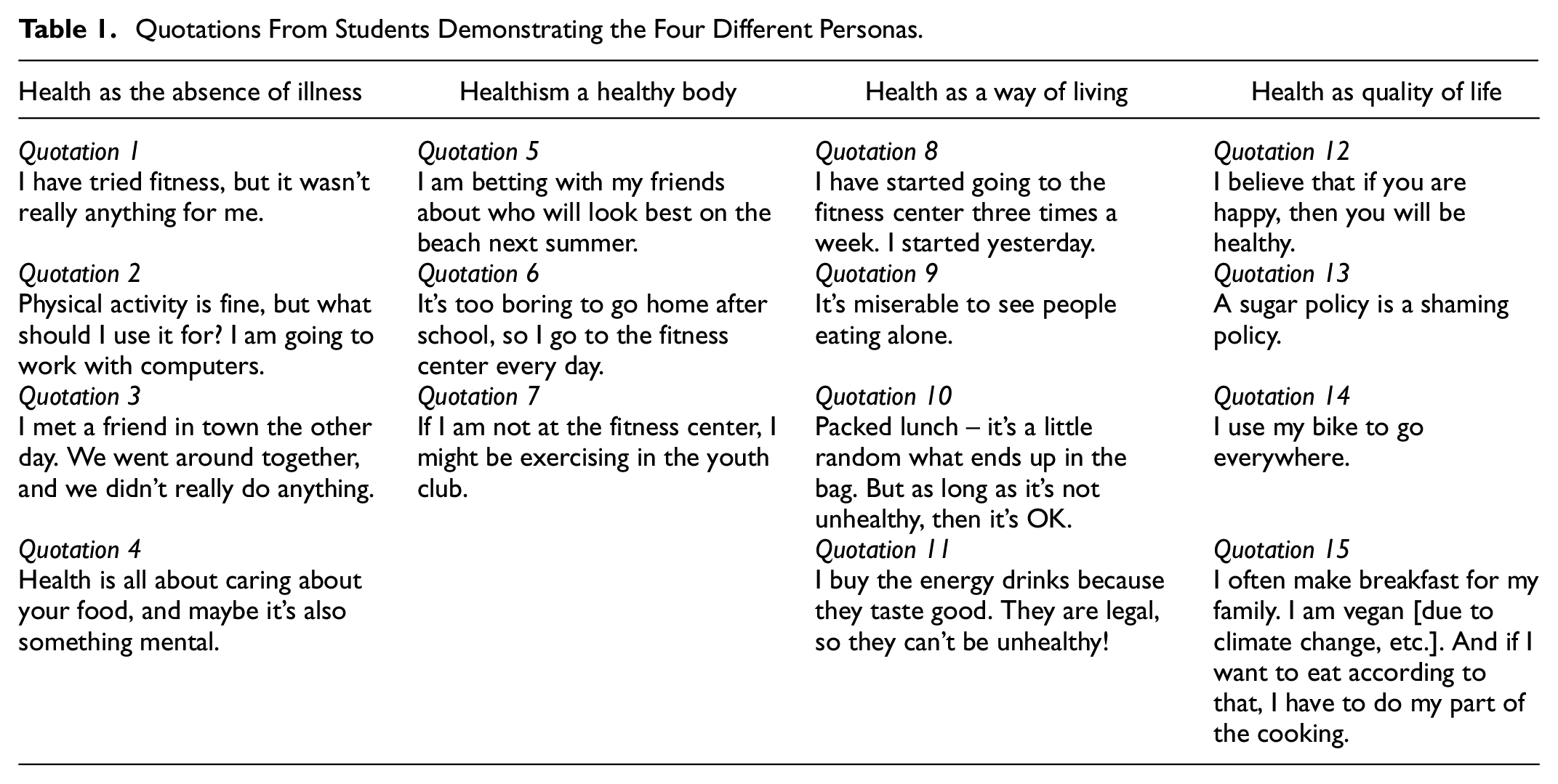
In contrast, Anders understands health as having a physically fit body and live a very active life. He relates to health as healthism and worships his body and his appearance (Quotation 5, Table 1). Physical activities are an important part of his life (Quotations 6 and 7, Table 1). He is motivated by action, even when he is not doing physical activities (playing Formula 1 on his computer). He generally eats healthily and only allows himself soft drinks and energy drinks if they do not affect his appearance or his training. He is motivated by external factors (the appearance of his body), and his focus on physical activities is related to his appearance rather than being healthy.
Health is somewhat absent for the persona called Laila (Figure 1). She does not think about health in her everyday life, but, when asked directly, she says that health is more a way of living than single factors like food or physical activity. She seldom goes to the fitness center and is aware of the fact that she does not do as much physical activity as recommended (Quotation 8, Table 1). Her social life is important for her (Quotation 9, Table 1), and she spends a lot of time with her friends. For Laila, food is not directly related to healthiness (Quotation 10, Table 1), and she navigates through what is healthy and unhealthy via blogs and influencers as well as her trust in society (Quotation 11, Table 1).
The fourth student persona is Line. For Line, health is primarily related to an internal state—health is life quality. She is very value-based and has a high level of integrity—she follows the values she believes in (Quotation 12, Table 1). She makes active choices, for example with regard to her school’s food policy (Quotation 13, Table 1). Physical activity is less important to Line compared with her friends. She usually eats a packed lunch made from leftovers together with her close friends. Climate change is important to her, and she usually rides her bike whenever possible; not for health reasons, but due to the climate impact of transportation (Quotation 14, Table 1). She lives at home and takes a value-based responsibility for the whole family (Quotation 15, Table 1).
Three Different Personas of the Teachers
The personas for the teachers were created by targeting their didactic approach and the dilemmas on teaching about health and not the teachers’ own understanding of health.
Three different themes relating to these dilemmas were identified in the teacher interviews: health authenticity, health didactics, and health motivation. The health authenticity dilemma was described in the persona called Kurt. Kurt has a vocational background and worked in different companies before he started teaching. He is an experienced teacher, and, with his didactic approach, he sees himself as a role model for the students. His focus is on educating young people to be skilled in their trade and preparing them for “the real world.”
Kurt knows that 45 min of physical activity per day is mandatory, but he does not see the point of it and prefers not to do anything specific about it (Quotations 1 and 2, Table 2). Furthermore, regarding food, Kurt finds it difficult to establish guidelines for the students. The only thing Kurt insists on is that the students do not drink energy drinks in his classes.
Quotations From the Teachers Demonstrating the Three Health Dilemmas.

Kurt questions his own right to integrate health promotion in his classes, since he does not see himself as healthy (Quotations 3 and 4, Table 2). He is slightly overweight and finds it difficult to talk with the students about food habits. Furthermore, he is rather confused about the definition of health—is it about BMI, intake of soft drinks or how far you can run? Health promotion in education is something determined top-down, and Kurt does as little as possible in this regard.
Lisette actively tries to integrate health promotion in her classes, talking about dietary recommendations and the need for physical activity. However, she feels helpless and frustrated and sense that she lacks the didactic tools to get the students involved in their own health promotion process (Quotations 5 and 6, Table 2). She hopes to be able to influence the students through her teaching but feels powerless without the didactic tools to establish health practices. She has a holistic approach to health and wants to make health promotion an integrated part of the entire day for the students (Quotation 7, Table 2). She uses a top-down approach, teaching the students about national health recommendations which underline her ambivalence in her teaching approach. However, she feels that this will not change the students’ health behavior. Her dilemma is how to navigate between her duty to teach about health promotion and her experience that her teaching doesn’t motivate the students to make changes to their health behavior.
Tanya is a relatively young teacher who, like Kurt, believes she needs to be a role model. However, whereas Kurt perceives this as being related to skills, Tanya believes her role model also concerns living a healthy life (Quotation 8, Table 2). She knows about health and health promotion and spends a lot of energy conveying this knowledge to the students. Despite her good ambitions and all her energy, she realizes that the students do not follow her down the “health path” (Quotation 9, Table 2). This frustrates her, and she does not understand why the students do not share her enthusiasm (Quotation 10, Table 2). Her enthusiasm is based on her own preconception of health and she does not always meet the students where they are. Sometimes, the students feel put off by her enthusiasm, since it does not fit in with their own life situation (e.g., long transport times or personal problems).
Discussion
The four personas created in this study are described as real persons as the methodology dictates (Dahiya & Kumar, 2018; Mujirishvili & Flórez-Revuelta, 2023). However, it is important to remember that the traits from all four personas were seen in both genders and that most of the students had traces of more than one persona. Yet, they describe, in a personal way, the diversity of the young people at the VET-schools and show why health interventions might be difficult to implement successfully, unless they target not just one aspect of health or one type of student but a variety of personalities. Through the personas, it is possible to describe the challenges and possibilities that are present in this very broad spectrum of people in VET-schools.
The four student personas are physically active on different levels. The level of physical activity is in general lower amongst adolescents in VET-schools compared with high school (Virtanen et al., 2019) and we also observed sedentary students, represented here by Michael and Laila. However, we also observed healthism in both girls and boys, represented here by Anders, where the students’ body composition is very important and training is an everyday event. Children, who are satisfied with their body, value physical activities in school more and are to a larger degree stimulated to engage in activities outside school (Kerner et al., 2019) and even though that was shown on younger children (13–14 years) it was the same tendency we saw in the VET-students, represented by Anders. In introducing physical activity for VET-students, it will be important to embrace not just Anders, who is motivated by himself, but also Michael and Laila. Making it relevant and using the social aspect such as go for a walk together while discussing a topic from the school day or play a game can be ways of including the more sedentary students. Shifting the focus from the activity being physical to a shared third (France et al., 2010), where students’ motivational preferences are involved—such as the social aspect of having fun, which can motivate Laila, or the professional aspect of discussing a topic, which can motivate Michael—can contribute to increasing the level of physical activity for all students.
The students in our study were not very food conscious (Laila and Michael), except when they were focused on the impact of food on their body (Anders) or the climate/environment (Line). Previous studies have shown that breakfast clubs can have an impact on dietary quality (Christensen et al., 2019) as well as on the connectedness to the school (Hill et al., 2023). However, a crowding out effect has also been seen on healthy eating meaning that intervening in eating behavior in a school setting might have a negative impact on eating habits outside school (Mikkelsen et al., 2021). The combination of a potential lack of interest among the students and the importance of food for the school day makes food an interesting aspect to include in further studies. A foodscape of the school describe how food, places, and people interact (Mikkelsen, 2011). Using the salutogenic perspective (Dooris, 2009) in changing the foodscape at the school, emphasizes the advantages in using a hedonic approach, having both Michael, Line and Laila in mind instead of a health conscious approach, which would only fit Anders.
Mental well-being and (lack of) connectedness to the school have been identified as key reasons for dropping out (Andersen et al., 2018). Social connectedness was important for many of the students (Anders, Laila, Line), though some of the students were loners and some even needed the space to be less social and to relax during the breaks (Michael). It is also important to take this into account when planning activities both from a bottom-up and a top-down perspective, as Michael might never be heard in a bottom-up perspective, while especially Line might react negatively on a top-down perspective. Working with the shared third as a community-building practice could be a part of a collective effort at VET-schools aimed at developing and transforming well-being through different participation opportunities and thereby enabling VET students to simultaneously promoting their health practice. The possibility for teachers to structure activities where students can participate from different positions and to varying degrees could enable both Michael, Anders, Laila, Line to engage and take part (Wenger, 1998).
The teachers are the key persons in developing a health promotion practice at VET-schools (Daniele et al., 2022) putting health into the everyday setting (Dooris, 2009). They are responsible for the learning situation in the classroom and, as such, also responsible for framing a health culture that supports students in developing a health practice enabling them to meet a long and often physically demanding working life. This leads to the need for didactic tools and an understanding of how the broad concept of health (WHO) can be embedded in daily teaching as part of health promotion. Furthermore, it also highlights several dilemmas in the interaction between their own behavior and the health practice culture in the classroom.
We identified three different dilemmas in the interviews with the teachers. Kurt represents the health dilemma: how is it possible to teach about health when you don’t feel you are healthy yourself and you don’t think it is important? In this context, it is important to work with health authenticity among the teachers, as suggested by Grabowski and Rasmussen (2014), as a health-pedagogical concept that focuses on the quality of being trustworthy through relations and committed instructions rather than having a fit body. Furthermore, the salutogenic perspective (Dooris, 2009) on understanding health and health promotion expands the focus beyond just overweight and physical activity, looking at health in a broader context. By using his skills in teaching, he can serve as a role model for students like Michael, demonstrating how to integrate these principles into daily life. This professional expertise, linked to vocational health, involves learning to take care of oneself throughout the workday—by taking breaks, maintaining good posture and ergonomics, and consuming meals and fluids that support the body’s energy and strength for the entire day—ultimately promoting a long and sustainable working life.
Lizette represents the health didactic dilemma, whereby there is a lack of didactic tools to work with participatory perspectives in her education. As suggested by Katznelson et al. (2018) motivation is not something that someone has but something that occur in a given situation, and the ability of the teacher to integrate cognition and emotions in the learning process and thereby engender motivation is essential for the educational outcome. In this approach, the teacher will need didactic tools to facilitate a dialogue combining the students’ knowledge, earlier experiences with health, and different professional perspectives. Lizette will be challenged by Lailas perception of health as a way of living, as the dietary recommendations and the need for physical activity is far from this understanding of health, and she will need to meet Laila, on a platform more inspired by the Shared Third (France et al., 2010), than of the official recommendations. In contrast, Anders, who focus on a physical fit body, might be more open to her teaching in health, as he is motivated by the positive effect on his body, if he follows the official recommendations, Lizette are teaching.
The dilemma of health motivation is represented by Tanya. She is frustrated that her own enthusiasm is not enough to motivate the students to participate in her activities. Tanya has the didactic skills in a participatory health promotion practice but does still not motivate the students to change their health behavior. Both skills and resources need to be present to transform health knowledge into behavior (Joseph, 2022) and this might explain why the students don’t change their health behavior despite the health knowledge she tries to give them. As pointed out by Katznelson et al. (2018), motivation includes more than the young people themselves; it is about the actual learning situation and the context the young adult is in. From this perspective, it is crucial to work with the social dimension of the learning situation, where ownership gradually changes hands from teacher to students. Katznelson et al. (2018) state that when the students are committed to small non-cognitive tasks (e.g., preparing the room for activities, choosing and initiating the warm-up) that are important for group cohesion, the potential for being motivated to learn increases in parallel with the ability to engage in a concentrated way (Katznelson et al., 2020). Integrating this perspective on motivation might have an impact on the students’ experience of social connectedness and also on their well-being.
When examining our personas in relation to each other, we can identify specific misalignments between student motivations and teacher approaches. Michael, motivated by personal relevance and utility, could potentially connect with Kurt’s practical approach if Kurt could frame health promotion as a skill relevant to workplace success rather than abstract health recommendations. Similarly, Anders might respond well to Tanya’s enthusiasm, but only if she could shift her approach from general health recommendations to acknowledging his focus on body aesthetics. Laila’s prioritization of social connections remains largely unaddressed by all three teacher personas, who tend to focus on individual health practices rather than the social dynamics of health. Line’s value-driven approach might find some resonance with Lizette’s holistic perspective, but Lizette lacks the didactic tools to engage with Line’s intrinsic motivation effectively.
The most sustainable effects of health promotion initiatives can be expected using a bottom-up approach (Verloigne et al., 2017) at least at the psychological level while the top-down approach could be efficient in increasing physical activity (Grüne et al., 2020). During our initial study, we realized that top-down and bottom-up are not straightforward terms, since this would assume only two organizational levels. In reality, several levels exist. Health initiatives from the teachers can be regarded as bottom-up in the organization compared to initiatives from the management. At the same time, these initiatives can be regarded as top-down from the students’ point of view. Furthermore, the term “sustainable changes” can be discussed. Changes can be sustainable in the sense that the students change toward a healthier kind of behavior, not just in the school setting or the intervention period, but in general. This is important from a broader health perspective, since development of health capacities are formed in the childhood and early adolescence and health capacities are drivers in health behavior (Joseph, 2022). However, sustainable changes can also take place from an organizational health culture perspective at the school. The importance of the school culture in health promotion with focus on overweight and health promotion was stressed in a Dutch study in which it was also concluded that it takes time to gain sustainable changes as while the teachers need to change their health didactics toward a more health-promoting teaching practice, the appointed School Health Coordinator must also grow into the role (van Dongen et al., 2022).
Future Research
This study explored how adolescents act and perceive health related matters in vocational schools.
Due to the rapid nature of the project we lack data from long term studies. This could be by deploying methods for tracking changes in health behavior, both physiological and mental well being, investigated on the background of the personas developed in the current study.
As the vocational training system in Denmark is a highly diverse type of training, ranging from carpentry and health care assistants to marketing leads, a future quantitative study that drills down and systematically segregates health patterns among (a) types of education, (b) socio-economic background, and (c) gender could shed further lights on health patterns and understanding of values related to health among adolescents in vocational training. This could be compared with a parallel study in other school settings for further elaborate the specific needs in the vocational setting.
In relation to the understanding of the teachers role in health promotion of the adolescent, a study that addresses how some of the insecurities about how to teach and act on health promotion training that was voiced in our data and given a voice through the personas and their effects on said insecurities is needed. This study could include mapping of the impact on teacher training on the effectiveness of health promotion in their classes as well.
Limitations
This study has certain limitations. Firstly, the data are based on a focused ethnography approach instead of longer observation periods. The advantage of these short observations is that it is possible to collect data in a relatively short period of time and it is especially well-suited to fragmented interactions (Andreassen et al., 2020) as in a school class. The disadvantage is that there might be some underlying structures that are not unveiled for the researcher.
Gender composition was not a priority when arrangements for visits were made. The main focus was to be able to visit as many classes as possible and follow them over the course of a day. More female-populated classes might have shown a new perspective in, for example, movement patterns and activities during a school day.
The interviews with the teachers were conducted via Zoom, and notes were taken during the interviews. A face-to-face interview with the possibility of recording the interviews would have been better, but this was not possible due to the Covid-19 lockdown.
This study was purely qualitative, and the prevalence of the different personas in the different educations was not investigated.
Practical Implications
Bottom-up processes in health promotion practice have the potential of providing more sustainable changes. The personas demonstrated a diversity among the students, stressing the need for multi-component interventions that target increased physical activity, healthy eating habits, and increased well-being. The design of health promotion processes at vocational schools can be based on the understanding of the teachers and the students as well as the principles of the shared third, thereby increasing the probability of introducing a successful health promotion practice at the school.
Footnotes
Acknowledgements
We thank Jes Rumberg Christiansen for organizing our visits to the vocational schools and providing support with practical issues during the project, Birthe Pedersen for practical help in doing the interviews and Marie Aakjær for valuable comments on the manuscript. Furthermore, we thank students at University College Absalon for their support during the data collection.

Ethical Considerations
According to Danish law, only research involving biological material must be approved by the National Committee on Health Research Ethics. Other types of research are approved locally. Research at University College Absalon follows the Danish Code of Conduct for Research Integrity, which is based on the Declaration of Helsinki. A letter confirming that no formal ethical approval is necessary in Denmark was signed by the Head of Research, Chair of Institutional Review Board at University College Absalon (Ref. No 115506).
Consent to Participate
All participants signed an informed written consent before interviews.
Author Contributions
MDAA: Conceptualizing, Investigation, Writing original draft, Writing review and editing.
JSBT: Conceptualizing, Investigation, Data analysis, Writing review and editing.
LJH: Conceptualizing, Investigation, Data analysis, Writing review and editing.
All authors have read and agreed to the final version.
Funding
The author(s) disclosed receipt of the following financial support for the research, authorship, and/or publication of this article: This study was partly funded by the Zealand Region and Fehmarn A/S, whom we thank. The funding agencies did not participate in the study design, data collection, analysis, decision to publish or preparation of the manuscript.
Declaration of Conflicting Interests
The author(s) declared no potential conflicts of interest with respect to the research, authorship, and/or publication of this article.
Data Availability Statement
Data is qualitative and in Danish and can be made available by contacting the authors.