




Abstract
Formative assessment is an important dimension of teaching reform, and so introducing formative assessment into teaching is of great importance for transforming students’ performance. It is also important to explore teachers’ understanding and practices of formative assessment. The present research therefore examined how university English teachers understand and apply formative assessment, and their motivation for adopting formative assessment through qualitative interview methods. It focused on the problems and difficulties of applying formative assessment in university English teaching in China, and possible improvement measures. The study found that university English teachers have a biased understanding and practice of formative assessment; most of their reasons for adopting formative assessment pointed to teaching management rather than to improving teaching, and students’ subjectivity in assessment was ignored. Several of the interviewed teachers with doctoral degrees had research interests in teaching and learning; therefore, teachers’ understanding of formative assessment is likely related to their education and training experiences. This paper discusses the reasons for the findings and proposes possible measures to solve the problems.
Introduction
Good assessment and testing are important tools to test the quality of teaching, promote learning, and facilitate curriculum development. The change in teaching has been one of the important issues of university English reform (Bunch, 2011; Chen et al., 2014). The teaching requirements for university courses involve a teaching model combining formative and summative assessment (Can Daşkın & Hatipoğlu, 2019; Herman et al., 2015). For example, the guide to college English teaching clearly states that college English courses should make comprehensive use of various evaluation tools, deal with the relationship between internal and external evaluation, formative and summative evaluation, and realize the change from the traditional summative evaluation of course results to the formative assessment for course development (Johnson et al., 2019; Xiao & Yang, 2019). The key phrase here is “promote curriculum development,” which means to improve teaching and learning based on evaluation information (Heritage et al., 2009; Younas & Dong, 2024). Teachers play a decisive role in this curriculum development. Most domestic studies on formative assessment have focused on whether it has contributed to students’ academic performance (Stiggins, 1992; Yarrow & Topping, 2001). Researchers usually use questionnaires or changes in students’ college English scores to determine whether formative assessment models are effective (Allal, 2021; Gardner, 2012). However, these studies also indicated that teachers’ understanding, and practice of formative assessment is a key factor in whether it can promote students’ academic development (Sadler, 1989). Research has shown how teachers adjust their teaching plans and help students solve their learning problems based on assessment information, which is a difficult issue that is often overlooked by teachers, either intentionally, or unintentionally (Heritage, 2007). Teachers’ understanding of formative assessment is variable or biased, so the ways and purposes of implementing formative assessment in the actual teaching process are supplementary, and the effects on students’ academic development also vary (Maqbool et al., 2024; Schneider & Gowan, 2013).
There is no common definition of formative assessment (Bennett, 2011). However, the purposes that have been stated largely view formative assessment as a continuous, cyclical process of using assessment information in the learning process to make instructional decisions that are responsive to students’ learning needs, promote student learning, and enhance student self-regulation (Black & Wiliam, 2010; Clark, 2012). Formative assessment includes the following characteristics: (1) the key to formative assessment is to provide feedback on teaching and learning based on assessment information; and (2) the purpose of formative feedback is to adjust the teaching and learning process (Black & Wiliam, 2009; Lund & Veal, 2013). In addition, some researchers believe that formative assessment implies diversification of evaluation subjects, whereas self-assessment and peer assessment are elements of formative assessment (Hattie & Timperley, 2007; Imran & Almusharraf, 2024; Yastibas & Yastibas, 2015). In practice, teachers tend to focus only on the process elements of formative assessment, but several other factors are key to whether it can work.
Research Gap
Although formative assessment has been proven to play an important role in teaching and learning, most recent research has focused on its effectiveness in terms of performance rather than dwelling on issues of university English teachers’ understanding and implementation of formative assessment. Literature lacks insight into how teachers’ educational background, especially those teachers with doctoral degrees, influences their understanding, and use of formative assessment. There is also a lack of examination of how the practices of formative assessment might be skewed toward the management of teaching rather than any real pedagogical improvement, and how students’ subjectivities are often ignored in the process. This gap points to the need for further research on the discrepancies between what teachers theoretically know about formative assessment and how they apply it in practice, along with strategies for better alignment of formative assessment with its intended purpose: fostering both student and instructional development.
Theoretical Background
Theory of Reflective Practice
In the formative assessment context, this theory helps teachers delve into how they think about their assessment methods, and how these thoughts impact how they use formative assessment techniques. The Reflection Practice Theory, proposed by Schön (2017) suggests that professionals can enhance their skills by reflecting on their experiences and actions. Schön makes a distinction between “reflection in action” which happens during practice, and “reflection on action” which involves looking back on experiences after they occur. This reflective process enables practitioners to evaluate their choices and adjust their approaches based on new insights and feedback. In education, this theory postulates that teachers can improve and innervate their knowledge sets about teaching practice besides the formative assessments by reflecting deeply on their practice and experiences and then modify their strategies to reflect the changes that the reflection has brought to light (Schön, 2017). It is for this reason that the process of reflection is done in cycles to enhance the professional development of practitioners and to lead to improvement in instructional practices.
Research Questions
This study conducted qualitative interviews to explore university English teachers’ understanding and practice of formative assessment. The specific questions this study addressed are listed as follows.
(1) What is university English teachers’ understanding of formative assessment?
(2) How do university English teachers implement formative assessment practices in their teaching?
(3) What motivates university English teachers to use formative assessment, and how do students participate in the evaluation process?
Research Method
In this study, we investigated the feasibility of using interviews to capture instructors’ formative assessment practices in the classroom (Cagasan et al., 2020). This study took the teachers in the university English teaching departments of top universities in the cities S and B as the subjects of the study. The reason for choosing these cities as the research location is that the English teaching reform in these cities is outstanding and has won the first prize in the Higher Education Teaching Achievement Awards. One of the highlights of the reform is the multiple evaluation methods, so this case is typical and of research value for the research problem. Figure 1 illustrates the study design and data analysis process.

Study design and data collection.
This research examined the characteristics that promote an integrated approach to formative assessment and how formative assessment techniques interact (Lyon et al., 2019). Given that this study aimed to reveal the current understanding and practice of formative assessment among university English teachers in China, focusing on individual differences and interpretive understanding, a qualitative interview method was adopted. Twelve university English teachers in universities in cities S and B with more than 5 years of teaching experience who volunteered to be interviewed were selected for this study. Table 1 and Figure 2 indicate their teaching position, education and experience
Interviewees’ Information.
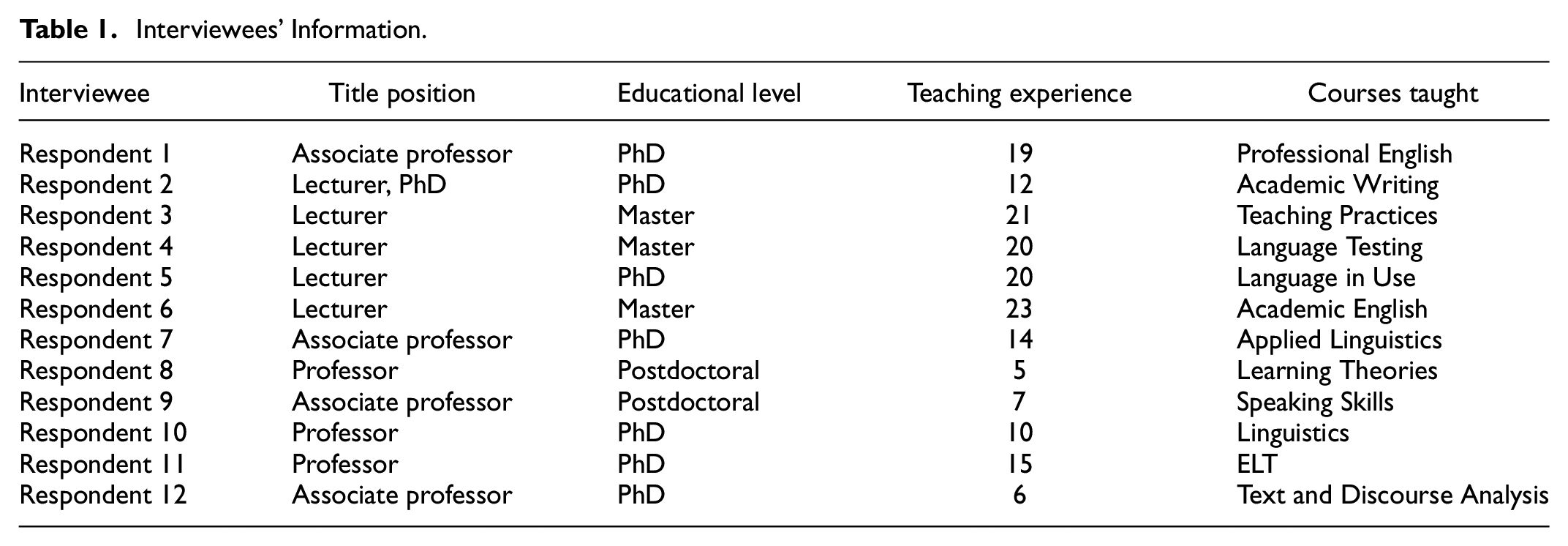

Demographic information of participants.
The interviews were based on a pre-designed interview, and the questions were focused on teachers’ understanding and practice of formative assessment (Yan et al., 2021; Zeng & Huang, 2021). Each interview was conducted individually, and questions and discussions were performed according to the interview outline. The interviews were audio-recorded with the interviewees’ consent, and were transcribed into text so that the data could be organized, coded, and analyzed.
Participant Criteria
In this qualitative study, a multi-stage sampling method was used to ensure that the candidates had sufficient relevant knowledge and experience regarding the topic of concern. The study interview criteria were as follows:
(a) have a minimum 5 years’ experience of teaching university-level English language courses;
(b) have a good understanding of formative assessment methods in language teaching; and
(c) be currently involved in teaching English courses at the university level in China.
Study Design
Inspired by Patton (2015), this study used the semi-structured interview method for data collection. The interviews aimed to study the understanding and practices regarding formative assessment in English language teaching. The questionnaire for the interview was created to examine teachers’ views on formative assessment, how it is incorporated into their teaching practice, and the issues they encounter in effectively implementing it. The research questions used within this research were framed in an open-ended manner to facilitate the articulation of the perceptions and experiences of the participants on the contribution of formative assessment to supporting instruction and learning. The emphasis was directed toward comprehending the impact of formative assessment on student achievement, the way teachers give feedback, and how much students participate in the assessment. Particularly, the study aimed to examine teachers’ academic qualifications and motivation and how they shape teachers’ practices in formative assessment.
Informed Consent
The respondents were made aware of the purpose of the study, which was to investigate their perceptions and implementation of formative assessment in teaching university English. Participation was voluntary, with participants free to withdraw from the study at any time without penalty. They were informed that all information would be kept in strict confidence and would be used solely for this research. Responses were anonymized and identifiers for individuals removed. The study was approved by the institutional review board to guarantee the protection of participants’ rights and the maintenance of ethical principles. Data were collected using English and Chinese interviews, which, for analysis, were translated from Chinese into English. Although the research adheres to high ethical standards, it should be noted that results may be confined to participants in particular urban cities and may not be representative of other geographic locations or demographic groups.
Quality Check of Data
To ensure the validity and accuracy of the data, we employed the respondent validation technique. This involves checking with participants once data has been gathered to ensure that the results accurately reflect their viewpoints. After data collection, participants were sent summaries of their responses to check that their opinions were accurately reflected. They were also asked to add more information or clarify points where needed. Additionally, the study followed recommendations outlined in qualitative research methodology, such as those provided by McGrath et al. (2019), which guide researchers in conducting thorough and reliable interviews. These practices are beneficial to any novice researcher in any field, for instance, social sciences, education, and health (Bell & Waters, 2018). A comparative analysis was carried out to ensure consistency and transparency of the data in order to perform comprehensive analysis of formative assessment practice.
Data Analysis
There were detailed notes taken for each interview, and the data which were gathered were analyzed using thematic analysis. Thematic analysis is a common method of analyzing qualitative data, but people sometimes get it wrong. Although it is a useful and usable tool for qualitative researchers, uncertainty regarding its philosophical underpinning and lack of precision in its definition have restricted its wider use (Kiger & Varpio, 2020). Some researchers have offered guidelines and descriptions of how to undertake various forms of thematic analysis. Thematic analysis is a simple, versatile, and commonly applied qualitative research methodology. The process includes six steps: familiarization with the data, creating initial codes (e.g., aspects such as emotions, responsibilities, and so forth), determining and refining themes, describing the themes, and lastly, writing the final report (Braun & Clarke, 2012 ).
Conceptualization of the Study Variables
Teachers’ Understanding of Formative Assessment
One of the primary elements of this study is how instructors recognize formative assessment. In other words, they should be aware of the purpose, procedures, and benefits of formative assessment in language teaching. Formative assessment is the usual performance reflected in the final results of the students. Formative assessment is the usual grade, a score given to students, a quantitative assessment of students based on a board set up on a public database. Usually grades are just quizzes, assignments, classes, and attendance. It is fair for each student. The feedback given in class is not a formative assessment. Formative assessment is to develop a positive mindset and seriousness in students’ English learning through regular tests. Students are made aware of the importance of regular effort.
Teachers’ Implementation of Formative Assessment
The second important variable is teachers’ use of formative assessment. This variable is the level of how much teachers use the formative assessment method in their classes. Different teachers may have different understanding of formative assessment so, their practices may be different from each other. These practices can include feedback on homework, class tasks or getting students to do self or peer reviews. This assessment can be more effective in promoting learning in students by how it is carried out in classrooms. The ability of a teacher to use these kinds of practices in daily classroom lesion and adapt them as per need of students is the main aspect of this variable.
Student Participation in Formative Assessment
The other important variable for the formative assessment is the student participation. This is also crucial for the effectiveness of student’s learning process. This assessment will be more impactful when the students show their active participation, rather than just receiving their feedback. This includes the engagement of students in self-assessment, sending feedback reviews to their peers, utilizing the received feedback to reflect on their learning progress, and improve their strategies. By taking part in this assessment, students can be self-aware, more engaged and can understand their strengths as well as their weakness to improve. This can also help students in developing the metacognitive skills, habits of responsibility for their own learning and improving overall academic performance.
Results
Thematic Analysis
The interviews revealed that the selected universities had conducted training on formative assessment for university teachers. The interviewees said that some teachers had never heard of the concept of formative assessment and that they had learned about it and how to do it through “seminars and training organized by the unit, even if it was not perfect, but they knew how to do it.” Four teachers thought such seminars and training were very effective, but five teachers said, “we don’t remember the school organizing (training), but it doesn’t prevent you from implementing it.”
Four of the teachers interviewed indicated that they had conducted research in the field at the master’s and doctoral levels and therefore had knowledge of or had explored the theory of formative assessment. Three teachers indicated that they did not systematically understand the idea but that their accumulated teaching experience “does not prevent them from implementing formative assessment.”
Teachers’ Understanding of Formative Assessment
Formative assessment reflects the usual grades, and in practice is a measure of the usual grade, a test of students’ learning attitude, and learning outcomes. Even according to an experienced teacher this grade includes two parts, the final grade and the formative evaluation, which is the usual grade. I guess this is how people generally understand it. Some colleagues who are more theoretical may have a higher level of understanding. Formative assessment is the usual performance reflected in the results of the students. Formative assessment is the usual grade, a score given to students, a quantitative assessment of students based on a board set up on a public database. Usual grades are just quizzes, assignments, classes, and attendance. It is fair for each student. The feedback given in class is not a formative assessment.
Formative assessment develops a positive mindset and seriousness in students’ English learning through regular tests. Students are made aware of the importance of regular effort. Formative assessment provides feedback and promotes learning. The assessment is a kind of feedback, right, and it emphasizes feedback. It’s about doing a test on how much the student has learned over time and then giving feedback on that. The assessment that the teacher does has to be valuable and needs to lead to some change. The most important purpose of formative assessment is to allow students to reflect after a test and then to guide or direct them in the future, so that they can summarize their learning in the previous period and guide them to make a corresponding plan for their future learning. Moreover, formative assessment aims to guide personalized learning. One of the spirits of formative assessment is to emphasize individualized learning and to pay attention to the differences of everyone. Students should dominate in formative assessment as a means of facilitating teaching and learning.
Exploring Teachers’ Formative Assessment Practices
The interviews revealed that university English teachers at different universities apply formative assessment in different ways. One of the most intuitive impressions of the reform of English teaching at the universities are the standardization and detailing of the evaluation criteria. One teacher in the Academic English Listening and Speaking course said that the teaching team “uniformly requires that the criteria for formative assessment be explained to students in the first class of the school year: there are four items for speaking assignments (intonation, vocabulary, grammar, and logic). Three of the classroom presentations are scored as a group, including logic, presentation, and group report; the others are scored for individual performance, including intonation, vocabulary, grammar, comprehensibility, and presentation performance.” The unified criteria facilitated teachers’ teaching evaluation efforts, while the openness of the evaluation criteria also provided students with a direction to work on.
The teachers interviewed were aware that regular tests were integral to formative assessment. Four of the teachers interviewed believed that formative assessment is reflected in regular tests: “(Formative assessment is) tests and exams. The usual grades are based on quizzes and classroom performance, and homework is included in the grade.” In contrast, some teachers opposed quizzes, arguing that scheduling multiple quizzes in a semester would increase the burden on teachers and students because of the tight class schedule. Some teachers believed that quizzes are less meaningful and that giving student’s feedback on their language output in class and after class is more important. Since the university has a uniform evaluation norm for teaching English at the university, every teacher interviewed recognized the formative assessment components. However, in addition to consistent testing and marking of papers, teachers’ evaluations of textbook notes, homework completion, and attendance and class performance are highly subjective and can vary in implementation. Some teachers focus heavily on classroom performance and attendance, deducting points for absences and adding points for answering questions, and using this to encourage student motivation in the classroom.
Five of the 12 university English teachers interviewed actively mentioned “feedback” as a manifestation of formative assessment. The rest of the teachers also had a deeper understanding of their teaching experience when asked about “feedback.” Most of the teachers thought that formative assessment practice was mainly reflected in various kinds of feedback. However, teachers took different approaches to the form and content of the input. Some teachers either did not give adequate feedback or gave no feedback at all to students. Three teachers said that students “need to see the teacher individually if they want to know what they did wrong, and then the teacher will show them the paper individually.” The remaining four teachers explicitly stated that they would not comment on the papers. The teachers would tell “where the students’ scores were ranked and compare them to the average score” so that “students could judge for themselves whether their abilities were on target and whether they were learning the right way,” but the papers “seemed to be the traditional practice of ‘confidential nature’.” Two teachers pointed out that their school was not doing enough in terms of test feedback and that they should send out corrected test papers each time and make comments so that students can understand where they are going wrong.
As for the role of feedback on student learning and teachers’ teaching, one teacher interviewed said that not giving specific feedback after a test has little effect on student learning: “The test is mainly a test of level. The main thing is that you’re not quite sure where I’m right and where I’m wrong. It doesn’t have much effect on their learning outcomes.” Two teachers thought feedback was mainly oriented toward students and had no practical effect on teachers’ teaching.
Teachers’ Motivation and Intention to Conduct Formative Assessment
The interviews revealed two patterns of teachers’ motivation to conduct formative assessment: intrinsic and active, extrinsic and passive.
Intrinsic, Active Motivation
Six of the teachers interviewed realized that the adoption of formative assessment is the general trend in education. They mentioned that they recognized in their academic research that the current popular international practice is a combination of formative and summative assessment, including specific measures such as individual assessment and peer assessment. Formative assessment is also a trend, and many studies have shown that formative assessment is quite useful. Many teachers in our school also intuitively feel that students should focus on the practices; if they have worked very hard before, the harvest will be very good when they check later. Four teachers mentioned the use of formative assessment to facilitate students’ learning. On the one hand, formative assessment can “better promote students’ progress and give them a better understanding of each stage of learning,” while on the other hand, it can “encourage students to invest time and effort in their English learning and to have a more positive attitude toward it.”
Extrinsic, Passive Motivation
Five teachers felt that the adoption of formative assessment was due to a change in school policy and that teachers had little autonomy and adopted formative assessment only in response to school requirements. One of the interviewees felt that he observed that many teachers adopted a combination of formative and summative assessments because they were driven by school policy, but teachers would prefer to use summative assessments. Four faculty members indicated that the formative assessment currently adopted in these universities is for instructional management purposes. Although the current practice is nominally a formative assessment, it is essentially a relatively simple, neat way of scoring students to monitor teaching and learning. Many teachers are content to judge students by their usual grade scores without achieving the true purpose of formative assessment. Many teachers take the formative assessment in college English because the usual grades include two tests to judge students according to their scores, but this is one of the most trivial purposes of formative assessment.
The Roles of Teachers and Students in Teaching Evaluation
All 12 teachers interviewed indicated that teachers are the subject of teaching evaluation and are responsible for establishing the criteria for assessment. Still, they also basically inform students how the teacher evaluates so they know what they are working on. The decision on whether to give feedback was also basically in the hands of the teachers. In practice, students are not involved in the evaluation process. When asked whether students were involved in the evaluation process, four teachers did not understand what “students’ participation in evaluation” meant, and four teachers generally understood that formative assessment required students to conduct self-evaluation and peer evaluation. All of them unanimously said this was not the case. Seven teachers generally understood that formative assessment requires students’ self-assessment and peer assessment, but all unanimously indicated that this aspect is not yet effectively implemented. Now, this aspect is not obvious, and students’ self-assessment and mutual assessment are rare and almost non-existent in listening classes. Only in the class presentation session would the teacher sometimes ask the students to comment on presentations or say what they thought.
Discussion
The study found that although the evaluation of college English teaching in selected universities adopts the “combining formative and summative evaluation” model, not all teachers have a correct understanding of what formative assessment is. The teachers’ knowledge of formative assessment showed a gradient effect. Most of them only focused on the process characteristics of formative assessment without knowing enough about the feedback, adjustment and subject of formative assessment (Schildkamp et al., 2020; Wang, 2017). Most teachers tended to interpret formative assessment as “usual grades,” which ultimately measure students according to scores. Five of the 12 teachers interviewed were largely aware of the challenges and understood formative assessment.
This understanding was also reflected in the purpose of the teachers’ approach to formative assessment (Pastore et al., 2019; Zhou et al., 2022). The dominant view of the academic interpretation of formative assessment is that it is “designed to facilitate learning” and “designed and administered with the primary goal of improving student learning and is therefore different from assessment that is designed for accountability, ranking, or testing competencies” (van der Kleij, 2019; Wiliam, 2017). Interview results showed that experienced teachers understand formative assessment, feel it is very important, and believe that it enhances their teaching practices and understanding (Imran et al., 2024; Younas et al., 2024). In other words, the formative assessment currently adopted in college English is a means of staging and standardizing the summative assessment. In this way, formative assessment, which aims to promote students’ learning, has become a tool for judging students by their quantitative grades, and its positive effect on teaching is doubtful.
In addition, the understanding of formative assessment is also reflected in teachers’ consideration and the roles of teachers and students in the teaching evaluation process (Afzaal et al., 2024; Wiliam, 2011; Zhang et al., 2021). All the teachers interviewed indicated that in the current evaluation system, which combines formative and summative assessment, the teacher is the main subject of evaluation, while the students’ main role is that of “learners”, and “receivers of evaluation.” However, it is an important feature of formative assessment that students are the main subjects of assessment (Ismail et al., 2022). Research shows that students can better achieve their learning goals only if they are clear about their learning objectives and participate in evaluating whether they have attained them (Black & Wiliam, 2009; Hattie & Timperley, 2007). Students need to have a clearer understanding of their learning process through their participation in the evaluation process to self-regulate their learning process and methods and improve their learning outcomes (Noor et al., 2022; Ozan & Kincal, 2018; Wang et al., 2025).
Misunderstanding leads to mis-practice. In the interviews, teachers who interpreted formative assessment as regular grades mostly emphasized the role of regular homework, tests and classroom presentations in assessing students (Cisterna & Gotwals, 2018). Some teachers even though the current formative assessment was more cumbersome in practice than the pre-reform summative assessment. A typical misconception of formative assessment is that teachers believe that scheduling students to take weekly tests and informing them of their results is formative assessment, which leads to teachers not focusing on feedback and not ensuring that the results of the tests contribute to students’ subsequent learning (Hansen, 2020). Such tests are just more frequent summative assessments and so they lose their original meaning (Blackà, 2003). This leads to a lack of focus on teacher feedback, making the test results less likely to promote subsequent learning.
There are also cases where understanding is in place, but implementation is not, which is like previous study results (Gamlem, 2015; Hattie et al., 2016; Lee et al., 2015). Despite recognizing the importance of feedback, the “teacher-led instructional assessment” approach has prevented the role and benefits of feedback in current formative assessment from being fully realized. Except for writing and classroom presentations, students at the universities mostly receive feedback in the form of grades and lack individualized feedback and suggestions for improvement in the learning process. At the same time, the role of formative assessment for teachers to learn from, reflect on and adjust their teaching was also weakened, as some teachers felt that the teaching schedule was still pre-determined, while most indicated that they would comment on and remind students of their mistakes in the tests. Despite understanding the advantages of student participation in assessment, some teachers could not implement this practice on a large scale because of teaching resource constraints (Cheng & Qi, 2006; Cowan, 2009).
Given that the selected universities and cities are considered leaders among domestic universities in terms of time, concept and degree of university English teaching reform, it is reasonable to infer that the deviation in the understanding, and practice of formative assessment by English teachers in these universities is typical of all Chinese universities. It is possible that many universities English teachers still regard formative assessment as the usual grades that serve as summative assessment.
Difficulties in Teachers’ Practice of Formative Assessment
The interviews revealed that some teachers were aware of the deviations in the understanding and practice of formative assessment since the beginning of the reform of the university’s English teaching evaluation tools. However, this problem has not been solved or improved in recent years and indicates many difficulties in applying formative assessment in practice (Ghahari & Sedaghat, 2018; Hopfenbeck et al., 2015). The following challenges in preparing formative assessments in the English language in China can be found by comparing the views of the interviewed teachers and the conditions of implementing formative assessments in universities in China and abroad.
Constraints of Objective Conditions
College English teaching classes are usually large, and teachers’ energy is extremely limited. The interviewed teachers generally reported that formative assessment, which accounts for 60% of the overall assessment grade, creates a large workload for teachers. Since each class size is around 35 students (a small class size in China) and each teacher must teach multiple classes per semester, it is difficult for them to pay attention to each student’s learning process inside and outside the classroom and to develop individualized feedback and assessment (Lee, 2007; MacLellan, 2001; Wu et al., 2021). Some of the interviewed teachers realized that the essence of formative assessment, which emphasizes individualized learning and attention to personal differences, could not be achieved with teachers’ limited teaching energy.
On the other hand, the uniform curriculum dictates that teaching autonomy is extremely limited in terms of time and space. The survey results showed that the teaching in selected universities is about 18 weeks per semester, and each course comprises 1.5 hr of class time per week. The short duration of the courses, coupled with the tight teaching schedule, leaves very limited time for teachers to conduct tests, and give feedback in class, making it very difficult to focus on individual learning and to guide students’ self-participation in assessment.
The Problem of Teachers’ Pedagogical Autonomy
Nearly half of the teachers interviewed indicated that teachers have very limited autonomy to influence and develop teaching evaluation policies, and that the adoption of the current “formative assessment” is only the implementation of guidelines set by their superiors, which indicates that teachers are not generally involved in the development of teaching evaluation policies, and are not highly motivated to participate (Younas et al., 2022). Some interviewees also pointed out that the importance of research and academic ability over the quality of teaching in the current evaluation of university teachers has led many teachers to put limited effort into education.
Lack of Knowledge of Teaching Evaluation Theory
Figure 3 illustrates that English teachers do not deeply understand the concept of formative assessment. Most of the university English teachers interviewed at the universities, except for those who had studied education or language testing at the graduate level, were aware of the concept of formative assessment through school policy. In addition, the teachers’ rich teaching experience had a negative rather than a positive impact on the change in assessment (Younas et al., 2023). Since most teachers were experienced in teaching, they were familiar with the operation of college English assessment and tended to replace the new assessment requirements with the old ones. The survey found that the university’s English teaching department provided relevant theoretical training and required all teachers to attend. Still, not all teachers participated in the training, or if they did, they did not give sufficient attention to theoretical learning. Some teachers thought that formative assessment only requires departments to standardize assessment criteria and that they do not need relevant theoretical knowledge.
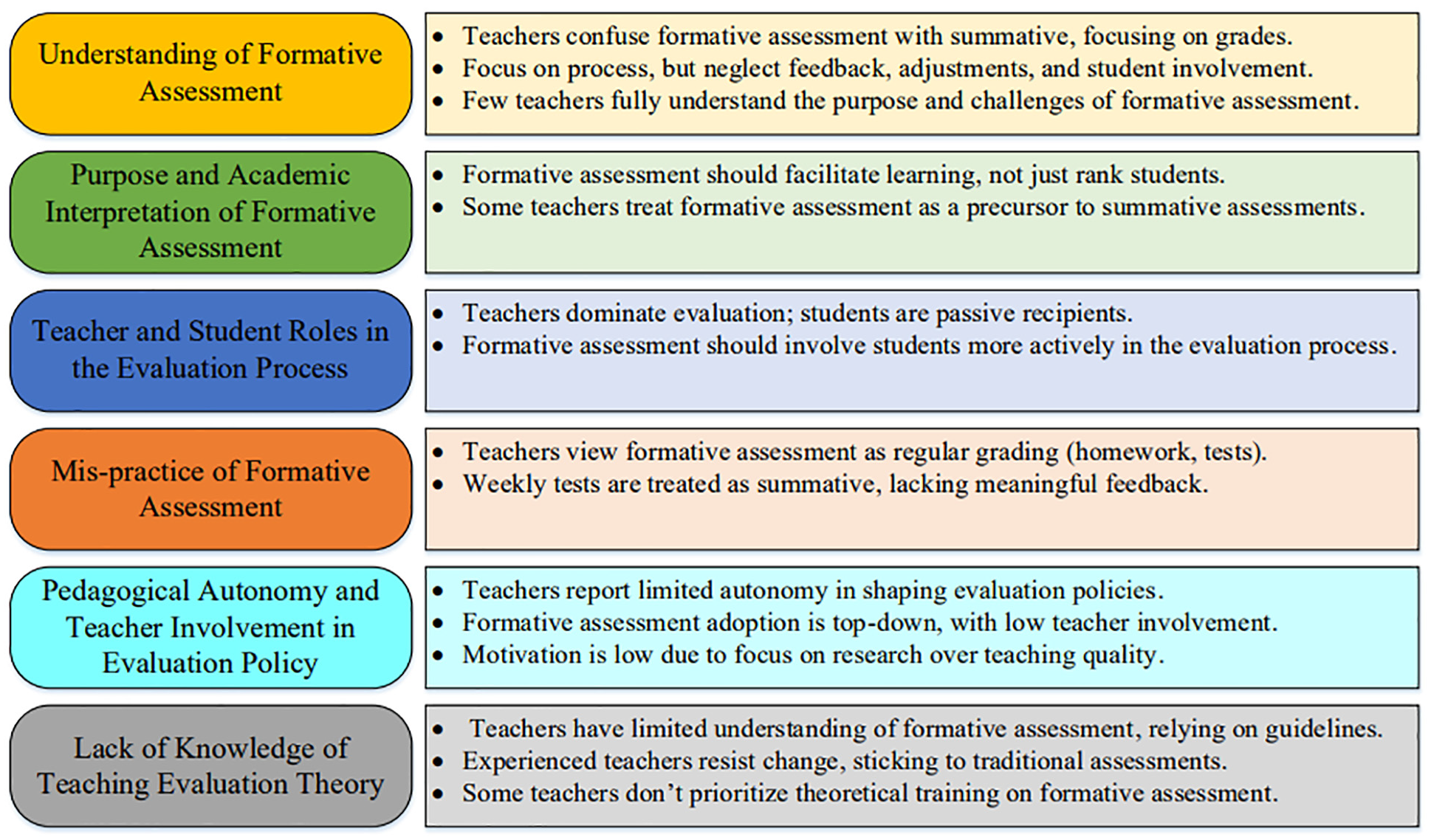
Main themes extracted from thematic analysis.
Suggestions for Improving the Current Practice of Formative Assessment
Formative assessment is vital when it comes to the process of reforming University English teaching in the current society, but the existing practices and perceptions of college English teachers in China exhibit many gaps. The study indicated that even those teachers with doctoral degrees and those specialized in teaching and learning have limited knowledge of formative assessment. Unfortunately, formative assessment is implemented at teachers’ convenience, especially in managing their classes, rather than to effectively helping improve student learning and provide detailed feedback. Such a misalignment with the intended purposes of formative assessment that include enhancing students’ self-motivated learning and learning activities suggests issues in teacher education and in the distribution of resources. For these issues to be effectively resolved, Figure 4 explains the role that formative assessment plays in the classroom. It should be rebalanced to conform with the intended intent of the popular general practice and to support teachers and students with a more student engaged educational practice.
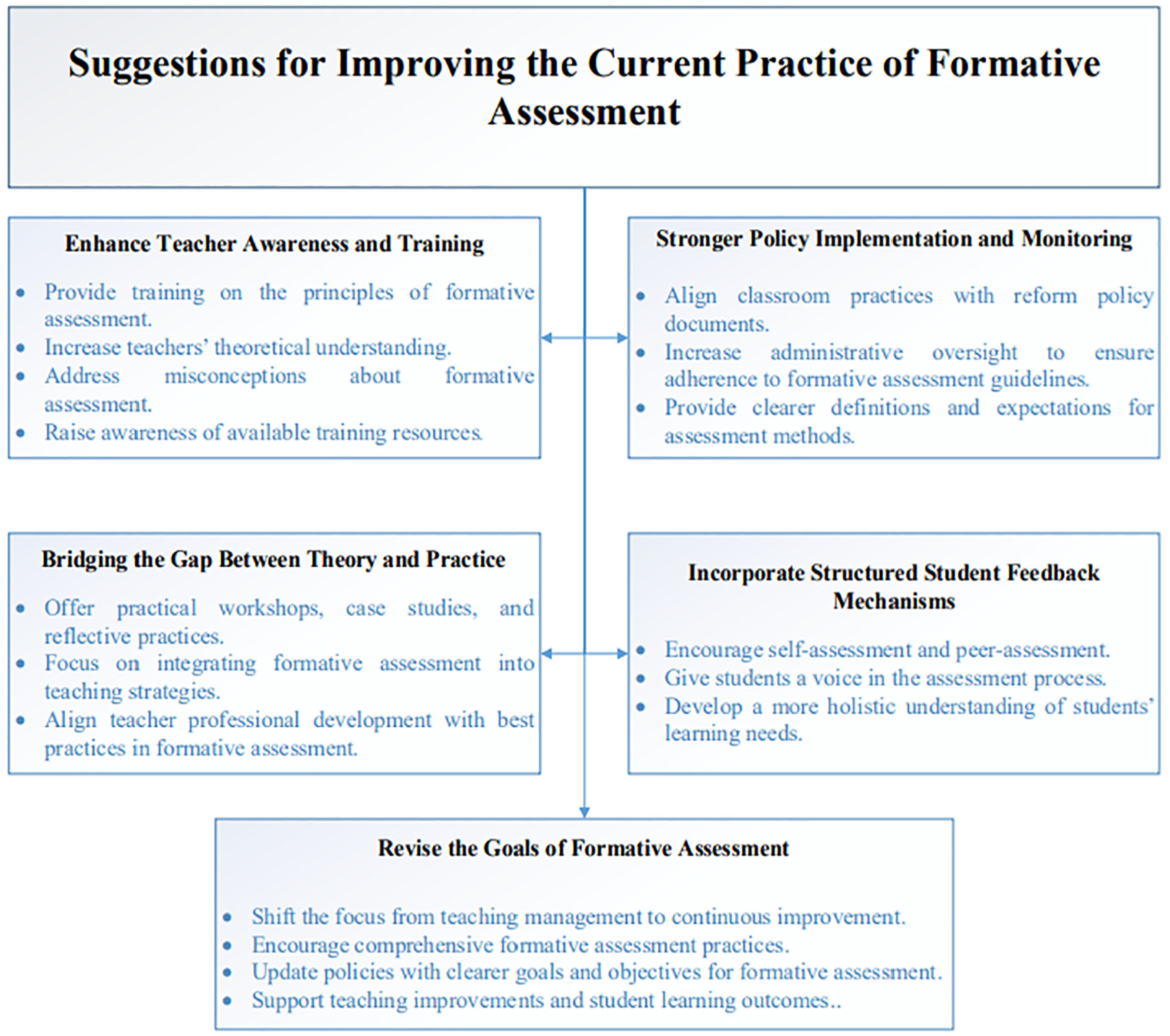
Suggestions for improving current practices for formative assessment.
First, teachers need to enhance their theoretical learning. Some interviewed teachers who realized that formative assessment in practice was contrary to the original intention had doctoral education backgrounds related to education and language teaching. They held certain administrative positions in the university English teaching departments and played an important role in the reform of university English teaching. Most of the interviewed teachers had some misconceptions about formative assessment or did not pay enough attention to the ideas related to formative assessment, while some said they did not know about the training provided by the university or did not think it was necessary to learn the theories. Therefore, to change teachers’ misconceptions about formative assessment, it is necessary to start by raising teachers’ awareness of theory learning and organizing relevant training (Xiao, 2017; Younas et al., 2025).
Second, effective formative assessment requires stronger policy implementation and monitoring by the teaching administration (Xiao & Yang, 2019). This study found discrepancies between teachers’ actual teaching assessment instruments and the reform policy document, such as students’ self-assessment, mutual assessment, and teachers’ provision of feedback, which was not ideally implemented. Thus, the teaching administration should increase supervision to put formative assessment into practice.
Third, training for professional development regarding formative assessment should focus on bridging the gap between theoretical understanding and actual practice. This will avail the opportunity to realign the educational training of teachers with the principles and best practices of formative assessment. Emphasis on practical workshops, reflective practice, and case studies will afford the teachers a better integration of formative assessment into their teaching strategies toward increased effectiveness in promoting student learning and self-regulation.
Fourth, it is also important that structured student feedback mechanisms be incorporated to enable students to have a voice in the assessment process. In their effort not to sideline the students’ subjectivity, teachers are encouraged to involve themselves in self-assessment and peer-assessment activities, which may allow for the development of a more holistic understanding of students’ learning needs, and thus realize more fully a responsive and adaptive teaching methodology.
The fifth idea is that formative assessment practices should be revised with regard to the goal, since the trends of practices are inclined toward teaching management more than improvement. The schools should encourage the teachers to move beyond teaching management for comprehensive formative assessment in order to effect continuous improvement in teaching methodology as well as in student learning achievements. This will be facilitated by updated policy guidelines, clearer definitions of what needs to be measured from formative assessment, and continued support from education policymakers.
Finally, the allocation of resources for teaching English at the university level needs to be improved. The lack of teaching resources and the limitations of the teaching environment pose obstacles to teachers’ implementation of formative assessment. Small English classes or the provision of teaching assistants in each class who provide feedback and building student profiles are necessary for implementing an assessment approach that focuses on individualized learning and promotes student learning.
Conclusion
Formative assessment has contributed to the reform of university English teaching. The evaluation method of combining formative and summative assessment is more objective and reasonable than the original single evaluation method of mainly summative assessment, the focus of which was on the usual grades and teaching management rather than on promoting students’ learning and providing personalized feedback. In practice, only teachers are still the focus of the assessment. Teachers use formative assessment mostly to facilitate teaching management, ignoring the most important purpose of formative assessment, namely, to provide feedback, and promote students’ independent learning. Therefore, to a certain extent, the current formative assessment implemented in college English teaching contradicts the original purpose of the reform and the fundamental purpose of formative assessment. The solution to this problem requires enhanced teacher training, improved teaching management, and resource allocation.
For the current limited sample size, there is a possible positive correlation between teachers’ understanding and the practice of formative assessment and their education and title. Several of the interviewed teachers with doctoral degrees had research interests related to teaching and learning; therefore, teachers’ understanding of formative assessment is more likely to be related to their education and training experiences.
Supplemental Material
sj-docx-1-sgo-10.1177_21582440251340462 – Supplemental material for Formative Assessment in Language Teaching at University Level: Teachers’ Understanding and Practice
Supplemental material, sj-docx-1-sgo-10.1177_21582440251340462 for Formative Assessment in Language Teaching at University Level: Teachers’ Understanding and Practice by Muhammad Younas, Iskander Ismayil, Yicun Jiang and Uzma Noor in SAGE Open
Footnotes
Acknowledgements
The researchers thank Prince Sultan University for funding this research project through the research lab [Applied Linguistics Research Lab - RL-CH-2019/9/1].

Ethical Considerations
The study is approved by the review board of School of Foreign Languages, Shenzhen Technology University, P.R. China.
Informed Consent
Before conducting the study, it is informed to participants that their participation is voluntarily, and a written Informed Consent form signed by participants that their responses will only be used for this research purpose.
Author Contributions
MY and II written the original draft and they worked equally in this manuscript, YJ and UN particiapted methodoly, data collection, analysis and discussion section.
Funding
The author(s) received no financial support for the research, authorship, and/or publication of this article.
Declaration of Conflicting Interests
The author(s) declared no potential conflicts of interest with respect to the research, authorship, and/or publication of this article.
Data Availability Statement
The raw data will be available at a reasonable request to the corresponding author.
Supplemental Material
Supplemental material for this article is available online.
References
Supplementary Material
Please find the following supplemental material available below.
For Open Access articles published under a Creative Commons License, all supplemental material carries the same license as the article it is associated with.
For non-Open Access articles published, all supplemental material carries a non-exclusive license, and permission requests for re-use of supplemental material or any part of supplemental material shall be sent directly to the copyright owner as specified in the copyright notice associated with the article.
