




Abstract
The emergence of immersive technology has revolutionized the traditional tourism model, making it crucial to explore how virtual tourism can promote real tourism. This study examines the tourism of China’s Grand Canal, employing the Technology Acceptance Model and cultural memory theory. The study collected 391 valid questionnaires from China and utilized PLS-SEM to confirm that technology acceptance and cultural memory positively influence virtual tourism attitude, real tourism attitude, and subsequently real tourism intention. Furthermore, fsQCA reinforces these findings and suggests six configurations for enhancing real tourism intention. These findings enable innovative strategies to leverage virtual tourism for promoting real tourism in the industry.
Keywords
Introduction
Against the backdrop of information and communication technology, as well as new media technologies, virtual tourism has been integrated with computers, smartphones, and tablets to create a highly attractive user experience (Frenzel et al., 2022). Immersive technologies like augmented reality, virtual reality, and metaverse are introduced to various tourist destinations such as theme parks, cultural heritage sites, and national parks to provide users with unique and realistic experiences without leaving their homes (M. J. Kim et al., 2020). Scholars began researching virtual tourism in the 1990s primarily investigating the use of single immersive technologies in the tourism industry (Garau & Ilardi, 2014; Guttentag, 2010), as well as tourist experiences (M. J. Kim & Hall, 2019; C. Liu & Huang, 2023). The emergence of immersive technologies has transformed human-environment relationships in the tourism industry (Z. Chen & Zhenfang, 2020). The traditional binary space of “tourists-real tourism destinations” has been shattered, giving way to a new triadic space of “virtual tourism destinations-tourists-real tourism destinations” (Kunz & Seshadri, 2015). The mutual relations and mechanisms of the triadic space have become important issues in the study of human-environment relationships in the digital age. Currently, research on the construction of triadic spaces is relatively mature, and scholars have proposed the Virtual Reality Tourism Involvement (VRTI) model based on this framework (Wang et al., 2022). Virtual tourism may affect users’ experiences, attitudes and behaviors (Jung et al., 2015; Tussyadiah et al., 2018), and studies have shown that virtual tourism can lead to attachment between people and places, thereby promoting real tourism (Wang et al., 2022). However, can a long-lasting attachment between people and places be achieved simply through technology? The answer is obviously no, as it is still necessary to return to exploring the content of tourism itself (Ye et al., 2022). However, in the research of this new triadic space field that involves “virtual tourism destinations-tourists-real tourism destinations,” the importance of tourism content has been largely overlooked.
Human fascination with curiosity often prioritizes innovative “technology” at the expense of overlooking the depth and substance of its content. Tourist attraction value heavily relies on its historical and cultural heritage, which appeals to visitors based on their “cultural memory” of it. Memory research originates from a psychological perspective (Bartlett, 1932), and tourism studies explore the impact of autobiographical memories on destination images (Li & Zhao, 2021). However, autobiographical memories are limited to the personal experiences of tourists before they visit the destination. In contrast, “cultural memory” is based on the social-historical foundation of memory and highlights the cultural basis of memory (Assmann, 1992). Therefore, knowing a destination’s historical and cultural heritage suffices to form cultural memories, even without physically visiting. Current research has explored the impact of culture on tourism through various case studies. For example, Zhou et al. (2023) investigated the attraction construction of tourist destinations using tea villages as a typical example. With their rich tea culture, these villages have successfully captivated many tea culture enthusiasts, becoming their top choice for exploration and experience. However, the deeper development of rural tourism should not be confined to specific cultural domains but should delve into and showcase the unique local cultural essence as a key to enhancing competitiveness. The study by Z. Chen and Diao (2022) effectively demonstrated that integrating modern agricultural tourism elements based on local culture into rural area planning is an effective approach to achieving sustainable development. “Cultural memory” crystallizes in dimensions relating to past history, while “technology” lies in prognostic value (Zhou et al., 2023). To ensure long-term success, tourist attractions must firmly grasp both past “cultural memory” and future “technology,” utilizing immersive technology to captivate the audience and preserving them by creating thick cultural content.
The increasing use of immersive technology in tourism has been well documented in recent studies, including applications of augmented and virtual reality in heritage tourism (Atzeni et al., 2022; Bec et al., 2019; Jia et al., 2023; C. Zhu et al., 2023), digital museum initiatives for virtual visitation (Guo et al., 2023), metaverse-based time-travel experiences (Buhalis et al., 2023), and the development of metaverse tourism ecosystems (Corne et al., 2023; Koo et al., 2023). However, despite this growing trend, research has only begun to explore how cultural factors influence the adoption and effectiveness of these technologies in tourism (J. Chen et al., 2023; Sun et al., 2023). The studies have highlighted the need for more research on the role of cultural differences in shaping tourists’ responses to immersive experiences (J. Chen et al., 2023; Sun et al., 2023). While the literature on virtual reality in tourism has grown significantly, there remains a dearth of studies delving into the latest developments of virtual reality in the tourism sector, particularly concerning the influence of cultural factors (Phoong et al., 2024; Sun et al., 2023). Therefore, this study incorporates cultural memory into the impact pathway of immersive technology driving “real tourism” by electing and supplementing the Technology Acceptance Model (TAM). To achieve this research objective, three research questions are proposed: (1) How can immersive technology be accepted by tourists? (2) Can cultural memory stimulate tourists’ intentions to participate in both virtual and real tourism? (3) Does the synergy between technology and culture facilitate virtual tourism visitors to engage in real tourism? A survey was conducted on China’s Grand Canal virtual tourism to answer these questions. The Grand Canal National Cultural Park Digital Cloud Platform implemented metaverse technology in 2023, placing the effectiveness of the Grand Canal virtual tourism at the forefront of the industry in the previous year. Based on this, in order to achieve the above research objectives, this research will utilize dual qualitative and quantitative validation to explore the potential mechanisms of the behavior of virtual tourism visitors to the Grand Canal. First, to analyze the research boundaries and applicability of the study model through PLS-SEM; then, to enrich the study results’ configurations through fuzzy set qualitative comparative analysis (fsQCA). This work has theoretical and managerial implications for studying the relationship between virtual and real tourism under the background of immersive technology, particularly incorporating the overlooked aspect of cultural memory into the arena of technology acceptance. Theoretically, this study contributes to the understanding of technology adoption in tourism. Practically, it offers insights for tourism providers on enhancing tourist experiences through immersive technology.
Literature Review and Hypothesis Development
Virtual Tourism-Immersive Technology in Tourism
Information and communication technology has led to the proliferation of new media, which offers unique and distinctive user experiences in terms of form, material, and phenomenology, guaranteeing each user a singular selection (Manovich, 2001). The progression of new media has enabled immersive technologies to be integrated into computers, smartphones and tablets, resulting in highly attractive user experience (Frenzel et al., 2022). Currently, virtual tourism is still at an early stage of development, as its autonomy, interactivity, dynamism and real-time capabilities are limited by technological constraints, necessitating joint efforts from both technology providers and market demand to achieve higher quality experiential outcomes. Researchers began to study virtual tourism in the 1990s, mainly focusing on exploring the potential value of individual immersive technologies in tourism (Garau & Ilardi, 2014; Guttentag, 2010) and tourist experiences (M. J. Kim & Hall, 2019; C. Liu & Huang, 2023). Studies related to “VR tourism” occupy a large proportion of virtual tourism research, playing an important role in advancing this field despite not clearly articulating the complete meaning of the concept of “virtual tourism” (C. Liu & Huang, 2023; Lo & Cheng, 2020). The forceful integration of immersive technology has bestowed the tourism industry with novel meanings, characteristics, and forms in human-place relations (Z. Chen & Zhenfang, 2020). The traditional binary space of “tourists—real tourism destinations” is being challenged, giving rise to a new triadic space of “virtual tourism destinations—tourists—real tourism destinations” (Kunz & Seshadri, 2015). Although scholars are currently studying the process of constructing this triadic space (Kunz & Seshadri, 2015), research on tourist behavior within it remains inadequate (P. Liu, 2020). This study examines people’s inclination toward virtual tourism and real tourism from both technological acceptance and cultural foundational perspectives, emphasizing the need to address gaps in micro-level psychological analyses and cultural sensitivity.
Theoretical Framework: Technology Acceptance Model
Davis proposed the Technology Acceptance Model (TAM), which is based on the Theory of Reasoned Action (TRA) and the Theory of Planned Behavior (TPB). TRA and TPB are universal models that explain individual behavior. The TAM model evolved from the TRA model to study the factors that affect an individual’s acceptance and adoption of new technology, explaining and predicting an individual’s technological usage behavior (Davis et al., 1989). The TAM model includes two key variables: perceived usefulness and perceived ease of use (Lai, 2017). Perceived usefulness is defined as the degree to which a person’s work performance is improved through using a specific system. Perceived ease of use is defined as the ease with which a person uses a specific system. The TAM posits that an individual’s utilization behavior is determined by their intention to behave, which, in turn, is influenced by their attitude toward using a particular system. The individual’s attitude is influenced by both the perceived usefulness and perceived ease of use associated with the said system. External variables affect perceived usefulness and perceived ease of use while perceived ease of use indirectly impacts attitude toward using through perceived usefulness (Davis et al., 1989). The application of virtual tourism in TAM focuses on analyzing users’ perceived usefulness and perceived ease of use of virtual tourism technology. This analysis helps predict and explain users’ acceptance and usage behaviors regarding virtual tourism. In the context of virtual tourism, perceived usefulness reflects whether virtual tourism can enhance users’ travel experiences, meet their travel needs, and provide actual benefits. Perceived ease of use reflects the ease of operating the virtual tourism system, the learning costs, and the system’s user-friendliness. The application of virtual tourism in TAM focuses on analyzing users’ perceived usefulness and perceived ease of use of virtual tourism technology. This analysis helps predict and explain users’ acceptance and usage behaviors regarding virtual tourism. In the context of virtual tourism, perceived usefulness reflects whether virtual tourism can enhance users’ travel experiences, meet their travel needs, and provide actual benefits. Perceived ease of use reflects the ease of operating the virtual tourism system, the learning costs, and the system’s user-friendliness.
Hypothesis Development
Perceived Ease of Use
Perceived ease of use in the TAM refers to the extent to which individuals believe that using a system would exempt them from putting in much effort and reflects their perception of the degree of complexity involved in using a particular system (Davis et al., 1989). In the context of virtual tourism preference intentions, perceived ease of use is defined as an individual’s perception of how effortless and straightforward it is to use immersive technology. Virtual tourism equipment should be user-friendly, easy to operate, and provide clear information.
Numerous scholars have demonstrated a close association between perceived ease of use, perceived usefulness, and attitude. When individuals perceive the level of effort required to use a certain technology as low, they tend to consider it as useful to them (Ali et al., 2016). Additionally, when users perceive acquiring immersive technology as relatively easy, they are more likely to hold positive attitudes toward virtual tourism without having to exert too much effort (Geng et al., 2022). Therefore, this study suggests that improving the perceived ease of use of immersive technology may positively impact the enhancement of perceived usefulness and virtual tourism attitudes.
H1: Perceived ease of use has a significant impact on perceived usefulness.
H2: Perceived ease of use has a significant impact on virtual tourism attitude.
Perceived Usefulness
Perceived usefulness in the TAM reflects the extent to which individuals believe that using a particular system will enhance their performance (Davis et al., 1989). In the context of virtual tourism preference intentions, perceived usefulness refers to the level at which users perceive that using immersive technology is useful in improving their travel usability, including the tourism experience, convenience, and efficiency in achieving travel objectives.
Existing studies have shown that perceived usefulness plays a decisive role in determining attitudes toward technology (Zhou et al., 2023). When individuals perceive certain technologies as useful in achieving specific goals or helping them carry out specific purposes, they tend to hold positive attitudes toward such technologies (Chueh & Huang, 2023). It is reasonable to anticipate that when users perceive that using immersive technology can enhance their performance or usefulness, they are more likely to hold positive attitudes toward it (Kao & Huang, 2023). Therefore, this study suggests that the perceived usefulness of immersive technology has a positive effect on enhancing virtual tourism attitudes.
H3: Perceived usefulness has a significant impact on virtual tourism attitude.
Virtual Tourism Attitude
Virtual tourism attitude is the evaluation of virtual tourism experience. First, tourism experience is described as a series of feelings, experiences, and emotions that are subjectively perceived by visitors (Tung & Ritchie, 2011). This includes customize according to the needs and preferences of individual tourists travel service, using real-time information to improve decision-making, and by means of mobile devices and other digital and the interaction with tourism environment (Buhalis & Amaranggana, 2015). Previous research has shown that positive stimulation of virtual travel attitudes will result in users having a positive impact on the image of the destination as well as their intention to go there. From the perspective of general emotions, experience is the key to the formation of users’ virtual travel attitude (Tussyadiah et al., 2018). Existing studies mainly consider the formation process in the definition of virtual tourism attitude. In this study, virtual tourism attitude is defined as users’ positive or negative emotions toward virtual tourism presented by virtual technology after using virtual technology to travel. That is, users’ attitude toward simulating real tourism scenes and scenic spots through virtual technology, and then the virtual tourism to produce a certain attitude and view.
In the field of immersive technology adoption, attitude has a significant impact on intention (Chiao et al., 2018; Shen et al., 2022). Perceptual enjoyment in virtual environment forms virtual tourism attitude, which can be used as antecedent of behavioral intention (Hew et al., 2018; Huang et al., 2013; Tussyadiah et al., 2018). Negative attitudes toward a service that does not meet customers’ utilitarian expectations may lead them to stop using the technology or service. A positive attitude toward virtual tourism will almost universally lead to an acceptance of its usage intention (Frenzel et al., 2022). Additionally, the satisfaction of immersive and memorable experiences or psychological imagery obtained through virtual tourism will further enhance their willingness to go to the same destination in person (Skard et al., 2021). Therefore, this study suggests that virtual tourism attitude has a positive impact on the improvement of real tourism attitude and real tourism intention (Geng et al., 2022).
H4: Virtual tourism attitude has a significant impact on real tourism attitude.
H5: Virtual tourism attitude has a significant impact on real tourism intention.
Cultural Memory Theory
Traditional research explored factors affecting users’ willingness to use and behavioral decisions from the perspective of user behavior, specifically through the TAM. As information technology has evolved, user behaviors and needs have also been continually changing and improving, leading scholars to recognize the significant role of user experience in behavioral intention studies. Consequently, emotional factors have begun to receive more attention (T. Kaya & Erkut, 2016). Cultural memory is one of the most important emotional variables in the cultural tourism process. Cultural memory refers to the sum of rituals, festivals, symbols, and figures that are unique and reusable in specific societies or time periods. The study of memory originated from a psychological perspective where it was considered as an individual’s mental existence. However, Bartlett (1932) argued that memory should be viewed as a construction process in social conditions (Bartlett, 1932). Maurice Halbwachs (2004) introduced the concept of “collective memory,” which refers to things or objects shared, passed down, and co-constructed by people within a group or modern society (Halbwachs, 2004). The introduction of this concept marked the shift in memory research from psychology to sociology. Assmann (1992) proposed the cultural memory theory, beginning with the social foundation of memory and highlighting the cultural aspect of memory (Assmann, 1992). Cultural memory can be preserved through memory media and passed on through the display of intellectuals such as priests, teachers, artists, and officials. The perpetuation of cultural memory requires the three dimensions of time, space, and group, each of which is indispensable. Asmann explains the development of civilization and the laws governing cultural memory from the perspective of cultural inheritance, stating that memory is governed by “symbols and the social world” and is a part of the cultural system.
In recent years, culture has increasingly gained attention in tourism research. As popular culture gains attention, managers transform local communities into fictional service landscapes to attract tourists (Lundberg & Lindström, 2020). Hip-hop has evolved from “folk culture” to “popular culture,” and the hip-hop culture has become a special interest for tourists who view it as a “popular culture” tourism attitude. Tourists visit these hip-hop destinations to explore the memories associated with hip-hop. Research has shown that hip-hop can be an important asset for global tourism marketing and planning (Xie et al., 2007). Moreover, related studies have shown that tea tourism destinations with a long history of tea culture attract many tourists interested in tea culture (Zhou et al., 2023). In addition to tea tourism, rural tourism also needs to have unique cultural characteristics of the local area. Research has demonstrated that the regional planning of modern agricultural tourism sites based on rural cultures is feasible (Z. Chen & Diao, 2022). Therefore, this study suggests that promoting cultural memory has a positive impact on both attitude and intentions toward virtual tourism and physical travel.
H6: Cultural memory has a significant impact on virtual tourism attitude
H7: Cultural memory has a significant impact on real tourism attitude
H8: Cultural memory has a significant impact on real tourism intention
Real Tourism Attitude
Attitude pertains to an individual’s positive or negative outlook and evaluation of their interests, behaviors, or objects (Davis et al., 1989). Since the 1970s, the tourism academic field has increasingly focused on attitudes toward tourism (Um & Yoon, 2021). Tourism attitude describes the psychological tendency of tourists to evaluate positively or negatively when they engage in uncertain behaviors (Kraus, 1995). Tourism attitudes include cognitive and emotional responses (Vincent & Thompson, 2002). Cognitive response refers to the evaluation made when forming an attitude, and refers to the knowledge and beliefs held by an individual about the characteristics and attributes of a tourist destination, while the emotional dimension of field travel refers to a person’s favorable or unfavorable feelings about a destination (Baloglu, 2000; H. Kim & Richardson, 2003). Emotional response is a psychological response that expresses a visitor’s preference for an entity, and the emotional dimension may be more subjective, reflecting the overall feeling toward a particular destination. Most of the existing studies define tourism attitude from the perspective of psychological emotion, but this study involves the dual conversion of virtual and reality, so it is necessary to further clarify the distinction between virtual tourism attitude and real tourism attitude. Therefore, in this study, the real tourism attitude is defined as the positive or negative emotion that experiencers hold toward the image of going to the tourism destination after virtual tourism.
As research on household recycling behavior (Vining & Ebreo, 1990), environmental behavior (Steel, 1996), and tourism behavior (Hrubes et al., 2001) show that attitudes predispose people to act or perform in a certain way. According to the existing research, tourism attitude is an effective predictor of tourists’ travel decision to a certain destination (Jalilvand & Samiei, 2012; Ragheb & Tate, 1993). In the field of tourism, studies show that tourists’ positive attitudes heighten the possibility of making purchases or visits while influencing their intentions. Additionally, Zhu and Deng delved into the mediating effect of attitude on tourists’ intentions, finding a positive correlation between attitude and tourist intentions (H. Zhu & Deng, 2020). Essentially, when tourists sustain a sanguine attitude toward virtual tourism, their willingness to utilize it increases over time (De Vos et al., 2022). Therefore, this study posits that enhancing real tourism attitude positively impacts real tourism intention.
H9: Real tourism attitude has a significant impact on real tourism intention.
Real Tourism Intention
The concept of tourism intention first evolved from consumers’ purchase intention (Davis et al., 1989). Real tourism intention is the potential behavior of tourists to travel destinations and the subjective probability of tourists engaging in specific travel behaviors. It includes a subjective judgment of a person’s or group’s tendency to engage in a certain travel behavior in the future and their willingness or plan to travel, explore, experience and visit a certain place in person (Gartner, 1994; Kozak, 2001). Tourism attitude can drive tourism intention, thus guiding tourists to choose a given destination and generate purchasing behavior. C.-F. Chen and Tsai (2007) proposed that real tourism intention includes two meanings: recommendation intention and revisiting intention, which refers to tourists’ judgment on the possibility of revisiting a tourist destination or recommending it to others (C.-F. Chen & Tsai, 2007). The previous definition of real tourism intention has been gradually improved from the potential behavior of traveling to the destination to the occurrence of recommendation behavior. In this study, real tourism intention is the effort tourists are willing to put into real tourism or recommending destinations after experiencing virtual tourism.
Serial Mediation Effects
Technology’s acceptability is constituted by the perceived ease of use and perceived usefulness. The tourists’ acceptance of immersive technology affects their attitude toward immersive technology usage (Geng et al., 2022; Kao & Huang, 2023). With tourists’ positive attitudes toward virtual tourism, the concept of real tourism gradually emerges (Skard et al., 2021), which in turn positively affects real tourism intention through the formation of a positive real tourism attitude (H. Zhu & Deng, 2020).It is worth noting that even fictional tourist landscapes cannot promote tourism attitude and intention without visitors’ cultural memory. By incorporating cultural elements into the virtual tourism content created through immersive technology, tourists develop an interest in virtual tourism and attempt to experience the local cultural atmosphere (H.-Y. Yen, 2022). For example, tourists’ memory of the popular culture phenomenon “Twilight” motivates them to browse fictional service sceneries and visit local communities (Lundberg & Lindström, 2020). Another example is the historical and cultural significance of Yellow Crane Tower in Wuhan, which enhances tourists’ cultural memory and makes it a virtual tourism destination, increasing their interest in real tourism during the virtual tourism process (Wang et al., 2022). Therefore, we believe that tourists’ cultural memory enhances virtual tourism attitude and real tourism attitude, ultimately promoting them to embark on real tourism. Based on our research, we believe that technology acceptance is determined by perceived ease of use and perceived usefulness, which influences tourists’ attitudes toward virtual tourism. When tourists hold a positive attitude toward virtual tourism, the concept of real tourism gradually forms, and their intention to engage in real tourism is further enhanced by a positive attitude toward it. Therefore, virtual tourism attitude and real tourism attitude serve as mediating variables, transmitting the effects of perceived ease of use and perceived usefulness on real tourism intention. Additionally, tourists’ memories of specific cultures increase their interest in virtual tourism, forming a positive virtual tourism attitude through this interest. This positive virtual tourism attitude, in turn, influences real tourism attitude and ultimately enhances tourists’ intentions for real tourism. Thus, cultural memory affects real tourism intention through the mediating effects of virtual tourism attitude and real tourism attitude. Overall, virtual tourism attitude and real tourism attitude play a role in the serial mediation effects between perceived ease of use, perceived usefulness, cultural memory, and real tourism intention.
H10: Virtual tourism attitude and real tourism attitude have serial mediation effects on the relationship between perceived ease of use and real tourism intention.
H11: Virtual tourism attitude and real tourism attitude have serial mediation effects on the relationship between perceived usefulness and real tourism intention.
H12: Virtual tourism attitude and real tourism attitude have serial mediation effects on the relationship between cultural memory and real tourism intention.
Accordingly, this study utilizes the TAM as the fundamental theoretical framework and incorporates the influence of cultural memory factors while adjusting it according to relevant situational factors to construct a theoretical model. The perceived ease of use and perceived usefulness of immersive technology, along with the cultural memory of tourist attractions, serve as the driving force for enhancing virtual tourism attitude and real tourism attitude, which in turn directly impact the formation of real tourism intention (Figure 1).

The theoretical model of this study.
Research Design
Sample Selection and Data Collection
During the World Canal Cities Forum in 2022, the achievements of the construction of the digital cloud platform of the China Grand Canal National Cultural Park were officially released. In 2023, metaverse technology will be applied to virtual tourism of the Grand Canal. This platform utilizes various digital technologies, such as oblique photography, three-dimensional modeling, virtual reality, GIS, big data, 5G, to showcase the historical evolution of the Grand Canal, classification and spatial distribution of cultural resources, ancient and modern styles of cultural relics and cultural resource points, 720° panoramic views of key locations along the canal, virtual tours of scenic spots, among others. Based on the extensive representation of the virtual tourism system built on the China Grand Canal National Cultural Park’s digital cloud platform, this study takes it as a case study to explore the immersive technology’s impact on the push mechanism for real tourism.
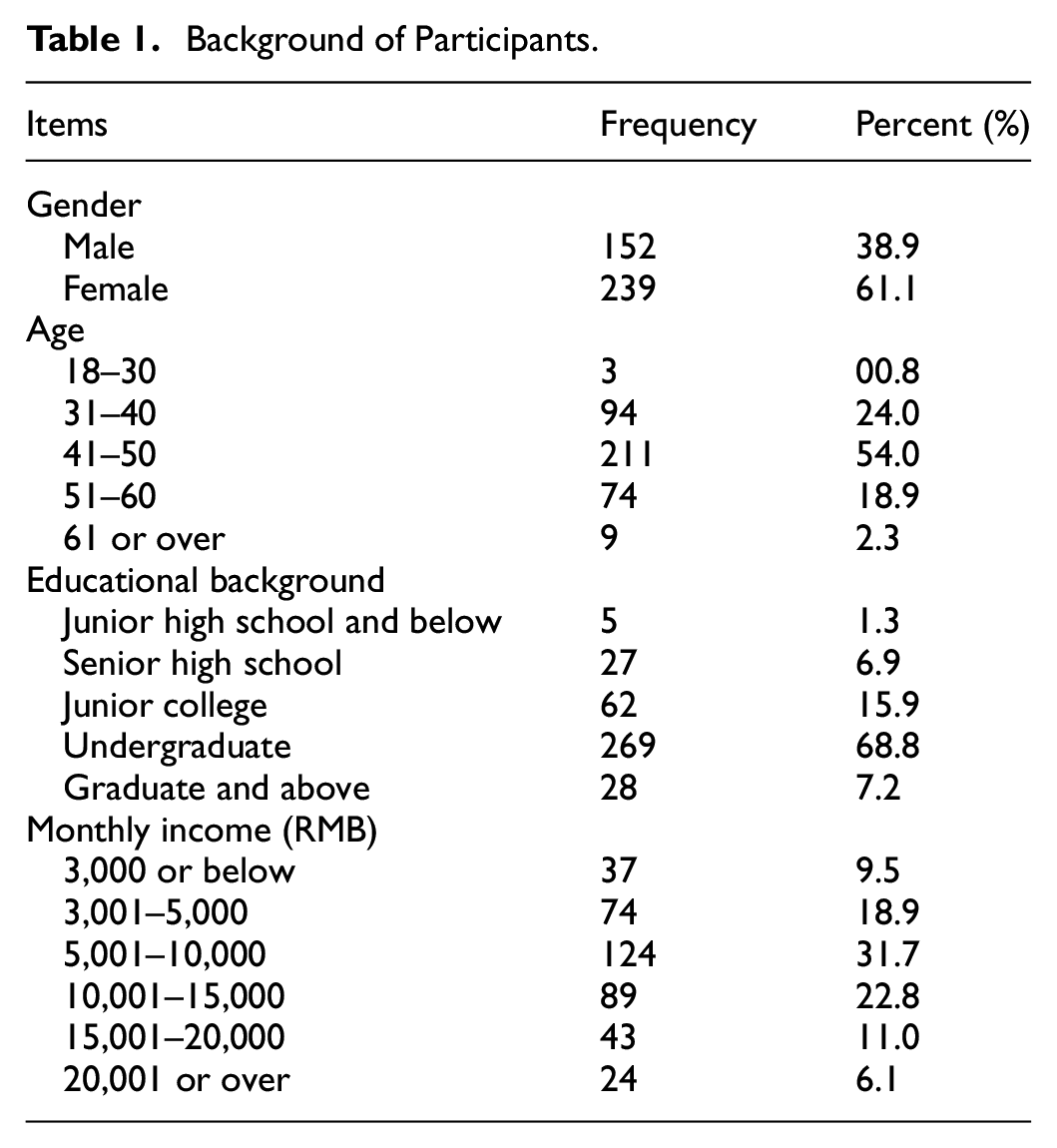
To effectively collect high-quality research data, a convenience sampling method combining both “online” and “offline” approaches was used. Online, we contacted the tourism bureau to distribute the survey link and QR code to users of the digital cloud platform of the China Grand Canal National Cultural Park. To ensure that users have sufficient virtual tourism experience and authentic impressions, the survey includes a link to the platform’s virtual tourism, guiding users to participate. Offline, three well-established sections along the canal: Tongzhou Section, Yangzhou Section, and Suzhou Section were selected, and tourists were asked if they had participated in Virtual Tourism and to fill out questionnaires if they had experienced it. The distribution of both online and offline questionnaires occurred simultaneously from February 5, 2023, to April 9, 2023. In the end, a total of 449 questionnaires were collected, and after removing invalid responses, 391 effective data sets were obtained with an effective rate of 87.1%. Table 1 summarizes the detailed statistical data of the respondents.
Background of Participants.
Measurement
The research scale includes the following structures: perceived ease of use, perceived usefulness, virtual tourism attitude, cultural memory, real tourism attitude, real tourism intention. The questionnaire was originally developed in English and then translated into Chinese. To preserve the original meaning of the items and obtain a Chinese version scale, reverse translation was conducted (Brislin & Richard). Additionally, to ensure measurement accuracy, we used a 7-point Likert scale (1 = totally disagree to 7 = totally agree; Stylidis et al., 2017). In this study, we utilized previous studies’ mature measurement scales, specifically: (1) Cultural memory was measured with a 4-item scale from Zheng et al. (2023); (2) Perceived ease of use was evaluated with 5-items from Davis et al. (1989) and D. C. Yen et al. (2010); (3) Perceived usefulness was measured using a 3-item scale adapted from Davis et al. (1989) and D. C. Yen et al. (2010); (4) Virtual tourism attitude was measured with a 3-item scale adapted from Davis et al. (1989) and C. F. Chen and Chen (2011); (5) Real tourism attitude was assessed with a 4-item scale adapted from Davis et al. (1989) and Zhao et al. (2022); (6) Real tourism intention was measured using a 3-item scale adapted from Woodside et al. (1989); (7) Finally, demographic information such as gender, age, educational background, and monthly income was included.
Data Analysis
Through Partial Least Squares Structural Equation Modeling (PLS-SEM) analysis, we can obtain path coefficients and significance levels between variables, revealing their direct impact relationships. However, this analysis may not fully uncover complex causal relationships and condition combinations. The introduction of fuzzy-set Qualitative Comparative Analysis (fsQCA) can further explore these complex relationships, especially how multiple conditions simultaneously influence outcome variables. This helps us gain a deeper understanding of the mechanisms behind tourists’ real tourism intentions. These new insights might be difficult to capture through traditional regression analysis but are crucial for a comprehensive understanding of the research problem. Therefore, using both PLS-SEM and fsQCA allows us to leverage the strengths of each method, complement and validate each other, and thus provide a more comprehensive view of the mechanisms behind tourists’ real tourism intentions, enhancing the accuracy and depth of the research.
In the first stage, we employed Partial Least Squares Structural Equation Modeling (PLS-SEM) using least squares methodology to analyze the research data, which comprised two stages—the measurement model assessment and assessment of the structural model (Hair et al., 2011, 2019). In terms of measurement model assessment, we assessed internal consistency, reliability, convergent validity, and discriminant validity. As for assessment of the structural model, we assessed path coefficients and their p-values, along with the hypothesis supporting them. The purpose of this method is to verify the effectiveness and reliability of measurements before assessing the structural relationships within the model. Finally, with reference to the non-parametric confidence set method proposed by Henseler et al. (2015), we adopted the Partial Least Squares Multi-group Analysis (PLS-MGA) from SmartPLS 3.3.9 to validate the moderating effect of different group characteristics on the model’s paths (Henseler et al., 2015).
In the second stage, we utilized fuzzy-set Qualitative Comparative Analysis (fsQCA) to strengthen our research findings. fsQCA is a comparative case-oriented technique that focuses on combinatory effects (Woodside, 2014). This technique assumes an asymmetrical and balanced relationship between independent and dependent variables, where multiple solutions can lead to the same results (Afonso et al., 2018; B. Kaya et al., 2020). Therefore, it has been extensively used to complement findings from the preliminary analysis of SEM-based research models (Bawack et al., 2021; Calabuig et al., 2021; Elbaz et al., 2018; Ganter & Hecker, 2014). Combining these methods enables researchers to overcome the oversimplification inherent in using regression methods to test hypotheses, and to identify sufficiently novel and unique findings on complex analytical issues. Therefore, this study chooses to use fsQCA4.0 to further explore the underlying mechanisms of real tourism intention formation among tourists.
Results
PLS-SEM Results
Measurement Model Assessment
This study employed SmartPLS 3.3.9 to test the reliability and validity of the sample (Hair et al., 2011). As part of the measurement model evaluation, the reliability of the items, measurement internal consistency, and discriminant validity were examined. To establish the individual item’s reliability, each construct’s factor loading on its respective construct was inspected. According to Hair et al.’s (2011) findings, items with a factor loading of 0.6 or above were acceptable and retained for further analysis, while items with a factor loading below 0.6 were removed (Hair et al., 2011). In this study, all the items were individually scrutinized, and their reliabilities were above the acceptable threshold of 0.6 (Table 2). Ideally, the items that measure a latent construct should have a high level of internal consistency. To ensure sufficient internal consistency reliability, we need to ensure composite reliability (CR) and Cronbach’s alpha are at least .7. All latent variables used in our study met the standards for internal consistency, with both Cronbach’s alpha and CR values exceeding .7. Additionally, average variance extracted (AVE) was checked to determine whether variables matched the standards for internal consistency. The study found that the variability of all latent variables measured met the recommendation above 0.5 indicating the significant importance of supporting internal consistency (Table 2; Bagozzi, 1981). To verify the existence of multicollinearity, the variance inflation factor (VIF) values of the exogenous variables were also tested in this study. They ranged from 1.187 to 1.565, lower than 5.0 (Schlittgen et al., 2016). Therefore, the issue of collinearity was not severe in this study.
Constructs’ Reliability and Validity.

In addition, the last evaluation in the measured model is discriminant validity. Fornell and Larcker’s criterion was used to compare the correlation between other constructs and the square root of AVEs of the constructs discussed here (Fornell & Larcker, 1981). The results of the analysis confirmed that all diagonal values were significantly higher than the values in the corresponding rows and columns, indicating that each construct in the model is different from the others (Table 3).
Discriminant Validity (Fornell and Larcker).

Note. Bold front = square-root of AVE.
Assessment of the Structural Model
The second step of PLS-SEM is an assessment of the structural model. First, conduct a Common Method Bias (CMB) test. To assess whether there is a possibility of CMB affecting the accuracy of the collected data, which can directly impact the precision of the retrieved data. Therefore, this study used a single-factor test to measure CMB in the data. The results indicate that the explanatory power of a single factor is 39.571% < 50%, suggesting that the common method variance in the data is within an acceptable range (Zhang et al., 2022).
To ensure that the model is interpretable, R2 must be as large as possible (Newsted et al., 2019). R2 values of perceived usefulness (.465), virtual tourism attitude (.578), real tourism attitude (.586) and real tourism intention (.505) indicate that the overall model fits well.
As Table 4, using the Stone-Geisser Q2 and blindfolding methods, we then assessed the model’s ability to accurately forecast the future. The Stone-Geisser Q2 values of 0.259 > 0 (perceived usefulness), 0.328 > 0 (virtual tourism attitude), 0.307 > 0 (real tourism attitude), 0.299 > 0 (real tourism intention), demonstrated an acceptable level of predictive relevance (Hair et al., 2016).
Q 2 Test.

As suggested by Hair et al. (2016), we estimated the path coefficients using the PLS algorithm to test the structural model’s effectiveness, and the statistical significance was calculated using bootstrapping with 500 replications (Hair et al., 2016). Considering the results of the study, it appears that most of the hypotheses are supported (Table 5 and Figure 2). The PLS-SEM analysis results in Table 5 and Figure 2 show that perceived ease of use has a significant positive impact on perceived usefulness (β = .682, t = 22.173, p < .05) and virtual tourism attitude (β = .317, t = 4.293, p < .05); Perceived usefulness also has a significant positive impact on virtual tourism attitude (β = .214, t = 3.469, p < .05); Virtual tourism attitude has a positive influence on real tourism attitude (β = .464, t = 7.218, p < .05) and real tourism intention (β = .253, t = 3.140, p < .05); Cultural memory has positive effects on virtual tourism attitude (β = .326, t = 4.799, p < .05), real tourism attitude (β = .370, t = 4.970, p < .05), and real tourism intention (β = .157, t = 2.446, p < .05); Real tourism attitude has a significant positive impact on real tourism intention (β = .379, t = 5.226, p < .05). Due to this, H1 to H9 were all supported.
Direct Effect Test.
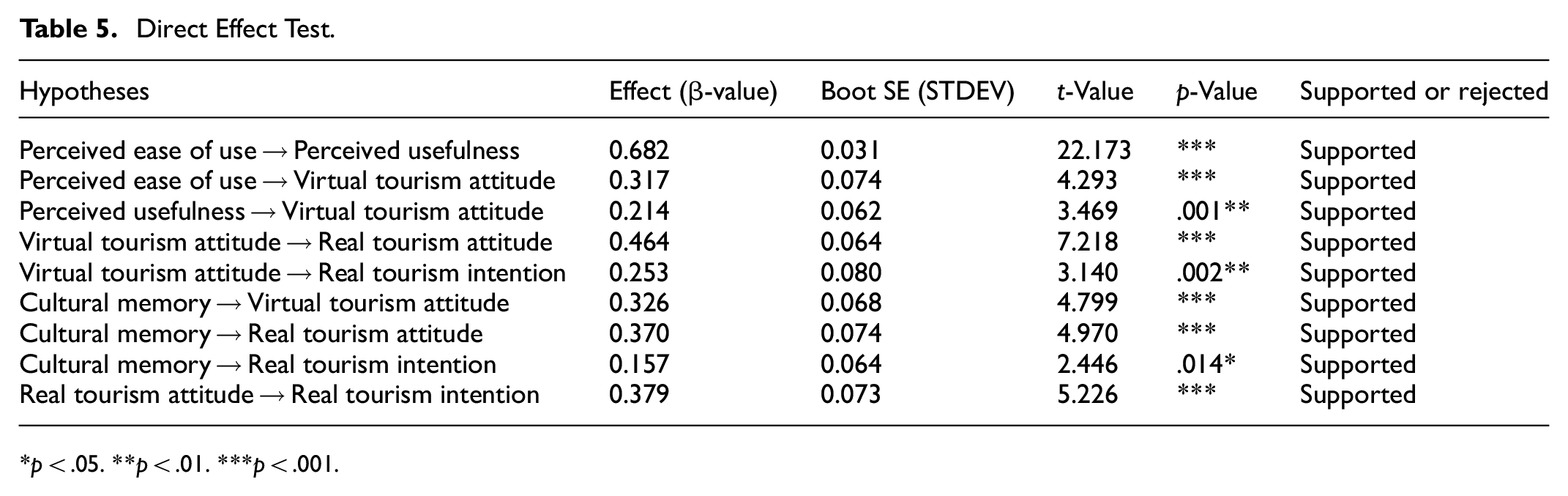
p < .05. **p < .01. ***p < .001.

Path coefficients.
According to Table 6, we further found that virtual tourism attitude and real tourism attitude play a chain-mediated role in the three paths of perceived usefulness, perceived ease of use, and cultural memory on real tourism intention. Specifically, the following paths were observed: perceived usefulness → virtual tourism attitude → real tourism attitude → real tourism intention (β = .038, t = 2.654, p < .05), perceived ease of use → virtual tourism attitude → real tourism attitude → real tourism intention (β = .056, t = 2.946, p < .05), and cultural memory → virtual tourism attitude → real tourism attitude → real tourism intention (β = .057, t = 3.641, p < .05). Therefore, hypotheses H10 to H12 were all supported.
Serial Mediation Effect Test.

p < .05. **p < .01. ***p < .001.
Multi-Group Analysis
Partial Least Squares Multi-group Analysis (PLS-MGA) in SmartPLS 3.3.9 was used to verify the moderating effects of different population characteristics on the model path, and the non-parametric confidence set method proposed by Henseler et al. (2015) was used for reference (Henseler et al., 2015). Multi-group comparison requires that the sample size of the group with more cases in the category variable is less than twice that of the group with fewer cases. According to the sample data of this study, the classification of gender and monthly income can meet this standard. The objects of this survey are divided again to study the real tourism intention shown by tourists with different characteristics and the different influencing factors (Table 7).
Classification Criteria for Multigroup Analysis.

According to the display in Table 8, as for gender, the influences of perceived ease of use on perceived usefulness, virtual tourism attitude; perceived usefulness on virtual tourism attitude; virtual tourism attitude on real tourism attitude and real tourism intention; cultural memory on real tourism attitude; and real tourism attitude on real tourism intention are all significant across different gender groups, consistent with the overall significant results. In terms of the impact of cultural memory on virtual tourism intention, females show a significant effect while males do not; however, in terms of the impact of cultural memory on real tourism intention, only males exhibit a significant effect whereas females do not. This may be because, compared to men, women have a lower willingness to participate in outdoor activities. Specifically, women might have less interest and involvement in outdoor activities due to factors such as personal interests, lifestyle, or social roles. This difference in interest may lead them to be more inclined to satisfy their travel needs through alternative means, such as virtual tourism or cultural experiences, rather than engaging in actual outdoor activities.
Multigroup Analysis Result.

p < .05. **p < .01. ***p < .001.
Regarding monthly income, the effects of perceived ease of use on perceived usefulness, virtual tourism attitude; perceived usefulness on virtual tourism attitude; virtual tourism attitude on real tourism attitude and real tourism intention; cultural memory on virtual tourism attitude, real tourism attitude; and real tourism attitude on real tourism intention are all significant among different income groups. However, in terms of the impact of cultural memory on real tourism intention, the group with a monthly income above 10,000 yuan does not demonstrate a significant effect while the group with an income of 10,000 yuan or below shows a significant effect. This may be because real travel usually involves a range of financial expenditures, including transportation costs, accommodation fees, and admission tickets, which are often relatively high. For low-income individuals, these financial burdens can be particularly heavy, making it difficult for mere emotional appeal through cultural memories to significantly enhance their intention to undertake real travel.
fsQCA Results
After model estimation, the present study sought to refine understanding of the data by delving deeper with fsQCA analysis to discern which antecedent configurations are associated with real tourism intention. The PLS-SEM analysis results furnished empirical evidence for exploring the influence mechanism of technology, culture, and attitude on real tourism intention through revealing relationships among various variables. Notwithstanding, it is pertinent to recognize that various factors, rather than a single one, exert influence over tourists’ real tourism intentions (Gerson et al., 2016). Consequently, building upon PLS-SEM results, utilization of fsQCA facilitated identification of the optimal configuration scheme for enhancing real tourism intention through exploration of the trigger mode from a configuration perspective.
Calibration
To apply fsQCA, transformation of interval scale variables into fuzzy sets is necessary. Calibration of these variables is then conducted to determine configurations that result in high solver engagement. The calibration scores range from 0 (non-membership) to 1 (full membership), with a crossover point of 0.5 denoting maximum ambiguity regarding membership (Brown, 2009). For calibration, the fsQCA software is recommended, with suggested breakpoints of 0.95 for full membership, 0.05 for non-membership, and 0.5 for crossover points (Ragin & Fiss, 2008). To achieve variable calibration, summated measures are used and created by summing items that measure each construct (Hu et al., 2016; Nguyen Dinh & Nguyen Thi Mai, 2015).
Analysis of Necessary Conditions
After calibrating the data into fuzzy sets, a necessity analysis of the dependent variable, real tourism intention, was conducted using a PLS-SEM model and five antecedent conditions (PEOU, PU, VTA, RTA, CM) were identified to determine whether they were necessary for real tourism intention. All presence and absence conditions were analyzed, and the resulting consistency values ranged from 0 to 1 (Rihoux, 2006). A condition was considered “necessary” when the consistency exceeded 0.9 (Ragin, 2010). However, as shown in Table 9, the consistency of real tourism intention for all five antecedent conditions did not reach the cutoff values of 0.90, indicating that no necessary condition exists for real tourism intention. Therefore, these five antecedent conditions can be combined for further analysis to determine their impact on real tourism intention through factor combination (configuration).
Analysis of Necessary Conditions for Model.

Analysis of Sufficient Conditions
According to Ragin & Fiss (2008), the analysis of sufficient conditions begins with the construction of a truth table. In this step, we first use fsQCA 3.0 software to create the truth table, which has 2 k rows (where k represents the number of conditions), with each row corresponding to a possible combination of conditions. (Ragin & Fiss, 2008). The truth table was then refined according to Fiss’s (2011) recommendation by removing rows that did not meet the frequency threshold of 3 when considering >150 samples (Fiss, 2011). We applied a consistency threshold of 0.75, as proposed by Rihoux (2006), and removed configurations with a consistency value below 0.75 (Rihoux, 2006). Additionally, the fsQCA findings provided three different solutions (i.e., complex, parsimonious, and intermediate), and the intermediate solution was chosen for analysis due to its superior completeness and interpretability, following Ragin & Fiss’s (2008) suggestion (Table 8; Ragin & Fiss, 2008).
Table 10 illustrates the presence of six configurations that lead to the emergence of real tourism intention. The overall solution coverage is 0.965, and the overall solution consistency is 0.748, indicating that the comprehensive effect of these six configurations has a good explanatory and consistency power. In terms of technological acceptability, S1 to S4 all involve perceived ease of use or usefulness of technology. The first configuration (i.e., S1) exhibits high levels of consistency (consistency = 0.832) and explains a large number of cases (coverage = 0.870). This indicates that perceived usefulness of technology is the basis for forming real tourism intention. The second configuration (i.e., S2) also demonstrates high levels of consistency (consistency = 0.866) and explains the number of cases (coverage = 0.330). This suggests that higher perceived ease of use of immersive technology will lead to higher real tourism intention under the circumstances of low virtual tourism attitude and real tourism attitude. The third configuration (i.e., S3) exhibits high levels of consistency (consistency = 0.843) and significant coverage (coverage = 0.428). The study shows that virtual tourism attitude becomes an important condition for the formation of real tourism intention when perceived ease of use of immersive technology is low. The fourth configuration (i.e., S4) reveals high levels of consistency (consistency = 0.856) and significant coverage (coverage = 0.446). Similarly to S3, when perceived ease of use of immersive technology is low, real tourism attitude strongly affects real tourism intention. Both the fifth configuration (i.e., S5) and the sixth configuration (i.e., S6) exhibit high levels of consistency (S5 = 0.816; S6 = 0.915) and explain a large number of cases (S5 = 0.886; S6 = 0.814). S5 demonstrates the decisive role of cultural memory in shaping real tourism intention, while S6 shows that the attitudes of tourists, including virtual tourism and real tourism attitude, play a critical role in the formation of real tourism intention.
Main Configurations for High Real Tourism Intention.
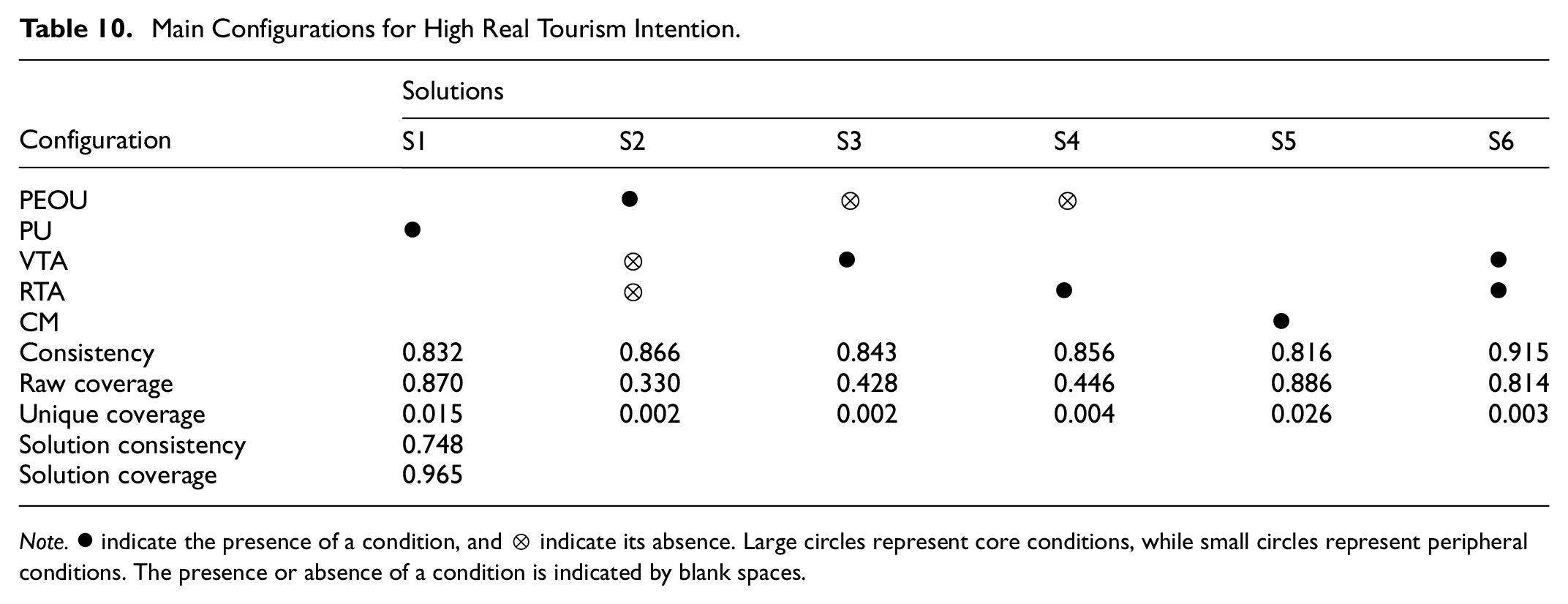
Note. ● indicate the presence of a condition, and ⊗ indicate its absence. Large circles represent core conditions, while small circles represent peripheral conditions. The presence or absence of a condition is indicated by blank spaces.
Discussion and Conclusions
Discussion of the Findings
The emergence of immersive technology has fundamentally changed traditional tourism models, presenting new challenges for the tourism industry’s transformation and upgrade, such as how to leverage virtual tourism to drive real tourism. Moreover, although virtual tourism technology is widely used in tourism marketing, understanding of how cultural factors influence its adoption is limited, and the factors and mechanisms by which digital technology stimulates tourism behavior remain unclear. This study uses the Grand Canal cultural heritage as an example to identify the crucial role of cultural memory in virtual tourism research. By employing a mixed-method approach combining PLS-SEM and fsQCA, the study explores the intrinsic mechanisms of how tourists’ virtual tourism attitudes can be transformed into real tourism intention. The main conclusions are as follows: First, the PLS-SEM analysis reveals the relationships between antecedent conditions: virtual tourism attitude, real tourism attitude, and cultural memory positively influence tourists’ real tourism intentions; perceived usefulness, perceived ease of use, and cultural memory all impact tourists’ real tourism intentions through the chained mediating effects of virtual tourism attitude and real tourism attitude; tourists’ gender and income are significant demographic variables affecting the impact of cultural memory on tourists’ real tourism behavior. Second, the fsQCA analysis confirms how cultural memory, perceived usefulness, perceived ease of use, virtual tourism attitude, and real tourism attitude combine to influence the formation of real tourism intention.
Firstly, within the TAM framework, tourists’ attitudes toward virtual tourism is influenced by perceived ease of use and perceived usefulness of immersive technology. Additionally, perceived ease of use also affects their perception of its usefulness—consistent with previous studies using TAM (Davis et al., 1989; Geng et al., 2022). The key to a successful virtual tourism experience lies in the richness and depth of touristic content. While technology may capture tourists’ attentions, the long-term viability of virtual tourism hinges on the quality of the content. Therefore, cultural memory is incorporated into our research framework. Our findings reveal that cultural memory positively and significantly impacts tourists’ attitudes toward virtual tourism and complements prior studies focusing on cultural factors in touristic intent (Z. Chen & Diao, 2022; Lundberg & Lindström, 2020; Xie et al., 2007; Zhou et al., 2023). With regards to promoting real tourism through virtual tourism, we discovered that virtual tourism attitude directly impacts real tourism attitude and intention. Further, real tourism attitude naturally influences real tourism intention, expanding research on the “virtual tourism destinations-tourists-real tourism destinations” triadic relationship space (Kunz & Seshadri, 2015; P. Liu, 2020). Cultural memory also plays an instrumental role in driving tourists’ real tourism attitudes and intentions.
Second, Virtual tourism attitude and real tourism attitude act as crucial mediating factors that drive real tourism intention through technology and culture. The virtual tourism attitude is the evaluation of virtual tourism experience. The real tourism attitude is the positive or negative emotion that experiencers hold toward the image of going to the tourism destination, which is formed after virtual tourism. On one hand, the perceived ease of use and usefulness of technology both influence virtual tourism attitude. On the other hand, cultural memory impacts virtual tourism attitude, which in turn affects real tourism attitude and ultimately leads to tourists’ real tourism intentions (Lundberg & Lindström, 2020; Wang et al., 2022). In short, virtual tourism attitudes and real tourism attitudes play a significant role as chain mediators in the impact pathways of technological acceptance and cultural memory on real tourism intention.
Third, in the multi-group analysis, direct effects’ significance varies across groups, affecting how cultural memory impacts virtual tourism attitude and real tourism intention. Cultural memory has no significant impact on males’ virtual tourism attitude, possibly because they prioritize technology over culture due to weaker emotional perception. Females’ real tourism intention is also not significantly influenced by cultural memory, likely due to their lower willingness for outdoor activities. Similarly, the emotional impact of cultural memory alone is insufficient to increase real tourism intention in the low-income group, as substantial financial costs are required for transportation, accommodation, and admission fees.
Finally, fsQCA identified six configurations that could potentially enhance real tourism intention. Solution 1 showcases how the perceived usefulness of immersive technology can promote real tourism intention. In Solution 2, perceived ease of use plays a critical role in promoting real tourism intention when both virtual tourism attitudes and real tourism attitudes are low. Solutions 3 and 4 suggest that without immersive technology, efforts should be made to stimulate both virtual tourism attitudes and real tourism attitudes simultaneously to encourage real tourism intention. Cultural memory is a significant factor that influences real tourism intention, as shown by Solution 5, which explains this result well. When tourists find immersive technology difficult to accept, cultural memory can greatly improve their virtual tourism attitude and real tourism attitude. Additionally, Solution 6 shows that having both virtual tourism attitude and real tourism attitude can positively influence real tourism intention. In conclusion, fsQCA analysis results provide valuable insights that reinforce and enhance PLS-SEM’s findings.
Contributions to Theory
Given the research gap in the micro-level psychology of the new triadic space comprising “virtual tourism destinations—tourists—real tourism destinations,” this study’s findings hold significant theoretical value and potential breakthroughs for the field.
First, this study provides a new perspective for the research on virtual tourism. The theoretical process highlights the transformation between the virtual and real in the triadic space, as well as the core driving forces of cultural memory and technological acceptance. On the one hand, although many scholars have conducted research on the development of virtual tourism (Cheng & Huang, 2022; Garau & Ilardi, 2014; Guttentag, 2010; M. J. Kim & Hall, 2019; C. Liu & Huang, 2023), but there are few researches on the transformation from virtual tourism to real tourism (P. Liu, 2020). This study breaks through the boundary between “virtual” and “real” by using the novel theory of triadic space and the TAM. On the other hand, while many scholars have emphasized the impact of perceived ease of use and perceived usefulness of immersive technology on tourists’ intentions to adopt immersive technology (Davis et al., 1989; Geng et al., 2022; Kao & Huang, 2023), there has been no research focusing on the influence of cultural memory on tourists’ attitudes toward virtual tourism and intentions for real tourism. Therefore, this study introduces culture as a soft power factor and also a core element of sustainable tourism development, rather than just considering the path for enhancing tourists’ attitudes toward virtual tourism and intentions for real tourism solely from the perspective of technological acceptance.
Second, the findings of this study contribute to a better understanding of the different factors that distinguish virtual tourism experience from real tourism intention. This conclusion addresses previous arguments regarding the impact of cultural distance on individuals (Huang et al., 2013). The multi-group analysis employed in this study further helps us to understand the effects of different cultural backgrounds and living environments on tourists’ characteristics, resulting in a clear reflection of varied behavioral patterns during the process of transition from virtual tourism experience to real tourism intention. Through analysis of the factors behind different visitor characteristics, it has been found that there is a strong technological aspect to virtual tourism of the Grand Canal, while the cultural heritage of the Grand Canal itself possesses a profound cultural essence. As such, the organic integration of immersive technology with the cultural attractions of the Grand Canal provides critical theoretical support for promoting the transition of tourists from purely virtual tourism experiences to real tourism behavior.
Lastly, this study offers new insights into the mechanism through which immersive technology drives real tourism from a configuration perspective. Through the combination of PLS-SEM and fsQCA methods, this study supplements existing literature on how perceived ease of use, perceived usefulness, cultural memory, virtual tourism attitude, and real tourism attitude interact to stimulate tourists’ real tourism intentions. Specifically, we have made contributions to research on the promotion of real tourism through immersive technology by identifying six configurations that enhance real tourism intention. The intricate interplay of these antecedents and how they interact to modify the real tourism intentions of virtual tourism experiencers, has never been academically investigated. Therefore, in addition to bridging the gap in previous research, our study offers various solutions to explain how factors interact to yield intriguing outcomes. Our research supports the notion that there is not a singular causation configuration governing outcomes.
Implications for Management
The research findings present a crucial path toward bolstering real tourism through strengthened immersion technology. First, to improve the perceived ease of use of immersive technology, it is necessary to reduce operational difficulty while integrating cultural and historical elements to enhance its usability. For device-side virtual tourism, potential tourists should be taught the basic operations of devices like VR and AR. As for internet-side virtual tourism, website operation processes should be simplified with attention-grabbing prompts provided at each step. In order to increase the perceived usefulness of immersive technology, tourism marketers can set up virtual tourism projects in combination with the historical and cultural significance of destination attractions. Introducing tourists to role-playing projects that include historical recreations increases their interest, amusement and appeal, bringing about a cultural depth that entices them to visit destinations in-person and experience their rich culture.
Second, to strengthen collective cultural memories of destination attractions, tourists must quickly generate emotional resonance by accessing cultural memory content through virtual tourism. This will enhance their inclination toward real tourism. Tourism policymakers could propose introducing the history and culture of various sites into educational curricula and social media. Students can have an intense introduction to the historical and cultural aspects of popular tourist sites while gaining insights into their structure through scientific education. This enriches their appreciation of historic culture. Furthermore, documentaries, advertising materials, and movies should be involved in pop culture to create a cultural memory of destinations that enhances their attractiveness to tourists.
Finally, it’s crucial to customize tourist projects based on the unique characteristics of different groups. As different groups of people have different demands for heritage tourism due to their lifestyle or characteristics, tourism marketers should pay attention not only to historical and cultural themes, but also to differentiated game projects, themed accommodation design and tourism services of different levels in the development of their tourism projects for example, women place greater emphasis on emotional involvement in travel experiences, so warmth-related content can be added accordingly. Additionally, gender should be considered when designing themed accommodations. Higher-income groups have greater work pressure and prefer relaxing tourism projects, such as hot springs resorts and yoga studios related to destination landscapes and historical culture. Low-income groups are primarily affected by tourism expenses, so providing different levels of tourism projects and services can make real tourism economically affordable for them. It’s worth noting that the above tourism project features should be fully reflected in promotional videos to encourage virtual tourists to venture outside and experience outdoor activities to boost the destination’s tourism industry.
Limitations and Future Research
This study has made a significant contribution by creating a new path model for understanding how immersive technology can drive tourism. However, it also has limitations and potential areas for future research. Firstly, this study focuses on visitors to the Grand Canal cultural heritage site, and its findings may not be generalizable to other destinations with different characteristics. Future case studies should develop tailored process models based on unique application scenarios to obtain more accurate results. Secondly, the sample size was limited to one specific country, and cultural differences could influence real tourism intentions toward the Grand Canal site. Therefore, future research should verify these findings under different cultural backgrounds. Finally, this study used a static self-report questionnaire survey, resulting in cross-sectional data that may limit causal inferences. Future research should employ longitudinal studies and experimental designs to better understand the relationships between dependent variables and their antecedents, while also exploring demographic variables using larger and more diverse samples.
Footnotes
Acknowledgements
We express our sincere gratitude to the Ministry of Education of the People’s Republic of China for their support. Additionally, we would like to extend our appreciation to the SAGE Open journal and the Academic Editor of the journal for their valuable input and constructive feedback on the content of this manuscript.

Author Contributions
J.L., S.Z. and L.L. involved in the conceptualization, methodology, and analysis. J.L. and S.Z. involved in the writing and original draft preparation. J.L., S.Z. and L.Z. involved in writing review and editing.
Funding
The authors disclosed receipt of the following financial support for the research, authorship, and/or publication of this article: This research was funded by the Key Projects of Philosophy and Social Sciences Research, Ministry of Education: Research on the historical context of the Grand Canal and the construction of national image (grant number 21JZD041). And Postgraduate Research & Practice Innovation Program of Jiangsu Province: Research on the Construction of Cultural Memory and Living Protection of the Grand Canal Cultural Heritage (KYCX24-1003) also provided fund support for this research.
Declaration of Conflicting Interests
The authors declared no potential conflicts of interest with respect to the research, authorship, and/or publication of this article.
Data Availability
Data sharing not applicable to this article as no datasets were generated or analyzed during the current study.