




Abstract
Participation in group music activities can promote the development of social-emotional competencies (SEC) while decreasing burnout. This study aimed to assess the influence of group singing activities on Chinese college students’ SEC and academic burnout. A cross-sectional comparative research design was employed to investigate the characteristics of social-emotional development of competencies and academic burnout among college students in eastern China who engaged in group singing activities and those who did not. Data were collected using the Social and Emotional Competence Assessment Battery for Adults (SECAB-A) and the Maslach Burnout Inventory-Student Survey (MBI-SS) from 364 individuals who participated in group singing and 360 who did not. The independent samples t-test, Pearson correlation and regression analysis analyses revealed that revealed significant statistical disparities in all evaluated variables between the two groups of participants. Engaging in collective singing endeavors can significantly enhance the cultivation of SEC among college students and mitigate the occurrence of academic burnout. Furthermore, the findings validated an inverse association between SEC enhancement and academic burnout and highlighted their predictive relationship.
Introduction
Over the past few decades, education has prioritized research on emotional intelligence and the acquisition and fostering of related competencies (Cefai et al., 2018; Taylor et al., 2017). Social-emotional competencies (SEC) refer to the capacity to comprehend, regulate, and articulate individuals’ social and emotional skills, which facilitate their achievement in task performance, learning, interpersonal connections, problem-solving, and adjustment to environmental requirements (Tarbetsky et al., 2017; Zins & Elias, 2007). SEC implementation significantly enhances students’ academic achievement and fosters their capacity to adjust effectively and withstand challenges (Gandía-Carbonell et al., 2022). Moreover, while considering individuals’ psychological characteristics, SEC interventions enhance mental well-being to foster overall well-being (Domitrovich et al., 2017).
The theory of emotional intelligence within the SEC framework describes it as a set of essential skills and emotional and social factors that determine one’s ability to manage their own emotions, connect with others, and navigate daily tasks (Bar-On, 2007). Building on this, Mayer and Salovey’s (1997) emotional intelligence model conceptualizes SEC through four abilities: perceiving, facilitating, understanding, and regulating emotions—crucial for handling social-emotional challenges. The latest development in SEC, social-emotional learning (SEL), as described by Borowski (2019), involves acquiring skills in self-awareness, self-regulation, social awareness, interpersonal skills, and responsible decision-making for individuals across all ages (Berg et al., 2017; Jones & Bouffard, 2012). SEL aims to foster emotional and social competencies that contribute to students’ growth (Friedlaender et al., 2014). Furthermore, Jennings and Greenberg’s (2009) prosocial classroom model highlights SEC’s role in education by incorporating dimensions like teacher well-being, teacher-student relationships, classroom management, SEL program implementation, and classroom climate. This model underscores SEC’s role in creating positive student outcomes. Previous studies have shown that enhancing emotional skills contributes to personal and social growth in various settings (Dodge et al., 2008; Kankaraš & Suarez-Alvarez, 2019).
The Role of SEC Across Educational Stages
In educational research, most studies on SEC primarily examine the advantages of fostering emotional skills during childhood and adolescence related to individual conduct and academic achievements. Research conducted by Domitrovich et al. (2017) provided evidence that social-emotional skills play a crucial role in developing preschool children’s ability to adjust actively and withstand potential dangers. Simultaneously, several studies have indicated that teachers significantly enhance children’s emotional capacities (Collie, 2022; O’Meara et al., 2013). Teacher-student interaction fosters the growth of children’s social-emotional competencies, leading to improved academic performance and behavioral skills (Alzahrani et al., 2019). While most current research on socio-emotional competencies primarily focuses on infancy and adolescence, acknowledging the significance of emotional skill development in adults is crucial. Several studies have identified a strong correlation between emotional skill cultivation during adulthood and factors such as happiness, self-efficacy, and interpersonal interactions (Chien-Chi et al., 2020; Jennings & Greenberg, 2009). SEC are essential in higher education (Conley, 2015). Enhancing SEC can considerably boost academic performance, professional accomplishments, and collaborative efforts (Elmi, 2020; Reinert, 2019). Nevertheless, despite these empirical findings, research to examine and understand SEC’s progression in higher education settings remains limited (Yu et al., 2023).
Academic Burnout and Its Influencing Factors
Academic burnout is driven by various factors, including challenges in managing academic and performance pressures, intense peer competition, and high expectations (Figueroa et al., 2019; Oyoo et al., 2020). These pressures negatively impact students’ psychological well-being, leading to exhaustion and disengagement. Internal factors such as self-efficacy, perfectionism, and self-esteem also contribute to academic burnout (Chen et al., 2023; Seong et al., 2021). Additionally, burnout is closely linked to insufficient social support and ineffective coping strategies (Ye et al., 2021). Academic burnout adversely affects students’ mental health, academic performance, and overall life satisfaction (Koppenborg et al., 2024). Therefore, understanding and addressing burnout are essential for improving students’ academic success and well-being in higher education (Reyes-de-Cózar et al., 2023).
Given these risk factors and their impact on student well-being, understanding the relationship between SEC and academic burnout is crucial. SEC not only helps students effectively cope with academic stress and enhances their learning motivation, thereby reducing burnout (Huttunen et al., 2024; Vestad & Tharaldsen, 2022), but also improves interpersonal relationships and increases social support from peers and teachers (Ogurlu et al., 2018; Poulou, 2017). Social support and positive interpersonal connections are key to mitigating burnout (Kim et al., 2018). Therefore, exploring the relationship between SEC and academic burnout can guide educators and policymakers in implementing targeted interventions to improve students’ academic performance and mental well-being.
Music’s Role in SEC and Burnout
Music is a powerful tool for eliciting and regulating emotions. It significantly enhances emotional expression and communication (Croom, 2015; Mas-Herrero et al., 2013), while also fostering the emotional and mental well-being of college students (Hu et al., 2021). Küpana (2015) demonstrated that musical experience enhances emotional intelligence, supporting the accurate comprehension, assessment, and articulation of emotions. Furthermore, music plays a crucial role in managing exhaustion and alleviating stress across various settings (Thoma et al., 2012). Moore (2013) found that music therapy effectively reduces academic stress among students. Integrating social-emotional skills into musical activities is essential since music helps in experiencing and regulating emotions (Juslin et al., 2014; Saarikallio & Baltazar, 2018).
Engaging in music education also enhances socio-emotional competence (SEC). Theorell et al. (2014) employed a twin model to explore the genetic link between musical practice and affective disorders, finding a preventive effect on alexithymia. Thompson et al. (2004) showed that individuals with musical training had superior emotional recognition abilities compared to those without. Studies further highlight the impact of participating in music group activities, such as improvisation, ensemble playing, and singing, on social-emotional skills (Edgar, 2013; Saarikallio, 2019). Activities like group singing are effective in fostering social-emotional learning (Varner, 2020). Ros-Morente et al. (2019) confirmed significant differences in emotional aptitude, motivation, and leadership skills between individuals engaged in musical versus non-musical group activities.
Academic burnout is energy depletion and fatigue due to experiencing high levels of school-related responsibility and stress. It is characterized by a lack of passion, ineffectiveness in academic and learning tasks, and feelings of indifference and disconnection in peer interactions (Meier & Schmeck, 1985; Schaufeli et al., 2002). It is a significant determinant that impacts students’ emotional well-being, academic achievement, and overall satisfaction (W. Liu et al., 2023; Z. Liu et al., 2023; Özhan & Yüksel, 2021). Research in this area concentrates primarily on occupational burnout. Several studies have indicated that engaging in music-related activities effectively mitigates occupational burnout across several professional domains (Mao, 2022; Raglio et al., 2020). For instance, Bittman et al. (2003) discovered that making music decreased burnout and improved the general mood of nursing home workers living in long-term care facilities. Furthermore, music production is a strategy employed to avoid burnout among mental health practitioners (Matoso et al., 2022). Engaging in music activities has been shown to help reduce academic burnout in college students, but further research in this area is necessary (Banda et al., 2023). Prior studies have established a correlation between SEC and burnout in different circumstances (Oberle et al., 2020; Salmela-Aro & Upadyaya, 2020). Molero Jurado et al. (2021) discovered that SEC mediates the relationship between academic performance and academic burnout of high school students. According to Lozano-Peña et al. (2021), SEC is a significant indicator for predicting teacher burnout.
Theoretical Framework and Current Study
Emotional intelligence theory emphasizes the ability to perceive, understand, and manage emotions, which forms the foundation for effective social interactions and emotional regulation (Salovey & Mayer, 1990). Building on this, social-emotional learning (SEL) refers to the process of acquiring and applying social and emotional skills through the development of social-emotional competence (SEC). It is typically defined as the knowledge, attitudes, and skills necessary for managing oneself, understanding and interacting with others, and making responsible decisions (Weissberg et al., 2013; Weissberg et al., 2015). SEL not only supports students’ academic growth but also plays a crucial role in mental health and social interactions (Gimbert et al., 2023; Oberle et al., 2014). In this study, SEL, underpinned by emotional intelligence theory, provides the foundation for understanding how collective activities influence social-emotional competence. Furthermore, social bonding theory emphasizes that emotions and interpersonal relationships are interconnected. Social bonds represent the emotional connections and relationships we share with others (Scheff, 1990, 1997). Positive interpersonal interactions foster these social bonds, supporting learning, and social-emotional development (Wubbels et al., 2012). Such connections help students cope with academic pressures, reducing academic burnout (Bellocchi, 2019). Based on the aforementioned theories, this study aims to explore the effects of group singing participation on enhancing social-emotional competence and reducing academic burnout among Chinese college students.
Recent research on collective music activities has primarily focused on exploring the role of group singing in enhancing social connectedness and reducing symptoms of depression. Studies have confirmed the potential of group singing to improve psychological well-being (Batt-Rawden & Andersen, 2020; Camlin et al., 2020). Engaging in group singing provides a shared emotional experience that fosters a sense of well-being, positively impacting participants’ self-esteem, psychological resilience, and self-efficacy (Fancourt et al., 2022). Furthermore, recent findings highlight the potential of group singing as an important public health resource for enhancing emotional and psychological health (Densley & Andrews, 2021; Good & Russo, 2022). Despite these findings, the association between enhanced social-emotional skills and reduced academic burnout among college students remains underexplored. Additionally, existing research on group singing in the Chinese context has mainly focused on investigating performance techniques with unique cultural characteristics (W. Liu et al., 2023; Z. Liu et al., 2023; Lu, 2022). While previous studies examined the positive effects of group singing on the mental health of elderly individuals in China, particularly regarding stress and depression reduction (Cai et al., 2023; H. Liu et al., 2019), the broader impact of collective singing on the general Chinese population remains unclear. Therefore, the potential link between social-emotional skills and academic burnout among college students warrants further investigation.
This study examines the impact of group singing on enhancing social-emotional skills and reducing academic burnout among Chinese college students. It builds upon prior research to analyze the profiles of SEC and academic burnout among participants in group singing and non-participants within Chinese higher education. The study aims to determine whether differences and correlations exist between group singing activities, social-emotional skills, and academic burnout.
The hypotheses of this study are:
Individuals engaged in group singing are expected to show greater improvement in SEC than those not participating.
Group singing participants are expected to have lower levels of academic burnout compared to non-participants.
A negative correlation is expected between SEC and academic burnout.
Academic burnout is expected to predict SEC.
Methods
Participants
Participants for this study were recruited through campus announcements, with both the group singing cohort and the control group drawn from the same undergraduate population. Participants, aged 18 to 25 years, were undergraduate students from four universities in eastern China. Data collection was conducted over a 3-month period, from October to December 2023. Data were collected using an online questionnaire distributed to participants. Before completing the survey, all participants provided informed consent. Anonymity was ensured for all participants, and their responses were treated with strict confidentiality.
Participants were assigned to either the group singing or control group based on their prior experience with group singing. Those with prior group singing experience were allocated to the group singing cohort, while those without such experience were included in the control group. The group singing cohort consisted of 364 participants (133 males and 231 females), all actively engaged in ensembles organized by non-profit college societies. These ensembles included choral groups, a cappella teams, and casual singing clubs. The repertoire performed by these groups encompassed traditional Chinese folk songs, contemporary pop music, and classical choral works. Rehearsals were typically held once a week, with each session lasting 60 min. Participants in this cohort had, on average, been involved in these singing activities for 3 months prior to the study. The control group comprised 360 participants (153 males and 207 females), none of whom had prior experience in group singing or other music-related activities.
The determination of sample size follows the rule of thumb. According to the recommendations of Green (1991) and Tabachnick (2007), the minimum sample size should be 50 + 8k, where k is the number of predictor variables. This rule is commonly referred to as a rule of thumb in regression analysis. Given that the model in this study included four predictor variables, the required minimum sample size was 82. The actual sample size in this study meets this requirement, thus ensuring the reliability of the statistical analysis.
Measures
Participant demographic data, specifically age, grade level (undergraduate), and gender, were gathered. Furthermore, the questionnaire covered SEC and academic exhaustion. The instruments utilized in this study include those described below.
The SEC Scale
The Social and Emotional Competence (SEC) of participants was evaluated using the Social and Emotional Competence Assessment Battery for Adults (SECAB-A; Oliveira et al., 2023). This scale is validated for adults, including college students aged 18 and older (Pixley, 2023). The SECAB-A consists of 37 items across five dimensions: self-awareness, self-regulation, positive relationships, conflict management, and responsible decision-making. Self-awareness (7 items) measures participants’ ability to recognize and understand their own emotions, with items like “I am capable of maintaining composure during times of stress.” Self-regulation (8 items) assesses how effectively participants manage their emotions in different situations, such as “In my everyday life, I can identify my emotions in the moment.” Positive relationships (8 items) evaluates the ability to maintain positive interpersonal connections, including “I can infer the emotions of others based on their communication style.” Conflict management (8 items) measures skills in managing conflicts constructively, for example, “I am able to acknowledge the other person’s correctness during an argument.” Responsible decision-making (6 items) assesses the ability to make respectful and thoughtful decisions, even in challenging situations, with items like “I can identify respectful methods to overcome obstacles even while making unpopular judgments.” All items use a five-point Likert scale (1: “never or almost never” to 5: “almost always or always”). The researcher translated the scale, and it was subsequently proofread and corrected before distribution. The scale demonstrated good internal consistency, with Cronbach’s alpha coefficients of .947 for participants and .930 for non-participants.
Academic Burnout Scale
Academic burnout was assessed using the validated Chinese version of the Maslach Burnout Inventory-Student Survey (MBI-SS), an adaptation of the Maslach Burnout Inventory-General Survey (MBI-GS) specifically designed for students (Schaufeli et al., 2002; Zhang et al., 2007). The MBI-SS, used to assess burnout in undergraduate students aged 18 to 25, includes three subscales: exhaustion, cynicism, and professional efficacy. Exhaustion (5 items) measures the extent to which participants feel emotionally drained by study demands, such as “I feel mentally exhausted from studying.” Cynicism (5 items) assesses negative attitudes or detachment from academic work, with items like “My enthusiasm for learning has decreased.” Professional efficacy (6 items) measures perceived competence and sense of achievement in academic work, including “I can effectively solve problems in my studies.” Note that professional efficacy is reverse-scored. All items are rated using a seven-point frequency scale (0: “never” to 6: “always”). The scale demonstrated good reliability, with Cronbach’s alpha values of .851 for participants and .899 for non-participants.
Ethical Considerations
The study recruited volunteers from universities in eastern China through an online process between October 2 and December 14, 2023. The survey did not involve human or animal experimentation and included only adult participants. Data were collected solely through questionnaires. The study adhered to the Declaration of Helsinki principles, and informed consent was obtained from all participants. Written approval was received before administering the surveys. Participant identities were kept anonymous, and confidentiality was maintained.
Statistical Analyses
The data were analyzed using SPSS Statistics Version 24 (Aljandali, 2016). Confirmatory factor analysis (CFA) was performed to assess the model fit for both participant and non-participant groups. To evaluate convergent validity, average variance extracted (AVE) and composite reliability (CR) were computed. Common method bias (CMB) was assessed using Harman’s single-factor test. Additionally, normality tests for all variables and subdimensions were conducted to ensure the appropriateness of subsequent statistical analyses, including Pearson correlations. To assess the disparities in SEC levels and academic burnout between the singing and control groups, independent samples t-tests were employed. Specifically, Hypothesis 1 (H1) was tested by examining the means of the overall SEC scale and its subscales to determine differences between the two groups. Similarly, Hypothesis 2 (H2) was tested by comparing the overall academic burnout scale and its subscales between the singing and control groups. For Hypothesis 3 (H3), the Pearson correlation coefficient was computed to assess the link between SEC and academic burnout among group and non-group singing participants, aiming to determine if a negative correlation exists between these variables. For Hypothesis 4, we used regression analysis to determine whether the subdimensions of academic burnout (exhaustion, cynicism, and professional efficacy) significantly predicted SEC levels. Specifically, exhaustion and cynicism were expected to have a negative impact on SEC, while professional efficacy was expected to have a positive impact. This approach allowed us to assess the predictive power of each burnout subdimension on social-emotional competence, using the scores obtained from the SECAB-A subscales.
Results
Previous Data Analysis
In this study, confirmatory factor analysis (CFA) was conducted to assess the model fit for both participant and non-participant groups. For the SAG variable among participants, fit indices were as follows: χ2 = 926.927, χ2/df = 1.497, CFI = 0.972, TLI = 0.969, SRMR = 0.043, and RMSEA = 0.037. Similarly, for non-participants, the results indicated: χ2 = 932.181, χ2/df = 1.506, CFI = 0.967, TLI = 0.965, SRMR = 0.050, and RMSEA = 0.037. These values meet the standard thresholds for good model fit, suggesting that the measurement model adequately represents the data. Moreover, the average variance extracted (AVE) for all variables exceeded 0.5, and composite reliability (CR) values were above 0.7, indicating good convergent validity. To address common method bias (CMB), Harman’s single-factor test was performed, revealing a total variance of 28.8%, well below the 50% threshold, indicating no significant CMB presence. Furthermore, the normality test (see Appendix 1) results show that skewness and kurtosis values for both participant and non-participant groups are within acceptable limits (skewness ± 3, kurtosis ± 5), indicating an approximate normal distribution. This supports the validity of using Pearson correlation analysis in the study. Sample sizes were 364 participants and 360 non-participants, allowing for reliable statistical conclusions.
Homogeneity Testing
We conducted a homogeneity test (see Table 1) on the initial demographic data of group singing participants and the control group (non-group singing participants). Its results showed no significant differences in the demographic data of the two groups, including gender and age. The proportions of male participants were similar (36.5% for group singing vs. 42.5% for control), and the proportions of female participants were also similar (63.5% vs. 57.5%). For age, the mean ± standard deviation was 20.33 ± 1.730 for group singing participants and 20.40 ± 1.749 for non-group singing participants, indicating no significant differences in age. Furthermore, no significant differences were observed in grade distribution between the groups (p > .05).
Homogeneity Testing for Participants.

SEC
Table 2 shows the SEC scale scores and independent sample t-tests with 95% confidence intervals for both groups. Results indicate a significant difference between the groups, with the singing group scoring higher on the overall SEC scale (M = 3.50, SD = 0.62) compared to the non-singing group (M = 3.34, SD = 0.53), t(707.748) = 3.837, p < .001. The singing group also showed significantly higher scores in self-regulation, self-awareness, positive relationships, and conflict management, whereas no significant difference was observed in responsible decision-making between the groups (t(722) = 1.264, p > .05).
The Overall SEC Scale and Sub-Scale Scores with 95% Confidence Intervals (CI).

Academic Burnout
Academic burnout levels were significantly higher among the non-group singing participants (M = 3.00, SD = 0.70) compared to group singing participants (M = 2.82, SD = 0.60; t(701.784) = −3.68, p < .001, d = 0.274). Additionally, those who engaged in group singing showed considerably lower scores across the subscales of academic burnout, including exhaustion, cynicism, and professional efficacy, compared to non-participants (see Table 3).
Overall Academic Burnout Scale and Sub-Scale Scores with 95% Confidence Intervals (CI).

Correlation Analysis Results
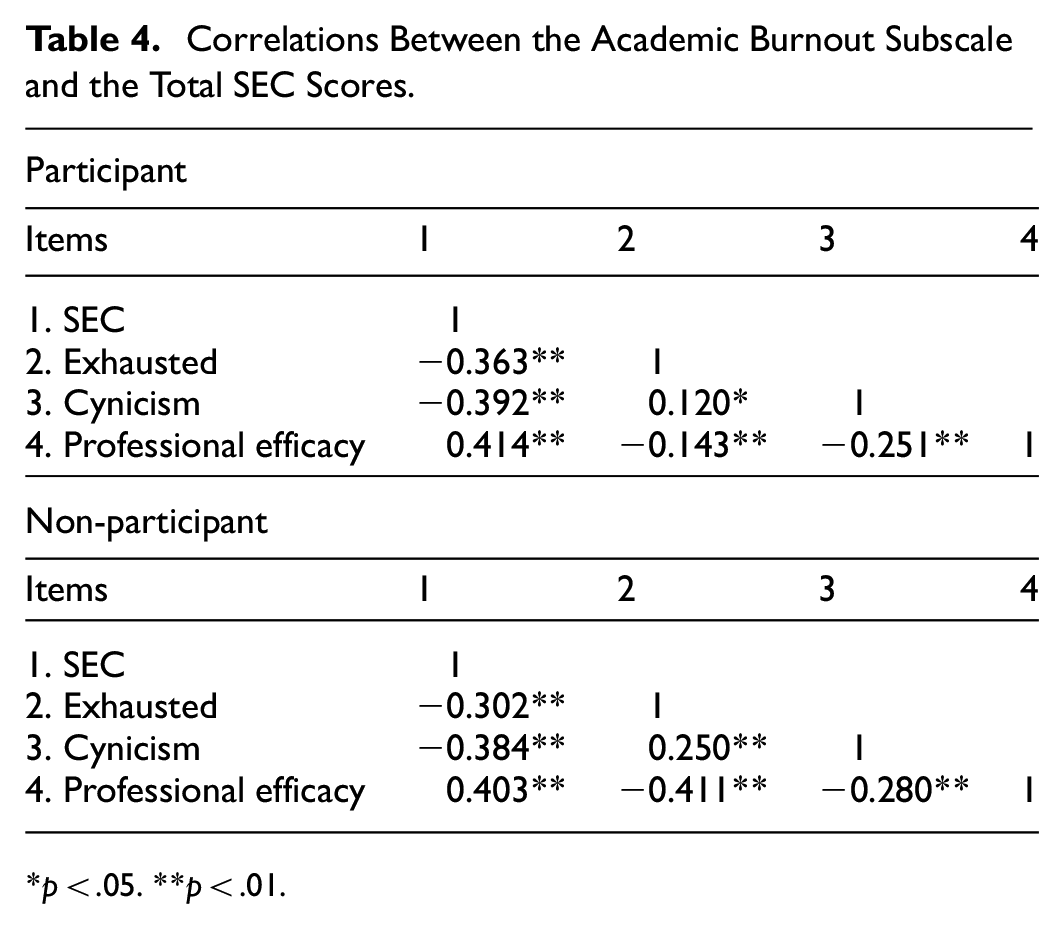
Table 4 displays the correlation between the academic burnout subscales and the total SEC scores for both participant and non-participant groups. Among group singing participants, SEC was significantly negatively correlated with exhaustion (r = −.363, p < .01) and cynicism (r = −.392, p < .01), while it was positively correlated with professional efficacy (r = .414, p < .01). For non-participants, similar trends were observed, with negative correlations for exhaustion (r = −.302, p < .01) and cynicism (r = −.384, p < .01), and a positive correlation for professional efficacy (r = .403, p < .01).
Correlations Between the Academic Burnout Subscale and the Total SEC Scores.
p < .05. **p < .01.
Regression Analysis Results
Table 5 presents the regression results for predicting social-emotional competence (SEC) from academic burnout subscales. In both participant and non-participant groups, the subdimensions of academic burnout (exhaustion, cynicism, and professional efficacy) significantly influenced SEC. The regression model indicated no multicollinearity or autocorrelation issues, as shown by appropriate VIF (0.797–0.972) and DW values (1.984–2.035). Exhaustion and cynicism negatively impacted SEC, while professional efficacy had a positive effect. The models had R2 values of .34 (participants) and .253 (non-participants), demonstrating their predictive ability.
Regression Models Predicting SEC.

Discussion
This study investigated disparities in social-emotional competencies and academic burnout among Chinese university students who participated in group singing and those who did not. The findings provide empirical evidence linking group singing to higher social-emotional competencies among university students, highlighting practical implications for music education. These findings align with the social bonding theory, which emphasizes the role of interpersonal connections in fostering emotional connection (Scheff, 1990, 1997). Positive interactions through group activities, such as group singing, help create a supportive environment that can reduce academic burnout and enhance social-emotional development (Bellocchi, 2019). As a framework developed further on the basis of emotional intelligence theory, Social-Emotional Learning (SEL) also supports these findings, emphasizing the importance of cultivating emotional regulation and interpersonal skills (CASEL, 2019; Gimbert et al., 2023).
SEC
The findings of Hypothesis 1 indicated that participants involved in group singing exhibited higher levels of social-emotional competencies compared to non-participants. This aligns with previous research suggesting that music activities enhance social-emotional skills across different age groups (Edgar, 2013; Saarikallio, 2019). Mogro-Wilson and Tredinnick (2020) found that music-based interventions improve goal-setting, empathy, connection, and decision-making skills among high school students, which is consistent with social-emotional learning principles. Our findings indicate that group singing promotes emotional regulation and self-awareness (Baltazar & Saarikallio, 2016; Bensimon & Amir, 2010). Engaging in collaborative music-making, such as singing in ensembles, appears to foster perseverance, self-control, positivity, and other related skills (Varner, 2020). Winsler et al. (2011) also suggested that singing enhances early self-regulation, while Camlin et al. (2020) emphasized that communal singing is an effective public health resource for enhancing self-awareness. Our findings provide empirical support for these arguments, showing that group singing participants scored highly in self-regulation and self-awareness, which were the top two categories in our social-emotional skills assessment. Notably, although participants involved in group singing scored higher in decision-making compared to non-participants, this difference was not statistically significant. This may be influenced by various factors, such as individual cognitive function, executive function, and other individual differences, which can interact and impact decision-making capacity (Parker & Fischhoff, 2005; Schiebener et al., 2014). Furthermore, emotional distress may impair decision-making abilities, as observed by Kirrane et al. (2017) in an orchestra setting. Maitlis and Ozcelik (2004) argued that cooperation among group members can enhance trust and communication within the team, thereby improving the inclusivity of decision-making in singing groups. This perspective helps explain why the observed improvement in decision-making did not reach statistical significance, despite being consistent with existing research linking music activities to enhanced decision-making abilities (Varner, 2019). Therefore, our findings align with prior research while also emphasizing the importance of considering contextual factors (e.g., collective cooperation environment, emotional support) when examining the influence of group singing activities on college students’ social-emotional competencies. A more detailed discussion of these aspects helps better understand and validate the nuanced outcomes of group singing interventions.
Academic Burnout
The results of Hypothesis 2 indicated significant differences in academic burnout between students who participated in group singing and those who did not, particularly in terms of emotional exhaustion and cynicism. This finding aligns with previous research that linked music activities to reduced burnout and improved well-being (Mao, 2022; Raglio et al., 2020). In this study, both groups scored highest on emotional exhaustion, which is considered a key factor in assessing burnout, as it is often an early indicator of academic burnout and significantly impacts students’ learning motivation and overall well-being (Schaufeli & Van Dierendonck, 1993). Although group singing activities may help reduce emotional exhaustion to some extent, this aspect remains a significant issue, indicating the need for additional supportive measures. Previous research suggests that unresolved emotional exhaustion may develop into cynicism (Lee et al., 2020). Despite this, significant differences in scores were found between participants and non-participants, the effect sizes were small. This may reflect differences in individual coping mechanisms and the availability of social support (Cabras et al., 2023; Ye et al., 2021). Overall, while music activities positively contribute to alleviating academic burnout, comprehensive interventions are still required to fully address this issue.
Relationship Between SEC and Academic Burnout
Hypothesis 3 results demonstrated a significant association between social-emotional competencies (SEC) and academic burnout, aligning with previous research findings. Specifically, as SEC increases, academic burnout decreases, demonstrating the protective effect of SEC on students’ well-being (Huttunen et al., 2024). Both groups showed significant negative correlations between SEC and emotional exhaustion and cynicism, and a significant positive correlation between SEC and professional efficacy. Notably, the negative correlation between SEC and emotional exhaustion was slightly stronger among participants compared to non-participants, suggesting that group singing may play an important role in more effectively reducing emotional exhaustion. This advantage may partly stem from the emotional regulation and social support provided by group singing, leading to greater reductions in emotional exhaustion for participants (Camlin et al., 2020; Densley & Andrews, 2021). Additionally, the positive correlation between SEC and professional efficacy also varied between participants and non-participants, with participants showing a slightly stronger correlation, potentially influenced by the collective nature of musical activities (Kajjimu et al., 2021). Fancourt et al. (2022) noted that the collective sense of accomplishment and support from group singing can enhance participants’ self-efficacy and emotional skills. Our study contributes by showing that group singing, as a form of social-emotional learning (SEL), can effectively increase SEC and thereby mitigate burnout, particularly in higher education. However, further research is needed to determine if these effects are sustained without continued participation. Previous research has demonstrated a negative correlation between self-regulation and academic burnout (Purwanti et al., 2022). Group singing provides an environment that supports emotional regulation, which may explain the observed reduction in burnout. Additionally, fostering peer relationships and developing problem-solving skills through collaborative activities like group singing has been shown to be effective in reducing burnout (Ogurlu et al., 2018; Poulou, 2017). These findings support Hypothesis 3 and highlight the importance of integrating SEL strategies, such as group singing, into educational curricula to foster emotional competence and reduce burnout among students.
Academic Burnout Predicting Social-Emotional Competence
The findings from Hypothesis 4 also demonstrated that academic burnout can influence the development of social-emotional competencies (SEC), implying that reducing burnout could not only mitigate negative outcomes but also promote SEC growth, thus improving student well-being (Lozano-Peña et al., 2021; Molero Jurado et al., 2021). Usán Supervía et al. (2019) identified correlations between burnout, emotional intelligence, and academic engagement. Our study extends these findings by demonstrating the effectiveness of collective activities in actively enhancing SEC, indicating that interventions targeting burnout can not only reduce negative impacts but also actively promote SEC. Additionally, Wang et al. (2015) emphasized emotional engagement as a predictor of burnout severity. In this study, group singing effectively facilitated the enhancement of SEC while simultaneously reducing academic burnout. This finding supports the need for a holistic approach that combines burnout reduction with active skill-building to improve overall student well-being.
Overall, the results confirmed our four research hypotheses, demonstrating that group singing participants exhibited notable differences in social-emotional competence and academic burnout compared to non-participants. These findings suggest that integrating group singing into higher education curricula could enhance social-emotional learning and reduce academic burnout, thereby supporting student well-being. Future studies could explore the long-term effects of group singing interventions and identify moderating factors that influence their impact.
Limitations
While this study identified differences and associations between social-emotional competence and academic burnout among students who participated in group singing and those who did not, several limitations must be acknowledged. The cross-sectional design limits our ability to draw causal conclusions about the relationship between social-emotional competence and academic burnout. Future research should employ longitudinal methods to better understand the impact of group singing on these variables. Additionally, the focus on students from universities in eastern China limits the generalizability of the findings. Expanding the geographic scope and increasing the sample size in future studies would improve reliability and generalizability.
Furthermore, this study did not account for potential confounding variables, such as participants’ prior musical experience and psychological health status, which could influence the outcomes. Addressing these variables in future research would strengthen the validity of the findings. The development of social-emotional competence is influenced by various factors, including individual cognition, education, and the environment (Harris et al., 2022). Future research should account for these factors to gain a more comprehensive understanding of the effects of group singing on social-emotional development. Moreover, future studies should include additional variables and examine their interactions within the context of group music activities beyond group singing to further understand their impact on social-emotional competence.
Implications
This study has both theoretical and practical significance. Using the social-emotional learning (SEL) model, inspired by emotional intelligence theory and social bonding theory, it examined the relationship between social-emotional competence and academic burnout among students who participated in group singing versus those who did not. The SEL model, which fosters emotional and social skills through collaborative activities, provides a relevant basis for understanding how group singing promotes these competencies. This study not only supports previous findings on the relationship between social-emotional competence and academic burnout but also addresses a gap in research concerning the impact of group singing in Chinese higher education. The findings highlight the potential of group music activities, particularly those based on the SEL model, to enhance social-emotional skills and reduce academic burnout. Integrating group singing into higher education may significantly contribute to students’ development and well-being.
Conclusions
This study examined the impact of group singing on social-emotional skills and academic burnout among college students. The results showed that students who participated in group singing had enhanced social-emotional competence and lower levels of academic burnout compared to non-participants. These findings suggest that incorporating group singing into student programs may effectively promote social-emotional skills and reduce academic burnout. This study also provides empirical evidence supporting the link between social-emotional competence and academic burnout and highlights the benefits of group singing as an intervention. Future research should use more diverse, larger samples and explore different methodologies to confirm the impact of group singing and other musical activities on these variables.
Footnotes
Appendix
Normality Test Results for Participants and Non-Participants.

| Participant | Non-participant | |||||||
|---|---|---|---|---|---|---|---|---|
| Skewness | Kurtosis | Skewness | Kurtosis | |||||
| Statistic | Std. error | Statistic | Std. error | Statistic | Std. error | Statistic | Std. error | |
| Self-control | −0.409 | 0.128 | −0.629 | 0.255 | 0.019 | 0.129 | −0.850 | 0.256 |
| Self-consciousness | −0.356 | 0.128 | −0.669 | 0.255 | 0.078 | 0.129 | −0.753 | 0.256 |
| Conflict management | −0.052 | 0.128 | −0.912 | 0.255 | 0.005 | 0.129 | −0.749 | 0.256 |
| Positive relationship | −0.278 | 0.128 | −0.743 | 0.255 | 0.114 | 0.129 | −0.810 | 0.256 |
| Responsible decision-making | −0.012 | 0.128 | −0.965 | 0.255 | 0.160 | 0.129 | −0.668 | 0.256 |
| SAG overall score | −0.781 | 0.128 | 0.801 | 0.255 | −0.911 | 0.129 | 0.970 | 0.256 |
| Exhausted | −0.010 | 0.128 | −0.606 | 0.255 | −0.433 | 0.129 | −0.710 | 0.256 |
| Be cynical | 0.033 | 0.128 | −0.622 | 0.255 | 0.047 | 0.129 | −0.871 | 0.256 |
| Professional efficacy | −0.091 | 0.128 | −0.897 | 0.255 | 0.136 | 0.129 | −0.794 | 0.256 |
| Academic burnout overall score | 0.676 | 0.128 | 0.712 | 0.255 | 0.226 | 0.129 | −0.377 | 0.256 |
| N | 364 | 360 | ||||||
Acknowledgements
The author would like to thank the participants for their active participation in this study.
