



Abstract
The widespread occurrence of violence against women takes place across diverse backgrounds, highlighting the importance of research on the survivors’ experiences. However, a notable gap exists between this research and the analysis of the survivors’ reflections made during these research interviews. Similarly, this research gap is visible in Mongolia, where the prevalence of intimate partner violence affects one in every three women. This qualitative study examined the Mongolian survivors’ reflections on the interview process involving research on intimate partner violence. The study is based on semi-structured interviews with 10 Mongolian IPV survivors. A thematic analysis found common patterns and themes among the survivors. The women in this study revealed that these interviews facilitated reflection, validated their survival experiences, made them feel heard, and provided a platform to express themselves. This reflective process engendered a profound sense of liberation, calmness, and contentment among participants, fostering a positive outlook for their future. The study highlights the pervasive adverse impact of violence on survivors, underscoring the need for continued efforts to address and mitigate its detrimental effects.The interview process empowers the survivors; this is achieved through an open, egalitarian relationship between the researcher and the participants. The study emphasizes the value of qualitative research, understanding the depth of intimate partner violence, and facilitating a healing and empowering process for survivors during the interviews. This approach could be vital for researchers and practitioners to consider incorporating into their interview process in order to enhance support mechanisms and interventions for survivors.
Plain language summary
This study shows the importance of the interviewing process for survivors of intimate partner violence. Interviewing for an IPV study provides a feeling of being heard, validated, healing and empowered. This study is the first in the country. Thus, Mongolian survivors' voices are being listened to and acknowledged.
Introduction
Intimate partner violence (IPV) is a global public health issue. Worldwide, one in every four women subjected to IPV experiences physical, psychological, sexual, social, and economic violence (World Health Organization, 2021). The prevalence of IPV is similarly concerning in Mongolia, affecting one in three women (National Statistics Office & UN Population Fund, 2018).
Mongolia is a vast territory, sandwiched between Russia and China, with a population of only a little over 3 million, comprising 51% of women. The deeply ingrained in patriarchal social structures in Mongolian society, contributing to the normalization and acceptance of gender-based violence, including IPV. In this context, men often hold dominant role, while women are subordinate to them and follow their commands (Oke, 2008). This power imbalance manifests in various aspects of life, including decision-making process at home; wheremen are the head of the household and responsible for providing income and making the major decisions (Oke, 2008). The cultural context in Mongolia further complicates the issue of IPV. Survivors are expected to keep household issues private to protect the reputation of the family, particularly the name of the husband and the father (Oyunbileg et al., 2009). Women who experience IPV are likely to be blamed, shamed, and left alone due to multiple factors. The reputation and honor of the family need to be safeguarded at all times. There are several widely used proverbs in daily life, such as “a donkey should not interfere between a man and a woman,”“the father is a king and the older brother is the king of the youngest,”“even a bad man is better than a woman,”“any man, including a bad man, should ruleover a woman,”“a woman should be beaten up once a month” and “the broken head is in the hat, the broken sausage should be left in the pot.” Stigma related to IPV persists in society. It is considered an internal family matter, and women are often blamed for disclosing incidents of IPV outside the family (Oyunbileg et al., 2009).
Although IPV is expected to be kept a secret within the confines of the house in Mongolia, in recent years, we have observed an increased disclosure on public platforms, particularly in the rapidly developing social media (G.Odonchimed, personal conversation, 18 October 2023). Paradoxically, despite this heightened visibility, women who disclose their experiences of IPV continue to face societal stigmatization and blame perpetuated by both the public and the media. This prevailing discourse further exacerbates the deeply ingrained shame associated with being a survivor of IPV. Consequently, such societal and media-driven responses dissuade survivors from seeking support from their communities and public services (G.Odonchimed, personal conversation, 18 October 2023).
Research about IPV is crucial for understanding its causes, consequences, effective prevention and response systems, and improving delivering services to survivors. While numerous studies have explored the negative impacts of IPV, there is a growing number recognition of the potential for positive outcome and empowerment through research participation (Cattaneo & Goodman, 2015; Draucker et al., 2009). Research, in particular, can provide a safe and empowering space for survivors to share their experiences, validate their feelings, and reclaim a sense of agency.
Scholars have noted that despite the distress shown during interviews in trauma-related research, the participants were not withdrawn; rather, they were eager to contribute to the research (Draucker et al., 2009). One of the primary protocols for interviews on a sensitive topic is to have a list of community resources for participants which would be helpful to them (Newman & Kaloupek, 2004). A recent scoping review of 300 full texts and extracts of 145 articles found that trauma-related studies are not harmful, but there is not enough standard for guiding “trauma-informed public health research” (Jefferson et al., 2021, p. 22).
Thus, it is also important to focus on the participation process expected to benefit the survivors. Scholars have underlined the empowering components such as “social justice values, personal choice, finding a voice, a focus on strength versus deficit. and transcending oppression” (Cattaneo & Goodman, 2015, p. 85).
Empowerment is moving forward with a goal, regularly checking on it, equipping oneself with a sense of security, realizing one’s resources, and identifying one’s needs (Cattaneo & Goodman, 2015). The empowerment process varies from person to person. According to Cattaneo and Goodman (2015), empowerment is defined as a “… meaningful shift in the experience of power attained through interaction in the social world” (p.84). Scholars argue that empowerment is a process and not a one-stop station; it depends on several factors, such as the availability of resources, achievements, aspirations, and a sense of agency (Nazneen et al., 2014). Therefore, empowerment is not limited to the survivors’ psychological state of mind; it is seen in relation to their social relationships (Cattaneo & Goodman, 2015). It is important to provide a sense of autonomy and safety where participants can withdraw at any time during the study (Newman & Kaloupek, 2009). An earlier study of 327 women who had been through traumatic situations found that, generally, participants did not have adverse experiences during the interviews. Their experience was relatively positive; only 13% of the women were distressed, and 4% regretted participating in the research (Walker et al., 1997). This may indicate that trauma research is less traumatizing than it is believed to be. Other researchers report that no harm was caused to the participants; rather, their participation benefitted them (Campbell et al., 2010; Snyder, 2016). Meta-analysis examined 70 case studies, conducted between 1967 and 2014, which analyzed the reaction of those participating in trauma-related research involving 73,959 participants; it found that such experiences are generally not traumatizing, and participants do not regret being a part of these studies. However, qualitative studies tend to be distressing for participants who are suffering from PTSD or trauma history. Although the trauma-related study was distressing, at the end of the research, the participants reported that the experience was beneficial (Jaffe et al., 2015). A recent study addressed the effects of researching violence on the psychological well-being of the participants; it reported that IPV research questions made participants feel distressed. However, it also concluded that it is essential to conduct such research (Hamberger et al., 2020). Moreover, qualitative interviews of IPV survivors offered them a sense of agency, a feeling of being heard, meaningfulness, and healing by sharing their lived experiences and owning their livelihoods (Bredal et al., 2022).
While comprehensive research on IPV is abundant in various global regions, in Mongolia, there is a significant dearth of research on IPV, primarily the interview process with survivors of IPV. In particular, qualitative research focusing specifically on empowerment, and the healing process remains limited in the East Asian region, including Mongolia. Consequently, the exploration of participants’ reflections on the interviewing process within the context of the IPV study represents a pioneering endeavor in Mongolia. It is crucial to emphasize that understanding survivors’ psychological processes during the interviews contributes significantly to their healing, growth, and empowerment.
Method
This study, conducted in Mongolia, explored the reflections of participants during interviews for the IPV research to assess and analyze the significance of the interviewing process. The research question addressed how participants felt during their interview for the IPV study; it utilized a qualitative framework that embraced a constructive methodology to gain deeper insight into the ordeals of IPV survivors. The study placed significant value on the distinct experiences of women, which were viewed as those shaped by their personal circumstances, viewpoints, and understanding within the social milieu (Hill Collins, 1997).
Participants
Participants were invited through purposive sampling; 10 survivors of IPV were interviewed for this study. The participants were recruited through a leading local NGO that specialized in delivering psychosocial and legal services to survivors of IPV, also through the first authors personal network. In addition, the first author sent out invitations to her former clients, whose sessions with the therapist had ended more than 11 years ago. The survivors’ experiences of IPV were broad-based as they had not been subjected to a single type of violence, but a combination of physical, psychological, sexual, and economic violence.
This study was part of a larger study that focused on the survival experiences of women subjected to IPV. The “survival experiences” study was conducted with 21 Mongolian participants a year earlier in 2019. For this study, 10 participants with diverse socioeconomic backgrounds and differing levels of education were randomly selected. Six participants had higher university degrees and four had a vocational or college degree. Six participants were in professional employment, two were self-employed and two held administrative jobs.
Seven participants identified themselves as spiritual; one participant did not have any spiritual leanings. Nine participants had children, while one participant did not. None of the participants identified a disability. The participants were aged between 30 and 60 years. Table 1 shows the demographics of the participants.
Demographic Characteristics of Participants.

Source: original data from this research.
Ethical and Safety Considerations
It is important to address ethical concerns and one must “be prepared to accept feelings of discomfort in a given situation” (Sperling, 2022, p. 3). For this study, the first author/interviewer prepared a list of contact details for locally available psychological services.
The researcher obtained informed consent from all participants, written in Mongolian, and a verbal explanation was given to each participant before they signed the consent document. Thus, participants were able to ask questions about consent and the overall research.
This study received ethical permission from the Ethics Committee of (university name removed) (code removed). To ensure confidentiality, the identity of the participants was not revealed, and their names were coded as P1, P2, P3, and so forth.
Data Collection
The first author formulated interview questions, sent invitations, and conducted the interviews.
Qualitative research aims to establish mutually supportive relationships, benefit the research with enhanced and comprehensive information, and assist the participants in local matters (Kang & Hwang, 2021). As per the World Health Organization recommendations, 2016, the participants were fully informed about the research goals and questions, and each one was given an open space to withdraw at any time during the interview.
Qualitative research allows the researcher to subjectively explore a participant’s experiences and identify the reasons behind their reactions and behaviors. This method is most suitable for a marginalized population (Braun & Clarke, 2013, p. 6), particularly for women like those participating in this research who have experienced IPV. A qualitative study “captures the complexity, mess, and contradictions that characterize the real world, yet allows us to make sense of the pattern of meaning” (Braun & Clarke, 2013, p. 10).
Since the validity of qualitative research can be affected by the researcher’s subjectivity, they need to be transparent about their methods throughout the research process (Anfara et al., 2002). Anfara et al. (2002) proposed four key components of validity: credibility, transferability, dependability, and confirmability. These factors should be considered to ensure the research is conducted rigorously and reliably. The first author/interviewer builds a rapport with the participants to provide them with a safe and secure environment where they can express themselves while relating any distressing or unpleasant experiences during the interview (Sipes et al., 2022).
In this study, member checking was employed to validate the interviewer’s interpretation of the responses of participants; this ensured accuracy and alignment with their actual experiences. Credibility was established through various methods, including data triangulation and ongoing discussions among researchers/three authors. Transferability was achieved by providing detailed information about the study methodology, the recruitment of participants, and data collection. Additionally, all authors of this study ensured transparency and rigorously maintained the audit trail by documenting the research process, including coding, making decisions of analysis, and ensuring consistency.
In such studies, authority is given to the participants; for example, they can withdraw from the research anytime during the interview (World Health Organization, 2016; Draucker et al., 2009). For this study, all interviews were carried out in Mongolian. The first study was conducted in person in Mongolia between May and June 2019. The interviews were 45 to 90 min long, while the revisit interviews took place online in 2020 via Skype because of the restrictions imposed during the COVID-19 pandemic. Such technological aid assisted us in continuing with the research, regardless of the global lockdown. Interviewing via Skype is relatively simple for participants, especially for people who do not have restricted access to the internet, thus creating an easy environment for them (Sipes et al., 2022).
The revisit involved reading out the transcript and allowing the participants to make changes. This approach is widely used in narrative research (Oke, 2008); the participants feel safe and have the power to make a change if anything has been misinterpreted or misunderstood by the researcher (Knox & Burkard, 2009; Rosenthal, 2016; Rowlands, 2021). During their revisit for this research, participants were not hesitant or reluctant, and the interviewer felt that a relationship based on trust had already been built.
A narrative inquiry allows participants to explore and interpret their experiences through stories (Bhattacharya, 2017, p. 93). The interview method involved the interviewer asking questions that prompted the participants to reflect on their responses; for example, queries such as “how do you feel after listening to your interview after a year?,”“how did the interview make you feel?,”“what were your insights?,” and “is there anything you want to add to the interview?” made the participants contemplate over their response. Reflective questions assist the interview process more meaningfully (Bhattacharya, 2017, p. 93).
In the qualitative interview process, the interviewer ensures an egalitarian relationship where the power equation between the interviewer and the survivors is equal (World Health Organization, 2016). The interviewer assumes that interviews conducted via Skype may have played a role in balancing the power where the participants had the agency to choose either to have a video or an audio call or to end the call (Sipes et al., 2022). This guideline was followed throughout the research process. As a consequence of the exchange of ideas and feelings, hierarchy, and power dynamics were removed.
The interviewer and the participants exchanged views, shared knowledge, talked about the experience of living in a patriarchal system, their feelings about IPV, trauma, and social injustice, and discussed how IPV is normalized in society. It led to the perception that the interviewer was also one of them, not an outsider or an evaluator. The interviewer allowed the survivors to see her point of view as well. To ensure an egalitarian relationship during the interview, the interviewer gave the participants the agency to decide if they were ready to respond to questions and disclose details about their abusive relationship.
Data Analysis
Qualitative data analysis is inseparable from the researchers’ subjectivity that is influenced by lived experiences, values, beliefs, and perspectives (Braun & Clarke, 2013, p. 36). The value of reflexivity lies in data collection and analysis (Willig, 2013, p. 94). Thus, the analysis of this research is heavily influenced by and reflected in the research interests, values, and beliefs.
Throughout the research and its analysis, researchers employ an interpretative paradigm that involves the “… assumption that phenomena are driven by the way social actors interpret their experiences…” because it is important to capture the distinctive qualities of the experience of interviewing (de Villiers et al., 2021, p. 1). Thisresearch followed the same approach while conducting this study.
For this qualitative study involving survivors of IPV, the researcher employed thematic analysis to detect regularities in the participants’ responses, co-relating it to the research’s overall objective. Specifically, the researcher used reflexive thematic analysis, which involves interpretation by the researcher during the analytic process, based on their own experience.
An inductive approach is utilized for the analysis. The researchers do not have theories prior to coding (Braun & Clarke, 2006, p. 83; Willig, 2013, p. 184), and they link themes together and draw conclusions (Willig, 2013, p. 185). The first stage is reading through the data set and then coding them. This is not a linear approach; rather, it takes several times of back and forth (Braun & Clarke, 2006, p. 86). Through empathic interpretation, the researcher identifies common patterns within the data (Willig, 2013, p. 146). The initial step involves identifying the main patterns through multiple levels of coding and then categorizing and making a connection between them. Next, the main themes are identified, reviewed, and named based on the patterns that are apparent in the data (Braun & Clarke, 2006). Themes are constructed rather than emerge from the data (Braun & Clarke, 2006, p. 80). Similarly, while conducting the study, all the authors exchanged ideas throughout the analysis process.
Findings
The following themes were extracted based on the responses of the survivors during the interviews. The findings indicate the participants’ feelings at the end of the interview. Table 2 shows the themes.
Themes.
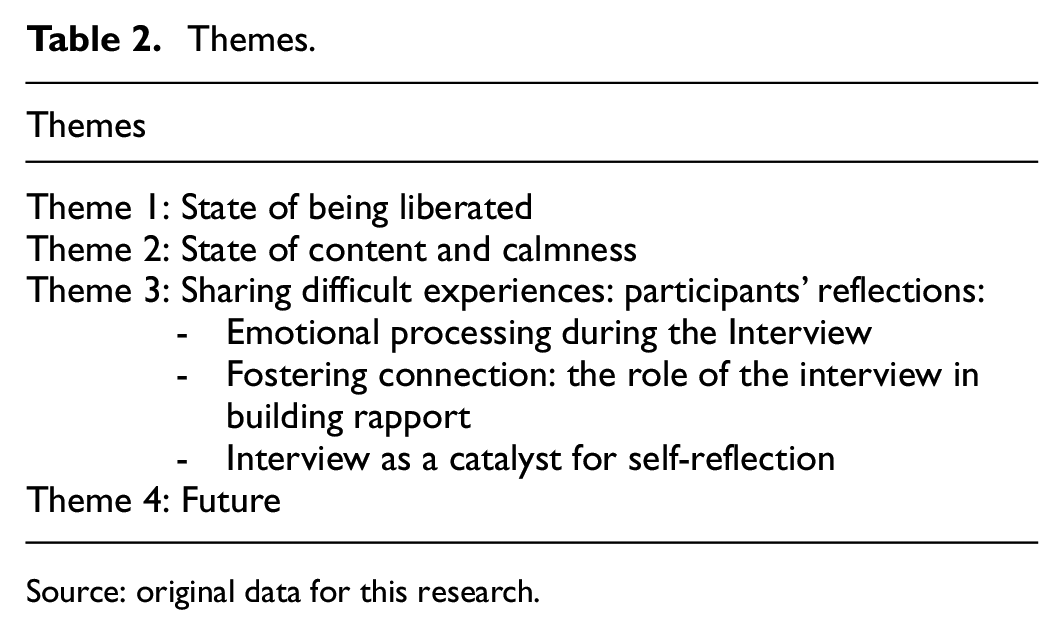
Source: original data for this research.
At the time of the interview, all participants were residing in Ulaanbaatar, the capital of Mongolia. Five participants were from the capital city and five from rural areas. To be included as a participant in this study, the women had to be over 18 years of age and no longer in a situation where they were being subjected to IPV. Survivors still living with their abusive partners were excluded from the study; only participants who were no longer in violent relationships since the last 2 to 19 years and divorced, separated, or widowed were included in the study.
Distribution of psychosocial and legal services among participants reveals varied patterns; four participants sought psychological counseling, four received legal counseling, one sought social welfare services, and three did not access any of these services. Moreover, three participants did not receive a combination of all services, illustrating the diverse spectrum of service-seeking experiences among the participants.
Theme 1—State of Liberation
At the end of the interview session, all participants stated they felt comfortable. To them, this sense of liberation felt like a relief from a psychological burden. For example, P1 expressed that this interview made her “feel free.” P3 stated: “I have never had psychological counseling before, thus I feel released.”” Furthermore, P8 shared: “All my life, I lived following someone else’s orders, and this interview made me realize what liberation is.” P7 said that she “felt released from a burden.” The women appreciated the comfortable environment in which the interviews were conducted.
Theme 2—A State of Contentment and Calmness
Most survivors, including P8, indicated that the interview made them feel ““relieved”; P9 stated: “I feel calm now.” All the survivors stated that they felt validated and heard; for example,P10 shared that she felt “heard,” and P3 stated: “I never shared my issues with others” and that this conversation made her feel comfortable in the environment created to share her feelings with the researcher. Furthermore, P2 said that it helped her to “realize my lived experience,” P8 felt a sense of “contentment,” and P9 noted that she “felt secure.” P4 said that the interview “seemed therapeutic when I shared my feelings with someone that I can trust,” and P2 reflected, “I had never thought about what I had gone through” and felt “relieved and released” at the end of the interview. Participating in the research and sharing their IPV survival experiences helped the women collectively experience “inner peace.” Several participants articulated identical feelings for the interview process and termed it “insightful.” Therefore, their collective voice highlighted a common theme, emphasizing contentment and calmness.
Theme 3—Sharing Difficult Experiences: Participants’ Reflections
Emotional Processing During the Interview
The survivors stated that they had expected a formal interview, but this interview process proved to be easy; P1 termed it “comfortable” while P2 shared: “I got all the information I wanted about dealing with IPV; because of our friendly conversation, it did not feel overwhelming.”
During the interviews, some participants wept, and P2 mentioned that “it felt like I was released from all my suppressed feelings while I was crying.” When the participants got upset, the interviewer provided comfort with empathy and compassion and offered to discontinue the interview. However, the women were eager to proceed. For women who had not had a counseling session before, this was the first time they were sharing their survival experiences. For example, P2 revealed, “I went through a lot; the abuse was hard to bear at the time.” Thus, it was important for the women to be heard and validated. Although the research did not focus on any violent experience, many women were willing to share their ordeals of abuse. The interviewer did not interfere during the process of reflection. P8 questioned the interviewer to find out why the latter had not inquired about her IPV experience. When the interviewer gave the survivor the choice to disclose what she went through, she chose to share. P8 stated, “I want to talk about it. Although it is painful, I want you to know.” A majority of the participants emphasized the importance of sharing the nature of the abusive relationship and acknowledged surviving the consequences of abuse.
Fostering Connection: The Role of the Interview in Building Rapport
Another important aspect of this process was the survivors’ sense of belonging. This feeling was engendered either through an informal or formal support network. To some extent, all women had social support; this indicates that they were engaging with their close networks. According to P10, this interview “made me realize the extent of my social support”; P5 stated: “I have supportive colleagues”; and P1 acknowledged: “My parents always support me.”
Interview as a Catalyst for Self-reflection
Some participants asked the interviewer to explain the difference between “survivor” and “victim.” They were told that a survivor survives the consequences of abuse and violence, even during the most violent episodes. The participants were keen to be identified and referred to as survivors. For example, P1 noted: “I never considered myself a victim; throughout my abusive relationship, I was surviving.” After realizing the distinction between a victim and a survivor, P2 firmly responded, “Oh, then I’m a survivor.” P4 shared: “I am in a survivors’ conference; I felt we’re strong survivors.”
Theme 4—Future
Many participants stated that the interview gave them a sense of “hope” and “empowerment.” For example, P10 asserted: “I always had hope, my participation in this study demonstrates my hopefulness for the future.” Participant P5 noted: “…the questions really made me think of the future. It is nice to share my plans with someone."
According to P7, this interview made her feel like a torchlight had been shone to show her the way to the future and that this was something she had never reflected on earlier. Many survivors could now think about their future and plan. P3, who had never had any formal support service before this session, said: “I can clearly plan my future now”, and P6 noted: “Earlier, I was not able to articulate anything about my future, but now I can plan.” In the follow-up interview, some participants like P3 referred to the first interview and stated that “everything went as planned”. P4 confirmed: “I changed my plans since we last spoke, but everything’s going as I wished.”
Discussion
This study shows the importance of validating the experiences of IPV survivors during the research interviews. Although there is previous research available about the participants’ reactions to IPV studies, there is a gap in how these interviews acknowledged the participants’ sense of liberation, calmness, contentment, and realization for the future. The interviewer did not expect the participants to acknowledge that the interview had been a positive experience; they stated that it had been insightful. The interview process acted as a catharsis and a means to rejuvenate the spirit of the survivors. The participation of survivors in IPV research is important, both for researchers and participants. Research on IPV is considered a sensitive domain and has to undergo a rigorous ethical review, mainly due to the potential psychological risks involved (Campbell et al., 2019). A large part of the research on IPV focuses solely on the reactions of the survivors to the negative effects and consequences of the victimization (Edwards et al., 2014), rather than on the process of an interview itself. The reflections of survivors of IPV research interviews have been under-researched (Edwards et al., 2014). It is vital for survivors to open up to a trustworthy person who provides them the space to release the psychological tension withheld within themselves (Hamberger et al., 2020). The interviewer ensures an egalitarian relationship by removing all power hierarchy, and survivors are given open space to share their lived experiences. Through this process, both the researcher and the survivors become part of the social transformation process to attain social justice and for the co-creation of knowledge.
It is important for women to share their experiences with someone who is interested in their account of what they have been through (Campbell et al., 2010); a narration of their experiences gives them a sense of agency and ownership of their survival (Hanmer & Klugman, 2016). These shared experiences are their own truth, discovered by exploring how they stood against oppression, and the feeling of being heard as a community (Hanmer & Klugman, 2016). All participants in this research study stated that these interviews brought them inner peace, a sense of calm, and an insight into their own situation. It provided them a strong push, a confirmation of their lived experiences where they felt they were heard, supported, and validated.
The significance of this study pertains to the uniformity in the participants’ reflective experiences during the interview process, despite the variations in the psychosocial services they received. Participants exhibited analogous responses regardless of the extent of services received: some received no services, some received only psychological or legal services, and only one participant received social welfare services. Participants consistently described the interviewing process as therapeutic and conducive to personal growth, underlining the profound impact of this approach on survivors, irrespective of the support services they accessed.
Although the participants in this research displayed distress during the interview, they did not discontinue the process; rather, they indicated it was a healing process where they realized things that were not obvious earlier and found it important to do so.It is important to engage with empathy, compassion, and respect. As a result, the women can fully engage with the interviewer (Campbell et al., 2010; Oke, 2008). This was reflected in our study, too. Reflexive interviewing allowed the women to express themselves, and the interviewer’s congruence and her compassionate, empathic nature may have appeared therapeutic. This also suggests that survivors of IPV would like to share their experiences, not only for research purposes but also because the interviews assist the women in constructing their present and future self.
When the women shared their survival experiences, they expressed their sadness and regret in losing time over dysfunctional relationships. The interviewer did not interfere in the process and focused on the women’s feelings (Campbell et al., 2010). Without disclosing their background related to IPV and establishing an egalitarian relationship by reducing hierarchy, the interviewer would have felt a barrier when connecting with these women (Campbell et al., 2010; Nazneen et al., 2014). Thus, sharing the interviewer’s own background results in unfolding the experience, together, making it a meaningful one (Nazneen et al., 2014). It is a crucial part of the interview where the interviewer shares her professional experience.
In this research, the interviewer used the co-authorship strategy; she contacted the participants after a year to reconsider and refine the story. Nanzneen et al. (2014) addressed this by closely examining the narrative’s components “revise and revisit the narrative.” As a result, the survivors confirmed and updated the earlier narratives they shared with the interviewer. The participants were invited to review their previous narratives and make any necessary modifications (Oke, 2008a). Most importantly, women felt validated to hear their own stories after a year. It was a structured exploration for survivors where they reflected upon the process of IPV, taking into account their position in society (Nazneen et al., 2014).
This empowering process would not have been achieved without active listening, where the interviewer was aware of other unspoken lines, which enabled both her and the survivors to fully acknowledge and own the survival experiences (Nazneen et al., 2014). It is not enough to be aware only of the words spoken by the survivors, but also to be fully attentive and attuned to the sounds, body language, and untold lines. Thus, listening between the lines benefitted both the research and the women interviewed.
By participating in IPV research, survivors can reflect on and give meaning to their experiences, which results in them becoming psychologically resilient (Snyder, 2016). In the current study, the emotional processing during the interview process, fostering connection and the meaning-making process are all likely to contribute positively to their lives. This process helped the women to feel a sense of liberation, and to understand and accept themselves as “survivors.”
Furthermore, the interviews helped some survivors identify that they needed psychological counseling; for others, it confirmed that their previous counseling had been beneficial. The survivors becoming agents of social change, imbued with a sense of belonging and agency, was significant to the interview process. By narrating their current achievements, experiences, and future goals, the women demonstrated that they were in the process of feeling empowered.
Strengths and Limitations of the Research
This research aimed to madea valuable contribution by addressing the gap that exists in accepting the significance of focusing on the interviewing process in IPV research. Globally, the interviewing process in research is an area that is not extensively studied, which is also true for Mongolia. This study provides valuable insights into the experiences of IPV survivors during the interview process. While examining the experiences of IPV survivors is crucial, this research offers suggestions and perspectives for researchers to consider when conducting interviews with survivors.
A notable limitation of the study is that all participants had exited abusive relationships, thus recounting their experiences retrospectively. This presents a potential limitation compared to survivors currently residing with their perpetrators, whose perspectives and experiences might differ due to their current ongoing situation.
Another limitation is that it is a relatively small study with only 10 participants. Therefore, it cannot be generalized. Due to the global geographical restriction on the overall research body, finding relevant literature in the field was challenging.
Conclusion
IPV is a sensitive subject and may retraumatize the survivors due to the nature of the research focus. Most research centers on the negative impact and the consequences of the violence that the survivor has endured. However, a study conducted on survivors of IPV can have several benefits for those affected. It is vital to note the importance of the interview process to understand how it makes the women feel afterward. The interviews give the survivors insight, a sense of agency, ownership, and belonging, and act as agent of social change. It helped them to reflect and comforts them with the assurance of being heard and validated. The sense of empowerment that the women had during the interview process was achieved through an egalitarian, open relationship between the researcher and the participants, where the researcher demonstrated empathy and compassion and showed an interest in the participants’ situation. It is crucial for the researcher to share her/his own background and create a common ground in the interview process. It is essential to be empathetic and humane during the interviews so that the participants are fully engaged and comfortable in sharing their innermost feelings.
Footnotes
Acknowledgements
Our deepest gratitude to all the participants who generously contributed their time and insights to this research.

Ethical approval
The research team obtained ethical permission from Eötvös Loránd University Ethical Committee (2019/165-2).
Consent to Participate
The research team obtained written informed consent from all participants.
Funding
The author(s) received no financial support for the research, authorship, and/or publication of this article.
Declaration of Conflicting Interests
The author(s) declared no potential conflicts of interest with respect to the research, authorship, and/or publication of this article.
Data availability statement
The datasets generated during and analysed during the current study are available from the corresponding author upon reasonable request.