




Abstract
This research aims to reveal the negative impacts of out-of-school sources on history lessons and how teachers respond to these effects. The participants of the study are 20 history teachers who teach history lessons in secondary education institutions in Turkey. The research was conducted using a qualitative research method, and data was collected through a semi-structured interview form. According to the findings, the participants considered out-of-school sources to have slightly more influence on shaping students’ historical consciousness compared to the school. In addition, these participants highlighted TV series and movies, family, and social media as significant factors. According to the participants, out-of-school sources can lead to negative effects on students, particularly by fostering misconceptions about historical processes, events, and figures, accepting incorrect information without questioning it, and rejecting the facts presented by teachers. Teachers’ approaches to counteracting the negative effects of these out-of-school sources mostly involve presenting accurate information, guiding students toward reliable sources by providing specific references, and explaining the fictional nature of movies. In the study, it is considered that teacher approaches may not be sufficient in addressing the negative impacts of out-of-school sources, and thus various recommendations have been put forward.
Keywords
Introduction
History is one of the most crucial subjects that impart knowledge and skills to students, primarily related to citizenship and various other purposes (Phillips, 2002). However, there are numerous variables that influence the achievement of its objectives. One of these variables is the presentation style of history through out-of-school sources.
History lessons taught in schools are just one of the sources that contribute to the formation and shaping of historical consciousness (Jensen, 2003). This is because children begin interacting with the past through sources such as fairy tales, rhymes, family anecdotes, films, old photographs, sculptures, religious structures, abandoned or obsolete buildings, and various objects even before they start school (Cooper, 2002. Also see Cooper, 2007, 2018). Therefore, as educators have emphasized in recent years, children do not come to school as empty vessels, and history lessons are not their sole source of learning about the past. Students also learn history outside school and in their social life, from their family environment, television and films, museums, fictional and nonfiction books, newspapers and magazines (Létourneau, 2012), and they bring this knowledge from outside of the school into history lessons. Hence, history teachers witness the impacts of out-of-school sources on their students’ historical consciousness while teaching their lessons (Grever & Van Nieuwenhuyse, 2020).
In today’s world, with the advancement of technology, it can be stated that much of the knowledge that young people possess about the past comes from visual/audio media. Students watch documentaries, movies, internet videos, and historical video games through various platforms like television, computers, and smartphones wherever desire (Paxton & Marcus, 2018). Moreover, it appears that “access” to popular history websites and historical content on social media is much greater than access to scholarly books prepared by academics. The development of technology and social media has not only expanded the range of sources providing historical information but has also increased the volume of unregulated information (Haydn & Ribbens, 2017). Furthermore, these developments also pose a dangerous situation where young people are exposed to unreliable and problematic information in the field of history like in many other areas (Haydn, 2014; Haydn & Ribbens, 2017). This issue alone highlights the importance of identifying the information that students acquire outside of school and its impact on history lessons. In order for teachers to be able to address and interrogate the narratives that students bring into the classroom from outside the school, they must take into account and try to recognize the structure and potential impact of these narratives (Lévesque & Croteau, 2020). However, it cannot be said that they sufficiently recognize the historical narratives that students encounter outside of school (Kühberger, 2019).
Schools and teachers play a central role in shaping students’ historical consciousness and in addressing and evaluating the effects of out-of-school sources. Therefore, teachers’ practices can have an impact on the quality of students’ historical understanding acquired through out-of-school sources (Grant, 2003). Out-of-school history sources are increasingly influential on young people, and these effects can sometimes be negative in nature. If teachers choose to ignore this negative situation and miss the opportunity to influence their students’ historical understanding, the streets or other out-of-school sources will become effective and primary means of conveying crucial information (Conway, 2004). However, it should not be forgotten that the ideas that students acquire from these sources and that educators will not approve of cannot be combated by providing factual knowledge in history lessons (Cooper, 2000). It is essential to impart the nature of science of history to students in order to protect them from the negative impacts of out-of-school sources. Especially in a digitalized world, it should not be forgotten that students can only combat the flood of information surrounding them by grasping the procedures of the historical discipline and thinking like historians (Rubio & Pons, 2022).
One of the primary requirements for students to understand the nature of history is to acquire evidence-based competence. Dealing with evidence and sources will contribute to students’ struggle against false sources and misleading information (Moreno-Vera, 2023) and become active citizens in today’s polarized world (Nokes, 2022).
Students should understand “how historical interpretations arise” and “why they differ” when grasping the nature of history, and they should be encouraged to think about “whether one interpretation is better than another” through comparison (Kitson et al., 2011, p. 81). For this reason, employing a deconstructive approach to interpretations in history lessons (Chapman, 2023) and engaging students in evaluating and analyzing historical interpretations (Kitson et al., 2011) is a crucial requirement. The interpretations to be discussed should not only encompass the narratives of historians but also presentations from interesting sources students may encounter outside of school, such as historical films, documentaries, songs, museums, etc. (Kitson et al., 2011. Also see Cooper, 2002; Harnett et al., 2014).
Another way to make the creation of historical interpretations understandable is having students compare the historical interpretations of their families with other sources of historical narratives (Levstik & Barton, 2005). In addition to this, students can also engage in comparing the different narratives they create themselves. Thus, they can also see the relationship between the interpretations they made and the evidence they use (Cooper, 2014; Kitson et al., 2011). Students should understand the importance of evidence, distinguish between false claims and evidence-based arguments, and comprehend how historical narratives and interpretations are constructed. This will prevent them from unquestioningly accepting claims they encounter from authorized sources/authorities, such as parents, teachers, books, television, without questioning, and enhance their strength to resist dominant interpretations presented to them (K. C. Barton & Levstik, 2004).
Understanding the nature of history, knowing how historians work and how knowledge is produced will help students make reasonable decisions in their lives and become conscious of the common distortions prevalent in today’s world (Haydn et al., 1997). Undoubtedly, a significant portion of these distortions is based on out-of-school sources. This situation and especially the widespread access to history through sources out-of-school such as social media and television, must be taken into account. Today’s history education should be multifaceted and should provide students with the awareness that the information they obtain from these out-of-school sources may be distorted and the skills to determine the reliability of this information (Haydn, 2014). Teachers should incorporate studies that involve analysis of written and visual sources that present and interpret historical information in their classrooms to prepare their students for the potential negative effects of non-academic history (For these analyses, see Nokes, 2022; Stradling, 2001). In these analyses, reflecting and practicing through source-focused questions, especially on the intentions of the creators of the sources, can provide an opportunity to question students’ biases based on out-of-school sources (Black, 2011).
Undoubtedly, especially with the increased prevalence of social media use and the rise in the misuse of history, it becomes necessary to illustrate to students the examples of differences between good and bad history (Haydn, 2017; Haydn & Ribbens, 2017. Also see Haydn, 2022, 2023).
Depriving students of such education would, as Lévesque and Croteau (2022, p. 115) put it, liken them to “junior car drivers on the cultural highway without a driver’s manual.”
As can be understood, in order to realize these approaches, it is necessary to include the historical narratives of out-of-school sources in history lessons within the scope of developing historical thinking skills (Kühberger, 2019; Martin, 2019). Martin (2019) emphasizes the inclusion of these narratives in the curriculum to enable students to understand of out-of-school sources the ways it work and to prepare them for the various historical narratives they will encounter in the future. Martin (2019) suggests two approaches to addressing these narratives in school based on source analysis. In the first approach, students play the role of consumers and in the second approach they play the role of producers. In the consumer role, students critically evaluate these narratives, while in the producer role, they create these out-of-school history products/narratives (plaques, local projects, exhibitions, etc.) themselves. In the role of producers, students also need to decide which selection criteria to apply in the creation of these products, taking into account the target audience
Literature Review
It is known that a significant portion of out-of-school sources, particularly centered around Northern Ireland, are dedicated to research on controversial and sensitive subjects. Numerous studies have been conducted on how information obtained from out-of-school sources such as family and society regarding controversial and sensitive subjects affect lessons, as well as on teachers’ approaches to this issue (See Günal, 2016). In studies of controversial and sensitive topics, teachers have been found to exhibit avoidance behavior when the information provided in school is at odds with family and societal understandings. Reasons for this include the perceived inappropriateness of teaching these subjects in relation to the age, maturity or needs of the pupils, teachers’ reluctance to face problems, and their lack of knowledge and skills in teaching the subject (The TEACH Report, 2007).
A study conducted by Conway (2004) between 1990 and 2001 with students and teachers at secondary school levels in Northern Ireland and England, a study carried out by K. Barton and McCully (2005) with 253 secondary school students aged 11 to 14 in Northern Ireland, and another study conducted by Bell et al. (2010) in Northern Ireland can be cited as examples of research that explore the sources from which students learn history and determine the role of the school. In the studies conducted by Epstein (2009) and Traille (2020), especially the racial identities of children and adolescents and the status and forms of the inclusion of issues related to these identities in the lessons It was determined how it shaped their perspectives on history lessons. In addition to this, the findings obtained from comprehensive research conducted as part of a youth and history project across Europe have revealed which ways of presentation of history students found reliable and enjoyable (Barschdorff, 1998; Jensen, 2003; Tekeli, 1998).
Understanding how out-of-school sources influence history lessons and identifying teachers’ approaches toward the impact of these sources will guide steps taken toward enhancing history education and the process of history teacher training. The purpose of this study is to determine the negative effects of out-of-school sources on history lessons and to understand the approaches of teachers toward these negative impacts.
Considering this purpose, the objectives of the research are as follows:
To identify which of the school and out-of-school sources are more effective on students’ historical consciousness.
To reveal the negative effects of out-of-school sources on history lessons.
To identify the approaches employed by teachers in response to the negative impacts of out-of-school sources on history lessons.
Method
Research Model
The study was conducted using a qualitative research method and basic qualitative research design. The basic qualitative research design is concerned with “how people interpret their lives, construct their worlds, and give meaning to their experiences. The whole aim is to understand how people make sense of their lives and experiences” (Merriam, 2018, pp. 22–23). The reason for conducting the research using a qualitative research method is to obtain in-depth information on this issue.
Study Group
The participants of the study are teachers who work at secondary education institutions and teach history classes in a city center in eastern Turkey. The participants of the study were determined by criterion sampling method (See Patton, 2002). Having experienced the negative effects of out-of-school resources in the lessons they taught constituted the criterion for the selection of the participants. The study was carried out with 20 history teachers, including 14 males and 6 females. The participants graduated from history or history teaching departments at various universities in Turkey in order to become history teachers. Eleven of the participants graduated from the history teaching department and nine from the history department. Those who graduate from the history department also received pedagogical formation training in order to become teachers. Eight of the participants have 20 to 25, five have 15 to 20, and three have 10 to 15 years of teaching experience. On the other hand, the years of professional experience of the remaining four participants are 35 to 40, 25 to 30, 5 to 10 and 0 to 5. The students in the participants’ classes were between the ages of 14 to 18.
Data Collection Tools
In the research, a semi-structured interview form was used as the data collection tool. The data collection tool includes questions which aim at obtaining teachers’ opinions about which of the school and out-of-school resources are more effective on the historical consciousness of their students, out-of-school sources that influence the students’ historical consciousness, the negative effects of these resources in history lessons, as well as their approaches in response to the negative effects of these sources. Conway's (2004) research was utilized in the question of which of the school and out-of-school resources are more effective on the historical consciousness of their students. The data were gathered through face-to-face interviews with teachers. At this stage, the data were recorded using a voice recorder with participants’ permission.
Data Analysis
After the data was collected, it was analyzed and transferred to a Word document on the computer. During the analysis phase, the data was read multiple times and contemplated upon. In this process, meaningful sections that could respond to the research question were attempted to be identified. During this rather exhausting process for the author, as categories were being formed, the opinions of each participant regarding all questions were initially approached holistically. Subsequently, the opinions of each participant regarding the same questions were comparatively examined and analyzed. In this regard, the extracted meanings from the data were consistently compared with each other, and repeating data segments conveying the same meaning were grouped under the same category. Comparative readings were again employed to determine/nominate categories that would best describe similar-meaning data segments (Merriam, 2018). The interview recordings were transcribed onto the computer without any modifications, exactly as they were. Therefore, the transcribed data unavoidably contains sentence deficiencies, grammatical errors, and word repetitions that occurred during the interviews. However, before presenting the findings without quotes, certain modifications were made to these interview data to enhance reader comprehension, while striving to maintain the original meaning as much as possible (Güler et al., 2015). During the use of quotations, unnecessary and distracting information has been omitted, and ellipsis (…) has been used for these parts. To help reader understand the text, square brackets have been employed to complete the meaning using the author’s words for unclear or missing parts within the quotations (Weaver-Hightower, 2021).
Reliability and Validity
After conducting a review of the relevant literature, the prepared data collection instrument was presented to the two expert faculty members in the teaching history field, and considering their feedback, some modifications were made. Subsequently, a pilot study was conducted with two experienced teachers. Both the answers provided by the teachers to the questions were examined, and their opinions regarding the purpose of the interview and the questions were received. The semi-structured interview form was then finalized. Both research permission from the Ministry of National Education and an ethical committee approval document from the Educational Sciences Unit Ethics Committee were obtained for data collection. In order to conduct the interviews and gather data, the voluntary participation form of the teachers was reviewed, and their consent was obtained. After being transcribed into text on the computer, the data were sent to the participants’ email addresses to solicit feedback and prevent misunderstandings. In addition, expert opinions were sought regarding the research process, the data, and the findings to determine whether there was consistency (See Merriam, 2018). Another researcher was also involved in examining the data during the analysis process, and comparisons were made within the created categories to reach a common understanding (Woods & Catanzaro, 1988, as cited in Kızıltepe, 2021). During the presentation of the data, excerpts from the participants’ statements were included using codes such as P1 (Participants 1), P2…, P20. In the process of citation, efforts were made to incorporate perspectives from a diverse range of participants whenever possible (Weaver-Hightower, 2021).
Findings
Participants’ Views on Which of the School and Out-of-School Sources is More Effective on Students' Historical Consciousness
In order to determine which source is more effective on students’ historical consciousness, the participants were first asked to indicate which out-of-school sources affect students’ historical consciousness according to their observations and experiences. In this question, the participants were asked to mention these sources in general, regardless of whether their effects were positive or negative. The responses obtained from the participants are presented in Figure 1 below.

Participants’ views on out-of-school sources that influence students’ historical consciousness.
The participants have identified history-themed TV series and movies, family, and social media as the out-of-school sources influencing students’ historical consciousness. In comparison to these sources, the frequency of mentioning other sources is quite limited. All participants have acknowledged history-themed TV series and movies as sources influencing historical consciousness.
The participants were then asked which of the out-of-school sources and the school they found more effective on students’ historical consciousness. Out of all the participants, 11 indicated that they found out-of-school sources to be more effective, while 9 stated that they considered school to be more effective (Figure 2).
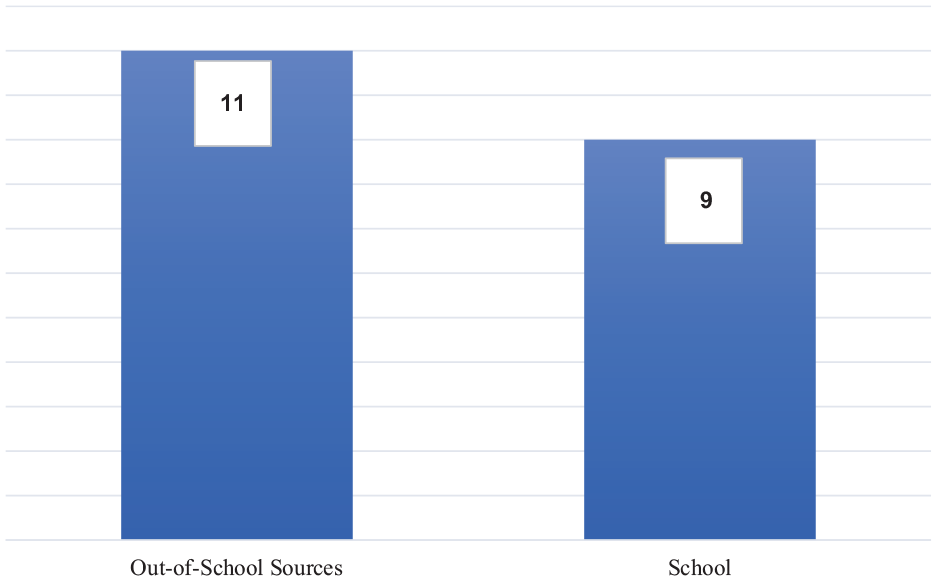
Participants’ views on which of the school and out-of-school sources is more effective on students’ historical consciousness.
All participants who believed that the school played a more primary role in the formation of historical consciousness attributed success in this matter to the teacher. On the other hand, the participants who placed the school behind other sources attributed the responsibility for this matter to the textbook. The participants mentioned that textbooks lacked a connection to daily life and predominantly focused on political history and that was why they failed to capture children’s interest. The participants who prioritized the school over other sources gave precedence to the teacher in this regard. The participants viewed the teacher’s ability to narrate history using scientific methods and data, as well as being knowledgeable about history, as influential in this matter.
From participants who prioritize the school’s role in influencing historical consciousness, P6 mentioned that teachers presented history using scientific methods and data, which sometimes makes it feel boring. However, they acknowledged the school’s predominant influence, and the students’ trust in their teachers. P6 furthermore emphasized the role of the school in shaping historical consciousness by stating that the education provided at school also forms a perception of history in response to out-of-school sources. P6 shared his view, and a personal experience as follows:
I personally believe that the school holds more influence… It was just a few days ago. A child came to me and said, “Teacher, my father brought me a book from his workplace. I looked at it, and the author criticizes Atatürk a bit. I told myself I won’t read this.” Such things can happen… The child’s historical perception, in my opinion, remained unaffected due to being more informed. He reacted by saying, “I won’t read this.” I believe this is a learning outcome from the formal education the child receives because in our formal education system, I don’t believe that any information or expressions criticizing Atatürk, the founder of our Republic, would be given.
Another participant, P11, placed the school in the first place due to students’ trust in the teacher’s historical knowledge and expertise.
For the student, the top priority is the lesson they receive in the classroom… Because there’s this aspect; if the student doesn’t have any antipathy towards the teacher, after a certain time, let’s say 2-3 months later, they believe everything you say because they have this mindset; “…if the teacher is saying it, it must be true. Because the teacher knows history.”
Out of the participants who prioritize out-of-school sources in influencing historical consciousness, P5 noted that based on her observations in class, students do not refer to textbooks and do not have situations where they say, “I have learned this from school”: So, I don’t think they really look at textbooks because sometimes, I pay attention during classes; I point out that there is something on that page. They are unaware. Unfortunately, they don’t look …series affect students because they are made for ratings and they are more fun, they are more attractive. Books can seem more boring… [School] is placed lower because they don’t have situations where they can say, “I have learned this from school.”
Another participant, P14, mentioned that teachers no longer hold the same influence as they did in the past, and that students learn much more effectively and permanently from out-of-school sources, especially TV series and movies. P14 essentially echoes the thoughts of those who emphasize the significance of out-of-school sources by conveying the following:
When attempting to correct negative information, we realize that the school doesn’t have as much influence in determining the reliability of information. There used to be a concept of teacher. There was this notion that a teacher would teach everything, would know everything. This is an indication that we have moved away from that point now…. In the face of a massive TV series, can what you’re saying change things? You can’t change it… Right now, I don’t know anything as powerful as the media. You can’t change the information obtained from the media.
Participants’ Views on the Negative Effects of Out-of-School Sources on History Lessons
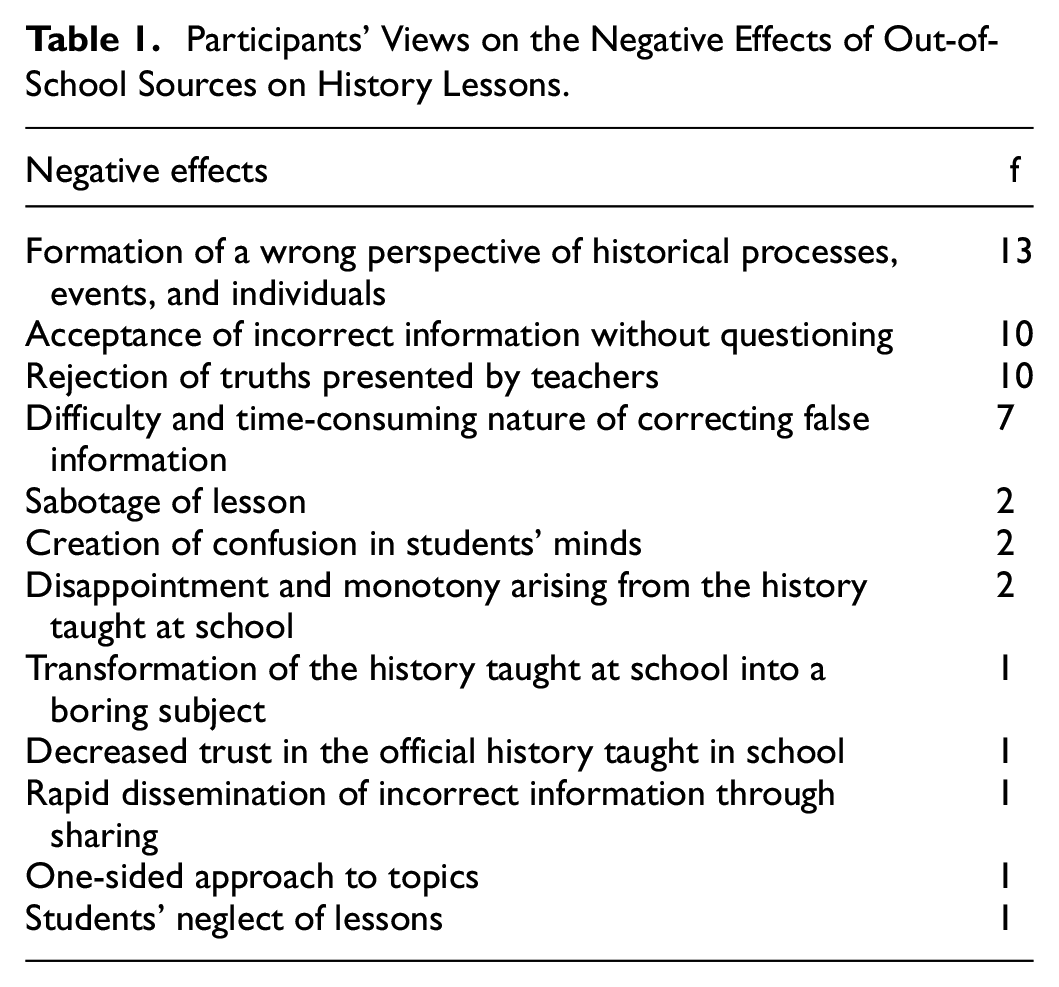
The first opinion expressed by the teachers regarding the negative effects of out-of-school sources on history lessons is the formation of a wrong perspective of historical processes, events, and individuals (Table 1). The participants, especially, indicated that TV series and movies distort historical facts, manipulate them for ideological purposes, and that the students who watch these productions perceive history as a process of warfare, success, epic victories, love, and intrigue. In this regard, the opinion of P6 is as follows:
Movies, TV series, and social media can sometimes distance people from reality… This detachment from reality and students perceiving history only as a chain of “continuous intrigues,”“endless digging of traps one after another” or seeing it solely as a “romantic adventure.”
Participants’ Views on the Negative Effects of Out-of-School Sources on History Lessons.
The participants also determined that due to these productions, students developed a distorted image of historical figures’ private lives, clothing styles, and appearances. In this regard, the opinion of P11 is as follows:
TV series, sometimes driven by ratings, especially emphasize the harem aspect. Students might say, “Teacher, you told me about Kanuni as the man who died on a horse. Kanuni never left the harem.” We struggled a bit with those topics.
Acceptance of incorrect information without questioning, rejection of truths presented by teachers, and difficulty and time-consuming nature of correcting false information are views expressed in high ranks, and they are interrelated with each other. The participants have mentioned that students tend to perceive the information presented by external sources as truths without questioning their accuracy. An example view related to this category is expressed by P1 as follows:
…Especially in recent times, children are very active on social media. Some information shared on social media, whether it’s true or false, attracts children… They don’t question whether it’s true or not, they immediately accept it and share it.
The participants have noted that when it comes to not accepting the truths presented by the teacher, students tend to be stubborn and, as described by P12, might even confront them with accusations like “you don’t know” or, as stated by P9, claim “you’re mistaken.” In this regard, P12 shared an experience of being compared with a popular researcher-writer, as follows: A man [student] who loves me a lot, believes in me greatly, and even comes to ask for my opinion on various matters outside of history, told me to my face, regarding a topic related to Atatürk, that I don’t know, and that [the researcher-writer] knows this topic better than me. It had infuriated me extremely. Now it’s really like a comic situation… He said, “You don’t know, you’ve learned official history. The truth of this matter is as he said”.
It should be noted here that from the participants’ perspectives, especially in recent historical matters, information from family sources appears to have a significant impact. The experience expressed by P9 can be cited as an example of this aspect:
When discussing the uprisings in the Republican era and saying, “Behind this matter, there was the involvement of England; they aimed to harm the new republic,” a student interrupted, saying, “Sir, we don’t know it as you explained.,” or “Sir, you’re wrong. The truth is like this.” I experienced this and it felt like their family had deeply ingrained in them the idea of “this is so, this is so, this is so.”
From participants’ statements, it is evident that changing and convincing a child about information acquired from family sources is more challenging compared to the influence of TV series and social media, especially on such topics. The participants have also highlighted the difficulty and time-consuming nature of correcting misinformation, mentioning that this process can lead to digression from the subject matter: During the class, I was explaining that Osman Bey’s mother was Halime Hatun, when suddenly one of the students said,” Oh sir, she died during childbirth.” Now you’re caught in a bind. You have to admit the truth. Now the topic is getting sidetracked… Of course, time is slipping away (P13).
The following are less frequently mentioned opinions by the participants: sabotage of the lesson, creation of confusion in students’ minds, development of disappointment toward the history taught in school, transformation of school-taught history into a boring subject, decreased trust in the official history taught in school, rapid dissemination of incorrect information through sharing, one-sided approach to topics, and neglect of lessons by students (Table 1).
The participants indicate that when it comes to sabotage of the lesson, the class is being sabotaged, especially through purposeful questions stemming from family influences or sensitive topics. They also indicate that the information acquired is being used for political or ideological confrontations and personal ego-driven motives within the class. The participants also mention that misinformation is leading to conflicts among students. P5 notes that when a student asks a question with the intention of sabotaging the lesson and if the teacher is unable to answer the question due to unpreparedness or nervousness, the student may perceive that the teacher does not know anything at all: [Student] He can inadvertently sabotage the lesson. While you’re explaining something, a student might ask something that he has heard of. If you don’t know or can’t remember it at that moment, he might claim, “this teacher doesn’t know anything”… In fact, he can purposefully ask about certain topics which he’s not particularly sensitive about in his personal life. Sometimes, it can be challenging to regain control.
The viewpoints including development of disappointment toward the history taught in school and transformation of school-taught history into a boring subject demonstrate the strong influence of out-of-school sources on student interest. Regarding the emergence of disappointment toward the history taught in school, P12′s opinions are as follows:
The child comes with enthusiasm and curiosity, especially for history… But the history he loves is entirely epic history. It’s the kind of history we think of with slogans like narrative history or history that raises goosebumps. When he realizes that it’s not exactly like that and when he learns… that these are just movies, fiction… he may be disappointed…
Regarding the transformation of school-taught history into a boring subject, P6 adds that students expect the lessons to focus on successful battles and romances like those depicted in TV series and movies:
This reflects as a negativity in the classroom in this sense. Of course, ultimately, the history we narrate encompasses dimensions of societal structure, scientific life, education, and cultural life. Of course, students find these aspects dull. They want to see it with the aspects like “if there were battles and victories, and if we were the winners.”
Regarding the decreased trust in the history taught in school, P16 has expressed his thoughts as follows: However, certain groups have attempted to shape a historical consciousness according to their own interpretations, especially distorting information about the recent history or the modern period of the Republic. They have fostered a sense of mistrust towards official history by providing children with misleading information… Additionally, they brought up various issues related to [different topics]. [Students] learned about these matters in educational institutions during that period. So, [the student] is now telling us that official history doesn’t convey the truth.
When the findings are examined in detail, it is seen that TV series and films are mainly more effective in the formation of wrong perspectives on historical processes, events, and individuals and the acceptance of incorrect information without questioning. In addition to these, the difficulty and time-consuming nature of correcting misinformation, the creation of confusion in students’ minds, the disappointment and monotony arising from the history taught at school, and the neglect of lessons by students are also influenced by TV series and films. Families have more influence in terms of the rejection of truths presented by teachers, the sabotage of the lesson, and the one-sided approach to topics. Finally, regarding the rapid dissemination of incorrect information, social media has a more significant impact.
Participants’ Approaches to the Negative Effects of Out-of-School Sources on History Lessons
As can be understood from the Table 2, teachers’ approaches in this matter can be categorized into two main groups. The first one is the approach demonstrated when any negative impact occurs in the classroom. The second one is the approach developed in advance almost as precautionary measures against any potential negative impact that might arise within the classroom.
Participants’ Approaches to the Negative Effects of Out-Of-School Sources on History Lessons.

The teachers’ initial response to the negative impacts of out-of-school sources on history lessons involves presenting the “accurate version” of the subject matter that is brought into the classroom. The participants who resort to this approach state that they convey this narrative to their students through verbal quotes from familiar and reliable sources. Some of them (six people) have mentioned that they also present “primary or secondary sources” while teaching. For instance, P4 explained his approach as follows: Generally, we aim to convey a more accurate version of the subject matter to students by referring to well-known sources that we have read, learned from, and seen. We often use quotes from the opinions, papers, and books of nationally recognized historians on this topic. This helps to provide students with a clearer understanding, supported by documented evidence.
The participants who explain the accurate version while also showing primary sources have indicated that this approach is highly effective in convincing students: The subject in which I was most effective was archival knowledge. There were very few students who were not convinced when they saw archive information. For example, when you say “…this is written here and this is an archive document,” s/he says “sir, okay then…” (P11). Sometimes we try to show this truth with documents. We are trying to provide proof so that it does not remain vague, that is, this is the proof of what he learned, this is the truth. So, when you give the document, this time the people on the other end, or children or young people, are convinced (P16).
Directing toward sources with specific names is the second most mentioned approach. The participants have noted that they guide students toward sources they specify, with a greater emphasis on books and a lesser emphasis on TV series and movies: …Because they constantly bring me information from what they read on social media and the videos they watch… For example, in the last lesson, I was talking about Turkish history before Islam. There were movies and books about the Atilla period. “You can get additional information from them, too,” I say… I give the name of the movie and the name of the book (P5). We can recommend sources to students by saying “read this book…” Sometimes, we might hesitate to give specific names… Especially when I know a source well, that is, there’s nothing problematic within it for me or the student, I give the name of the source. (P20)
Explaining the fictional nature of films and their lack of reality is the third most mentioned approach. The participants have noted that they explain to students that TV series and films are scripted, fictional, and often shaped to attract viewership for rating purposes, rather than accurately reflecting reality. The examples from participants’ perspectives include the following: Children accept these events as real. I tell them, “It is a screenplay. There’s a concern for ratings, and events are shaped in a way that you can watch them because of ratings. Most of the events are different. Apart from the names, you’re not confronting historical truths” (P7). I explain that this is a movie; they can exaggerate small things to maintain high ratings and to capture attention. If the people living in that era had a chance to witness these events during this time, they would probably say, “Did we really experience those things?” (P5).
The following views have been mentioned with moderate levels of frequency: encouraging the reading of different sources, emphasizing the significance of primary sources in historical research, proving the students’ misconceptions, highlighting history’s susceptibility to change and interpretation, stressing the need for a holistic assessment of events and characters, advising research from reliable sources, and promoting impartiality and objectivity.
Two of the participants who recommend turning to different sources have also added that they tell their students to form their own opinions by reading these sources.
“Okay, you’ve heard of it; but have you looked at different sources on that subject? Have you searched other opinions?” I speak as… I say “don’t just stick to a certain thing but to turn to other sources as well” (P1). They often ask at school, “What was Sultan Abdulhamid like?” I tell them, “If you look at him through one person’s perspective, he’s the Red Sultan; if you look at him through another person’s perspective, he’s the Great Khan. It’s up to you to decide. You’ll read, you’ll read different viewpoints, learn about the events, and based on that, you’ll make the decision whether Sultan Abdulhamid was like this or not” (P9).
In emphasizing the role of primary sources, the participants have mentioned that they aim to highlight the importance of sources and evidence in the field of historical study and learning. Some of these participants stated that they apply this approach at the beginning of the education period, during the first lesson. P17 notes that a student who learns the importance of evidence also understands that objecting to evidence-based information is incorrect:
What we provide to students initially in the ninth grade is a document or evidence. History is a discipline based on documents. It’s not something that everyone can interpret as they wish. Since the students are somewhat aware of this, they can realize that objecting to something backed by documentation and evidence is incorrect.
In this regard, it is evident that some participants touch upon the significance of sources when they inquire about where students acquire negative information they bring to the classroom. The following statement from Participant 10 serves as an example of this:
For instance, I ask them, “Where did you hear that?” When they say, “My mom said,”“My dad said,” or “My friend said,” I tell them, “Well then, it becomes a story. What you’re telling should have a source, a reference.”
In terms of proving students’ misconceptions, the participants mentioned that they employed this approach by explaining the reasons and providing examples. For instance, P8 conveyed her opinions as follows: …For instance, when a student mentions the alphabet reform…, I explain by providing concrete evidence by writing it on the board and providing examples, that what he is saying is not accurate… I give examples of using letters, both vowels and consonants, to express a language, and I explain that it [old alphabet] is not suitable for Turkish.
In terms of highlighting history’s susceptibility to change and interpretation, the participants have emphasized that history is a social science based on interpretation, not an absolute truth and that historical information can change due to the sources available, indicating that history does not always have to be 100% accurate. When it comes to emphasizing the need for a holistic evaluation of historical events and figures, the participants have expressed that they tell students the necessity of examining historical events and characters from all perspectives. They stress the importance of presenting characters with both their strengths and weaknesses. In this regard, the viewpoint of P5 is as follows:
I say that those people could be like that as well. However, when you look from a different perspective, these individuals possess exceptional qualities; they founded a nation, they struggled for it. But if you focus only on that minor aspect, you can make an incorrect evaluation.
In terms of advising students to research from reliable sources, the participants have stated that they recommend more scientific, academically oriented books, articles, websites, and documentaries. P6 has indicated that he advised his students to use works where they are certain about the author’s impartiality and that included references from scholarly works:
I always tell children this at least once: “When reading a book, first research the author of the book you’re reading. Is this person truly acting in the name of objectivity? … Second, make sure the book you’re reading has a references section. Look at that references section. Are there scientific, academic works in that references section?” When children are researching topics on the internet, they often type in a subject and read whatever comes up. I advise them to follow publications that are mostly in PDF format and published in the form of articles and to read more scientific data.
The least mentioned viewpoints by the participants include the following: Instilling a sense of criticism and questioning in students, advising to consider the conditions of the era, grasping historical methodology, assigning research projects based on sources, presenting events in connection with the present day, highlighting the susceptibility of history to manipulation, and encouraging multidimensional thinking.
The participants mentioned that they aim to instill a sense of criticism and questioning in students by encouraging them to be open to criticism and the awareness of not blindly adhering to something. In addition, they recommended that students question the authenticity of what they see on social media or in TV series. In this regard, the advice given by P6 to students is as follows:
Question what is presented on social media or in TV series. Ask yourself, “Is this real or not?” Let that be a doubt in your mind. You might like it and watch it. There’s nothing wrong with that, but have a slight doubt about the authenticity of everything you watch.
P12 claims that by making students grasp the historical methodology [just at the beginning of the course] he develops an antidote against the negative influences of out-of-school sources: Teaching the philosophy of history, teaching historical methodology……without teaching these, having knowledge of history is meaningless if you can’t develop a historical perspective. I always… in my first classes, I make sure to explain historical methodology and the philosophy of history… Some teachers might not have given importance to these aspects, they might have overlooked them. But for me, you can learn the fact that “Sultan Mehmed II, byname Fatih Sultan Mehmet, conquered Istanbul in 1453” from anywhere, at any time, but you can’t always learn the other things. Indeed, when we provide [students] with this measure, they can assess the information they come across on social media and various platforms. At the very least, they will have something that enables them to distinguish between accuracy and inaccuracy.
The same participant, P12, also mentioned that he assigned research assignments based on sources to his students, often involving the comparison of contradictory sources. Beneath the viewpoint of presenting events connected to the present, lays the idea to make the subject more engaging and likable in the eyes of students: Let’s say, when we talk about when Syria fell under the rule of the Ottomans and the colonial [administration] during the French period, and when you compare it with [the Syrian issue] today, children are naturally interested… I paid attention; when we compare the past and the present, then the child becomes interested. …yes of course we must do this (P18).
Discussion
In the research, it is observed that in shaping historical consciousness, particularly history-themed TV series and movies, family, and social media sources play a prominent role. More than half of the participants in the study (55%) considered out-of-school sources to be more effective in influencing students’ historical consciousness. The participants who emphasize the role of school have all prioritized the teacher as indispensable. The teacher’s presentation of history with scientific methods and data, as well as their expertise in the subject, has been perceived as effective in this regard. The participants who placed the school behind other sources have attributed the responsibility to the textbooks. They mentioned that textbooks lacked connection with daily life and were heavily focused on political history, that was why they failed to capture children’s interest.
A comprehensive research was conducted by Conway (2004), between 1990 and 2001, to determine the extent of the effectiveness of history instruction provided in schools. The research involved students and teachers at the secondary school level in Northern Ireland (Mid-Ulster) and England (Oxford). In all her studies, it has been revealed that students prioritize history lessons. For example, students listed factors that are effective in learning their country’s history as history lessons, history textbooks, followed by relatives, television, their own experiences, newspapers and peers. Students perceived classrooms as places where they can learn accurate information about the past. In contrast, during the interviews, teachers believed that the history taught in schools was not as effective as out-of-school sources like family, peer group, society, and television.
In a study conducted by K. Barton and McCully (2005) with 253 secondary school students aged between 11 and 14 in Northern Ireland, it was found that the sources from which students learned history included their families, peers, and local communities, films, television programs, and documentaries, public parks, museums and heritage sites, books, stories, murals, and commemorative events. As seen in the research, students’ perspectives on history were largely based on family and society. In addition, it was determined that students described history lessons differently and objectively compared to other out-of-school sources due to the multifaceted perspective these lessons provide them.
In another study conducted in Northern Ireland, the sources influencing young people’s knowledge of their country’s past were listed as follows: parents, educational institutions, relatives, followed by television, cinema, peer group, newspapers, the internet, books, museums, and various clubs and associations. It was found that their parents and family environment have a particularly strong influence on young people’s historical knowledge (Bell et al., 2010; McCaffery & Hansson, 2011).
In a study conducted in Germany (North Rhine-Westphalia), high school students cited school/history classes as the main source from which they both learnt about National Socialism and the Holocaust and considered it reliable. Television and family sources were mentioned less frequently (Stubig, 2015 as cited in Bilewicz et al., 2017). These studies provide different findings regarding the role of school in affecting historical consciousness. It is seen that teachers are more cautious in their thinking about the role of school.
In the research conducted within the framework of the historical consciousness of modernity as part of youth and history project on a European scale, students were asked in which form they found the presentation of history reliable and enjoyable. Looking at the overall European results of the research, the ranking of reliability is as follows: museums and historical sites, historical documents and sources, TV documentaries, followed by teachers’ narratives, family’s narratives, textbooks, historical films (Barschdorff, 1998; Tekeli, 1998).
The first viewpoint expressed by the teachers regarding the negative effects of external sources in history lessons is the formation of incorrect perspectives on historical processes, events, and figures. The participants have emphasized that TV series and movies distort historical facts, manipulate them for ideological purposes, and lead students watching these productions to perceive history as a series of battles, triumphs, epic victories, love, and intrigue. The participants have pointed out that TV series and movies particularly create distorted images related to the personal lives, clothing, and appearance of historical figures. In a study conducted by Rosenzweig and Thelen (1998), participants from various segments of society ranked television and movies relatively low in terms of reliability. The participants have noted that facts are altered for reasons such as enhancing dramatic impact, entertainment, ratings, and financial gain in movies. In the research conducted by R. Kaya and Günal (2015), teachers expressed that the historical TV series The Magnificent Century (Muhteşem Yüzyıl) focused solely on the harem, presenting an incomplete image of the Ottoman Empire to society. They also noted that the series avoided many significant events of the era, contributed to polarization among students, portrayed historical events and costumes inaccurately, prioritized ratings, led students and society to perceive the series as reality.
In our study, other viewpoints that were prominently expressed and interconnected include acceptance of incorrect information without questioning, disregard for the truths presented by the teacher, and the challenging and time-consuming nature of correcting false information. The teachers point out that students tend to perceive the information presented by out-of-school sources as if it were the absolute truth. Students often engage in arguments with teachers, asserting that they do not know the subject matter or that they are mistaken. From the participants’ viewpoints, it becomes evident that altering information obtained from family sources is particularly challenging compared to information derived from TV series and social media sources. “Social background influences historical understanding” (K. C. Barton & McCully, 2012, p. 373). The information students learn from society can differ from the information they acquire in the classroom. These pieces of information have firmly embedded themselves in the background of the society they live in (McCaffery & Hansson, 2011). In this regard, the historical narratives prevalent in families and society in especially conflict environments can sometimes dominate over the historical knowledge taught in schools (McCully, 2019). In a study conducted by Conway (2004) in Northern Ireland and England in 1996 and 2001, teachers associated the prejudices present in their students to their families. In the studies carried out by Arslan (2012, 2022), it was found that Alevi students in Tunceli were reluctant to question the historical information they received verbally from their elders. When this information contradicted what was taught in the school, these students displayed reactions and objections. The evaluations of teachers in Arslan’s (2012, 2022) research closely resemble the findings of the study. The findings indicate that students who rely on verbal history information from their elders around them tend to voice objections to their teachers. During these objections, they exhibited behaviors such as raising their voices, getting angry, displaying aggressive attitudes, telling the teacher that they do not believe what he is telling them and became disengaged from the class. Another finding obtained from the same research (Arslan, 2012, 2022) is that students’ reactions to the history taught in school are particularly directed toward the topics in the revolution history course. Similarly, in a study conducted by Günal (2016), history teachers noted that because historical information acquired from various sources, especially family, contradicted the information taught in school and held more influence over students, this has led certain topics in the revolution history to become controversial and sensitive. In a study conducted by Epstein (2009), which examined how racial identity experiences influence children and adolescents’ interpretations of history, identity, and citizenship topics taught in schools, it was revealed that black children and adolescents are hesitant to trust information that contradicted what they learned through their families and communities and resorted to other sources. In the study conducted by Traille (2020), it was revealed that the familial and social identities of black students affected their views on history lessons. It was revealed that when black students’ needs related to their family and cultural ties were not met at school, they turned to out-of-school sources, and when what they learnt from school and out-of-school sources contradicted, they could not understand the subjects and returned to their out-of-school based opinions. However, it should be noted that in addition to the family factor, students’ racial identities in Epstein’s (2009) and Traille’s (2020) studies and sectarian differences in Arslan’s (2012, 2022) study played a significant role in students’ interpretations. The views pertaining to problems such as sabotaging the lesson, causing confusion in students, disappointment in the history taught at school, finding the school-taught history boring, reduced trust in the official history taught at school, rapid dissemination of incorrect information through sharing, one-sided approach to topics, and neglecting lessons by students were expressed less frequently. Regarding the sabotage of the lesson, the participants indicate that deliberate questions from family sources or references to sensitive topics are used to sabotage the class. They mention that information acquired outside of school is employed by the students in the classroom for political or ideological confrontations and personal ego purposes. The participants have further reported that misinformation leads to bickering among students. In a study conducted by K. Barton and McCully (2005) in Northern Ireland showed that secondary school students’ family and community-based views of history were often political and biased. In the research conducted by Arslan (2012, 2022), the students who found themselves between the oral history rooted in their environment and the history taught in school expressed that their interest in lessons and their opinions about textbooks were negatively impacted, there were inconsistencies in the information they received, and they were confused about what to believe.
In response to the negative effects of out-of-school sources on history lessons, the teachers’ initial approach is often centered around providing “accurate information” in the classroom. The participants who chose this approach mentioned that they did this by verbally quoting from familiar and reliable sources, while others stated that they also showed primary or secondary sources. The participants who resort to presenting primary and secondary sources have noted that this approach is highly effective in convincing students. As Levstik and Barton (2005) point out, students can change their misinformation they have previously learned from out-of-school sources, not by teachers telling them that their information is wrong, but by new experiences such as dealing with evidence. In our research, however, it is observed that teachers only present primary sources, but do not choose to provide new experiences that could change students’ understanding.
Directing students to information sources by giving names is a frequently used approach among the participants. They mentioned that they guided students toward sources, particularly books and extra sources like TV series and movies, related to the events discussed in the classroom. Explaining the fictional nature of movies and their lack of accuracy is another approach frequently mentioned by the participants. In this regard, the participants mentioned that they explained to students that TV series and movies are scripted, fictional, and crafted and tailored to be engaging for viewers and for ratings. Films are productions that try to ensure the audience’s interest by using the element of entertainment for commercial gain. Therefore, historical information can be distorted and fictional additions can be made (Donnelly, 2020). In order to be aware of these issues, students need to develop skills in interpreting and analyzing films (Paxton & Marcus, 2018). In a study conducted by R. Kaya and Günal (2015), history teachers recommended teaching students critical viewing skills when using TV series and films in the classroom, so that they can identify the political messages and perspectives of the creators. Similarly, in a study conducted by E. Kaya and Çengelci (2011) with social studies teacher candidates, participants advised teachers to teach students critical thinking skills when using films, so that students can recognize both positive and negative messages in these productions. It was observed that the teachers, who were the participants of our study, reminded their students of the fictional nature of historical films rather than the ability to interpret and analyze historical films.
As reflected in the findings, teachers’ other approaches generally involve advising, indicating, and emphasizing what should be done. However, it was observed that the teachers failed to use the approaches that involve understanding the nature of history, such as the use and analysis of evidence, comparing and analyzing historical interpretations, and other approaches that aid in grasping the nature of history at an adequate level. In this regard, it was determined that the teachers emphasize the importance of primary sources to their students, point out that history is open to change and interpretation, and recommend that they should consider the atmosphere of the period. However, there are scarce practices that actively engage students. Only one participant pointed out adopting the method of teaching historical methodology to students and assigning research projects based on sources.
Conclusions and Recommendations
Based on the teachers’ perspectives, there are various negative effects of out-of-school sources on the history classes including the formation of incorrect perspectives on historical processes, events, and figures, acceptance of false information without questioning, and disregard for the truths told by the teacher. Teachers, in response to these negative effects, tend to adopt approaches such as telling the truth, directing students to reliable sources of information, and highlighting the fictional nature of movies. It has been identified that teachers do not adequately utilize approaches that aim at comprehending the nature of history, such as the use and analysis of evidence and explaining how historical interpretations are formed. In addition to this, it was observed that teachers did not really touch upon the nature of out-of-school sources and the ways in which these sources handle history. They only drew attention to the fact that films are fictional products prepared with the concern of ratings because they encountered problems in their lessons. In this regard, it can be stated that teacher approaches are not sufficient in addressing the negative impacts of out-of-school sources.
Considering these factors, the need to improve history education within schools in response to external historical presentation tools has resulted in the formulation of the following recommendations.
Students should be made to understand the difference between scientific history and other types of history. For this purpose, firstly, the working methods of the historian should be included in the lessons and the nature of history should be comprehended by the students. In addition, the nature of the sources that students encounter outside of school, especially the media, and the ways they deal with history should also be emphasized. In this context, students can be enabled to do activities. For example, students can be asked to prepare posters, newspapers, news, short documentaries and films in groups, especially on recent issues, taking into account esthetic and commercial concerns. After these materials are presented in the classroom, evaluations can be made. As another example, students can be asked to conduct oral history interviews with people who have witnessed events on recent issues. The findings obtained from these interviews can be presented to the class and compared with the information provided by other sources, especially books written by historians and textbooks.
History lessons should include sensitive and controversial topics, which are often covered by out-of-school sources, and emphasis should be placed on teaching them in a scientific manner. The use of evidence and analyses of historical interpretations should also be included in the teaching of these topics. In addition, students should be guided to understand how history is misused by out-of-school factors, especially the media. Thus, students can become better equipped against the negative effects of out-of-school history sources.
It should be ensured that history lessons at school are supported and enriched with new technologies. Thus, history lessons, which have the function of creating historical consciousness, can be more interesting for students.
Limitations
This study has various limitations. The research was conducted with 20 history teachers working in secondary education institutions in a city center in eastern Turkey. Data were collected only through interviews with the teachers. The results obtained offer a variety of experiences that can be detailed and useful. However, since the research was conducted with a qualitative approach and with a limited number of participants, the results are specific to the context in which the research was conducted. However, since the teachers in question graduated from different universities in Turkey and some of them had previously worked in different provinces of Turkey, it can be considered to reflect the diversity in the country in this regard, albeit relatively. In the study, data were not diversified through questionnaires and interviews in which students could participate. In future studies, data and sampling can be diversified. Especially research with students can strengthen our understanding of the impact of out-of-school sources on history lessons. In addition, it would be useful to conduct research with teachers to identify the challenges and barriers to addressing out-of-school narratives in the classroom.
Footnotes
Declaration of Conflicting Interests
The author declared no potential conflicts of interest with respect to the research, authorship, and/or publication of this article.
Funding
The author disclosed receipt of the following financial support for the research, authorship, and/or publication of this article: This research has been prepared within the scope of the project numbered SAB-2022-10053, supported by the Atatürk University Scientific Research Projects Coordination Unit.
Compliance With Ethical Standards
This research involves human participants and conducted in accordance with ethical standards. This research has been approved by the Social and Human Sciences Ethics Committee and the Educational Sciences Unit Ethics Committee in Atatürk University with the decision number 01/03 on 26.01.2021.

Data Availability Statement
The data of this study can be obtained from the corresponding author upon request.