




Abstract
This study aims to examine the psychometric properties of the Spanish adaptation of the Oxford Utilitarianism Scale (OUS-Spa) across three samples. The total sample consisted of 3,427 participants (M = 33.11 years; SD = 13.68; 67% female), including respondents from Spain (n = 1,047), Chile (n = 1,039), and Colombia (n = 1,341). The results support the bifactor structure of the model, which includes the dimensions of Instrumental Harm and Impartial Beneficence, across all three samples. Measurement invariance was confirmed, and the scale demonstrated adequate internal consistency. Additionally, convergent validity was consistent with the psychological profiles associated with the subscales. These findings contribute to the literature on moral decision-making during times of heightened uncertainty, such as the early stages of the COVID-19 pandemic. Impartial Beneficence was positively associated with concerns about the coronavirus and perceptions of personal and global threat. Women scored higher on Impartial Beneficence, while men scored higher on Instrumental Harm. These patterns were consistently observed across all three samples. Older adults in Spain and Chile exhibited higher levels of Impartial Beneficence and lower levels of Instrumental Harm. Overall, the results support the validity of the Spanish version of the OUS, demonstrating a strong alignment with the original inventory.
Keywords
Introduction
The study of moral judgments provides valuable insights into the processes underlying social interaction by examining how individuals make decisions in morally complex situations. Utilitarianism, a prominent moral theory, is grounded in the evaluation of the consequences of moral decisions (Greene et al., 2001). According to utilitarian principles, the moral choice is the one that maximizes benefits or minimizes harm for the greatest number of people, even if it involves sacrificing personal interests for the well-being of others. For instance, utilitarian ethics may justify the decision to sacrifice one person’s life to save many others, prioritizing the maximization of overall outcomes (Kahane & Everett, 2023).
Much of the research in this area has focused on moral dilemmas involving sacrifice to explore individuals’ utilitarian versus non-utilitarian orientations in situations of instrumental harm (Bartels & Pizarro, 2011; Kahane, 2015). These dilemmas typically present scenarios in which one person must be sacrificed to save a larger group, reflecting a utilitarian stance that permits instrumental harm for the greater good. One well-known example is the “trolley dilemma” introduced by Foot (1967), in which a person must decide whether to divert a runaway trolley from a group of people, killing one individual in the process to save the others. Such dilemmas assess whether individuals are willing to sacrifice a life to achieve a greater collective benefit.
Oxford Utilitarianism Scale (OUS): The Two-Dimensional Model of Utilitarian Psychology (2D)
Traditionally, research on utilitarian decision-making has emphasized the negative aspect of instrumental harm in the pursuit of the greater good, often overlooking the positive, altruistic side of utilitarianism—particularly when moral decisions involve impartial concern for the well-being of all people, regardless of their personal connection to the decision-maker (Everett & Kahane, 2020). In response to this gap, Kahane et al. (2018) proposed a new conceptual model of moral utilitarianism, the “2D model,” which conceptualizes utilitarianism as a bifactor structure comprising two distinct psychological dimensions (Everett & Kahane, 2020). The Oxford Utilitarianism Scale (OUS) was developed to assess these two dimensions: (1) Instrumental Harm (OUS-IH), which involves justifying harm for the greater good, and (2) Impartial Beneficence (OUS-IB), which involves promoting the well-being of all individuals impartially, regardless of emotional closeness or personal ties.
The instrumental harm dimension is related to the permissive attitude toward causing harm to maximize the common good or achieve the greatest benefit for the vast majority. For example, it is considered morally right to harm an innocent person if harming them is a necessary means of helping other innocent people. In this sense, it would be permissible to torture an innocent person if that act were necessary to obtain information that would prevent the explosion of a bomb that would kill hundreds of people.
The dimension of impartial beneficence is linked to the impartial or universal concern for promoting the greatest common good of all people equally, regardless of the emotional relationship or proximity with the person and even involves self-sacrifice if the objective is to achieve the common good. This OUS-IB positive dimension evaluates the degree of moral obligation of the subject to others, without favoring the well-being of close people, whether physically or emotionally. As Kahane and Everett (2023) point out, it is about adopting a completely impartial moral stance aimed at achieving the well-being of each person as equally important, at the expense of self-interest and giving up opportunities to benefit others who are close to the individual. Therefore, it differs from common sense morality. For example, if the only way to save another person’s life during an emergency is to sacrifice one’s own leg, then one is morally required to make this sacrifice. From a moral perspective, people should care about the well-being of all human beings on the planet equally; they should not favor the well-being of people who are especially close to them either physically or emotionally.
Regarding the relationship between both constructs, there is research that observes low and positive correlations between the dimensions of OUS-IH and OUS-IB (e.g., Kahane et al., 2018; Navajas et al., 2021; Park et al., 2024; Paruzel-Czachura & Kocur, 2023). Specifically, in the studies of Kahane et al. (2018) and Navajas et al. (2021), the relationship between the two variables was r = .14 (p < .01) and r = .13 (p < .01), respectively. In other studies, the results show a very low and statistically non-significant relationship (Bahcekapili & Kumova, 2021; Carron et al., 2023; Erzi, 2019; Paruzel-Czachura & Charzyńska, 2022).
The results of the study by Kahane et al. (2018) provide evidence of divergent validity given that a distinct profile of certain psychological variables was detected in each of the dimensions. Thus, impartial beneficence (OUS-IB) is positively associated with variables related to self-sacrifice and orientation towards others such as empathic concern, identification with all humanity, concern for future generations, for the environment and even giving greater importance to religiosity in a person’s daily life. On the other hand, these variables are negatively related to the dimension of instrumental harm (OUS-IH) and, in addition, the OUS-IH score is directly related to symptoms of psychopathy and to economic and social conservatism (Everett & Kahane, 2020).
Also in the study by Carron et al. (2023), the relationships between impartial beneficence and empathic concern and between instrumental harm and symptoms of psychopathy were verified. In the study by Paruzel-Czachura and Charzyńska (2022), religiosity was directly related to the variable of impartial beneficence (r = .26, p < .001), while the relationship between religiosity and instrumental harm was very low and not statistically significant (r = −.008). In terms of the gender variable, men have been found to exhibit higher levels of utilitarianism when making moral decisions when compared to women. Women tend to be more reluctant towards causing harm and are more sensitive, emotional, supportive, and empathetic than men (Arutyunova et al., 2016; Fumagalli et al., 2010; Wei, 2023). In addition, the study by Friesdorf et al. (2015) found that women were more sensitive when it comes to causing harm, that is, they exhibited a greater aversion to causing harm.
Regarding age, younger individuals tend to make more utilitarian decisions than older individuals, who often favor deontological reasoning (McNair et al., 2019). As individuals age, their moral judgments often shift toward more rule-based, deontological perspectives (Bara et al., 2001; Bucciarelli, 2015).
Context of Our Research. Beginnings of the COVID-19 Pandemic
Our study was conducted during the early months of the COVID-19 pandemic, a timemarked by global uncertainty, widespread fear, and high mortality rates. The pandemic provided a unique context in which individuals were forced to confront moral dilemmas related to survival and the collective good. By examining moral decision-making during this crisis, our research offers valuable insights into how people navigate utilitarian and non-utilitarian choices when faced with a real, global threat.
Furthermore, the study was conducted across three countries—Spain, Chile, and Colombia—providing a cross-cultural perspective on how different populations respond to moral dilemmas in times of crisis. This cross-national approach allows us to explore potential cultural differences in moral reasoning and the relationship between the two dimensions of the OUS scale with individuals’ perceptions of threat and concern about the pandemic.
Research Questions
The goals of our research are as follows:
(1) To adapt the Oxford Utilitarianism Scale (OUS) to Spanish and assess the quality of its bifactor model, the internal consistency of its two dimensions, and the invariance of its scores across three Spanish-speaking countries (Spain, Chile, and Colombia). This will provide evidence for the robustness of the OUS in these cultural contexts and contribute to the development of cross-cultural measures of moral decision-making. Our team has not found any adaptation of the OUS scale to the Spanish language. Adaptations have been found from English to French (Carron et al., 2023), Turkish (Bahcekapili & Kumova, 2021; Erzi, 2019), Polish (Paruzel-Czachura & Farny, 2022), Korean (Jang, 2020), and Brazilian Portuguese (Culau, 2019).
(2) To examine potential cultural differences in moral decision-making by analyzing the OUS subscales across the three countries. Cultural contexts may affect moral judgments and values, in that national culture plays an influential part in shaping individuals’ morality (Graham et al., 2016). We aim to explore how cultural factors influence the resolution of moral dilemmas in the context of instrumental harm and impartial beneficence, while also considering gender differences in these moral orientations.
(3) To investigate the relationships between the OUS subscales and factors such as age, general concern about the coronavirus, and perceptions of personal and global threat during the pandemic. This analysis will contribute to the validity of the OUS as a tool for understanding moral decision-making in times of crisis.
Materials and Methods
Participants
The study sample was a self-selected convenience sample. The final sample consisted of 3,427 participants who satisfied the inclusion criteria and currently reside in their country: Spain (n = 1,047), Chile (n = 1,039), or Colombia (n = 1,341) with a mean age of 33.11 years (SD = 13.68). A total of 95% of participants were 65 years old or younger. Regarding gender, 2,317 were women (67.6%), 1,098 men (32%), and 12 reported another gender (0.4%). To analyze the gender variable, self-identified gender groups were used, such as man or woman (n = 3,415; Spain (n = 1,042), Chile (n = 1,038), Colombia (n = 1,335)). Table 1 shows the sociodemographic and context variables for each country and total.
Sociodemographic for the Participants Surveyed. Spain, Chile, Colombia, and Total Sample. Frequencies (Percentages).

Measures
Socio-Demographic Variables
Gender (male, female, and other), age (collected as a continuous variable), having children (yes/no), living alone (yes/no), perceived social class (low/medium, medium, medium/high), country of current residence, checking that it coincides with their nationality (Spain, Chile, or Colombia), education level, and current work situation.
Oxford Utilitarianism Scale (OUS)
The OUS is a self-report tool designed to measure an individual’s utilitarian ethical beliefs and values and it consists of nine items (Kahane et al., 2018). Participants were asked to indicate how much they agreed with each statement, using 7-point rating scales ranging from 1 (strongly disagree) to 7 (strongly agree). The OUS comprises two subscales: “instrumental harm” (OUS-IH) and “impartial beneficence” (OUS-IB). Higher scores on the sub-scale indicate a greater tendency toward the corresponding component of utilitarian thinking. The impartial beneficence subscale includes five items measuring the extent to which people endorse the utilitarian demand for impartial helping (e.g., “It is morally wrong to keep money that one doesn’t really need if one can donate it to causes that provide effective help to those who will benefit a great deal”). The range of its total score ranges from 5 to 35. The instrumental harm subscale includes four items measuring willingness to cause harm to achieve positive consequences for the greater good (e.g., “It is morally right to harm an innocent person if harming them is a necessary means to help several other innocent people”). The range of the total score ranges from 4 to 28.
Index of Concern About the Coronavirus
The degree of concern about the coronavirus problem was measured with a single item ranging from not concerned at all (1) to quite concerned (10) (Frias-Navarro et al., 2020, 2021).
COVID 19
Perception of Personal and Global Threat.
The survey has two questions related to the perceived threat of the coronavirus: The perception of the degree of threat to the world population (collective or existential threat) and the degree of perceived personal threat (personal threat). The response scale ranges from no threat (1) to a high threat (7). This question is the same one used in the study by Everett et al. (2020).
Procedure
The procedure for this study was conducted online using the Survey Monkey platform. This study is part of a larger investigation that has been described in detail in Frias-Navarro et al., (2021). The data analyzed in this research were collected between March 25th and April 21st (2020). Participants were also informed that their data would be processed anonymously, and that they had the right to withdraw from the study at any time. Before beginning the study, electronic consent was obtained from each individual. Relevant ethical guidelines were followed and the research was approved by the University of Tarapacá (Chile; Document: No 13/2020). Participants were informed of the confidentiality of the data. In our research, the OUS-Spanish cross-cultural adaptation process was developed using the recommendations of double English-Spanish translation (Beaton et al., 2000; Cha et al., 2007). It is important to highlight that the sample size of each country has sufficient sensitivity to detect very small effects (sensitivity analysis conducted with GPower: alpha = .05, power = .8).
Data Analysis
The assessment of construct validity involved conducting confirmatory factor analyses (CFA). We employed the Robust Maximum Likelihood Estimation (MLM) method, complete with robust standard errors, as outlined by Satorra and Bentler (1994). This analysis was conducted utilizing the “lavaan” package (Rosseel, 2012) and “semtools” (Jorgensen et al., 2018), both of which are developed within the R programming environment (R Core Team, 2017). Prior to testing, goodness-of-fit indices were evaluated following the CFA recommendations in the literature (Hooper et al., 2008; Hu & Bentler, 1999). The internal consistency of the Spanish version of the OUS scale was assessed by calculating Cronbach’s alpha and McDonald’s omega for each subscale using the “psych” package in R (Revelle, 2017). Cronbach’s alpha and McDonald’s omega values greater than .70 are considered to indicate good internal consistency (Nunnally, 1978). Although Cronbach’s alpha is the most commonly used method by researchers (Hogan et al., 2000), it has several limitations (Dunn et al., 2014). Considering its limitations, in addition to Cronbach’s α, coefficient omega was also calculated, and following Green and Yang’s (2015) suggestions, the findings obtained from two techniques were presented together. Correlation analyses, between-group factorial multivariate analysis of variance designs, were applied. Univariate analyses of variance designs were conducted for variables that showed statistically significant multivariate global differences. The results of the statistically significant univariate tests were later studied by analyzing all the possible comparisons of pairs of means, using Bonferroni’s correction for the p-values of probability of the contrasts between the pairs of means. Effect size measures were noted next to the p-values for probability (Monterde-i-Bort et al., 2006). The effect sizes were interpreted according to the values proposed by Cohen (1988): small effect size: d = 0.2, η2 = .01, r = .10; medium effect size: d = 0.5, η2 = .06, r = .30; and large effect size: d = 0.8, η2 = .14, r = .50. When analyzing the difference between two mean scores, Cohen’s d was used, and when it was an ANOVA with more than two groups, eta squared was used. Statistical analyses were performed with the SPSS v.28, and the Cohen’s d effect sizes were conducted with the Comprehensive meta-analysis program. The original contributions presented in the study are publicly available.
Results
Item Translation
Table 2 details the authors’ original version (Kahane et al., 2018) and the Spanish adaptation that we developed.
Spanish Adaptation. Subscale 1: Impartial Beneficence (OUS-IB). Subscale 2: Instrumental Harm (OUS-IH) and Item Number in the Original Scale.

Descriptive Analysis
Below, Table 3 presents the descriptive statistics for each of the items of the OUS scale and the correlations of the item with the total score (discrimination indices).
The Descriptive Statistics of OUS Items and Corrected Item Correlations (CIT). Spain, Chile, Colombia, and Total Sample.

Note. Response scale: 1 totally disagree to 7 totally agree. In the three countries the minimum score was 1 and the maximum 7 in all items. IB = impartial beneficence; IH = instrumental harm.
Construct Validity: Confirmatory Factor Analysis
The Confirmatory Factor Analysis (CFA) presented here aims to scrutinize the factorial structure of the measurement scale. Central to this analysis is the empirical validation of the scale’s proposed theoretical structure within our data set, with a specific focus on studying its dimensionality.
The fitting of the model across the Spanish, Chilean, and Colombian samples was appraised using key indices: Root Mean Square Error of Approximation (RMSEA), Standardized Root Square Residual (SRMR), and Comparative Fit Index (CFI). Within the realm of CFI, values equal to or exceeding 0.95 were considered indicative of a positive outcome, aligning with Hu and Bentler’s (1999) criteria. For RMSEA and SRMR, thresholds were set at 0.08 or lower, as per recommendations from Fan and Sivo (2005) and Hu and Bentler (1999), signaling a satisfactory fit for the evaluated model. Details of these findings are comprehensively presented in Table 4.
Results of Confirmatory Factor Analysis: Spain, Chile, and Colombia.
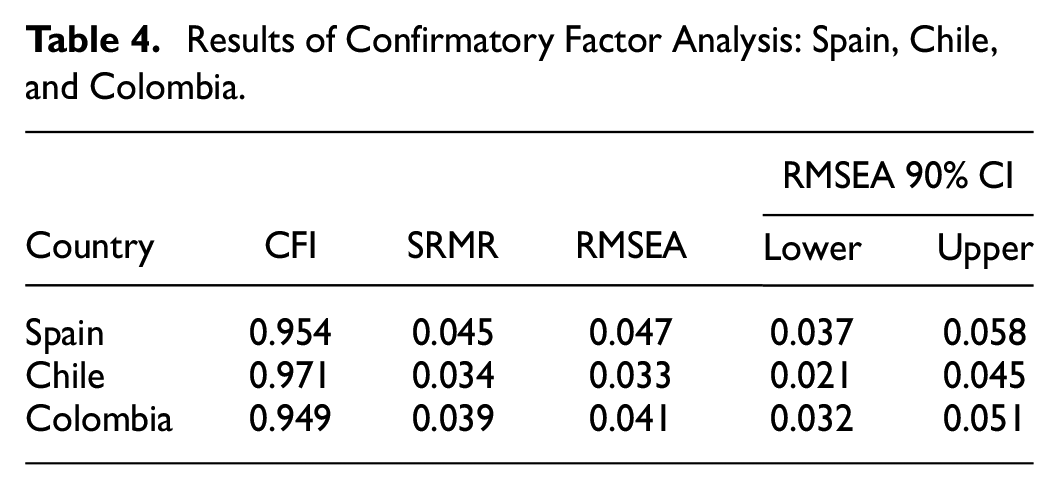
The outcomes of the CFA are uniformly positive across all indicators. This consistency is evidenced by each of the evaluative indices—RMSEA, SRMR, and CFI—underscoring a robust model fit.
The standardized factor loadings of the items on the dimensions of the scale under study are presented in Table 5. Statistically significant factor loads were observed in the three samples p < .001). Positive correlations are observed between the dimensions of the scale in the three samples analyzed (Spain, .19, p < .001; Chile, .16, p < .001; Colombia, .16, p < .001).
Standardized Factor Loadings: Spain, Chile, and Colombia.

Factorial Invariance
In this section, we conducted a detailed examination of factorial invariance across three distinct populations. More specifically, our analysis began with an assessment of configural invariance to evaluate the model’s fit across the Spanish, Chilean, and Colombian cohorts without imposing any constraints. Subsequently, we probed weak or metric invariance, determining whether the model’s fit remained satisfactory when, in addition to cross-group model equivalence, the factor loadings were equated. In the third phase, we scrutinized the attainment of strong invariance; here, while upholding the conditions established in the preceding stages, we imposed constraints on the intercepts. Our progressive evaluation ended with an examination of the fit at the level of strict invariance, where we applied an additional constraint to the residuals.
To assess the fit of the models, we focused on the changes in the Comparative Fit Index (CFI) and the Root Mean Square Error of Approximation (RMSEA). We considered the scales to be equivalent or invariant when the nested models exhibit differences of .01 or less in CFI (Cheung & Rensvold, 2002) and less than .015 in RMSEA (Chen, 2007). The obtained results are displayed in Table 6.
Factorial Invariance Results Across Spanish, Chilean, and Colombian Samples.

In conclusion, the findings demonstrate that the scale under study achieves residual invariance across the three analyzed samples, Spanish, Chilean, and Colombian, confirming its robustness and consistency in these diverse contexts.
Internal Consistency
The assessment of internal consistency for the Spanish version of the OUS scale was conducted through the calculation of Cronbach’s alpha and McDonald’s omega for each subscale. The results are detailed in Table 7.
Reliability Coefficients for the Analyzed Scale and Its Subscales.
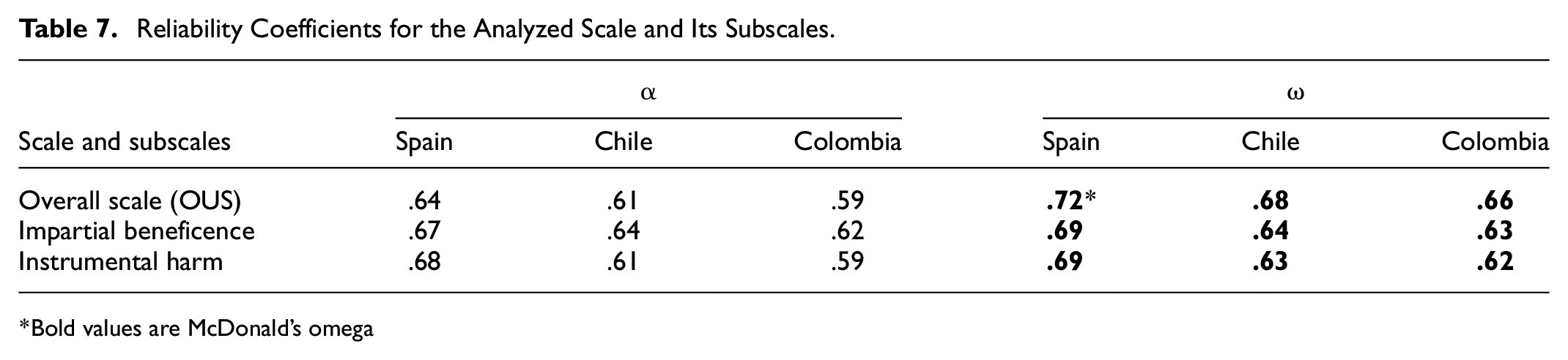
Bold values are McDonald’s omega
Gender and Country
To analyze the effect of the country’s interaction with gender, a between-groups 3 × 2 multivariate factorial analysis of variance (MANOVA) was applied, with the factors being country (Spain, Chile, and Colombia) and gender (male and female, n = 3,415). The results of the MANOVA show that there is no interaction effect between country and gender, Λ (Wilks’ Lambda) = .998, F (4, 6816) = 1.29, p = .271, η2 = .001. The main effects of the country (Λ, Wilks’ Lambda = .972, F (4, 6816) = 24.24, p < .001, η2 = .014) and the gender (Λ, Wilks’ Lambda = .984, F (2, 3408) = 34.56, p < .001, η2 = .16) are statistically significant. Previously, a MANCOVA design was carried out using the age variable as a covariate and the results did not change substantively with regard to those obtained with the MANOVA.
In terms of the main effect of the gender variable, it is observed that the effect is statistically significant for the Impartial Beneficence (F (1, 3409) = 20.91, p < .001, d = 0.164, 95% CI [0.092, 0.236]) and Instrumental Harm variables (F (1, 3409) = 28.91, p < .001, d = 0.221, 95% CI [0.149, 0.293]). Specifically, women obtain higher scores (Mean = 22.47, SD = 6.25, n = 2,317) than men (Mean = 21.44, SD = 6.35, n = 1,098) on the Impartial Beneficence variable. On the other hand, in the Instrumental Harm variable, men obtain higher scores (Mean = 12.84, SD = 5.62) than women (Mean = 11.67, SD = 5.14). The magnitude of the effect size of the differences between men and women is greater in the Instrumental harm variable.
The analysis by country indicates that the main effect is statistically significant in the variables of Impartial Beneficence (F (2, 3409) = 9.43, p < .001, η2 = .006) and Instrumental Harm (F (2, 3409) = 39.10, p < .001, η2 = .022). The results for the comparisons of pairs of means for country on each of the measured variables can be found in Table 8. It is observed that the largest effect size corresponds to the scores of the Instrumental Harm variable where Chile obtains the lowest score compared to Spain (d = 0.327) and Colombia (d = 0.436).
Main Effect of Country of Residence. Means, Standard Deviations, Comparisons, and Effect Size (95% CI).

Note. *Comparisons. **Bonferroni-adjusted p-values. Spain: 1, Chile: 2, Colombia: 3.
Relationships Between Variables
The results indicate that the relationship profile of the two OUS subscales is different. Specifically, it is observed that the Impartial Beneficence dimension is directly related to the variables of concern about the coronavirus and perception of threat from COVID-19 (personal and global). The magnitudes of the relationships are small, but statistically significant. On the other hand, the relationships between the Instrumental Harm dimension and these variables are not statistically significant. It is worth noting that the profile of the results is replicated in the three countries. Regarding the age variable, our findings with the adult sample indicate that in Spain and Chile there is a direct relationship with the Impartial Beneficence variable, but it is inverse when it comes to Instrumental Harm. The magnitude of the relationship between the two subscales is low and statistically significant (r = .107) (Table 9).
Correlations Between OUS-IB, OUS-IH, Total OUS, Age, and COVID-19 Variables.

Bold values are statistically significant.
Note. Confidence Interval [CI]: 95%. Bonferroni-adjusted p-values: p ≤ .001.
Discussion
This study examined the psychometric properties of the first Spanish adaptation of the Oxford Utilitarianism Scale (OUS; Kahane et al., 2018). The study was conducted simultaneously in Spain, Chile, and Colombia with adult participants during the early months of the COVID-19 pandemic. This research contributes to the literature by demonstrating the invariance of the scale’s scores and the robustness of the two-dimensional model of utilitarianism across these three countries.
The results of the confirmatory factor analysis support the two-dimensional model of utilitarianism (2D model) proposed by Kahane et al. (2018), providing evidence for the distinct psychological profiles represented by the two subscales: Impartial Beneficence (IB) and Instrumental Harm (IH). Specifically, the Impartial Beneficence subscale was positively correlated with general concern about the coronavirus and perceptions of personal and global threat during the pandemic. These findings suggest a link between impartial beneficence and empathy toward others, both on a personal and global scale. In contrast, no such relationships were observed for the Instrumental Harm subscale, underscoring the divergent validity between the two dimensions. Although the effect sizes were small, our results align with existing literature (Kahane et al., 2018), confirming that the two subscales represent distinct constructs. Regarding studies conducted during the COVID-19 pandemic, Schiffer et al. (2021) indicate that individuals reported engaging in more virus-mitigation efforts to protect their families rather than themselves. Similarly, Borhany et al. (2023) emphasize concerns about family members contracting the virus. Jin et al. (2021) further highlight the importance individuals place on maximizing overall benefits, with a preference for prioritizing the young (over the elderly) and patients with higher chances of survival.
The internal consistency estimates in our study were comparable to those reported in previous research. For example, Carron et al. (2023) found acceptable internal consistency (α = .64 for the total score, α = .67 for IB, and α = .73 for IH). In the adaptation study by Erzi (2019), the OUS-total had an internal consistency coefficient of .70, Instrumental Harm = .74, and Impartial Beneficence = 75. In the research by Everett et al. (2018) a value of α = .70 was obtained for Impartial Beneficence and α = .78 (ω = .71) for Instrumental Harm. The results of the study by Paruzel-Czachura and Charzyńska (2022) are also similar, as they were α = .68 (ω = .69) for the Impartial Beneficence subscale and α = .71 (ω = .71) for the Instrumental Harm dimension. And in the study by Francis and McNabb (2022), carried out during the COVID-19 pandemic, the internal consistency of the Impartial Beneficence was α = .73 and α = .61 for Instrumental Harm. In the work of Park et al. (2024), also developed during COVID-19, the results were α = .60 for the Impartial Beneficence subscale and α = .75 for Instrumental Harm. It is observed that the internal consistency values revolve around the values of .60 to .75, and these values can be considered acceptable if we take into account the high abstraction of the wording of its items and that they are scales with four and five items. Additionally, discrimination indices (item-total correlations) exceeded .30 in all cases, except for one item in Chile and Colombia, indicating strong item validity. Future research should continue to explore internal consistency in diverse contexts and populations.
Regarding the gender variable, our findings support the presence of gender-based differences in moral decision-making, consistent with previous literature (Mestre et al., 2009). Specifically, women scored higher on the Impartial Beneficence subscale, while men scored higher on the Instrumental Harm subscale. These differences were replicated across all three samples. The heightened emotional and empathic responses of women during the early stages of the pandemic may have contributed to this pattern, while men’s greater tendency toward rational decision-making may have influenced their higher scores on instrumental harm. These results underscore the importance of considering gender in future studies of moral psychology and utilitarian decision-making, as gender-based differences may influence how individuals respond to moral dilemmas.
The relationship between age and utilitarian decision-making in our study deviated from the typical pattern reported in the literature, where utilitarianism tends to decrease with age. For example, in the study by Kahane et al. (2018), the impartial maximization of the greater good (impartial beneficence) is more frequent among younger adolescents than in adolescents closer to adulthood. In contrast, older adults in Spain and Chile scored higher on Impartial Beneficence and lower on Instrumental Harm compared to younger adults. Given that our study was conducted during a period of heightened uncertainty and emotional distress due to the COVID-19 pandemic, it is possible that the crisis context influenced moral reasoning across different age groups. The pandemic may have prompted individuals, particularly older adults, to prioritize the collective well-being of others over self-interest (Haidt, 2001). Further research is needed to explore the influence of age on utilitarian decision-making in high-stress contexts, such as during natural disasters or other crises. As Thangaraju and Velmurugan (2023) point out in their systematic review on ethical challenges at the time of the COVID-19, the key is to recognize our own biases and be aware of how our actions influence others.
Our results revealed cultural differences in moral decision-making across the three countries. Notably, Chilean participants scored significantly lower on Instrumental Harm, which may reflect the country’s strong tradition of solidarity and collective action, particularly in response to natural disasters (Sepúlveda & Moreno, 2022). Additionally, both Chile and Colombia scored higher on Impartial Beneficence compared to Spain, which may be attributed to the collectivist cultural orientation prevalent in many South American societies (Berríos-Riquelme et al., 2021) and with training focused on the social aspects of this type of collectivist cultures (Oyserman et al., 2002). These findings are consistent with the notion that moral values are shaped by cultural contexts, and they highlight the need for cross-cultural studies to further investigate how culture influences utilitarian decision-making. Future research should examine whether these cultural differences persist across various social contexts and over time.
Limitations and Future Directions
While this study makes important contributions, it also has several limitations. First, the research was conducted during the early stages of the COVID-19 pandemic, a time of extreme uncertainty and social upheaval. This context may have influenced participants’ moral reasoning, as pandemics often heightened concerns about survival and well-being. It has been proven that during the pandemic there was a lower utilitarian willingness to violate personal rights compared to previous contexts (Antoniou et al., 2021). Although some studies have shown that the pandemic did not significantly alter moral judgments (Francis & McNabb, 2022), it is possible that the emotional context of the pandemic affected participants’ decisions in ways that differ from typical moral dilemmas. Perhaps, the results we obtained with the age variable and its distinct profile with the Impartial Beneficence and Instrumental Harm subscales could be influenced by the real-world crisis and ethical challenges. Furthermore, although all age groups can become infected by COVID-19, individuals over 65 years face more risks of developing severe illness, especially due to cumulative health conditions that are likely to come with aging (European Centre for Disease Prevention and Control, 2020). Additionally, our study used a convenience sample, which limits the generalizability of the findings and could introduce bias. Future research should employ random sampling to ensure broader representativeness and mitigate selection bias. Lastly, the cross-sectional nature of the study limits causal inferences. Longitudinal or experimental designs would be valuable for exploring the dynamics of utilitarian decision-making over time.
Conclusion
This study provides the first Spanish adaptation of the Oxford Utilitarianism Scale (OUS) and offers valuable insights into moral decision-making in the context of the COVID-19 pandemic. The results confirm that the Spanish version of the OUS closely matches the original scale, supporting the theoretical and empirical validity of the two-dimensional model of utilitarianism. Our findings underscore the utility of the OUS-Spa as a reliable tool for studying moral psychology in Spanish-speaking populations. Given its sound psychometric properties, we recommend the use of the OUS-Spa in future research on moral decision-making, particularly in situations of high uncertainty and moral dilemmas.
Footnotes
Acknowledgements
Our thanks to all the participants who collaborated with our study.
Declaration of Conflicting Interests
The author(s) declared no potential conflicts of interest with respect to the research, authorship, and/or publication of this article.
Funding
The author(s) received no financial support for the research, authorship, and/or publication of this article.
Ethical Approval and Informed Consent Statements
Yes. The research was approved by the Ethics Committee of the University of Tarapacá (Chile; Document: N°13/2020). Participants were also informed that their data would be processed anonymously, and that they had the right to withdraw from the study at any time. Participants were informed of the confidentiality of the data.
