




Abstract
A key performance variable for entrepreneurs’ success is their satisfaction with their startup. However, there is limited research identifying the path to entrepreneurial satisfaction and even less research suggesting the enhancement of entrepreneurial success. Our study investigates self-leadership’s role in increasing self-efficacy and entrepreneurial satisfaction levels. To achieve this, we independently used behavior awareness and volition, task motivation, and constructive cognition—three sub-variables of self-leadership—as predictors and self-efficacy as a mediator. We tested the customer interactor mode for its role as a moderator in the relationship between self-efficacy and the final dependent, entrepreneurial satisfaction. Our results indicate that all self-leadership variables are positively related to self-efficacy. Also, self-efficacy predicts entrepreneurial satisfaction. However, the influence of task motivation on self-efficacy is only marginal, and different modes of customer interaction do not influence self-efficacy’s impact on satisfaction.
Plain language summary
Self-leadership involves self-controlling behavioral and cognitive strategies that build entrepreneurs’ motivations, enhance performances, and achieve goals. Our research investigates whether self-leadership brings self-efficacy, a belief in one’s capability, and whether self-efficacy influences entrepreneurs’ satisfaction. The study was conducted with South Korean entrepreneurs in small and medium-sized enterprises.
Keywords
Introduction
Small and medium-sized enterprises (SMEs) bolster the labor market and serve as hubs for innovation and entrepreneurial aspirations in South Korea. In 2021, over 99.9% of operational businesses in South Korea fell into the category of SME, contributing to 81% of the labor market (Park, 2023). In the years around 2020, compared with statistics from other countries, over 96.5% of firms in South Korea, the United States, Canada, Australia, Taiwan, and Japan were SMEs. Among these, SMEs in the United States employ nearly 42.6% of the workforce, while South Korea and Taiwan provide jobs for around 72%. The employment rates in the remaining countries range from 66.4% to 68% (KBIZ Korea Federation of SMEs, 2022). However, the fifth-year survival rate of new businesses in South Korea is 33.8% compared with the Organization for Economic Co-operation and Development (OECD) average of 45.4%. These statistics indicate that enhancing the survival rate of new SMEs could significantly bolster the South Korean job market and economy.
Scholars have extensively studied entrepreneurship. For example, Khan (2021) highlighted that Elon Musk, a successful entrepreneur, possesses entrepreneurial and conventional leadership. In another study, Khan et al. (2022) focused on women entrepreneurs entering small business organizations to construct an entry model specifically for retail-based women entrepreneurship. Entrepreneurs are those who identify meaningful and actionable goals and then proceed to execute plans for establishing their businesses. Entrepreneurs must also sustain themselves by continually being motivated to achieve these goals. Self-leadership involves entrepreneurs setting goals, finding value in keeping the goals and controlling their behaviors (Manz, 1986; Manz & Neck, 1999). However, self-leadership remains underexplored in the context of entrepreneurship research. Godwin et al. (2016) proposed a model where self-leadership helps entrepreneurs manage their stress through self-efficacy, positively impacting firm performance and satisfaction with the venture. According to Goldsby et al. (2021), only seven peer-reviewed research papers discussed self-leadership within the context of psychological empowerment and satisfaction, while three papers explored self-leadership within the entrepreneurship domain.
Bandura (2006) defines self-leadership as the confidence to manage and operate a business effectively, even in difficult situations, and the current research explores how self-leadership affects entrepreneurial self-efficacy within the context of SMEs. Self-efficacy is an important variable bringing enhanced task performance (Barling & Beattie, 1983; Lee & Gillen, 1989; Mathieu et al., 1993), innovative work behavior (Bagheri et al., 2022; Sarwoko, 2020), an internal drive for entrepreneurial activities, superior performance in organizational innovation, and better financial performance (Newman et al., 2019). Bandura (2006) hinted at how self-efficacy impacts one’s motivations, behaviors, and experiences to bring eagerness and energy to achieve goals. However, our search revealed no studies examining the link between entrepreneurs’ self-leadership and self-efficacy. Thus, exploring this uncharted relationship could significantly enhance research on self-leadership.
Finally, this research contributes to enhancing entrepreneurs’ satisfaction. Self-leadership research potentially deepens the understanding of successful entrepreneurs and helps cultivate a positive environment for their businesses to thrive. Entrepreneurs grapple with aligning their life goals and aspirations with environmental constraints. Fulfilling entrepreneurs’ goals and achieving success brings them satisfaction in their entrepreneurial endeavors. Entrepreneurs’ satisfaction is an important measure of entrepreneurial success and a core determinant of venture survival (Carree & Verheul, 2012). Entrepreneurs’ satisfaction encompasses various dimensions, including life goals, personal development, and the mastery of their environment (Binder & Coad, 2016).
This research explores how customer interaction moderates the relationship between self-efficacy and entrepreneurs’ satisfaction within the hypothesized framework. The COVID-19 pandemic brought about significant consumer behavior and business operation shifts, necessitating new customer engagement and service delivery approaches. The modes of customer interaction include face-to-face (F2F), hybrid, and online interactions, delineating how entrepreneurs engage and communicate with customers. An interaction mode enabling social interaction can boost communicators’ well-being indicators such as mental health, psychological safety, interpersonal trust, positive emotion, and openness to others (Reis et al., 2022). Also, higher social interaction brings life satisfaction, an important dimension of subjective well-being as a final dependent variable (Merolla et al., 2024). The choice of mode can potentially affect the entrepreneurial process. For example, entrepreneurs can promptly respond to real-time customer feedback and establish strong connections with their customers using a business model that employs an F2F interaction mode. These robust ties with customers may result in heightened entrepreneurial satisfaction. Notably, many businesses had to shift their customer interaction modes during the pandemic. This study hypothesizes that using communication methods that offer less social interaction weakens the relationship between self-efficacy and entrepreneurial job satisfaction.
Conversely, a digital platform serving as the primary avenue for customer engagement is an example of a business model characterized by an online interaction mode, providing the opportunity to reach a more extensive customer base. However, effectively addressing customers’ immediate demands could pose challenges. Consequently, we anticipate that the mode of customer interaction acts as a moderator, influencing how self-efficacy relates to entrepreneurial satisfaction and thereby shaping an individual’s overall entrepreneurial satisfaction. Thus, this study examines whether these interaction modes influence the relationship between self-efficacy and the entrepreneur’s satisfaction in different ways.
The entrepreneurial spirit drives innovative performance and a strong determination to innovate within SMEs (K.-C. Kim, 2019). However, South Korean entrepreneurs’ spirits have diminished over the years. According to the Global Entrepreneurship Development Index (GEDI), which compares countries based on entrepreneurial attitudes, resources, and infrastructure, South Korea’s ranking has dropped from second in the world in 2000 to 24th among 138 countries in 2018 (GEDI.org, 2019). Enhancing the entrepreneurial spirit among South Korean SMEs is key to boosting South Korean SMEs’ innovativeness and performance (K.-C. Kim, 2019); investigating new approaches might be needed to help South Korean SMEs thrive again. While entrepreneurship research has explored diverse dimensions, including entrepreneurial leadership (Khan, 2021) and women entrepreneurship (Khan et al., 2022), the role of self-leadership in enhancing self-efficacy among entrepreneurs remains largely unaddressed within entrepreneurship, particularly in South Korea. The present study addresses this gap by surveying South Korean SME entrepreneurs who had been in business for less than 7 years as of 2021.
According to Manz (1986), the foremost aim of self-leadership should be enhanced performance. The current research seeks to determine whether self-leadership dimensions help enhance (1) self-efficacy, an important self-belief of entrepreneurs, and (2) entrepreneurs’ satisfaction with their entrepreneurial activities as a final dependent, with self-efficacy mediating between self-leadership and entrepreneurial satisfaction. Also, we examined how the mode of customer interaction affects the relationship between self-efficacy and job satisfaction, particularly because we surveyed during the pandemic lockdown period. This study analyzes self-leadership’s critical role in determining entrepreneurs’ satisfaction. Thus, this research could help enhance entrepreneurial self-actualization, foster a sense of accomplishment, and improve the quality of life for entrepreneurs.
Literature Review
Self-leadership
Thought self-leadership shapes behavior by manipulating the environment and cognitive processes to reach desired goals (Neck & Manz, 1992). It draws from multiple theories, including reinforcement, social learning, and constructive thought pattern theories. Reinforcement theory explains how the environment can influence a person’s behavior. This environment includes intrinsic and extrinsic rewards for performing and reinforcing positive behavior (Neck & Houghton, 2006). Manz and Sims (1980) adopted social learning theory to explain how environments can influence behavior through cognitive processes. Self-regulating cognitions can result in positive individual behavior and performance. Constructive thought pattern theory explains the role of cognitive thought patterns and reinforcement in positive behavioral outcomes. When individuals set and keep track of goals and tasks, they can meet them by utilizing cognitive thought patterns and reinforcements (Georgianna, 2007; Markham & Markham, 1995). Therefore, basic theories behind self-leadership place individuals as the central influencers of what behavior occurs and how it unfolds.
The primary significance of thought self-leadership lies in recognizing an individual’s self-control system’s superiority over an organizational control system due to its viability, applicability, and reality (Manz, 1986). Instead of relying on an organization’s values, structures, standards, rewards, and reinforcement systems, Manz (1986) suggested utilizing individuals’ self-control systems. An individual’s naturally formed motivation, values, beliefs, scripts, and programs influence their self-control system. The sequence of control starts with self-standards, leading to behavior, self-evaluation, and then self-administered consequences. When there are no external controls, individuals operate a self-management system, choosing to engage in less attractive but more socially desirable behaviors.
There are many dimensions of self-leadership categorization, including various self-management strategies. However, these strategies comprise three self-leadership categories: behavior awareness and volition, task motivation, and constructive cognition (Crayne & Brawley Newlin, 2023; Houghton et al., 2012; Houghton & Neck, 2002). Therefore, these three normative categories dictate how leaders should act when setting goals and standards, how to keep motivation high with appropriate reinforcements, and how to use cognitive techniques to reach goals according to the standards.
Self-leader qualities are essential for entrepreneurs as self-leadership enables leaders to achieve the self-motivation and self-direction needed to behave desirably (Manz & Neck, 1999). Entrepreneurs can learn strategies and morph behaviors, adopt positive perceptions, and establish desirable thought patterns to self-manage, self-motivate, and self-regulate (Prussia et al., 1998). Therefore, leaders can improve performance using behavior awareness, volition, task motivation, and constructive cognition strategies.
Self-efficacy
Self-efficacy is “the extent to which an individual believes him or herself capable of successfully performing a specific behavior” (Bandura, 1986). Self-efficacy for entrepreneurs can be their belief in the successful pursuit of a career and the required tasks (C. C. Chen et al., 1998; Newman et al., 2019). We can understand entrepreneurs’ actions and action-related beliefs through the lens of self-efficacy (Newman et al., 2019). In other words, self-efficacy is essential for company founders to create new businesses (Markman et al., 2002; Zhao et al., 2005).
There are many subsequent outcomes to self-efficacy. Empirical research has indicated that entrepreneurial self-efficacy can positively increase the internal drive for entrepreneurial activities and enable challenging goal-setting and quick recovery from failures (Bandura, 1997). Interestingly, self-efficacy is more critical for young firms’ performance but this influence dissipates over 5 years (McGee & Peterson, 2019). Self-efficacy also influences a firm’s innovative behavior, an important outcome of entrepreneur creativity (Ahlin et al., 2014; Y. Chen & Zhou, 2017). These self-efficacy outcomes are critical for new ventures regarding their performance and survival. A person with high self-efficacy can draw from cognitive resources to plan the actions necessary for a successful outcome (Yousaf et al., 2021). Self-efficacy motivates entrepreneurs to pursue their goals by tackling business environment uncertainty through preparation, tenacity, and hard work (Bandura, 2006). Individuals with an elevated level of entrepreneurial self-efficacy show significant efforts for a longer period, endure setbacks, and produce effective plans and strategies (Hassan et al., 2020).
In social cognitive theory, Bandura (1986) presented a cognitive model showing the triadic reciprocal relationships between people, the environment, and behavior. Personal influence within the model describes cognitive and motivational variables, such as students’ learning and work environments, as influencing behaviors. A socially encouraging or physically equipped environment could promote self-efficacy and provide better behavioral outcomes for the intended tasks. Positive achievement can influence cognitive variables, such as self-efficacy, and a person can change their environment using these cognitive variables. Self-efficacy can create a supportive environment and positive behavioral outcomes. Utilizing the cognitive model, Bandura found self-efficacy and self-regulation to promote better learning and achievements among students, where self-regulation is also an aspect of self-leadership. Therefore, there seems to be a close relationship between self-efficacy and self-leadership at the theory level.
Entrepreneurial Satisfaction
Job satisfaction results from individuals’ interactions with organizations and environments (Wang & Brower, 2019). Job satisfaction is a positive emotional state derived from appraising one’s job or job experience (Locke, 1976). A study by Georgianna et al. (2016) examined the connection between self-leadership and job satisfaction, revealing positive correlations. The satisfaction derived from developing a new company could be related to the intention to continue working within that company. The connection between job satisfaction and commitment becomes clearer when noting that employees’ intentions to leave directly connect to their overall job satisfaction (Cole & Castro, 2023; Faliza et al., 2023). This relationship holds in general job settings and the context of entrepreneurs.
Research Model
Figure 1 illustrates the proposed research model, wherein self-leadership, encompassing behavior awareness and volition, task motivation, and constructive cognition, influences self-efficacy, which impacts startup satisfaction. This study examines their direct effects on self-efficacy and indirect effects on startup satisfaction.

Proposed research model.
Self-leadership comprises three main strategies: behavior-focused, natural reward-focused, and constructive thought pattern strategies (Houghton & Neck, 2002; Houghton & Yoho, 2005). Houghton et al. (2012) redefined traditional self-leadership strategies as behavior awareness and volition, task motivation, and constructive cognition based on the modifications proposed by Georgianna (2007). For example, in a study of employees working in an automotive company in Turkey, Şahin (2015) found a relationship between employees’ general self-leadership, general self-efficacy, and performance. Similarly, self-leadership builds normative commitment, a belief to meet expected demands, and work performance (Inam et al., 2023). According to Georgianna (2007), self-leadership strategies positively impact self-efficacy, as substantiated by numerous empirical studies (Andressen et al., 2012; Ganesh et al., 2019; Ho & Nesbit, 2009; Neck & Houghton, 2006; Prussia et al., 1998).
Self-awareness is crucial in augmenting leadership capabilities, as leaders must ascertain whether they can effectively address challenging situations (Sommerlatte, 2023). Moreover, volitional strategies create concrete intentions to implement a desired behavior (Georgianna, 2007), which are essential for implementing self-leadership in place of managerial leadership (Manz & Sims, 1980) and for self-setting and self-controlling goals (Manz, 1986). Volition is essential for leaders, implying they are willing to sacrifice for the greater good by setting aside personal interests, rights, and privileges (Yang et al., 2023). Additionally, volitional strategies such as tracking goals in a daily journal helped medical students achieve their academic goals (Breitwieser et al., 2021).
High self-awareness is associated with confidence, interest, and excitement, producing better, longer, and more creative outcomes (Ryan & Deci, 2000). In an educational setting, reflective thinking and the self-monitoring of emotions promote volition (Grothérus et al., 2019. Furthermore, Rice (2014) examined the relationship between self-leadership and self-efficacy of U.S. employees, revealing that behavior awareness and volition were predictors of self-efficacy. Based on the above discussion, we propose the following hypothesis regarding the relationship between behavior awareness, volition, and self-efficacy:
H1 Behavior awareness and volition positively impact entrepreneurial self-efficacy.
Task motivation strategies include setting smaller and more immediate goals, utilizing self-rewards, and finding a silver lining within unpleasant tasks (Deci et al., 1999; Deci & Ryan, 1985). Natural rewards have a potent influence akin to the effects of drugs (T. E. Brown & Sorg, 2023). The natural reward strategy involves experiencing intrinsic satisfaction when focusing on the positive aspects of a task rather than the negative ones (Harari et al., 2021), fostering a sense of competence, self-control, and purpose.
Moreover, a study by Rice (2014) found that self-efficacy positively correlated with task motivation. Motivational strategies encompass behavior-focused and constructive thought process dimensions (Ganesh et al., 2019). A combination of rewards and consequences can influence behavior. Conversely, appropriate punishments can deter negative behaviors to prevent their recurrence. Thus, motivational strategies improve individual performance (Elliot, 2005; Manz & Neck, 1999). Building upon the preceding discussion, we propose the following hypothesis:
H2 Task motivation positively impacts entrepreneurial self-efficacy.
Constructive cognition strategies build and reshape mental processes. Cognitive strategies include mental imagination, rehearsing a desired performance, improving beliefs and assumptions, and self-talk. Cognitive thought patterns can influence performance outcomes. Cognitive strategies such as mental imagery and self-talk positively increase psychological empowerment (Neck & Manz, 2006). Furthermore, cognitive visualization and vicarious learning capabilities enhance self-efficacy in performance abilities, and self-efficacy mediates the influence of self-leadership on positive performance outcomes (Harari et al., 2021), including health-protective behaviors (Maykrantz et al., 2021). Rice (2014) explored the connections between self-leadership and self-efficacy among U.S. employees, identifying constructive cognition as a predictor of self-efficacy. Psychological skill training, including goal-setting, positive self-talk, and imagery, significantly impact self-confidence among volleyball players (Heydari et al., 2018). Thus, drawing from these references, we propose the following hypothesis:
H3 Constructive cognition positively impacts entrepreneurial self-efficacy.
In this study, we introduce the following hypotheses to explore the direct effects of self-leadership on entrepreneurial satisfaction. These additional hypotheses are critical for a deeper understanding of how the components of self-leadership influence entrepreneurial satisfaction through the mediation of entrepreneurial self-efficacy. By examining the direct impacts of self-leadership on entrepreneurial satisfaction through these additional hypotheses, we anticipate providing further evidence to strengthen the mediating role of entrepreneurial self-efficacy.
Specifically, H1a anticipates a direct positive effect of behavioral awareness and volition on entrepreneurial satisfaction, suggesting ways self-leadership can directly enhance individuals’ sense of achievement and satisfaction. H2a and H3a explore the direct impacts of task motivation and constructive cognition on entrepreneurial satisfaction, respectively, illustrating how these elements of self-leadership contribute to various aspects of entrepreneurial spirit. Should our analysis reject these hypotheses as expected, it would affirm the significant mediating variable of entrepreneurial self-efficacy between self-leadership and entrepreneurial satisfaction. This research approach reevaluates the role of self-leadership in entrepreneurship studies and provides practical insights into how entrepreneurs can enhance their satisfaction by boosting their self-efficacy.
H1a Behavior awareness and volition positively impact entrepreneurial satisfaction.
H2a Task motivation positively impacts entrepreneurial satisfaction.
H3a Constructive cognition positively impacts entrepreneurial satisfaction.
The role of self-efficacy in employee satisfaction is less studied, but several research papers have found the relevance of self-efficacy regarding satisfaction. Within the learning environment, self-efficacy increases learners’ satisfaction with educational materials, learning processes, learning institutions, and majors. For example, Prifti (2022) examined the effects of blended learning on economic majors’ satisfaction, revealing a positive relationship between self-efficacy and satisfaction. Additionally, D. J. Kim and Lee (2014) found that nursing students’ ego-resilience and self-efficacy can influence their satisfaction with their major. During the coronavirus pandemic, Aldhahi et al. (2022) found online learning self-efficacy in remote learning, time management, and technology influenced e-learning satisfaction. This finding demonstrates that domain-specific self-efficacy can enhance a specific form of satisfaction.
Furthermore, self-efficacy can improve job satisfaction, work perception, and task performance among public officers (Machmud, 2018). Meng (2022) found that self-efficacy mediates the relationship between autonomy/competence satisfaction and job satisfaction among Chinese university teachers, leading to life satisfaction. Entrepreneurial self-efficacy is crucial in motivating individuals to venture into new business creation. Within this context, Prussia et al. (1998) examined the mediating effects of self-efficacy on the relationship between self-leadership and performance. Additionally, it considerably influences a firm’s innovative behavior, impacting the performance and survival of new ventures. Given this study’s focus on startups, assessing firm performance regarding entrepreneurial satisfaction is more reasonable than traditional financial metrics like net profit or sales revenue (Rauch et al., 2009). This approach is because primarily measuring financial indicators like net profit within a short time after establishment, such as in the case of startups, poses challenges. Therefore, given the above discussion, we propose the following hypothesis regarding the relationship between entrepreneurial self-efficacy and startup satisfaction:
H4 Entrepreneurial self-efficacy positively impacts startup satisfaction.
Technological progress is spurring businesses to adopt untact (contactless) models swiftly, creating greater dependence on interactions outside F2F settings—the recent pandemic disrupted the conventional ways of conducting business. Even service sectors innovated virtual or remote services to mitigate the spread of COVID-19 (Shanbehzadeh et al., 2021). These practices have persisted as the new norm even beyond the pandemic. Entrepreneurs now often run businesses with minimal staff. According to Forbes Advisor (Main & Bottorff, 2022), 99.9% of U.S. businesses are small, with 8 out of 10 having no employees. This statistic means new entrepreneurs mainly interact directly with customers, and limited business-related social ties can negatively impact their mood and increase withdrawal tendencies during economic stress (Pollack et al., 2012). This finding shows that the level of interaction mode can work as a moderator and, alongside self-efficacy, may influence entrepreneurial satisfaction.
To investigate this further, we examine different modes of customer interaction to explore the moderating effect based on the Media Richness Theory proposed by Daft and Lengel (1984), which explains the optimal utilization of communication modes across different circumstances (Daft & Lengel, 1984, 1986). During the pandemic, the field of education has seen numerous studies examining the quality of instructional services in F2F and non-F2F settings. Some researchers show positive effects regardless of the mode of instruction (Lin & Shek, 2021), whereas others have reported varying results (Cho & Kim, 2021). Furthermore, some studies show the impact on consumers’ usage intention varies depending on the type of untact service (Liu et al., 2023). However, there is limited research comparing the influence of self-efficacy on business performance between F2F and non-F2F business domains. We bridge this gap with our final hypothesis, which examines the role of interaction modes—whether untact or contact-based—as moderators of the relationship between self-efficacy and entrepreneurial satisfaction. We expect this role to differ among entrepreneurs, depending on their mode of interaction. Specifically, we propose that the F2F interaction positively moderates the relationship between self-efficacy and entrepreneurial satisfaction. Therefore, our hypothesis for examining the moderating effect of interaction modes is as follows:
H5 Self-efficacy has a more significant impact on entrepreneurial satisfaction in face-to-face customer interactions than virtual ones.
Methodology
Data Collection
The population of interest was venture firms located in a metropolitan city in South Korea. In 2021, we distributed 1,257 questionnaires, of which participants returned 808. After removing poorly completed responses, we used 712 for analysis. Table 1 reports the characteristics of participating firms and their entrepreneurs. The response rate was 56.6%, and 553 entrepreneurs were male (77.67%) and 159 were female (22.33%). Of the firms, 417 were in manufacturing (58.57%) and 295 were service firms (41.43%).
Characteristics of Responding Startups and Entrepreneurs.

Note: N = 712.
Questionnaire Development
We developed the questionnaire using three sub-variables: self-leadership, entrepreneurial self-efficacy, and startup satisfaction. Self-leadership utilizes the three sub-variables: awareness and volition, task motivation, and constructive cognitions. As the original definitions only covered strategies and tactics, the current research defined the sub-variables based on previous literature (K. W. Brown & Ryan, 2003; Georgianna, 2007; Manz & Sims, 1980, 1991; Orbell & Sheeran, 2000; Stewart et al., 1996).
We defined the awareness and volition variable as “having clear strategies to consistently and systematically overserving one’s behavior some time and having a firm volition to pursue a goal” based on previous studies (Georgianna, 2007; Manz & Sims, 1980). We defined the task motivational strategies variable as “knowing how to accomplish smaller and more visible goals, utilizing self-rewards, and motivating oneself for unpleasant tasks” based on definitions from existing research (Deci et al., 1999; Deci & Ryan, 1985). This study uses existing literature to define constructive cognition as “utilizing mental techniques such as imagination, self-talk, and belief, to achieve higher mental performance, job satisfaction, success expectations, and positive thought patterns” (Manz, 1986; Markham & Markham, 1995; Neck & Manz, 1996, 2006).
The current research borrows from Bandura (1997) to define self-efficacy as “beliefs entrepreneurs have in their capabilities to organize and execute the courses of action required to produce given attainments” (p. 3). We used four questions in our research based on self-efficacy question items from Shaheen and Krishnankutty (2018). Further, regarding entrepreneurial satisfaction, an entrepreneur is satisfied if “they have a preference to continue in self-employment as opposed to switching back to paid employment if the latter became a viable option” (Kautonen & Palmroos, 2010). We adopted Cooper and Artz’s (1995) scale to test entrepreneurs’ satisfaction with their performance, overall satisfaction, and initial startup intentions; we also used several items from Cooper and Artz (1995).
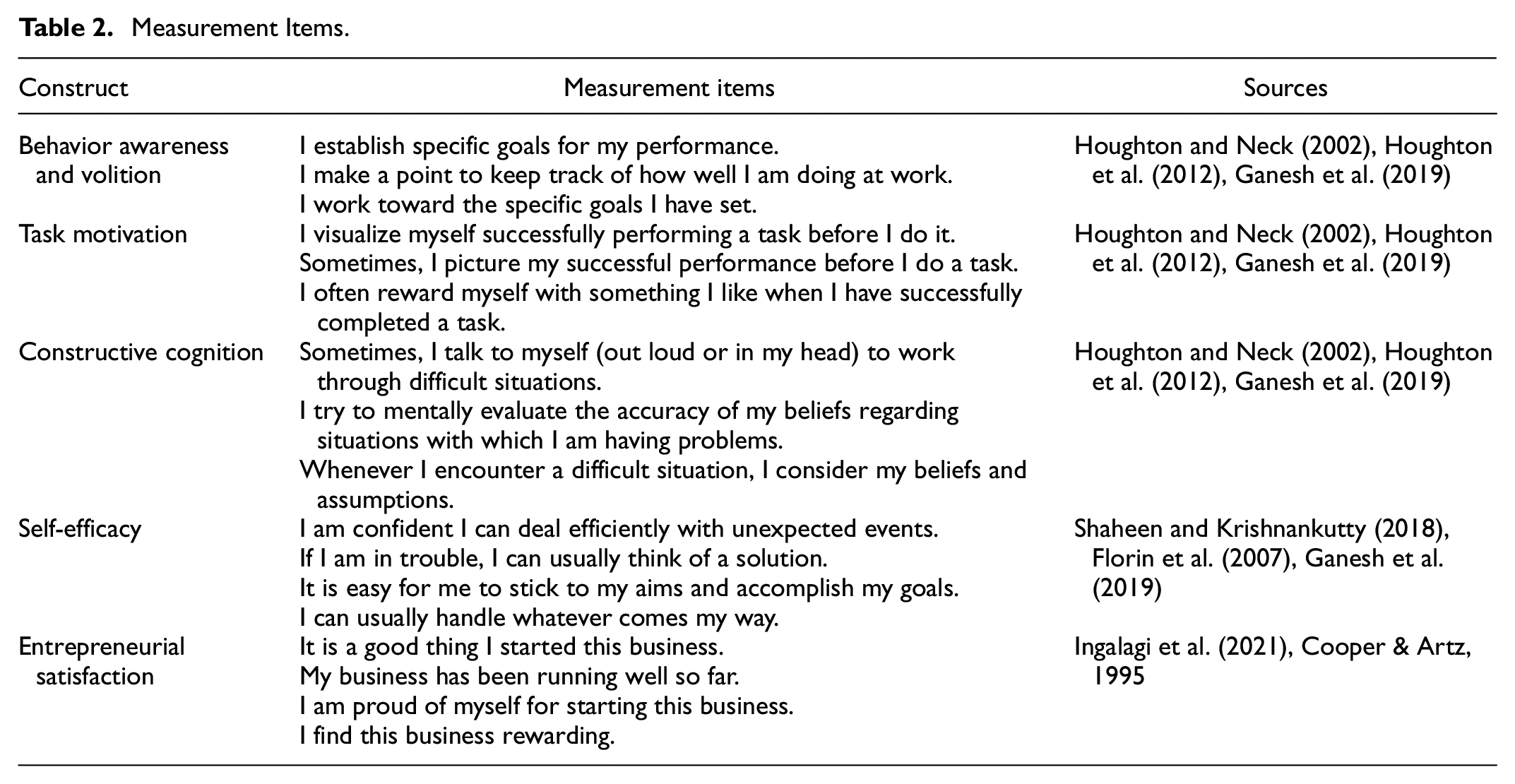
As shown in Table 2, we used five constructs with 15 items on a seven-point Likert scale for the survey.
Measurement Items.
Assessment of the Measurement Model
We used confirmatory factor analysis (CFA) to evaluate the unidimensional nature of the constructs. In this examination, we constrained all measurement items to load onto a single factor and allowed them to correlate with other factors within their respective categories in the CFA. The comparative fit index (CFI) was above the 0.90 threshold, and the root mean square error of approximation (RMSEA) was 0.10, indicating a marginal fit (Hu & Bentler, 1999). Table 3 shows that the Cronbach’s alpha and composite reliability of the constructs exceeded the .70 threshold (Fornell & Larcker, 1981). These findings affirm that the theoretical constructs exhibit satisfactory reliability.
Summary of Measurement Results, Standardized Factor Loadings, Reliability, and Convergent Validity.

We assessed convergent validity through CFA. As shown in Table 3, each item demonstrates a statistically significant factor loading greater than 0.60 within its respective constructs, with a t-value surpassing 2.0. The average variance extracted (AVE) values surpass the commonly accepted guideline of 0.50, affirming convergent validity (Fornell & Larcker, 1981).
We evaluated discriminant validity by examining the correlation between a construct and the squared root of its AVE. This procedure helped determine whether the AVE of each multi-item construct exceeds the shared variance between constructs (Fornell & Larcker, 1981). We also checked cross-loadings of all factors to ensure discriminant validity. In this analysis, the square roots of AVEs for all constructs must be higher than the correlations between any individual pair of constructs.
Assessment of the Structural Model
This study investigated the relationships between constructs by testing the proposed model through structural equation modeling (SEM). Figure 2 and Table 4 present the findings. Hypothesis 1 suggests that behavior awareness and volition positively correlate with self-efficacy. The hypothesis test results confirmed this relationship (H1: β = .377, t = 5.321). H2 and H3 test results showed that constructive cognition significantly and positively influences self-efficacy (H3: β = .359, t = 2.822), while task motivation has a marginal positive influence (H2: β = .214, t = 1.852). We embedded H1a, H2a, and H3a to examine the direct effects of self-leadership on entrepreneurial satisfaction. While we found statistical support for H1a, its t-value (3.339) was not greater than H1’s. H2a and H3a didn’t have statistical significance, strengthening the mediating effect of entrepreneurial self-efficacy between self-leadership and entrepreneurial satisfaction (H2a: β = −.078, t = −0.629; H3a: β = .141, t = 1.006). Moreover, self-efficacy has a positive, significant relationship with startup satisfaction, supporting Hypothesis 4 (H4: β = .848, t = 16.761). However, the test result did not support the significant moderating impact of customer interaction mode on the relationship between self-efficacy and startup satisfaction, thus rejecting H5 (β = −.108, t = −1.519). Regarding explanatory power, this model explains 44.2% and 53.6% of the variance in self-efficacy and startup satisfaction, respectively.

Results of the hypothesized research model.
Hypotheses Test Results.

p < .001. *p < .1.
Discussion
This study investigated self-leadership using three sub-variables: behavior awareness and volition, task motivation, and constructive cognition. Like Ganesh et al.’s (2019) research results, we found that behavior awareness and volition, and constructive cognition positively impacted self-efficacy. However, the analysis identified a marginal influence of task motivation on self-efficacy. Behavior awareness and volition show the strongest influence on self-efficacy, similar to previous research supporting the mediating role of self-efficacy in the relationship between behavior-focused self-leadership and personal outcomes (Ebner et al., 2018). According to the self-setting goal theory, entrepreneurs with self-efficacy can set challenging and achievable goals (Bandura & Locke, 2003) since goals are important for entrepreneurs to increase performance. General self-efficacy can be a predictor variable or a mediator between self-leadership and multiple dependents, including job satisfaction, work engagement, performance, and creativity innovation (Knotts et al., 2022).
Many studies identify motivations as significant predictors of job satisfaction (Hajiali et al., 2022; Maya & Uzman, 2019). Especially, Maya and Uzman (2019) found natural rewards, a task motivator, to be a better predictor of self-efficacy than behavior-focused and constructive thought strategies. However, this study found that task motivation, capturing motivation’s intrinsic and extrinsic aspects, influences self-efficacy just marginally. The contradiction might have resulted from the fact that task motivation, an external motivator, may not significantly improve self-efficacy and entrepreneurial satisfaction as much as natural rewards (Singh et al., 2018). As a task motivator, natural rewards work similarly to intrinsic motivation as they strengthen and encourage behaviors to support task enjoyment. However, extrinsic motivation often fails to increase satisfaction among entrepreneurs. In their study, Tanković et al. (2023) examined whether a distinct set of skills, similar to self-leadership strategies, could influence pull and push motivators, ultimately impacting the satisfaction of female entrepreneurs. They found that soft, hard, and communicating skills contributed to push and pull motivation. Nevertheless, push motivation, an extrinsic motivation, did not exhibit a positive relationship with entrepreneurial satisfaction.
Another possible reason for the weak support of H2 could be the multidimensionality of self-efficacy (Taneja et al., 2023). The current research may have failed to capture the specific dimension(s) of entrepreneurial self-efficacy that better mediate the relationship between task motivation and satisfaction. General self-efficacy does not serve every aspect of individuals’ beliefs in their capabilities. Self-efficacy can be more specific to satisfy a particular purpose depending on the types of goals and tasks. Scholars have found a positive relationship between constructive cognition and self-efficacy. For instance, Neck and Manz (1996) described how self-dialog, mental imagery, beliefs and assumptions, and thought pattern training improved the treatment group’s mental performance, created more enthusiasm, increased job satisfaction, and decreased nervousness. Those with training eventually formed self-efficacy and accepted their financial bankruptcy better than the control group without training, demonstrating the influence of self-training on increasing mental performance.
The research supports H1a, indicating that behavior awareness and volition positively impact entrepreneurial satisfaction. This finding suggests that when entrepreneurs are more aware of their behaviors and have a strong will to accomplish their goals, they will likely be more satisfied with their entrepreneurial endeavors. The fact that H1a’s t-value was not greater than H1’s suggests that while behavior awareness and volition impact entrepreneurial self-efficacy and satisfaction, their direct effect on satisfaction, although positive, may not be as strong as their effect on self-efficacy. This result could imply that self-efficacy significantly mediates the pathway between behavior awareness and volition to entrepreneurial satisfaction. Entrepreneurs who feel competent (high self-efficacy) due to their behavior awareness and volition will likely derive more satisfaction from their entrepreneurial activities.
The lack of statistical significance for H2a and H3a presents an intriguing scenario. The data did not support these hypotheses despite asserting task motivation and constructive cognition would positively impact entrepreneurial satisfaction. This lack of direct impact might indicate that the simple presence of task motivation and constructive cognition is not enough to ensure entrepreneurial satisfaction without the mediating role of entrepreneurial self-efficacy. In essence, even if an entrepreneur is highly motivated and possesses a constructive mindset, these attributes alone do not guarantee satisfaction from their entrepreneurial journey unless they feel efficacious. The results align with Knotts et al. (2022), who explored the mediating mechanisms of self-efficacy connecting self-leadership to performance outcomes via a meta-analytic path model. They discovered that self-efficacy serves as a primary mechanism linking self-leadership to outcomes. This finding reinforces the critical mediating role of entrepreneurial self-efficacy between self-leadership (encompassing task motivation and constructive cognition) and entrepreneurial satisfaction. It suggests that self-leadership components might primarily influence satisfaction by enhancing self-efficacy.
Entrepreneurs need to feel capable and productive in their endeavors to translate their motivation and constructive thinking into satisfaction with their work and outcomes. Our study found that self-efficacy positively impacts satisfaction regardless of the mode of customer interaction. However, self-leadership does not always predict better job satisfaction. For example, Korean nurses’ overall self-leadership did not significantly influence job satisfaction; however, sub-variables, including self-goal setting and constructive thinking, helped improve their job satisfaction (J.-H. Kim & Han, 2016). Therefore, self-leadership dimensions can differentially predict job satisfaction. We applied the media richness theory, but our research did not show a moderating role of customer interaction mode on the relationship between self-efficacy and job satisfaction. However, multiple studies align with our findings, indicating that encounters using different modalities did not bring different outcomes (Sprecher, 2014, 2021; Sprecher & Hampton, 2017).
These results suggest that businesses should identify and implement suitable communication modes to facilitate the necessary level of interaction with their customers. Adopting a multi-modal approach to increase customer engagement may benefit some industries. For instance, Warby Parker, an eyewear and sunglasses brand, combines virtual online sales with offline brick-and-mortar stores, harmonizing sales channels to maximize customer interactions. The mode of customer interaction will continuously evolve with the emergence of newer technologies. Different industries may require varying levels of technological interaction to engage with their customers effectively.
Implications
The primary insight from this research is the need for entrepreneurs to encourage self-management skills within themselves to improve their self-efficacy and satisfaction in pursuing their business goals. Self-management can utilize self-influence techniques involving a set of behavioral and cognitive skills. These techniques should put them in a positive circle, building the confidence to meet goals and obtain satisfaction in their successes. Regarding task motivation techniques, entrepreneurs can utilize natural reward strategies to build enjoyable features in their work performance. Further, cognitive thought patterns such as self-talk and mental imagery can improve self-confidence, build strong will, and improve performance.
Self-leadership encompasses a set of strategies that entrepreneurs can learn. Based on social cognitive theory, experiences, education, and social persuasion can boost entrepreneurs’ self-efficacy (Newman et al., 2019). While entrepreneurs can self-train themselves with positive thought patterns and mental assurance using self-talk, beliefs, and other techniques, there are programs entrepreneurs can utilize to improve self-leadership (Goldsby et al., 2021). These professional improvement and certification programs include, for example, “Gallup Suit of Talent Development and Performance Management Tools” and creativity, innovation, and problem-solving programs offered by Basadur Applied Innovation and FourSignt Innovation. Other programs include design thinking training programs, personality assessments, and training programs. Therefore, entrepreneurs can utilize various programs to enhance their self-leadership strategies and techniques in addition to self-discipline.
When entrepreneurs learn self-leadership strategies for setting goals, monitoring progress, and making personal sacrifices for goal achievement, their sense of self-efficacy should increase along with their performance. For example, the founder of Baedal Minjok, the first successful food delivery application company in South Korea, demonstrated a keen awareness of his behaviors, notably in his entrepreneurial journey. When Bong-Jin Kim found an opportunity to publish a mobile version of the restaurant directory, he exhibited volition by starting the business in 2010 at the beginning of the mobile revolution. This decision, grounded in self-awareness and determination, played a pivotal role in the subsequent success of Baedal Minjok. The founder’s ability to identify and pursue opportunities, coupled with a keen sense of purpose and decisive action, reflects the positive impact of behavior awareness and volition on entrepreneurial self-efficacy within Baedal Minjok’s growth.
Further, self-leadership contributes to job satisfaction, which leads to entrepreneurs’ work quality of life. Setting and achieving goals can be a self-fulfilling experience leading to a better overall quality of life. Thus, this study suggests a crucial mediating role of entrepreneurial self-efficacy. For practitioners, this emphasizes the importance of developing interventions and support systems to boost entrepreneurs’ self-efficacy and foster their self-leadership skills, such as task motivation and constructive cognition.
Academically, this research has several contributions, such as determining the role of self-leadership in increasing self-efficacy and entrepreneurs’ subsequent satisfaction with their startups. First, the current research furthers the understanding of how entrepreneurship forms and its cultivation; both areas have been underexplored academically. Our findings reveal that self-leadership among entrepreneurs positively impacts their self-efficacy, which, in turn, influences entrepreneurial satisfaction. One can develop self-leadership through education, so self-efficacy—a strong predictor of entrepreneurs’ startup intentions, behavior, internal motivation, and performance—becomes more achievable. By examining the links between self-leadership, self-efficacy, and entrepreneurs’ satisfaction in their endeavors, this research contributes to fostering the positive economic impact of new businesses and advancing their sustainability. Our study also suggests the practical implications that some sub-variables of self-leadership are more effective in increasing self-efficacy than others.
Conclusion
Self-leadership is an important quality of leaders, bringing work engagement, belief to meet expected demands and work performance. This paper empirically tested the role of self-leadership in building self-efficacy and job satisfaction in South Korean SME entrepreneurs. Also, we tested whether customer interaction mode moderated the relationship between self-efficacy and job satisfaction. The study results showed that all three dimensions of self-leadership were good predictors of self-efficacy, and self-efficacy mediated the relationship between self-leadership and job satisfaction.
Regarding the study’s limitations, we gathered the data from one country, restricting the study’s generalizability. Also, the diversity of the industries might be obscuring the moderating effect of customer interaction mode. Within some industries, contacting customers online was not possible or unnecessary before the pandemic. For example, the South Korean government did not approve untact meetings with doctors. Therefore, self-efficacy related to Internet skills was not necessary at that time. However, patients could call or videoconference their doctors for diagnosis and prescriptions during the pandemic when they showed COVID-19 symptoms. Doctors’ self-efficacy regarding their Internet skills could better affect satisfaction under the untact mode. However, for companies in the high-tech industry, the level of Internet skills should already be sufficient not to affect self-efficacy or the outcome variables. As the last limitation, the current research did not consider self-efficacy as an independent variable affecting self-leadership variables. As several studies used self-efficacy as a predictor of self-leadership, it would be meaningful to test self-efficacy’s role in self-leadership and entrepreneurs’ satisfaction in a future study.
Footnotes
Declaration of Conflicting Interests
The author(s) declared no potential conflicts of interest with respect to the research, authorship, and/or publication of this article.
Funding
The author(s) received no financial support for the research, authorship, and/or publication of this article.
Ethics Statement
Not applicable.

Data Availability Statement
The datasets generated during and/or analyzed during the current study are not publicly available due due to the fact that we did not inform our research participants regarding the public sharing of their data but are available from the corresponding author on reasonable request.