




Abstract
Teachers’ conceptions of assessment, as a dimension of assessment literacy, have an impact on their assessment practices. Chinese teachers of English as a foreign language (EFL) writing hold a range of conceptions of assessment because of the generally poor English writing proficiency of their students, the requirement in higher education for teachers to employ formative assessment, and the need to prepare their students to pass summative exams. In this study, teachers’ conceptions of assessment in Chinese university EFL writing instruction were examined. 406 university EFL teachers participated in a survey, with the focus on seven constructs. The results indicated that, overall, Chinese university EFL teachers held mixed yet compatible conceptions of assessment, without a clear predominance of either formative or summative orientation. Three distinctive conception profiles were identified. Of the background variables examined, only age was found to significantly influence teachers’ conceptions of assessment profiles. These findings have implications for the design of classroom assessment in higher education, teacher professional learning, and assessment reform policy.
Introduction
In the classroom, teachers can spend about a third to a half of their time in assessment-related activities (Stiggins, 1999), and in an English as a foreign language (EFL) context, they may devote even more time and effort in assessing and providing feedback on student writing (Lee, 2017). As a central element in teaching pedagogy, assessment is therefore critical for enhancing students’ writing proficiency, and needs to play an active role in the writing classroom (Hamp-Lyons, 2007; Lee, 2017). The theories and conceptions that teachers develop through experience and then bring into the classroom have a significant influence on what and how they teach (Box et al., 2015), and teachers’ conceptions of assessment, as a critical dimension of teacher assessment literacy (Xu & Brown, 2016), have a strong impact on their assessment practices (DeLuca et al., 2019; Fives & Buehl, 2014; Halim et al., 2024; Tang & Chow, 2007). Thus, to help teachers of EFL enhance their assessment literacy and in turn employ forms of assessment appropriately, their conceptions of assessment must first be fully understood (Leung & Lewkowicz, 2006; Z. Yan et al., 2021).
To date, research on assessment in the writing classroom has primarily focused on teachers’ use of assessment strategies (e.g., Allal, 2021; Cheng et al., 2008; Cheng & Wang, 2007; Lee & Coniam, 2013; Mak & Lee, 2014; Xiang et al., 2021; Zheng & Xu, 2023). Despite the growing body of literature on teachers’ conceptions of assessment in recent years (e.g., Barnes et al., 2017; Klieger, 2016; Kyaruzi et al., 2018; Kyttälä et al., 2022; Lutovac & Flores, 2022), their conceptions of assessment within the curriculum of writing, particularly in the context of EFL writing, have been surprisingly neglected.
To address this research gap, the aim of this study is to investigate teachers’ conceptions of assessment in university EFL writing instruction. This was undertaken first by classifying their dominant assessment conceptions, and then by profiling their conceptions. In addition, background variables that may impact teachers’ conceptions of assessment were also explored. It is hoped that this area of research will provide educational researchers and teacher educators with valuable insights into future teacher learning and professional development programs in assessment, thereby informing teachers’ assessment practices and ultimately enhancing students’ writing proficiency.
Literature Review
Teachers’ Assessment Conceptions
Teacher conceptions of assessment act as interpretive and guiding frameworks that filter and mediate teachers’ uptake and implementation of assessment knowledge. Teachers are therefore more inclined to take in new assessment knowledge and expertise that are consistent with their current conceptions of assessment and refuse to accept those are not (Fives & Buehl, 2014; Xu & Brown, 2016). Teacher conceptions of assessment have therefore, been increasingly recognized as a legitimate dimension of teacher assessment literacy (Xu & Brown, 2016).
Drawing on the foundational work on teachers’ conceptions of assessment (Heaton, 1975; Torrance & Pryor, 1998; Warren & Nisbet, 1999), Brown (2004a, 2006) developed the Teacher Conceptions of Assessment (TCoA-III) model. Within this model, conceptions of assessment can be considered to align on a continuum, with advancing learning and teacher/school accountability at opposite ends and with student accountability occupying a middle ground (Remesal, 2007). Notably, the conception of assessment as irrelevant, which serves neither pedagogical nor accountability purposes, is excluded from the continuum (Barnes et al., 2015, 2017).
While some studies that applied the TCoA-III model confirmed the original framework of improvement, school accountability, student accountability, and irrelevance (e.g., Brown & Harris, 2009; Gebril & Brown, 2014), others identified alternative factor structures (Barnes et al., 2017; Brown et al., 2015; Brown, Hui, et al., 2011; Brown & Michaelides, 2011; Brown & Remesal, 2017; Gebril & Brown, 2014; Muianga, 2023; Remesal & Brown, 2014; Segers & Tillema, 2011). For example, Brown and Remesal (2017) proposed a new conception model that comprised accountability, improvement, caution and irrelevance among Ecuadorian primary and secondary teachers (Brown & Remesal, 2017), while Muianga (2023) identified conceptions such as extrinsic motivation of students, reporting, and compliance among Mozambican EFL teachers.
The relationships between the identified conceptions of assessment across sociocultural contexts are also of interest. Improvement and accountability represent key purposes of assessment and exploring the relationships between these purposes can deepen our understanding of the interplay between formative and summative assessment (Brown & Gao, 2015). Besides, the relationship between improvement and irrelevance also warrants investigation, as it provides valuable insights into the complexities of implementing learning-oriented assessment in the classroom. The studies addressing these issues are explored in detail below.
Research on the relationship between improvement and accountability has produced mixed findings and some studies suggest that these conceptions are incompatible (Brown & Harris, 2009; Klieger, 2016), indicating that in certain contexts, teachers that aim to improve teaching and learning through assessment may believe that summative assessment is not fit for this purpose. Other studies, however, argue that improvement and accountability can coexist (Barnes et al., 2017; Brown, 2004a; Brown et al., 2009; Brown, Lake, & Matter, 2011, 2011; Brown & Michaelides, 2011; Brown & Remesal, 2017; Kyaruzi et al., 2018) and in such contexts, teachers believe that summative assessment can be utilized to improve both student learning and teaching quality, particularly in high-stakes accountability environments, where formative assessment may not be easily implemented.
Most studies report a negative correlation between improvement and irrelevance, most studies report a negative correlation (Barnes et al., 2017; Brown, 2004a; Brown et al., 2009, 2015; Brown, Hui, et al., 2011; Brown, Lake, & Matters, 2011; Brown & Remesal, 2017; Gebril & Brown, 2014). Interestingly, the directionality of this relationship does not appear to be strongly tied to examination policies and the stakes involved. For example, improvement and irrelevance have been perceived as compatible in both high-stakes (Kyaruzi et al., 2018) and low-stakes environments (Brown & Harris, 2009). Conversely, negative correlations have also been observed in both high-stakes (e.g., Barnes et al., 2017; Brown et al., 2015; J. Chen & Brown, 2016; Gebril & Brown, 2014) and low-stakes settings (e.g., Brown, Lake, & Matters, 2011). This suggests that while social and cultural contexts can play a significant role, they may not fully determine the direction of this relationship. Overall, the prevailing trend suggests that the more teachers view assessment as a tool for improvement, the less inclined they are to perceive it as irrelevant.
It is worth noting that only a few studies have explored how teachers’ background variables influence their conceptions of assessment. For example, teachers’ age and their assessment training experience may shape their assessment-related beliefs (J. Chen & Brown, 2016; Young & Jackman, 2014). Young and Jackman (2014) also found that in Grenadian lower secondary schools, trained teachers held more positive perceptions of and attitudes toward formative assessment compared to their untrained counterparts, indicating that assessment training can significantly impact teachers’ conceptions. Overall, how teachers’ individual background variables are associated with their conceptions of assessment is in need of more research, and is therefore one of the areas to be addressed in the present study.
Teachers’ Assessment Conceptions in EFL Writing Instruction
In EFL writing pedagogy, classroom assessment has great potential to help teachers shift their focus from the long-criticized product-oriented approach to process-based writing with a closer integration between teaching, assessment, and learning (Hamp-Lyons & Condon, 2000; Lee, 2011; Weigle, 2007). Good writing assessment practice is “an intermediate, or even initial, step in a continuous process of teaching and learning” (Berchoud et al., 2011, p. 11). Accordingly, classroom writing assessment with a focus on formative assessment is considered more valid because it aligns constructively with the process approach to teaching and assessing writing (Lam, 2016).
Classroom assessment also serves a number of summative purposes, including monitoring student progress, assigning grades, providing feedback to parents, determining instructional effectiveness, evaluating educational effectiveness, and evaluating teacher performance (Briggs et al., 2019; DeLuca et al., 2016; McMillan, 2013; Popham, 2017; Shepard, 2006). Teachers may, therefore, assess students for multiple, sometimes contradictory, purposes (Bonner, 2013). While both formative and summative assessment are vital, the summative-oriented writing assessment is characterized by teachers’ responses to students’ terminal writing products, which may hinder the connection between teaching and learning, weaken students’ interest in writing, and reduce their motivation (Hamp-Lyons, 2007; Wiliam, 2001).
Empirical research has started to focus on teachers’ perceived conceptions of assessment and there is a consensus that they tend to use assessment more for summative purposes, such as evaluating student performance retrospectively and assigning grades (Cheng et al., 2004, 2008; Cheng & Wang, 2007; Lee, 2007; Lee & Coniam, 2013; Mak & Lee, 2014), providing feedback to parents (Lee & Coniam, 2013), monitoring student progress (Cheng et al., 2004; Lee & Falvey, 2014), preparing for external examinations (Cheng et al., 2004, 2008), and determining instructional effectiveness (Cheng et al., 2004). In most of these studies, however, a systematic understanding of teachers’ conceptions of assessment in the EFL writing classrooms was not developed, which, in turn, would impede the realization of the full potential of classroom assessment in terms of both formative and summative purposes.
Taken as a whole, the current literature on teachers’ conceptions of assessment has informed the current vision of both the structure of, and the relationships among teachers’ conceptions of assessment. How teachers perceive assessment in the classroom remains poorly understood in specific curriculum areas, for example, EFL writing. Additionally, there is limited exploration of how teachers’ background variables, such as age and training experience, influence their conceptions of assessment. Further, profiling of how teachers vary in their conceptions of assessment could provide deeper insights into classroom assessment within this domain, and is another gap in the literature that the present study seeks to address.
To address these research gaps, the following research questions need to be answered:
RQ1 What conceptions of assessment do university EFL teachers hold with respect to the writing classroom?
RQ2 What, if any, profiles emerge in terms of university EFL teachers’ conceptions of assessment with respect to the writing classroom?
RQ3 To what extent are key background variables associated with university EFL teachers’ conceptions of assessment profiles?
Method
In the present study, a quantitative research design was employed. Data concerning university EFL teachers’ conceptions of assessment in teaching English writing in China were collected through a web-based survey.
Context
The aim of this study was to undertake an analysis of Chinese university EFL teachers’ conceptions of assessment in writing instruction. These EFL teachers taught English to non-English-major students, who needed to take College English courses during at least their first year of university. The aim of the College English courses is to enhance students’ overall English language proficiency, including listening, speaking, reading, writing, and translation. College English teachers are encouraged to employ formative assessment in the classroom (Q. Chen et al., 2021).
The present survey was conducted in a province located in central China, where there are 31 universities running 4-year degree programs (CMoE, 2023), four of which are sponsored by the government’s “Double First-Class Initiatives” (a government-initiated plan with the aim of developing first-class universities and subject disciplines with international competitiveness). At the time of this study, China has a high-stakes assessment environment where students’ English learning outcomes are measured by mandatory national testing. For example, college students are required to take the College English Test (CET). Their performance in the CET has an impact on their employment potential, and, if they wish to apply for domestic postgraduate programs, they have to take the National Postgraduate Enrollment Examination, which includes an additional, independent, English test.
Participants
A total of 406 EFL teachers from 12 different universities participated in the survey through a stratified sampling procedure. A sample size of 360 was determined by assuming a 5% error rate and 95 confidence level (Krejcie & Morgen, 1970) for an estimated population of 4,000 (obtained by consulting all the deans of foreign language colleges or departments in the province) EFL teachers. The sample was stratified according to whether the universities were sponsored by “the Double First-class Initiatives.” The 31 universities were therefore proportionally represented by selecting one sponsored and eight non-sponsored universities for each category. Selection was achieved with reference to the university identification number issued by the CMoE (every third university from the identification number list). The survey was sent out to all the deans, or deputy deans of each university, with a letter of information and instruction by email. All nine universities agreed to participate in the survey. The questionnaire was completed online anonymously. After the survey had been open for 3 weeks, a total of 406 samples were obtained. The subject-to-item ratio was about 9:1, which is acceptable according to Gorsuch (1983) and Hatcher (1994). The final response rate was approximately 31%. Table 1 presents the demographic information of the respondents.
Demographic Information of the Respondents.

Note. IW = independent writing course experience; LA = language assessment training experience; CA = classroom size.
Instrument
The constructs from the TCoA III inventory (Brown, 2006) were used, combined with the newly identified constructs (i.e., examination, control and development) from the Chinese-Teachers’ Conceptions of Assessment (C-TCoA; Brown, Hui, et al., 2011). Given that student control is as important as teacher and school control in China, student control (four items) was also developed and added to the construct of control. The questionnaire was, therefore, composed of seven constructs (i.e., school accountability, student accountability, improvement, irrelevance, examination, control and development) and comprised 44 items in total. Although the Chinese version of C-TCoA was available (Brown, Hui, et al., 2011), the wording of the items was examined and revised by three experts in classroom assessment who gave feedback for necessary revisions before the final draft was piloted with small samples of teachers from the target population. The questionnaire employed a six-point positively packed scale (Brown, 2004b; Klockars & Yamagishi, 1988).
Data Analyses
Data analyses comprised factor analysis, descriptive analysis, Pearson’s Chi-Square tests, and the Kruskal-Wallis tests, all conducted using a combination of SPSS 22 and R.
Since the questionnaire was composed of two known sets of constructs, which had been confirmed in previous research, a confirmatory factor analysis (CFA) was first used to test the fitness of the two known models and the mixed model, using the lavaan package in R (Rosseel, 2012). Since the data was not multivariate normal, as indicated by the Mardia’ Multivariate Normality Test, the Satorra-Bentler rescaling method was used to estimate the model parameters (Satorra & Bentler, 1994). Three goodness-of-fit indicators were reported according to Schreiber et al. (2006) Comparative Fit Index (CFI), Tucker & Lewis’s index (TLI) and Root Mean Square Error of Approximation (RMSEA).
Descriptive statistics were then performed to show participant teachers’ scores of the derived variables, as well as the correlations among those variables.
To identify the number of dominant teachers’ profiles, in terms of their conceptions of assessment, both a hierarchical cluster analysis and a K-means cluster analysis were conducted. A combination of the two cluster analysis methods can overcome the shortcomings of each other (Mooi & Sarstedt, 2011). Teachers’ responses to the 43 items were entered into a hierarchical cluster analysis using Ward’s method of minimum within-group variance based on Z-scores, to identify the best number of clusters (Atlas & Overall, 1994). To explore the associations between teachers’ conceptions of assessment and their background variables, Pearson’s chi-squared (χ2) and Cramer’s Phi (φ c ) were used. The effect sizes were interpreted according to Cohen (1988): φ c = 0.10, small effect; φ c = 0.30, medium effect; and φ c = 0.50, large effect (df = 1).
Results
The Identified Factors of the Questionnaire
The CFA results indicated that none of the three models fitted the data well (the TCoA model: CFI = 0.867; TLI = 0.838 and RMSEA = 0.069; the C-TCoA model: CFI = 0.762; TLI = 0.738 and RMSEA = 0.09; the mixed model: CFI = 0.752; TLI = 0.733 and RMSEA = 0.076).
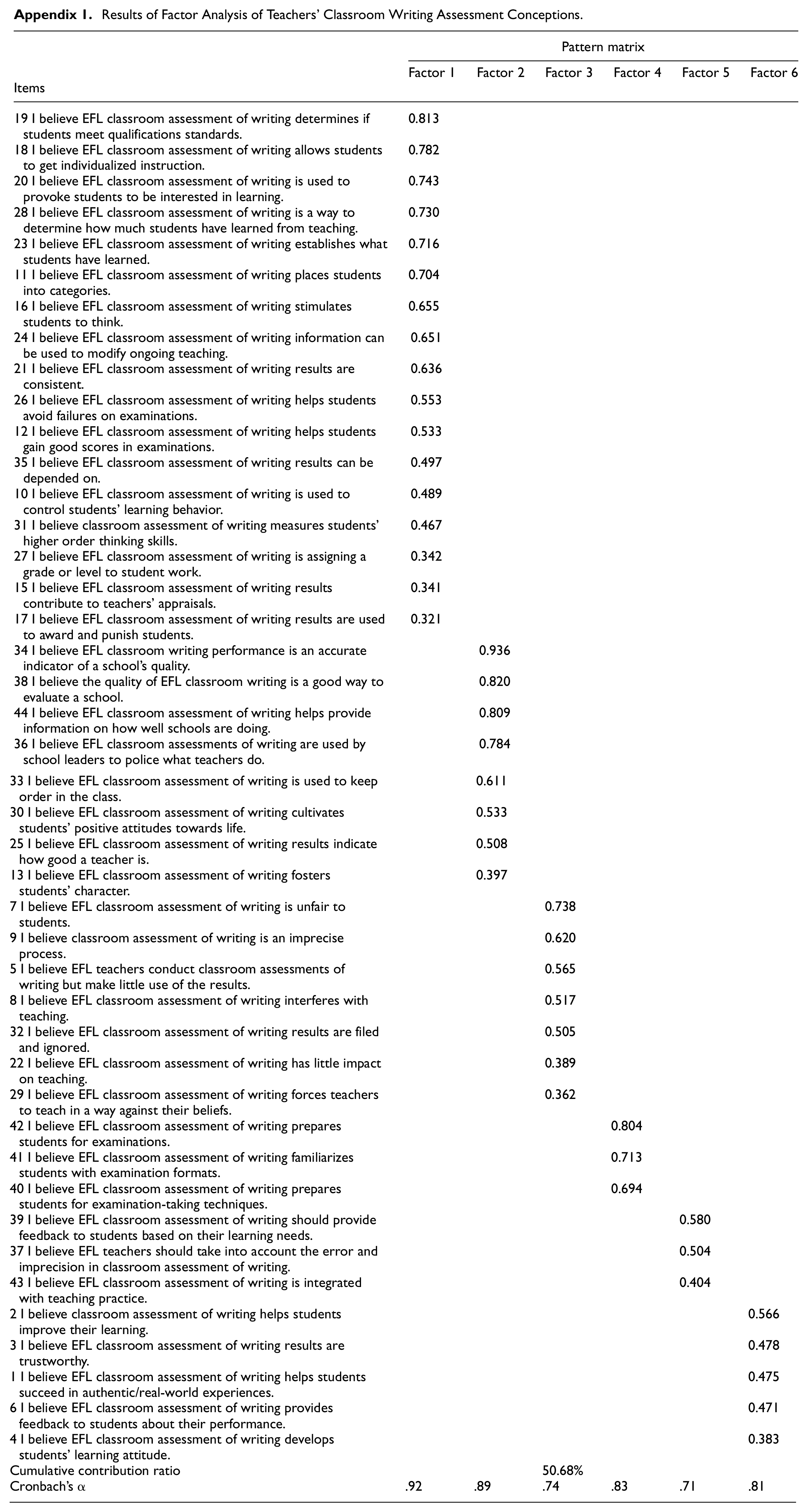
An exploratory factor analysis (EFA) was therefore carried out to develop a new model. The data set was randomly divided into two subsets (203 each). One subset was used for performing EFA and the other was employed for CFA. Given that principal axis factoring (PAF) can give the optimal results (Osborne et al., 2008), and that PAF is favored when the data is not multivariate normal (Fabrigar et al., 1999), PAF was performed with promax rotation, which is a better solution when correlations among constructs exist (Osborne et al., 2008). One item was deleted because it was outside of the six factors in the initial factor analysis. The factor analysis was then run again to determine the underlying factors. Bartlett’s test of sphericity was significant (χ2 = 6,827.93, p = .000), indicating that it was appropriate to use a factor analysis on this set of data. The Kaiser-Meyer-Olkin (KMO) measure of sampling adequacy indicated that the strength of the relationships among variables was high (KMO = 0.931), indicating that it was acceptable to continue the analysis. In line with using PAF, the scree test and parallel analysis were used to determine the number of factors (Fabrigar et al., 1999). Both the scree plot and parallel analysis indicated a six-factor solution. The rotated factor loading matrix was then examined to determine factor members. Items with loadings above 0.30 were assigned to a certain factor and those with cross-loadings were assigned to the factor which had the highest loading. Six factors were identified with a cumulative contribution of 50.68%. The high alphas indicated that internal consistency was satisfactory. CFA was then performed to estimate the model parameters. Acceptable goodness of fit indices was obtained (CFI = 0.90; TLI = 0.90; RMSEA = 0.054).
Appendix 1 shows the six factors, along with the items loading on each factor, as well as the Cronbach’s alphas. Factor 1 could be interpreted as Student Accountability/Improvement with items predominantly originating from the constructs of student accountability and improvement, with some contribution from development, control, or examination. Factor 2 was named School Accountability/Teacher Control/Development. Factor 3 was named Irrelevance. Factor 4 included three items that revealed that teachers help students prepare for examinations, and was therefore named Examination. Factors 5 and 6 had items predominantly originating from the construct of improvement; however, a closer examination suggested that Factor 5 was focused on teaching-oriented improvement, while Factor 6 described improvement oriented with students’ learning outcome. Factors 5 and 6 were therefore named Teaching-oriented Improvement and Outcome Improvement respectively.
Descriptive Analysis Results
Table 2 shows the descriptive statistics, including means, standard deviations, and correlations for all variables. The results indicate that the least endorsed factor was “Assessment is irrelevant” and the most endorsed factors were “Assessment is used for teaching-oriented improvement” and “Assessment is used for students’ learning outcome improvement.” The teachers slightly agreed that “Assessment is used to make schools accountable, control teachers, and develop students,” and moderately agreed with the factors of “Assessment is used to take students accountable and improve students’ learning performance,” and “Assessment is used to help students prepare for exams.” Statistically significant correlations, except those between Factor 1 and Factor 3, and Factor 3 and Factor 4, were obtained between the six factors.
Means, Standard Deviations and Correlations Between Factors.

Correlation is significant at the 0.001 level (two-tailed).
Identified Participant Clusters
The dendrogram of the hierarchical cluster analysis suggested a two-, three-, or four-cluster solution. The subsequent K-Means cluster analysis was conducted, which indicates that a three-cluster model was the best, because the exploratory runs of the other solutions did not generate profiles as differentiated from each other as a three-cluster solution produced. Subsequently, Kruskal-Wallis tests were conducted to explore the significant differences between the three clusters across all of the six conceptions (Factor 1: χ2 = 275.62, df = 2, p = .000; Factor 2: χ2 = 139.73, df = 2, p = .000; Factor 3: χ2 = 135.76, df = 2, p = .000; Factor 4: χ2 = 123.30, df = 2, p = .000; Factor 5: χ2 = 102.90, df = 2, p = .000; Factor 6: χ2 = 192.56, df = 2, p = .000). All clusters therefore showed significant differences on all the conceptions of assessment. Cluster 1 was named Improvement-focused Assessment Conceptions as improvement-related dimensions are dominant. Cluster 2 was labeled as Underdeveloped Assessment Conceptions due to its consistently low levels of conception across all identified factors, with no single factor displaying prominence. Similarly, Cluster 3 was named Moderate Assessment Conceptions. The three profiles of teachers’ conceptions of assessment are shown with means and standard deviations in Table 3 and descriptive statistics by cluster with demographic information are shown below in Table 4.
Assessment Conception Profiles of the Participating Teachers.

Note. IAC = Improvement-focused Assessment Conceptions; UAC = Underdeveloped Assessment Conceptions; MAC = Moderate Assessment Conceptions.
Descriptive Statistics by Cluster With Demographic Information.

Note. IAC = Improvement-focused Assessment Conceptions; UAC = Underdeveloped Assessment Conceptions; MAC = Moderate Assessment Conceptions; Assistant P/L = assistant professor/lecturer; Associate P = associate professor; BD = bachelor degree; MD = master’s Degree; DD = doctor degree; IW = independent writing course experience; LA = language assessment training experience; CS = class size.
Cluster 1, Improvement-focused Assessment Conceptions, included 42.1% (n = 171) of the sample of the present study. This cluster was 87.1% female; 62.0% were assistant professors/lecturers; 70.2% held a master’s degree; 70.8% were between 35 and 50 years old; 54.4% received language assessment training; 74.3% did not teach independent writing courses; and 73.1% had more than 35 students in classroom. This cluster had the highest mean scores on four of the six factors (i.e., Student Accountability/Improvement, Examination, Teaching-oriented Improvement and Outcome Improvement) and the lowest mean score on Irrelevance. Within this cluster, a Wilcoxon signed-rank test showed that Factor 6 was significantly higher than Factor 4 (z (171) = −8.059, p = .000), Factor 3 (z (171) = −11.342, p = .000), Factor 2 (z (171) = −11.208, p = .000) and Factor 1 (z (171) = −9.629, p = .000); Factor 5 was significantly higher than Factor 4 (z (171) = −7.335, p = .000), Factor 3 (z (171) = −11.344, p = .000); Factor 2 (z (171) = −10.941, p = 000); Factor 1 (z (171) = −6.623, p = .000); Factor 4 was significantly higher than Factor 3 (z (171) = −10.948, p = .000), Factor 2 (z (171) = −8.630, p = .000). Factor 2 was significantly higher than Factor 3 (z (171) = −8.948, p = .000); Factor 1 was significantly higher than Factor 2 (z (171) = −11.186, p = .000) and Factor 3 (z (171) = −11.342, p = .000).
Cluster 2, Underdeveloped Assessment Conceptions, included 41.4% (n = 168) of the sample. This cluster was 87.5% female; 65.5% were assistant professors/lecturers; 77.4% held a master’s degree; 64.3% were between 35 and 50 years old; 56.5% received language assessment training; 69.6% did not teach independent writing courses; 69.0% had more than 35 students in classroom. This cluster had the lowest scores on five of the six factors (i.e., Student Accountability/Improvement, School Accountability/Teacher Control/Development, Examination, Teaching-oriented Improvement and Outcome Improvement). Factor 6 was significantly higher than Factor 4 (z (168) = −6.953, p = 000), Factor 3 (z (168) = −10.146, p = .000), Factor 2 (z (168) = −10.498, p = .000) and Factor 1 (z (168) = −8.744, p = .000). Factor 5 was significantly higher than Factor 4 (z (168) = −8.299, p = .000), Factor 3 (z (168) = −10.399, p = .000), Factor 2 (z (168) = −10.506, p = .000), and Factor 1 (z (168) = −8.085, p = .000). Factor 4 was significantly higher than Factor 3 (z (168) = −7.435, p = .000), Factor 2 (z (168) = −8.827, p = .000). Factor 3 was significantly higher than Factor 2 (z (178) = −3.382, p = .001). Factor 1 was significantly higher than Factor 2 (z (168) = −9.895, p = .000) and Factor 3 (z (168) = −9.047, p = .000).
Cluster 3, Moderate Assessment Conceptions, included 16.5% (n = 67) of the sample. In this cluster, 82.1% were female; 71.6% were assistant professors/lecturers; 64.2% held a master’s degree; 61.2% were between 35 and 50 years old; 59.1% received language assessment training; 59.7% did not teach independent writing courses. 70.1% had more than 35 students in classroom. This cluster had the highest mean scores on two of the six factors (i.e., School Accountability/Teacher Control/Development and Irrelevance). Factor 6 was significantly higher than Factor 3 (z (67) = −4.502, p = .000), Factor 2 (z (67) = −2.189, p = .029) and Factor 1 (z (67) = −5.763, p = .000). Factor 5 was significantly higher than Factor 3 (z (67) = −5.186, p = .000), Factor 2 (z (67) = −3.730, p = .000). Factor 4 was significantly higher than Factor 3 (z (67) = −4.297, p = .000) and Factor 2 (z (67) = −2.972, p = .003). Factor 2 was significantly higher than Factor 3 (z (67) = −3.055, p = .002). Factor 1 was significantly higher than Factor 2 (z (67) = −3.798, p = .000) and Factor 3 (z (67) = −5.916, p = .000).
Relationships Between Teachers’ Background Variables and Their Conceptions of Assessment
Pearson’s Chi-Square tests revealed a significant association between conceptions of assessment and age (χ2 = 10.903, df = 4, p = .028, φ c = .12). The effect size was small, but Kruskal-Wallis tests showed a tendency for the older teachers to perceive assessment as less irrelevant (χ2 = 11.719, df = 2, p = .003), and to be more focused on teaching-oriented improvement (χ2 = 11.769, df = 2, p = .003) and students’ learning outcomes (χ2 = 9.545, df = 2, p = .008).
Discussion
In this study, teachers’ conceptions of assessment within the context of Chinese EFL writing instruction were investigated. The findings revealed that teachers held multiple conceptions of assessment. In addition, more than half of the participant teachers neither strongly agreed that assessment serves the purposes of facilitating teaching and learning, nor did they show strong agreement on summative purposes. These findings suggest that, in general, university EFL teachers’ assessment literacy in the writing instruction needs to be enhanced. Of the background variables, only age was found to be associated with teachers’ conceptions of assessment.
These findings contribute to the literature by examining how teachers perceive assessment specifically within the EFL writing context, an area that has been underexplored. Moreover, by employing cluster analysis, this study profiles how teachers’ conceptions of assessment vary, and offer a more nuanced, person-centered perspective on teachers’ beliefs and attitudes toward assessment.
University EFL Teachers’ Conceptions of Assessment in the Writing Classroom
Overall, the findings reveal that while these teachers recognized the importance of assessment in teaching, they did not fully embrace any single, specific conception of its purpose. Instead, they demonstrated a preference for using assessment to enhance learning but also relied on it to hold students accountable and prepare them for external examinations. This suggests that the teachers held a blend of complementary yet potentially conflicting beliefs about the role of assessment in EFL writing instruction. Such mixed beliefs could lead to tensions when teachers make assessment-based decisions. For instance, while teachers aim to use assessment to support process writing, they might feel pressured to shift their focus toward final writing products to meet external demands. The subsequent sections will further explore and discuss these findings.
Factor 1, Student Accountability/Improvement, received moderate agreement. This suggests that when teachers use assessments to improve students’ English writing, they are often simultaneously making students accountable for their learning, and vice versa. This finding is consistent with prior studies indicating that formative and summative purposes often overlap in EFL writing instruction in the Chinese context (Cheng et al., 2004, 2008; Cheng & Wang, 2007; Lee, 2007; Lee & Coniam, 2013; Mak & Lee, 2014). Two key factors that likely contributed to this overlap are the entrenched traditional examination culture and the pervasive influence of the high-stakes examination system in China (Carless, 2011; J. Chen & Teo, 2020; Lam, 2016; Lee et al., 2015; Tan, 2016). While formative assessment strategies, such as multiple writing, teacher-student conferencing, and self-/peer assessment, have significant potential to greatly enhance students’ writing, their implementation is often hindered by systemic constraints and the overriding focus on high-stakes examinations. Integrating formative and summative assessments through process-oriented approaches, such as portfolio assessment, appears to be a more pragmatic strategy (Carless, 2011; Teng, 2020; L. Wang et al., 2020). Such an approach however acknowledges the necessity of addressing external examination demands while still promoting learning improvements.
The findings for factor 2, School Accountability/Teacher Control/Development, received slight agreement, indicating that these EFL writing teachers believe that assessment simultaneously contributes to school accountability mechanisms, controls teaching, and also fosters student development, though these roles are less strongly emphasized. These results align with broader studies suggesting that accountability systems often imply control over teachers, and reaffirm that assessment outcomes in the Chinese context frequently reflect not only students’ academic achievements, but also their character and personal values (Brown, Hui, et al., 2011; Hui, 2012; P. Wang, 2010).
The notion of school accountability, which is tied to high-stakes assessments, often leads to an inherent control over teaching practices. This dual focus reflects the broader societal expectations that assessments serve both academic and moral purposes, and aligns with China’s educational emphasis on character development alongside academic success (Eryong & Li, 2020). Teachers, therefore, may feel pressured by these accountability mechanisms to align their teaching practices with institutional demands, which include fostering personal values in students, in addition to academic performance. Combined with the findings from Factor 1, this also challenges the conventional Western dichotomy of formative versus summative assessment purposes (Brown, Hui, et al., 2011; Muianga, 2023; P. Wang, 2010), and demonstrates that in China, assessment fulfills multiple roles by balancing institutional accountability and student development.
However, these competing demands pose significant challenges for teachers in a system dominated by high-stakes assessments for selection purposes as the pressure to meet school evaluation requirements often intertwines with efforts to address students’ broader developmental needs, leaving little room for teachers to disentangle their instructional practices from external accountability demands. Such systems, which prioritize school accountability and control, constrain teachers’ autonomy, and limit their ability to implement alternative, student-centered assessment approaches. To address these challenges requires, structural policy reforms are required to support greater teacher autonomy and foster diverse assessment practices. Equally important is a cultural shift in societal values surrounding assessment, that move away from the dominance of public examinations toward a more balanced approach that values both academic success and holistic development (Brown & Remesal, 2017; Shepard, 2000).
The results for factor 3 confirm that irrelevance is a distinct and independent conception of assessment across sociocultural contexts (e.g., Barnes et al., 2017; Brown, Lake, & Matters, 2011; Kyaruzi et al., 2018; Muianga, 2023). In this study, the findings suggest that the teachers generally did not perceive assessment as irrelevant in the EFL writing classroom. Instead, they emphasized that assessment must serve some meaningful purpose for stakeholders, as reflected in the higher mean scores of other identified conceptions of assessment. This is consistent with previous studies (e.g., Barnes et al., 2017; Brown, 2004a), and reinforces the idea that assessment is expected to be useful for teachers, students, and other stakeholders. This underscores the importance of incorporating this belief into teacher development programs, where it can serve as a foundation for enhancing teachers’ assessment knowledge and its practical application in the classroom.
Factor 4, Examination, highlights that these teachers tended to view assessment as a tool to help students prepare for external examinations. This confirms that examination is a distinct and significant factor in Chinese teachers’ conceptions of assessment (Brown, Hui, et al., 2011). Rooted in the Confucian-oriented culture of the Chinese educational system, examination-driven practices continue to dominate society (Carless, 2011). These findings support the earlier suggestion that one practical solution to tackling the summative-oriented purposes in Chinese EFL writing instruction may be that if the dominance of summative assessment cannot be reduced, a combination of formative assessment and summative assessment might be a solution.
The results for Factor 5, Teaching-oriented Improvement, revealed that these EFL writing teachers recognize both the limitations of classroom assessments in terms of reliability and validity and their potential to support process-oriented writing instruction that meets students’ learning needs. This dual perspective may stem from the relatively lower stakes associated with classroom assessment compared to formal testing (Bennett, 2011; Popham, 2017). These teachers therefore view classroom assessment as an integral part of teaching practice rather than a rigid evaluative tool, despite the potential for uncertain inferences. This finding highlights that EFL teachers are willing to tolerate some degree of uncertainty in classroom assessment, considering it a dynamic and iterative process to enhance students’ writing skills.
Factor 6, Outcome Improvement, highlights the role of assessment in enhancing students’ learning outcomes. The results for this factor suggest that these teachers moderately agreed on the positive impact of classroom assessment on students’ achievement (Black & Wiliam, 1998). Together with factor 5, this finding underscores that assessment can be utilized to promote both pedagogy and learning in the EFL writing classroom. These two factors were the most strongly endorsed conceptions, which reflects the teachers’ belief in the formative purposes of assessment in writing instruction. These purposes were not, however, dominant among the identified conceptions. Thus, although the teachers valued their practices of assessment for learning, which is consistent with previous studies (e.g., Kyaruzi et al., 2018; Pat-El et al., 2015), their overall conceptions of assessment were not predominantly improvement-oriented. The coexistence of competing conceptions here suggests that shifting toward a more improvement-centered perspective will require deeply rooted alternative beliefs and practices to be examined and addressed.
A close examination of the interrelationships among the identified conceptions, a close examination revealed that all, with the exception of Irrelevance, are positively correlated. This finding provides robust evidence for the coexistence of multiple conceptions of assessment in writing instruction, and reflects the complex and often competing demands that teachers face. These competing demands could also lead to conceptual confusion and interfere with teachers’ assessment identity development, particularly as they navigate accountability and improvement requirements in their dual roles as educators and assessors. The study further found that accountability-related conceptions (i.e., Student accountability/Improvement and School accountability/Teacher control/Development) and improvement-related conceptions (i.e., Teaching-oriented improvement and Outcome improvement) were positively related, which supports earlier research (e.g., Barnes et al., 2017; Brown & Remesal, 2017), while contrasting with other findings (Brown & Harris, 2009; Klieger, 2016). This finding reaffirms the earlier observation that Chinese university EFL teachers often adopt both summative and formative purposes in writing instruction, and view assessment as serving dual roles, such as improving students’ examination outcomes while meeting accountability requirements. The strong correlation between student accountability and improvement-related conceptions, however, points to potential tension in process-oriented approaches to writing. In high-stakes environments, teachers may prioritize product-oriented methods, and focus on summative scores and error correction. These findings emphasize the importance of integrating formative and summative assessments, such as combining grades with detailed feedback, to support the crucial role of feedback in assessment.
An inverse correlation found between improvement and irrelevance further underscores that the more teachers view assessment as a tool for improving student writing, the less they regard it as irrelevant. This result, consistent with prior research (e.g., Barnes et al., 2017; Brown & Remesal, 2017; Gebril & Brown, 2014), indicates that while teachers value assessment for its formative potential, the relatively weak correlation suggests that many remain uncertain about its effectiveness in promoting improvement. This aligns with findings from Brown, Hui, et al. (2011), which suggest that Chinese EFL teachers have not fully embraced the benefits of classroom assessment, despite extensive evidence supporting the positive impact of formative assessment on learning outcomes (Black & Wiliam, 1998; Graham et al., 2015; Kingston & Nash, 2011). This gap therefore highlights the need for targeted teacher education programs to enhance assessment literacy and promote improvement-oriented conceptions as a central aspect of assessment practice.
University EFL Teachers’ Profiles of Assessment Conceptions in the Writing Classroom
In this study, less than half (42.1%) of the participating teachers were in general agreement that assessment serves the purposes of facilitating teaching and learning, while the majority (57.9%) expressed only moderate support for these pedagogical views of assessment. This finding suggests that university EFL teachers’ classroom assessment practices in teaching writing are not primarily learning-oriented, which echoes earlier studies (Cheng et al., 2004, 2008; Cheng & Wang, 2007).
A closer examination of the clusters indicates that these teachers did not express a strong agreement with items associated with summative functions either (i.e., Factors 1, 2, and 4). For example, teachers in the Underdeveloped Assessment Conceptions and Moderate assessment conceptions clusters neither strongly agreed nor disagreed with most conceptions. This result therefore challenges previous research suggesting that assessment in Chinese EFL writing instruction is predominantly summative (Cheng et al., 2004, 2008; Cheng & Wang, 2007). A possible explanation is that while assessments are primarily used for accountability purposes, teachers may rely on these practices due to institutional requirements, rather than a belief that they effectively reflect or support students’ learning processes. This suggests a disconnect between mandated assessment practices and teachers’ deeper understanding or acceptance of their pedagogical value.
When teachers view assessment as irrelevant, they typically perceive it as ineffective for both pedagogical and accountability purposes (Barnes et al., 2017); however, in the present study, teachers in the Underdeveloped Assessment Conceptions cluster neither strongly supported the irrelevance of assessment nor fully endorsed other purposes. In contrast, however, teachers in the Moderate Assessment Conceptions group demonstrated a moderate inclination to agree that assessment is irrelevant, while simultaneously supporting other conceptions to varying degrees. These findings suggest that EFL teachers may hold relatively ambiguous conceptions of assessment in Chinese university writing instruction as they appear familiar with the idea of classroom assessment but lack a deep understanding of its functions, potentially perceiving it as an added burden rather than an integral pedagogical process that bridges teaching and learning. This ambiguity implies that Chinese university EFL teachers may not yet possess adequate assessment literacy for teaching English writing. To address this issue, it is imperative for teacher education programs to prioritize classroom assessment training that clarifies the functions and purposes of assessment. Such initiatives should aim to develop conceptions of assessment that balance both pedagogical and accountability needs, ultimately enhancing teachers’ capacity to use assessment as a central tool in fostering student learning and achievement.
Teachers’ Background Variables and Profiles of Assessment Conceptions
The results of the Pearson’s Chi-Square tests indicate a significant association between EFL teachers’ age and their conceptions of assessment. This finding aligns with previous research by J. Chen and Brown (2016), and indicates that as teachers gain more experience in writing instruction over time, they increasingly recognize assessment as a classroom-centered tool aimed at improving student learning. To foster such positive conceptions, teachers should be encouraged to share their assessment practices and perspectives through in-house teacher training or professional development programs focused on assessment. Teacher educators and researchers could therefore benefit from consulting experienced veteran teachers when designing these programs to ensure they are grounded in practical classroom and school realities (Uztosun, 2018). Professional development initiatives could then bridge the gap between national policies and the realities of classroom teaching, and create an alignment that supports both teachers and learners (C. Yan & He, 2015).
Contrary to expectations, other background variables, such as teachers’ language assessment training experience, were not significantly associated with their conceptions of assessment. This may reflect the prevailing focus of such training on test theory and technical aspects, such as test specifications and statistical analysis, rather than on classroom-based assessment practices (Jeong, 2013). To address this, it is suggested that assessment training programs should place greater emphasis on helping teachers understand the role of classroom assessment, explore their own conceptions of it, and link these conceptions to practical knowledge and application. By prioritizing these areas, training programs can then help teachers develop a stronger belief in the potential of assessment to enhance student learning, thereby fostering more effective and learning-oriented assessment practices.
Implications
The findings in this study hold both theoretical and practical significance. From a theoretical perspective, they contribute to the growing body of literature on assessment conceptions by examining the integration of constructs from the New Zealand model and the Chinese model in the specific context of EFL writing instruction in China. It therefore advances the understanding of how teachers’ conceptions of assessment are shaped in sociocultural and curricular contexts. Future research could further validate the findings by employing the combined model in similar settings or expanding the framework to other curriculum areas and educational contexts.
From a practical standpoint, the findings highlight the importance of fostering teachers’ assessment literacy and developing learning-oriented conceptions of assessment. Teacher educators should therefore be encouraged to prioritize teachers’ conceptions of assessment in training programs. These programs should not only focus on practical assessment methods but also address misconceptions and help teachers clarify their purposes for assessment in their own unique teaching contexts. A stronger emphasis on integrating formative and summative assessments is therefore recommended, particularly in examination-driven environments. For instance, alternative and more innovative forms of assessment, such as portfolios, could bridge the gap between traditional and innovative practices by supporting process-oriented teaching and learning.
Coordinated efforts among stakeholders, including the government, universities, and parents, are also essential to shifting social values and expectations surrounding assessment. Government-led reforms could promote systemic change in assessment practices, while institutional support could empower teachers to explore and adopt alternative approaches that align with process-oriented pedagogy. These collective actions could foster a more balanced and pedagogically informed understanding of improvement and accountability, encouraging more comprehensive and nuanced views of assessment.
Limitations and Directions for Future Research
This research has certain limitations. Due to space constraints, qualitative data, such as interviews, were not included, which could have provided richer insights into teachers’ conceptions of writing assessment. Future studies should incorporate qualitative methods to explore these conceptions more deeply. In addition, the way in which teachers’ conceptions of assessment evolve in response to external expectations, such as in-house or external policies, were not assessed. Investigating these dynamics could potentially reveal how policy changes and institutional pressures shape teachers’ assessment practices over time. Finally, other potentially significant background variables, particularly those tied to sociocultural factors, were not examined in this study. Further research should expand the scope of background variables to better understand the diverse influences on teachers’ conceptions of assessment in different contexts.
Conclusion
In this study, Chinese university EFL teachers’ conceptions of assessment in English writing instruction were investigated and it was revealed that these teachers hold mixed, yet compatible conceptions of assessment. While they showed a tendency to use assessment for improving student learning, their conceptions were not consistently learning-oriented. Instead, they appeared to perform assessment for multiple purposes, such as student accountability and preparation for external examinations. The coexistence of these conceptions reflects the complex demands teachers face and may also lead to ambiguity and challenges in their classroom decision-making. Furthermore, this study classified teachers into three profiles: Improvement-focused Assessment Conceptions, Underdeveloped Assessment Conceptions, and Moderate Assessment Conceptions, highlighting that their views were often unclear and unfocused. Age emerged as an important factor influencing these conceptions, which suggests that experience plays a role in shaping teachers’ perspectives on assessment. These findings have the potential to provide valuable insights for educators across similar contexts regarding how to enhance teachers’ assessment literacy and align assessment practices with pedagogical goals.
Footnotes
Appendix
Results of Factor Analysis of Teachers’ Classroom Writing Assessment Conceptions.
| Pattern matrix | ||||||
|---|---|---|---|---|---|---|
| Factor 1 | Factor 2 | Factor 3 | Factor 4 | Factor 5 | Factor 6 | |
| Items | ||||||
| 19 I believe EFL classroom assessment of writing determines if students meet qualifications standards. | 0.813 | |||||
| 18 I believe EFL classroom assessment of writing allows students to get individualized instruction. | 0.782 | |||||
| 20 I believe EFL classroom assessment of writing is used to provoke students to be interested in learning. | 0.743 | |||||
| 28 I believe EFL classroom assessment of writing is a way to determine how much students have learned from teaching. | 0.730 | |||||
| 23 I believe EFL classroom assessment of writing establishes what students have learned. | 0.716 | |||||
| 11 I believe EFL classroom assessment of writing places students into categories. | 0.704 | |||||
| 16 I believe EFL classroom assessment of writing stimulates students to think. | 0.655 | |||||
| 24 I believe EFL classroom assessment of writing information can be used to modify ongoing teaching. | 0.651 | |||||
| 21 I believe EFL classroom assessment of writing results are consistent. | 0.636 | |||||
| 26 I believe EFL classroom assessment of writing helps students avoid failures on examinations. | 0.553 | |||||
| 12 I believe EFL classroom assessment of writing helps students gain good scores in examinations. | 0.533 | |||||
| 35 I believe EFL classroom assessment of writing results can be depended on. | 0.497 | |||||
| 10 I believe EFL classroom assessment of writing is used to control students’ learning behavior. | 0.489 | |||||
| 31 I believe classroom assessment of writing measures students’ higher order thinking skills. | 0.467 | |||||
| 27 I believe EFL classroom assessment of writing is assigning a grade or level to student work. | 0.342 | |||||
| 15 I believe EFL classroom assessment of writing results contribute to teachers’ appraisals. | 0.341 | |||||
| 17 I believe EFL classroom assessment of writing results are used to award and punish students. | 0.321 | |||||
| 34 I believe EFL classroom writing performance is an accurate indicator of a school’s quality. | 0.936 | |||||
| 38 I believe the quality of EFL classroom writing is a good way to evaluate a school. | 0.820 | |||||
| 44 I believe EFL classroom assessment of writing helps provide information on how well schools are doing. | 0.809 | |||||
| 36 I believe EFL classroom assessments of writing are used by school leaders to police what teachers do. | 0.784 | |||||
| 33 I believe EFL classroom assessment of writing is used to keep order in the class. | 0.611 | |||||
| 30 I believe EFL classroom assessment of writing cultivates students’ positive attitudes towards life. | 0.533 | |||||
| 25 I believe EFL classroom assessment of writing results indicate how good a teacher is. | 0.508 | |||||
| 13 I believe EFL classroom assessment of writing fosters students’ character. | 0.397 | |||||
| 7 I believe EFL classroom assessment of writing is unfair to students. | 0.738 | |||||
| 9 I believe classroom assessment of writing is an imprecise process. | 0.620 | |||||
| 5 I believe EFL teachers conduct classroom assessments of writing but make little use of the results. | 0.565 | |||||
| 8 I believe EFL classroom assessment of writing interferes with teaching. | 0.517 | |||||
| 32 I believe EFL classroom assessment of writing results are filed and ignored. | 0.505 | |||||
| 22 I believe EFL classroom assessment of writing has little impact on teaching. | 0.389 | |||||
| 29 I believe EFL classroom assessment of writing forces teachers to teach in a way against their beliefs. | 0.362 | |||||
| 42 I believe EFL classroom assessment of writing prepares students for examinations. | 0.804 | |||||
| 41 I believe EFL classroom assessment of writing familiarizes students with examination formats. | 0.713 | |||||
| 40 I believe EFL classroom assessment of writing prepares students for examination-taking techniques. | 0.694 | |||||
| 39 I believe EFL classroom assessment of writing should provide feedback to students based on their learning needs. | 0.580 | |||||
| 37 I believe EFL teachers should take into account the error and imprecision in classroom assessment of writing. | 0.504 | |||||
| 43 I believe EFL classroom assessment of writing is integrated with teaching practice. | 0.404 | |||||
| 2 I believe classroom assessment of writing helps students improve their learning. | 0.566 | |||||
| 3 I believe EFL classroom assessment of writing results are trustworthy. | 0.478 | |||||
| 1 I believe EFL classroom assessment of writing helps students succeed in authentic/real-world experiences. | 0.475 | |||||
| 6 I believe EFL classroom assessment of writing provides feedback to students about their performance. | 0.471 | |||||
| 4 I believe EFL classroom assessment of writing develops students’ learning attitude. | 0.383 | |||||
| Cumulative contribution ratio | 50.68% | |||||
| Cronbach’s α | .92 | .89 | .74 | .83 | .71 | .81 |
Declaration of Conflicting Interests
The author declared no potential conflicts of interest with respect to the research, authorship, and/or publication of this article.
Funding
The author(s) disclosed receipt of the following financial support for the research, authorship, and/or publication of this article: This study was supported by Hunan Provincial Social Science Fund (Grant Number # 24 WLH20).

Data Availability Statement
Data will be made available on request.