



Abstract
Teacher shortages are a global issue. England chose to address this by offering financial incentives (in the form of bursaries and scholarships) to postgraduates in shortage subjects. The impact of these incentives, however, on those training in non-shortage areas remains unclear. A survey of 439 trainee teachers in England (2019–2020) revealed that those without financial incentives often took up additional paid work, primarily during holidays and weekends. Most of these working students were young, female, single, lived with their parents, and traveled more than 10 miles to their universities and placements. This study highlights the unintended consequences of the current policy to offer financial incentives to postgraduates in shortage subjects, including financial inequalities and a divide among trainees based on the subject they chose to teach. It suggests the need for policies that ensure long-term support and equal opportunities for all trainee teachers, irrespective of their teaching specialty.
The fundamental purpose of teacher education is to provide every child with excellent teachers. In an ideal world, no child would lack for high-quality teachers and no subject would be short of strong applicants to fill any vacancy. Unfortunately that aspiration is not always met, as shortages in teacher recruitment and retention remain both global and national educational issues (Fullan, 2016; See et al., 2020; Vaughan, 2019). The causes of the ongoing teacher recruitment crisis in England are well documented. Increasing school pupil numbers, higher paid employment opportunities elsewhere, less stressful and better perceived professions, changes in primary and secondary enrollment, and failing government policies, are some of the contributing factors in the differences between teacher supply and demand (Department for Education [DfE], 2018; DfE, 2019; Noble-Rogers, 2021; Ovenden-Hope & Passy, 2021; Vaughan, 2019).
The under-recruitment in initial teacher training (ITT) in England is not a recent phenomenon and is also evidenced globally. Writing at the beginning of the century, Whitehead and Postlethwaite (2000) reported that all subjects, except history and physical education, under-recruited in the academic year 1998 to 1999. They also argued that shortfalls in recruiting the required numbers of secondary school teachers were not new. Indeed, such was the shortfall in recruitment in the mid-1980s in the key subjects of mathematics, physics, and technology, that the then English Government introduced a means-tested, tax-free bursary, in addition to the student grant, to attract graduates to the teaching profession (Whitehead & Postlethwaite, 2000). This deficit picture has not changed greatly in the intervening years. Klassen et al. (2021), for example, reported that since 2011 to 2012, the recruitment of trainee teachers in England has consistently fallen short of the Department for Education’s (DfE) targets, and that this trend is predicted to continue as pupil numbers increase.
Training to Teach in England
There are several routes into teaching in England: school direct, school-centered initial teacher training, teach first, troops to teachers, researchers in schools, and university-based routes including undergraduate and postgraduate degrees that offer Qualified Teacher Status (Roberts & Foster, 2016). However, the focus of this research was university-based postgraduate routes, namely, the 1-year Postgraduate or Professional Graduate Certificate in Education (PGCE) and School Direct Non-Salaried (SDNS) courses in the academic year 2019 to 2020.
Despite the different routes into teaching, the reality of teacher shortages is clearly illustrated when considering recent postgraduate figures. In 2019 to 2020 the DfE reported that there were 34,543 new entrants to ITT, of which 29,580 were new entrants to postgraduate ITT. This represented a 1% increase (i.e., 365 trainees) in postgraduate recruitment in 2019 to 2020 compared to 2018 to 2019. However, whilst recruitment increased, the demand for teachers (as shown through the Government’s Teacher Supply Model [TSM] target) also increased by 864 (DfE, 2019). This meant that, in real terms, there was a net loss in recruitment of 499 trainees. As Table 1 highlights, both the primary and secondary sectors under-recruited in 2019 to 2020. However, shortages were not uniform across subjects (DfE, 2019), with some subjects (e.g., biology, history, geography, English, and physical education) over-recruiting in 2019 to 2020, while others (e.g., physics, and design and technology) reached less than 50% of their TSM target.
Entrants to Postgraduate Initial Teacher Training as a Proportion of TSM Targets in 2019 to 2020.

In 2021 Noble-Rogers, the Executive Director of the Universities Council for the Education of Teachers (UCET), considered teacher recruitment and retention in England and attributed the recruitment crisis to two main factors: (1) demographic and extraneous factors and (2) policy factors. Drawing on the TSM (DfE, 2017), the English Government attempts to predict teacher supply needs based on demographic and extraneous factors, that is, “forecast changes in pupil numbers, teacher wastage rates (through retirement or other reasons), returners to the profession, and policy changes that will impact on the demand for teachers in particular subject areas” (Noble-Rogers, 2021, p. 25). All or any of these factors can contribute to, or potentially ease, the teacher recruitment crisis and can been seen as being both outside (birth rates) and inside (teacher wastage rates) of what successive Governments can control. Top amongst the English Government’s responses, and the focus of this paper, has been to offer firstly bursaries and latterly scholarships in shortage subject areas (i.e., chemistry, computing, geography, languages, physics) to entice successful graduates into teaching.
Funding ITT in 2019 to 2020
In the 2019 to 2020 academic year, the type and amount of funding available for teacher training in England was dependent on the trainee’s chosen subject (see Table 2 for a more detailed look at the bursaries and scholarships available to trainees in shortage subject areas (DfE, 2020)). At the time of this research, teacher trainees could access four types of funding for their postgraduate ITT studies: Tuition fee loans (up to £9,250), maintenance loans (up to £11,672), bursaries and scholarships (up to £28,000 but only available in shortage subjects), and extra financial support (such as disabled students’ allowances, childcare grant, parents learning allowance, child tax credits).
Value of Scholarship, Bursary, and Loans in England in 2019 to 2020.
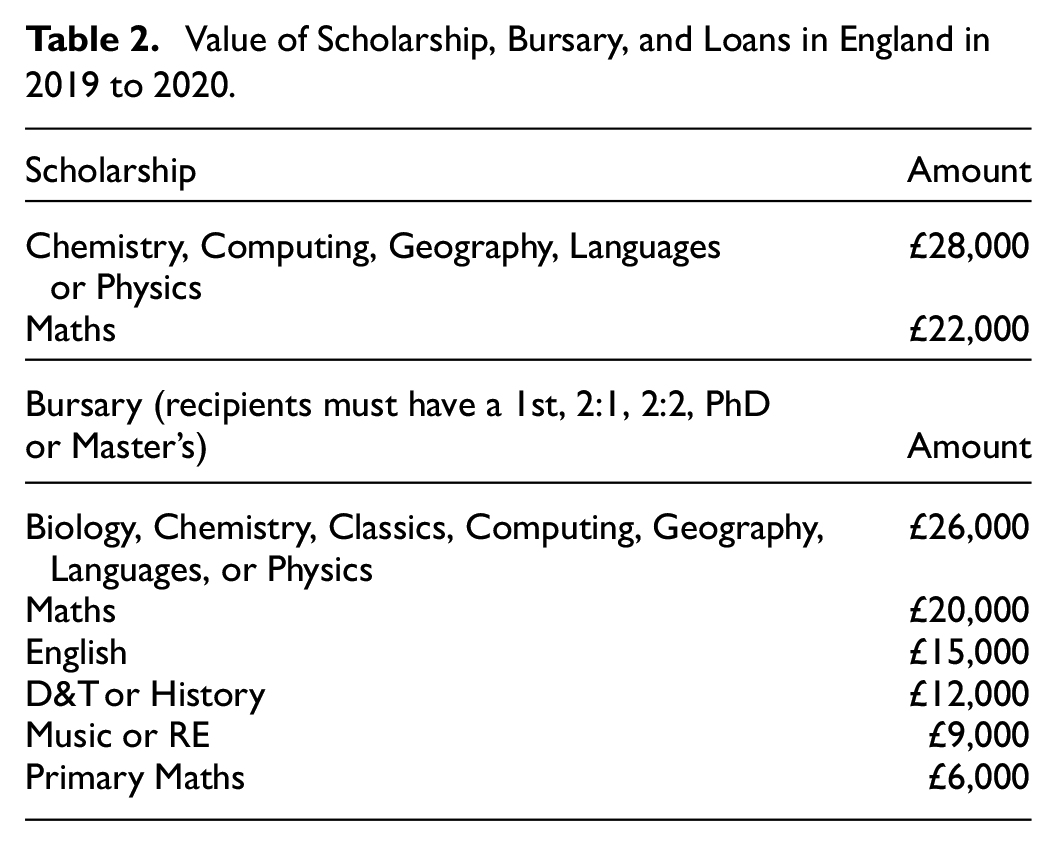
In contrast to the repayment thresholds built into tuition fee and maintenance loans, those who receive either a training bursary or a scholarship are not required to repay these, even if they choose not to go on to teach. Consequently, whilst the bursary and scholarship systems supported trainees in higher priority subjects, they simultaneously expected most primary school (except for mathematics) and many secondary school trainees (in subjects such as drama, physical education, social science, and art and design) to finance their training through tuition fee loans, maintenance loans, and any extra financial support available.
Given the differences in available funding, it would be remiss for any consideration of the inequities of incentivizing ITT not to explore the cost of 4 years of higher education in England (undergraduate plus postgraduate) and the commitment to further debt that comes with the desire to become a teacher. Rehman-Jones (2020, n.p.) gave the following example to represent the level of debt a student might accrue following a 3-year undergraduate degree in the England: “if you did a three-year course at £9,250 a year and got £6,378 a year for a maintenance loan, you’d graduate with £46,884 of debt.” Extrapolating that example across an additional year to complete a PGCE increases that debt to £62,512.
Both £46,884 and £62,512 of debt would be a daunting prospect to many prospective students, but for those in receipt of the biggest scholarship or bursary available, this burden would be significantly reduced. The tax-free nature of both the scholarship and the bursary, and the lack of any requirement to repay these stipends, means that a recipient of a chemistry, computing, geography, languages, or physics scholarship in 2019 to 2020 would have received the equivalent of a classroom teacher on the Max M6 band of the Teachers’ Pay Scale, that is, approximately £36,000 a year (see NASUWT, 2020). Similarly, a recipient of a biology, chemistry, classics, computing, geography, languages, or physics bursary would receive the equivalent of a classroom teacher on M5 or £33,000.
It is our belief that such incentives are offered with the best of intentions, that is, to address shortages in teaching. That said, little is known about the impact of financial incentives, or the lack therein, on individuals who opt to train to teach non-shortage subjects (Lynch & Casey, 2024). While we fully support the Government’s drive to recruit and retain excellent teachers, what concerns us most in this paper, however, is the impact of these good intentions on the teaching profession as a whole. In a system buoyed by high value scholarships and bursaries in shortage subjects, we were interested in knowing more about non-scholarship and non-bursary students, and the potential impact of economic incentives on them. We were also interested in better understanding the impact on different populations. This is especially important given that West et al. (2015), in their work on funding policy and families, found that “the effects of loans are worst for students from poor backgrounds with less access to family support” (p. 40). Furthermore, Allen et al. (2016) found that many trainees are unable to repay their loans across the course of their careers, due to high levels of pre-existing undergraduate debt. As a result, many low-income and ethnic minority trainees are forced to carefully consider the viability of undertaking teacher training (Griffith, 2019), thus reducing teacher diversity, whilst those who do complete a PGCE incur higher levels of debt. Worryingly, as Griffith (2019) found, educational debt has become unequally distributed among low income and ethnic minority students).
In their exploration of the determinants of student loan take-up in England, de Gayardon et al. (2019) placed financial need and a family’s financial resources as central to a student’s decision to take out student loans. They argued that students from high-income backgrounds are consistently better off throughout higher education and, subsequently, in the labor market because of their economic, cultural, and social advantages (Crawford et al., 2016; Forsyth & Furlong, 2003; Haveman & Smeeding, 2006). With financial help from their parents, these students can afford to pay for some or all their tuition fees and living costs up front and can avoid, or at least reduce, the need to take out student loans.
Conversely, trainees from low-income backgrounds depend on student finance systems, seeking part-time work, or relying on family and savings to be able to survive throughout the training year (Griffiths, 2019). Whilst there is a dearth of research exploring the impact of bursaries and scholarships in England, an emerging body of work in Ireland suggests that financial worries, alongside school and university work, is one of the most common factors causing feelings of pressure and stress among trainee teachers (Hanly & Heinz, 2022). Hanly and Heinz (2022, p. 2382) found that a very high percentage of Irish students in their study raised concerns not only about their finances, but also associated challenges around “work overload, lack of free time and, in some cases, wellbeing and/or mental health issues.” Furthermore, Prendergast et al. (2021, p. 590), in their study of financial stress in initial teacher education in Ireland, reported that “while the vast majority of those attending higher education in Ireland grapple with financial stress to some degree, this issue can be even more apparent for student teachers.”
The availability of bursaries and studentships to trainees in shortage subjects, regardless of socio-economic background, has the potential to further skew the financial inequities already prevalent in postgraduate ITT. Therefore, this research seeks to address a gap in the research related to the effect of financial incentives, or the absence of them, on individuals choosing to train as teachers in non-shortage subjects. Furthermore, it explores the actions non-incentivized trainee teachers take to offset the financial inequity they face. Specifically, it sought to understand whether trainee teachers were adding the role of part-time worker to their role of full-time trainee teacher (i.e., learners and earners, or (l)earners). It is vital that, as a field, teacher education better understands the impact of incentivizing trainee teachers in some subjects and at some age ranges and not others. Without this knowledge teacher education will remain ill-prepared and under-informed regarding the pressures of (l)earning to teach. The impact of this research lies in its potential to draw our attention to potential inequities in current funding policy in the England and, if needed, open doors to more equitable access to training incentives for individuals who aspire to be teachers in underrecruiting subjects both nationally and internationally.
Methods
Data Collection
After ethical consent was obtained from the Ethics Approvals (Human Participants) Sub-Committee at the Loughborough University (ref: SSEHS-2634), a convenience sampling method was used to recruit trainee teachers who were completing either a PGCE or a School Direct Non-Salaried (SDNS) ITT program in England during the 2019 to 2020 academic year. This sampling method was selected because it allowed us access to gatekeepers (which included lecturers and program leaders) at specific ITT institutions who, in turn, could make the research sample more accessible and grant us access to particular populations (Andoh-Arthur, 2019).
Gatekeepers were emailed an information letter regarding the research, as well as a pre-written email which they could send to ITT trainees and a link to an online survey. Gatekeeper email addresses were taken from university websites and proved unpredictable as a sole form of communication and participant recruitment. Given the vagrancies of email, and to maximize recruitment, we also sent out invitations to the online survey through our personal contacts and shared the survey on social media (i.e., X, formerly Twitter). Moreover, both the UCET and the Black, Asian and Minority Ethnic Educators (BAMEed) Network either included the survey link in their weekly email to teacher educators or included it in their monthly email to network members. Responses were higher from physical education (PE) trainees when compared to other subject areas. This is perhaps explained by two of the authors being physical educationalists.
Data were collected through online survey responses to 47 questions. The survey, that included both closed and open questions, used in the study to gather both quantitative and qualitative data. Prior to commencing the study, a pilot survey was shared with colleagues (N = 10) working in ITT who provided feedback to discern face validity of all questions (i.e., to determine if questions appeared to measure what they intended to). Survey questions began by asking respondents about their chosen route (i.e., primary or secondary), their subject(s), scholarships or bursaries received (see Table 2 for eligibility by subject and the value of the scholarship or bursary), whether they were accessing a tuition fee loan (£9,250), a maintenance loan (maximum of £11,672), additional financial support (e.g., if they had children, were a carer or had a disability) and/or received parental, guardian, partner, and/or family support. The second part of the survey asked respondents about additional paid work undertaken during their programs that is, the number of hours worked during term time (weekends and/or weekdays) and/or during school holidays, the reasons for undertaking part-time work, as well as if they had considered leaving the course and why. The final four questions were open to all survey respondents, with 160 (of 439) choosing to provide an open text response.
The survey, hosted on Online Surveys, was open for 93 days between 11th February and 14th May 2020. During this time, 450 individuals responded to the call for participants and started the survey. Nine of these exited after the first question which asked, “Are you currently studying for a PGCE or a School Direct Non-salaried qualification in England.” Two further respondents exited the survey before providing details of whether they were undertaking additional paid work during their PGCE or SDNS course were inputted and have been removed from the sample. As such the total number of complete respondents was 439.
Data Analysis
Quantitative data from Questions 4 to 44 were analyzed for the purposes of this paper. Most questions had categorical answers, with most requiring either a “yes” or “no” response, except for questions related to: age range respondents were training to teach (i.e., primary or secondary); subject taught; number of hours worked during holidays; weekend and weekdays; and sample characteristics (e.g., age, gender identity, etc.). Data were analyzed using IBM SPSS Statistics version 28. First, crosstabs were performed to examine whether the frequency distributions differed between those respondents who were and were not undertaking additional paid work during their PGCE or SDNS course in relation to whether they were or were not in receipt of funding (e.g., bursary or scholarship, tuition fee loan, etc.). Second, differences in relation to sample characteristics for those who reported undertaking additional paid work during their course were examined. All differences were assessed using Chi-square tests (i.e., categorical data).
Free text responses to questions 44 to 47, which allowed participants to provide written (i.e., qualitative) answers relating to their ITT experiences, were transferred to a password protected Microsoft OneNote documents by the third author. Miles and Huberman’s (1994) analytic actions were used to code the data inductively and deductively, specifically (a) condensing the data, (b) displaying the data for interpretation for the other authors, and (c) drawing conclusions based on the data’s meaning. Deductively, we collaboratively selected quotes to illustrate the single qualitative theme: “I am willing to be in financial turmoil for a year.”
Results
Quantitative Results
As shown in Table 3, of the 439 respondents, 156 (35.5%) were studying to teach at primary and 283 (64.5%) were studying to teach at secondary level. The majority (n = 113; 72%) of primary school trainees were studying to teach in specialist areas, such as special education needs (SEN) and early years foundation stage (EYFS). For secondary school trainees, most (n = 74; 26.1%) were studying to teach physical education, followed by science (n = 48; 17.0%) and humanities-based subjects (n = 37; 13.1%). Only 1 out of 153 primary school participants (0.64%) received a bursary for teacher training. In stark contrast, 55% (155 out of 282) of secondary school participants were in receipt of a bursary or scholarship.
Frequency (and Percentage) of Respondents Studying to Teach Specific Subjects at Primary or Secondary School Level.

Table 4 shows the number of respondents who did or did not report undertaking additional paid work during their ITT course relative to whether they were or were not in receipt of funding (e.g., bursary or scholarship, tuition fee loan, etc.). Most respondents (n = 324; 73.8%) reported that they did not undertake paid work, irrespective of whether they were in receipt of a bursary or scholarship. However, for respondents who did work during their ITT course, a significantly higher proportion did not receive a bursary or scholarship (χ2(1, N = 439) = 30.9, p < .001). Similarly, a higher proportion of those who worked also accessed a tuition fee loan (χ2(1, N = 439) = 5.0, p = .026) and/or maintenance loan (χ2(1, N = 438) = 10.4, p = .001). The proportion of respondents who worked and were in receipt of additional financial support (i.e., from state benefits, a family member/friend) did not significantly differ from those who were not in receipt of financial support (p ≥ .15). On this basis, individuals who work during their ITT course may be more likely to be (1) studying to teach subjects that are ineligible for a bursary or scholarship, and (2) accessing a tuition fee and/or maintenance loan to further supplement their income.
Crosstabs Showing the Frequency Distributions Between Those Who Were and Were Not Undertaking Additional Paid Work During Their PGCE Course in Relation to whether They Were or Were Not in Receipt of Funding (e.g., Bursary or Scholarship, Tuition Fee Loan, etc.).

Bold indicates a p-value <.05.
Table 5 shows the sample characteristics for the 115 (of 439) respondents who reported undertaking additional paid work during their ITT course. Overall, a significantly higher proportion of these respondents reported working during holiday time (n = 102; 88.7%) and term-time weekends (n = 91; 79.1%), working between 1 and 9 or 10 to 19 hr/week. It is also important to note that more than a third of respondents worked during term-time weekdays (n = 44; 38.3%) that is, alongside their university and school-based work. In addition, a significantly higher proportion of respondents who reported working did so for multiple reasons (n = 80; 70.2%), were in the younger 20 to 29 years age category (n = 103; 90.4%), were female (n = 85, 73.9%), were single (n = 101; 88.6%), lived at home with parents (n = 59; 51.4%), and traveled more than 10 miles from home to their university campus (n = 56; 49.1%) and placement school (n = 50; 43.9%). Although a significantly lower proportion of respondents who reported working had considered leaving their ITT course (n = 40; 34.8%), of those workers who had did consider leaving this was for financial reasons (n = 23; 76.7%).
Differences Between the Sample Characteristics for the 115 (of 439) Respondents Who Reported Undertaking Additional Paid Work During Their ITT Course. All Differences Were Assessed Using Chi-square Tests.

Bold indicates a p-value <.05.
Qualitative Results
Our analysis of the 160 qualitative responses to the final four questions highlighted the differences respondents experienced in terms of funding.
“I am Willing to be in Financial Turmoil for a Year.”
One student, whose words are representative of the majority of working respondents, gave voice to the unfairness she saw in the system: I know a number of people who have been enticed by the bursary available to them and with job hunting proving unsuccessful, decided that nearly £30,000 to train as a teacher for a year is a good salary to earn while they work things out in regard to what they want to do. It’s not a passion of theirs, the desire to teach is purely because of the bursary. Therefore, when I am following a career I am so passionate about that I am willing to be in financial turmoil for a year it just does not seem fair. [Secondary PE Trainee]
Feelings of being treated unjustly and unfairly were common in the data. One respondent, a secondary mathematics trainee with a bursary, inadvertently confirmed the accusation made above when they admitted that they “only stayed to finish the course as I get paid every month.” Other trainees held similarly negative perspectives regarding what some perceived as differences in the value and status of different subjects based on the funding available: Art & Design secondary PGCE is not currently a funded course, which does lead to a sense of being an under-appreciated subject. This can be difficult to navigate. [Secondary Art & Design Trainee, no bursary/scholarship] I would like to query why only Secondary and Primary with Maths receive bursaries, when others work just as hard. Secondary only teach one specialist subject but Primary teach all subjects. [Primary with Computing Trainee, no bursary/scholarship]
Not all respondents felt bursaries and scholarships were bad. One, a secondary geography trainee with a bursary, stated that they “are important as it draws in more people of a higher caliber.” The disparity of award, however, meant that others found that the funding provided was still not enough: I have to cycle everywhere as I cannot afford transport [even] with the bursary. This means I will need to have a shower in my next placement which is over an hour’s cycle ride away from my home. I am unwilling to take out a maintenance loan because of the amount of interest it builds. [Secondary Religious Education Trainee, with bursary]
Others, including those in receipt of a bursary, recognized inequity in the system. For others, the reality of debt in undergraduate and postgraduate higher education meant that they financed their training by increasing their student debt: I think that the tax-free bursary has extremely helped in living costs throughout the training course so far. There are others on training courses who do not receive bursaries and have to work during the weekends which I would find extremely tiring, especially due to the stressors of the training year. I think that there should be some sort of bursary available to these trainees which would take off some of the financial pressures associated with training to become a teacher. [Secondary Geography Trainee, with bursary] Even though I am a chemistry teacher trainee, I am not accessible to bursary due to having pass certificate, which is unfair [Secondary Chemistry Trainee, no bursary/scholarship] I feel that we are doing the same course and therefore should all get the same access to funds, bursaries, and other financial schemes. I feel very cheated, particularly as I have taken on the task of learning to teach a second subject. This subject is biology/science which receive one of the largest bursaries available! So not only am I training to teach my subject but alongside this I am learning an entirely new one and getting no financial support. I genuinely would not have been able to get through this year financially if I had still been a single parent!! [Secondary PE with Biology/Science Trainee, no bursary/scholarship] I took the loans from student finance due to my vast loans already, after this year I will have approximately £100,000 of student loans debt. [Secondary Mathematics Trainee, with bursary]
Across both the quantitative and qualitative data, there is evidence that many (115 out of 439, 26.1%) postgraduate teacher trainees, both with and without a bursary/scholarship, were further supplementing their income as they sought to qualify to teach (with the attendant long hours and perceptions of free labor). In undertaking what could be described as work-plus-work, these trainees are not only required to match the working hours of their fellow trainee teachers but also undertake, in some cases, holiday, weekday evening and weekend work. In doing so they positioned themselves, either through choice or necessity, as both learners and earners, that is, (l)earners. In what remains of this paper, we explore the real-world impact on those trainees without additional funding of the policy decision to financially incentivize shortage subjects in England. We do this to provide examples of the impact on some trainees of failing to equally value the work of every trainee teacher.
Discussion
Little is known about the potential impact of the lack of financial recruitment and retention incentives on teachers of non-shortage subjects, nor on different populations within this larger group. The purpose of this research was to better understand whether the absence of a scholarship or a bursary for postgraduate ITT trainees would have unforeseen and unintended consequences. Our quantitative results showed that, for those who worked during their ITT course (i.e., (l)earners), a significantly higher proportion did not receive a bursary or scholarship, accessed a tuition on fee and/or maintenance loan, worked for multiple reasons (e.g., subsistence, travel, accommodation), were younger (20–29), identified as female, single, lived with their parents and traveled more than 10 miles to the university campus and their placement schools. These findings allow us to create a pen portrait of a young, female PGCE trainee, who does not receive a bursary or scholarship. She is accessing both a tuition fee loan and a maintenance loan, is living at home with her parents and traveling more than 10 miles to university and her placement schools. Furthermore, she is working for between 1 and 19 hr during university holidays and at weekends. Finally, while she may not have considered leaving her course (perhaps because she was taking significant steps to limit her outgoings by living at home and supplementing her income with loans and paid work), if she had thought of leaving, it would likely to have been for financial reasons.
Whilst this is not the description of a person, or a group of people, undertaking postgraduate ITT courses in England that any policy maker would have envisioned or endorsed, it does paint a picture of inequality. Coupled with the striking number of pre-existing workload concerns relating to teaching and teacher training (Allen et al., 2016; Quickfall et al., 2020) there is, in these findings, a suggestion of other inequalities regarding gender, socio-economic background, and subject in the current recruitment strategy. Although our sample was predominantly white, preventing a detailed discussion on ethnicity, we direct readers to an earlier paper (Masked for Peer Review) where the relationship between ethnicity and inequality is explored in greater depth.
(L)earner Workload Concerns
Allen et al.’s (2020) study on England’s teacher workforce revealed that teachers typically work long hours (median of 50 hr/week) during term time with around 40% reporting working on weekday evenings, 10% on weekends, and 7% at night. Overlaying our findings with these and remembering the advice given to Quickfall et al. (2020, n.p.) that as trainee teachers they should “submit to unreasonable expectations [during teacher training],” we perceive some worrying outcomes, especially for those trainee teachers with similar working hours comparable to those reported above. Furthermore, and given the high percentages of the 115 (l)earners in this study working during term-time weekends and term-time weekdays, there may be many incidences where trainees are working nearly 70 hr a week for the entirety of their ITT programs.
We neither condone nor support the normalcy that such draconian working practices have achieved. We are, however, concerned by the number of trainees who may be: (a) learning to teach while earning to sustain themselves, and/or (b) missing out on opportunities to match high expectations of university and school-based colleagues because they are having to undertake additional paid employment. These concerns are heightened when we consider the pen portrait we have created and begin to catalog the inequities inherent in higher education in England.
Debt Avoidance
One way for students to manage their financial needs and avoid or minimize the need to take on student loans is to adopt “debt avoidance mechanisms” (de Gayardon et al., 2019, p. 968). Such actions often involve living with their family and/or working whilst studying (Artess et al., 2014; Bates et al., 2009; Callender, 2008). Despite the financial benefits inherent in not paying rent and working, there are, arguably, several notable disadvantages to these practices. In their study of student loan take-up in England, de Gayardon et al. (2019) reported that working during term time can negatively impact on academic performance and increase the risk of dropping out. Indeed, they found that for students “living at home while studying is a significant debt avoidance mechanism” (p. 979). Significantly, and as depicted in the pen-portrait presented above, research suggests that females are more risk-adverse than males and, as such, are more likely to live at home (Artess et al., 2014) and work during term-time (de Gayardon et al., 2019; Eckel & Grossman, 2002; Galizzi et al., 2016). Artess et al. (2014) also reported that students from households with lower socioeconomic status were more likely to reside with their families compared to those from households with higher socioeconomic status.
The introduction and proliferation of student loans, and the associated tactic of debt avoidance, has had a significant impact on university students. In her work exploring the impact of term-time employment on higher education students’ academic attainment and achievement, Callender (2008) reported on the growing importance of working alongside studying during term-time. In her sample of 1,360 full-time “home” final year undergraduate students, more than “four in five students worked because they ‘need the money for basic essentials,’ and the same proportion worked because they ‘can’t manage just on my student loan’” (Callender, 2008, p. 368). Callender also found that more than half the students who worked did so because their families could not support them, with 77% of those students coming from deprived backgrounds. While termtime employment and living with parents are not new strategies for students managing debt, they both mark an upward shift in the level of personal responsibility students are taking for their university education. Given the recognized increase in debt avoidance at undergraduate level, it is unsurprising to see post-graduate students, with the added demands of a professional training course, adopting the same approach. What is worrying, however, is that these tactics are: (a) more likely to be adopted by disadvantaged students when compared to their wealthier peers (Callender, 2008), and (b) have greater negative impact on students from disadvantaged backgrounds with less access to family support (Barr, 2012).
A Hierarchy of Both Subjects and Levels of Schooling
Workload is a systemic and enduring concern in teaching and teacher recruitment. It is recognized as a significant factor in teacher attrition, and yet we have a system that potentially penalizes trainee teachers because of the subject they wish to teach. Teaching has long been described as a vocation where teachers care about children’s successes in life (Estola et al., 2003) and many trainee teachers report a long-held ambition to teach their favorite subject. The financial incentivization of shortage subjects, however, is creating several divides between various levels of schooling and different subjects. For example, only one subject is eligible for a bursary in primary education, whilst 12 are eligible in secondary. In our sample, only 1 out of 153 primary school respondents (0.64%) received a bursary to train to teach. This compares to 155 out of 282 (55%) of secondary school respondents who received either a scholarship or a bursary. Equally, such incentivization may impact students’ choice of level and subject in their efforts to teach whilst simultaneously avoiding debt. We are professionally obliged to ask what sort of message, for example, does this send to (1) primary level trainee teachers about the perceived value of their level of schooling? (2) the 128 primary trainees who have no chance of a bursary? (3) the 21 secondary school trainees in eligible subjects who receive neither a scholarship nor a bursary, trainees who might be better teachers than their stipend-receiving peers? or (4) the 106 secondary level trainees who teach in subjects ineligible for a scholarship or a bursary?
In the UK, due to the focus of successive governments on recruiting and training individuals rather than re-culturing teaching and ensuring that it is a profession that attracts excellent teachers (Fullan, 2016), we are in a position where, through no fault of their own, lower value scholarship or bursary and non-scholarship or bursary recipients are training, often in the same institutions, alongside high value scholarship or bursary recipients in shortage subjects. The reality for many students—and the universities in which they study—is that the highest “earners” and the lowest “earners” often use the same resources, be it lecture halls or car sharing (or pooling) to and from work. Ultimately, we are compelled to highlight the inequity in subject and phase funding in ITT and feel that it serves as an important reminder that policy (i.e., funding) can affect practice (i.e., a significantly higher proportion of trainees without bursary/scholarship worked). Moreover, the immense pressure that trainees face, especially those who are working long hours with little rest, might result in even lower teacher training satisfaction, and greater burnout and retention issues, which, in turn, could be a real loss to the profession.
Limitations
The scope of this study was limited by the fact that two of the authors are subject specialists in PE. This inevitably yielded a greater number of PE trainee responses from our professional networks. To reduce the risk of potential sample biases in future research, collaboration with colleagues from other disciplines could allow for the recruitment of a more representative sample of trainees from different subject areas. Secondly, as scholars with a critical perspective and a commitment to activism, we may have been inclined to find evidence in our data that aligned with the experiences shared by our trainee teachers during their teaching practices. Consequently, the disparities we identified in the process of learning to teach—and the broader realities of these trainee teachers as reflected in our findings—could have been influenced by our own preconceptions. Future research could, therefore, employ reflexivity practices, such as maintaining reflexive journals and/or conducting regular discussions amongst team members to ensure transparency of approach. Thirdly, our conclusions are drawn from a small sample of 439 participants, a small population of trainee teachers compared to the 29,580 new entrants to postgraduate ITT in 2019 to 2020 (DfE, 2019). Additionally, our sample was recruited entirely online and was predominantly White British. Future research should aim to recruit larger and more diverse samples that are more reflective of the teacher training population. This could be achieved by extending recruitment strategies beyond online methods, as well as targeting the recruitment of underrepresented groups through, for example, partnerships with national training providers and professional organizations.
Conclusion
Taken together, the findings of this study suggest that the English Government’s decision to address the enduring teacher recruitment crisis by offering scholarships and bursaries to some trainees and not others has created both financial inequalities and a hierarchical divide between trainees based on their subject choices. Previous research showed both that bursary schemes have not worked in other contexts and that the Government’s own analysis indicated that bursaries are not attracting bursary holders either into state education or education itself (Noble-Rogers, 2021; See et al., 2020). We suggest that bursary/scholarship schemes have had the unintended consequence of creating subject and level favoritism and workload inequalities. Importantly, the prospect of accruing vast sums of personal debt to learn to teach can either turn people away from the profession altogether, or see them engaging in debt avoidance strategies such as undertaking paid work and living at home which, as seen in this study, ultimately disadvantaged them.
While financial incentives can entice those looking for something to do while being paid simultaneously (what we might term as “bursary chasers”), it has not solved the teacher recruitment crisis. Policy makers and political lobbyists need to be aware of the implications of their policymaking. The decision to incentivize graduates into the teaching profession by offering financial rewards in shortage subjects and shortage districts is a laudable one. That said, and as this study shows, it risks creating a hierarchy and economic “class” system not only within ITT, but also between subjects inside and outside institutions where students and lecturers continue to consider their subject as either more or less valuable. Trainee hierarchy could impact on specific trainees who receive little to no incentivization to make them feel resentful that their peers in other subjects are gaining significantly more financial support than them, especially knowing that they may not go on to teach. When we also consider that female students are more risk-adverse than their male counterparts (Eckel & Grossman, 2002; Galizzi et al., 2016) then this picture of inequality begins to closely resemble our pen portrait.
In terms of a path forward, we suggest policy-makers review the value of awarding scholarships and bursaries where a certain number of years in the profession is not a requirement, and to what extent bursaries should be equally distributed or means-tested. We believe further work needs to be carried out in this area to establish the best course of action for a more equitable future of ITT scholarships and bursaries. Moreover, increased consistency of funding between phases and subjects warrants further investigation.
Ultimately, this study shows that trainees are aware of the inequity they face during teacher training and know what incentives others receive to enter what, in the end, will be the same profession, perhaps even the same school. In a world where neoliberalism and individualism prevail and the responsibility is put on the self, encouraging competition and creating hierarchies between subjects has the potential to result in further divisions which carry through to employment. For example, recruitment in easier to staff areas means joining teaching at the lowest point of the pay-scale, whereas shortage subjects can negotiate and start on a higher wage. Such a system is highly unfavorable to those teaching in non-shortage subjects and is wholly inequitable. As social justice advocates, we should instead promote an approach that favors collective unity and success of opportunity for
Footnotes
Declaration of Conflicting Interests
The author(s) declared no potential conflicts of interest with respect to the research, authorship, and/or publication of this article.
Funding
The author(s) received no financial support for the research, authorship, and/or publication of this article.

Data Availability Statement
Data sharing not applicable to this article as no datasets were generated or analyzed during the current study.