



Abstract
By following the qualitative evidence synthesis, this article reports on how education policy is made in Sudan by considering the contextual, socio-economical background of Sudanese education in the pre –post colonial era. Out of 39 published and unpublished documents, 33 documents were synthesized to answer these research questions: (1) who is responsible for education policymaking, and (2) how is the education policy made in Sudan? The analyses report that the promulgations of marco education policy in Sudan have been developed based on the contributions of different entities/bodies with a lack of transparency and consistency. The findings call for the presence of a transparent, consistent, integrated framework for education policymaking in the nation, which in effect facilitates the processes of effective implementations.
Keywords
Introduction
Educational policy can be found in initiatives, decisions or plans being developed according to educational perspective or philosophy and ideology of one’s region or country. It can be in the form of formal speeches collectively gathered from spokesmen or ministers of education, political parties, and/or president of a country. The “policy” concept was applied in political science research within education (Almond, 1990), and refers to a set of principles or a broad course of action, guiding the behavior of governments, organizations, corporations, and individuals (Cooper et al., 2004).
The dramatic transformations in the international policy environment have an impact on the formulation of national policies (Bray et al., 2007), leading scholars of comparative education to grappling with issues of international policy (Menashy & Verger, 2019). These transformations however indicated that the structural, normative, constituent, and technical dimensions can help in the evaluation and development along with the implementation of education policies.
Despite the presence of a few studies and reports on education policy (e.g., Abuharaz, 2007; Salman, 1995; UNESCO, 2018) in Sudan, the Sudanese educational policy was not discussed; rather, they focused on the issues facing planning to educating children (such as teacher’s education and children out of the formal education system). As a result, it is significant to draw the attention of policymakers and education scholars in Sudan on the importance of developing an integrated framework for the education policy making in Sudan based on the bodies contributing to these processes. Understanding how policy making is processed in different nations contributes to solidify international education policies.
In this article, we focus on how the K-12 education policy is made in Sudan. The article attempts to answer these research questions: (1) who is responsible for education policymaking, and (2) how is the education policy made in Sudan? The analyses report that the promulgations of marco education policy in Sudan have been developed based on the contributions of different entities/bodies with a lack of transparency and consistency. The findings call for the presence of a transparent, consistent, integrated framework for education policymaking in the nation, which in effect facilitates the processes of effective implementations. The article is structured into four sections. The first section details on the context of the study in terms of history and culture, socio-economic (comparative) situation of Sudan, and the current situation of Sudan and its effect on education. The second section presents how we collected and interpreted the data. The third section presents the findings of the study. And the fourth section provides the discussion and conclusion for the study. Following is a detail of the first section that contains three important themes.
Sudan and Sudanese Education: History and Culture
Sudan is located to the south of Egypt and Libya and has eastern sea-boarders with Saudi Arabia. One of the main five general directives or purposes of the Sudanese educational system is to primarily develop and/or establish the spirit of patriotism and preserve the cultural heritage of Sudan along with the awareness of the cultural relationship with African, Arab and other nations, regardless of the emphasis on the Afro-Arab culture background in the general Sudanese educational objectives of 1992 and Article 25 of the Child Act 2004 Provisional Decree (Alamin, 2015; Nasir, 1990; Omer, 2015; Siddiek, 2012; UNESCO, 2012b).
Sudan was colonized by the United Kingdom during the era of 1899 to 1956, thereby creating an influence in the post-colonial era till the present. For instance, the root of the present Sudanese educational system follows the colonial era, consisting of pre-school education, basic (compulsory) education compulsory (9 years), and secondary education (3 years). The higher education takes place at universities and colleges (5- and 4-year levels respectively). Such systems were adopted primarily from the National Educational Policy conference in 1990. Following is a comparative lens on the socio-economy and Sudanese education.
Socio-economy and Sudanese Education: A Comparative Lens
By the end of 2012, the population was 35.1 million (Sudanese Ministry of the Cabinet [SMC], 2013). Sudan spends less on its basic education as compared to its peers in Africa, and Middle Eastern countries of lower and middle income. The World Bank (2012) reported that Sudan’s Gross Domestic Product (GDP) was 58.77 billion US dollars and while the GDP was 16.95 USD per capita, it was still considered as a lower income in a middle-class country. In the same year, the spending on Sudanese education was 2.7% derived from the total GDP. About 49% from the whole education budget supports basic education. The budget expenditure items have reportedly been as 91% from the entire budget scheme which also support the current expenditures of education in general, whereas 9% was only allocated to the educational development funds. Further, 91% of the current expenditures mainly support the salaries of teachers at all levels of education in Sudan (Federal Ministry of General Education [FMGE], 2012a).
Successful governments have considered education to be at the heart of economic development (Kelly et al., 2017). By considering the gross enrollment ratio (GER) as a measurable indicator for educational provision, UNESCO reports indicate that there is a relative increase between the percentages of GER and spending in education, so the situation of GER in Sudan is a normal result for the government policy toward spending on education. For example, the report of UNESCO (2012a) on Sub-Saharan Africa shows an increase of financial commitment or dedication to education, leading to progress in education. As such, the United Republic of Tanzania has spent only 2% of its Gross National Product (GNP) on education alone in 1999. Consequently, in 2010 the share was 6.2% at the same period, but it is primary net enrollment ratio that has doubled. With respect to Kenya, the government spent over 5% of its income on education over a decade and the enrollment ratio increased from 62% in 1999 to 83% in 2009. Egypt, Tunisia, Morocco, Ethiopia, and Chad invests between 3% and 7% of their GDP on education (FMGE, 2012a) while South Africa, which currently ranks as an emerging economy and upper middle income country, spends 7% to 8% of its GDP to the education sector (World Bank, 2015).
Investing in education is not a priority for the policy makers in Sudan. For example, the government announced in 2012 that there would be an increase to the education expenditure from 2.7% to 8% of GDP and 20% from the total government budget (FMGE, 2012a). Such statements are not implemented yet. Another example is that of the Sudanese budget for 2017 which shows that the government allocated about 123.6 million US dollars for the entire education sector, accounting for less than 1% from the total budget which was identified as 12.5 billion US dollars (Sudanese Ministry of Finance Report [SMFR], 2017). However, based on the above figures, it is obvious that the poor funding of education in Sudan has over time deprived a lot of Sudanese children an access to education.
Current Situation in Sudan and Its Effect on Education
Different economic issues have contributed to shaping the political landscape in Sudan before the occurrence of the revolution in December 2018. The revolt occurred mainly due to the unemployment of the youth and the lack of daily basic needs for the Sudanese as it is the case in some other Arab nations (Muthanna, 2013). However, the young protesters believed that the economic corruption and the incorrect national policies of the ruling regime were the core reasons for the issues facing their dreams of freedom and justice in the nation.
In April 2019, the young Sudanese protesters successfully removed the president Al-Bashir after thirty years in power. More than 8 months of continued civil disobedience has ended up in September 2019 with transferring the executive power to a civilian prime minister with a civilian cabinet, in addition to a mixed military–civilian collective head of state known as the Sovereignty Council of Sudan. Different speeches from the new transitional-regime leaders about the education quality have been delivered, stating commitments of reforms and new preferential and specific policies of increasing teachers’ salaries and spending in education. All these happenings have an impact on education directly or indirectly.
The Present Study
Methods
This study follows a qualitative evidence synthesis (QES) method which mainly aims to integrate and compare the findings of published qualitative studies (Grant & Booth, 2009). While Thomas and Harden (2008) referred to this as a thematic synthesis method, Grant and Booth (2009) described this type of study as a qualitative method for it “looks for “themes” or “constructs” that lie in or across individual qualitative studies” with “an interpretative [aim] in broadening understanding of a particular phenomenon” (p. 99). The authors selected this research method for its major characteristic that “findings from qualitative research may be more powerful than isolated comments from local questionnaires or surveys” (Grant & Booth, 2009, p. 100). Additionally, a major advantage of following this research method is that it can “. . . identify patterns in the data, explore similarities and differences across settings, lead to a new interpretive model or framework . . .” (Downe et al., 2019, p. 2). Further, the employment of the QES method is useful in providing key evidence that can contribute to informing guideline recommendations and other important decisions (Lewin et al., 2019). Additionally, the use of QES method is significant when developing important considerations for implementation (Glenton et al., 2019). Following is a presentation of the sampling frame.
Sampling Frame
With the focus on the who and how of the K-12 education policymaking in Sudan, we collected published and non-published studies and reports as data sources as long as they state, discuss or present policies related to K-12 education in Sudan. There is no publication data limitation or specification as the papers in Sudan exploring this area are scarce. Because of this, we considered and gathered documents in both Arabic and English languages. The same reason applies to the inclusion of unpublished reports. The first author reports that it was hard to access and locate this list of documents due to poor information system of data in the country. Figure 1 below illustrates the study sampling frame.
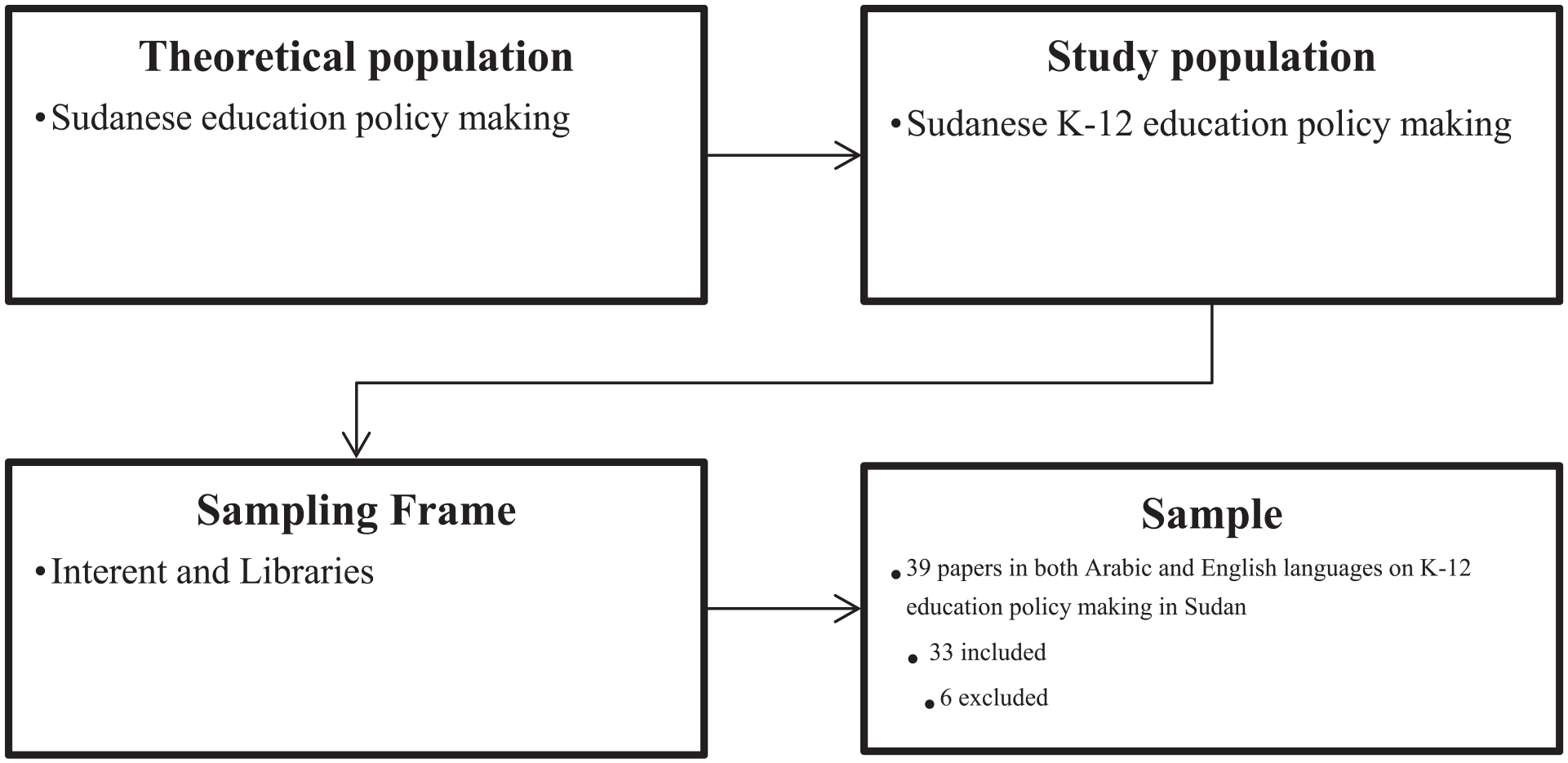
The sampling frame.
On average, 39 documents were included in this study of which 20 are in Arabic (51%) and the rest are in English (19 = 49%). The table below shows the characteristics of the included studies. After the screening of the content of these documents, six were excluded for not matching the criteria of inclusion. Resultantly, 33 documents are included. The following table shows the studies reviewed for the current study.
Measures and Procedures
The main inclusion criterion was the mentioning of Sudan and the K-12 education policy in Sudan. As previously mentioned, the study data sources are published and unpublished documents written in Arabic or English languages. The documents include reports from the following websites: Sudanese National Center for Curricula and Educational Research, Federal Ministry of General Education Educational Planning management, Federal Ministry of General Education Nomadic education department, Federal Ministry of Education Reports for UNESCO, the Department of Educational Documentation at Federal Ministry of General Education, Federal Ministry of General Education, Khartoum Ministry of Strategic Affairs, Sudan Open University Library, University of Khartoum Library, Sudan Parliament website and Sudanese Secondary Education Certificate.
With reference to Table 1 on the characteristics of the included studies, the data related to K-12 education policy is scarce in Sudan, so it was not possible to follow strict validity and reliability measures for the included studies and the extracted data. A number of studies are unpublished. Several sources are also reports made by officials of which some have been deleted from the Internet due to the current political situation in the country and the removal of the ex-president of the country. Furthermore, some of the documents are originally in Arabic and the data was extracted directly (i.e., literal translation and formal citation) to be used in the QES method.
Characteristics of the Included Studies.

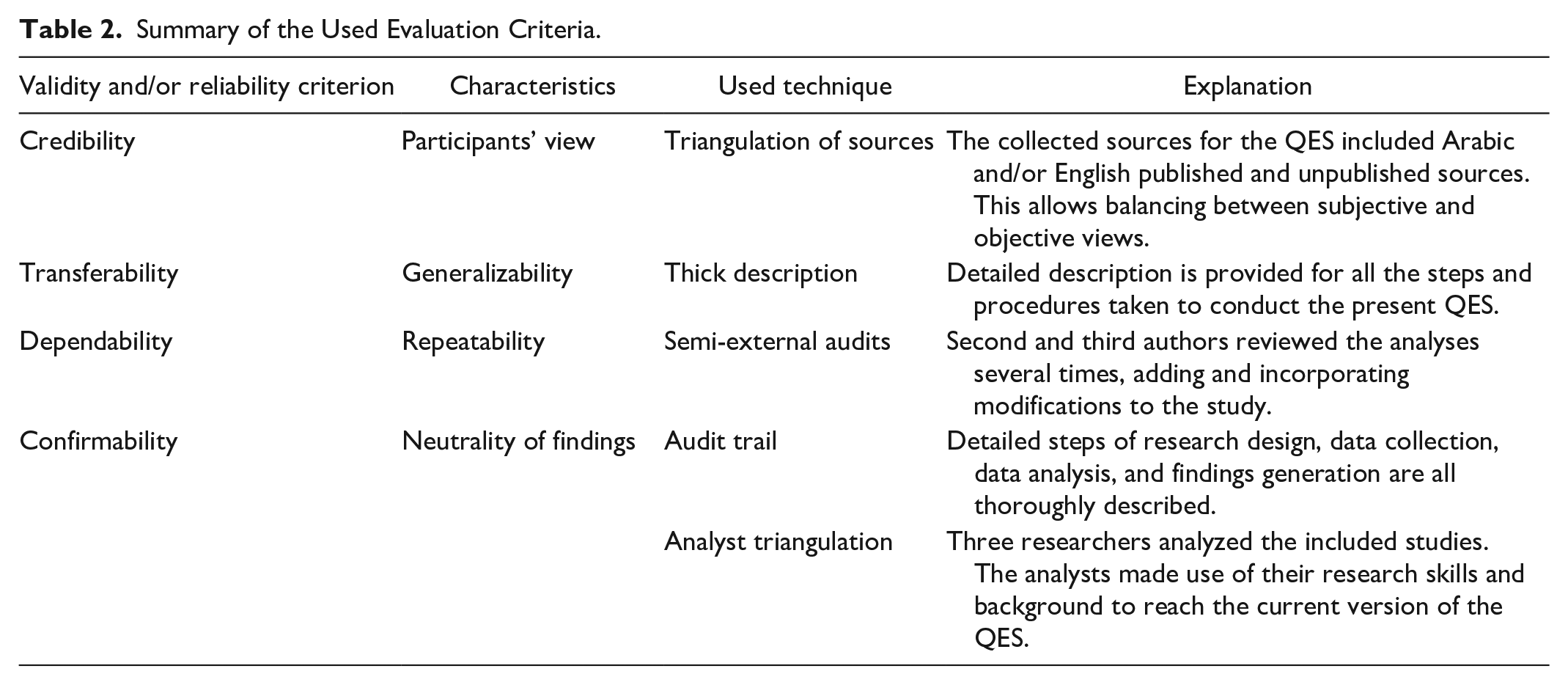
However, to ensure a good level of validity, the authors followed Guba and Lincoln’s four criteria for measuring validity in this study. Table 2 below demonstrates each of these four criteria and how they are approached and realized (Lincoln & Guba, 1985) in the current study.
Summary of the Used Evaluation Criteria.
Findings
We report the findings of this study in two main categories with sub-themes under each category.
Bodies Responsible for Education Policymaking in Sudan: Who and How?
Before 1991, governmental plans of Sudan were carried out in the form of short term-planning led by the Ministry of Financial and National Economy. After 1991, Sudan adopted the strategic planning by releasing the National Comprehensive Strategy (1991–2000) established by Khartoum Center for Strategic Planning (KCSP). In 2001, the 34th Presidency Decree announced the establishment of the National Council for Strategic Planning (NCSP) directly supervised by the president of Sudan. The announcement identified NCSP to be a federal governmental unit which is affiliated with the Ministry of Cabinet. As such, NCSP can be defined as a federal Sudanese institution, striving to attain success based on financial aspects or status of the Sudanese people and their hopes and expectations to be considered in the national strategies. Further, the National Higher Committee for Strategic Planning (NHCSP) was established and created under the 2001, 34th Presidency Decree. It is a committee of experts and counselors who also work under the supervision of the vice-president of Sudan. Its main roles are primarily to create the national commission who will be in-charge of national planning, and to promote preliminary directives pertaining to national plans and projects at all levels.
With respect to the National Secretariat for Strategic Planning (NSSP), its basic role is to provide the NCSP and NHCSP with essential reports and information needed to help policymakers formulate and finalize policies that benefit the entire nation. It should be highlighted that these federal ministries, while their roles mainly focus on developing, monitoring and evaluating the federal institutional plans, are in-charge of the preparation of the reports to the NSSP and NHCSP (KCSP, 1991; Omer, 2015; WHO, 2012). According to the Khartoum Ministry of Strategic Affairs (KMSA, 2017), the government of Sudan has apparently listed or recruited the counselors who belong to some national public institutions and also connected with the Strategic Counselors of Cabinet Ministry.
In view of this, in 2001 the government and the parliament of Sudan have released a policy which established the Council of Planning for Education as basically an advisory body responsible for educational planning in Sudan. Hence, this new organizational body works jointly with the FMGE and its affiliated departments by conducting reviews and granting their approval to the final version of education policy in one aspect and with NCSP and its affiliated committees on the other aspect. Subsequently, the council of ministers would, in consensus with the federal, provincial and local levels, ratify the strategy to be implemented (SP, 2017; UNESCO, 2012b).
Education planning management at the federal ministry of general education
Federal Ministry of General Education (FMGE) is divided into eight bodies of management that is, educational planning; educational training; educational qualifications; foreign educational relations; information and public relations; administrative affairs and services; students’ activities; and technical education and examinations. Additionally, there are also four administrative units belonging to the FMGE namely; NCCER, National Committee for Education, Culture and Science, General Secretarial for literacy and adults learning, and National Sudanese Center for Language. With respect to management units, there are four that belong to the FMGE:executive office, administration development, information center and financing management (FMGE, 2015).
Regarding the fourth governmental decree announced in 1991 -which hereby meant to ratifying the FMGE and its responsibilities (e.g., by managing and handling the educational process in the whole country)—aimed to lower and decrease the illiteracy rate amongst the citizens, to enhance and improve the national curriculum and teacher’s professional development according to the national strategies and approaches.
Education planning has become one of the most essential tasks of the FMGE after the implementation and carrying out of the governmental decentralization policies in the year of 1998. Since then, the FMGE is considered as a coordinator between the Ministry of Education in all states of Sudan and the central government relating to its divisions. It is also in-charge of the managerial tasks along with monitoring, planning and developing the governmental policies toward education for all states of Sudan (FMGE, 2004, 2015; UNESCO, 2012b). In 2002, the government of Sudan had declared its 32nd decree which basically pointed out the responsibilities of the FMGE and the FMGE-EPM. It aimed to adapt the international policies, considering the Sudanese culture and tradition, encouraging the reform of national curriculum for general education as a whole according to the national policies, coordinating efficiently and working with the Ministry of Higher Education to train general education teachers. It also aimed to advance the proposed policies, plans and projects for the vocational education. Addionally, it aimed to prepare the curriculum specifically for the illiteracy categories and displaced citizens and include those adults and pre-school education and those belonging to special categories with special needs and arrange such special plans to educate students with special needs. Meanwhile, it aimed to supervise the entire private and public education sector in Sudan and coordinate between the provincial ministers. Promoting basic international educational relationships with other countries and organizations was identified and acknowledged by the council of ministers (FMGE, 2012a, 2015). Figure 2 below, Adopted from FMGE (n.d.) website shows the Federal, provincial and common educational authorities as below:

Federal, provincial, and common educational authorities in Sudan.
Generally speaking, the direct responsibilities of the FMGE can further be gleaned upon in managing the Sudanese Secondary School Certificate and its qualification framework that are required for teachers, the basic development and the curriculum secondary education. Managing and overseeing the basic education certificate is considered as a provincial task/responsibility but pre-education is regarded as a local educational matter.
Additionally, there are several federal institutions that are actively involved in implementing educational tasks which are in coordination with the FMGE for example, Ministry of Welfare and Social Security, which works on educational activities for homeless orphans and learners with special educational needs. For example, the Ministry of Interior is in charge of educational programs and agendas for refugees; the Ministry of Health involves in some areas of programs of school pertaining to environmental matters; the Ministry of Labor relates to vocational trainings and programs of vocational education department; and the National Council for Technical and Technological Education -created and established in 2005- consolidates all of the programs of vocational education under the mantle of one accredited body (World Bank, 2012).
National Center for Curriculum and Educational Research (NCCER)
In 1934, the Bakht Alruda Educational Institute was introduced and established by the United Kingdom government at Aldwaim city, with the main role of providing professional training for in-service teachers. The institute is still located in the same city in the center of Sudan. However, in 1996 the government has changed its name to the National Center for Curriculum and Educational Research (NCCER). It further acknowledged its main responsibilities and tasks as to develop the national curriculum and the national and governmental research projects toward general education and to strengthen the links between the educational institutions at both regional and international levels (UNESCO, 2012b).
Generally, the NCCER is basically in charge of some federal educational planning matters. An example is the releasing of the process or initiative of Nomadic Education for 100 schools in Dafurs state in 1993, which was however subsequently approved in 1994 at the Sudanese Institute. Bakht Alruda has announced its establishment of the teaching strategy or approach for nomadic students as the special department for nomadic education (FMGE, 2007). Furthermore, in 2015 the NCCER promulgated a policymaking of basic education which is compulsory for the first 9 years, instead of 8 years of studying. The application of such policy started in the academic year of 2015/2016 for first-grade students. The policy implementation ends by 2024 when the students who started their basic education in 2015 will be in the ninth grade (FMGE, 2015).
Regional and International Organizations
International organizations, operating as transnational or multi-stakeholder partnerships, are growing in prominence (Bray et al., 2007; McPherson, 2016). The government of Sudan conforms to some regional and international organizations to be able to fairly provide basic education for all children in the nation. The main organizations are UNESCO, UNICEF, United Nations Organization of Islamic Conference (OIC) and Arab League Educational Cultural and Scientific Organization (ALESCO) that collaborate in the planning of education (FMGE plan, 2007).
In 1990, the Jomtien Conference was held with the slogan that “education is a fundamental right for all people, women and men, of all ages throughout the world” (UNESCO, 1994, p. 2). The conference had a positive impact toward Sudan; those responsible for education policymaking decided and conducted the Fifth National Educational Conference in September 1990, resulting in a further expansion and improvements in all levels of education in Sudan. Also, the Dakar Conference in 2000 primarily focused on the same goals introduced in the Jomtien Conference. However, it clearly emphasized that such goals and agendas pertaining to education for all needed to be attained by 2015 (UNESCO, 2000). The UNICEF (2014) reported that there are more than 3 million of Sudanese children out of basic education; it ranked Sudan as a country with the highest number of students out of compulsory education. However, there are several issues behind this ranking. For example, the insecurity situation in some southern areas caused the displacement of more than 2 million citizens. Further, more than 9% of Sudanese students are nomads with GER of less than 24% (UNESCO, 2018; UNICEF, 2014).
It should be noted that both international conferences such as Jomtien and Dakar introduced a new change into the education process in Sudan. For instance, the total of those students who have successfully passed in the secondary education examinations increased from 50,200 students statistically in 1990 to 260,000 in 2003 and eventually reached up to 499,000 students in 2017 (Sudanese Secondary Certificate Website, 2017). Apparently, since 1990, the percentage amongst the pre-education institutions has increased to 2.7% in a yearly basis whereas on the other hand, the percentage of illiteracy rate has gradually decreased its number from 72.9% in 1990 to 47.3% by the year of 1999 (FMGE, 2015; Gasim, 2010; UNESCO, 2012b; Zarrug, 2005).
However, after the introduction of Dakar Conference in 2000, the government of Sudan amended its educational constitution and by-laws, revised and changed the educational curriculum,andassembled for the sixth national education conference adopted in 1990 conference. The government also improved its role which was primarily stated in Bakht Alruda and eventually renamed the institute to “National Center for Curriculum and Educational Research.”
National Conferences for Education Policymaking
In Sudan, the bodies mentioned earlier work on preparing the education policy by participating in conferences that mainly focus on education policy preparation. Following is a presentation of the conferences used for discussing and preparing the education policy in the nation.
Educational policy conferences from 1969 to 1989
The first national education policy conference in the post-colonial era in Sudan was held in Khartoum in 1969 and resulted in amending the constitution ladder or levels from 4-4-4 (i.e., 4 years in primary education, 4 years in preparatory education and 4 years for secondary education) to 8-4 (i.e., 8 years for basic education and 4 years for secondary education). However, the Sudanese policymakers and educational experts at that time preferred and adopted the recommendation of the Arabian States Conference of 1970, and promptly changed the educational ladder to 6-3-3 (e.g., Daaud, 2005; Salman, 1995). Subsequently, in 1972 the FMGE held its meeting for its second education policy or approach which was promulgated by the conference itself and purportedly commissioned to Bakht Alruda Institute to further develop the national curriculum.
In 1972, the second conference held in Khartoum identified Bakht Alruda or NCCER to be responsible for developing the national curriculum; this policy works till now. The third and fourth conferences regarding education policy were in 1984 and 1987. According to Salman (1995), the pertinent decisions of the third and fourth conferences were not however implemented outright due to the fact that the policymakers during that time were unwilling to implement the same recommendations. There was some consideration of the prevailing political situation in Sudan that consequently made a direct effect toward Sudanese educational landscape. For example, Sudan had a political security and stability during and under the leadership of the former president Numairi during the era of 1969 until the year of 1985 thereof. However, in the period between 1984 and 1990, Sudan was under the leadership of four regimes. As a result, the third and fourth conferences had not however influenced the educational process in Sudan.
Educational policy conferences from 1990 to 2012
Al-Bashir’s regime had conducted a series of national conferences in 1990 to make significant and important changes regarding the political institutions, economy, peace process and higher education of Sudan (Gasim, 2010). Eventually, those events ended with the fifth conference which had a positive and great impact toward the Sudanese educational systems.
The fifth national conference with regard to education policies and approaches held its meeting in September 1990 and had however created an expansion for education in all states of Sudan and at all levels of education. Notably though, the recommendation of the conference had put an effect of great change toward the general education system (from 6 years for primary education, 3 years for secondary education and 3 years for higher secondary education to 8 years for basic education and 3 years of secondary education). Obviously, such a recommendation primarily aimed to increase the years of education in compulsory basis from 6to 8 years and subsequently merged all the students of the first grade to the eighth grade in one campus with the purpose of lessening the stages of the study from two stages of primary and secondary education to one stage r and to change its name or category to basic education.
According to Salman (1995), the national conferences of education policies before 1990 did not have a great impact on the educational process in Sudan. In effect however, this conference was the first national conference of education policies in Sudan. In addition, according to the 1990 conference, the government of Sudan basically formed and created an educational institution in 1991 and most of its recommendations were unanimously reached by approval and implemented eventually, that is, the expansion of higher and general educational systems in Sudan. Also, adopting the Arabization and/or acquiring an Arab customary, outlook and manners for the entire national curriculum included but not limited to the university level, and modified the general educational ladder from 6-3-3 to 8-3 years for the basic and secondary levels.
In the sixth Education Conference held in Khartoum in 2002, Abuharaz (2007) explained that this conference succeeded in changing the entire national curriculum and replaced it with current curriculum being implemented in the K-12 education system in Sudan. Abuharaz was an expert of the NCCER in that time, and later became the president of the NCCER. He stated that the other submitted papers were related to two major areas that is the monitoring of factual basis of educational performance, and the basic formatting and its framework of papers for National Education Strategy.
The educational policy conference in 2012
This conference was held in Khartoum with the purpose of changing or modifying the Sudanese educational ladder from 11to 12 years before attending the higher education institutions. In March 2014, the FMGE promulgated and thereby adopted such policy that pertaining to 9 years policy with regard to basic education. Additionally, in 2015, the new educational ladder was accordingly introduced to the basic education system and was gradually implemented to this policy in particular. Therefore, an such educational ladder was expected to be fully amended or modified from 8 years of basic education to 9 years by the year of 2024. However and in this regard, it should be emphasized that the sixth and seventh conferences, which basically held their meetings during Al-Bashir’s regime, did not unfortunately have the same apparent impact as compared to the fifth conference, particularly in terms of policies or basic approaches which related to spending in education. Put differently, both conferences emphasized and pointed out on raising the spending in education as a manifest national policy. Meanwhile, the experts from FMGE recommended to establish a new support fund particularly for the children out of basic education system, allotting thereby in proportion of the levels from animal exportation to however support the nomadic education system and thereby consequently increased the spending in education from 2.7% to 8% of Gross Domestic Product (GDP) (FMGE, 2012a). Unfortunately, such recommendations have still not been applied and as yet to be fully materialized with. In general, the recommendations of conferences (from 1st to 7th conference) on education policies shape the current general educational system and policies in Sudan.
A Visual Presentation of Findings
For a simple understanding of the above findings, Figure 3 below summarizes the conflict of education policymaking in Sudan. The figure is presented in four parts. First, it lists the possible factors causing the conflict of education. Second, it lists plus points which were achieved through responsible sectors for education administration in the country. This also includes the other activities held for supporting education in the country. The third part lists the minuses of these agencies, sectors and activities—leading to the expansion of education policymaking conflict. The last part proposes a few actions that are required for effective education reform in the country. As is seen, the presented evidence shows either absence or poor communication among this parties-leading to poor implementation or negligence of several education policies. Although the literature review—we reached—does not clearly state any ideological differences resulting from this conflict, it seems clear that this failure has emerged of possible conflict related to leadership and power differences among all these dynamic sectors in the education administration.

A visual representation of findings on education policymaking conflict in Sudan.
Discussion and Conclusion
Our study focused on exploring how the K-12 education policy is made and who contributes to making it in Sudan. The findings of this study reported a number of bodies and conferences for the policymaking in Sudan as shown in Figure 4 below.

The K-12 education policy making in Sudan.
The analyses showed two patterns affecting the education policy making in Sudan. First, the presence of several bodies responsible for making education policy in Sudan resulted in inconsistent policy making particularly when it comes to the implementation stages. Such finding supports that the absence of coordination among the involved bodies in the educational processes (Lea, 2018) form a key factor that weakens the formulation and implementation of education policies. It also worsens when these bodies are also formulating multiple policies without a national authority standardizing and mentoring the policymaking and implementation (O’Doherty, 2014). Second, the impact of national, regional, and international educational and non-educational conferences were insufficient and ineffective to level up the educational system in the country. In many cases, the intention of the country to implement a certain policy from, for example, the Arab States or from an international organization has negatively impacted the educational system, -instead of improving it-, due to the broad limitations and conditions—put forward by such funders. This goes in line with the findings that the complexity of formulating and implementing education policies increase when a particular country either adopts or is required to adopt another country’s educational policies based on funding agreements, and financial loans (Milić, 2018).
These two patterns add to the existing literature on the need for reforming education policy in Sudan generally and for the K-12 education in particular. For instance, Tairab and Ronghuai (2017) concluded that the problem in Sudan is the implementation of the policy other than policy itself and they emphasized in particular on the importance of technology inclusion for K-12 education in Sudan. Besides, Elsunni and Xiaohong (2014) concluded that Sudan as a developing country failed to enact and implement any policy for the integration of technology in education. Furthermore, Kheir (1987) described the education policy making in Sudan between 1975 and 1985, mainly higher education, as being guided politically to match the interests of the existing political regime. The continuous wars and instability have made it hard to fully realize any implemented policy (Ismail, 1992). Further, Karar (2019) argued that both political leadership and political economy drive the education policy making with evidence for analyzing policy making in Sudan between 1990 and 2000.
Given the fact that education policies fail when there is either absence of interaction or poor interaction among educational actors (i.e., the former is referred to mutual adaptation [McLaughlin, 1990] and the latter is referred to accountability [Thorn & Harris, 2013]), it is important to propose a framework—to policymakers, decision-makers, and all relevant parties toward a better K-12 education policy making in Sudan. This is being motivated by the assumption that the conflict among the education actors in Sudan resulted into failure of the whole educational system. Yoo (2019) argued that the conflict among political actors including government, teachers and schools resulted into the failure of adopting a new education policy at the national, regional and school levels in South Korea. In this regard, Kremer-Asaf (2015) argued that “most educational systems in nowadays are hierarchical organization [that are] bureaucratic organizations that protect their own turf by controlling policy in their area of expertise” (p. 281). The author encourages either adapting or adopting models from political sciences to ensure successful implementation of education policies. Should policymakers in Sudan consider these? Above all, Edwards (2017) and Edwards and Higa (2018) proposed the use of school-based management (SBM) to countries that are classified as conflict-affected contexts (CACs) as a governance model to ensure better policy implementation and development achievement. Recently, Rohner and Saia (2019) showed the impact of political conflicts on educational systems mainly armed conflicts. The more relevant issue to Sudan on the SBM and CACs framework is that evidence about the interference of international organizations on education can either positively or negatively impact the implementation of an education policy and the development of educational system in a certain country. Should leaders in Sudan reconsider the adaptation of any fully funded proposed education policy that will not really improve education as being irrelevant to the current educational system of the country? This is ensured by the fact that the focus of the organization is to report the progress of a certain policy, in many cases, without considering the pre-conflict and post-conflict situations. Nevertheless, other researchers argue in favor of the usefulness of borrowing and adapting other policies from developed nations. For instance, Irwin (2019) argued that “policy borrowing” can be positive to guide and match certain needs of a country regardless of the differences between the country of origin and the adapting country with evidence from Northern Ireland and the UK (p. 274). In short, the current state of K-12 education policy making in Sudan is also similar to that picturized by Novelli et al. (2019) who introduced the 4Rs framework: redistribution, recognition, representation and reconciliation. This framework allows making a shared political system and educational system that serve for the betterment of the nation instead of serving one’s own interests or political perspectives. In this regard, Molokwane (2019) showed how policy networks impact policy making in terms of the interaction among power, conflict and cooperation.
In conclusion, the lack of systematic policy making processes and transparency in the nation makes the decisions coming from different institutions/sectors on national and international levels harder for implementation. Therefore, it is important for the policymakers of the new regime to develop a policy framework that describes clearly and transparently the roles of each entity and explains each role for any institution involved in the national education policies.
Footnotes
Declaration of Conflicting Interests
The author(s) declared no potential conflicts of interest with respect to the research, authorship, and/or publication of this article.
Funding
The author(s) received no financial support for the research, authorship, and/or publication of this article.
