




Abstract
There is a well documented connection between children’s exposure to adverse childhood events (ACEs) and the risk of negative outcomes. However, many children with ACE exposure go on to perform fairly well in life, due to the support from multiple interacting systems within and around them. Resilience science has led to the development of creative interventions and policies that prevent negative outcomes for children. There is growing attention, though, to the promotion of positive outcomes such as flourishing, which matters profoundly to individual and collective well-being. Flourishing has not been well examined in young people exposed to adversity, especially in early childhood. The objective of this work is to identify family-level mechanisms that support children’s flourishing amid adversity. It draws from a nationally representative sample of children from the United States under the age of six (n = 8,174) who were included in the National Survey of Children’s Health (NSCH). In addition to surveys on ACE exposure, the NSCH used a four-item index to measure children’s flourishing, which was operationalized as positive emotionality, relational health, and emotional resilience. Using structural equation modeling (SEM) with path analysis, this work found that exposure to ACEs was negatively and directly associated with children’s flourishing, but that children in families with higher family resilience showed higher levels of flourishing. Furthermore, there were indirect associations between ACEs and flourishing, where about 60% of the effect of ACEs on flourishing was mediated through family resilience. We offer program- and policy-level suggestions for enhancing young children’s flourishing through promotion of family resilience and prevention of ACEs.
Plain Language Summary
This study looked at how family resilience can help young children thrive even after difficult life events. Results showed that children from families who talk through problems, stay hopeful, and work together tend to show more curiosity, laughter, and ability to bounce back. Building family resilience may help promote children’s wellbeing.
Key Points
A nationally representative study examined the impact of adverse childhood experiences (ACEs) on flourishing in early childhood in the United States.
Flourishing for young children is directly related to lower levels of ACEs and higher levels of family resilience practices.
Family resilience mediates the relationship between ACEs and flourishing, accounting for about 60% of the effects.
Policy and intervention personnel alike should prioritize both preventing ACEs and promoting family resilience capacity to support healthy child development.
Many of the most salient developmental tasks for young children—positive relationship formation, basic emotion regulation, and exploration of surroundings—are measured at the individual level but largely reflect processes occurring in the child’s environment. It is not surprising, then, that threat and deprivation in the home or community may impact how children develop positive functioning skills. Adversities like poverty, domestic violence, or parental mental illness can harm children directly while also impeding caregiving processes that nurture development (Bowen, 2015; Brown, 2018; Jensen, 2009). The impacts of adversity on the family system are particularly concerning given how intimately child wellbeing is connected to family well-being (Masten & Monn, 2015) and given that supportive family processes are key buffers of stress for children (Masten & Palmer, 2019). Thus, the goal of the current study is to examine the relationships between adverse childhood experiences (ACEs), family resilience and flourishing behaviors in early childhood using a nationally representative sample of young children in the United States, and to examine whether family resilience explains relationships between ACEs and flourishing.
The Impacts of Adverse Childhood Experiences (ACEs) on Children and Families
The original 1998 study on adverse childhood experiences (ACEs; Felitti et al., 1998) has inspired decades of research showing that hardships experienced during early childhood can have long-lasting negative effects on health and wellbeing (Karatekin et al., 2022). Although the original ACEs questionnaire focused on ten items related to abuse, neglect and family dysfunction (Felitti et al., 1998), researchers have also begun considering how additional challenges such as economic hardship, discrimination, and neighborhood violence impact development (e.g., C. D. Bethell et al., 2019; Turney, 2020). It is now known that exposure to a wide range of ACEs (including those outside of the original ten) are linked to developmental challenges across domains (Hughes et al., 2017), including impeded flourishing in youth (C. D. Bethell et al., 2019). Further, the more ACEs an individual experiences, the higher their risk for poor outcomes (i.e., cumulative effect: Hughes et al., 2017). Importantly, these negative outcomes emerge across multiple domains of a child’s functioning, including neurobiology, behavior, and even stress metabolism (McLaughlin et al., 2020; Womersley et al., 2021). Even though ACEs are common across individuals and socioeconomic statuses in the United States, children from lower income families and children of color are disproportionately likely to experience higher numbers of ACEs (Ports et al., 2020), demonstrating how material circumstances (e.g., poverty) and psychosocial experiences (e.g., domestic violence) are embedded in the social determinants of health inequities (Solar & Irwin, 2010).
Because ACEs have long-term negative effects, they impact both young people and adults, including caregivers. For example, a recent scoping review found that maternal ACEs are associated directly and indirectly to a wide-range of child outcomes, and that this is often explained by maternal mental health and parenting practices (Zhang et al., 2022). Since ACEs are embedded in the social determinants of health inequities (Bruner, 2017; Karatekin et al., 2022), children are also more likely to grow up in similar environments to their caregivers (e.g., poverty or structural racism), increasing the likelihood that they will experience similar ACEs to their caregivers (e.g., economic hardship, community violence; McEwen & McEwen, 2017; Schickedanz et al., 2021). Researchers therefore argue that ACEs and their consequences are passed down across generations (Narayan et al., 2021).
Additionally, adversity and stress experienced during adulthood impacts caregivers and their ability to provide support to their children consistently. For example, ample research demonstrates that poverty is associated with increased stress and mental health problems in caregivers (Johnson et al., 2019; Magnuson & Duncan, 2019), and that poor mental health and stress are associated with less positive parenting practices (e.g., self-efficacy, supportive parenting behaviors; Choi & Becher, 2019; Crnic & Ross, 2017). That is to say, caregiver stress and mental health “trickle down” to impact the child (Choi & Becher, 2019; Zhang et al., 2022). Children’s ACEs are also associated with stress and mental health in caregivers, which may explain part of the relationship between child ACEs and poor outcomes (Uddin et al., 2020). This is most likely because adversity experienced by a caregiver or child often influences the entire family system. However, family systems experiencing adversity do not necessarily lack family-level resources that can support positive adaptation and functioning (Walsh, 2016).
Child and Family Resilience
Although ACEs are considered risk factors for children and families, there is often variation in outcomes, as many children and families adapt and “do well” in the face of adversity by leveraging resources in their environment. Just as environmental risk processes can shape development both directly and indirectly, the presence of developmental assets at one level of a child’s ecology can “cascade” across time and domains to promote positive outcomes. Many children exposed to risk show better-than-expected developmental outcomes as they lean on their families, schools, and communities (Masten, 2015; Ungar, 2021). This pattern is known as resilience and reflects dynamic ability of systems (like a family, or a developing child) to adapt to challenges that threaten their functioning (Masten et al., 2021). The family system is one of the most proximal sources of support for children, especially for younger children who may spend more time at home and rely heavily on their caregivers for protection, nurturing and education (Britto et al., 2017). As such, a family’s ability to adapt to adversity (family resilience) is linked to a child’s ability to adapt to adversity (child resilience; Masten & Monn, 2015) and display positive functioning outcomes, like flourishing behaviors (C. D. Bethell et al., 2019). Evidence now suggests that family resilience buffers against the negative effects of ACEs on child mental health (Uddin et al., 2020).
While supportive family processes promote positive outcomes for all children, they may be especially protective in contexts of adversity, and for young children, who rely more heavily on caregivers for support (Britto et al., 2017; Knauer et al., 2019). Caregivers not only provide children with basic needs for survival, but they also offer emotional security and a foundation for emotion regulation, stress management and socialization skills (Masten & Palmer, 2019). Many of these processes, passed down through caregivers, foster children’s adaptation early on in life (e.g., strong emotion regulation skills). Looking specifically at ACE exposure and its differential effects on outcomes during the early childhood years is important as children are undergoing rapid brain development and may be most sensitive to resilience processes during this time (Hodel, 2018; Masten & Barnes, 2018). Additionally, although many studies have examined how parenting practices and supportive relationships buffer the relationship between ACEs and child outcomes (e.g., Bellis et al., 2017; Yamaoka & Bard, 2019), few studies have focused on measures of family resilience as a protective process linked to child well-being, particularly in younger children. For example, one study found that family resilience buffers the relationship between ACEs and mental health in older children (6–17 years: Uddin et al., 2020), but no known work has looked at these relationships in children under five, even though they represent key targets for prevention and intervention (Britto et al., 2017).
Child Flourishing and Gaps in the Literature
While much of the adversity literature has focused on negative outcomes in children, there has been a growing interest in the concept of flourishing, which refers to displays of positive functioning across emotional, social, and developmental domains (Agenor et al., 2017; C. D. Bethell et al., 2019). However the concept of flourishing has not been well examined in young children exposed to adversity, especially during early childhood, possibly because some components of flourishing (like positive relationships, emotional resilience, and coping) are more difficult to measure in young children than in adolescents and adults. Still, recent work shows that in children aged 6 to 17, only 40% of children consistently demonstrate flourishing behaviors (C. D. Bethell et al., 2019). Furthermore, children experiencing adversity have lower rates of flourishing, while those with higher family resilience show greater flourishing (C. D. Bethell et al., 2019; Kwong & Hayes, 2017). This leaves room to investigate how flourishing, especially in the context of adversity, might be fostered in the critical early childhood years.
As childhood flourishing encompasses components of positive relationships, emotional regulation, and resilience (Moore et al., 2016), the family environment is uniquely situated to both promote and undermine children’s ability to flourish. Specifically, family-level processes that enhance adaptation to adversity not only mitigate negative outcomes but also provide opportunities for positive development (Walsh, 2016). Resilient families model security, connectedness, and hope that fuel children’s curiosity, flexibility, and happiness even amidst ongoing stressors. By examining flourishing behaviors in young children within families that have experienced adversity or ACEs, this work offers a unique perspective into family resilience processes that may nurture children’s positive development and well-being (Masten, 2015). This further builds rationale for prioritizing family-level resilience as a key leverage point for policies and interventions aiming to promote children’s flourishing.
The Current Study
The current study examines whether factors such as ACEs and family resilience contribute to flourishing in an early childhood population. We define flourishing as the frequency with which caregivers observe that their child shows affection and curiosity, smiles or laughs, and bounces back in difficult times. We seek to examine the interconnected nature of family resilience and young children’s ability to flourish in the face of adversity, as well as whether family resilience explains part of the relationship between ACEs and child flourishing. This study adds substantially to the literature by identifying (a) the pathways by which family systems are impacted by adversity, as well as (b) family system targets for prevention and intervention that may reduce the effects of ACEs on children.
Hypothesis 1. Test the relationship between ACEs and flourishing in young children. We expected that exposure to ACEs would be negatively associated with children’s flourishing.
Hypothesis 2. Test the relationship between ACEs and family resilience. We expected that exposure to ACEs would be negatively associated with family resilience.
Hypothesis 3. Test the relationship between family resilience and flourishing in young children. We expected family resilience to be positively associated with children’s flourishing.
Hypothesis 4. Test whether family resilience mediates the relationship between ACEs and children’s flourishing. We expected family flourishing to explain part of the relationship between exposure to ACEs and children’s flourishing.
Methods
This study utilizes data from the 2019 NSCH, which is a representative sample of non-institutionalized children in the United States. Data collection occurred between June 2019 and January 2020. The NSCH collects data in two phases including an initial screener of basic demographics and special health care needs and followed by a topical question. Survey instruments included both paper and web instruments. This method results in a very low non-response rate. A total of 29,433 respondents participated in the 2019 data collection round. An early childhood sample composed of children under the age of six (n = 8,174) was used for this study. Data collection instruments can be found at https://www.childhealthdata.org/learn-about-the-nsch/survey-instruments.
The NSCH examines both physical and emotional health of children in the United States as well as family and community factors important to well-being. Prior research using the NSCH data has explored concepts around children’s special health care needs, ACEs, access to services, family wellbeing and school engagement (Kwong & Hayes, 2017; Westphaln et al., 2022). Because this study used publicly available data, IRB approval was not required.
Measures
Flourishing
Children’s flourishing was measured using four caregiver-report items; participants were asked to report how frequently (0 = all of the time, 1 = most of the time, 2 = some of the time, or 3 = none of the time) their child engages in the following behaviors: (1) shows affection, (2) shows curiosity, (3) smiles or laughs, and (4) bounces back in difficult times (Child and Adolescent Health Measurement Initiative [CAHMI], 2021). The flourishing behavior was marked as present if a parent reported that a child engaged in it most of the time or all of the time. Flourishing scores were re-coded such that higher flourishing scores represented higher levels of flourishing behavior. The flourishing measure had an acceptable level of internal consistency (Cronbach’s α = .61).
Family Resilience
To measure family resilience, caregivers were asked to rate how often (0 = all of the time, 1 = most of the time, 2 = some of the time, and 3 = none of the time) they engage in certain behaviors with their family when faced with a problem: (1) talk together about what to do, (2) work together to solve our problems, (3) know we have strengths to draw on, and (4) stay hopeful even in difficult times. Variables measuring family resilience were reverse coded so that a higher score represented a higher level of family resilience. The family resilience index had high internal consistency in this sample (α = .90).
Adverse Childhood Experiences (ACEs)
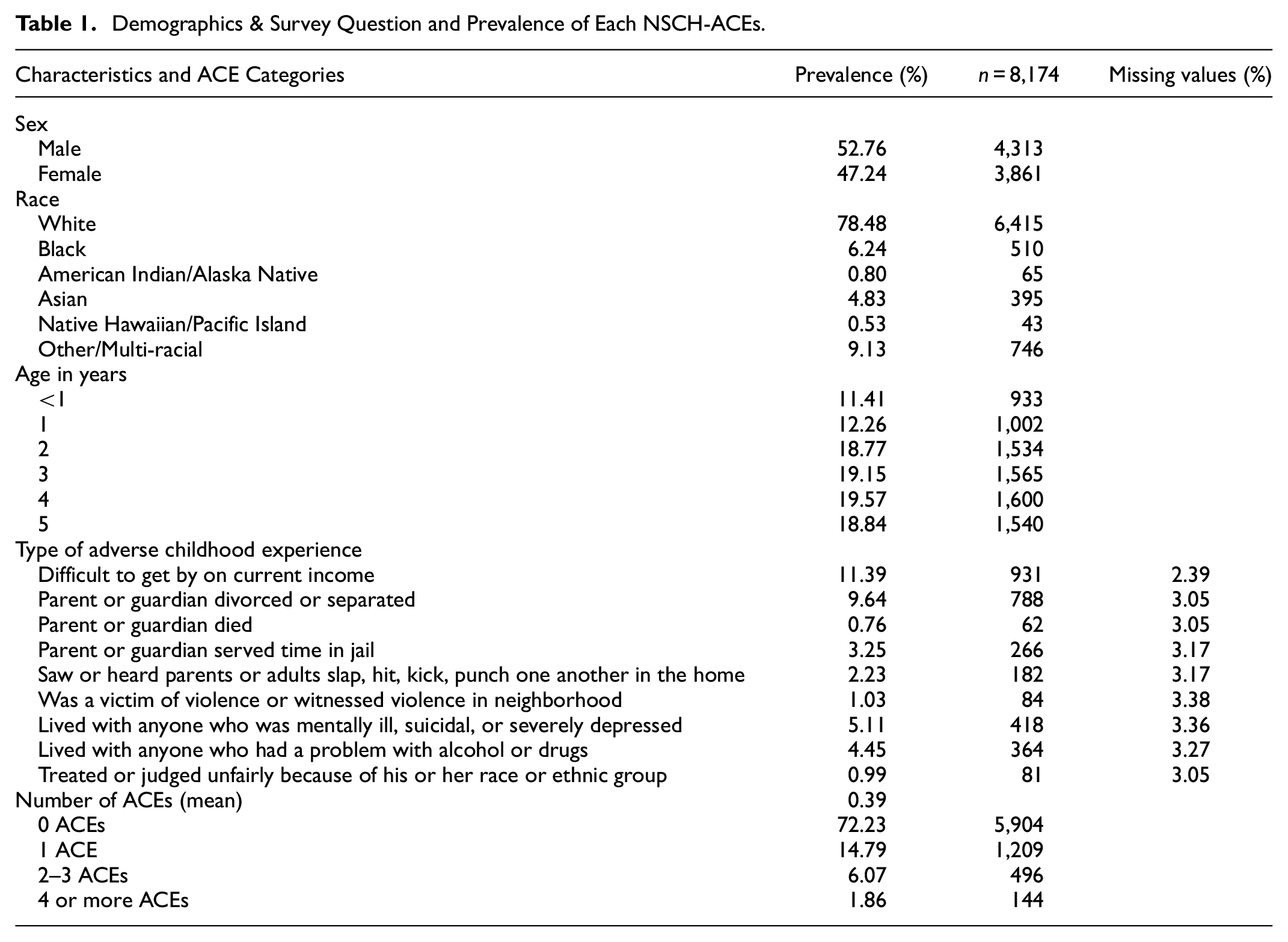
Exposure to nine ACEs was measured via self-report on the NSCH ACEs scale, which includes economic hardship, parental divorce, death of a parent, parental incarceration, mental illness of a family member, drug/alcohol abuse of family member, domestic violence, neighborhood violence, and racial discrimination. The wording of the questions was adjusted to be suitable for parental response and to minimize under-reporting (United States Census Bureau, 2018). Participants reported how often they experienced economic hardship (never/rarely = 0 & somewhat/often = 1) and whether or not their child had experienced the eight other ACEs (yes = 1 & no = 0). A sum score was created to represent total ACE exposure. The usage of the NSCH ACE scale is considered to be an appropriate measure for cumulative risk based on the findings of C. D. Bethell et al. (2017). The ACE questions and prevalence of each ACE is shown in Table 1.
Demographics & Survey Question and Prevalence of Each NSCH-ACEs.
Demographic Characteristics
Demographic characteristics were assessed in the initial screener prior to the administration of the full parent questionnaire so there were no missing variables. Age was coded in years with a range of birth to five. Gender was coded as either male or female. Race was categorized as White, Black, American Indian or Alaska Native, Asian, Native Hawaiian or Pacific Islander, or Other/Two or More Races. Hispanic or Latine identity was not controlled for in this analysis.
Data Analysis
A full SEM model with structural parts was used to examine the impact of ACE count on children’s flourishing and family resilience, the impact of family resilience on flourishing, and the indirect effects of ACE exposure mediated through family resilience (modeled in Figure 1; Schumacker & Lomax, 2016). To account for the underlying nature of family resilience and flourishing as multidimensional constructs, both were modeled as latent variables in the full structural equation model. This allowed measurement error to be parsed out and the relationships between latent constructs themselves to be tested (Table 2; Figure 2).

Conceptual model for the mediating relationship of family resilience on children’s flourishing for children experiencing ACEs.
Results from Structural Equation Models (Schumacker & Lomax, 2016).

Note. Models controls for age, sex, and race.
***p < .001; **p < .01; *p < .05.

Final model.
Multicollinearity among variables was examined, and all variance inflation factors (VIF) were within an acceptable range (below 10) with the highest VIF of 9.99 (Kline, 2011). All demographic information was complete due to the NSCH practice of administering screeners prior to data collection. Missing data for all included variables was low (less than 5%; Schafer & Graham, 2002). Bivariate regression models found no significant predictors of missingness, so complete case analysis was used.
To build the hypothesized model, a full SEM model was used with path analyses (Schumacker & Lomax, 2016). In the first stage of analysis, confirmatory factor analyses (CFAs) were conducted to evaluate the loadings of observed variables onto the latent constructs of family resilience and children’s flourishing. In the second stage of analysis, the full SEM model was constructed by adding paths between the latent variables.
Results
Demographic characteristics were examined using descriptive statistics (shown in Table 1). Results showed that the early childhood subpopulation represented slightly more males than females (53% and 47%, respectively). The majority of the children in the sample identified as White (78.48%), 6% of children identified as Black, and 9% identified as “Other” or “Two or More Races.” Children’s ages ranged from birth to age five, with only 11% of children being less than one, 12% of children being one, and about 19% in each of the other age categories. Descriptive statistics for ACEs showed that 72% of the respondents reported no ACEs, 14% reported one ACE, 6% reported two to three ACEs, and less than 2% reported four or more. The most frequently occurring ACE was difficulty getting by on current income (11%), with the least common ACE being treated unfairly because of race or ethnic group (1%).
The full SEM model demonstrated overall adequate model fit (Hu & Bentler, 1999; Schumacker & Lomax, 2016), X2 = 1,304.37, p = .000, RMSEA = 0.06, CFI =0.950, TLI = 0.935 and SRMS = 0.030. All fit indices except for X2 fell within the acceptable range, which may reflect the large sample size (Bentler & Bonett, 1980).
As hypothesized, ACE count was negatively associated with children’s flourishing (β = −.013, SE = 0.004, z = −3.13, p = .002, 95% CI [−0.022, −0.005]) and negatively associated with family resilience (β = −.131, SE = 0.007, z = −17.66, p = .000, 95% CI [−0.145, −0.116]). Family resilience was found to be positively associated with children’s flourishing (β = .152, SE = 0.008, z = 18.95, p = .000, 95% CI [0.136, 0.168]).
Analyzing the indirect effects, results revealed that family resilience significantly mediates the relationship between ACE count and flourishing (β = −.020, SE = .002, z = −12.92, p = .000, 95% CI [−0.23, −0.017]). The Sobel test showed that this relationship was partially mediated (Sobel, 1987). A ratio of indirect effects to total effects (RIT = 0.596) indicated that about 60% of the effect of ACE count on flourishing is mediated by family resilience (Mehmetoglu, 2018). Additionally, the ratio of the indirect effects to the direct effects (RID = 1.478) specified that the mediated effect of family resilience is about 1.5 times as large as the direct effect of ACE count on children’s flourishing. Nevertheless, the results indicate that after accounting for the mediating role of family resilience, ACE exposure still has a negative impact on flourishing. These findings provide evidence that while ACE exposure poses a risk to young children’s ability to prosper, families who engage in resilience practices are likely to have children who display characteristics of flourishing even in the context of environmental threat or deprivation.
Discussion
The goal of this work was to add to the understanding of resilience processes for early childhood populations, especially those exposed to adversity, with a focus on the outcome of flourishing. This work parallels the findings from flourishing research in older children, identifying ways in which flourishing is associated with both risk and protective factors (C. D. Bethell et al., 2019; Kwong & Hayes, 2017; Westphaln et al., 2022). Our first hypothesis was that, in line with previous findings, ACEs would be associated with lower levels of flourishing in children. This hypothesis was supported in the current study, with a significant and negative direct relationship emerging between these variables after controlling for children’s age, sex, and race. As mentioned above, exposure to adversity can impact children’s well-being through direct processes as well as indirect ones. Witnessing or experiencing traumatic events directly places young children at risk of developing maladaptive threat responses and hostile attribution biases, for example (McLaughlin et al., 2020). Meanwhile, when parents have suffered from domestic violence, their mental health and parenting may suffer, which indirectly impacts outcomes for their children (Huang et al., 2010; Suardi et al., 2017). This confluence of direct and indirect pathways between adversity and child outcomes is described in family stress theory (Masarik & Conger, 2017).
The second research hypothesis was also supported in these data, as ACE count was found to be negatively associated with family resilience. It is likely that a bidirectional relationship exists between these variables in many circumstances, with ACEs interfering with resilience-promoting family processes and intergenerational family resilience processes offering protection against some ACEs—for example, a family with high social support is protected from some of the effects of material hardship, and families with collective orientations of hopefulness and collaboration may be less vulnerable to substance use and intrafamilial conflict (Masten et al., 2021; Ungar, 2015).
In support of the third hypothesis, family resilience was found in this study to be positively associated with children’s flourishing. This finding is consistent with the relationship between family resilience and flourishing for older children (C. D. Bethell et al., 2019). One probable process underlying this relationship is that the presence of family-level adversity can interfere with the development of age-expected coping and regulation skills (Kwong & Hayes, 2017). For example, early childhood environments marked by chaos and unpredictability—especially when they interfere with stable and responsive caregiving—may have a negative impact on developing neural pathways that support emotion regulation (Gee & Cohodes, 2021).
Finally, the present study expanded upon the relationship between ACE exposure and flourishing by considering the role of family resilience in explaining these negative effects. The full SEM model determined that 60% of the effects of ACEs on flourishing were indirect effects mediated through family resilience, indicating partial mediation. Additionally, family resilience processes accounted for more variance in children’s flourishing than did exposure to adversity. This finding aligns with previous research in showing how family-level resilience factors relate to children’s positive development even in the midst of adversity. For example, positive parenting behaviors can help to protect social and emotional development in children exposed to early-life adversity (Yamaoka & Bard, 2019), and can act as a buffer against family-level stress in families experiencing homelessness (Labella et al., 2017). Children whose families solve problems together and remain hopeful together have been found to show lower risks of depression after adversity exposure (Elmore et al., 2020). Importantly, though, family resilience does not fully mediate the relationship between ACEs and flourishing in this study, as ACE exposure still has negative effects on flourishing regardless of family resilience. Preventing ACEs remains a critical goal, both from a moral and from a public health perspective.
This work adds to the understanding of the resilience process in young children by connecting resilience in families to flourishing in children (Masten & Monn, 2015). In both high-adversity and low-adversity contexts, family resilience was positively related to children’s flourishing. As such, family resilience is a powerful target for prevention and intervention programs alike.
The use of flourishing as an outcome variable is fairly unique in the early childhood adversity literature, but it is an important perspective nonetheless. First, children’s flourishing is a priority for caregivers experiencing high levels of family-level adversity (Akesson & Sousa, 2020; Herth, 1998). That is, caregivers exposed to challenges like poverty, abuse, and displacement do not simply wish for their children to avoid negative outcomes, but also hope to see them develop internal coping skills, resourcefulness, curiosity, and joy. Second, flourishing and its component constructs have emerged as valuable predictive variables in their own right. A tendency to feel and express positive emotionality is associated with adaptive outcomes in refugee youth (Mohamed & Thomas, 2017), and young children’s displays of happiness and emotional resilience can elicit greater sensitivity and warmth from caregivers (Lunkenheimer et al., 2020; Von Suchodoletz et al., 2011). In other words, researchers hoping to document and intervene on resilient outcomes across development are wise to attend to children’s early displays of flourishing behavior.
More broadly, this study adds to the growing evidence that the resilience of an individual—especially of a child—depends on the resilience of both proximal and distal systems around them. In fact, some scholars propose that as a child’s exposure to adversity increases, the relevance of the child’s individual traits and abilities to resilience outcomes diminishes, overshadowed by the adaptive capacity of the systems around a child (Ungar et al., 2013).
While this study has notable contributions, it is not without limitations. The use of cross-sectional data makes it so this research could not definitively identify causal relationships or explore the dynamic relationships between constructs across development. While the designers of the NSCH made efforts to reduce the risk of social desirability shaping participant reports (United States Census Bureau, 2018), caregivers’ positive feelings toward their children and difficulty bringing adverse experiences to mind may have shaped answers somewhat. Furthermore, the flourishing index only assessed four behavioral items, which are subjective in nature, and this index has not yet been evaluated for clinical applications (Moore et al., 2016). Controlling for parents’ self-reported mental health may also improve validity in future studies, as low mood may shape both recall of ACEs and reports of children’s flourishing.
Future research may use behavioral observation or assessment from multiple informants to corroborate parent reports of children’s flourishing. Such an approach can also broaden the range of positive developmental outcomes measured. For example, teachers may be able to report on children’s creativity and motivation in the classroom, school readiness skills, and prosocial peer behavior. Additionally, future analyses may examine whether the individual items within the flourishing index and the family resilience index are differentially associated with children’s outcomes, with clear implications for prevention and intervention programs. In order to test the protective effects of family resilience in contexts of adversity, future studies could also examine how family resilience buffers the association between ACEs and flourishing. Longitudinal data collection, including through intervention studies, can elucidate the impacts of risk and protective factors on children’s flourishing at distinct developmental stages.
Conclusion
Early childhood is characterized by a high degree of plasticity in neurobiology, hormones, and behaviors. As such, it is a period marked by both positive and negative susceptibility. Just as children are especially vulnerable to threat and deprivation in their early years, their biological and behavioral development are very malleable in the face of protective and promotive factors (Shonkoff, 2016; Turecki et al., 2014). To best support children’s flourishing, programs should focus on the prevention of ACEs and other developmental insults while equipping and fueling family-level resilience processes. Programs such as the Nurse Family Partnership, Head Start, or other home visiting interventions are uniquely positioned to address difficulties and boost assets within a child’s direct home and neighborhood ecology. Meanwhile, parent training can help facilitate resilient behaviors such as open communication, hopeful orientation, and collaborative problem-solving. Interventions like the Attachment and Biobehavioral Catch-up (ABC), by virtue of focusing on parent training, can help to prevent family-level adversity while also equipping the family to respond adaptively to developmental insults (Grube & Liming, 2018). Increasing access to these evidence-based programs would support positive development in children by supporting family systems as a whole. Additionally, these programs are positioned to assess ACE exposure and provide referrals for additional support to families facing hardships. Research and evaluation studies of these programs can further clarify the ways in which resilience factors (at the level of the individual, family, and community) interact over time to prevent and mitigate the impact of ACEs.
The United States ranks among the worst wealthy countries for child well-being, based in part on the high incidence of many ACEs like poverty and exposure to parental substance use (Finkelhor, 2020). Reading through the list of common ACEs children experience, one may reflect on how many of these challenging experiences can be prevented, partially or entirely, by interventions from outside the family system. In the United States, children aged four and under are the group most likely to be threatened by eviction and housing loss (Graetz et al., 2023). Meanwhile, mass incarceration harms child development in communities that are already facing marginalization, simultaneously reflecting and exacerbating structural inequities (Wildeman et al., 2018). Systems-level intervention, coupled with culturally adapted community-based resources, can simultaneously reduce the prevalence of many childhood adversities while also strengthening family resilience practices. For example, educational resources, employment support, and substance use counseling are promising prevention and intervention strategies in families at risk of experiencing domestic violence (Kyriacou et al., 1999), and these resources can also mitigate the risk of other ACEs like poverty, exposure to insensitive caregiving, and housing loss. Meanwhile, community-based mental health services that are evidence-based, culturally grounded, and accessible can allow adults to access care that amplifies their coping skills, caregiving capacity, and use of social support (Eddie et al., 2019; Kearns et al., 2019). Developmental scientists can and should be informing the design and implementation of these programs and policies as we work collectively toward resilience-informed systems for children.
Footnotes
Declaration of Conflicting Interests
The author(s) declared no potential conflicts of interest with respect to the research, authorship, and/or publication of this article.
Funding
The author(s) received no financial support for the research, authorship, and/or publication of this article.

Data Availability Statement
Data sharing not applicable to this article as no datasets were generated or analyzed during the current study.