




Abstract
Born Global small and medium enterprises (SMEs) must survive, grow, and develop on the international market. Therefore, the appropriate strategy is needed to overcome challenges and seize opportunities. This paper presents an up-to-date review of this subject, using the Systematic Literature Review (SLR) method with PRISMA diagrams to analyze papers published under the theme of Born Global SMEs on both the Web of Science (WoS) and Scopus, totaling 549 and 1,365 papers, respectively. Approximately 1,914 papers were extracted from these databases, of which 57 met the review selection criteria, thus included in the review. The review found that SME strategies generally emphasize adaption, strengthening innovation, and technology to deal with the global market. In addition, one of the key findings in this review is that founders and leaders are key in the internationalization of SMEs into Born Global. Born Global SMEs are grounded in and take advantage of the international experiences of their founders or leaders to form global networks in overcoming limited resources and reach market niches as the main strategies in addition to adaptive, innovation, and technology strategies. The question of what internationalization framework is most appropriate for describing and predicting the growth, development, and even survival of Born Global SMEs has not been comprehensively studied. This study offers to learn the strategy of Born Global SMEs in the rationalization to face challenges or obstacles and seize opportunities that are essential.
Keywords
Introduction
Small and medium-sized enterprises (SMEs) play an essential role in economic development in both emerging and developed markets (Su et al., 2020), particularly in the era of dynamic globalization (Paul et al., 2017). According to a study from the European Commission (2010) and Kalinic and Forza (2012) report the following: “Internationally active SMEs report employment growth of 7% versus only 1% for SMEs without international activities” and “26% of internationally active SMEs introduce new products or services to their sectors in their countries; for other SMEs, this is only 8%.” The role of SMEs that conduct international activities will provide greater value to a country’s economic development. Therefore, providing an adequate strategy for SMEs to overcome challenges and obstacles and seize opportunities in the international market is a key issue.
Going international has become an essential strategy for SMEs in exploring global business opportunities and growing their businesses quickly (Coviello & Munro, 1997). In addition, SMEs have large domestic markets (Li et al., 2018), but conventional beliefs indicate that SMEs are vulnerable in the international market due to resource constraints (Knight & Cavusgil, 2004; Love et al., 2016). Research into SMEs has been dominated by models advocating for a pattern of gradual internationalization (Baum et al., 2015) or dividing the internationalization process into two phases (Cannone et al., 2014), namely the initial phase and subsequent international growth. However, the gradual internationalization process is no longer applicable. Instead, it is carried out quickly and simultaneously with the establishment of the SME.
Companies that conduct internationalization activities that start from the moment or close to their establishment are called Born Global (Knight, 1996; Rennie, 1993). A Born Global company is usually an SME (Cavusgil & Knight, 2009; Weerawardena et al., 2007) seeking to gain a competitive advantage by using resources and sales in several countries (Oviatt & McDougall, 1994, 1995).
Born Global companies often act as key players in an ecosystem that supports large multinational corporations (Sasi et al., 2015), drive innovation and technology (Baum et al., 2015), support industrial growth (Cannone et al., 2014), have much higher job growth rates (Choquette et al., 2017), and play a fundamental role in the economic development of developing countries (Lamotte & Colovic, 2015). The development of Born Global defies the traditional theory of gradual internationalization (Johanson & Valhne, 1977, 1990). Ample research has also recognized the significant role of SMEs in the global market (Knight & Cavusgil, 1996a, 1996b; Oviatt & McDougall, 2005).
The question of which internationalization framework is most appropriate to describe and predict the growth, development, and even survival of Born Global SMEs has not been comprehensively studied (Kuivalainen, Sundqvist, Saarenketo, & McNaughton, 2012). Therefore, learning the strategy of Born Global SMEs serves as a rationalization for facing challenges and obstacles and seizing opportunities is essential. SMEs and large companies have differences, particularly in terms of their access to resources and expertise. While SMEs usually start with a highly specific niche of expertise and a limited number of resources, especially human resources, large companies potentially have a larger pool of expertise and resources. These differences cannot be neglected as they might influence how SMEs deal with global market challenges. The flexibilities offered through the availability of resources owned by larger companies make it possible for them to navigate through the complexities of the global market and serve as buffers for those companies. These flexibilities may not become the privilege of SMEs. Therefore, such differences need to be taken into consideration in conducting an analysis of such contexts.
This systematic literature review is able to identify the knowledge, skills, technology, and innovation for Born Global SMEs to succeed and develop in the international market. More specifically, the knowledge and experiences of owners to conduct internationalization has become a critical aspect in ensuring the successful entrance to the global market.
On this ground, this research aims to investigate challenges, obstacles, and opportunities faced by Born Global SMEs and the strategies that the employ to grow and develop on the international market. The research question asked by this paper is as follows: What are the challenges or obstacles and opportunities faced by Born Global SMEs in the internationalization process and what strategies have been implemented so that Born Global SMEs can grow and develop in the international market?
To answer this question, this research collected papers to systematically understand and group the challenges, obstacles, opportunities, and strategies for Born Global SMEs as a foundation for further research.
As a systematic literature review, this work aims to contribute to both general literature on SMEs and Born Global SMEs through a helicopter view that identifies which factors contribute critically to the existence and survivability of Born Global SMEs in entering the global market. This article is comprised as follows. The second section provides details about the methodology used in this study. The third section discusses findings related to the challenges, obstacles, opportunities, and strategies of Born Global SMEs. The discussion provides implications for researchers and management, conclusions, and suggestions for future research directions.
Methods
Systematic Literature Review
This study used the Systematic Literature Review approach to analyze selected publications transparently and with replicable procedures (Tranfield et al., 2003) and classify them into structured reviews to explore what is conveyed in the papers, such as methods, theories, publication outlets, research problems, countries, and research limitations. Following the methods of Tranfield et al. (2003), this systematic review approach was based on manual filtering due to its replicable and transparent process that allows authors to minimize bias in library review results. This approach enables reviewers to identify, assess, and synthesize relevant studies using transparent and replicable processes. This approach is also suitable for gaining more insights and providing an in-depth understanding of quantitative and qualitative issues rather than automated filtering.
The inclusion criteria by refining paper quality using Web of Science and Scopus Indexing (Q1 in both Scopus and Web of Science), based on the suggestions of previous SLR literature by Pascucci et al. (2018), and Supriharyanti and Sukoco (2023).
The two indexing journals with the highest quartile criteria were used because academics and researchers around the world have credibly recognized them (Lu et al., 2015), and their search functions are broadly comprehensive, increasing their level of accuracy (Pascucci et al., 2018). Scopus is a comprehensive electronic database with over 18,000 articles from over 5,000 international publishers, including coverage of 16,500 peer-reviewed journals in the scientific, technical, medical, and social sciences. This platform has been chosen because of its more comprehensive coverage of relevant, high-quality publications (Phillips et al., 2015; Supriharyanti & Sukoco, 2023). This explanation has been to strengthen the reasoning in the research methods section.
Research Protocol
In general, the flow of research protocols in this study is divided into four main stages: identification, screening, eligibility, and inclusion.
Identification
The first step was identification. At this stage, the search was focused on articles indexed by Web of Science (WoS) and Scopus (June 2021) with keywords “Born Global” OR “International New Venture” OR “Born to be global” OR “Early Internationalizing Firms” in a paper published from 2000 to 2021. On the Web of Science, articles are selected using the string LANGUAGES: (ENGLISH) AND DOCUMENT TYPES: (ARTICLE OR REVIEW) AND WEB OF SCIENCE CATEGORIES: (BUSINESS OR MANAGEMENT), finding 549 articles. Later, Scopus used strings (LIMIT-TO (SUBJAREA, “BUSI” OR “DECI”) AND (LIMIT-TO (DOCTYPE, “ar” OR “re”) AND (LIMIT-TO (LANGUAGE, “English”), and 1,365 articles were found.
Screening
The results of the identification stage found 549 articles from the Web of Science and 1,365 from Scopus, meaning that some 1,914 articles were passed to the screening stage. At the screening stage, the articles found were filtered back with the following indicators: WoS-indexed articles published in the journal Q1 with Impact Factor ≥6 (Included n = 232; Excluded n = 317); and Scopus-indexed articles published in the journal Q1 with the category of top 10% ranking (Included n = 399; Excluded n = 966).
Eligibility
Furthermore, several papers that passed the screening stage continued to the eligibility stage by reducing the duplicated articles (indexed WoS or indexed Scopus) to n = 631 (Included n = 505; Excluded n = 126) and reading abstracts and keywords that addressed the theme of SMEs. At the eligibility stage, the combined number of articles from the Web of Science and Scopus was reduced by 411 articles, so 94 articles were declared appropriate.
Inclusion
This stage ended until the eligibility stage and 94 eligible articles were filtered back through the process of reading articles related to research questions at the included stage. The final results offered 57 articles that met the requirements to proceed with the systematic literature review process, where researchers focused on reading to gain an understanding and answering the research questions. Figure 1 provides an overview of the flow of the research protocol.

Flow diagram of the study (PRISMA).
Figure 2 shows the number of papers published from 2000 to 2021 out of 57 papers to be reviewed. The largest number of papers was found in 2012, and then again increased from 2019 to 2021.

Yearly paper frequency.
Based on data extracted per journal, it can be said that this study provides a systematic review of 57 papers spread across 22 journals indexed quartile 1 on the Scimago web, namely British Journal of Management (n = 1), BRQ-Business Research Quarterly (n = 1), Entrepreneurship and Regional Development (n = 2), Entrepreneurship Theory and Practice (n = 1), European Business Review (n = 2), European Journal of Marketing (n = 1), European Management Journal (n = 1), Global Strategy Journal (n = 1), Industrial Marketing Management (n = 1), International Business Review (n = 9), International Entrepreneurship and Management Journal (n = 2), International Journal of Entrepreneurial Behavior & Research (n = 2), International Marketing Review (n = 8), International Small Business Journal (n = 4), Journal of Business Research (n = 1), Journal of Construction Engineering and Management (n = 1), Journal of International Business Studies (n = 4), Journal of International Marketing (n = 3), Journal of Small Business Management (n = 3), Journal of World Business (n = 7), Review of Managerial Science (n = 1), and Small Business Economics (n = 1), as shown in Figure 3.
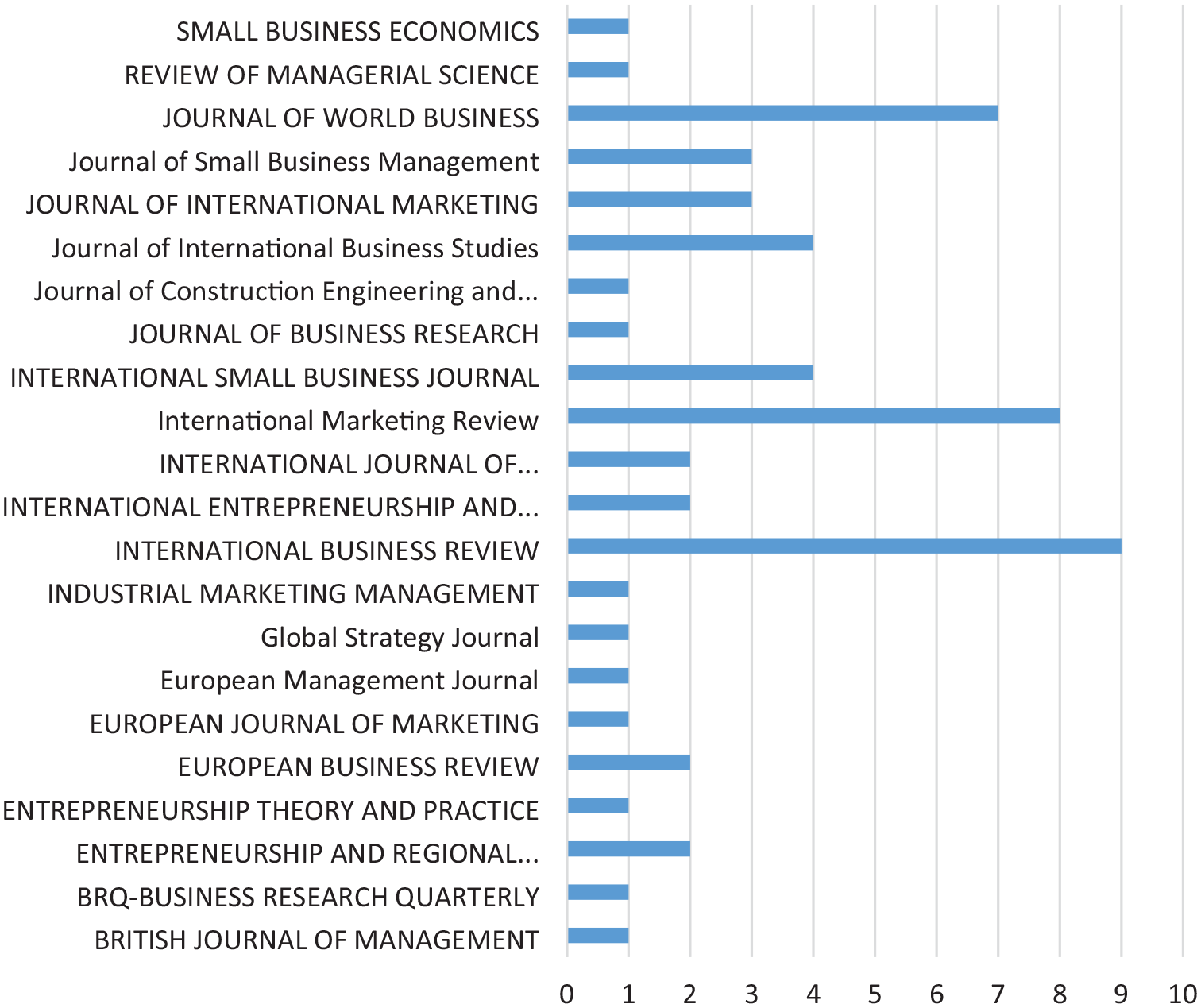
Number of papers from each journal.
The significant role of SMEs in a country’s national economy makes researchers interested in grouping papers related to SMEs based on developed or developing countries as research objects, as can be seen in Table 1 below. Research related to Born Global SMEs has been more widely conducted in developed countries, with as many as 44 countries comprising 40% or 70% of related papers, while developing countries only comprise 17 papers or 30%.
Research Object Countries.

Findings
Challenges
Being a Born Global SME is inseparable from the various challenges of having to be able to penetrate new markets in new international environments that are significantly different from the local environment (Ai et al., 2007). The results of the literature study found that Born Global SMEs from both developing and developed countries faced a number of challenges or obstacles that were more or less the same, as summarized in Table 2.
Challenges and Barriers of Born Global SMEs.

Resource and financial constraints have been the most widely identified categories of Born Global SMEs challenges from previously reviewed literature. Resource and financial limitations in this category are defined as scarcity and limited access to resources (Felzensztein et al., 2015) needed for SMEs to target the wider international market (Habbershon, 2006), both external resources (Dimitratos et al., 2003) and internal resource such as human resource capabilities (Deng & Zhang, 2018), managerial resources (Paul et al., 2017), financial resources (Yi & Wang, 2012), technology resources (Ekanem, 2019), material resources (Laforet, 2012), and physical resources (factories and equipment, locations, export departments; da Rocha et al., 2012).
Resources are one of the only operating factors for Born Global SMEs (in addition to strategies and structures) that need to be adapted to the needs of the international environment (Kuivalainen, Sundqvist, Saarenketo, & McNaughton, 2012). Lack of resources is a crucial obstacle facing SMEs who want to be involved in international business (Fletcher, 2004) and protect the market from large-scale competitors (Coelho et al., 2014). The limited resources and finances of SMEs are very related to the next category of challenges, namely networking (Freeman et al., 2006).
The second classification of Born Global SMEs’ challenges is the inability to manage global networks and relationships, which refers to the conservative attitude of SMEs (Tang, 2011) in finding international business partners (Dimitratos et al., 2003) due to their limited relationships with international business (Ai et al., 2007), that is, suppliers, distributors, export agents, joint venture partners, government organizations. The lack of networking activity configuration may have an impact on the late internationalization of SMEs (Hughes et al., 2019). SMEs originating from emerging markets may face more significant challenges in establishing a central position in international networks because they lack international experience and result from a weak institutional environment (Su et al., 2020).
This challenge is critical because networking plays an important role in SMEs gaining knowledge of international markets (Hanell & Nordman, 2018) and access to valuable resources (Tang, 2011), which is one of the competitive strategies to be able to compete with international rivals (Falahat et al., 2021). The quality of networking is often associated with the dependence needs of entrepreneurs, particularly when SMEs aim to develop their organizations (Fletcher, 2004), improve their performance (Paul et al., 2017), and overcome weaknesses related to technology, scale, and productivity (Yi & Wang, 2012). Resource-related barriers identified in the first category may be overcome if SMEs have effective networking (Tang, 2011). Empirical evidence shows that the international network is a form of social capital (Habbershon, 2006) that determines the success of the internationalization process of SMEs (Kalinic & Forza, 2012).
The limitation of information and knowledge of internationalization activities is the third challenge that Born Global SMEs must face. Knowledge is a significant driver of value creation globally (Dimitratos et al., 2003) and identifies opportunities for niche product concepts (Fletcher, 2004) that will expand the competitive advantage of Born Global SMEs (Deng & Zhang, 2018). SMEs able to gain knowledge from international business partners and spread the condemnation in organizations tend to have successful alliance relationships (Felzensztein et al., 2015). Knowledge accessed through international business partners may accelerate the internationalization of organizations by reducing uncertainty surrounding external markets (Gilbarragan & Masverdú, 2018). If SMEs have adequate “knowledge-intensive assets,” these assets will support international activities to compete with other multinational companies (Dimitratos et al., 2003).
Limitations of information and knowledge possessed by SMEs in internationalization activities include a lack of international market knowledge (da Rosa & Schouteten, 2018; Ekanem, 2019), which include knowledge of the characteristics of a specific national market, its business climate, cultural patterns, individual customer firms, and their personnel (Hånell et al., 2017), lack of legal knowledge in an international context (Drennan et al., 2020), lack of experiential knowledge (Evangelista, & Mac, 2016; Hennarrt et al., 2021), lack of technological knowledge (Bai et al., 2017), tacit knowledge of international business practices (Zhou et al., 2007), lack of entrepreneurial and managerial knowledge (Zonta & Amal, 2018), lack of grafted knowledge acquired by hiring managers with relevant experience (Love et al., 2016), lack of workers with sufficient information or experience about foreign markets, and the misconception that the size of demand in overseas markets is too high to be handled by SMEs (Paul et al., 2017).
The fourth category of challenges that have been successfully identified is the ability of the owner or founder in terms of managerial internationalization, which may be a more serious obstacle faced by Born Global SMEs than a lack of financial resources (da Rocha et al., 2012) since founders or owners are the majority decision makers in organizations (Su et al., 2020). In developing countries, the managerial ability of owners exerts a more significant influence on the internationalization of organizations (Tiwari & Korneliussen, 2018). The founder’s skills, combined with the creative ability of human resources, will lead an organization to develop unique products that have the potential to be marketed globally (Gabrielsson et al., 2008a). However, managerial ability alone is not enough if not accompanied by control, and founders must have the ability to control and manage internationalization (Dimitratos et al., 2003). Effective founders to lead Born Global SMEs encourage the maximum use of limited resources (Ekanem, 2019)
In essence, characteristics (Paul et al., 2017), behavior (Bangara et al., 2012), innovation propensity (Kowalik et al., 2020), experience, global vision (Dimitratos et al., 2003), knowledge (Prashantham & Floyd, 2012), international business network background (Nilsson & Hidou, 2014), and skills are all important. The managerial ability of the founder is shown to impact product innovation significantly and is a key factor in the success of Born Global SMEs (Gabrielsson et al., 2008a). The founder’s international background is a major differentiator between traditional organizations and Born Global, which can affect how founders overcome barriers to internationalization (Bangara et al., 2012).
In addition to the challenges mentioned above, several articles state that the challenges or other obstacles experienced by Born Global SMEs in terms of internationalization are licensing issues, government regulations that do not support international activities, and the tax system (Dimitratos et al., 2003; Moen, 2002) as well as an aversion to taking risks (Freeman et al., 2006; Zhou et al., 2007), all of which further inhibits SMEs from conducting international activities.
Opportunities and Strengths
The pressures of globalization that have followed economic liberalization are now considered an opportunity for Born Global companies to build speed toward internationalization (Nilsson & Hidou, 2014). Born Global companies are required to be able to take advantage of the conditions, in this case, an opportunity to politicize technology as a significant driver in the internationalization of the company (Paliwoda et al., 2009), offering different, unique qualities (Deng & Zhang, 2018), the speed of Dimitratos et al. (2003) and having creative and skilled individuals (extreme) (Bangara et al., 2012). The results of the literature study found that Born Global SMEs from both countries with developing categories and countries with advanced categories turned out to have several opportunities or opportunities, as summarized in Table 3.
Opportunities and Strengths of Born Global SMEs.

Superior, newer technologies are the most widely found opportunities in this review; this makes sense considering BG startups that began their international activities soon after their establishment (Hughes et al., 2019), besides this BGs are also uniquely relatively small in terms of ownership and organizational structure while they aim to serve the international market from scratch (Almor et al., 2014); therefore, the readiness to internationalize companies to take risks quickly captures market opportunities either domestic or foreign (Zhou et al., 2007).
Excellent technological opportunity becomes a Born Global company’s competitive advantage if exploited properly because it is a first mover (Almor et al., 2014). Developing a technology-based business at first, Born Global plays in one of the product lines that are companies that exist in certain niche markets, in which they develop competency- and technology-based business strategies and become an important source of revenue for high-tech Born Global companies, interacting more frequently with customers because their products are often unknown and based on proprietary knowledge (Almor, 2013).
This review’s second opportunity classification of SMEs is a higher-quality product through innovation. The resulting innovative product development comes from strong customer relationships (Mort et al., 2012). The uniqueness of products and processes is another foundation of competitive advantage constantly being improved according to customer needs and the development process outlines breakthrough innovations that may take years to internationalize (Gassmann & Keupp, 2007). Product innovation is more effective if the company wants to enter new markets before competitors and meet customer needs (Laforet, 2012).
Innovative products are one of the hallmarks of a Born Global company, and innovation refers to the company’s capacity to generate new ideas, products, and services for overseas markets (Freeman et al., 2006) and is aimed at being a creative solution to facing challenges by offering unique products such as shortening time to market and serving clients in a fast way, more accurately identifying and answering relatively new needs, which will be a distinguishing feature of the company in optimizing opportunities (Almor et al., 2014). The construction of successful innovation will be different for each organization and become a distinguishing feature of each (Laforet, 2012).
Being more flexible, agile, and adaptable is the third opportunity that SMEs must exploit. In the context of exports, a Born Global has a higher absorption capacity and can learn about export markets and export strategies better and faster, which is especially important when dealing with dynamic export markets (Evangelista & Mac, 2016). Rapid ability learning tends to be more important for survival because Born Global companies will adapt easily to the market and its needs (Prashantham & Floyd, 2012). The pressures of globalization are a factor that encourages companies to have fast and flexible learning skills: high-tech Born Global companies need to respond quickly to developing mechanisms to take advantage of opportunities (Freeman et al., 2006).
The ability to learn, adapt, and be flexible and agile must be able to be well-exploited by Born Global/INV because not all companies have the same ability. After all, the size of Born Global/INV is smaller and is more flexible in dealing with the uncertainty of the situation (Prashantham & Floyd, 2012). Companies need to optimize their capabilities in integrating, building, and reconfiguring their complement even in undynamic environments (Evangelista & Mac, 2016), validating the assumption that BGs’ ability to adapt becomes an advantage in achieving competitive advantage.
The fourth dimension of opportunity is to employ skilled and creative individuals with extreme specialization, which is a potential opportunity for BGs to be optimized as competitive advantage comes from specializing in an individual’s ability to elaborate on knowledge, leading to product distinctiveness (Gassmann & Keupp, 2007).
In addition to these opportunities, several papers state that another opportunity owned by BGs in terms of internationalization is social networking (Su et al., 2020).
Strategy
Born Global SMEs’ internationalization strategy is generally focused on niche markets (Dimitratos et al., 2003; Moen, 2002) by improving product capabilities (Fletcher, 2004) and implementing formal and factual protection of owned products (Gassmann & Keupp, 2007), even in some countries with unfavorable domestic markets, conducting an internationalization strategy is a step for SMEs to survive (Moen, 2002) In addition, Table 4 shows several strategies that Born Global SMEs have used to achieve success in the international market.
SMEs Born Global Strategy.

According to these data, the internationalization of SMEs may be achieved through cooperation with larger companies. With this cooperation, SMEs benefit from being part of an established network of work. The role of SMEs is usually in the form of sub-contractors and suppliers from large companies (Su et al., 2020).
In addition, the literature also shows that Born Global SMEs undertake diversification strategies, particularly product diversification, in the process of internationalization (Dominguez & Mayrhofer, 2017). In this regard, Born Global SMEs are experiencing different product demands from initial products marketed to international markets. With the demand for different products, SMEs are aiming to meet market demand by bringing up or adding new product lines.
Interesting findings that have also emerged are the pattern of SMEs that use the capabilities and previous international experience of founders and/or business leaders. This international experience may change the understanding of people’s cultures and destinations, the languages used, and even market preferences and networks and connectivity with business people in the destination country (Tang, 2011).
Discussion and Implications
Discussion
Although there have previously been researchers who have discussed the challenges and problems of export SMEs (Paul et al., 2017), as well as the strengths and weaknesses of small companies involved in internationalization (Kahiya, 2013), strategies that have begun to be implemented by SMEs should be added. Almost all researchers have recognized that the main challenges and obstacles for Born Global SMEs to thrive are limited resources and finance, while the opportunity for SMEs to enter international markets is due to niche markets not seen by large companies.
The role of the owner or leader determines SMEs to be Born Global, plus international experience that supports SMEs in being more prepared to enter the global market. Strategies utilizing the international experience of owners/leaders require leaders to have an international entrepreneurial culture (IEC) whereby this becomes a comprehensive concept that, as one of the findings of this study, shows internationalized entrepreneurial behavior of SMEs (Dimitratos et al., 2012) as being proactive to competition, innovation, and risky attitudes abroad (Zahra, 2005) based on opportunities.
Forming a network is also one of the strategies suggested in this study, particularly when the network has healthy cooperation (Su et al., 2020) so that it can partner and cooperate in joining export ventures (Lopez & Fiol, 2013) for sustainable growth and adapting to change (Hånell et al., 2017) while continuing to carry out a proactive learning process (Evangelista & Mac, 2016) to cover the spread of resources and knowledge (Tang, 2011).
Improving and developing social capital is also a strategy for Born Global SMEs (Gittins et al., 2015) and using family networks (Habbershon, 2006) to bind the company’s internationalization commitments (da Rocha et al., 2012) by gathering tacit knowledge related to internationalization routines and developing skills necessary to be successful in foreign markets (Prashantham & Floyd, 2012).
UKM Born Global also requires the role of government institutions in fostering and providing services that may be a source of information and knowledge development (Deng & Zhang, 2018), such as by providing consulting services for SMEs that conduct internationalization (Cumming et al., 2014). Moreover, policy and regulatory direction to support export capabilities.
Implications
Leaders and owners should expand their knowledge of internationalization, expand networks, and strengthen cooperation. Cooperation will allow businesses to upgrade capabilities and learn from each other. It can also help reduce resource limitations, including human, technological, and even research and development. Product innovation that offers uniqueness or special skills may be used as a business development strategy for SMEs.
Limitations and Future Research
A technical limitation is that because this paper focuses on Q1 and high-impact journals, it does not cover many papers. Thus, if this protocol is developed and extended, it is advisable to increase or expand the inclusion criteria so that a greater number of papers will be received, potentially providing richer results. Based on the analysis and discussion, further study is necessary to investigate how cooperation, network strength, and experience can comprehensively increase the potential of Born Global SMEs.
Conclusion
This paper examined the internationalization phenomenon of Born Global SMEs, focusing on the strategies that have been implemented by Born Global SMEs to face challenges and seize opportunities in the international market. The author highlighted the importance of international skills and experience of SME owners or leaders who decide to be Born Global. With the international experience of the leader or owner, Born Global SMEs will be able to overcome the resource constraints that are mostly a challenge for every Born Global SME. Next, the international experience will also be a strategy for seizing opportunities on the international market by using the international network owned by the owner or leader of Born Global SMEs. Furthermore, research emphasized the importance of knowledge, skills, technology, and innovation for Born Global SMEs to succeed and develop in the international market.
Footnotes
Declaration of Conflicting Interests
The author(s) declared no potential conflicts of interest with respect to the research, authorship, and/or publication of this article.
Funding
The author(s) disclosed receipt of the following financial support for the research, authorship, and/or publication of this article: This research is funded by: Ministry of Education and Culture, Dissertation Research Grant 2021, Universitas Airlangga, Mandate Research 2021

Data Availability Statement
Data sharing not applicable to this article as no datasets were generated or analyzed during the current study.