



Abstract
While previous work suggested that presenters may benefit from the use of humor, others argue that the use of humor can be risky. Therefore, there is a need to examine the potential moderators and mediators of this process. The study aims to experimentally explore the appropriate use of humor during a professional investment presentation. The sample included 400 participants. After being randomly assigned to 2 × 2 between-subjects conditions (man /woman presenter × with/without a humorous message), the participants watched a video of an investment presentation. Participants who were asked to invest virtual money in the firm after the video. Using a moderated mediation analysis, the results show that humor was related to higher investment amounts and that the presenters’ perceived organizational status mediated this indirect relationship. The novelty of the study lies in its experimental design, focusing on audience behavioral tendencies and its unexplored mixed-gender effect: women tended to invest less when a male presenter used humor, while men tended to invest more when a female presenter used humor. The perceived status of the presenter mediated these associations. Theoretically, the study expands the understanding of the Benign Violation Theory (BVT) regarding the need to address contextual factors while examining the appropriate use of humor. Moreover, to maximize the benefits of humor, one must consider the humor’s relevance to the audience and acknowledge that humor needs to be appropriately used. This is particularly important for people working in investment settings.
Plain Language Summary
While previous work suggested that presenters may benefit from the use of humor, others argue that the use of humor can be risky. The purpose of the study is to experimentally explore the use of humor during a professional investment presentation. The final sample included 400 participants who were randomly assigned to four conditions (man or woman presenter and a presentation with or without a humorous message). The participants watched a video of an investment presentation. Participants were asked to invest virtual money in the firm after the video. the key results show that humor was related to higher investment amounts due to the increase in the presenters’ status. In addition, women tended to invest less when a male presenter used humor, while men tended to invest more when a woman female presenter used humor. The perceived status of the presenter mediated these associations. Our findings practically encourage females to use humor in the workplace, specifically during presentations. To maximize humor’s benefits, one must consider its relevance to the audience and recognize that it must be appropriately used. This is particularly important for people working in financial and investment setting.
Introduction
It has been established that humor has advantages in the workplace (e.g., Rosenberg et al., 2021). Researchers have also attempted to determine the answers to the four “W” questions – in terms of the use of humor – who should use humor, and why, where, and when they should use it (Bergeron & Vachon, 2008; Curtis, 1990; Kaupins, 1988; Spaeth, 2001). There are no definite answers to these questions, and the word caution is sometimes added when humor in the workplace is concerned (e.g., Duncan et al., 1990; Holmes & Marra, 2002). Amid this problem, we encountered a more specific question, one that is more colloquial and seems unanswered as well. Occasionally, people facing the task of speaking professionally in front of a group ask, “Should I start with a joke?.” Examining the four “W” questions above – these future presenters (to answer – who) with the audience (to whom) and what is the process through which humor can impact behavioral tendency (to answer the question why).
We consulted communications and lecture experts and found them in dispute (Asher, 2019; Bonanno, 2008; Fruciano, 2022; Hurley Hall, 2020; Pink elephant, 2021; The Buckley School, 2018). Quite a lot of these experts have experience and an opinion. However, since presentations are a frequent and essential task for managers, salespersons, speakers, and so on (e.g., Clark, 2008), we set as our goal to attempt and ascertain an educated answer to this question – Should a presenter open a professional presentation/ sale – with a joke? Is this tactic an advantage or a disadvantage for the presenters and their expected outcomes from the presentation? Therefore, our research question is whether and how humor in a presentation affects audience behavior—level of investment decision (which we measure as the behavior response to a presentation). Organizational heads and policymakers should consider this question carefully to make clear what instructions they give to the individuals who speak on their behalf.
Humor is considered a positive strategy for supervisors (Kong et al., 2019), advertisers, and salespeople (Warren et al., 2018) and an effective tool in TED presentations (Shoda & Yamanaka, 2021). During presentations, humor catches the audience’s attention (Eisend, 2009), increases positive emotions (Kim & Plester, 2021), can be used as a stress relief tool to disperse tense situations (T. B. Bitterly & Schweitzer, 2019), and facilitates interpersonal interactions (Cooper, 2008). However, the use of humor can be risky. For example, humor in advertising can fail to advance brand attitude or sales (Eisend, 2009; Warren & McGraw, 2016), can cause the audience to refer to the presenter’s incompetence (T. B. Bitterly et al., 2017), and a highly humorous person may be perceived as not serious (McGee & Shevlin, 2009). In addition, some researchers argued that humor is more suitable for social interactions than professional business interactions (Scott et al., 1990). Based on these contradicting findings, there is a need to examine humor’s boundaries and recognize when humor is perceived positively or negatively. This increases the need to map the potential moderators applicable to the relationships between humor and various outcomes (Warren et al., 2018).
The motivation for our research and its objective is to answer whether using humor in professional presentations has a positive or negative effect, as this decision could benefit or harm the perceived status of the presenter (e.g., prestige, prominence, and respect). The theoretical basis for our research is the Benign Violation Theory (BVT; Warren et al., 2021; Warren & McGraw, 2016), which is especially helpful for capturing whether humor is considered acceptable or unacceptable. According to the BVT, something is perceived as humorous when it represents a violation (a stimulus or event i.e., contrary to one’s expectations) that is also perceived as benign (being fun, and appropriate; Do & Warren, 2023; McGraw et al., 2012, 2014; Warren & McGraw, 2016). In a professional presentation, observers may view humor as a norm violation because the speaker is making jokes rather than giving a professional presentation. However, depending on the circumstances, this violation could be viewed as appropriate, a “nice move,”“fun,” or entirely inappropriate (Warren & McGraw, 2016). Previous studies based on BVT focused on the circumstances in which someone regards or does not regard something as funny (McGraw et al., 2012, 2014; Warren et al., 2018). However, previous work did not sufficiently address the differences between a joke-teller and a joke-listener and whether these differences influence the extent to which something is perceived as funny or disturbing. Recent theoretical considerations by Kant and Norman (2019) suggested that the next line of research should focus on bringing BVT into a broader, more comprehensive social context and exploring the mechanisms that moderate and mediate its effects. Therefore, the current study would address this call. By using an experimental design, the current research has three main goals. First, there is a need to examine the impact of humor during presentation due to the contradicting results in the existing literature arguing for positive or negative impacts of humor during job interviews (e.g., T. B. Bitterly et al., 2017) or managers’ speech (Evans et al., 2019). Specifically, The current study would expand previous experimental work by identifying whether humor has positive behavioral outcomes such as financial investment. Second, it aims to develop previous work suggesting that humor can increase the joke teller’s perceived status (T. B. Bitterly et al., 2017; Evans et al., 2019) by implying that perceived status mediates the associations between the use of humor in the professional presentation and behavioral intentions. Third, the study examines gender as a potential moderator of the relationship between humor and behavioral outcomes. Gender is treated as a social construct and was recently included as an essential mechanism in using and interpreting managerial humor (Brender-Ilan & Reizer, 2021; Evans et al., 2019). Using the BVT theoretical framework, T. B. Bitterly et al. (2017) called to include gender in future work based on the BVT perspective. The current work empirically addresses their call by identifying the role of both parties’ gender (presenter and audience) in the associations between the use of humor and behavioral outcomes. Therefore, gender (dis)similarity may explain the difference between successful and unsuccessful humor attempts. The moderated mediation model is shown in Figure 1.

The moderated mediation model.
Humor in Presentation and Investment Amount
Humor is a verbal or nonverbal social communicative event that intentionally or unintentionally amuses an “audience” (Cooper, 2008; McGraw & Warren, 2010). Humor is perceived as a powerful predictor of performance outcomes (Kong et al., 2019). Humor may shape how consumers feel, think, or interact with the presenter. These processes, in turn, shape audiences’ behaviors (Warren et al., 2018).
The Benign Violation Theory (BVT; Warren & McGraw, 2016) argues that to elicit humor, the following things should occur: (1) considering the event as a violation (of norms, for example); (2) the interpretation of an event as harmless (benign); and (3) holding these two interpretations simultaneously, which is necessary for processing humor (the “sweet spot”). The theory also acknowledges that social circumstances can be involved in resolving the event as humorous. According to BVT, if humor is perceived as inappropriate and threatening to the audience, the use of humor during the presentation would be related to adverse outcomes (such as decreased investment). However, if jokes are perceived as surprising and benign, a humorous joke can be related to positive outcomes (such as increasing benign). Based on these theoretical assumptions, the current study would clarify the effectiveness of humor in the investment presentation setting.
Previous work supported the conclusion that humor promotes persuasion processes. Using humor improves emotions, making consumption experiences more enjoyable and persistent (Eisend, 2009). Customers may be more likely to consider a humorous message than a non-humorous one (Strick et al., 2012), and it is easier to convince an audience to accept complex or contradictory information when the presenter uses humor (Yoon, 2015). Humor evokes positive emotions, and presenters tend to be more persuasive when they use humor (Pham et al., 2013). In addition, humor helps adults’ bond by facilitating communication (Dezecache & Dunbar, 2012). It promotes social bonding among strangers, develops social skills, and builds customer relationships (Warren et al., 2018); thus, humor increases consumer acceptance (Mukherjee & Dubé, 2012). In addition, due to the social character of humor, its production influences the presenter’s ability to persuade others (Eisend, 2009). There are several positive qualities to using humor in TED presentations (Shoda & Yamanaka, 2021) and advertising (e.g., Warren et al., 2018). However, whether and when humor production affects audience and client behaviors remains unclear (Warren et al., 2018).
The current work would focus on humor in the financial sector. The financial industry is considered conformist and conventional (Bergeron & Vachon, 2008). Compared to other sales sectors, the financial investment context has particularities that could influence the effects of humor usage. On one hand, humor in an investment presentation can be beneficial. Recent work supported the positive benefits of humor in the finance industry (e.g., Call et al., 2022; Iqbal & Hassan, 2019). For example, it suggested that senior managers use humor during public profit conversations to increase the marketplace response and the firm’s evaluation (Call et al., 2022). The authors further found that leaders’ use of humor is positively associated with the company’s income in the next quarter.
On the other hand, the use of humor in this early investment presentation sale phase can be risky and be considered very fragile as the audience is likely to be more cautious (e.g., Lunardo et al., 2018), therefore making jokes at the beginning of an investment pitch presentation may be perceived as a non-professional act. However, literature on humor during professional presentations is still missing. As such, it is necessary to understand whether it is an advantage in a more complex and “serious” context, such as a professional investment presentation.
Hypothesis 1: The presenter’s use of humor in investment presentation would increase the investors’ willingness to invest in the firm.
Presenter Status as a Mediator of the Associations Between Humor and Investment
Humor is an interpersonal and impression management tool (T. B. Bitterly et al., 2017). Previous work indicated that humor is associated with a sense of proficiency achievement and success (e.g., T. B. Bitterly et al., 2017; Greengross & Miller, 2011) and creativity (Kellner & Benedek, 2017). In the current work, we examine the mediating role of the presenter’s status in the associations between the use of humor and investment.
Workplace status is the perception of “an employee’s relative standing in an organization” (Djurdjevic et al., 2017, p. 1125). This perceived status includes three overlapping aspects: respect (a person’s social worth), prominence (the way the employee stands out), and prestige (the employee’s personal and position-based qualities; Djurdjevic et al., 2017). As low-power individuals are unlikely to use humor, humor is intrinsically connected to power (B. Bitterly, 2020). In addition, humor can also be used as an effective tool to increase competence and status (T. B. Bitterly et al., 2017). The effect of humor can also be found in the stock market. Call et al. (2022) found that managers’ use of humor enhances positive evaluations of the firm. Humor can act as a signal to encourage investor trust in managers’ leadership skills.
Higher status is a vital resource and a fundamental motive for human beings (Anderson et al., 2015), and people accord tremendous respect to individuals who display excellent capabilities (Anderson & Kilduff, 2009; T. B. Bitterly et al., 2017). Status is self-reinforcing, so higher-status individuals obtain more gains (Magee & Galinsky, 2008). The self-reinforcing quality of perceived status implies that individuals with higher status tend to be ranked higher in performance evaluations. Therefore, the use of humorous speakers who are perceived as having high status can ultimately increase investors’ investment prosperity.
The current hypothesis would be based on two previous experiments. First, previous experimental work based on BVT and conducted by T. B. Bitterly et al. (2017) supported the conclusion that humor can increase the perceived status of the client or the job candidate at the workplace (through the mediating role of perceived confidence and competence). Second, it was suggested that perceived status can mediate the relationship between the managers’ use of humor and the evaluations of their performance ranking (Evans et al., 2019). Yet, both studies did not address the behavioral consequence of humor on the audience and did not examine the use of humor in an investment pitch presentation. Based on their work, we argue that audiences facing a humorous message in a professional presentation might perceive the speaker as demonstrating a higher status, thus ending up investing in the company.
Hypothesis 2: The presenter’s status will mediate the indirect associations between humor and the audience’s investment levels.
The Presenter’s Gender as a Moderator of the Mediating Path
According to the BVT, a joke can be viewed as appropriate and fun—or not at all—depending on the circumstances (Warren & McGraw, 2016) and the acceptable social norms and expectations (Kant & Norman, 2019; McGraw & Warren, 2010). As gender differences are considered a social contract that activates social expectations and stereotypes regarding the use of humor (Evans et al., 2019; Kant & Norman, 2019), the moderating role of gender should be considered when we examine the role of humor.
Previous work has indicated that men and women differ in their use of humor. On the one hand, there is a widely held belief that humor is a masculine trait (Stillion & White, 1987), and a well-known stereotype suggests that males are more amusing as opposed to females (Hooper et al., 2016) and that men prefer to produce humor while women usually laugh more (Mehu & Dunbar, 2008). These differences align with the Social Role Theory that emphasizes the unique social roles of males and females (A. Eagly, 1987). While men are expected to express more agentic and assertive behaviors in the workplace, women are expected to display more thoughtful and considerable behaviors (A. H. Eagly & Sczesny, 2019). These expectations impact different career interests and professional achievements among females and males. Therefore, men are more interested in careers emphasizing status, competition, and financial revenue, while women are more interested in careers emphasizing caregiving orientations (Block et al., 2018). Since humor is often used to demonstrate masculinity in the organizational context (Westwood & Johnston, 2013), positive humor can be more effective for men (Decker & Rotondo, 2001).
On the other hand, other studies did not support the assumption that men use humor more successfully than women. For example, Hooper et al. (2016) found that while participants assumed men would be funnier than women, they did not appreciate cartoons created by males as more amusing than those produced by females. In addition, female leaders who used humor in the workplace received higher ratings in relationship aspects and effective leadership behaviors than men (Decker & Rotondo, 2001; Rosenberg et al., 2021). As the common stereotype favors the use of humor by men, when a woman uses humor, it would be counter-stereotyping behavior. It would counteract their communal and caring role expectations (Ely et al., 2011). As such, women can act in an agency to prove their ability and competence by practicing humor (Eagly & Karau, 2002). Indeed, the recent literature review on the role of gender in humor literature argued that although men and women differ in their humor usage, there are inconsistencies, even disagreement, about the magnitude of those effects, their exact nature, and their universality versus cultural specificity, and role dependency (Hofmann et al., 2023). These contradictory results emphasize the need to examine the role of gender in our study of humor in presentations.
The theoretical basis of the current hypothesis is the BVT framework. The theory does not yet address the gender of the presenter. Still, T. B. Bitterly et al. (2017) indicated that humor increased the perceived status of a joke teller and recommended that the following line of research address the moderating role of gender. The follow-up study expanded their work by focusing on creating humor among leaders. Based on the gender stereotyping perspective of leadership, the authors suggested that a leader’s humor would signal status, which ultimately increases performance evaluations for men, but would be negatively associated with status among female leaders (Evans et al., 2019). Based on previous work, we form the following hypothesis:
Hypothesis 3: The presenter’s gender will moderate the indirect association between the use of humor and investment level. Specifically, the positive relationship between the use of humor, perceived status, and investment outcomes would be stronger for male presenters than for women presenters.
The Moderating Role of Same/Mixed Gender Dyads
As humor use and humor understanding can vary based on gender (Hofmann et al., 2023) and mixed-gender dyads represent social difference (Hofmann et al., 2023; Kant & Norman, 2019; Tabassum & Karakowsky, 2023), it is essential to examine not only the gender of the presenter but also that of the audience to identify whether humor is perceived positively or negatively. In the current work, we expand our knowledge by examining the moderating role of mixed- and same-gender dyads.
Previous work suggested that gender differences between the two parties are meaningful. For example, impression management tactics are more common among mixed-gender dyads than those in same-gender dyads (e.g., Bolino et al., 2008). Sexist jokes targeting the opposite gender were regarded as funnier than those targeting one’s gender (Hemmasi et al., 1994). In addition, leader humor increased performance assessments of the opposite employee gender as opposed to the same gender employee (Tan et al., 2021). Therefore, we suggest that humor in mixed-gender dyads would be more influential than in same-gender dyads.
Benign Violation Theory (BVT; McGraw & Warner, 2014) can support our hypothesis regarding the advantage of the use of humor by a female presenter in front of a male audience. According to the BVT, a humorous message represents a violation of expectations (a stimulus or event, i.e., contrary to one’s expectations) that is also perceived as benign (being “okay,” fun, and appropriate; Warren & McGraw, 2016). The audience may refer to the presenters’ use of humor as a norm violation if the person is telling jokes rather than giving a serious presentation. However, depending on the circumstances and social expectations, this violation can be considered suitable or entirely inappropriate (Kant & Norman, 2019). Several scholars recommended that the gender of the joke-teller and joke-listener can impact the appreciation of humor as successful (e.g., T. B. Bitterly et al., 2017; Kant & Norman, 2019; Warren & McGraw, 2016) however, mixed-gender dyad elements have not yet been systematically integrated into the BVT. In addition, previous studies focused mainly on temporal and geographical distance while ignoring other aspects of social distance, such as social distance and power asymmetry (Kant & Norman, 2019; McGraw et al., 2012, 2014).
Recent theoretical considerations by Kant and Norman (2019) suggested that the following line of research should investigate humor beyond the individual level, and include more social mechanisms involved with (un)successful humor outcomes. They recommended that addressing the role of mixed-gender dyads as representing social differences and asymmetrical power relationships can bring BVT into a broader social context. Based on the theoretical framework’s expansion, we propose that women who initiate positive and benign humor in front of a male audience will be viewed more favorably as it is a benign violation of social norm expectations. However, the male presenter may increase the social distance between him and the female listeners, who have less social power (Hofmann et al., 2023; Kant & Norman, 2019; Tabassum & Karakowsky, 2023). This may result in him entering the “inappropriate threshold” and cause unsuccessful outcomes (Kant & Norman, 2019). A recently published work supports our rationale. These authors indicated in their experimental design that female employees found the use of humor by a male manager to be less effective and evaluate him more negatively as opposed to male followers who considered a female manager more positively if she used a humorous email message (Brender-Ilan & Reizer, 2021). Therefore, we suggest the following hypothesis:
Hypothesis 4: There will be different investment behaviors depending on the combination of the presenter’s gender and the investor’s gender, so men tend to invest more when the presenter-woman uses humor.
Method
Participants
We recruited 440 full-time employees in the United States through MTurk (Amazon Mechanical Turk). The final sample included 400 participants who passed the attention check (screens for careless or insufficient effort responding). G*Power suggested we need 90 participants in each condition to detect a medium effect size (Faul et al., 2009). The final sample comprised 60.20% of women. The mean age of the participants was Mage = 37.17 (SDage = 12.16), and included 65% Caucasian, 18.30% Asian, 10.30% African-American, 4% Hispanic, and 2.40% other races.
Stimulus Manipulation
We created video clips of a salesperson trying to persuade the audience to invest in a hypothetical investment firm. The video followed a 2 (humor: yes vs. no) × 2 (man salesperson vs. woman salesperson) between-subjects design. The man and woman actors were asked to play the salesperson’s role with and without humor. The 2 × 2 experimental design included 100 participants in each condition. There are no significant differences in investors’ gender differences between the two experimental conditions (χ2(2) = 2.05, p = .563). Appendix A1 includes complete transcripts of the presentations (both with and without humor).
Procedure
This experimental study examined the outcomes of humor in an organizational setting. Therefore, we developed our manipulation and used the manipulation check and perceived status questionnaires similar to Evans et al. (2019) work. The scripts were the same for all four videos except for the humorous comment (see Appendix A1). Participants were randomly assigned to 2 × 2 between-subjects conditions (male presenter/woman presenter × presentation with/without a humorous message at the start). First, the participants watched a video of an investment presentation. After watching the video, they were requested to answer two attention trap questions (“What was the gender of the presenter?” and “What was the video about?”). Those who failed to answer the question were excluded from the final sample. Then, the participant answered a complete questionnaire that included all the research variables. After completing the research questionnaire, the participants were asked to decide how much of their virtual $1,000, they would invest. The final section included the participants’ demographic questions.
We used the MTurk platform to recruit research participants. This is a valid and legitimate platform. However, following previous recommendations, we included full-time employees and screened “professional respondents”; we also had two attention trap questions and excluded those who did not answer them correctly (Lowry et al., 2016; Rouse, 2020; Moss et al., 2023; Woo et al., 2015).
Measurements
Manipulation Checks
We asked participants to rate the presentation on a seven-point scale (1 = not at all, 7 = extremely) on eight dimensions (engaging, funny, appropriate, entertaining, succinct, clear, memorable, and effective). This questionnaire was previously used as a manipulation check measurement (see T. B. Bitterly et al., 2017; Evans et al., 2019). In the current work, participants rated the humor condition as significantly funnier (M = 3.33, SD = 1.84) than the non-humor condition (M = 1.94, SD = 1.38), t(398) = 8.55, p < .001.
Perceived Status
The presenters’ workplace status was measured with a five-item scale adapted from Djurdjevic et al. (2017) and was previously used by Evans et al. (2019) in their experimental leadership design. Participants rated the degree to which items accurately reflected “Eric” or “Erica” on a seven-point scale (1 = very inaccurate, 7 = very accurate). For example, the items for the male presenter were the following ones: “Eric has great prestige within the organization”, “Eric possesses high status in the organization”, “Eric occupies a respected position in the organization”, “Eric has a position of prestige in the organization”, “Eric possesses a high level of prominence in the organization”. Cronbach’s alpha for the status scale was .96. The general score is calculated by averaging five items.
Investment Level
Participants’ investment level was evaluated using one question. The participants were asked to type in the number of dollars they were willing to invest in the firm out of the 1,000 virtual dollars allocated. This question is commonly used in economic and behavioral finance and investment studies (e.g., Hetsroni et al., 2017).
Results
Examining the Effects of Humor on the Level of Investment and the Mediating Role of Perceived Status
Descriptive statistics and intercorrelations are shown in Table 1. As indicated in Table 1, a significant correlation exists between humor and the investment amount, thus supporting the first hypothesis (H1). In addition, to examine the mediating effect of status on the impact of the use of humor on the level of investment (H2), we used Hayes’s (2017) procedure to test for regression. The analysis utilized SPSS macro-PROCESS 3.2, specifically model 4. We used mean-centering for independent variables to reduce nonessential multicollinearity concerns (Enders & Tofighi, 2007). A bootstrapping procedure (5,000 resamples) was conducted to examine the mediating path. The first bootstrap analysis revealed a significant indirect path from the use of humor by the presenter via the presenter’s status to the level of investment (effect = 85.7; 95% [CI] [64.81, 106.64). When controlling for the mediator, there was no direct association between the use of humor and the level of investment (effect = 50.20, p = .06), thus indicating a full mediation path. We controlled investors’ level of income and their self-esteem.
Means, Standard Deviations, and Intercorrelations.

Note. N = 400. Humor: 0 = no, 1 = yes.
p < .05. **p < .01. ***p < .001.
Examining the Moderated Mediation Effect
A mediated regression analysis was conducted using Hayes’s (2017) PROCESS model 9 to test the moderated mediation model (see Table 2). The variables were mean-centered before calculating the final analysis to reduce nonessential multicollinearity concerns (Enders & Tofighi, 2007). Hypothesis 3 proposed that the presenter’s gender would moderate the indirect effect of the use of humor on the level of investment via status. We tested the indirect effects using bootstrapping with 5,000 randomly generated samples. Results indicated that the indirect impact for the presenter’s gender was non-significant (B = 0.57 SE = 0.17, 95% [CI] [−0.399, 0.285]), thus not supporting H3.
Moderation and Mediation Effects for Use of Humor.

Note. N = 400. Coefficients are unstandardized. Bootstrap samples = 5,000. Controls: investor’s income, self-esteem. Abbreviations. X = independent variable; M = mediator; W, Z = interaction variables; X*W and X*Z = interaction products; CI = confidence interval; LL = Lower limit; UL = upper limit.
Hypothesis 4 proposed that there would be a cross-gender effect between presenters’ gender; specifically, a male presenting to female investors would show a negative investment effect, while a female presenting to male investors would show a positive effect. Initially, the interaction—humor × presenter’s gender—was statistically non- significant (B = 0.40, SE = 0.25, p = .11). However, the interaction—humor × investor’s gender (B = −0.62, SE = 0.25, p < .05), was significant.
When examining the moderated mediation hypothesis of investors’ gender, we examined the index of moderated mediation. The findings indicate that the investor’s gender moderated the the presenter’s status as a mediator between the effects of the use of humor and the level of investment (effect = −.52.98, 95% [CI] = [−98.02, −10.05]). Conditional indirect results are shown in Table 3. Explicitly, the impact of the female presenter’s use of humor on their perceived status by male investors was positive, showing higher investment. On the other hand, the effect of the male presenter’s use of humor on their perceived status by female investors was negative, indicating lower levels of investment. The moderating effect is illustrated graphically in Figures 2 and 3.
Conditional Indirect Effects of Use of Humor on Level of Investment via Status as a Function of Investor’s Gender (W) and Presenter’s Gender (Z).
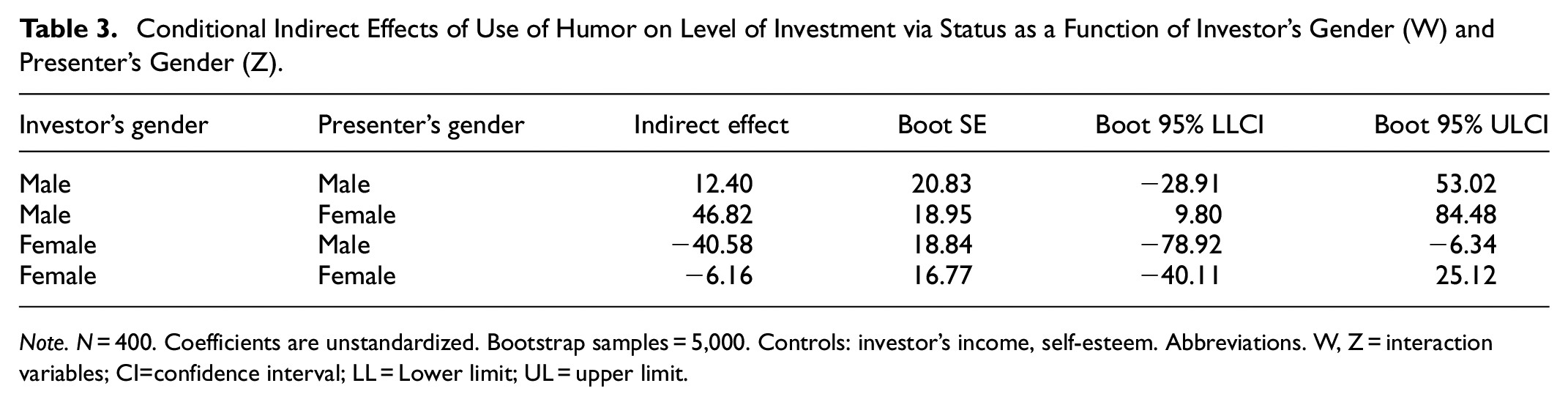
Note. N = 400. Coefficients are unstandardized. Bootstrap samples = 5,000. Controls: investor’s income, self-esteem. Abbreviations. W, Z = interaction variables; CI=confidence interval; LL = Lower limit; UL = upper limit.

The interaction between male salesperson’s use of humor and level of investment on salesperson’s status.
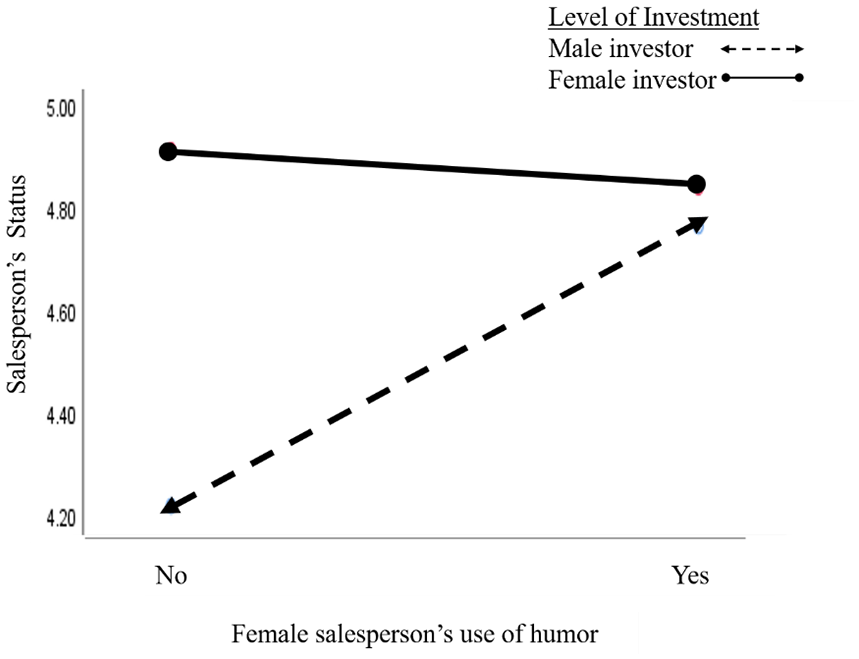
The interaction between male salesperson’s use of humor and level of investment on salesperson’s status.
Discussion
Scholars often refer to humor as a “risky” or “double-edged sword” (e.g., T. B. Bitterly et al., 2017). Therefore, in the current study, we examined the conditions that create an effective use of humor in a presentation. Specifically, we examined the role of humor in an investment presentation setting. We answered the following questions: whether humor is effective in an investment presentation, who can use the humor, to whom humor is directed, and why it is effective. The study is based on the BVT, a model that emphasizes the need to address the appropriateness of humor in any potential setting and consider both the present and the audience characteristics (McGraw & Warren, 2010; Warren et al., 2018). This study makes several contributions to literature in several ways. First, to the best of our knowledge, this is the first study that experimentally examines the impact of humor during investment pitch presentations and answers the question of whether one can start a business presentation with a joke. Second, we suggest that perceived status can contribute to a better understanding of the processes by which the presenter’s use of humor during the presentation pitch affects the actual client’s behavioral tendencies. Third, the current study addresses the need to explore gender differences (T. B. Bitterly et al., 2017; Kant & Norman, 2019). The present work empirically investigates the theoretical expansion of the BVT framework suggested by Kant and Norman (2019), who argue that humor studies should explore both parties—the person telling the joke and and the person receiving it and any gender differences that may impact whether humor is perceived as appropriate.
Following our first hypothesis, we found that using humor at the beginning of a sales presentation could increase the client’s investment level, thus supporting H1. This finding supports the argument that humor can be a powerful tool in persuasion (Martin & Ford, 2018). Research in the use of humor among salespersons is still developing (Bompar et al., 2018; Guenzi et al., 2019; Lussier et al., 2017), and based primarily on cross-sectional and self-report designs (e.g., Bergeron & Vachon, 2008; Iqbal & Hassan, 2019). During the workplace negotiation process, humor can be considered “a vehicle to deliver contentious dialog in a less threatening manner and simultaneously reduce the potential for refusal” (Taylor et al., 2022, p.17). In addition, in the investment literature, managerial humor can be a positive signal about the firm’s prospects (Call et al., 2022). The current experiment supports this previous work by suggesting that starting a presentation pitch with a joke is effective even in the financial and investment domain, which is considered relatively conservative and traditional (Iqbal & Hassan, 2019) and increases a potential client’s willingness to invest.
Our second hypothesis was further supported, indicating that the perceived status of the presenter mediated the associations between the use of humor and the level of investment. Two experimental studies suggested that humor can increase the joke teller’s perceived status (T. B. Bitterly et al., 2017) and that perceived status can mediate the relationship between managers’ use of humor and managers’ performance evaluation status (Evans et al., 2019). The current work is in line with these findings by indicating that humor in an investment pitch process can be used not just to showcase one’s superiority and ability, but rather to provide a better position in financial consulting negotiation. As people are attracted to individuals who affirm their status (Sadler & Woody, 2003), the use of humor by the presenter should be interpreted by the investors as a reassuring signal that the presenter is in control and ultimately increases their willingness to take a risk and invest in the company.
Contrary to our third hypothesis, we did not find that the presenter’s gender moderated the mediation path of humor on the investment level via perceived status. These findings contradict Evans et al. (2019) conclusion that humor is functional for male managers but disruptive for female managers. Our work is different than their work in the following way. Evans et al. (2019) manipulated two contradicting aspects – the stereotype of men as funnier and the stereotype of leaders that includes the stereotype “to think like a man” (Lanaj & Hollenbeck, 2015). Both stereotypes lead to the woman manager experiencing more penalization than the man when she uses a humorous message. However, the current study, conversely, focused on manipulating gender differences but without addressing formal power hierarchies (manager-employee) between the presenter and the audience. In addition, in the financial setting, the relationships can be more complicated regarding the appropriateness of using humor by a female presenter. On the one hand, women in the financial investment domain (a traditionally male organization) may encounter gender stereotypes and biases, such as men being agentic and women being communal (Eagly & Sczesny, 2019). Therefore, a woman presenter who uses humor may be negatively perceived because she violates a solid gender norm. Yet, a woman presenter who uses humor can be positively evaluated because her actions can be perceived as status-incongruent, which supports this idea (Schaumberg & Flynn, 2017). Both lines of reasoning can explain the non-significant conclusions in our empirical results. The inconclusive results are also in line with the recent review on gender differences in humor. The review indicated that there are only a few studies on this topic, and while three samples showed no gender differences, three showed that men are funnier than women, and one showed that women are more amusing than men (Hofmann et al., 2023).
While our results did not support H3, namely that the gender of the presenter did not moderate the indirect relationship between the use of humor and level of investment, we did find a significant interaction between the gender of the presenter and the gender of the investor, thus supporting H4. We found that while a female presenter’s use of humor in front of male investors activated positive outcomes such as increased status and increased level of investment, the effect of a male presenter’s use of humor on female investors was more costly and resulted in decreased status that ultimately reduced the levels of investment. Our findings echo the theoretical expansion of the BVT framework (Kant & Norman, 2019), emphasizing the need to explore both parties, the joke-teller, and the joke receiver, and that perceived social distance and power asymmetry (such as gender differences). Social distance activates psychological distance between the joke-teller and the joke-listener, especially when the two parties do not belong to the same in-group, and accounts for the perception of the joke as benign (and consequently funny) or inappropriate. According to Kant and Norman (2019), social power asymmetry can shape the joke’s perception as offensive and benign. Mixed-gender dyads represent social differences and asymmetrical social power relationships (Hofmann et al., 2023; Kant & Norman, 2019; Tabassum & Karakowsky, 2023; Taylor et al., 2022). Therefore, if the joke-teller belongs to a low-social power group (women presenter in our study).
In contrast, for the joke listener in a high-social power group (male investor), the joke listener would tend to refer to the use of humor as more benign and would have a higher “impropriety threshold” to perceive a humorous message as a violation and offensive. However, if the joke-teller belongs to a high-social power group (e.g., male presenter), and the joke-listener belongs to a low-social power group (female investor), this is a potentially risky situation, and the joke-listener may have a higher impropriety threshold. In these asymmetric situations, the use of humor by a male creates an even greater social distance between the two parties, and the joke listener may feel that the violation of norms is inappropriate and harmful and can no longer be perceived as benign.
Additional support for our mixed-gender dyads findings rely on the overcorrection bias: when people take a robust firm stance in the opposite way to overcompensate for socially undesirable behavior. For example, while experiencing physiological threat response during contact, ingroup members respond more favorably to minority outgroup members than ingroup members (e.g., smiling more frequently; Mendes & Koslov, 2013). In addition, inoffensive humor by high-status women was considered better than that by high-status men (Sacco et al., 2021). More research should be done to explore the potential impact of mixed-gender dyads in the workplace (the “glass partition”; Elsesser & Peplau, 2006).
Theoretical and Practical Implications
This study includes several contributions to the current literature, in several ways. First, this work experimentally examines the boundaries of the benign violation theory (McGraw & Warren, 2010; Warren et al., 2021; Warren & McGraw, 2016). The theory acknowledges that the larger social context determines whether something is funny but focuses on individual-level moderators and temporal and geographical distance rather than social or dyadic ones (Kant & Norman, 2019). Specifically, Kant and Norman (2019) suggested that the following line of research should focus on bringing BVT into a broader social context, investigate humor beyond the individual level, and include more social mechanisms involved with (un)successful humor outcomes. The current work addresses their call and expands the understanding of the need to systematically integrate social distance elements (such as mixed-gender dyads) into humor investigations based on BVT. Gender differences are one aspect of social distance (Kant & Norman, 2019) that provides an additional determinant of construal level for searching for a “sweet spot” within which the joke-teller and joke-listener can agree on a joke constituting a benign violation. Future work may expand this line of research by including other aspects of social distance and power asymmetry.
The current research further contributes to the scarce literature on humor in sales relationships in general (Lussier et al., 2017) and presentation pitch in particular. By identifying the moderating role of mixed-gender dyads and the mediating role of perceived status, we offer an initial response to Wagle’s (1985, p. 225) still-to-be-answered call to “determine when and how humor should not be used”. Consistent with previous research suggesting that sometimes humor might be inappropriate and should be avoided (T. B. Bitterly et al., 2017), this research provides a clear indication that humor indeed might reveal itself to be detrimental, especially for a man in front of female investors.
Practical Implications
From a practical point of view, our findings encourage females to use humor in the workplace, specifically during presentations. This can be a managerial imperative and may affect the decisions and instructions given to presenters when they speak on behalf of the organization. Given gender stereotypes regarding humor, misattributions can become self-fulfilling prophecies for women. Women’s humor is not encouraged, and this lack of encouragement may inhibit further attempts at humor (Cann et al., 2011). Our work provided some support that this vicious circle can be stopped when women can benefit from using humor in male interactions.
Humor may exclude some people and can be interpreted negatively, creating conflict and disruption (Kim & Plester, 2021). Therefore, the risk of using humor in mixed-gender dyads (when the male is the presenter, and the female is the investor) should be considered. This is especially significant in diverse workplace contexts, where people from different cultures interacting and working together. Like T. B. Bitterly et al. (2017), we demonstrate that humor can influence status, but attempting to use humor is risky because, as we indicated, it can be more harmful to men. A sense of humor is considered essential for career advancement (Kong et al., 2019), and indeed, training scholars provided several techniques to win over audiences with humor (Martin & Ford, 2018). However, our findings suggest that this perspective requires a note of caution. We recommend that intervention programs incorporate these findings to identify gender differences and, thus, reduce potential adverse outcomes.
Our results showed that men invested more when the presenter was a woman and she used humor. It was as if men appreciated that a woman in the field of investment felt “free” to use humor regardless of the seriousness of the presentation. The reversed result was found for women, who invested less when the presenter was a man and he used humor. In this regard, we draw attention to the issue of male-dominated occupations. Our research targeted financial firms and investment. Finance and investment banking have long been male-dominated (Koch et al., 2015; Mohammadi & Shafi, 2018; Spinelli-de-sá et al., 2017). This social phenomenon created and perpetuated gender stereotypes could influence how men and women judge women’s behavior in investment presentations and in the use of humor during them. (Ellemers, 2018). We maintain that this interaction result shows the manifestation of gender stereotypes and how they control our judgment of behavior. While men are expected to play by the occupation rules (Snickare & Holter, 2018), women are exempt from the occupation incumbents (i.e., men) since they are new to the game.
Finally, the current study focuses on the financial investment context. This context compared other sales sectors’ particularities that could influence the effects of humor usage. Indeed, financial transactions are much more significant in terms of sales volumes, take more time to unfold, are more relationship-based, and are much more critical to the success of firms (Iqbal & Hassan, 2019). In addition, the recent trend in financial institutions is to go virtual. Virtual banks and virtual investment firms are prevalent. As more communication will occur virtually, for instance, via email, chat, or Skype, these changes transmit less information than traditional face-to-face communication (Kilson & Tavares, 2024). Therefore, our experimental virtual setting may expand the understanding of the social norms of the receivers. It is even more critical on these channels. There is a lack of social and emotional cues that signal to the presenter that their joke is inappropriate, and more misunderstandings in humorous communications should result. Therefore, we assume that this is relevant to study the behavior of virtual investment of the general population to test the reaction to such sales attempts. In this sense, our study is relevant and trendy and contributes to understanding how these financial endeavors will be reacted to. Given these trends, our research allows a better understanding of which route or process is most important for financial investor salespersons. In this sense, this study is relevant. It contributes to the broad knowledge of how the general population will react to such financial endeavors and which route or process is most important for financial investors and presenters.
Future Studies and Limitations
Our study has several limitations. First, humor is affected by culture. Our study was conducted in American culture, but more diverse cross-cultural investigations can generalize the findings. For example, Western individuals tend to have more positive perceptions regarding the use of humor than Easterners (Jiang et al., 2019). While Decker and Rotondo (2001) found that humor may benefit women leaders in the Western culture, an opposite direction was found in a Chinese sample (Decker et al., 2011). Future work may also expand research knowledge regarding the cross-cultural differences in humor perception. In addition, one of the benefits of investigating our ideas in a controlled environment is the opportunity to test these effects when work experience, background, and performance are kept constant. Our results provide evidence that, all things equal, reactions to successful humor depend on the interactions between the gender of the source and the gender of the audience. However, one of the limitations that stem from an experimental design is the results’ generalzability and the study’s external validity. We tried to address these limitations by developing a realistic script that intentionally addressed a sample of potential investors (people who are full-time employed). However, the study context is still limited, and participants were asked to evaluate their investment level deliberately. However, we do not know what would happen in the real world and whether they would invest their money. In addition, the context differs from casual, authentic conversations. Thus, one potential area of future research is to consider more casual contexts through field experiment manipulation in investment companies. Future work may also generalize the result for different settings (commercial products, educational training programs, or online sales) and with various humorous manipulations. Third, we did not manipulate aggressive and offensive use of humor; future work may also expand on these aspects. Finally, we recommend that future work consider other potential mediators (such as warmth and competence) or moderators (e.g., audience motivation, type of product, and the contextual setting of the presentation). Another potential line of research may also focus on the use of artificial intelligence and humor in sales and commercial settings. Promising work has indicated that humor improves interactions between robots and healthcare patients (Johanson et al., 2020).
In Conclusion
This research expands our knowledge of the use of humor during investment presentations. It is a priority to answer this question since using humor is a common practice by presenters. Still, it’s positive or negative effects are is unknown, especially the differentiated effect of gender. Existing theory does not provide a clear answer to this prevalent practice, and by using an experimental design, this study aims to alleviate this lacuna. Using an ethically approved design, which was also anonymously gleaned, the study’s results are based on reliable data that can be replicated. To this end, we assert that to maximize the benefits of humor, one must consider the humor’s relevance to the audience and acknowledge that humor needs to be used appropriately. This is essential for people working in the finance and investment setting and with mixed-gender dyads. Humor was far more than a furtive means of having fun and lighting the mood. It was shown to be a complex communication tool that crossed borders both industrially and socially.
Footnotes
Appendix A1
Script of investment presentation with and without a joke.
Declaration of Conflicting Interests
The author(s) declared no potential conflicts of interest with respect to the research, authorship, and/or publication of this article.
Funding
The author(s) disclosed receipt of the following financial support for the research, authorship, and/or publication of this article: This study has received a grant from the Research authority of Ariel University.
Ethical Approval Statement
All procedures performed in studies involving human participants followed the ethical standards of the institutional and national research committee and with the 1964 Helsinki Declaration and its later amendments or comparable ethical standards. The university IRB committee approved the study. Online -informed consent was obtained from all participants included in the study.

Data Availability Statement
The datasets generated during and analyzed during the current study are available from the corresponding author upon reasonable request.