




Abstract
Past research on subjective well-being (SWB) in Western society and China has revealed various contributing factors. This study conducted a series of interviews with Chinese urban residents to systematically analyze those factors based on Bronfenbrenner’s Ecological System Theory. The results revealed that 5 layers, 23 factors, and 55 elements, many of which had distinct Chinese characteristics, contributed to Chinese urban residents’ SWB. The Top Model of SWB, visualized as a spinning top or gyroscope, showcased the interdependent layers of factors impacting Chinese urban residents’ SWB. At its vertical axis is a time dimension as residents often reflect on factors by comparing their present situation with the past and the future. Discussion regarding each layer, the primary factors that comprise each layer, links between the layers, and the impact of a time dimension was included to substantiate the proposed model. The discussions focus on the study’s contribution to SWB literature, public policy-making, and future research on urban Chinese residents’ SWB.
Plain Language Summary
What factors determine the happiness of Chinese urban citizens? This study interviewed 65 citizens in Shenzhen with various ages, professions, and income levels to analyze the factors that impact their happiness. Based on Bronfenbrenner's Ecological System Theory, the authors identified five layers, 23 factors, and 55 elements that contribute to happiness. These factors form a spinning gyroscope, with the personal, family, community, city, and nation layers forming from the innermost to the outermost layers. The vertical axis of the gyroscope represents the time dimension, as residents often reflect on factors by comparing their present situation with the past and the future. Many of these factors have unique Chinese characteristics, such as a focus on family, the huge gap between salaries and apartment ownership, and the importance of the Hukou status. The results of this study call for changes in government policies to support lower-income Shenzhen citizens and avoid frequent policy changes.
Introduction
Philosophers and religious scholars from Aristotle to Confucius have contemplated the topic of human well-being. Empirical studies of subjective well-being (SWB), variously referred to as life satisfaction, happiness, and quality of life, began to take shape in the early 20th century and have proliferated over the past decade (Diener et al., 2009, 2018). Most SWB research to date has been conducted by Western scholars and with Western participants, resulting in a bias toward a Western society with individualistic values (L. Lu & Shih, 1997). The SWB research conducted with people living in areas with collectivist values and orientations, such as interdependence, communalism, filial piety, cohesion, commitment, and obligation, has generally been built upon Western concepts and measures of SWB with a universalism-rooted etic approach (Burholt et al., 2018). Many have ignored the impact that cultural context may have on individuals’ perception of SWB (Davey & Rato, 2012; Stone & Mackie, 2013). This approach may have led to misleading findings (Fulford et al., 2015; Pyke, 2017). Ignoring cultural context is particularly concerning in China, where its unique history, culture, and socio-economic-political environment have shaped its underlying core values, potentially impacting Chinese citizens’ SWB/happiness (L. Lu, 2007). For example, the Western conception of happiness emphasizes intrapersonal factors, while the Chinese conception emphasizes interpersonal factors and external evaluation (L. Lu, 2007; L. Lu & Shih, 1997).
China has experienced astounding economic growth since the introduction of its open-door policy in 1978, raising millions out of poverty and improving living standards (International Monetary Fund, 2019). Yet recent statistics suggest a puzzling decline in Chinese citizens’ self-reported life satisfaction and happiness, that is, SWB (Brockmann et al., 2009). Recognizing that unique life circumstances may be impacting the SWB of Chinese citizens, we adopted a qualitative approach to investigate residents’ perceptions of happiness and the potential factors contributing to their happiness. This was crucial because existing SWB findings associated with Chinese citizens are primarily based on adapted versions of Western quality-of-life scales (Chen & Davey, 2008). The results might not capture the unique cultural imprint of Chinese citizens’ conception of happiness (Hsu et al., 2017) or account for factors currently impacting citizens’ SWB in China’s new socio-economic-political environment (Steele & Lynch, 2013; Yan, 2010). Our approach and results informed a theoretical framework—the Top Model—which was used to crystallize our new understanding of the SWB of urban residents in China.
Literature Review
SWB is defined as “people’s overall evaluations of their lives and emotional experiences” (Diener et al., 2017, p. 87). Scholars have generally agreed that SWB encompasses two distinct facets: reflective and cognitive evaluations of one’s life or emotional responses to ongoing life events in terms of positive and negative affect (Diener et al., 2018). The former has been the subject of extensive research on life satisfaction, examining people’s overall evaluation of their life as a whole or in various domains (e.g., health, work). The latter typically concerns the assessment of short-term or momentary emotional states. Although these facets are correlated, they are independent, with different sets of causes and consequences (Diener et al., 2017, 2018).
In this research, we focus on the cognitive aspect of SWB. We review relevant literature on life satisfaction or happiness research, emphasizing factors contributing to cognitive evaluations of SWB. Furthermore, we introduced Bronfenbrenner’s Ecological System Theory, which guided our interpretation of the data (Bronfenbrenner & Ceci, 1994). We also reviewed SWB research conducted in China.
Predicting Factors of SWB
Researchers have employed diverse methodological approaches to explore factors contributing to SWB. Notably, Lyubomirsky et al. (2005) developed a regression model of SWB and highlighted a set point, life circumstances, contextual factors, and intentional activities as primary predictors (Shah & Marks, 2004). A set point is largely influenced by genetics and is challenging to modify externally. In contrast, life circumstances encompass factors like age, health, marital status, and income, as well as contexts such as social networks and the physical environment. Regarding age, health, and marital status, findings have been relatively consistent: SWB either remains stable or improves with age (Mather, 2012; Smyth et al., 2010); subjective perceptions of health and healthcare accessibility influence SWB (Fung & Wong, 2007; Marks & Shah, 2004; Wangmo, 2011); and married individuals report higher SWB than those who are never-married or previously married (Diener et al., 2000). The relationship between income and SWB has been debated: while Easterlin (2003) found no correlation, others have reported contrasting findings (Graham & Pettinato, 2002; Welsch, 2002). The disparities might arise from focusing on relative rather than absolute income (Helliwell & Putnam, 2005), individuals’ tendencies to compare their financial standing to others (Knight et al., 2009; Smith et al., 2013), or from the ability to adapt aspirations in changing circumstances (Vemuri & Costanza, 2006).
Contextual factors, like social connections with family, friends, and community organizations, impact SWB (Helliwell & Putnam, 2005). Such connections foster a sense of belonging and positive attitudes, both crucial for psychological well-being (Diwan et al., 2004). Reis and Gable (2003, p. 129) posited that these connections might be the predominant source of life satisfaction and emotional well-being. Proximity to green spaces also enhances well-being (Maller et al., 2002), as does the presence of natural capital (Burns, 2005; Vemuri & Costanza, 2006). Government policies on social security and citizens’ perceptions of their government also affect SWB (Braam et al., 2008; Musikanski et al., 2017; Schoenenberger & Stuck, 2006). Given the influence of life circumstances and contextual factors on SWB, we utilized Bronfenbrenner’s Ecological System Theory (Bronfenbrenner, 1979) to guide our study’s interpretation.
Bronfenbrenner’s Ecological Framework and Subjective Well-Being
Bronfenbrenner (1979) originally argued that human development depends on four interdependent systems: microsystem, mesosystem, exosystem, and macrosystem. The microsystem represents the environment in which an individual interacts directly with other agents, such as parents and teachers. The mesosystem provides the connections between those agents in the microsystem; the exosystem defines the societal system (e.g., workplace) where the individual functions. The macrosystem includes the cultures, laws, and customs that affect daily life.
Later, Bronfenbrenner (1989) recognized the importance of the individual self and its development, referring to sex, age, health, genetic makeup, and how each interacts with the four systems. The chronosystem was later added, accounting for time and its impact on a person’s development. In 2006, Bronfenbrenner and Morris expanded the framework by introducing the People-Process-Context-Time (PPCT) model. They argued that the interaction between a biological human being and the people, objects, and symbols in their environment forms proximal processes that evolve over time. To our knowledge, neither Bronfenbrenner’s Ecological System Theory nor the PPCT model has been applied to guide SWB studies.
SWB Research in China
SWB research has grown significantly in China over the past two decades. Most SWB research has been conducted in mainland China and published in Chinese-language journals. A few studies have been conducted in Hong Kong, Taiwan, or overseas Chinese communities and published outside China. In their review of SWB studies conducted in mainland China, Chen and Davey (2008) documented focal areas that have attracted scholarly attention, including, but not limited to, SWB and life circumstances, as well as SWB and personality.
Regarding the relationship between SWB and life circumstances, Easterlin et al. (2012) and Sun et al. (2016) reported a U-shaped pattern of SWB/life satisfaction over time and with age. They also found positive correlations between SWB and subjective health, income, and education, as well as higher levels of SWB in females and married individuals. SWB’s link to absolute income may be tenuous, however. For example, several researchers found that SWB is strongly affected by perceptions of relative financial well-being, such as perceived household position in the community, perceived equality of income distribution, and financial situation relative to the past (Jiang et al., 2012; Knight et al., 2009). Similarly, homeownership has been identified as another important contextual factor in Chinese SWB studies. Chinese have long viewed homeownership as a rite of passage. F. Hu (2013) found that homeownership is linked to higher social status, enhanced confidence and self-esteem, greater financial security, and a stronger sense of community. Homeownership may also negatively influence SWB when homeowners over-extend themselves financially, which results in less liquidity, mobility, flexibility, and financial stability. The pros and cons of homeownership may depend on the type and location (e.g., city center, rural area) of a home (F. Hu, 2013). Davey et al. (2009), for example, reported that respondents in an economically disadvantaged rural village in Hunan province were generally satisfied with their lives. Webb (2009) found similar results with a sample of Tibetan nomads. They provided several explanations for the finding: (a) respondents’ basic needs are met, (b) they are doing better than in the past, and (c) strong Buddhist beliefs (e.g., one should accept life with a peaceful mind; hardship leads to enlightenment).
Other researchers who’ve used existing SWB scales have reported relationships between life circumstances, contextual factors, and SWB. Li (2006) and Nielsen et al. (2010) used a single-item indicator (i.e., “All in all, how happy are you these days?” or “All in all, how satisfied are you with your life?”) to measure SWB. They found that SWB was related to the ability to work, despite the lack of job security. Using the International Well-being Index, various researchers (e.g., Chen & Davey, 2008; Davey et al., 2009; Huang & Xing, 2005; Smyth et al., 2010) found residents were generally satisfied with their lives, primarily because of strong family and community support (i.e., contextual factors). Similarly, Knight et al. (2009, p. 647), who used a proxy to measure personal relationships, found that the “quality of, and importance attached to, personal relationships tended to raise happiness.” Studying perceptions of quality of life (as a proxy for SWB), Liu (2006) found they were linked to life circumstances/contextual factors such as family, work, social relations, and the natural environment.
Few researchers have adopted a qualitative approach to the study of SWB in China. Over two decades ago, L. Lu and Shih (1997) documented Chinese citizens’ focus on interpersonal evaluation, revealing the collective nature of Eastern culture. Their finding reflects the duality in Chinese mentality: they both possess the collective self, where one focuses on harmony with one’s peers, community, and the environment, and the individual self, where one focuses on self-achievement and productivity in an industrial world. The result is a composite self as the negotiation of the two (L. Lu, 2007). In addition, Lee (2005), studying older adults in Hong Kong and mainland China with in-person interviews, found that mental health, number of days in a hospital, age, self-esteem, and life satisfaction were significant predictors of SWB. Xing (2003) and Niu and Xing (2017) conducted interviews with urban citizens in China and constructed a happiness index. Their final happiness measurement included 56 indices covering six dimensions (health, living conditions, human labor, culture, social security, and social network).
In conclusion, researchers who have conducted SWB research in China have used various scales to measure SWB and have investigated factors affecting SWB, including life circumstances, physical environment, contextual social factors, and culture. Many of these factors can be viewed as part of the ecological environment in Bronfenbrenner’s model (Bronfenbrenner & Ceci, 1994; Bronfenbrenner & Morris, 2006). For example, family relations, work, and social relations are considered part of the microsystem. How these factors interact with each other and the community generally is linked to the mesosystem. The exosystem may involve housing policies, income inequality, and changes in societal well-being in general (also part of the chronosystem). Culture is deemed to be part of the macrosystem. However, many factors are likely unique to the individual, such as a sense of achievement, which is not a part of Bronfenbrenner’s model. Life circumstances and specific contextual factors of the study site influence SWB (Broberg, 2012; Lagacé-Séguin & Case, 2010; Lawler et al., 2017; Newland et al., 2014, 2015). Chinese society is developing so fast that the results of earlier SWB research may no longer be applicable and, as such, not effective in informing today’s policy-making (Davey & Rato, 2012; Xi, 2017). Thus, we chose to employ a qualitative approach to explore factors impacting urban Chinese citizens’ SWB systematically.
Research Method
To address the purpose of this study, we used the phenomenological approach, which focuses on “the common meaning for several individuals of their lived experiences of a concept or a phenomenon” (Creswell, 2013, p. 76). This approach is ideal for researchers who want to approach a phenomenon anew by eliciting descriptive data (Colaizzi, 1978) that can enhance understanding and lead to effective practices and policies.
Study Site and Sample
The study site was Shenzhen, China’s fourth-largest city with 20 million residents (Nylander, 2017). It was chosen because it epitomizes today’s urban China—fast-paced development, great prosperity (residents have the highest level of personal income; Nylander, 2017), and the complexity of growth associated with urbanization. Like Han (2015), we suspect these changes have affected SWB.
The sample was comprised of Chinese residents living in Shenzhen. They were initially chosen based on three criteria: occupation (hospitality-related vs. non-hospitality), work status (retired vs. working), and education (college vs. high school or less). Past research on SWB in China has demonstrated a correlation between income, education, and happiness (Easterlin et al., 2012; Sun et al., 2016). Additionally, previous research has demonstrated higher stress levels among employees in hospitality-related industries (O’Neill & Davis, 2011). However, mid-way through data collection, the research team found that demographic characteristics were unrelated to an individual’s conceptualization of SWB or their perception of the contributing factors. Thus, according to Marshall and Rossman (2010), the research team adopted a snowball sampling method.
The final sample comprised 51 females and 14 males (Table 1). The sample ranged in age from 30 to 70. Around 58% were employed, almost one-half possessed a college degree, most were married (82%) with children (83%), and 63% had Shenzhen Hukou status. Hukou is a household registration status system for social control in China. It limits social mobility, especially between urban and rural areas. Urban Hukou status reflects privilege and carries benefits such as better education for children, healthcare benefits, and enhanced welfare (Chan & Zhang, 1999). The benefits vary by each city’s level of economic development.
Demographic Profile of Sample.
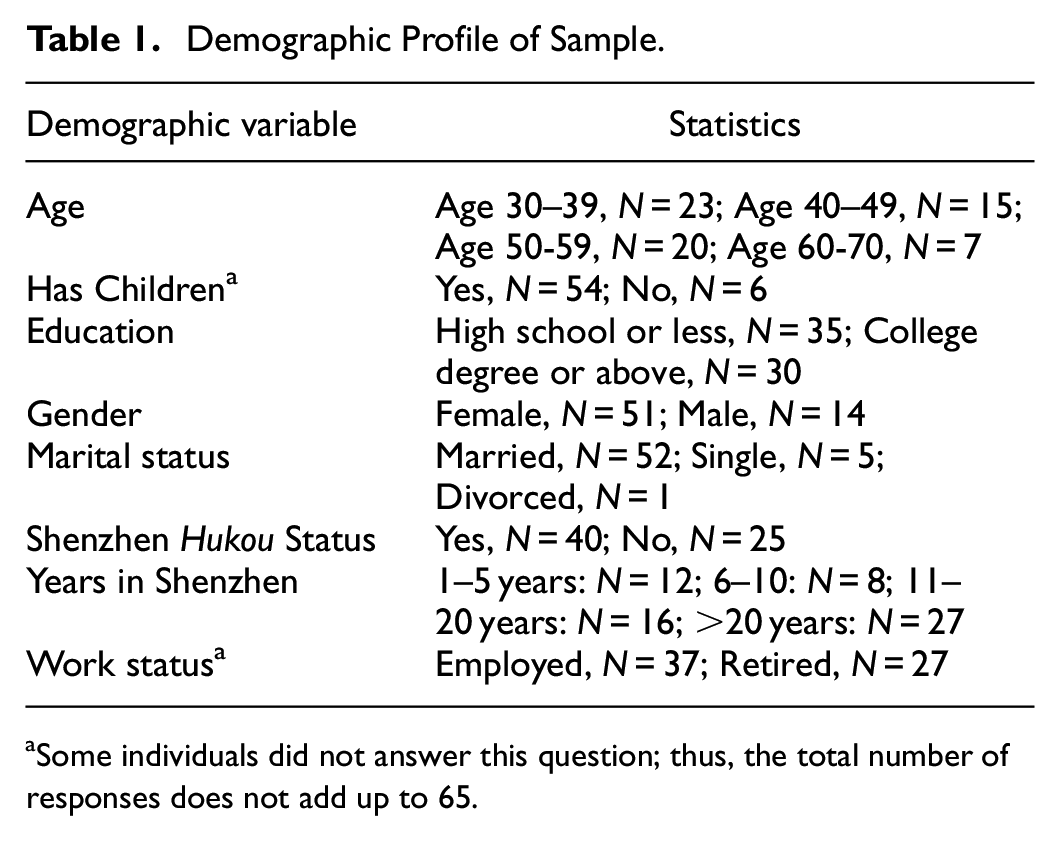
Some individuals did not answer this question; thus, the total number of responses does not add up to 65.
Data Collection
The research team designed an interview protocol based on two research questions: “What is urban Chinese residents’ conceptualization of SWB?” and “What factors contribute to urban Chinese residents’ conceptualization of SWB?” After testing the protocol through a pilot study, the research team changed the wording of certain questions. For example, the term happiness (Xingfu or  in Chinese) rather than SWB (
 in Chinese) was used because SWB is an academic term and rarely appears in daily conversations in China. The final version of the interview protocol included 11 broad questions (Table 2). The actual interviews were conducted in Chinese.
Guiding Interview Questions. a

Questions were asked in Chinese and translated into English for the purpose of this manuscript.
One-on-one interviews were conducted in July and August, 2017. Interviewers began each session with questions about residents’ length of residency and their observation of recent changes in the city in order to develop rapport and trust with the interviewees. The interviewers then asked about residents’ conceptualization of happiness and the factors that affect their level of happiness. Interviews, which lasted from 15 to 50 minutes, were conducted in an office on a university campus in Shenzhen.
Data Analysis
Data analysis began with open coding and proceeded to axial coding (Corbin et al., 2014). Transcripts of the interviews were reviewed in an effort to obtain an overview of the data. Then, ten transcripts were randomly selected and three members of the research team: (a) independently reviewed them for significant phrases or sentences pertaining directly to happiness, (b) created codes associated with the significant phrases or sentences, and (c) met to compare codes and reduce codes into themes. An initial codebook comprised of 23 codes guided analysis of the remaining 55 transcripts.
During the coding process, the research team recognized that interviewees’ responses to the questions about their conceptualization of happiness were intertwined with the factors (e.g., family harmony, personal health) that influenced it. Thus, answers to the conceptualization question and the factors impacting happiness were coded together. Additionally, the team found that the themes could be viewed and referred to as “layers,” mirroring Bronfenbrenner and Ceci’s (1994) bioecological model. The decision to adopt this approach, which Wolcott (1994) deemed acceptable, was in part based on Vélez-Agosto et al.’s (2017) support of Bronfenbrenner’s bioecological theory and their belief that “individual development cannot be separated from its social and cultural-historical context” (p. 906). Thus, individual factors were treated as “a critical part of the microsystems as well as all other systems that the microsystems are a part of” (p. 909).
The final number of codes followed a tree structure with 55 elements, 23 factors, and 5 layers (Figure 1). Methodological rigor was achieved through bracketing, attaining an adequate sample, conducting interviews until saturation was reached, utilizing multiple coders, comparing codes, and having codes reviewed by the most experienced members of the research team (Silverman, 2005).

The coding tree.
Results
The findings are presented as the layers that form the Model of SWB of Urban Chinese Residents (Figure 2). The model should be visualized as a spinning top or gyroscope, indicating the delicate balance of the factors impacting one’s happiness. The vertical axis of this spinning top represents a time dimension when respondents discussed their views on their past or future life conditions compared to their current situation.
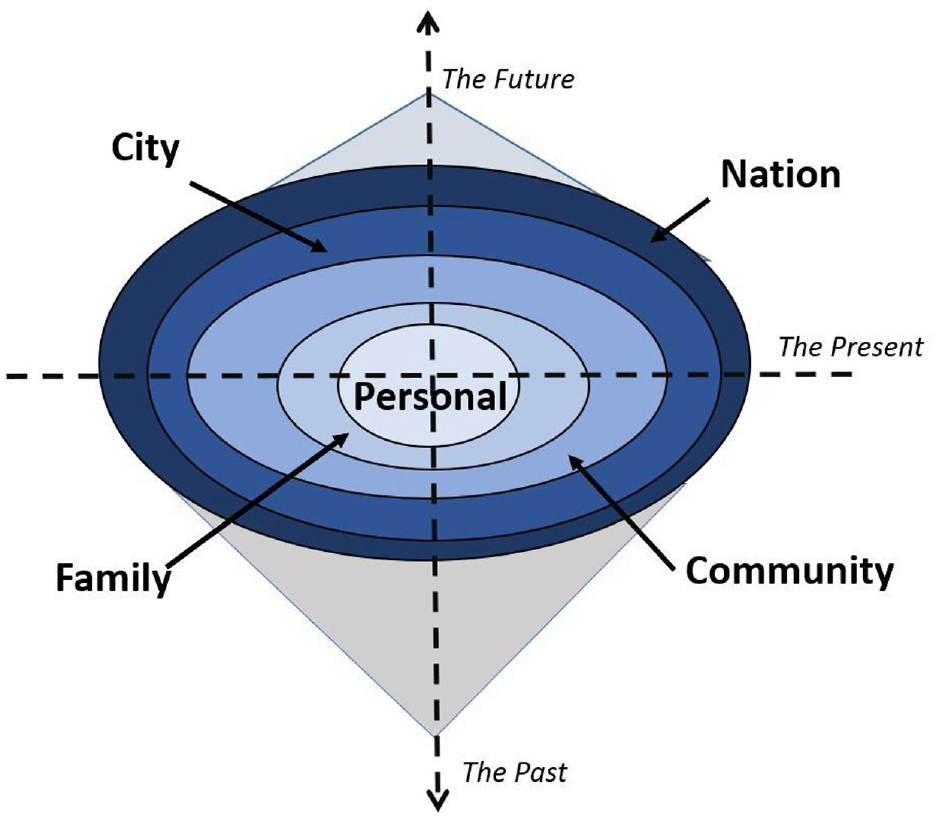
The top model of SWB of Chinese urban residents.
Layers of SWB
A total of five layers, which represent residents’ conceptualization of SWB, were revealed. The first layer is a “Personal Layer,” followed by four outer layers—“Family,”“Community,”“City,” and “Nation,” in that order. Each of the five layers comprises multiple factors, which are highlighted in the following discussion (Table 3).
The Codes Structures and Counts.

Only included elements mentioned five or more times.
Personal Layer
While the Personal Layer is not part of Bronfenbrenner’s ecological model, it was a significant layer in our investigation of residents’ happiness. This layer involved factors related to residents’ Job and Salary, Mentality, Leisure Activities, Stress, Mood, and Personal Development.
The two most often cited factors contributing to the Personal Layer were Job and Salary, and Mentality (Table 3). When discussing their Job and Salary, residents’ mentioned their low salaries, for example, “…To us, the salary is not enough right now…” (11); an improvement in their salary, for example, “…We also have an increase in salary” (28); or gaps in salaries, for example, “…Salary is low, big difference when comparing with the [salary of] leadership positions …” (67). They also linked comments about their salary to other issues, such as the cost of housing: “…The only drawback is that my income does not keep up with the apartment price” (19).
Mentality, on the other hand, was linked to a mental state emanating from within: “I think you can’t compare with others. Everyone’s mood is different; everyone’s views are different…” (18) and “I think a healthy body and happy daily life are happiness. Why do you compare yourself with others? There will be people who are better than you, and there will be people who live in worse condition than you…” (19). This belief that mentality is individualistically extended to the notion of positivity: “I am an optimistic person. I won’t allow it to affect my mood. I won’t bring [my negative mood] from my work to my life…” (31).
Family Layer
This layer, part of the microsystem in Bronfenbrenner and Ceci’s (1994) bioecological model, included three primary factors—Housing, Family Health, and Family Relationships. Mentioned less often were Parents and Children, Healthcare, and Hukou (Table 3).
Housing was an important factor in the Family Layer, as one interviewee said, “No house, no home. [Without your own house], you are just floating in this city. …I would feel like a leaf without a root…” (66). Unfortunately, owning, even renting a home is difficult for many residents in Shenzhen: “It’s all due to apartment price [so I’m not perfectly happy]…” (15).
The health of family members also proved important to residents’ happiness: “Family harmony, old and young, safe, sound, and healthy, are more important than anything else. Personally, money is not that important compared to family harmony and health. That [family harmony] is the best” (16). One resident suggested it was the most important factor contributing to happiness: “Family health is the number one factor. Without health, a family will fall apart…healthy is not only important for an individual. A family cannot be genuinely happy if one member is sick” (53).
This layer also included Family Relationships. A woman’s failing relationship with her husband negatively affected her happiness as did a man’s concern for his children: We were very happy. I bought an apartment in Guangzhou on February 9 and was planning to buy furniture. Then on February 15, my husband suddenly, out of nowhere, told me he wanted a divorce. He is not in Shenzhen, no, he is in Guangzhou. By no means will I leave Shenzhen. Things were really good, then all of a sudden. I cannot accept it. (74)
Children’s education: “For an average resident like me who does not have the privileges on both sides [urban and rural], children’s education is a big headache.” (37)
Community Layer
This layer primarily included references to Relationships in one’s immediate social circles. Much lesser attention was given to one’s physical surroundings (e.g., buildings, neighborhood, or district around one’s apartment). Most comments were positive. For example, when discussing relationships in her community, one woman said, “…If you live in a community where we have good relationships, don’t you feel happy? It is harmony in personal relationships” (24). Another indicated, “I have a few good friends [in the neighborhood]. I have lived here for more than ten years, after all. If I need any help, they will help out, and I will do the same vice versa…” (43). Focusing more on the larger community, interviewee 28 mentioned, “… the Neighborhood Management Committee often holds volunteering activities, or problem-solving for the residents, which is lacking in western cities…” Others recognized the role Physical Conditions in their neighborhood played in their happiness: “The place we used to live has more greenery these days… with better planning and better access” (13).
City Layer
In Shenzhen, one of the most developed cities in China, the city’s various status has been a source of happiness for residents. Eight factors emerged in this context (Table 3): Municipal Administration, Public Transportation, Urban Environment, Education System, Welfare Policy, Public Order and Safety, Prices, and Citizenship. All factors, with the exception of Education System, Welfare Policy, and Prices, were perceived positively.
Municipal Administration was addressed most often in the City Layer. Residents were generally satisfied with the overall administration of the city; they suggested: “Yes… [insurance for major disease] is very good for citizens. Shenzhen is much better than other cities on this aspect” (18). When discussing the administration of the city residents also alluded to the state of the city’s Public Transportation—“Life is getting better. Specifically, the subway and bus system make transportation a lot more convenient” (14), and its Urban Environment—“Another good aspect of Shenzhen is trees. Shenzhen is so hot, extremely hot. It is good now that Shenzhen has trees everywhere…” (26). Perhaps as a result of the city’s efforts to improve the overall environment, many informants indicated they appreciate the Public Order as well as Citizenship of residents in Shenzhen: “When we first arrived in Shenzhen, especially in Baishizhou, safety is not good. Stealing happened all the time. Thieves will steal from your apartment even when we were napping in the daytime. Nowadays, there is video surveillance everywhere, and it is very good.” (16) In terms of Citizenship, informants praised the civility of Shenzhen citizens: “When I was pregnant and taking a bus, people would immediately give their seats to you. This is a good civilized city” (16).
Residents also noted the negative effects of the city on their happiness. Living in Shenzhen, they suggested, is pricey: “In everyday life, it’s getting more and pricier. Though salary is increasing, it didn’t catch up with the faster-growing living cost” (17). For families, the negative aspects of living in the city extended to the Public Education System—“Yeah, I hope my child will have a better education… Yes, it’s much troublesome without Shenzhen Hukou” (22)—as well as the government’s Welfare Policy—“Our parents also have retirement benefit. They used to be working class, but now they have retirement benefits. In my opinion, in terms of income, our retirement benefits are so good. Everyone can have retirement payments. I think we have money to spend” (63).
Nation Layer
Comments about the Nation mainly focused on the national economy and power. For example, in the words of one resident: “only if the nation is getting better and better, can we have a better life; now that the nation is strong and prosperous, talents will stay” (26). Another referenced the nation’s economy: “When the nation is prosperous, everyone has money and job, and young children all go to school. I think it is all good” (52). Residents also spoke to the strength of their Nation and being respected: “If we travel abroad, and if we are not maltreated, a strong nation is a must. It is happiness to be respected…” (63)
Time Dimension
When analyzing the layers impacting residents’ happiness, a theme associated with time was uncovered. It cut across all five layers and included two directions—the past and the future. Interestingly, when residents contrasted their current situation with the past, it was usually positive (53 out of 61 comments). Alternatively, when their comments were associated with the future, they were mostly negative or uncertain (12 out of 14). Example of positive changes from the past included, for example, the ease of living in Shenzhen: “I feel happy now. We [are] old people from the rural area. Our lives were so hard and tiresome. Now the general direction is very good, the basic needs, such as eating and housing. We don't need to work too hard…” (26). Safety was also an important positive change and contributor to happiness: “The change I experienced is safety: it is really chaotic in the past; we won't dare walk out at night or day” (14). However, not all comments were positive, as some residents indicated, “…The food we eat is not as healthy as before…” (19).
When envisioning the future, some residents expressed hope for the future, while others noted concern for themselves as well as family members. Informant 26’s comment reflected a belief expressed by many: “I have nothing to worry about. I just hope my grandchildren grow up day by day. They will enjoy studying and learning good skills and having a job….” Concern for the future-focused on the ability to purchase a home, for example, “I am worried about housing. I may not be able to afford an apartment in the future…” (84), as well as their children’s future, for example, “[The unhappiness], is mainly due to children. I think today’s good job does not mean [you have a good job in the future]. I worry about unemployment…” (48).
Discussions
The layers and factors are validation of past studies, though termed differently. In the Personal Layer, contributing factors were linked to individuals’ internal and external conditions. For example, they referred to how internal conditions such as their mental state, mood, and personal stress affected their happiness and reflected on the impact of external conditions such as their salary or their participation in leisure activities. The internal conditions that comprise this layer are similar to what Lyubomirsky et al. (2005) refer to as an individual’s set point, which is thought to partially impact long-term happiness (Diener et al., 2003). Job and Salary and participation in Leisure Activities are also reflected in Lyubomirsky et al.′s framework, albeit in different categories (i.e., Life Circumstances and Intentional Activities).
The factors within different layers also connect, cutting across layer boundaries. When speaking about their Job and Salary, some residents referred to the growing income inequality in China, which has been shown to affect happiness (Asadullah et al., 2018). Others lamented that their salary had not kept pace with the costs of goods and services. In both cases, residents often tied their discussion about salary to their ability to provide for their families. The link between the external condition of a salary in the Personal Layer and family in the Family Layer is important as it reinforces that many factors contributing to happiness/SWB are interdependent and often jointly lead to the desired benefit (e.g., the ability to purchase an apartment). The connections between Layers might not have surfaced if we utilized an existing SWB scale.
Family Health and Family Relationships are two primary factors comprising the Family Layer. Both are characteristics of a collectivist culture, where the family is essential and directly related to one’s happiness. According to Chen and Davey (2008, p. 597), family harmony and altruistic commitment “…are an integral component of the Chinese view of self, in which happiness is accomplished partly through group relationships and the welfare of others.” So too, is the notion of familism or prioritization of the family unit, which Burholt et al. (2018) feel is linked to SWB in collectivist cultures.
The third primary factor in the Family Layer was Housing. According to Sito and Liu (2018), “Homeownership has become the ultimate symbol of success in China, the mark of adulthood, readiness for a family, and ownership of one’s financial destiny.” Homeownership has also made residents house poor (mortgage debt increased from 3 to 25 trillion RMB from 2008 to 2018, Caixin, 2018) and increasingly financially and emotionally stressed (Prakash & Smyth, 2019). Over time these stressors may increase. Research suggests that 91% of millennials, that is, individuals born between 1981 and 1998, in China intend to purchase a home in the near future, yet many have not saved enough to make a down payment on a home (HSBC, 2017). Thus, parents (primarily) will be burdened with bankrolling their children’s home purchase or supporting them while they save enough money to make a down payment on a home. This burden on parents and millennials may manifest in lower rates of SWB in the future.
Unique to China is the finding that the three factors comprising the Family layer are interrelated through China’s Hukou household registration system. For example, buying and owning an expensive apartment can result in a prestigious Shenzhen Hukou for the family, which carries better healthcare and education benefits, contributing to family members’ health. The three factors are also linked to the Personal layer, as one’s salary can determine if one can own an apartment, which brings Hukou status. The link to Hukou is important, as Jiang et al. (2012) have recognized the impact of Hukou on well-being. New to the literature is our finding that Hukou status is integrally linked to other factors and layers contributing to happiness/SWB.
In the Community Layer, social relationships were of primary importance to residents. They recognized the positive role of good relationships with neighbors and community volunteering in their happiness. Integrating locally with a diverse social network is more reminiscent of individuals living in individualistic cultures (Litwin & Shiovitz-Ezra, 2011). This phenomenon may be changing in China with the introduction of new neighborhoods that have engendered what Prakash and Smyth (2019) refer to as “neighborhood attachment.” Building broader social networks may also be tied to the fact that housing preferences are contextually shaped. As Chinese residents’ expectations for housing change (e.g., what is adequate living space, the composition of the household), so too may the degree to which their happiness/SWB is affected (Y. Hu & Coulter, 2017). In terms of the small number of comments related to the physical environment in the community, living in a well-planned, harmonious community appears to contribute to residents’ happiness. Musikanski et al. (2017) reported a similar result.
In the City Layer, the comments associated with five of the eight factors were generally positive. The negative comments were primarily associated with three factors—Education System, Welfare Policy, and Prices—all of which are linked to Personal and Family Layers factors. For example, the Education System and Welfare Policy are linked to Hukou status. Shenzhen Hukou’s status directly affects the resident’s welfare provisions and where their children attend school. Further, Prices are linked to Job and Salary (Personal Layer) and Housing (Family Layer). Without a decent job that pays a livable salary, residents can’t afford to live in Shenzhen, much less own an apartment.
The comments in the Nation Layer were universally positive. Residents commented on how strong and prosperous China is, which has resulted in economic prosperity, relative stability, and a sense of pride among citizens. While this layer was comprised of the fewest comments, it is notable for a number of reasons. According to C. Lu and Wan (2018), strong identification with a culture contributes to enhanced well-being, including happiness (Kiang et al., 2006). However, this could be affected through discrimination from the mainstream culture (Branscombe et al., 1999). If issues with income continue to escalate and the government’s household registration system is not modified, residents may begin to question their national identity, which indirectly could influence their happiness/SWB.
An important contribution of this study was the introduction of a Time dimension to the conceptualization of SWB, similar to the chronosystem in the ecological framework. The time dimension cuts across all five layers and includes two directions—the past and the future. This reflects the evaluative nature of SWB—contrasting the present with the past or future—which is rarely, if ever, discussed in the SWB literature. Residents’ reference to the future may also reflect Chinese culture, where Chinese people tend to plan ahead for the long term (Hofstede, 1980).
Many informants were positive when they compared their current with their past life (e.g., Shenzhen 10–20 years ago or their previous residence in a much less-developed rural area) and less positive or uncertain when they considered the future. Residents’ uncertainty may, in part, be linked to the fast pace of urbanization in China. Shenzhen has become a major metropolitan area in China in approximately 30 years, reflecting unprecedented growth and change. What is to come is uncertain for many. Many are worried about their children’s education and fierce competition for jobs in China’s urban areas. This uncertainty is upsetting and, for many residents, affecting their well-being. Graham and Pettinato (2002) may have explained the impact of uncertainty best when they said, “People are better able to adapt to unpleasant certainty and retain relatively high levels of evaluative well-being… than to live with uncertainty, even when that uncertainty is associated with progress” (as cited in National Research Council, 2013, p. 34).
Limitations and Future Research
We utilized a phenomenological approach to uncover factors impacting urban Chinese citizens’ happiness/SWB. In doing so, we allowed study participants to speak in detail about their lived experiences, perceptions, and views on happiness. This approach also allowed us to minimize the cultural assumptions or pre-judgments embedded in existing happiness/SWB instruments while maximizing the expression of culturally unique conceptions and ideas. That said, we recognize the reality of life and well-being amid China’s massive urbanization and relentless development, and acknowledge that our results are likely not generalizable to all urban Chinese residents. For example, we used the term “Xingfu” to represent happiness in our study of SWB. China is a vast country with extremely diverse cultures and regional differences.
Question-order and data collection may have impacted our results. We pilot-tested our interview protocol, but despite our best efforts, there may have been a question-order effect. For example, in an effort to develop rapport and trust with interviewees, one of the first questions focused on recent changes in Shenzhen. This may have prompted individuals to think more specifically about the cost of living in the city, etc. In addition, data collection took place in an office on the campus of a local public university sponsored by the government. Individuals who mistrust the government or are intimidated by an educational environment might have felt uncomfortable sharing all of their thoughts with the interviewer.
The Top Model conceptualizes factors that impact urban Chinese residents’ well-being. However, how to quantify and measure the factors comprising the five layers reflected in the Model needs more in-depth research. We invite researchers to examine and test the validity and usefulness of the Top Model in future studies.
We have alluded a great deal to the link between the personal factors of Job and Salary (Personal Layer) and Housing, Family Relationships, and Hukou (Family Layer). If, as we believe, China will continue to experience cultural and socio-economic changes, researchers must conduct longitudinal studies that validate the links we’ve uncovered and how these changes affect SWB. In terms of the Community Layer, given the continued development of new housing types and neighborhoods throughout China, studying the link between social networks, community settings (e.g., neighborhood), and even housing is necessary to advance the understanding of SWB.
Practical Implications
The apparent disconnect between China’s booming economy and its citizens’ happiness (Brockmann et al., 2009) calls for in-depth research to aid policy decisions at the societal level, as happiness becomes a focus of China’s national policy (Xi, 2017). The results of our study provide insight into factors that contribute to residents’ happiness, which, with further study, can inform China’s policy-making
For example, some personal and family factors negatively affected happiness/SWB. Many working professionals whose personal salary is tied to the government-mandated minimum-wage do not believe they will ever own an apartment. Raising the minimum wage and improving basic welfare could help to improve urban Chinese residents’ happiness. As F. Hu (2013) suggested, the government should also provide more low-price housing (family factor) for those in minimum wage jobs and develop housing areas with better infrastructure close to city centers. The government should also re-evaluate the Hukou registration system. The system limits non-Hukou citizens’ access to healthcare, welfare, and better education facilities for their children.
In addition, great changes bring great uncertainty. Frequent policy changes (a factor in the City Layer) characterize China’s governmental administration and may be well-justified due to frequent and significant societal change. However, policy stability is required if the government aims to promote positive SWB (Graham & Pettinato, 2002).
Conclusions
We introduced The Top Model of Happiness for urban citizens of China, which was constructed after uncovering the multiple layers of factors that contribute to SWB and the impact time may have on them. The Model is a useful framework for explaining and describing an individual’s perception of factors impacting well-being. An individual’s SWB is influenced by many layers of life circumstances and a time dimension—the past and the future of those layers and the factors of which they are comprised. Many distinct cultural-specific elements, including political, economic, and social, impact urban Chinese citizens’ SWB.
To validate the model and to continue this line of SWB research, we resound Chen and Davey’s (2008) call for more happiness/SWB research in diverse areas in China, particularly other urban areas in China. Only by collective and accumulative rigorous investigations that look at the same issue from different angles can we start to understand and reconstruct the plurality and complexity of Chinese SWB.
Footnotes
Acknowledgements
The students in Shenzhen Tourism College worked diligently on this project, including Rao Yao, Shihao Ye, Yue Zhong, Tiannan Ni, and Jialing Sun.
Declaration of Conflicting Interests
The author(s) declared no potential conflicts of interest with respect to the research, authorship, and/or publication of this article.
Funding
The author(s) disclosed receipt of the following financial support for the research, authorship, and/or publication of this article: Jinan University Shenzhen Tourism College and Penn State University provided research funding.
Ethics Statement
The study is approved by Penn State’s Human Subject Internal Review Board with ID STUDY00006268.

Data Availability Statement
Anonymous data is aviable from the corresponding author upon request.