




Abstract
This study examines individual-specific covariates of unemployment duration, with evidence from four administrative regions of Ghana. It employs primary data and semi-parametric Cox regression and Cox proportional hazard models, underpinned by job search and human capital theories. This study is distinct from other unemployment-related studies in Ghana in that it highlights how individual characteristics affect their employability and unemployment spells. The study concludes that age, locality, social networks, alternative income sources, migration, and education are significant factors influencing unemployment duration in Ghana. Also, migration status and education are jointly associated with shorter unemployment duration. The study encourages young people to take up voluntary services and other forms of industry attachments to build labor market experience. Again, the government should develop and implement a policy on industrial attachment and internship programs for tertiary students. Individuals should build and effectively utilize their social networks. Individuals who receive financial support while unemployed should leverage such income to intensify their job search efforts and activities. Moreover, individuals should take advantage of the opportunities created in the educational sector to upgrade their educational levels. The study further encourages job seekers with higher education to migrate as part of their job search efforts and activities. The study sets the springboard for further studies to be conducted on employment duration in Ghana but using longitudinal data and national survey data.
Plain language summary
Our study analyzes individual-specific determinants of unemployment duration using data from four administrative regions of Ghana. It employs primary data and semi-parametric Cox regression and Cox proportional hazard models, supported by the job search theory and human capital theory. This study is distinct from other unemployment-related studies in Ghana in the sense that it highlights how individuals’ specific traits affect how long they stay in unemployment. The study concludes that age, locality, social networks, alternative income sources, being an internal migrant, and education are significant factors affecting unemployment duration in Ghana. Also, migration status and education jointly reduce unemployment duration. Young people are encouraged to take up voluntary services and other forms of industry attachments to build labor market experience. Again, the government should develop and implement a policy on industrial attachment and internship programs for tertiary students. Individuals should build and effectively utilize their social networks. Individuals who receive financial support while unemployed should leverage such income to intensify their job search efforts and activities. Moreover, individuals should take advantage of the opportunities created in the educational sector to upgrade their educational levels. Moreover, job seekers with higher education are encouraged to migrate as part of their job search efforts and activities. The study sets the springboard for further studies to be conducted on employment duration in Ghana but using longitudinal data and national survey data.
Introduction
Unemployment, particularly among the youth, has emerged as one of the most pressing socio-economic challenges in recent times (Ministry of Finance [MoF], 2017). The United Nations Sustainable Development Goal Eight (SDG 8) stresses the need to promote inclusive and sustainable economic growth, full and productive employment, and decent work for all. SDG 8 is one of the 17 SDGs adopted by the United Nations party states in 2015 for implementation from 2016 to 2030. This goal envisions that 470 million jobs would be required worldwide for new entrants to the labour market to match up with the surge of the global working-age population by 2030. This implies about 30 million jobs are to be created yearly between 2016 and 2030 globally (https://www.un.org/sustainabledevelopment/wp-content/uploads/2018/09/Goal-8.pdf). However, much has not been achieved in this goal. Global labour market statistics indicate that employment growth dipped from an estimated average of 1.5% in the 1990s to less than 1% in 2018 (International Labor Organisation [ILO], 2019). This situation was exacerbated by the 114 million job losses recorded in 2020 due to the COVID-19 pandemic, but it is also projected that global employment will grow by 1.0% in 2023 (ILO, 2021, 2023).
In the mid-1980s, most developing countries particularly in Africa, including Ghana, embarked on the economic recovery program (ERP) and structural adjustment program (SAP) due to economic predicaments suffered by the economies. In 1983, Ghana launched the ERP and its successor SAP in 1986 to address the significant economic challenges facing the country such as high inflation rates, negative growth rates, lax financial management, balance of payment problems, extensive government involvement in the economy, and huge government debts. These programs introduced market-oriented interventions including liberalization of the external sector, exchange rate and trade systems, and active private sector participation in the economy (https://www.imf.org/external/np/pfp/ghana/ghana0.htm). The state was seen as a significant part of the economic problem that confronted the countries. This necessitated the withdrawal of the state from direct economic activities to create an enabling environment for the private sector to thrive (Otoo, 2018). Privatization then became an element of the broader trend of disengaging the government from direct economic activities (Feldman & Kumar, 1995). Between 1988/89 and 2000, the Ghanaian economy consistently experienced growing adult unemployment from 0.8% to 10.1% due to retrenchment in both state-owned and private enterprises (Baah-Boateng, 2004). Upon the implementation of the ERP and the SAP, growth has been realized in Ghana, but at the cost of employment over the years. The annual average growth rate improved significantly from an estimated negative 0.004% in 1984 to 5.5% in 2017 but declined to 4.6% in 2021 largely due to the Covid-19 pandemic (World Bank Group, 2022). In 2011, the Ghanaian economy recorded estimated real GDP growth of 14%, while in 2017 the growth rate was 8.1% but dipped to 0.5% in 2020 on the back of the Covid-19 pandemic and 5.4% in 2021 (MoF, 2018, 2022). These growth achievements, however, have not positively impacted the employment levels and other labour market outcomes in Ghana. The performance of the Ghanaian labour market since the implementation of the SAP and successor policies and programs remains a major challenge to whatever was achieved during the period (Panford, 2001). The employment situation has been deteriorating, with unemployment trends assuming an upward trajectory.
Accordingly, successive governments of Ghana have established key agencies and rolled out several initiatives—including the introduction of the one district one factory, one village, one dam, planting for food and jobs, rearing for food and jobs, digital marketing entrepreneurial program; the Nation Builders’ Corp; and National Entrepreneurship and Innovation Program; establishment of Youth Employment Agency; and Ghana Youth Employment and Entrepreneurial Development Agency; Graduate Business Support Scheme; and National Youth Employment Program—to address the employment challenge facing the country. Despite these initiatives and interventions, the employment situation keeps deteriorating in terms of numbers and quality. The economy is not able to generate enough jobs to meet the demand mainly because of rapid population growth, youth bulge, unbridled trade liberalization, and high lending rates (Otoo, 2018; Panford, 2001). The industry (18.2%), which is associated with employment-intensive growth, is struggling behind the service (43.5%) and agriculture (38.3%) (Ghana Statistical Service [GSS], 2019). Unemployment levels are high, youth unemployment is beyond measure. Between 2017 and 2021, the unemployment rate in Ghana surged from 8.4% to 13.4% (GSS, 2019, 2022). The 8.4% recorded in 2017 was higher than that of Africa (7.9%) and the world (5.6%) (ILO, 2018). The situation is more threatening with the youth (15–24 years) than the other age categories. Youth unemployment remains a major socio-economic challenge in Ghana (Essel et al., 2020). The youth unemployment rates are more than double the national rates. For example, in 2017, the youth unemployment rate was estimated at 18.5% relative to the national unemployment rate (8.4%) and in 2021 the rate was 32.8% compared with the national rate of 13.4% (GSS, 2019, 2022), largely because they have lower or no qualifications (O’Reilly et al., 2015).
Efforts to better understand the employment challenge in Ghana have been initiated academically. Baah-Boateng (2018) argued that the expanding gap between economic growth and employment is a sign of sluggish employment growth compared to output growth. Aryeetey and Baah-Boateng (2016) revealed a weak employment response to growth due to slow growth in high-labor absorption sectors of the economy compared to high growth in low-employment generating sectors. Baah-Boateng (2015) found unemployment to be an increasing function of education and reservation wage, but it decreases with age. Baah-Boateng (2013) maintained that Ghana’s unemployment situation is more of a demand-side effect than a supply-side one due to a weak employment creation effect of output. The categories of persons considered vulnerable to unemployment by the study are the youth and urban residents, with education and sex acting as moderating factors. Poku-Boansi and Afrane (2011) posited that jobless and unemployed people are compelled to identify alternative sources of livelihood, engage in survival-type activities, informal sector employment, and sometimes in unlawful practices like robbery and prostitution.
In the past, the unemployment phenomenon was much associated with a lack of adequate education, but now, it is a major challenge facing graduates (Biney, 2015). It is quite worrying to experience high unemployment rates at a time when the country is recording improvement in access to education at all levels. The high level of unemployment has subjected many Ghanaians, particularly the youth and women, to economic hardship and increased migration aspirations. Usually, unemployed people tend to migrate with the hope of finding jobs (Blakely et al., 2003). Unemployment-induced migration among graduates is gaining substantial interest in the labor market architecture as well as in policy design in recent times. Individuals and families migrate mainly to seek better economic opportunities elsewhere, either temporarily or permanently (Bonifacio, 2013). However, some studies have established mixed effects of migration on employment outcomes (Angrist & Kugler, 2003; Borjas, 1994; Fromentin, 2012; Jean & Jiménez, 2011).
Amid the extensive studies on unemployment in Ghana, unemployment duration has not been considered. But, ignoring unemployment duration and focusing on unemployment levels, rates, determinants, and/or impacts presents a distorted picture of the complexity and the reality of the unemployment situation (Sayre & Daoud, 2010). This is the situation in Ghana, which suggests unemployment in the country has not been fully explored and understood. This study deviates from all the existing studies on unemployment in Ghana because it explores how individual’s specific traits affect their employability and unemployment spells. Studying unemployment duration is key from the perspectives of atrophy of skills, welfare, and threat to social inclusion. Longer unemployment duration is considered a major problem in society because it increases the risk of social exclusion among its victims (Muilu et al., 2019). Hence, this study seeks to expand on the studies on unemployment in Ghana by examining the duration aspect of unemployment. This is the knowledge gap this study intends to address. Moreover, some authors (D. E. Dănăcică, 2010; Haynes et al., 2011; Kherfi, 2015; Kisto, 2014; Kong & Jiang, 2011; Marek et al., 2016; Ur Rahman et al., 2019) studied determinants of unemployment duration in different countries but failed to consider the joint effect of educational attainment and migration status. The study, therefore, investigates individual-specific factors that influence employment duration, with special attention to the joint effect of internal migration and education in Ghana. The study addresses the following research questions: (1) How do individual characteristics such as age, sex, reservation wage, marital status, education, migration status, access to financial support while unemployed, having social network, locality, and household size influence unemployment duration? and (2) How do migration status and education jointly affect unemployment duration? The study provides an estimate of unemployment duration in Ghana. This is something that all the existing studies have neglected, to the best of our knowledge. The outcome of the study would help the government and policymakers to clarify whether unemployment in Ghana is a transitory or a chronic problem for job seekers to inform the kind of social interventions and support systems that should be targeted. The study would, further, help job seekers and new labor market entrants to identify potential individual-specific factors affecting unemployment duration for them to act accordingly.
The rest of the paper is organized into four sections. The next section is devoted to the review of literature relevant to the study. This is followed by the research methods and data employed, the results and discussions, conclusions and policy recommendations, and the limitations of the study.
Literature Review
Theoretical Review
The job search theory by Stigler (1962) presents a model that seeks to examine how an unemployed person might approach a job search in a labor market in which enterprises provide a wide range of employment offers. The model is premised on the assumption that unemployed persons are aware of the existence of many job opportunities at different wage levels and that they can identify an enterprise that will offer a higher wage by contacting the different enterprises at some cost. Stigler speculated that the optimum search approach would be to contact a specified number of enterprises and accept the best wage among the available wage offers. Mortensen (1986) and Lancaster (1990) independently developed models of job search theory consistent with Stigler (1962) to enhance understanding of how unemployment may arise. These models assume that for an individual who is declared unemployed in the labor market, the expected spell of unemployment duration is affected by two conditions: the probability of getting a job opportunity, and the probability of not letting go of the offer but accepting it. Human capital comprises both the instrumental concept to produce a certain value and the endogenous means to self-generate it. It is accumulated slowly over time, an investment that yields economic returns, and it depreciates due to new knowledge or technical progress. A person’s success in the labor market is influenced by investments in human capital including education, training, and work experience (Becker, 1974; Shumway, 1993).
Empirical Review on Determinants of Unemployment Duration
Unemployment duration, like many other variables, could be influenced by a myriad of factors. Covariates of unemployment duration have been studied extensively in advanced countries including Germany, France, and Turkey since the early 1980s. However, they hardly feature in unemployment studies in developing countries, Africa and particularly in Ghana. Premised on this, the study presents the review of literature on determinants of unemployment duration in two parts, that is global and African contexts.
Bairwa and Sharma (2019a, 2019b) indicated that caste, location, education, and gender are significant factors affecting the probability of employment in India. Educational level, language proficiency, age, socio-economic factors, nepotism, and specialization influence unemployment duration (D. E. Dănăcică & Cîrnu, 2014; Ur Rahman et al., 2019). Other studies found that social capital decreases the risk of remaining unemployed and reduces unemployment duration (Marek et al., 2016). Gender and education independently play key roles in job search and the probability of finding a job and re-employment of women (D. E. Dănăcică, 2010, 2015; D. E. Dănăcică & Cîrnu, 2014). Moreover, Kong and Jiang (2011) showed that graduates find jobs faster if they graduate from a high-reputation 4-year university. Marital status and age are significant drivers for reducing men’s unemployment time, while the presence of children under 5 years increases a woman’s unemployment time (Haynes et al., 2011). According to Shumway (1993), migration lowers the likelihood of leaving unemployment spells or increases the probability of remaining unemployed. Also, unemployed individuals entitled to unemployment compensation tend to have a lower hazard rate and a higher risk of unemployment. Moreover, among the migrants, those with unemployment compensation experienced a higher risk of unemployment and longer unemployment spells than those without compensation. Urban areas and education were associated with lower hazard rates and longer unemployment durations. Variables such as age, male and marriage were, however, observed to be associated with higher hazard rates and short unemployment duration.
Differing in perspective, Nonyana (2015), using South African data, revealed higher hazards for males, young adults, individuals with at least tertiary education, married couples and persons who have work experience. Similarly, Kisto (2014) found that females were more vulnerable to experiencing a longer duration of unemployment than males, whereas the youth with secondary or higher education as well as those with vocational and professional qualifications were observed to have a shorter unemployment spell. In a different scope, Kherfi (2015) showed a longer unemployment duration for women and individuals who have secondary education or higher. Persons who joined the labor market at their adolescent stage were associated with longer duration relative to the older youth. Married people were also found to have a lower likelihood of leaving unemployment spells, compared to their counterparts who are not married. However, Serneels (2008) concluded that the probability of securing a job does not diminish with the time stayed in unemployment for most of the spells when the unobserved heterogeneity is controlled for in the model. Hence, the negative duration dependence assumption does not hold.
It could be deduced from the afore-reviewed studies that different factors influence unemployment duration in different countries and territories. Individual characteristics, locational factors, and state policies on unemployment such as unemployment insurance/compensations affect how long jobless and unemployed job seekers remain in unemployment spells. Also, despite the extensive studies on unemployment duration, none considered the joint effect of migration status and educational attainment on duration of unemployment. In Ghana, very little, if any, could be said empirically about factors affecting unemployment duration. Moreover, given that the joint effect of migration status and educational attainment on unemployment duration has not been considered by the available literature in this area, this study seeks to expand the existing studies on the unemployment situation in Ghana and the growing knowledge on covariates of unemployment duration in general by examining: (a) individual-specific factors that influence duration of unemployment in Ghana, and (b) the joint effect of migration status and educational attainment on waiting time for employment.
Research Methods
Study Paradigm
The study employed the positivist paradigm. This paradigm was adopted because reality is stable and can be observed and described from an independent perspective (Levin, 1988). The positivists mostly adopt quantitative techniques including surveys, structured questionnaires as well as certified statistics from private, national, and international organizations. Positivists stress quantitative approaches such as observation, measurement, reliability and validity in the process of investigation. The quantitative approach allows the investigator to put the social world into a structure of causality and eliminates subjectivity through the use of a quantitative instrument including multivariate statistical analysis in analyzing data as employed in this study.
Data, Sample, and Sampling Procedure
For the determination of the sample, a multistage sampling procedure was employed. The study adopted stratified and random sampling techniques. In the first place, the then 10 administrative regions of Ghana (now 16 regions) were stratified into two main zones (North Zone and South Zone) for this study. Each zone was made up of five regions. It is worth noting that the study emphasizes 10 regions because the Ghana Statistical Service 2019 population projection used in the study was based on 10 regions and not the current 16 regions. Secondly, after the regions had been stratified into the two zones, a simple random sampling technique was adopted to select two (2) regions from each zone, making four (4) regions. Moreover, two (2) districts were randomly selected from each of the four (4) regions, totalling eight (8) districts. Thirty (30) enumeration areas (EAs) and 836 respondents active in the labor market were selected from the eight districts for the study. The four randomly sampled regions are the Central, Greater Accra, Brong Ahafo and Upper East Regions and the eight districts include the Cape Coast North Sub-Metro, Agona East District, Ablekuma Central and Osu Klottey Sub-Metros, Sunyani Municipal, Dorma East District, Bawku Municipal, and Builsa North District. The regions and their respective districts, EA codes, locality names and addresses of the households were obtained from the Ghana Statistical Service based on the Ghana Living Standards Survey (GLSS) seventh wave. The household selection was also done randomly, while the purposive approach was employed to select the individual respondents, the unit of analysis. The determination of a desired sample size for the study was guided by Cochran’s (1977) statistical formula for the determination of sample size as specified in Equation 1.

where n is the desired sample size, z is the desired confidence level evaluated at 2.58 (99%), p is the estimated rate of employment (86.6%), q = 1 − p is the unemployment rate (13.4%), and is d the desired degree of accuracy expected (3%).

To address the possibility of missing information and cater for potential non-response, 42 additional questionnaires were added. With this, a total of 900 questionnaires were administered in the four regions. Out of this, non-response and missing values for some variables reduced the sample to 836, representing a response rate of 92.9%. Since the study’s focus is on the duration of unemployment, the analysis concentrated on 575 respondents who had exited unemployment spells.
Data Collection Instrument
A detailed questionnaire was designed and administered to the respondents in the study areas. Some of the items were adopted from the GLSS 7 questionnaire where necessary. In developing the instrument, most of the items and indicators were adopted from the GLSS 7 dataset, a national representative data produced by the Ghana Statistical Service, and literature. To guarantee the reliability of the instrument and ultimately the data for the study, the instrument was pre-tested in the Cape Coast North Sub-Metro using 60 participants. Ethical clearance was obtained for the data collection. All these ensured the instrument and its outcome were valid and reliable.
Analytical Framework
The analysis of the data on covariates of unemployment duration in Ghana is rooted in two theories: the human capital model (Becker, 1974) and the job search theory (Lancaster, 1990; Mortensen, 1986; Stigler, 1962). The study evaluated individual-specific factors that influence unemployment duration, and also the joint effect of migration status and education on the duration in Ghana. Generally, the choice of an estimation technique is influenced by the type of dataset employed for the analysis. Duration data, therefore, requires a different statistical analysis from (other) quantitative data due to their nature and particularities (D. Dănăcică & Babucea, 2010). The probability of leaving unemployment status to employment has an instantaneous risk of occurring; hence, it is unreasonable to assume normality (Cleves et al., 2004). This study applied survival analysis to a sample of 575 unemployment spells from four regions of Ghana to analyze covariates of unemployment duration. Thus, the study sought to model individual-specific determinants of unemployment duration in Ghana using the survival analysis framework, which is basically about how to model time to an event. The study, therefore, estimated the functions of the elapsed time between the entry into unemployment and the exit to employment.
Assuming T is a random variable denoting time, f(t) is defined as the probability distribution function on the random variable, and F(t) is the cumulative distribution function with F(t) = Pr {T > t}. The survival function S(t) is, therefore, modeled mathematically as follows:

Following Equation 2, the hazard function is defined as the instantaneous rate of event occurrence (transition from unemployment state to employment). This can be written mathematically as:

where h(t), the hazard rate, is the instantaneous rate at which the unemployed individuals exit the unemployment state to employment over the period t to t + dt; T is a non-negative random variable representing the duration between the onset of unemployment and the exit to employment, and t is the realization of T. The associated conditional probability function can be specified as:

where the f(t) denotes the density function of duration in unemployment before the exit to employment, and S(t) is the survival function. From Equation 4, the density of completed unemployment spells can be obtained as:

where S(t) is the survival function which refers to the probability of surviving the unemployment spell till the time, t.
The nature of the survival curve offers important information on how fast the sample population transits to employment from unemployment. However, since the focus of the study was to explore the effect of multiple explanatory variables on the duration, the application of the hazard function is deemed most suitable (Shumway, 1993). The hazard functions allow for the determination of the risk associated with the event happening after a time t has elapsed for individuals surviving up to time t. Such functions are, particularly, convenient because they allow for the modelling of equations that relate the hazard rate to the independent variables. Moreover, hazard functions are necessary, especially when the intention is to generate parameter estimates and make conclusions on the impacts of independent variables on the hazard rate.
Survival analysis takes the form of non-parametric, semi-parametric and parametric models. The choice of a particular survival model is dependent on the assumptions developed about the nature of the hazard function (Cleves et al., 2004). With the non-parametric (Kaplan Meier estimator and Nelson Aalen methods) modes and the semi-parametric (Cox Proportional hazard) models, estimates are computed using the observed data and do not assume anything about the distribution of failure times, also known as the baseline hazard (Nonyana, 2015). The parametric model (Normal, Uniform, Exponential, Weibull, and lognormal), however, involves parameterization of the hazard function.
The study employed the semi-parametric Cox regression model. The rationale behind the use of Cox regression was to examine variables that influence the hazard rate (D. Dănăcică & Babucea, 2010). The Cox proportional hazards model has the advantage of incorporating sample design characteristics including complex survey design (Boudreau & Lawless, 2006). Analyzing data with complex design features calls for a statistical technique that takes into account the design features, since failure to acknowledge complex design factors biases estimates of the standard error (Nonyana, 2015). This model was also adopted on two counts: One, it does not make any assumption about the functional form of the hazard (baseline hazard) and the distributional function of the data is not known unlike the parametric models; and two, it involves multivariate analysis, unlike the non-parametric model that focuses on univariate analysis. Thus, the non-parametric analysis does not model the effects of explanatory variables on the hazard. Therefore, the effect of independent variables on hazard rate is computed by Cox regression. The Cox model is regarded as a partially parametric model with the general form specified below:

where
A Cox regression model comprising potential individual-specific determinants is fitted to examine the effects of socio-demographic variables on waiting time for employment. The degree of the relation is determined using the estimates of the hazard ratios. Although the semi-parametric models do not assume anything about the functional form of the hazard, the Cox proportional model assumes proportional hazards between two categories. Mathematically, the Cox proportional hazards assumption is written considering two observations with covariate values Xi and Xj with a ratio of their respective hazards as:

Testing of Proportional Hazards Assumption
Model diagnostics are indispensable in regression analysis to ensure the non-violation of an assumption of a particular model of interest. As indicated earlier, the Cox proportional hazards model has the assumption that the hazards of two observations are proportional. Schemper (1992) posits that the comparative risk of covariates with non-constant hazard ratios is either underestimated or overestimated, subject to the direction of change. The log-minus-log plots and Schoenfeld residuals are commonly used approaches for testing the proportional hazards assumption (Nonyana, 2015). However, Schoenfeld residuals are mostly preferred to the log-minus-log plots, since the former is not dependent on time (Bellera et al., 2010). The log-minus-log plots are misleading due to their non-reaction to the structure of data (Schemper, 1992). Accordingly, the test of proportional hazards assumption in this study is done using the Schoenfeld residual test. In conducting the Schoenfeld residual test, proportionality is examined, focusing on both p-values. It is appropriate when the proportional hazards assumption test is conducted on each explanatory variable in the model separately, especially for instances where the assumption is violated. As a rule of thumb, for the proportionality assumption to hold, the covariates must have insignificant p-values at a 5% level. For the general model, the p-value for the global test must be insignificant for the proportionality assumption to be valid.
Empirical Model
Based on Equation 6, the empirical specification for the non-interaction and interaction models could be written as Equations 8 and 9 respectively:


In Table 1, we present the summary of the descriptions of variables used in the estimation. It captures the variable definitions, measurements and a priori signs.
Summary Description of the Variables.

Source. Authors’ construct.
Results and Discussions
This section presents and discusses the results of the study, which examined individual-specific factors that affect the duration of unemployment. It specifically looked at (a) the effects of individual traits on unemployment duration, and (b) the joint effect of migration status and educational attainment on unemployment duration.
Summary Statistics of the Variables
The summary statistics of the continuous variables used in the estimations are presented in Table 2. Age measured in completed years has a maximum value of 67 years and a minimum of 17 years with a mean of 34 years, indicating quite a youthful population. Reservation wage (rwage) records a mean of Gh₵1,495.25 with maximum and minimum values of Gh₵10,000.00 and Gh₵100.00 respectively and a standard deviation of Gh₵1,320.04. This means, on average, people would accept available job opportunities when the pay-offers are at least Gh₵1,495.25. House size (hsize), the number of persons living in a household, has a mean of five (5), a minimum of one (1) and a maximum of 16 with a standard deviation of three (3).
Summary Statistics of Continuous Variables.
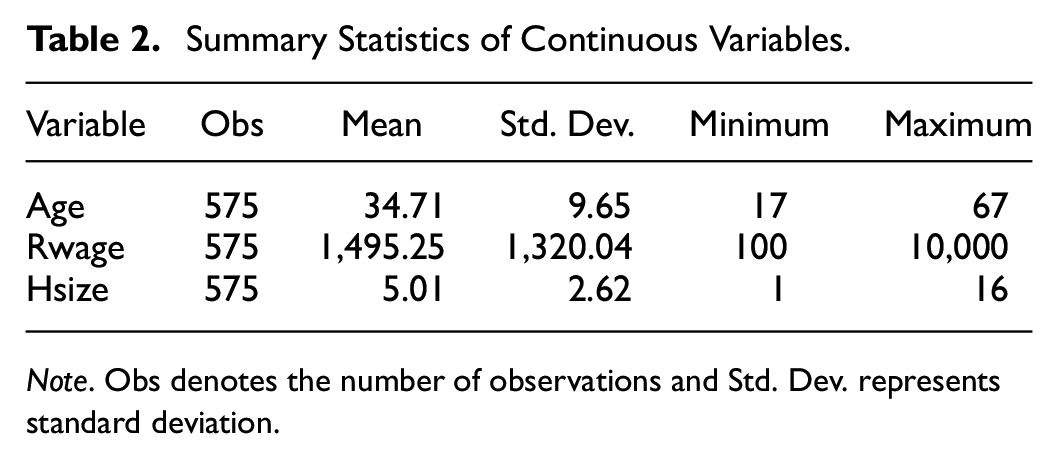
Note. Obs denotes the number of observations and Std. Dev. represents standard deviation.
Descriptive Statistics of the Categorical Variables
This section provides the descriptive statistics of the categorical variables in the analysis. Figure 1 shows the distribution of unemployment duration by region and place of residence. With an average unemployment duration of about 1 year and 5 months (16.7 months), among the four regions studied, Upper East has the longest duration of about 3 years (36.7 months), with Central recording the shortest of about 1 year (11.8 months). The duration is longer in Greater Accra, with about 2 years (23.0 months) and in Brong Ahafo about 1 year, 2 months (14.3 months). The implication is that unemployed persons in the Upper East and Greater Accra Regions have a higher probability of staying longer in unemployment than those in the other regions studied. This could be explained by the seeming unavailability of job opportunities in the Upper East Region and the high influx of rural-urban migrants in the Greater Accra Region. For the place of residence, the statistics show that unemployment duration is longer in the urban centers (about 1 year and 10 months) than in the rural areas (about 1 year and 4 months). These statistics presuppose that areas with higher unemployment rates are associated with longer unemployment duration, holding all other factors constant.
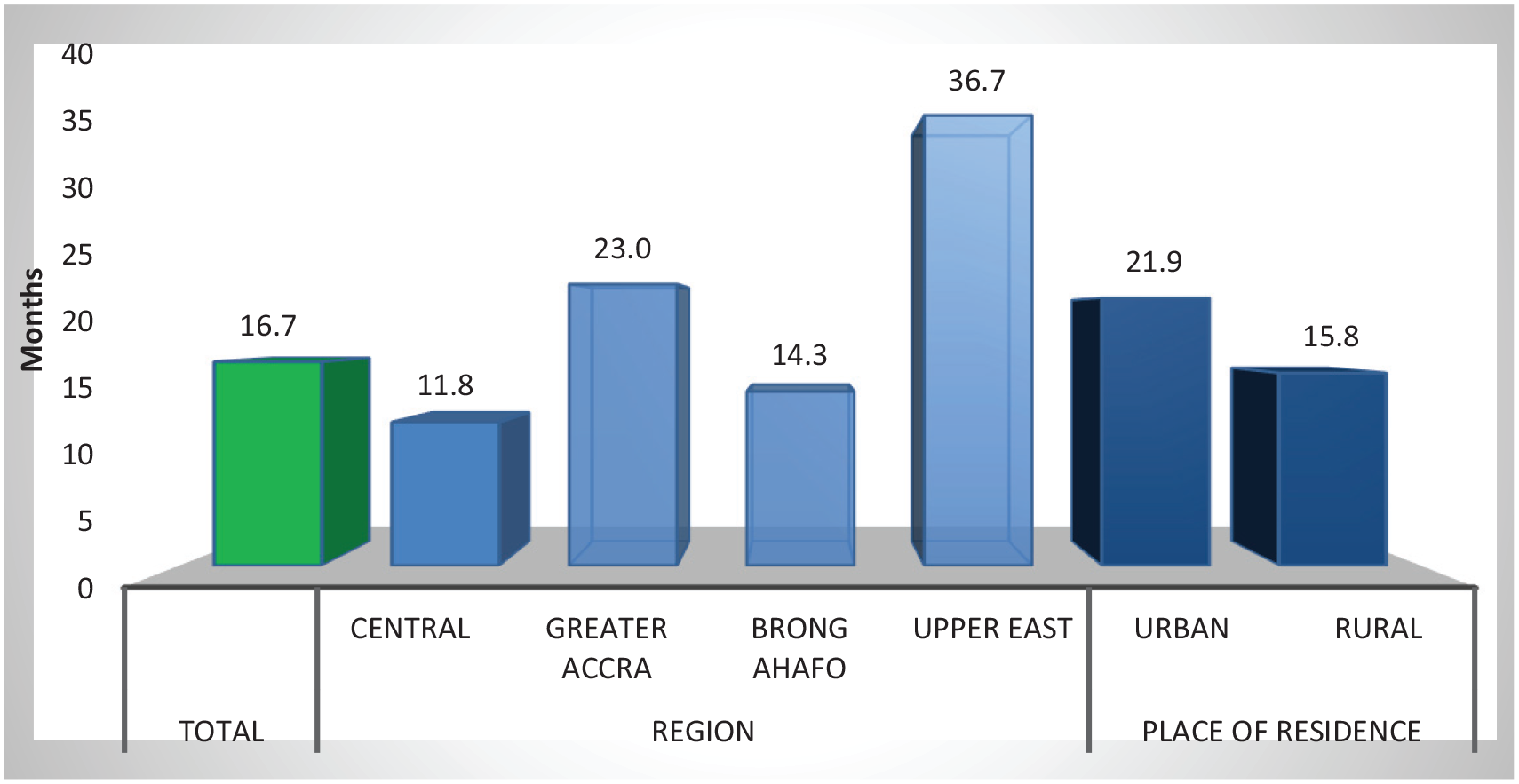
Average unemployment duration by region and place of residence.
The distribution of unemployment duration by sex, marital status, and access to alternative income sources is depicted in Figure 2. It is observed that the unemployment duration for those who are single (never married/divorced/separated/widow) is relatively shorter (about a year and 4 months–16.3 months) than that of those who are married (1 year and 5 months–17.3 months). Also, the unemployment duration for males is shorter (1 year and 4 months–16 months) than that of females (about 1 year and 6 months–17.8 months). Thus, unemployment duration for females is about 2 months higher than that of their male counterparts. Moreover, unemployed persons who have access to alternative income (financial support in affirmation, Yes) because they are unemployed are associated with a longer unemployment duration, about one and half years (18.4 months), compared to their peers without such support (No financial support) who recorded about 1 year and 3 months (14.6 months) unemployment duration.

Average unemployment duration by sex, marital status and access to alternative income sources.
Considering educational attainment and migration status, individuals with basic education qualifications have the longest duration of unemployment (about 1 year and 9 months–21.3 months), while those with tertiary/higher educational qualifications have the least duration of about 1 year and 1 month (13.3 months). Individuals who have a secondary education are associated with a relatively longer duration (1½ years–18 months) than their peers with certificate, diplomat or HND qualifications (about 1 year and 5 months–16.7 months). Those without any educational attainment have a duration of about 1 year and 2 months (13.9 months). Among those with educational qualifications, it is observed as the level of education increases from basic through to tertiary education, the duration of unemployment decreases (Figure 3). This could be explained by the fact that with higher levels of education, one can read and write, think critically, and acquire requisite skills that are needed by employers or enable them to succeed in the labor market. Thus, keeping all other things constant, higher educational attainment increases an individual’s chances of receiving job offers. This is consistent with job search theory models (Lancaster, 1990; Mortensen, 1986) and the human capital theory (Becker, 1964) which maintain that education enhances labor market outcomes including a higher probability of employability and better earnings for individuals
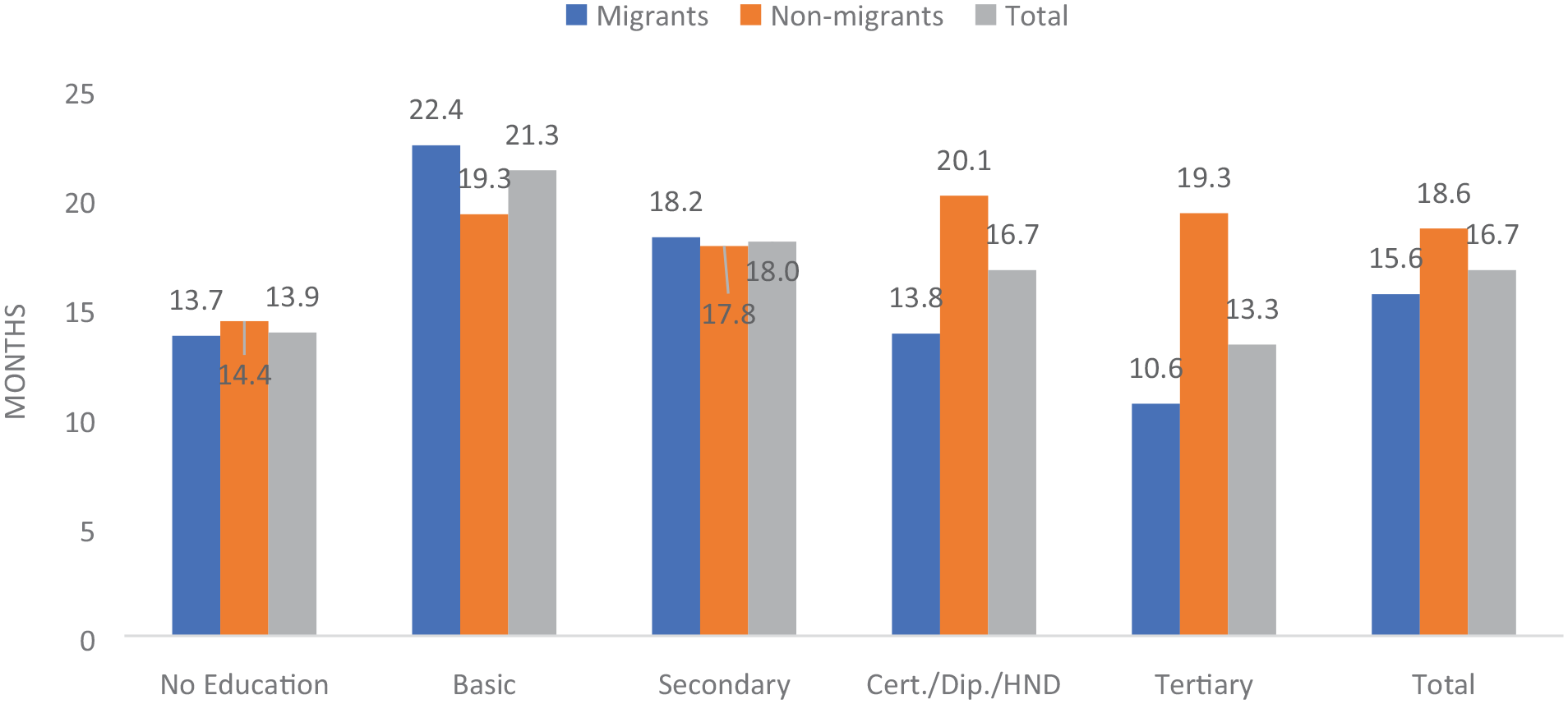
Average unemployment duration by educational attainment and migration status.
Generally, the duration of unemployment is shorter for migrants (about 1 year and 4 months–15.6 months) compared to their non-migrant peers (about 1 year and 7 months–18.6 months). Migration potentially increases an individual’s chances of exiting unemployment since those who migrate are mostly exposed to more opportunities as well as competition in the labor market. It allows individuals to move from excess labor and low-wage areas to scarce labor and high-wage areas with the ultimate outcome of employment. The net effect is mostly positive for the migrant.
Again, it could be seen from Figure 3 that tertiary education qualification holders who are migrants experience comparatively shorter duration (less than 1 year–10.6 months) than their non-migrant colleagues (about 1 year and 7 months–19.3 months). Likewise, individuals with certificate, diploma or HND qualifications who leave their communities of origin tend to have a shorter duration (about 1 year and 2 months–13.8 months) relative to those with the same qualification and remain in their communities (about 1 year and 8 months–20.1 months). However, for those with lower educational qualifications such as basic and secondary education, migrants tend to suffer longer duration than their non-migrant counterparts. With those who have no educational qualification, migrants record a shorter duration (13.7 months) relative to their non-migrant peers (14.4 months).
Test of Cox Proportional Hazards Assumption
The Cox proportional hazards assumption states that the hazards of two observations are proportional. For the proportional hazards assumption to be legitimate, the individual covariates must be statistically insignificant at 5%. In Table 3, the study presents the results of the test of the Cox proportional hazards assumption. The results provide enough evidence that suggest non-violation of the assumption since all the covariates are statistically insignificant. This implies the existence of proportionality of the hazards.
Model Test for the Cox Proportional Hazards Assumption.

Individual-Specific Covariates of Unemployment Duration
Once the assumption of proportionality of the hazards is not violated, the results of the Cox regression and the Cox proportional hazards models can be presented and discussed. Accordingly, the results of the Cox regression and the Cox proportional hazards models of the effects of individual-specific traits on unemployment duration and the joint effect of migration status and educational attainment on unemployment duration are presented in Tables 4 and 5 respectively.
Individual-specific Covariates of Unemployment Duration (Non-interaction Model).

Note. Std. err. denotes standard error.
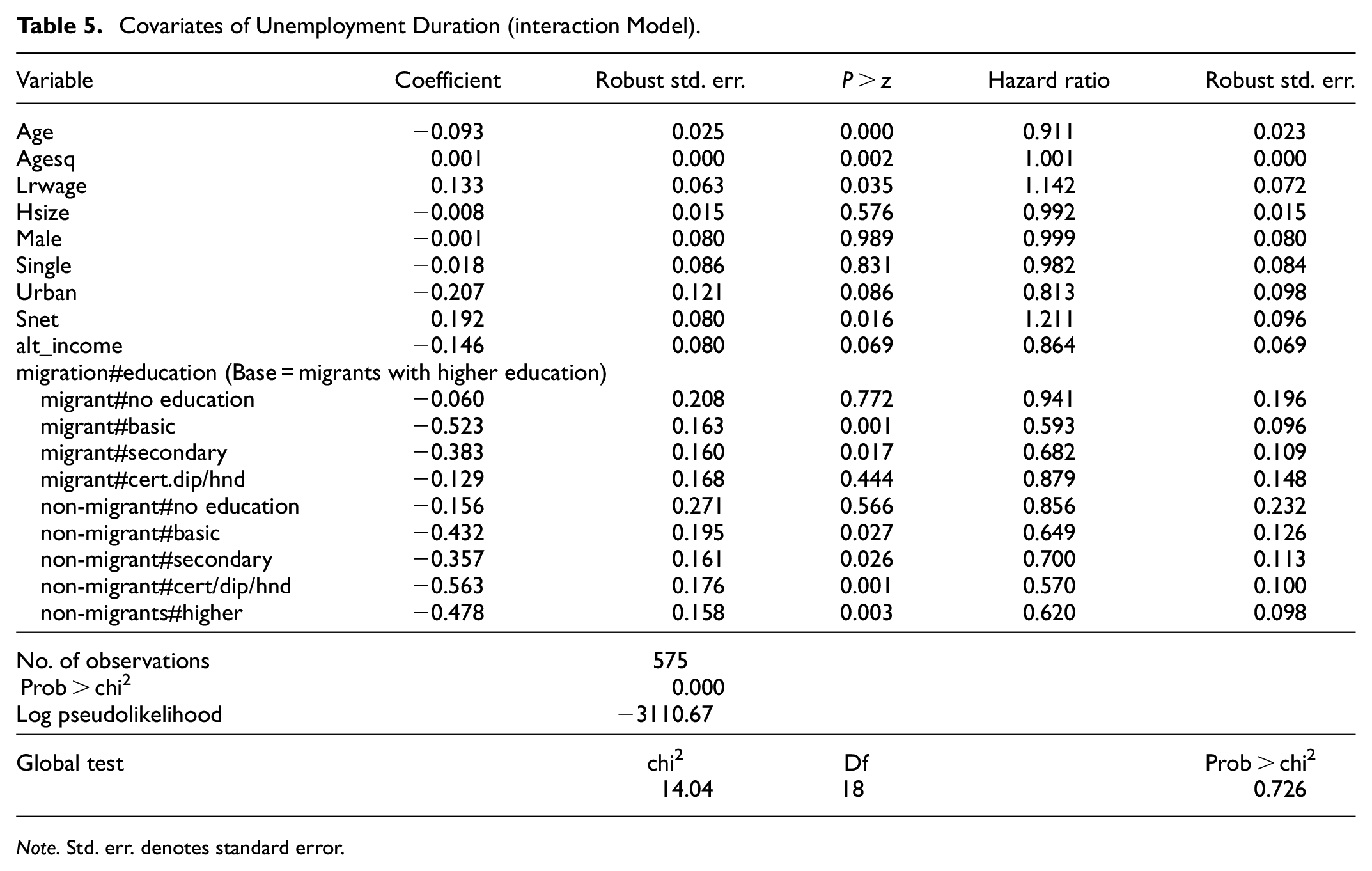
Covariates of Unemployment Duration (interaction Model).
Note. Std. err. denotes standard error.
As shown in both Tables 4 and 5, age and its squared (agesq) are both statistically significant at 1%, indicating the existence of a non-linear relationship. The results show that holding all other factors constant, initially, every additional year of an individual reduces the hazard of transiting from unemployment to employment by 8.9%, but around age 47 years, each additional year increases the hazard by 0.1% per year. For instance, if persons between ages 15 and 24 years have an average unemployment duration of 11 months, all other things held constant, those between ages 25 and 34 years, 35 to 46 years, and those 47 years and older will experience 17, 19, and 18 months of unemployment respectively, on average. This means youth and young adults will experience a longer duration of unemployment than adults. The adults are more likely to meet the requirements (such as years of labor market experience, higher education, and or professional qualifications) of employers than the young ones. This enhances their chances of employability more than the young job seekers in the labor market where both categories are struggling over the same and limited employment opportunities. This finding mirrors the results of Shumway (1993) and Kherfi (2015) that established that a departure from the state of unemployment to employment is more challenging for young job seekers than for the adult population. The finding, however, contradicts that of Nonyana (2015) who found, in South Africa, a lower hazard rate for adults relative to young people. This means country-specific context and dynamics play a crucial role in how age categories influence unemployment duration.
Reservation wage (lrwage), the lowest wage at which a person will be willing to accept a given job offer, is statistically significant at 5% but does not have the expected sign. Holding other factors constant, unemployment duration is expected to be positively related to reservation wage, where a high reservation wage engenders a longer duration and a low reservation wage shortens the duration. The results indicate that a percentage increase in reservation wage increases the hazard rate for leaving the unemployment spell by 14.6% (Table 4) and 14.2% (Table 5). This could mean that persons in Ghana either do not have reservation wages or they do not enforce them because job opportunities are highly limited. Therefore, it would be too expensive to reject job offers based on their reservation wages in an economy where there is no support scheme for the unemployed. Also, many unemployed persons are more likely to accept available job offers below their reservation wages, with the view to building their labor market experiences by way of preparing themselves for better offers in the future. Such persons may have reservation wages but will compromise when they receive job offers and wage rates lower than their reservation wages. This outcome conflicts with some studies (Lancaster, 1990; Mortensen, 1986; Stigler, 1962) that posited that unemployed persons with high reservation wages might experience a longer unemployment duration than their counterparts with low reservation wages.
Urban residents have 19.9% (Table 4) and 18.7% (Table 5) lower hazards than their rural peers at a 10% significance level. The situation could be attributed, in part, to persistently high unemployment levels in urban areas resulting largely from the influx of rural residents to urban areas in search of non-existing jobs. Usually, most rural-urban migrants have little/no education, are poorly skilled, have no formal work experience, and are not well connected. These mostly preclude them from some job offers, and they end up unemployed and add up to the unemployment levels in urban areas with the attendant long stay in employment. The implication is that most urban job seekers will suffer a longer duration than their counterparts in rural areas. This is consistent with Shumway’s (1993) claim that urban centers are associated with lower hazard rates and longer unemployment durations than rural areas.
Social network (snet) is statistically significant at 5%. The results show that among unemployed persons, those with social networks are about 20% (Table 4) and 21% (Table 5) more likely to find employment than those without social networks, all other things held constant. Access to information is key in job search and eventual employment. Social networks are indispensable in this regard. This is because access to information about job openings potentially facilitates the job search process. Therefore, people who have avenues to share information among themselves are more likely to succeed in their job search and have a shorter duration than those who do not have any means of networking. This finding mimics Marek et al. (2016), who revealed that in Germany, people with good social networks have higher chances of finding jobs, hence shorter unemployment time. This also supports the assertion of Gush et al. (2015) that “who you know,” or social network, is indispensable to job seekers in the 21st century on three counts: (a) what they can impart, (b) what they know about you, and (c) what you know about them.
Alternative income source (alt_income) is statistically significant at 10% and negative in sign. The results in Tables 4 and 5 indicate that unemployed persons who receive financial support stand about 14% higher risk of remaining unemployed, compared to those without such support. In other words, unemployed persons who are supported financially tend to have longer unemployment duration, all other things held constant. This could mean that instead of leveraging such financial resources to increase job search activities, it makes them relax, which increases the risk of staying unemployed. It could also mean that because of such support, they would not like to rush into accepting any job offer but wait until they get better offers. Such people behave like in some countries where the existence of unemployment compensation makes some people either develop higher reservation wages or relent on job search, which ultimately results in longer duration. This finding corroborates Røed and Zhang (2003) who demonstrated that marginal upward adjustments in unemployment compensations significantly reduce the likelihood of existing unemployment spells to employment. It further supports other studies (Marinescu & Skandalis, 2021; Rotar & Krsnik, 2020; Rothstein, 2011; Schmieder & von Wachter, 2016) that concluded unemployed persons who are entitled to generous benefits, including financial support, have less motivation for intensive job search relative to their peers who do not enjoy such benefits.
On migration status, migration (migrant) is statistically significant at 5% and positive. The result in Table 4 depicts that, unemployed persons who migrate in search of jobs reduce their risk of unemployment by roughly 23% relative to their peers who do not migrate. Migration helps to redistribute labor across different labor markets with employment prospects. This is consistent with the neoclassical theory of migration which regards migration as the outcome of geographical disparities between labor demand and labor supply which exist at various levels (De Haas, 2010; Kurekova, 2011). As people migrate, they tend to experience many opportunities as well as competition in the labor market. The net effect has mostly been positive, including a shorter unemployment duration. This finding is in harmony with Fromentin (2012), who established that migration has a long-term unemployment-reducing effect. The implication is that migration increases hazard rates and shortens unemployment duration. Contrary to this finding, Shumway (1993) argued that migration raises the likelihood of remaining unemployed.
As presented in Table 4, all the categories except basic education are statistically insignificant. Thus, though not statistically significant, people who have no education have 8.7 higher hazards than those who have higher education, implying a longer duration for the latter category than the former. Those with secondary education and certificate/diploma/HND qualifications have 16.6% and 13.5% higher risk respectively of remaining unemployed than those who have higher education. Basic education is statistically significant at 5% and negative. The result indicates that people who have the basic education qualification have a 27.4% lower probability of exiting unemployment than those with higher education. All other things being equal, people who have good education tend to be more productive and efficient and meet the requirements of most firms. Education enhances an individual’s prospects in the labor market. This resonates with studies (Becker, 1964, 1974; D. E. Dănăcică, 2010; D. E. Dănăcică & Cîrnu, 2014; Kenny, 2019; Nonyana, 2015; Ur Rahman et al., 2019) that suggest that a person’s success in the labor market is influenced by investments in human capital, including education. It further presupposes that a highly developed human capital enhances employability, reduces unemployment, and shortens unemployment duration among job seekers, all other things held constant. A similar result was obtained by Kisto (2014) in Mauritius, where people with secondary, vocational, higher education and/or professional qualifications were found to have a shorter employment waiting time than those who have lower education. Contrary to this are the results of Shumway (1993) and Kherfi (2015). While Shumway (1993) posited every additional year of education worsens the risk of maintaining an unemployment status by roughly 2%, Kherfi (2015) established that people who have secondary education or higher are associated with a longer unemployment duration.
From Table 4, we realize a positive effect of migration on duration, where migrants are associated with a higher hazard rate and shorter duration than non-migrants. Moreover, higher education reduces the risk of remaining unemployed. What we, however, do not know is the nature of employment people are engaged in. Nonetheless, in line with the human capital model, we can, to a large extent, also presume that people who have a higher education have a higher probability of securing decent jobs than those with lower/no education (Becker, 1964, 1974). This makes it imperative to assess the joint effect of migration status and educational attainment on employment duration. The rationale behind this interaction is to provide an idea about the kind of job one is likely to find when one migrates, given one’s level of education. All other things being equal, individuals who have higher education are more likely to secure decent jobs than those with lower/no educational qualifications. The joint effect of migration status and educational attainment on unemployment duration is provided in Table 5.
In this analysis, the base category is migrants with higher education (migrant#higher education). The results, generally, indicate that migration and higher education jointly increase the chances of finding jobs and, therefore, shorter duration. As shown in Table 5, all the categories of the interaction term have the expected signs, but some are statistically insignificant. Among migrants, those with higher educational qualifications have a higher hazard rate and shorter duration than those with lower educational attainments. Migrants with basic education qualification (migrant#basic) is negative and statistically significant at 1%. The result shows that migrants with basic education have a 40.7% higher risk of unemployment, compared to migrants who have higher education. At 5% significance, migrants who have secondary education (migrant#secondary) have a 31.8% lower probability of transiting from unemployment than migrants with higher education. This implies a longer duration for migrants with secondary education qualifications compared to higher educational qualification holder migrants.
Table 5 further shows that non-migrants with basic education qualification (non-migrant#basic) is significant at 5% and negative. The result presents that the non-migrants with basic education qualifications have about 35% lower hazard of finding employment, hence, longer duration than higher education holder migrants. Also, the non-migrants with secondary education qualifications (non-migrant#secondary) has the predicted negative sign, and it is statistically significant at 5%. The result indicates that non-migrants who have secondary education qualifications are 30% more likely to remain unemployed, compared to migrants with higher education. This suggests a longer duration for non-migrants with secondary education qualifications than migrants who have higher education. Moreover, non-migrants with certificates, diplomas or HND (non-migrant#cert/dip/hnd) and non-migrants with higher education (non-migrant#higher) are both statistically significant at 1% and negative. As depicted in Table 5, non-migrants with certificates, diplomas or HND qualifications (non-migrant#cert/dip/hnd) and non-migrants who have higher education (non-migrant#higher) increase their risks of unemployment by 43% and 38% respectively and experience a longer waiting time to employment relative to migrants with higher education.
Migration increases the chances of employability and potentially reduces unemployment duration among job seekers. When people migrate on the back of a job search, they intensify job search activities and become exposed to several job offers as well as competition in the labor market. The net effect is positive for the migrant jobseeker. Moreover, the opportunities in the labor market are better when the migrants have higher education, compared to lower/no education. All other things being equal, individuals who have higher educational qualifications are more likely to secure decent jobs than those who have lower educational qualifications. Therefore, as individuals decide to migrate on the grounds of job search, they must ensure they have a good education qualification: so that if they are transiting from unemployment, they will be able to find decent jobs. This is because higher hazard rates and shorter durations do not guarantee a departure into decent jobs. Variables like household size, sex, and marital status are not important factors influencing unemployment duration in Ghana.
In terms of contribution, this study has empirically expanded the scope of existing studies on unemployment in Ghana to include the duration dimension of unemployment. It established that age, locality, social networks, alternative income sources, migration, and education are significant factors influencing unemployment duration in Ghana. Also, the study further explored the joint effect of migration status and education on unemployment duration, something all the available and related studies have neglected. It found that migration status and education are jointly associated with higher hazard and shorter unemployment duration.
Conclusions and Recommendations
This study examined individual-specific determinants of unemployment duration with a special focus on the joint effect of migration status and education using data from selected regions of Ghana. The outcome provides useful information that augments the existing studies on the unemployment situation in Ghana. The study established that young people, living in an urban area, access to alternative income while unemployed, and lower educational attainments are associated with longer unemployment duration. Migration, social networks, and higher educational attainment independently reduce unemployment duration. Moreover, the study concluded that migrants with higher education are associated with higher hazard rates and shorter unemployment duration. Young people are encouraged to take up voluntary services and other forms of industry attachments to build labor market experience. The government through the Ministries of Education, Trade and Industry, and Employment and Labor Relations should develop and implement a policy on industrial attachment and internship programs for tertiary students. Individuals are entreated to build and effectively utilize their social networks to reduce the waiting time for employment. Individuals who receive financial support while unemployed should leverage such income to intensify their job search efforts and activities. Individuals should take advantage of the opportunities created in the educational sector in enhancing access to higher education to upgrade their educational levels. Job seekers with higher education are encouraged to migrate as part of their job search to increase their chances of employability.
Limitations of the Study
An unemployment study of this nature would ideally use data with nationwide coverage, but this study employed data from four regions out of the 16 administrative regions of Ghana. Again, survival analysis is mostly done with longitudinal data where the study participants are followed over time to determine their survival times and hazard rates, but this study utilized cross-sectional data. These limitations, however, have less impact on the outcome and robustness of the study since several studies (Ahiakpor, 2012; Barrera-Osorio & Bayona-Rodríguez, 2019; Kong & Jiang, 2011; Lyu et al., 2019) employed data from few regions, provinces or institutions but produced robust results, conclusions, and generalizations. Moreover, several authors and scholars (D. E. Dănăcică, 2015; Kisto, 2014; Ur Rahman et al., 2019) have done survival analysis using cross-sectional data and obtained efficient and consistent results. These limitations also offer important grounds for further studies. Future studies in this area should employ national dataset and/or longitudinal data.
Footnotes
Declaration of Conflicting Interests
The author(s) declared no potential conflicts of interest with respect to the research, authorship, and/or publication of this article.
Funding
The author(s) received no financial support for the research, authorship, and/or publication of this article.

Data Availability Statement
Data is available upon request to the corresponding author.